SET
COMMON
OBJECTIVES
, TARGETS AND ACTIONS TO MEET EU, NATIONAL OR REGIONAL GOALSTAILOR POLICIES
TO ORGANIC NEEDS THAT SUPPORT HIGH QUALITY FOOD, JOBS, THE ENVIRONMENT, ANIMAL WELFARE AND OUR CLIMATE
CREATE A
PARTNERSHIP
APPROACH BETWEEN STAKEHOLDERS AND PUBLIC INSTITUTIONSUSE
PUBLIC POLICY
SUPPORT TO COMPLEMENT ORGANIC MARKET GROWTH
FOSTER A
POSITIVE ENVIRONMENT
TO ENHANCE THE COMPETITIVENESS AND SUSTAINABILITY OF ORGANIC PRODUCERS AND SMEs
FOCUS ON
SUPPLY AND DEMAND
ISSUES OF RELEVANCE TO THE ORGANIC SECTOR
SME ORGANICSbrings together regional governments, development agencies, organic food and organic farming organisations, enterprise bodies, universities and research institutes from eight regions across Europe over a 4-year period 2016-2020.
As part of a participatory learning process, partners and stakeholders exchange and share experiences of best practices for devising organic action plans. These action plans cover a number of areas such as production and processing, commercialisation and marketing, training and advice, and organic value chain efficiency and governance, that can support the competitiveness and sustainability of organic SMEs in their region.
ORGANIC
ACTION
PLANS
DEVELOPMENT, IMPLEMENTATION
AND EVALUATION
Second edition
A RESOURCE MANUAL FOR THE ORGANIC
FOOD AND FARMING SECTOR
www.interregeurope.eu/smeorganics www.facebook.com/SMEorganics https://twitter.com/SMEorganics https://www.linkedin.com/company/sme_organics O R G A N IC A C T IO N P L A N
S - D
EDITOR AND PUBLISHER:
IN ASSOCIATION WITH:
EDITORS: Stephen Meredith, Nic Lampkin, Otto Schmid RESEARCH SUPPORT: Max Hubbard
PRODUCTION SUPPORT: Triin Viilvere, Eva Berckmans LANGUAGE EDITING: Chris Sinclair
SPECIAL THANKS FOR THEIR CONTRIBUTION TO: all SME project partners, Christopher Stopes
DESIGN AND LAYOUT: Lii Ranniku / Ecoprint Ltd – www.ecoprint.ee THIS BOOK SHOULD BE CITED AS: Meredith, S., Lampkin, N.,
Schmid, O., (2018). Organic Action Plans: Development, implementation and evaluation, Second edition, IFOAM EU, Brussels.
A PDF version is available at:
www.ifoam-eu.org and www.orgprints.org/32771/
© 2018. IFOAM EU, FiBL and Organic Research Centre - Elm Farm ISBN: 978-3-03736-081-1
PROJECT PARTNERS:
EXPLORE THE
INTERACTIVE MAP
ORGANIC IN EUROPE
INTERACTIVE MAP
PRODUCTION &
RETAIL DATA BY COUNTRY
ifoam-eu.org/en/organic-europe
Action co-financed by the European
Co-financed by
Commission, Directorate General for Agriculture and Rural Development
Produced by
Supported by
Data compiled by IFOAM EU
Rue du Commerce 124, BE - 1000 Brussels, Belgium Phone +32 2280 1223, Fax +32 2735 7381
DEVELOPMENT, IMPLEMENTATION
AND EVALUATION
Second edition
ORGANIC
ACTION
PLANS
Table of contents
Foreword to second edition 2
Foreword to first edition 4
1. Introduction
6
1.1 About this manual 6
1.2 What is organic farming? 9
1.3 Development of organic food and farming in Europe 13
2. Organic food and farming and public policy 15
2.1 EU Regulations on organic food and farming 17
2.2 EU Policy support for organic food and farming 18
3. Organic action plans – What are they about? 28
3.1 Why organic action plans? 28
3.2 European organic action plans 33
3.3 Overview of national and regional organic action plans 34
4. Planning organic action plans
39
4.1 Policy development 39
4.2 Defining organic sector development needs and potential 41
4.3 Defining policy aims and objectives 44
4.4 Decision making: selecting, integrating and prioritising
relevant measures 51
5. Involving stakeholders
55
5.1 Identifying relevant stakeholders 55
5.2 Participatory approaches for stakeholder involvement 58
6. Implementing organic action plans
62
6.1 Including monitoring and evaluation of organic action plans
from the outset 67
6.2 Managing communication 68
6.3 Development of action plans in regions or countries
7. Evaluating organic action plans
74
7.1 Principles of evaluation 74
7.2 Conducting an evaluation 78
7.3 Evaluating action plan design and implementation 84
7.4 Evaluating action plan effects 91
7.5 Overall evaluation of organic action plans – judging success 99
8. Organic action plans – Recommendations 103
Annex 1: Key elements of organic action plan development 108
Annex 2: Detailed synopsis of ORGAPET 110
List of figures
Figure 1.1 Growth of organic retail sales in Europe, 2007-2016 13 Figure 1.2 Growth of organic farmland area in Europe,
2007-2016 14
Figure 2.1 Share of EAFRD for organic farming support
compared to the total organic farmland area in 2014 23 Figure 4.1 Policy cycle – stages in policy development 39 Figure 4.2 Learning through development of policy cycles 40 Figure 5.1 Stakeholder perspectives in organic action plans 56
Figure 7.1 Aims of programme evaluation 74
Figure 7.2 Example of an effects diagram showing the links between policy measures/action points and impacts 97 Figure 7.3 A hypothetical radar or ‘cobweb’ diagram 100
List of tables
Table 2.1 Overview of Europe 2020 goals and thematic
objectives for 2014-2020 19
Table 2.2 Overview of Rural Development Programme
measures in addition to organic farming payments 24 Table 3.1 Overview of selected national and regional
organic action plans in Europe 36
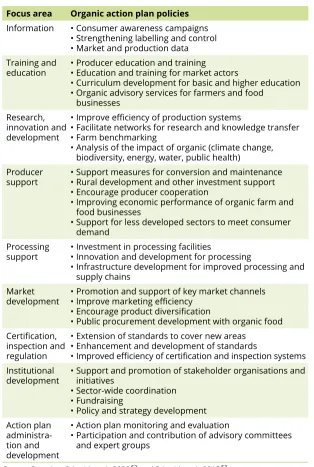
Table 3.2 Areas addressed by organic action plans –
overview of different action plan policies 38 Table 4.1 SWOT analysis of organic processing sector
in Aargau, Switzerland 42
Table 4.2 Organic action plan – priorities for development
and desired outcomes 45
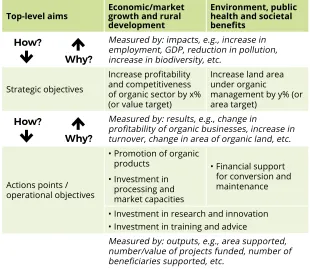
Table 4.3 Hierarchy of objectives 46
Table 5.1 How and when to involve stakeholders? 60
Table 7.1 Steps in preparing an evaluation 79
Table 7.2 Steps in performing an evaluation 81
Table 7.3 The failure mode applied to a typical organic
action plan 87
List of boxes
Box 1.1 What is SME ORGANICS all about? 8
Box 1.2 IFOAM Principles of Organic Agriculture 9 Box 1.3 IFOAM EU Vision 2030 and Roadmap towards
Organic 3.0 12
Box 2.1 EU Policy framework for supporting organic
sector development 16
Box 2.2 Overview of EU’s Organic Regulations 18
Box 2.3 Why are organic farming and public goods
payments necessary? 21
Box 2.4 TP Organics - European Technology Platform for
organic food & farming 27
Box 3.1 Multi-sector approach of the French Organic
Action Plan 30
Box 3.2 Regionalisation of organic action plan development 35 Box 4.1 Strengthens and weaknesses analysis for the
Scottish Organic Action Plan 43
Box 4.2 Aims and strategic objectives of the German
Organic Action Plan 49
Box 4.3 Cross-impact matrix for the European Organic
Action Plan 2014-2020 53
Box 5.1 Stakeholder involvement in action plan
development in Nouvelle-Aquitaine, France 59
Box 5.2 Lateral thinking method – creativity by provocation 61 Box 6.1 Government-led elaboration and implementation
of the Finnish Organic Action Plan 63
Box 6.2 Public-private partnerships for promoting domestic demand for organic food in the Danish Organic
Action Plan 66
Box 6.3 Presenting the key elements of an organic action plan 69 Box 6.4 Communicating the development and
implementation of the German Organic Action Plan 71 Box 7.1 Types of evaluation for different stages of the
policy cycle 75
Box 7.2 Evaluation of the Czech Republic’s Second
Organic Action Plan 83
Box 7.3 Classification of indicators 93
Box 7.4 Example of how to derive impact statements and
Foreword to second edition
Political and financial support provided through the European Union and national and regional governments’ policies are crucial for crea- ting and further developing a steady market demand, a solid supply base and good operating conditions for stimulating organic food and farming in Europe. These factors have contributed significantly to the growth of the EU organic food market and the expansion of the supply base. In the EU alone, organic farming represented 6.7% of agricultural land in 2016, due to policy support and a strong demand for organic produce amongst EU consumers. Moreover, the EU market doubled in value over the last decade, from €14.5 billion in 2007 to €30.7 bil-lion by 2016.
With current trends indicating that EU demand for organic produce is far outstripping production levels, there are great opportunities to enhance the competitiveness and sustainability of small and medium enterprises (SMEs) in the organic sector as innovative solutions for the whole agri-food sector. Organic action plans can help organic SMEs and the European agri-food sector to develop in a more holistic way. They do this by providing a framework for integrating different policies into a broader policy picture, and setting common objectives, targets and actions that serve the organic sector’s needs and meet public policy goals in a specific country or region.
While in the past organic action plans mainly focused on the supply of organic produce, there is growing interest in developing the whole organic supply chain. Such developments offer attractive prospects for SMEs who wish to make the move to organic, whilst contributing to policy goals for rural employment, economic development, the environment and climate action. This includes the European Deve- lopment Fund’s (ERDF) Investment for Growth and Jobs goal. The rich experience of organic action plan development, implementation and evaluation in Europe can also help to inform the formulation of future policy objectives, targets and policy instruments at EU, national and regional levels.
and stakeholders. This was one of the reasons why the SME Orga- nics project was funded under Interreg Europe financed by the ERDF.
The methodology for developing, implementing and evaluating organic action plans is based on the results of the EU project ORGAP, funded under the sixth EU Framework Research Programme. ORGAP deve- loped a very useful resource manual and toolbox for the development, implementation and evaluation of organic action plans (published by FiBL – Research Institute of Organic Agriculture (Frick, Switzerland) and IFOAM EU (Brussels, Belgium)).
Building on this knowledge the SME Organics project team decided to integrate the experiences in the development of regional organic action plans into an updated version of the manual. In this second edition several sections have been updated and recommendations for policymakers and stakeholders put forward drawing on nearly two decades of research and practice, including the experiences from the first phase of the SME Organics project. We trust that these recom-mendations can also inform EU Member States’ and regions’ future Research and Innovation Strategies for Smart Specialisation. Further-more, the text is illustrated with many examples taken from the SME Organics project and further afield.
We wish to thank all the people who have contributed to this manual, in particular the editors of this second edition and the members of the SME Organics project team and other experts for sharing their experiences.
We hope that this manual will help stakeholders from both the or-ganic and non-oror-ganic sectors, policy makers and administrators to further develop, implement, and evaluate successfully future organic action plans in order to support sustainable development in Europe for years to come.
Alberto Enrique Martín
SME Organics Project Coordinator, INTIA, Villava, Navarra, Spain
Otto Schmid
Foreword to first edition
In June 2004 the European Commission published the European Action Plan for Organic Food and Farming. With this Action Plan the Com-mission intended to assess the situation of organic farming and to lay down the basis for future policy development. At the national level many governments have also developed Action Plans for promoting organic farming. Therefore, it was seen as necessary to consider how such Action Plans could be evaluated successfully.
The European Action Plan was the main reason why the DG Research of the European Commission decided to fund a specific support project, the ORGAP Project No. CT-2005-006591 within the 6th Framework Re-search programme. This project, with the title European Action Plan of Organic Food and Farming: Development of criteria and procedures for the evaluation of the EU Action Plan for Organic Agriculture, started in May 2005 and was completed in April 2008.
Within the project a toolbox was developed to evaluate and monitor the implementation of the European Action Plan in the following areas: information, training and education, research, production, processing, market development, certification, and public expenditures. This tool-box was tested on selected existing national Action Plans and partially also for the European Action Plan, mainly focussing on the implementa-tion processes. In addiimplementa-tion, policy recommendaimplementa-tions to the European Commission, national authorities and other stakeholders were made.
In order to communicate the recommendations of this project as widely as possible, this practical manual for initiating and evaluating Action Plans has been produced. This manual is intended to serve two functions:
a) A tool for stakeholder involvement in future Action Plan development and implementation at the EU, national and regional levels
b) A guide to the use of the ORGAPET, the Evaluation Toolbox of the ORGAP project (included as a CD-ROM with the manual and at
The manual was developed as part of the ORGAP project and is largely based on the documents included in the Organic Action Plan Evalua-tion Toolbox (ORGAPET).
The following institutions contributed to the development of ORGA-PET and the manual: Research Institute of Organic Agriculture (Otto Schmid, Bettina Landau, Matthias Stolze, Hanna Stolz); University of Hohenheim (UHO), Stuttgart (Prof. Stephan Dabbert, Christian Eichert); Aberystwyth University (UWA), Wales, United Kingdom (Dr. Nic Lamp-kin, Ian Jeffreys); Polytechnic University of Marche, Ancona (UNIVPM), Italy (Prof. Raffaele Zanoli, Dr. Daniela Vairo); University of Southern Denmark (USD), Denmark (Dr. Johannes Michelsen).
The IFOAM EU Group (Victor Gonzálvez, Marco Schlüter and Chris-topher Stopes on behalf of Soil Association, United Kingdom) was responsible for the development of the manual together with the project coordinator FiBL and the assistance of Dr. Nic Lampkin (UWA). The other partners in the project have contributed to the manual, providing information about national Organic Action Plans: Institute of Sustainable Development (ISD) Slovenia (Anamarija Slabe); Institute for Agricultural Economics (VUZE) Czech Republic (Pavla Wollmuthova); Agricultural Economics Research Institute (LEI) Netherlands (Robert Stokkers); Sociedad Española de Agricultura Ecológica (SEAE) Spain (Victor Gonzálvez).
A special thanks goes to Christopher Stopes, who helped to edit the text of this manual. We are also grateful to Ben Millbank and Joy Carey of the Soil Association for the final layout and the graphic design of the manual.
We acknowledge the support of DG Research of the Commission of the European Communities, in particular their scientific officer Dr. Danièle Tissot.
The editors hope that this manual helps to initiate a process of evalu-ation and progressive development of Organic Action Plans at the European, national and regional level.
Otto Schmid
Introduction
1.1 ABOUT THIS MANUAL
What are organic action plans and who is this manual for?
Organic action plans are commonly used in Europe for coordinating public policies and private or voluntary-led initiatives in a framework, at different governance levels – local, national or European, to support the development of the organic sector. They are usually based on a partnership approach between the organic sector, policy makers and other stakeholders, with common objectives and actions for deve- lopment set out over a defined period of time. This manual serves to inspire the people, organisations and institutions at these different levels involved in, and with an interest in the organic food and farming sector, who may wish to engage in the initiation, review, revision or renewal of organic action plans.
The manual is targeted at all the stakeholders who have participated in the development and implementation of organic action plans – and those who did not:
Policy administrators Politicians
Members of action plan or policy advisory group Organisations and representative bodies
Farmers and farming businesses Food businesses, in particular SMEs
The manual is a tool for stakeholder involvement
The objective of the manual is to provide a tool for stakeholder involve-ment in future action plan developinvolve-ment and impleinvolve-mentation and evalu-ation processes at European Union (EU), nevalu-ational and regional level.
ORGANIC A
CTION PL
What does the manual include?
The manual outlines:
The development of the organic food and farming sector in Europe Organic action plans as a component of European, national and
regional policies for organic farming
Planning and implementation of organic action plans
Involvement of stakeholders in organic action plan development Methods and tools for evaluation of organic action plans
The manual draws on key lessons learnt from more than two decades’ experience of development, implementation and evaluation of organic action plans throughout Europe. The first edition of this manual was originally prepared as part of the Evaluation of the European Organic Action Plan Project (ORGAP), published in 2008.1
This new edition has been revised, updated and further developed as part of a follow-up regional organic action plans project, SME ORGAN-ICS, which runs from 2016 to 2020. It aims to enhance the competi-tiveness and sustainability of SMEs within the organic sector, in the context of a growing European organic sector and increasing interest in organic food and farming amongst many policy makers and stake-holders across Europe (see Box 1.1).
The manual is complemented by an on-line Organic Action Plan Evalu-ation Toolbox (ORGAPET),2 which includes comprehensive information
to support the development and evaluation of organic action plans. Further information about ORGAPET is included in the Annex to this manual. (The toolbox has not been updated as part of the SME OR-GANICS project).
The manual is a guide for all stakeholders, not only those from the organic sector
The manual is, therefore, an information source of particular interest to those stakeholders involved in organic food and farming, but also for those who may not necessarily see themselves as a part of the ‘organic sector’ currently.
Box 1.1 What is SME ORGANICS all about? ²
SME ORGANICS, a project supported by the Interreg Europe, explores the use of organic action plans to enhance the competitiveness and sustainability of SMEs in the organic sector. The project brings together regional governments, development agencies, organic food and farming organisations, enterprise bodies, universities and research institutes, as part of a participatory learning process to exchange and share experien- ces of best practice for devising organic action plans in seven European regions. SME ORGANICS recognises the potential for regional authorities to support their local organic sectors and aims to facilitate stakeholders in the development of regional organic action plans.
To this end the project explores how organic action plans can be used to support SMEs involved the development of the whole organic value chain, including production, processing and distribution. Supporting the
development of the organic sector is of benefit of all stakeholders, not
only as a means to increase the availability of organic produce, but also
in terms of the related environmental and social benefits associated
with organic food and farming. Across Europe there are already many great examples of organic food and farming systems which show how real food for real people can translate into vibrant rural economies and a re-energised food culture through bottom-up and top-down initiatives or a combination of both.
The manual therefore highlights and draws on some of these examples as well as lessons learned from project partners and stakeholders during
the first phase of the project.
WHAT DOORGANIC ACTION PLANS INCLUDE?
WHATACTIONS ARE PART OF PLANS IN PRACTICE?
SME ORGANICS: A DYNAMIC LEARNING PROCESS
INFORMATION AND AWARENESS-RAISING
An understanding of organic food and farming can vary significantly amongst consumers and other stakeholders. Many stakeholders may have an inte-rest in knowing more about organics, but might not have immediate access to information or not see it as being directly relevant to their work. Plans actively highlighting the benefits of organic food and farming, including the promotion of EU and national organic logos can help to increase re- cognition and address misconceptions.
REGIONAL DIAGNOSIS OF ORGANIC SECTOR Programmes targeting consumers, procurement and catering teams, other public and private organisa-tions, civil society and policymakers to promote the economic, environmen-tal and social value of organic produce (Scotland, UK).
Programmes developed with the Ministry of Education targeting schoolchildren, parents and teachers to raise awareness about organic farming through school gardens, farm visits and food tastings (France).
RESEARCH & INNOVATION
Globally, only 1% of agricultural re-search funding is directly targeted at the organic sector. This funding is insufficient to stimulate investment, especially by SMEs, and to meet the innovation needs of the fast growing organic sector. Plans can aim to remedy this by identifying research needs for the sector and allocating funding to them to deliver on societal challenges and policy goals.
DEVELOPMENT OF REGIONAL ACTION PLANS Working with researchers to identify and address challenges facing organic production and distribution. Collecting biodiversity data from organic farms to promote habitat management using organic farming under agri-environ-ment climate schemes (Scotland, UK). Continuous development of federal research for organic farming to further expand its pioneering role in the field of sustainable land management and resource use by building on past programmes (Germany).
MARKET DEVELOPMENT
Historically, public support for organic farming has focused on production- oriented land area payments. However, promotion and organic market deve- lopment, including support for short supply chains, are increasingly being considered priorities in plans. Particular attention is given to public procure-ment and export opportunities.
Establishing new points of sale for organic farmers. Educational semi-nars for supply chain actors to identify market success factors and promote better cooperation amongst produ- cers, processors and retailers (Czech Republic).
Developing educational activities and materials and subsidising organic fruit and vegetables in schools. Pro-viding support and advice to convert public catering to organic, and the promotion of organic brands in can-teens and restaurants (Denmark).
TRAINING & EDUCATION
Although organic is a more know- ledge intensive way of farming, it is often not taught or advised in a specialised way, whilst teachers and advisors may not be aware of many organic farming practices. Those work-ing in the organic supply chain and retail environments need a specific understanding of the specificities of organic production and the value to consumers. This can be addressed in plans by tailoring training and advice to organic needs.
PARTNERS AND STAKEHOLDERS REGULARLY EXCHANGE Reviewing how advice for farmers interested in conversion can be im-proved, including the responsibility of relevant government departments and bodies to offer agricultural advice and education (Germany).
Improving knowledge of organic production and its economic and envi-ronmental efficiency through technical materials for farmers, strengthening partnerships for developing organic production and enhancing training for organic producers (Andalusia, Spain).
PRODUCER SUPPORT
To strengthen the supply base pro-ducts, most countries, even those with-out Organic Action Plans, use organic farm payments to support farmers who wish to convert to organic or who are already organic. Plans can also help to develop one area of production such as milk production or fruit-growing sectors, and build producer capacities in a specific area, such as advisory services or invest-ments in infrastructure.
IDEAS AND BEST PRACTICES SPREAD ACROSS EUROPE Creating a more stable support payments system that is easier to un-derstand and offers more incentives for farm viability. Priority funds given to agroecological projects and organic farming in areas with water quality problems (France).
Making a direct link in the plan to support payments offered, placing specific focus on farmlands with re-duced nitrogen as well as areas used for organic fruit production (Denmark).
INSPECTION, CERTIFICATION AND REGULATION
The organic sector develops and im-proves continuously. As a result, there may be a desire to improve how in-spections and certification are carried out, or a need to promote or enhance the standards for organic in general, or for a specific product group. Plans can be used to address many of these issues.
Improving organic control systems to make them more transparent ensuring the co-existence of organic production with other production systems - in particular the promotion of regulatory and administrative instruments to prevent GMO conta- mination (Andalusia, Spain).
Improving animal welfare inspec-tions by developing methods and training for organic farming inspec-tors (Czech Republic).
FOR MORE INFORMATION
PLEASE SEE ORGANIC ACTION PLANS: A STAKEHOLDER GUIDE. IT PROVIDES A THOROUGH ANALYSIS OF THE CURRENT STATE OF ORGANIC ACTION PLANS IN EUROPE, INCLUDING CASE STUDIES OF SIX PLANS.
DOWNLOAD THE GUIDE FROM WWW.IFOAM-EU.ORG
ORGANIC ACTION PLANS SET OUT A NUMBER OF ACTIONS TO SUPPORT THE DEVELOPMENT OF THE ORGANIC SECTOR IN A COUNTRY OR REGION. PLANS INCLUDE SPECIFIC FOCUS AREAS WHICH COVER DIFFERENT THEMES TO ASSIST THE NEEDS OF THE ORGANIC SECTOR.
INFORMATION AND AWARENESS-RAISING TRAINING & EDUCATION RESEARCH & INNOVATION PRODUCER SUPPORT MARKET DEVELOPMENT INSPECTION, CERTIFICATION AND REGULATION
Source: SME ORGANICS, Using action plans to develop organics
ORGANIC A
CTION PL
1.2 WHAT IS ORGANIC FARMING?
Ideas, principles and definitionThe ideas and principles behind organic farming have been practised in Europe and internationally for the last 100 years, covering a wide range of different issues including the environment, animal welfare, food quality and health.3 The concept of sustainability is at the heart
of organic production, in the widest sense of the term, encompassing environmental, economic and social spheres. These ideas have been expressed in the Principles of Organic Agriculture – health, ecology, fairness and care (see Box 1.2).
The principles, defined in a participatory and democratic process, by the International Federation of Organic Agriculture Movements (IFOAM) – Organics International, outline the basis on which organic farming should grow and develop further – all around the world. The principles consistently serve as a source of inspiration for the organic movement and its continuous development.
Box 1.2 IFOAM Principles of Organic Agriculture 4
The principle of HEALTH
Organic agriculture should sustain and enhance the health of soil, plant, animal, human and planet as one and indivisible.
The principle of ECOLOGY
Organic agriculture should be based on living ecological sys-tems and cycles, work with them, emulate them and help sus-tain them.
The principle of FAIRNESS
Organic agriculture should build on relationships that ensure fairness with regard to the common environment and life op-portunities.
The principle of CARE
Organic agriculture should be managed in a precautionary and responsible manner to protect the health and well-being of current and future generations and the environment.
The Principle ofHealth.
The Principle of Ecology.
The Principle ofFairness.
The Principle ofCare.
Based on these four principles, IFOAM defines organic farming as:
a production system that sustains the health of soils, ecosystems and people. It relies on ecological processes, biodiversity and cycles adapted to local conditions, rather than the use of inputs with adverse effects. Organic agriculture combines tradition, innovation and science to benefit the shared environment and promote fair relationships and a good quality of life for all involved.5
The term ‘organic’ specifically is best thought of as referring to a farm as an organism rather than to organic inputs.6 This considers all the
component parts of a farm within an agroecosystem – including the soil minerals, organic matter, micro-organisms, insects, plants, animals and humans – and how they interact to create a coherent and stable whole. The aim of organic farming can therefore be described as:
to create integrated, humane, environmentally and economically sustainable agricultural production systems. Maximum reliance is placed on locally or farm-derived, renewable resources and the management of self-regulating ecological and biological processes and interactions in order to provide acceptable levels of crop, live-stock and human nutrition, protection from pests and diseases and an appropriate return to the human and other resources employed.7
This understanding also places a strong emphasis on reducing reliance on external inputs (chemical or organic) as far as possible. In many European countries, organic agriculture is also known as ecological or biological agriculture. This reflects the reliance on ecosystem mana- gement and working with living organisms, rather than focussing on external inputs.
Development of organic standards
The ideas, principles and definitions that underpin organic food and farming have helped to form and encourage the development of organic standards, first by the organic movement and later by public institutions. This started with the development of private standards such as Biofarm in Switzerland, Nature & Progrès in France, Soil As-sociation in the UK and Demeter in Germany. In 1980 IFOAM (founded in 1974), developed broadly accepted private international standards for organic production.
ORGANIC A
CTION PL
Subsequently several countries started to develop their own regula-tions for organic farming in 1980s (Austria, France, Denmark and Spain).
In 1991 the EU established and implemented Council Regulation (EEC) 2092/91, which set out a first common EU-wide standard for organic farming. The adoption of this Regulation formed a legal basis for all organic production in the EU. (see Section 2). Later many other countries in the world developed their own regulations. Guidance to governments was given by the Codex Alimentarius, a common UN Programme of the Food and Agriculture Organization (FAO) and the World Health Organization (WHO), which developed guidelines for organically produced food, first published in 1999.
Organic food and farming, however, is an ‘open source’ concept which evolved as a social movement for agricultural change, with commit-ted individuals, businesses and producers working together to define standards and develop systems and practice, in order to achieve the organic movement’s goals of environmental protection, animal welfare, food quality, health and social justice. The organic concept is also market-led, benefiting from the willingness of committed consumers to pay a premium price, and over time, recognised by policy makers in many countries around the world for its contribution to sustainable food and farming.
Over the years, the organic movement has further developed the principles and rules of organic of organic agriculture beyond the scope of the European Union’s legislation through the IFOAM Norms (Basic Standards and Accreditation Criteria)8 and at national level through
private organic standards, which are regularly updated and provide further detail and commitments in specific areas. As organic moves beyond niche markets, the organic movement is working proactively to position the organic approach as a means to transition food and farming systems worldwide towards a more sustainable path based on the organic principles (see Box 1.3).
Box 1.3 IFOAM EU Vision 2030 and Roadmap towards Organic 3.0 9
The European organic movement is committed to securing fair, ecolo- gical, healthy and caring food and farming. To this end the move-ment is working to better enable the uptake of truly sustainable food and farming systems, and of markets based on organic and agroecological principles. This renewed commitment is set out in ‘Transforming Food and Farming: An Organic Vision for Europe in 2030’, adopted in 2015 by IFOAM EU, as part of the global Organic 3.0 process initiated by IFOAM Organics International. The Vision 2030 has been complemented by ‘Transforming Food and Farming - Making It Happen: An Organic Road-map to Sustainable Food and Farming Systems in Europe’, published in 2017, which sets out strategic directions for reaching the Vision, based on three themes:
• Organic on every table: The contribution of organic to sustainable food systems is recognised by policy makers and citizens and is matched with a growing land share and supply of organic products
• Improve – Inspire – Deliver: Organic food and farming systems are resilient and continuously improving their performance, and they inspire a positive change in our knowledge systems and diets
• Fair play – Fair pay: Value and power are fairly distributed among
all the operators in the supply chain, and the costs and benefits of
food production are accounted for.
In its efforts to transform food and farming, the organic movement sees
the organic food and farming approach as a proven pathway for achie- ving an ambitious implementation of UN Sustainable Development Goals across Europe and beyond. Moreover, it recognises that the movement must further engage with other food and farming actors and policy makers working both within and beyond the organic sector. Further information about the Organic Vision 2030, including practical examples of how the Roadmap is being put into action by the organic movement and other stakeholders can be found at EUorganic2030.bio
ORGANIC A
CTION PL
1.3 DEVELOPMENT OF ORGANIC
FOOD AND FARMING IN EUROPE
Current production and market trends serve as an important marker for farmers, SMEs and other businesses to make long-term business decisions in terms of their engagement in the organic sector and should be carefully considered in the development and implementation of an organic action plan.
The organic industry is one of the most rapidly expanding sectors of the food industry in many European countries.10 Figure 1.1 shows that
between 2007 and 2016 the EU market for organic products doubled from a retail value of 14.5 billion euro to 30.7 billion euro (from 15.4 billion euro to 33.5 billion euro in Europe). The organic retail market recorded an annual growth rate of 12% between 2015 and 2016 (11.4% in Europe). However, organic retail market shares vary significantly between different European countries both inside and outside the EU.
Figure 1.1 Growth of organic retail sales in Europe, 2007-2016
Source: FiBL-AMI Surveys 2006-2018, OrganicDataNetwork Surveys 2013-2015
Figure 1.2 shows that the organic farmland area has also expanded rapidly in the EU, from 7.2 million hectares in 2007 to 12.1 million hectares in 2016 million hectares (7.8 million hectares to 13.5 million hectares in Europe). The annual growth rate was 8.2% between 2015 and 2016 (6.7% in Europe). Similarly, to the organic retail market, the organic share of total farmland also varies significantly between dif-ferent European countries.
1.1
1.2
15.4 17.0 18.1 19.5
21.4 22.6 24.3
26.5 30.1 33.5
14.5 15.9 16.9 18.1
19.8 20.8 22.2
24.2 27.4 30.7 0 5 10 15 20 25 30 35 40
2007 2008 2009 2010 2011 2012 2013 2014 2015 2016
B ill io n e u ro
Europe European Union
7.8 8.3
9.2 10.0 10.5
11.2 11.4 11.8
12.7 13.5
7.2 7.7 8.3
9.1 9.5 10.0 10.2 10.4
11.1 12.1 0,0 2,5 5,0 7,5 10,0 12,5 15,0
2007 2008 2009 2010 2011 2012 2013 2014 2015 2016
[image:19.420.57.366.286.421.2]1.1
1.2
15.4 17.0 18.1 19.5
21.4 22.6 24.3
26.5 30.1 33.5
14.5 15.9 16.9 18.1
19.8 20.8 22.2
24.2 27.4 30.7 0 5 10 15 20 25 30 35 40
2007 2008 2009 2010 2011 2012 2013 2014 2015 2016
B ill io n e u ro
Europe European Union
7.8 8.3
9.2 10.0 10.5
11.2 11.4 11.8
12.7 13.5
7.2 7.7 8.3
9.1 9.5 10.0 10.2 10.4
11.1 12.1 0,0 2,5 5,0 7,5 10,0 12,5 15,0
2007 2008 2009 2010 2011 2012 2013 2014 2015 2016
M ill io n h ec ta re s
Europe European Union
Figure 1.2 Growth of organic farmland area in Europe, 2007-2016
Source: FiBL Survey 2018, based on national data sources and Eurostat
However, the growth of organic farmland in the EU is not increasing at the same pace as the organic retail market. Indeed, while the dynamic growth of the organic market has resulted in more and more importers and retailers engaging in the organic food sector, organic producer growth is not increasingly as rapidly and there is a severe risk that the growing demand for European organic products could end up having to be met through imports if these trends continue.11
A sound understanding of these trends, as part of a wider status quo anaylsis, should be carefully considered in the development and implementation of an organic action plan. At the same time, it is im-portant to remember that European consumers typically see organic food as a healthy, safe and of high quality which are often the main reasons they are willing to pay the higher prices in the organic market. However, they are less strongly motivated by the altruistic concerns of environmental protection, high animal welfare and support for rural society – the so-called ‘public goods’ and consumer expectations de-livered by organic food and farming.12 This highlights the necessity to
complement growing consumer demand for organic products with a supportive policy environment that can ensure the long-term develop-ment of the organic sector.
ORGANIC A
CTION PL
[image:20.420.59.362.52.219.2]Organic food and farming
and public policy
Recognition of organic food and farming in public policy
Public policies better tailored towards the needs of the organic sector can play an important role in fostering a more supportive environ-ment for producers, SMEs and other organic stakeholders. This can also better enable the organic sector to stimulate wider economic and rural development and achieve environmental, public health and other societal benefits. A huge range of stakeholders – from farmers, SMEs and consumers to policy makers, environmentalists and wider civil society – have developed a growing interest in organic food and farming over the last few decades, with its multiple benefits beco- ming increasingly recognised by policy makers. Across Europe, at both national and regional level, and in the EU in particular, the organic sector is widely acknowledged as a solution for:
responding to growing consumer demand for high quality food integrating environmental conservation and animal welfare
prac-tices into agricultural production
contributing to the economic development of rural areas
The growing recognition of the importance of organic food and farm-ing has helped to facilitate significant growth, in both the organically farmed area and the market for organic food over recent decades (see Section 1.3) – a trend that seems set to continue.
EU policy framework for supporting organic sector development
In Europe, the introduction of a legal definition of organic production in the EU in 1990s created an important basis for the establishment of EU policy support for organic food and farming – starting with the agri-environmental and rural development policies and extending into policies related to research, market development and consumer promotion.13 An overview of the EU policy framework for organic food
and farming is outlined below (see Box 2.1). These policies directly
Organic f
ood and f
affect EU Member States but may also be of influence developments in other European countries.
Box 2.1 EU Policy framework for supporting organic sector development
As illustrated above the EU policy framework for supporting organic sector development consists of four main areas:
Legally defined production and labelling rules: Based on the EU organic regulations and a widely recognised common logo
Supporting farmers financially: Compensation is provided for the
costs of managing farmland under organic production with benefits
for the environment and animal welfare as well as additional en-vironmental and land management actions through the Common Agricultural Policy (CAP)
Production and supply chain development: Measures are available
to support training and advice, farm diversification, including pro -cessing, supply chain development, consumer promotion, education, technology development, research and extension for organic farming and processing through the CAP and other horizontal policies
Recognition of contribution to wider policy goals: The organic sector can support EU strategies on biodiversity, and soil, Directives on water, sustainable pesticide use, air quality, legislation on climate action, programmes promoting healthy eating and education on sustainable production methods in schools, and green public pro-curement for food and catering services
ORGANIC SECTOR DEVELOPMENT
Supporting farmers financially
Legally defined production and labelling
rules Production
and supply chain
develop-ment
Recognition of contri-bution to wider policy
goals
ORGANIC A
CTION PL
Policy support for organic food and farming, coupled with growing demand for organic food amongst European consumers, therefore presents many opportunities for producers and SMEs to generate additional income by adding value to their produce. Therefore, a comprehensive understanding of the different public support options available to producers, SMEs and other organic stakeholders, at either EU, national or regional level, is essential in the development of an organic action plan. Further information about key elements of the EU Policy framework can be found throughout this section. Individual countries (both inside and outside the EU) may have similar or additional national or regional policies targeting the organic sector.
2.1 EU REGULATIONS ON ORGANIC
FOOD AND FARMING
Currently the EU regulatory framework for organic food and farming operates mainly through a number of key regulations which cover all parts of organic production (see Box 2.2). Consequently, to use the term ‘organic’, all businesses must follow specific standards and all products labelled as ‘organic’ and sold in the EU must be produced in accordance with these regulations. As well as the term ‘organic’ these regulations embrace other terms such as ‘biological’ and ‘ecological’ which are more relevant to some regions of Europe. All such terms for food and feed products sold in the EU are thus protected by law, with regular inspections by approved certification bodies also required.
The EU organic regulations are implemented by governments or government agencies as the designated Competent Authority at Member State level. Standards are also supplemented with additional rules from private organic standard owners, many of which were established prior to 1991. Unlike governments or government agencies, private standard owners can have stricter rules and requirements.18
Organic f
ood and f
2.2 EU POLICY SUPPORT FOR
ORGANIC FOOD AND FARMING
In Europe, the organic food and farming sector is often supported through agricultural and rural development policies. As organic pro-duction is a means to transition towards the development of more sustainable food systems, issues such as minimal food processing, distribution and consumption are increasingly being considered as part of the organic approach. In the EU specifically, there are several funds, of relevance to farmers, SMEs and other organic stakeholders that can help to build their capacities and long-term sustainability. The European Agricultural Fund for Rural Development (one of European Structural and Investment Funds - ESI), which forms part the Common Agricultural Policy (CAP), has had a significant influence on the develop-ment of organic farming in the EU over the years. The other ESI funds are also relevant to the sector more broadly, while EU policies in areas such as market development and consumer promotion and research
Box 2.2 Overview of EU’s Organic Regulations 14
Council Regulation (EC) 834/2007 sets out the overall objectives and principles for organic production, outlining the basic rules for organic production of crops, livestock, aquaculture and seaweed, and the processing of food and feed products. The regulation also includes criteria for the use of certain products and substances, control and
inspection of the supply chain and rules of trade with third countries.15
Commission Regulations (EC) 889/2008 and (EC) 1235/2008 ac-company Council Regulation (EC) 834/2007 and lay out more detailed implementing rules which cover production, processing, packaging,
transport, storage, labelling and controls as well as imports.16
New EU Organic Regulations
The current EU Regulations, outlined above, has been under review
by the EU since 2012. Specific review objectives included removing
obstacles to the development of organic production as well as
main-taining and improving consumer confidence in organic products. A
new regulation, agreed by the EU Institutions in 2017 which took up
many of the recommendations of the organic sector, will in effect
repeal the current regulation. It is expected to come into force in 2021 supplemented by a number implementing rules under development at time of press.17
ORGANIC A
CTION PL
and innovation offer instruments that can support organic food and farming development as well.
European Investment and Structural Funds
The European Investment and Structural Funds (ESI funds) offer sup-port for EU producers, SMEs and other organic stakeholders through different national/regional operational programmes. The ESI funds are part of the EU’s Common Strategic Framework (CSF), and aim to support economic development across all Member States in the EU, as part of the Europe 2020 strategy, based on 11 thematic objectives (see Table 2.1). These objectives are translated into investment priori-ties (in the case of the ERDF, ESF, and the ECF) and Union prioripriori-ties (in the case of the EAFRD and the EMFF). For the period 2014-2020 the ESI funds account for a budget of 454 billion euro, with national public and private co-financing expected to be about 184 billon euro.19
Table 2.1 Overview of Europe 2020 goals and thematic objectives for 2014-2020
Europe 2020 Goals
Thematic Objectives of the European Structural and Investment Funds
Smart Growth
1. Strengthening research, technological development and innovation;
2. Enhancing access to, and use and quality of, ICT;
3. Enhancing the competitiveness of SMEs, of the agricultural sector
(for the EAFRD) and of the fishery and aquaculture sector (for the
EMFF);
Sustainable Growth
4. Supporting the shift towards a low-carbon economy in all sectors; 5. Promoting climate change adaptation, risk prevention and
management;
6. Preserving and protecting the environment and promoting
resource efficiency;
7. Promoting sustainable transport and removing bottlenecks in key network infrastructures;
Inclusive Growth
8. Promoting sustainable and quality employment and supporting labour mobility;
9. Promoting social inclusion, combating poverty and any discrimination;
10. Investing in education, training and vocational training for skills and lifelong learning;
11. Enhancing institutional capacity of public authorities and
stakeholders and efficient public administration.
Source: European Commission, 2015
Organic f
ood and f
The main fund commonly used by producers, SMEs and other stake-holders, including the organic sector, is the European Agricultural Fund for Rural Development (EAFRD)20 which forms part of the CAP.
Under the EAFRD, Member States are legally obliged to dedicate at least 30% of their spending to adoption of environmental and climate-friendly practices, including farms under organic conversion and main-tenance. Other relevant EAFRD measures are used to support farm diversification, investments and knowledge transfer, and innovation and community-led development in rural areas (see CAP section below).
Other ESI funds which may be of relevance to producers, SMEs and other organic stakeholders include:
The European Regional Development Fund (ERDF)21 – which aims
to promote balanced development in the different regions of the EU. This includes a focus on innovation and research, the digital agenda, support for SMEs and the low-carbon economy. The fund aims to support all thematic objectives with a specific emphasis on investments related to objectives 1-4.
The European Social Fund (ESF)22 – which supports
employment-related projects throughout Europe focusing on workers, young people and jobseekers. Relevant opportunities may include sup-port for employment training and social farming. The fund places specific emphasis on thematic objectives 8-11, but is also relevant to objectives 1-4.
The European Maritime and Fisheries Fund (EMFF)23 – which
promotes the adoption of sustainable fishing practices, economic diversification and the improvement quality of life in coastal commu-nities. Relevant supports include conversion to organic aquaculture practices as well as processing and marketing
The European Cohesion Fund (ECF)24 – which funds transport and
environment projects in countries where the gross national income (GNI) per inhabitant is less than 90% of the EU average. The fund places a specific emphasis on objectives 4-7 and 11.
Further information about the specific opportunities available through the ESI funds are set out in Member States’ national/regional opera-tional programmes. It is possible for Member States to develop multi-fund operational programmes for the ERDF, EDF and the ECF. You can find more details about these programmes by contacting your relevant managing authority. Although all ESI funds can be used to support the organic sector in different ways, for the period 2014-2020, the EAFRD
ORGANIC A
CTION PL
and the EMFF are the only ESI funds that have a legal basis for invest-ment in organic food and farming..
Common Agricultural Policy
The Common Agricultural Policy (CAP) is the key EU policy that has contributed the most to supporting the development of organic farm-ing in the EU. The CAP largely offers support for direct payments to farmers and measures regulating or supporting agricultural markets. These payments are fully financed by the EU through the European Agricultural Guarantee Fund (EAGF).25 Now that payments are linked
to land area and not production, there is very little difference in the impact on organic compared with non-organic producers (although attempts to ‘green’ these payments in the post-2013 reform have recognised the environmental benefits of organic farming).26
The main public investment in organic farming is directed at organic farming payments for conversion and maintenance (Measure 11). These payments are co-financed by the EU through the European Agricultural Fund for Rural Development (EAFRD). These pay-ments cover the income forgone and the additional costs of organic production and are offered in 27 out of 28 Member States’ EU Rural Development Programmes.27 As organic production has higher costs
than non-organic production, this support is acknowledged to be ex-tremely important financially for new and existing organic farmers who internalise many of the external costs not fully considered in premium prices, e.g. protecting and maintaining water quality, biodiversity (see Box 2.3). However, because organic premium prices are considered in the income forgone calculation, this can result in non-organic pro-ducers being paid higher payments for equivalent actions, such as not using fertilisers or pesticides.
Box 2.3 Why are organic farming and public goods payments necessary? 28
The positive benefits of organic farming, such as environmental de -livery, are often seen as one of the key reasons why organic farmers
are supported financially and why consumers are willing to pay a premium
for organic produce. However, it is questionable whether organic
con-sumers should be expected to subsidise such benefits for other citizens
at no extra cost (the free-rider problem), and organic premium prices do
not always fully remunerate the true costs of production.
Organic f
ood and f
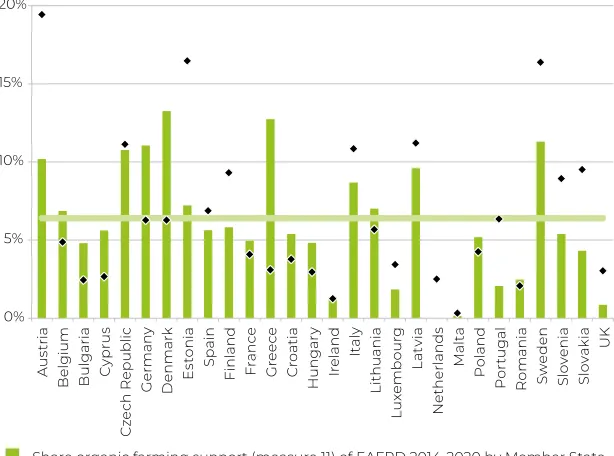
Figure 2.1 provides an overview of the EU’s co-financing contribu-tion to organic farming payments under the CAP compared to the total area of farmland under organic production in the different EU Member States. The figures demonstrate that while the majority of Member States offer organic farming payment, the prioritisation of public investment in organic farming varies significantly from Member State to Member State.
Evidence shows that to ensure the sustainable development of the sector ‘supply-push’ measures such as organic farming payment must be complemented by ‘demand-pull’ measures to support and encou- rage market development as part of an overall policy mix.31
Indeed, the justification for financially supporting organic farming is not simply driven by vested interests of specific groups: it is supported by a significant proportion of society that wish to reach common environ -mental and societal goals (often referred to as public goods) which are consistent with more sustainable food production. While there are very
few pure public goods, benefits such as agricultural landscapes, biodiver -sity, water and air quality, soil functionality, carbon storage and climate stability, rural viability, and animal health and welfare, are considered to be public goods to varying degrees, as many consumers cannot gene- rally be persuaded to pay for them, because they can still enjoy these
benefits even if they don’t pay for them. This reality demonstrates that markets alone are often not sufficient to ensure that all farms deliver
a full suite of positive environmental and socio-economic outcomes expected from society.
Therefore, if markets fail to fully reward these public goods, it is up to
public policy to intervene to support such goods by using financial incen -tives. As a whole-farm systems approach with well-developed standards, backed by legally binding requirements in the EU and proven track record internationally, public support for organic farming can deliver a wide
range of benefits compared to other production methods. For example,
in the area of the environment, payments for converting or maintaining farmland under organic production are multi-objective measures that
offer a more cost-effective solution for sustainable agriculture than
single-objective agri-environmental measures. This is because organic
farming results in more synergies and addresses trade-offs with other
environmental actions, and has lower transaction costs compared to
individual interventions. These efficiencies are further complemented
by greater market returns.29
ORGANIC A
CTION PL
Figure 2.1 Share of EAFRD for organic farming support compared to the total organic farmland area in 2014
Source: Stolze et al., 2016 30
2.1
0% 5% 10% 15% 20%Share organic farming support (measure 11) of EAFRD 2014-2020 by Member State Share organic farming area 2014 of total agricultural area [%]
Share organic farming support (measure 11) of total EAFRD 2014-2020
A u str ia B el g iu m B u lg ari a C yp ru s C ze ch R ep ub lic G erm an y D enm ark E sto n ia Sp ain Fin la n d Fr an ce G reec e C ro atia H un g ar y Ir el an d It al y Li thu ani a Lu xe m b ou rg Lat vi a N et h erl an d s M alt a P ol and P or tu g al R om ani a Sw ed en Sl ov en ia Slo va ki a UK
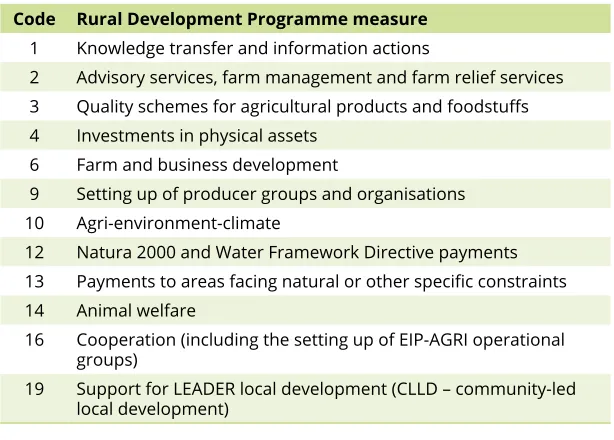
In addition to organic farming payments, Rural Development Pro-grammes offer broader based support for both organic farmers and SMEs using other measures such as investments in infrastructure and processing, training and marketing, land management and innovation (see Table 2.2).
The uptake of these measures provides many opportunities for organic farmers and SMEs to build capacities and their long-term sustainability. In recent years there has been movement by some EU Member States to emphasise the need to balance supply-push measures with more market-focused demand-pull measures. Evaluations have also recog-nised the need for measures such as research, training and advice to be included as well. These are critical to improve the performance and competitiveness of systems as well as the quality of outputs at both production and market levels. However, similarly, to support measures offered for the period 2014-2020, experience from the previous Rural Development Programme period 2007-2013 shows
Organic f
ood and f
[image:29.420.57.364.33.261.2]Table 2.2 Overview of Rural Development Programme measures in addition to organic farming payments
Code Rural Development Programme measure
1 Knowledge transfer and information actions
2 Advisory services, farm management and farm relief services
3 Quality schemes for agricultural products and foodstuffs
4 Investments in physical assets
6 Farm and business development
9 Setting up of producer groups and organisations
10 Agri-environment-climate
12 Natura 2000 and Water Framework Directive payments
13 Payments to areas facing natural or other specific constraints
14 Animal welfare
16 Cooperation (including the setting up of EIP-AGRI operational
groups)
19 Support for LEADER local development (CLLD – community-led
local development)
Source: Stolze et al., 2016 32
Market development and consumer promotion support
In additional to some rural development measures support for mar-ket development and consumer promotion is primarily also offered through the CAP’s Common Organisation of Markets (CMO) in Agri-cultural Products framework.34 It mainly covers market intervention
measures and rules on marketing and producer organisations. Of particular interest to organic farmers, SMEs and other stakeholders are the schemes and programmes that promote organic products and supply chain development. These include:
Funding for the promotion of EU farm products, which is available for private sector information and promotion initiatives designed to promote and raise awareness of agricultural products in EU Member States as well as countries outside the EU. Depending on the type of that Member States’ use of these other measures for farmers, SMEs and other organic stakeholders can vary considerably.33
ORGANIC A
CTION PL
programme, applications can be made by a European organisation, a combination of organisations from the same country or from dif-ferent EU countries. EU co-financing contributions are usually 50%, with at least 20% coming from the applicant and the remainder from the Member State, depending on the specific programme.
Funding for fruit and vegetables producer organisations, which is available to recognised Producer Organisations (PO) in the fruit and vegetable sector to finance operational programmes. The overall aim is to increase the competitiveness of farmers and grow-ers in the supply chain. Operational programmes must place over a 3- to 5-year period and meet specific objectives as part of the funding requirements. Within these objectives specific reference is made to organic farming as a method of production respecting the environment. EU funding contributions can be up to 50% for operational programmes.
The EU also has other market development and promotion schemes as well as guidelines for the agri-food sector targeted at Member States which may be of interest to organic farmers, SMEs and other stakeholders. These include:
EU school fruit, vegetables and milk scheme,35 which aims to
support the distribution of fruit, vegetables and milk in schools throughout the EU to encourage an increase in consumption and to promote the benefits of healthy eating amongst children. Un-der the EU school scheme Member States may apply for funding on an annual basis and are required to draw up a strategy, either at national or regional level, which sets out their priorities for the implementation of the scheme every six years. The scheme also encourages the sourcing of organic products and the promotion of organic farming.
EU voluntary Green Public Procurement (GPP) guidelines for food and catering services,36 which aim to encourage public
au-thorities in Member States to draw up procurement criteria that can help reduce the environmental impact of the goods and services they purchase. Within the EU’s GPP guidelines the procurement of organic food with minimum sourcing requirements is strongly encouraged. Public authorities and the organic sector have also developed standards for organic mass catering through national legislation and private standards in many European countries.
Organic f
ood and f
Research and innovation support
Over the years the EU and individual European countries have invested in agricultural research, with the amount devoted specifically to organic food and farming systems increasing slowly, but progressively, since the 1990s.
Horizon 2020
In the EU, 43 million euro is dedicated specifically to organic food and farming projects under Horizon 2020 – the EU Framework Programme for Research and Innovation.i Many other projects, funded under Hori-zon 2020, are required to benefit both organic and conventional food and farming. This means, the EU is an increasingly important investor in organic research, and hence in the development of the sector.
The three key priorities for Horizon 2020 are excellent science, indus-trial leadership and societal challenges for the period 2014-2020. For each of these priorities, the Commission develops work programmes with the actions to be financed, the amount allocated to each action and indicative timetables. Of most importance to the agri-food sector is the societal challenge priority, in particular Societal Challenge 2: ‘Food security, sustainable agriculture and forestry, marine and maritime and inland water research and the bio-economy’.
European Innovation Partnership for Agricultural Productivity and Sustainability
The European Innovation Partnership for Agricultural Productivity and Sustainability (EIP-AGRI) was launched by the Commission in 2012 to foster a competitive and sustainable agriculture and forestry sector. EIP-AGRI has an EU level component and a national component. The EU level component is funded through Horizon 2020. The national (or regional) components are the Operational Groups funded by the EU Rural Development Programmes of Member States and regions. Operational Groups seek to guide and direct investments in innovation action that can support the transition towards sustainable agriculture and agroecological production systems. The EIP-AGRI and its Opera-tional Groups are therefore key instruments for supporting innovation initiatives within the organic sector to bridge the gap between research and practice.38
ORGANIC A
CTION PL
ERA-Net CORE Organic
Transnational funding is also offered through CORE Organic, which is one of the European Research Area Network schemes set up to develop and strengthen the coordination of national and regional research programmes. The CORE Organic consortium is made up of 21 funding bodies from 19 participating European countries. Now in its fourth iteration, it is the only transnational funding structure deal-ing 100% with organic research. Its aim is to gather into a critical mass the often small and scattered organic research community, to deliver better research more efficiently. The most recent call for proposals was launched in 2016. CORE Organic is now exploring the possibility of launching a new call in 2019.39
Box 2.4 TP Organics - European Technology Platform for organic food & farming 40
Adequately funded research and innovation is fundamental to the further development of the organic sector and the transition to sus-tainable food and farming systems. Indeed, the EU and many European countries are big investors in agricultural research. TP Organics, the Euro-pean Technology Platform for organic food and farming, was established in 2007 to ensure that organic food and farming is prioritised in European research and innovation agendas. The platform is one of the 40 European
Technology Platforms (ETPs) officially recognised by the European Com -mission. It unites companies, farmers, consumers, civil society organisa-tions and researchers active in the organic value chain from production, input and supply, to food processing, marketing and consumption across Europe. Its mission is to strengthen research and innovation for organics and other agroecological approaches that contribute to sustainable food and farming systems. TP Organics does this by identifying organic and agroecological research priorities and communicating them to policy makers in Europe and beyond. It also informs its members about fund-ing opportunities for research and innovation and promotes knowledge exchange between farmers, companies and researchers.
Recognition of organic food and farming in public policy has developed significantly over recent decades, particularly within the EU. However, as outlined above, the level of interest in organic food and farming amongst policy makers does vary significantly between different Euro-pean countries. Therefore, it is important for organic stakeholders to work in partnership with EU, national and regional policy makers and administrators to ensure full use is made of all relevant support mea-sures in the development and implementation of an organic action plan.