An investigation into the role and impact of Peer Learning in an
online environment: a case study on students’ learning experience
By
Songlak Sakulwichitsintu
B.Sc.(Computer Science), M.Sc.(Computer Science), M.Sc.(ICT)
School of Technology, Environment and Design Discipline of ICT
University of Tasmania Hobart,
Tasmania, Australia, 7000
A dissertation submitted in fulfilment of the requirements for the degree of
Declaration
This thesis contains no material which has been accepted for the award of any other
degree or diploma in any tertiary institution, and to my knowledge and belief, the
thesis contains no material previously published or written by another person except
where due reference is made in the text of the thesis.
Songlak Sakulwichitsintu
July 2018
Authority of Access
This document may be made available for loan and limited copying in accordance with the Copyright Act 1968.
Songlak Sakulwichitsintu
Abstract
This research investigates the role and impact of technology-supported peer learning activities in an online environment through a case study examining students’ learning experience. The case study involved 196 students, 14 teaching staff and 3 technologies used within three academic units (one first year undergraduate unit, one third year undergraduate unit and one master level postgraduate unit) at the University of Tasmania over two years.
In research on peer learning there is evidence that a positive student learning experience is important for successful learning. But the concept of the student learning experience is still poorly defined. There is also evidence to highlight that in an online environment, the student learning experience involving peer learning activities has been negatively impacted by challenges related to several factors including: students' accountabilities when working with other students, and challenges related to students’ communication on exchanging learning experiences.
These factors, including the lack of clear definition of the student learning experience pose further challenges to improve the development, implementation and evaluation of peer learning activities within the online environment. These challenges include the absence of guidelines on how best to develop and implement peer learning activities in an online environment; how to link these activities to select the right technology to support peer learning in online environment; and how to customize individual delivery and assessment to enhance student learning experience.
Previous research has already identified the influence of a range of factors on peer learning including: the attribute of individual student; the role and behaviour of teaching team; student understanding of the unit requirements; natural events and experiences of peer activities; supporting of social relationships; and the design, adoption and use of information technology. However, exploring their relationship and how they influence student learning experience is still limited. In this context, this research aims to:
(2) Implement a set of technology-supported peer learning activities and evaluate their impact on students learning experiences in an online environment;
(3) Generate a framework for supporting online peer learning unit designs that optimise students learning experiences
The research methodology deployed in conducting this exploratory investigation adopted a research philosophy drawing on a subjective ontology and interpretivist epistemology. The research strategy involved a case study involving participants and technologies used in three educational units (one first year undergraduate unit, one third year undergraduate unit and one master level postgraduate unit) at the University of Tasmania over two years.
The research design utilised both qualitative and quantitative methods structured through a pre- and post- intervention approach over four phases supporting concurrent triangulation. The four phases were: a preliminary phase selecting and assessing units for the case study; a baseline phase involving data collection and analyses of existing unit delivery; a redesign phase involving development, implementation and evaluation phase targeting students learning experiences; and an outcome phase involving interpretation and discussion of the research findings. Across the first three phases data collection involved the use of both quantitative and qualitative techniques. Data analysis techniques included the use of social network analysis, descriptive statistics, factor analysis and thematic coding of the qualitative data from 3 focus groups and 14 semi-structured interviews. Following base-line analysis of two online units, re-design was conducted within the two online units and evaluation conducted within them.
Based on this research it is possible to provide a clearer definition of student learning experience in the context of technology-supported peer learning in an online environment as follows:
The efficacy of these processes is related to an individual’s personal motivation and perception of, and engagement in interaction and communication with other students as supported by teachers and technology in an online environment. To understand and investigate the diversity of the processes involved in student learning experience, it is useful to consider them across 7 inter-related dimensions. These 7 dimensions are accountability for collaborative works, sense of community, self-efficacy for reflection, group work contribution, competency of reflective practices, assistance for interaction, and communication convention.
The research has produced four key findings as follows:
(1) The nature and importance of the interdependence among the three peer learning attributes (interaction, communication, and motivation) on the learning experience of students. When students have their critical thinking presented and share their active ideas, other students (peers) are challenged and encouraged to use reflective practice without feeling direct pressure. Consequently, the peer interaction was increased as a result of both critical thinking and reflective practice, all of which help improve the learning experience of students. This finding shows that it is not the frequency of interaction but the perception of content quality exchanged is significant. The capacity of the individual for beginning, and reflecting on, peer communication is also significant for enhancing the learning experience of students.
reflection, appropriate orientation to learning and the improved expectations of students around skills development, learning outcomes, assessment and the use of technology. All these have been identified as contributing positively to students’ learning experiences.
(3) The impact and role of the teaching team on peer learning activities, learning resources and learning environment. This finding suggests that re-designs that encourage students to actively participate in peer learning without the involvement of teachers require that the teaching team clearly explain the aims, assessments, and objectives of technology-supported peer learning activities. However, the teaching team must continue to anticipate that some students will still requires direct interaction with the teaching team. The student learning experience is greatly enhanced by the teaching team when resources, the learning environment and peer learning activities are communicated, structured and delivered in an integrated and holistic manner.
(4) Understanding the role of technology affordance and integration on peer learning activities. This finding suggests that the interaction between students on peer learning activities worked more effectively by using technologies that supported asynchronous communication, while the interaction of the teacher and student worked effectively by technologies that supported synchronous communication. For the learning experience of students, it is also apparent that message notifications are a useful way of stimulating the interaction even when using asynchronous technologies.
At the substantive level, this research contributes a detailed case study on the role and impact of technology-supported peer learning activities in an online environment. Specifically it identifies factors relating to peer learning attributes, the role of the teaching team and the role of technology and how these interact to impact on students learning experiences.
Acknowledg
ments
At first I would like to express my gratitude to my team of supervisors - Associate Professor Paul Turner, Dr Douglas Colbeck, and Associate Professor Leonie Ellis. Thank you all for being my initial and ongoing inspiration including guiding, supporting and encouraging me for my research and dissertation. Their continuous assistance and suggestion directed me to write through to the end.
My supportive friends and family both in Australia and Thailand, you were all there to encourage and support me to the very end. I sincerely thank you all.
The staffs and PhD students of the School of Technology, Environment and Design, Discipline of ICT at the University of Tasmania, you provided me with the resources, support and opportunities that I needed since the very first day.
I gratefully acknowledge my PhD financial funding granted by Sukhothai Thammathirat Open University (STOU) PhD scholarship.
I would like to acknowledge the support of The Tasmanian Institute of Learning and Teaching (TILT) and staffs. Also, I would like to thank teaching team of Faculty of Education at University of Tasmania and their student participants for valuable information and feedback for my research contribution. Without their time and efforts, this research would not have been possible.
A warm and special thanks to my dad and my mom together with my two sisters and one brother. Importantly, my dad who has already passed away was the first person who guided me the good opportunity for ICT learning. My lovely mom who always cheers me up and her unconditional love has been key to my achievement including everything in my life that I have undertaken.
Table of Contents
DECLARATION ... 1-II AUTHORITY OF ACCESS ... 1-II ABSTRACT ... III ACKNOWLEDGMENTS ... VIII TABLE OF CONTENTS ... IX
TABLES ... XIII FIGURES ... XIV
CHAPTER 1: RESEARCH PROJECT INTRODUCTION ... 16
1.1 INTRODUCTION ... 16
1.2 RESEARCH AIMS ... 18
1.3 RESEARCH QUESTIONS AND RESEARCH OBJECTIVES ... 18
1.4 RESEARCH JUSTIFICATION ... 19
1.5 PROJECT RATIONALE ... 20
1.6 CHAPTER SUMMARY ... 24
1.7 THESIS OUTLINE ... 24
CHAPTER 2: LITERATURE REVIEW ... 26
2.1 INTRODUCTION ... 26
2.2 TECHNOLOGY SUPPORTED ONLINE LEARNING ... 31
2.2.1 Computer-Supported Collaborative Learning (CSCL) ... 32
2.2.2 Group Decision Support Systems (GDSS) ... 34
2.2.3 Technology Acceptance Model (TAM) ... 34
2.2.4 Socio-Technical System (STS) ... 37
2.2.5 Computer-Supported Communication and Collaboration Tools ... 38
2.2.6 Game-Based Learning ... 39
2.2.7 Mobile Learning ... 42
2.2.8 Social Technology and Social Network ... 45
2.2.9 Massive Open Online Course (MOOC) ... 47
2.2.10 Social Learning Analytics (SLA) ... 52
2.3 PEER LEARNING ... 58
2.3.1 Concept of Peer Learning ... 58
2.3.2 Aspects of Peer Learning ... 61
2.3.3 Applying Peer Learning ... 67
2.3.4 Impacts of Peer Learning ... 68
2.4 STUDENT LEARNING EXPERIENCE ... 72
2.4.1 Pedagogy Supported Learning ... 72
2.4.2 Psychology Supported Learning with Learning Communities ... 77
2.5 CHAPTER SUMMARY ... 84
CHAPTER 3: METHODOLOGY ... 85
3.1 INTRODUCTION ... 85
3.2 RESEARCH AIMS,QUESTIONS AND OBJECTIVES ... 86
3.2.1 Research Aims ... 86
3.2.2 Research Questions and Research Objectives ... 86
3.3 RESEARCH PHILOSOPHY ... 87
3.3.1 Ontology ... 88
3.3.2 Epistemology ... 89
3.4 RESEARCH STRATEGY ... 90
3.4.1 Case study ... 90
3.4.2 Three stage approach ... 92
3.6 DATA COLLECTION TOOLS ... 99
3.6.1 Ethics Procedures ... 101
3.6.2 Participant Selection and Involvement Process ... 102
3.6.3 Quantitative data collection ... 102
3.6.4 Qualitative data collection ... 105
3.7 DATA ANALYSIS ... 108
3.7.1 Quantitative Data Analysis ... 109
3.7.2 Qualitative Data Analysis ... 122
3.8 RESULTS /FINDINGS ... 129
3.9 RESEARCHER BIAS ... 129
3.10 CHAPTER SUMMARY ... 131
CHAPTER 4: QUANTITATIVE DATA ANALYSIS AND RESULTS ... 132
4.1 INTRODUCTION ... 132
4.2 SOCIAL NETWORK ANALYSIS (SNA) ... 133
4.2.1 SNA stage one ... 133
4.2.2 SNA stage two ... 136
4.2.3 SNA stage three ... 141
4.3 DESCRIPTIVE SPREADSHEET ANALYSIS (DSA) ... 147
4.3.1 DSA stage one ... 149
4.3.2 DSA stage two ... 152
4.3.3 DSA stage three ... 159
4.4 FACTOR ANALYSIS (FA) ... 164
4.4.1 FA stage one ... 164
4.4.2 FA stage two ... 169
4.4.3 FA stage three ... 177
4.5 COMPARISON OF THE CONTRIBUTIONS OF THREE QUANTITATIVE DATA ANALYSIS APPROACH 186 4.6 CHAPTER SUMMARY ... 188
CHAPTER 5: QUALITATIVE DATA ANALYSIS AND RESULTS ... 190
5.1 INTRODUCTION ... 190
5.2 INTERVIEW DATA ANALYSIS (IDA)STAGE ONE ... 191
5.2.1 Thematic Code – Community Development ... 193
5.2.2 Thematic Code – Extrinsic Improvement ... 195
5.2.3 Thematic Code – Facilitating Thinking ... 196
5.2.4 Thematic Code – Intrinsic Improvement ... 198
5.2.5 Thematic Code – Learning Administration ... 200
5.2.6 Thematic Code– Learning Mechanism ... 201
5.2.7 Thematic Code – Pedagogical Preparation ... 202
5.2.8 Thematic Code – Skills Development ... 203
5.2.9 Thematic Code – Student Experience ... 204
5.2.10 Thematic Code – Teaching Condition ... 205
5.2.11 Thematic Code – Technology Affordances ... 206
5.2.12 Thematic Code – Virtual Implementation ... 208
5.3 FOCUS GROUP DATA ANALYSIS (FGDA)STAGE ONE ... 209
5.3.1 Thematic Code – Student Demography ... 210
5.4 INTERVIEW DATA ANALYSIS (IDA)STAGE TWO ... 210
5.4.1 Thematic Code – Learning Environment ... 211
5.4.2 Thematic Code – Orientation to Learning ... 212
5.5 FOCUS GROUP DATA ANALYSIS (FGDA)STAGE TWO ... 212
5.6 INTERVIEW DATA ANALYSIS (IDA)STAGE THREE ... 213
5.6.1 Thematic Code – Content Engagement ... 215
5.6.2 Thematic Code – Human Relationship ... 215
5.6.3 Thematic Code – Moral Awareness ... 216
5.6.4 Thematic Code – Time Management ... 218
5.7 FOCUS GROUP DATA ANALYSIS (FGDA)STAGE THREE ... 219
5.7.1 Thematic Code – Assessment Driven ... 220
5.7.2 Thematic Code – Conversations ... 221
5.8 COMPARISON OF THE THEMES FROM THREE STAGES OF QUALITATIVE DATA ANALYSIS ... 223
5.9 CHAPTER SUMMARY ... 224
CHAPTER 6: INTERPRETATION AND DISCUSSION ... 225
6.1 INTRODUCTION ... 225
6.2 SUMMARY OF DATA ANALYSIS ... 225
6.3 STUDENT RELATED FACTORS ... 229
6.3.1 Intrinsic improvement ... 230
6.3.2 Orientation to learning ... 231
6.3.3 Skill development ... 231
6.3.4 Assessment driven ... 232
6.3.5 Conversations ... 233
6.3.6 Moral awareness ... 233
6.4 ORGANIZATION AND DELIVERY FOR ONLINE PEER LEARNING ... 235
6.4.1 Peer learning attributes ... 235
6.4.2 Teaching team ... 238
6.4.3 Technology ... 239
6.5 STUDENT LEARNING EXPERIENCE ... 240
6.5.1 Accountability for collaborative works ... 241
6.5.2 Competency of reflective practices ... 243
6.5.3 Self-efficacy for reflection ... 243
6.5.4 Assistance for interaction ... 245
6.5.5 Communication convention ... 245
6.5.6 Group work contribution ... 246
6.5.7 Sense of community ... 247
6.6 CHAPTER SUMMARY ... 248
CHAPTER 7: RESEARCH FINDINGS ... 250
7.1 INTRODUCTION ... 250
7.2 RESEARCH QUESTIONS AND OBJECTIVES ... 250
7.3 PRESENTATION OF THE RESEARCH FINDINGS ... 251
7.3.1 Key Finding One ... 252
7.3.2 Key Finding Two ... 254
7.3.3 Key Finding Three ... 259
7.3.4 Key Finding Four ... 260
7.4 ANSWERING THE RESEARCH QUESTIONS ... 264
7.4.1 Question One – What factors promote or hinder peer learning activities in an online environment? ... 265
7.4.2 Question Two – How do technology-supported peer learning activities in an online environment impact on students’ learning experiences? ... 266
7.5 CHAPTER SUMMARY ... 267
CHAPTER 8: CONCLUSION ... 269
8.1 INTRODUCTION ... 269
8.2 SUMMARY OF RESEARCH FINDINGS ... 269
8.3 CONTRIBUTIONS OF THE RESEARCH ... 270
8.4 LIMITATIONS OF THE STUDY ... 271
8.4.1 Scope of the Research ... 271
8.4.2 Researcher Bias ... 272
8.4.3 Lack of Generalizability ... 273
8.5 FUTURE RESEARCH ... 273
8.6 CHAPTER SUMMARY ... 274
REFERENCE ... 275
APPENDIX A: STATEMENTS OF ANONYMOUS ONLINE SURVEYS ... 301
APPENDIX B: LEARNING EXPERIENCE SURVEY ONE ... 303
APPENDIX E: STAFF PARTICIPANT INTERVIEW QUESTIONS ... 313
APPENDIX F: QUANTITATIVE DATA ANALYSIS (STAGE ONE) ... 314
APPENDIX G: QUANTITATIVE DATA ANALYSIS (STAGE TWO) ... 331
APPENDIX H: QUANTITATIVE DATA ANALYSIS (STAGE THREE) ... 350
APPENDIX I: 12 THEMES FROM IDA STAGE ONE ... 373
APPENDIX J: 13 THEMES FROM FGDA STAGE ONE ... 374
APPENDIX K: 15 THEMES FROM IDA STAGE TWO ... 375
APPENDIX L: 14 THEMES FROM FGDA STAGE TWO ... 376
APPENDIX M: 19 THEMES FROM IDA STAGE THREE ... 377
APPENDIX N: 22 THEMES FROM FGDA STAGE THREE ... 378
APPENDIX O: THEMES LIST (22 THEMES) FROM QUALITATIVE DATA ANALYSIS 379
Tables
TABLE 2.1:AN ACTIVITY-BASED APPROACH TO CONSIDER LEARNING WITH MOBILE TECHNOLOGIES .... 43
TABLE 2.2:COMPARISON BETWEEN E-LEARNING AND M-LEARNING ... 44
TABLE 2.3GAGNE’S TAXONOMY OF LEARNING OUTCOMES ... 78
TABLE 2.4BLOOM’S TAXONOMY OF COGNITIVE OUTCOMES ... 78
TABLE 3.1CHARACTERISTICS OF CASE STUDY APPROACHES ... 90
TABLE 3.2KEY CHARACTERISTICS OF THE CASE STUDY METHODOLOGY ... 91
TABLE 3.3THE TERM/SEMESTER STRUCTURE OF THE UNIVERSITY OVER THE TWO-YEAR RESEARCH PERIOD ... 96
TABLE 3.4:EXAMPLE OF CORRELATION MATRIX ... 116
TABLE 3.5:EXAMPLE OF EIGENVALUE ... 118
TABLE 3.6:EXAMPLE OF INTERPRETING FACTORS ... 121
TABLE 3.7:STEPS OF CONDUCTING QUALITATIVE ANALYSIS ... 123
TABLE 3.8:EXAMPLE OF RAW TRANSCRIPT TO SUMMARY CODES ... 125
TABLE 3.9:EXAMPLE OF OPEN CODING ... 127
TABLE 3.10:EXAMPLE OF HOW THE OPEN CODES ARE CATEGORISED INTO THEMES ... 128
TABLE 4.1:DATA OF TITLES, THREADS, AND REPLIES FROM DISCUSSION BOARD ON MYLO ... 134
TABLE 4.2:ADAPTED CONSTRUCTIVIST ON-LINE LEARNING ENVIRONMENT SURVEY (COLLES) ... 148
TABLE 5.1:AN EXAMPLE OF THE CODING PROCESS ... 192
TABLE 5.2:EXAMPLE OF POSITIVE ASPECTS AND NEGATIVE ASPECTS OF SOME THEMES FROM IDA STAGE ONE ... 192
TABLE 5.3:NEW DATA SET FROM FGDA STAGE ONE ... 209
TABLE 5.4:NEW DATA SET FROM IDA STAGE TWO ... 211
TABLE 5.5:NEW DATA SET FROM FGDA STAGE TWO ... 213
TABLE 5.6: NEW DATA SET FROM IDA STAGE THREE ... 214
Figures
FIGURE 1.1:RESEARCH WITHIN GREATER RESEARCH CONTEXT ... 17
FIGURE 1.2:GROWTH IN ONLINE EDUCATION ... 21
FIGURE 1.3:STUDENTS’ ENROLMENT IN ONLINE UNITS ... 21
FIGURE 2.1:TEACHER’S AND STUDENT’S PERSPECTIVES ON ASSESSMENT ... 26
FIGURE 2.2:LEARNING PYRAMID ... 28
FIGURE 2.3:FRAMEWORK OF ADULT DROPOUT IN ONLINE LEARNING BASED ON ROVAI’S MODEL ... 30
FIGURE 2.4:THREE LEVELS OF SOCIAL COLLABORATION USING ONLINE SHARED WORKSPACES ... 33
FIGURE 2.5:EXPECTATION-CONFIRMATION MODEL (ECM),TECHNOLOGY ACCEPTANCE MODEL (TAM),THEORY OF PLANNED BEHAVIOUR (TPB) AND FLOW THEORY ... 36
FIGURE 2.6:COMPUTING APPLICATIONS AND LEVELS ... 37
FIGURE 2.7:THE COMPUTING REQUIREMENTS HIERARCHY ... 38
FIGURE 2.8:COMPUTER-SUPPORTED COMMUNICATION AND COLLABORATION TOOLS ... 39
FIGURE 2.9:EXPERIENTIAL GAMING MODEL ... 41
FIGURE 2.10:USING TECHNOLOGY TO SUPPORT CONVERSATIONAL LEARNING ... 43
FIGURE 2.11:DESIGN SPACE OF SOCIAL MEDIA LEARNING ... 46
FIGURE 2.12:MAJOR PLAYERS IN THE MOOCUNIVERSE ... 50
FIGURE 2.13:A MODEL OF LEARNING ANALYTICS FOR CONTINUOUS TEACHING AND LEARNING DEVELOPMENT CYCLE ... 55
FIGURE 2.14:LEARNING ANALYTICS FRAMEWORK ... 55
FIGURE 2.15:LEARNING ANALYTICS REFERENCE MODEL ... 56
FIGURE 2.16:THEORETICAL MODEL OF PEER-ASSISTED LEARNING ... 60
FIGURE 2.17:ASYNCHRONOUS ONLINE DISCUSSION WITH MULTIDIMENSIONAL ASSESSMENT PROCESSES ... 71
FIGURE 2.18:KOLB’S LEARNING STYLES AND LEARNING MODES ... 77
FIGURE 2.19:RCET MODEL OF TECHNOLOGY SUPPORTED LEARNING WITHIN SOCIAL CONSTRUCTIVIST STRUCTURE ... 82
FIGURE 3.1THE ORGANIZATION OF RESEARCH METHODOLOGY ... 87
FIGURE 3.2FOUR PHASES OF RESEARCH PROCESS ... 93
FIGURE 3.3DIAGRAM OF RESEARCH DESIGN INCLUDING FOUR PHASES OF RESEARCH PROCESS AND MIXED METHOD WITH CONCURRENT TRIANGULATION APPROACH ... 95
FIGURE 3.4DATA COLLECTION APPROACH ... 101
FIGURE 3.5DATA ANALYSIS APPROACH ... 109
FIGURE 3.6EXAMPLE OF SOCIAL NETWORK DIAGRAM ... 111
FIGURE 3.7EXAMPLE OF GRAPHICAL REPRESENTATION OF STATISTICS ... 112
FIGURE 3.8EXAMPLE OF SCREE PLOT ... 119
FIGURE 3.9EXAMPLE OF INTERPRETING FACTORS ... 122
FIGURE 3.10THE PROCEDURE OF THEMES DEVELOPMENT ... 129
FIGURE 4.1:SNA STAGE ONE, STUDENT INFORMATION SESSION DISCUSSION INTERACTION ... 135
FIGURE 4.2:SNA STAGE ONE, STUDENT TUTORIAL DISCUSSION INTERACTION ... 135
FIGURE 4.3:SNA, STAGE TWO, UNIT ONE, WEEK THREE ... 137
FIGURE 4.4:SNA, STAGE TWO, UNIT ONE, WEEK ELEVEN ... 138
FIGURE 4.5:SNA, STAGE TWO, UNIT TWO, WEEK THREE (GROUP ONE) ... 139
FIGURE 4.6:SNA, STAGE TWO, UNIT TWO, WEEK THREE (GROUP TWO) ... 139
FIGURE 4.7:SNA, STAGE TWO, UNIT TWO, WEEK ELEVEN ... 140
FIGURE 4.8:SNA STAGE THREE, UNIT TWO, WEEK THREE (GROUP ONE) ... 143
FIGURE 4.9:SNA STAGE THREE, UNIT TWO, WEEK ELEVEN (GROUP ONE) ... 143
FIGURE 4.10:SNA STAGE THREE, UNIT TWO, WEEK THREE (GROUP TWO) ... 144
FIGURE 4.11:SNA STAGE THREE, UNIT TWO, WEEK ELEVEN (GROUP TWO) ... 144
FIGURE 4.12:SNA STAGE THREE, UNIT THREE, WEEK THREE ... 146
FIGURE 4.13:SNA STAGE THREE, UNIT THREE, WEEK ELEVEN ... 146
FIGURE 4.14:THE COMPARISON BETWEEN SURVEY ONE AND SURVEY TWO RESPONSES (DSA STAGE ONE, UNIT ONE) ... 150
FIGURE 4.15:THE COMPARISON BETWEEN ‘PREFERENCE’(I PREFER THAT) AND ‘FEEDBACK’(I FOUND THAT) OF 7 PARTS FROM SURVEY TWO (DSA STAGE ONE, UNIT ONE) ... 151
FIGURE 4.17:THE COMPARISON BETWEEN SURVEY ONE AND SURVEY TWO RESPONSES (DSA STAGE
TWO, UNIT ONE) ... 153
FIGURE 4.18:THE COMPARISON BETWEEN ‘PREFERENCE’(I PREFER THAT) AND ‘FEEDBACK’(I FOUND THAT) OF 7 PARTS FROM SURVEY TWO (DSA STAGE TWO, UNIT ONE) ... 154
FIGURE 4.19:THE COMPARISON BETWEEN FEEDBACK OF 7 PARTS FROM SURVEY ONE AND SURVEY TWO (DSA STAGE TWO, UNIT ONE) ... 155
FIGURE 4.20:THE COMPARISON BETWEEN SURVEY ONE AND SURVEY TWO RESPONSES (DSA STAGE TWO, UNIT TWO) ... 156
FIGURE 4.21:THE COMPARISON BETWEEN ‘PREFERENCE’(I PREFER THAT) AND ‘FEEDBACK’(I FOUND THAT) OF 7 PARTS FROM SURVEY TWO (DSA STAGE TWO, UNIT TWO) ... 157
FIGURE 4.22:THE COMPARISON BETWEEN FEEDBACK OF 7 PARTS FROM SURVEY ONE AND SURVEY TWO (DSA STAGE TWO, UNIT TWO) ... 158
FIGURE 4.23:THE COMPARISON BETWEEN SURVEY ONE AND SURVEY TWO RESPONSES (DSA STAGE THREE, UNIT TWO) ... 159
FIGURE 4.24:THE COMPARISON BETWEEN ‘PREFERENCE’(I PREFER THAT) AND ‘FEEDBACK’(I FOUND THAT) OF 7 PARTS FROM SURVEY TWO (DSA STAGE THREE, UNIT TWO) ... 160
FIGURE 4.25:THE COMPARISON BETWEEN FEEDBACK OF 7 PARTS FROM SURVEY ONE AND SURVEY TWO (DSA STAGE THREE, UNIT TWO) ... 161
FIGURE 4.26:THE COMPARISON BETWEEN SURVEY ONE AND SURVEY TWO RESPONSES (DSA STAGE THREE, UNIT THREE) ... 162
FIGURE 4.27:THE COMPARISON BETWEEN ‘PREFERENCE’(I PREFER THAT) AND ‘FEEDBACK’(I FOUND THAT) OF 7 PARTS FROM SURVEY TWO (DSA STAGE THREE, UNIT THREE) ... 163
FIGURE 4.28:THE COMPARISON BETWEEN FEEDBACK OF 7 PARTS FROM SURVEY ONE AND SURVEY TWO (DSA STAGE THREE, UNIT THREE) ... 164
FIGURE 4.29:7 FACTORS FROM FA STAGE ONE, UNIT ONE, SURVEY ONE ... 165
FIGURE 4.30:6 FACTORS FROM FA STAGE ONE, UNIT ONE, SURVEY TWO ... 167
FIGURE 4.31:6 FACTORS FROM FA STAGE TWO, UNIT ONE, SURVEY ONE ... 169
FIGURE 4.32:6 FACTORS FROM FA STAGE TWO, UNIT ONE, SURVEY TWO ... 171
FIGURE 4.33:8 FACTORS FROM FA STAGE TWO, UNIT TWO, SURVEY ONE ... 174
FIGURE 4.34:8 FACTORS FROM FA STAGE THREE, UNIT THREE, SURVEY ONE ... 177
FIGURE 4.35:5 FACTORS FROM FA STAGE THREE, UNIT THREE, SURVEY TWO ... 179
FIGURE 4.36:8 FACTORS FROM FA STAGE THREE, UNIT TWO, SURVEY ONE ... 181
FIGURE 4.37:7 FACTORS FROM FA STAGE THREE, UNIT TWO, SURVEY TWO ... 183
FIGURE 6.1:SUMMARY OF DATA ANALYSIS ... 226
FIGURE 6.2:STUDENT RELATED FACTORS (SRF) ... 230
FIGURE 7.1:FOUR RESEARCH KEY FINDINGS ... 252
FIGURE 7.2:THE FRAMEWORK OF RECOMMENDATIONS FOR ENHANCING STUDENT LEARNING EXPERIENCE IN ONLINE PEER LEARNING ... 263
Chapter 1:
Research Project Introduction
1.1 Introduction
This research investigates the role and impact of technology-supported peer learning activities in an online environment through a case study examining students’ learning experiences. The case study involved 196 students, 14 teaching staff, and 3 technologies used within three educational units (one 1st year undergraduate, one 3rd year undergraduate and one postgraduate unit) at the University of Tasmania.
Research into peer learning provides evidence that a positive student learning experience is critical for successful learning. However as a concept, the student learning experience remains poorly defined. There is also evidence highlighting that in online environments the student learning experience involving peer learning activities is negatively impacted by challenges relating to a number of factors including: students accountability when working with other students; and, challenges related to the students’ communication when exchanging learning experiences.
Combined, these factors and the lack of a clear definition of the student learning experience pose challenges to improving the development, implementation and evaluation of peer learning activities within online environments. Other challenges include the absence of guidelines on how best to develop and implement peer-learning activities in online environments; how to link these activities to appropriate technology choices to support peer learning online and how to iteratively refine delivery and assessment to optimise the student learning experience.
Figure 1.1: Research within greater research context
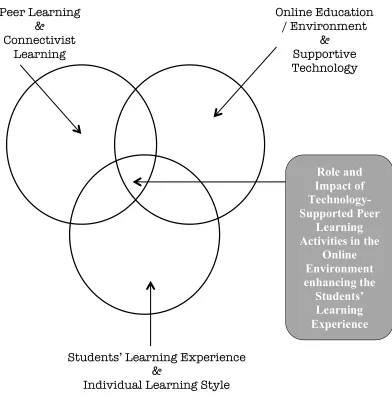
For consideration about enhancing the students’ learning experience, there are 3 parts involved: 1) peer learning & connectivist learning, 2) online education/environment & supportive technology, and 3) students’ learning experience & Individual learning style.
This chapter provides an overview of the background, method, and outcomes that have resulted from the research investigation. The primary research aims, questions, and objectives are specifically stated to justify the undertaking of the research.
Peer Learning &
Connectivist Learning
Students’ Learning Experience &
Individual Learning Style
Online Education / Environment
& Supportive Technology
Role and Impact of Technology-Supported Peer
Learning Activities in the
Online Environment enhancing the
1.2 Research Aims
In this context, this research aims to:
1. Investigate the role and usefulness of peer learning activities in an online environment for contributing to students learning experiences;
2. Implement a set of technology-supported peer learning activities and evaluate their impact on students learning experiences in an online environment; the set includes:
• The use of asynchronous discussion tools to support higher levels of
student-student and student-teacher interactions
• The use of a face-to-face virtual room application as synchronous tools
for student engagement and conversation
3. Generate a framework for supporting online peer learning unit designs that optimise student learning experiences
1.3 Research Questions and Research Objectives
This research is able to answer the following research questions along with their objectives.
Research question 1: What factors promote or hinder peer learning activities in an online environment?
Objective 1: To determine the enabling elements of peer learning activities in online environment
Objective 2: To determine the impact and position of the teacher on peer learning activities in online environment
Research question 2: How do technology-supported peer learning activities in an online environment impact on students’ learning experiences?
Objective 3: To determine what influences interactions when engaging in peer learning activities in online environment
1.4 Research Justification
This research provides the following substantive, methodological and theoretical contributions to the body of existing knowledge.
At the substantive level, this research contributes a detailed case study on the role and impact of technology-supported peer learning activities in an online environment, together with a broad range of factors covering the peer learning attributes, the role of the teaching team and the role of technology. Also how they impact the student learning experience when students communicate or interact with each other. Frequency of communication and content exchange are also considered. For a student participating in technology-supported peer learning activities it is clear that, “learning experience” relies on students:
a. Accountability for collaborative works: Students must be conscious that interoperability is achieved depending on their own responsibilities for giving valued comments and opening up their mind, together with a willingness to help others with full support.
b. Sense of community: To work together or get involved in society or a community, students have to acknowledge their differences and believe in the ability and experience of the individual. With mutual understanding, students are able to create a good sense of community for the purpose of working together.
c. Self-efficacy for reflection: Students are able to extend their valued and constructive ideas and beliefs to complete tasks, they must be motivated and persuaded by somebody else including the fellow students and teachers. The skills of reflection are important for questioning and developing interactive writing.
d. Group work contribution: The degree of relationship between group members is an important part of maintaining group cohesion. Especially, when the group members have to interact periodically with each other through any available channels. e. Competency of reflective practices: Questioning is a challenge to reflective practices when engaging and sharing expressive critical thinking.
f. Assistance for interaction: With high levels of concentration and attention, it is important to have intellectual curiosity for others’ opinion in order to stimulate and increase interaction.
makes communication smoother and stimulates the collaborative participation through continuous communication.
At the methodological level, this research includes data collected from multiple quantitative and qualitative sources, then using various techniques of data analysis in an innovative approach to interrogate the data and address any emerging themes. This innovative mixed method approach is used for investigating the phenomenon of peer learning as it impacts the students' learning experience. By using this approach, it is also possible to determine a clearer picture of the role and impact of technology-supported peer learning activities in an online environment in order to enhance the students’ learning experience.
At the theoretical level, this research will deliver a framework of recommendations for peer learning of educational units being launched in online environments with technology-supported peer learning activities to improve students’ learning experiences (see figure 7.2). The framework illustrates how teaching staff provide orientation, teaching activities, learning activities, appropriate technology tools, individual assignments and group assignments based on levels of interaction between student-student and student-teacher. In addition, a structural model of exploratory factors will illustrate the relationship between significant factors impacting peer learning interactions in an online environment by highlighting underlying influence and causality in those interactions.
1.5 Project Rationale
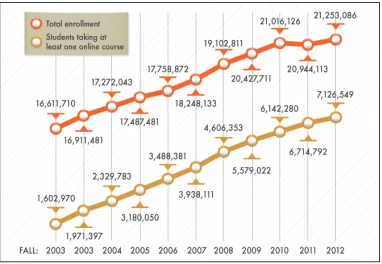
affordability, and support; and particularly more economical for universities (Croft, Dalton & Grant 2010; Graves 2001).
[image:21.595.124.538.115.395.2]Source: Center for Online Education (2015)
Figure 1.2: Growth in Online Education
1.
2.
[image:21.595.135.517.471.735.2]Although all research agrees that learning experience is important, learning experience tends not to be clearly defined and depends on the focus of the individual research. Moreover, the learning experience is described in slightly different ways depending on the perspective of the interrogation: teacher, unit content, technology, peer activities, and social relationships.
The literature shows that there are 3 key linked issues impacting students studying in an online environment. Firstly, students lack of accountability when working with others. As peer learning focuses on students learning with and from each other (Boud, Cohen & Sampson 1999) even in the era of web 2.0, students still need to learn together with peers, as it can be argued that it is an even more important part of the process of enhancing learning in online environments. As previously discussed, one major challenge in on-line learning environments is the relatively high drop-out rate (Croft, Dalton & Grant 2010) and peer learning has proven useful for reducing the isolation of online students in university or higher education programs. More recently, research has confirmed that students do not want to study alone, preferring to learn together through sharing learning experiences (Douglass, Smith & Smith 2013; Raymond et al. 2016). Critically, both Douglass, Smith and Smith (2013) and Raymond et al. (2016) highlight that:
• The success of students’ learning comes from the support of their peers.
• Working in groups can facilitate student learning.
• Students appreciate peer learning.
Peer learning is now widely promoted for students’ engagement in online environments (Bryson 2016; Yeh et al. 2016). Yeh et al. (2016) highlight that online peer learning delivers a number of benefits for students including increasing learning awareness, motivation to study and improve, and satisfaction with the learning experience. Bryson (2016) has provided evidence that students’ ongoing collaboration and participation influences both learning and teaching in higher education.
students do productively engage in peer learning on-line and acquire positive learning experiences remains the key challenge in delivering effective on-line learning (Keller & Karau 2013).
Secondly, students may not easily share learning experiences with others. As different students have different learning potential and intelligence, some students need peer motivation or support in order to encourage them to exchange their own ideas and opinions (Russell et al. 2009), in order to ensure that the interactions between students who learn together have an impact on the success of online peer learning (Hew & Cheung 2014; Xu & Jaggars 2013). Xu and Jaggars (2013) highlight that students’ learning potential and capabilities can be varied depending on their backgrounds and other factors. Hew and Cheung (2014) have provided evidence that encouragement and sympathy for each other is important for learning development. Peer learning supports students either when they assimilate lesson content or complete assignment tasks. The key challenge of successful online learning is to maintain a good relationship between students or student and teacher.
This project will construct a comprehensive framework of guidelines for teachers and students in supporting and improving their engagement in an online environment. Teachers can then reflect on how the students’ learning experience can be enhanced based on peer learning activities, teaching team activities, and supporting technology.
1.6 Chapter summary
This chapter provides the background information that underpins this research. The rationale of the research has been discussed together with the research aims, research questions, and research objectives. It has been identified that there are many challenges impacting peer learning activities within technology-supported online environments and that this research will greatly contribute to the current body of knowledge at the substantive, methodological and theoretical level.
1.7 Thesis Outline
The physical layout of this dissertation is described in detail below.
Chapter one outlines the background with the research aims, research questions, and research objectives of the study by providing justification and insight into this research project.
Chapter two reviews the literature underpinning this research. Chapter two has three sections. Section one examines technology supported online learning, focussing on the importance of technology support for students who study in online environment. Section two covers the overview of peer learning including concepts, aspects, and applying peer learning activities for supporting students’ learning in an online environment; and the third section covers students’ learning experience with pedagogy supported learning, individual learning style, and psychology supported learning with learning communities.
Data collection and data analysis involved 3 stages (3 semesters). Four data collection tools including discussion boards, online surveys, semi-structured interviews, and focus groups were undertaken.
Chapter four presents the quantitative data analysis results of the online survey and discussion board responses. The data collected was analysed using three different analysis techniques: social network analysis for discussion boards, and descriptive spreadsheet analysis and factor analysis for online survey analysis.
Chapter five presents the qualitative data analysis results from the semi-structured interview and focus group responses. The data collected was analysed using thematic coding by inductive and deductive coding.
Chapter six presents the interpretation of the data analysis presented in chapter four and chapter five, and then a discussion of these results from the perspective of the existing body of literature. The chapter further examines the results in relation to the intersection between technology-supported online learning, peer learning activities, and students’ learning experience. Finally, discussion is presented in relation to the role of technology-supported peer learning activities in an online environment that might support the students’ learning experience.
Chapter seven presents the findings that emerged from the research. Details of key findings obtained are discussed and then responded to in relation to the research questions. The findings present the role of peer learning activities together with a broad range of factors impacting peer learning attributes, the role and responsibilities of the teaching team and the affordances of technology-supported peer learning activities.
Chapter 2:
Literature Review
2.1 Introduction
This chapter provides a review of the main literary works that were sought and examined as part of the research. It includes 2.2) Technology supported online learning 2.3) Peer learning, and 2.4) Students’ learning experience. These elements attempt to frame the comprehensive review of issues and approaches in an effort to optimise the student learning experience in an online environment for use in an educational institution context.
Educational Context
Tertiary or higher education maintains diverse educational levels from undergraduate to doctoral degree. The studying environment consists of both physical classroom learning space and the virtual online learning space. Also, the university and teacher prepare learning environment and technology tools according to learners’ availability.
Tertiary education in any university generally considers suitable teaching and learning activities on the assessment or feedback on learning. According to the effects of assessment on learning, backward works positively by the encouragement of appropriate learning when the assessment is aligned to what students should be learning (see figure 2.1). Both the teaching activities of teachers and the learning activities of students are paralleled to achieve the same objective. For the preparation of assessment, students are learning the intended outcomes (Biggs & Tang 2011).
Source: Biggs and Tang (2011)
Figure 2.1: Teacher’s and student’s perspectives on assessment
Teaching activities
Learning activities
Assessment
Outcome s
Perspective
Teachers’
Students’
Intended outcomes
Impacts on educational stakeholders
E-learning with internet and web technologies are adopted to support lifelong learning of knowledge communities at anytime and anywhere especially in higher education (Graves 2001). Furthermore, the technological innovation helps faculty and teachers not only by increasing learning opportunities contributed to by the university, but also results in learning productivity (Graves 2001; Hew & Cheung 2014).
Encouraging a successful IT system in a university can be done based on social constructivism as student-centred learning (Papastergiou 2007). Increasing the use of online education influences learners who have feelings of isolation based on the physical and temporary separation of teacher and student and between students (Croft, Dalton & Grant 2010). Moreover, distance learning has a high risk of drop- out with isolation being a significant contributing factor (Croft, Dalton & Grant 2010; Mark & Anthony 2007).
Challenges for delivering online courses relates to the broad diversity of learning styles in relation to online accessibility. Also, the possibility of a learner’s isolation by way of lacking a cohort is a specific effect of the online education environment (Croft, Dalton & Grant 2010).
Belkin and Gray (1977) presented that alienation is a limitation of the individual and his/her connections with others, not a condition of the community. Alienation includes feelings of isolation and lonesomeness, disconnection from others, and a loss of consistent sense of self. Moreover, there are five elements of superiority of alienation including powerlessness, meaninglessness, normlessness, isolation, and self-estrangement.
The important obstacles to online learning are not influenced by current technologies, but by the pedagogical presumptions and comprehensions in the nature of their use (Bartley & Golek 2004). Advanced technologies are narrowly used only for inactive online tutorials and online books (Kilby 2001). However, the way to use technology influences the accomplishment of innovative and efficient ways of academic procedures online (Bartley & Golek 2004).
Online Education and Peer Learning
Boud, Cohen and Sampson (1999, p. 413) stated that peer learning mentions ‘the use of teaching and learning strategies in which students learn with and from each other without the immediate intervention of a teacher’. Specifically, each individual student has different learning potential and intelligence and aptitude (Carey et al. 2008; Daradoumis, Martínez-Monés & Xhafa 2006; Zhang, Carey & Te'eni 2007). The interesting point is that meaningful learning including building experiences will support learners to think accurately and apply knowledge to actual situations. That means meaningful learning with building experiences can improve learning outcomes (Daves & Roberts 2010).
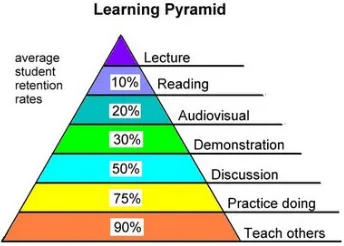
The Learning Pyramid (figure 2.2) shows thatthe average student retention rates of 90%were the result of Teach Others. This indicated that Peer Learning has the highest retention rate (National Training Laboratories Institute for Applied Behavioural Science n.d.). Although this pyramid deals with offline learning, peer learning encourages students who are studying online as online has high retention rates (Abdol Latif, Sungsri & Bahroom 2009; Bryson 2016).
[image:28.595.249.421.587.710.2]Source: National Training Laboratories Institute for Applied Behavioural Science (n.d.)
In higher education, there are limited budget for overloaded teaching staff (Boud, Cohen & Sampson 1999), and peer learning is initiated for teamwork skill development of graduates (Boud & Lee 2005) and increased participation for open learning groups (Ahn, Weng & Butler 2013).
One of the crucial reasons of attrition of open distance learning (ODL) organization is lonesomeness and separation sensation (Abdol Latif, Sungsri & Bahroom 2009). Online learners feel isolated (Palloff & Pratt 1999). In addition, isolation can affect an online learner’s manner so online courses should be designed to meet the individual characteristics of learners (McInnerney & Roberts 2004). McInnerney and Roberts (2004) stated that for online learners, it is unavoidable to feel a sense of isolation, so teachers should improve online surrounding beforehand including preparation of prosperous online interaction manual.
Learners are discouraged by alienation and in an online community then they do not accomplish their study (Rovai & Wighting 2005). Rovai and Wighting (2005) presented that three alienation variables (social isolation, powerlessness, and normlessness) are connected with two classroom community variables (social community and learning community). Social community and learning community influenced online studying (Rovai & Wighting 2005), this is in accordance with Bronfenbrenner (1986) who claimed that alienation occurs because of a lack of feelings related to ownership.
Social isolation and normlessness are contrarily associated with learning communities through online learning (Rovai & Wighting 2005). Moreover, learners should discuss their pedagogical values, objectives, and requirements through online discussion together within a standard group setting (Rovai & Wighting 2005).
Source: Park and Choi (2009)
Figure 2.3: Framework of adult dropout in online learning based on Rovai’s model
Distance learning benefits both learners and academic institutes by providing learning opportunities to learners regardless of location and society problems (Croft, Dalton & Grant 2010; Lake 1999). Liu, Magjuka and Lee (2006) claimed that distance learning are popular and delivered in higher education. Moreover, distance learning is referred as ‘e-learning’, ‘on-line learning’, and ‘distance education’ (Liu 2008)
Using technology for online courses supported learners who are able to work together (Macdonald 2003). The number of online courses in educational institutes including non-profit and profit organizations are increased (Carey et al. 2008). Currently, there are various communication approaches and tools, for instance, asynchronous discussion boards, webcasts, online workspaces, videoconferencing, peer-to-peer collaborative discussions, and blend face-to-face with online interactions (Carey et al. 2008; Treacy, Kleiman & Peterson 2002).
Learning community model of Online Professional Development (OPD) supports challenge of productive professional improvement for teachers and administrators of academic institutes. In the model, learners exchange ideas, comments and thinking including answer questions through asynchronous online discussion that are more reflective than synchronous face-to-face discussion (Treacy, Kleiman & Peterson 2002).
Another reason that the educational organization turns attention to peer online learning seriously is caused by the open opportunity for learners’ studying and sharing knowledge or learning experience with each other. Moreover, meaningful learning including building experiences will support learners to think accurately and apply knowledge to actual situations for further improving learning outcomes (Daves & Roberts 2010).
The Impact of Peer Learning on Students’ Learning Experience
To begin with, peer learning focuses on “the use of teaching and learning strategies in which students learn with and from each other without the immediate intervention of a teacher” (Boud, Cohen & Sampson 1999, p. 413). Learners can discuss experiences, ideas and concepts with each other as they engage with their peers, reflect on what they are learning and improving their personal knowledge by being part of the peer discussion experience (Evans & Moore 2013; Topping & Ehly 2001).
In considering learning experiences from the perspective of students involved in peer learning, it is clear that there are a number of issues such as the lack of accountability in working with others for students who are studying in an online environment (Prøitz 2010) and that students may not easily exchange learning experiences within their cohort (Russell et al. 2009). These issues directly affect the learning experiences of the students and this directly impacts on their ability to meet the unit criteria or other defined learning outcomes of the unit (Vaughan 2007).
2.2 Technology supported online learning
Technology is an essential component used in education (Kemp et al. 2014) and it has been used for educational benefits including supporting the communication and interaction between student and teacher or students and their cohort (Schmid et al. 2014). Also, technology can increase the flexibility, facilitation and ease of online learning (Abrami et al. 2011). On the other hand, technology can negatively influence students’ conviction, preference and learning experience (Kemp et al. 2014; Kukulska-Hulme 2012; Lai, Wang & Lei 2012).
experiences (Wang 2009, 2010). Teachers can support learner-centred approaches in online peer learning environments by selecting appropriate online technology (Abrami et al. 2011; Caballé, Juan & Xhafa 2008; Revere & Kovach 2011; Wang 2010).
As technology advances, any technology used to support an online learning environment must be set up and must function appropriately. This is to better enable students to engage effectively with their learning experiences and in particular, enhance students’ interaction with peers as they learn (Revere & Kovach 2011).
Technology has been used in educational institutions for accommodating the needs of students, teachers and faculty members especially in higher education (Hannay & Fretwell 2011; Kassens-Noor 2012; Wankel 2009). Technology supported online learning includes Computer-Supported Collaborative Learning (CSCL), Group Decision Support Systems (GDSS), Technology Acceptance Model (TAM), Socio-Technical System (STS), Computer-Supported Communication and Collaboration Tools, Game-Based Learning, Mobile Learning, Social Technology and Social Networks, Massive Open Online Course (MOOC), and Social Learning Analytics (SLA) as follow
2.2.1 Computer-Supported Collaborative Learning (CSCL)
Computer-Supported Cooperative Work (CSCW) is advanced in collaborative learning manner named Computer-Supported Collaborative Learning (CSCL) (Wang 2009). Personalized annotation management system (PAMS) based on Technology Acceptance Model (TAM) is a web 2.0-based collaborative annotation system using for developing knowledge sharing in collaborative learning surroundings (Su et al. 2010). Su et al. (2010) also presented that the result of studying PAMS shows positive relationship between learning achievements and quantity of annotation.
assessment for individual learner and can recognize problems suddenly (Pozzi et al. 2007; Wang 2010).
Collaboration by using online shared workspaces can sustain coordinating learners’ collaborative attempt and watching learning process (Wang 2010). Furthermore, intimately monitoring learning processes can be useful for both teacher’s identification of individual learner works, and learners’ encouragement of active participation (Caballé, Juan & Xhafa 2008; Wang 2010).
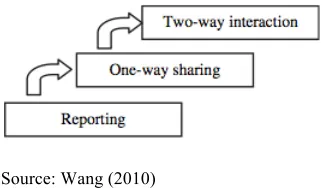
Building groups by friendship and creating in meaningful learning task support, individual accountability and optimistic interdependence in CSCL (Wang 2009). Three levels of social collaboration using online shared workspaces (see figure 2.4) compose of reporting progress (no share resources or ideas), one-way information sharing (share resources and report progress), and two-way interaction (share resources; compromised meanings, ideas and feedbacks; with progress reports) (Wang 2010).
[image:33.595.251.413.393.487.2]Source: Wang (2010)
Figure 2.4: Three levels of social collaboration using online shared workspaces
Computer-Supported Collaborative Learning (CSCL) in higher education is implemented and motivated toward learners who are unfamiliar with new system to involve learners’ interaction and realize peers’ thinking (Veldhuis-Diermanse 2002). Learners can use CSCL to conduct their tasks and strengthen their cognitive learning activities (Veldhuis-Diermanse 2002). In addition, social critical moderation can motivate learners to increase participation and collaboration for further public effort enhancement (Veldhuis-Diermanse 2002).
2.2.2 Group Decision Support Systems (GDSS)
A GDSS consists of communication, computing, and decision support technology to solve a group’s unstructured problems (DeSanctis & Gallupe 1987; Limayem, Banerjee & Ma 2006; Nour & Yen 1992) together with three crucial factors: group size, member proximity, and the task confronting the group (DeSanctis & Gallupe 1987). The objective of GDSS is to enhance the efficiency of decision groups by supporting interactive sharing and information usage among group participants including between groups and a computer (Huber 1984).
The consequence of GDSS on decision making procedures and outcomes depends on task structure significantly disjunctive and conjunctive tasks (Lam 1997). In addition, changing the patterns of group communication has a strong relationship with group decision quality (Lam 1997).
GDSS facilitative support mode may include user-driven (no facilitative support), chauffeur-driven (operational facilitative support), and facilitator-driven (task facilitative support) (Dickson, Partridge & Robinson 1993). Although supporting of group members effects to outcome, facilitation of GDSS should not be restrictive (Dickson, Partridge & Robinson 1993).
Decision guidance with cognitive feedback and feed forward at specific breakpoint advances faithfulness appropriation of GDSS, and whereby pointing to better decision outcomes and perceptions of decision process (Limayem, Banerjee & Ma 2006). The cooperation of technology support, communication mode, and incentive structure can influence group decision making (Barkhi, Jacob & Pirkul 2004).
According to GDSS, making decisions to solve problems is part of the process of stimulating learning. In addition, members need to support each other for completing the assignment or task by mutual intention. Although it demonstrates that technology plays an important role in supporting students’ learning to complete the assigned task, it remains unclear what the factors influencing peer learning are.
2.2.3 Technology Acceptance Model (TAM)
recognize the learning enhancement via Web-based technologies (Petrova 2007). E-learning is used extensively in educational institute such as school or university and some learning development part of business firms.
Since the beginning of e-learning selection in every university is currently perceived tactical approach to encourage and support learning environment for further student accomplishment (Petrova & Sinclair 2008).
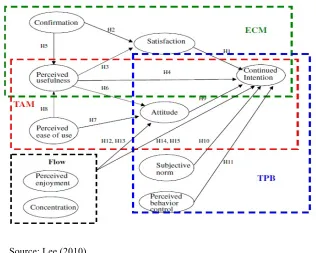
Technology Acceptance Model (TAM) was improved to evaluate how users manipulate and accept technology by theory of perceived usefulness and perceived ease of use describing user’s attitude to system (Su et al. 2010). Lee (2010) stated that expectation-confirmation model (ECM), technology acceptance model (TAM), theory of planned behaviour (TPB) and flow theory influenced to learners continuous learning (see figure 2.5).
For ECM, the five hypothesis are (H1) users’ satisfaction with e-learning is positively related to their continued e-learning usage intention, (H2) users’ confirmation of expectations is positively related to their satisfaction with e-learning, (H3) users’ perceived usefulness of e-learning is positively related to their satisfaction with e-learning, (H4) users’ perceived usefulness of e-learning is positively related to their continued e-learning usage intention, and (H5) users’ confirmation of expectations is positively related to their perceived usefulness of e-learning.
For TAM, both perceived usefulness and perceived ease of use are beliefs related to theory of reasoned action and may influence to user’s attitude (Fishbein & Ajzen 1975). These 3 hypothesis of TAM are (H6) Perceived usefulness is positively related to behavioural attitude toward e-learning, (H7) Perceived ease of use is positively related to behavioural attitude toward e-learning, and (H8) Perceived ease of use is positively related to perceived usefulness of e-learning.
For flow theory, users understand their activities and cannot remember any changes enclosing. The 4 hypotheses of flow theory are (H12) Perceived enjoyment is positively related to the attitude toward e-learning, (H13) Perceived enjoyment is positively related to the behavioural intention to use e-learning, (H14) Concentration is positively related to the behavioural attitude toward e-learning and (H15) Concentration is positively related to the behavioural intention to use e-learning.
Questionnaire survey, pilot test, sample plan and data collection are used for research methodology. Using questionnaire survey, two tested parts are choice measurement and question for participants (Lee 2010). Moreover, seven-point Likert scale uses for choice measurement. For pilot test, there are suitable sampling and evaluation of results using reliability coefficient and factor analysis. For sample plan and data collection, every element was tested with population controls (gender, age, studying levels) and website usage.
The result is described that satisfaction is most powerful predictor of users’ continuance attention, followed by perceived usefulness, attitude, concentration, and perceived behavioural control as significant but weaker predictors (Lee 2010)
[image:36.595.177.493.431.684.2]Source: Lee (2010)
Figure 2.5: Expectation-Confirmation Model (ECM), Technology Acceptance Model (TAM), Theory of Planned Behaviour (TPB) and Flow Theory
provides limited insight into the most appropriate technology selections to achieve the most optimal result.
2.2.4 Socio-Technical System (STS)
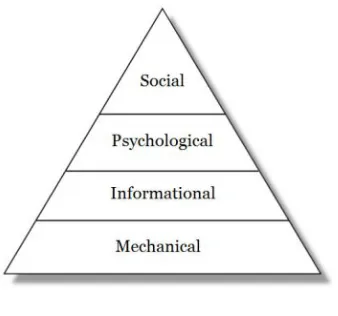
Fundamental to Socio-Technical System (STS) Design is common system theory (Bertalanffy 1968). The level of computing system (see figure 2.6) can be displayed with various levels that are 1) mechanical level: using technology (only hardware) as a tool that people build it, 2) informational level: use information technology including hardware and software to work together, 3) personal level: human computer interaction (HCI) conducts human needs for computing and HCI changes the information into meaning), and 4) community level: people create online community with hardware, software, personal, and community status (Whitworth & Ahmad 2013). STS is made according to personal and community requirements (Whitworth 2009).
Source: Whitworth and Ahmad (2013)
Figure 2.6: Computing applications and levels
Source: Whitworth and Ahmad (2013)
Figure 2.7: The computing requirements hierarchy
Knowledge is publicly created, communicated, and validated; and knowledge creation is either supported or forced by social interaction, for instance, collegial interaction affected teachers’ professional development (Park et al. 2007).
As communication has many levels, STS focuses on both individual and community. Also, knowledge will be generated when communities can exchange information with each other. Although STS shows that learning together enables the sharing of ideas and knowledge with both individuals and groups, it is not clear how individuals or groups should behave during these interpersonal communications.
2.2.5 Computer-Supported Communication and Collaboration Tools
As discussed in section 2.2.1 on Computer-Supported Collaborative Learning (CSCL), the process of collaboration can be supported by working groups and facilitating communication (White et al. 2010). Moreover, small groups are formed to support sharing ideas and feedback together with performance encouragement (Raelin 2002).
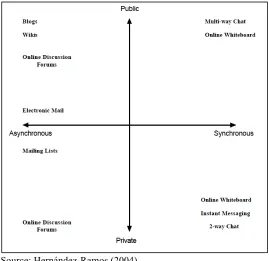
engagement, self reflection capabilities and critical thinking skills (Jin & Erben 2013). In addition, Blackboard Collaborate is one available synchronous academic tool that has a whiteboard, allow desktop sharing and recording, and can be used of engagement and communication during live sessions (Jones & Hansen 2014; Yeung 2013).
[image:39.595.199.468.180.441.2]Source: Hernández-Ramos (2004)
Figure 2.8: Computer-supported communication and collaboration tools
Teachers are encouraged to use technologies in order to investigate attitudes towards technology and intend personal preference for reflection (Shoffner 2009). Technology can be used to support teachers to increase students’ reflective learning with engagement in reflective tasks (Strampel & Oliver 2007).
Computer-Supported Communication and Collaboration tools are used for communication between individuals regardless of synchronous or asynchronous features. It also depends on convenience and the purpose of usage. Although CSCL shows that both synchronous and asynchronous communication modes are important for learning together, it is not possible to determine the extent to which each of the features is suitable for peer learning.
2.2.6 Game-Based Learning
Papagianni 2010). Video game enslavement is youth’s problem especially males and dependence is related to bad academic performance and offensive attitudes and manners (Hauge & Gentile 2003). Moreover, learners enjoy games in which they participate in the action as a role player and males tend to play games more than females (Paraskeva, Mysirlaki & Papagianni 2010).
It can be seen that academic games should be considered educational operation, self-appreciation, and computer self-capability (Paraskeva, Mysirlaki & Papagianni 2010). Effective Video game should consist of edutainment & academic games, motivation, story context, objectives and rules, and interactivity & multi-feeling cues (Dondlinger 2007). Learning theories for video games should include constructivism, constructionism, and cognitive procedures (Dondlinger 2007). Moreover, learning outcomes and gender preferences should be encouraged by design and improvement of academic game.
Gros (2007) claimed that digital games are user-centred to support challenges, communication, engagement and enhancement of problem solving procedures. Furthermore, commitment and motivation are important advantages of games using but academic aims may not be pleasing (Gros 2007). Gros (2007) also presented that using game will be achieve depend on staff or teacher support by their analysis and consideration. In addition, this approach can be time consuming and personal differences should be considered for successful learning.
Game computing can be an instrument for supporting productive geography studying and it also encourages learners’ motivation (Tüzün et al. 2009). However, Tüzün et al. (2009) claimed that good document and problem awareness should be considered according to possible implementation problem such as software, hardware, and infrastructure issues. Malone (Ebner & Holzinger 2007) claimed that satisfied computer game should have three important attributes including challenge, imagination, and inquisitiveness.
measurement. Ebner and Holzinger (2007) presented that prosperous game-based learning depends on abundance of motivation. Also, user-focused design at the starting of project is necessary with regard to learners’ knowledge existence. Game procedure was more sufficient and inspired than non-gaming procedure to advance learners’ knowledge (Papastergiou 2009).
Personal learner characteristics should be considered with regard to game design and together with thoughtfulness of pedagogical value of games (Papastergiou 2009). Kiili (2005) claimed that experiential gaming model concerned educational theory, flow theory, and game design by concentrating on sudden feedback, explicit objectives and challenges of players that are related to his/her skill level (see figure 2.9).
Source: Kiili (2005)
Figure 2.9: Experiential gaming model
The major objective of the model is to connect playing a game with empirical studying for the purpose of simplifying flow experience (Kiili 2005). In addition, both cognitive and behavioural actions are significant for studying. Nevertheless, social communication is not involved in this model. Moreover, increasing the skill of players and becoming more difficult game should be happened simultaneously for keeping player in game flow (Kiili 2005).