Comparative genome analysis indicates high
evolutionary potential of pathogenicity genes
in Colletotrichum tanaceti
Ruvini V. LelwalaID1, Pasi K. Korhonen1, Neil D. Young1, Jason B. ScottID2, Peter K. Ades3,
Robin B. Gasser1, Paul W. J. Taylor1*
1 Faculty of Veterinary and Agricultural Sciences, The University of Melbourne, Parkville, Victoria, Australia, 2 Tasmanian Institute of Agriculture, University of Tasmania, Burnie, Tasmania, Australia, 3 Faculty of
Science, The University of Melbourne, Parkville, Victoria, Australia
Abstract
Colletotrichum tanaceti is an emerging foliar fungal pathogen of commercially grown pyre-thrum (Tanacetum cinerariifolium). Despite being reported consistently from field surveys in Australia, the molecular basis of pathogenicity of C. tanaceti on pyrethrum is unknown. Herein, the genome of C. tanaceti (isolate BRIP57314) was assembled de novo and anno-tated using transcriptomic evidence. The inferred putative pathogenicity gene suite of C. tanaceti comprised a large array of genes encoding secreted effectors, proteases, CAZymes and secondary metabolites. Comparative analysis of its putative pathogenicity gene profiles with those of closely related species suggested that C. tanaceti likely has addi-tional hosts to pyrethrum. The genome of C. tanaceti had a high repeat content and repeti-tive elements were located significantly closer to genes inferred to influence pathogenicity than other genes. These repeats are likely to have accelerated mutational and transposition rates in the genome, resulting in a rapid evolution of certain CAZyme families in this species. The C. tanaceti genome showed strong signals of Repeat Induced Point (RIP) mutation which likely caused its bipartite nature consisting of distinct gene-sparse, repeat and A-T rich regions. Pathogenicity genes within these RIP affected regions were likely to have a higher evolutionary rate than the rest of the genome. This “two-speed” genome phenome-non in certain Colletotrichum spp. was hypothesized to have caused the clustering of spe-cies based on the pathogenicity genes, to deviate from taxonomic relationships. The large repertoire of pathogenicity factors that potentially evolve rapidly due to the plasticity of the genome, indicated that C. tanaceti has a high evolutionary potential. Therefore, C. tanaceti poses a high-risk to the pyrethrum industry. Knowledge of the evolution and diversity of the putative pathogenicity genes will facilitate future research in disease management of C. tanaceti and other Colletotrichum spp.
a1111111111 a1111111111 a1111111111 a1111111111 a1111111111 OPEN ACCESS
Citation: Lelwala RV, Korhonen PK, Young ND,
Scott JB, Ades PK, Gasser RB, et al. (2019) Comparative genome analysis indicates high evolutionary potential of pathogenicity genes in Colletotrichum tanaceti. PLoS ONE 14(5): e0212248.https://doi.org/10.1371/journal. pone.0212248
Editor: Craig Eliot Coleman, Brigham Young
University, UNITED STATES
Received: January 24, 2019 Accepted: May 2, 2019 Published: May 31, 2019
Copyright:©2019 Lelwala et al. This is an open access article distributed under the terms of the Creative Commons Attribution License, which permits unrestricted use, distribution, and reproduction in any medium, provided the original author and source are credited.
Data Availability Statement: Data are available
from NCBI (accession number PJEX00000000).
Funding: This research was funded by Botanical
Introduction
Plant pathogens cause diseases world-wide that have devastating economic, social and ecologi-cal consequences [1]. Fungi are among the dominant causal agents of plant diseases [2] and the genusColletotrichumhas been ranked among the top-ten most important fungal plant pathogens [3]. ManyColletotrichumspecies are known to cause major economic losses glob-ally, and have been extensively used in the study of the molecular and cellular bases of fungal pathogenicity [4]. The publication of 25 whole genome sequences ofColletotrichumspecies has significantly improved understanding of the biology, genetics and evolution of this genus [5–11]. However, a large research gap still exists with this ever-expanding genus consisting of more than 200 accepted species [12] and 14 major species complexes [13,14]. The availability of only one genome of a member of the destructivum complex,C.higginsianum, [5,15] has constrained comparative studies within and among species complexes. Insights into the geno-mic organization and the pathogenicity gene repertoire of otherColletotrichumspecies in the destructivum complex therefore, will significantly expand the knowledge base of this impor-tant genus.
Colletotrichum tanaceti, a member of the destructivum complex [16], is an emerging foliar fungal pathogen [17] of Dalmatian pyrethrum (Tanacetum cinerariifolium). Pyrethrum is commercially cultivated as a source of the natural insecticide pyrethrin [18].Colletotrichum tanacetihas been consistently reported in Australian field surveys of the crop [19] since 2012 [17] and causes leaf anthracnose, with black, water-soaked, sunken lesions [17]. Due to its hemibiotrophic lifestyle, characteristic symptoms ofC.tanacetiare not evident on leaves until around 120 hours after infection [17,20], when it switches from biotrophy to necrotrophy. A significant reduction in green leaf area occurs usually 10 days after infection [17]. This suggests a rapid disease cycle forC.tanacetiin pyrethrum and, given its aggressiveness, the potential for serious crop damage. The molecular basis of pathogenicity ofC.tanaceti, which includes the pathogenicity genes and their evolution, has not been studied. The genome sequence of an emerging plant pathogen such asC.tanacetiis a good source for identifying putative genes associated with the pathogen life cycle, pathogenicity and virulence. Effectors [21], proteases [22], and carbohydrate active enzymes (CAZymes) [23] are such important gene categories in fungal pathogenesis. Furthermore, secondary metabolites and transporters,P450sand tran-scription factors [24] associated with biosynthesis of secondary metabolites are also important pathogenicity factors. Fungal mitogen activated protein (MAP) kinase pathways regulate the cascade of reactions that respond to various environmental stresses and are also important fac-tors determining pathogenicity and virulence [25]. Draft genomes of many fungal pathogens have been used to infer genes involved in pathogenicity with a high accuracy [26,27] using homology searches against curated databases [28,29] andde novoinference using bioinfor-matics tools [21,30]. Identification of putative pathogenicity genes ofC.tanacetiis fundamen-tal for assessing the present risk of the pathogen, for future studies of functional validation and ultimately for economic disease management.
The genome of a pathogen is also a good source for assessing evolutionary potential [31–
33] as the adaptive evolution increases with the plasticity of the genome [34,35]. In filamen-tous plant pathogens, repeat-rich gene-sparse genomic regions tend to harbor genes that are involved in pathogenicity and host adaptation [35] and evolve at higher rates than the rest of the genome giving rise to “two-speed genomes” [36]. Repeat-induced-point mutation (RIP) is a fungal-specific mechanism for limiting transposon proliferation below destructive levels [37]. Over time, RIP can cause the formation of A-T rich regions and is a mechanism facilitat-ing two-speed fungal genomes [38–41]. The genome ofC.tanacetican be used to identify such NHMRC Career Development Fellowship
-APP1109829 (https://nhmrc.gov.au/). PK Korhonen was supported by NHMRC Early Career Research Fellowship - APP1127033 (https:// nhmrc.gov.au/). The funders had no role in study design, data collection and analysis, decision to publish or Preparation of the manuscript.
Competing interests: The authors have declared
genomic architecture and their relationship to pathogenicity genes, in order to assess the plas-ticity and thereby the evolutionary potential.
Comparative genomics has enabled inference of patterns of speciation, pathogenesis and host determination withinColletotrichumlineages [42]. These studies have indicated that the gain and loss of putative pathogenicity gene families inColletotrichumgenomes are important determinants of host specificity and pathogenic adaptation of these species [7,9–11,43]. Colle-totrichum tanacetihas only been reported from pyrethrum in Australia but may have crossed over from another host plant species. However, cross-host pathogenicity has not yet been assessed and the potential host range of the pathogen is currently unknown. Comparison of putative pathogenicity gene repertoires ofColletotrichumspecies from different species com-plexes and species closely related to the genusColletotrichummay provide insights into evolu-tion of pathogenicity gene and the host range ofC.tanaceti. Therefore, combined genomics and comparative genomics analyses can provide sound means of assessing the current and future risks posed byC.tanaceti.
In order to achieve the major goal of evaluating the potential risk to the pyrethrum industry formC.tanaceti, the aims of this study were to: 1) infer the pathogenicity gene suite ofC. tana-ceti; 2) infer the host range ofC.tanaceti; and 3) assess the evolutionary potential of pathoge-nicity genes ofC.tanaceti.
Materials and methods
Sequencing and
de novo
-assembly of the genome of
C
.
tanaceti
Fungal strain. The ex-holotype ofC.tanacetistrain BRIP57314 (CBS 132693 = UM01) [17] was acquired from the culture collection of BRIP (Plant Pathology Herbarium, Depart-ment of Primary Industries, Queensland, Australia). This isolate was propagated on potato dextrose agar (PDA; Sigma Aldrich, St. Louis, USA) and incubated at 24˚C using a 12 h:12 h light:dark photoperiod. Genomic DNA was isolated using a modified CTAB protocol [44]. The integrity and quantity of DNA was confirmed by 1.5% agarose gel electrophoresis and a nanodrop spectrophotometer (Thermo Fisher Scientific, Waltham, USA).
Genome sequencing and assembly. Genomic DNA was fragmented using a Covaris ultrasonicator (Covaris Inc., Massachusetts, USA) to achieve an average fragment length of 532 base pairs (bp). A genomic DNA library with an average insert size of 420 bp was constructed using the KAPA Hyper Prep Library Preparation Kit [45] and was paired-end sequenced (2×300 bp reads) using the Illumina Miseq platform (San Diego, USA). The raw reads were filtered for low quality nucleotides and adapters using Trimmomatic [46] (Phred score-33, leading-3, trailing-6, slidingwindow-4:15, minlen-36) to retain 22,871,341 sequences and were profiled using KAT [47]. Filtered reads were then assem-bled using DISCOVARde novo[48]. The completeness of the assembly was assessed with the Sordaromyceta_odb9gene set [49] using the program Benchmarking Universal Single-Copy Orthologs (BUSCO v2) [49] in the Genomics Virtual Laboratory platform [50].
RNA sequencing
Inoculation of pyrethrum leaves. Pyrethrum leaves were inoculated using the leaf-sand-wich method [58,59] by placing a fungal ‘mat’ between two pyrethrum leaves in a petridish. Each petri dish was sealed with parafilm and incubated at 24˚C with a 12 h-photoperiod. Induced mycelia were harvested at 6, 24 and 48 h after inoculation, and total RNA was extracted using the RNeasy Plant Mini kit (Qiagen, Australia) following the manufacturer’s instructions. Total RNA was extracted from the saprobic stage (1-week-old cultures growing on potato dextrose agar). Contaminating genomic DNA was removed from RNA samples by Ambion DNase I (Thermo Fisher Scientific, USA) treatment; the integrity and quantity of total RNA was confirmed by 1% agarose gel electrophoresis and the Experion automated elec-trophoresis system (Biorad Laboratories, Australia).
RNA libaries were prepared using both E7530L and E&335L NEBNext Ultra RNA Library Prep Kits (New England Biolabs, USA) to generate fragment sizes of 351–371 bp. The tran-scriptome was paired-end sequenced (2×150 bp reads) on the Illumina Hiseq 2500 platform (San Diego, USA). Raw reads were trimmed for quality using Trimmomatic [46] (leading-25, trailing-25, slidingwindow-4:25, minlen-40) to retain between 17,935,938–18,761,773 sequences for each library and profiled using FastQC [60].
Gene prediction
Genes were first predicted using the MAKER3 v3.0.0-beta [61], in which both the transcrip-tomic data fromC.tanacetiand the proteomic andab initiogene predictions fromC. gramini-cola;[43] andC.higginsianum;[43,62] were combined into a consensus prediction. In brief, transcriptomic RNAseq reads ofC.tanacetiwere assembled into transcripts in bothde novo and genome-guided modes of the program Trinity v2.2.0 [63]. In genome guided assembly, reads were mapped onto the genome using the program TopHat2 v2.1.0 [64]. Genome guided andde novotranscriptomic assemblies were combined, redundancy (99% similarity) was removed using the program cd-hit-est [65,66] and resulting transcripts were filtered for full-length open reading frames (ORFs) using the program Transdecoder [63]. Resulting full-length transcripts were further reduced to 80% similarity using the program cd-hit-est and checked for splicing sites. These high quality transcripts were then used as a training set forab initiogene prediction programs AUGUSTUS v3.1 [67] and SNAP v6.7 [68] and GENEMARK v4.2.9 [69]. Evidence data from assembled transcriptomes (with 99% redundancy using cd-hit-est) and the proteomes were provided to Maker3. The predicted genes (length of conceptually translated protein�30 amino acids) were further clustered using thek-means clustering algo-rithm [70] with following metrics: 1) Maker3 annotation edit distance (AED); 2) number of exons in the mRNA; 3) length of translated protein sequence; 4) fraction of exons that overlap transcript alignment; 5) fraction of exons that overlap transcript and protein alignment; 6) fraction of splice sites confirmed by a SNAP prediction from Maker3; 7) percentage for repeat overlap with gene-, exon- and CDS-sequence; 8) size of the inferred orthologous group the gene belongs to using OrthoMclv2.0.9 [71]; and 9) presence of functional annotation (see Functional annotation of theC.tanacetigenome section below). Resulting clusters with trans-posons andab initiogene predictions with no transcriptome or proteome support were removed.
Functional annotation of the
C
.
tanaceti
genome
InterProScan 5 [73]. Additionally, Kyoto Encyclopedia of Genes and Genomes (KEGG) Orthology (KO) terms were assigned to predicted proteins using the Blastkoala search engine [74]. Assigned KO terms were used to generateC.tanacetipathway maps using KEGG mapper [75]. Putative genes ofC.tanacetiwith functional annotations were subjected to species-spe-cific gene enrichment analysis on the DAVID functional annotation database tool [76,77] and usingC.graminicolaas the reference species.
Comparison to related taxa
The genome and proteome ofC.tanacetiwas compared to genomes of related taxa using genome alignment, synteny and orthology analyses as following.
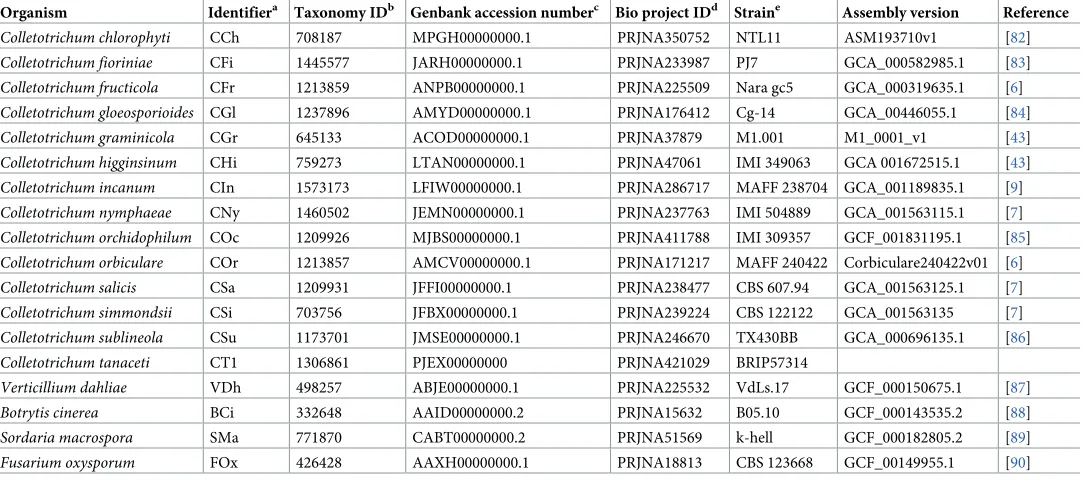
Genome alignment and synteny analysis. Colletotrichum tanacetigenome contigs were aligned to 13 other publicly available genomes (Table 1) ofColletotrichumspecies using Nuc-mer in MumNuc-mer v 4.0 [78,79]. Contig-alignments were then filtered for a minimum 30% nucleotide identity and 200 bp in aligned length. The global coverage of each of the genomes from contigs ofC.tanacetiwas computed as a measure of pairwise sequence comparison between the two genomes.
[image:5.612.36.582.378.618.2]The program ‘Synteny Mapping and Analysis Program’, SyMAP v 4.2 [80,81] was used to mapC.tanaceticontigs of the highest sequence length (>150 kb) to the chromosomes ofC. higginsianumIMI349063 reference genome [43] to identify the syntenic regions. PROmer was invoked within SyMAP.
Table 1. Genomes used in the comparative genomic analyses.
Organism Identifiera Taxonomy IDb Genbank accession numberc Bio project IDd Straine Assembly version Reference
Colletotrichum chlorophyti CCh 708187 MPGH00000000.1 PRJNA350752 NTL11 ASM193710v1 [82]
Colletotrichum fioriniae CFi 1445577 JARH00000000.1 PRJNA233987 PJ7 GCA_000582985.1 [83]
Colletotrichum fructicola CFr 1213859 ANPB00000000.1 PRJNA225509 Nara gc5 GCA_000319635.1 [6]
Colletotrichum gloeosporioides CGl 1237896 AMYD00000000.1 PRJNA176412 Cg-14 GCA_00446055.1 [84]
Colletotrichum graminicola CGr 645133 ACOD00000000.1 PRJNA37879 M1.001 M1_0001_v1 [43]
Colletotrichum higginsinum CHi 759273 LTAN00000000.1 PRJNA47061 IMI 349063 GCA 001672515.1 [43]
Colletotrichum incanum CIn 1573173 LFIW00000000.1 PRJNA286717 MAFF 238704 GCA_001189835.1 [9]
Colletotrichum nymphaeae CNy 1460502 JEMN00000000.1 PRJNA237763 IMI 504889 GCA_001563115.1 [7]
Colletotrichum orchidophilum COc 1209926 MJBS00000000.1 PRJNA411788 IMI 309357 GCF_001831195.1 [85]
Colletotrichum orbiculare COr 1213857 AMCV00000000.1 PRJNA171217 MAFF 240422 Corbiculare240422v01 [6]
Colletotrichum salicis CSa 1209931 JFFI00000000.1 PRJNA238477 CBS 607.94 GCA_001563125.1 [7]
Colletotrichum simmondsii CSi 703756 JFBX00000000.1 PRJNA239224 CBS 122122 GCA_001563135 [7]
Colletotrichum sublineola CSu 1173701 JMSE00000000.1 PRJNA246670 TX430BB GCA_000696135.1 [86]
Colletotrichum tanaceti CT1 1306861 PJEX00000000 PRJNA421029 BRIP57314
Verticillium dahliae VDh 498257 ABJE00000000.1 PRJNA225532 VdLs.17 GCF_000150675.1 [87]
Botrytis cinerea BCi 332648 AAID00000000.2 PRJNA15632 B05.10 GCF_000143535.2 [88]
Sordaria macrospora SMa 771870 CABT00000000.2 PRJNA51569 k-hell GCF_000182805.2 [89]
Fusarium oxysporum FOx 426428 AAXH00000000.1 PRJNA18813 CBS 123668 GCF_00149955.1 [90]
aShort identifier used in pace of the species name in supplementary information
bTaxonomy ID of each species according to the NCBI taxonomy database
cGenbank accession number for the deposited nucleotide sequence
dNCBI bioproject ID
eversion of the genome assembly
Orthology search and phylogenomics analysis. The proteomes ofC.tanacetiand the publicly available 17 other species were subjected to ortholog searching using OrthoMCL v2.0.9 [71] and MCL [91] with an inflation value of 1.5. The orthoMCL output was used to determine the percent orthology among the species and to determine the core gene set for Col-letotrichum. The ortho-groups with pathogenicity genes (inferred as below) ofC.tanacetiwere extracted and used to determine the percent conservation of those gene categories within the genus. Furthermore the single copy orthologs were extracted from the orthoMCL output and aligned using MAFFT v.7 [92]. These alignments were then trimmed using trimAl v.1.3 [93] to remove all positions in the alignment with gaps in 20% or more of the sequences, unless this leaves less than 60% of the sequence remaining. The trimmed reads were concatenated using FASconCAT-G [94]. The concatenated alignment was partitioned and amino acid substitution models were predicted for each partition using ProtTest 3 [95] in FASconCAT-G. The parti-tioned, concatenated alignment was subjected to maximum likelihood phylogenetic analysis using RAxML v8.2.10 [96] to find the best tree from 20 maximum likelihood searches and using 100 bootstrap replicates. Evolutionary distance in number of substitutions per site was computed using theapepackage [97] in the R statistical language framework v 3.5.1. [98] from the maximum likelihood tree.
Estimation of divergence dates. The phylogram developed from above was utilized to estimate the divergence dates of the species considered as following. The final RAxML phylo-genetic tree was used to generate an ultrametric tree in r8s v1.81 [99] applying the penalized likelihood method [100] and the truncated Newton (TN) algorithm [101]. Divergence times were estimated using previously derived estimates [8,11,102] of 267–430 million years (Myr) for the Leotiomycetes-Sordariomycetes crown, 207–339 Myr for the Sordariomycete crown and 45–75 Myr for theColletotrichumcrown as calibrations. An optimal smoothing factor which was deduced using the cross validation process [99] among 50 values across 1 to 6.3e +09 was used in the divergence time estimation.
Prediction of secretome and database searches for identifying other
virulence factors
inhibitor units) of MEROPS release 12.0 [111]. Furthermore, potential virulence factors ofC. tanacetiwere identified by blastp searches (E-value�1e-10) against PHI-base v 4.4 [28]. The online analysis tools, Antibiotics and Secondary Metabolite Analysis Shell (antiSMASHV.4) [30] with default parameters and SMURF [112] were used to predict potential secondary metabolite backbone genes and clusters using the default parameters. Cytochrome P450s and transporters were described based on blastp (E-value�1e-10) homology searches against the Fungal Cytochrome P450 database [113] and the Transported Classification Database [114]. The functional annotations forC.tanacetiwere compared across 17 other closely related taxa (Table1). The family specific Hidden Markov Model profiles of dbCan database v6 [115] were employed using the program HMMScan in HMMER v31.b2 [116] in order to identify the car-bohydrate active enzymes (CAZymes) and the CAZyme families in the proteome ofC. tana-ceti. Fungi-optimal cut-off E-value of 1e-17 and a coverage cut-off of 0.45 [115] were used in the analysis which was repeated for seventeen related species (Table 1). The identified CAZymes were run though InterProScan 5 [73] (E-value�1e-10) to check for false positives. The member counts of each CAZyme family for each taxon were corrected accordingly.
Evolution of CAZyme gene families
CAFE v4.0 [117,118] was used to estimate the number of CAZyme gene family expansions, contractions and the number of rapidly evolving gene families upon divergence of different lineages. Error-models [118] were estimated to account for the genome assembly errors and were incorporated into computations. A universal lambda value (maximum likelihood value of the birth-death parameter) was assumed and gene families with significant size variance were identified using a probability value cut-off of 0.01. The branches responsible for signifi-cant evolution, were further identified using the Viterbi algorithm [117] with a probability value cutoff of 0.05. Sizes of plant pathogenicity-related gene families from CAZomes of each of the species; the ‘CAZyme pathogenicity profiles’ were retrieved and compared using the online tool ClustVis [119]. The ‘CAZyme pathogenicity profile’ of a particular species included the gene families that have activities in binding to or degradation of plant cell wall components such as cellulose, hemicelluloses, lignin, pectin, cutin and chitin.
Testing for the bipartite nature of the
C
.
tanaceti
genome
The GC-bias of the genome was detected using OcculterCut version 1.1 with default settings [37]. The genome wide dinucleotide frequency and the two RIP indices, TpA/ApT and (CpA + TpG)/(ApC + GpT) were computed and the RIP affected genomic regions were identified using the RIPCAL V.2 [120]. Significant enrichment of A-T rich regions of theC.tanaceti genome with interspersed repeats and RIP were tested using permutation tests implemented in the package regioneR in the R statistical language framework v3.5.1 [98] with the evaluation function for number of overlaps [121]. Ten thousand random iterations were conducted, from which aZ-statistic estimate, and its associated probability, were computed.
Relationship of pathogenicity related genes with repeat elements and RIP
RIP affected region was compared against a distribution of distances of random samples from the whole genome. Ten thousand random iterations were conducted, from which aZ-statistic estimate, and its associated probability, were computed for each gene category.
Results
Colletotrichum tanaceti
genome and gene content
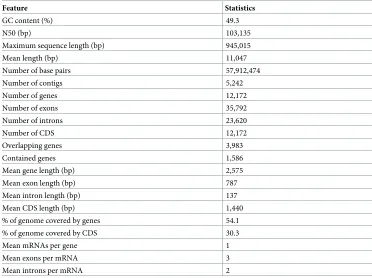
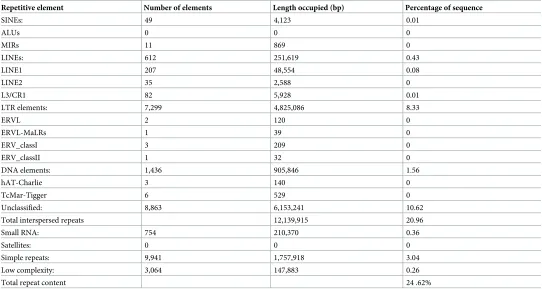
The genome of isolate BRIP57314 was assembled into 5,242 contigs with an N50 value of 103,135 bp and assembly size of 57.91Mb. The average GC content was 49.3% (Table 2). The genome size and GC content ofC.tanacetiwas within the range previously reported for other Colletotrichumspp. (S1 Fig). Draft genome assembly and the raw unassembled sequences are available under the accession no PJEX00000000 in Genbank. The genome contained 12,172 coding genes with an average gene length of 2,575bp. Mean exon count per gene was 3, and 54.1% of the genome sequence contained protein-encoding genes. In the BUSCO analysis, out of the 3,725 benchmarking genes in the Sordariomycetes group, the genome was reported to contain 3,656 complete BUSCOs (98.2%), of which two were duplicated and the rest were sin-gle copy genes (98.1%). A total of 30 (0.8%) BUSCOs were fragmented and 39 were missing (1.0%). The repeat content ofC.tanacetiwas 24.6% of the total genome of which 85.2% was interspersed repeats (Table 3).
[image:8.612.198.570.421.699.2]Of the 12,172 predicted proteins, 11,352 had an annotation edit distance (AED) value of less than 1.0, and 2962 genes had an AED value of zero. The number of genes without putative annotation from the public database searches was only 958. A total of 8,945 proteins (73.5% of proteome) had InterProScan annotations of which 6,911 contained 9,647 Pfam domain anno-tations and 5,452 had GO term ontology annotation. The most abundant (n= 129) Pfam domain was the cytochrome P450 family (PF00067) followed by the protein kinase domain
Table 2. Features of theColletotrichum tanacetiBRIP57314 genome.
Feature Statistics
GC content (%) 49.3
N50 (bp) 103,135
Maximum sequence length (bp) 945,015
Mean length (bp) 11,047
Number of base pairs 57,912,474
Number of contigs 5,242
Number of genes 12,172
Number of exons 35,792
Number of introns 23,620
Number of CDS 12,172
Overlapping genes 3,983
Contained genes 1,586
Mean gene length (bp) 2,575
Mean exon length (bp) 787
Mean intron length (bp) 137
Mean CDS length (bp) 1,440
% of genome covered by genes 54.1
% of genome covered by CDS 30.3
Mean mRNAs per gene 1
Mean exons per mRNA 3
Mean introns per mRNA 2
(n= 127; PF00069). Gene enrichment analysis suggested enrichment of many GO terms including those associated with translation and chromosome telomeric region (S1 Table). Putative proteins ofC.tanacetiwere subjected to KEGG pathway analysis which returned assignment of 5,883 proteins to known pathways (S2 Table). The highest number of KO identi-fiers was among the metabolic pathway assignments (n= 693) of which the majority (n= 363) were for amino acid metabolism followed by carbohydrate metabolism (n= 290) (S3 Table). Among the environmental information processing pathways, 81C.tanacetigenes were assigned into 47 KO identifiers belonging to MAPK pathway (S4 Table). Furthermore, 24C. tanacetiproteins were annotated with 10 aflatoxin biosynthesis pathway KO assignments (S5 Table) and 56 proteins were assigned KOs for ABC transporters (S6 Table).
Genome alignment and synteny
[image:9.612.35.577.88.377.2]The global alignment coverage of 13 otherColletotrichumgenomes fromC.tanaceticontigs was proportionate to the evolutionary proximity toC.tanaceti(Fig 1A). The highest coverage was inC.higginsianum(63.8%) and the least was inC.orbiculare4.26%. Among theC.tanaceti contigs aligned to the chromosomes ofC.higginsianum, the best alignment coverage was to chromosome NC_030961.1 (chromosome 9) (S7 Table).Colletotrichum tanaceticontigs (n= 155 of size�10 kb) were mapped in SyMAP synteny analysis to form 142 synteny blocks which covered 44.0% of theC.higginsianumand 80.0% of theC.tanacetisequences that were used (S2 Fig). Genes were present in 92.0% of the syntenic regions inC.tanacetiand in 77.0% ofC.higginsianum. No inverted synteny blocks were reported. Despite the highest coverage in C.higginsianumchromosome 9, the largest synteny block was identified between the complete C.tanaceticontig 4 (945.01 kb of length) andC.higginsianumchromosome NC_030954 Table 3. Repetitive elements of theC.tanacetigenome.
Repetitive element Number of elements Length occupied (bp) Percentage of sequence
SINEs: 49 4,123 0.01
ALUs 0 0 0
MIRs 11 869 0
LINEs: 612 251,619 0.43
LINE1 207 48,554 0.08
LINE2 35 2,588 0
L3/CR1 82 5,928 0.01
LTR elements: 7,299 4,825,086 8.33
ERVL 2 120 0
ERVL-MaLRs 1 39 0
ERV_classI 3 209 0
ERV_classII 1 32 0
DNA elements: 1,436 905,846 1.56
hAT-Charlie 3 140 0
TcMar-Tigger 6 529 0
Unclassified: 8,863 6,153,241 10.62
Total interspersed repeats 12,139,915 20.96
Small RNA: 754 210,370 0.36
Satellites: 0 0 0
Simple repeats: 9,941 1,757,918 3.04
Low complexity: 3,064 147,883 0.26
Total repeat content 24 .62%
(Chromosome 1). A total of 38 effector candidates ofC.tanacetiwere within these syntenic regions betweenC.tanacetiandC.higginsianum. No synteny blocks were detected to the two mini chromosomes (NC_030963.1 and NC_030964.1) ofC.higginsianum.
Orthology search
Of 221,456 total genes from 18 genomes, the number of core genes reported for all ascomy-cetes in the orthology analysis was 3,944. A total of 10,695 putative proteins fromC.tanaceti were assigned to 10,074 groups containing orthologs and/or recent paralogs and/or co-ortho-logs across all species tested. A total of 6,002 genes were conserved in all tested members of the genusColletotrichum.Colletotrichum tanacetihad 9,679 orthologs withC.higginsianumwhich was the highest ortholog count amongColletotrichumspp. followed by 8,855 orthologs withC. nymphaea(Fig 1B). Twenty of these groups, with 48 genes among them were exclusive toC. tanacetiand were defined as recent paralogs (in-paralogs) ofC.tanacetiwith no homology to the 16 other species tested.
Divergence time in
Colletotrichum
lineages
A total of 2,214 single copy ortholog (SCO) genes identified among theC.tanacetiand 17 closely related genomes (Table 1) were used to generate a maximum likelihood (ML) evolu-tionary tree in which all branches achieved bootstrap support of 100%.Colletotrichum tanaceti formed a clade withC.higginsianum, a member of the destructivum complex and the two destructivum complex members formed a sister clade with the graminicola complex members andC.incanum. A smoothing factor value of 1 was reported as the optimal value for diver-gence time predictions in r8s.Colletotrichum tanacetiandC.higginsianumwere reported to have diverged ~9.97 million years ago (mya). The most recent common ancestor (MRCA) of gloeosporioides, acutatum, and graminicola clades were reported to be 6.12, 10.98 and 15.78 mya, respectively (Fig 2).
Identification of pathogenicity related genes in
C
.
tanaceti
Secretome ofC.tanaceti. Of the 12,172 putative proteins, 1,024 (8.41%) were predicted to be secreted. A total of 2,702 Conserved Domain Database (CDD) domains were found in the secretome. Of these, 287 were specific features with NCBI curated models, 124 were generic features with only the superfamily annotations [122]. Only 433 queries had no known domain hits. The secretome was rich in alpha beta hydrolase superfamily (cl21494) containing enzymes, glycosyl hydrolases and proteolytic enzymes and cytochrome P450 monoxygenases (P450) (S8 Table). A total of 100 secreted proteins had nuclear-localization signals (S8 Table). A total of 233 putative effector candidates were predicted by EffectorP. Following manual inspection and filtering out candidates with known plant cell wall degrading catalytic domains, a total of 170 candidates were selected as putative effectors ofC.tanaceti(S9 Table). The puta-tive secreted candidate effector repertoire ofC.tanaceticontained homologs of known effec-tors, such as theEcp6ofCladosporium fulvum[123],MC69ofMagnoporthe oryzaeand Colletotrichum orbiculare[124],EP1ofColletotrichum graminicola[125],NLP1of Colletotri-chum higginsianum[126]ToxBofPyrenophora tritici repentis[127] andMagnoporthe oryzae
Fig 1. Comparison of theC.tanacetigenome to previously publishedColletotrichumspp. genomes. (a) Percentage global alignment (y axis) of 13
Colletotrichumdraft genomes to contigs representing theC.tanacetidraft genome, plotted against evolutionary distance with reference toC.tanaceti(x axis), (b) Number of orthologs shared by 13Colletotrichumdraft genomes andC.tanaceti(y axis) plotted against the evolutionary distance with reference toC.tanaceti(x axis); evolutionary distance given in number of substitutions per site, computed using the ape package [98] in R from a maximum likelihood tree.
Bas3[128]. Furthermore, among the putative effector candidates, there were proteins with conserved domains of known virulence factors. Most effector candidates were small (average length of 157 amino acids) and rich in cysteine (average cysteine composition was 3.3%) which are the hallmarks of effectors. A total of 78 conserved motifs of fungal effectors [129] were present in 62 effector candidates which had at least one motif each. Twenty-two effector candidates that did not cluster in ortholog search among the 14Colletotrichumand three related species, and also did not show detectable homology to the NCBI-nr and swissprot data-bases were defined asC.tanaceti-specific. Only 25% of the putative effectors ofC.tanaceti were conserved among all 14Colletotrichumspp.
A total of 98 putative secreted peptidases were predicted with the majority (n= 64) being serine peptidases largely comprising the S08 and S09 subfamilies. The second most abundant class was the metallo peptidases (n= 19) (S10 Table). All six putative aspartic peptidases belonged to subfamily A01. A total of 20 putative secreted peptidase inhibitors were reported inC.tanaceticomprising two carboxypeptide-y inhibitors, five family-19 inhibitors and 13 family-14 inhibitors (S11 Table). Forty nine percent of the putative proteases ofC.tanaceti were among the “core” set of proteases ofColletotrichumspp. tested.
[image:12.612.72.577.78.364.2]Secondary metabolite-related genes and clusters. Forty-one putative secondary metabo-lite backbone genes were predicted inC.tanacetiusing SMURF and the majority were polyke-tide synthases (PKS,n= 13) with four PKS-like proteins. Furthermore, nine non-ribosomal peptide synthases (NRPS), eight NRPS–like proteins, two hybrid PKS-NRPS enzymes and five dimethylallytryptophan synthases (DMATS) were also predicted as backbone genes (S12 Table). A total of 52% of these putative backbone genes were within the core set of genes in Colletotrichum. A total of 33 putative secondary metabolite gene-clusters were predicted Fig 2. Chronogram showing divergence time estimations (in million years) forColletotrichumspp. and related taxa.
surrounding the backbone genes. However, the program antiSMASH predicted a total of 50 clusters. Among the clusters, there were twelve typeІPKS, two typeІІІPKS, thirteen terpenes, eleven NRPS, four indoles, three typeІPKSs-NRPS, one typeІPKS-indole and four other pro-teins. Cluster 10 of typeІPKS showed 100% similarity to the genes in LL-Z1272 beta biosyn-thetic gene cluster (BGC0001390_cl). Furthermore, a homolog to the melanin biosynbiosyn-thetic geneSCD1was also reported inC.tanaceti(CTA1_6632). When predictions from the two tools were compared, putative SMB clusters on 31 contigs ofC.tanacetiwere predicted by both tools and 19 of the backbone genes from SMURF were also predicted in antiSMASH (S12 Table). A total of 37 putative SM clusters were within the syntenic blocks ofC.higginsianum. The conserved SM domains identified in each cluster were reported (S13 Table). Predictions from antiSMASH were compared across taxa and majority of the clusters were typeІPKS like followed by NRPS in all ascomycetes compared (Fig 3A). The highest number of clusters were reported fromC.fructicola(n= 84) followed byC.higginsianum(n= 74) andC. gloeospor-ioides(n= 73). The composition of the SMB gene cluster composition ofC.tanacetiwas most similar toC.orchidophilum, the acutatum complex members andC.orbiculare(S3 Fig).
Cytochrome P450 monoxygenases (P450s) and transporters. In theC.tanacetigenome, 1,457 putative genes had homologs in the fungal cytochrome P450 database (S14 Table) and 911 out of that had>30% identity. There were 1,824 homologs (S15 Table) in the transport classification database forC.tanacetiwith 1,276 genes with>30% identity. The majority (n= 430) of the homologs were genes of the major facilitator superfamily (MFS, 2.A.1) fol-lowed by 129 genes of the ABC transporter family (3.A.1) and 123 of N.P.C 1.I.1. Within Colletotrichumgenus, members of the gloeosporioides complex had the highest number of homologs for both P450s and transporters (Fig 3B).
Homologs in PHI-base. A total of 3,497 homologs were recorded inC.tanacetifrom the pathogen-host interaction database (PHI), of which 1,592 represented homologs of genes that result in reduced virulence in loss of function mutants (S16 Table). The second most common (n= 1,514) were the unaffected pathogenicity category, 382 homologs were for loss of pathoge-nicity and 42 were in the effector category. Notably, 141 homologs were reported to genes of which the loss of function mutants were lethal to the pathogen and 103 homologs were reported to genes in which virulence increased after loss of function mutation (Fig 3C). The two gloeosporioides complex members had the highest number of homologs in the database among theColletotrichumspp., followed by the acutatum complex species,C.simmondsii,C. fioriniaeandC.nymphaea. DespiteC.higginsianumhaving a large number of homologs,C. tanacetihad a below average number for all the categories among theColletotrichumspp., with a profile similar toC.orchidophilum,C.chlorophytiandC.graminicola(S4 Fig).
CAZymes. A total of 608C.tanacetiproteins were assigned to 121 CAZyme families of which 43% was putative glycosyl hydrolases followed by 18% of putative redox enzymes (auxil-iary activities) and 14% putative carbohydrate esterases (S17 Table). Putative carbohydrate binding molecules and polysaccharide lyases both formed 7% each of theC.tanacetiCAZome whereas 11% was glycosyltransferases. A total of 179 CAzymes were secreted (S17 Table). Members of the gloeosporioides and acutatum complexes had the largest CAZomes among Colletotrichumspp. The CAZyme repertoires of the graminicola complex members were rela-tively small (Fig 3D).
Evolution of CAZyme families upon divergence of Colletotrichum lineages
(family-widepvalue�0.05), of which 21 were rapidly evolving (family-widep�0.01 and Viterbi p�0.01 in any lineage) (S18 Table).
[image:14.612.73.571.78.428.2]At the divergence ofColletotrichumspp., 39 expansions and 12 contractions were predicted with respect to its MRCA withVerticilliumspecies (S19 Table). Expansions included the lignin hydrolase family AA2, pectin degrading polysaccharide lyase families (PL1, 3, 4, 9 and GH78), lignocellulose degrading families (AA3, AA9, GH131, GH5, GH6, GH7), hemicelluloses degrading families (CE1, CE4, CE5, CE12, GH3, GH16, GH30, GH43, GH51, GH67, and GH10), Lys M domain containing family CBM50 and cutinase family CE5. The cellulose degrading family GH131 was the only rapidly evolving CAZyme family (family-widep�0.01 andViterbi p�0.01) which expanded upon the divergence ofColletotrichumspp. Within the genus, the highest number of expansions (n= 38) was reported at the divergence of the gloeos-porioides-complex clade with only 4 contractions. Notably, the CBM18 and GH10 families were contracted and many families with plant cell wall degrading enzyme activity were expanded. The rapidly and significantly expanded families, (family-widep�0.01 andViterbi
Fig 3. Composition of different pathogenicity gene categories predicted forColletotrichum tanacetiand related species. The number of genes in each gene
category (x axis) plotted for each species (y axis). (a) secondary metabolite biosynthetic gene clusters-(gene clusters producing polyketides, terpenes, non-ribosomal peptides (NRPS), indoles and the hybrids of above); (b) number of homologs in the fungal cytochrome P450 database and the transporter classification database (TCDB); (c) homologs in the pathogen-host interaction database; homologs to entries in the “unaffected pathogenicity” database were excluded; (d) CAZyme classes; glycoside hydrolases (GH), polysaccharide lyases (PL), glycosyltransferases (GT), carbohydrate esterases (CE), molecules with auxiliary activities (AA), and carbohydrate binding molecules (CBM).
p�0.01) upon the divergence of the gloeosporioides-complex clade include GH43, GH106, CBM50 and AA7. At the divergence of the acutatum-complex clade, there were 22 expansions, of which expansions in GH78, GH43 families were rapid and significant and there was only one contraction. The divergence event of the graminicola-complex clade involved contractions in many CAZyme families with pectin degradation activity showing significant, rapid contrac-tions (family-widep�0.01 andViterbi p�0.01)in families AA7, CBM50, CE8, GH28, GH78, PL1, and PL3. Divergence of the destructivum complex-clade was associated with 11 expan-sions and 21 contractions, of which expansion in AA7, GH74 and CE10 was significant and rapid.
Among the other species considered,Fusarium oxysporumhad the highest number of genes (n= 344) that were gained, with 75 expanded CAZyme with respect to its MRCA (S20 Table). Colletotrichum incanumhad the second highest number of gene family expansions (n= 35) and genes gained (n= 69) followed byC.higginsianum(31 and 68 respectively). Forty
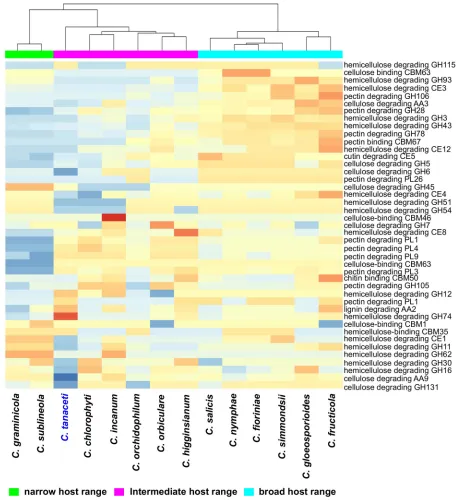
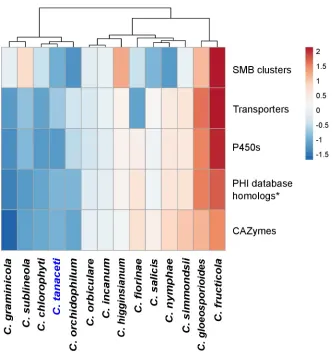
CAZyme families contracted and only nine expanded inC.tanacetiwith respect to the MRCA withC.higginsianum. The AA2 family with lignin peroxidase activity and the hemicellulose degrading GH12, GH74 families were among the expanded families, but many families with pathogenicity and plant cell wall degrading activity had contracted inC.tanaceti. However, the highest number of significant, rapidly evolving gene families was reported fromC.tanaceti (n= 9) followed byF.oxysporumandC.higginsianum, both which had seven rapidly evolving gene families each. InC.tanaceti, rapidly evolving CAZyme families included AA9, GH131 with lignocellulose degrading activity, chitin binding molecule families CBM18 and CBM50, GH18 with chitinase activity, GH3 and GH74 with hemicelluloses degrading activity, GH78 with pectinase activity and GT1 with glucuronosyltransferase activity. However, CBM18 and GH74 were the only families that expanded among those above with the rest contracting inC. tanacetiwith respective to their MRCA. Gloeosporioides complex species had the largest ‘CAZyme pathogenicity profiles’ among allColletotrichumspecies considered. The CAZyme pathogenicity profile ofC.tanacetiwas most similar to those ofColletotrichumspecies known to have an intermediate host range, infecting many hosts within a single plant family or few hosts across several plant families (Fig 4). When compared the overall pathogenicity gene pro-files of allColletotrichumspp., which included the numbers of the SMB clusters, transporters, P450s, CAZymes and the homologs to the PHI database, the profile ofC.tanacetiwas most similar toC.orchidophilumandC.chlorophyti(Fig 5).
RIP affected regions of the
C
.
tanaceti
genome
The RIP indices computed for the genome ofC.tanacetiusing the dinucleotide frequencies (S21 Table) indicated strong RIP signals in the genome. The TpA/ApT index ofC.tanaceti (1.2) was higher than the cutoff 0.89 and the (CpA + TpG)/(ApC + GpT) index (0.96) was lower than the cutoff 1.03 indicating a strong RIP signal. Homologs to two genes involved in RIP ofNeurospora crassa RID[130] andDim-2[131] were identified from the genome ofC. tanaceti(CTA1_356s and CTA1_4791s respectively).
Bipartite nature of
C
.
tanaceti
genome
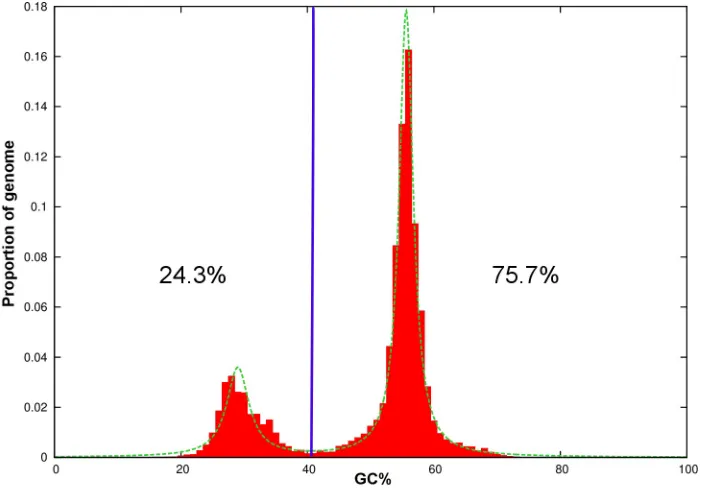
A-T rich regions of the genome, the TpA/ApT index was 1.86 and (CpA + TpG)/(ApC + GpT) index was 0.32 indicating a strong RIP signal. A total of 85 genes were reported in these regions which had a gene density of 6.04 genes per Mb but the majority (68.25%) of these genes was hypothetical. Two secondary metabolite biosynthetic genes, 3 CAZymes, 2 cyto-chrome P450s, 2 lipases, 4 transporters, one transcription factor and one DNA polymerase were putative pathogenicity genes among the genes in the A-T rich regions (S22 Table). The Fig 4. Comparison of CAZyme pathogenicity profiles predicted forColletotrichumspecies. Number of genes in each CAZyme family is normalized
using unit variance scaling. Hierarchical clustering performed with Euclidean distance and Ward linkage. Overrepresented and underrepresented CAZyme families are represented in red to orange and blue respectively as fold standard deviations above and below the mean.
G-C equilibrated regions accounted for 75.7% of the genome and the average length was 14.6 Kb. The maximum G-C percentage in these regions was 55.6 and 12,087 genes were reported with a gene density of 276 genes per Mb.
Relationship of putative pathogenicity genes with repeat elements and RIP
[image:17.612.199.532.66.419.2]The permutation tests confirmed that genes in all the tested pathogenicity-related gene catego-ries are located significantly closer to tandem repeats than expected in a random sample (Table 4). The negativeZ-scores confirmed the mean distance between those genes and the nearest repetitive element was less than mean of a random sample of the genome. Further-more, all gene categories except the CAZymes were located significantly closer to the inter-spersed repeats. However, the expanded and the contracted subgroups of the total CAZome were significantly associated with interspersed repeats (Table 4). All pathogenicity gene catego-ries except contracted CAZymes and effectors were also located closer to the RIP affected regions of the genome than expected.
Fig 5. Comparison of the overall pathogenicity profiles predicted forColletotrichumspecies. The numbers of
CAZymes, secondary metabolite biosynthetic gene clusters (SMB), homologs in the transporter classification database (transporters), homologs in the fungal cytochrome P450 database (P450) and the number of homologs in the PHI database, excluding the homologs to entries in the “unaffected pathogenicity” database were used in the analysis. Hierarchical clustering was performed using Euclidean distance and Ward linkage methods. The number of genes in each pathogenicity gene category is normalized using unit variance scaling. Overrepresented and underrepresented pathogenicity gene categories are represented in red to orange and blue respectively as fold standard deviations above and below the mean.
Discussion
Genome and the repeat content of
Colletotrichum tanaceti
[image:18.612.201.552.77.322.2]This study reports the first draft genome sequence and annotations of the emerging plant path-ogen,C.tanaceti. The high N50 value and BUSCO completeness indicates the high quality of the assembly and AED scores of less than one for the majority of predicted genes (93.3%) sug-gested that these genes had at least partial congruence with the transcriptomic evidence [132]. These good quality gene predictions and annotations will provide a solid foundation for down-stream genetic, population genomic and evolutionary studies.
Fig 6. Plot of GC-content in the draft genome ofColletotrichum tanacetiagainst proportion of the genome.
Genome segments were classified into A-T rich (24.3%) and G-C equilibrated (75.7%) using a GC content threshold of 40% (vertical blue line).
https://doi.org/10.1371/journal.pone.0212248.g006
Table 4. Permutation tests for association of repetitive elements with pathogenicity gene categories.
Gene categories of interest All repeatsa Tandem repeats Interspersed repeats RIP affected regions
Zscoreb
Pvaluec
Zscoreb
Pvaluec
Zscoreb
Pvaluec
Zscoreb
Pvaluec
CAZymes -5.97 �0.001 -3.914 �0.001 -0.443 0.334 -4.674 <0.001
Expanded CAZymes -3.514 �0.001 -4.553 �0.001 -3.050 �0.001 -3.878 <0.001
Contracted CAZymes -4.413 �0.001 -3.237 �0.001 -5.883 �0.001 -1.534 0.06
Effectors -5.631 �0.001 -4.725 �0.001 -3.861 �0.001 1.3957 0.087
Peptidases -5.787 �0.001 -4.679 �0.001 -3.895 �0.001 -4.302 <0.001
SMB clusters -7.901 �0.001 -8.490 �0.001 -2.610 0.003 -4.334 <0.001
a
tandem and interspersed repeats
b
Z-statistic estimate and its
c
associated probability computed based on 10,000 random iterations.
[image:18.612.33.589.542.643.2]The genome ofC.tanacetihad a larger repeat content (25%) than the typical 3–10% in fungi [133]. Simple sequence repeats comprised 3.03% of the genome ofC.tanacetiwhich itself was unusually high for fungi (generally 0.08–0.67%) [134]. However, the majority of repeats were interspersed transposable elements (TE) (21%). TE content ofC.tanacetiwas higher than in six previously studiedColletotrichumspecies, includingC.higginsianumwhich is in the same species complex, but lower than inC.orbiculare(44.8%). The majority of TE were retro-transposons, similar to otherColletotrichumspp. [41]. Proliferation of repetitive elements especially transposons, is known to be a major mechanism driving expansion of eukaryote genomes [135,136]. Furthermore, TE activity favors chromosomal rearrangements, gene dele-tions, gene duplications and greater sequence diversity and is a mechanism of genome plastic-ity [35].
Colletotrichum tanaceti’s genome consists of distinct A-T rich, gene sparse regions. These regions are also enriched in putative TE and RIP. Strong genome-wide RIP signals were observed onC.tanaceti. RIP is a method of controlling TE proliferation in fungi and facilitates genome plasticity, via high mutational rates and inactivating genes [35]. Homologs of two genes involved in RIP were present inC.tanacetisimilar toC.higginsianum[15]. Therefore, TE proliferation inC.tanacetimay have caused accumulation of RIP as a control mechanism. These RIP mutations may have caused the bipartite nature of theC.tanacetigenome giving rise to A-T rich blocks [38–41] similar to the observations inC.orbiculareandC.graminicola [6,41]. Similar toC.orbiculareandC.graminicola[6,41],C.tanacetihas a known sexual stage [17] which could have activated the RIP in the genome [137]. Although genome-wide RIP was not prominent, the TEs in the genomes ofC.fructicola[42],C.higginsianum[15],C. trunca-tum[41] and theC.cereale[138] has shown signals of RIP.
Pathogenicity genes of
C
.
tanaceti
A large array of putative genes related to pathogenicity was inferred from the sequenced genome ofC.tanaceti. Apart from many plant cell wall-degrading enzymes, effectors,P450s and the proteolytic enzymes, there were proteins with CFEM domain (pfam05730) [139] with roles in conidial production and stress tolerance [140] among the secreted proteins. The aver-age cysteine composition, length and proportion of specificity of the candidate secreted effec-tors ofC.tanacetiwere similar to those hemibiotrophic pathogens [141]. However, a minority of effector candidates was neither small (<300bp) nor rich in cysteine (>3%), similar to previ-ous reports of atypical effectors [142]. Effector candidates with a nuclear localization signal might translocate to the host nucleus and reprogram the transcription of genes related to host immune responses. Homologs to known effectors, and effectors with conserved domains of virulence factors may have similar functions inC.tanaceti, for example, in penetration peg for-mation (cyclophilin) [143], phytotoxity induction (cerato-platanin) [144] and adherence of the fungal structures to other organisms (hydrophobin) [145].
Most secreted proteases ofC.tanacetiwere serine proteases predicted to evade plant immune responses by degrading plant chitinases [22]. Subtilisins (S08) were the most abun-dant of these inC.tanaceti, similar to reports in other fungi [22]. Subtilisins, with their alkaline optima, and the proteases in other subfamilies with acidic optima, such as A01, C13, G01, M20 and S10 [146], might enableC.tanacetito degrade plant proteins across a wide pH range. Also, the protease inhibitors ofC.tanacetimight have effector-like roles via inhibition of plant defense proteases [147].
associated with synthesizing fungal toxins [148]. Melanin, another important secondary metabolite aids penetration via increasing turgor pressure [149]. Even though the gene cluster associated with melanin biosynthesis was not identified, the homolog of the melanin biosyn-thetic geneSCD1encoding Scytalone dehydratase [150] inC.tanacetiis worth investigating further sinceSCD1has been successfully used as a target for fungicides to control other patho-gens [151]. Apart from their function in SM biosynthesis, the candidate P450s ofC.tanaceti could be involved in housekeeping roles and therefore, could be good targets for fungicide development, as in the case of azoles targeting CYP51 [152]. Furthermore, the candidate pro-teins of MAPKs pathway inC.tanaceticould play a crucial role in appressorium formation [25,153], penetration [154], conidiation [155] and pathogenesis-related morphogenesis [156], as reported forC.higginsianumandC.lagenaria.
Of the CAZyme families identified to be expanded inC.tanaceti, the chitin binding family CBM18 could play a role in protecting theC.tanaceticell wall from exogenous chitinases, as is the case inTrichoderma reesei[157]. The expansion of the hemicellulose-degrading GH74 family could promote rapid degradation of host tissues byC.tanacetiduring the necrotrophic phase. The expansion of the lignin-degrading AA2 family inC.tanacetihas the potential to assist infection of xylem vessels and thereby aid translocation of propagules to different parts of the plant and establishing secondary infections.
The conserved nature of certain pathogenicity genes, such as the secondary metabolite clus-ters within the destructivum complex, was evident with their presence within the syntenic blocks withC.higginsianum. However, only a minority of the effectors, proteases and SM backbone genes ofC.tanacetiwere among the core gene set forColletotrichumspp. tested, therefore emphasizing their role in adaptation to new hosts. The species-specific effectors, sin-gletons from the orthology analysis and the genes exclusive toC.tanacetimight have been hor-izontally transferred or be related to the host affiliation and niche specialization ofC.tanaceti. Taken together, this inferred pathogenicity gene suite ofC.tanaceticould be targeted in future resistance breeding and other disease management strategies forC.tanaceti.
Host range of
Colletotrichum tanaceti
The proposed pathogenicity gene repertoire ofC.tanacetiwas most similar to that of patho-gens with intermediate host ranges. The number of pathogenicity genes inferred fromC. tana-cetiwas either similar to or less than the average for allColletotrichum spp. investigated, but the overall composition was similar toColletotrichumspp. which either were able to infect many species within a plant family or few species across families.
multiple herbaceous plant species was notable as the only known host ofC.tanacetiis also her-baceous. BothC.chlorophytiandC.orchidophilumhave been reported from multiple host spe-cies. Therefore, the putative pathogenicity gene suite ofC.tanacetisuggests thatC.tanacetihas the genetic ability to infect more hosts than currently recognized. IfC.tanacetican infect other hosts, such crops could also provide an external gene pool of inoculum for infection of pyre-thrum crops increasing the evolutionary potential of the pathogen populations. Based on results of comparative analysis of pathogenicity profiles, a further hypothesis is that these alter-native hosts are likely to be herbaceous plants. Future studies investigating the cross-host infectivity and pathogenicity ofC.tanacetiare recommended.
Evolution of pathogenicity genes
Pathogenicity genes ofC.tanacetiappear to be capable of evolving relatively rapidly. Tandem repeats such as simple sequence repeats have high mutation rates [160] and could promote frameshift mutations in adjacent genes by slipped misalignment during replication. Therefore, the significant overlap between the tandem repeats and the pathogenicity genes suggested high potential to mutate and create different pathotypes. Transposons promote insertional muta-tions that can either cause disruption or modification of gene expression or generate new pro-teins and also are major drivers of gene duplication [161]. Transposons were in close
proximity to putative pathogenicity inC.tanaceti, such as the SMB clusters, expanded and contracted CAZymes, peptidases and effectors. The significant association of TE with pathoge-nicity genes were previously reported inC.truncatum[41] andC.higginsianum[15]. The RIP affected regions of the genome were also in close proximity to certain putative pathogenicity genes ofC.tanaceti. RIP mutations can leak into nearby flanking regions causing mutations in those genes, further diversifying the pathogenicity gene repertoire ofC.tanaceti[35]. How-ever, unlike inLeptosphaeria maculans[162] RIP was not associated with the putative effectors ofC.tanaceti. Therefore, TEs could be facilitating effector diversification in this species [41]. Although gene sparse, the A-T rich regions of theC.tanacetigenome contained several (n= 18) putative pathogenicity and virulence factors and many hypothetical proteins which could be functioning as effectors facilitating adaptive evolution. Small secretory proteins were identified in the A-T rich regions ofC.orbiculare[6]. The genes in these A-T and repeat rich, gene sparse regions can evolve faster than the rest of the genome according to the “two-speed genomes” hypothesis [36].
Colletotrichum tanacetihad the highest number of rapidly evolving CAZyme families among the 17 species studied which also was indicative of the high evolutionary potential in these pathogenicity genes. Interspersed repeats were not in close proximity to the total CAZome. They were however, located significantly closer to the expanded or contracted fami-lies indicating that interspersed repeats were a major contributor to CAZyme family expan-sions/contractions inC.tanacetiby causing gene duplication (in expansions) or gene disruptions (in contractions) [135,163]. Diversification of pathogenicity and virulence genes through repeats and RIP mutation inC.tanacetiresult a high evolutionary potential for patho-genicity genes of this pathogen. The high evolutionary potential of pathopatho-genicity genes may cause rapid evolution of resistance to host immune responses in existing hosts or even adapta-tion to new host species inC.tanaceti.
Genus
Colletotrichum
divergence time estimates for the divergence ofColletotrichumspecies complexes which were more ancient than reported by Liang et al [11], despite using the same calibration times. This could have been due to this study using cross-validation across 50 smoothing factors in CAFE´ as opposed to using 12 different constraints and smoothing factor combinations differences, as well as the use of the use of the different data sets.
Comparative genomic analyses emphasized the rapid evolutionary rate and the high diver-sity within the genus. The short time for speciation within the acutatum complex, and the fourteenColletotrichumspecies in general, was suggestive of the high evolutionary rate within the genus with respective to the typical evolutionary rate of the fungal kingdom (0.0085 species units per Myr) [164]. The sequence similarity betweenC.tanacetiand other species of Colleto-trichumvaried widely and dropped drastically with evolutionary distance, suggesting high diversity within the genus. However, the drop in orthology was less dramatic, emphasizing the contribution of non-coding regions in generating diversity within the genus. The extent of synteny betweenC.tanacetiandC.higginsianumwas high and very similar to the percentage synteny previously reported for the two graminicola complex species,C.sublineolaandC. gra-minicola[165]. This suggested that even though there was high diversity within the genus, the species in the same species complex tend to share more synteny and orthology than the species between species complexes.
Evolutionary analysis of CAZyme families of differentColletotrichumlineages revealed an association between CAZyme families and host range. The GH131 with cellulose degrading activity was the only rapidly evolving gene family at the MRCA ofColletotrichumspp. suggest-ing a possible association of this family with speciation and host determination within the genus. Families GH43, with hemicellulose degrading activity and AA7, with gluco-oligosac-charide activity significantly expanded upon divergence of both the gloeosporioides and acuta-tum-complex clades, which could have broadened the host ranges of members of these two complexes, consistent with previous reports [7,9–11].The significant expansions in pectin degrading enzyme families GH106 in gloeosporioides and GH78 in the acutatum clades could also have enabled degradation of pectin rich cell walls of young fruits [166] of these fruit-rot-ting species.
The most significant contractions were reported in pectin degrading families upon the divergence of the graminicola complex clade. This could have been the reason for species in this complex exclusively infecting monocot plant species considering that the pectin content of monocot cell walls is generally less than in dicots [167]. Even though this was a similar result to previous studies [6,7,9–11,43],C.orchidophilumwhich is known to infect plants from monocot family Orchidaceae [168], deviated from this pattern. Gene family AA7 was rapidly evolving in manyColletotrichumspecies and could have been involved in biotransformation or detoxification of the lignocellulosic compounds [169].
In general, the overall CAZyme pathogenicity profiles ofColletotrichumspp. followed host range of those species rather than the taxonomy in consistence with the previous studies, [6,7,
species with similar pathogenicity gene profiles to cluster together, despite their evolutionary distance.
Conclusion
In conclusion, a draft genome ofC.tanacetiwas used to characterize the molecular basis of pathogenicity of the species and to improve the knowledge of the evolution of the fungal genus Colletotrichum.Colletotrichum tanacetiis likely to have alternative hosts to pyrethrum. The genome ofColletotrichum tanaceticontains a large component of repetitive elements that may result in genome expansion and rapid generation of novel genotypes. The tendency of the pathogenicity genes to evolve rapidly was evident in genomic signals of the RIP and association of repeats and RIPs with the putative pathogenicity genes. Therefore, due to the large array of pathogenicity genes with a high evolutionary potential,C.tanacetiis likely to become a high-risk pathogen. Complexity of theColletotrichumgenus was evident with its high diversity and evolutionary rate. The significant expansions and contractions of gene families upon diver-gence of different lineages within the genus could be important determinants in species and species complex diversification inColletotrichum. The reason for pathogenicity genes to have different clustering than the phylogeny inColletotrichumcould be the occurrence of “two-speed” genomes in certain species. These findings will facilitate future research in genomics and disease management ofColletotrichum.
Supporting information
S1 Table. GO term enrichment analysis inC.tanaceti. (XLSX)
S2 Table. KEGG orthology annotations ofC.tanaceti. (XLSX)
S3 Table. KEGG pathway map IDs ofC.tanaceti. (XLSX)
S4 Table. KEGG orthology assignments of Map kinase pathway inC.tanaceti. (XLSX)
S5 Table. KEGG orthology assignments of Aflatoxin biosynthesis pathway inC.tanaceti. (XLSX)
S6 Table. KEGG orthology assignments of ABC transporters inC.tanaceti. (XLSX)
S7 Table. Global alignment ofC.tanaceticontigs to theC.higginsianumchromosomes. (XLSX)
S8 Table. Secreted proteins ofC.tanacetiand their conserved domains. (XLSX)
S9 Table. Secreted effector candidates ofC.tanacetiwith homology to known effectors and conserved motifs.
(XLSX)
S11 Table. Secreted peptidase inhibitors ofC.tanaceti. (XLSX)
S12 Table. Secondary metabolite biosynthetic gene cluster predictions ofC.tanaceti. (XLSX)
S13 Table. Conserved domains of secondary metabolite biosynthetic genes ofC.tanaceti. (XLSX)
S14 Table. Homologs inC.tanacetito fungal cytochrome P450 database. (XLSX)
S15 Table. Homologs inC.tanacetito transporter classification database. (XLSX)
S16 Table. Homologs to pathogen host interaction database inC.tanaceti. (XLSX)
S17 Table. CAZyme family assignment ofC.tanaceti. (XLSX)
S18 Table. Family-wide probability values and viterbi probability values of CAZyme fami-lies across taxa.
(XLSX)
S19 Table. Expansions and contractions of CAZyme families upon divergence of different lineages.
(XLSX)
S20 Table. Statistics of CAZyme gene family evolution across taxa. (XLSX)
S21 Table. Dinucleotide frequencies of the whole genome and the A-T rich regions of C. tanaceti.
(XLSX)
S22 Table. Genes in the AT rich region ofC.tanacetigenome. (XLSX)
S1 Fig. Median GC percentage and median total length (Mb) (x axis) of publicly available draft genomes representingColletotrichumspecies (y axis).
(TIF)
S2 Fig. Circular plot showing synteny betweenColletotrichum tanaceticontigs (numbers) mapped to the 12 individual chromosomes (NC_codes) of theC.higginsianumgenome. (TIF)
S3 Fig. Comparison of type of secondary metabolite biosynthetic gene clusters (gene clus-ters producing Terpenes, Indoles, Polyketides (PKs), Non-ribosomal peptides (NRPs_and hybrids of the above categories) inColletotrichumspecies; hierarchical clustering per-formed using Euclidean distance and Ward linkage. The number of genes in each gene cate-gory is normalized using unit variance scaling. Overrepresented and underrepresented types of secondary metabolite gene clusters are represented in red to orange and blue respectively as fold standard deviations above and below the mean.