RESEARCH
MKRMDA: multiple kernel
learning-based Kronecker regularized least
squares for MiRNA–disease association
prediction
Xing Chen
1*, Ya‑Wei Niu
2, Guang‑Hui Wang
2*and Gui‑Ying Yan
3Abstract
Background: Recently, as the research of microRNA (miRNA) continues, there are plenty of experimental evidences indicating that miRNA could be associated with various human complex diseases development and progression. Hence, it is necessary and urgent to pay more attentions to the relevant study of predicting diseases associated miR‑ NAs, which may be helpful for effective prevention, diagnosis and treatment of human diseases. Especially, construct‑ ing computational methods to predict potential miRNA–disease associations is worthy of more studies because of the feasibility and effectivity.
Methods: In this work, we developed a novel computational model of multiple kernels learning‑based Kronecker regularized least squares for MiRNA–disease association prediction (MKRMDA), which could reveal potential miRNA– disease associations by automatically optimizing the combination of multiple kernels for disease and miRNA. Results: MKRMDA obtained AUCs of 0.9040 and 0.8446 in global and local leave‑one‑out cross validation, respec‑ tively. Meanwhile, MKRMDA achieved average AUCs of 0.8894 ± 0.0015 in fivefold cross validation. Furthermore, we conducted three different kinds of case studies on some important human cancers for further performance evalu‑ ation. In the case studies of colonic cancer, esophageal cancer and lymphoma based on known miRNA–disease associations in HMDDv2.0 database, 76, 94 and 88% of the corresponding top 50 predicted miRNAs were confirmed by experimental reports, respectively. In another two kinds of case studies for new diseases without any known asso‑ ciated miRNAs and diseases only with known associations in HMDDv1.0 database, the verified ratios of two different cancers were 88 and 94%, respectively.
Conclusions: All the results mentioned above adequately showed the reliable prediction ability of MKRMDA. We anticipated that MKRMDA could serve to facilitate further developments in the field and the follow‑up investigations by biomedical researchers.
Keywords: miRNA, Disease, miRNA–disease association, Multiple kernel learning, Kronecker regularized least squares
© The Author(s) 2017. This article is distributed under the terms of the Creative Commons Attribution 4.0 International License (http://creativecommons.org/licenses/by/4.0/), which permits unrestricted use, distribution, and reproduction in any medium, provided you give appropriate credit to the original author(s) and the source, provide a link to the Creative Commons license, and indicate if changes were made. The Creative Commons Public Domain Dedication waiver (http://creativecommons.org/ publicdomain/zero/1.0/) applies to the data made available in this article, unless otherwise stated.
Background
MicroRNAs (miRNAs) are a class of endogenous and small noncoding RNAs, which function in RNA silencing and post-transcriptional regulation of gene expression
via base-pairing with complementary sequences within mRNA molecules [1–6]. However, some researches have shown that in some cases miRNAs could also function as positive regulators [7, 8]. Since the first discovery of miRNAs (C. elegans lin-4) in the early 1990s, thousands of currently annotated miRNAs have been identified from a wide variety of species, ranging from nematodes to humans (for example, more than 1800 homo sapiens miRNAs according to miRBase21) [9–13]. In addition,
Open Access
*Correspondence: [email protected]; [email protected] 1 School of Information and Control Engineering, China University of Mining and Technology, Xuzhou 221116, China
plenty of evidences have shown that miRNAs play impor-tant roles in many fundamental and critical biological processes, such as cell growth, proliferation, differentia-tion, development, apoptosis, metabolism, aging, signal transduction, viral infection and so on [14–19]. Thus, it is not surprising that more and more miRNAs have been reported to be associated with various complex human diseases [20–22]. For example, compared with normal tissue controls as measured by microarray, miR-129, miR-142, and miR-25 were differentially expressed in every pediatric brain tumor type [23]. Furthermore, according to hepatitis C virus (HCV) case report, the miR-122 expression level could be down-regulated by HCV core protein in a time- and dose-dependent man-ner [24]. Moreover, compared with the healthy gingiva, in periodontitis cases, six miRNAs (let-7a, let-7c, miR-130a, miR-301a, miR-520d and miR-548a) were up-regulated more than eightfold [25]. Additionally, 372 and miR-373 were highly up-regulated in the cerebellar tumors compared with normal cerebellum or whole brain [26]. Therefore, identifying potential disease-related miRNAs could not only significantly contribute to comprehend-ing the diseases mechanisms, but also be beneficial to the prognosis, diagnosis, treatment and prevention of human complex diseases [27–30]. However, as is known, tradi-tional experimental methods are usually expensive and time-consuming. Fortunately, as the accumulated results of vast biology experiments, some reliable miRNA-related datasets have been constructed and updated. So it is necessary and viable to develop more efficient and feasible computational approaches to predict underlying diseases associated miRNAs based on available biologi-cal datasets. In addition, the promising predicted results obtained by computational methods could be used as guidance for further experimental validation [31, 32].
In fact, based on the hypothesis that functionally similar miRNAs are often associated with phenotypi-cally similar diseases and vice versa [12, 33–37], many computational models have been proposed for predict-ing disease-associated miRNAs durpredict-ing the last years. For example, Jiang et al. [27] presented a network-based approach, which scored each miRNA in the miRNA network through the cumulative hypergeometric dis-tribution to predict potential miRNA–disease associa-tions. Considering the functional connections between miRNA targets and disease genes in protein–protein interaction (PPI) networks, Shi et al. [38] developed a computational method to identify miRNA–disease asso-ciations by performing random walk. Their model took advantage of human PPIs, the miRNA–target interac-tions and disease–gene associainterac-tions to predict potential associations between the miRNAs and diseases based on the assumption that miRNAs could tend to be associated
WBSMDA integrated miRNA functional similarity, dis-ease semantic similarity, known miRNA–disdis-ease associa-tions, and Gaussian interaction profile kernel similarity for diseases and miRNAs into an integrated similarity for diseases and miRNAs respectively, then the model com-bined within-score and between-score from the view of miRNAs and diseases to calculate the association prob-ability for miRNA–disease pairs. WBSMDA could be implemented for the diseases without known associated miRNAs. Then, Chen et al. [45] developed the compu-tational model of Heterogeneous Graph Inference for MiRNA–disease association prediction (HGIMDA) by integrating known verified miRNA–disease associations, miRNA functional similarity, disease semantic similarity, Gaussian interaction profile kernel similarity into a het-erogeneous graph. Then they could infer potential asso-ciation between disease and miRNA by summarizing all paths with the length equal to three in the graph. Com-pared with previous computational models, HGIMDA model got a better prediction performance and could be effectively applied to new diseases and new miRNAs without any known associations, which overcame the important limitations of many previous computational models.
Additionally, some studies developed machine learn-ing-based computational models to predict potential dis-ease–miRNA associations. For example, according to the assumption that miRNAs associated with specific tumor phenotype would show aberrant regulation of their target genes, Xu et al. [5] proposed an approach based on the miRNA target-dysregulated network (MTDN) to prior-itize potential diseases associated miRNAs. Based on the network topology information, some feature measures were extracted for miRNAs in MTDN. Then the authors used support vector machine (SVM) to construct classi-fier for distinguishing positive miRNA–disease associa-tions from negative associaassocia-tions. Nowadays, by utilizing the network information flow model, Yu et al. [46] devel-oped a combinatorial prioritization algorithm of maxi-mizing network information flow (MaxFlow) to predict microRNA–disease associations based on the microR-NAome-phenome network. To overcome the negative influence on model prediction performance that resulted from the selection bias of negative samples, Chen et al. [47] developed a computational model of regularized least squares for MiRNA–disease association (RLSMDA). RLSMDA model was implemented in the framework of a semi-supervised learning, which meant that it needed no negative samples. Recently, considering that no pre-vious computational methods could predict the types of disease–miRNA associations, Chen et al. [48] devel-oped the model of Restricted Boltzmann machine for multiple types of miRNA–disease association prediction
(RBMMMDA). RBMMMDA model could obtain not only new miRNA–disease associations, but also the cor-responding association types by employing Restricted Boltzmann machine (RBM). Predicting the different types of disease–miRNA associations could be beneficial for our understanding about the molecular basis of dis-eases in the level of miRNAs. RBMMMDA model is the first model that could infer association types of miRNA– disease pairs on a large scale.
Before presenting our model, we briefly introduced some information about kernel-based methods. Given a known disease–miRNA association network, ker-nel based methods could be implemented to predict unknown miRNA–disease interactions, where a kernel could be seen as a similarity matrix of miRNAs or dis-eases. Kernel based approaches used some base kernels, such as disease semantic similarity or miRNA functional similarity, to measure the similarity between diseases or miRNAs. Then, a pairwise kernel function, which meas-ured the similarity between disease–miRNA pairs, could be calculated by combining a miRNA base kernel and a disease base kernel via kernel product. Multiple kernel learning (MKL) was a machine learning method focus-ing on the search for an optimal combination of base ker-nels [49]. However, since traditional MKL methods were based on SVM [49, 50], they were subject to memory limitations imposed by the pairwise kernel function and the difficulty of obtaining negative samples in supervised learning. Kronecker regularized least squares approach (KronRLS) [51] abandoned SVM and took advantage of the algebraic properties of Kronecker product to imple-ment predictions without the explicit calculation of pair-wise kernels function. However, KronRLS method could not be conducted to solve multiple kernels situations because it was initially developed to handle single kernel situation.
patterns of case studies in this work (more details in part 3.2). As mentioned in abstract, there were high ratios of the predicted miRNAs confirmed in all three ways of case studies by corresponding databases. Therefore, it showed the effectivity of MKRMDA in predicting poten-tial miRNA–disease associations for various categories of diseases.
Methods
Human miRNA–disease associations
Human miRNA–disease associations dataset employed in this work were obtained from the HMDDv2.0 database [52], consisting of 5430 experimentally confirmed human miRNA–diseases associations about 495 miRNAs and 383 human diseases. We adopted the adjacency matrix
A to clearly describe the known miRNAs–disease asso-ciations. Specifically, if miRNA m(i) was confirmed to be related to disease d(j), the entity A(i,j) was assigned 1, otherwise 0.
MiRNA functional similarity
MiRNA functional similarity has been worked out previ-ously by Wang et al. [35]. In this study, benefitting from their relevant researches, we downloaded the relevant miRNA functional similarity measures information from http://www.cuilab.cn/files/images/cuilab/misim.zip and constructed the corresponding miRNA functional simi-larity matrix FS, where FS(i,j) was denoted as the func-tional similarity score between miRNA m(i) and m(j). We got the known miRNA functional similarity about 271 miRNAs in this way. For the rest 224 miRNAs without known functional similarity, we calculated the Gauss-ian interaction profile kernel similarity, which would be introduced in part 2.5. By integrating the known 271 miRNA similarity entries and the 224 newly calculated Gaussian similarity entries, the miRNA similarity matrix had exact 495 entries for prediction work.
Disease semantic similarity model 1
Based on the disease MeSH descriptor downloaded from the National Library of Medicine (http://www.nlm.nih. gov/), the relationship between different diseases could be represented by a structure of directed acyclic graph (DAG). For an arbitrary disease D, DAG(D) = (D, T(D), E(D)) can be defined to represent the disease D, where T(D) is a node set, consisting of D itself and all its ances-tor nodes, E(D) is the corresponding edge set, consist-ing of the directed edges pointconsist-ing from parent nodes to child nodes [35]. The semantic value of disease D could be defined as follows:
(1)
DV1(D)=
d∈T(D) D1D(d)
where is the semantic contribution factor. It is obvious
that for a given disease D, as the distance between D and another disease, d, increases, the contribution score of d
for disease D decreases. In this method, diseases located in the same layer would contribute the same score to the semantic value of disease D. Finally, the semantic similar-ity between disease d(i) and d(j) can be calculated based on the observation that two diseases with larger common part of their DAGs will have larger similarity score:
where SS1 represents the disease semantic similarity matrix in this model.
Disease semantic similarity model 2
In this calculation method of disease semantic similarity, different from the above method, we assign different con-tribution value to the diseases in the same layer of DAG(D) out of the consideration that disease which appears in less DAGs contributes to the semantic similarity of disease D at a higher contribution level. So the contribution of disease
d in DAG(D) to the semantic value of disease D is defined as follows when nd represent the number of all diseases and DAGt represents the number of DAGs including t:
Then, the semantic similarity of disease d(i) and d(j) can be calculated as follows:
where SS2 represents the disease semantic similarity matrix in this model.
Gaussian interaction profile kernel similarity
Gaussian kernel function is a kind of widely used radial basis function (RBS), based on which the Gaussian inter-action profile kernel similarity could be calculated by taking advantaging of the known miRNA–disease asso-ciation information. Specifically, by observing whether a disease d(i) is associated with each miRNA or not, binary vector IP(d(i)), the ith column of the adjacency matrix A, could be obtained and denoted as the interaction profiles of disease d(i). Then, Gaussian kernel similarity between disease d(i) and d(j) can be calculated as follows:
(2)
D1D(d)=1 if d=D
D1D(d)=max��∗D1D�d′�|d′ ∈ child of d� if d�=D
(3)
SS1 d(i),d
j
=
t∈T(d(i))∩T(d(j))(D1d(i)(t)+D1d(j)(t)) DV1(d(i))+DV1(d(j))
(4)
D2D(d)= −log
DAGt
nd
(5) SS2
d(i), d(j) =
where rd is adopted to control the kernel bandwidth, GD
represent Gaussian interaction profile kernel similarity of diseases. In addition, rd can be obtained by normalizing
a new bandwidth parameter r′
d by the average number of
known associations with miRNAs per disease as follows:
where nd is denoted as the number of all the diseases investigated. In principle, the new bandwidth parameter
r′
d could be set with cross-validation, but in this article, r′d
was set 1 based on previous studies [53, 54].
Additionally, the construction method of miRNA Gaussian interaction profile kernel similarity matrix, GM, is similar to the calculation of disease Gaussian interac-tion profile kernel similarity:
where nm is denoted as the number of all the miRNAs investigated.
MKRMDA
With the advance of sequencing technology and biology, more and more reliable biological data about disease and miRNA had been released, including various similarity information about disease and miRNA. If we could effi-ciently take advantage of the multi-source similarity data as more as possible, we could obtain more precise infor-mation about disease–miRNA associations. Hence, in this work, we proposed the MKRMDA to predict poten-tial disease associated miRNAs in the situation where multiple kernels were involved, meaning that much more similarity information could be integrated. To this end, at first we briefly introduced the relevant classification algorithm, which could be used in single kernel prob-lem. Given a set of diseases D=d(1),d(2) . . .,d(nd) , a set of miRNAs M= {m(1),m(2) . . .,m(nm)} ,
we could obtain a set of training samples
S=x1,y1
, x2,y2
. . .xn,yn
, xi represented a
dis-ease–miRNA pair, and yi represented the corresponding
binary labels, where 1 stood for a known association and 0 otherwise with 1<i≤n,n=nd×nm, which meant the number of all disease–miRNA pairs. In our model, if a miRNA–disease pair xi was a known
miRNA–dis-ease association recorded in HMDDv2.0 database, the
(6)
GDd(i),dj=exp
−γd �IP(d(i))−IP(dj)�2
(7)
rd =rd′
1
nd nd
i=1
�IP(d(i))�2
(8)
GM
m(i),m
j
=exp−γm�IP(m(i))−IP(m(j))�2
(9) γm =
γ′m
1 nm
nm
i=1�IP(m(i))�2
corresponding yi was set 1, otherwise 0. Denoting the
training set as S, our goal was to learn a function f that could generalize well on new samples, namely new dis-ease–miRNA pairs. Then this problem could be solved based on the closely related (via Lagrange multipliers) Tikhonov minimization problem as follows [55]:
where V was a smooth loss function, ||f||K was the norm
of the prediction function f associated to the kernel K, and λ > 0 was a regularization parameter balancing the prediction error and the complexity of the model. Then considering that we aimed to obtain a function f, which could assign close value for every disease–miRNA pairs compared with their initial values in S, we could use the following simple square-loss function:
Based on the Representer Theorem [56], the solution of Eq. 9 could be written in the following form:
Furthermore, with the fact that ||f||2K =αTKα [57] we
could obtain the classification function for single kernel problem:
Hence if α could be calculated, the prediction score for
all the disease–miRNA pairs in S could be obtained. In fact, according to previous study [55],α could be obtained by solving a single of system linear equations:
In single kernel situation, we could construct such pairwise kernel K as the Kronecker product of the two base kernels [58]: K =KD⊗KM. Unfortunately, the
Kronecker product kernel directly would involve calcu-lating the inverse of an (nd × nm) × (nd × nm) matrix, which would take O((nd × nm)3) operations. Thus, the size of the base kernel matrix made the model training computationally unfeasible even for moderate number of diseases and miRNAs. Hence, in order to make train-ing process more efficient, we could further take advan-tage of two specific algebraic properties of the Kronecker product [59] and use the eigendecomposition of the Kro-necker product [60] to calculate α.
(10) min
f∈H 1 n n i=1 V
yi,f(xi)
+||f||2 K
(11) V
yi,f(xi)
=(yi−f(xi))2
(12)
f(xi)= n
i=1
αiK(x,xi)
(13) minF(α)=min
α∈Rn
1
2n
n
i=1
(y−Kα)T(y−Kα)+
2α
TKα
Let KD=QDΛDQD and T KM =QMΛMQTM be the eigendecomposition of the kernel matrices KD and KM .
Since the eigenvalues (vectors) of a Kronecker product are the Kronecker product of eigenvalues (vectors), for Eq. 13, the solution α can be calculated by
Kronecker-RLS method as follows [60]:
where vec(·) stacked the columns of a matrix into a vector, and C was a matrix defined as:
vec(C)=(ΛD⊗ΛM)(ΛD⊗ΛM+I)−1vec
QT
MYTQD
. So far, the single kernel problem had been introduced, and the solution, α, could be calculated successfully and
efficiently.
Next, we would introduce how MKRMDA could be designed for multiple kernels problem, which meant that MKRMDA could integrate more similarity infor-mation about disease and miRNA. It was natural that if we could combine different kernels by an opti-mized and reasonable way, we could make the best of relevant data information. We considered vari-ous base kernels for diseases and miRNAs as KD=
K1
D,K
2
D,. . .,K PD
D
andKM =
KM1,KM2,. . .,KPM
M
,PD
and PM were the number of base kernels investigated for diseases and miRNAs, respectively. In MKRMDA, dif-ferent base kernels could be finally combined by a linear function, such as K∗
DandKM∗:
where βD=
βD1,βD2,. . . βPD
D
and βM=
βM1,
βM2,. . . β PM
M
corresponded to the weights of disease and miRNA kernels, respectively. Then KD∗ andKM∗ could be used as single base kernel for disease and miRNA, which suited for single kernel problem. To obtain opti-mal βD andβM, we used a two-step optimization process
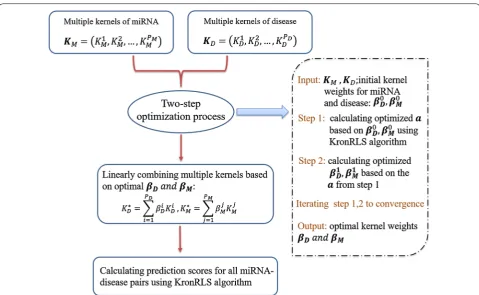
[49], in which the optimization of the vector a was inter-leaved with the optimization of the kernel weights. Step 1 was that given two initial weight vectors, β0Dandβ0M, an optimal value for the vector a could be calculated by Eq. 14. Step 2 was that using the optimized a, we could proceed to find optimal βDandβM. These two steps
were repeated until convergence, resulting in the finally optimal KD∗ andKM∗ for disease and miRNA, respectively (due to limited space, for further information, see Addi-tional file 1).
As mentioned before, after this two-step optimiza-tion process reached the convergence, we obtained the
(15)
α=vec
QMCQTD
(16)
KD∗= PD
i=1
βDiKDi,KM∗ = PM
j=1
βMj KMj
optimized single kernel both for disease and miRNA, K∗
DandKM∗, then we could make use of these two kernels
in single kernel situation introduced before, finally the prediction scores for all disease–miRNAs pairs were gen-erated by MKRMDA (see Fig. 1).
Additionally, in our model, we set the mean of all the base kernels of miRNA and disease as the initial value for the two-step optimization iterative process, which was employed to further calculate the optimal kernel weights for multiple kernels involved as men-tioned above. The mean disease kernel was computed as K∗
D=1/PDPDi=1KDi, and the same could be done for
miRNAs, analogously. In addition, the λ parameter was evaluated in the interval
2−15, 2−10,. . ., 230
. The σ reg-ularization coefficient was also optimized in the interval
{0, 0.25, 0.5, 0.75, 1}.
Results
Cross validation
LOOCV was often implemented to evaluate the perfor-mance of prediction model. In this work, we conducted LOOCV in two different ways: global and local LOOCV. Like the meaning of ‘local’, local LOOCV was imple-mented as follows: firstly, we chose a disease, then each known miRNA associated with this chosen disease was left out in turn as test sample and the other associated miRNAs were used as seed samples, thirdly each time we ranked the predicted association probability of cur-rent test sample with the candidate samples, which were the miRNAs without known association with the cho-sen disease. If the rank of the test miRNA exceeded the given threshold, the model was considered to successfully predict this miRNA–disease association. While, global LOOCV was implemented in a different way: firstly, we considered all the diseases simultaneously, which meant that each time the known disease–miRNA associations in HMDD v2.0 was left out in turn as test sample. Then all the other associations were set as seed samples and all the unknown associations were considered as candidate samples. Thirdly, same as local method, if the rank of test association exceeded the given threshold, the model was considered to successfully predict this association.
predictive performance of the model, and AUC = 0.5 indicated a random performance.
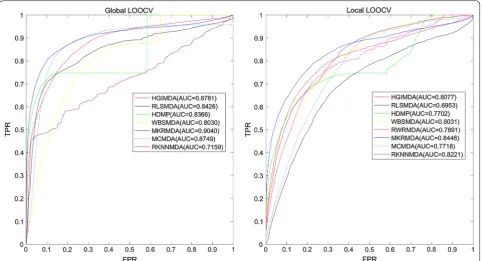
Figure 2 showed the performance comparisons of the global and local LOOCV results between sev-eral computational models. As shown in the figure, MKRMDA, HGIMDA, RLSMDA, HDMP, WBSMDA, MCMDA, RKNNMDA obtained AUCs of 0.9040, 0.8781, 0.8426, 0.8366, 0.8030, 0.8749 and 0.7159 in the global LOOCV, respectively. For the local LOOCV, MKRMDA, HGIMDA, RLSMDA, HDMP, WBSMDA, RWRMDA, MCMDA and RKNNMDA obtained AUCs of 0.8446, 0.8077, 0.6953, 0.7702, 0.8031, 0.7891, 0.7718 and 0.8221, respectively. The MaxFlow model obtained AUC of 0.8693 according to their paper, was also a lit-tle lower than MKRMDA’s. RWRMDA model could not implement global LOOCV because this model could not be implemented for all the diseases simultaneously. Additionally, RBMMMDA [48] was not included in the comparison with MKRMDA because the result of RBMMMDA were the corresponding association types between miRNAs and diseases, which were different from the input and output of our algorithm. As a result, MKRMDA had shown excellent and reliable prediction performance. We thought that MKRMDA may provide
potential reference value for miRNA–disease association predictive experiments.
In addition, we also adopted fivefold cross validation for prediction evaluation, which was conducted in this way: all the known miRNA–disease associations were randomly divided into 5 groups with equal sizes, then each of the 5 groups was set as test samples and the other groups as training samples. Hence, when a group test samples was chosen, MKRMDA would be implemented and the prediction scores of every test sample in this group would be compared with the scores of candidate miRNAs. To reduce the possible impact caused by ran-dom divisions in the process of obtaining test samples, fivefold cross validation was conducted 100 times. Finally, MKRMDA achieved reliable performance with AUC of 0.8894 ± 0.0015, higher than those generated by other models, such as RLSMDA: 0.8569 ± 0.0020; HDMP: 0.8342 ± 0.0010; WBSMDA: 0.8185 ± 0.0009 MCMDA: 0.8767 ± 0.0011; RKNNMDA: 0.6723 ± 0.0027.
Case studies
MKRMDA had been applied to predict potential miRNA–disease associations for all the diseases inves-tigated in this paper. To further demonstrate the
[image:7.595.58.538.85.380.2]prediction ability of MKRMDA, as mentioned before, three ways of case studies were carried out. Case stud-ies on colonic cancer, esophageal cancer and lymphoma were implemented in the first way of case study, in which the disease–miRNA associations recorded in HMDDv2.0 [52] were used as training samples and miRNAs without known associations with currently considered diseases were regarded as test samples. After MKRMDA was implemented, we verified the top 50 miRNAs predicted to be associated with corresponding disease based on the experimental associations recorded in miR2Disease [61] and dbDEMC database [62].
Colonic cancer is a complex disease in which cancer cells form in the tissues of the colon, and colonic cancer is reported to the second leading cause of cancer death in the United States with the 5 year survival rates of 65% in the United States [63]. As many colonic cancers arise from adenomatous polyps without obvious symptoms, screening test for this cancer is effective not only for early detection but also for prevention. Additionally, with the rapid development of high-throughput sequencing tech-nologies, researchers have identified many miRNAs asso-ciated with colonic cancer. For example, miR-141 and miR-200b were confirmed to be highly overexpressed in colonic cancer [64]. In the case study for colonic cancer,
candidate miRNAs were prioritized according to the scores obtained from MKRMDA, as a result, 38 out of top 50 were confirmed by recent experimental results in miR2Disease and dbDEMC (see Table 1). For example, miR-183, highly ranked and confirmed by miR2Disease and dbDEMC databases simultaneously, was significantly deregulated in colorectal cancer cells [65].
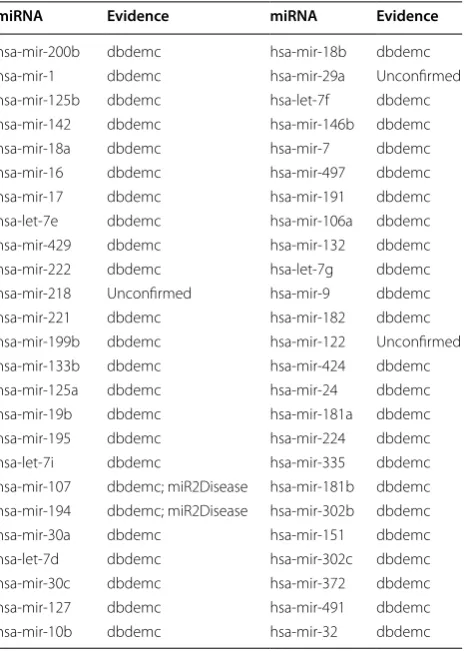
Esophageal cancer is the eighth common cancer world-wide and is one of the deadliest cancers worldworld-wide because of its extremely aggressive nature and poor sur-vival rate [66]. The overall 5-year survival of esophageal cancer ranges from 15 to 25% [67, 68]. There is research suggesting that the survival rate could increase to 90% if the tumors could be diagnosed at an early stage [69]. Therefore, the early detection is vital for timely treat-ment of esophageal cancers [70]. Many miRNAs have been reported to be related with esophageal cancers. For example, by post-transcriptionally regulating enhancer of zestehomolog 2, miR-214 and miR-98 could suppress migration and invasion in human esophageal squamous cell carcinoma [71]. As mentioned before, in the first way of case study for esophageal cancer, 47 out of top 50 pre-dicted miRNAs for esophageal cancer were confirmed by at least one of miR2Disease and dbDEMC databases (see Table 2).
[image:8.595.58.541.88.349.2]Lymphoma is a group of blood cell tumors that develop from lymphocytes and lymphoma most often spreads to the lungs, liver, and brain. The two main types of phoma are Hodgkin lymphoma and non-Hodgkin lym-phoma (NHL) [72]. Meanwhile, lymphomas, including HL and NHL, are reported as the seventh-most lethality cancers worldwide and lymphomas are also the third-most common cancer in children [72]. However, lym-phomas may be curable if detected in early stages with modern treatment. Recent experimental research found
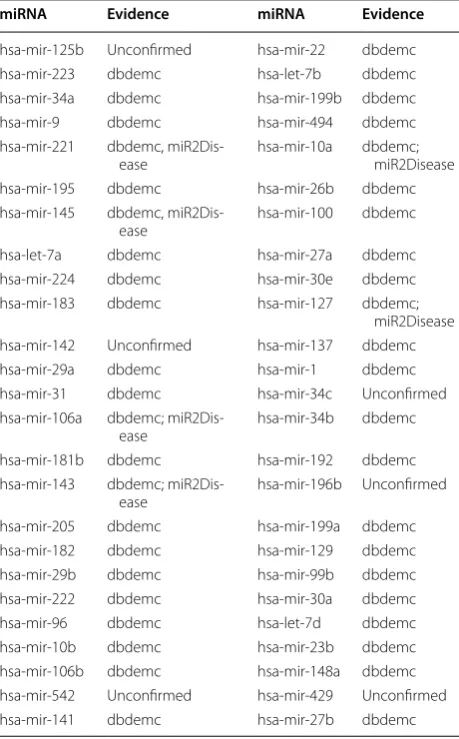
that miR-17-5p showed an increased expression level compared with normal canine peripheral blood mono-nuclear cells and normal lymph nodes (LN). In the case study on lymphoma, for the top 50 predicted lymphoma-associated miRNAs ranked by MKRMDA, we had 44 associations confirmed by experimental literature evi-dences (see Table 3).
[image:9.595.307.540.134.460.2]These 3 cancers were chosen mainly because these 3 cancers (included some other cancers) were very impor-tant and these cancers were often taken as case studies in many computational models such as HGIMDA (colonic cancer, esophageal cancer), RKNNMDA (colonic can-cer, esophageal cancer), MCMDA (colonic cancan-cer, lym-phoma) and so on. What’s more, we also compared the confirmed case studies results of HGIMDA and RKNN-MDA on previously mentioned three cancers for the top 50 predicted miRNAs (see Additional file 1). We chose these two models because they were ranked first in the models whose performance were compared with our
Table 1 We implemented MKRMDA on colonic cancer for potential disease–related miRNA prediction and con-ducted the first pattern of case study, in which the dis-ease–miRNA associations recorded in HMDDv2.0 were used as training samples and miRNAs without known associations with currently considered diseases were regarded as test samples
According to the prediction results, among the top 10 and 50 potential colonic cancer related miRNAs, 6 and 38 were confirmed by miR2Disease and dbDEMC databases
miRNA Evidence miRNA Evidence
hsa‑mir‑222 dbdemc hsa‑mir‑199b dbdemc
hsa‑mir‑150 Unconfirmed hsa‑mir‑30d dbdemc hsa‑mir‑146b Unconfirmed hsa‑mir‑130a Unconfirmed hsa‑mir‑200a Unconfirmed hsa‑mir‑375 Unconfirmed hsa‑mir‑199a Unconfirmed hsa‑mir‑194 dbdemc,
miR2Disease hsa‑mir‑183 dbdemc; miR2Disease hsa‑mir‑18b Unconfirmed hsa‑mir‑196a dbdemc; miR2Disease hsa‑mir‑27a miR2Disease hsa‑mir‑203 dbdemc; miR2Disease hsa‑mir‑93 dbdemc;
miR2Disease hsa‑mir‑181b dbdemc; miR2Disease hsa‑mir‑7 dbdemc;
miR2Disease
hsa‑mir‑210 dbdemc hsa‑mir‑373 dbdemc
hsa‑mir‑135b dbdemc; miR2Disease hsa‑mir‑98 Unconfirmed hsa‑mir‑34c miR2Disease hsa‑mir‑124 dbdemc
hsa‑mir‑135a dbdemc hsa‑mir‑30b dbdemc
hsa‑mir‑148a dbdemc hsa‑mir‑339 dbdemc;
miR2Disease
hsa‑mir‑29c dbdemc hsa‑mir‑95 dbdemc;
miR2Disease hsa‑mir‑195 dbdemc; miR2Disease hsa‑mir‑30e Unconfirmed hsa‑mir‑34b dbdemc; miR2Disease hsa‑mir‑302c Unconfirmed hsa‑mir‑92b Unconfirmed hsa‑mir‑27b dbdemc;
miR2Disease hsa‑mir‑181a dbdemc; miR2Disease hsa‑mir‑206 dbdemc hsa‑mir‑133a dbdemc; miR2Disease hsa‑mir‑99a dbdemc hsa‑mir‑25 dbdemc; miR2Disease hsa‑mir‑451 miR2Disease hsa‑mir‑26a dbdemc; miR2Disease hsa‑mir‑182 dbdemc;
miR2Disease
hsa‑mir‑214 dbdemc hsa‑mir‑224 dbdemc;
miR2Disease hsa‑mir‑15b miR2Disease hsa‑mir‑20b Unconfirmed
hsa‑mir‑429 dbdemc hsa‑mir‑219 dbdemc
Table 2 We implemented MKRMDA on esophageal cancer for potential disease–related miRNA prediction and con-ducted the first pattern of case study according to the pre-diction results
As a result, among the top 10 and 50 potential esophageal cancer related miRNAs, 10 and 47 were confirmed by miR2Disease and dbDEMC databases
miRNA Evidence miRNA Evidence
hsa‑mir‑200b dbdemc hsa‑mir‑18b dbdemc
hsa‑mir‑1 dbdemc hsa‑mir‑29a Unconfirmed
hsa‑mir‑125b dbdemc hsa‑let‑7f dbdemc
hsa‑mir‑142 dbdemc hsa‑mir‑146b dbdemc
hsa‑mir‑18a dbdemc hsa‑mir‑7 dbdemc
hsa‑mir‑16 dbdemc hsa‑mir‑497 dbdemc
hsa‑mir‑17 dbdemc hsa‑mir‑191 dbdemc
hsa‑let‑7e dbdemc hsa‑mir‑106a dbdemc
hsa‑mir‑429 dbdemc hsa‑mir‑132 dbdemc
hsa‑mir‑222 dbdemc hsa‑let‑7g dbdemc
hsa‑mir‑218 Unconfirmed hsa‑mir‑9 dbdemc
hsa‑mir‑221 dbdemc hsa‑mir‑182 dbdemc
hsa‑mir‑199b dbdemc hsa‑mir‑122 Unconfirmed
hsa‑mir‑133b dbdemc hsa‑mir‑424 dbdemc
hsa‑mir‑125a dbdemc hsa‑mir‑24 dbdemc
hsa‑mir‑19b dbdemc hsa‑mir‑181a dbdemc
hsa‑mir‑195 dbdemc hsa‑mir‑224 dbdemc
hsa‑let‑7i dbdemc hsa‑mir‑335 dbdemc
hsa‑mir‑107 dbdemc; miR2Disease hsa‑mir‑181b dbdemc hsa‑mir‑194 dbdemc; miR2Disease hsa‑mir‑302b dbdemc
hsa‑mir‑30a dbdemc hsa‑mir‑151 dbdemc
hsa‑let‑7d dbdemc hsa‑mir‑302c dbdemc
hsa‑mir‑30c dbdemc hsa‑mir‑372 dbdemc
hsa‑mir‑127 dbdemc hsa‑mir‑491 dbdemc
[image:9.595.57.288.168.563.2]computational model in the global LOOCV and local LOOCV, respectively.
In addition, we conducted case study of hepatocel-lular carcinoma (HCC) in the second way, in which we removed all the related miRNAs information of HCC to model the situation where a new disease without known miRNA associations was investigated. Then we verified the prediction results of HCC with HMDD v2.0 data-base, miR2Disease, and dbDEMC database. Hepatocel-lular carcinoma is the most common type of liver cancer. Meanwhile, HCC is the sixth most prevalent cancer and the third most frequent cause of cancer-related death [73]. More than 30 miRNAs have been validated to be related to the development of HCC in the gold standard dataset. For example, the expression of miR-125a and miR-99b were quite lower in HCC compared to normal liver [74].
MiR-122a was a liver-specific miRNA and it was fre-quently downregulated in HCC [75]. Among the top 50 predicted potential HCC-related miRNAs, there were 44 miRNAs confirmed by aforementioned various databases, i.e. HMDDv2.0, miR2Disease and dbDEMC database (see Table 4). For example, miR-21, which was ranked first in the top 50 predicted miRNAs, had been reported to be up-regulated in patients with HCC and it had strong potential to serve as novel biomarker for liver injury [76].
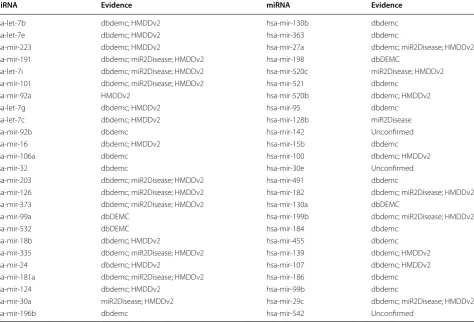
Furthermore, to test the robustness of MKRMDA, we presented case study for breast cancer in the third way, in which we only used the known disease–miRNA asso-ciations in HMDDv1.0 database as training samples and used associations in HMDD v2.0 database, miR2Disease, and dbDEMC database as test datasets. Breast cancer is currently reported as the deadliest cancer in women, accounting for 25% of all cancer caused death cases [72]. Specifically, breast cancer is more common in developed
Table 3 We also implemented MKRMDA for potential lym-phoma-related miRNA prediction and conducted the first pattern of case study based on the prediction results
As a result, among the top 10 and 50 potential lymphoma-related miRNAs, 9 and 44 were confirmed by miR2Disease and dbDEMC databases
miRNA Evidence miRNA Evidence
hsa‑mir‑125b Unconfirmed hsa‑mir‑22 dbdemc
hsa‑mir‑223 dbdemc hsa‑let‑7b dbdemc
hsa‑mir‑34a dbdemc hsa‑mir‑199b dbdemc
hsa‑mir‑9 dbdemc hsa‑mir‑494 dbdemc
hsa‑mir‑221 dbdemc, miR2Dis‑
ease hsa‑mir‑10a dbdemc; miR2Disease
hsa‑mir‑195 dbdemc hsa‑mir‑26b dbdemc
hsa‑mir‑145 dbdemc, miR2Dis‑
ease hsa‑mir‑100 dbdemc
hsa‑let‑7a dbdemc hsa‑mir‑27a dbdemc
hsa‑mir‑224 dbdemc hsa‑mir‑30e dbdemc
hsa‑mir‑183 dbdemc hsa‑mir‑127 dbdemc;
miR2Disease hsa‑mir‑142 Unconfirmed hsa‑mir‑137 dbdemc
hsa‑mir‑29a dbdemc hsa‑mir‑1 dbdemc
hsa‑mir‑31 dbdemc hsa‑mir‑34c Unconfirmed
hsa‑mir‑106a dbdemc; miR2Dis‑
ease hsa‑mir‑34b dbdemc
hsa‑mir‑181b dbdemc hsa‑mir‑192 dbdemc
hsa‑mir‑143 dbdemc; miR2Dis‑
ease hsa‑mir‑196b Unconfirmed
hsa‑mir‑205 dbdemc hsa‑mir‑199a dbdemc
hsa‑mir‑182 dbdemc hsa‑mir‑129 dbdemc
hsa‑mir‑29b dbdemc hsa‑mir‑99b dbdemc
hsa‑mir‑222 dbdemc hsa‑mir‑30a dbdemc
hsa‑mir‑96 dbdemc hsa‑let‑7d dbdemc
hsa‑mir‑10b dbdemc hsa‑mir‑23b dbdemc
hsa‑mir‑106b dbdemc hsa‑mir‑148a dbdemc
hsa‑mir‑542 Unconfirmed hsa‑mir‑429 Unconfirmed
[image:10.595.57.287.124.494.2]hsa‑mir‑141 dbdemc hsa‑mir‑27b dbdemc
Table 4 We conducted case study of hepatocellular car-cinoma in the second way, in which we removed all the hepatocellular carcinoma related miRNAs information to simulate a new disease without any known associations
Then we verified the prediction results based on HMDD v2.0 database, miR2Disease, and dbDEMC database. As a result, among the top 10 and 50 potential miRNAs, 10 and 44 were confirmed
miRNA Evidence miRNA Evidence
hsa‑mir‑21 HMDDv2 hsa‑mir‑571 Unconfirmed
hsa‑mir‑122 dbdemc; HMDDv2 hsa‑mir‑133b HMDDv2
hsa‑mir‑375 HMDDv2 hsa‑mir‑34a dbdemc; HMDDv2
hsa‑mir‑145 dbdemc; HMDDv2 hsa‑let‑7b HMDDv2
hsa‑mir‑200c HMDDv2 hsa‑mir‑138 HMDDv2
hsa‑mir‑200b HMDDv2 hsa‑mir‑100 dbdemc; HMDDv2 hsa‑mir‑200a dbdemc; HMDDv2 hsa‑mir‑148a dbdemc; HMDDv2
hsa‑mir‑451a HMDDv2 hsa‑mir‑26b dbDEMC
hsa‑mir‑124 HMDDv2 hsa‑mir‑214 dbdemc; HMDDv2
hsa‑mir‑486 HMDDv2 hsa‑mir‑199a dbdemc; HMDDv2 hsa‑mir‑210 dbdemc; HMDDv2 hsa‑mir‑625 Unconfirmed hsa‑mir‑16 dbdemc; HMDDv2 hsa‑mir‑370 HMDDv2
hsa‑mir‑10b HMDDv2 hsa‑mir‑23a dbdemc; HMDDv2
hsa‑mir‑629 HMDDv2 hsa‑mir‑708 Unconfirmed
hsa‑mir‑126 dbdemc; HMDDv2 hsa‑mir‑499a HMDDv2 hsa‑mir‑196a HMDDv2 hsa‑mir‑184 Unconfirmed
hsa‑mir‑31 HMDDv2 hsa‑mir‑378a HMDDv2
hsa‑mir‑425 HMDDv2 hsa‑mir‑141 HMDDv2
hsa‑mir‑143 dbdemc hsa‑mir‑548d Unconfirmed
hsa‑mir‑182 HMDDv2 hsa‑mir‑25 dbdemc; HMDDv2
[image:10.595.306.540.375.698.2]countries and is about 100 times more common in women than in men. The majority deaths of the breast cancer come from the developing countries, where most of the women are diagnosed in late stages [77]. There are about 176 miRNAs known to be related to the breast cancer in the golden standard dataset. For example, miR-122 was down-regulated in breast cancer cells, while, the expression levels of miR-10b and miR-21 were reported significantly increased in the CSF (cerebrospinal fluid) of patients with breast cancer, compared with patients in nonneoplastic conditions [78, 79]. We implemented MKRMDA to prioritize candidate miRNAs without the known associations with breast cancer in HMDDv1.0. As a result, among the top 50 potential breast cancer-related miRNAs, there were 47 associations which have been verified by known miRNA–disease associations in at least one of HMDD v2.0 database, miR2Disease, and dbDEMC database (see Table 5).
In conclusion, the promising results obtained from LOOCV, fivefold cross validation and case studies in
three different ways had demonstrated the reliable pre-diction performance of MKRMDA. Therefore, we further prioritized all the candidate miRNAs for all the diseases recorded in HMDD v2.0 database. The predicted ranks of miRNAs for each disease were publicly released for further experimental validation (see Additional file 2). A higher prediction score meant a higher association prob-ability of the corresponding disease and miRNA. While, we had to point out that the negative scores did not mean that the relevant miRNA and disease were negatively correlated. Our case studies focus on the top prediction scores, which generally were all positive. The potential disease–miRNA associations with relatively high ranks were expected to be confirmed by biological experiments and clinical observation in the future.
Discussion
The excellent and reliable prediction performance of MKRMDA could largely be owed to the following sev-eral factors. Firstly, the known experimentally confirmed
Table 5 We presented a case study for breast cancer in the third way of case study, in which we only used known dis-ease–miRNA association based on HMDDv1.0 database as test samples to assess the robustness of the prediction model, and then we verified the prediction results according to the experimental confirmed disease–miRNA associations recorded in HMDD v2.0 database, miR2Disease, and dbDEMC database
As a result, among the top 10 and 50 potential breast cancer related miRNAs, 10 and 47 were confirmed
miRNA Evidence miRNA Evidence
hsa‑let‑7b dbdemc; HMDDv2 hsa‑mir‑130b dbdemc
hsa‑let‑7e dbdemc; HMDDv2 hsa‑mir‑363 dbdemc
hsa‑mir‑223 dbdemc; HMDDv2 hsa‑mir‑27a dbdemc; miR2Disease; HMDDv2
hsa‑mir‑191 dbdemc; miR2Disease; HMDDv2 hsa‑mir‑198 dbDEMC
hsa‑let‑7i dbdemc; miR2Disease; HMDDv2 hsa‑mir‑520c miR2Disease; HMDDv2
hsa‑mir‑101 dbdemc; miR2Disease; HMDDv2 hsa‑mir‑521 dbdemc
hsa‑mir‑92a HMDDv2 hsa‑mir‑520b dbdemc; HMDDv2
hsa‑let‑7g dbdemc; HMDDv2 hsa‑mir‑95 dbdemc
hsa‑let‑7c dbdemc; HMDDv2 hsa‑mir‑128b miR2Disease
hsa‑mir‑92b dbdemc hsa‑mir‑142 Unconfirmed
hsa‑mir‑16 dbdemc; HMDDv2 hsa‑mir‑15b dbdemc
hsa‑mir‑106a dbdemc hsa‑mir‑100 dbdemc; HMDDv2
hsa‑mir‑32 dbdemc hsa‑mir‑30e Unconfirmed
hsa‑mir‑203 dbdemc; miR2Disease; HMDDv2 hsa‑mir‑491 dbdemc
hsa‑mir‑126 dbdemc; miR2Disease; HMDDv2 hsa‑mir‑182 dbdemc; miR2Disease; HMDDv2
hsa‑mir‑373 dbdemc; miR2Disease; HMDDv2 hsa‑mir‑130a dbDEMC
hsa‑mir‑99a dbDEMC hsa‑mir‑199b dbdemc; miR2Disease; HMDDv2
hsa‑mir‑532 dbDEMC hsa‑mir‑184 dbdemc
hsa‑mir‑18b dbdemc; HMDDv2 hsa‑mir‑455 dbdemc
hsa‑mir‑335 dbdemc; miR2Disease; HMDDv2 hsa‑mir‑139 dbdemc; HMDDv2
hsa‑mir‑24 dbdemc; HMDDv2 hsa‑mir‑107 dbdemc; HMDDv2
hsa‑mir‑181a dbdemc; miR2Disease; HMDDv2 hsa‑mir‑186 dbdemc
hsa‑mir‑124 dbdemc; HMDDv2 hsa‑mir‑99b dbdemc
hsa‑mir‑30a miR2Disease; HMDDv2 hsa‑mir‑29c dbdemc; miR2Disease; HMDDv2
[image:11.595.63.538.393.715.2]disease–miRNA associations in HMDDv2.0, which we used as training samples in the prediction process, were abundant and reliable. Secondly, MKRMDA fully took advantage of heterogeneous datasets (known disease– miRNA associations, miRNA functional similarity, dis-ease semantic similarity, Gaussian interaction profile kernel similarity for miRNAs and diseases) to predict the potential associations. Thirdly, MKRMDA used a two-step optimization process to automatically optimize the combination of the involved multiple kernels in the diction progress, which significantly improved the pre-diction performance. Additionally, MKRMDA conquered the memory limitation difficulty by using some algebraic properties of Kronecker product. All in all, MKRMDA could handle data from different resources by two-step optimal decision for automatically combining them to fully take use of them for biology research or multisource data fusion research.
Of course, MKRMDA also needs to be improved in the future for the reasons as follows: first, MKRMDA was developed mainly based on the assumption that functionally similar miRNAs were more likely to have associations with phenotypically similar diseases, which might cause bias to miRNAs with more known associ-ated diseases. Furthermore, how to appropriately choose proper values for the parameters involved in the model of MKRMDA from the alternative values need to be fur-ther solved. In addition, in the optimization iterative pro-cedure, the method used to set initial values might also be opportunely improved to get more reliable prediction result.
Conclusion
Identifying novel miRNA–disease associations is a vitally important goal of biological development, and it also plays a critical role in the understanding of disease pathogenesis at the miRNA level. In this paper, we pro-posed the computational method, MKRMDA, to predict potential diseases related miRNAs. The performance of MKRMDA was evaluated by implementing LOOCV and fivefold cross validation based on the known experi-mentally verified miRNA–disease associations. The AUC scores, 0.9040 in global LOOCV and 0.8446 in local LOOCV, demonstrated the reliable and effective perfor-mance of MKRMDA. Moreover, we implemented three different kinds of case studies for further evaluations. As mentioned before, in the first case study, 38, 47, and 44 out of top 50 predicted miRNAs for colonic can-cer, esophageal cancan-cer, and lymphoma were verified by recent experimental reports, respectively. In the second and third way of case study for hepatocellular carcinoma and breast cancer, 44 and 47 out of top 50 predicted miR-NAs were verified by recent experimental researches,
respectively. All of these showed the reliable perfor-mance of MKRMDA. It was anticipated that MKRMDA could be an important and valuable computational tool for miRNA–disease association prediction and miRNA biomarker identification for human disease diagno-sis, treatment, prognosis and prevention. In addition, MKRMDA was well suited for research situations where abundant kernel-related data from different resources was provided, especially when researchers expected to find an appropriate and optimal method to combine the different types of relevant data for the best use of them. All the above-mentioned results sufficiently showed the reliability of MKRMDA in predicting potential disease– miRNA associations. MKRMDA was hoped to be helpful for miRNA–disease association prediction and relevant miRNA research from the perspective of computational biology.
Abbreviations
MiRNA: microRNA; LOOCV: leave‑one‑out cross validation; fivefold CV: fivefold cross validation; ROC: receiver‑operating characteristics curve; AUC: the area under ROC curve.
Authors’ contributions
XC conceived the project, developed the prediction method, designed and implemented the experiments, analyzed the result, and wrote the paper. YWN implemented the experiments, analyzed the result, and wrote the paper. GYY and GHW analyzed the result. All authors read and approved the final manuscript.
Author details
1 School of Information and Control Engineering, China University of Mining and Technology, Xuzhou 221116, China. 2 School of Mathematics, Shandong University, Jinan 250100, China. 3 Academy of Mathematics and Systems Sci‑ ence, Chinese Academy of Sciences, Beijing 100190, China.
Acknowledgements
We thank anonymous reviewers for very valuable suggestions.
Competing interests
The authors declare that they have no competing interests.
Availability of data and materials
The MKRMDA codes and datasets used in the work are freely available at
http://www.escience.cn/system/file?fileId=91140. We also provide the MKRMDA codes and datasets as Additional file 3.
Consent for publication
Not applicable.
Ethics approval and consent to participate
Not applicable. Additional files
Additional file 1. Additional information about the multiple kernel learning method, two‑step optimization process and the case studies comparison with HGIMDA and RKNNMDA.
Additional file 2. We further applied MKRMDA to predict candidate miRNAs for all the diseases involved in HMDDv2.0. Prediction results were publicly released for further research and experimental validation.
Funding
XC was supported by National Natural Science Foundation of China under Grant Nos. 61772531 and 11631014. GHW was supported by National Natural Science Foundation of China under Grant Nos. 11471193 and 11631014, the Foundation for Distinguished Young Scholars of Shandong Province No. JQ201501, the Fundamental Research Funds of Shandong University and Inde‑ pendent Innovation Foundation of Shandong University. GYY was supported by National Natural Science Foundation of China under Grant Nos. 11371355 and 11631014.
Publisher’s Note
Springer Nature remains neutral with regard to jurisdictional claims in pub‑ lished maps and institutional affiliations.
Received: 16 May 2017 Accepted: 7 November 2017
References
1. Ambros V. The functions of animal microRNAs. Nature. 2004;431:350–5. 2. Bartel DP. MicroRNAs: genomics, biogenesis, mechanism, and function.
Cell. 2004;116:281–97.
3. Meister G, Tuschl T. Mechanisms of gene silencing by double‑stranded RNA. Nature. 2004;431:343–9.
4. Ambros V. microRNAs: tiny regulators with great potential. Cell. 2001;107:823–6.
5. Xu J, Li CX, Lv JY, Li YS, Xiao Y, Shao TT, Huo X, Li X, Zou Y, Han QL, et al. Pri‑ oritizing candidate disease miRNAs by topological features in the miRNA target‑dysregulated network: case study of prostate cancer. Mol Cancer Ther. 2011;10:1857–66.
6. Kong W, He L, Richards EJ, Challa S, Xu CX, Permuth‑Wey J, Lancaster JM, Coppola D, Sellers TA, Djeu JY, Cheng JQ. Upregulation of miRNA‑155 pro‑ motes tumour angiogenesis by targeting VHL and is associated with poor prognosis and triple‑negative breast cancer. Oncogene. 2014;33:679–89. 7. Jopling CL, Yi M, Lancaster AM, Lemon SM, Sarnow P. Modulation of
hepatitis C virus RNA abundance by a liver‑specific MicroRNA. Science. 2005;309:1577–81.
8. Vasudevan S, Tong Y, Steitz JA. Switching from repression to activation: microRNAs can up‑regulate translation. Science. 2007;318:1931–4. 9. Lee RC, Feinbaum RL, Ambros V. The C. elegans heterochronic gene lin‑4
encodes small RNAs with antisense complementarity to lin‑14. Cell. 1993;75:843–54.
10. Reinhart BJ, Slack FJ, Basson M, Pasquinelli AE, Bettinger JC, Rougvie AE, Horvitz HR, Ruvkun G. The 21‑nucleotide let‑7 RNA regulates develop‑ mental timing in Caenorhabditis elegans. Nature. 2000;403:901–6. 11. Pasquinelli AE, Ruvkun G. Control of developmental timing by micrornas
and their targets. Annu Rev Cell Dev Biol. 2002;18:495–513. 12. Bandyopadhyay S, Mitra R, Maulik U, Zhang MQ. Development of the
human cancer microRNA network. Silence. 2010;1:6. 13. Kozomara A, Griffiths‑Jones S. miRBase: annotating high confi‑
dence microRNAs using deep sequencing data. Nucleic Acids Res. 2014;42:D68–73.
14. Cheng AM, Byrom MW, Shelton J, Ford LP. Antisense inhibition of human miRNAs and indications for an involvement of miRNA in cell growth and apoptosis. Nucleic Acids Res. 2005;33:1290–7.
15. Karp X, Ambros V. Developmental biology. encountering microRNAs in cell fate signaling. Science. 2005;310:1288–9.
16. Miska EA. How microRNAs control cell division, differentiation and death. Curr Opin Genet Dev. 2005;15:563–8.
17. Xu P, Guo M, Hay BA. MicroRNAs and the regulation of cell death. Trends Genet. 2004;20:617–24.
18. Alshalalfa M, Alhajj R. Using context‑specific effect of miRNAs to identify functional associations between miRNAs and gene signatures. BMC Bioinform. 2013;14(Suppl 12):S1.
19. Bartel DP. MicroRNAs: target recognition and regulatory functions. Cell. 2009;136:215–33.
20. Esquela‑Kerscher A, Slack FJ. Oncomirs—microRNAs with a role in cancer. Nat Rev Cancer. 2006;6:259–69.
21. Latronico MV, Catalucci D, Condorelli G. Emerging role of microRNAs in cardiovascular biology. Circ Res. 2007;101:1225–36.
22. Lu M, Zhang Q, Deng M, Miao J, Guo Y, Gao W, Cui Q. An analysis of human microRNA and disease associations. PLoS ONE. 2008;3:e3420. 23. Birks DK, Barton VN, Donson AM, Handler MH, Vibhakar R, Foreman NK.
Survey of MicroRNA expression in pediatric brain tumors. Pediatr Blood Cancer. 2011;56:211–6.
24. Li S, Xing X, Yang Q, Xu H, He J, Chen Z, Zhu H. The effects of hepatitis C virus core protein on the expression of miR‑122 in vitro. Virol J. 2013;10:98. 25. Lee YH, Na HS, Jeong SY, Jeong SH, Park HR, Chung J. Comparison of
inflammatory microRNA expression in healthy and periodontitis tissues. Biocell. 2011;35:43–9.
26. Pfister S, Remke M, Castoldi M, Bai AH, Muckenthaler MU, Kulozik A, von Deimling A, Pscherer A, Lichter P, Korshunov A. Novel genomic amplifica‑ tion targeting the microRNA cluster at 19q13.42 in a pediatric embryonal tumor with abundant neuropil and true rosettes. Acta Neuropathol. 2009;117:457–64.
27. Jiang Q, Hao Y, Wang G, Juan L, Zhang T, Teng M, Liu Y, Wang Y. Prioritiza‑ tion of disease microRNAs through a human phenome‑microRNAome network. BMC Syst Biol. 2010;4(Suppl 1):S2.
28. Calin GA, Croce CM. MicroRNA signatures in human cancers. Nat Rev Cancer. 2006;6:857–66.
29. Cho WC. MicroRNAs: potential biomarkers for cancer diagnosis, prognosis and targets for therapy. Int J Biochem Cell Biol. 2010;42:1273–81. 30. Tricoli JV, Jacobson JW. MicroRNA: potential for cancer detection, diagno‑
sis, and prognosis. Cancer Res. 2007;67:4553–5.
31. Chen X, Yan CC, Zhang X, You ZH. Long non‑coding RNAs and complex diseases: from experimental results to computational models. Brief Bioin‑ form. 2017;18(4):558–76.
32. Chen X, Yan CC, Zhang X, Zhang X, Dai F, Yin J, Zhang Y. Drug‑target inter‑ action prediction: databases, web servers and computational models. Brief Bioinform. 2016;17:696–712.
33. Perez‑Iratxeta C, Wjst M, Bork P, Andrade MA. G2D: a tool for mining genes associated with disease. BMC Genet. 2005;6:45.
34. Perez‑Iratxeta C, Bork P, Andrade MA. Association of genes to genetically inherited diseases using data mining. Nat Genet. 2002;31:316–9. 35. Wang D, Wang J, Lu M, Song F, Cui Q. Inferring the human microRNA
functional similarity and functional network based on microRNA–associ‑ ated diseases. Bioinformatics. 2010;26:1644–50.
36. Goh KI, Cusick ME, Valle D, Childs B, Vidal M, Barabasi AL. The human disease network. Proc Natl Acad Sci USA. 2007;104:8685–90. 37. Pasquier C, Gardes J. Prediction of miRNA–disease associations with a
vector space model. Sci Rep. 2016;6:27036.
38. Shi H, Xu J, Zhang G, Xu L, Li C, Wang L, Zhao Z, Jiang W, Guo Z, Li X. Walking the interactome to identify human miRNA–disease associations through the functional link between miRNA targets and disease genes. BMC Syst Biol. 2013;7:101.
39. Mork S, Pletscher‑Frankild S, Palleja Caro A, Gorodkin J, Jensen LJ. Protein‑driven inference of miRNA–disease associations. Bioinformatics. 2014;30:392–7.
40. Chen X, Liu MX, Yan GY. RWRMDA: predicting novel human microRNA– disease associations. Mol BioSyst. 2012;8:2792–8.
41. Xuan P, Han K, Guo M, Guo Y, Li J, Ding J, Liu Y, Dai Q, Li J, Teng Z, Huang Y. Prediction of microRNAs associated with human diseases based on weighted k most similar neighbors. PLoS ONE. 2013;8:e70204. 42. Chen X, Wu QF, Yan GY. RKNNMDA: ranking‑based KNN for MiRNA–dis‑
ease association prediction. RNA Biol. 2017;14:952–62.
43. Li JQ, Rong ZH, Chen X, Yan GY, You ZH. MCMDA: matrix completion for MiRNA–disease association prediction. Oncotarget. 2017;8(13):21187–99. 44. Chen X, Yan CC, Zhang X, You ZH, Deng L, Liu Y, Zhang Y, Dai Q. WBSMDA:
within and between score for MiRNA–disease association prediction. Sci Rep. 2016;6:21106.
45. Chen X, Clarence Yan C, Zhang X, You ZH, Huang YA, Yan GY. HGIMDA: heterogeneous graph inference for miRNA–disease association predic‑ tion. Oncotarget. 2016;7:65257–69.
46. Yu H, Chen X, Lu L. Large‑scale prediction of microRNA–disease associa‑ tions by combinatorial prioritization algorithm. Sci Rep. 2017;7:43792. 47. Chen X, Yan GY. Semi‑supervised learning for potential human micro‑
• We accept pre-submission inquiries
• Our selector tool helps you to find the most relevant journal • We provide round the clock customer support
• Convenient online submission • Thorough peer review
• Inclusion in PubMed and all major indexing services • Maximum visibility for your research
Submit your manuscript at www.biomedcentral.com/submit
Submit your next manuscript to BioMed Central
and we will help you at every step:
48. Chen X, Yan CC, Zhang X, Li Z, Deng L, Zhang Y, Dai Q. RBMMMDA: predicting multiple types of disease–microRNA associations. Sci Rep. 2015;5:13877.
49. Nen M, Alpay D, Ethem N. Multiple kernel learning algorithms. J Mach Learn Res. 2011;12:2211–68.
50. Ammad‑ud‑din M, Georgii E, Gonen M, Laitinen T, Kallioniemi O, Wen‑ nerberg K, Poso A, Kaski S. Integrative and personalized QSAR analysis in cancer by kernelized Bayesian matrix factorization. J Chem Inf Model. 2014;54:2347–59.
51. van Laarhoven T, Nabuurs SB, Marchiori E. Gaussian interaction profile kernels for predicting drug–target interaction. Bioinformatics. 2011;27:3036–43.
52. Li Y, Qiu C, Tu J, Geng B, Yang J, Jiang T, Cui Q. HMDD v2.0: a database for experimentally supported human microRNA and disease associations. Nucleic Acids Res. 2014;42:D1070–4.
53. Chen X, Ren B, Chen M, Wang Q, Zhang L, Yan G. NLLSS: predicting synergistic drug combinations based on semi‑supervised learning. PLoS Comput Biol. 2016;12:e1004975.
54. Chen X, Yan GY. Novel human lncRNA–disease association inference based on lncRNA expression profiles. Bioinformatics. 2013;29:2617–24. 55. Rifkin R, Yeo G, Poggio T. Regularized least‑squares classification. Acta
Electronica Sinica. 2003;190:93–104.
56. Kimeldorf G, Wahba G. Some results on Tchebycheffian spline functions. J Math Anal Appl. 1971;33:82–95.
57. Hue M, Riffle M, Vert JP, Noble WS. Large‑scale prediction of protein–pro‑ tein interactions from structures. BMC Bioinform. 2010;11:144.
58. Yamanishi Y. Chemogenomic approaches to infer drug–target interaction networks. Methods Mol Biol. 2013;939:97–113.
59. Nascimento AC, Prudencio RB, Costa IG. A multiple kernel learning algo‑ rithm for drug–target interaction prediction. BMC Bioinform. 2016;17:46. 60. Pahikkala T, Airola A, Pietila S, Shakyawar S, Szwajda A, Tang J, Aittokallio T.
Toward more realistic drug–target interaction predictions. Brief Bioinform. 2015;16:325–37.
61. Jiang Q, Wang Y, Hao Y, Juan L, Teng M, Zhang X, Li M, Wang G, Liu Y. miR2Disease: a manually curated database for microRNA deregulation in human disease. Nucleic Acids Res. 2009;37:D98–104.
62. Yang Z, Ren F, Liu C, He S, Sun G, Gao Q, Yao L, Zhang Y, Miao R, Cao Y, et al. dbDEMC: a database of differentially expressed miRNAs in human cancers. BMC Genom. 2010;11(Suppl 4):S5.
63. Bibbins‑Domingo K, Grossman DC, Curry SJ, Davidson KW, Epling JW Jr, Garcia FA, Gillman MW, Harper DM, Kemper AR, Krist AH, et al. Screening for colorectal cancer: US preventive services task force recommendation statement. JAMA. 2016;315:2564–75.
64. Cahill S, Smyth P, Denning K, Flavin R, Li J, Potratz A, Guenther SM, Henfrey R, O’Leary JJ, Sheils O. Effect of BRAFV600E mutation on transcription and
post‑transcriptional regulation in a papillary thyroid carcinoma model. Mol Cancer. 2007;6:21.
65. Bandres E, Cubedo E, Agirre X, Malumbres R, Zarate R, Ramirez N, Abajo A, Navarro A, Moreno I, Monzo M, Garcia‑Foncillas J. Identification by real‑ time PCR of 13 mature microRNAs differentially expressed in colorectal cancer and non‑tumoral tissues. Mol Cancer. 2006;5:29.
66. Mao WM, Zheng WH, Ling ZQ. Epidemiologic risk factors for esophageal cancer development. Asian Pac J Cancer Prev. 2011;12:2461–6. 67. Ogata‑Kawata H, Izumiya M, Kurioka D, Honma Y, Yamada Y, Furuta K,
Gunji T, Ohta H, Okamoto H, Sonoda H, et al. Circulating exosomal micro‑ RNAs as biomarkers of colon cancer. PLoS ONE. 2014;9:e92921. 68. Enzinger PC, Mayer RJ. Esophageal cancer. N Engl J Med.
2003;349:2241–52.
69. Jemal A, Bray F, Center MM, Ferlay J, Ward E, Forman D. Global cancer statistics. CA Cancer J Clin. 2011;61:69–90.
70. Drusco A, Nuovo GJ, Zanesi N, Di Leva G, Pichiorri F, Volinia S, Fernandez C, Antenucci A, Costinean S, Bottoni A, et al. MicroRNA profiles discrimi‑ nate among colon cancer metastasis. PLoS ONE. 2014;9:e96670. 71. Guo C, Sah JF, Beard L, Willson JK, Markowitz SD, Guda K. The noncoding
RNA, miR‑126, suppresses the growth of neoplastic cells by targeting phosphatidylinositol 3‑kinase signaling and is frequently lost in colon cancers. Genes Chromosomes Cancer. 2008;47:939–46.
72. McGuire S. World Cancer Report. Geneva, Switzerland: World Health Organization, International Agency for Research on Cancer, WHO Press, 2015. Adv Nutr. 2014;2016(7):418–9.
73. Ferlay J, Shin HR, Bray F, Forman D, Mathers C, Parkin DM. Estimates of worldwide burden of cancer in 2008: GLOBOCAN 2008. Int J Cancer. 2010;127:2893–917.
74. Feitelson MA, Lee J. Hepatitis B virus integration, fragile sites, and hepato‑ carcinogenesis. Cancer Lett. 2007;252:157–70.
75. Diao S, Zhang JF, Wang H, He ML, Lin MC, Chen Y, Kung HF. Proteomic identification of microRNA‑122a target proteins in hepatocellular carci‑ noma. Proteomics. 2010;10:3723–31.
76. Xu J, Wu C, Che X, Wang L, Yu D, Zhang T, Huang L, Li H, Tan W, Wang C, Lin D. Circulating microRNAs, miR‑21, miR‑122, and miR‑223, in patients with hepatocellular carcinoma or chronic hepatitis. Mol Carcinog. 2011;50:136–42.
77. Kelsey JL, Horn‑Ross PL. Breast cancer: magnitude of the problem and descriptive epidemiology. Epidemiol Rev. 1993;15:7–16.
78. Liu Y, Zhao J, Zhang PY, Zhang Y, Sun SY, Yu SY, Xi QS. MicroRNA‑10b tar‑ gets E‑cadherin and modulates breast cancer metastasis. Med Sci Monit. 2012;18:Br299–308.