R E S E A R C H
Open Access
Effects of inbreeding and genetic modification
on
Aedes aegypti
larval competition and adult
energy reserves
Constantianus JM Koenraadt
1,3*, Matthias Kormaksson
2, Laura C Harrington
1Abstract
Background:Genetic modification of mosquitoes offers a promising strategy for the prevention and control of mosquito-borne diseases. For such a strategy to be effective, it is critically important that engineered strains are competitive enough to serve their intended function in population replacement or reduction of wild mosquitoes in nature. Thus far, fitness evaluations of genetically modified strains have not addressed the effects of competition among the aquatic stages and its consequences for adult fitness. We therefore tested the competitive success of combinations of wild, inbred and transgenic (created in the inbred background) immature stages of the dengue vectorAedes aegyptiin the presence of optimal and sub-optimal larval diets.
Results:The wild strain ofAe. aegyptidemonstrated greater performance (based on a composite index of survival, development rate and size) than the inbred strain, which in turn demonstrated greater performance than the genetically modified strain. Moreover, increasing competition through lowering the amount of diet available per larva affected fitness disproportionately: transgenic larvae had a reduced index of performance (95-119%) compared to inbred (50-88%) and wild type larvae (38-54%). In terms of teneral energy reserves (glycogen, lipid and sugar), adult wild type mosquitoes had more reserves directly available for flight, dispersal and basic metabolic functions than transgenic and inbred mosquitoes.
Conclusions:Our study provides a detailed assessment of inter- and intra-strain competition across aquatic stages of wild type, inbred, and transgenic mosquitoes and the impact of these conditions on adult energy reserves. Although it is not clear what competitive level is adequate for success of transgenic strains in nature, strong gene drive mechanisms are likely to be necessary in order to overcome competitive disadvantages in the larval stage that carryover to affect adult fitness.
Background
The incidence of arthropod-borne diseases is increasing globally [1,2]. Control of diseases such as malaria and dengue is complicated by the lack of effective vaccines [3] and new vector control strategies. Genetic modifica-tion of arthropods offers a promising strategy for the prevention and control of the diseases they transmit [4-7]. Currently, efforts are underway to develop and evaluate the potential of genetically sterile and disease-refractory Anopheles gambiaeGiles andAedes aegyptiL. mosquitoes [8-10], vectors of malaria and dengue fever, respectively. The goal of this endeavor is to release
genetically modified (GM) mosquitoes to either reduce population densities, or replace the wild population with a disease-refractory one [11,12].
Of critical importance is the ability of released GM mosquitoes to survive, mate and pass on desirable genetic traits [13]. GM mosquitoes will have greater suc-cess if genetic modification imparts low fitness costs [14]. Fitness is a complex parameter that is impacted by survival and development time of immatures, mating success, adult survival, age of first reproduction and life-time reproduction [15,16]. Deleterious effects of trans-genesis on mosquito fitness may be the result of insertional mutagenesis and/or added burden of the transgene product [14]. Often transgenic insects are inbred to develop a strain that is homozygous for the
* Correspondence: [email protected]
1Department of Entomology, Cornell University, Ithaca, NY 14850, USA
Full list of author information is available at the end of the article
insertion, further decreasing fitness. Previous studies have not examined the effects of transgene insertion versus the effects of mass-rearing which may lead to the fixation of recessive, fitness-reducing mutations.
An unresolved issue is how competition among the immature stages of wild and GM mosquitoes may affect population reduction or replacement. Irvin et al. [17] reported on larval development rate for transgenic ver-sus a wild type laboratory strain of Ae. aegypti, but not at varying (sub-optimal) nutrition levels or with mix-tures of transgenic and wild-type mosquitoes, as would eventually occur in nature. Furthermore, other studies have not considered the effects of larval competition and only provided insight into adult survival and fecundity [18,19]. Another drawback of previous studies is that they compared GM strains with highly inbred wild-type strains (the‘outcross’strain).
Therefore, we evaluated the impact of inter- and intra-strain competition on the performance of three intra-strains ofAe. aegypti: (1) a wild-type (second generation) strain collected from Mexico (referred to as‘Wild’), (2) Higgs’ white eye (HWE), an inbred, white eye mutant strain (referred to as ‘Inbred’) and (3) a transgenic strain with a green fluorescent protein (GFP) insert (referred to as
‘Transgenic’). The latter strain was created using the HWE genetic background. Because breeding sites of Ae. aegypti, such as water storage containers and tires, are often food-limited which may lead to density-dependent competition [20-22], we tested how the outcome of competition is altered under optimal and sub-optimal amounts of food. Finally, we investigated differences between wild, inbred and transgenic strains in terms of their energetic reserves upon emergence. These reserves
are critical for key behaviors in adult life such as flight, dispersal and mating [23].
Results
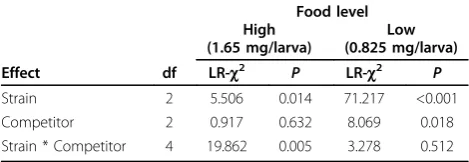
At ‘high’diet conditions, survival of larvae to the pupal stage was significantly higher than under ‘low’diet con-ditions (LR-c2 = 221.47,df= 1, P< 0.001). At high diet conditions, survival ranged from 78 to 100% and at low diet levels from 27 to 76% (Figure 1). Most strikingly, the survival of Wild larvae in the presence of Transgenic larvae was similar under both diet conditions (86 and 76%, respectively; Figure 1), whereas Transgenic survival in presence of Wild was reduced from 88 to 27%. At high diet levels, a significant interaction was detected, indicating that the strain effect differed over the three levels of competitor presence (Table 1). Post-hoc con-trasts of the strain by competitor interaction at high diet level revealed that survival of Inbred larvae was signifi-cantly lower in presence of larvae of their own strain compared to survival with any of the two other strains (LR-c2 = 7.964, df= 1,P = 0.007). This effect was not significant for the Transgenic and Wild strains (LR-c2= 2.725,df = 1, P > 0.05 and LR-c2 = 4.231, df= 1, P > 0.05). At low diet levels, there was no significant interac-tion, but clear main effects of strain and competitor (Table 1). The effects of both strain and competitor were ranked, with the Wild strain demonstrating higher survivorship than both Inbred and Transgenic (LR-c2= 22.963, df = 1, P < 0.001 and LR-c2 = 70.813, df = 1,
P< 0.001, respectively), whereas Inbred had significantly higher survivorship than Transgenic (LR-c2 = 13.248,df
[image:2.595.58.540.501.695.2]= 1, P < 0.001). A similar ranking was found for the competitor effect whereby Wild had a stronger, negative
impact on survival of the other larvae in the well than Transgenic (LR-c2= 7.938,df= 1,P = 0.007). Although the effect of Inbred on survival of the other strains was intermediate, it did not differ significantly from Wild or Transgenic (LR-c2= 2.761,df= 1,P> 0.05 and LR-c2= 1.153,df= 1,P> 0.05, respectively).
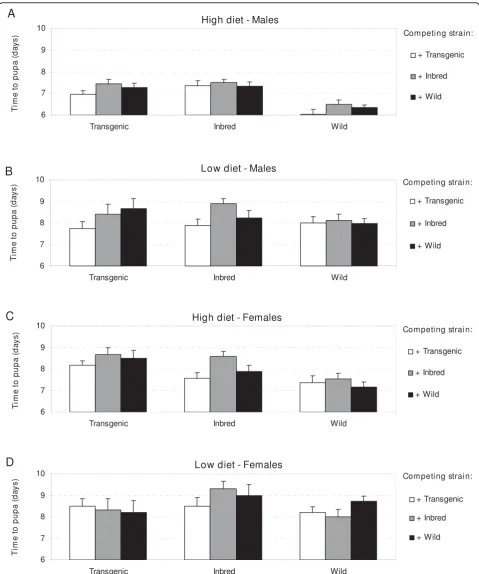
Because of significant interactions between food or sex and the main variables of interest (strain and com-petitor), subsequent analyses of development time were conducted separately for the four (2 × 2) different level combinations of food and sex. Wild males at optimal food conditions developed significantly faster to the pupal stage than Inbred or Transgenic males (Tukey HSD, P < 0.05; Figure 2-A). This effect disappeared when reared at sub-optimal food conditions (Figure 2-B, Table 2). Under sub-optimal diet conditions all strains of larvae took longer to develop to adults than under optimal diet conditions: Wild larval development time increased by 25-33%, whereas it increased 11-19% for Transgenic and 7-19% for Inbred. A similar trend was observed for females. Under optimal diet condi-tions, female Wild larvae developed faster into pupae than Inbred or Transgenic larvae (Tukey HSD, P < 0.05; Figure 2-C). Moreover, a significant effect of the competing strain was observed. Tukey HSD tests revealed that in the presence of Inbred, females of all three strains developed significantly slower (time to pupation was longer) than in the presence of Trans-genic. As with males, effects disappeared at the subop-timal diet levels where no significant differences between strains or effects of competing strain were found (Table 2).
Because of significant interactions between food or sex and the main variables of interest (strain and competi-tor), subsequent analyses of pupal size were performed separately for the four different levels of food and sex (similar to the results on development time). For all four models, significant interactions between strain and competitor existed (Table 3), indicating that the effect of competitor presence on pupal size was different for the three strains studied. Subsequent post-hoc analyses revealed that male Wild and Inbred pupae from both
diet levels were always smaller when reared in the pre-sence of their own larvae (t= 2.01, P = 0.046 and t= 5.342,P< 0.001 at low diet level andt= 3.50,P< 0.001 andt= 2.238,P= 0.026 at high diet level, respectively), suggesting higher intra-strain than inter-strain competi-tion. This was also the case for females of the Wild and Inbred strain at high diet levels (t= 1.99,P = 0.048 and
t= 3.541,P < 0.001) and Wild females at low diet level (t= 3.245,P = 0.002), but not for Inbred females at low diet level (t= 1.932, P = 0.0564). Such effects were not observed with Transgenic larvae (Figure 3).
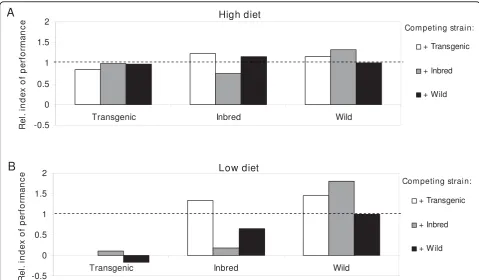
Figure 4 illustrates the relative index of performance of females after setting the Wild-Wild combination at 1.0 as the reference group. Especially at low diet levels, overall performance of the Transgenic strain was much lower compared to the Inbred and Wild strains. Wild females exposed to the low diet had 38-54% reduction in performance compared to those in high diet treat-ments. The same comparison demonstrated a 50-88% reduction in Inbred and 95-119% in Transgenic. These results suggest that Transgenic larvae were more sensi-tive to a change in diet levels than Inbred and Wild, whereas Inbred was more sensitive than Wild.
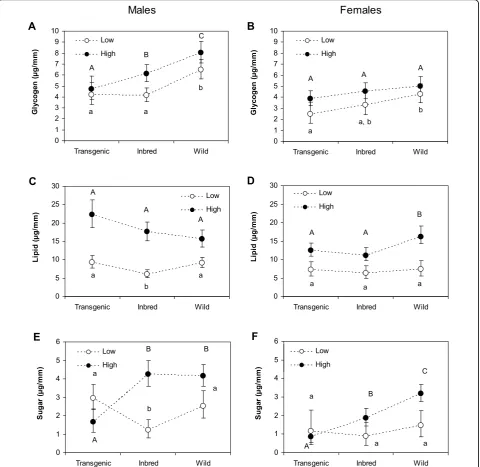
Glycogen levels of the Wild strain were significantly higher than the Inbred and/or Transgenic strain, except for females at the high diet level (Figures 5-A and 5-B). Inbred males at the low diet level contained significantly less lipids than the Wild and Transgenic strain (Figure 5-C). Wild females reared at high diet levels had signifi-cantly more lipids than both the Inbred and Transgenic strain, whereas no significant differences were found at the low diet level (Figure 5-D). At the high diet level, Wild males and females contained significantly more sugars than Inbred and/or Transgenic (Figures 5-E and 5-F). At the low diet level, only male Inbred contained significantly less sugars than Wild and Transgenic (Figure 5-E).
Discussion
[image:3.595.56.291.101.182.2]Our study demonstrated lower survivorship and increased development time of the inbred and trans-genic strain of Ae. aegypti larvae when compared to their wild counterpart. Clearly, this outcome of competi-tion was mediated by the relative competitive strength of each strain as well as the amount of food available. First, the results of increased development time of Inbred and Transgenic larvae were most pronounced at high diet conditions for both males and females. Second, when competition for food was highest (i.e., at the low diet level), the wild-type strain was a superior competi-tor in terms of survival over the inbred strain, which in turn was superior over the transgenic strain (Figure 1-B). Because nutritional resources in the aquatic environ-ment of Ae. aegypti are limited, such effects of
Table 1 Statistical model results of survival
Food level High
(1.65 mg/larva)
Low (0.825 mg/larva)
Effect df LR-c2 P
LR-c2 P
Strain 2 5.506 0.014 71.217 <0.001
Competitor 2 0.917 0.632 8.069 0.018
Strain * Competitor 4 19.862 0.005 3.278 0.512
LR-cχ2
: Likelihood ratio chi-square value.
Effects of strain, presence of competing strain and strain by competitor interaction on survival to the pupal stage ofAe. aegyptilarvae at‘high’and
competition for nutrients are likely to occur in nature as well [20-22].
Our experimental set-up with microcosms was based on earlier work that investigated the effects of density-dependent competition on the life-history ofAe. aegypti
[24]. In the field, a substantial diversity in container habitats can be found. These range from large, rain-filled water storage containers (~500 L) to very small containers such as ant-traps filled with tap water. The minimalist approach uses small numbers in small volumes [24], but still with comparable densities as encountered in the field [25]. This experimental design allowed us to track larvae throughout their development and control for the amount of food available per larva.
It is possible that some of the observed effects may offset each other in nature. For example, lower survivor-ship could result in less frequent interactions with remaining larvae, which in turn could lead to larger, more fecund adults, and eventually result in no net effect on relative fitness. Using the index of performance that incorporates survival, development time and size-related fecundity, we found that the Wild strain had an overall competitive advantage in the larval stage. The Inbred strain was more fit than the Transgenic strain which in turn was less fit than the Wild strain, suggest-ing that genetic modification imparted a fitness cost on top of inbreeding costs.
The results on energetic reserves of the three strains suggest that inbreeding and genetic modification also affect the mosquito’s metabolism. Such differences could be the result of poorer resource acquisition rate during the larval stage (e.g. amount of time spent feeding or efficiency of filter feeding). In general, glycogen reserves
for the Wild strain were higher than for the Inbred and/ or Transgenic strains. Lipid reserves showed a reverse trend for males, but not significantly so, whereas for females lipids showed a similar trend as glycogen levels. This suggests sex-specific variation in energetic budget as demonstrated for the malaria vectorAnopheles gam-biae [26]. Because glycogen is an important stored energy source for mosquito flight and dispersal that can be rapidly utilized after eclosion, these differences could have a serious impact on mating and eventual reproduc-tive success [23,27].
Although the inbred and transgenic strains had a dif-ferent origin than the wild strain (Puerto Rico versus Mexico), and intrinsic genetic differences could not be ruled out completely, our results on reduced competitive ability and altered metabolism are most likely the conse-quence of detrimental effects of both inbreeding and genetic modification. Ideally, transformation should be conducted on genetically diverse laboratory strains which could mitigate the impact of modification and inbreeding [15].
[image:5.595.56.543.101.188.2]Although it is not clear just how competitive modified mosquitoes need to be compared with wild type mos-quitoes in order to replace vector populations, the fit-ness effects observed in our study are likely to be relevant. First, the strong dependence on food level sug-gests that the outcome of competition is not fixed and thus fitness evaluations should not be performed only under ‘ideal’laboratory conditions [17-19]. Next, our results support earlier statements that incorporation of strong gene drive mechanisms in the transgenic con-struct will be important [28]. If they are not, a competi-tive disadvantage in the larval stage may lead eventually
Table 2 Statistical model results of development time
Males Females High (1.65 mg/larva) Low (0.825 mg/larva) High (1.65 mg/larva) Low (0.825 mg/larva)
Effect df SS P SS P SS P SS P
Strain 2 68.886 <0.001 4.189 0.416 50.344 <0.001 7.410 0.094
Competitor 2 6.038 0.084 13.316 0.063 15.670 0.034 0.956 0.733
Strain * Competitor
4 1.431 0.881 9.854 0.389 6.796 0.562 6.580 0.373
Effects of strain, presence of competing strain and their interaction on development time to the pupal stage of male and femaleAe. aegyptilarvae at‘high’and
‘low’diet levels.
Table 3 Statistical model results of pupal size
Males Females High (1.65 mg/larva) Low (0.825 mg/larva) High (1.65 mg/larva) Low (0.825 mg/larva)
Effect df SS P SS P SS P SS P
Strain 2 0.302 <0.001 0.046 0.119 0.292 0.003 0.032 0.387
Competitor 2 0.121 0.007 0.074 0.033 0.067 0.262 0.024 0.498
Strain * Competitor 4 0.123 0.038 0.281 <0.001 0.353 0.008 0.224 0.013
[image:5.595.56.540.644.724.2]to the exclusion of the‘weaker’GM strain in nature [29] ultimately compromising control efforts. For a popula-tion reducpopula-tion strategy based on RIDL or SIT, reducing the potential for density-dependent competition may negate the effectiveness of a mosquito control program, because less competition may result in increased wild type larval survival and potentially more fecund adult mosquitoes. This effect could thereby offset the initial positive effects of a reduced population [30], although the importance of density-dependent competition under field conditions remains unclear [31]. Design of late-act-ing dominant lethal genetic systems may be promislate-act-ing in this regard as they carry a GM larval population through the density-dependent phase [32].
Conclusions
Future studies on competition and fitness of transgenic mosquitoes should address how the competitive ability of various transgenic strains is affected when exposed to dif-ferent scenarios of density-dependent (e.g., container size and food availability) and density-independent factors (e. g., temperature). These studies should address both the fitness cost of inbreeding as well as genetic modification. In line with our results, other studies have shown that expression of genetic background strongly depends on environmental conditions (gene by environment
interactions) [33,34]. Similarly, there is an urgent need to evaluate transgenic mosquito lines under more realistic field conditions [13,14] and across life stages.
Methods
Mosquito strains
Competition experiments were carried out with combi-nations of three strains ofAe. aegypti: (1) wild-type (Wild); larvae were second generation offspring of field collected pupae from Tapachula, Mexico (14° 54’N, 92° 15’W); (2) Higgs’white eye (HWE), an eye-pigment defi-cient variant of the Puerto Rican Rexville D strain [35] as the result of a spontaneous mutation (S. Higgs, pers. comm.; [8]) and (3) enhanced green fluorescent protein (EGFP), a HWE strain in which the GFP gene has been inserted through germ-line transformation using the
[image:7.595.57.537.88.368.2]piggyBactransposable element (A.A. James, pers. comm.; [36]). All strains were maintained in separate environ-mental chambers set at a temperature and humidity com-parable to the origin of the Wild strain (Tapachula, Mexico): 27°C, 80% RH and a photoperiod of 12:12 L:D. The Inbred (HWE) and Transgenic (GFP) strains were kept at 28°C and 80% RH prior to shipment to our laboratory facilities. Experiments were executed in another environmental chamber with the same tempera-ture, humidity and light settings. Standard rearing
conditions for all strains used 200 larvae per tray (27 × 20 × 8 cm) filled with 1 L of tap water. We added 30, 60, 90 and 90 mg of food to the rearing trays on days 0, 1, 3 and 5, respectively (1.65 mg/larva). Food consisted of a 1:1 ratio of lactalbumin: brewers yeast mixture.
Competition experiments
We followed the approach of Agnewet al.[24] to study the effects of larval competition inAe. aegypti. Wells of
[image:8.595.59.540.90.557.2]12-well cell culture plates (2.2 cm diameter, Corning Incorporated Life Sciences, Lowell, MA) were filled with five ml tap water. Water was added daily to account for evaporation. Newly hatched first-instar larvae (~ 4 h old) were introduced in the following six combinations at high and low diet regimens: (1) 4 Wild larvae, (2) 4 Transgenic larvae, (3) 4 Inbred larvae, (4) 2 Wild plus 2 Transgenic larvae, (5) 2 Wild plus 2 Inbred larvae and (6) 2 Transgenic plus 2 Inbred larvae. We added 0.15,
0.3, 0.6 and 0.6 mg of food per larva on days 0, 1, 3 and 5, respectively, for the high diet regimen (total 1.65 mg/ larva). This diet amount was found to be optimal for development of large body size mosquitoes in previous experiments in our laboratory. The low diet consisted of half the amount of the high diet regimen (total 0.825 mg/larva). Mortality was recorded daily and, over the course of the study, the amount of food added to each well was adjusted to the number of larvae remaining. Thirty replicates per treatment were carried out.
Time to pupation was recorded, as well as sex of pupae [37]. Size of pupae was measured as an indicator of adult body size as described by Koenraadt [38]. Briefly, after moving the pupa to its lateral side, cepha-lothorax length was measured as the distance between the anterior point of the median keel and the ventral tip of the pupal wing sheath [39]. The relationship could be expressed asy = 1.110x + 0.014 andy = 0.974x+ 0.119 for females and males, respectively, whereby x= cepha-lothorax length (mm) andy = adult wing length (mm). GFP expression in the eyes of pupae was visualized using a Stemi 2000-C stereomicroscope (Carl Zeiss MicroImaging Inc., Thornwood, NY) equipped with an Endura Bright Royal Blue (450 nm) LED-light (Opto Technology, Inc., Wheeling, IL) and a yellow barrier fil-ter (Edmund Optics Inc., Barrington, NJ). The experi-ments were terminated when all larvae had died or pupated.
Nutritional status
To test for differences in nutritional reserves of teneral adults emerging from the single species treatment, we determined glycogen, lipid and sugar content using pre-viously published protocols [40-42]. Body size dependent variation in nutrient quantities were controlled for by expressing nutritional reserves per mm pupal height.
Data analysis
Our analyses focused on detecting differences in survival to the pupal stage, development time and pupal size that were inherent to the strain (strain effect), how each strain affected survival, development and size of the other larvae in the same wells (competitor effect), and how these effects changed at optimal and sub-optimal diet levels. Random plate and well effects were not found to be significant in our initial model development; consequently, they were removed from further analysis. Survival data were analyzed with the binomial logistic regression procedure (JMP 7.0, Cary, NC, USA). Ana-lyses of development time and pupal size were per-formed with standard least squares models (JMP 7.0, Cary, NC, USA). Significant main effects in all models without significant interactions were indicative of a
‘ranking’in strain and competitor effects. In that case,
post-hoc contrasts were specified to test the hypothesis that the Wild strain was‘stronger’than the Inbred strain (e.g., higher survivorship or larger size), that the Inbred strain was stronger than the Transgenic strain and that the Wild strain was stronger than the Transgenic strain. Similarly, we tested the hypothesis that the Wild or Inbred strain as a competitor had a greater negative impact on survival, development time or pupal size than the Transgenic strain. Significant interactions between strain and competitor were indicative of intra-strain ver-sus inter-strain differences, i.e. survival, development time and pupal size for larvae reared with their own strain were different than when reared with any of the two other strains. This hypothesis was analyzed by spe-cifying post-hoc contrasts, and significance was evalu-ated by using Tukey-HSD tests or by correcting significance levels using the Bonferroni correction.
Ideally, the overall impact of transgenesis and inbreed-ing for cohorts of organisms should be assessed by cal-culating per capita rates of change. In our study, a simpler index of performance was calculated that com-bines information about survivorship and fecundity in a way that essentially simulates computation of the per capita rate of change [43]:
I N
A w
xA w A w
x x x x x x x x x =
∑
∑
∑
ln 1 0N0 represents the initial number of females (assumed
to be 50% of the starting number in our experiments);
Axis the number of adult females produced at timexof
the experiment; wx represents the size of the emerging female and is a direct proxy for fecundity. For the pre-sent study we used female pupal size because of its strong correlation with female adult size [38]. Indices were calculated for each cohort, whereby cohort was defined as all females from one treatment combination. After calculating the indices, we set the value of the Wild-Wild combination at 1 as the reference group. We did this separately for the high diet and the low diet experiment. All other calculated performance index values were then adjusted so that values >1 would indi-cate better performance and values <1 would indiindi-cate poorer performance than the Wild larvae in the pre-sence of larvae of their own strain.
Funding
This work was funded by a grant from the Foundation for the National Institutes of Health through the Grand Challenges in Global Health Initiative.
Acknowledgements
We thank Dr. Janine Ramsey and Guillermo Bond (Centro Regional de Investigaciones en Salud Publica, Tapachula, Mexico) for collecting pupae for the low generation Wild colony. James Booth is acknowledged for statistical advice. We thank Fred Gould, Erik Poelman and Michelle Helinski for their comments on an earlier draft of this manuscript.
Author details
1
Department of Entomology, Cornell University, Ithaca, NY 14850, USA.
2Department of Statistical Sciences, Cornell University, Ithaca, NY 14850, USA. 3
Laboratory of Entomology, Wageningen University, P.O. Box 8031, 6700 EH Wageningen, The Netherlands.
Authors’contributions
CJMK carried out the experimental work, analyzed the data and drafted the manuscript. MK participated in statistical data analyses and helped to draft the manuscript. LCH participated in study design and coordination and helped to draft the manuscript. All authors read and approved the final manuscript.
Competing interests
The authors declare that they have no competing interests.
Received: 19 July 2010 Accepted: 6 October 2010 Published: 6 October 2010
References
1. Harrus S, Baneth G:Drivers for the emergence and re-emergence of vector-borne protozoal and bacterial diseases.Int J Parasitol2005, 35:1309-1318.
2. Gratz NG:Emerging and resurging vector-borne diseases.Annu Rev Entomol1999,44:51-75.
3. Monath TP:Dengue and yellow fever - Challenges for the developments and use of vaccines.New Engl J Med2007,357:2222-2225.
4. Allen ML, Scholl PJ:Quality of transgenic laboratory strains of Cochliomyia hominivorax(Diptera: Calliphoridae).Journal of Economic Entomology2005,98:2301-2306.
5. Atkinson PW, Michel K:What’s buzzing? Mosquito genomics and transgenic mosquitoes.Genesis - The Journal of Genetics and Development
2002,32:42-48.
6. Beard CB, Dotson EM, Pennington PM, Eichler S, Cordon-Rosales C, Durvasula RV:Bacterial symbiosis and paratransgenic control of vector-borne Chagas disease.Int J Parasitol2001,31:621-627.
7. Scott MJ, Heinrich JC, Li XL:Progress towards the development of a transgenic strain of the Australian sheep blowfly (Lucilia cuprina) suitable for a male-only sterile release program.Insect Biochem Mol Biol
2004,34:185-192.
8. Franz AWE, Sanchez-Vargas I, Adelman ZN, Blair CD, Beaty BJ, James AA, Olson KE:Engineering RNA interference-based resistance to dengue virus type 2 in genetically modifiedAedes aegypti.Proc Natl Acad Sci
2006,103:4198-4203.
9. Riehle MA, Srinivasan P, Moreira CK, Jacobs-Lorena M:Towards genetic manipulation of wild mosquito populations to combat malaria: advances and challenges.Journal of Experimental Biology2003,206:3809-3816. 10. Fu GL, Lees RS, Nimmo D, Aw D, Jin L, Gray P, Berendonk TU,
White-Cooper H, Scaife S, Phuc HK,et al:Female-specific flightless phenotype for mosquito control.Proc Natl Acad Sci2010,107:4550-4554. 11. Benedict MQ, Robinson AS:The first releases of transgenic mosquitoes:
an argument for the sterile insect technique.Trends Parasitol2003, 19:349-355.
12. Gould F, Schliekelman P:Population genetics of autocidal control and strain replacement.Annu Rev Entomol2004,49:193-217.
13. Scott TW, Takken W, Knols BGJ, Boete C:The ecology of genetically modified mosquitoes.Science2002,298:117-119.
14. Marrelli MT, Moreira CK, Kelly D, Alphey L, Jacobs-Lorena M:Mosquito transgenesis: what is the fitness cost?Trends Parasitol2006,22:197-202. 15. Scott TW, Rasgon JL, Black WC IV, Gould F:Fitness studies: developing a
consensus methodology.InBridging laboratory and field research for genetic control of disease vectors.Edited by: Knols BGJ, Louis C. Dordrecht, The Netherlands: Kluwer Academic Publishers; 2006:11:210, Bogers RJ (Series Editor).
16. Begon M, Harper JL, Townsend CR:Ecology - Individuals, populations and communities.Boston, Oxford, London, Edinburgh, Melbourne: Blackwell Scientific Publications, 2 1990.
17. Irvin N, Hoddle MS, O’Brochta DA, Carey B, Atkinson PW:Assessing fitness costs for transgenicAedes aegyptiexpressing the GFP marker and transposase genes.Proc Natl Acad Sci2004,101:891-896.
18. Catteruccia F, Godfray HC, Crisanti A:Impact of genetic manipulation on the fitness ofAnopheles stephensimosquitoes.Science2003,
299:1225-1227.
19. Moreira LA, Wang J, Collins FH, Jacobs-Lorena M:Fitness of anopheline mosquitoes expressing transgenes that inhibit Plasmodium development.Genetics2004,166:1337-1341.
20. Dye C:Competition amongst larvalAedes aegypti: the role of interference.Ecol Entomol1984,9:355-357.
21. Gilpin ME, McClelland GAH:Systems analysis of the yellow fever mosquitoAedes aegypti.Fortschritte der Zoologie1979,25:355-388. 22. Southwood TR, Murdie G, Yasuno M, Tonn RJ, Reader PM:Studies on the
life budget ofAedes aegyptiin Wat Samphaya, Bangkok, Thailand.Bull World Health Org1972,46:211-226.
23. Briegel H, Knusel I, Timmermann SE:Aedes aegypti: size, reserves, survival, and flight potential.J Vector Ecol2001,26:21-31.
24. Agnew P, Hide M, Sidobre C, Michalakis Y:A minimalist approach to the effects of density-dependent competition on insect life-history traits.
Ecol Entomol2002,27:396-402.
25. Koenraadt CJM, Jones JW, Sithiprasasna R, Scott TW:Standardizing container classification for immatureAedes aegyptisurveillance in Kamphaeng Phet, Thailand.J Med Entomol2007,44:938-944. 26. Huho BJ, Ng’habi KR, Killeen GF, Nkwengulila G, Knols BGJ, Ferguson HM:
Nature beats nurture: a case study of the physiological fitness of free-living and laboratory-reared maleAnopheles gambiaes. l.J Exp Biol2007, 210:2939-2947.
27. Yuval B, Hollidayhanson ML, Washino RK:Energy budget of swarming male mosquitos.Ecol Entomol1994,19:74-78.
28. James AA:Gene drive systems in mosquitoes: rules of the road.Trends Parasitol2005,21:64-67.
29. Grover JP:Resource competition.London: Chapman & Hall, 1 1997. 30. Atkinson MP, Su Z, Alphey N, Alphey LS, Coleman PG, Wein LM:Analyzing
the control of mosquito-borne diseases by a dominant lethal genetic system.Proc Natl Acad Sci2007,104:9540-9545.
31. Legros M, Lloyd AL, Huang Y, Gould F:Density-dependent intraspecific competition in the larval stage ofAedes aegypti(Diptera: Culicidae): revisiting the current paradigm.J Med Entomol2009,46:409-419. 32. Phuc HK, Andreasen MH, Burton RS, Vass C, Epton MJ, Pape G, Fu GL,
Condon KC, Scaife S, Donnelly CA,et al:Late-acting dominant lethal genetic systems and mosquito control.BMC Biology2007,5:11. 33. Devlin RH, D’Andrade M, Uh M, Biagi CA:Population effects of growth
hormone transgenic coho salmon depend on food availability and genotype by environment interactions.Proc Natl Acad Sci2004, 101:9303-9308.
34. Sundström LF, Lõhmus M, Tymchuk WE, Devlin RH:Gene-environment interactions influence ecological consequences of transgenic animals.
Proc Natl Acad Sci2007,104:3889-3894.
35. Miller BR, Mitchell CJ:Genetic selection of a flavivirus-refractory strain of the Yellow Fever mosquitoAedes aegypti.Am J Trop Med Hyg1991, 45:399-407.
36. Adelman ZN, Jasinskiene N, Vally KJM, Peek C, Travanty EA, Olson KE, Brown SE, Stephens JL, Knudson DL, Coates CJ, James AA:Formation and loss of large, unstable tandem arrays of the piggyBac transposable element in the yellow fever mosquito,Aedes aegypti.Transgenic Research
2004,13:411-425.
38. Koenraadt CJM:Pupal dimensions as predictors of adult size in fitness studies ofAedes aegypti(Diptera : Culicidae).J Med Entomol2008, 45:331-336.
39. Knight KL:A mosquito taxonomic glossary VII. The pupa.Mosquito Systematics Newsletter1971,3:42-65.
40. Van Handel E:Rapid determination of glycogen and sugars in mosquitos.
J Am Mosq Control Assoc1985,1:299-301.
41. Van Handel E:Rapid determination of total lipids in mosquitos.J Am Mosq Control Assoc1985,1:302-304.
42. Harrington LC, Edman JD, Scott TW:Why do femaleAedes aegypti (Diptera: Culicidae) feed preferentially and frequently on human blood?
J Med Entomol2001,38:411-422.
43. Livdahl TP, Sugihara G:Non-linear interactions of populations and the importance of estimating per-capita rates of change.Journal of Animal Ecology1984,53:573-580.
doi:10.1186/1756-3305-3-92
Cite this article as:Koenraadtet al.:Effects of inbreeding and genetic
modification onAedes aegyptilarval competition and adult energy
reserves.Parasites & Vectors20103:92.
Submit your next manuscript to BioMed Central and take full advantage of:
• Convenient online submission
• Thorough peer review
• No space constraints or color figure charges
• Immediate publication on acceptance
• Inclusion in PubMed, CAS, Scopus and Google Scholar
• Research which is freely available for redistribution