City, University of London Institutional Repository
Citation
:
Simpson, A. and Janner, M. (2010). Star Wards Survey Report 2009/2010. London: Bright.This is the published version of the paper.
This version of the publication may differ from the final published
version.
Permanent repository link:
http://openaccess.city.ac.uk/7246/Link to published version
:
Copyright and reuse:
City Research Online aims to make research
outputs of City, University of London available to a wider audience.
Copyright and Moral Rights remain with the author(s) and/or copyright
holders. URLs from City Research Online may be freely distributed and
linked to.
City Research Online: http://openaccess.city.ac.uk/ [email protected]
Survey Report
2009/2010
Alan Simpson, Professor of Collaborative Mental Health Nursing,
School of Community and Health Sciences, City University,
London E1 2EA
2 Contact Address:
Star Wards Bright
16 Springfield Avenue London N10 3SU
Email: [email protected] Telephone: 07932 696083
Website: http://www.starwards.org.uk/
3
Contents
Page No.
Executive summary 5
Background 8
Methods 10
Procedure 11
Analysis 11
Results: Quantitative data 12
Star Wards Activity 12
Impact of Star Wards 13
Star Wards Resources 14
Service Users’ Views 14
Results: Qualitative data 17
Description of Star Wards 17
Impact of Star Wards 23
Activities and facilities 23
Interactions 25
Reductions in conflict 29
New focus 29
Too early to tell 30
Positive feedback 31
4
Star Wards Email Newsletter 34
Challenges and barriers 38
Staff numbers, changes and demands 38 Staff attitudes, skills and confidence 41
Funding and resources 44
Patient factors 45
Ward environment 47
Organisational restrictions and changes 47
Further developments of Star Wards 49
Dislikes 49
Limitations of the survey 52 Discussion 53
Impact 53 Challenges 55
Resources 55
Further developments 56 Conclusion and transferable principles and practices 57
5
Executive Summary
Star Wards was set up by Marion Janner, following her time as a detained mental health in-patient, to work collaboratively with the full range of mental health wards from acute admission to high secure, to improve inpatients’ experiences and outcomes. Initially, the focus for Star Wards was on
promoting the use on mental health units of 75 practical, mainly low-cost and easy to implement ideas, but its role is increasingly as a catalyst to change through inspiring, collecting and disseminating great practice in inpatient care.
This report presents the results from a survey of ward staff and service users engaged with Star Wards. The aim of the survey was to explore the impact of Star Wards on the wards; to evaluate the use and value of Star Wards
resources including publications, website and newsletter; to identify the challenges and difficulties that remain; and to elicit members’ views on the substance and direction of future Star Wards activities.
Following a brief background and explanation of how the survey was
conducted and analysed, the results are presented in two sections. First the numerical results derived from staff and service users’ responses are
presented and then more detailed textual findings are explored. We then discuss the results and suggest some tentative underlying and transferable principles and practices that may account for the undoubted success of Star Wards.
A total of 188 ward staff surveys were completed, with 97 returned by post and 91 completed online. The vast majority of returns came from England. An additional 62 service user surveys were also returned.
6
Impacts
• Involvement with Star Wards has led to an increase in patient-focused activities on over 83% of the 188 wards, with over a third (36.2%) reporting a ‘big’ or ‘massive’ difference
• Respondents describe a wide range of creative, innovative initiatives and new facilities that have been introduced.
• Star Wards is overwhelmingly described in positive and enthusiastic terms, including ‘rewarding’, ‘interesting’, ‘fun’ and ‘innovative’.
• Star Wards has reportedly led to increased staff-patient contact on over three-quarters of the wards (81.4%), with almost a third (30.3%)
reporting a ‘big’ or ‘massive’ increase.
• Star Wards has freed-up staff time to provide patient-focused activities on 40.5% of wards, although almost half (48.9%) said it had made little or no difference in this regard.
• Star Wards-related activities have reportedly improved ward atmosphere on over 85% of wards, with over a quarter (26.6%) reporting a ‘big’ or ‘massive’ difference.
• Patient satisfaction has reportedly improved on 83.5% of wards and staff reported improved staff morale.
• Improvements in staff morale, improvements in patient satisfaction and quality of care, less boredom and improvements in ward atmosphere and environment are all reported.
• Impact on the provision of ‘talking therapies’ on wards was less marked with just over half (56.4%) reporting any improvement and just 12.8% saying there was a significant increase. Almost a third (31.4%) said Star Wards had made no difference.
• Reduction in aggression on the ward was reported by 71.2%, although 44.7% said it had made little or no difference. There was little reported impact on patients going missing from the ward with over half (56.9%) reporting little or no change.
7
• Three-quarters of respondents said that maintaining changes brought about through Star Wards would be ‘easy’ or ‘fairly easy’.
Resources
• Star Wards resources (books, newsletter, website) are extremely highly valued and reasonably well accessed.
• The first Star Wards book of 75 suggestions for improving wards was available on 65% of the wards with almost all (97.5%) finding it ‘useful’, ‘very useful’ or ‘excellent’.
• The second book (Star Wards 2) was definitely available on half (51.1%) of wards and again almost all (96.8%) found it ‘useful’, ‘extremely useful’ or ‘excellent’.
• The fortnightly email newsletter was reportedly accessed by almost three-quarters (70.7%) of the wards. Over three-quarters (79.2%) found the contents ‘fairly useful’, ‘useful’ or ‘very useful’.
• Around two-thirds (62.7%) of respondents said the publications had inspired changes on their wards.
• The Star Wards website was described as ‘very useful’ or ‘excellent’ by over two-thirds (71.9%) of respondents and had inspired changes on over half (56.9%) the wards.
Challenges
• Key challenges and barriers to the implementation of Star Wards initiatives were reported by about two-thirds of staff.
• Key challenges were staff numbers and changes, overlapping with demands on staff time; staff attitudes, skills and confidence; lack of funding and resources; patient type and mental state; type of ward and/or ward environment; and hospital rules, regulations and culture.
Future
8
Background
Guidelines on acute psychiatric care published in the UK acknowledged that “too often acute inpatient services are not working to anyone’s satisfaction” (Department of Health 2002; p3). Numerous difficulties and criticisms have been identified over the years (Simpson 2008, Warner 2005), but probably none more so than the reported lack of staff-patient interaction and
therapeutic activities (Ford, Duncan & Warner, 1998). However, it is generally acknowledged that inpatient wards remain an essential part of any
comprehensive mental health service (Thornicroft & Tansella 2004).
A national survey of 7,500 people recently discharged from psychiatric inpatient units in England (CQC 2009) found that although 73% had rated their overall care as “good, very good or excellent”, a third (35%) reported insufficient activities on the ward during weekdays and over half (54%) said there was too little to do in evenings and at weekends. In addition, over half (52%) of the former patients had wanted talking therapies, such as
counselling, cognitive behavioural therapy and anxiety management, while just 29% received such interventions.
Repeated reports issued by the Mental Health Act Commission have lamented the high levels of boredom experienced by patients, the lack of meaningful activities and low levels of staff-patient contact on psychiatric wards, which they suggest leads to difficult behaviours and challenging situations on wards (MHAC 2009).
9
Staff working on mental health wards have identified spending time with patients and providing an array of array of psychotherapeutic approaches and activities as core components in their endeavours to keep people safe and provide assessment and treatment (Bowers et al 2005). Yet both nurses and occupational therapists report that their ability to provide therapeutic
interactions is prevented by other demands on their time (Cleary & Edwards 1999) and the swift throughput and acuity of patients (Simpson et al 2005).
Star Wards
Marion Janner set up Star Wards following her time as a detained mental health in-patient, having previously managed residential and vocational services for people with learning disabilities and a campaign to reduce the prison population. Star Wards works collaboratively with the full range of mental health wards from acute admission to high secure, to improve
inpatients’ experiences and outcomes. Using 75 practical, mainly low-cost and easy to implement ideas forms the core of Star Wards, but its role is
increasingly as a catalyst to change through inspiring, collecting and disseminating great practice in inpatient care.
Star Wards’ main activities
Website (http://www.starwards.org.uk/) E-newsletter
Visiting hospitals Facilitating networking Conferences
Articles
Training resources for staff e.g. TalkWell, Starter for Ten book and card set Resources for patients eg Forwards magazine
Motivational awards eg Full Monty awards
More intensive direct work with hospitals eg London Bridges project
Active participation in national acute care steering groups, government consultations and inpatient care reviews
10
Star Wards is run by the charity Bright, whose projects use the strongest social marketing practices to improve the lives and autonomy of the most marginalized social groups.
On joining Star Wards, a member of staff is asked to complete a brief tick box questionnaire on their “hopes and expectations in taking part in Star Wards?” The data from this suggest that participating ward staff hope that involvement would lead to increased involvement of patients in their own care planning and treatment; increased therapeutic and recreational activities for patients; greater therapeutic opportunities, improved safety for patients, staff and visitors; and reduced staff sickness and absence.
Several reports have been published outlining how individual ward teams have been influenced by Star Wards (James, 2007; Jones 2008) but this is the first major survey of wards participating in the Star Wards initiative.
Methods
We conducted a postal and internet survey of around 500 wards registered as participating in Star Wards. The lead author designed and developed the survey, which was then revised by the Director and other members of the Star Wards team. It contained 54 questions for ward staff, with a mixture of tick box, likert scale and free text responses available. An additional pull-out section for service users on the ward contained 14 questions with a similar mix of answers possible. Topics covered included amount of Star Wards-related activity being undertaken; main impacts on patients and staff
11
Procedure
The survey questionnaire was titled “The Stupidly Big Star Wards Survey 2009”, attractively designed, printed on coloured paper and posted in colourful sparkly envelopes (in typical Star Wards style) to all wards registered on the Star Wards database, with a covering letter from the Director encouraging participation in the survey. Each survey also contained an invitation to take part in a prize draw to win an MP3 music player as an inducement to
complete the survey, which had to be returned with the competition entry in the freepost envelope provided. A link to an online version of the survey was also placed on the Star Wards website. The launch of the survey was
promoted in the Star Wards email newsletter, with staff encouraged to complete either the postal or online versions of the survey. Three email reminders to complete the survey were sent to the wards after two, three and four weeks. Survey responses were collated by the lead author, who made checks to ensure no duplication of postal and online responses and then conducted all analysis.
Analysis
Quantitative data were entered into SPPS vs 16, checked for anomalies and descriptive statistics produced. Textual data was entered into qualitative analytic software (QSR N6), reviewed and analysed using conventional content analysis. This type of qualitative analysis is most suited to identifying the range of views on a topic where the level of analysis required is
descriptive rather than interpretative or theoretical (Hseih & Shannon 2005). Themes identified were tabulated as to frequency and provenance (type of ward) and illustrated with representative quotations. The coding system was developed iteratively, with a set of descriptive codes and sub codes
12
Results: Quantitative data
Star Wards Activity
A total of 188 (37.6%) staff surveys were completed, with 97 returned by post and 91 completed online. The vast majority of returns came from England (n = 178, 94.6%), with 8 (4%) from Scotland and one from each of Wales and Australia.
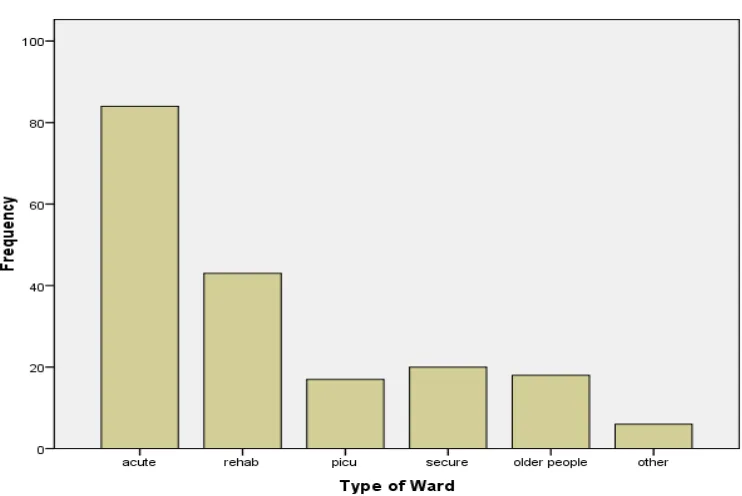
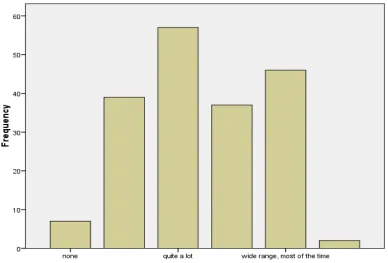
Almost half (n=84, 44.7%) were acute psychiatric wards, with a further 17 (9%) psychiatric intensive care units (PICUs). A further 43 (22.9%) were rehabilitation wards; 20 (10.6%) were secure units and 18 (9.6%) wards for older people (Figure 1). Length of involvement in Star Wards is shown in Figure 2.
[image:13.595.107.478.472.720.2]Respondents were asked to rate how much Star Wards-related activity regularly takes place on the ward. Over 95% said there was some activity taking place and almost a quarter (24.5%) said that a wide range of activities were occurring most of the time (Figure 3).
13
Figure 2: Length of involvement with Star Wards (n = 188)
Figure 3: Amount of Star Wards-related activity taking place regularly
[image:14.595.106.494.464.727.2]14
Impact of Star Wards
[image:15.595.90.514.203.680.2]Table 1 shows the level of impact that staff thought that Star Wards had achieved on the ward, with each statement rated on a five point likert scale.
Table 1: Impact of Star Wards-related activities (percentages) (n=188)
Statements No, not really A little bit Quite a lot A big difference A massive difference Don't know Improved ward
atmosphere 5.9 20.7 38.3 20.2 6.4 8.5
Increased activities on
ward 4.8 19.1 33 29.8 6.4 6.9
Increased patient
satisfaction 5.9 23.4 34 23.4 2.7 10.6
Increased availability of
talking therapies 31.4 28.2 15.4 9.6 3.2 12.2
Reduced aggression on
ward 15.4 29.3 20.7 10.6 3.2 20.7
Increased length of
patient stays on ward 63.8 5.3 2.7 1.6 0 26.6
Reduced the number of
patients going missing 46.8 10.1 6.4 1.6 0 35.1
Increased amount of
staff-patient contact time 8.5 19.7 31.4 18.1 12.2 10.1
Freed up time for
patient-related activities 13.3 35.6 25 9.6 5.9 10.6
Reduced staff sickness
rates 47.3 13.3 2.7 2.1 0 34.6
Improved team working
on the ward 13.8 31.4 27.7 11.7 3.2 12.2
Improved physical
environment of the ward 15.4 23.9 29.8 10.1 8 12.8
15
Star Wards Resources
Resources made available by Star Wards appeared to be reasonably well accessed and highly valued. The first Star Wards book of 75 suggestions for improving wards was available on 123 (65%) of the 188 wards that responded with almost all (97.5%) finding it ‘useful’, ‘very useful’ or ‘excellent’. The
second book (Star Wards 2) was definitely available on half (51.1%) of wards, with a similar proportion (96.8%) finding it ‘useful’, extremely useful’ or
‘excellent’.
The fortnightly email newsletter was reportedly accessed by almost three-quarters (70.7%) of the wards, with 61.2% saying the newsletter was read by staff. Between two and six staff read the newsletter on over half (55.5%) of the wards; three-quarters (74.4%) found the contents ‘fairly useful’ or ‘useful’ and another 4.8% said it was ‘very useful’. A total of 118 (62.7%) respondents said the publications had inspired changes on their wards.
The Star Wards website was accessed by 44.7% wards ‘occasionally’ and 36.7% ‘frequently’ and was described as ‘very useful’ or ‘excellent’ by over two-thirds (71.9%) of respondents and had inspired changes on over half the wards (56.9%).
Service user views on Star Wards
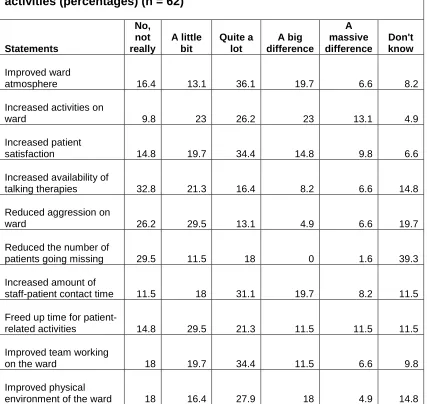
A third of the wards that responded (n = 62, 32%) returned the additional survey completed by service users on the ward. On 43 (69.4%) of the 62 wards, service users were aware of Star Wards-related activities with 19.7% reporting a few activities, 39.3% identifying ‘quite a lot’ of Star Wards
activities; 19.7% finding ‘some, a lot of the time’ and 11.6% reporting ‘a range of activities, most of the time’ on their wards (Figure 4).
16
Figure 4: Service users’ views on level of Star Wards activities (n = 62)
Table 2: Service users' views on level of impact of Star Wards-related activities (percentages) (n = 62)
Statements
No, not really
A little bit
Quite a lot
A big difference
A massive difference
Don't know
Improved ward
atmosphere 16.4 13.1 36.1 19.7 6.6 8.2
Increased activities on
ward 9.8 23 26.2 23 13.1 4.9
Increased patient
satisfaction 14.8 19.7 34.4 14.8 9.8 6.6
Increased availability of
talking therapies 32.8 21.3 16.4 8.2 6.6 14.8
Reduced aggression on
ward 26.2 29.5 13.1 4.9 6.6 19.7
Reduced the number of
patients going missing 29.5 11.5 18 0 1.6 39.3
Increased amount of
staff-patient contact time 11.5 18 31.1 19.7 8.2 11.5
Freed up time for
patient-related activities 14.8 29.5 21.3 11.5 11.5 11.5
Improved team working
on the ward 18 19.7 34.4 11.5 6.6 9.8
Improved physical
[image:17.595.90.517.343.747.2]17
Results: Qualitative data
Description of Star Wards
Star Wards members were asked how they would describe Star Wards to other ward staff contemplating becoming members. The responses were overwhelmingly positive and stressed the improvements made to staff-patient interactions, with words such as ‘rewarding’, ‘interesting’, ‘fun’, ‘innovative’ frequently used. We have included a large number of the responses to reflect the vastly affirmative and enthusiastic response Star Wards stimulates.
“A range of cost effective activities/tasks that can be introduced onto the ward to make patients stay much more therapeutic and positive.” [Older People Ward 02]
“Star Wards is helpful within the rehabilitation setting to help rebuild lives and reallocate power to the patients and to provide patient centred care based on 75 simple standards. “ [Rehab Ward 04]
“A programme designed to increase the amount of therapeutic
engagement on the ward and improving service users' experience on the ward.” [Acute Ward 05]
“Therapeutic activity for all concerned. Patients and staff adding enjoyment to your daily life.” [Acute Ward 08]
“A good opportunity to improve patient care. Working in partnership with services users to improve stay and promote recovery.” [Acute Ward 09]
18
“A good idea which is simple, easy to get going and above all beneficial.” [PICU 12]
“Don't think twice about it. Don't worry if there are any of the 75 ideas that you'll never achieve - just go with the flow and your own ideas will follow.” [Acute Ward 13]
“Rewarding - fun to go to work - good support to get going - aids patient recovery - more natural rapport building.” [PICU 14]
“Helps you focus even more on the quality and detail of the service you are providing.” [Rehab Ward 17]
“Exciting way of benchmarking your ward.” [Rehab Ward 19]
“Helps to enhance inpatient experience. Allows staff and service users to achieve a good rapport based on trust (and to) partake in ward activities with staff and fellow service users.” [Acute Ward 20]
“A service user led initiative derived from actual patient experience with aspirations to improve patient experience and therapeutic
engagement.” [Acute Ward 22]
“An initiative to create activities and links with the community to help with the recovery of patients on mental health wards. Creating a welcome environment for staff and patients to be involved with each other, lessening boredom and increases in patients going AWOL.” [Acute Ward 29]
19
“It is a very exciting time to be involved in healthcare as Star Wards is a bright new idea to improve patient care.” [PICU 34]
“Interesting, motivating, not difficult to implement. Provides a challenge and new ideas.” [Acute Ward 35]
“It is worth the effort, when patients describe the staff and the ward as 'good staff' and 'the best ward'. These views are not always consistent but Star Wards will help to provide more positive feedback.” [Acute Ward 37]
“An initiative where wards from all over the country share ideas and best practice to ensure the best possible care for patients.” [Acute Ward 40]
“Star Wards gives you the opportunity to bring about positive change on your ward, putting you in the driving seat. Working with SW's information and charts gives you a visual tool to see all your good work. It also encourages you to network and have the feeling of belonging to something positive and effective.” [Acute Ward 41]
“Star Wards help build relationships with patients and therefore help build trust. This increases patient and staff interaction. SW also helps deal with patients' problems, e.g. stress awareness, anger
management. This also has a calming influence on the ward as a whole.” [PICU 42]
“That it is very rewarding and exciting.” [Older People 47]
20
“It's fun, free and effective project that allows patients to receive a creative and therapeutic experience whilst in hospital. “ [Secure Unit 54]
“Enhance the patient journey through hospital with increased
engagement through social and recreational activities.” [Acute Ward 56]
“Fun, team building, useful, affirming.” [Rehab Ward 58]
“It's really beneficial to both staff and patients. You see attitudes and cultures changing around you which is great to see. “ [Secure Unit 61]
“I would encourage anyone to become involved in the Star Wards project as it leads to greater client interaction, you get to spend more quality time with clients on a more informal basis, this leads to happier clients and staff.” [Rehab Ward 100]
“Do it. It’s fun for patients and staff.” [Acute Ward 105]
“Star Wards helps ward teams to work with patients and carers in creating the best care pathway possible, and have a laugh whilst doing so.” [Acute Ward 107]
“A simple pragmatic programme for energising a ward and the staff team.” [Acute Ward 101]
“Helps you to refocus on why we work in this profession and the impact we have on client's lives. Suggests simple initiatives that are
21
“That there can only be positives, as the patients feel empowered and make their own choices, staff feel happier because the patients are occupied and focused.” [Secure Unit 126]
“It is a framework that enables the ward to improve activities and engagement, is flexible in the areas you choose to develop. It gives practical ideas in ways to improve the service received by the client group- whilst improving staff.” [PICU 127]
“It’s a good vehicle to introduce change and to springboard into the Recovery Approach.” [Acute Ward 138]
“A way of engaging staff and patients together in a meaningful way. It’s about ensuring that the wards are therapeutic, recovery focused
places.” [Acute Ward 139]
“A scheme designed to make quality of life better for staff and patients. A series of practical and realistic suggestions.” [Secure Unit 140]
“Great information on activities for wards. Offers inspiring ideas for activities. Makes you feel like part of a community all striving to the same thing - create better, improved, innovative, high standard mental health services.” [Rehab 145]
22
“It’s a really good framework for developing wards in all directions. Gives you ideas to start with - usually the easier fun stuff to get nurses and patients involved and before you know it you've moved onto the more therapeutic work - made easier because the relationship is there.” [Other Ward 156]
“A user led, user focussed initiative which provides a menu of good ideas to make changes for the better.” [Acute Ward 160]
“Good sound common sense that looks at improving the quality of life of patients and improves the therapeutic benefits of the hospital environment for all. A natural stepping stone for building a workable rehab program that folks wish to be part of. Normalises patient life.” [Secure Unit 166]
“An opportunity to make a difference and reach out to our service users in an inclusive way which enables the principals of recovery to be at the hub of care.” [Acute Ward 170]
“The Star Wards has opened up the ideas for activities and gives more motivation for patients / staff and this in turn lifts the atmosphere and appears to reduce aggression and incidents on the ward.” [PICU 171]
“Innovative, simple, fun, effective, something everyone can do.” [Acute Ward 175]
“Don't miss the opportunity to be part of a network that is free and allows you to share with others the things that make a difference to patient care.” [Older People Ward 182]
In all of the responses to this question, there were almost no negative
23
“A great guide and basis on which to benchmark the activities you are providing on the ward and to develop the most appropriate activity provision in lines with the needs of your service. It is my opinion that Star Wards will only be successful if the whole MDT own the ethos!” [PICU 116]
“Good for patients but hard trying to find time to implement some of activities.” [PICU 117]
“A good guidance tool however some of the elements cannot be managed due to resource issues. Needs to be a balance of what is achievable.“ [Other Ward 132]
“It takes time and planning to instigate but can improve both service users time and recovery on the ward.” [Acute Ward 183]
But, you can’t keep all the people happy all of the time:
“Dear god don't do it.” [Acute Ward 151]
Impact of Star Wards
Activities and facilities
Asked to describe the main impacts of being involved with Star Wards and the key changes service users would have seen, the overwhelming majority of responses focused on the introduction and increase in availability of a range of structured activities and additional facilities for patients.
24
“Exercise therapies; Complimentary therapies; Community meetings; Protected Time.” [Acute Ward 15]
“Creation of resource room with supervised internet access, Wii
console and games and resource library. (Staff raised funds for above by completing sponsored canoe race). Increase in outside agencies involvement in group work. Physical exercise programmes available.” [Acute Ward 22]
“More of a variety of activities e.g. crystal/colour therapy; jewellery 6-week course; Belly dancing course; pets as therapy; creative groups; internet access; more games; access to gym and healthy living group.” [Acute Ward 22]
“Patients seem happier and look forward to external activities, e.g. walking group, cafe group, visits to parks and museums. Staff are happier seeing patients engaging more with them.” [Acute Ward 25]
“We have an activity co-ordinator and so need to increase the amount of resources and choice to the patients - in terms of one-to-one therapy time - this has been successful so far.” [Older People Ward 28]
“Main changes is creating more ward based activities for both patients and staff to be involved. Observing Protected Engagement Time. Creating more links to community services.” [Acute Ward 29]
“Increased activities from OT on ward and more social/diversional activities, e.g. bingo, quizzes etc. PET (Protected Engagement Time) introduced.” [Acute Ward 32]
25
walks and smoothie hours which have been well attended. Attendance at patient community meetings has increased. More requests from service users to introduce more activities such as swimming and cooking groups.” [Acute Ward 37]
“Ward looking good. New projects: therapy garden, revamp cafe into 'Lilly's Tea Room'.” [Acute Ward 41]
“Day starts with community group. More activities on ward (structured day). Patients' now access and care for animals.” [Secure Ward 54]
“Activities Co-ordinator. Development of a recovery folder for patients. Daily Planning meetings. A chill out room - The chill out room has been the biggest success so far!” [Acute Ward 160]
Some wards provided evidence of the impact Star Wards had achieved.
“An increase in the variety of activities especially outside of the
hospital, e.g. walking groups, cycling, swimming. Concerts in hospital, professional musicians coming in and performing. AIMS accreditation - level 1 with excellence. High level of compliments received; between 130-140 hours of activities available each month; number of days with ward based activities (100% every month); % of activities outside mon-fri 95 (100% every month).” [Acute Ward 56]
“More available for patients not yet ready for community integration. Annual patient survey - last year 60% said activities useful; this year 100%.” [Rehab Ward 58]
Interactions
26
staff morale, improvements in patient satisfaction and quality of care, less boredom and improvements in ward atmosphere and environment.
“More activities; more time spent with nurses; structured day; less aggressive episodes on the ward.” [PICU 11]
“More activities; more contact time with staff. Staff make more of an effort to engage patients in planning activities or themes on wards.” [Acute Ward 23]
“Staff more involved with patients (staff available for 1:1 sessions at any time). More volunteers on the ward.” [Acute Ward 26]
“Our patients have been able to bring new ideas such as the new service user forum where service users discuss their problems with managers and service advocates.” [Rehab Ward 27]
“There has been an increase in activities for patients on the ward. Due to the ward just being refurbished we have been able to obtain Play Station, Wii Nintendo, Snooker/Pool table and a table tennis table, which has given us the opportunity to provide a structured activities programme which increases the happiness of staff and their morale.” [PICU Ward 34]
“We now have a group room (thanks to Star Wards) where we play games, e.g Wii, take part in talking therapies, etc. This has led to many more activities taking place and increased patient involvement, staff are taking part and enjoying the increased activity. Patients are not as bored and therefore not as resentful or aggressive.” [PICU Ward 42]
27
“Much more going on on the ward which have improved relationships between staff and patients. Animal-assisted therapy - pet lambs have been a great success also.” [Secure Ward 61]
“Interaction has increased due to activities that have been set up on the unit and there is a more homely feel for our clients.” [Rehab Ward 100]
“More activities run by all levels of staff. Everyone is involved; warm atmosphere on ward; something for everyone.” [Acute Ward 109]
“The patients have stated that there is a wider range of activities on the ward and that they have more input in the decision making of the types of activities that take place. This then has a positive effect on the staff.” [Secure Ward 126]
“More activities and activities based upon choice. For example we have introduced more arts based groups and pilates sessions as well as psychotherapeutic activity. We also now have a dedicated activities co-ordinator. Staff feel happier that service users are getting a better service.” [Other Ward 132]
28
“I think that they have noticed an increase in activities and more engagement between them and staff. The meetings we have given them time to ventilate their thoughts about the ward and so far the meetings have remained constructive and they enjoy getting involved in improving the ward for themselves and other service users.” [Acute Ward 150]
“Patients complain less of boredom, and look forward to particular activities. More interaction with the patients, doing more "normal" things together.” [Acute Ward 174]
“Better staff dynamics. A happier more optimistic environment for all.” [Secure Ward 166]
“Some staff feeling that they are doing the job that they trained to do.” [Other Ward 156]
“Patients feel more empowered, this creates more motivation,
improved relationships between staff and patients, staff and staff, less division, more optimistic attitude, improved mental health for patients and some discharges which I believe have happened sooner.” [Secure Ward 166]
“The older adult group feel it reduces their social isolation, and are more confident to engage in community resources after discharge. Service users looking forward to getting involved in the activities with the staff identified as being friendly.” [Older People Ward 178]
“More direction for staff and service users. Better structure. A more inclusive feel to the ward (especially in the evening).” [Secure Ward 183]
29
Reductions in conflict
A small number of staff suggested there had been reductions in conflict incidents including aggression and patients going missing from the ward.
“Reduction in aggression from clients.” [PICU Ward 11]
“Less aggression from patients, less boredom.” [Older People Ward 115]
“Improved engagement of patients with activity and rehab. Less incidents.” [Secure Ward 166]
“Less conflict /aggression. Less AWOL.” [Acute Ward 170]
New focus
Others suggested that the main impact was providing a ‘tool’ or new focus for the ward staff and for a few wards it included the development of new staff posts such as activity co-ordinators or the employment of occupational therapists.
“It has been a good tool to demonstrate to staff and patients that a lot of what we were doing pre-SW and more of what we do post-SW is helpful and appreciated.” [Rehab Ward 58]
“Used as a reference in the unit. Provides a resource for our staff to look into when thinking about creative activities.” [Rehab Ward 145]
“Position of Activities Co-ordinator on the ward.” [Acute Ward 29]
“More activities, especially evening & weekends. Development of Groups/Activities Nurse role (me!). Supper & evening relaxation
30
Too early to tell
A small number of wards said there had been little impact or that it was too early to tell as they had just started to implement changes.
“Too early to say at present; we are presently looking at baseline questionnaires involving patients.” [Other Ward 24]
“We are a new unit and have only recently joined SW. We are in the process of educating staff and introducing SW ideas.” [PICU 30]
“Having only just joined it has had more impact on the staff team, so we can see the direction the ward need to go and where to improve.” [Secure Acute Ward 40]
“The impact on the day hospital has been quite minimal as most of that level of Star Wards was already active in the day hospital. “ [Older People Ward 118]
“Just beginning our Star Wards project, had first steering group
meeting today and will meet next month to put together an action plan.” [Rehab Ward 120]
“Have seen no impact.” [Rehab Ward 129]
31
Positive feedback
Where Star Wards was up and running, respondents frequently commented on the positive feedback they received from patients, visitors and other staff.
“Feedback from other professional and relatives very positive.” [Older People Ward 02]
“Patients feel more empowered.” {Acute Ward 09]
“Positive feedback from staff and patients.” [Rehab Ward 38]
“Increased motivation for staff and patients” [Secure Ward 60]
“Happy service users, enjoying service user led care!!” [Rehab Ward 106]
“Increased satisfaction from service users, better feedback from visitors.” [Acute Ward 113]
“Good feedback from carers.” [Older People Ward 115]
Changes noticed by visitors
Some staff reported specific changes that visitors to the wards had noticed or commented on.
“Yes, like the displayed timetable of activities. Find it open and proves to them that activities are going on, especially if relatives say they are not.” [Older People Ward 02]
32
“Yes, visitors have noted and commented on our Star Wards board saying that they are impressed with the activities Star Wards is introducing to the ward.” [Acute Ward 05]
“Parents of a client loved the song he wrote about Star Wards. Family are happy that there are activities for their families on the ward.” [PICU 11]
“Comments of ward sounding a lot quieter than it used to be.” [Acute Ward 20]
“Surprised at amount of activities provided.” [Acute Ward 22]
“Visitors who have come to the ward (relatives) are happy to see their relatives engaged in activities, e.g. relatives see them playing board games, puzzles or engaged in creating art and seeing it displayed on the ward.” [Acute Ward 25]
“The ward appears friendly, fun, environment. Good distraction from the stress of loved ones being unwell and creating an upset
environment.” [Older People Ward 33]
“More pleasant atmosphere and improved decor.” [Rehab Ward 38]
“Visitors have made comments about staff-patient interaction.” [Older People 39]
“Visitor feedback forms - they like the new library/IT suite.” [Rehab Ward 58]
33
“Relatives have commented on more activities. The last Mental Health Act commissioners visit commented on calm ward environment.” [Other Ward 112]
“Families and outside agencies have commented that the atmosphere on the ward is less tense.” [Secure Ward 126]
“Yes, activities are well received and as we work on a mother and baby unit then we do offer activities/support based groups with fathers and other relatives.” [Other Ward 132]
“Carers have been involved in several Star Wards events, discos, film evening and a charity walk.” [Acute Ward 141
“Visitors are extremely encouraged by the carer groups that are now running.” [Acute Ward 154]
“Some have said that there is a "real buzz" about the place.” [Other Ward 156]
“Have had visitors attend ward events such as disco's and film evenings always to a positive response.” [Acute 170]
“A carer commented recently that her relative become more socially engaged since being admitted on the ward. Carers commented on the willing of some staff members who engaged their relatives in
34
Star Wards Newsletter
The Star Wards email newsletter is was usually sent fortnightly to the registered email address for participating wards and contained reports from Marion Janner about her visits to mental health units and an account and sometimes photographs of innovations and changes that staff and service users had brought about through involvement with Star Wards. Staff were asked specific questions about the newsletter as we were unsure how many staff received the newsletter, how many read it and whether the content was appreciated and considered useful.
Staff that received the email newsletter welcomed the opportunity to read about what staff on other wards were doing and to be inspired and enthused by activities and ideas from other units and many spoke of using or ‘stealing’ other people’s ideas.
“Seeing how units all over the country with diverse environments adapt to Star Wards to improve patient care.” [Rehab Ward 07]
“It's good for ideas sharing and seeing how other areas have implemented good practice.” [Acute Ward 09]
“Knowing what others are doing and copying those ideas for our own
wards environments.” [Rehab Ward 27]
“To see what has been possible on real wards and ideas for our own ward.” [Secure Unit 40]
“Activity from other wards gives us some ideas and also helps overcome problems that we can face.” [PICU 42]
35
“Gives ideas of what others are doing and we can look at what is going on that we can adapt to our unit.” [Older People Ward 115]
“Definitely the swiping of ideas from other wards.” [Rehab Ward 124]
“Always good to have an update on success elsewhere - good to see what is achievable (and nick-able - why re-invent the wheel?).” [Acute Ward 144]
Respondents also valued hearing about how people on other and especially similar units (e.g. PICUs or older people’s wards) had managed to resolve certain challenges they faced. A few spoke of comparing or benchmarking themselves against other similar units.
“How to deal with certain challenges.” [Acute Ward 107]
“Checking ourselves against other units to better ourselves.” [Rehab Ward 123]
“Examples of how other wards are implementing activities and how
they have overcome challenges.” [Acute Ward 142]
“You’re able to get pointers and tips from wards who have the relevant experience in all the aspects of Star Wards. Also any up to date information/changes are included, which is a must.” [Other Ward 152]
36
“It cheers me up to know that there is good practice going on. I've never actually taken on an idea though - the best ones come from within.” [Acute Ward 13]
“Interesting to know what others are doing. Makes you feel part of something important.” [Medium Secure Unit 18]
“Variety of ideas from other areas. Newsletters placed on General Information Board for patients to see.” [Acute Ward 32]
“It has always been helpful to hear what other wards are doing and what has been effective. The newsletter helps to keep the focus on Star Wards and keeps the motivation going within the team.” [Acute ward 37]
“It's nice to find out what's happening across the Star Wards 'family'.” [Acute Ward 59]
“Seeing what other wards have achieved gives motivation to improve your own ward.” [PICU 127]
“Feeling part of the overall project. Inspirational ideas.” [Acute ward 141]
“It always makes me smile. The enthusiasm about even the smallest things makes you think you're doing a good job, which is hard to do some days!” [Acute Ward 175]
“It's a well written piece with good hints tips and supportive comments.” [Secure Unit 183]
37
see more of the same. A few suggested more specific features on overcoming barriers. Some suggested that the design could be improved with the use of colour and more photographs and a few suggested a magazine-like format. A small number said that the newsletter can be too long as staff had limited time to read them.
It is worth noting that a small but significant number mentioned that they had not seen the newsletters or were not aware that they existed. This suggests that staff access to the newsletter and perhaps computers is limited or that individual staff may ‘sign-up’ their ward to Star Wards but not keep the contact email address up to date if they move on or leave. Either way, such difficulties may restrict the spread and greater uptake of ideas. A small number of staff suggested the email should be emailed directly to all individual ward staff or even all NHS staff!
“Not aware of receiving newsletter fortnightly (no emails received). Occasionally will see correspondence via post?” [Acute ward 15]
“Do not currently receive email; could you commence sending one.” [Acute Ward 22]
“Never seen one!” [Secure Ward 44]
“We have never received a newsletter and need to be put on the mailing list.” [Acute Ward 179]
38
Challenges and barriers
Whilst the vast majority of respondents enthusiastically described the changes that Star Wards had stimulated, nonetheless around two-thirds of ward staff reported various challenges and barriers that they had to battle with in order to implement Star Wards. These fell under the following headings: staff
numbers and changes, overlapping with demands on staff time; staff attitudes, skills and confidence; lack of funding and resources; patient type and mental state; type of ward and/or ward environment. A small but significant number also mentioned barriers created by hospital rules, regulations and culture and major organisational changes. A few spoke of the challenges in maintaining changes and encouraging further development.
Staff numbers, changes and demands on staff time
“Some staff are not keen for many reasons ie time factors, workloads, not agreeing with the groups as a way of helping.” [Acute Ward 03]
“Some challenges include: Star Wards activities need to be run by a member of staff. However, some staff not willing to do (some) activities. Activities tend to be done only when a Star Wards champion is
working. Lack of support eg no extra staff or time available (no activity coordinator).” [Acute Ward 05]
“Staff levels (number of staff per shift)” [PICU 11]
“Initially there was a tendency to stop activities due to staff shortages, incidents on wards etc took a while for staff to see the benefit.” [PICU 12]
“Staff shortages. Occupational therapist post not been refilled as yet.” [Acute Ward 22]
39
to attend groups, as a second person etc.” [Acute Ward 26]
“Maintaining PET time due to staffing levels and busy ward area.” [Acute Ward 32]
“Due to my ward being a PICU we have a high ratio of turnover of staff using a lot of bank staff who are not aware of ward and also SW.” [PICU 34]
“Short of staff” [PICU 45]
“Shortage of staff.” [Older People Ward 47]
“Adequate staffing is required to implement program.” [Acute Ward 105]
“Staffing levels can be a challenge and make it difficult to be proactive.” [Rehab Ward 124]
“Staff availability (lack of) related to operational challenges e.g. adhering to non-smoking policy (staff escorting patients off ward to smoke); staff involved in transfer of patients across the county on a regular basis.” [Acute Ward 135]
“Staffing levels particularly when accommodating other clinical activity eg ward rounds, CPAs, specialling, levels of observation.” [Acute Ward 141]
40
helpful. With some of the standards it has been difficult for some staff to get involved.” [Acute Ward 143]
“We've recently had some big changes in structures to the staffing on the ward and there has been a period where Star Wards was put on hold due to staffing levels. However things have really improved and we are now looking at getting the star wards up and running again. Some of the barriers we have faced are usually around staff not getting involved or not seeing the value in the changes made. However we are going to persevere and prove to those the real value in the changes. Also, when I have tried to delegate some of the Star Wards
suggestions for other staff to take and implement they have either been extremely slow at doing so or have not done it at all, this they blame on staffing levels.” [Acute Ward 150]
“Staff are demotivated due to current and ongoing changes on site. But those that are motivated are exceptionally keen and are working hard to change this.” [Acute Ward 161]
“All staff have been moved around due to "organisational change". This has caused a great deal of stress and unhappiness and in turn high sickness levels. Star Wards fell by the wayside a bit at this time, however things are picking up and improving.” [Acute Ward 174]
“Revert to single sex and then back to mixed sex at short notice. Unlike our previous site, staff are now having to deal with crisis management on other wards leaving a depletion in staff numbers thus making difficult to dedicate quality time to our Star Wards initiatives.” [Acute Ward 179]
41
“Facilitating escorted time off ward.” [Acute Ward 15]
“Very little time to do activities when taking into consideration running of the ward, MDT meetings, patient appointments, care delivery by MDT” [Older People Ward 33]
“Activity on the ward (increased admissions and ward changes) makes it difficult to prioritise activities.” [Acute Ward 37]
“Pressure of the workload, paperwork, high intensity clients, complex needs, and change to client type, often linked to the recession.” [Acute Ward 48]
“Pressure of paperwork, reviews by doctors, taking patients to appointments impacts on program facilitation.” [Acute Ward 105]
Staff attitudes, skills and confidence
There were frequent comments that whilst many staff were keen to get involved with Star Wards-related activities, others were resistant or lacked motivation. Sometimes lack of motivation was specifically linked to
organisational changes that had dampened enthusiasm. Some responses suggested that staff resistance could be overcome. There was also
recognition that some staff lacked the confidence or skills to facilitate certain activities such as groups and required support and encouragement or even training.
“Lack of confidence in running groups.” [Acute Ward 08]
“Staff - lack of interest; more important things to do.” [PICU 14]
42
“Some staff are at times reluctant to take the lead in facilitating activities, in particular when activities co-ordinator is off on leave.” [Acute Ward 29]
“Staff inexperience and inadequacies re conducting activities. Lack of skills and ideas.” [Older People Ward 33]
“Some staff are keen to get involved and some are not.” [Rehab Ward 36]
“There are quite a few members of staff in the team who do not appear keen or motivated to support SW and its activities.
“Lots of prompting needed to sustain the ward based activities and encouragements needed for some individuals to facilitate activities.” [Acute Ward 37]
“Some staff love to get involved however it is hard to get some staff motivated.” [Older People 39]
“At first staff were very sceptical but soon came on board when they saw the positive results.” [PICU 42]
“Lack of motivation by staff - morale has been low because of low staff numbers, lack of management support, high staff turnover - so new initiatives hard.” [Secure Ward 44]
“Cynical unmotivated staff although these people have moved on.” [Acute Ward 52]
43
“Staff not having motivation or knowledge of delivering therapies. Staff not interested in following other people's ideas.” [Secure Ward 60]
“There has been a lot of negativity on the unit when the initiative was first suggested. Trying to convince other disciplines that this would be a positive move was difficult, but once people could see the changes happen they became much more supportive.” [Secure Ward 61]
“Paperwork and reading always seems to put some staff off. The activity programme for the ward is well established.” [Secure Ward 101]
“We have recently integrated the Crisis Home Treatment team onto the ward - these staff are now our biggest challenge.” [Acute Ward 108]
“As the management team embraced the idea initially it seems that staff followed suit so we encountered no major difficulty.” [Acute ward 109]
“It’s been hard to keep the momentum going from certain groups of nursing staff. Despite putting on lots of training about running activity groups many staff seem anxious about getting stuck in.” [Acute Ward 113]
44
“Some staff members still in "traditional roles" and not open for new ways of working; group work and therapeutic 1:1 which demotivates willing staff members.” [Older People Ward 178]
Funding and resources
Some ward staff reported difficulties and frustrations in obtaining adequate or timely funds or particular resources that would enable activities to be
implemented.
“Generally knowing how/where to access funding for some activities.” [Older People Ward 02]
“Lack of resources to implement good ideas ie financial constraints.” [Acute Ward 09]
“Money - raising money for large activities, e.g. library, musical instruments, ongoing supplies.” [PICU 14]
“The usual problem of funding for resources!!!” [Rehab Ward 19]
“Some challenges we faced were not having funding to be able to Certain activities or groups.” [Acute Ward 25]
“Mainly replacing things that get broken, e.g. library books that get thrown away, service user computer getting smashed up or DVDs stolen.” [PICU 55]
“Fund raising to get more activity equipment.” [Older People 115]
45
“The amount of funding available for these activities can make it restrictive to what can be done.” [PICU 171]
“Cost to staff to finance outside activities as no petty cash - I am looking into this. Funding is always an issue.” [Acute Ward 184]
Patient factors
Some staff identified the acuity or type of patients on the wards as a barrier to implementing various activities, while others highlighted other patient-related challenges.
“Acute ward is open to variable changes due to the unwellness of acutely ill patients. Therefore when these changes occur, some activities may not.” [Acute Ward 10]
“Alcohol/drugs on the ward. Intoxicated patients.” [Acute Ward 15]
“Difficult during week - many patients involved in off-ward activities.” [Medium Secure Ward 18]
“Trying to convince service users to partake. Difficult patients and various levels of observations.” [Acute Ward 20]
“High levels of clinical activity sometimes prevent Patient Protected Time.” [Acute Ward 23]
“Some patients due to lack of motivation or prior arrangements do not want to attend.” [Acute Ward 25]
46
“Patient's health - poor physical and mental health.” [Older People Ward 33]
“Patients are used to spending a lot of time sleeping, so activities, although interesting, are in need of enthusiasm to ensure motivation to attend.” [Secure Ward 40]
“As an IPCU patients sometimes are too unwell to join in but as they start their recovery they begin to become involved.” [PICU 42]
“Lack of time - rapid throughput of service users. More acutely unwell service users.” [Acute Ward 46]
“Clients absconding off ward. Clients clashing with other clients.” [Older People Ward 47]
“As we are a rehab unit our focus will always be to encourage patients wherever possible to use community facilities (social integration) so getting a balance with inhouse SW stuff and maintaining community integration.” [Rehab Ward 58]
“Due to some clients Mental Health Problems It is sometimes a lack of motivation that poses a challenge.” [Rehab Ward 100]
“Lack of motivation for long stay patients.” [Rehab Ward 123]
47
Ward environment
A relatively small number of staff reported difficulties with the design or nature of the ward environment which made it difficult sometimes to implement particular Star Wards ideas and activities.
“However the challenges have been trying to adapt the environment to coincide with the Star Wards objectives.” [Rehab Ward 04]
“Restricted by poor environment, feel we bring about positive change in spite of poor environment.” [Rehab Ward 16]
“My Trust lease the unit I work on from another NHS Trust. This causes problems as the leasing trust will not allow us to make environmental changes without major consultation. Also they do not offer many facilities such as gymnasium etc.” [Acute Ward 154]
“We are hoping it will in improve when we have a new, appropriate environment. I think this will make a huge difference.” [Rehab Ward 159]
“Also, the biggest challenge we face is the actual design of the ward which does not allow for a usable kitchen. We counter this with on ward baking and utilizing the rehab kitchen as much as possible but it cannot substitute for the atmosphere of 'farmhouse kitchen' and group cooking sessions for Sundays/ breakfast etc.” [Secure Ward 166]
“Very unsuitable ward environment - lack of therapeutic space; lack of private space; no garden facility; lack of natural light and ventilation (based on the 3rd floor).” [Older People Ward 178]
Organisational restrictions and changes
Other staff had faced difficulties in overcoming organisational rules and
48
challenges created by service re-organisations, merging of services and moves to new premises.
“Trying to work differently within a hospital, bound by certain rules and regulations.” [Rehab Ward 16]
“Some staff find it difficult to commit, I think this is due to our Trust going through great changes at the moment.” [Acute Ward 41]
“Sometimes difficult to implement change on a secure unit because of restrictions.” [Secure Ward 54]
“Trust culture, which is also improving.” [Acute Ward 57]
“Ward moved location from [deleted name] to [deleted name] which has derailed a lot of the STAR Wards activities and intentions. This will get underway as soon as the ward finishes unpacking and settles down to its new environment.” [Acute Ward 107]
“Services manager not allowing some of the items you suggested on the hospital premises.” [Rehab Ward 123]
“Major re-organisation of service and nursing teams which staff found very difficult, made it difficult to push forward. Having said that staff coped with keeping the basic programme going.” [Other Ward 156]
49
Further development of Star Wards
A few staff identified the need to sustain change and encourage further development of new initiatives and ideas as a key challenge.
“Keeping the process of development going.” [Acute Ward 103]
“An active programme requires continual innovation and this requires some special staff with extraordinary talent to keep a programme fresh and alive over the years.” [Acute Ward 111]
“Keeping ongoing . Consistency.” [Rehab Ward 145]
“Getting most people involved in the fun stuff was easy, but trying to increase the number of more therapeutic things has been harder. Finding time to develop things such as the Personal Recovery Folder.” [Acute Ward 153]
“The recovery folder is a big cultural shift requiring much in the way of Implementation.” [Acute Ward 160]
Dislikes
One question on the survey asked respondents whether there was anything they disliked about Star Wards. The vast majority of respondents simply wrote ‘no’ or left that question blank. Others made positive remarks such as:
“No, it is a breath of fresh air.” [Acute Ward 23]
“No, overall SW seems to be very enjoyable project that can bring new ideas for all health care professionals.” [PICU 34]
“Not a thing. It's Fab!” [Acute Ward 107]
50
talking and broken down a few barriers. It's fab!” [PICU 106]
A small number of respondents suggested that some of the original 75 ideas from Star Wards were not practical and achievable in their particular setting:
“As far as the acute unit is concerned, some of the original 75 ideas are impractical.” [Acute Ward 26]
“Inability to understand that SW adds pressure to normal staff duties. For SW activities to be effectively run daily, an activity co-ordinator is required to gain the best benefits.” [Older People Ward 33]
“Some of the outcomes are not relevant in this setting as we like to use community facilities in rehab.” [Rehab Ward 36]
“Too fluffy and hippy. Some ideas just not achievable therefore we are not going to get an award however much work we put in.” [PICU 45]
“Some of the 'Ideals' are difficult to facilitate on a PICU such as pets and ex-service users returning to talk to other service users when they are transferred.” [PICU 55]
“There is so much that can be changed/improved and can seem a bit daunting in first instance - even though you can select and prioritise the areas of development.” [PICU 127]
51
“It is not very much focused on older people wards, more on adult wards.” [Older People Ward 134]
“There is nothing I dislike about Star Wards. There are some star wards suggestions that we have found difficult as an NHS ward but we see them as challenges!” [Acute Ward 150]
“It is important that any Star Wards activities are presented as a choice to each patient where they are free to opt in and opt out, without
feeling excluded. It is a lot of work to organise and co-ordinate all the activities, volunteers etc, and although we see the benefit of this, it creates more burden on the ‘willing/ motivated staff’.” [Older People Ward 178]
Whilst the majority appreciated the often light-hearted tone contained within most Star Wards communications, a few thought that this distracted from the message:
“Initially thought it was too tongue in cheek but the ideas speak for themselves and the language it uses makes it friendly & unthreatening to everyone.” [Acute Ward 109]
“Some of the language used can appear jocular and flippant at times.” [Acute Ward 46]
“Apart from being called Yoda! I have no dislikes.” [Secure Ward 61]
“It starts to feel a little childish.” [Rehab Ward 121]
“It can be very simplistic which allows the staff room for cynicism.” [Acute Ward 138]
52
“Absolutely not. I love the joking and I think it’s great that patients are able to design their own service.” [Secure Ward 166]
“Some confusion about having fun on the ward however we can all enjoy ourselves.” [Acute Ward 170]
“Most of team feel there are too many jokes but fun is an essential element.” [Rehab Ward 176]
“No, the jokes are great, our work is so full of political correctness we hardly breath.” [Rehab Ward 177]
“A little full on!” [Acute Ward 186]
Limitations of the survey
There are three key limitations to this survey. First, whilst the response rate of 37.6% is quite reasonable, there is the high likelihood of a response bias, in that wards enthusiastically implementing Star Wards-related activities are more likely to complete the survey. However, while it would be fantastic if staff on all wards that registered to participate in Star Wards went on to
successfully implement changes and introduce a range of activities, it is well known that there are numerous barriers to the successful introduction of new initiatives on psychiatric wards even with constant support and
encouragement (Brennan et al 2006). Yet, here is an arms-length initiative that in little over two years has seen massive enthusiasm and a high proportion of wards report the development of a range of activities with positive impacts reported across a range of measures.
53
giving their impression of the implementation and impact of Star Wards. Clearly, there is little to validate the reliability or accuracy of these views.
A final limitation concerns the service user survey. It is unlikely that service users on a ward at any given point in time are necessarily in a position to make a judgement about whether Star Wards has had an impact, unless they had previously been a patient on that ward before the involvement with Star Wards. Nonetheless, we thought it worthwhile to attempt to obtain an
indication of users’ perspectives at the same time that we surveyed staff. A more thorough appraisal of the views of users and the impact of Star Wards on the experience of service users is recommended.
Discussion
Impact
Involvement in ‘Star Wards’ has reportedly led to an increase in patient-focused activities on over 83% of the 188 wards responding to this survey, with over a third (36.2%) reporting a ‘big’ or ‘massive’ difference. The textual data demonstrates the wide range of activities and creative ideas that are now being provided on various psychiatric wards including acute units, PICUs, secure units and wards for older people.
Additionally, Star Wards has reportedly led to increased staff-patient contact on over three-quarters of the wards (81.4%), with almost a third (30.3%) reporting a ‘big’ or ‘massive’ increase. Given the historically accepted difficulty in increasing face-to-face contact time between staff and patients (see
Bowers et al 2010 for a review and discussion of this issue) this is an
54
Star Wards-related activities have reportedly improved ward atmosphere on over 85% of wards, with over a quarter (26.6%) reporting a ‘big’ or ‘massive’ difference. Patient satisfaction has reportedly improved on 83.5% of wards.
Impact on the provision of ‘talking therapies’ on wards was much less marked with just over half (56.4%) reporting any improvement and just 12.8% saying there was a significant increase and almost a third (31.4%) saying Star Wards had made no difference.
Reduction in aggression on the ward was reported by 71.2%, although 44.7% said it had made little or no difference. Disappointingly, there was little
reported impact on patients going missing from the ward with over half (56.9%) reporting little or no change, which may reflect the diverse reasons patients choose to leave the ward without agreement (Bowers et al 1999).
Star Wards does not appear to have much impact on staff sickness rates, with 60.6% saying it made little or no difference. However, team working had improved on the vast majority of wards (74%) and the physical environment had seen an improvement on a similar proportion (71%) of the wards.
There was no theoretical expectation that Star Wards would lengthen length of stay on wards and this question was included to check for validity of responses, which appeared to be confirmed with 69.1% of respondents saying there had been little or no change. Interestingly, this result also
challenges the frequently heard quip when improvements are suggested that ‘patients will not want to leave if you make it too nice here’.