A Knowledge Flow Model to Capture Unstructured Product Development Processes$ Gokula Annamalai Vasantha#, Amaresh Chakrabarti*, Jonathan Corney# #Design Manufacture and Engineering Management, University of Strathclyde,
Glasgow, UK
*Innovation Design Study and Sustainability Lab, Centre for Product Design and Manufacturing, Indian Institute of Science, Bangalore, India
Abstract
Product knowledge emerges from day-to-day, ubiquitous interactions executed by engineers. Types of interaction and their associated influence on knowledge activities are often not perceptible, and therefore not captured in current industrial practices. To emphasize the importance of interactions, an interaction-centric model, along with necessary knowledge elements, is proposed. To evaluate the usefulness of the proposed model, two industrial observational case studies were conducted. In total, nine engineers were observed. The paper reports validation of the proposed model emphasizing interaction as a core element associated with knowledge activities and mapping knowledge elements. The frequency and duration of time spent on the variety of interaction types and knowledge activities are detailed. The commonly used interactions for respective knowledge activities are elaborated. The proposed model should help understand knowledge activities in organizations better and act as a valuable tool for conducting knowledge audit. Elicitation of the types of interactions and supporting knowledge activities should help engineers improve their understanding and their influences on product development.
Keywords: Knowledge audit, Knowledge flow, Case Study, knowledge creation, knowledge model,workflow, Knowledge activity, Interaction
Introduction
important to organizations, it has been reported that at least half of all KM initiatives fail (Rossett, 2002). These failures could be due to inadequate understanding of operational foundation and process for management of knowledge assets (Cheung et al., 2007), more dynamic and complex nature of organizational knowledge creation (Marr and Spender, 2003), failure to identify critical knowledge resources (Lee et al., 2007), not addressing critical business requirements (Rollett, 2003),and disintegration of KM from work processes (Scholl et al.,2004). Successful integration of KM into an organization’s business processes is a most pressing issue, and the future of KM lies in the solutions of this issue (Mertins et al., 2003).
To find a solution for integrating KM with the PD process, we based our studies on the hypothesis, proposed by Nonaka et al., (2000) that the theory of organizational knowledge creation cannot be understood without understanding the nature of human beings and the complex nature of human interactions. In this work, we hypothesise that the complex interactions, carried out by engineers in a rapidly changing technocratic PD organizational environment, play a vital role in knowledge activities. We argue that following the day-to-day interactions of engineers will help us understand the dynamic nature of knowledge activities. This is in-line with Seeley’s (2002) view that “knowledge is created, exchanged, applied, refined and captured through the work that's naturally done by knowledge workers”. Knowledge and work processes develop concurrently and therefore should be studied concurrently. The simple mapping of static knowledge resources is not sufficient to satisfy the requirements for a comprehensive approach of processes aimed at KM (Barcelo-Valenzuela et al., 2008). To understand the dynamic nature of knowledge creation, an interaction-centric model along with necessary PD knowledge elements is proposed in this paper. The objective of this paper is to use this model in order to understand the rationale of activities within unstructured PD processes, and form development of strategies for effective KM through transparent knowledge flows.
argue that very little of the literature investigates beyond superficial discussions of what such a knowledge audit might entail. We aim to undertake in-depth KA in PD organizations to understand the dynamic and unstructured nature of PD through the proposed interaction-centric model. Answering the above question will help an organization to understand the dynamics involved during PD and how knowledge is embedded in action, and understand the various knowledge activities such as knowledge capture, sharing and acquisition.
Two observational case studies were undertaken, one each in two PD organisations. The paper describes the understanding obtained about the types of interactions, knowledge activities and the linkages between them. The understanding obtained aids to inform generating requirements for developing better KM systems and procedures that are aligned to an engineer’s intuitive design environment. The subsequent discussions in this paper are organized in five sections. The next section provides a detailed literature survey about knowledge processing and interactions, and further establishes the relevance of this paper. The subsequent sections detail the proposed interaction-centric model, elaborate the research objectives and methodology used, discuss the results from the KA, discuss the implications of the results and proposes a strategy for managing knowledge, and conclusions from these observations and further extensions to this work.
Related literature
Nonaka and Takeuchi (1995) formalize a generic model of organizational knowledge creation that emphasizes conversions between tacit and explicit knowledge. The importance of interaction in knowledge creation is recognised at individual, group, and organizational interaction levels through four knowledge conversion modes- socialization, externalisation, internalisation and combination. Although the importance of interactions in knowledge creation within an organization is recognized, the work focuses mainly on strategy, structure and culture of the organisation. In PCANS model of organizations proposed by Krackhardt and Carley (1998), interaction is illustrated with three primary networks, a collaboration (social) network, a task network, and a knowledge network, in order to understand the complex structure of interdependencies that exists within organizational boundaries. PCANS stands for precedence, commitment of resources, assignment of individuals to tasks, networks of relations among personnel, and skills linking individuals to resources. Marr et al., (2004) illustrate a structure for the knowledge asset dashboard to identify important actor/infrastructure relationship and to elucidate the dynamic nature of assets. Ullman et al., (1995) used Design Structure Matrix (DSM) for representing interactions between engineers in a large project. In this technique, engineers are asked how they fit into a large project by describing the knowledge they receive and from whom, as well as the knowledge they generate and for whom. In addition, they describe their design tasks. Dattero et al., (2007) focus on four classes of nodes: agents (employees), knowledge categories, resources, and processes or tasks. From these, ten interaction or relation networks are defined. They used Meta-Matrix analysis to elicit various network relations within an organization by integrating multiple and related network matrices into a single interrelated unit. The above models emphasize the importance of interactions in knowledge processing and propose various structures for representing knowledge formation. However, the types of interactions that take place within an organisation are not exhaustive, and their purposes are not identified and illustrated.
applications (the type of knowledge that has to be applied at a certain process stage), and knowledge-development maps (that depict the necessary stages as which to develop a certain competence). Lee et al., (2007) proposed a systematic, contextual and action-oriented methodology called STOCKS (Strategic Tool to Capture Critical Knowledge and Skills). A STOCKS schema contains the fields which include a selected business process, its process flow (i.e. tasks), industrial technology, documents and tacit knowledge. Also STOCKS forms contain source, user, format, location and medium of communication. Perez-Soltero et al., (2009) demonstrate PROTO-KA, a computer tool that proposes an ontology to represent data obtained from a knowledge audit. Ontology elements include: agents (persons, systems and documents), agent-flow, knowledge, processes, and process value. Court and Culley (1995) develop and apply information access diagrams to understand how engineers access design information based upon IDEF 1X methodology. However, the above maps and schema proposed provide only a static view of organizational knowledge possession at any particular point of time. Wu and Duffy (2001) propose a model for representing knowledge flow in design, based on Situation Theory. The model includes input knowledge of sender(s) and receiver(s), interaction between agents, output knowledge of agents, the goal of interaction, and the goal of sender and of receiver. However, there is no concrete definition of goals, and types of interaction possible are not defined in this work.
processes. However, habitual interactions in which knowledge emerges are not comprehensibly depicted.
Remus and Schub (2003) pictured that during the execution of activities, objects (e.g. materials, products, services, information and knowledge) are consumed, produced and transformed. Remus and Schub (2003) represented Event driven Process Chains (EPCs) for process transparency using a graphical notation that was developed as part of the Architecture of Integrated Information Systems. Action charts are used to model input and output flows of functions described in the EPC. The modelling is structured to represent functions producing events or states, which in turn can cause a change of states of these objects or the execution of other functions. Gronau and Weber (2004) proposed Knowledge Modelling Description Language (KMDL) to provide an integrated approach for process-oriented KM. The language used the following modelling elements: information, task, position, task requirements, person, knowledge object and knowledge descriptor. Yip et al., (2011) present a knowledge audit methodology for unstructured processes. The mapping elements are respondent, activity, stakeholder, explicit and implicit knowledge items, and knowledge categories. These activity-oriented modelling approaches emphasise the many kinds of variables to be incorporated in order to study the dynamics of knowledge creation. In particular, importance is given to input and output within the activities, interactions, knowledge objects and state changes. These elements are indeed important, but they need to be adapted for modelling the PD process.
As seen from the above review of existing literature, current models for studying the dynamic nature of knowledge creation frequently use the following elements in process mapping: (1) Agents (individual, group, organizational), (2) Knowledge activities (generate, share, use, store, access), (3) Resources (organizational infrastructure, knowledge objects), (4) Tasks (business processes, respective states), and (5) Interactions between agents, resources, tasks, and knowledge activities. The main drawbacks observed in the current models are the following: the complex types of interactions are not enumerated, and the intrinsic synergy between interactions and knowledge activities is not adequately modelled. The approaches discussed intend to cover the various types of knowledge classified so as to answer knowing what, knowing who, knowing when, knowing where, knowing how and knowing why. These elements, proposed in a fragmented manner across the various approaches, need to be integrated. Also, the elements need to be appropriately defined to enable depiction of the dynamic knowledge creation processes in PD. The next section proposes a new model, along with the underlying rationale and definition of its elements, in order to address the above mentioned issues.
The KRIT Model
Based on the review of literature, and the authors’ own experience of interacting with industry, the following are argued to be the list of criteria to be observed while modelling the knowledge creation model.
It should give a simple yet meaningful representation of the dynamic process of knowledge creation while not requiring a large amount of time to generate it.
The importance of interactions in processing knowledge activities should be stressed. An exhaustive list of interactions, and associated knowledge activities occurring in the design process should be identified.
It should represent the day-to-day knowledge activities of engineers without being cumbersome to produce and understand.
Transformation of knowledge elements in interactions should be represented.
The model should aid knowledge flow in representing the complete picture (from start to end) of PD covering the entire organization.
PD knowledge. PD knowledge comprises many elements. Therefore, it is necessary to split each piece of knowledge into its elements so that the model aids understanding knowledge activities in a more specific and targeted manner. In order to classify knowledge into their various elements, the following points are taken into account:
Both product and process elements should be considered.
The number of elements should be as few as possible, for these to be able to describe a whole PD process efficiently.
An appropriate terminology should be used that is expressive enough to enable understanding of the knowledge activities better, while being appealing to engineers.
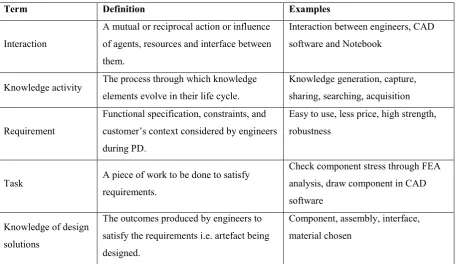
By considering these points, for product related elements, two components are considered, namely ‘requirements’ and ‘fulfilment of requirements’ (henceforth, ‘fulfilment of requirements’ will be called ‘knowledge of solutions’ or simply ‘solutions’). For process-related elements, ‘tasks’ are taken as the component. In the PD process, requirements are the primary objectives to be fulfilled, since they fulfil the customers' needs and enable development of a design into a product. Together, it is argued, these three components can comprehensively represent both product and process aspects of PD. The model is named ‘KRIT’ model, which is an acronym for Knowledge of solutions-Requirements-I
nteractions-Tasks. Definitions of these terms are provided in Table 1. We argue that these five terms are adequate for comprehensive mapping of the elements commonly used in literature. In our definition, interaction includes agents, resources and the interface between them.
Table 1. Terms and Definitions
activity, such as capture, usage and sharing. In this model, the specific knowledge activities are taken to be generation, capture, sharing, searching and acquisition, because together these adequately describe knowledge work on an operative level, as argued by Strohmaier and Tochtermann (2005).
Figure 1. Mutual flow of elements to depict dynamic nature of knowledge creation
With interactions as the core, the links between requirements (R), tasks (T), interactions (I) and solutions (S) need to be explicitly defined and represented. The various possible links are R-I-R, T-I-T, S-I-S, R-I-T, T-I-R, R-I-S, S-I-R, T-I-S and S-I-T. The representation should be read, e.g. for R-I-R, as requirements leading, through interactions, to requirements (R-I-R). Each link has an associated knowledge activity (or activities) with it. These links aid in understanding the context in which PD takes place. Only single input single output relationships have been described. These could be expanded into multiple inputs to multiple outputs, single input to many outputs, etc. For example, R-T-I-S should be read as the inputs to the interactions are requirements and tasks to generate design solutions as outputs. In this case, a requirement might consist of a set of tasks, where each task is performed with interactions from one or more agents to generate solutions. The knowledge which dominates this stage of interactions would be knowledge to satisfy the tasks involved in order to achieve the specific requirements.
It is argued here that with the help of these links, PD knowledge flow should be possible to be modelled. Each interaction might lead to new/modified tasks, requirements and/or design solutions. Each interaction would have associated knowledge activities such as knowledge generation, capture and reuse. The generated knowledge in each interaction would act as input for the other tasks and requirements that need to be carried out further down the PD process.
In order to validate the proposed model and its usefulness, two industrial observational case studies have been undertaken. To find the existence of each and every link hypothesised using the model, the various interactions performed by the engineers observed during the PD process have been analysed. The next section describes the research aim and methodology used to collect necessary data.
Research questions and methodology
The validation of the KRIT model involves demonstrating the association between interaction and knowledge activities, and illustrating the links between the constituents of model. The following research questions facilitate the process of validation:
1. How is knowledge flow modelled to represent unstructured PD processes? 2. What are the various types of interactions that occur and in what proportions? 3. What are the various types of knowledge activities that occur and in what
proportions?
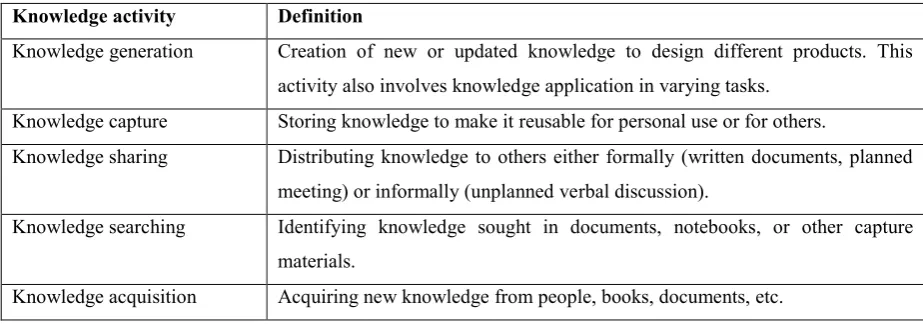
4. How are interactions and knowledge activities associated with one another? To aid observational recordings, the knowledge activities have been classified into five categories. They are: knowledge generation, capture, sharing, searching and acquisition. These five knowledge activities comprehensively cover the activities proposed in the various KM models reviewed (e.g. Coakes et al., 2004, Choy et al., 2004, and Jiuling, 2010). The definitions for these knowledge activities are given in Table 2. Since no extensive types of interactions are noted in literature, interactions were not pre-defined before the observational study. The interaction list was populated based on observations of different engineers.
Table 2. Definitions for knowledge activities
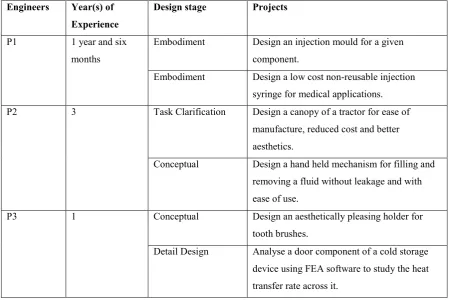
In Study – I, three engineers, each involved in a variety of projects, have been observed continuously for five, three and seven days respectively. The initial plan was to observe each engineer for five days. The observation of the second engineer was stopped on the fourth day because of his sudden unavailability due to personal grounds. This is one of the limitations of case studies in industry wherein the researcher has little control over the proceedings. Table 3 enlists the number of years of experience of the three subjects, the projects carried-out by each engineer during the observed periods, and the design stages in which each worked. All projects observed are original projects i.e. done for the first time by the engineer. From here onwards, the three engineers observed in Study – I are represented by P1, P2 and P3 respectively.
Table 3. Observed projects and the design stages in Study – I
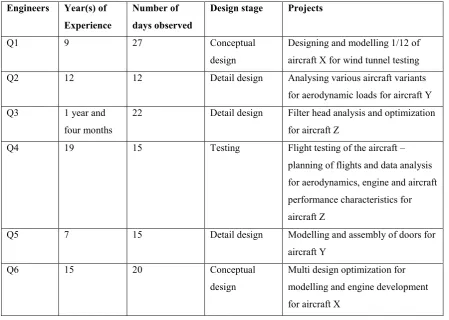
In Study – II, six engineers were observed. In this paper, these six engineers are represented as Q1 to Q6. Different projects involved in different stages of design were chosen to answer the research questions covering a comprehensive spectrum of PD stages. At the start of this observational study, three major aircraft variants, described henceforth as X, Y and Z, were at different stages of design: feasibility study (for X), conceptual design (for Y) and detail design (for Z). An informal interview with the top management reveals that the percentage of work completed in each variant at the start of these observational studies is 2-3% for feasibility study (X), 30-40% for conceptual design (Y) and 60% for detail design project (Z). Table 4 provides information about the observed subjects, projects, aircraft variants (X, Y and Z), respective design stage and number of days observed. The table illustrates that the experience of observed subjects varies from 1 year to 40 years. Most of the members were at senior levels in the organization. Even though observation was planned to be one month for each subject, the observed days actually varied from 9 to 27 days. The reason for this variation was due to the restrictions imposed on the researchers for observations, and the relative lack of co-operation from the engineers. Each project had different objectives and were in various design stages. This helped to answer the research questions holistically with respect to the overall PD process of the organization. Comparison of Tables 3 and 4 reveals that the engineers observed in Study – I were novices, whereas in Study – II all were experienced engineers except one (Q3).
Even though many methods are proposed in literature, questionnaires, data sheets, and unstructured interviews played a vital role in answering the research questions framed for validating the model. Data sheets gave details about the purpose of the tasks, interactions, place of interaction, and duration of interaction. Questionnaires were used to collect information about the organization, projects, and subjects involved in the observations. Unstructured interviews were conducted with the observed subjects in order to understand the subjects’ activities or problems that occurred during the observation. Before answering the research questions, it is worth reiterating that all the observed subjects informed that the observations had not disturbed or influenced their activities.
The average time observed per day for subjects P1, P2 and P3 were 5.7 hours, 3 hours and 3.9 hours respectively. The average time observed per day for subjects Q1 to Q6 were 2.7 hours, 2.2 hours, 4.5 hours, 3.7 hours, 3.5 hours, and 1.8 hours respectively. The observed durations do not include the time spent by the subjects for personal activities. The difference in the observed durations among subjects was due to the limitations of observation and personal activities carried out by the subjects, e.g., interactions occurring outside the organization and the mode of working of the observed engineers. To validate the KRIT model, the entire set of data collected from the observed interactions of these subjects is analysed. Though we focused only on nine engineers in two organizations, the data also include many other engineers who interacted with the nine engineers under focus during the periods of observation.
Validation of the KRIT model
In this section, the results obtained from the observational studies are presented in the order in which the research questions are posed.
Modelling knowledge flow of unstructured PD processes
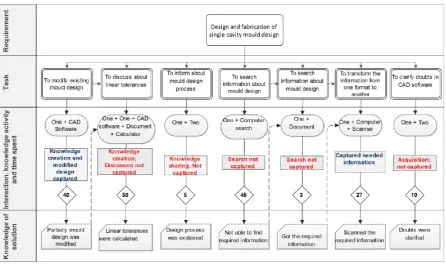
was finalised and no updates or changes were observed. The requirement ‘to design an injection mould within manufacturing constraints’ was the primary objective to be fulfilled. To fulfil this requirement, the observed engineer undertook a set of tasks, each with a particular objective to achieve. Each task was accomplished with a variety of interactions. The time spent on each interaction is also given in Figure 2 (in diamond shape box). Finally, the outcome(s) of each interaction is represented as knowledge of solution. Different knowledge activities could be differentiated with many colours. In Figure 2, blue and red colours are used to highlight knowledge ‘captured’ and ‘not captured’ activities respectively.
Figure 2. Partial knowledge flow depicted through the KRIT model for the subject P – 1
Studying Figure 2 in a forward way (as the figure develops) helps answer the questions what, how, and who for the following elements:
the various tasks performed by the engineer, the purpose and outcomes of each particular task,
the inter-relationships between requirements, tasks, interactions and knowledge of solutions,
the hierarchical nature of tasks and sub-tasks,
the association between interaction and knowledge activity(/activities),
the transfer of knowledge of solutions from one task to the another (dotted arrow link), the knowledge sources used and time spent in each interaction, and
the types of interaction media used to achieve each task.
Studying the figure backward (knowledge of solutions to requirements) will lead to understand why these knowledge processing activities occurred during designing. This is important because it will lead to an understanding of the context of the knowledge processes. The context is important because knowledge is context-specific, as it depends on a particular time and space. The context here does not mean a fixed set of surrounding conditions, but a wider dynamical process of which cognition of an individual is only a part. The information about ‘when’ and ‘where’ could also be made available in Figure 2 by introducing additional tags.
following sections illustrate some of the parameters measured from the parameters collected for developing this knowledge flow model.
Types of knowledge activities and their proportions
Study – I
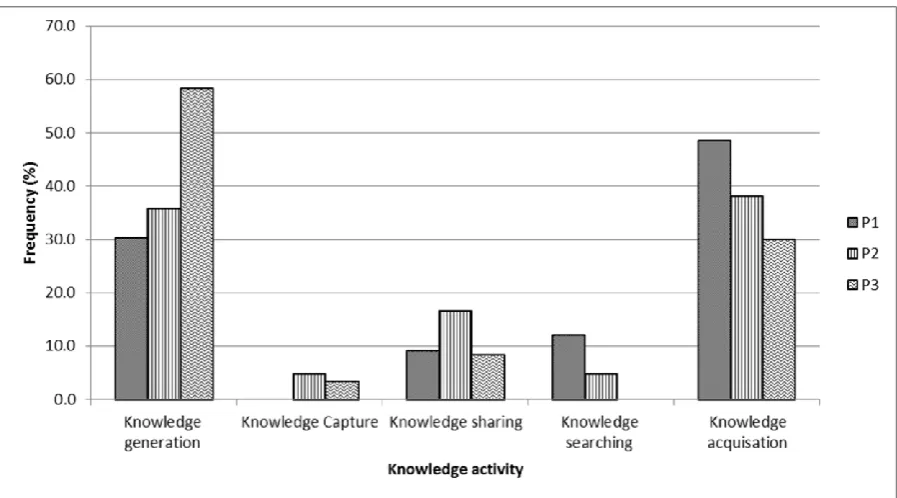
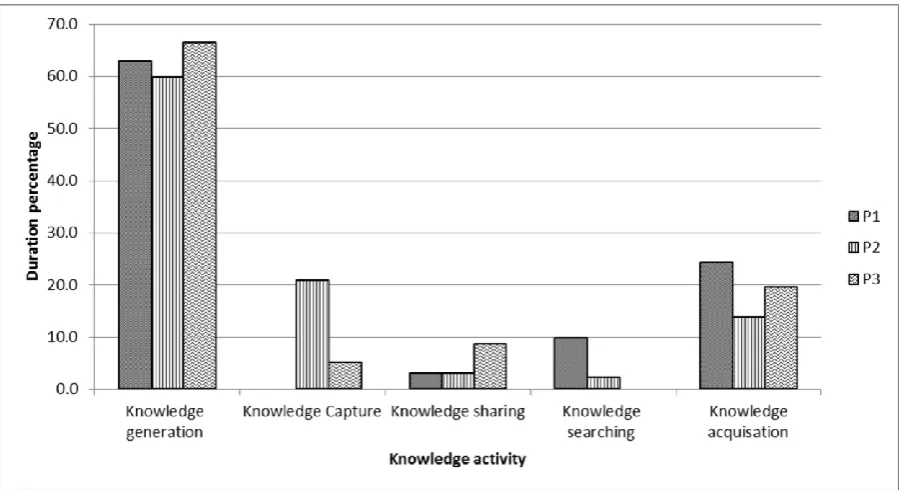
Figures 3 and 4 illustrate the percentage of frequency and time spent on different knowledge activities. Irrespective of different design stages, the trends across all three engineers observed in terms of frequency and time spent on knowledge activities are almost the same. The cumulative average of the three engineers shows that knowledge generation dominates over the other knowledge activities, both in frequency (average 41.5 % of occurrences) and time spent (average 63% of the time spent). Knowledge capture is the least frequently occurred activity (average 2.7% of occurrences). The amount of time spent is the least on knowledge sharing (average 5% of the time spent) and knowledge searching (average 4% of the time spent). Figure 3 shows the critical issues that Engineer ‘P1’ did not spend any activity for explicit knowledge capture, whereas engineer ‘P3’ did not spent any activity on knowledge searching, instead relied mostly on knowledge acquisition from others.
Figure 3. Interaction frequency percentage of knowledge activities in Study - I
Figure 4. Percentage of time spent on knowledge activities in Study - I
Study – II
The percentage of frequency and time spent on each knowledge activity by every subject are shown in Figures 5 and 6 respectively. A huge percentage difference in frequency and duration spent are noted across the six observed engineers in Study – II. These results show the eccentric nature of knowledge activities across the organization. The frequency percentage varies between 32-90%, and the duration percentage between 23-60%, for knowledge generation activity across the engineers. These huge variations primarily occurred due to the significant amount of time spent on knowledge capture by two of the observed engineers. These two engineers (Q2 and Q4) spent 56% and 62% of their time on knowledge capture activity. This is not due to the subjects’ intention of capturing knowledge, but due to the need for the International Organization of Standards (ISO) certification. Since their observed periods fell within the certification time, most of their time was spent on capturing knowledge. Knowledge sharing and searching activities are very minimal across all the observed engineers. Engineers Q3 and Q4 did not involve them in any knowledge sharing, searching and acquisition from others activities. This shows that experience plays a vital role in knowing about the various knowledge resources in an organization, which helps an engineer to get the required knowledge. However, this is a major problem for an organization, because the experience of the subjects is not properly nurtured and utilized by other engineers.
Figure 5. Frequency percentage of knowledge activities in Study – II
Figure 6. Duration percentage of knowledge activities in Study – II
acquisition are quicker ones. Since in this paper, interactions are considered to be a primary constituent for knowledge activities in an organization, detailed analyses of the interactions observed are provided in the next section.
Types of interactions and their proportions
Study – I
In this section, the types of interaction used by the observed subjects to fulfil their tasks are discussed. Figures 7 and 8 show the percentage of frequency and time spent on each interaction by the three subjects respectively.
Figure 7. Frequency percentage distribution of various interactions in Study – I
Figure 8. Percentage of time spent on various interactions in Study – II
Twenty eight different types of interaction were found to be present in the activities involving the observed engineers. The notation ‘One + CAD Software’ means ‘one engineer working with CAD software’. Based on the average across the three engineers observed, the interactions which most frequently occurred during PD were: ‘engineer interacting with another engineer’ (34.2%), ‘two engineers jointly working with a CAD software’ (12.1%), ‘engineer working with CAD software alone’ (7.7%), ‘engineer working with soft document (6.6%), ‘engineer interacting with another through telephone’ (6.6%) and ‘engineer working with e-mail’ (6.3%). The interactions which occupied most of the time were: ‘two engineers jointly working with CAD software’ (20.2%), ‘engineer interacting with another engineer’ (16.4%), ‘engineer working with CAD software alone’ (12.7%), ‘engineer working with soft document (8.8%) and ‘engineer working with soft document and notebook (6.7%). It means that that amount of time spent by engineers in socializing with others and externalizing their views and thoughts are higher than working alone. In interactions (Figures 7 and 8) also, almost the same trend was observed across all the three engineers in frequency and time spent. Since the engineers were engaged mostly in few notable interactions during designing, any tools to support knowledge activities should prioritize its support to these interactions such that enhancement of knowledge activities are built into an engineer’s work habits in a natural way.
Study – II
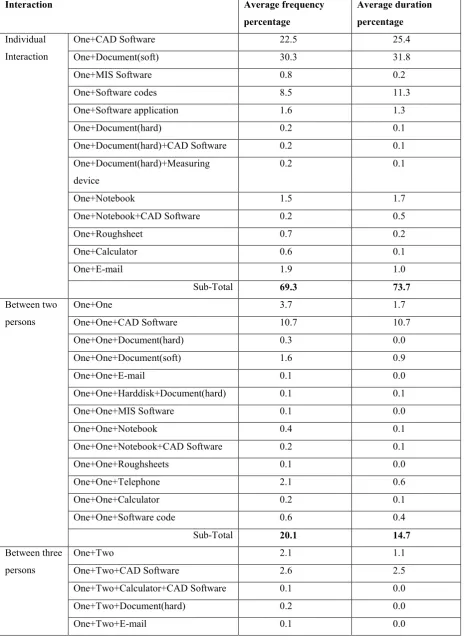
interactions were observed. The sum of average frequency and duration percentage of individual interactions (69.3% and 73.7% respectively) predominate over the interactions between two or more engineers. In Study – II, the amount of time spent by an engineer working alone is higher than socializing, externalizing their views and thoughts with others. In the individual interactions, ‘engineer interacting with CAD software’ (22.5% and 25.4%) and ‘engineer interacting with soft document(s)’ (30.3% and 31.8%) occurred frequently and occupied most of the observed engineers’ time respectively. Even in the interactions between two engineers, ‘engineer interacting with another engineer along with CAD software’ (10.7% and 10.7%) occurred frequently and occupied most of the observed engineers’ time respectively. Since knowledge activities are embedded within these interactions, their associations are studied in the next section.
Table 5. Average frequency and duration percentage of individual interaction
Associations between interactions and knowledge activities
Study – I
Figure 9(a-e). Cumulative percentage of time spent on various interactions in each knowledge activity in Study – I
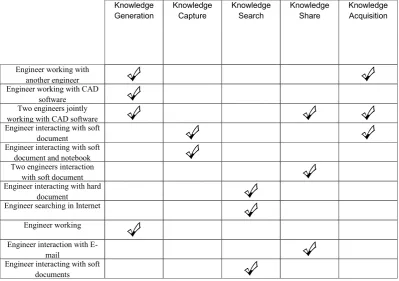
Out of the twenty eight types of interactions observed, only seven were used for knowledge sharing. Knowledge sharing predominately occurred through ‘two engineers interacting with a CAD software’ and ‘two engineers interaction with soft document’. Only one of the observed engineers used E-mail communication to share knowledge during the observed period. Knowledge sharing occurred for training CAD software, informing about the task plan and design process. Knowledge sharing is very much localised to personal groups. Organization-wide knowledge sharing needs to be incorporated with appropriate interaction types introduced. The interactions ‘engineer interacting with hard document’ and ‘engineer searching in Internet’ predominate in knowledge searching. Searches were specific either to find the right document or to get required knowledge within the document. Although organizational soft documents were searched 71.8% of the time for knowledge searching, Internet medium also largely used (28.1%). A strategy needs to be incorporated to structure access of external knowledge sources.
For knowledge acquisition, interactions ‘two engineers interacting with a CAD software’, ‘engineer interacting with soft document’ and ‘engineer interacting with another engineer’ predominate in knowledge acquisition. For knowledge acquisition, engineers spent most of their time contacting experts (70.1%) than referring documents (29.9%). These percentages represent that an engineer’s time is consumed to satisfy colleague’s knowledge needs. This issue need to be addressed by providing proper knowledge capture and access tools to the concerned engineer. Knowledge acquisition involved queries and questions about specific tools, computer support, modelling in CAD software, domain specific knowledge, task plan, colleagues’ expertise, showing interest to know about other projects, and asked about specific documents. Most of these knowledge acquisitions could be avoided if the knowledge were captured, shared and accessed at the time of its processing. To improve knowledge activities (especially capture, searching and sharing activities) the predominant interactions have to be enhanced and/or substituted with other new, more efficient interactions.
Study – II
whereas two engineers (Q2 and Q6) used individual interactions with software coding (41.4% and 84.2% respectively). These variations are predominately due to the respective tasks handled by the individual engineers. The interaction ‘engineer interacting with another engineer along with CAD software’ is more substantial for engineers (Q1, Q3 and Q5 - 41%, 14.4% and 5.5% respectively) who significantly interacted with CAD software alone. Engineer Q4 is unique compared to the other engineers because he spent 70.1% of his time on knowledge generation (together with many people). Engineer Q2 used a notable period of time on other kinds of interactions such as two engineers interacting with computer document (14.9%), two engineers interacting with telephone (10%), two engineers interacting with software codes (10.8%), and three engineers interacting with each other (13.5%).
Only three types of interactions predominate out of the fourteen types observed during knowledge sharing. The engineers (Q2 and Q6 – 80% and 100% respectively) shared knowledge via e-mail. Engineer (Q3) performed sharing only by copying computer documents directly to another engineer’s computer. The engineers (Q1 and Q5 – 72.5% and 100% respectively) shared their expertise (i.e. knowledge) on CAD software to another engineer.
For knowledge searching, only three engineers (Q2, Q5, and Q6 – 37%, 20% and 45% respectively) interacted with documents. Q5 engineer interacted mostly (83.3% of the search time) to find the right CAD files. Q1 involved others to search for required CAD files. He used collaborative interactions such as two engineers interacting along with a CAD Software (51.7%), two engineers interacting with organizational information software system (34.5%) and interacting with many other along with hard document (10.3% of the search time).
Figure 10(a-e). Cumulative percentage of time spent on various interactions in each knowledge activity in Study – II
Although 19 different types of interactions were observed during knowledge acquisition, only two interactions were largely used. Out of the six engineers, only two (Q2 and Q6 – 65% and 91.3% respectively) used documents for knowledge acquisition. The engineers Q1 and Q5 interacted with another engineer along with CAD software (58.3% and 20.9% of the acquisition time) to acquire expertise in CAD (knowledge). A specific instance was observed with engineer Q5 in which expert knowledge on CAD software was presented to a group of interested people (48.8% of the acquisition time).
the capture time respectively) used this interaction mostly for knowledge capture. Notably, engineer Q5 only used personal notebook for knowledge capture (95% of the capture time). These results help understand the current status of the dynamic nature of knowledge creation in PD, especially across engineers, and highlight the issues that need to be addressed in order to enhance knowledge activities with appropriate interactions.
Implication of the results
Understanding dynamic interactions is the key for effective knowledge processing in organizations. The proposed KRIT model facilitates studying interactions leading to a deeper understanding of the dynamics between requirements, tasks, knowledge activities and knowledge of solutions. This modelling approach aids to understand unstructured, distributed, unstipulated, and constantly changing knowledge flow in PD organizations. Modelling through the KRIT model led to positive responses from the observed engineers in the organizations studied. They highlighted that the model is clear, simple, easy to read and understandable. The model is accurate enough to reflect important detail, but simple enough to avoid confusion. In the process of modelling knowledge flow, it led to identifying which knowledge agents and resources are frequently used by specific engineers. It helps highlights critical knowledge issues to be addressed within organizations.
Table 6. Interactions occurred mostly in knowledge activities in Study – I and Study – II
captured and all generated rationale in the various interactions was lost. To enhance rationale capture, the interaction with CAD software should be enhanced. Some of the solutions proposed in the literature could be useful for rationale capture. For example, Chakrabarti et al, (2007) proposed a real-time design rationale capture framework which captures product structure, snaps, events, versions, version-tree and audio–video clips in real-time while engineer(s) interact with a specific CAD software. Sung et al, (2011) propose an unobtrusive solution for generating design rationale by automatic logging of user’s actions during a design session with CAD software. These interactions enhancement tools could support knowledge capture so that capture can be intuitive and part of the natural way of work for engineers.
The variation in the amount of time spent on knowledge sharing and acquisition between Study – I and Study – II indicates that the group of novice engineers worked together to share knowledge frequently than did the group of experienced engineers. Experienced engineers’ spending less time in knowledge sharing can be a major drawback for the organization involved in Study – II, where most of the engineers are experienced, and capturing knowledge is consistently low. The reason for less knowledge sharing was not due to unwillingness, but they were not approached by others. Introduction of new interactions for locating expertise such as yellow pages could greatly change knowledge sharing and acquisition in both the companies observed. Also, forming communities and knowledge networks could eliminate an agent’s isolation within an organization. Another issue is that, although most of the captured knowledge were available in soft documents, those can be accessed only by the engineer who captured it and his/her teams. Creating common knowledge repositories could facilitate wider knowledge access and distribution.
Searching of knowledge from documents is more in Study – II than in Study – I. This shows that the experienced engineers relied on documents more than did the novice engineers. Training novices is necessary for them to get acquainted with the knowledge resources, so that their efficacy in searching increases and acquisition from others of already documented knowledge decreases. Introduction of effective content management approaches and tools could facilitate greater trust on knowledge searching in documents rather than acquiring needed knowledge from colleagues.
one study may not be specifically applicable to others. This is also true across groups within an organization. Developing KM solutions based on observed issues through a grounded approach could lead to a greater acceptance of KM implementation.
Conclusion and future work
To understand the dynamic nature of knowledge processing, KRIT model is proposed, the explanatory potential of which is demonstrated with data from two industrial case studies. In this model, interaction is represented as a core element through which knowledge processing occurs. The model helps visualize transparently as to how knowledge of PD is generated, captured, shared, searched and acquired. Following day-to-day interactions of engineers helped to understand the dynamic nature of knowledge activities. This model helps to capture and externalize the PD process. The model maps PD requirement, task, interaction, knowledge activity and knowledge of design solution. These elements are together modelled and studied in the two industrial observational case studies undertaken. Using data collected from the two organizations, it has been shown as to how the knowledge flowed within unstructured PD processes, the types of interactions that occurred and their proportions, the types of knowledge activities that occurred and their proportions, and the associations between these interactions and the knowledge activities.
with engineers and organizational environment and PD processes. It should help integrate KM within work processes.
The other benefits the proposed model could provide are process transparency across organizations which provide the best medium for learning across organization, and help to know expertise and locate explicit knowledge documents generated for specific tasks. It provides a process-oriented navigation structure which could leads to continuous process improvement. Experienced engineers could suggest changes in processes followed and efficient knowledge resources to be used by seeing occurrences of knowledge processes. Knowledge profiles could be automatically updated with the finished tasks and requirements achieved. Lessons learned could be extracted from the repetition of tasks. Best practices could be extracted by noticing satisfying requirements with minimal resources. It could assist in project planning and management. The model could help generate organizational social networks and provides direction to expand it. The model could be used for performance measurement to understand whether requirements are achieved in a resource effective way or not.
The model could be of greater usefulness if the data collected from all employees were integrated. To reduce the time spent by the observer to collect data to populate the KRIT model, it could be more easily done by the engineers themselves. A light weight computer application could be developed to facilitate an engineer to record day-to-day processes of required data. This model could be used as the basis for a computational aid for engineers to capture knowledge processing without significant intrusion to their regular activities. This individual data could be integrated with those from other engineers through the interaction elements present in the model. As part of future work, more detailed applications and implementation of this model are planned to be carried out in the organizations.
References
Barcelo-Valenzuela M, Sanchez-Schmitz G, Perez-Soltero A, Martı´n RF and Palma J. 2008. Defining the problem: key element for the success of knowledge management. Knowledge Management Research and Practice 6: 322–333.
Cheung CF, Li ML, Shek WY, Lee WB and Tsang TS. 2007. A systematic Approach for knowledge auditing: a case study in transportation sector. Journal of Knowledge Management 11(4): 140-158.
Choy SY, Lee WB and Cheung CF. 2004. A systematic approach for knowledge audit analysis: integration of knowledge inventory, mapping and knowledge flow analysis, Journal of Universal Computer Science 10(6): 674-82.
Coakes E, Bradburn A, Sugden G. 2004. Managing and leveraging knowledge for organisational advantage, Knowledge Management Research and Practice 2: 118–128.
Court AW and Culley SJ. 1995. A methodology for analyzing the information accessing methods of engineering designers. Proceedings of International Conference on Engineering Design 2: 523-528.
Datta P and Acar W. 2010. Software and human agents in Knowledge Codification. Knowledge Management Research and Practice 8(1): 45–60.
Dattero R, Galup SD, and Quan JJ. 2007. The knowledge audit: Meta-Matrix analysis. Knowledge Management Research and Practice 5(3): 213–221.
Eppler MJ. 2001. Making knowledge visible through intranet knowledge maps: concepts, elements, cases. IEEE Proceedings of the 34th Annual Hawaii International Conference onSystem Sciences 9-pp.
Frankenberger E and Badke-Schaub P. 1999. Information management in engineering design – empirical results from investigations in industry. Proceedings of International Conference on Engineering Design 911-916.
Gronau N and Weber E. 2004. Management of knowledge intensive business processes, Business Process Management 1–17.
Hicks BJ, Dong A, Palmer R and McAlpine HC. 2008. Organizing and managing personal electronic files: A mechanical engineer’s perspective. ACM Transactions on Information Systems 26(4): 23-40.
Jiuling X and Jiankang W. 2010. Enterprise Knowledge Management Audit based on Processes: Toward an Integrated Conceptual Framework. IEEE International Conference on Management of Innovation and Technology (ICMIT), Singapore 940–945.
Krackhardt D and Carley KM. 1998. A PCANS model of structure in organizations. Proceedings of the 1998 International Symposium on Command and Control Research and
Lee WB, Shek WY and Cheung CF. 2007. Auditing and Mapping the Knowledge Assets of Business – An Empirical Study, Knowledge Science, Engineering and Management. Lecture Notes in Computer Science 4798: 11-16.
Levy M, Hadar I, Greenspan S and Hadar E. 2010. Uncovering cultural perceptions and barriers during knowledge audit. Journal of Knowledge Management 14(1): 114–127.
Liebowitz L. 2005. Linking social network analysis with the analytic hierarchy process for knowledge mapping in organizations. Journal of Knowledge Management 9(1): 76–86. Marr B and Spender JC. 2004. Measuring knowledge assets: Implications of the knowledge economy for performance measurement. Measuring Business Excellence 8(1): 18-27.
Marsh JR. 1997. The capture and utilisation of experience in engineering design. Ph.D. Thesis, St. John’s College, Department of Engineering, University of Cambridge, UK.
McAlpine H, Hicks B and Tiryakioglu, C. 2011. The digital divide: Investigating the personal information management practices of engineers, Proceedings of International Conference on Engineering Design, ICED '11, Copenhagen, Denmark.
Mertins K, Heisig P, Vorbeck J. 2003. Knowledge Management: Concepts and Best Practices, Springer, Berlin.
Nonaka I and Takeuchi H. 1995. The Knowledge-Creating Company: How Japanese Companies Create the Dynamics of Innovation. Oxford University Press, Oxford.
Nonaka I, Toyama R and Nagata A. 2000. A Firm as a Knowledge-creating Entity: A New Perspective on the Theory of the Firm. Industrial and Corporate Change 9(1).
Perez-Soltero A, Barcelo-Valenzuela M, Sanchez-Schmitz G and Rodriguez-Elias OM. 2009. A Computer Prototype to Support Knowledge Audits in Organizations. Knowledge and Process Management 16(3): 124–133.
Reimer U, Heck U and Streit S. 2008. Collaboration-Oriented Knowledge Management Using Interaction Patterns. Yamaguchi T. (Ed.) PAKM 2008, LNAI 5345: 26–37.
Remus U and Schub S. 2003. A Blueprint for the Implementation of Process-oriented Knowledge Management. Knowledge and Process Management 10(4): 237-253.
Robertson J. 2002. Benefits of a KM framework. available at: http://www.steptwo.com.au/papers/kmc_framework/index.html (accessed 20 Feb. 14)
Rollett H. 2003. Knowledge Management: Processes and Technologies. Kluwer, Dordrecht. Rossett A. 2002. The ASTD E-Learning Handbook: Best Practices, Strategies, and Case Studies for an Emerging Field. McGraw-Hill, New York.
Schwikkard DB and du Toit ASA. 2004. Analysing knowledge requirements: a case study. Aslib Proceedings 56(2): 104-111.
Seeley CP. 2002 Igniting knowledge in your business processes: how to connect knowledge activities with your business processes. KM Review 5(4): 12-15.
Strohmaier M. 2004. B-KIDE: a framework and a tool for business process oriented knowledge infrastructure development. PhD thesis, Graz University of Technology, Graz. Strohmaier M and Lindstaedt S. 2007. Rapid knowledge work visualization for organizations. Journal of Knowledge Management 11(4): 97-111.
Strohmaier M and Tochtermann K. 2005. B-KIDE: a framework and a tool for business process oriented knowledge infrastructure development. Journal of Knowledge and Process Management 12(3): 171-89.
Sung R, Ritchie JM, Rea HJ and Corney J. 2011. Automated design knowledge capture and representation in single-user CAD environments, Journal of Engineering Design 22(7): 487-503.
Ullman DG. 1995. e-Study Guide for: The Mechanical Design Process. McGraw Hill, Boston, USA.
Wild PJ, McMahon C and Liu S. 2010. A diary study of information needs and document usage in the engineering domain. Design Studies 31: 46-73.
Wu Z and Duffy AHB. 2001. Using situation theory to model information flow in design. Proceedings of International Conference on Engineering Design 155-162.
Table 1. Terms and Definitions
Term Definition Examples
Interaction
A mutual or reciprocal action or influence of agents, resources and interface between them.
Interaction between engineers, CAD software and Notebook
Knowledge activity The process through which knowledge
elements evolve in their life cycle.
Knowledge generation, capture, sharing, searching, acquisition
Requirement
Functional specification, constraints, and customer’s context considered by engineers during PD.
Easy to use, less price, high strength, robustness
Task A piece of work to be done to satisfy
requirements.
Check component stress through FEA analysis, draw component in CAD software
Knowledge of design solutions
The outcomes produced by engineers to satisfy the requirements i.e. artefact being designed.
Table 2. Definitions for knowledge activities
Knowledge activity Definition
Knowledge generation Creation of new or updated knowledge to design different products. This
activity also involves knowledge application in varying tasks.
Knowledge capture Storing knowledge to make it reusable for personal use or for others.
Knowledge sharing Distributing knowledge to others either formally (written documents, planned
meeting) or informally (unplanned verbal discussion).
Knowledge searching Identifying knowledge sought in documents, notebooks, or other capture
materials.
Table 3. Observed projects and the design stages in Study – I
Engineers Year(s) of Experience
Design stage Projects
P1 1 year and six
months
Embodiment Design an injection mould for a given
component.
Embodiment Design a low cost non-reusable injection
syringe for medical applications.
P2 3 Task Clarification Design a canopy of a tractor for ease of
manufacture, reduced cost and better aesthetics.
Conceptual Design a hand held mechanism for filling and
removing a fluid without leakage and with ease of use.
P3 1 Conceptual Design an aesthetically pleasing holder for
tooth brushes.
Detail Design Analyse a door component of a cold storage
Table 4. Observed projects and the design stages in Study – II
Engineers Year(s) of Experience
Number of days observed
Design stage Projects
Q1 9 27 Conceptual
design
Designing and modelling 1/12 of aircraft X for wind tunnel testing
Q2 12 12 Detail design Analysing various aircraft variants
for aerodynamic loads for aircraft Y
Q3 1 year and
four months
22 Detail design Filter head analysis and optimization
for aircraft Z
Q4 19 15 Testing Flight testing of the aircraft –
planning of flights and data analysis for aerodynamics, engine and aircraft performance characteristics for aircraft Z
Q5 7 15 Detail design Modelling and assembly of doors for
aircraft Y
Q6 15 20 Conceptual
design
Table 5. Average frequency and duration percentage of individual interaction
Interaction Average frequency
percentage
Average duration percentage
Individual Interaction
One+CAD Software 22.5 25.4
One+Document(soft) 30.3 31.8
One+MIS Software 0.8 0.2
One+Software codes 8.5 11.3
One+Software application 1.6 1.3
One+Document(hard) 0.2 0.1
One+Document(hard)+CAD Software 0.2 0.1
One+Document(hard)+Measuring device
0.2 0.1
One+Notebook 1.5 1.7
One+Notebook+CAD Software 0.2 0.5
One+Roughsheet 0.7 0.2
One+Calculator 0.6 0.1
One+E-mail 1.9 1.0
Sub-Total 69.3 73.7
Between two persons
One+One 3.7 1.7
One+One+CAD Software 10.7 10.7
One+One+Document(hard) 0.3 0.0
One+One+Document(soft) 1.6 0.9
One+One+E-mail 0.1 0.0
One+One+Harddisk+Document(hard) 0.1 0.1
One+One+MIS Software 0.1 0.0
One+One+Notebook 0.4 0.1
One+One+Notebook+CAD Software 0.2 0.1
One+One+Roughsheets 0.1 0.0
One+One+Telephone 2.1 0.6
One+One+Calculator 0.2 0.1
One+One+Software code 0.6 0.4
Sub-Total 20.1 14.7
Between three persons
One+Two 2.1 1.1
One+Two+CAD Software 2.6 2.5
One+Two+Calculator+CAD Software 0.1 0.0
One+Two+Document(hard) 0.2 0.0
One+Two+Notebook 0.3 0.1
One+Two+Notebook+CAD Software 0.1 0.1
One+Two+Notebook+Calculator+CAD Software
0.1 0.0
Sub-Total 5.4 3.9
Between many people
One+Many 4.7 7.0
One+Many+CAD Software 0.4 0.5
One+Many+Document(hard) 0.1 0.0
One+Many+Notebook 0.1 0.0
Table 6. Interactions occurred mostly in knowledge activities in Study – I and Study – II
Engineer working with another engineer Engineer working with CAD
software Two engineers jointly working with CAD software Engineer interacting with soft
document
Engineer interacting with soft document and notebook Two engineers interaction
with soft document Engineer interacting with hard
document Engineer searching in Internet
Engineer working
with software coding Engineer interaction with