A novel semisupervised SVM classifier based on active learning and
1context information
2Fei Gao · Wenchao Lv · Yaotian Zhang · Jinping Sun · Jun Wang · Erfu Yang 3
4 5
Abstract This paper proposes a novel semisupervised support vector machine classifier (S3VM) based 6
on active learning (AL) and context information to solve the problem where the number of labeled 7
samples is insufficient. Firstly, a new semisupervised learning (SSL) method is designed using AL to 8
select unlabeled samples as the semilabled samples, then the context information is exploited to further 9
expand the selected samples and relabel them, along with the labeled samples train S3VM classifier. 10
Next, a new query function is designed to enhance the reliability of the classification results by using 11
the Euclidean distance between the samples. Finally, in order to enhance the robustness of the proposed 12
algorithm, a fusion method is designed. Several experiments on change detection are performed by 13
considering some real remote sensing images. The results show that the proposed algorithm in 14
comparison with other algorithms can significantly improve the detection accuracy and achieve a fast 15
convergence in addition to verify the effectiveness of the fusion method developed in this paper. 16
Keywords semisupervised support vector machine · active learning · context information · remote 17
sensing 18
This work was supported by the National Natural Science Foundation of China (61071139; 61471019; 61171122; 61501011), the Aeronautical Science Foundation of China (20142051022), the Pre-research Project(9140A07040515HK01009), the National Natural Science Foundation of China (NNSFC) under the RSE-NNSFC Joint Project (2012-2014) (61211130210) with Beihang University, and the RSE-NNSFC Joint Project (2012-2014) (61211130309) with Anhui University.
Fei Gao • Wenchao Lv • Yaotian Zhang • Jinping Sun • Jun Wang
School of Electronic and Information Engineering, Beihang University, Beijing, China Fei Gao
e-mail: [email protected] Wenchao Lv
e-mail: [email protected] Yaotian Zhang()
e-mail: [email protected] Jinping Sun
e-mail: [email protected] Jun Wang
E-mail: [email protected] Erfu Yang
1 Introduction
1
With the rapid development of remote sensing (RS) technology, RS data has been expanded constantly 2
and used widely in geologic monitoring, environmental protection and disaster relief, where the 3
distinction of the land-cover change(Hansen and Loveland 2012), classification of the land-use(Gong et
4
al. 2015) and assessment of the earthquake influence(Geiß and Taubenböck 2013)can be attributed to 5
the problem of object detection under certain conditions. In these fields, it is a very difficult task to 6
detect useful objects from a large amount of RS images (RSIs), which presents a high requirement to 7
the information extraction ability of the correlated algorithms and increasingly attracts the research 8
interest. 9
The traditional technologies for object detection are mainly based on unsupervised learning and 10
supervised learning. Unsupervised method detects the object from its background via grouping the 11
samples into different clusters and does not require prior knowledge, which reduces the time and cost 12
for human-labeled training samples. However, such methods only consider the characteristic 13
information between the different clusters and lack the effective guidance of the labeled samples, 14
which makes it impossible to extract objects of interest(Anand et al. 2014). Therefore, the supervision 15
method based on the labeled samples is adopted to change the detection problem into classification 16
problem and quickly captures the effective RS information with the high accuracy. However, to train 17
the classifier, the supervised method requires enough labeled samples(Ujjwal Maulik and Chakraborty
18
2012), which are scarce in practice and easily affected by noises. Moreover, it is very difficult to obtain 19
the labeled samples manually because of the limit of the time and cost (Li et al. 2010). In contrast, the 20
unlabeled samples are abundant and contain a wealth of information. By using them, not only the 21
problem of insufficient training samples can be solved, but also the working efficiency is 22
improved(Shahshahani and Landgrebe 1994). Therefore, in recent years the algorithms based on the 23
semisupervised learning (SSL) have been concerned greatly. 24
The SSL based method iteratively selects the unlabeled samples with the labeled samples together to 25
train the classifier(Kawakita and Kanamori 2013), and can reduce human intervention and classify the 26
unlabeled samples more effectively. In general, the SSL can be grouped into the following five 27
categories, i.e.: self-training, cooperative training, generative probability model, semisupervised 28
support vector machine(S3VM) and graph based methods(Chapelle et al. 2006; Zhu 2010), where the 29
key to their effective functioning is the way for screening the unlabeled samples. The progressive 30
S3VM with diversity (PS3VM-D) takes γ samples which are within and closer to the margin band, to 31
define the candidate semilabeled samples, then incrementally selects ρ diverse samples among the γ 32
candidates by considering the kernel cosine-angular similarity(Persello and Bruzzone 2014). The 33
context-sensitive S3VM (CS4VM) selects the context patterns of training samples as the semilabeled 34
samples, then weights them depending on their consistency with the center sample by SVM(Bruzzone
35
and Persello 2009).Junwei et al. (2015a)built a high-level object feature representation using a deep 36
Boltzmann machine(DBM) and applies the proposed Bayesian principle to characterize the objects 37
information, then classifies the objects by the liner SVM to select the semilabeled samples. 38
The performance of the SSL algorithms can still be improved in the following aspects. First, the SSL 39
would seriously hinder the adjustment of the relevant parameters(Munoz-Mari et al. 2012; 1
Gomez-Chova et al. 2008), and the effective strategy for the selection of the semilabeled samples is 2
necessary. The SSL based methods can be greatly affected by initial training set(Didaci et al. 2012), 3
where the validity of samples can't be guaranteed sometimes, leading to random classification result. 4
For the selection strategy of the semilabeled samples, Pasolli et al. (2014) applied the active learning 5
(AL) and the spatial information, including Parzen window, spatial entropy, etc., to process the 6
unlabeled samples, where the semilabeled samples were selected by estimating the probability density 7
distribution function of the random variables and the entropy of the discrete random variables. Demir et
8
al. (2011) applied the AL based on kernel clustering to deal with the unlabeled samples, then designed a 9
new strategy to select the most representative semilabeled samples. Inspired by the above algorithms, 10
the selection strategy was designed utilizing AL in the proposed SSL based algorithm. The AL 11
iteratively extracts the most informative unlabeled samples to be labeled manually and can obtain a 12
higher classification accuracy than other SSL algorithms, reducing the dependence on the labeled 13
samples (Tuia et al. 2011; Persello and Bruzzone 2014).However, the existing feature descriptors are 14
insufficiently powerful to characterize the information of objects, which inevitably leads samples 15
mislabeling and seriously reduces the classification accuracy. To fully describe the sample 16
characteristics, Junwei et al. (2015b)proposed a novel framework via the deep learning methods for the 17
salient object detection, which extracts four neighborhood image boundaries of the object as a 18
reference, then applied the stacked de-noising auto-encoder(SDAE) with the deep learning 19
architectures to model image background. The robustness of the mislabeled patterns is improved by 20
exploiting spatial information. Inspired by the above method, the structure of the AL is modified by 21
using the context information, which can expand the amount of semilabeled samples and improve the 22
accuracy to a certain extent when labeling them. 23
The reason why the S3VM is chosen to process the selected samples is detailed in the following. The 24
support vectors of S3VM make the decision rather than many redundant samples to improve the 25
operational efficiency and the robustness to the polluted samples. The nonlinear mapping based S3VM 26
can map the samples into a high dimensional characteristic space to make them linearly separable. The 27
functional margin that is the distance between the sample and the optimal hyper plane decided by the 28
S3VM, can be used as the confidence-based decision marking to make the S3VM be effectively 29
exploited by the SSL based methods(Hearst et al. 1998; U. Maulik and Chakraborty 2014). 30
For the uncertainty of the initial training set, the fusion is an effective method. The downsampling is 31
commonly used to obtain different data models by generating the images at different resolutions(Bazi
32
et al. 2010). However, the progressively downsampling is not suitable to deal with the image with large 33
difference in areas, because it can lose them with scanty pixels. The initial sets in the SSL does not 34
require many labeled samples, so they can be directly selected from the image to reduce the complexity 35
of the preprocessing. Their SSL results as different models were fused to decrease the influence of the 36
random distribution of the initial set and obtain stable classification result. 37
In this paper, a novel S3VM algorithm is proposed to address the classification problems of the RSIs 38
when the available labeled samples are not sufficient. To guarantee the decision-making ability of the 39
samples (semilabeled samples), which are combined with the labeled samples together to train the 1
S3VM. The novelty of this paper lies in the following aspects. First, a new query function is designed 2
based on the Euclidean distance among samples. Second, the amount of the semilabeled samples are 3
increased by exploiting their contextual patterns. Last, the selected samples are relabeled by exploiting 4
the correlation between the sample and context. Hence, the comprehensive utilization of the context 5
information ensures the reliability of the selected samples and increases the classification credibility of 6
the S3VM. 7
The rest of this paper is organized as follows. Section 2 describes the proposed SSL based method in 8
detail, and the necessity of the fusion is also analyzed to design new fusion rules. Section 3 presents the 9
three data sets and experiments for the RSIs change detection. Section 4 draws the conclusion of this 10
paper. 11
2 Proposed method
12
The algorithm consists of two parts: the proposed S3VM based on AL and context information, and the 13
fusion method. 14
2.1 Proposed SSL-based method 15
Assuming that the training set Lis composed of n pairs (xi,yi) available, where xi denotes the training 16
samples and yi∈ {+1, −1}denotes the label for the binary classifier. We assume that a learning set U
17
with m unlabeled samples (xj). They are defined as 18
( ,x yi i) | i 1 n
L (1)
19
{xj| j 1 m}
U (2)
20
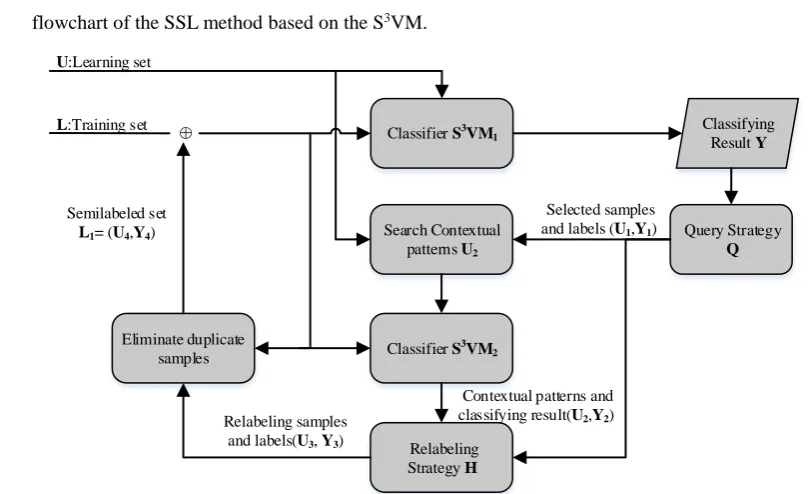
In order to expand L, the semilabeled samples are selected from U iteratively. Fig. 3 shows the 21
flowchart of the SSL method based on the S3VM. 22
Classifier S3VM 1
Eliminate duplicate samples L:Training set
Semilabeled set
L1= (U4,Y4) Query Strategy
Q Search Contextual
patterns U2
Classifier S3VM 2
Selected samples and labels (U1,Y1)
Relabeling samples and labels(U3, Y3)
U:Learning set
⊕
Relabeling Strategy H
Classifying Result Y
Contextual patterns and classifying result(U2,Y2)
23
[image:4.595.74.480.494.741.2]First, L is processed by the S3VM
1,during which the label Y of the U is obtained. The subset (U1, Y1) is
1
selected by the query function Q. Then, the context patterns U2of the U1 is found from the U and
2
classified by the S3VM
2.U2along with the central pattern (U1,Y1) are relabeled by H to get the
3
semilabeled set (U3,Y3). Last, the repeated samples between Land (U3,Y3) are eliminated to obtain the
4
ultimate semilabeled set L1= (U4, Y4)to be added into L. The entire process is iterated until the
5
predefined convergence condition is satisfied, e.g., the total number of the semilabeled samples or the 6
classification accuracy is reached (Pasolli et al. 2014). 7
Next, the implementation of the S3VM, the query function Q, the search contextual patterns and 8
relabeling strategy H are described. 9
2.2S3VM method 10
The S3VM is the expansion of the SVM. A standard SVM is based on the structural risk minimization 11
to classify the learning set by extracting the support vectors from the training set to find the optimal 12
hyper plane(Scholkopf et al. 1997). In case of the binary SVM, given the training set Land the testing 13
set U, it is limited to the following constrained optimization problem (Izquierdo-Verdiguier et al.
14
2013): 15
1Subject t 1
min ( ) ( )
2
[ 1 1, ,
0 o ] n T i i T i i i C
y b i n
iw w w
w x
: (3)
16
Where xi is the training sample and yi is the corresponding label,(xi,yi)∈ 𝐋;Φ(∙) maps the data into the 17
feature space; w is the orthogonal vector between xi and the hyper plane; b is the bias to measure 18
the distance between L and the hyper plane; ξi is the slack variable to represent offset of xi; Cis the cost 19
factor to measure the weight between the optimal hyper plane and the minimum offset; n is the number 20
of the training samples. 21
After the initialization, the iterative process is operated and the semilabeled samples (selected from U
22
in the previous step) are added to L. Their confidence is diverse in different iterative steps and they are 23
given different cost factors(Bovolo et al. 2008), which leads to the following cost function for the 24
classifier learning : 25
1 1
1
min ( ) ( )
2
[ ] 1
ˆ [ ˆ ]
Subject t 1 0 1, , 1, , o , 0 n m T
i j j
i j
T
i i i
T
j j j
i j
C C
y x i n
j n
b
y x b
w w w
w
w
: (4)
26
where𝑥̂𝑗is the semilabled sample selected from U, with the slack variable(εj),cost factor (Cj) and 27
semilabel(𝑦̂𝑗), and nis the number of the semilabeled samples.
28
Applying the Lagrange Duality, the equation (4) can be transformed into the dual problem, which can 29
, 1 1 , 1 , 1 1 1
1 1
1 1
ˆ ˆ ˆ
Subject t
ˆ ˆ ˆ
( , ) ( , ) ( , )
2 2
ˆ 0
0 1, ,
:
0 o
max
i
n m n m n m
i j i j i j i j i j i j i j i j i j i j
i j i j i j i j
n m
i j j
i j
i
j
y y K x x y y K x x y y K x x
y y
C i n
1, , jC j m
(5) 1
where K=(xi,𝑥̂𝑗𝑗)is a kernel function to calculates the inner product<Φ(xi)∙Φ(𝑥̂𝑗)>;αi and βj are the 2
Lagrange multipliers corresponding to the labeled sample (xi) and the semilabeled sample (𝑥̂𝑗)
3
respectively. When αi and βj are solved by(5), b is solved by 4 1 1 ˆ ˆ ( ) ( ) ( , ) ( , ) n m T
i i i j j j
i j
f x
x b a y K x x
y K x x b
w (6)
5
Finally, the unlabeled sample x(x∈U) can be labeled by the following decision function: 6
1 1
ˆ ˆ
sgn{( ) } sgn ( , ) ( , )
n m
T
i i i j j j
i j
y x b a y K x x y K x x b
w (7)
7
It is worth noting that with the increase of iteration, the previous semilabeled samples are more 8
convincing and the corresponding Cj would get bigger. The S3VM can deal with the nonlinear problem 9
using many different kernel functions, such as Gauss kernel function, radial kernel function or 10
exponential kernel function. 11
The basic structure of the S3VM is described above. The learning set U and the result Y classified by 12
the S3VM
1 are the inputs to Q that is described next. 13
[image:6.595.56.508.68.788.2]2.3Query Strategy Q 14
Fig. 2 shows the structure of the query strategy Q consisting of two parts Q1 and Q2. Q1is used to screen 15
(U, Y) from (U, Y).Then, (U, Y) is refined by Q2using the proposed rules f1 and f2, and the output 16
is(U1, Y1).
17
Query Strategy Q2 Query Method:f1 Query
Strategy Q1 Learning set and
labels (U,Y)
Query Method:f2
Selected samples and labels (U1,Y1)
Temporary result (U',Y')
18
Fig. 2Structure of Q 19
2.3.1 The implementation of Q1 and Q2 20
Q1is designed on the basis of the MS. The MS is conducive to the convergence of the algorithm 21
because the samples within the margin band are more informative than others. Therefore, Uis selected 22
within the margin band, where the absolute value of the decision function is limited between the ρ and 23
[image:6.595.70.511.74.162.2]
| , ( ) 1, 1, ,
Subject to ( )
i i i
T
i i i
x x abs value i m
value f x x b
U U
w
: (8)
1
Q2is designed by using the Euclidean distance between the samples and the screening samples from the 2
Uby applying the rules f1and f2.The implementation is shown as follows: 3
I. The distance (D) between the sample of Uand the training set L is calculated by 4
{dij|dij norm( ,x xi j),xi ,xj }
D U' L (9)
5
II. The minimum, maximum and their ratios between Uand L are calculated by 6
min d di| i min (j dij),dij
D D (10)
7
max d di| i max (j dij),dij
D D (11)
8
( )
| ( ) i i i i min
max
D D
(12)
9
III. The rulef1 is used to select x1 from U: 10
1 1
Subjected to
: ( )
( ) max( ), 1,..., :
f x i
i i k
max max
U
D D (13)
11
IV. The rulef2 is used toselectx2fromU: 12
2 2
Subjected to
: ( )
( ) max( )
: , 1,...,
f x i
i i k
U
(14)
13
V. Finally, update U1:
14
1 2
= x x
1 1
U U (15)
15
Through the loop running I-V, U1 is updated continuously until the number of samples in U1 reaches
16
the threshold. 17
The implementation of Q has been introduced. Next, the significance off1 and f2is described to prove 18
the rationality of Q. 19
2.3.2 Significance of f1 andf2 20
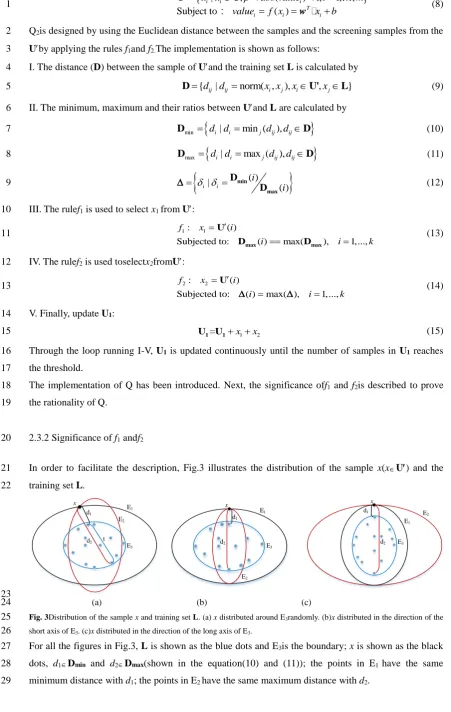
In order to facilitate the description, Fig.3 illustrates the distribution of the sample x(xU) and the 21
training set L. 22 d2 d1 E1 E3 E2 x d2 d1 E1 E3 E2 x d2 d1 E1 E3 E2 x t 23
(a) (b) (c)
[image:7.595.61.513.82.795.2]24
Fig. 3Distribution of the sample x and training set L. (a) x distributed around E3randomly. (b)x distributed in the direction of the 25
short axis of E3. (c)x distributed in the direction of the long axis of E3. 26
For all the figures in Fig.3, L is shown as the blue dots and E3is the boundary; x is shown as the black 27
dots, d1Dmin and d2Dmax(shown in the equation(10) and (11)); the points in E1 have the same 28
For thef1, Fig. 3(a) shows that the bigger d2generates a longer distance between x and L, and a smaller 1
probability of x belonging to L, so more information is contained in xwhich can decrease the amount 2
of the semilabeled samples used by the SSL. Therefore, f1canselectthe informative sample and reduce 3
the semilabeled samples to the greatest extent. 4
For the f2,Fig. 3(a) shows that the δ (δ∈Δ,in (12))in x can be written as 5
δ= d1/d2 (16)
6
In order to facilitate the description of f2, the expression of δ needs to be changed. 7
Let: d1= d2-t (17)
8
Where t is the secant of x in E3, then substitute (17) into (16): 9
δ = (d2-t)/d2 (18)
10
Get: δ = 1-t/d2 (19)
11
where it can be seen that: when d2 is invariant, the bigger δ is, the smaller t is, which means that x 12
would be closer to the short axis of E3(shown in Fig. 3(b)) and can make distribution of L more 13
uniform (compared with Fig. 3(c));when t is constant, the bigger δ is, the smallerd2is, and the longer 14
distance between x and Lis, which means that the smaller of the probability of x belonging to the L, so 15
the more information that x contains. Therefore, f2cannot only reduce the semilabeled samples by 16
selecting informative ones, but also make the distribution of L better. 17
2.4Search contextual patterns 18
This function makes the current pixel x(x∈U1) as the center sample to find the context patterns U2 from
19
the neighborhood. There are many choices forU2. Espinola et al. (2015)introduced the most
20
common types shown in Fig.4, where Von Neumann neighborhood and Moore neighborhood are called 21
the first-order system and the second-order system(Bruzzone and Persello 2009), and Von Neumann 22
neighborhood is also called the four-directly neighbored pixels (Zhao et al. 2013). 23
24
(a) (b) (c)
[image:8.595.60.504.59.796.2]25
Fig. 4 Examples of neighborhood systems. (a) Von Neumann neighborhood, (b) Moore neighborhood and (c) Extended Moore 26
neighborhood 27
Context information is very significant. Firstly, the center sample and the context patterns are close in 28
the space, which makes their characteristics exist great relevance that can be applied to calculate the 29
image texture feature(D'Elia et al. 2014)or generate the classification map(Bruzzone and Persello 2009). 30
More semilabeled samples are found using context information, which can improve the convergence 31
speed for the SSL. Secondly, their labels can also provide very important information. In(Espinola et al.
32
2015), the cell automaton distinguishes the different pixels (such as the boundary, noise, or common) at 33
properly using the context information of labels. The next section describes the way to relabel samples 1
by using the information of labels. 2
2.5 H: Relabeling samples 3
Q selects the samples between the maximum margin bands, where the selected samples are more likely 4
to be contaminated and mislabeled manually. To increase the reliability of the selected samples, the 5
central samples (U1,Y1) and the context patterns (U2,Y2)are relabeled by the function H with the
6
following rules: 7
I. When Y2are consistent with Y1, they are left;
8
II. When Y2are inconsistent with Y1, Y1 is incorrect. To make L representative, the corresponding
9
central sample is discarded and the context patterns are left. 10
III. When a part of Y2 is consistent withY1, forY2, the inconsistent context patterns are removed; for Y1,
11
the proportion of consistent part to context patterns is calculated: if the proportion is greater than 12
the threshold, rules A would be followed, else rules B would be chosen. 13
The semilabeled set (U3,Y3) is obtained after being relabeled by H. Then, those samples repeated with
14
L are eliminated, which generates the semilabeled set L1= (U4,Y4)to add to L.
15
Section 2.1-2.5 describes the proposed SSL based method. In order to overcome the influence of the 16
randomness of the learning set L, the classification results are fused in the next section. 17
2.6Fusion method 18
Data fusion is a very popular data processing technology to make up for the defects caused by the 19
missing data or noise pollution. It can be used in many methods. The principal component analysis 20
(PCA) extracts the principal components to fuse the training set, and the spectral information and 21
spatial information are combined together to fuse images. Our fusion method is shown in Fig.5,where 22
the part in the dashed rectangular box is the SSL based method proposed in Section 2.1: 23
Select learning set L' by manual DATA
Proposed Method Select learning
set L by manual
Proposed Method
Fusion Classifying result Y
Classifying result Y' 24
Fig. 5Fusion method 25
Firstly, because only a few labeled samples are needed to initialize the training set, the initial L (L' and 26
etc.) are selected from the DATA manually and would not cost a lot. Then, L is processed by the 27
proposed method to classify the learning set U for obtaining the classification result Y. The other initial 28
sets are processed by the same way. Finally, the different classification results (Y,Yand etc.) are treated 29
3 Experiments
1
In this section, the related experiments are designed to measure the performance of the proposed 2
algorithm (Method Proposed, PM) in three aspects. Firstly, to compare PM with the supervised 3
algorithm, the experiments on PM and SVM are carried out. Secondly, to compare PM with the 4
semisupervised algorithm, the experiments on PM, CS4VM and PS3VM-D are carried out. Finally, to 5
further improve the performance of PM, the different experimental results are fused. 6
3.1 Dataset description and parameters setting 7
3.1.1 Dataset Description 8
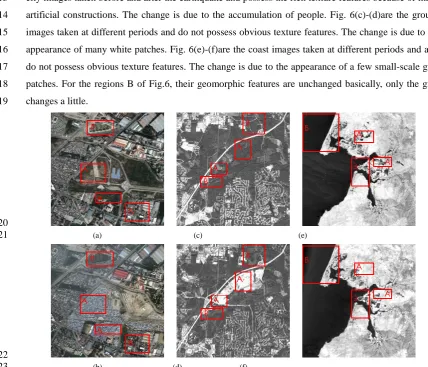
Our experiments on change detection are performed on real RSIs, as shown in Fig. 6, where the regions 9
A and regions B indicate the changed regions and unchanged regions respectively. The aim of change 10
detection is to distinguish the changed part and unchanged part of images (Habib et al. 2009; Celik
11
2010), and can be regarded as the binary classification problem. For the regions A: Fig. 6(a)-(b) are the 12
city images taken before and after the earthquake and possess the rich texture features because of many 13
artificial constructions. The change is due to the accumulation of people. Fig. 6(c)-(d)are the ground 14
images taken at different periods and do not possess obvious texture features. The change is due to the 15
appearance of many white patches. Fig. 6(e)-(f)are the coast images taken at different periods and also 16
do not possess obvious texture features. The change is due to the appearance of a few small-scale gray 17
patches. For the regions B of Fig.6, their geomorphic features are unchanged basically, only the gray 18
changes a little. 19
20
(a) (c) (e)
21
22
(b) (d) (f)
23
Fig. 6 Remote sensing images ofthe city (a) before earthquake and (b) after earthquake, the ground (c) before change and (d) 24
after change, and the coast (a) before change and (b) after change. A represents the changed areas, B represents the unchanged 25
[image:10.595.64.493.346.713.2]After all the images are processed by the geometric registration and radiometric calibration, then the 1
ratio map of grayscales is generated. To characterize the images, for Fig. 6(a)-(b) the gray level 2
co-occurrence matrix is calculated as the DATA1; for Fig. 6(c)-(d) and Fig. 6(e)-(f), the sample texture
3
featuresare calculated as the DATA2 and DATA3 respectively. All the experimental data are normalized
4
and divided into the training set and the learning set respectively. 5
3.1.2Parameters setting 6
The cost factor C of the PM is nonlinear, defined as follows: 7
2 1
• ( -1)
C N C (20)
8
Where N is the number of iterations; C1 is the initial cost factor; αis the weight coefficient. α and C1are 9
set to 1, and the change range of C is [1,100]. With the increase of iterations, the reliability of the 10
selected samples would increase, and the corresponding C would become larger than the previous one. 11
For the PS3VM-D, C is shown in (20), whereC
1 is set to 2 andαis calculated by 12
2 max min
(C -C ) / (r 1)
(21)
13
Where Cmax and Cmin are the maximum and minimum of C; r is designed artificially, with r = 10 herein. 14
For the CS4VM, C is defined as: 15
1
2 ( 1)
C N C (22)
16
where N is also the number of iterations; The initial value of C1 is 2. C is weighted by the K 17
K=C/C=2 (23)
18
When the label of the contextual pattern is the same as the center sample, C is exploited, otherwise C
19
is explored. 20
All the methods are performed using the Gauss kernel function, with the radial width set 0.6. The Von 21
Neumann neighborhood is applied by the PM and CS4VM. 22
3.2 Comparison with SVM 23
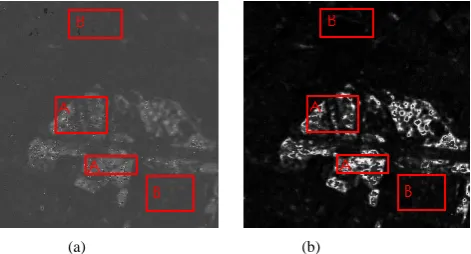
Considering the DATA1, the performance of the SVM and PM is compared. Fig. 7 shows the detection
24
grayscales of the two algorithms. 25
26
[image:11.595.182.418.572.699.2](a) (b) 27
Fig. 7 Detection grayscales achieved on DATA1in terms of (a) SVM and (b) PM.A represents the changed areas, B represents the
28
unchanged areas 29
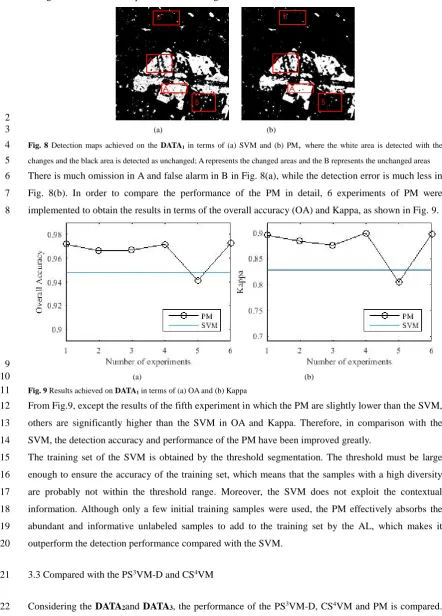
Through the threshold processing, the detection maps are obtained, as shown in Fig. 8 where the 30
changed areas and the B represents the unchanged areas. 1
2
(a) (b) 3
Fig. 8 Detection maps achieved on the DATA1 in terms of (a) SVM and (b) PM, where the white area is detected with the
4
changes and the black area is detected as unchanged; A represents the changed areas and the B represents the unchanged areas 5
There is much omission in A and false alarm in B in Fig. 8(a), while the detection error is much less in 6
Fig. 8(b). In order to compare the performance of the PM in detail, 6 experiments of PM were 7
implemented to obtain the results in terms of the overall accuracy (OA) and Kappa, as shown in Fig. 9. 8
9
(a) (b)
10
Fig. 9 Results achieved on DATA1 in terms of (a) OA and (b) Kappa
11
From Fig.9, except the results of the fifth experiment in which the PM are slightly lower than the SVM, 12
others are significantly higher than the SVM in OA and Kappa. Therefore, in comparison with the 13
SVM, the detection accuracy and performance of the PM have been improved greatly. 14
The training set of the SVM is obtained by the threshold segmentation. The threshold must be large 15
enough to ensure the accuracy of the training set, which means that the samples with a high diversity 16
are probably not within the threshold range. Moreover, the SVM does not exploit the contextual 17
information. Although only a few initial training samples were used, the PM effectively absorbs the 18
abundant and informative unlabeled samples to add to the training set by the AL, which makes it 19
outperform the detection performance compared with the SVM. 20
3.3 Compared with the PS3VM-D and CS4VM 21
Considering the DATA2and DATA3, the performance of the PS3VM-D, CS4VM and PM is compared.
22
[image:12.595.62.505.82.699.2] [image:12.595.165.422.86.216.2]1
(a) (b) (c)
2
Fig. 10 Detection grayscales achieved on DATA2 in terms of (a) CS4VM, (b) PS3VM-D and (c) PM.A represents the changed
3
areas, B represents the unchanged areas 4
5
(a) (b) (c)
6
Fig. 11 Detection grayscales achieved on DATA3 in terms of (a) CS4VM, (b) PS3VM-D and (c) PM.A represents the changed
7
areas, B represents the unchanged areas 8
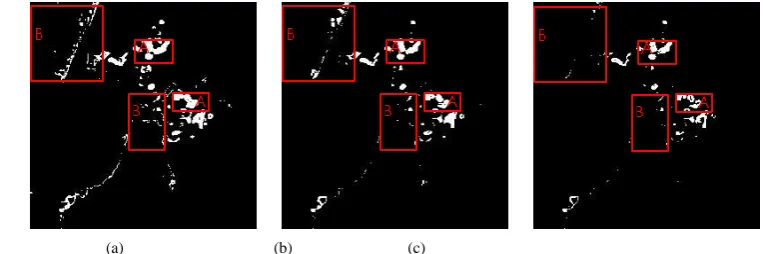
Through the threshold processing, the detection maps of DATA2 and DATA3are obtained, as shown in
[image:13.595.57.488.61.761.2]9
Fig. 12 and Fig. 13 respectively, where the white area is detected with the changes and the black area is 10
detected as unchanged; A represents the changed areas and B represents the unchanged areas. 11
12
(a) (b) (c)
[image:13.595.113.481.69.198.2]13
Fig. 12 Detection maps achieved on DATA2 in terms of (a) CS4VM, (b) PS3VM-D and (c) PM, where the white area is detected
14
with the changes and the black area is detected as unchanged; A represents the changed areas and the B represents the unchanged 15
areas 16
17
(a) (b) (c)
18
Fig. 13 Detection maps achieved on DATA3 in terms of (a) CS4VM, (b) PS3VM-D and (c) PM, where the white area is detected
[image:13.595.99.483.230.357.2] [image:13.595.92.482.439.570.2] [image:13.595.100.482.618.745.2]with the changes and the black area is detected as unchanged; A represents the changed areas and the B represents the unchanged 1
areas 2
In Fig. 12, the omission of PS3VM-D is the least and that of the PM is the greatest in A; the false alarm 3
of PM is the least and that of the CS4VMisthegreatest in B. It can be seen that the performance of the 4
three algorithms is ideal and that of PM is more accurate than others for DATA2. In Fig.13, the false
5
alarm of PM is significantly less than that of the other algorithms in B, followed by thePS3VM-D. The 6
omission of three algorithms is almost the same in A. Therefore, the detection result of PM is the best 7
for DATA3.
8
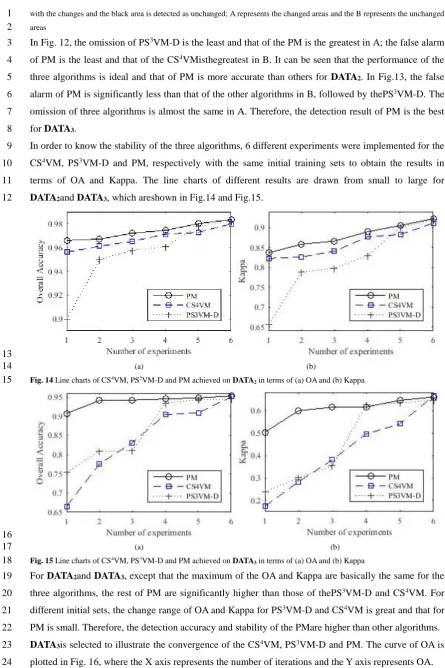
In order to know the stability of the three algorithms, 6 different experiments were implemented for the 9
CS4VM, PS3VM-D and PM, respectively with the same initial training sets to obtain the results in 10
terms of OA and Kappa. The line charts of different results are drawn from small to large for 11
DATA2and DATA3, which areshown in Fig.14 and Fig.15.
12
13
(a) (b)
[image:14.595.60.506.63.732.2]14
Fig. 14 Line charts of CS4VM, PS3VM-D and PM achieved on DATA
2 in terms of (a) OA and (b) Kappa
15
16
(a) (b) 17
Fig. 15 Line charts of CS4VM, PS3VM-D and PM achieved on DATA
3 in terms of (a) OA and (b) Kappa
18
For DATA2and DATA3, except that the maximum of the OA and Kappa are basically the same for the
19
three algorithms, the rest of PM are significantly higher than those of thePS3VM-D and CS4VM. For 20
different initial sets, the change range of OA and Kappa for PS3VM-D and CS4VM is great and that for 21
PM is small. Therefore, the detection accuracy and stability of the PMare higher than other algorithms. 22
DATA3is selected to illustrate the convergence of the CS4VM, PS3VM-D and PM. The curve of OA is
23
1
Fig. 16 Line charts of PM achieved on DATA3
2
With the increase of iterations, the OAs of the three algorithms all change, where the OA of the CS4VM 3
increases from 0.64 to 0.79, the OA of thePS3VM-D increases from 0.64 to 0.82 and the OA of PM 4
increases from 0.64 to 0.94. The curve of the PM rises fastest, which suggests that the PM can get the 5
faster convergence speed than other algorithms. 6
The CS4VM can increase the relevance of the training samples by searching the contextual samples, 7
but it does not consider whether those samples are beneficial to improve the convergence rate. The 8
PS3VM-D guarantees the information of the selected samples by searching them within the margin 9
band, but the probability that these samples are polluted is also great. Compared to the CS4VM and the 10
PS3VM-D, the PM uses the AL to select the informative samples, then use the context information to 11
increase the samples correlation, which improves the detection accuracy and ensures the reliability of 12
the selected samples. We use a new query function Q to make the distribution of the training samples 13
more uniform for improving the detection efficiency and accuracy. Moreover, the convergence of the 14
PM is further improved by applying the semilabeled samples. 15
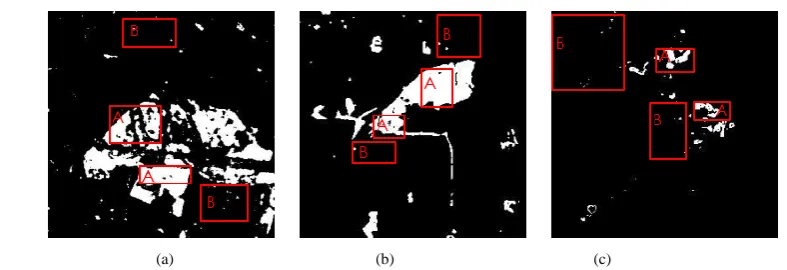
3.4Fusion for PM 16
To obtain the more accurate results and verify the effectiveness of the fusion for the SSL methods, the 17
experimental results of the PM are fused. The OA and Kappa are listed in Table 1, and the fusion 18
detection maps are shown in Fig. 17, where the white area is detected with the changes and the black 19
area is detected as unchanged. A represents the changed areas and B represents the unchanged areas. 20
21
(a) (b) (c)
22
Fig. 17 Fusion detection maps achieved on (a) DATA1, (b) DATA2and (c) DATA3for PM, where the white area is detected with
23
the changes and the black area is detected as unchanged; A represents the changed areas and the B represents the unchanged areas 24
Table 1OA and Kappa of different experiments for DATA1, DATA2 and DATA3
[image:15.595.66.503.117.741.2] [image:15.595.91.485.572.707.2]1 2 3 4 5 6 Fusion OA Kappa OA Kappa OA Kappa OA Kappa OA Kappa OA Kappa OA Kappa DATA1 0.9718 0.8955 0.9662 0.8839 0.9668 0.8760 0.9717 0.8997 0.9413 0.8045 0.9724 0.8977 0.9744 0.9060 DATA2 0.9659 0.8582 0.9721 0.8661 0.9835 0.9225 0.9800 0.9053 0.9670 0.8365 0.9744 0.8894 0.9837 0.9250 DATA3 0.9475 0.6155 0.9420 0.6139 0.9409 0.6447 0.9451 0.5991 0.9072 0.5031 0.9528 0.6599 0.9534 0.6638
In TABEL 1, both the OA and Kappa get higher after fusion. By comparing Fig. 17(a), Fig. 17(b) and 1
Fig. 17(c) with Fig. 8(b), Fig. 12(c) and Fig. 13(c) respectively, it is found that the false alarm in B and 2
the omission in A reduces a lot after the fusion for DATA1 and DATA3. The false alarm in B region and
3
the omission in A decreases slightly for DATA2. Obviously, the data fusion could effectively
4
compensate the detection error, reduce the risk caused by the different initial training sets and improve 5
the detection accuracy. 6
4. Conclusion
7
In this paper, a novel method is proposed for the change detection of RS images. It fully incorporates 8
the methods and concepts in the SSL, and adopts them to fit the situation where the labeled samples are 9
insufficient. 10
The novelty of this paper lies in: a) By considering the advantages of the AL and the context 11
information, a novel semisupervised method is designed; b) by analyzing the distribution of the 12
samples, a new query function is designed to select the semilabeled samples using the Euclidean 13
distance; c) Based on the idea of data fusion, the discrete results of the PM are effectively fused. In the 14
experiments of change detection for actual RSIs, the PM has made a significant improvement in the 15
detection accuracy, convergence rate, and the stability in comparison with other existing methods. It 16
can be further improved by using other effective fusion methods. 17
References
18
Anand, S., Mittal, S., Tuzel, O., & Meer, P. (2014). Semi-Supervised Kernel Mean Shift Clustering. Pattern Analysis and
19
Machine Intelligence, IEEE Transactions on, 36(6), 1201-1215, doi:10.1109/TPAMI.2013.190. 20
Bazi, Y., Melgani, F., & Al-Sharari, H. D. (2010). Unsupervised change detection in multispectral remotely sensed imagery with 21
level set methods. Geoscience and Remote Sensing, IEEE Transactions on, 48(8), 3178-3187. 22
Bovolo, F., Bruzzone, L., & Marconcini, M. (2008). A Novel Approach to Unsupervised Change Detection Based on a 23
Semisupervised SVM and a Similarity Measure. Geoscience and Remote Sensing, IEEE Transactions on, 46(7), 24
2070-2082, doi:10.1109/TGRS.2008.916643. 25
Bruzzone, L., & Persello, C. (2009). A Novel Context-Sensitive Semisupervised SVM Classifier Robust to Mislabeled Training 26
Samples. Geoscience and Remote Sensing, IEEE Transactions on, 47(7), 2142-2154, 27
doi:10.1109/TGRS.2008.2011983. 28
Celik, T. (2010). Change Detection in Satellite Images Using a Genetic Algorithm Approach. Geoscience and Remote Sensing
29
Letters, IEEE, 7(2), 386-390, doi:10.1109/LGRS.2009.2037024. 30
Chapelle, O., Schölkopf, B., & Zien, A. (2006). Semi-supervised learning. 31
D'Elia, C., Ruscino, S., Abbate, M., Aiazzi, B., Baronti, S., & Alparone, L. (2014). SAR Image Classification Through 32
Information-Theoretic Textural Features, MRF Segmentation, and Object-Oriented Learning Vector Quantization. 33
Selected Topics in Applied Earth Observations and Remote Sensing, IEEE Journal of, 7(4), 1116-1126, 34
doi:10.1109/JSTARS.2014.2304700. 35
Demir, B., Persello, C., & Bruzzone, L. (2011). Batch-Mode Active-Learning Methods for the Interactive Classification of 36
Remote Sensing Images. Geoscience and Remote Sensing, IEEE Transactions on, 49(3), 1014-1031, 37
Didaci, L., Fumera, G., & Roli, F. (2012). Analysis of Co-training Algorithm with Very Small Training Sets. In G. Gimel’farb, E. 1
Hancock, A. Imiya, A. Kuijper, M. Kudo, S. Omachi, et al. (Eds.), Structural, Syntactic, and Statistical Pattern
2
Recognition (Vol. 7626, pp. 719-726, Lecture Notes in Computer Science): Springer Berlin Heidelberg. 3
Espinola, M., Piedra-Fernandez, J. A., Ayala, R., Iribarne, L., & Wang, J. Z. (2015). Contextual and Hierarchical Classification of 4
Satellite Images Based on Cellular Automata. Geoscience and Remote Sensing, IEEE Transactions on, 53(2), 795-809, 5
doi:10.1109/TGRS.2014.2328634. 6
Geiß, C., & Taubenböck, H. (2013). Remote sensing contributing to assess earthquake risk: from a literature review towards a 7
roadmap. Natural Hazards, 68(1), 7-48, doi:10.1007/s11069-012-0322-2. 8
Gomez-Chova, L., Bruzzone, L., Camps-Valls, G., & Calpe-Maravilla, J. Semi-Supervised Remote Sensing Image Classification 9
based on Clustering and the Mean Map Kernel. In Geoscience and Remote Sensing Symposium, 2008. IGARSS 2008.
10
IEEE International, 7-11 July 2008 2008 (Vol. 4, pp. IV - 391-IV - 394). doi:10.1109/IGARSS.2008.4779740. 11
Gong, C., Junwei, H., Lei, G., Zhenbao, L., Shuhui, B., & Jinchang, R. (2015). Effective and Efficient Midlevel Visual 12
Elements-Oriented Land-Use Classification Using VHR Remote Sensing Images. Geoscience and Remote Sensing,
13
IEEE Transactions on, 53(8), 4238-4249, doi:10.1109/TGRS.2015.2393857. 14
Habib, T., Inglada, J., Mercier, G., & Chanussot, J. (2009). Support Vector Reduction in SVM Algorithm for Abrupt Change 15
Detection in Remote Sensing. Geoscience and Remote Sensing Letters, IEEE, 6(3), 606-610, 16
doi:10.1109/LGRS.2009.2020306. 17
Hansen, M. C., & Loveland, T. R. (2012). A review of large area monitoring of land cover change using Landsat data. Remote
18
Sensing of Environment, 122, 66-74, doi:http://dx.doi.org/10.1016/j.rse.2011.08.024. 19
Hearst, M. A., Dumais, S. T., Osman, E., Platt, J., & Scholkopf, B. (1998). Support vector machines. Intelligent Systems and their
20
Applications, IEEE, 13(4), 18-28, doi:10.1109/5254.708428. 21
Izquierdo-Verdiguier, E., Laparra, V., Gomez-Chova, L., & Camps-Valls, G. (2013). Encoding Invariances in Remote Sensing 22
Image Classification With SVM. Geoscience and Remote Sensing Letters, IEEE, 10(5), 981-985, 23
doi:10.1109/LGRS.2012.2227297. 24
Junwei, H., Dingwen, Z., Gong, C., Lei, G., & Jinchang, R. (2015a). Object Detection in Optical Remote Sensing Images Based 25
on Weakly Supervised Learning and High-Level Feature Learning. Geoscience and Remote Sensing, IEEE
26
Transactions on, 53(6), 3325-3337, doi:10.1109/TGRS.2014.2374218. 27
Junwei, H., Dingwen, Z., Xintao, H., Lei, G., Jinchang, R., & Feng, W. (2015b). Background Prior-Based Salient Object 28
Detection via Deep Reconstruction Residual. Circuits and Systems for Video Technology, IEEE Transactions on, 25(8), 29
1309-1321, doi:10.1109/TCSVT.2014.2381471. 30
Kawakita, M., & Kanamori, T. (2013). Semi-supervised learning with density-ratio estimation. Machine Learning, 91(2), 31
189-209, doi:10.1007/s10994-013-5329-8. 32
Li, J., Bioucas-Dias, J. M., & Plaza, A. (2010). Semisupervised Hyperspectral Image Segmentation Using Multinomial Logistic 33
Regression With Active Learning. Geoscience and Remote Sensing, IEEE Transactions on, 48(11), 4085-4098, 34
doi:10.1109/TGRS.2010.2060550. 35
Maulik, U., & Chakraborty, D. (2012). A novel semisupervised SVM for pixel classification of remote sensing imagery. 36
International Journal of Machine Learning and Cybernetics, 3(3), 247-258, doi:10.1007/s13042-011-0059-3. 37
Maulik, U., & Chakraborty, D. (2014). Fuzzy Preference Based Feature Selection and Semisupervised SVM for Cancer 38
Classification. NanoBioscience, IEEE Transactions on, 13(2), 152-160, doi:10.1109/TNB.2014.2312132. 39
Munoz-Mari, J., Tuia, D., & Camps-Valls, G. (2012). Semisupervised Classification of Remote Sensing Images With Active 40
Queries. Geoscience and Remote Sensing, IEEE Transactions on, 50(10), 3751-3763, 41
doi:10.1109/TGRS.2012.2185504. 42
Pasolli, E., Melgani, F., Tuia, D., Pacifici, F., & Emery, W. J. (2014). SVM Active Learning Approach for Image Classification 43
Using Spatial Information. Geoscience and Remote Sensing, IEEE Transactions on, 52(4), 2217-2233, 44
doi:10.1109/TGRS.2013.2258676. 45
Persello, C., & Bruzzone, L. (2014). Active and Semisupervised Learning for the Classification of Remote Sensing Images. 46
Geoscience and Remote Sensing, IEEE Transactions on, 52(11), 6937-6956, doi:10.1109/TGRS.2014.2305805. 47
Schohn, G., & Cohn, D. Less is more: Active learning with support vector machines. In ICML, 2000 (pp. 839-846): Citeseer 48
Scholkopf, B., Kah-Kay, S., Burges, C. J. C., Girosi, F., Niyogi, P., Poggio, T., et al. (1997). Comparing support vector machines 49
2758-2765, doi:10.1109/78.650102. 1
Shahshahani, B. M., & Landgrebe, D. A. (1994). The effect of unlabeled samples in reducing the small sample size problem and 2
mitigating the Hughes phenomenon. Geoscience and Remote Sensing, IEEE Transactions on, 32(5), 1087-1095, 3
doi:10.1109/36.312897. 4
Tuia, D., Volpi, M., Copa, L., Kanevski, M., & Munoz-Mari, J. (2011). A Survey of Active Learning Algorithms for Supervised 5
Remote Sensing Image Classification. Selected Topics in Signal Processing, IEEE Journal of, 5(3), 606-617, 6
doi:10.1109/JSTSP.2011.2139193. 7
Yi, Y., Wu, J., & Xu, W. (2011). Incremental SVM based on reserved set for network intrusion detection. Expert Systems with
8
Applications, 38(6), 7698-7707. 9
Zhao, C., Li, X., Ren, J., & Marshall, S. (2013). Improved sparse representation using adaptive spatial support for effective target 10
detection in hyperspectral imagery. International Journal of Remote Sensing, 34(24), 8669-8684, 11
doi:10.1080/01431161.2013.845924. 12
Zhu, X. (2010). Semi-Supervised Learning. In C. Sammut, & G. Webb (Eds.), Encyclopedia of Machine Learning (pp. 892-897): 13
Springer US. 14
Author Biographies
15
FeiGao received the B.S. and M.S. degree from the Xi’an Petroleum Institute, Xi’an, China, in 1996 16
and 1999, respectively, and the Ph.D. degrees from Beijing University of Aeronautics and Astronautics 17
(BUAA), Beijing, China, in 2005. He is currently an Associate Professor with the School of Electronic 18
and Information Engineering, BUAA. He is interested in radar signal processing, moving target 19
detection and image processing. 20
21 22 23
Wenchao Lv received the B.S. degree in electronic and information engineering fromBeijing 24
University of Posts and Telecommunications, Beijing, China, in 2014. He is currently pursuing the 25
M.E. degree in electronic and communication engineering at Beijing University of Aeronautics and 26
Astronautics, Beijing, China. His current research activity is in machine learning and synthetic aperture 27
radar image classification. 28
29 30
31
Yaotian Zhang received the B.S. degree in Electronic Engineering from BeihangUniversityin 2003. He 32
was awarded Ph.D degree in Signal Processing from Beihang University in 2009. Since2010, he has 33
worked in School of Electronic and Information Engineering of Beihang University as an assistant 34
professor. His research interest covers image understanding, target detection and Micro-Doppler signal 35
analysis. 36
37 38 39
Jinping Sun received the M.Sc. and Ph.D. degrees from the Beijing University of Aeronautics and 40
Astronautics (BUAA), Beijing, China, in 1998 and 2001, respectively. He is currently a Professor with 41
the School of Electronic and Information Engineering, BUAA. His research interests include 42
high-resolution radar signal processing, image understanding, and robust beamforming. 43
44 45 46 47
Jun Wang received the B.S. degree from the Northwestern Polytechnical University, Xi’an, China, in 48
(BUAA), Beijing, China, in 1998 and 2001, respectively. He is currently a Professor with the School of Electronic and 1
Information Engineering, BUAA. He is interested in signal processing, DSP/FPGA real-time architecture, target recognition and 2
tracking, and so on. His research has resulted in 38 papers in journals, books, and conference proceedings. 3
4 5
Erfu Yang is a Lecturer in the Department of Design Manufacture and Engineering Management 6
(DMEM) at the University of Strathclyde, Glasgow, UK. His main research interests include robotics, 7
autonomous systems, mechatronics, manufacturing automation, computer vision, image/signal 8
processing, nonlinear control, process modelling and simulation, condition monitoring, fault diagnosis, 9
multi-objective optimizations, and applications of machine learning and artificial intelligence including 10
multi-agent reinforcement learning, fuzzy logic, neural networks, bio-inspired algorithms, and cognitive 11
computation, etc. He has over 60 publications in these areas, including more than 30 journal papers and 12