City, University of London Institutional Repository
Citation
:
de Valk, R. (2015). Structuring lute tablature and MIDI data: Machine learning models for voice separation in symbolic music representations. (Unpublished Doctoral thesis, City, University of London)This is the accepted version of the paper.
This version of the publication may differ from the final published
version.
Permanent repository link:
http://openaccess.city.ac.uk/15659/Link to published version
:
Copyright and reuse:
City Research Online aims to make research
outputs of City, University of London available to a wider audience.
Copyright and Moral Rights remain with the author(s) and/or copyright
holders. URLs from City Research Online may be freely distributed and
linked to.
STRUCTURING LUTE TABLATURE
AND MIDI DATA
MACHINE LEARNING MODELS FOR VOICE SEPARATION
IN SYMBOLIC MUSIC REPRESENTATIONS
Reinier Franciscus de Valk
A thesis submitted for the degree of Doctor of Philosophy
City University London
Department of Computer Science Music Informatics Research Group
Declaration
The research presented in this thesis was conducted within the Music Infor-matics Research Group housed at the Department of Computer Science at City University London. It was carried out from October 2011 to March 2015 under the supervision of Dr Tillman Weyde, head of the Music Informatics Research Group, and Professor Tim Crawford, affiliated with the Department of Computing at Goldsmiths College, University of London. In submitting this thesis, I declare the research presented in it to be my original work. Wherever contributions of others are concerned, every effort is made to indi-cate this clearly, with due reference to the literature, and acknowledgement of collaborative research and discussions.
Abstract
This thesis concerns the design, development, and implementation of ma-chine learning models for voice separation in two forms of symbolic music representations: lute tablature and MIDI data. Three modelling approaches are described: MA1, a note-level classification approach using a neural net-work, MA2, a chord-level regression approach using a neural netnet-work, and MA3, a chord-level probabilistic approach using a hidden Markov model. Furthermore, three model extensions are presented: backward processing, modelling voice and duration simultaneously, and multi-pass processing us-ing an extended (bidirectional) decision context.
Two datasets are created for model evaluation: a tablature dataset, con-taining a total of 15 three-voice and four-voice intabulations (lute arrange-ments of polyphonic vocal works) in a custom-made tablature encoding for-mat,tab+, as well as in MIDI format, and a Bach dataset, containing the 45 three-voice and four-voice fugues from Johann Sebastian Bach’sDas
wohltem-perirte Clavier (BWV 846–893) in MIDI format. The datasets are made
available publicly, as is the software used to implement the models and the framework for training and evaluating them.
The models are evaluated on the datasets in four experiments. The first experiment, where the different modelling approaches are compared, shows that MA1 is the most effective and efficient approach. The second experiment shows that the features are effective, and it demonstrates the importance of the type and amount of context information that is encoded in the feature vectors. The third experiment, which concerns model extension, shows that modelling backward and modelling voice and duration simultaneously do not lead to the hypothesised increase in model performance, but that using a multi-pass bidirectional model does. In the last experiment, where the performance of the models is compared with that of existing state-of-the-art systems for voice separation, it is shown that the models described in this thesis can compete with these systems.
Acknowledgements
Armed with an interdisciplinary research proposal that was perhaps a bit heavy on the musicological side, in September 2011 I moved to London, where I was to embark on a research project upon completion of which I would be awarded a doctorate in computer science. Not for a single moment did I doubt that, once I had reached the other end of the journey I was about to begin, and regardless of my newly acquired title, I would continue to consider myself a musicologist. So I immersed myself in the new discipline. Four years and countless hours of modelling, programming, conducting experiments, and writing later, upon submitting the final version of my thesis as you have it before you, I must admit that I am now in fact equally—if not more— comfortable with the titlecomputer scientist.
For this conversion I hold responsible my supervisor, Tillman Weyde, whom I would like to thank first. Without his advice and guidance, this thesis would never have seen the light of day. From the innumerable inspiring discussions and brainstorming sessions we had—the door to his office was always open—my research has benefitted greatly, and whenever I strayed away from the path we had set out, he was there to steer me back into the right direction. Moreover, as the head of the Music Informatics Research Group, he succeeded in creating an informal and collegial environment within which it was very pleasant to work.
I also thank my second supervisor, Tim Crawford, for many stimulating meetings about a wide range of topics related directly (and sometimes not-so-directly) to my research, and, especially, for reminding me from time to time not to lose touch with the musicological aspect of my work. I am grateful to him for offering me the opportunity to be part of the Goldsmiths team and work as a research assistant for the ECOLM III project, and, later, for the SLICKMEM project. Both experiences have broadened my horizon
viii ACKNOWLEDGEMENTS
considerably.
I thank my colleagues and friends in the Department of Computer Science, and, specifically, in the Music Informatics Research Group: Daniel Wolff, problem solver extraordinaire and formidable tennis opponent; Emmanouil Benetos, HMM wizard; Srikanth Cherla, kindred musical spirit and concert companion; Dan Tidhar, undisputed champion of puns; Andreas Jansson, vegetarian Viking; Andy Lambert, cheerful multi-instrumentalist; Luca Pino, Java oracle and recommended tour guide; Manoel Vitor Macedo Fran¸ca, carioca Inglˆes; and Son Tran, master of understatement. I will miss the lively discussions we had—be they about music information retrieval, where to go for dinner and a drink (“Not Wetherspoon’s again!”), or the whereabouts of the office mouse.
I also thank Frans Wiering, Ted Dumitrescu, Marnix van Berchum, Karl K¨ugle, and Matjaˇz Matoˇsec, all of whom I met and worked with at Utrecht University, where it all started, and all of whom helped me find my way.
Contents
Tables xiii
Figures xvii
Symbols, abbreviations, and terms xix
1 Introduction 1
1.1 Motivation . . . 2
1.2 Aims and objectives . . . 4
1.3 Contributions . . . 5
1.4 Thesis overview . . . 6
2 Background and related work 9 2.1 Terminology . . . 9
2.1.1 Voice . . . 9
2.1.2 Polyphonic music . . . 10
2.1.3 Voice separation . . . 10
2.2 Musicological background: the lute and its music in the six-teenth century . . . 11
2.2.1 Lute tablature . . . 12
2.2.2 Intabulations . . . 15
2.2.3 Instrumental idiom: three characteristics . . . 17
2.3 Computational background: voice separation . . . 17
2.3.1 Voice separation, Phase 1: modelling of perceptual phenomena . . . 18
2.3.2 Voice separation, Phase 2: voice separation systems . . 19
2.3.2.1 Rule-based systems (1) . . . 19
x CONTENTS
2.3.2.2 Rule-based systems (2): non-monophonic voices 21
2.3.2.3 Machine learning systems . . . 23
2.3.2.4 A priori modelling assumptions . . . 24
2.3.3 Applications for automatic transcription of lute tablature 24 3 Method 27 3.1 Modelling . . . 28
3.1.1 Learning models . . . 28
3.1.1.1 Neural networks . . . 28
3.1.1.2 Hidden Markov models . . . 30
3.1.2 MA1: a note-level classification approach using a neu-ral network model . . . 30
3.1.2.1 Single-note unisons . . . 31
3.1.2.2 Sigmoid versus softmax activation function . . 32
3.1.2.3 Simultaneous voice and duration modelling . 32 3.1.2.4 Application to unseen data and conflicts . . . 33
3.1.2.5 Number of voices . . . 34
3.1.2.6 Nomenclature . . . 34
3.1.3 MA2: a chord-level regression approach using a neural network model . . . 34
3.1.3.1 Mappings: enumeration and pruning . . . 35
3.1.3.2 Feature vector set generation and relative train-ing . . . 37
3.1.3.3 Application to unseen data . . . 39
3.1.3.4 Number of voices . . . 40
3.1.3.5 Nomenclature . . . 40
3.1.4 MA3: a chord-level probabilistic approach using a dis-crete hidden Markov model . . . 40
3.1.4.1 Number of voices and conflicts . . . 42
3.1.4.2 Nomenclature . . . 42
3.1.5 Processing modes . . . 42
3.1.6 Decision context and double-pass models . . . 43
3.1.6.1 Nomenclature . . . 45
3.1.7 Features . . . 46
3.1.7.1 Feature descriptions, categories (1)–(3) . . . . 46
3.1.7.2 Feature descriptions, category (4) (polyphonic embedding features) . . . 48
3.1.7.3 Organisation in feature vectors . . . 51
3.1.7.4 Scaling . . . 53
3.2 Evaluation . . . 54
CONTENTS xi
3.2.2 Evaluation metrics . . . 55
3.2.2.1 Statistical significance . . . 56
3.2.3 Evaluation of single-note unisons . . . 56
3.2.4 Evaluation modes and error propagation . . . 57
3.2.4.1 Evaluation of unidirectional models . . . 58
3.2.4.2 Evaluation of bidirectional models . . . 59
3.3 Conflicts . . . 59
3.3.1 Conflict resolution in unidirectional application mode . 61 3.3.1.1 Special conflicts: type (iv) and (v) conflicts . 64 3.3.2 Conflict resolution in bidirectional application mode . . 66
3.4 Implementation details . . . 69
4 Datasets 71 4.1 The tablature dataset . . . 71
4.1.1 Formats and data creation . . . 72
4.1.1.1 Polyphonic alignment . . . 75
4.1.1.2 Sebastian Ochsenkun’sTabulaturbuch auff die Lauten . . . 77
4.1.2 Internal data representations . . . 78
4.1.3 Encoding format . . . 79
4.1.3.1 Content and symbols . . . 80
4.1.3.2 Encoding principles . . . 83
4.2 The Bach dataset . . . 85
4.2.1 Format and data adaptations . . . 85
4.2.2 Internal data representations . . . 88
5 Experimental results and discussion 89 5.1 Neural network models and hyperparameter optimisation . . . 90
5.1.1 Hidden layer size and regularisation . . . 90
5.1.2 Margin . . . 93
5.2 Hidden Markov model and matrix configuration optimisation . 95 5.3 Experiment 1: modelling approaches . . . 97
5.3.1 Conclusion . . . 101
5.4 Experiment 2: features . . . 101
5.4.1 Experiment 2.1: context information . . . 101
5.4.2 Experiment 2.2: tablature information . . . 104
5.4.3 Conclusion . . . 105
5.5 Experiment 3: model extensions . . . 105
5.5.1 Experiment 3.1: backward processing (X2) . . . 107
xii CONTENTS
5.5.3 Experiment 3.3: multi-pass processing using a
bidirec-tional decision context (X3) . . . 112
5.5.4 Conclusion . . . 117
5.6 Experiment 4: comparison with existing voice separation sys-tems . . . 118
5.6.1 Datasets . . . 119
5.6.2 Evaluation metrics . . . 120
5.6.3 Results and conclusion . . . 122
5.7 Overarching issues . . . 124
5.7.1 Conflicts and conflict resolution . . . 126
5.7.2 Error propagation . . . 127
5.7.3 Complex musical phenomena . . . 130
5.7.3.1 Single-note unisons . . . 130
5.7.3.2 Voice crossing and imitation . . . 131
5.7.4 Conclusion . . . 133
6 Summary and conclusions 135 6.1 Summary . . . 135
6.2 Conclusions . . . 140
6.3 Future work . . . 143
Bibliography 145
Tables
3.1 Number of mapping possibilities for a chord of n notes in a context of v voices before and after pruning of mappings con-taining more than two voice inversion pairs. Tablature and
Bach datasets. . . 37
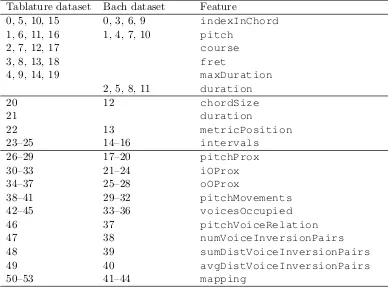
3.2 MA1, feature vector for the unidirectional model: note-level features (top), note-chord features (upper middle), chord-level features (lower middle), and polyphonic embedding features (bottom). . . 52
3.3 MA2, feature vector: note-level features (top), chord-level fea-tures (middle), and polyphonic embedding feafea-tures (bottom). 53 3.4 Voice assignment scenarios and corresponding voice assign-ment categories. . . 57
3.5 Conflict resolution per conflict type in unidirectional applica-tion mode. Tablature and Bach datasets. . . 63
4.1 Tablature dataset, three-voice pieces. . . 73
4.2 Tablature dataset, four-voice pieces. . . 74
4.3 Encoding, header section: fields. . . 80
4.4 Encoding, body section: punctuation symbols and musical symbols. . . 83
4.5 Bach dataset, three-voice pieces. . . 86
4.6 Bach dataset, four-voice pieces. . . 86
5.1 Hyperparameter optimisation, N, N0, and C models: optimal hidden layer size and λ value. Tablature dataset, four-voice pieces. . . 92
xiv TABLES
5.2 Hyperparameter optimisation, N and C models: optimal hid-den layer size and λ value. Bach dataset, four-voice pieces. . . 92 5.3 Hyperparameter optimisation, C model: effect of different ε
values. Tablature dataset, four-voice pieces. . . 94 5.4 Hyperparameter optimisation, C model: effect of different ε
values. Bach dataset, four-voice pieces. . . 94 5.5 Matrix configuration optimisation, H model: effect of different
configurations of matrix types. Tablature dataset, four-voice (top) and three-voice (bottom) pieces. . . 95 5.6 Matrix configuration optimisation, H model: effect of different
configurations of matrix types. Bach dataset, four-voice (top) and three-voice (bottom) pieces. . . 95 5.7 Experiment 1: modelling approaches. Tablature dataset,
four-voice (top) and three-four-voice (bottom) pieces. . . 96 5.8 Experiment 1: modelling approaches. Bach dataset, four-voice
(top) and three-voice (bottom) pieces. . . 97 5.9 Experiment 2.1: features, context information. Tablature
data-set, four-voice pieces. . . 102 5.10 Experiment 2.1: features, context information. Bach dataset,
four-voice pieces. . . 103 5.11 Experiment 2.2: features, tablature information. Tablature
dataset, four-voice (top) and three-voice (bottom) pieces. . . . 104 5.12 Experiment 3.1: model extensions, backward processing (X2).
Tablature dataset, four-voice (top) and three-voice (bottom) pieces. . . 106 5.13 Experiment 3.1: model extensions, backward processing (X2).
Bach dataset, four-voice (top) and three-voice (bottom) pieces. 107 5.14 Experiment 3.2: model extensions, simultaneous voice and
du-ration modelling (X1), forward processing mode. Tablature dataset, four-voice (top) and three-voice (bottom) pieces. . . . 108 5.15 Experiment 3.2: model extensions, simultaneous voice and
du-ration modelling (X1), backward processing mode. Tablature dataset, four-voice (top) and three-voice (bottom) pieces. . . . 109 5.16 Experiment 3.3: model extensions, multi-pass processing using
a bidirectional decision context (X3). Tablature dataset, four-voice (top) and three-four-voice (bottom) pieces. . . 113 5.17 Experiment 3.3: model extensions, multi-pass processing using
TABLES xv
5.18 Experiment 3.3: model extensions, multi-pass processing using a bidirectional decision context (X3), use of correct polyphonic information for data annotation. Tablature dataset, four-voice (top) and three-voice (bottom) pieces. . . 116 5.19 Experiment 3.3: model extensions, multi-pass processing
us-ing a bidirectional decision context (X3), use of correct poly-phonic information for data annotation. Bach dataset, four-voice (top) and three-four-voice (bottom) pieces. . . 117 5.20 Experiment 4: comparison with existing voice separation
sys-tems, model performance on the six inventions and fugues sub-sets. . . 123 5.21 Experiment 4: comparison with existing voice separation
sys-tems, pairwise comparisons. . . 125 5.22 Conflict numbers and conflict percentage c for the N, N0, B,
and B0 models. Tablature and Bach datasets, four-voice pieces. 126 5.23 Error propagation percentage m for the N, N0, and C models.
Tablature and Bach datasets, four-voice pieces. . . 127 5.24 Spread of single-note unison assignments for all models in
ap-plication mode. Tablature dataset, four-voice pieces. . . 131
A.1 Hyperparameter optimisation, N model: hidden layer size and
λ, accuracies for all combinations in training (top), test (mid-dle), and application (bottom) mode. Tablature dataset, four-voice pieces. . . 156 A.2 Hyperparameter optimisation, N model: hidden layer size and
λ, p-values for pairwise comparison of the highest accuracy value with all other values in training (top), test (middle), and application (bottom) mode. Tablature dataset, four-voice pieces. . . 157 A.3 Hyperparameter optimisation, N model: hidden layer size and
λ, accuracies for all combinations in training (top), test (mid-dle), and application (bottom) mode. Bach dataset, four-voice pieces. . . 158 A.4 Hyperparameter optimisation, N model: hidden layer size and
λ, p-values for pairwise comparison of the highest accuracy value with all other values in training (top), test (middle), and application (bottom) mode. Bach dataset, four-voice pieces. . 159 A.5 Hyperparameter optimisation, N0model: hidden layer size and
xvi TABLES
A.6 Hyperparameter optimisation, N0model: hidden layer size and
λ, p-values for pairwise comparison of the highest accuracy value with all other values in training (top), test (middle), and application (bottom) mode. Tablature dataset, four-voice pieces. . . 161 A.7 Hyperparameter optimisation, C model: hidden layer size and
λ, accuracies for all combinations in training (top), test (mid-dle), and application (bottom) mode. Tablature dataset, four-voice pieces. . . 162 A.8 Hyperparameter optimisation, C model: hidden layer size and
λ, p-values for pairwise comparison of the highest accuracy value with all other values in training (top), test (middle), and application (bottom) mode. Tablature dataset, four-voice pieces. . . 163 A.9 Hyperparameter optimisation, C model: hidden layer size and
λ, accuracies for all combinations in training (top), test (mid-dle), and application (bottom) mode. Bach dataset, four-voice pieces. . . 164 A.10 Hyperparameter optimisation, C model: hidden layer size and
Figures
2.1 A typical Renaissance lute with six courses and eight frets. . . 12 2.2 Examples of staff-based and staffless lute tablature systems. . 14 2.3 Transcription in modern music notation of a tablature
frag-ment. Abondante (15481), ‘Mais mamignone’, opening bars. . 15
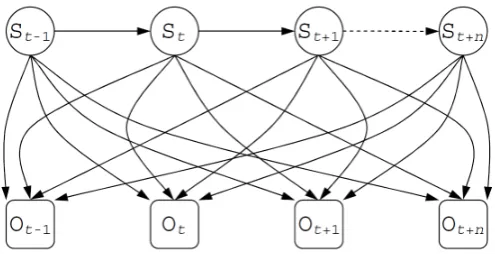
3.1 A three-layer neural network withninput neuronsx,khidden neuronsz, m output neurons y, and two bias neurons b. . . 29 3.2 A hidden Markov model withn hidden statesS and
observa-tions O. . . 30 3.3 Vectorial representation of mappings of chord notes to voices.
Abondante (15481), ‘Mais mamignone’, bars 3–4 (chords 10–21). 36 3.4 Mapping enumeration and pruning, feature vector set
genera-tion, and creation of the list of relative training pairs. . . 38 3.5 Creation of the list of training examples for each training
it-eration. . . 39 3.6 Textural saturation. Pisador (15527), ‘Pleni de la missa misma’,
opening and closing bars. . . 43 3.7 Unidirectional (extending to the left or right) and bidirectional
(extending to both directions) decision contexts. Abondante (15481), ‘Mais mamignone’, bars 3–4. . . 44 3.8 Schematic view of type (i) conflicts in a four-voice piece. . . . 62 3.9 Schematic view of type (ii) conflicts in a four-voice piece. . . . 62 3.10 Schematic view of type (iii) conflicts in a four-voice piece. . . . 62 3.11 Schematic view of a type (iv) conflict in a four-voice piece. . . 64 3.12 Schematic view of a type (v) conflict in a four-voice piece. . . 64 3.13 Schematic view of a type (vi) conflict in a four-voice piece. . . 66 3.14 Schematic view of type (vii) conflicts in a four-voice piece. . . 66
xviii FIGURES
4.1 Polyphonic alignment ambiguities. . . 76 4.2 Sebastian Ochsenkun’s intabulation style. Ochsenkun (15585),
‘Absolon fili mi’, opening bars. . . 77 4.3 TabSymbolSets. . . 81 4.4 tab+encoding of a tablature fragment. Phal`ese (publ.) (15477),
‘Tant que uiuray’ [a4], opening bars. . . 84 4.5 In-voice chords. Bach, Das wohltemperirte Clavier, book I,
Fugue 2 in c minor (BWV 847), closing bars. . . 87 4.6 Added extra voice. Bach, Das wohltemperirte Clavier, book
II, Fugue 17 in A[major (BWV 886), closing bars. . . 87 5.1 Error propagation, N (fwd) model: indices of notes assigned
to an incorrect voice. Ochsenkun (15585), ‘Herr Gott laß dich erbarmen’. . . 128 5.2 Error propagation group, N (fwd) model. Ochsenkun (15585),
‘Herr Gott laß dich erbarmen’, bars 14–15 (note indices 201– 223). . . 129 5.3 Imitation necessitating voice crossing. Phal`ese (publ.) (156312),
Symbols, abbreviations, and terms
ε margin, Section 3.1.3.2
λ regularisation parameter, Section 5.1.1
acc accuracy, Section 3.2.2
application mode Section 3.2.4.1
AVC average voice consistency, Section 5.6.2
B (B0) bidirectional model as used in MA1, Section 3.1.6.1
bidirectional Section 3.1.6
bwd backward processing mode, Section 3.1.5
C model as used in MA2, Section 3.1.3.5
c conflict percentage, Section 5.7.1
cmp completeness, Section 3.2.2
conflict Section 3.3
decision context Section 3.1.6
deviation threshold Section 3.1.2.1
duration class Section 3.1.2.3
error propagation Section 3.2.4.1
fwd forward processing mode, Section 3.1.5
ground truth feature vector Section 3.1.3.2
H model as used in MA3, Section 3.1.4.2
half voice assignment Section 3.2.3
HMM hidden Markov model, Section 3.1.1.2
in-voice chord Section 4.2.1
xx SYMBOLS, ABBREVIATIONS, AND TERMS
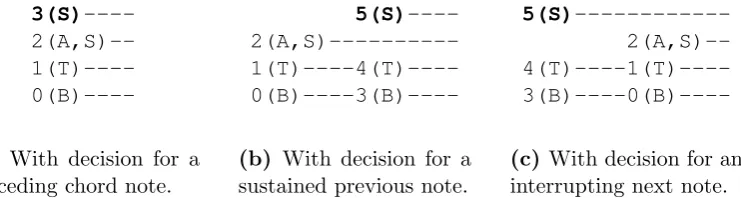
interrupting next note Section 3.1.2.4
ISM initial state matrix, Section 3.1.4
m error propagation percentage, Section 3.2.4.1
MA1 (2, 3) modelling approach 1 (2, 3), Section 3.1.2 (3.1.3, 3.1.4)
mapping Section 3.1.3.1
MIDI Musical Instrument Digital Interface, Chapter 1, introduction
MIR music information retrieval, Chapter 1, introduction
multiple-highest-rating problem Section 3.1.3.3
N (N0) unidirectional model as used in MA1, Section 3.1.2.6
OPM observation probability matrix, Section 3.1.4
overlooked voice (duration) assignment Section 3.2.3
polyphonic alignment Section 4.1.1.1
polyphonic information Section 3.1.6
prc precision, Section 5.6.2
primary voice class Section 3.3.1
processing mode Section 3.1.5
rcl recall, Section 5.6.2
relative training pair Section 3.1.3.2
secondary voice class Section 3.3.1
single-note unison Section 2.2.2
snd soundness, Section 3.2.2
superfluous voice assignment Section 3.2.3
sustained previous note Section 3.1.2.4
test mode Section 3.2.4.1
TPM transition probability matrix, Section 3.1.4
unidirectional Section 3.1.6
voice class Section 3.1.2
voice inversion pair Section 3.1.3.1
X1 (2, 3) model extension 1 (2, 3), Section 3.1.2.3 (3.1.5, 3.1.6)
ελB (B0)chalf voice assignmentmMA1 (2, 3)N (N0)overlooked voice
1
Introduction
The representations of music used in the field of music information retrieval (MIR) can be audio-based or symbol-based. Audio representations include recorded sound signals, while the symbolic representations comprise any form of musical notation, text, or any of the “myriad discrete computer encodings” (Downie, 2003, p. 302) such as the Musical Instrument Digital Interface (MIDI) format, the Music Encoding Initiative (MEI) format, the MusicXML format, or the Humdrum **kern format.1 MIR is a genuinely
multidisci-plinary field, combining areas such as information science, musicology, music theory, music perception and cognition, audio engineering, and computer sci-ence (Downie, 2003; Byrd and Crawford, 2002; Orio, 2006). Traditionally, symbolic music representations have been the tools of musicologists, and it is indeed in the musicological areas of MIR—areas relating to music analysis, music theory, music perception and cognition—where they are used most. Although strong in the early years of MIR, the role of symbolic music rep-resentations has become less significant over time, and the past decade has seen a clear shift towards signal processing and audio representations. This shift can be ascribed to the constant development of the internet in conjunc-tion with the invenconjunc-tion of audio encoding formats such as MP3 (MPEG-1 or MPEG-2 Audio Layer III) and their increasing (online) availability (Orio, 2006; Volk et al., 2011). As a result, the audio engineering areas of MIR have witnessed a considerable growth, while the musicological areas now consti-tute a clear minority. This shift in focus is one reason why the exploration of a number of complex problems relating to symbolic music representations has stagnated.
One of such complex problems is voice separation in symbolic music
rep-1See http://www.music-encoding.org, http://www.musicxml.com, and
http://www.music-cog.ohio-state.edu/Humdrum.
2 STRUCTURING LUTE TABLATURE AND MIDI DATA
resentations, the subject of this thesis. Voice separation, simply put, is the task of identifying individual melodic lines (voices) in a music representation in which these lines are not directly identifiable (a more formal definition is given in Section 2.1.3). Voice separation in symbolic music representa-tions is a research topic that has received relatively little attention hitherto. Only a handful of systems designed for this task exist. All these systems have been reported to perform reasonably well, but in all cases room for im-provement is evident. A possible explanation for the abandonment of some existing research and the lack of new initiatives may very well be the fact that voice separation has been recognised as a difficult task even for expert musicians—let alone for a computer (Orio, 2006). An adequate separation into constituent voices, however, is an essential precondition for the successful execution of other complex MIR tasks that can be of direct use for musico-logical research, such as automatic transcription, pattern retrieval, melody matching and the detection of concordances (identical pieces occurring in more than one source), voice-based content analysis, etc. It is thus well worthwhile revisiting the topic.
In this thesis, the problem of voice separation is tackled using a super-vised machine learning approach, where models are trained on example data to learn mappings of notes to voices, and then applied to new data to provide such mappings. The use of machine learning models to tackle the problem of voice separation is still relatively novel. Only in two previous studies have such models been implemented and evaluated; an extended and more systematic approach, however, has hitherto not been undertaken. In this thesis, three new modelling approaches are presented, two of which are neu-ral network-based, while in the third a hidden Markov model is used. The models are specifically designed for voice separation in lute tablature, or, more precisely, sixteenth-century lute intabulations, instrumental arrange-ments of polyphonic vocal works. However, as a sole focus on this highly specialist symbolic representation would limit their practical applicability significantly, each model is also implemented in an adapted version, to be applied to a much more widely used symbolic representation: MIDI data.
1.1
Motivation
INTRODUCTION 3
that merely prescribes the physical actions a lute player must perform in or-der to produce sound from the instrument. It provides no direct information about pitch, only limited information about note duration, and, although it was used to notate at times considerably complex polyphonic music, it reveals very little information about polyphonic structure. This renders lute tablature hard to interpret for the majority of musicologists. As a conse-quence, the corpus of music written in lute tablature, which spans more than two-and-a-half centuries and contains some 860 individual sources harbouring invaluable musicological information, has been largely overlooked in musico-logical research. In order to unlock this corpus for further research, it must thus be presented in a more familiar format. The traditional musicological solution is transcription into modern music notation, and such work indeed has been ongoing—but it is a time-consuming and specialist undertaking. The situation sketched above is a typical example of an opportunity for in-terdisciplinary interaction (Neubarth et al., 2011; Honingh et al., 2014): a musicological problem exists, for which MIR research can provide a solution. MIR models for voice separation as presented in this thesis, together with MIR models for key detection, pitch spelling, etc., can be integrated in (inter-active) systems for automatic transcription of tablature. Such systems, which enable fast and large-scale transcription, can then provide non-specialists the tools to overcome problems that previously prevented them from researching music written in lute tablature.
The second question in fact consists of two parts: why only
sixteenth-century lute music, and why only intabulations? The reason for the focus
on sixteenth-century lute music, or, as it is commonly known, Renaissance lute music, is mostly a practical one. Limits to the scope of the research have to be set, and the choice for Renaissance music is motivated by several factors. These include, but are not limited to, the fact that this subcorpus is (i) large, as the lute was extremely popular in the sixteenth century,2 (ii) stylistically fairly homogeneous, (iii) mostly highly contrapuntal (that is, the music consists of different voices sounding simultaneously, each of which moves independently of the others and has a strong individual character), and (iv) not complicated by a large number of tuning variants being used, as is the case for later corpora. The reason for the focus on one particular genre, sixteenth-century intabulations, is threefold (and explained in more detail in Section 2.2.2). Apart from the fact that intabulations are representative and challenging, using them facilitates the process of labelling the data. This can
2To give an impression of the size of the subcorpus: approximately 200 print sources
4 STRUCTURING LUTE TABLATURE AND MIDI DATA
be achieved relatively quickly, and with minimal need for interpretation, by using the vocal models as polyphonic blueprints.
The research presented in this thesis connects well to ongoing efforts to-wards digitisation of lute sources. Since its inception in 1999, the Electronic Corpus of Lute Music (ECOLM) project has aimed to make lute music avail-able for research and performance (Lewis et al., 2004). To this end, machine-readable encodings, tablature renderings thereof, images of original sources, and different kinds of metadata have been stored in a database that is acces-sible through the project website.3 Recently, research into the application of optical music recognition methods to tablature (Dalitz and Karsten, 2005; Dalitz and Crawford, 2013) has enabled the encoding process, which had hitherto been manual, to be carried out (semi-)automatically. A large—and growing—body of encodings is thus available for research and analysis; among the tools to start tackling this body are models such as the ones presented in this thesis.
1.2
Aims and objectives
In this thesis, the following two-fold research question is explored:
How can supervised machine learning models be used for voice sep-aration in polyphonic music in symbolic representations, and which modelling approaches are the most effective?
This question is considered in terms of a main aim and four objectives. The main aim underlying the research is to design, implement, and evaluate su-pervised machine learning models for voice separation in polyphonic music written in lute tablature and polyphonic music in MIDI format. To this end, the following objectives are formulated:
Objective 1 To design and implement models.
1.1 To design three different modelling approaches:
MA1 A note-level classification approach using a neural network model, where notes are classified into classes representing voices.
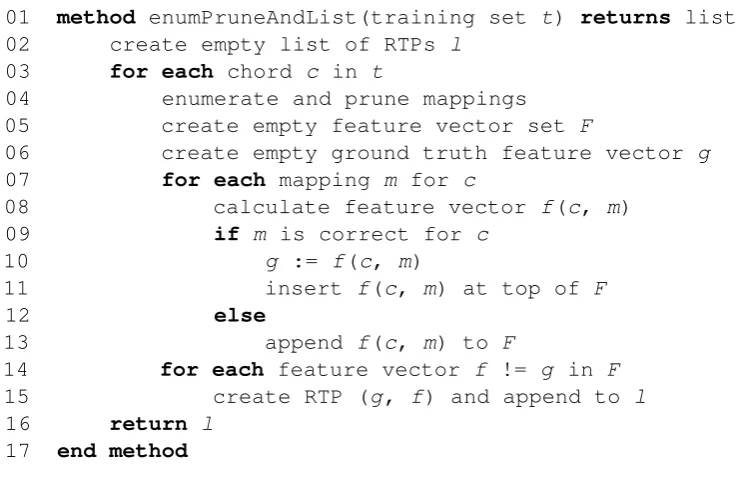
MA2 A chord-level regression approach using a neural network model, where mappings of chords to voices are rated.
MA3 A chord-level probabilistic approach using a discrete hidden
INTRODUCTION 5
Markov model, where the most likely sequence of mappings of chords to voices is determined.
1.2 To design three model extensions:
X1 Simultaneous voice and duration modelling.
X2 Backward processing.
X3 Multi-pass processing using a bidirectional decision context.
1.3 To define a set of features, numerical representations of properties of notes or chords in their polyphonic context, relevant to the task of voice separation.
1.4 To implement the models, the model extensions, the feature ex-traction algorithms, and the framework for training and evaluating the models.
Objective 2 To create datasets.
2.1 To create a corpus of sixteenth-century lute intabulations, where each intabulation is represented as a machine-readable encoding of the tablature in plain text format and a set of monophonic MIDI files.
2.2 To create a corpus of music written in (early) modern staff notation —keyboard fugues by Johann Sebastian Bach—, where each fugue is represented as a set of monophonic MIDI files.
Objective 3 To evaluate the models.
3.1 To evaluate, on both datasets, the three modelling approaches.
3.2 To evaluate, on both datasets, the relevance of the features.
3.3 To evaluate, on both datasets, the effect of the model extensions.
3.4 To compare the models’ performance with that of existing systems for voice separation.
As is explained in more detail in Section 1.4, the individual objectives together with their sub-objectives are addressed in the successive chapters of this thesis; they thus determine its overall structure.
1.3
Contributions
The key contributions of this thesis to the existing research are:
I Three new machine learning models for voice separation in lute tablature and MIDI data:
6 STRUCTURING LUTE TABLATURE AND MIDI DATA
representing voices.
I A neural network model for rating mappings of chords to voices.
I A hidden Markov model for determining the most likely sequence of mappings of chords to voices.
I A set of features relevant to the task of voice separation.
I The implementation as open source software of the models, the three model extensions, the feature extraction algorithms, and the framework for training and evaluating the models.
I tab+, an extensible encoding format for rendering lute tablature machine-readable that supports all lute tablature systems.
I Two datasets:
I A tablature dataset, consisting of encodings and sets of monophonic MIDI files.
I A Bach dataset, consisting of sets of monophonic MIDI files. This dataset, which is an adaptation of an existing dataset, can be used as a standardised benchmark for research into voice separation in symbolic representations, which is cur-rently lacking.
Additionally, for each piece in the tablature dataset a transcription in modern music notation is devised.
I Experimental results enabling assessment of the models.
1.4
Thesis overview
Chapter 2 opens with the definition of three key terms in Section 2.1: voice,
polyphonic music, and voice separation. Following that, in Section 2.2,
the musicological background against which the research is carried out is sketched, where the sixteenth-century lute, its music, and the notational for-mat of this music and the problems it entails, are introduced. Subsequently, in Section 2.3, the computational background to the research is given, where existing research into voice separation in symbolic representations is dis-cussed.
INTRODUCTION 7
specific to MA1, is discussed. The chapter closes with a description of the implementation details in Section 3.4.
In Chapter 4, which in its entirety addresses Objective 2, the datasets are described. In Section 4.1, first, the tablature dataset is presented, and the data formats, the data creation, and the internal representation used are discussed. Furthermore, a detailed description of the encoding format devised for this thesis, tab+, is given. In Section 4.2, then, the same is done for the Bach dataset.
Chapter 5 deals with model evaluation, and thus covers Objective 3. Sections 5.1 and 5.2, first, describe two preliminary experiments concerning hyperparameter optimisation. In Experiment 1, described in Section 5.3, the three modelling approaches are evaluated and compared (Objective 3.1). In Experiment 2, described in Section 5.4, the relevance of the features is eval-uated in two sub-experiments (Objective 3.2). In Experiment 3, described in Section 5.5, the effect of the three model extensions is evaluated in three sub-experiments (Objective 3.3). In Experiment 4, described in Section 5.6, a comparison between the performance of a selection of the models presented in this thesis and the performance of a number of existing voice separation systems is made (Objective 3.4). Chapter 5 is concluded with a discussion of a number of overarching issues that stem from limitations of the modelling approaches, presented in Section 5.7.
2
Background and related work
In this chapter, the background to the research presented in this thesis is out-lined. In Section 2.1, which deals with terminology, a number of important recurring terms are defined: voice, polyphonic music, and voice separation. In Section 2.2, then, the musicological background to the research is given. The sixteenth-century lute is introduced, its notation—lute tablature—and the problems it entails with respect to the reflection of polyphonic structure are described, and the rationale behind the focus on intabulations, instru-mental arrangements of polyphonic vocal works, is explained. In Section 2.3, lastly, the computational background to the research is provided. The musi-cological problem described in Section 2.2 is linked to the problem of voice separation, existing research into voice separation in music in symbolic for-mats is discussed, and systems for voice separation are compared.
2.1
Terminology
There are three important terms, all of which can be considered to be key terms in the research carried out in this thesis: voice,polyphonic music, and
voice separation. Before giving any musicological or computational
back-ground, these terms must be defined clearly.
2.1.1
Voice
In the field of musicology, when not referring to the human voice, the term
voice denotes an individual musical line, either sung or played, that
“con-tribute[s] to one or more elements of the music” (Drabkin, 2001, p. 164). Often-used alternatives arepart, or, less frequently,voice part. Cambouropou-los (2008) acknowledges ambiguity of the term, and distinguishes between (i)
10 STRUCTURING LUTE TABLATURE AND MIDI DATA
a music-theoretical meaning, where a voice is defined as a “monophonic se-quence of successive nonoverlapping [sic] musical tones” (p. 78), and (ii) a perceptual meaning, where it is defined as a “perceptually independent se-quence of notes or multi-note simultaneities” (p. 78, emphasis mine). The former meaning corresponds to the musicological definition of the term; in the latter meaning, where a voice is not necessarily monophonic, it is re-garded as an equivalent of an auditory stream, a phenomenon described in the field of music psychology. The term is coined by Bregman and Camp-bell (1971), who define an auditory stream as “a sequence of auditory events whose elements are related perceptually to one another, the stream being segregated perceptually from other co-occurring auditory events” (p. 244).
Throughout this thesis, the term voice is used in its musicological (or music-theoretical) meaning, denoting a monophonic sequence of notes. Where a sequence of notes or multi-note simultaneities is intended, the term stream
is preferred.1
2.1.2
Polyphonic music
In MIR research, the term polyphonic music is generally used to denote any kind of music in which “more sounds are playing at the same time” (Orio, 2006, p. 10), or, more specific, in which “multiple notes sound at a time” (Byrd and Crawford, 2002, p. 255). By this definition, many genres of music—ranging from a Renaissance motet to a twenty-first-century rock song—may be categorised as polyphonic music.
The definition used in this thesis is somewhat more restricted, and re-mains closer to the musicological notion of what polyphony is (see, for exam-ple, Frobenius et al., 2001). Music is considered to be polyphonic if it satisfies three criteria: (i) it must consist of multiple parts, (ii) the individual parts must be of equal importance, and (iii) the individual parts must, at least to some extent, move independently.
2.1.3
Voice separation
Voice separation (also encountered is voice segregation) is defined by Cam-bouropoulos (2008) as “the task of separating a musical work consisting of multi-note sonorities into independent constituent voices” (p. 75). Although a suitable starting point, this definition leaves some room for interpretation. First, it does not specify whatmulti-note sonorities are. A multi-note sonor-ity shall therefore be defined as a multi-note musical event occurring at time
BACKGROUND AND RELATED WORK 11
t, at least one note of which has an onset time that is equal to t. If all the notes have an onset time equal to t, the multi-note sonority is said to be
left-aligned. From this definition, then, it follows that there can also exist
single-note sonorities. A single-note sonority shall be defined as a single-note
event occurring at time t, the only note of which has an onset time that is equal to t. In polyphonic music, single-note sonorities generally constitute the minority. However, their use, as well as the use of non-left-aligned multi-note sonorities, increases the rhythmic salience of the individual voices, which promotes their independence. Second, Cambouropoulos’s definition does not specify whether the term voice is intended in its music-theoretical or in its perceptual meaning (see Section 2.1.1).
In this thesis, a slightly elaborated version of Cambouropoulos’s defini-tion is therefore used. Voice separadefini-tion is taken to denote:
The task of separating a musical work consisting of single-note and multi-note sonorities into independent constituent voices, that is, mono-phonic sequences of successive non-overlapping notes.
2.2
Musicological background: the lute and
its music in the sixteenth century
From its rise in the late fifteenth century to its gradual decline in the second half of the eighteenth century, the lute remained among the most popular solo instruments in Western Europe. Played in social settings ranging from the church to the court to the tavern, throughout all social classes, and by professionals and amateurs alike, a vast and diverse amount of music was written for it. The instrument’s historical significance is attested by over 360 printed and over 500 manuscript sources extant today, containing approximately 60,000 compositions (Ness and Kolczynski, 2001).
12 STRUCTURING LUTE TABLATURE AND MIDI DATA
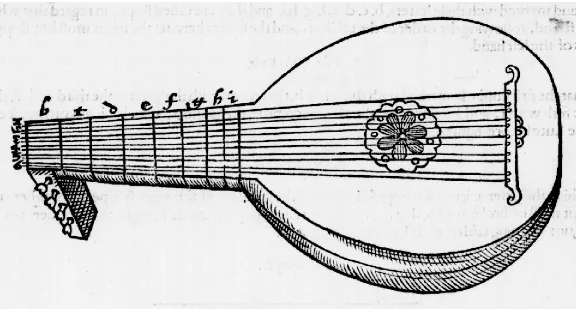
Figure 2.1 A typical Renaissance lute with six courses and eight frets. Image taken from William Barley, A nevv Booke of Tabliture (London, 15964).
stringing served to brighten the tone of a course, and is reflected neither in the tablature nor in transcription in modern music notation. The standard tuning used for the most part of the sixteenth century is the so-called
Re-naissance tuning, where the courses are tuned in perfect fourths with a major
third in the middle. For an instrument as depicted in Figure 2.1, this thus yields a range of approximately two octaves and a fifth.
2.2.1
Lute tablature
The music in the surviving sources is notated exclusively in lute tablature. Lute tablature, a practical notation designed by and for lutenists, is a Griff-schrift that instructs the player where on the fretboard to place the left-hand fingers and which courses to pluck with the right hand. It was born out of necessity for a new form of notation when in the late fifteenth century a shift from playing monophonic music with a plectrum to playing polyphonic music using the right-hand fingers took place. Throughout the sixteenth century, various tablature systems were in use simultaneously, conceptually all very similar to each other. Generally, four main systems are distinguished: on the one hand there are the so-called French, Italian, and Spanish systems, and on the other the German system. The former three all make use of a six-line (or, sometimes, five-line) staff whose lines represent the courses of the lute, where the lowest line may represent either the lowest-sounding (French and Spanish tablature) or the highest-sounding (Italian tablature) course. The frets at which the courses must be stopped are indicated either by means of letters (French tablature) or numerals (Italian and Spanish tablature), where
BACKGROUND AND RELATED WORK 13
system, then, a unique symbol—encountered are letters, numerals, and vari-ous other symbols—is used for each course-fret combination. In this system, a staff is therefore not needed. Unlike the other systems, the German tabla-ture system is not uniform: because the system was originally invented for the five-course lute, the symbols used to denote the frets on the later-added sixth course can vary from source to source. In all four systems, rhythm symbols indicating a minimum duration (more on this below) that applies to all notes in a chord are placed above the tablature chords. Two practices of rhythm symbol placement are discerned: in the one, symbols are given for all tablature chords, while in the other, they are only provided when there is a change in minimum duration.2 In Figure 2.2, fragments of music notated in respectively Italian, French, and German lute tablature are shown.3
Although used to notate highly polyphonic music, lute tablature con-veys no—or at best very limited—information about polyphonic structure, which was assumed to be filled in by the player. Moreover, as improvisa-tion and ornamentaimprovisa-tion were an important part of sixteenth-century perfor-mance practice, the notation must not be considered prescriptive, but rather descriptive, to be deviated from at one’s own discretion. Concretely, lute tablature lacks two notational clues necessary for the visualisation of poly-phonic structure. First, it does not indicate to which polypoly-phonic voices the tablature notes belong, and second, it does not indicate individual note du-rations, but rather gives a minimum duration that applies to all notes in a chord (and thus enables only the duration of the shortest notes in the chord to be notated precisely). Notational devices by means of which the former is achieved in mensural and modern music notation are, for example, stem direction or placement of the notes on separate staves; notational devices by means of which the latter is achieved are the use of various note head shapes or colours, as well as different flaggings of the note stems.
An additional problem with tablature—although one not directly related to polyphonic structure—concerns pitch, which depends on the tuning of the lute. Contemporary treatises show that the sixth (lowest-sounding) course was generally tuned to nominal G or A, although other pitches are mentioned as well (Wachsmann et al., 2001; Radke, 1963). Additionally, scordatura
tunings deviating from the standard tuning were in use—the lowering of the sixth course by a whole tone being the most common example. All of this, however, is generally left unspecified in the tablature.
2Minor variants of the four main tablature systems exist; for more details, the reader
is referred to the existing literature. Suitable starting points are Dart et al. (2001) and Smith (2002).
3More information on the pieces shown in this figure, as well as in subsequent figures,
14 STRUCTURING LUTE TABLATURE AND MIDI DATA
(a) Italian lute tablature. Abondante (15481), ‘Mais mamignone’, opening bars.
(b)French lute tablature. Phal`ese (publ.) (15477), ‘Tant que uiuray’ [a4], opening
bars.
(c) German lute tablature. Judenk¨unig (15232), ‘Elslein liebes Elslein’, opening
bars.
Figure 2.2 Examples of staff-based and staffless lute tablature systems.
BACKGROUND AND RELATED WORK 15
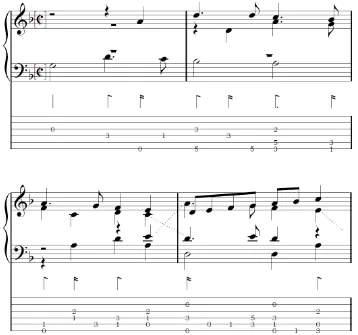
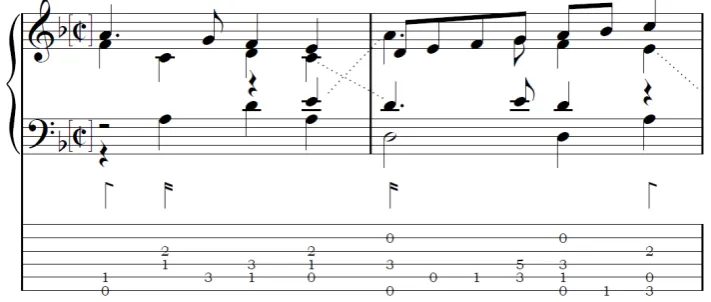
Figure 2.3 Transcription in modern music notation of a tablature fragment. Abondante (15481), ‘Mais mamignone’, opening bars.
2.2.2
Intabulations
16 STRUCTURING LUTE TABLATURE AND MIDI DATA
ranging in structure from simple homophony to strict imitative polyphony. Second, since the densest polyphonic structures in lute music are found in intabulations, they constitute a challenging subcorpus. Third and most im-portant, using intabulations facilitates the process of labelling the tablature data (that is, mapping the individual data points—the tablature notes—to voices), as the vocal models, whose polyphonic structure is unambiguous, can be used as polyphonic blueprints. This thus presupposes that intabulations are close arrangements of their vocal models. Studies of intabulations and the intabulation process (Ward, 1952; Brown, 1973–1974, 1976; Thibault, 1976; G¨ollner, 1984) and studies of contemporary treatises on the subject (Minamino, 1988; Canguilhem, 2001) indeed show that, although often a significant amount of ornamentation was added, it was generally of great concern to the intabulator to remain faithful to the vocal model. The pro-cess of labelling the tablature data and the role of the vocal models therein is described in further detail in Sections 4.1.1 and 4.1.2.
Although intabulators strove to remain faithful to the vocal models they arranged, intabulations are generally not literal, verbatim transcriptions of their vocal counterparts. First, the technical limitations of the instrument had to be taken into account: often reworkings were necessary because pas-sages were otherwise not playable. Second, in some cases, intabulators simply
chose to change the original notes. In general, two categories of adaptations
can be discerned, be they by necessity or by choice: changes and simplifica-tions.4 Among the most common changes are included:
I Addition of notes, ornamental or other.
I Addition of complete bars or longer sections.
I Alteration of notes, in terms of pitch, duration, onset time, or combinations of these.
I Omission of notes.
I Omission of complete bars or longer sections. Furthermore, the following simplifications are encountered:
I The representation of unisons by a single note rather than by two notes of the same pitch. Four examples of this practice can be found in the fragment shown in Figure 2.3: two in the second half of bar 3 (notes D4 and E4), and two in the first half of bar 4 (notes
4A more complete overview of such adaptations, most of them due to the technical
BACKGROUND AND RELATED WORK 17
D4 and G4). A single note belonging to two voices shall henceforth be referred to as asingle-note unison.
I The omission of complete voices. Although a fairly drastic adapta-tion, it is nevertheless a common one. It is generally a structurally less important inner voice, such as the altus in a four-voice piece or one of the tenors in a five-voice piece, that is left out.
2.2.3
Instrumental idiom: three characteristics
In instrumental music, the musical idiom is often determined by the par-ticular possibilities of the instrument on the one hand, and by its technical limitations on the other. This is no different in lute music. There are three characteristics of lute music, all due to instrumental limitations, that deserve special mention as they have a direct influence on the modelling approaches. First, unisons are more often than not represented as a single note rather than as two notes of the same pitch (as discussed in Section 2.2.2). Sec-ond, although six-note chords are encountered from time to time, lute music rarely contains more than five consistently independent voices. For practical reasons, in this thesis it is therefore assumed that the maximum number of voices possible on the lute is five. Third, as shown by Minamino (1988), there was a general consensus among intabulators that a note played on the lute could not be sustained beyond what was called a semibreve, a duration that corresponds to a modern half note when a reduction of the values by a factor of two is assumed (as is common practice when transcribing various forms of early music).
2.3
Computational background: voice
separation
18 STRUCTURING LUTE TABLATURE AND MIDI DATA
voice separation systems, intended specifically for the automatic transcrip-tion of German lute tablature. These applicatranscrip-tions were developed more or less concurrently with, but independently of, the models developed in Phase 1.
2.3.1
Voice separation, Phase 1: modelling of
perceptual phenomena
In the first phase of research into voice separation (1980s–1990s), the research focused on the modelling of perceptual phenomena relating to polyphonic structure and auditory stream segregation, the process of grouping and sepa-rating components of sound (Bregman and Campbell, 1971; Bregman, 1990). Different approaches are taken.5
Huron (1989b) focuses on the perceptual independence of individual poly-phonic voices, and presents a model for measuring pseudo-polyphony in Bach fugues. The model predicts the number of concurrent streams perceived at a certain time. A related experiment, focusing on listeners’ ability to identify correctly the number of simultaneously sounding voices in polyphonic music, is described in Huron (1989a).
Marsden (1992) applies a rule-based approach to modelling the perception of voices in polyphonic music, and describes six models that are, again, tested on Bach fugues. The first two of these models are production systems based on production rules, mostly related to pitch and theGestalt principle of good
continuation, a principle that allows established patterns to be continued.
The latter four are competition rule models analogous to neural networks, where rules compete with each other and the outcome of the competition is determined by the global functioning of a model through a system of weights. The perception of apparent motion in music is modelled by Gjerdingen (1994). The term is borrowed from psychology, and denotes how a succes-sion of static individual events (such as musical notes) are perceived as a moving, fluid whole (a melodic line). Gjerdingen uses an adaptation of the Grossberg-Rudd neural network model (Grossberg and Rudd, 1989), origi-nally intended to model apparent motion in vision, and applies it to pitch, resulting in a model able to simulate several musical phenomena of auditory stream segregation.
McCabe and Denham (1997), lastly, present a two-layer leaky integrator neuron model of the early stages of auditory stream segregation. The model segregates acoustic input into a foreground stream and a background stream,
5The overview presented here is by no means exhaustive; it is limited to the studies
BACKGROUND AND RELATED WORK 19
and is capable of replicating the results from a number of psychophysical experiments relating to auditory stream segregation.
2.3.2
Voice separation, Phase 2: voice separation
systems
The first phase of research into voice separation, as discussed above, can be regarded as a preliminary phase or theoretical background for the sec-ond phase (2000s–2010s), where systems for voice separation were developed. Two categories can be discerned: rule-based systems (the majority, discussed first below) and machine learning systems. The behaviour of rule-based sys-tems is governed and formally described by a set of pre-defined rules. Machine learning systems, on the other hand, do not solely rely on knowledge encoded in them, but instead learn from training data to adapt their behaviour.
A common element that links the systems in both categories together is that all of them, in one way or another, are based on at least one of two fun-damental perceptual principles associated with auditory stream segregation. These two principles are presented by Huron (2001) as the Pitch Proximity Principle and the Principle of Temporal Continuity. The former dictates that “[t]he coherence of an auditory stream is maintained by close pitch proximity in successive tones within the stream” (p. 24), and the latter that “[i]n order to evoke strong auditory streams, use continuous or recurring rather than brief or intermittent sound sources” (p. 12). Put differently: the closer two notes are to one another in terms of pitch or time, respectively, the more likely they are perceived as belonging to the same voice.
2.3.2.1 Rule-based systems (1)
Cambouropoulos (2000) briefly describes an elementary version of a stream-ing algorithm that uses path length minimisation. The algorithm, which is part of a larger system for automatic transcription of MIDI data into modern music notation, is based on the Gestalt principle of proximity and attempts to find, after the music is segmented into beats, the shortest streams that connect all onsets within the beats. It is acknowledged, however, that the problem is not trivial, and that the algorithm presented can be improved.
20 STRUCTURING LUTE TABLATURE AND MIDI DATA
The fifth rule, added only following testing, is the Top Voice Rule, which prescribes to maintain a single voice as the top voice. Numerical scores, reflecting to which extent the preference rules are satisfied, are assigned to individual analyses; the analysis that gets the highest score is selected. Dynamic programming techniques are used to limit the amount of possible analyses that are to be evaluated. In later work, Temperley (2009) presents a unified probabilistic model of polyphonic music analysis. This model in-tegrates three aspects of music analysis—metrical analysis, harmonic analy-sis, and stream segregation—and captures the complex interactions between them. The stream segregation analysis process presented can be regarded as a probabilistic version of the system presented in Temperley (2001).
Chew and Wu (2005) present acontig mapping approach that bears sim-ilarities to the saturated chord approach adopted by Charnass´e and Stepien (1992) and discussed in Section 2.3.3. In addition to the Pitch Proximity Principle, a second perceptual principle underlying their approach is defined: the Stream Crossing Principle, prohibiting voice crossing. Their algorithm divides the music into segments where a constant number of voices is active, the contigs (the term is borrowed from computational biology). The
max-imal voice contigs, in which the number of voices that is active equals the
BACKGROUND AND RELATED WORK 21
connecting process is terminated when there are no more contigs to connect. Madsen and Widmer (2006) present an algorithm for separating voices in MIDI data that is, according to themselves, highly inspired by Temper-ley (2001). The algorithm consists of a voice configuration unit and a note assignment unit. The music is processed in a linear fashion, where voice assignments are calculated locally, using a small lookahead. For groups of notes, the voice configuration unit generates well-formed solutions by ensur-ing that neither too few nor too many voices are available. The notes are then assigned to voices by the note assignment unit, which evaluates all possible voice assignments and calculates a preferred solution using a parametrised cost function. The cost of assigning a note to a voice depends on its pitch distance to the previous note in that voice (cf. the Pitch Proximity Prin-ciple); furthermore, costs are assigned to starting or ending a voice, and to adding a rest, that is, not assigning a note to an available voice.
Szeto and Wong (2006) consider streams to be clusters containing events proximal in the pitch and time dimensions, and model stream segregation as a clustering problem. Notes are defined as events, vectors consisting of a start time, an end time, and a pitch. Relations between events are defined as sequential (meaning that the notes do not overlap) and simultaneous (mean-ing that they do overlap). Simultaneous events cannot belong to the same cluster; therefore, relations between clusters are also defined as sequential and simultaneous. The starting point is an initial clustering in which each event is a separate cluster. By means of an an agglomerative single-link clus-tering algorithm, in an iterative process all clusters are combined into larger clusters until onlyn simultaneous sequential clusters—the streams—remain. It must be noted, lastly, that for Szeto and Wong stream segregation is only a means to an end—as can be deduced form the title of their study. Stream segregation, it is suggested, should be included as a preprocessing step in sys-tems for pattern matching in polyphonic music databases, as this is expected to improve the quality of retrieved patterns.
2.3.2.2 Rule-based systems (2): non-monophonic voices
In all of the studies discussed so far, the term voice is used in its music-theoretical meaning. Kilian and Hoos (2002) present a stochastic local search algorithm for calculating an optimal voice separation. In their study, the
termvoice is used in its perceptual rather than its music-theoretical meaning.
22 STRUCTURING LUTE TABLATURE AND MIDI DATA
cost function is a weighted sum of four terms that penalise, respectively, large pitch intervals between successive notes in a voice (cf. the Pitch Proximity Principle), large gaps between successive notes in a voice (cf. the Principle of Temporal Continuity), large pitch differences within a chord, and overlap between successive notes in a voice. By weighting these terms differently, different results can be achieved, where voices can be strictly monophonic but may also contain multiple notes simultaneously. This is in line with their aim to be able to create “reasonable and flexible score-notation” rather than a “correct analysis” (p. 40), or even one that is valid in terms of auditory stream segregation.
The perceptual concept of a voice as a stream that is not necessarily monophonic is also fundamental to the Voice Integration/Segregation Algo-rithm (VISA) presented by Karydis et al. (2007a,b). Two types of percep-tual principles underly their approach: principles responsible for horizontal
integration (the Pitch Proximity Principle and the Principle of Temporal
Continuity), and principles responsible for vertical integration. Of the latter kind are defined the Synchronous Note Principle, which is based on Huron’s Onset Synchrony Principle (Huron, 2001), and which dictates that notes that have the same onset time and duration tend to be merged into a single sonority, and the Principle of Tonal Fusion, which is based on Huron’s Tonal Fusion Principle (Huron, 2001), and which dictates that concurrent notes are perceptually less independent when they form intervals that promote tonal
fusion. Tonal fusion is the phenomenon where two notes tend to be perceived
BACKGROUND AND RELATED WORK 23
Lastly, a revised version of VISA is described in Rafailidis et al. (2009). The general functioning of the algorithm is left unchanged; revisions have been made with respect to the enumeration of voices, the partitioning of the sweep line sets into clusters, and the matching of notes to voices as well as the cost calculation.
2.3.2.3 Machine learning systems
In addition to the rule-based systems described above, two machine learning approaches have been tried. Kirlin and Utgoff (2005) present VoiSe, a sys-tem designed to separate voices in both explicit and implicit polyphony. The system consists of two components. The first is asame-voice predicate, imple-mented as a learned decision tree. Based on the examination of a number of features—5 measurements of pitch distance and 10 rhythmic features, among which several forms of time distance (cf. the Pitch Proximity Principle and the Principle of Temporal Continuity)—the predicate determines whether or not two notes belong to the same voice. It does so for all note pairs within two types of windows: one based on a maximum number of beats between the offset of the first note and the onset of the second note of a note pair, and one based on a maximum number of intervening notes. Per window, one predicate is learned. The second component is a hard-coded algorithm that maps notes to voices, and that is applied to a different excerpt of music than the predicate is trained on. The algorithm moves through the music in a linear fashion. If a note pair within a similar window as used for training the predicate satisfies the learned predicate, the notes are mapped to the same integer; otherwise, they are mapped to different integers.
24 STRUCTURING LUTE TABLATURE AND MIDI DATA
2.3.2.4 A priori modelling assumptions
In all except two cases—the system by Kilian and Hoos (2002) and VISA (Karydis et al., 2007a,b)—voices are assumed to be monophonic. Three more of such a priori modelling assumptions can be distinguished: (i) voice crossing is allowed (or not), (ii) voices are allowed to share notes (or not), and (iii) the number of voices is known at the start of the voice assignment process (or not). Note that assumptions (i) and (ii) need only be made a priori when using a rule-based system. When using a machine learning system, they can
be made—but it can also be left to the system to learn whether voice crossing occurs or whether voices are allowed to share notes.
Based on findings from music psychology showing that crossing streams are difficult to perceive (Deutsch, 1975; van Noorden, 1975), in most of the rule-based systems voice crossing is either not allowed or strongly discour-aged. Only Madsen and Widmer (2006) explicitly allow them, but add that for their algorithm solutions involving voice crossing are more costly and therefore not the preferred choice. Voices sharing notes, second, is generally also discouraged, on the grounds that the unison is the interval that most promotes tonal fusion (DeWitt and Crowder, 1987; Huron, 1991). Third, with regard to the number of voices, two approaches are discerned. In the majority of the systems the number of voices is determined during the pro-cess. Generally, it is preferred to be kept to a minimum. In the systems by Chew and Wu (2005) and Jordanous (2008), then, the number of voices is known at the start of the voice assignment process, as it is determined by the maximal voice contigs from which the voice assignment process is seeded.
2.3.3
Applications for automatic transcription of lute
tablature
A series of articles published over the course of two decades (Charnass´e and Ducasse, 1971, 1973; Charnass´e and Stepien, 1986; Charnass´e, 1988; Charnass´e and Stepien, 1991a,b, 1992) report the research conducted by the
´
BACKGROUND AND RELATED WORK 25
way. Additionally, two applications of rule-based voice separation systems (where ad hoc rules are used rather than perceptual principles) intended for automatic transcription of German lute tablature are described.
The first is a so-called one-pass restructuring exploration that uses
sat-urated chords—chords containing as many notes as there are voices—as
an-chor points. The music is processed in linear fashion (both left-to-right and right-to-left are tried), in segments delimited by the saturated chords. Us-ing a self-defined Principle of Continuity dictatUs-ing that melodic lines in lute music tend to be composed of small intervals, notes between two framing saturated chords are connected to the contiguous notes closest in pitch. A last-assigned note concept is used to improve connections. In this straightfor-ward approach, a fair number of problematic situations are encountered—for example, when large pitch distances between contiguous notes or voice cross-ing (which is said to be mainly due to imitation) lead to what is called
continuity disruption, or, conversely, when multiple acceptable solutions lead
to ambiguity with respect to continuity. Such situations are handled with additional ad hoc rules and heuristics, and the parametrisation of threshold values for continuity decisions.
The second system, which again makes use of saturated chords and the principle of continuity, is a fixed-rules inference system implemented in Pro-log. It consists of two stages: first, imitative entries or other motifs are identified and frozen, thus exempting them from any further continuity anal-ysis. Second, the remaining notes are grouped together in chains based on the principle of continuity (it is not entirely clear whether the frozen motifs are included in the chains or whether they are considered separate chains). Once all notes have been assigned to a chain, ambiguities and complex dis-ruptions in continuity (which determine the beginnings and endings of the chains) are resolved. Each chain is connected to a saturated chord or another chain; production rules are used to determine good connections. Unambigu-ous cases are resolved first; problematic cases lead to new production rules and are resolved iteratively.
3
Method
In this thesis, the problem of voice separation is tackled using a supervised machine learning approach: models are trained on example data (pairs of input and desired output) to learn underlying rules or principles that map the inputs to the outputs, and then applied to new, unseen data (inputs) to make output decisions. More concretely, the models presented take as in-put feature vector representations of musical entities—in this case, notes or chords—and produce as output voice decisions. Three modelling approaches are described:
MA1 A note-level classification approach using a neural network model.
MA2 A chord-level regression approach using a neural network model.
MA3 A chord-level probabilistic approach using a discrete hidden Markov model.
This chapter, which describes the methodology used, is organised as follows. A fully detailed description of the modelling approaches and the models, the model extensions—simultaneous voice and duration modelling, backward processing, and multi-pass processing using a bidirectional deci-sion context—, and the feature set is given in Section 3.1. In Section 3.2, the evaluation procedure, the evaluation metrics, and the evaluation modes are discussed, followed in Section 3.3 by a detailed description of conflicts occurring in MA1 and their resolution. Section 3.4, finally, gives the imple-mentation details.