–Regular Paper–
STABILIZATION OF HYBRID SYSTEMS BY FEEDBACK CONTROL
BASED ON DISCRETE-TIME STATE AND MODE OBSERVATIONS
†Jianqiu Lu1∗, Yuyuan Li2, Xuerong Mao1, Qinwei Qiu2
ABSTRACT
Recently, Mao [1] proposed a kind of feedback control based on discrete-time state observations to stabilize continuous-discrete-time hybrid stochastic systems in mean-square sense. We find that the feedback control there still depends on the continuous-time observations of the mode. However, it usually costs to identify the current mode of the system in practice. So we can further improve the control to reduce the control cost by identifying the mode at discrete times when we make observations for the state. In this paper, we aim to design such a type of feedback controls based on the discrete-time observations of both state and mode to stabilize the given unstable hybrid stochastic differential equations (SDEs) in the sense of mean-square exponential stability. Moreover,
a numerical example isgiven to illustrate our results.
Key Words: Brownian motion, Markov chain, mean-square exponential stability, discrete-time feedback control.
1. INTRODUCTION
Hybrid stochastic differential equations (SDEs) (also known as SDEs with Markovian switching), usually used to model practical systems where they may experience abrupt changes in their structure and parameters, have been attracting a lot of attention in recent years. Particularly, as the most fundamental problem in engineering, the asymptotic stability has been studied extensively [2,3,4,6,12,13,14,18,20,
21,22,23,24,26,27,28,29,30]. Here we mention that [10,11] are two of the most cited papers while [17] is the first book in this area.
One classical topic in this field is the problem of stabilization, i.e. designing a control function
u(x(t), r(t), t) which usually appears in the drift part
∗Manuscript received 11 February 2016 and accepted on 8
February 2017.
∗The authors are with 1
Department of Mathematics and Statistics, University of Strathclyde, Glasgow G1 1XH, U.K.
2 College of Information Sciences and Technology, Donghua
Univerisity, Shanghai 201620, China.
∗Jianqiu Lu (corresponding author, e-mail:
such that the controlled system
dx(t) =[f(x(t), r(t), t) +u(x(t), r(t), t)]dt
+ g(x(t), r(t), t)dw(t) (1.1)
will be stable though the original system (1.1) with
u(x(t), r(t), t) = 0 is unstable, where t≥0, r(t) is a Markov chain, x(t)∈Rn is the state, w(t) =
(w1(t),· · · , wm(t))T is an m-dimensional Brownian
motion and the SDE is in the Itˆo sense.
Wang et al. in [25] designed a state feedback controller to stabilize bilinear uncertain time-delay stochastic systems with Markovian jumping parameters in mean square sense. In [5], the problem of almost sure exponential stabilization of stochastic systems by state-feedback controls was discussed. A robust delayed-state-feedback controller that exponentially stabilizes uncertain stochastic systems was proposed in [15]. It is observed that the state feedback controllers in these papers require continuous observations of the system state x(t) for all time t≥t0. Recently, Mao [1] first proposed to design a discrete-time feedback control
system
dx(t) =[f(x(t), r(t), t) +u(x(δ(t, t0, τ)), r(t), t)]dt
+g(x(t), r(t), t)dw(t)
(1.2)
become exponentially stable in mean square. Hereτ > 0is a constant and
δ(t, t0, τ) =t0+ [(t−t0)/τ]τ, (1.3)
in which [(t−t0)/τ] is the integer part of(t−t0)/τ.
The advantage of such a discrete-time feedback control is that it requires only state observations x(t0+kτ)
at discrete times t0, t0+τ, t0+ 2τ,· · · and hence it will cost much less and more realistic. Despite this advantage, we can take a further step to make it even better. We observe that the feedback control in Mao [1] is based on the discrete-time observations of the state x(t0+kτ)(k= 0,1,2,· · ·) but still depends on the continuous-time observations of the mode r(t)on
t≥t0. This is perfectly fine if the mode of the system can be fully observed at no cost. However, it usually costs to identify the current mode of the system in practice. So we can further improve the control to reduce the control cost by identifying the mode at discrete times when we make observations for the state. Therefore, in this paper, we will consider an n -dimensional controlled hybrid system
dx(t) =[f(x(t), r(t), t)
+u(x(δ(t, t0, τ)), r(δ(t, t0, τ), t)]dt
+g(x(t), r(t), t)dw(t)
(1.4)
ont≥t0, where our new feedback control is based on the discrete observations of statex(t0+kτ)and mode
r(t0+kτ).
Due to the difficulties arisen from the discrete-time Markov chainr(t0+kτ), the analysis in this paper will be much more complicated in comparison with the related previous papers and new techniques will be developed. Our main results will be formed in Section 3 and Sections 4 after giving preliminaries in Section 2. We will discuss an example in Section 5 to verify the effectiveness of the results and conclude our paper in Section 6.
2. Notation and Problem Statement
In this paper, we use the following notation. Let
(Ω,F,{Ft}t≥0,P)be a complete probability space with a filtration{Ft}t≥0satisfying the usual conditions (i.e.
it is increasing and right continuous withF0 contains
all P-null sets). Let w(t) = (w1(t),· · · , wm(t))T be an m-dimensional Brownian motion defined on the probability space. If A is a vector or matrix, its transpose is denoted by AT. If x∈Rn, then |x| is its Euclidean norm. If A is a matrix, we let |A|=
p
trace(ATA)be its trace norm andkAk= max{|Ax|: |x|= 1} be the operator norm. If A is a symmetric matrix (A=AT), denote byλ
min(A)andλmax(A)its
smallest and largest eigenvalue, respectively. ByA≤0
and A <0, we mean A is non-positive and negative definite, respectively. Denote byL2
Ft(R
n)the family of
allFt-measurable Rn-valued random variables ξsuch thatE|ξ|2<∞, whereEis the expectation with respect to the probability measureP.
Letr(t),t≥0, be a right-continuous Markov chain on the probability space taking values in a finite state spaceS ={1,2,· · · , N}with generatorΓ = (γij)N×N given by
P{r(t+ ∆) =j|r(t) =i}
=
(
γij∆ +o(∆) ifi6=j,
1 +γii∆ +o(∆) ifi=j,
where∆>0. Hereγij ≥0is the transition rate fromi tojifi6=jwhile
γii=− X
j6=i
γij.
We assume that the Markov chainr(·)is independent of the Brownian motionw(·). It is known that almost all sample paths ofr(t)are piecewise constant except for a finite number of simple jumps in any finite subinterval of R+ (:= [0,∞)). We stress that almost all sample
paths ofr(t)are right continuous.
Consider an n-dimensional uncontrolledunstable linear hybrid SDE
dx(t) =A(r(t))x(t)dt+
m X
k=1
Bk(r(t))x(t)dwk(t)
(2.1) ont≥0, with initial datax(0) =x0∈L2F
0(R n)
. Here
A, Bk :S→Rn×n and we will often write A(i) =
Ai and Bk(i) =Bki. Now we are required to design a feedback control u(x(δ(t)), r(δ(t))) based on the discrete-time state and mode observations in the drift part so that the controlledlinearSDE
dx(t) =[A(r(t))x(t) +u(x(δ(t)), r(δ(t)))]dt
+
m X
k=1
Bk(r(t))x(t)dwk(t)
(2.2)
c
will be mean-square exponentially stable, whereuis a mapping fromRn×StoRn,τ >0and
δ(t) = [t/τ]τ fort≥0, (2.3)
in which[t/τ]is the integer part oft/τ. As the given SDE (2.1) is linear, it is natural to use a linear feedback control. One of the most common linear feedback controls is the structure control of the formu(x, i) = F(i)G(i)x, where F and G are mappings from S to
Rn×landRl×n, respectively, and one of them is given while the other needs to be designed. These two cases are known as:
• State feedback: designF(·)whenG(·)is given; • Output injection: designG(·)whenF(·)is given.
Again, we will often write F(i) =Fi and G(i) =Gi. Then the controlled system (2.2) becomes
dx(t) =[A(r(t))x(t) +F(r(δ(t)))G(r(δ(t)))x(δ(t))]dt
+
m X
k=1
Bk(r(t))x(t)dwk(t). (2.4)
It is observed that equation (2.4) is in fact a stochastic differential delay equation (SDDE) with a bounded variable delay (see e.g. [1]). So equation (2.4) has a unique solution x(t) such that E|x(t)|2<∞ for all t≥0(see e.g. [17]).
3. Stabilization of linear hybrid SDEs
We will first denote F(r(δ(t)))G(r(δ(t))) = D(r(δ(t))) and discuss the stability of the following hybrid stochastic system
dx(t) =[A(r(t))x(t) +D(r(δ(t)))x(δ(t))]dt
+
m X
k=1
Bk(r(t))x(t)dwk(t)
(3.1)
in this section. And then design eitherG(·)givenF(·)
orF(·)givenG(·)in order for the controlled SDE (2.4) to be stable.
Let us first give two lemmas for preparation.
Lemma 3.1 Letx(t)be the solution of system (3.1). Set
MA= max i∈S kAik
2, M
D= max i∈S kDik
2,
MB= max i∈S
m X
k=1
kBkik2
and define
K(τ) = [6τ(τ MA+MB) + 3τ2MD]e6τ(τ MA+MB) (3.2)
forτ >0. Ifτis small enough for2K(τ)<1, then for
anyt≥0,
E|x(t)−x(δ(t))|2≤ 1−2K(τ)2K(τ)E|x(t)|2. (3.3)
Proof. Fix any integerv≥0. Fort∈[vτ,(v+ 1)τ), we
haveδ(t) =vτ. It follows from (3.1) that
x(t)−x(δ(t)) =x(t)−x(vτ)
=
Z t
vτ
[A(r(s))x(s) +D(r(vτ))x(vτ)]ds
+
m X
k=1
Z t
vτ
Bk(r(s))x(s)dwk(s).
Using the fundamental inequality |a+b+c|2≤ 3|a|2+ 3|b|2+ 3|c|2as well asHolder¨ 0sinequality and
Doob’s martingale inequality, we can then derive
E|x(t)−x(δ(t))|2
≤3(τ MA+MB) Z t
vτ
E|x(s)|2ds
+3τ2MDE|x(vτ)|2
≤6(τ MA+MB) Z t
vτ
E|x(s)−x(δ(s))|2ds
+[6τ(τ MA+MB) + 3τ2MD]E|x(vτ)|2.
By the well-known Gronwall inequality, we have
E|x(t)−x(δ(t))|2≤K(τ)E|x(vτ)|2. Consequently
E|x(t)−x(δ(t))|2 ≤2K(τ)
E|x(t)−x(δ(t))|2+E|x(t)|2
.
This implies that (3.3) holds fort∈[vτ,(v+ 1)τ). But
v≥0 is arbitrary, so the desired assertion (3.3) must hold for allt≥0. The proof is complete.2
Lemma 3.2 For anyt≥0, v >0andi∈S,
P(r(s)6=ifor somes∈[t, t+v]|r(t) =i) ≤1−e−γv¯ , (3.4)
where
¯ γ= max
Proof. Givenr(t) =i, define the stopping time
ρi= inf{s≥t:r(s)6=i},
where and throughout this paper we set inf∅=∞(in which ∅ denotes the empty set as usual). It is well known (see e.g. [17]) that ρi−t has the exponential distribution with parameter−γii. Hence
P(r(s)6=ifor somes∈[t, t+v]|r(t) =i)
=P(ρi−t≤v|r(t) =i) = Z v
0 1
−γii
eγiisds
=1−eγiiv≤1−e−¯γv
as desired.2
We now state the main result on the exponential stability in mean-square of system (3.1).
Theorem 3.3 If there exist positive definite symmetric
matricesQ(i) =Qi,i∈S, such that
¯
Q(i) = ¯Qi:=Qi(Ai+Di) + (Ai+Di)TQi
+
m X
k=1
BkiTQiBki+ N X
j=1
γijQj (3.6)
are all negative-definite matrices. Set
MQD = max
i∈S kQiDik
2, N
D= max
i,j∈SkDj−Dik
2
and −λ:= max
i∈S λmax( ¯Qi)
(of course λ >0). If τ is sufficiently small for λ >
2λτ+ 2λMµτ, where
λτ := s
2MQDK(τ)
1−2K(τ) , µτ :=
s
2ND(1−e−¯γτ)
1−2K(τ) ,
(3.7)
then the solution of the SDE (3.1) satisfies
E|x(t)|2≤ λM
λmE
|x0|2e−θt, ∀t≥0, (3.8)
whereK(τ)has been defined in Lemma3.1and
λM = max
i∈S λmax(Qi), λm= mini∈Sλmin(Qi),
θ= λ−2λτ−2λMµτ λM
. (3.9)
In other words, the SDE (3.1) is exponentially stable in
mean square.
Proof. LetV(x(t), r(t)) =xT(t)Q(r(t))x(t). Applying
the generalized Itˆo formula (see e.g. [17]) toV, we get
dV(x(t), r(t)) =LV(x(t), r(t))dt+dM1(t),
whereM1(t)is a martingale withM1(0) = 0and
LV(x(t), r(t))
=2xT(t)Q(r(t))[A(r(t))x(t) +D(r(δ(t)))x(δ(t))]
+
m
X
k=1
xT(t)BkT(r(t))Q(r(t))Bk(r(t))x(t)
+
N
X
j=1
γr(t),jxT(t)Qjx(t)
=xT(t) ¯Q(r(t))x(t)
−2xT(t)Q(r(t))D(r(t))(x(t)−x(δ(t)))
−2xT(t)Q(r(t))(D(r(t))−D(r(δ(t))))x(δ(t))
≤ −λ|x(t)|2+ 2pMQD|x(t)||x(t)−x(δ(t))|
−2xT(t)Q(r(t))(D(r(t))−D(r(δ(t))))x(δ(t))
(3.10)
Applying the generalized Itˆo formula now to
eθtxT(t)Q(r(t))x(t), we then have
eθtxT(t)Q(r(t))x(t) =xT(0)Q(r(0))x(0)
+ Z t
0
eθs[θxT(s)Q(r(s))x(s) +LV(x(s), r(s))]ds
+M2(t),
where M2(t) is also a martingale with M2(0) = 0.
Combining this with (3.10) yields
λmeθtE|x(t)|2
≤E(eθtxT(t)Q(r(t))x(t))
≤λME|x0|2+
Z t
0
(θλM−λ)eθsE|x(s)|2ds
+ Z t
0
2eθspMQDE(|x(s)||x(s)−x(δ(s))|)ds
− Z t
0
2eθsE(xT(s)Q(r(s))(D(r(s))
−D(r(δ(s))))x(δ(s)))ds. (3.11)
c
But, by Lemma3.1and3.2, we have
−2eθsE xT(s)Q(r(s))(D(r(s))−D(r(δ(s))))x(δ(s))
≤eθsE λMµτ|x(s)|2
+λM µτ
kD(r(s))−D(r(δ(s)))k2|x(δ(s))|2
=eθsλM{µτE|x(s)|2
+ 1 µτE E
(kD(r(s))−D(r(δ(s)))k2|x(δ(s))|2|F
δ(s))
}
≤eθsλM{µτE|x(s)|2
+ 1 µτE
|x(δ(s))|2 X r(δ(s))=i
I{r(δ(s))=i}max
i,j∈SkDj−Dik
2 }
≤eθsλM{µτE|x(s)|2+ND(1−e
−γτ¯ )
µτ E
|x(δ(s))|2}
≤eθsλM{µτE|x(s)|2
+ND(1−e −γτ¯ ) µτ
2
1−2K(τ)E|x(s)| 2
}
=2eθsλM µτE|x(s)|2 (3.12)
and
2pMQDE(|x(s)||x(s)−x(δ(s))|)
≤λτE|x(s)|2+
MQD
λτ E
|x(s)−x(δ(s))|2
≤λτE|x(s)|2+MλQD τ
2K(τ)
1−2K(τ)E|x(s)| 2
=2λτE|x(s)|2. (3.13)
Substituting (3.12)(3.13) into (3.11) gives
λmeθtE|x(t)|2≤λME|x0|2
+
Z t
0
(θλM + 2λτ+ 2λMµτ−λ)eθsE|x(s)|2ds.
But, by (3.9),θλM+ 2λτ+ 2λMµτ−λ= 0. Thus
λmeθtE|x(t)|2≤λME|x0|2,
which implies the desired assertion (3.8). The proof is complete.2
The following two corollaries provide us with an LMI method to design the controller based on discrete-time observations of both state and mode to stabilize the unstable system (2.1). Corollary 3.4 and 3.5 demonstrate the case of state feedback and output injection, respectively.
Corollary 3.4 Assume that there are solutions Qi=
QT
i >0andYi(i∈S) to the following LMIs
QiAi+YiGi+ATiQi+GTi Y T i
+
m X
k=1
BkiTQiBki+ N X
j=1
γijQj<0. (3.14)
Then by setting Fi=Q−i 1Yi and Di=FiGi, the
controlled SDE (2.4) will be exponentially stable in
mean square ifτ >0is sufficiently small forλ >2λτ+
2λMµτ.
Proof. RecallingFi=Q−i 1Yi and Di=FiGi, we find
that (3.14) is equivalent to the condition that matrices in (3.6) are all negative-definite. So the required assertion follows directly from Theorem 3.3.
Corollary 3.5 Assume that there are solutions Xi=
XT
i >0andYi(i∈S) to the following LMIs
Mi1 Mi2 Mi3 MT
i2 −Mi4 0 MT
i3 0 −Mi5
<0, (3.15)
where
Mi1=AiXi+FiYi+XiATi +Y T i F
T
i +γiiXi,
Mi2= [XiB1Ti,· · · , XiBmiT ],
Mi3= [
√
γi1Xi,· · · , √
γi(i−1)Xi, √
γi(i+1)Xi,· · · , √
γiNXi],
Mi4=diag[Xi,· · ·, Xi],
Mi5=diag[X1,· · · , Xi−1, Xi+1,· · ·, XN].
Then by setting Qi=Xi−1, Gi=YiXi−1 and Di=
FiGi, the controlled SDE (2.4) will be exponentially
stable in mean square ifτ >0is sufficiently small for
λ >2λτ+ 2λMµτ.
Proof. We first observe that by the well-known Schur
complements (see e.g. [17]), the LMIs (3.15) are equivalent to the following matrix inequalities
AiXi+FiYi+XiATi +Y T i F
T
i +γiiXi
+
m X
k=1
XiBTkiX−
1
i BkiXi+ N X
j6=i
γijXiXj−1Xi<0.
(3.16)
Recalling thatGi=YiXi−1andXi=XiT, we have
AiXi+FiGiXi+XiATi +XiGTiF T i
+
m X
k=1
XiBTkiX −1
i BkiXi+ N X
j=1
γijXiXj−1Xi<0.
Multiplying Xi−1 from left and then from right, and noting Qi=Xi−1, Di=FiGi, we see that the matrix inequalities (3.18) are equivalent to the following matrix inequalities
QiAi+QiDi+ATiQi+DiTQi+
m X
k=1
BTkiQiBki+ N X
j=1
γijQj<0, (3.18)
which yields matrices in (3.6) are all negative-definite. Again, the required assertion follows directly from Theorem 3.3.
4. Stabilization of nonlinear hybrid SDEs
Let us now develop our theory to cope with the more general nonlinear stabilization problem. For an unstable nonlinear hybrid SDE
dx(t) =f(x(t), r(t), t)dt+g(x(t), r(t), t)dw(t) (4.1)
on t≥0 with the initial data x(0) =x0∈ L2F0(Rn). Here, f :Rn×S×R+→Rn and
g:Rn×S×R+→Rn×m. Assume that both f
andgare globally Lipschitz continuous and hence obey the linear growthcondition(see e.g. [17]).
Assumption 4.1 Assume that the coefficients f and g
are globally Lipschitz continuous (see e.g. [7,8,9,17]). That is, we have
|f(x, i, t)−f(y, i, t)| ≤K1|x−y|
and |g(x, i, t)−g(y, i, t)| ≤K2|x−y|, (4.2)
for all(x, i, t),(y, i, t)∈Rn×S×R
+, where bothK1
andK2are positive numbers.
We also assume thatf(0, i, t) = 0andg(0, i, t) = 0
for alli∈S andt≥0 so thatx= 0is an equilibrium point for (4.1).
Hence, f, g satisfy the following linear growth condition as stated in Assumption4.3withδ1=K12and
δ2=K22.
We are required to design a linear feedback control
F(r(t))G(r(t))x(δ(t))based on the discrete-time state and mode observations in the drift part so that the controlled system
dx(t) = [f(x(t), r(t), t) +F(r(t))G(r(t))x(δ(t))]dt
+g(x(t), r(t), t)dw(t) (4.3)
will be mean-square exponentially stable.Definingζ: [0,∞)→[0, τ]by
ζ(t) =t−vτ for vτ ≤t < t(v+ 1)τ, (4.4)
andv= 0,1,2,· · ·, thenwe see that the SDE (4.3) can be written as an SDDE
dx(t) = [f(x(t), r(t), t)+
F(r(t−ζ(t)))G(r(t−ζ(t)))x(t−ζ(t))]dt
+g(x(t), r(t), t)dw(t). (4.5)
It is therefore known (see e.g. [17]) that equation (4.3) has a unique solutionx(t)such thatE|x(t)|2<∞for
allt≥0.
In order to stabilize a nonlinear system by a linear control, we impose some conditions on the nonlinear coefficientsf andgasfollows.
Assumption 4.2 For each i∈S, there is a pair of
symmetric n×n-matrices Qi and Qˆi with Qi being
positive-definite such that
2xTQif(x, i, t) +gT(x, i, t)Qig(x, i, t)≤xTQˆix
for all(x, i, t)∈Rn×S×R
+.
Assumption 4.3 There is a pair of positive constants
δ1andδ2such that
|f(x, i, t)|2≤δ1|x|2 and |g(x, i, t)|2≤δ2|x|2
for all(x, i, t)∈Rn×S×R+.
Let us first present a useful lemma.
Lemma 4.4 Let Assumption4.3hold. Set
δ3= max
i∈S m X
k=1
kFiGik2,
and define
H(τ) = [6τ(τ δ1+δ2) + 3τ2δ3]e6τ(τ δ1+δ2) (4.6)
forτ >0. Ifτ is sufficiently small for2H(τ)<1, then
the solutionx(t)of the SDE (4.3) satisfies
E|x(t)−x(δ(t))|2≤1 2H(τ)
−2H(τ)E|x(t)| 2
(4.7)
for allt≥0.
This lemma can be proved in the same way as Lemma3.1was proved so we omit the proof.
c
Theorem 4.5 Let Assumptions 4.2 and 4.3 hold. Assume that the following LMIs
Ui:= ˆQi+QiFiGi+GTiF T i Qi
+
N X
j=1
γijQj<0, i∈S, (4.8)
have their solutionsFi (i∈S) in the case of feedback
control (i.e.Gi’s are given), or their solutionsGiin the
case of output injection (i.e.Fi’s are given). Set
−γ:= max
i∈S λmax(Ui) and δ4= maxi∈S kQiFiGik
2,
δ5= max
i,j∈SkFiGi−FjGjk
2.
Ifτis sufficiently small forγ >2γτ+ 2λMητ, where
γτ := s
2δ4H(τ)
1−2H(τ), ητ :=
s
2δ5(1−e−¯γτ) 1−2H(τ) (4.9)
then the solution of the SDE (4.3) satisfies
E|x(t)|2≤λλM
mE
|x0|2e−θt, ∀t≥0,
(4.10)
whereH(τ)has been defined in Lemma4.4and
λM = max
i∈S λmax(Qi), λm= mini∈Sλmin(Qi),
θ= γ−2γτ−2λMητ λM
. (4.11)
Proof. This theorem can be proved in a similar way
as Theorem 3.3 was proved so we only give the key steps. Applying the generalized Itˆo formula to
xT(t)Q(r(t))x(t)we get
d[xT(t)Q(r(t))x(t)]
=xT(t)U(r(t))x(t)
−2xT(t)Q(r(t))F(r(t))G(r(t))(x(t)−x(δ(t)))
−2xT(t)Q(r(t))
F(r(t)−r(δ(t)))G(r(t)−r(δ(t)))x(δ(t))dt
+dM3(t),
where M3(t) is a martingale with M3(0) = 0. Applying the generalized Itˆo formula further to
eθtxT(t)Q(r(t))x(t), we can then obtain
λmeθtE|x(t)|2
≤λME|x0|2+ Z t
0
(θλM −γ)eθsE|x(s)|2ds
+
Z t
0
2eθspδ4E(|x(s)||x(s)−x(δ(s))|)ds
+
Z t
0
2E eθsxT(s)Q(r(s))(F(r(s))G(r(s))
−F(r(δ(s)))G(r(δ(s))))x(δ(s))
ds. (4.12)
But, by Lemma4.4, we can show
2pδ4E(|x(s)||x(s)−x(δ(s))|)≤2γτE|x(s)|2, (4.13)
while by Lemma3.2and (4.9) we can prove that
2E eθsxT(s)Q(r(s))(F(r(s))G(r(s))
−F(r(δ(s)))G(r(δ(s))))x(δ(s))
≤2eθsλMητE|x(s)|2. (4.14)
Substituting this into (4.12) yields
λmeθtE|x(t)|2≤λME|x0|2,
which implies the desired assertion (4.10). The proof is complete.2
To apply Theorem4.5, we need two steps:
1 we first need to look for the2N matricesQiand
ˆ
Qifor Assumption4.2to hold;
2 we then need to solve the LMIs in (4.8) for their solutionsFi(orGi).
There are available computer softwares e.g. Matlab for step 2 so in the remaining part of this section we will develop some ideas for step 1. To make our ideas more clear,we will only consider the case of feedback control,
but the same ideas work for the case of output injection.
In theory, it is flexible to use2N matricesQi and
ˆ
Qi in Assumption 4.2. But, in practice, it means more work to be done in finding these2N matrices. It is in this spirit that we introduce a stronger assumption.
Assumption 4.6 There are N+ 1 symmetric n×n
-matricesZ andZi(i∈S) withZ >0such that
2xTZf(x, i, t) +gT(x, i, t)Zg(x, i, t)≤xTZix
Under this assumption, if we let Qi=qiZ and Qˆi=
qiZifor some positive numbersqi, then Assumption4.2 holds. Moreover, the LMIs in (4.8) become
qiZi+qiZFiGi+qiGTiFiTZ
+
N X
j=1
γijqjZ <0, i∈S.
If we set Yi:=qiFi, then these become the following LMIs inqiandYi:
qiZi+ZYiGi+GTi Y T i Z
+
N X
j=1
γijqjZ <0, i∈S. (4.15)
We hence have the following corollary.
Corollary 4.7 Let Assumptions 4.6 and 4.3 hold.
Assume that the LMIs (4.15) have their solutionsqi>
0 and Yi (i∈S). Then Theorem 4.5 holds by setting
Qi=qiZ,Qˆi=qiZi andFi=q−i 1Yi. In other words,
the controlled SDE (4.3) will be exponentially stable in
mean square if we setFi =qi−1Yiand make sureτ >0
be sufficiently small forγ >2γτ+ 2λMητ.
An even simpler (but in fact stronger) condition is:
Assumption 4.8 There are constants zi (i∈S) such
that
2xTf(x, i, t) +|g(x, i, t)|2≤zi|x|2
for all(x, i, t)∈Rn×S×R+.
Under this assumption, if we let Qi=qiI and Qˆi=
qiziIfor some positive numbersqi, whereIis then×n identity matrix, then Assumption4.2holds. Moreover, the LMIs in (4.8) become
qiziI+qiFiGi+qiGTi FiT
+
N X
j=1
γijqjI <0, i∈S.
If we set Yi:=qiFi, then these become the following LMIs inqiandYi:
qiziI+YiGi+GTi Y T i
+
N X
j=1
γijqjI <0, i∈S. (4.16)
We hence have another corollary.
Corollary 4.9 Let Assumptions 4.8 and 4.3 hold.
Assume that the LMIs (4.16) have their solutionsqi>
0 and Yi (i∈S). Then Theorem 4.5 holds by setting
Qi =qiI,Qˆi=qiziIandFi=q−i 1Yi. In other words,
the controlled SDE (4.3) will be exponentially stable in
mean square if we setFi=q−i1Yiand make sureτ >0
be sufficiently small forγ >2γτ+ 2λMητ.
5. Example
Let us consider an unstable linear hybrid SDE
dx(t) =A(r(t))x(t)dt+B(r(t))x(t)dw(t) (5.1)
ont≥t0. Herew(t)is a scalar Brownian motion;r(t)
is a Markov chain on the state spaceS={1,2}with the generator
Γ =
−1 1 1 −1
;
and the system matrices are
A1=
1 −1 1 −5
, A2=
−5 −1
1 1
,
B1=
1 1
1 −1
, B2=
−1 −1
−1 1
.
The computer simulation (Fig. 1) shows this hybrid SDE is not mean square exponentially stable.
Let us now design a discrete-time-state feedback control to stabilize the system. Assume that the controlled hybrid SDE has the form
dx(t) = [A(r(t))x(t) +F(r(δ(t)))G(r(δ(t)))x(δ(t))]dt
+B(r(t))x(t)dw(t), (5.2)
where
G1= [1,0], G2= [0,1].
Our aim is to findF1and F2 inR2×1and then make sureτis sufficiently small for this controlled SDE to be exponentially stable in mean square. To apply Corollary
3.4, we first find that the following LMIs
¯
Qi:=QiAi+YiGi+ATiQi+GTi Y T
i +B
T i QiBi
+ 2
X
j=1
γijQj<0, i= 1,2,
have the following set of solutions
Q1=
1 0 0 2
, Q2=
2 0 0 1
,
c
0 1 2 3 4 5
t
1 1.5 2
r(t)
0 1 2 3 4 5
t
-400 -200 0
x1(t)
0 1 2 3 4 5
t
-100 0 100
[image:9.595.309.537.82.315.2]x2(t)
Fig. 1.Computer simulation of the paths ofr(t),x1(t)andx2(t)for
the hybrid SDE (5.1) using the Euler–Maruyama method with step size10−6 and initial valuesr(0) = 1,x
1(0) =−2and
x2(0) = 1.
and
Y1=
−10
0
, Y2=
0
−10
,
and for these solutions we have
¯ Q1=
−7 0 0 −1
, Q2¯ =
−1 0 0 −7
.
Hence, we have
−λ= max
i=1,2λmax( ˆQi) =−1, MY G= maxi=1,2kYiGik
2= 100.
It iseasy to compute that
MA= 27.42, MB = 2, MD= 100, MQD = 100, ND= 100.
Hence
λτ = s
200K(τ)
1−2K(τ), µτ =
s
200(1−e−γτ¯ ) 1−2K(τ)
where K(τ) = [6τ(27.42τ+ 2) + 300τ2]e6τ(27.42τ+2).
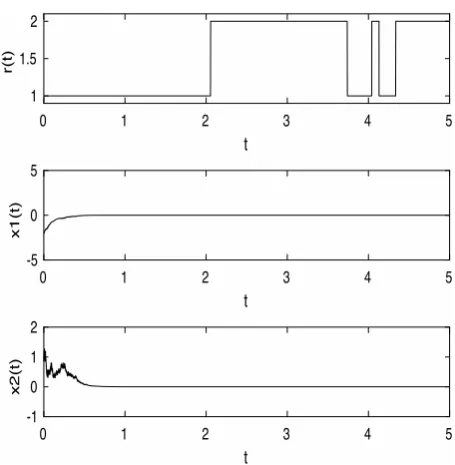
By calculating, we get that λ >2λτ+ 2λMµτ when-ever τ <0.000015. By Corollary 3.4, if we set F1= Y1 and F2=Y2, and make sure thatτ <1.5×10⁻⁵,
then the discrete-time-state feedback controlled hybrid SDE (5.2) is mean-square exponentially stable. The computer simulation (Fig. 2) supports this result clearly.
0 1 2 3 4 5
t 1
1.5 2
r(t)
0 1 2 3 4 5
t -5
0 5
x1(t)
0 1 2 3 4 5
t -1
0 1 2
x2(t)
Fig. 2.Computer simulation of the paths of r(t), x1(t) andx2(t)
for the controlled hybrid SDE (5.2) withτ= 10−3 using the Euler–Maruyama method with step size10−6and initial values
r(0) = 1,x1(0) =−2andx2(0) = 1.
6. Conclusion
In this paper, we have proved that unstablelinear hybrid SDEs, in the form of (2.1),can be stabilized by a feedback control based on discrete-time state and mode
observations.Moreover, we have generalised the theory to a class of nonlinear systems.
Acknowledgements
The author wold like to thank the reviewers and the editor for their very helpful comments and professional suggestions. The authors would also like to thank the Leverhulme Trust (RF-2015-385), the Royal Society of London (IE131408), and the Ministry of Education (MOE) of China (MS2014DHDX020) for their financial support. In particular, the first author would like to thank the University of Strathclyde for awarding her the PhD studentship.
REFERENCES
1. Mao,X., Stabilization of continuous-time hybrid stochastic differential equations by discrete-time feedback control, Automatics 49(12) (2013), 3677-3681.
2. Basak, G.K., Bisi, A. and Ghosh, M.K., Stability of a random diffusion with linear drift, J. Math.
[image:9.595.59.287.86.313.2]3. Gao, H., Wang, C. and Wang, L., On H∞
performance analysis for continuous-time stochas-tic systems with polytopic uncertainties,Circuits
Systems Signal Processing24(2005), 415–429.
4. He, H., Ho, D.W.C. and Lam, J., Stochastic sta-bility analysis of fuzzy Hopfield neural networks with time-varying delays, IEEE Trans. Circuits
and Systems II: Express Briefs52 (2005), 251 –
255.
5. Hu, L., Mao, X., Almost sure exponential stabilization of stochastic systems by state-feedback control,Automatica44(2008), 465–471. 6. Ji, Y. and Chizeck, H.J., Controllability, stabi-lizability and continuous-time Markovian jump linear quadratic control, IEEE Trans. Automat.
Control35(1990), 777–788.
7. Mao, X., Stability of Stochastic Differential
Equations with Respect to Semimartingales,
Longman Scientific and Technical, 1991.
8. Mao, X., Exponential Stability of Stochastic
Differential Equations, Marcel Dekker, 1994.
9. Mao X., Stochastic Differential Equations and
Their Applications, 2nd Edition, Chichester:
Horwood Pub., 2007.
10. Mao, X., Stability of stochastic differential equations with Markovian switching, Sto. Proc.
Their Appl.79(1999), 45–67.
11. Mao, X., Exponential stability of stochastic delay interval systems with Markovian switching,IEEE
Trans. Auto. Control47(10)(2002), 1604–1612.
12. Mao, X., Stability and stabilization of stochastic differential delay equations, IET Control Theory
& Applications1(6)(2007), 1551–1566.
13. Mao, X., Matasov, A. and Piunovskiy, A.B., Stochastic differential delay equations with Markovian switching, Bernoulli 6(1) (2000), 73–90.
14. Mao, X., Yin, G. and Yuan, C., Stabilization and destabilization of hybrid systems of stochastic differential equations,Automatica43(2007), 264– 273.
15. Mao, X., Lam, J. and Huang, L., Stabilisation of hybrid stochastic differential equations by delay feedback control, Systems & Control Letters 57 (2008), 927–935.
16. Mao, X., Liu, W., Hu, L., Luo, Q. and Lu, J., Stabilization of Hybrid SDEs by Feedback control based on discrete-time state observations,Systems
and Control Letters73(2014), 88-95.
17. Mao, X. and Yuan, C., Stochastic Differential
Equations with Markovian Switching, Imperial
College Press, 2006.
18. Mariton, M., Jump Linear Systems in Automatic
Control, Marcel Dekker, 1990.
19. Mohammed, S.-E.A., Stochastic Functional
Dif-ferential Equations, Longman Scientific and
Technical, 1986.
20. Niu, Y., Ho, D.W.C. and Lam, J., Robust integral sliding mode control for uncertain stochastic systems with time-varying delay, Automatica 41 (2005), 873–880.
21. Shaikhet, L., Stability of stochastic hereditary systems with Markov switching, Theory of
Stochastic Processes2(18)(1996), 180–184.
22. Shi, P., Mahmoud, M.S., Yi, J. and Ismail, A., Worst case control of uncertain jumping systems with multi-state and input delay information,
Information Sciences176(2006), 186–200.
23. Sun, M., Lam, J., Xu, S. and Zou, Y.,
Robust exponential stabilization for Markovian jump systems with mode-dependent input delay,
Automatica43(2007), 1799–1807.
24. Willsky, A.S. and Levy,B.C., Stochastic stability research for complex power systems, DOE
Contract, LIDS, MIT, Report ET-76-C-01-2295,
1979.
25. Wang, Z., Qiao, H., Burnham, K.J., On stabi-lization of bilinear uncertain time-delay stochastic systems with Markovian jumping parameters,
IEEE Trans. Automat. Control47(4)(2002), 640–
646.
26. Wu, L., Shi, P. and Gao, H., State estimation and sliding mode control of Markovian jump singular systems,IEEE Trans on Automatic Control55(5) (2010), 1213-1219.
27. Wu, L., Su, X. and Shi, P., Sliding mode control with boundedL2gain performance of Markovian jump singular time-delay systems, Automatica
48(8)(2012), 1929–1933.
28. Wei, G., Wang, Z., Shu, H. and Fang, J., Robust H∞ control of stochastic time-delay
jumping systems with nonlinear disturbances,
Optim. Control Appl. Meth.27(2006), 255–271.
29. Xu, S., Lam, J., Wang J.L. and Yang, G.H., Stabilization and H∞ control for uncertain
stochastic time-delay systems via non-fragile controllers, Asian Journal of Control 8 (2006), 197–200.
30. Yue, D. and Han, Q., Delay-dependent exponential stability of stochastic systems with time-varying delay, nonlinearity, and Markovian switching,
IEEE Trans. Automat. Control 50 (2005), 217–
222.
c