A Cartesian-Grid Discretisation Scheme Based on Local
Integrated RBFNs for Two-Dimensional Elliptic Problems
N. Mai-Duy1and T. Tran-Cong1
Abstract: This paper reports a new numerical scheme based on Cartesian grids and local integrated radial-basis-function networks (IRBFNs) for the solution of second-order elliptic differential problems defined on two-dimensional regular and irregular domains. At each grid point, only neighbouring nodes are activated to construct the IRBFN approximations. Local IRBFNs are introduced into two dif-ferent schemes for discretisation of partial difdif-ferential equations, namely point col-location and control-volume (CV)/subregion-colcol-location. Linear (e.g. heat flow) and nonlinear (e.g. lid-driven triangular-cavity fluid flow) problems are consid-ered. Numerical results indicate that the local IRBFN CV scheme outperforms the local IRBFN point-collocation scheme regarding accuracy. Moreover, the former shows a similar level of the matrix condition number and a significant improvement in accuracy over a linear CV method.
Keywords: local approximations, integrated RBFNs, point collocation, subre-gion collocation, second-order differential problems.
1 Introduction
RBF-based discretisation methods have emerged as a new attractive solver for par-tial differenpar-tial equations (PDEs) (e.g. [Fasshauer (2007)]). They have the capabil-ity to work well for problems defined on irregular domains. Very accurate results can be achieved using only a relatively-small number of nodes. However, RBF matrices are dense and generally ill-conditioned. To resolve this problem, local RBF methods have been developed, resulting in having to solve a sparse system of algebraic equations. The RBF approximations are constructed locally on small overlapping regions which are represented by a set of structured points or a set of scattered points. Works reported include [Lee, Liu, and Fan (2003); Shu, Ding, and Yeo (2003); Tolstykh and Shirobokov (2003); Chantasiriwan (2004); Shu, Ding,
1Computational Engineering and Science Research Centre, Faculty of Engineering and Surveying,
and Yeo (2005); Tolstykh and Shirobokov (2005); Wright and Fornberg (2006); Kosec and Sarler (2008a); Kosec and Sarler (2008b); Orsini, Power, and Morvan (2008); Sanyasiraju and Chandhini (2008); Vertnik and Sarler (2009)].
To transform a PDE into a set of algebraic equations, one needs to discretise the problem domain. For irregular domains, this task can be expensive and time-consuming. It can be seen that using Cartesian grids to represent the domain is economical. Considerable effort has been put into the development of Cartesian-grid-based computational techniques (e.g. [Johansen and Colella (1998); Jomaa and Macaskill (2005); Hu, Young, and Fan (2008); Parussini and Pediroda (2008); Pasquim and Mariani (2008); Bourantas, Skouras, and Nikiforidis (2009)]).
The proposed numerical procedure combines strengths of the local RBF approach and the Cartesian-grid approach for solving 2D differential problems. At each grid point, only neighbouring nodes are activated to construct the RBF approximations. Unlike local RBF techniques reported in the literature, RBFNs are employed here to approximate highest-order derivatives in a given PDE and subsequently integrated to obtain expressions for lower-order derivatives and the field variable [Mai-Duy and Tran-Cong (2001)]. This use of integration to construct the approximations provides an effective way to circumvent the problem of reduced convergence rate caused by differentiation and to implement derivative boundary conditions (e.g. [Mai-Duy (2005); Mai-Duy and Tran-Cong (2006)]). In this study, we introduce lo-cal integrated RBFNs into two PDE discretisation formulations, namely point col-location and control-volume (CV)/subregion-colcol-location, and then conduct some numerical experiments to investigate accuracy of the two local IRBFN techniques.
Recirculating viscous flows in enclosed cavities have received a great deal of at-tention in fluid mechanics community as they can produce interesting flow features at different Reynolds numbers. Examples of this type include lid-driven flows in square and triangular cavities. For such problems, at the two top corners, the ve-locity is discontinuous and the stress is unbounded. These pose great challenges for numerical simulation. In contrast to the square cavity problem, the triangular cavity flow presents a severe test for structured-grid-based numerical methods (e.g. [Jyotsna and Vanka (1995)]). The latter is chosen here to investigate the perfor-mance of the present local IRBFN CV technique. The flow is simulated using the streamfunction and vorticity formulation discretised on rectangular grids. Attrac-tive features of the proposed technique are (i) no coordinate transformations are required and (ii) computational boundary conditions for the vorticity are derived in a new effective way, where analytic formulae that need only nodal values of the streamfuntion on one grid line [Le-Cao, Mai-Duy, and Tran-Cong (2009)] are utilised.
RBFNs is given in Section 2. The proposed computational procedure is presented in Section 3 and numerically verified through a series of examples in Section 4. Section 5 concludes the paper.
2 Integrated radial-basis-function networks
RBFNs allow a conversion of a function f from a low-dimensional space (e.g. 1D-3D) to a high-dimensional space in which the function can be expressed as a linear combination of RBFs
f(x) =
m
∑
i=1
w(i)G(i)(x), (1)
where the superscript(i)is the summation index,xthe input vector,mthe number of RBFs,{w(i)}m
i=1the set of network weights to be found, and{G(
i)(x)}m
i=1the set
of RBFs.
This study is concerned with second-order differential problems in two dimen-sions. The integral approach [Mai-Duy and Tran-Cong (2001)] uses RBFNs (1) to represent the second-order derivatives of the field variableuin a given PDE. Ap-proximate expressions for the first-order derivatives and the variable itself are then obtained through integration as
∂2u(x) ∂x2j =
m
∑
i=1
w([xi)
j]G
(i)(x), (2)
∂u(x) ∂xj
=
m
∑
i=1
w([xi)
j]H
(i)
[xj](x) +C1[xj](xk), (3)
u[xj](x) =
m
∑
i=1
w([xi)
j]H
(i)
[xj](x) +xjC1[xj](xk) +C2[xj](xk), (4)
where the subscript[xj]is used to denote the quantities associated with the process
of integration with respect to thexj variable;C1[xj](xk)andC2[xj](xk)the constants
of integration which are univariate functions of the variable other thanxj (i.e. xk
with k 6= j); H[(xi)
j](x) =
R
G(i)(x)dxj and H
(i) [xj](x) =
R
H[(xi)
j](x)dxj. The reader is
referred to [Duy and Tran-Cong (2001); Duy and Tanner (2005); Mai-Duy (2005);Mai-Mai-Duy and Tran-Cong (2005)] for further details (e.g. explicit forms of integrated and differentiated RBFs).
3 Proposed technique
ref-erence point, we form two local integrated networks using (2)-(4): one associated with thex1 coordinate and the other with thex2coordinate. The two networks are
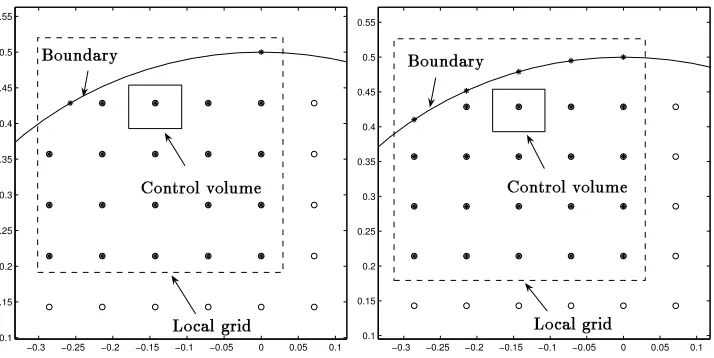
constructed on the same set of l×l grid lines. The reference point may not be the centre of the local grid when the construction process is carried out near the boundary (Figure 1).
−0.3 −0.25 −0.2 −0.15 −0.1 −0.05 0 0.05 0.1 0.1
0.15 0.2 0.25 0.3 0.35 0.4 0.45 0.5 0.55
PSfragreplaements
Lo algrid Controlvolume Boundary
−0.3 −0.25 −0.2 −0.15 −0.1 −0.05 0 0.05 0.1 0.1
0.15 0.2 0.25 0.3 0.35 0.4 0.45 0.5 0.55
PSfragreplaements Lo algrid Controlvolume Boundary
[image:4.504.75.432.213.392.2]Lo algrid Controlvolume Boundary
Figure 1: Local networks inx1(top) andx2(bottom) (∗: RBF centre and o: interior
point).
For local grids entirely embedded in the domain, the two networks have the same set of RBF centres which are chosen to be the interior grid nodes. The value ofm
in (4) is equal tol2.
For local grids that are cut by irregular boundary, one generally has different sets of RBF centres for the two associated networks. A set of the RBF centres for thexj
network is comprised of the interior grid nodes and the boundary nodes generated by thexjgrid lines. The value ofmin (4) may be less thanl2(Figure 1).
We also employ IRBFNs to represent the variation of the constants of integration. The construction process forC1[xj](xk)is exactly the same as that forC2[xj](xk). To
is constructed through
d2C(xk)
dx2k =
l
∑
i=1
w(i)g(i)(xk), (5)
dC(xk)
dxk
=
l
∑
i=1
w(i)h(i)(xk) +c1, (6)
C(xk) =
l
∑
i=1
w(i)h¯(i)(xk) +xkc1+c2, (7)
wherec1andc2are the constants of integration which are simply unknown values,
andg(i),h(i)and ¯h(i)the one-dimensional forms ofG(i),H(i)andH(i), respectively. Collocating (7) at the local grid pointsx(ki)withi={1,2,· · ·,l}leads to
b
C=Tcwb, (8)
whereCbandwbare the vectors of lengthl and(l+2), respectively, andTcis the
transformation matrix of dimensionsl×(l+2)
b
C=
C(x(1)k ),C(x(2)k ),· · ·,C(x(kl))
T
=
C(1),C(2),· · ·,C(l)
T
,
b
w=w(1),w(2),· · ·,w(l),c1,c2
T , c T = ¯
h(1)(x(1)k ), h¯(2)(x(1)k ), · · ·, h¯(l)(x(1)k ), x(1)k , 1 ¯
h(1)(x(2)k ), h¯(2)(x(2)k ), · · ·, h¯(l)(x(2)k ), x(2)k , 1 ..
. ... . .. ... ... ...
¯
h(1)(x(kl)), h¯(2)(x(kl)), · · ·, h¯(l)(xk(l)), x(kl), 1
.
Taking (8) into account, the value ofCin (7) at an arbitrary pointxk can be
com-puted in terms of nodal values ofCas
C(xk) = h
¯
h(1)(xk),h¯(2)(xk),· · ·,h¯(l)(xk),xk,1 i
c
T+
b
C, (9)
or
C(xk) = l
∑
i=1
P(i)(xk)C(i), (10)
whereP(i)(xk)is the product of the first vector on RHS and theith column ofTc+,
obtained using the SVD technique. It is noted that bothP(i)(xk)andTc+ could not
be defined explicitly.
Substitution of (10) into (3) and (4) yields
∂u(x) ∂xj
=
m
∑
i=1
w([xi)
j]H
(i) [xj](x) +
l
∑
i=1
P[(xi)
j](xk)C
(i)
1[xj], (11)
u[x
j](x) =
m
∑
i=1
w([xi)
j]H
(i) [xj](x) +
l
∑
i=1
xjP
(i) [xj](xk)C
(i) 1[xj]+
l
∑
i=1
P[(xi)
j](xk)C
(i)
2[xj]. (12)
For convenience of presentation, expressions (2), (11) and (12) can be rewritten as
∂2u(x) ∂x2j =
m+2l
∑
i=1
w([xi)
j]G
(i)
[xj](x), (13)
∂u(x) ∂xj
=
m+2l
∑
i=1
w([xi)
j]H
(i)
[xj](x), (14)
u[xj](x) =
m+2l
∑
i=1
w([xi)
j]H
(i)
[xj](x), (15)
where
{G([xi)
j](x)}
m+2l
i=m+1≡ {0}2
l i=1,
{H[(xi)
j](x)}
m+l
i=m+1≡ {P (i) [xj](xk)}
l
i=1, {H (i) [xj](x)}
m+2l
i=m+l+1≡ {0}
l i=1,
{H([xi)
j](x)}
m+l
i=m+1≡ {xjP( i) [xj](xk)}
l
i=1, {H (i) [xj](x)}
m+2l
i=m+l+1≡ {P (i) [xj](xk)}
l i=1,
{w([xi) j]}
m+l
i=m+1≡ {C (i) 1[xj]}
l
i=1,and{w (i) [xj]}
m+2l
i=m+l+1≡ {C (i) 2[xj]}
l i=1.
We seek the solution in terms of nodal values of the field variable u. To do so, (15) is collocated at the nodal points on the local grid, from which the relationship between the network-weight space and the physical space can be established as
e
u[xj] = T[fxj]we[xj], (16)
e
w[xj] = Tf+
[xj]eu[xj], (17)
where ue[xj] is the vector of length m consisting of the nodal values of u on the
local grid, we[xj] the vector of length(m+2l) made up of the RBF weights and
the nodal values ofC(1[i)x
j] andC
(i)
2[xj], andTf
+
[xj] the generalised inverse ofT[fxj]. The
transformation matrixT[fx
j] has the entriesT[fxj]rs =H
(s) [xj](x
(r)), where 1≤r≤m
It is noted that the two vectors,ue[x1]andue[x2], are unknown. From now on, they are
forced to be identical
e
u[x1]≡ue[x2]≡ue. (18)
The values of u,∂u/∂xj and∂2u/∂x2j at an arbitrary pointx can be computed in
terms of nodal variable values as
u(x) =1
2
2
∑
j=1
u[xj](x) =
1 2 2
∑
j=1 hH(1)[x
j](x),H
(2)
[xj](x),· · ·,H
(m+2l) [xj] (x)
i f
T+ [xj]
e
u, (19)
∂u(x) ∂xj
=
h
H[(1)x
j](x),H
(2)
[xj](x),· · ·,H
(m+2l) [xj] (x)
i f
T+
[xj]ue, (20)
∂2u(x) ∂x2j =
h
G(1)(x),G(2)(x),· · ·,G(m+2l)(x)
i f
T+
[xj]ue. (21)
In (19), there are two integrated networks in thex1 andx2 directions that produce
two values of the function at a point. Theoretically, they are the same. However, due to approximation errors, these two values are not identical. As a result, the function value is computed by taking the average of the two.
For the point-collocation formulation, there are no integrations required for the discretisation. The process of converting the PDE into a set of algebraic equations is straightforward.
For the control-volume formulation, one has to define a control volume for each node, over which the PDE will be integrated. The control volume is formed using the lines that are parallel to the x1 andx2 axes and go through the middle points
between the reference node and its neighbours or appropriate points on the bound-ary (Figure 1). Integrals can be calculated using high-order (e.g. 5-points used here) Gauss quadrature since the present approximation scheme allows the accu-rate evaluation of the variable u and its derivatives at any point within the local grid.
The use of local integrated networks results in a sparse system of simultaneous equations. It can be seen that operations on zero elements are unnecessary. Avoid-ing these operations provides a considerable savAvoid-ing in time. By takAvoid-ing account of sparseness of the system matrix, one has the capability to reduce the computational time and storage facilities. Such sparse equation sets can be solved effectively by means of iterative solvers (e.g. generalised minimum residual methods).
4 Numerical examples
function whose form is given
G(i)(x) =
q
(x−c(i))T(x−c(i)) +a(i)2, (22)
wherec(i) anda(i)are the centre and width of the ith MQ basis function,
respec-tively. The set of centres and the set of collocation points are identical. It is well known that the width/shape-parameter strongly affects accuracy of the RBF scheme. However, it is still very difficult to determine the optimal value of the shape parameter in practice. In this study, we do not focus on the study of the RBF width. All MQ centres are associated with the same width that is chosen to be the grid size. For problems whose exact solution is available, we use the discrete relative L2norm of u, denoted byNe(u), to measure accuracy of an approximate
scheme. We apply the matrix 1-norm estimation algorithm for estimating condi-tion numbers of the system matrix. Furthermore, linear CV (central difference) techniques, which are similar to those described in [Patankar (1980)], are referred to as a standard CV technique.
4.1 Test problem
Consider the following PDE
∂2u ∂x21+
∂2u
∂x22 =0 (23)
with Dirichlet boundary conditions. Two computational domains, namely a unit square 0≤x1,x2 ≤1 and a circle centered at the origin with radius of 0.5, are
considered. The exact solution is given by
ue=
1
sinh(π)sin(πx1)sinh(πx2) (24)
from which the boundary values ofucan be derived.
The point-collocation formulation consists in forcing (23) to be satisfied exactly at discrete points in order to form a determined set of algebraic equations. It means that (23) needs be collocated at the interior grid nodes.
For the control-volume formulation, (23) is forced to be satisfied in the mean. In-tegrating (23) over a control volumeΩi, we have
Z
Ωi
∇2udΩi=0. (25)
Using the divergence theorem, (25) becomes
Z
Γi
whereΓi is the boundary ofΩi andnthe outward normal unit vector. To compute
∂u/∂xj on the faces that are parallel to the xk (k 6= j) direction, we use the xj
network.
[image:9.504.114.394.228.482.2]Uniform Cartesian grids are employed to represent the problem domain.
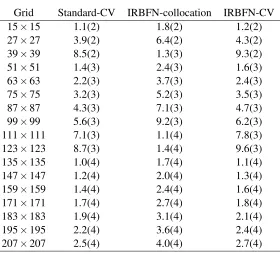
Table 1: Rectangular domain: Condition numbers of the system matrix by stan-dard CV, local IRBFN collocation and local IRBFN CV methods. Notice thata(b)
meansa×10b.
Grid Standard-CV IRBFN-collocation IRBFN-CV
15×15 1.1(2) 1.8(2) 1.2(2)
27×27 3.9(2) 6.4(2) 4.3(2)
39×39 8.5(2) 1.3(3) 9.3(2)
51×51 1.4(3) 2.4(3) 1.6(3)
63×63 2.2(3) 3.7(3) 2.4(3)
75×75 3.2(3) 5.2(3) 3.5(3)
87×87 4.3(3) 7.1(3) 4.7(3)
99×99 5.6(3) 9.2(3) 6.2(3)
111×111 7.1(3) 1.1(4) 7.8(3)
123×123 8.7(3) 1.4(4) 9.6(3)
135×135 1.0(4) 1.7(4) 1.1(4)
147×147 1.2(4) 2.0(4) 1.3(4)
159×159 1.4(4) 2.4(4) 1.6(4)
171×171 1.7(4) 2.7(4) 1.8(4)
183×183 1.9(4) 3.1(4) 2.1(4)
195×195 2.2(4) 3.6(4) 2.4(4)
207×207 2.5(4) 4.0(4) 2.7(4)
10−3 10−2 10−1 100 10−7
10−6 10−5 10−4
10−3 10−2 10−1
Standard CVM IRBFN Collocation IRBFN CVM
PSfragreplaements
h
N
e
(
u
[image:10.504.126.375.90.291.2])
Figure 2: Rectangular domain, [7×7,11×11,· · ·,203×203]: Error versus grid size for standard CVM/FDM and local IRBFN methods.
shown in Figure 2. The IRBFN-CV method outperforms the IRBFN-collocation method. Given a grid size, the CPU time for the IRBFN-CVM solution is seen to be greater than that for the standard-CVM solution. However, from Figure 2, the IRBFN-CVM is much more accurate than the standard CVM. To achieve a similar level of accuracy, it is necessary to use denser grids for the standard CVM. For example, to yieldNe=1.9×10⁻⁷, one needs to employ approximately a grid of 1701×1701 for the standard CVM (this grid density is estimated through extrap-olation) and only 203×203 for the IRBFN CVM. It is noted that very high grid densities lead to ill-conditioned matrices. For a given accuracy, the IRBFN CVM can thus be more efficient than the standard CVM. Figure 3 shows the locations of nonzero entries in the IRBFN system matrix.
In the case of circular domain, we generate boundary nodes through the intersection of the grid lines and the boundary. It can be seen that there may be some interior grid nodes that are very close to the boundary. A parameter∆=h/8 is introduced
here. Interior nodes, which fall within a small distance∆to the boundary, are set
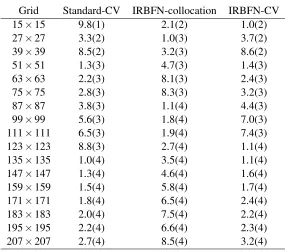
aside. The matrix condition number and the accuracy of the three methods are shown in Table 2 and Figure 4. Remarks for this case are similar to those for the rectangular case.
0 0.5 1 1.5 2
x 104 0
0.5
1
1.5
2 x 10⁴
[image:11.504.121.375.95.362.2]nz = 549081
Figure 3: Rectangular domain, 151×151: The structure of the 22201×22201 IRBFN system matrix.
power than differentiated RBFNs. The implementation of local- and global-IRBFN versions incorporating Cartesian grids shares many common features. The latter was presented in detail in our previous works [Mai-Duy and Tran-Cong (2009a); Mai-Duy and Tran-Cong (2009b)]. For the handling of a Neumann boundary con-dition on a curved boundary, the reader is referred to [Mai-Duy and Tran-Cong (2009b)] for a full detail. Generally speaking, global versions are capable of giv-ing more accurate results than local versions. However, global schemes produce fully-populated matrices that may limit the number of nodes to a few hundreds only. For problems, which require a relatively-dense discretisation for an accurate simulation, the use of local schemes is a preferred option.
Table 2: Circular domain: Condition numbers of the system matrix by standard CV, local IRBFN collocation and local IRBFN CV methods. Notice that a(b) means
a×10b.
Grid Standard-CV IRBFN-collocation IRBFN-CV
15×15 9.8(1) 2.1(2) 1.0(2)
27×27 3.3(2) 1.0(3) 3.7(2)
39×39 8.5(2) 3.2(3) 8.6(2)
51×51 1.3(3) 4.7(3) 1.4(3)
63×63 2.2(3) 8.1(3) 2.4(3)
75×75 2.8(3) 8.3(3) 3.2(3)
87×87 3.8(3) 1.1(4) 4.4(3)
99×99 5.6(3) 1.8(4) 7.0(3)
111×111 6.5(3) 1.9(4) 7.4(3)
123×123 8.8(3) 2.7(4) 1.1(4)
135×135 1.0(4) 3.5(4) 1.1(4)
147×147 1.3(4) 4.6(4) 1.6(4)
159×159 1.5(4) 5.8(4) 1.7(4)
171×171 1.8(4) 6.5(4) 2.4(4)
183×183 2.0(4) 7.5(4) 2.2(4)
195×195 2.2(4) 6.6(4) 2.3(4)
207×207 2.7(4) 8.5(4) 3.2(4)
4.2 Heat flow
Find the temperatureθ such that
∇.
vθ− 1
Pe∇θ
=0, x∈Ω, (27)
wherevis a prescribed velocity,Ωthe domain andPethe Peclet number. Here,Ω
andvare taken as[0,1]×[−0.5,0.5]and(1,0)T, respectively. Boundary conditions are prescribed as follows
θ=0, for x2=−0.5 and x2=0.5, (28)
θ=cos(πx2) for x1=0, and (29)
10−3 10−2 10−1 100 10−7
10−6 10−5 10−4
10−3 10−2 10−1
Standard CVM IRBFN Collocation IRBFN CVM
PSfragreplaements
h
N
e
(
u
[image:13.504.125.376.91.293.2])
Figure 4: Circular domain, [7×7,11×11,· · ·,203×203]: Error versus grid size for standard CVM/FDM and local IRBFN methods.
The exact solution to this problem can be verified to be
θe=
cos(πx2)
exp(a)−exp(b)(exp(a+bx1)−exp(b+ax1)), (31)
wherea=0.5
Pe+√Pe2+4π2andb=0.5Pe−√Pe2+4π2. This problem
is taken from [Kohno and Bathe (2006)].
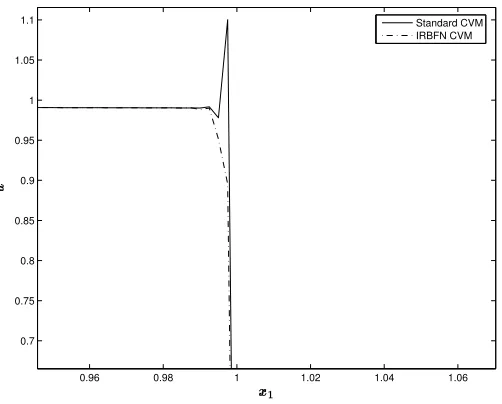
The temperature boundary layer becomes thinner with increasingPe. AtPe=1000, very steep boundary layer is formed. Figure 5 shows the temperature contours for three different values ofPeby the present CV method. Its accuracy is better than that of the standard CV method as shown in Table 3. Figure 6 displays variations of temperature along the centre line. It can be seen that the proposed method produces very accurate results for all cases. Figure 7 show that there are no fluctuations in the IRBFN CVM solution.
4.3 Lid-driven triangular-cavity flow
PSfragreplaements
Pe=10(2121)
PSfragreplaements
Pe=100(5151)
PSfragreplaements
[image:14.504.180.324.86.574.2]Pe=1000(401401)
0 0.2 0.4 0.6 0.8 1 0
0.2 0.4 0.6 0.8 1
Pe=10 Pe=100 Pe=1000 Exact solution
PSfragreplaements
x1
[image:15.504.127.379.86.291.2]u
Figure 6: Heat flow: temperature variations on the horizontal centreline for differ-ent values ofPe. Exact values are also included for comparison purposes.
0.96 0.98 1 1.02 1.04 1.06
0.7 0.75 0.8 0.85 0.9 0.95 1 1.05
1.1 Standard CVM
IRBFN CVM
PSfragreplaements
x1
u
[image:15.504.128.379.348.550.2]Table 3: Heat Flow,Pe=1000: ErrorNe(u)by standard CV and local IRBFN CV methods. Notice thata(−b)meansa×10−b.
Grid Standard-CV IRBFN-CV
11×11 2.69(-1) 1.00(-1)
51×51 1.83(-2) 3.69(-3)
101×101 4.25(-3) 9.36(-4)
151×151 1.83(-3) 3.47(-4)
201×201 1.01(-3) 1.75(-4)
251×251 6.45(-4) 1.11(-4)
301×301 4.46(-4) 8.32(-5)
351×351 3.27(-4) 6.92(-5)
401×401 2.50(-4) 6.15(-5)
PSfragreplaements
x1 x2
(0;0)
(P ;Q) ( P ;Q)
( =0; =n=0)
[image:16.504.142.361.316.517.2]( =0; =n=0) ( =0; =n=1)
Figure 8: Cavity flow: geometry and boundary conditions.
Governing equations:
The governing equations are obtained from the streamfunction-vorticity formula-tion
ω=∇2ψ, (32)
∂ ω ∂t +
v1∂ ω
∂x1
+v2∂ ω
∂x2
= 1
Re∇
2
ω, (33)
where Re is the Reynolds number defined as Re=U L/ν (L: the characteristic
length,U: the characteristic velocity andνthe kinematic viscosity),ψ the
stream-function,ω the vorticity,v1=∂ ψ/∂x2andv2=−∂ ψ/∂x1. The reference length
and velocity are presently chosen asL=Q/3 andU=1 (the velocity of the lid), respectively.
Spatial discretisation:
The equilateral triangular cavity is discretised using a Cartesian grid. Grid nodes inside the cavity are taken to be the interior grid points. For this particular geometry, boundary nodes are generated using only grid lines that contain at least one interior grid node. With this approach, the set of RBF centres/collocation-points do not include the two top corners and hence infinite values of the vorticity do not enter the discrete system.
Boundary conditions:
Boundary conditions for the velocity lead toψ=0 and∂ ψ/∂x2=1 on the lid, and ψ=0 and∂ ψ/∂n=0 on the remaining walls (n: the direction normal to the wall). We will use the boundary values ψ =0 for solving the streamfunction equation.
Fromψ=0 and∂ ψ/∂n=0, one obtains∂ ψ/∂x1=0 and∂ ψ/∂x2=0 along the
boundaries, which are used for solving the vorticity equation. A vorticity boundary condition is computed through
ωb=
∂2ψb
∂x21 + ∂2ψb
∂x22 , (34)
where the subscriptbis used to indicate the boundary value. On the top wall, (34) reduces to
ωb=
∂2ψb
∂x22 . (35)
On the side walls, there are two possible cases
(ii) A boundary point is not a grid node or the number of nodal points on one of the two associated grid lines is too small.
To computeωb, one can use (34) directly for the first case but may need to derive
a suitable formula from (34), which requires information aboutψ on one grid line
only, for the second case. The latter will be handled here by applying formulae reported in our previous work (e.g. [Le-Cao, Mai-Duy, and Tran-Cong (2009)]), namely
ωb= 1+ t1 t2
∂2ψb
∂x12 , (36)
for ax1-grid line, and
ωb= 1+ t2 t1
∂2ψb
∂x22 , (37)
for ax2-grid line. In (36) and (37),t1andt2are thex1- andx2-components of the
unit vector tangential to the boundary.
As mentioned earlier, one has to incorporate∂ ψb/∂x1=0 and∂ ψb/∂x2=0 into
(35), (34), (36) and (37). The incorporation process is similar to that in [Ho-Minh, Mai-Duy, and Tran-Cong (2009)]. It will be briefly reproduced here for the sake of completeness. Consider axjgrid line. On the line, one has
∂2ψ(x) ∂x2j =
nj
∑
i=1
w(i)g(i)(xj) +0c1+0c2, (38)
∂ ψ(xj)
∂xj
=
nj
∑
i=1
w(i)h(i)(xj) +c1+0c2, (39)
ψ(xj) = nj
∑
i=1
w(i)h¯(i)(xj) +xjc1+c2, (40)
where nj is the number of nodal points on the line and other notations are
de-fined as before. There are two extra coefficients c1 and c2 in (40). As a re-sult, two extra equations representing boundary derivative values∂ ψ(x(1)j )/∂xjand
∂ ψ(x(jnj))/∂xjcan be added to the transformation system
b ψ
∂ ψ(x(1)j )
∂xj
∂ ψ(x(jn j))
∂xj
whereψbis the vector of nodal variable values of lengthnj,wbthe coefficient vector
of length (nj+2) andTcis the transformation matrix of dimensions (nj+2)×
(nj+2)
b
ψ =
ψ(x(1)j ),ψ(x(2)j ),· · ·,ψ(x(jnj))
T
, (42)
b
w=w(1),w(2),· · ·,w(nj),c
1,c2
T , (43) c T = ¯
h(1)(x(1)j ), h¯(2)(x(1)j ), · · ·, h¯(nj)(x(1)
j ), x
(1)
j , 1
¯
h(1)(x(2)j ), h¯(2)(x(2)j ), · · ·, h¯(nj)(x(2)
j ), x
(2)
j , 1
..
. ... . .. ... ... ...
¯
h(1)(x(jnj)), h¯(2)(x(jnj)), · · ·, h¯(nj)(x(nj)
j ), x
(nj)
j , 1
h(1)(x(1)j ), h(2)(x(1)j ), · · ·, h(nj)(x(1)
j ), 1, 0
h(1)(x(nj)
j ), h(2)(x
(nj)
j ), · · ·, h( nj)(x(nj)
j ), 1, 0 .
The values of∂2ψ/∂x2j at the two boundary points can be computed by
∂2ψ(x(1)j )
∂x2
j
∂2ψ(x(jn j))
∂x2
j
= (44)
"
g(1)(x(1)j ), g(2)(x(1)j ), · · ·, g(nj)(x(1)
j ), 0, 0
g(1)(x(jnj)), g(2)(x(jnj)), · · ·, g(nj)(x(nj)
j ), 0, 0 #
c
T−1
b ψ
∂ ψ(x(1)j )
∂xj
∂ ψ(x(jn j))
∂xj , (45)
whereTc−1is an inverse ofTc.
By means of point collocation and integration constants, derivative boundary values are forced to be satisfied exactly. Moreover, all grid points on the associated grid lines are used to computeωb. The present boundary schemes thus have a global
property.
initial solution to be the solution at a lowerRe. For the case ofRe=0, the flow starts from rest.
PSfragreplaements
Re=0,Grid1
PSfragreplaements
Re=100,Grid2
PSfragreplaements
Re=200,Grid3
PSfragreplaements
[image:20.504.87.415.135.442.2]Re=500,Grid4
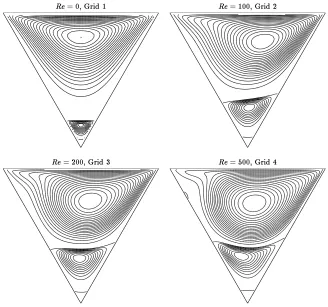
Figure 9: Cavity flow: Streamlines which are drawn using 21 uniform lines be-tween the minimum and zero values, and 11 uniform lines bebe-tween the zero and maximum values.
Figures 9 and 10 present contour plots of the streamfunction and vorticity variables, which look reasonable when compared with those available in the literature (e.g. [Ribbens, Watson, and Wang (1994); Kohno and Bathe (2006)]).
Figure 11 presents variations of the x1 component of the velocity vector on the
vertical centrelinex1=0 and thex2 component of velocity on the horizontal line
PSfragreplaements
Re=0,Grid1
PSfragreplaements
Re=100,Grid2
PSfragreplaements
Re=200,Grid3
PSfragreplaements
[image:21.504.90.413.87.396.2]Re=500,Grid4
Figure 10: Cavity flow: Iso vorticity lines whose values are the same as those in [Kohno and Bathe (2006)]
5 Concluding remarks
−1.50 −1 −0.5 0 0.5 1 1.5 0.5
1 1.5 2 2.5 3
Grid 1
Grid 2
v
1 by FEM
v2 by FEM
PSfragreplaements
Re=100
−1.50 −1 −0.5 0 0.5 1 1.5
0.5 1 1.5 2 2.5 3
Grid 2
Grid 3
v
1 by FEM
v
2 by FEM
PSfragreplaements
Re=200
−1.50 −1 −0.5 0 0.5 1 1.5
0.5 1 1.5 2 2.5 3
Grid 3
Grid 4
v
1 by FEM
v2 by FEM
PSfragreplaements
[image:22.504.162.342.88.563.2]Re=500
Acknowledgement: This work is supported by the Australian Research Council. We would like to thank the referees for their helpful comments.
References
Bourantas, G. C.; Skouras, E. D.; Nikiforidis, G. C.(2009): Adaptive sup-port domain implementation on the moving least squares approximation for mfree methods applied on elliptic and parabolic pde problems using strong-form descrip-tion. CMES: Computer Modeling in Engineering & Sciences, vol. 43, no. 1, pp. 1–26.
Chantasiriwan, S.(2004): Investigation of the use of radial basis functions in local collocation method for solving diffusion problems. International
Communi-cations in Heat and Mass Transfer, vol. 31, no. 8, pp. 1095–1104.
Fasshauer, G. E.(2007): Meshfree Approximation Methods With Matlab
(Inter-disciplinary Mathematical Sciences - Vol. 6). World Scientific Publishers.
Ho-Minh, D.; Mai-Duy, N.; Tran-Cong, T.(2009): A Galerkin-RBF approach for the streamfunction-vorticity-temperature formulation of natural convection in 2D enclosured domains. CMES: Computer Modeling in Engineering & Sciences, vol. 44, pp. 219–248.
Hu, S. P.; Young, D. L.; Fan, C. M. (2008): FDMFS for diffusion equation with unsteady forcing function. CMES: Computer Modeling in Engineering &
Sciences, vol. 24, no. 1, pp. 1–20.
Johansen, H.; Colella, P.(1998): A Cartesian grid embedded boundary method for Poisson’s equation on irregular domains. Journal of Computational Physics, vol. 147, no. 1, pp. 60–85.
Jomaa, Z.; Macaskill, C.(2005): The embedded finite difference method for the Poisson equation in a domain with an irregular boundary and Dirichlet boundary conditions. Journal of Computational Physics, vol. 202, no. 2, pp. 488–506.
Jyotsna, R.; Vanka, S. P.(1995): Multigrid calculation of steady, viscous flow in a triangular cavity. Journal of Computational Physics, vol. 122, no. 1, pp. 107–117.
Kohno, H.; Bathe, K.-J.(2006): A flow-condition-based interpolation finite ele-ment procedure for triangular grids. International Journal for Numerical Methods
Kosec, G.; Sarler, B.(2008a): Solution of thermo-fluid problems by collocation with local pressure correction. International Journal of Numerical Methods for
Heat & Fluid Flow, vol. 18, pp. 868–882.
Kosec, G.; Sarler, B.(2008b): Local RBF Collocation Method for Darcy Flow.
CMES: Computer Modeling in Engineering & Sciences, vol. 25, pp. 197–208.
Le-Cao, K.; Mai-Duy, N.; Tran-Cong, T.(2009): An effective integrated-RBFN Cartesian-grid discretisation for the stream function-vorticity-temperature formu-lation in non-rectangular domains. Numerical Heat Transfer, Part B, vol. 55, pp. 480–502.
Lee, C. K.; Liu, X.; Fan, S. C. (2003): Local multiquadric approximation for solving boundary value problems. Computational Mechanics, vol. 30, no. 5-6, pp. 396–409.
Mai-Duy, N. (2005): Solving high order ordinary differential equations with radial basis function networks. International Journal for Numerical Methods in
Engineering, vol. 62, pp. 824–852.
Mai-Duy, N.; Tanner, R. I.(2005): An effective high order interpolation scheme in BIEM for biharmonic boundary value problems. Engineering Analysis with
Boundary Elements, vol. 29, pp. 210–223.
Mai-Duy, N.; Tran-Cong, T.(2001): Numerical solution of differential equations using multiquadric radial basis function networks. Neural Networks, vol. 14, no. 2, pp. 185–199.
Mai-Duy, N.; Tran-Cong, T.(2005): An efficient indirect RBFN-based method for numerical solution of PDEs. Numerical Methods for Partial Differential
Equa-tions, vol. 21, pp. 770–790.
Mai-Duy, N.; Tran-Cong, T. (2006): Solving biharmonic problems with scattered-point discretisation using indirect radial-basis-function networks.
En-gineering Analysis with Boundary Elements, vol. 30, no. 2, pp. 77–87.
Mai-Duy, N.; Tran-Cong, T. (2009a): A control volume technique based on integrated RBFNs for the convection-diffusion equation. Numerical Methods for
Partial Differential Equations (accepted).
Mai-Duy, N.; Tran-Cong, T. (2009b): A numerical study of 2D integrated RBFNs incorporating Cartesian grids for solving 2D elliptic differential problems.
Orsini, P.; Power, H.; Morvan, H.(2008): Improving volume element meth-ods by meshless radial basis function techniques. CMES: Computer Modeling in
Engineering & Sciences, vol. 23, pp. 187–208.
Parussini, L.; Pediroda, V.(2008): Investigation of multi geometric uncertain-ties by different polynomial chaos methodologies using a fictitious domain solver.
CMES: Computer Modeling in Engineering & Sciences, vol. 23, no. 1, pp. 29–52.
Pasquim, B. M.; Mariani, V. C.(2008): Solutions for incompressible viscous flow in a triangular cavity using cartesian grid method. CMES: Computer Modeling
in Engineering & Sciences, vol. 35, no. 2, pp. 113–132.
Patankar, S. V.(1980): Numerical Heat Transfer and Fluid Flow. McGraw-Hill.
Ribbens, C. J.; Watson, L. T.; Wang, C.-Y. (1994): Steady viscous flow in a triangular cavity. Journal of Computational Physics, vol. 112, no. 1, pp. 173–181.
Sanyasiraju, Y. V. S. S.; Chandhini, G.(2008): Local radial basis function based gridfree scheme for unsteady incompressible viscous flows. Journal of
Computa-tional Physics, vol. 227, no. 20, pp. 8922–8948.
Sarra, S. A.(2006): Integrated multiquadric radial basis function approximation methods. Computers & Mathematics with Applications, vol. 51, no. 8, pp. 1283– 1296.
Shu, C.; Ding, H.; Yeo, K. S.(2003): Local radial basis function-based differen-tial quadrature method and its application to solve two-dimensional incompressible Navier-Stokes equations. Computer Methods in Applied Mechanics and Engineer-ing, vol. 192, pp. 941–954.
Shu, C.; Ding, H.; Yeo, K. S.(2005): Computation of incompressible navier-stokes equations by local RBF-based differential quadrature method. CMES:
Com-puter Modeling in Engineering & Sciences, vol. 7, pp. 195–206.
Tolstykh, A. I.; Shirobokov, D. A.(2003): On using radial basis functions in a “finite difference mode” with applications to elasticity problems. Computational
Mechanics, vol. 33, no. 1, pp. 68–79.
Tolstykh, A. I.; Shirobokov, D. A. (2005): Using radial basis functions in a “finite difference mode”. CMES: Computer Modeling in Engineering & Sciences, vol. 7, pp. 207–222.
Wright, G. B.; Fornberg, B.(2006): Scattered node compact finite difference-type formulas generated from radial basis functions. Journal of Computational
![Figure 2: Rectangular domain, [ × 7,7 11 ×,11 · · · , 203 ×203] : Error versus gridsize for standard CVM/FDM and local IRBFN methods.](https://thumb-us.123doks.com/thumbv2/123dok_us/214121.56378/10.504.126.375.90.291/figure-rectangular-domain-error-versus-gridsize-standard-methods.webp)

![Figure 4: Circular domain, [ × 7,7 11 ×,11 · · · , 203 ×203] : Error versus grid sizefor standard CVM/FDM and local IRBFN methods.](https://thumb-us.123doks.com/thumbv2/123dok_us/214121.56378/13.504.125.376.91.293/figure-circular-domain-error-versus-sizefor-standard-methods.webp)