A collocation method based on one-dimensional RBF
interpolation scheme for solving PDEs
N. Mai-Duy
∗and R.I. Tanner
School of Aerospace, Mechanical and Mechatronic Engineering,
The University of Sydney, NSW 2006, Australia
Submitted to
International Journal of Numerical Methods for Heat &
Fluid Flow
, 27-October-2005; Revised 6-April-2006
Abstract
Purpose – To present a new collocation method for numerically solving partial differential
equations (PDEs) in rectangular domains.
Design/methodology/approach– The proposed method is based on a Cartesian grid and a
one-dimensional integrated-radial-basis-function (1D-IRBF) scheme. The employment of
inte-gration to construct the RBF approximations representing the field variables facilitates a fast
convergence rate, while the use of a 1D interpolation scheme leads to considerable economy in
forming the system matrix and improvement in the condition number of RBF matrices over a
2D interpolation scheme.
Findings – The proposed method is verified by considering several test problems governed by
second- and fourth-order PDEs; very accurate solutions are achieved using relatively coarse
grids.
Research limitations/implications – Only 1D and 2D formulations are presented, but we
believe that extension to 3D problems can be carried out straightforwardly. Further
develop-ment is needed for the case of non-rectangular domains.
Originality/value – The contribution of this paper is a new effective collocation formulation
based on RBFs for solving PDEs.
Keywords: integrated radial basis function, collocation method, Cartesian grid, multiple
boundary conditions.
Paper type: Research paper
1
Introduction
Radial-basis-function networks (RBFNs) have become one of the main fields of research
in numerical analysis (Haykin, 1999). It has been proved that RBFNs have the property
of universal approximation, i.e. an arbitrary continuous function can be approximated to
Sandberg, 1991). Madych and Nelson (1988,1990) showed that the RBF interpolation
scheme using multiquadrics (MQ) can offer exponential convergence rates/spectral
accu-racy. The application of MQ-RBFNs for the numerical solution of differential equations
has received a great deal of attention over the past 15 years (see, for example, Kansa,
1990; Fasshauer, 1997; Zerroukat et al, 1998; Mai-Duy and Tran-Cong, 2001; Fedoseyev
et al, 2002; Power and Barraco, 2002; Cheng et al, 2003; Larsson and Fornberg, 2003;
Sarler et al, 2004). These global methods had considerable success in solving a variety of
scientific and engineering problems governed by differential equations.
However, it should be noted that the resultant RBF matrices are dense and their condition
numbers grow rapidly as the number of nodes is increased. To resolve this problem, several
attempts to use local RBF approximations (e.g Shu et al, 2003; Lee et al, 2003) or to
combine RBF and domain decomposition (e.g Dubal, 1994; Kansa and Hon, 2000; Li and
Hon, 2004) have been made. For a local-approximation based approach, only a small
region associated with a point, a node’s region of influence, is activated to construct
the RBF approximations for that point. The two most common shapes of an influence
domain are circles and rectangles. Using a local procedure, the cost of computation can be
modest; for example, the inversion involved in the construction process is conducted for
a series of smaller matrices rather than for a large matrix. For a domain-decomposition
based approach, the given analysis domain is divided into a finite number of subdomains.
The original problem can be then reformulated for each subdomain, leading to a series
of coupled smaller subproblems. The solution is required to be continuous and smooth
across the subdomain interfaces. This can be achieved either by overlapping regions (e.g
Li and Hon, 2004) or by common data points along the interfaces (e.g Dubal, 1994).
Using local approximations or domain decompositions have the following advantages: (i)
the resultant coefficient matrices are sparse/block-banded and hence their solutions are
more efficient, and (ii) it can help prevent the rapid growth of the condition number of
It should also be noted that the performance of the RBF scheme is strongly affected by the
RBF width. To date, there is a lack of mathematical theory for finding appropriate values
of the RBF width. In practice, the RBF width is chosen either by empirical approaches or
by optimization techniques. The latter are expensive, especially for non-linear problems.
Generally, the RBF scheme is more accurate, but less stable with increasing RBF-width.
Recently, an alternative approach based on integration to construct the RBF expressions
for the interpolation of functions and the solution of differential equations was proposed
(Mai-Duy and Tran-Cong, 2001,2003). It was found that the indirect/integration-based
RBFN approach (IRBFN) outperforms the direct/differentiation-based RBFN approach
(DRBFN) regarding accuracy and convergence rate over a wide range of the RBF width.
The improvement is attributable to the fact that integration is a smoothing operation
and is more numerically stable.
In this study, a collocation method based on a 1D global IRBF interpolation scheme
for the solution of 2D-PDEs is proposed. A rectangular domain of computation is
dis-cretized using a Cartesian grid (For the case of a non-rectangular domain, prior coordinate
transformation can be conducted to produce a rectangular domain in the computational
space). With the use of IRBFNs, one can make the approximating functions smoother,
and generate additional coefficients (integration constants) that can be used to impose
the governing equation on boundaries and/or to incorporate normal derivative boundary
conditions more efficiently. On the other hand, with the use of a 1D global
interpola-tion scheme, the construcinterpola-tion of RBF approximainterpola-tions for a given point x involves only points that lie on lines intersected at x and parallel to x− and y−axes, rather than the whole set of grid points. This improves the conditioning of the system and requires less
computational work than the case of using a higher-dimensional scheme. One important
feature of the present scheme is that it still maintains the advantages of a global
high-order method such as the capability to achieve a high degree of accuracy using relatively
system matrix limits the use of a global 2D-RBF collocation method to a few hundred
interpolation points. With the present approach, much larger numbers of nodes (e.g, up
to 10201 nodes in this study) can be employed. Numerical results show that the proposed
method achieves a high degree of accuracy.
The remainder of the paper is organized as follows. The proposed 1D-IRBF collocation
method for the solution of second- and fourth-order PDEs is presented and verified in
section 2 and 3, respectively. The method is then applied to simulate the
thermally-driven cavity flow in Section 4. Section 5 gives some concluding remarks.
2
Second-order PDEs
2.1
The IRBF formulation
The domain of interest is discretized using a Cartesian grid, i.e. an array of straight lines
that run parallel to the x− and y−axes. Let Nx and Ny be the numbers of grid lines
in the x− and y−directions, respectively. The dependent variable u and its derivatives
are approximated using a 1D-IRBF interpolation scheme. It should be indicated that the
1D interpolation scheme uses onlyNx or Ny nodes (instead of NxNy nodes) to construct
the approximations for a given point, resulting in considerable economy when compared
with an earlier 2D-IRBF interpolation scheme reported in (Mai-Duy and Tran-Cong,
2005). The construction process involves two steps: (i) To use IRBFNs to approximate
the variable u and its derivatives along a straight line, and (ii) To use Kronecker tensor
2.1.1 One-dimensional formulation
Consider a line in a Cartesian grid, e.g the line runs parallel to thex−axis. The dependent
variable u along this line is sought in the IRBF form. The second-order derivative of
u is decomposed into RBFs; the RBF network is then integrated twice to obtain the
expressions for the first-order derivative of u and the solution u itself
∂2u(x)
∂x2 =
Nx
X
i=1
w(i)g(i)(x) =
Nx
X
i=1
w(i)H[2](i)(x), (1) ∂u(x)
∂x =
Nx
X
i=1
w(i)H(i)
[1](x) +c1, (2)
u(x) =
Nx
X
i=1
w(i)H(i)
[0](x) +c1x+c2, (3)
where{w(i)}Nx
i=1are RBF weights to be determined;{g(i)(x)}
Nx
i=1are known RBFs;H[1](x) = R
H[2](x)dx, H[0](x) = R
H[1](x)dx; and c1 and c2 are integration constants. Here it is
re-ferred to as a second-order 1D-IRBF scheme, denoted by IRBF-2. It is more convenient
to work in physical space than in network-weight space. The RBF coefficients including
two integration constants can be transformed into the meaningful nodal variable values,
based on the following equations
u(x(1)) =
Nx
X
i=1
w(i)H(i) [0](x
(1)) +c
1x(1)+c2, (4)
u(x(2)) =
Nx
X
i=1
w(i)H(i) [0](x
(2)) +c
1x(2)+c2, (5)
· · · ·
u(x(Nx)) =
Nx
X
i=1
w(i)H[0](i)(x(Nx)) +c
The above system can be written in the matrix form
b
u=H
wb
b
c
, (7)
whereHis aNx×(Nx+2) matrix,ub= (u(1), u(2),· · ·, u(Nx))T,wb= (w(1), w(2),· · · , w(Nx))T,
and bc= (c1, c2)T.
One difference between 1D integrated- and differentiated-RBF interpolation schemes is
that the former possesses a larger set of expansion coefficients owing to the presence of two
integration constants c1 and c2. The present conversion schemes can be thus developed
into two directions.
2.1.2 Non-square conversion matrix (NSCM)
The direct use of (7) leads to an underdetermined system of equations. The associated
matrix is referred to as the conversion matrix, denoted byC (C =H). The pseudo inverse
of C can be found using the SVD technique. It is noted that the purpose of using SVD
here is to provide a solution whose norm is the smallest in the least-squares sense
b
u=H
wb
b
c
=C
wb
bc
, (8)
wb
b
c
2.1.3 Square conversion matrix (SCM)
One can add two additional equations of the form
f1 =
Nx
X
i=1
w(i)H[(†i])+c1α1+c2β1, (10)
f2 =
Nx
X
i=1
w(i)H[(‡i])+c1α2+c2β2, (11)
or
b
f =K
wb
b
c
(12)
to (7). The conversion system can be written as
bu
b f = H K wb
b
c
=C
wb
bc
. (13)
The conversion matrix C becomes square, and its inverse can be computed by using the
LU decomposition
wb
b
c
=C−1
bu
b
f
. (14)
It is widely observed that the RBF approximations have a tendency to produce larger
errors near boundaries. Fedoseyev et al (2002) developed a MQ-RBF collocation method
with PDE collocation on the boundaries; numerical results indicated a considerable
im-provement in accuracy. Motivated by these results, the two extra equations (10) and
(11) can be utilized here to satisfy the governing equation at both ends of the line: x(1)
and x(Nx). If the Neumann boundary condition rather than the Dirichlet condition is
given, these equations can be used to represent normal derivative boundary conditions;
imposition of the governing equation on the boundaries is carried out at a later stage
are known quantities. However, their explicit forms/values depend on the problem to be
solved; they will be presented in some detail in section Numerical Results. A distinct
difference between the differentiation- and integration-based formulations is that the
gov-erning equation is forced to be satisfied exactly on the boundaries by means of fictitious
points inside/outside domain for the former and by integration constants for the latter.
In the following discussion, only the SCM version is considered since the NSCM system
(8) can be obtained from the SCM system (13) by simply setting matrix K and vector fb to null.
By substituting (14) into (1) and (2), the second- and first-order derivatives of the variable
u will be expressed in terms of nodal variable values
∂2u(x)
∂x2 =
H[2](1)(x), H[2](2)(x),· · · , H(Nx)
[2] (x),0,0
C−1
bu
b
f
, (15)
∂u(x) ∂x =
H[1](1)(x), H[1](2)(x),· · · , H(Nx)
[1] (x),1,0
C−1 bu
b
f
, (16)
or
∂2u(x)
∂x2 =D2xub+k2x, (17)
∂u(x)
∂x =D1xub+k1x, (18)
where k2x and k1x are scalars whose values depend on f1 and f2.
Application of (17) and (18) to every collocation point on the line yields
d
∂2u
∂x2 =Db2xbu+bk2x, (19) c
∂u
whereDb2x and Db1x are known matrices of dimensionNx×Nx, andbk2x andbk1x are known
vectors of length Nx.
Similarly, along a vertical line, the values of the second- and first-order derivatives of u
with respect to y at the collocation points can be given by
d
∂2u
∂y2 =Db2ybu+bk2y, (21) c
∂u
∂y =Db1ybu+bk1y. (22)
2.1.4 Two-dimensional formulation
Assuming that the grid points are numbered from bottom to top and from left to right,
one can write the values of the derivatives ofuover the whole domain by using Kronecker
tensor products as follows
g
∂2u
∂x2 =
b
D2x⊗ Iy
e
u+ek2x =De2xeu+ek2x, (23)
f
∂u ∂x =
b
D1x⊗ Iy
e
u+ek1x =De1xeu+ek1x, (24)
g
∂2u
∂y2 =
Ix⊗Db2y
e
u+ek2y =De2yeu+ek2y, (25)
f
∂u ∂y =
Ix⊗Db1y
e
u+ek1y =De1yeu+ek1y, (26)
whereIx andIy are the identity matrices of dimensionNx×Nx andNy×Ny, respectively;
e
k2x, ek1x,ek2y and ek1y are known vectors of lengthNxNy;De2x,De1x, De2y andDe1y are known
matrices of dimensionNxNy ×NxNy; and ue= u(1), u(2),· · ·, u(NxNy)
T
2.2
Numerical results
The accuracy of an approximation scheme is measured by means of the discrete relative
L2 error defined as
Ne =
r PN
i=1
u(ei)−u(i)
2
r PN
i=1
u(ei)
2 , (27)
where N is the number of collocation points; and ue and u are the exact and computed
solutions, respectively. The present study employs multiquadrics (MQ) whose form is
g(i)(x) =
q
kx−c(i)k2+a(i)2, (28)
where c is the centre,a is the RBF width and k.kdenotes a Euclidean norm. The width of theith MQ-RBF,a(i), is simply chosen to be the minimum distance from theith centre
to its neighbours.
2.2.1 Problem 1
Consider the following Poisson equation
∇2u=b=−8π2sin(2πx) sin(2πy). (29)
An approximate solution is sought in the unit square domain, 0 ≤ x, y ≤ 1. The exact
solution is given by
ue = sin(2πx) sin(2πy). (30)
Ten uniform grids, 11×11, 21×21, · · ·, 101×101, are employed. A comparative study
of the accuracy of the present 1D-IRBF method between the two versions, NSCM and
SCM, is carried out for two different types of the boundary condition, namely {u} and
Dirichlet boundary condition
Along the two vertical sides, the extra information fi, which are used for computing the
derivatives ofu with respect to x, are taken to be
f1(x= 0, y) =
∂2u
∂x2(0, y) =b(0, y)−
∂2u
∂y2(0, y) = 0, (31)
f2(x= 1, y) =
∂2u
∂x2(1, y) =b(1, y)−
∂2u
∂y2(1, y) = 0, (32)
or
Nx
X
i=1
w(i)H[2](i)(0) = 0, (33)
Nx
X
i=1
w(i)H[2](i)(1) = 0. (34)
Similarly, along the two horizontal sides, the extra information fi, which are used for
computing the derivatives ofu with respect to y, are defined as
f1(x, y = 0) =
∂2u
∂y2(x,0) =b(x,0)−
∂2u
∂x2(x,0) = 0, (35)
f2(x, y = 1) =
∂2u
∂y2(x,1) =b(x,1)−
∂2u
∂x2(x,1) = 0. (36)
Applying the governing equation (29) at the interior points (ip) yields
e
D2x+De2y
ipeu= (b)ip−
e
k2x
ip−
e
k2y
ip. (37)
Making use of the Dirichlet boundary condition of the problem, a determinate system of
equations is obtained which can be solved by Gaussian elimination.
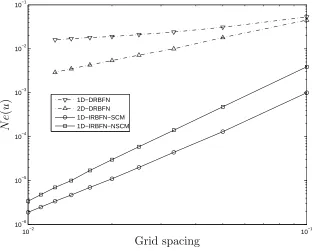
Results concerning the relative L2 error are given in Figure 1 which indicates the rapid
improvement in accuracy with increasing density for both versions. The SCM version is
The present results are also compared with those obtained by the classical DRBFN method
(Figure 1). The DRBFN method that is based on a 1D interpolation scheme is also
implemented here. The 1D- and 2D-DRBF methods use the same network parameters
(e.g the number of collocation points, their locations and the RBF widths) as the proposed
1D-IRBF method. It can be seen that the proposed method outperforms the 1D- and
2D-DRBF methods regarding accuracy and convergence.
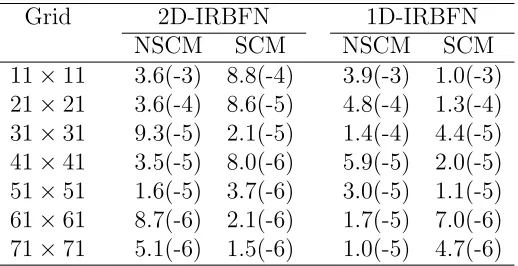
In comparison with the 2D-IRBF method, Table 1 shows that for each version (SCM
and NSCM), the 2D-IRBF method is more accurate than the 1D-IRBF method. It is
interesting to note that the accuracy of the 1D-IRBF method with SCM is superior to that
of the 2D-IRBF method with NSCM. The 2D method requires much more computational
effort than the 1D method. For example, the inversion is conducted for matrices of
dimensions aboutNx×NxorNy×Ny for the 1D method, but of dimensionsNxNy×NxNy
for the 2D method.
Dirichlet and Neumann boundary conditions
The Neumann boundary conditions are imposed on the two vertical sides, while the
Dirich-let conditions are specified along the two horizontal sides. Special attention here is given
to the implementation of the Neumann boundary condition. The two additional equations
(10) and (11) can take the form
f1(x= 0, y) =
∂u
∂x(0, y) = 2πsin(2πy), (38) f2(x= 1, y) =
∂u
or
Nx
X
i=1
w(i)H(i)
[1](0) +c1 = 2πsin(2πy), (40)
Nx
X
i=1
w(i)H(i)
[1](1) +c1 = 2πsin(2πy). (41)
For the SCM version, the governing equation (29) is forced to be satisfied not only at the
interior points but also at the 2(Ny −2) boundary points on the two vertical sides. For
the NSCM version, the governing equation (29) is applied at the interior points and the
Neumann boundary conditions are enforced explicitly by adding some additional equations
to the system. After introducing the Dirichlet boundary condition of the problem, for
both versions, a square algebraic system of dimension (NxNy−2Nx)×(NxNy −2Nx) is
obtained for the unknown nodal values of u inside the domain and on the boundaries of
the Neumann boundary condition.
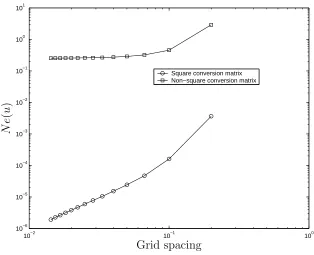
Figure 2 presents the convergence behaviour of the present method using NSCM and SCM.
It is clear that both versions have essentially the same convergence rates, but the latter
produces a higher degree of accuracy. Imposition of the Neumann boundary condition
through the conversion process is recommended for use because of its superior accuracy
and its straightforward implementation.
3
Fourth-order PDEs
One distinct feature of problems governed by fourth-order PDEs is that there are two
required values of the variable at each boundary point. For the conventional
implementa-tion of multiple boundary condiimplementa-tions, fictitious points are introduced outside/inside the
domain (the fictitious-point technique) or the differential equations are collocated at a
is referred to References (e.g Shu, 2000; Shu et al, 2000; Chen et al, 2000) for a more
detailed discussion of this topic. In the present work, the imposition of multiple
bound-ary conditions is simply conducted by means of integration constants; its performance is
compared with that of the node-reduction technique. The details of implementing
mul-tiple boundary conditions using integration constants were reported in (Mai-Duy, 2005;
Mai-Duy and Tanner, 2005).
For the sake of simplicity, the following discussion is given to the case of biharmonic
equations of the form
∂4u
∂x4 + 2
∂4u
∂x2∂y2 +
∂4u
∂y4 =b(x, y) (42)
in the rectangular domain, subject to the boundary conditions u and ∂u/∂n along the
boundaries.
The process of deriving the 1D-IRBF formulation for fourth-order PDEs is similar to
that for second-order PDEs. However, the corresponding equations involve more terms.
Furthermore, special attention needs to be paid to the treatment of mixed partial
deriva-tives, e.g∂4u/∂x2∂y2. Notations used in this section and in the previous one have similar
3.1
The IRBF formulation
3.1.1 One-dimensional formulation
The variable u and its derivatives along a grid line that runs parallel to the x−axis can
be approximated by
∂4u(x)
∂x4 =
Nx
X
i=1
w(i)g(i)(x) =
Nx
X
i=1
w(i)H[4](i)(x), (43) ∂3u(x)
∂x3 =
Nx
X
i=1
w(i)H[3](i)(x) +c1, (44)
∂2u(x)
∂x2 =
Nx
X
i=1
w(i)H[2](i)(x) +c1x+c2, (45)
∂u(x) ∂x =
Nx
X
i=1
w(i)H[1](i)(x) +c1
x2
2 +c2x+c3, (46)
u(x) =
Nx
X
i=1
w(i)H[0](i)(x) +c1
x3
6 +c2 x2
2 +c3x+c4, (47)
in which the fourth-order derivative of the variable u is decomposed into RBFs. Here it
is referred to as a fourth-order 1D-IRBF scheme, denoted by IRBF-4.
Some relevant matrices and vectors to be used for the conversion process are given below
H =
H[0](1)(x(1)) H(2)
[0](x(1)) · · · H (Nx)
[0] (x(1)) x(1)3/6 x(1)2/2 x(1) 1
H[0](1)(x(2)) H(2)
[0](x(2)) · · · H (Nx)
[0] (x(2)) x(2)3/6 x(2)2/2 x(2) 1
· · · ·
H[0](1)(x(Nx)) H(2)
[0] (x(
Nx)) · · · H(Nx)
[0] (x(
Nx)) x(Nx)3/6 x(Nx)2/2 x(Nx) 1
b w= w(1) w(2) · · ·
w(Nx)
, bc=
c1 c2 c3 c4
, ub=
u(1) u(2) · · ·
u(Nx)
3.1.2 Non-square conversion matrix (NSCM)
The unknown expansion coefficients can be converted into the nodal variable values
ac-cording to the following relation
b
u=H
wb
b
c
=C
wb
bc
, (48)
wb
b
c
=C−1
b
u. (49)
3.1.3 Square conversion matrix (SCM)
The presence of four integration constants allows the addition of 4 extra equations to the
conversion system. Using information on the governing equation and normal derivative
boundary conditions at both ends of the line, the additional matrix and vector can be
generated as follows
K=
H[1](1)(x(1)) H(2)
[1](x(1)) · · · H (Nx)
[1] (x(1)) x(1)2/2 x(1) 1 0
H[1](1)(x(Nx)) H(2)
[1] (x(
Nx)) · · · H(Nx)
[1] (x(
Nx)) x(Nx)2/2 x(Nx) 1 0
H[4](1)(x(1)) H(2)
[4](x(1)) · · · H (Nx)
[4] (x(1)) 0 0 0 0
H[4](1)(x(Nx)) H(2)
[4] (x
(Nx)) · · · H(Nx)
[4] (x
(Nx)) 0 0 0 0
, b f = ∂u ∂x(x
(1))
∂u ∂x(x
(Nx))
b(x(1))−2 ∂4u
∂x2y2(x(1))−
∂4u
∂y4(x(1))
b(x(Nx))−2 ∂4u
∂x2y2(x(
Nx))− ∂4u
∂y4(x(
Nx))
The conversion process thus becomes
bu
b f = H K wb
b
c
=C
wb
bc
, (50)
wb
b
c
=C−1
bu
b
f
. (51)
Substitution of (51) into (43)-(46) yields
∂4u(x)
∂x4 =
H[4](1)(x), H[4](2)(x),· · · , H(Nx)
[4] (x),0,0,0,0
C−1 ub
b
f
, (52)
∂3u(x)
∂x3 =
H[3](1)(x), H[3](2)(x),· · · , H(Nx)
[3] (x),1,0,0,0
C−1 ub
b
f
, (53)
∂2u(x)
∂x2 =
H[2](1)(x), H[2](2)(x),· · · , H(Nx)
[2] (x), x,1,0,0
C−1
bu
b
f
, (54)
∂u(x) ∂x =
H[1](1)(x), H[1](2)(x),· · · , H(Nx)
[1] (x),
x2
2, x,1,0
C−1 bu
b
f
. (55)
The values of the ith-order derivative of u (i = {1,2,3,4}) at the grid points along a
horizontal line can be computed by
d
∂iu
∂xi =Db IV ix
ub
b
f
, i={1,2,3,4}, (56)
where the superscriptIV is used to indicate thatDbix is obtained using the IRBF-4 scheme;
andDbIV
ix is a known matrix of dimensionNx×(Nx+4); and∂c
iu
∂xi =
∂iu
∂xi
(1)
,∂iu
∂xi
(2)
,· · · ,∂iu
∂xi
(Nx)T
Expression (56) can be rewritten as
d∂iu
∂xi =Dc1 IV
ix bu+Dc2 IV
ix f ,b (57)
where Dc1IVix and Dc2 IV
ix are matrices that are formed by the first Nx columns and the last
four columns of the matrix DbIV
ix , respectively. Unlike the case of second-order PDEs, the
extra information vector fb(components f3 and f4) contains some unknown values—the
mixed partial derivative ∂4u/∂x2∂y2 at the two boundary points. The treatment is as
follows. These unknown values will be replaced by linear combinations of nodal values of
the variable u (the detailed expression of ∂4u/∂x2∂y2 will be given in section 3.1.4). In
the same way, one can obtain the values of the ith-order derivative of u with respect toy
along a vertical line.
3.1.4 Two-dimensional formulation
Making use of the following expression
∂4u
∂2x∂2y =
1 2 ∂2 ∂x2
∂2u
∂y2 + ∂ 2 ∂y2
∂2u
∂x2
, (58)
the mixed fourth-order partial derivative can be computed by the 1D IRBF-2 scheme with
the extra information fi being the values of the first-order derivatives at the boundary
points which are given or can be computed easily. Expression (58) can be rewritten as
g
∂4u
∂x2∂y2 =
1 2 De2x
g
∂2u
∂y2 +ek2x+De2y g
∂2u
∂x2 +ek2y ! , (59) = 1 2 e
D2xDe2y+De2yDe2x
e
u+ek4xy, (60)
where De2x and De2y are known matrices obtained from (23) and (25); ek4xy is a known
vector of length NxNy; De4xy is a know matrix of dimension NxNy ×NxNy; and g∂
4u
∂x2∂y2 =
∂4u
∂x2∂y2
(1)
,∂x∂24∂yu2
(2)
,· · · ,∂x∂24∂yu2
(NxNy)T
.
It can be seen that the mixed fourth-order partial derivative of the variable u is now
ex-pressed in terms of nodal variable values. Using these results to represent the components
f3 and f4, one can now extend the approximations for ∂iu/∂xi (57) to a 2D domain by
means of Kronecker tensor products. Their final forms can be written as
g
∂iu
∂xi =De IV ix eu+ek
IV
ix (62)
g
∂iu
∂yi =De IV iy eu+ek
IV
iy (63)
where i={1,2,3,4};ekIV
ix and ekiyIV are known vectors of length NxNy; and DeixIV and DeiyIV
are known matrices of dimension NxNy ×NxNy.
3.2
Numerical results
A biharmonic Dirichlet problem is considered here to verify the 1D-IRBF formulation.
3.2.1 Problem 2
Consider the biharmonic equation
in the domain 0≤x, y ≤1, subject to the boundary conditions
u= 0 along the boundaries, ∂u
∂x = 2πsin(2πy) x= 0, x= 1 ∂u
∂y = 2πsin(2πx) y= 0, y = 1
The exact solution is given by
ve(x, y) = sin(2πx) sin(2πy). (65)
A number of uniform grids, 6×6, 11×11, ..., and 71×71, are employed. In forming the
system matrix, the SCM version allows the biharmonic equation (64) to be collocated at
every interior point. For the NSCM version, it is necessary to reduce the number of interior
points used for (64) in order to impose the boundary conditions ∂u/∂n; these interior
points chosen here for collocating the biharmonic equation are (xi, yj) with 3 ≤i≤Nx−2
and 3 ≤ j ≤ Ny −2. A comparison of the accuracy of the present method between the
two versions is given in Figure 3. The NSCM version does not perform as well, probably
due to the fact that the governing equation is not forced to be satisfied exactly at every
interior point. For the SCM version, a high degree of accuracy and fast convergence are
achieved.
The question here is whether the accuracy of the NSCM approach is improved when one
tries to impose the normal derivative boundary conditions through the conversion process
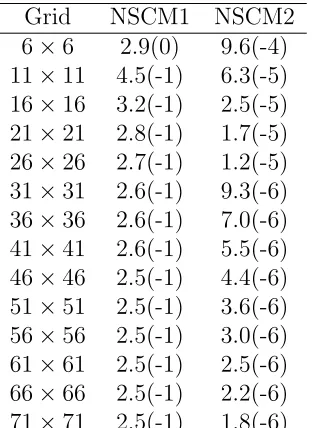
(NSCM2). In this case, the dimension of conversion matrices is (Nx+ 2)×(Nx+ 4). Table
2 reveals that this implementation leads to a significant improvement in accuracy over
the traditional node-reduction technique.
Numerical results show that both SCM and NSCM versions of the proposed 1D-IRBF
underdeter-mined matrices, while the latter involves the inversion of square matrices. Fortunately,
these calculations are conducted in 1D-domains only, and hence they do not add greatly
to the computational cost. The classical DRBFN method does not require such inversions,
but its approximations involve all data points. It should be emphasized the final matrices
obtained by the IRBFN and DRBFN methods have similar sizes.
For the SCM version, to impose the governing equation on the boundaries, the values of
relevant derivatives at the boundary points should be known or should be written in terms
of nodal variable values. It is difficult to meet this requirement when extending the SCM
version to the case of irregular domains. One possible way to overcome these difficulties is
to apply a technique by Sanmiguel-Rojas et al (2005) to generate a non-uniform Cartesian
grid in which all the boundary nodes are regular nodes of the grid. For the NSCM version,
one does not need to concern these issues when extending it to irregular domains.
4
Natural convection flow in a square slot
The proposed method is applied here to simulate the thermally-driven cavity flow in a
square slot. For this problem, the governing equation presents the coupling of momentum
(fourth-order PDE, streamfunction formulation) and energy (second-order PDE)
equa-tions. Very thin boundary layers are formed at high values of the Rayleigh number,
thereby making the numerical simulation difficult. This problem provides a good means
for testing and validating new numerical methods. From the literature, a range of the
Rayleigh number from 103 to 106 is usually employed for the verification of numerical
methods. It will be shown that converged solutions for higher-Rayleigh-numbers are
achieved with the present method, and the obtained RBF results are in very good
T and streamfunctionψ behaviour can be written as ∂T ∂t + ∂ψ ∂y ∂T ∂x − ∂ψ ∂x ∂T ∂y
= √ 1 RaP r
∂2T
∂x2 +
∂2T
∂y2
, (66)
− ∂t∂
∂2ψ
∂x2 +
∂2ψ
∂y2
+ ∂ψ ∂y
∂3ψ
∂x3 +
∂2 ∂y2 ∂ψ ∂x
− ∂ψ∂x
∂2 ∂x2 ∂ψ ∂y + ∂ 3ψ ∂y3 = − r P r Ra
∂4ψ
∂x4 +
∂2
∂x2
∂2ψ
∂y2 + ∂ 2 ∂y2
∂2ψ
∂x2 +∂ 4ψ ∂y4 +∂T
∂x, (67)
where Ra and P r are the Rayleigh number and the Prandtl number, respectively. The
variables are normalized here using reference quantities recommended by Ostrach (1988)
for the case of pRa/P r > 1 and P r <1. These non-dimensional equations are written in detail in order to show how their derivative terms are computed, e.g mixed third-order
partial derivatives are determined through relevant second- and first-order derivatives.
A square cavity of a unit size, containing a fluid of P r = 0.71, is considered.
Non-slip boundary conditions (ψ = 0 and ∂ψ/∂n) are imposed along all the walls. The
thermal boundary conditions are T = 0.5 and T = −0.5 (isothermal) along the left and
right walls, respectively, and ∂T /∂y = 0 (adiabatic) along the bottom and top walls.
The benchmark solutions for this problem can be found in (de Vahl Davis, 1983) for
103 ≤ Ra ≤ 106 and in (Le Quere, 1991) for Ra ≥ 106. The former used second-order,
finite-central-difference approximations and a Richardson extrapolation scheme, while the
latter employed a pseudo-spectral Chebyshev algorithm using the spatial resolution up to
a 128×128 polynomial expansion.
The present solution procedure involves the following steps
1. Guess a set of initial conditions: T, ψ and their spatial derivatives
2. Discretize in time using a first-order accuracy finite-difference scheme, where the
diffusive and convective terms are treated implicitly and explicitly, respectively
3. Discretize in space using 1D-IRBF schemes with NSCM2:
Solve the momentum equation (67) for ψ
4. Check to see whether the solution has reached a steady state
r PN
i=1
ψ(ki+1) −ψk(i)2
r PN
i=1
ψk(i+1) 2
< ǫ, (68)
where k is the time level, ǫ is the tolerance and N is the number of collocation
points.
5. If it is not satisfied, advance time step and repeat from step 2. Otherwise, stop the
computation and output the results.
Normal derivative boundary conditions ∂ψ/∂nand ∂T /∂y are imposed by means of
inte-gration constants. The energy equation (second-order PDE) is collocated not only at the
interior points but also at the boundary points on the bottom and top walls.
A range of Ra= {105,106,107} is considered here. The computed solution at the lower
and nearest value of Ra is taken to be the initial solution. Seven uniform grids, namely
21×21,31×31,· · ·,81×81, are employed to study the convergence behaviour of the
method. Time steps are chosen to be 0.1 for Ra = 105, 0.05 for Ra = 106 and 0.01 for
Ra= 107.
The following quantities are of interest to this type of flow
1. the maximum horizontal velocity umax on the vertical mid-plane of the cavity and
its location
2. the maximum vertical velocity vmax on the horizontal mid-plane of the cavity and
3. the average Nusselt number throughout the cavity
Nu =
Z 1
0
Nu(x)dx (69)
Nu(x) =
Z 1
0
uT − ∂T ∂x
dy (70)
The present velocity components are related to the corresponding benchmark solutions
(de Vahl Davis, 1983) according to the relation
√
RaP r(u, v)present = (u, v)benchmark.
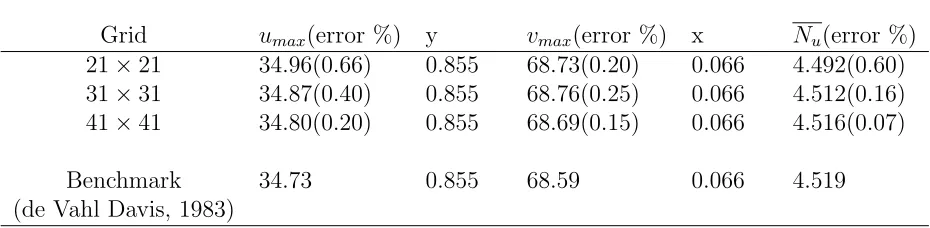
The results obtained are given in Tables 3-5, which show the rapid improvement in
accu-racy as the density increases. Although very sharp gradients are formed at high values
of the Rayleigh number, the present method achieves very accurate results. For example,
the maximum error is less than 0.2% for Ra= 107 using a grid of 81×81.
Figure 4 shows the streamlines, isotherms and iso-vorticity lines of the flow at Ra= 107
using a grid of 81×81. Every plot contains 17 contour lines whose values vary linearly
from the minimum to maximum values, and they look reasonable when compared to the
benchmark solutions.
5
Concluding remarks
This paper reports a collocation method based on a one-dimensional
integrated-radial-basis-function interpolation scheme for the solution of second- and fourth-order PDEs
in rectangular domains. The use of integrated RBFs allows (i) the normal derivative
boundary condition to be incorporated more efficiently and (ii) the exact satisfaction of
PDEs not only at the interior points but also at the boundary points. The imposition of
for use. On the other hand, the employment of a 1D interpolation scheme instead of 2D
interpolation scheme permits relatively large numbers of data points to be employed. The
present one-dimensional global IRBF scheme is demonstrated on a number of test cases,
including the benchmark natural convection problem; a very high degree of accuracy is
achieved using relatively coarse grids. Extension of the proposed method to the case of
non-rectangular domains is currently underway, and it will be reported in future work.
ACKNOWLEDGEMENTS
N. Mai-Duy wishes to thank the University of Sydney for a Sesquicentennial Post-doctoral
Research Fellowship. We would like to thank the referees for their helpful comments and
suggestions to improve the paper.
REFERENCES
1. Cheng, A.H.-D., Golberg, M.A., Kansa, E.J. and Zammito, G. (2003) “Exponential
convergence and H-c multiquadric collocation method for partial differential
equa-tions”, Numerical Methods for Partial Differential Equations, Vol 19, pp. 571-94.
2. Chen, W., Shu, C., He, W. and Zhong, T. (2000) “The application of special matrix
product to differential quadrature solution of geometrically nonlinear bending of
orthotropic rectangular plates”, Computers & Structures, Vol 74, pp. 65–76.
3. de Vahl Davis, G. (1983) “Natural convection of air in a square cavity: a bench
mark numerical solution”, International Journal for Numerical Methods in Fluids,
Vol 3, pp. 249-64.
4. Dubal, M.R. (1994) “Domain decomposition and local refinement for multiquadric
approximations. I: Second-order equations in one-dimension”, Journal of Applied
Science and Computation, Vol 1 No 1, pp. 146-71.
5. Fasshauer, G.E. (1997), “Solving partial differential equations by collocation with
Surface Fitting and Multiresolution Methods, Vanderbilt University Press, Nashville,
TN, pp. 131-38.
6. Fedoseyev, A.I., Friedman, M.J. and Kansa, E.J. (2002) “Improved multiquadric
method for elliptic partial differential equations via PDE collocation on the
bound-ary”,Computers & Mathematics with Applications, Vol 43 No 3-5, pp. 439-55.
7. Haykin, S. (1999), Neural Networks: A Comprehensive Foundation, Prentice-Hall,
New Jersey.
8. Kansa, E.J. (1990) “Multiquadrics- A scattered data approximation scheme with
applications to computational fluid-dynamics-II. Solutions to parabolic, hyperbolic
and elliptic partial differential equations”,Computers and Mathematics with
Appli-cations, Vol 19 No 8-9, pp. 147-61.
9. Kansa, E.J. and Hon, Y.C. (2000) “Circumventing the ill-conditioning problem with
multiquadric radial basis functions: applications to elliptic partial differential
equa-tions”, Computers and Mathematics with Applications, Vol 39, pp. 123-37.
10. Larsson, E. and Fornberg, B. (2003) “A numerical study of some radial basis
func-tion based solufunc-tion methods for elliptic PDEs”, Computers and Mathematics with
Applications, Vol 46, pp. 891-902.
11. Lee, C.K., Liu, X. and Fan S.C. (2003) “Local multiquadric approximation for
solving boundary value problems”, Computational Mechanics, Vol 30 No 5-6, pp.
396-409.
12. Le Quere, P. (1991) “Accurate solutions to the square thermally driven cavity at
high Rayleigh number”, Computers & Fluids, Vol 20 No 1, pp. 29–41.
13. Li, J. and Hon, Y.C. (2004) “Domain decomposition for radial basis meshless
14. Madych, W.R. and Nelson, S.A. (1988) “Multivariate interpolation and
condition-ally positive definite functions”, Approximation Theory and its Applications, Vol 4,
pp. 77-89.
15. Madych, W.R. and Nelson, S.A. (1990) “Multivariate interpolation and
condition-ally positive definite functions, II”, Mathematics of Computation, Vol 54 No 189,
pp. 211-30.
16. Mai-Duy, N. (2005) “Solving high order ordinary differential equations with radial
basis function networks”,International Journal for Numerical Methods in
Engineer-ing, Vol 62, pp. 824-52.
17. Mai-Duy, N. and Tanner, R.I. (2005) “Solving high order partial differential
equa-tions with radial basis function networks”, International Journal for Numerical
Methods in Engineering, Vol 63, pp. 1636-54.
18. Mai-Duy, N. and Tran-Cong, T. (2001) “Numerical solution of differential equations
using multiquadric radial basis function networks”, Neural Networks, Vol 14 No 2,
pp. 185-99.
19. Mai-Duy, N. and Tran-Cong, T. (2003) “Approximation of function and its
deriva-tives using radial basis function networks”,Applied Mathematical Modelling, Vol 27,
pp. 197-220.
20. Mai-Duy, N. and Tran-Cong, T. (2005) “An efficient indirect RBFN-based method
for numerical solution of PDEs”, Numerical Methods for Partial Differential
Equa-tions, Vol 21, pp. 770-90.
21. Ostrach, S. (1988) “Natural convection in enclosures”, Journal of Heat Transfer,
Vol 110, pp. 1175-90.
22. Park, J. and Sandberg, I.W. (1991) “Universal approximation using radial basis
23. Power, H. and Barraco, V. (2002) “A comparison analysis between unsymmetric
and symmetric radial basis function collocation methods for the numerical solution
of partial differential equations”, Computers and Mathematics with Applications,
Vol 43, pp. 551-83.
24. Sanmiguel-Rojas, E., Ortega-Casanova, J., del Pino, C. and Fernandez-Feria, R.
(2005) “A Cartesian grid finite-difference method for 2D incompressible viscous
flows in irregular geometries” Journal of Computational Physics, Vol 204, pp. 302–
318.
25. Sarler, B., Perko, J. and Chen, C.S. (2004) “Radial basis function collocation method
solution of natural convection in porous media”,International Journal of Numerical
Methods for Heat & Fluid Flow, Vol 14 No 2, pp. 187-212.
26. Shu, C. (2000),Differential Quadrature and Its Application in Engineering.
Springer-Verlag, London.
27. Shu, C., Chen, W. and Du, H. (2000) “Free Vibration Analysis of Curvilinear
Quadrilateral Plates by the Differential Quadrature Method”,Journal of
Computa-tional Physics, Vol 163, pp. 452–466.
28. Shu, C., Ding, H. and Yeo, K.S. (2003) “Local radial basis function-based
differen-tial quadrature method and its application to solve two-dimensional incompressible
Navier-Stokes equations”, Computer Methods in Applied Mechanics and
Engineer-ing, Vol 192, pp. 941-54.
29. Zerroukat, M., Power, H. and Chen, C.S. (1998) “A numerical method for heat
transfer problems using collocation and radial basis functions”, International
Table 1: Second-order PDE, Dirichlet boundary conditions: RelativeL2errors obtained by
the 2D- and 1D-IRBF methods. For each version (SCM and NSCM), the 2D-IRBF method is more accurate than 1D-IRBF method. It is interesting to note that the accuracy of the 1D-IRBF method with SCM is superior to that of the 2D-IRBF method with NSCM. The 2D-IRBF method requires much more computational effort than the 1D-IRBF method. a(−b) means a×10−b.
Table 2: Fourth-order PDE: Relative L2 errors obtained by the NSCM1 and NSCM2
ap-proaches. For NSCM1, the multiple boundary conditions are implemented by the node-reduction technique (collocating the governing equation at a smaller number of interior points), while for NSCM2, normal derivative boundary conditions are imposed by means of integration constants. The latter outperforms the former regarding accuracy and con-vergence rate. a(−b) meansa×10−b.
Table 3: Natural convection, Ra= 105.
Grid umax(error %) y vmax(error %) x Nu(error %)
21×21 34.96(0.66) 0.855 68.73(0.20) 0.066 4.492(0.60) 31×31 34.87(0.40) 0.855 68.76(0.25) 0.066 4.512(0.16) 41×41 34.80(0.20) 0.855 68.69(0.15) 0.066 4.516(0.07)
Table 4: Natural convection, Ra= 106. It is noted that the percentage errors presented
here are relative to the spectral results of Le Quere (1991).
Grid umax(error %) y vmax(error %) x Nu(error %)
51×51 65.04(0.32) 0.850 220.96(0.16) 0.038 8.816(0.10) 61×61 64.98(0.23) 0.850 220.83(0.10) 0.038 8.819(0.07) 71×71 64.94(0.17) 0.850 220.74(0.06) 0.038 8.820(0.06) 81×81 64.91(0.12) 0.850 220.69(0.04) 0.038 8.821(0.05)
Benchmark 64.63 0.850 219.36 0.038 8.800 (de Vahl Davis, 1983)
Table 5: Natural convection, Ra= 107.
Grid umax(error %) y vmax(error %) x Nu(error %)
51×51 143.9(3.16) 0.885 680.8(2.63) 0.021 16.126(2.40) 61×61 146.9(1.14) 0.881 693.1(0.87) 0.021 16.370(0.93) 71×71 148.2(0.27) 0.879 698.0(0.17) 0.021 16.463(0.36) 81×81 148.8(0.13) 0.878 699.7(0.07) 0.021 16.499(0.15)
10−2 10−1
10−6
10−5
10−4
10−3
10−2
10−1
1D−DRBFN 2D−DRBFN 1D−IRBFN−SCM 1D−IRBFN−NSCM
Grid spacing
N
e
(
u
[image:35.612.153.465.48.299.2])
Figure 1: Second-order PDE, Dirichlet boundary conditions: Relative L2 errors obtained
10−2 10−1
10−5
10−4
10−3
10−2
10−1
Square conversion matrix Non−square conversion matrix
Grid spacing
N
e
(
u
[image:36.612.154.465.47.298.2])
10−2 10−1 100
10−6
10−5
10−4
10−3
10−2
10−1
100
101
Square conversion matrix Non−square conversion matrix
Grid spacing
N
e
(
u
[image:37.612.152.466.45.300.2])
Streamlines
Iso-vorticity lines
[image:38.612.205.421.22.683.2]