Frequency-domain Elastic wave Simulation Based on the
Nonoverlapping Domain Decomposition Method
Wensheng Zhang, Yinyun Dai
Institute of Computational Mathematics and Scientific/Engineering Computing, LSEC Academy of Mathematics and Systems Science, Chinese Academy of Sciences, Beijing, P.R.China
Email: [email protected], [email protected]
Received May, 2013
ABSTRACT
A new wave simulation technique for the elastic wave equation in the frequency domain based on a no overlapping do-main decomposition algorithm is investigated. The boundary conditions and the finite difference discrimination of the elastic wave equation are derived. The algorithm of no overlapping domain decomposition method is given. The method solves the elastic wave equation by iteratively solving sub problems defined on smaller sub domains. Numerical computations both for homogeneous and inhomogeneous media show the effectiveness of the proposed method. This method can be used in the full-waveform inversion.
Keywords: Finite Difference; Nonoverlapping DDM; Elastic wave Equation; Wave Simulation; Preconditioner; Absorbing Boundary Conditions
1. Introduction
The numerical solution of wave equations is a very im-portant problem. The applications can be found in elec-tromagnetic, acoustic wave propagation, seismic inver-sion. The wave equations can be solved in either the time or the frequency domain. When applying the Fourier transformation with respect to time to the acoustic wave equation, the Helmholtz equation is obtained. The Helm-holtz equation has important applications in underwater and seismic imaging [1, 2]. In the geophysical fre-quency-domain inversion one needs to do forward mod-eling which means solving the Helmholtz equation. Dur-ing the inversion process, the synthetic model is con-tinuously updated until a convergence is reached. Thus finding an efficient numerical method to solve the Helmholtz equation is important. For a finite element or finite difference discrimination of the 2D Helmholtz, it is necessary to use large number of grid points to handle large domains and high wave numbers. Moreover, the requirement of ten points per wavelength at least leads to very large complex linear systems. In seismic full- waveform inversion, the number of grid points grows very rapidly in order to maintain good accuracy. The error is proportional to kp1hp, where k is the wave
number, p is the order of discrimination and h is the grid size [3,4]. The linear system becomes extremely large and highly indefinite. This makes the problem even harder to solve. Direct methods easily suffer from inac-ceptable computational work. The iterative methods for
the Helmholtz equation have been an active research field since the 1980s. Since then many attempts have been spent to develop a powerful iterative method for solving it, see, for instance, [2, 5-6].
The domain decomposition method (DDM) is an ef-fective technique for solving large-scale problems [7-10]. The idea is to split the computational domain into several smaller m sub domains i , and
solve a sequence of similar sub problems on these sub-domains. The boundary conditions are adjusted itera-tively the transmission conditions between adjacent sub-domains. The number and size of sub domains can now be chosen so as to enable direct methods to solve the sub problems. Several classes of DDM exist, e.g. multiplica-tive and addimultiplica-tive Schwartz methods [7-10].
i1,,m
proposed by Berenger [13] which offers an almost com-plete elimination of boundary reflections. The PML method has been widely used in wave simulation.
The DDM solving procedure for the Helmholtz has been investigated; for example, see [14-16]. In this paper, we focus on the elastic wave simulation in the frequency domain rather than the acoustic wave based on the no overlapping domain decomposition method. Here we use the no overlapping DDM algorithm to solve the elastic wave equation in the frequency domain.
2. Theoretical Methods
2.1. Finite Difference Discretization
The 2-D, second-order, frequency-domain elastic wave equation in a homogeneous, isotropic, and source-free media consists of the two coupled equations
2 2 2
2
2 2
( 2 ) u u ( ) v 0
u
x z x z
, (1)
2 2 2
2
2 2
( 2 ) v v ( ) u 0
v
z z x z
, (2)
where 2f is the angular frequency, is the den- sity, and and are Lame parameters. The wave- field variables and are, respectively, the horizon-tal and vertical components of the Fourier transformed displacements. In a more general formulation, one also included a source term in the right-hand side of (1) or (2).
u v
We wish to find the solution to system (1)-(2) for a fi- nite model domain, , but without reflected energy from the domain boundary. For simplicity we use a sim-ple absorbing boundary condition firstly proposed by Clayton and Engquist [11]
2 2 1 / 0 0, ,
0 1 /
p s
u u v
i S S
v v v n
(3) where n is the direction normal to the absorbing model boundary, and
( 2 ) / , /
p s
v v , (4) are the velocities of compressive wave and shear wave, respectively. The condition (3) is only perfectly absorb- ing when the out-going wave impacts the boundary at normal incidence. We discredited (1)-(3) using an im-plicit finite-difference scheme based on the 2nd order accurate centered-difference operators. We assume the computational domain is rectangular. A 2D regular mesh with constant grid spacing is used for deriving computational schemes. The difference schemes for (1)-(2) are the following:
1, , 1, , 1 , , 1
2
, 2 2
2 2
( 2 ) i j i j i j i j i j i j
i j
u u u u u u
u
x
1, 1 1, 1 1, 1 1, 1
( )
4
i j i j i j i j
v v v v
x z
0,
(5)
1, , 1,
2
, 2
, 1 , , 1 2
1, 1 1, 1 1, 1 1, 1 2
( 2 ) 2
( )
4
i j i j i j
i j
i j i j i j
i j i j i j i j
v v v
v
z
v v v
x
u u u u
x z 0, (6)
The difference schemes for the absorbing boundary condition (3) can be written as
,0 ,2 ,1
,0 ,2 ,1
2 , 2, ,
i i i
i i i
u u u
i x i N v v v
1,
(7)
, 1 , 1 ,
, 1 , 1 ,
2 , 2, ,
i N i N i N
i N i N i N
u u u
i z i N
v v v
1,
(8)
0, j 2, ,1
0, 2, ,1
2 , 2, ,
j i
j j i
u u u
i x j M
v v v
1,
(9)
1, 1, ,
1, 1, ,
2
N j N j N j
N j N j N j
u u u
i x
v v v
, (10)
where x and z are the spatial steps in x and z di- rections respectively. The difference schemes (7)-(10) are used at the top, bottom, left and right boundary re- spectively. Combining all the difference schemes above, we have the following concise form
1 11 12
21 22 2
,
b u A A u xA A A v v
b (11)
where A is the known matrix, Aij can be considered the
sub matrixes of A, 1 and b2 are the known vectors. They can be obtained based on the difference schemes above. For example, the elements of
b
11
A can be deter- mined by the following expressions:
11
2
2 2
( ( 1) , ( 1) )
2( 2 ) 2 ,
x z
A i j n i j n
r x
(12)
11( ( 1) , 1 ( 1) ) ( 2 ),
x z
A i j n i j n
(13)
11( ( 1) , 1 ( 1) )
( 2 ),
x z
A i j n i j n
(14)
11 2
( ( 1) , )
,
x z
A i j n i jn r
(15)
11 2
( ( 1) , ( 1) )
,
x z
A i j n i j n
r
(16)
z
/
r x z; x and z are the discretiza-
tion points number in the x and z directions respectively. We omit the detail expressions of other ij
n N n M
A for saving space. Solving (11) by a direct method is impractical when the system is huge. For this reason, various itera-tive methods, e.g. the Krylov subspace methods, are the interesting alternative. However, Krylov subspace meth-ods are not competitive without a good preconditioned [17]. Here we adopt the preconditioned Bi-conjugate gradient stabilized (Bi-CGSTAB) to solve (11). The preconditioned is the so-called “shifted Laplace” precon-ditioner [18].
2.2. Nonoverlapping Domain Decomposition
In no overlapping domain decomposition methods, the computational domain is decomposed into sub- domains k, , which are no overlapped. The
basic idea of DDM is to find a solution in by solving the sub domain problems in k
K
k1,,K
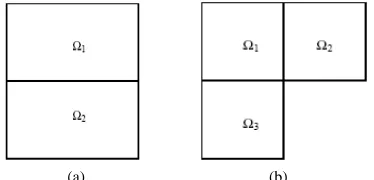
and then ex- changing solutions in the interface between two neighbor- ing do-mains. Let us consider a trivial case where is split into two sub domains 1 and 2 see Figure 1(a). We denote by u1, 1 and u2, 2 restrictions of (1) on
1
d 2 pectively. They satisfy the follow- ing interface conditions on 1 d 2
, v the an v res an : 1 2 1 2 u u v v 1 1 u v n n 2 2 , u v 1 2 ,
(17)
where i is the exterior normal to i. However, the
conditions (17) may cause ill-posed problem. We pro- pose to use the following equivalent boundary condi- tions:
n
1 1 2
1 1 2
1 2
,
u u
v v
n n
2 2 u u i S v v
i S
(18)
and
2 2 1
1 i S n
( , )x z
1
2 2 1
2 1 , u u v v u u i S v v n (19) The sub problem on 1 or 2 together with condi- tion (18) or (19) is now well posed. We describe the general domain decomposition algorithm in the follow- ing. The idea is to adjust iteratively the boundary condi- tions at the interface between sub domains to obtain the transmission conditions of the type (3) and (17). Initial-ize , for all then iterating for , where n is the iterative number:
1, , k K 0 k u 0 k
v , n0
1) Solve the following equations for k:
1 1 2 2 2 2 n n k k u u 1 2 2 ( ) n k u 1 ( 2 )
0 n k x z v x z (20) 1 1 2 2 1 2 2 1 2 ( 2 )
( ) 0
n n k k n k n k v v v z u x z 2
z (21)
2) Solve the following interface equations for ( , )x z
k
:
1 1
1 1 0,
n n k k n n k k u u i S v v n
(22) and for ( , )x z j k:
1 1
1 1
1 1 1 1 ,
n n
n n
j j
k k
n n n n
j j
k k
k j
u u
u u
i S i S
v v
v v
n n
(23) where j and k denote the th and kth
subdo-mains respectively.
j
3) Extrapolate the n1
k
u and n1 in the sub domains
k
v
k
to the whole domain :
1 1 1
1 1 1
/
, ,
k k
n n n
k k k
n n n
k k k
u u u
v v v
n k n k u
v (24) then set 1 1 1 1 1 ,
n K n
k n
k
k k
u u
v K v
1k
n (25)
4) Set n n 1, return to step (1) to start the next it-eration until the solutions convergence.
3. Numerical Computations
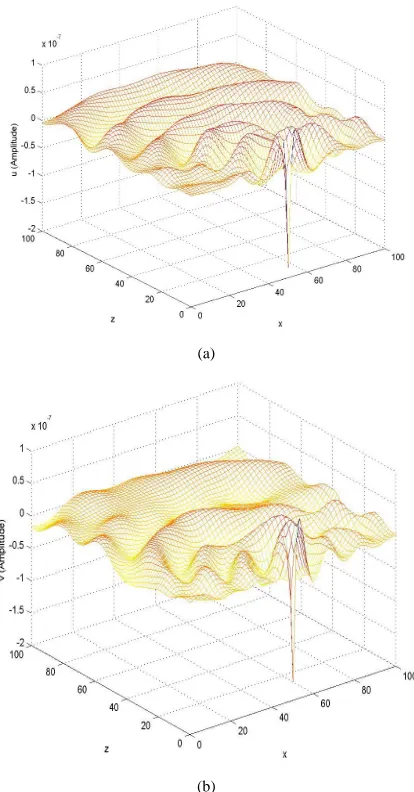
Numerical tests are performed on a homogeneous model and a three-layered model. The source function is set to be a point source. First we consider a homogeneous model with vp3000 m/s and m/s. The frequency is 100 Hz. The convergent solutions are shown in Figures 2 and 3. In Figure 2, the strategy of two no overlapping sub domains is adopted. Figure 2(a) is the horizontal displacement and Figure 2(b) is vertical component. In Figure 3, the strategy of three nonover- lapping subdomains is used. Figure 3(a) is the horizontal
2000
s
v
[image:3.595.330.517.605.695.2]
(a) (b)
(a)
(b)
Figure 2. Horizontal (a) and vertical (b) displacements for a homogeneous model. The solutions are obtained based on the nonoverlapping DDM with two subdomains. The frequency in computations is 100Hz.
displacement and Figure 3(b) is the vertical component. The waveform is correct through verification. The solu- tions on the common interface are almost same and we conclude that the solutions convergence.
Next we consider an inhomogeneous model with three-layered media shown in Figure 4. From top to bot- tom in Figure 4, the velocities of compressive wave are 2000 m/s, 3000 m/s and 4500 m/s respectively, and the velocities of shear wave are 1500 m/s, 2000 m/s and 2500 m/s respectively. The solutions are shown in Fig-ure 5. Figure 5(a) is the horizontal displacement and Figure 5(b) is the vertical displacement. The frequency is still 100 Hz. In computations the strategy of two no overlapping subdomains is adopted. We also present the contours of waveform. The contours corresponding to Figures 5(a) and (b) are shown in Figures 6(a) and (b) respectively. Figure 7 are the solutions with a high fre- quency 200Hz. Figure 7(a) is the horizontal displace-
ment and Figure 7(b) is the vertical displacement. Com- paring Figure 7 with Figure 6, we see that the waves at high frequency have more oscillation which coincides with the law of physics.
(a)
(b)
Figure 3. Horizontal (a) and vertical (b) displacements for a homogeneous model. The solutions are obtained base on the nonoverlapping DDM with three subdomains. The frequency in computations is 100Hz.
(a)
[image:5.595.69.276.85.481.2](b)
Figure 5. Horizontal (a) and vertical (b) displacements for a three-layered model. The solutions are obtained based on the nonoverlapping DDM with two subdomains. The fre- quency in computations is 100Hz.
(a)
[image:5.595.337.508.85.256.2](b)
Figure 6. Waveform contours of horizontal (a) and vertical (b) displacements for a three-layered model. The solutions are obtained based on the nonoverlapping DDM with two subdomains. The frequency in computations is 100Hz.
(a)
[image:5.595.76.270.546.736.2](b)
4. Conclusions
A new wave simulation technique for the elastic wave equation in the frequency domain is investigated. It is based on the no overlapping domain decomposition method. The computational difference schemes and the corresponding algorithm of domain decomposition are presented. The numerical computations both for a ho-mogeneous model and a three-layered model show the effectiveness of our proposed method. This method can be used in the full-waveform inversion. It can sometimes reduce the computational complexity.
5. Acknowledgements
This research is supported by the State Key project with grant number 2010CB731505 and the Foundation of Na-tional Center for Mathematics and Interdisciplinary Sci-ences, CAS. The computations are implemented in the State Key Lab. of Sci. and Eng. Computing (LSEC).
REFERENCES
[1] A. Bayliss, C. I. Goldstein and E. Turkel, “The Numerical Solution of the Helmholtz Equation for Wave Propaga-tion Problmes in Underwater Acoustics,” Computers and Mathematics with Applications, Vol. 11, No. 7-8, 1985, pp. 655-665. doi:10.1016/0898-1221(85)90162-2
[2] R. E. Plexxis, “A Helmholtz Iterative Solver for 3D Seis-mic-imaging Problems,” Geophysics, Vol. 72, No. 5 2007, pp. SM185-SM197. doi:10.1190/1.2738849
[3] F. Ihlenburg and I. Babuska, “Finite Element Solution of the Helmholtz Equation with High Wave Number. Part I: The H-version of the FEM,” Computers and Mathematics with Applications, Vol. 30, No. 9, 1995, pp. 9-37.
doi:10.1016/0898-1221(95)00144-N
[4] F. Ihlenburg and I. Babuska, “Finite Element Solution of the Helmholtz Equation with High Wave Number. Part II: The Hp-version of the FEM,” SIAM Journal on Numeri-cal Analysis, Vol. 34, No. 1, 1997, pp. 315-358.
doi:10.1137/S0036142994272337
[5] A. Bayliss, C. I. Goldstein and E. Turkel, “An Iterative Method for the Helmholtz Equation,” Journal of Compu-tational Physics, Vol. 49, No. 3, 1983, pp. 443-457.
doi:10.1016/0021-9991(83)90139-0
[6] Y. A. Erlangga, “Advances in Iterative Methods and Pre-Conditioners for the Helmholtz Equation,” Archives of Computational Methods in Engineering, Vol. 15, No. 1
2008, pp. 37-66. doi:10.1007/s11831-007-9013-7
[7] T. F. Chan and T. P. Mathew, “Domain Decomposition Algorithms,” Acta Numerica, Vol. 3, 1994, pp. 61-143.
doi:10.1017/S0962492900002427
[8] A. Tosseli and O. Widlund, “Domain Decomposition Methods-Algorithms and Theory,” Springer, Berlin, 2005.
[9] J. Xu, “Iterative Methods by Space Decomposition and Subspace Correction,” SIAM Review, Vol. 34, No. 4, 1992, pp. 581-613.doi:10.1137/1034116
[10] J. Xu and J. Zou, “Some Nonoverlapping Domain De-composition Methods,” SIAM Review, Vol. 40, No. 4, 1998, pp. 857-914.doi:10.1137/S0036144596306800
[11] C. Cerjan, D. Kosloff, R. Kosloff and M. Reshef, “A Non-reflecting Boundary Condition for Discrete Acoustic and Elastic Wave Equations,” Geophysics, Vol. 50, No. 4, 1985, pp. 705-708. doi:10.1190/1.1441945
[12] R. Clayton and B. Engquist, “Absorbing Boundary Con-ditions for Acoustic and Elastic Wave Equations,” Bulle-tin of the Seismological Society of America, Vol. 67, No. 6, 1977, pp. 1529-1540.
[13] J. P. Berenger, “A Perfectly Matched Layer for Absorb-ing of Electromagnetic Waves,” Journal of Computa-tional Physics, Vol. 114, No. 2, 1994, pp. 185-200.
doi:10.1006/jcph.1994.1159
[14] S. Kim, “Domain Decomposition Iterative Procedures for Solving Scalar Waves in the Frequency Domain”, Nu-merische Mathematik, Vol. 79, No. 2, 1998, pp. 231-259.
doi:10.1007/s002110050339
[15] S. Larsson, “A Domain Decomposition Method for the Helmholtz Equation in a Multilayer Domain,” SIAM Journal on Scientific Computing, Vol. 20, No. 5, 1999, pp. 1713-1731. doi:10.1137/S1064827597325323
[16] F. Magoulès, F. X. Roux and S. Salmon, “Optimal Dis-crete Transmission Conditions for a Nonoverlapping Domain Decomposition Method for the Helmholtz Equa-tion,” SIAM Journal on Scientific Compting, Vol. 25, No. 5, 2004, pp. 1497-1515.
doi:10.1137/S1064827502415351
[17] Y. A. Erlangga, C. Vuik and C. W. Oosterlee, “On a Class of Preconditioners for Solving the Helmholtz Equa-tion,” Applied Numerical Mathematics, Vol. 50, No. 3-4, 2003, pp. 409-425. doi:10.1016/j.apnum.2004.01.009