COMMISSION OF THE EUROPEAN COMMUNITIES
COM(76) 224 final
Brussels, 26th May 1976
COMMUNICATION
FROM THE COMMISSION TO THE COUNCIL ON
SHIPBUILDING
I . ' '•.
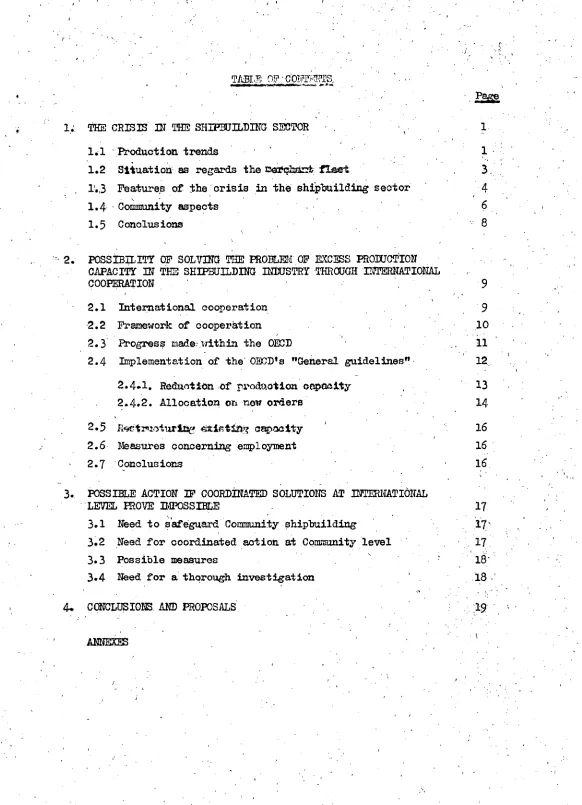
TABLE OF· CON'r:t<~:nrm,
. . . _ . . --~ . .
:1':-1.~
THE
CRISIS JN THE SHIP.BUTI.DING SECTOR1.1 Production trends
1.2
Situation· as regards the I:GrqbtL~; tleetl',J Feature,s of :the. crisis in the shipbuildin€ sector
' .
1.4 ·
Community aspects1.
5
Conolus ions.,. 2. POSSIBILITY OF SOLvnTG THE PROBLEM OF &"<:CESS PROIUcTION
CAPACITY
m
THE
SHIPBUILDnm INDUSTRY THR<XJGH INTERNATIONAL COOPERATION2.1
International cooperation·2.2
Framework of cooperation2.3
Progresl;l made: vi thin the OECD2.4
Implementation of the· OECD1s "General guidelines"·2.4.1.
Radttction.of ~1~oiion o~~ity2.4 .. 2.
Allocation on new orders2.5
n~t!"ll/)'f;UJ'ille' ~,;:tif;titl!_? oapooity/
2.6
Measures concerning employment"
2.7
·conclusions3 •.
POSSIBLE ACTION IF COORDiNATED SOLUTIONS AT INTERliJATIONAL· . LEVEL PROVE D•lPOSSIBLE
3.1
Need to safegtta.rd Coilliiiilllity " ~hipbuilding3~2 Need for coordinated action at Community level
3.3
Possible mea$urcs3-4 Need for athqrough investigation
4-
CONCLUSIOm AND PROPOSALS.ANNEXJi.5
, .
·I . ,;;
1
1·
3.
4
6
8
9
9
10 ..
11
12
13
14
16
16.
16
17
17'
. 17
. 18·
.18 .·
..
.. 19'. .
.
. \
..
-. '
..
, [image:2.592.10.593.18.823.2];:· O. INTRODUCTION ... I r-._...,...,, a•o
\ '
COMt·ru1qCATION .
FROM 'rlre' GOMMISSrON-· TO~
THE
-COUNCJJ., .' ' ·~ . . ' ' ' , ; . '
· Oil
.~·eRIPIDILDUNG
... · ...
Taking- as its basis ·the nature of the situation facing the Cornrm.m.ity shiP"":
building sector and prospective developm~nts, the Commission in
1972
pointed to tf'le coming danger of surplus capacity, and ~
1973
submitt-edproposals to the Council to a.c~elerate the improvement of the industry's COrnPetit.ivity be.fore .the (3~~uation deteriorates without ao~ra.vating .·
the ii!J];rending imbalance.
Sin:ce: the events of late
.:J.-973
in the oil sector, ·and their repercussions ·on .economic activity, the. latent imbalance· betw·een supply and demand has
rapidly .developed and assumed considerable proportions. Th~ threatened '
problems have; therefore; been acutely re~is'ed. ,.
To _adapt t9 ,th~ ef'fects of the cr.isis in .the ·short term,. the problem of 'overcapacity must be resolved,, 5W-d, perhaps, problems· connected with the
allocation of ord.ers. ·In the, long term, apart from the sheer re'duction in
capacity, the Coiili!!Ullity•s capacity 1-.rill have to be considerably
reo;- ·
struct'lired.'·The analysis of the crisiS ,facing the :sector de~onstrates inter e~ia. the. Coi!)rlrull.ity' s interest. in !!UPPOt"til3g rosolutaly and,
if
need be, prc-o motihg any method of obtaining a solution by means·of internationalcollaboration.
/
~;';
' I .
' ! ,
·,
!~:;:
1 •
.'EJlE
CRISIS ll! THE SHIPBUILDING SECTORAlthough the shipbuilding sector is still mainta.ining a. satisfactory level of activity as a. result of work on orders received before 1975, it is faced with a. serious i-1orldwide crises characterized by a. structural
. .
surplus of production capacity oomp~d with current and foreseeable orders. This imbalance is at present reflected in a. d~cline _in new orders accompanied by a. wave of cancellations of· earlier commitments and
a
f'SJ.l of prices.1.1 Production trend
During the last fifteen yea.rs, l'lorld ship production h~. increased rapidly, at an aver8f;e rate of around 10
%
per year,. rising from 7.9 million. grt in 1960 to 34~8 million grt in 1975. This trend has'
.led not only to the appe~ance of new shipbuilding countries, in
particular the developing countries and Southern :furope, but also to a. considerable difference.between ~he Jap~ese rate of expansion and that of most of. the other shipbuilding countries. Shipbuilding capacity has been developed most intensively in Japan, where
production rose from 1.7 million grt in 1960 to 17 million grt in 1975,'whereas during .the same period in the Comnnmity countries it increas-ed only from
4
milliori to7.8
million grt.~ ., ... • !
·: _;' 2
-·: . ...
·:··-~:::)
>:. · __ . :·..
'
_SI-IlPIDILDING,_. ... ;.Br€ak..9:Q.~f- ·· .... wc>rlai·:·:g:'?O~uotio:t~.·
.-. - · ··
1) ·, . f . ,·-. ,·- '. ~~~· ::.: ' '. / ... :... . ' ' .... ...
.... ~· . . ., '
~ . ~ ~ . . ... ~ .. . - ·inillio:r;t grt'. ~ ._ ::
·- -· , :· ·
~%1of ·world·t'otal
·,. . ·~ '·-'J.96o
--·"':7-;234-: '-3·;99q
1,687
.
.·-Y-ugoslavia·- ,··. 0•;182 ·
South.
:Korea.·'Brazil
t-Torld
,,- -; · •• ···,!:-·
: . ..:..
., 7~85~
... .,J
'!-~
"
1970 l974
.·. '·
19.75 ' 1970 . ·.,.
.
... .20;705 '• .'91,4
~
-6;305 27,8'
10,539 46,5'
; 7,4 3,6 .- 2-;9·? ·2,0 ··',
o,669-· \.· .o~672 = ·o~623··· I 2;3 3~0
. 0, 005 . :~ 0' 320 . 0' 420 .. 0 ' 0,056 0,297 -... :01346 _·.· 0,2. ''. - 0,2
'.· ,: .,:,;,I. ' · ... ·
; :· ' . -or-< •. . .:-
.
.... _.'100,0 100,0 '
.. ,. ·-~>:, ·-:··-·-~: :-.--~~~-- . . . 22' 643
. ' '
·-
: .!, ·; • ~ •Soure~: 'Lloyd's Register of Shipping . . ·, ~ --, ~ }
'. . --·~-: :· .
-.. . . ~ ·~
.·, ~
- . -... : ~
.. . ~ l . . ' ( ~ ·.· .
~-. -
-_i)
n... .r.r.·o uc.d
t. ~on . . ... ...., . ships comman.ced - + shipsdeliver¢ " ..
2_ . . - ·
..
. . ·• ~-.I
.; •,
19'7
4 '
.1975·~n
;o
''90?2 -... ''22?9 ;_·22)3'
50,6 49,4
6~0
6,3
-· 5,0 4 ~.
'~
;, 2,
6
.. 2,9 2,6 2;7..
·t~9'-..
1,8 0,9· 1,2·0 f • 8 . 1,·0
100?0 19~)0
' > '-'-· ,,
. 2), mil,lion .grt = million
gross
regJ.st ered.~oriS
: (see ArL"lex I for·tli.edefinition-_. of
the
units used) •.. ~ ; . ' ' • ; . . . . , . r. t:·:
. : ' - ·' ' /
\ . ,
• • . t . ;:'',:I ~ ' I '
.··_.-....·· I.!.·
...
' :· " ... '.
:'. ;~
'• ·.'.
'. ; ' ' .. < ~ •
'·'
,I
'•
-'
.,-This trend was a.poompanied
:by~ a:::fien~~hey for·.:p·r.<Xfuo't'~on'to.'b~come-··mo~·.:.
specialized. This was caused mainly by tho need to rationalize in. order to
: de(3.].
·~c:.;:tll ~.:4e,.tnand
which .we.s g.rovd.ng·.both' ·i.'l respGct of·quanti_tY·.~d-
..~ality,.,
.: ...
o ,, ' ' ', :• • ' ' ' •• ' • : f ' • I • •
Thus a number of. uridettaJdngs. in _Japan.l¥.1d .-the. western <European countries
,. rda.pted.
the·i~
p-;odtictionf'aclili~j_e~-
to_~on~ent·;ate o~·
ihe
b~iiding ~f o~rta.in
.
type~ o~
vessels,~in ~artio~la.r ·I~ie· tanka~~
..
In a.d.d:itioii,";.shipy~·
spociaiiy .·.'designed for
const~ct'ing s~oh
vefilsels wereore~t~d;· .'parti~ul~ly
inJap~
•... '' .. • • . I
The production· of' t~ankers cttroontly
,piavrs ·
an· i~ol-tant peJ1;izi
the shipouildtDg: : ~ ~ '·
\.
. . . .sector throughout ~he world." · · .
• ' . ' . . . . J ' :: ·.: ·: ,.
BreakdoWn
~-
world iotpl.of.
shil's de:t!i wredi..:.b:X:ty;p~
o!,veesel in· tho;usand grt and ~;,- ... ' I ' •
.,. ' I ,. ' . . 1.. I.
I
· ·Year
1 ·Tankers . .
Buik·.
carrie~ .1 · ·9-thers l . ~ Total·· · ·• ' . , • !' ::.grt at
1
A
~
,%·i
i
·~t;
,
of. '1"-...__..oo!o-... _,.__v_-+-_g_J.;·-11 ...
~-·
·-·~·---111-,
._c_·'-·
-~1-'-_:_10-:
- ·J
1970 ·
I
10 033 j47
.a
12o
9~1
I
too
I ;
'1974· ,.
I 2'0854
162~2
. . . \33 541
I 100 .I
. 1975
;2~725-1.66~4,.
. :34203 1 ·100·1
=.!_· ... '- ;_,· · .. ,,; !·" ,. . -·.
t·, .... ;·
!;,., 'c(l)
Iiu.rther d~tails in Annex· II ·'~ j· •. • ' • '. - ~ I ~~. ~
1.2 Situation of' the merchant fleet
.
-The trend described above can be explained by the. ~peotacular inorease
in oil transport require;oonts .·which
b~gan
in thei~6·~~s .an~ l~·d
to am~
ma:-ked demand f'or tankers andlarge
combinationoarriers(l)oo~a.red
with
that for 6ther. types of vessels_., Despite' the. f'act that-Si~
·Ofex-. .
cess transport capacity 'Qege.n to appear
as
ea.rly as 1912~73, man;yship-owners pursued a feverish bt\fing policy, encouraged by the considerable
expansion in public and private credit, thus lea.<iing the shipyards in
their, turn to increase capacity considerably.
_Following the events of
1973
in the energy sector, the growth of the .trade in oil was hal ~ed, indeed, abruptly and the demand for its
transport declined. In the mep.ium term, any revival of such requirements
.
'•
I
•,
..:.4-I '
-. ; ' ~ . I .
...
will 'Pe. inf~11enced by new· ~evelopments
;in
the:
tr8de·in
encrg;)r of the.· iri.-.'dustrialized cow1tries, such as, ,a r~lative decline in __ consumption. due to more
J!ation~i utili~atiori,
the tendency to shortent~~port
rou·bes.e.g_.
by the_ openiilg and probable, .vd.denirig of the. Suez·. CMal,: the working of !leW.sources • ,esPecially in the North ·Sea., and t.he
devl~iopmelit
of.pi~eli.!l~,
etc-.'. . Although the energy policies of the oil-producing and ...:ConsU.ming c~'untriescannot yet be fully appreciated, the, medium-term forecast~ are for ·C!--'less '
· ·
s·ust·a~ed.
development of. oiit~ansp~rt
.. by sea than.he;e· before. , : . .. · . •. . ., . . . . .,
. : .
There is currently estiLw:ted to· be an 'excess of
1/3
in tanker mipa.Oity, · which, . tak~ into account ves_sols Wlder construction and in spite of forced modificatiqn of producti.on pla."lS (cancellatioris ~d conversions) is: expected . to last. at least until, 19,~0 (Ju:na"{ III). _ ,. .,In :parallel' with these structural 'changes. in oil. tr~sport, -,the re'cent .. economic · recession_h~ led :to a tS'eneral decline in trBd.e, and, therefore,
au:
overallreduatio~ in the-growth of shipping.
-. '
The crisis on the _oil transport ma.rket .. has ·haa._. serious reper~ussions·
em·
thesl1ipbU:i.ld~ indci:ltcy. ·
For those shipyards specializing _in the construction_ of large tankers, the
immediat~ consequences have been:
le:.r~sca.le ca.ricella.tions- of orders and .the amendment of some· to other types of vessel; '· .
~ aimost total ~sen9e ·of new orders_,_since the end of
i974;
a. a·ftua.i;ion 'ElX.pecteq ~o. end~. for .several ;v,e.ara ~ .\ ..
. ,·.,. ·. .. ,
,.
-:.
Neverthe~ess, the ~emaining orders for t~~ers will ensure satis~actory
levels of employ~ent until 1977; this type of shipyard is then in danger of
oointi
·qompletely:w:fth'~t 'wo~k
in. its i3peciality ·until at leaSt 1980 •.. . .. . ' . ' ~ .. '
For qther ·types
or:
~hipya.rd, the oonsequoncos of th~. crisis in the oil. · transport market :wi+l. mainly. arise from the attempts' of big shipyards . spezia.J.iz'illg in large tazikers . to· put their equipme;tt to use in these .other m~ket sectors. ·Howe~r,
the :construction. o;f' dry bulk carriers,~.sub-sector
of the 'i.ridustcy,which is.technically closest to the construction of large tankers, oould
. .
in, turn be. affected by surplus
.
tannage~. Several. factors could cause a .de.cline in activit~: .
. - the conversion. of orders for tankers i.D.to·
bulk
carriers ; ·- the use of combination vessels, preViously used for oil, for ,. the .transport ,of. dry bulk ; ·.
account of very low prices rullJ"~..g in 'Japan.
It must therefore be expected that the current level. of oi'de.IS fqr ~his , ·: '" type of vessel .cannot be maintained during the worst of the crisis in tanker construction. Shipyards specializing in tankers will the.refore .not
.
' .
be e.ble to switch t.o bu1ldi..'lg bulk carriers, withOll,t damage to the level of'the activities of shipyards ,operating in this latter sector.
The activity of shipyards operating, in the ~ket for other types· of
.
.
ships (freighters, specialized and miscellaneous vessels) will probably only suffer
a.
temporary setback caused by general slowing down of theeoono~.: Nevertheless, e. crisis could a.rise.if shipyards specializing
in
It.~~. dif'ficul~·
t!·~~e
a~.~t~:.~tive. e.rtim~te/7'. _th'7:,lJ~rl<:l~~~~. ~~Pt~
·production. capacity iri. shipya..rds. According,. to· a.Wil,able. estilpates'~. for' ... ; · , ' , • • '
1 , •, ~ _'. , , r • . : • ·: ' ' :.,_ ' , , , ' , ' • ' ' : I , ' ,' ' I. , ' ' ' , , ' ' \. , '
.
'!;h~ periocf-1976 'to'l98o' ~d~iiredin
grt, it' a•noWtts. to ;tm aver~e .0~40.%
:f~r~'th~-'whole .:ilid~try,> ~d:.:to. ·a'b~~t .6o·;~·:for tallk~;s,
..
esp_ecialiY .the· ...., , ., ' , ' I : , • : ' , ' ' . , •• .. 1 41, , -~ l . , , ' ·.I • :. J .. ~ ~. , ' ' ~ ·I • . • . • : . ~
large
run
·veiry large.: Eq)ressed iri. terms of 'employment levels, ·end bearingin mind th~t , ~he +abQ\U' ~qu_i;r-ement! varies. c~hs iderably · according to .'·the
tec~i~~
features .. of the V?or.ious,;~ypes
of sh'ips, built, this'stirpl~
cap
a,;.' ' . '· . -·- . . .· .
·city. is abou~ 20% for. the .. industry: as a wh'ol~
arid
about· 60·% fo~ tankerc.or~t~cti~n· (~~es ·~·arid
V}• ·.·: ... : .:· ,.... - ' ' '
Hi th
·r~gru.a'
to.
~arket
·p;ospects for·.th~: ~hi~~~~~i~
¥ld1;tst;as.;~· ~hole
aftet1980,
theieneral~~acce;t~d· e~·tima.tes'j~:t!d ;~·~how
that~f;lplBnd
.win. . ' ~ . : ~ . . ' . '
pick up again slowly. However, this recove:ry will not oo··su:f'.f'ioie!rl
to· en- ,
· a.ble1current ava:fla.ble ·,cap.acityin ·be· ,;.tilizedi the
:~r'i~is
isth~~~f~;e:
o:f
a ·structural na:ture;.: . . :· . . . ·:·· ;,;, .. -~:' - .. ·· ' . ; . . .. '
• ; ~ ' • 1 •.
; . -.' . ,_ .... ~ '·. ; .·, ":.'
1•4
Com~nit~pspec~si .·.:
.. ! .·.. ~ .: . . . •• " :
I,.. ' .t.
'.
• .- ~- r"
~. : ,, ...
~ f .
.. .~:.
The ability of .individ!,l.a.l yar.ds to ta.Ckle such an ext.erisiw .and except'iona.lly
J ~ • -r '
lo~l.a.sting
c'risis.v~i_es
gre.atly. The struggle: fors~i~a:r
will. urtdoubtedly··-.. ' I .
be ext.remely .. hard.. · ;: . ; . . -. . '·· . ' ~
,•,.
..
~ II • ~ ~, ' ~.- • ( :
" ·. I -;_ .. ·
J'af)anese shipyards, tvhich erijoy compara~ively substantfal advantages., above
I
all b~cause, o:t'teil forming p~i;, of' industrial and-. trade conglomerate coiJl-0
p·~ie;~.
that are.:rinanci~lly,
strongerthan
.the~
,opposit.e numbers. in the;Conmrunity,, vrill be.better equ~pped .to P-ea+ with:. the crisis~ This ·is
alreadY
evident; J~anese shipy?,rdsa.re
not-r obta.ining·.the.·majority~ of new 'oJ;'dersi'.., : ~ ...
.' '.~ ... :
...
by
offer'~
'i>riot.B; which ·wouid not.aiiow
'coininunity"shi~~a.rds.
to.rb.~ta.in
• • , ., • · . ~ " : . · • · . • ; : . , 1 : . . . : ; . . . ·.~-~ .:.:<:~· ··-~ ' .··. -~ ,· .·
their a.otivi'ties·; :A·nunibel~ of ·commti.nity shipyards are there~ore in danger
:o:r: being 'forced to 'oloae
end.
~his
wouldfu_~h~r
..
strengthen the Japanese. . ·. . :'
indUstry•s doniinance of a.' market wh'ioh will stabilize a.t a lower level •
. •· . . : . "' . ' . . ·. '. ·
....
,•.
Th.e ship~ilding . . ,• .,• industr.y .:is extremely. important to the CoiiiiJn.Uiity (see ; . ~
; Annex ,VI). It. dir$ctly. emp~oys more than
.:too. coo
people ·and also·proVicies W:o~ft.t~ ;a. further .1.000.900 odd in various supply industries, whosede..::
liveries of goods or services represent a.b'outl 60% of· shipyard 'turnover. The industry is also extremely important for regional policy,_ as it 11:1' . . . . . t. ' . ~ ' " . . . . : . ' : • . ' •
· often located in regions···w~ere the· struc~ure of ind~str7 is sca.rpel;y-·'diversified {see Annex VII).
in'
·addition,'in
t,he light of·t~e
Community's export trad.e ahd the fact. :tha.tmor~·'th~
80%~ c~ried
b;
-~e~ the·C~mmunity
has a. right to retain-somedegree of independence, in the building of the shipping essential for its trade and thus to contribute to the .. maintainanoe of international
oompeti~ion. In this connection, it should be .noted that shippirig ·Urid~r ·
,,,Member. stat13s' flags: ,ac·c-ounts ·for 22.% .of tho world ·merchant fle·et.
rn·
the :. past, C9IIJ1!l'lll1i ty ship owners purchased a.bo\lt two-thirds of new ·tonnage' fromCommunity shipyards (Annexes VIII A + B). These shipyards sold about one-third of their pro~uotion on th_e world market.
'•.
Fpr the Co~ity to be in a position to ma~ta.in
a
share of the shipbuil-ding market commensurate with ita interests·; it must.devote more effort .than in'the pas~ to re~$Sta.bliahing the oompetitivity· of this sector •·_ ....
.
~~<;'
·.; '
/
f ·~·
·.·'';
... " .
- lht this restruo~
pan
.olll.Y
be.
echievedm'the
"long term.!t
is neoess8ry to m~ ~ the short term measures suffic~ent .t~ dee!l ·with the seriou.S em- . ployment and regional .problems likely to. arise, as the .. unf'avorable market · s_ituat,ign develops.1.5
Conclusions' •. ' •• ' • 1 ...
This·
analysis highlights. the severity of the crisis facing .shipbuilding .·'!he mazzy·. assessments of others· confirm this situation, and the observatiOns
' 4 .• .• · • • • I· '
made by the OlOOJ?. ·Cio!'e . telling: 't}ley ~aid· .that recent ~es ·~ •••. clearly show t~e seriO'llllness _,~r' the,' problems to ·be resoi~a: on the one h~ .a
~ub~t~tial ~1,1}
6£-
t8nk~:X<.ionna:ge
ill
:ilid~
short
Ma:
meditim ·term,·.arid
on'
the other, a
very
·large. surplUs in .s.hipyard.capa.ci~y
inth~ "sl~~rl .~a·.
long . n. run.
!n view of. all the factors ·mentioned;· we mu.st eocept that the Community. cannot escape the consequ.ences of the crisis in this. industry. Bear~· .
in mind the political, economic and social interests involved and 'the .. features peculiar to this industry .where traditional protective measures are ineffectual {see 2.1), Comnnnity action must be plenne_d to help keep the
. ' . . . . ' ~. . .
harmful conse<iuences of t:ilis. crisis to a ~
1
and el~ate t;he _Co~ty inclustryis handicaps in~ relation to its. co~etitors.·; ••
Jr-,·.
''
,:;'
I I
\.
Convention8J. market defence measures ~uoh as in;lort ~ontrols .. or
the introduction of 0\'lStoms duties are dif'tioult to apply in the
shipbuilding sector; partioulm,ly
as
shipowners oan resort tothe use of fl·~ of convenience.
Furthermore, both the crisis i.n the ship~Uding seotor ·and, the
ma.t'ket · it serves are worldwide. It is therefore to be fea:red the:t
uncoordinated measul'es by individual countries woUld be ineffective
and, because of their protectionist effect, lead
onlY
to disruptionof competition and a partitioning of the market.·
It is to oppose a. development of this kind .that the most important
shipbuild:i.lJ8 nations ha.w subscribed to 1;he .OECD .arrangements on
aids
to shipbuilding and. export· oredits forvessels*)~
FUrthermorethe Communities Third Council Directive ·of 10 July 1975 on aids to
shipbuUding
(lf 75/432/ElOO)
stems from the same concern •. *)"General arrangement on the gradual elimination of obstacles to
normal conditions of competition in the shipbuilding industry''
which has been in effect since 1972 and which ·oonoernes pa.rti~arly
. .
the gradual dismantling of direct aids and the "Arrangement on export
I,
I,,
-;"":·'
..:.:.
' '
-
10-These factors show tha~ the mqst suitable ~hicle for re-ee~ablis~ing
a satisfactory equili'brium between production capa.c,ity and demand'
is that of international. c~perat'ion. The aim of .such ·.cooperation
should
-~e
toachie~ ~- a.degu~to.
andO~derly reduct~o~
inpl~Od~ction(l)
. ' . . ' ', . ~ ~
and_ thereby a fair distribution of the economic an4 social burden
involved. ·This will·prevent the bidding·up· of·cos~ly financi~ aids
'' '
and S·af eguard the freedom · of -t rad.e ~
Th~s approach is conson'a..'1t with the Cornrrnmity•s· commercial pol"icy . principles and. interests.·
All
posf!:;t.b~~' efforts IllUSt therefo~. be, mad~.•"':,
to prevent 'the emergence. :of .new barriers. It f?hould be noted .. that .the
' . ' • • , '• . . . I
Community, as-such, has 26% by value of the world's foreign trade;
and that this together with intra CoiW':!!Ullity exchanges· amounts to
40
%
of -world trade.2.2 -~:.r;o,rk -for cooperation
~lmerous lilitia.tiws.hn~_ ~ad.Y beai-ttlkon by ~blio enthorifitm, and
interested
c~les
·to solve -throughinte~i.enol coopernti~
theworld-vTide problems ·of 'gradually adjust~ the shipbu;!.lding industry
' I , ' ' ' . • ' ' . '
to a.ctuai needs. It should be noted he:re that, at the level of the .
. . , ..
industry,· the Ass.ociation of l-Jest EUropean Shipbuilders (Av.JE:i) .and
the Shipbuilders Association of japan (SAJ) are studyi~ the possibil~ties
6f establishi..11g jointlythe bases for volUntary restraint .in the industry.
These negotiations have, however, not produced any obvious results up
·' .. ,
(1) .The expression nred,uction of ca.pa.citiesit used in this doeument'' covers . variOU:S measures such a reduction of production, abolition of capacities
by convert~ng the~ to other activities or other forms of withdrawal
of investment.
The most noteworthy efforts made by public authorities have been undertaken wit~ 0
'in
the·emxm.
As90
%
of world ship production comes from countries represented.in this Organization ahd its work has already produced a valid basis from ~.
which to develop acceptable solutions. The OBCD's seems the most appropriate forum in which to work out a system of internationai cooperation·.
The fact ~hat some countries do not belong to. this Organization (notably
Yugoslavia., South K;orea. and Brazil), or do not participate ·in these activities as is the 9ase with some members (notably the United States and Greece), does not invaJ.idate this conciusion.'~- Indeed, though their production capacity is
not hegligibl~; it is not such as to constitute a. major threat to the effective
appl~cation of a system of international ·coope~ation.
2. 3 Progress made within the OlllQP_
At its meeting on 30 and 31 March 1976 the OECD Council's t~orking Group n° 6
on shipbuilding reached agreement on the "General Guidelines for government policies in the shipbuilding industry" (Annex IX); they have 'Qeen adopted
by the OECD Council on 4
Mavr
1976.According to these "General Guidelines" ~rhich are ·based on the principle of solidarity, fairness and international responsibility, each member.
gove~ent of the Working Group n° 6 (*) (although not bound to do so) .should:
(a) set ·itself as first priority the objective of a suitable reduction . • . • I :. in its shipbuilding capacity, taking into account the regional and social problems which the pursuit of this objective will create;
(b) refrain from taking any measures or granting any- aid likely to up-set the process of adaptation within the industry in' question;
·*)The _"Genel'al Guidelines" have been adopted by all
pr!)d1J.c.~r CO'\ll:ltrie~
. ,in the Community and by the following cOQntries: Spain, Finland, Japan,
I ...
12
. . . .·f ··_,. ....
-~ _..; ·.. . .. . .... . . .
(c.) ensure tha.t practices, partiotilarlY for p~iping, ;r-em~in.'-ritliin the' ii.~it:s· of ~~ir comp~titi~(.·· .· · ··~ ' . · ·. · .• ... · · ·
' . . ' . ... . ' ·: ... ~ ~-:·_. ~ ·. .
of:.new ··coriS'ti'Uction capacity. · ·.
• .. ·•. 1 ..
/
Under these "l'zenera.l Guidelines" it
was
-~so ag:r,eed~:to ~~te theexC?h~e :o~ info:r:~a.t~on, particularly about··developments iii. national
P()_l~cies,; t;re~d~. ~ produc1i~ cepaci'j;y .and the order· book of each
. p~oduoer. OO'!J1ltry •
..
. ' . . 'r!'l' •• • ; . ' • ·
It
sh~ld a.l~o
be· noted that, althoughthes~ .~'Genera!. Gtiidel~es"'
haw been accepted by those Member States which are shipbuilders, seileral haife ..exp're~sed.
reserves,.q~~d ·o~·Ahei~
own. partcicula.rcircumst~·es,
... about the ve-ry principle·op,
~ucing .prodl+ction.~capaci.ty._: ,,. · ... ·,;·
'Ihe Community stat·ed in a dealara.tion that the "General Guidelines" were an. initial-.. ' ., : . ~tep .-;hich s:P,ould' be followed. befor.e the· end of· the current
' _., -. . '
year by :pos~tive ~asures ~to ~~stabliS'l a .bal:anc~ between supply and
demand (~ex X).:· . :: ....
-...
.
·' ·' ' -~ ·,. .~ ~ .. . ~j :.
2.
4
Ipple!I}entatipn, of th,e .O~D' s ,"General G:uj.delines" ... ·,,-- ' . .. . ~ .
·.-Since these · "Genera.J. Guide'lin~s" iiilPose
no
b'blfgat.ion, . th~y.are
in fact• ~ ,I . ' ' ' ' . ', ~ • ., t ~· • . • • ' •
·recommendations 'to the signatory courit:des. FUrthermore~ the prinCiples which
tfH~y·
leyd~wn.-·
are .
6f
:a.VGrY
~enefal:
n:atUi'e Blld i finlpiem~ziteCl
Withoutco~rdinat'ion
risk failing to achieve tliJ objective· ofre-e~t.~liSh:i.ng ~
-.13-
.,2.4.1 ReductiOn of productiop oepacity
. \
In the light of 'this, the Communi~ must be ready to gq fur:ther1
should the OID:;D Gu.idlines fail to a6hieve th~ir object:iws (reduc-tion of capacity, alloca(reduc-tion ~f ne:w orders) . and try end negotiate
a. convention or gentlemen's B,;,"-Teement. with its main p~ners within this organization.
J3ut straight aM~ the Community· should 'a.ff.irm unquivoca.lly its willingness to pursue the realization 'of these objectives on the basis of the "Genere.l Guidelines". In pa.:rtioula.r, it should declare its readiness to pley its part in the reduction of global production capacity for the purposes of re-establishing a. balance between
supply and demand.
·In this. comtoo~ion:, the ••aenerai Guidelines" BJ.low each participating country to decide· for its·elf, ·the extent,· rate a.nd means of achieving the reduction of its capacity.
It ill for consideration whether CoiillllWlity crite-ria and mechanisms should be established for the. coherent application of these · "Guidelines" within the Coi!IIIDlnity and to enable the Gonu;nmity to platY its pa,rt
as
such, thus avoiding disjointed action by its Member · States.The Community has an interest in ma.int~in~ a shipbuilding industry which is collll'etitive on the world ma.rke.t and best able to supply Comounity's own needs. This obje.ctive . .. . . m~ best be secured by the . . ~ selective reduction of the Commw1ity's product~on cap~ity.
'
\. ' ' 1
To act on its commitment ana iuin'dful of the aheve mentioned C:oi11l'!!U.ility
p1·i~~itie~
,'.the"·c"~I!lnission:
·Hnlco~ul
tth~ T~mber
States· ahd other pa..T>tiesc'6nce~ed:
ahcfth,enpf~se"nt prop~s~ls·_f~;
qornmun.:i.t; action'. particularly on ·' .
the reduction envisaged the extent of the criteria,
means
and.times~le for. . ' .
for the Cpmmunity.
6n
the :specific point> of how the reduction w~ll be borne. by the uiffererit Member.·States,' th~ Co~~~ioh pr~poses to ad9pt .the follcrwing cri teriru-; :
. .
...
c~pac:i.tysh.6uid
in the mam, be reduced in th,ose Me!Jlber States;. in which. _ \ .
shipya>:>(is usually bUilding t4e types of ship ~f.ected by the crisis are located,
.
and
,should bein
dire~t ;r9port~on
to the .. relatiye~ v~lume
of. . ·.
such 'cnpacit.y
in
~ach Member State;. -, ' . ... ~' . ···.:- .
""' each Member State ·will decide for .itsetf where .the .cuts :will be made . . . ' within its ovm f!hipbuildmg industry. It. wOu.lc'f. indeed be .·economically wrong:, ~o,close the mos.t up-:.to-d.ate anfl. efficient ;y:~d£:l i·lVhich ~e of~en those, f'i tted out .· t6 buil'd big
t~ers.
· This freedem of manouyre .willmake :.it possible. for the ·cuts· to bear mainly on the less effici,a.nt yards,
to
the extent that this does not create social p~oblems, and providedthat there is c.n .actual raiuction in tanker ·produc=tion capacity';·
reduct_ions in capacity will be defi..'led -in compensated gross registered
tons (Annex. I),. Shipbuilding i~ gimerally a labour intensive operation,·
: ' . •. . ' ~ ' ! . ' . ~ -· : • . • . . . . .
but the labour reqU.irement -can ·1.rary widely· depending on the type of
. vesse-l btd .. lt~ the use of· cgrt wiii
allbw
for ·these dif'ferences.·when · '. ::·Q?nsidering hovr ther~dttotions
should be·shar~d.
·The 'fea.sibilit;y: of this appr?_ach -.it must .meet the requ:i.rements rif l?oth
employment and .cor;:rpetitivity - vTill largely hinge oh the _extent to l-Thich,
' ' . . . ~-: ,· . I ~ . .
agreement can be reached be·cween the two sides of :the industry. The com-:
mission t-lill consider -v;hether the means could not be provided to allo~.r this
concensus to be reac:hed together at ·the Community level.
' '
·~~~·~*he .. ,~lloo~tion of neli:l orc'ters, the OEPD's
"'eneral
Guid0lines" envisage, at the pr~sent, a systei~1atic e:Jcch~ooe of information· about the state of order books. ···lb:t it must be borne ,in mi:rid that' the reduction of capacity, even
if. agreed and orderly, uould bo·.b~t.LtO\ndught
-lw'.
tbp~~ootlOtmtroUon oforde~
in
·.oe~ ~tm.trl:ea
'Ol"a~Gt'dB•
Maz.ket-to~ ol-Ol:l~ m~
t-tell not .bring about an equitable distribution cf the consequences of the ·crisis. One can therefore consider that, in ·the fra.uiework of a
cooperat'ive mternatio~1al policy, a ·nece~sa.ry ooruplement' to the
. '
. .
.
' ' . ' . : . . .• reduction of· capacity will be a temporary agreement ebout-mw Joroers. In
thio' e<:mnoottoo, Jopo.n~se public authorities
ana
•'industry haveboth ?SSerte~ .that their shipyard's pricing policies are economically
. . '
justified •. Nonetheless it remains the fact that: .these policies pose recl problE!mn for. the Comnn.mity•s. shipbuilding, industry.; A consequence of their considerably 'lm·Ter level of prices is likely to be that
· . the· majority of new . ' . ord~rs ' _vlill . continu~ to go to· .. Japanese yards. The Communit;y- ~hou~d. therefqre, tdthout waiting, prepare proposals vrhich could be put in good ~ime to its O!!XJD partnel'St should the excha.t'lgooe of information envisc:~ged. by the "General oUidelin~s" prove ina4equ.a.te to ensure a fair distribution of new o~ers.
This problem is so complex that only detailed study will. allow the
. . .
main lines of such proposals to be defined. We shall, .hm.r~ver, have to depart from the ~ption that the participants will accept shares .based upon the pro~ortion of world orders.that they obtained
'
.
... .~ 16
'1 ,,
, ·o'~. :._ ., i_ • • ._ r - -.. \
The Gor.mmnity shipbuildi.ni industry can be bette~ .equiped, to. meet future .
market requirenlents if it uses this ."!;ime '9f crisis,.1;o overcome· once .and
. . ,. . .. .~ ;·' : · :· , " '·;.' ~·· I . ' .Jc. ,1,: .~ : ' ; ,• . for all the competitivity handi.cap t--ihich .rr..ak:es it so vU.lneraple todey •. ·
' ' . • I
This, requires ··a ·decisiVe effort· to re'organize and mOde;mize shipyards
-throUghout the
.Co~ity before~
if. atall
pos~ible, th~·
end. o:r .thepresent crisis. T~ this
end
it is neciess·acy to conoer"Ji. e:x:_fsting.·. :· ancl prospective. ~ational measure t~gether with an;y p·bs~ible Commuility
act
:Len •
. .
2.6 ~wres c,srco.~ing eumloyment
Decisions taken to reduce' ·capacity and to restructure exiSting capacity
will directly .affect employment and could cause proble!Ill3 in certain
-1.- • . - - . . .
. .--. . . .· .. .
regions where industry is little divers?£ied. This calls for the
pre-.. paration.-of
·pr~graiames
that· will enaure that any adju.stnents in~mploy-~-• ' ~ • . ' - ' -- . I ~ .
ment wii'l be >UMG Wi:th due consideratio~ for the inte~osts Of employees
with i>ci.rticular emphasis on their redeployment should they have to be
.
.
. - .- .··
made redUndant. 'llhe Cori1ID.ission :-.rill p:opose support for national action
-·in
th~s·
fieldvia~he
EuropeanHegi~nal
Fund a.nd·t,he~ope·~
.Soc:laiI . . ·.- . . ·, , . '. ~
Fund.·, and particula.J;'ly tmder Article 4 of -the Council Decis-i9n of
' ' • •• I • • • • ~ ; • : ' ' •• ·' ' • ~
1.2.1971. The Cor;]'Jlission has already laid an appropriate proposal before .
the Council {cor.r(73)1788 ·final Add.-dated 14.1.74) •
Conclu.Sion
Even .successful internati·onal cobperatipn will not. solve ., - fo~ the· Corruiiunity
the qasic p:roblel;!l'facin.g. i:ts shipbuilding sector, i.e. seeking ahd
establl.shing a d~g:-ee of c9mpeti:f;ivity comparable .:t;o that achieved by
. . ' .· . .
its WOJ;ld partneJ;S, pa.rticu:larly._ Japan. 'fh.ere is no reason why this
. . . . '
objective should !'lot be . a~tained, especially if Commu.nity. shipbuilders
' ' ' . . ,.., ·. . .
. ' . . fl " . •
resolve to· take ,advantage. of all the potential offered by the Co:mrm.mJ.ty
dimension ' It follows that this restructuring is the . maill problem to be
tackled, as the Coontission has on more than one occassion sought to bring
'- . '
.
the Member States to realise. It can..."lot .be relied upon_ alone, however, · ·
since i~ would 1?ring no results in, the short term, even i f set in hand· immediately.
/
3.
~IDLE ACTION IF COORDINATIOrt OF SOLUTIONS .AT. INTEIDTATIONALLEVEL .PHOVE3 ll•D?OSS IBL~
. .
· ShoUld the ·OECD be unabl~ ·to offer'
a:
satisf~tory .. solution, tpe. . . ' . . . . . . :
.
. . ~ 'CoLlilll.mity should seek, with 'Japan,. an ~ement, open to subscription 'by· eny other
OECD
member. In viet~ of its economic ,social .and. strategic . . .·' .
impor~anoe, the Community cannot' see its.~hipbuild~ indu~try elimtnated,
i f the ·efforts
bei~g
merle to achieve an internationally coordinated'
reduction of capacity and'allocation of new orders should fail. This would require it to take any ,necessary step ·tc preserve. a euffioiettt · shipbuilding o~pacity to protect its vital interest.
:a.it the donnnunity will b~. obliged to hasten evel'l more the unavoidable process of reducing capacity and iliJpro~il;g that considered jndispensable
in the event of a complete failure of all attempts at international cooperation •.
In
doing' thiS;' solut'ions will have to be foulw.ed on thoseBaOO
principles of iiltra-Communit.y coordination a8 weres~ecUied
for a poss;ible in·ternational agreement in sub-:-paragra.phs 2 .4.1, 2.~,:· 2.6 and· 2.7
above; and· shouldb~
s'eught, ·to-th~ great·~'st
extent possible, with theagreem~ht
of both sides or' industry.· But atzyw€!iY,if
this happensit l'till· not be possible to Ulld.ertake any 'orde.rly ·.reor~ation ot production
. .
facilities unless they are accorrrpahied
by
immed~a.te steps to ensure the survival of that capacity that needs to be retained.3•2 !eeB;.for ooordinate?-..iaaction at Communit;y; ~o~!, ·
. It is to be :feared that. the failu.re of e:f:f"orts at international ·cooperation will give rise to a. prolj,feration of unilateral tutional measures, in
I '
-~'. i:'· ... ·.
,•;
-- 18
< • . r
, Fr?m the Community's shipbufl\.".i!lg ind1:1stries' point of view, the
p;rolir~e·!'ation
of natione.l 1"!!ea.sures 1'10Uld imperii J:iot onl; ConllriunityI • . . I
solid~ity_ but: also;. as. a ccnisequel_lce' of 'enfeebling internal co~etition · weaken•,its.
erlerna.J.
coroPetitirlty. The "coo!'flinatioA o:r, the steps that·~Ouid t:h~
havet6'
be· tak:en·-vlithi.n the Cor.mnmitymust
the:refo~
be
·arrane~d.
This ·need~ ~ernonstra.ted
by the :tactt~at th~·
direct and indirect national support i,or the industry heretobehas
not enabled..
it to be. competitive ·with third. countries shipya.rd.s,. particularly those
i ~ • ':
in· j
ap
a"l~ .3. 3 .
-=-··==-Possible action8I ' I
Ip. viet·l· of the abova, maintai.ri.iilg at least the- essential core, of a CoiDIIllinity
. ·
ship1n~ildill~ ind~·stry re~{res':
.:;.. ·cori.tirluous · CoiD.ll!UD.ity coo:rdination; to be effective this must cover
all. fields of action consic1ered •. ( ·. .
- joint recourse to all those ueasures necessa.7 to maintain t:he activities
of at least -the ess.entiaJ. core of the industry, and ;protect it against the measures of third. countrieEq among these rneas~es .one· ~an rule m+t
. ' • I
nei·~her financial support .for sh:ipmme!'S or yards, nor . . . .
·a:zy
appropriate.
. action in the field of maritime or commerd.aJ. policy. . . .. '
.
.
Hhat is more,· to obtain moxir:n.un results, the use of such measures in
combination cannot be excluded.. · '
• ·'l
' '
3.4
'Heed for a ·thorm1goh ex:a.L1ina.tion ~... :e-... ., ,. . '
The ·extent of such measures, their costs and modalities, shou.ld be
examined fur:bher, in t'he light of future developiiients affecting the resolution
of the se?t.or's proolems.
. .
In
an;;,r
case .su9h measures wotild involve a more serious political conmi.ittment ·~- '
than those -in .consequence of .an· iri.ternation8l ·agreGment, since the ·comimthity would then haye to act.
m
a- clitiate of hostility~(
. ·,,
. '• . ' .
4.
CONCLUSIONS AND PROPOSALS...
The. CoiJUiliss ion is. of :the o;;inion that, . to· obt al.n best reaul:ts, /the. serious world-t·dde crisis in·shipbuilding oal:).s for immediate Community action,
in adyonce. of .azzy possible fruition :of. the ariavoidable steps for re- ·
structuring the, industry in the longer term! It believes that among such pof3s;ble. community initiatives, the best wa.y of achieving a. satisfactory and orderly balance •between supply ;a.rt.d demand • ~ .h~ce a·fair, distri-. bution of the elll;luing economi.c and social consequences - is to ·seek
solutions through international cooperation. This cooperation:uould' also avoid recourse to autonomous safeguard meas~s with its Em;SUi."lg
disadvantages.
. . - . . . ....
Accordingly the Commission considered it approJ?riate that the .. Coiil!I.lt,Ulity should at this stage ·talce constructive action follow~ the initiative
shown ·by· the OFXJD~ and which h~ found practical expression· in. the acceptance of the "General Guideli.'les for government policies in the s'hipbuUding
industry''.
· To this end the Coznmission recomme11ds ·that the Council should· decide on the need for the Community to:
-(i) negotiate'· on the basis of
a:
common position any meaSures necessary,l~ithin the framelrork of the OFXJD, for the implementation of the
"General Guidelines". ,
(ii) conunit itself, within that context; to plq its part in bringing about the reduction in production capacity which is necessary ..
on
a. world wide scale in order to restore the balance bettieen supply, and demand.
(iii) define at the appropriate moment the extent of the Community's ·share · in t~.is l:'Undown
as
well its ti!lling •.The .·CoJDmis'sion.wj,ll_ inform the· OECD that ,the above action ·is the Conn'rilmity's contribution to the gradu~ ·application of the principle of solidarity, of international responsibili·liy a.."ld fairness which ls the basis of this
Organization's initiative.
For its part the Commission will not fail to fon-va.rd to the Cauncil, suit able proposals with a. ·view to implementillg t:l;le above action, based on the guidelines contained in its Communication.
··-.
..
.,
_.._!,,
, I
~--•'·
' \ .. · ....
,·
..
t ·.·
' .J.
. ' ;.,.
f .
I
ANNEX I
Gross registered tonnage ·_(:grt,
f.
The·_gross· t_onna;ge of. a ship is a measur~. of voltmle .and "- is ./ ~reseed in tons: the value of ' I 'a
ton is 100 cubic feet. ~or 2~83
m\
: ::_. :·,:.
·
r:···· ..
· \ ' - .
·.D'ea.dwei$t
to~ (dwt).,_calC?~at·ed
in~etri<;'_.tonnes,
i'a a measur_ement~f jlj.e total.: .~eight of· cargo, fuel', and .. s~ppiies __ .etc •. c~ried on board ··
.ship.-·
.,
Remark: Theoreti~ally these tw~ units
are'
n,ot comparable~since_they'refe~_;t9: different . concepts ... A fixed ratio exists only ~or ~ specific ship.
:H<:mever, _for similar. types' of- vessel, it is som·etimes· pe'rmis~ible to make
an
appr~xima.te
conV:ersi.on;this
fa:o·wr .may_varY
f~m
o.a5
tO
2.0; in the. . .. .
. cas_~_:of o_il tankers it varies fr,om h_~ to. 2~0~ '
Y.
It is .impossible always to use the same Unit of measurement. :aoth a.re used in . the text according to the nature of the data ava.ilable.
' . . . . . ... : . ' ' . '·.. ( ·~ · ... '
..
. ~' . . .,. ' ,. . ./'
'Compensated. gross ref)ister
tonna.~e
(cgrt_) is a measure for the expression·~-of.
'the _amount -of·. labourre~r~
to build a ship; it~akes
account of the fact :that the' activity measured,in riumber'of hours ~e~ grt'variescon-... ' . . ' ~ ' ' ! • . . : ~ .
siderably accord.ing t~ . on the d~erisions,._ ~d type of .:.ship~
5
000 cgrt . is defined as the equivalent of:theamount
of labour re·quired to build' ·,
...
a gener8.1 cargO vessel of 5' 000 dwt.
;:Tonne.mile is a measure of· tr~sport ··oapa.ci ty:~the. .
_unit
for which represents.
_the carriage· of:~ wei~t of one ~metric tonne'~ver one· nautical mile
;(1 ..
852
m). :
' '
··
~' . . ...
.
~,.
,_ ~·-.
·.','
,I
..
. ~ .. ~ .. '""'. '· ·,.,~, .
T,y-pe of vessel Germany
1m
. .1. Tankers :1l54~8
--2. Bulk carriers 428•9
3 •. _Genera1 Cargo 90•5
'
4,- .$p9Citlllaed ca~go 22;9
5. tUscella.nc.ous 145.8
Total 2 142.9
=
1.: .
!!U.J.
..
. . .1. Tankers J 749 .. ;5
2 •. Bulk carries .. 3.1L3
· 3.
General cargo 195~-84·· SpoclallzOd' cargo· 145.•9
5·~ Miscellaneous.
L
{/
1\
(
)
. t.\..
. ·~ ."' ..
Total
'
~-96.0
2 '498.6
(Source: J .. loyd's Annual Summaries of Merchant Ships coniplt:tcJ-,... tal'lt 3)
\.
- ....
~]ether:.
trn:t+ ed:
..Belgiu."'ll · Denmark France· Ir.eland _ Italy
· 1&.n1s. Kingclo~ CO!!L'llU'li ty
. ~ - .. .. . ·,·· .. .
119~8 . 785~ 6 •. . 691.2
-
586~3 .819.1 . 457;.3 .,
4 914~1129.~4 21J.;l . 76•4:
-
29L8-
44£; 3 1 585.9.;.. 4L4 55~2:
-
27;0 39;7 200;6454~4
,.18L7
·-
..:.-
25~9 20;5 25~2 276~2.
-6"9 36.5 :. 41.7 0.4 . 22~2 62.6 67
,o ..
383.1 ....
'
256,1
1
076.6 1 046.2 0.~4 953;2 .. . 941-·9 .1 196,4 7 613.7~ - =
====-. . .. . . . .... . .
. ..
18;.9 -.~
648;5
638.6 ... 497 ;4. 871<3 584:·4. 5'008.6... 112.6: .. 202.;3 .
_
.. 28;1· . 226;8: ·:: ·-J-5• J 380;8''· . 1 277;2-·
85·.:o .. .60~2 2.4, . 36~3 41:5 I66·3 587·4·50;9· '· 396;3.
_,_
4;0 17,:2
c:o
' ; . 620;3...
-r.
. 18.2 33.5'". 54.6 ..., 27:0 83.< 2 . 32 2 34-1· 7
..
..
11
028,:5200.6 969.2' . 1 149· 7 30.5" 791,5
>
lt-9 5 7 838~2' ~ .. .: ..
~
1/
Reet of "''-_,_
:··Japan·
World Worlcl.
"-·
11 710.8 ':
4
229.1. 20 8SJ.3 505.9 . .
.
-~ : . .'2._ 366.6 7 45·:'180.1. . 1 531.0 2 7~--::·
484.6 224.6 oo--, ..
.,..' ·~
412.6 682.2 1 4'"''
-
.... . . .. '16 894.0' 9 033.5 33. 'jf~J. ~ ~·
· t · ' :.~ :-· . .
.
12·646.7 6 070.1 22' 7~:·) ~
',
2.918 .. 2 5• 052 •. 6 6 24G.o ..
981.8 1 207.3 . 2. 77'-'·' 5
161.6
290.5
1 0q2·.i(.283.2 152.:4 1~380.?
16 991.2 9.373.1 . 34,202. ·.
-~--~
~?j·
.,
.. ···:··.:: .. :,-.
-.. -.:·.
':-.-.~.m~.cl..f.?.r
....
O.i.l •.
c .. e.r~.c~~.ij;¥- . \. -;.· .· :.:
-~-, .•..
~> >'{ ~tl~·iihS.t~)::-, ..
·-._~~--~-<
>:: .. · .:> .
. ' . c: .liORL!> ·· · •.
1974
1980
... ; ··, .• 6 . . '
1. Oil transport by sea in 10 tonnes 1 624.
:.
~.450.
1 661*)
.• • • • , ' I " \ . "
2. Car~ying_~apacity requirements .in·.
I
j\
.· ·. · · ·i-6
12 .. tornie-•:nii'es · · · .. ·, .··-
..
I .I
11.16 13.02J
. . _..I
3 •...
Theoretical ·d~mand;·::;, ··' :.. , for .. oil ... ·~~ers
in106
d.ut.:. --; . :, ' 2_34 1 frO!D--240to 255
.28.0 · .. ' \., ...
4.
Theoretical carrying capa.Ci ty ·· available (Fleet+
delive~ier:)6 . ..
in 10· · -t dut . .. ·· ,.
. I
280 . I .. \. ... I
. ,,'. 340
*}
Based on an assessment. of the development· of· future. oil. r~quirements ., .... , .... · ·· ·· ·:·by
tho.pmii:on
tlie
ooeumPt-S.on·
:or:
c. priec <>~ if6.t~rbnnel.
. ·
. · .,
I. .
The oil tanker fleet t~as est:i,mat~d at 3t0 fili_llion tdi.r as at 1 January 19761 o:f ~•hich more than .one third was ~urplus·. . .
I . ' ~ ' ,,. ' ' ~ ' ' ·:- . .-~ :
Nerchant Fleets of theworld
- - - --=:-=-=--:
·= • ... ..
"
(ships
of
100. grt and upwards) . ·,: in 1000 grt at the 1st Ju~y of each year\ . . . ·, ·: ·•·. -~ .;: .
.
. .. ·.:-; :·' ... ..._-- * .
,
...
_r-·
·••
t' 1
'
.
'
1970 ...
·-··-·l::...:·l9-75---~··''i ..
ifulk carriers ) . . General . cargo-··: · :·· ·
-~
Specialized cargo )~.lis ce 11 aneous
)86
140
46
652
72
396
6 699
15 603
, . i ....
·15o
057 1 , .:85
?48' _·· .
70
399.
19 189
'16
969
I '
I
Total
129
770 · I 227490
342 162 Iof whioh eotmutity.
43
621 57.370
74
282·l· .
----~~---~---~---1.
Source: Statistical Tables of Lloyd's Register of Shipping
oh t!rikera
Bulk carriers
. 6.55
others
5.84
Oil tankers
280
.Bulk oarriora
109
others
300
. TotaJ. 689
221
82
..287 ..
590· .
-455'
265
846
·1 566
l
!
117
I .
!
848
(1) Bas.ed o~ the initial estimates drawn up by the A!OO
( *)
St andBr<l: .::la:l Hours. '
I .
. : ~ . : .
·, ... . , .. •· .• ·:··
...
,. -~ :.···.
ORDER lOOKS
(in
'103 grt}.,
ArW..I!lX. V ~.
'lYPe
of vessel. .
.
. }·Ireland!
:-;_ ·' It.aly
.I
'!
F.R. _ Belgium I Denmar~ France Worl: ·~tbta-1.
Nether-lands· Kingdom ;-.. - .
~~
tJ
l-
Co~uni
t;l.
. Jap&l,~
Rest -o:f the l·rorldI
-· -_ .
~ Gem~-~
I . I
·1
t ..
l
. . -
-as at
~1 ~
12.121,~
• • . . · •~
, ' ' 'I .· " .,, l ' · · I
I
1 · ,_,
Oil tankers
-Bulk carriers
(a.l1 typos)
\
Other vessels:. _
5·113
951
i 615·
44
480
2132 408
564
--261
3 6o7
2
947
~·.~ 1.
961
. 95
968
.. s--
281
1
418
80
394
3 9.23:
i
411
Boo
~ ; :,~
-18
474
45~
. .
c
6 516
'42 '820
6 962
2 '737
25 409
5
8917 345
86 703
17 4<>: ; ... 16 :=1:.}it:
TOta;l
1· . · · . . . :
1
'7679;
_I ..
7~413
23316·
5541
100
l
3. 210:.1
1892
1 :
6·134
J
29' 5~91 . 1
52 519I
38
645 1120 70.'l"i
~
..
as at
Jl•l2.1912
Oil ta..'"lkers
:Bulk carriers:
(all -types)
·-T
'Othci vessel~ :\
\.
' ·\· ·"', 1'601 ~713' II . . . .-- .1
888
~ •. \ .;
. 44 1 340
t
2 162 -···4l6
449
67-.'- 2
-- i65- .. , .. ---· -213
I ..
2 -696·I
1·219
552.
. 3 237 ..;:_
.816 ·66- 1'·03.6
262 326
_·.::·656>
.· .. ,
10 155
.. ::3 563
. -. '
"· 6''208
18 716
9
881
2 766
17 466
I
46 :<376 099
11?
54.'7 492 i 16 4C:J
j_~--· 944.·.
l: _
·: ,
k -_
·~:
1 .: · l02i
4ass
1
>
691· .
2 ?9719~--
-l
4
?29 _
1 1_9.:926_1
31363~
o57
1
s23r'
CiiNCEU..ATIONS- ~ Bettwe~rr 3:}. December 1974 a.nd )1 Decef!!ber, 1975
-the
oaaoenaticn
ot
~ers-·t(£<-0!.1.-~~~ ~-$ mU.liaz)-~tdt-19
: i which_. c~r:ref.!'OOnda t<.> more thru1 18 'million. grt'; . . . ' . . : . - : ; < i . - . • .1IT3.:
·.,
-,;,
-·;... ~
_.: .. ~:
-> This ~-
.showe -.
the considerable reductio~ in' orders due mainly to· :thrae.fa.ctors.:'<-- the hi~ rate ()f production · . .. _ :~ · ·
:-'-- :-'-- cancellations ·· ..
-- --·-the~ la~k of .hew .-orders· for-largo ~oil· ta..."lkqrs; '· · ._,. · · ' , :_; .:·
...
. . :.:. - -~ ;~ . ,_-:- :-';;,.
:' . ':- '1 .-:~:
·'
:'",! 7
~
.
-,;
_.::..,:;-·.·:/ ;..:,
,. t·-~.--::;
.:: .. ... . ... .
...
~· .~. ':' ~; .. .·'; ~~ . \~!> •• ~
-~~ . ,--~
-~~- ~ -,l;
. \ .:_~
\--l' 1'.._-<; '.
-·
··.• ..
·:._
''.
;
.
' '
·. ,, . ~ . ·.· -~:
.. ,._
..
·. : .•
Ma:t
~ere
Etm- SharE', of the -::~'l'otal !~ro -·
sector in the
Country ll'llnb'rs ocpl~edr ployOd
as ·
o.
pex-GDP •• • l eq?l.O;y~ -.ill the ceirtage ot the · ·
me.~<n- ship
&.'tlve
pOpi:Ll~ionyardS
*)
- ' ....
...
··Qerma.n;y
65
700- 45' 000 i 0.25fc
0.32%
Fra.rtoe . 44 500
15
Boo. 0.20 "/o 0,20%Italy
. 42
000 --15 800 0.22%
0-17% ...Netherla.nds 49:300 17 400 ' L10'}h: 1.40
%
Belgium 12 500 • :0.32
%
,United
173
000 40'000 .. 0.65% 0.69%Kingdom ..
Ireland 1'780 • 0.17 "/o 0,23%
llenlrJark
22 3005
100 0.90% 0.64%Community 411 o8o (139 100) 0.40%
0.35%
· ( awrage
tor
7
J~pa.n_ 265_~800
('7o'
ooo)
0.51%oow:rtrles)
. ' .,,
sweO.en.
31
5~0 0,79%; . ,. -·~:-·· ..
•) capable of constructing
v~esels
wi1;ha.
capacity of e.t lc:ast 150 000 tdtv. ' ~ . . . ..
O.B.
'rhodata
~wnabow iilclude relctod actlv:tties, OCJI'&ot.Q.\l,J"
1nthe
en-.
~~aoote:r, il3sofar aa
tho7
c.a-o
oa.rried out
b7
~ort~ 1nuhiob
t)ie · t1ldD
aotl'Vi
ti
is
the
oomrtruotf.011Md
Jtepair otvessels.
these
dat~
azoe based mainly. on D&ticul~rial
ste.tistios, the figures,tor the
ditf'ereut ... oountriesare net necessarily
comparablebecause
at gaps· \o~, dU't'ereDCes
ai
def'iMtioD.. · · ·/ 1 I • I
.•·
I .
...
' ..
'.· .. .,,
'·.
:
\
\i·
I I.;
;
! '
\
. !
....
'
·.l·
l
\'
j
!
.\ i
. r
..
l
:.·:·
~-;' :~:~·;_':
·
..
,~:~:
----.: ...
>.·~·, ~::~~:·
.
~ ~~;·~· :~:?j.~.
. ·• .. t ; ·.:C~-77
,:_ .. _:.... ____ .: ... ,----~~---·~~-·-..
·~ . :
r
! :
.. :."· , ' '
'·
Annox · VII-SHIPN!HDltiG.
Siting of the· main Dhipynrrln,
(acco~diug to ~~pllPA to Lh&" OECD 'lucation:l(lirc· ''::
15 Feb~uary 1973)
·-t·~· rroiil-2 ooo to 25 oc)
· gross ton~
o from 25 000 to lOC 000
groee tons
0 over 100 000 groe~ tono
0,5 .
D
National Pr.oducti,nror 1915 in millions
. , ot groas tons
(according to Ll~yd'a
R•giater ot ehl~ping)
...
T.
.,
...MOOit&OO
..
I
}.
1,.·
-.,
... ,~; 'y
.!L~:I,Y'1ml,EB.
TO COivlMUNW,.,f?,ffl.f..Pi.:mms
D~.191:1. ·
BY
COON'l'RYctJ!' ..j!l]!..,P. .
,.
--
.•.,~:h&Bing country Cotmtry of buil(l
- a t
-·
--(for registratio~ in) Country of registration Other F.C countries Total EC countries Non-member-countries
--- grt
'%
grt%
ri',.,_ grt%
-
grt· .:1f::-.... _
--
~--
...-
...
. .
.. - . .
Unit~ Kingdom 954.428 25.0 . L 104 326 29~0 2 058 754 54;0 '1 754 608 . 46,q
. ... ~. . . •. .. . .
-
.. ,. . i8'6 044 -- -
.
.·-Belgium
-
-
132 0~1 '132 O;l 99.9• '
428
734
·. ·nenmai-k ' '67~5 ! . 49ob23 7;8 478 357 75;3 . '156 921 24-7
· ·1
:514o-24
.· . ' 31; 2 - .. 43-:_6992;1'.
1~089 349.France '557-723 33~9 - -66.L
~ ··~-
:
.. _
-r•R.
aenrimzy - - ·1. 291 786 .. 96.2 5 486 0~4 ' 1.297. 272-
..
96.6 ~. . •. :. ·44·992 . ."' .3.f:-,.·' ,.
•· · ·. :trela.l"..d . ". . . . . ·. ;-~. ~~
-
-
.. 220 13~7 ~ ·.220 13~7 }-385 . 86. '),.- ' - . . ' .
-' ·- . - ' .. --·'
'.:~-~· _,, _, .
Italy_- ., 887.-424 . 99;97 _·245 0~03. 887.669 100;0
-
-' '
_,, :NErther1a.nc1.s - . 39 641
15.7
_149 141 1:9 3 ., . ) Q ~ • -~88 782 75.0 62 902 25.0-.
- '
-
--. ·--.Total EC
. . ' .. 4 .. 116.037 - 47
.o
L352 872 15.4 5·468-909 62.4 3 296 201 ·37.6
.:....----
-
--
----
.
---·
Japan Other oountrias '
.
'
·' . · ...
: .. ·
· .. ...;;
..
.·
' '. · . -.J,apan 8 Q 08? ' ' . 1 . ; . .
304 ..
· ' .
2~4_::..::...::.-.~.~-·
-
.
'- ' - . - '•
•'
--.i .·
~-•''
.: .Sou~ce: .:Lloyd's ~~a1 Summary 1974 ('l;ablc 4- Registration of all ships compl~ted during 1974)
, • , , . , >·• - •
·.:'.
\. ---.. ,