Open Access
R E S E A R C H A R T I C L E
© 2010 Taylor et al; licensee BioMed Central Ltd. This is an Open Access article distributed under the terms of the Creative Commons Attribution License (http://creativecommons.org/licenses/by/2.0), which permits unrestricted use, distribution, and reproduction in any medium, provided the original work is properly cited.
Research article
A pre-post test evaluation of the impact of the
PELICAN MDT-TME Development Programme on
the working lives of colorectal cancer team
members
Cath Taylor*
1, Joanna M Sippitt
2, Gary Collins
3, Chris McManus
4, Alison Richardson
5, Jeremy Dawson
6,
Michael Richards
7and Amanda J Ramirez
2Abstract
Background: The PELICAN Multidisciplinary Team Total Mesorectal Excision (MDT-TME) Development Programme
aimed to improve clinical outcomes for rectal cancer by educating colorectal cancer teams in precision surgery and related aspects of multidisciplinary care. The Programme reached almost all colorectal cancer teams across England. We took the opportunity to assess the impact of participating in this novel team-based Development Programme on the working lives of colorectal cancer team members.
Methods: The impact of participating in the programme on team members' self-reported job stress, job satisfaction
and team performance was assessed in a pre-post course study. 333/568 (59%) team members, from the 75
multidisciplinary teams who attended the final year of the Programme, completed questionnaires pre-course, and 6-8 weeks post-course.
Results: Across all team members, the main sources of job satisfaction related to working in multidisciplinary teams;
whilst feeling overloaded was the main source of job stress. Surgeons and clinical nurse specialists reported higher levels of job satisfaction than team members who do not provide direct patient care, whilst MDT coordinators reported the lowest levels of job satisfaction and job stress. Both job stress and satisfaction decreased after participating in the Programme for all team members. There was a small improvement in team performance.
Conclusions: Participation in the Development Programme had a mixed impact on the working lives of team
members in the immediate aftermath of attending. The decrease in team members' job stress may reflect the
improved knowledge and skills conferred by the Programme. The decrease in job satisfaction may be the consequence of being unable to apply these skills immediately in clinical practice because of a lack of required infrastructure and/or equipment. In addition, whilst the Programme raised awareness of the challenges of teamworking, a greater focus on tackling these issues may have improved working lives further.
Background
The National PELICAN Multidisciplinary Team Total Mesorectal Excision (MDT-TME) Development Pro-gramme was a unique team-based residential training course attended by colorectal multidisciplinary team members across England. The Programme originated as a
series of workshops funded by Macmillan Cancer Sup-port. It was designed to teach surgeons the technical skills to complete total mesorectal excision (TME) by live demonstration of the surgery using video conferencing facilities, and thereby aimed to improve the quality and usage of TME surgery. The success of these initial work-shops led to the NHS commissioning a fully multidisci-plinary programme for all members of colorectal multidisciplinary teams[1]. The demonstration of TME remained central to the Development Programme which * Correspondence: [email protected]
1 Florence Nightingale School of Nursing and Midwifery, King's College London, London, SE1 8WA, UK
also aimed to provide education about relevant aspects of radiology, histology, oncology and nursing.
We took the opportunity to evaluate the impact of par-ticipating in this national team-based course on the working lives of colorectal team members. Underpinning this study was the drive to tackle the high levels of poor mental health reported among UK cancer doctors. In 2002 the estimated prevalence of psychiatric morbidity (GHQ-12 scores ≥4) among UK hospital consultants was 33% compared with 27% in 1994, according to a national cohort study[2,3]. This deterioration in mental health over an eight year period was especially marked in clini-cal and surgiclini-cal oncologists and explained by increased job stress without a comparable increase in job satisfac-tion. Similarly high levels of poor mental health have recently been reported amongst colorectal surgeons and nurse specialists in the UK NHS[4]. On the basis of find-ings that MDT working may be beneficial to the mental health and working lives of team members[5], we evalu-ated the impact of participating in this novel MDT-based Development Programme on levels of job stress, levels of job satisfaction and team performance of colorectal can-cer team members.
Methods
Study design and participants
We conducted a pre-post course evaluation involving all core team members from the 75 teams attending one of the 11 courses in the final year of the programme (Sep-tember 2005 to October 2006). Core team members included consultant surgeons, oncologists, histopatholo-gists and radiolohistopatholo-gists, as well as clinical nurse specialists and MDT coordinators.
Procedures
We ascertained team members through the PELICAN Cancer Foundation, the charity coordinating the Devel-opment Programme. Pre-course questionnaires were posted and e-mailed to each core team member approxi-mately three weeks before each course, with a reminder two weeks later. Post-course questionnaires were sent four weeks after each course, with reminders sent six and eight weeks post-course. Consent to participate in the study was assumed by return of a completed question-naire. Confidentiality was maintained by the allocation of a unique identification number, necessary for matching pre- and post-course responses. Approval for this study was granted by South East Research Ethics Committee and by the Trust Research and Development Department for each multidisciplinary team.
The Development Programme
In total, 35 courses were held from June 2003 to October 2006. 183 out of 186 colorectal multidisciplinary teams in
England attended (1639 delegates in total). Courses were held on a monthly basis and an average of seven teams attended each course.
Each course lasted two days, over which time team members received education about the management of rectal cancer from national leaders in the field. Central to the course was the opportunity to observe live TME sur-gery with two-way discussion between operating and lec-ture theatres using video conferencing facilities. There were also seminars on the latest advances in imaging[6,7], pathology[8,9], pre-operative radio and chemo-radiother-apy[10], supportive care issues including stoma manage-ment, and the management of secondary disease. One session was dedicated to the challenges of multidisci-plinary team working. This session was unique to each course and chaired by members of the teams in atten-dance. Team members had the opportunity for social interaction throughout the course by virtue of its residen-tial nature, with overnight accommodation for two nights, together with a course dinner.
Outcomes
Change in self-reported job stress, job satisfaction, and team performance between pre- and post-course assess-ment.
Job stress and job satisfaction
We measured self-reported job stress and job satisfaction using an adapted version of The Hospital Consultants' Job Stress and Satisfaction Questionnaire[11]. The result-ing study-specific questionnaire comprised items com-mon to all multidisciplinary team members (46 items related to job stress and 44 items related to job satisfac-tion) and items relevant only to team members who pro-vide direct patient care: surgeons, oncologists and clinical nurse specialists (10 job stress items and 10 job satisfac-tion items). See addisatisfac-tional file 1 for job stress and satis-faction questionnaire.
Job stress and satisfaction item scores: Each question-naire item was rated according to the extent it had con-tributed to an individual's total job stress or total job satisfaction on a scale from 0 (not at all) to 3 (a lot).
by summing ratings given to the individual items that aggregated to each source and were standardised (on a scale of 0-100). For each score presented, the higher the score the higher the level of job stress or job satisfaction.
Total job stress and satisfaction scores: Total job stress and job satisfaction scores were calculated by summing ratings given to all job stress and job satisfaction items respectively. Scores were standardised (on a scale of 0-100) to aid comparison between team members who did and did not provide direct patient care.
Team performance
Key aspects of team performance were measured the Aston Team Performance Inventory[12] (ATPI). Each team member rated 33 statements on a five-point scale from 'Strongly Disagree' to 'Strongly Agree'. Total team performance scores were calculated by aggregating responses to all 33 statements. Individual statements also aggregated to one of six domains of team-working (table 1). Scores were standardised to enable comparison across domains. The ATPI is designed for use as a team-level measure and therefore for each team in the study, the response from individual members was averaged to give team-based total and domain scores.
Pre-course expectations of the Development Programme and reported adequacy of skills training for effective
multidisciplinary team working
At the pre-course assessment, team members completed
an open-ended question: 'What are you hoping to gain
from the PELICAN MDT-TME Development Pro-gramme?' At that assessment team members also reported whether they felt adequately trained in commu-nication skills, teamworking skills, handling complaints from patients and relatives, and team leadership.
Statistical Methods
We assessed the impact of participation in the Develop-ment Programme on job stress, job satisfaction and team performance by analysing responses from team members who responded to both pre- and post-course question-naires (n = 333). Analysis of team performance excluded one team as only one member responded to both pre-and post-course questionnaires.
We used repeated measures ANOVA to assess the impact of participation in the Development Programme on team members' job satisfaction and job stress (total levels and individual sources) and team performance. Due to the exploratory nature of this study no adjustment was made for multiple testing. Analysis was conducted using SPSS v.15 and R v.2.6.0.
Responses to the pre-course open-ended question about team members' expectations of the Development Programme were read and main themes described inde-pendently by four members of the research team. Once themes were agreed, one member of the research team coded each response according to the agreed framework.
Results Participant flow
Between September 2005 and October 2006, 568 team members from 75 teams participated in the Development Programme at one of 11 courses. 464/568 (82%) team members responded to the pre-course questionnaire and 367/568 (65%) to the post-course questionnaire. A total of 333 team members (59%) responded to both pre- and post- course questionnaires. The average number of respondents per team was 7 (range 1 to 10).
Characteristics of team members
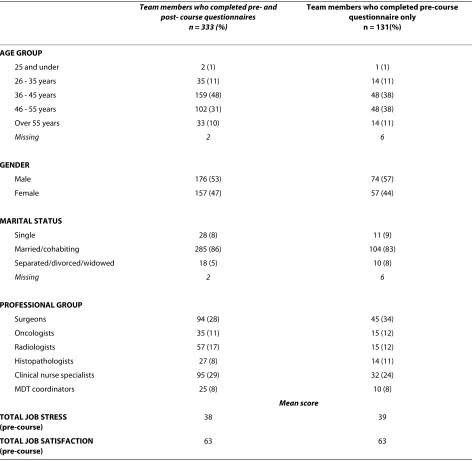
Team members who completed both pre- and post-course questionnaires and those who were lost to follow-up had very similar baseline characteristics, including having similar levels of total job stress and job satisfaction (table 2). 104 team members participated in the Develop-ment Programme but did not complete either pre- or post- course questionnaires. Of these, 67 (65%) were male; 46 (45%) were surgeons and 21 (20%) were clinical nurses specialists.
Over half of the team members who participated in the evaluation of the Programme were clinical nurse special-ists or surgeons. Overall, the proportions of male and female team members were similar, but over 90% of MDT coordinators and clinical nurse specialists were female, whereas 90% of surgeons and 79% of radiologists were male.
Most surgeons and nurses were core members of only one multidisciplinary team, but the majority of oncolo-gists, radiologists and histopathologists were core mem-bers of between two and four teams. Five percent of team members were core members of between five and nine different teams; over half of these were oncologists.
Job stress and job satisfaction among colorectal cancer teams members at the pre-course assessment
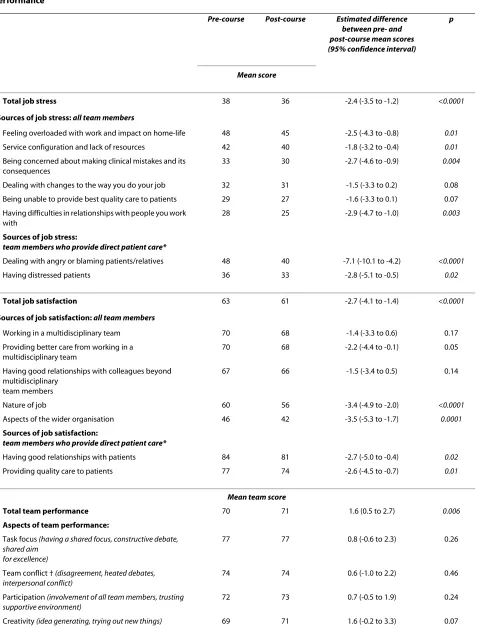
Among all team members 'feeling overloaded with work
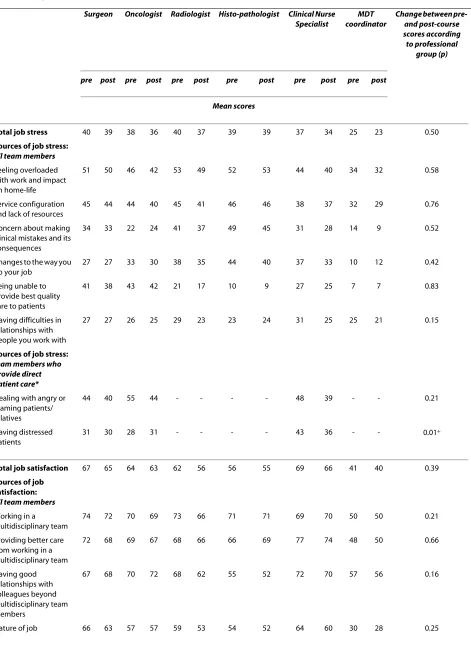
and impact on home life' was the most frequently reported source of job stress. 'Dealing with angry or blaming patients/relatives' was associated with similarly high levels of job stress amongst team members who pro-vide direct patient care (table 1). Across the professional groups surgeons reported the highest total job stress although only significantly higher than MDT coordina-tors. MDT coordinators reported the lowest job stress; significantly lower than all other professional groups (F5,327 = 4.9, p < 0.001). This pattern of differences in lev-els of total job stress across the professional groups was repeated for each of the individual sources of job stress (table 3).
mem-Table 1: Impact of participation in the MDT-TME Development Programme on job stress, job satisfaction and team performance
Pre-course Post-course Estimated difference between pre- and post-course mean scores (95% confidence interval)
p
Mean score
Total job stress 38 36 -2.4 (-3.5 to -1.2) <0.0001
Sources of job stress: all team members
Feeling overloaded with work and impact on home-life 48 45 -2.5 (-4.3 to -0.8) 0.01
Service configuration and lack of resources 42 40 -1.8 (-3.2 to -0.4) 0.01
Being concerned about making clinical mistakes and its consequences
33 30 -2.7 (-4.6 to -0.9) 0.004
Dealing with changes to the way you do your job 32 31 -1.5 (-3.3 to 0.2) 0.08
Being unable to provide best quality care to patients 29 27 -1.6 (-3.3 to 0.1) 0.07
Having difficulties in relationships with people you work with
28 25 -2.9 (-4.7 to -1.0) 0.003
Sources of job stress:
team members who provide direct patient care*
Dealing with angry or blaming patients/relatives 48 40 -7.1 (-10.1 to -4.2) <0.0001
Having distressed patients 36 33 -2.8 (-5.1 to -0.5) 0.02
Total job satisfaction 63 61 -2.7 (-4.1 to -1.4) <0.0001
Sources of job satisfaction: all team members
Working in a multidisciplinary team 70 68 -1.4 (-3.3 to 0.6) 0.17
Providing better care from working in a multidisciplinary team
70 68 -2.2 (-4.4 to -0.1) 0.05
Having good relationships with colleagues beyond multidisciplinary
team members
67 66 -1.5 (-3.4 to 0.5) 0.14
Nature of job 60 56 -3.4 (-4.9 to -2.0) <0.0001
Aspects of the wider organisation 46 42 -3.5 (-5.3 to -1.7) 0.0001
Sources of job satisfaction:
team members who provide direct patient care*
Having good relationships with patients 84 81 -2.7 (-5.0 to -0.4) 0.02
Providing quality care to patients 77 74 -2.6 (-4.5 to -0.7) 0.01
Mean team score
Total team performance 70 71 1.6 (0.5 to 2.7) 0.006
Aspects of team performance:
Task focus (having a shared focus, constructive debate, shared aim
for excellence)
77 77 0.8 (-0.6 to 2.3) 0.26
Team conflict † (disagreement, heated debates, interpersonal conflict)
74 74 0.6 (-1.0 to 2.2) 0.46
Participation (involvement of all team members, trusting supportive environment)
72 73 0.7 (-0.5 to 1.9) 0.24
[image:4.595.64.541.112.748.2]bers 'working in a multidisciplinary team' and 'providing better care from working in a multidisciplinary team' were the predominant sources of job satisfaction (table 1). Sur-geons and clinical nurse specialists reported the highest job satisfaction; significantly higher than all other team members except oncologists. MDT coordinators reported the lowest satisfaction; significantly lower than all other team members (F5,326 = 16.5; p < 0.001). As with job stress, the pattern of job satisfaction levels by profes-sional group for the individual sources of job satisfaction was similar to the pattern for total job satisfaction (table 3).
Impact of the Development Programme on job stress, job satisfaction and team performance
Across all team members, levels of total job stress decreased after participation in the Development Pro-gramme (table 1). Levels of job stress decreased in six out of the eight individual sources (table 1). The decrease in total job stress was similar across all professional groups, as was the decrease in relation to seven of the eight indi-vidual source of job stress (table 3).
Levels of total job satisfaction also decreased after par-ticipation in the Development Programme (table 1). Lev-els of job satisfaction decreased in four out of the seven individual sources (table 1). The decrease in total job sat-isfaction and each individual source of job satsat-isfaction was similar across each professional group (table 3).
There was a small increase in team performance scores after participation in the Development Programme. This was mostly accounted for by an increase in one aspect of team performance: the extent to which the team reflected on their objectives and the way their team was working (reflexivity; table 1).
Team members' expectations regarding the Development Programme
278 (83%) team members responded to the pre-course question about their expectations of the Development Programme. The majority (240/278; 87%) gave a response that aggregated to one of two main themes:
• To assess or improve their team working (n = 206, 74%): to assess their team working in relation to others; or improve their team working (e.g. improve relationships
within the team, increase efficiency, manage conflict or gain a better understanding of other team members' roles):
'Reassurance we are working together effectively and that our discussions are broadly in line with national thinking'
'How to make the MDT more effective, efficient and pro-fessional with more input from all members'
'An increased awareness of the responsibilities of the other disciplines'
'I hope that as a result of the Programme our team may become more cohesive and be more functional, respectful and supportive'
• To improve their knowledge (n = 80, 29%): to be edu-cated about best practice, latest advancements, and train-ing or learntrain-ing specific to their role.
'To improve my knowledge and skills in colorectal cancer management'
'To improve my skills and understanding of MRI staging of rectal cancer and to improve the quality of the imaging'
Adequacy of skills training for effective multidisciplinary teamworking
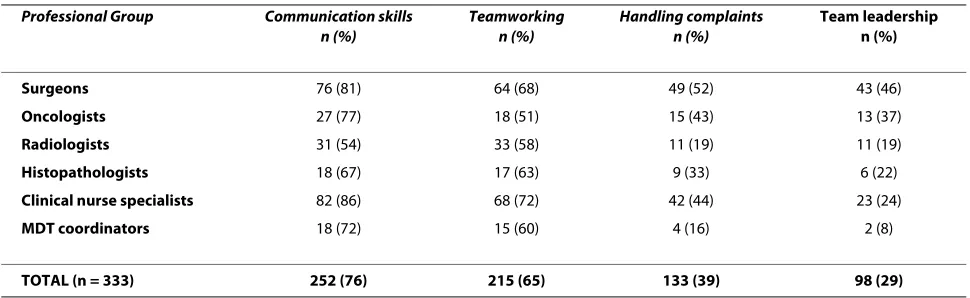
Prior to attending the Development Programme, three quarters of team members felt adequately trained in com-munication skills but this varied from 86% of nurses to only just over half of radiologists (table 4). Two-thirds of team members felt adequately trained in teamworking skills. Less than 40% of respondents felt adequately trained in dealing with complaints, with particularly low proportions of radiologists (19%) and MDT coordinators (16%) feeling adequately trained. Less than a third of team members felt adequately trained in team leadership.
Discussion
For the colorectal team members we evaluated, partici-pating in the MDT-TME Development Programme was associated with a decrease in average levels of job stress and job satisfaction six to eight weeks post-course. Team members also reported a marginal improvement in team performance. The magnitude of the decrease in team members' levels of job stress and job satisfaction was sim-ilar to the increase in job stress reported by UK hospital consultants between 1994 and 2002 using the same
mea-Managing (how well the team leader organises and coordinates team,
monitors quality, progress and provides feedback)
68 69 0.8 (-0.7 to 2.4) 0.28
Reflexivity (reviewing team's objectives, discussing how team is working)
59 61 2.0 (0.3 to 3.7) 0.02
[image:5.595.57.543.124.184.2]* completed by surgeons, oncologists and clinical nurse specialists only; † scores reversed (higher score = less conflict)
sures[3]. The increase in job stress explained a five per-cent increase in prevalence of estimated psychiatric morbidity among UK hospital consultants over that time period (from 27% to 32% with GHQ-12 scores ≥ 4). This suggests that the impact of the Development Programme on the well-being of colorectal team members is mean-ingful. The improvement in team performance scores was mainly explained by a change in the extent to which teams reflected on their teamworking. This has face validity given the nature of the Programme. Its impor-tance is however difficult to interpret as the Aston Team Performance Inventory has yet to be validated against
measures of the effectiveness of multidisciplinary teams including the mental health of team members.
[image:6.595.67.539.113.574.2]These findings are challenging to interpret. The decrease in team members' job stress may reflect the improved knowledge and skills that the Development Programme conferred. The decrease in job satisfaction may be the consequence of being unable to apply these newly acquired skills in the immediate aftermath of the Development Programme because of a lack of required infrastructure and/or equipment. Early reports suggest that attendance at the Development Programme has improved clinical practice, including increased usage of
Table 2: Demographic and professional characteristics of colorectal team members
Team members who completed pre- and post- course questionnaires
n = 333 (%)
Team members who completed pre-course questionnaire only
n = 131(%)
AGE GROUP
25 and under 2 (1) 1 (1)
26 - 35 years 35 (11) 14 (11)
36 - 45 years 159 (48) 48 (38)
46 - 55 years 102 (31) 48 (38)
Over 55 years 33 (10) 14 (11)
Missing 2 6
GENDER
Male 176 (53) 74 (57)
Female 157 (47) 57 (44)
MARITAL STATUS
Single 28 (8) 11 (9)
Married/cohabiting 285 (86) 104 (83)
Separated/divorced/widowed 18 (5) 10 (8)
Missing 2 6
PROFESSIONAL GROUP
Surgeons 94 (28) 45 (34)
Oncologists 35 (11) 15 (12)
Radiologists 57 (17) 15 (12)
Histopathologists 27 (8) 14 (11)
Clinical nurse specialists 95 (29) 32 (24)
MDT coordinators 25 (8) 10 (8)
Mean score
TOTAL JOB STRESS (pre-course)
38 39
TOTAL JOB SATISFACTION (pre-course)
Table 3: Impact of participation in the MDT-TME Development Programme on job stress and job satisfaction by professional group
Surgeon Oncologist Radiologist Histo-pathologist Clinical Nurse Specialist
MDT coordinator
Change between pre- and post-course scores according to professional
group (p)
pre post pre post pre post pre post pre post pre post
Mean scores
Total job stress 40 39 38 36 40 37 39 39 37 34 25 23 0.50
Sources of job stress:
all team members
Feeling overloaded with work and impact on home-life
51 50 46 42 53 49 52 53 44 40 34 32 0.58
Service configuration and lack of resources
45 44 44 40 45 41 46 46 38 37 32 29 0.76
Concern about making clinical mistakes and its consequences
34 33 22 24 41 37 49 45 31 28 14 9 0.52
Changes to the way you do your job
27 27 33 30 38 35 44 40 37 33 10 12 0.42
Being unable to provide best quality care to patients
41 38 43 42 21 17 10 9 27 25 7 7 0.83
Having difficulties in relationships with people you work with
27 27 26 25 29 23 23 24 31 25 25 21 0.15
Sources of job stress:
team members who provide direct patient care*
Dealing with angry or blaming patients/ relatives
44 40 55 44 - - - - 48 39 - - 0.21
Having distressed patients
31 30 28 31 - - - - 43 36 - - 0.01+
Total job satisfaction 67 65 64 63 62 56 56 55 69 66 41 40 0.39
Sources of job satisfaction:
all team members
Working in a multidisciplinary team
74 72 70 69 73 66 71 71 69 70 50 50 0.21
Providing better care from working in a multidisciplinary team
72 68 69 67 68 66 66 69 77 74 48 50 0.66
Having good relationships with colleagues beyond multidisciplinary team members
67 68 70 72 68 62 55 52 72 70 57 56 0.16
MRI preoperatively (Brown, personal communication, 27.05.10); improved quality of reporting for radiology and increased lymph-node harvest (Yorkshire Audit Data, Quirke, personal communication, 08.06.10). An internal evaluation of the impact of the Development Programme on clinical practice 6-12 months after participation[13] also reports improved usage and reporting of MRI subse-quent to attendance, as well as the adoption of new net-work-wide policies and protocols. However, some teams also reported being unable to implement some of the rec-ommendations of the Programme due to workforce shortages. These included dual consultant operating for difficult cases and not having an MDT coordinator or clinical nurse specialist as part of the team.
Across all team members the main sources of job satis-faction related to working in a multidisciplinary team and providing better patient care as a result of multidisci-plinary teamworking. This finding is consistent with find-ings from a national survey completed by over 2000 MDT members in England, of whom 90% agreed that MDT-working is beneficial to the mental health and wellbeing of team members, and 81% agreed that being an MDT
member improves job satisfaction[14]. The perception that teamworking improves patient care fits with the emerging evidence that multidisciplinary teams are bene-ficial in terms of disease management and clinical out-comes[15].
The levels and nature of job stress and satisfaction among hospital consultants has already been well described[2,3] but this study provided a unique opportu-nity for comparison across all core colorectal members of multidisciplinary teams. We found that clinical nurse specialists reported similarly high levels of job stress as their medical colleagues. These high levels for nurses may reflect a lack of clarity about the content and boundaries of their job leading to excessive expectations from oth-ers[16-19]. They also reported high job satisfaction which is likely to be derived from spending most of their work-ing time deliverwork-ing direct patient care[16], as well as the positive impact on their professional status and esteem of being recognised as a core member of the multidisci-plinary team in recent cancer policy. Having professional status and esteem has been shown to be a key source of satisfaction for hospital consultants[2,3]. MDT
coordina-Aspects of the wider organisation
46 44 46 44 45 40 42 40 50 45 37 36 0.57
Sources of job satisfaction:
team members who provide direct patient care*
Having good relationships with patients
83 80 82 79 - - - - 86 84 - - 0.97
Providing quality care to patients
74 72 72 70 - - - - 83 79 - - 0.50
*completed by surgeons, oncologists and clinical nurse specialists only
[image:8.595.58.542.124.263.2]+ estimated difference: CNS -7; 95% CI -11 to -3, p < 0.001; surgeons -1, 95% CI -5 to 2, p = 0.5; oncologists +3, 95% CI -3 to +9, p = 0.3 Table 3: Impact of participation in the MDT-TME Development Programme on job stress and job satisfaction by professional group (Continued)
Table 4: Adequacy of skills training for effective multidisciplinary teamworking
Professional Group Communication skills n (%)
Teamworking n (%)
Handling complaints n (%)
Team leadership n (%)
Surgeons 76 (81) 64 (68) 49 (52) 43 (46)
Oncologists 27 (77) 18 (51) 15 (43) 13 (37)
Radiologists 31 (54) 33 (58) 11 (19) 11 (19)
Histopathologists 18 (67) 17 (63) 9 (33) 6 (22)
Clinical nurse specialists 82 (86) 68 (72) 42 (44) 23 (24)
MDT coordinators 18 (72) 15 (60) 4 (16) 2 (8)
[image:8.595.56.541.598.747.2]tors, who prepare and organise the multidisciplinary team meetings, have a relatively new and rapidly expand-ing role[20]. The importance of MDT coordinators for effective MDT working has been acknowledged[20,21]. However, their low job stress and low job satisfaction sug-gests the need to standardise and professionalise their work[22].
Strengths of this study include the response from almost 60% of team members from a third of all colorec-tal cancer teams in England to both pre- and post-course questionnaires. We received completed questionnaires from 82% of delegates pre-course and found no difference in total job stress and satisfaction scores between those who responded to follow-up and those who did not. We also used well validated job stress and satisfaction mea-sures, designed specifically for cancer health profession-als[11]. The Development Programme reached almost every colorectal cancer team in England and thus we chose a pre-post evaluation design as a randomised con-trolled trial was not possible. Our evaluation focused on only the final year of the programme, which was for prag-matic reasons. The relatively short timeframe of follow-up may have impacted on the results. Benefits may have dissipated in the long-term. Alternatively, gains in job sat-isfaction may have been reported in the longer term, once the challenges of instigating the necessary service changes had been overcome.
The Development Programme was not intended to vide training in teamworking. Nevertheless, a large pro-portion of team members attended the course with expectations that it would do so. This study highlights significant shortfalls in the training that multidisciplinary team members reported they had received in the skills that are key to effective teamworking, namely in commu-nication, teamworking, handling complaints and leader-ship. Amongst these skills, effective leadership is arguably the most critical to the success of teamworking, sup-ported by the recommendation for standardised leader-ship training by Lord Darzi[23]. To address the outstanding need for teamwork training identified by col-orectal team members, the methods used to improve communication skills in cancer health professionals[24] could be integrated into courses such as the Development Programme.
Conclusions
Participation in the Development Programme had a mixed impact on the working lives of team members in the immediate aftermath of attending. Although chal-lenging to interpret, the decrease in team members' job stress may reflect the improved knowledge and skills con-ferred to many participants by the Programme. The decrease in job satisfaction may be the consequence of being unable to apply these skills immediately in clinical
practice because of a lack of required infrastructure and/ or equipment. In addition, whilst the Programme raised awareness of the challenges of teamworking, a greater focus on tackling these issues in combination with enhancing clinical skills and knowledge may go further to improve the working lives of cancer multidisciplinary team members.
Additional material
Abbreviations
ANOVA: Analysis of variance; ATPI: Aston Team Performance Inventory; MDT: Multidisciplinary team; NHS: National Health Service; TME: Total Mesorectal Excision.
Competing interests
The authors declare that they have no competing interests.
Authors' contributions
All named authors have agreed to the submission of this manuscript and par-ticipated in this study to a sufficient extent to be named as authors. AJR and MR conceived the idea for the study; CT was the study lead and wrote the first draft of the paper; JS was the study coordinator; GC provided statistical sup-port; CMc, AR and JD advised on aspects of study design and interpretation of findings. All authors participated in the critical revision of the article and have read and approved the final manuscript.
Acknowledgements
This study was funded by Cancer Research UK. We thank all of the colorectal cancer team members who participated in this study; Dr Gina Brown, Mrs Celia Ingham Clark, Maggie Vance, Theresa Porrett, Jill Dean and Sue Bates for their support in encouraging participation; the PELICAN Cancer Foundation (Juliet Crawley, Julia Jessop; Chris Beagley and all the faculty) for facilitating the evalu-ation; Sinead Drew, Jenny Harris, Emma Teasdale and Chris Papadopoulos for assisting with data collection and analysis.
Author Details
1Florence Nightingale School of Nursing and Midwifery, King's College London, London, SE1 8WA, UK, 2Promoting Early Presentation Group, Institute of Psychiatry, King's College London, Adamson Centre, St Thomas' Hospital, London, SE1 7EH, UK, 3Centre for Statistics in Medicine, Wolfson College Annexe, University of Oxford, Oxford, OX2 6UD, UK, 4Department of Psychology, University College London, Gower Street, London, WC1E 6BT, UK, 5School of Health Sciences, University of Southampton and Southampton University Hospital Trust, Southampton, SO16 6YD, UK, 6Work & Organisational Psychology Group, Aston Business School, Aston University Aston Triangle, Birmingham, B4 7ET, UK and 7National Cancer Action Team, St Thomas' Hospital, London, SE1 7EH, UK
References
1. Jessop J, Beagley C, Heald RJ: The Pelican Cancer Foundation and the English National MDT-TME Development Programme. Colorectal Disease 2006, 8:1-2.
2. Ramirez AJ, Graham J, Richards MA, Cull A, Gregory WM: Mental health of hospital consultants: The effects of stress and satisfaction at work.
Lancet 1996, 347:724-728.
3. Taylor C, Graham J, Potts HWW, Richards MA, Ramirez AJ: Changes in mental health of UK hospital consultants since the mid-1990s. Lancet
2005, 366:742-744.
Additional file 1 Adapted version of the hospital consultants' job
stress and job satisfaction questionnaire. The questionnaire used to
assess cancer team members' job stress and job satisfaction.
Received: 23 November 2009 Accepted: 29 June 2010 Published: 29 June 2010
This article is available from: http://www.biomedcentral.com/1472-6963/10/187 © 2010 Taylor et al; licensee BioMed Central Ltd.
This is an Open Access article distributed under the terms of the Creative Commons Attribution License (http://creativecommons.org/licenses/by/2.0), which permits unrestricted use, distribution, and reproduction in any medium, provided the original work is properly cited.
4. Sharma A, Sharp DM, Walker LG, Monson JRT: Stress and burnout among colorectal surgeons and colorectal nurse specialists working in the National Health Service. Colorectal Disease 2007, 10:397-406. 5. Haward B, Amir Z, Borrill C, Dawson J, Scully J, West MA, Sainsbury R:
Breast Cancer Teams: The impact of constitution, new cancer workload, and methods of operation on their effectiveness. British Journal of Cancer 2003, 89:15-22.
6. Burton S, Brown G, Daniels IR, Norman AR, Mason B, Cunningham D: MRI directed multidisciplinary team preoperative treatment strategy: the way to eliminate positive circumferential margins? British Journal of Cancer 2006, 94:351-357.
7. MERCURY Study Group: Diagnostic accuracy of preoperative magnetic resonance imaging in predicting curative resection of rectal cancer: prospective observational study. BMJ 2006, 333:779-784.
8. Quirke P: Training and quality assurance for rectal cancer: 20 years of data is enough. Lancet Oncology 2003, 4:695-702.
9. West NP, Morris EJ, Rotimi O, Cairns A, Finan PJ, Quirke P: Pathology grading of colon cancer surgical resection and its association with survival: a retrospective observational study. Lancet Oncology 2008, 9:857-865.
10. Glynne-Jones R, Sebag-Montefiore D, Samuel L, Falk S, Maughan T, McDonald A: Socrates phase II study results: capecitabine combined with oxaliplatin and preoperative radiation in patients with locally advanced rectal cancer. J CLIN ONCOL 2005, 23:3527.
11. Teasdale E, Drew S, Taylor C, Ramirez AJ: Hospital Consultants' Job Stress and Satisfaction Questionnaire. 2008 [http://www.iop.kcl.ac.uk/iopweb/ blob/downloads/locator/l_370_HCJSSQ_Manual.pdf]. Cancer Research UK London Psychosocial Group
12. West MA, Markiewicz L, Dawson FC: Aston Team Performance Inventory. London, ASE; 2005.
13. Jessop J: National MDT-TME Development Programme: changes to clinical practice. 2007.
15. Taylor C, Ramirez AJ: Multidisciplinary team members' views about MDT working: results from a survey commissioned by the National Cancer Action Team. 2009.
16. Taylor C, Munro AJ, Glynne-Jones R, Griffith C, Trevatt P, Richards M, Ramirez AJ: Multidisciplinary team working in cancer: what is the evidence? BMJ 2010, 340:c951.
17. Royal College of Nursing: Maxi Nurses. Advanced and Specialist Nursing Roles: Results from a survey of RCN members in advanced and specialist nursing roles Royal College of Nursing, London; 2005.
18. Willard C, Luker K: Working with the team: strategies employed by hospital cancer nurse specialists to implement their role. J CLIN NURS
2007, 16:716-724.
19. Lloyd-Jones M: Role development and effective practice in specialist and advanced practice roles in acute hospital settings: systematic review and meta-synthesis. J ADV NURS 2005, 49:191-209. 20. Trevatt P, Petit J, Leary A: Mapping the English cancer clinical nurse
specialist workforce. Cancer Nursing Practice 2008, 7:33-38.
21. Kelly M, Lloyd T, Marshall D, Garcea C, Sutton C, Beach M: A snapshot of MDT working and patient mapping in the UK colorectal cancer centres in 2002. Colorectal Disease 2003, 5:577-581.
22. National Cancer Action Team: The characteristics of an effective multidisciplinary team. National Cancer Action Team, London; 2010. 23. Soukop M, Robinson A, Soukop D, Ingham-Clark CL, Kelly MJ: Results of a
survey of the role of multidisciplinary team coordinators for colorectal cancer in England and Wales. Colorectal Disease 2007, 9:146-150. 24. Department of Health: High quality care for all: NHS next stage review
final report. Department of Health, London; 2008.
25. Fallowfield L, Jenkins V, Farewell V, Saul J, Duffy A, Eves R: Efficacy of a Cancer Research UK communication skills training model for oncologists: a randomised controlled trial. The Lancet 2002, 359:650-56.
Pre-publication history
The pre-publication history for this paper can be accessed here: http://www.biomedcentral.com/1472-6963/10/187/prepub
doi: 10.1186/1472-6963-10-187
Cite this article as: Taylor et al., A pre-post test evaluation of the impact of