
Rochester Institute of Technology
RIT Scholar Works
Theses Thesis/Dissertation Collections
5-1-2012
Error analysis of sequence modeling for projecting
cyber attacks
Venkata Mudireddy
Follow this and additional works at:http://scholarworks.rit.edu/theses
This Thesis is brought to you for free and open access by the Thesis/Dissertation Collections at RIT Scholar Works. It has been accepted for inclusion in Theses by an authorized administrator of RIT Scholar Works. For more information, please [email protected].
Recommended Citation
Error Analysis of Sequence Modeling
for Projecting Cyber Attacks
by
Venkata Prasanth K R Mudireddy
A Thesis Submitted in Partial Fulfillment of the Requirements for the Degree of Master of Science in Computer Engineering
Supervised by
Dr. Shanchieh Jay Yang, Associate Professor and Department Head, Department of Computer Engineering
Kate Gleason College of Engineering Rochester Institute of Technology
Rochester, New York May 2012
Approved By:
Dr. Shanchieh Jay Yang
Associate Professor and Department Head, Department of Computer Engineering Primary Adviser
Dr. Dhireesha Kudithipudi
Assistant Professor, Department of Computer Engineering
Dr. Amlan Ganguly
Dedication
This work is dedicated to my parents Rama Devi and Bhaskara Reddy and to my brother
Acknowledgments
First and foremost, I would like to express my sincere gratitude to Dr. Shanchieh Jay Yang
as my primary adviser for his continuous support and patience throughout my thesis, and
for his immense knowledge. I would also like to thank Dr. Dhireesha Kudithipudi and Dr.
Amlan Ganguly for serving on my committee and for their encouragement.
Special thanks to Daniel Fava and Stephen Byers for their research work which
devel-oped the model that my research is based on. I would also like to thank all my friends and
Abstract
Intrusion Detection System (IDS) has become an integral component in the field of network
security. Prior research has focused on developing efficient IDSs and correlating attacks as
Attack Tracks. To enhance the network analyst’s situational awareness, sequence modeling
techniques like Variable Length Markov Models (VLMM) have been used to project likely
future attacks. However, such projections are made assuming that the IDSs detect each
and every attack action, which is not viable in reality. An IDS could miss an attack due
to loss of packets or improper traffic analysis, or when an attacker evades detection by
employing obfuscation techniques. Such missed detections, could negatively affect the
prediction model, resulting in erroneous estimations.
This thesis investigates the prediction performance as an error analysis of VLMM when
used for projecting cyber attacks. This analysis is based on the impact of missed alerts,
representing undetected attack actions. The analysis begins with an analytical study of a
state-based Markov model, called Causal-State Splitting Reconstruction (CSSR), to
con-trast the context-based VLMM. Simulation results show that VLMM and CSSR perform
comparably, with VLMM being a simpler model without the need to maintain and train the
state space. A thorough design of experiments studies the effects of missing IDS alerts, by
having missed alerts at different locations of the attack sequence with different rates. The
experimental results suggested that the change in prediction accuracy is low when there
are missed alerts in one part of the sequence and higher if they are throughout the entire
sequence. Also, the prediction accuracy increases when there are rare alerts missing, and
it decreases when there are common alerts missing. In addition, change in the prediction
with larger symbol space. Overall, the results demonstrate the robustness and limitations
of VLMM when used for cyber attack prediction. The insights derived in this analysis
will be beneficial to the security analyst in assessing the model in terms of its predictive
Contents
Dedication. . . ii
Acknowledgments . . . iii
Abstract . . . iv
1 Introduction. . . 1
2 Related Work . . . 6
2.1 Markov and Hidden-Markov Models . . . 6
2.2 Intrusion Detection System and events happening beyond detection . . . 9
2.3 Sequence Modeling and Prediction using Context-based Algorithm (VLMM) 12 3 Sequence Modeling and Prediction using State-based Algorithm (CSSR) . . 19
3.1 Methodology . . . 20
3.2 Comparison of CSSR with other state-based algorithms . . . 24
3.3 Comparison of CSSR with context-based algorithms . . . 25
4 Error Analysis . . . 27
4.1 Possible Errors and their Significance . . . 27
4.2 VLMM . . . 29
4.3 CSSR . . . 30
5 Results and Discussion . . . 33
5.1 VLMM and CSSR on True Data . . . 33
5.1.1 Experiment Design . . . 33
5.1.2 Results and Discussion . . . 35
5.2 VLMM in presence of Missed Alerts . . . 37
5.2.1 Analysis based on Position . . . 38
5.2.1.2 Results and Discussion . . . 39
5.2.2 Analysis based on Occurrence . . . 43
5.2.2.1 Experiment Design . . . 43
5.2.2.2 Results and Discussion . . . 44
5.3 Summary of results . . . 51
5.4 Error Analysis on CSSR . . . 52
6 Conclusion and Future Work . . . 54
6.1 Conclusions . . . 54
6.2 Future Work . . . 55
List of Figures
1.1 Components of Intrusion Detection System . . . 2
2.1 Markov Process . . . 7
2.2 Hidden-Markov Process . . . 8
2.3 Overview of IDS and events happening beyond IDS . . . 10
2.4 Attack Track Example . . . 13
2.5 Suffix Tree for sequence: +ABACBAC- . . . 14
2.6 Real-time Suffix Tree for sequence: +ABACBAC . . . 15
2.7 GUI used for projection system [8] . . . 18
3.1 Flow chart of CSSR [40] . . . 21
3.2 Even process used to illustrate CSSR [42] . . . 22
3.3 The full-machine reconstructed from 10,000 samples of the even process before the determinization procedure [42] . . . 23
3.4 The final-machine by CSSR . . . 24
4.1 Example showing the change in order of probabilities of two symbols . . . 30
5.1 Interface used to generate a simulated network [28] . . . 34
5.2 VLMM vs. CSSR for true data . . . 36
5.3 VLMM vs. CSSR for average of all data sets . . . 37
5.4 Change in Prediction Accuracy for data sets with 376 alerts . . . 39
5.5 Change in Prediction Accuracy for ’Description’ data sets . . . 40
5.6 Change in Prediction Accuracy for ’Destination’ data sets . . . 40
5.7 Change in Prediction Accuracy for ’Category’ data sets . . . 40
5.8 Change in Prediction Accuracy for ’Description’ data sets based on posi-tion for different trials . . . 41
5.9 Change in Prediction Accuracy for ’Destination IP’ data sets based on po-sition for different trials . . . 42
5.11 Change in Prediction Accuracy for data sets with 376 alerts . . . 45
5.12 Change in Prediction Accuracy for ’Description’ data sets . . . 45
5.13 Change in Prediction Accuracy for ’Destination IP’ data sets . . . 45
5.14 Change in Prediction Accuracy for ’Category’ data sets . . . 46
5.15 Change in Prediction Accuracy for ’Description’ data sets based on occur-rence for different trials . . . 47
5.16 Change in Prediction Accuracy for ’Destination IP’ data sets based on oc-currence for different trials . . . 48
List of Tables
2.1 Probabilities of predicted symbols given observed sequence ’A, B’ . . . 17
3.1 Count statistics for words of length4and shorter from104 samples of the even process [42] . . . 22
4.1 CSSR variables description . . . 31
5.1 Data Sets used to compare VLMM and CSSR . . . 35
5.2 Prediction Accuracy of VLMM and CSSR for true data . . . 36
5.3 Data Sets used for error analysis of VLMM based on position . . . 39
Glossary
CSSR Causal-State Splitting Reconstruction. iv, xi
FN False Negative. xi, 27
FP False Positive. xi, 27
GUI Graphical User Interface. xi, 17
HMM Hidden-Markov Models. xi, 3
IDS Intrusion Detection System. iv, xi
IP Internet Protocol. xi, 13
KS test Kolmogorov-Smirnov test. xi, 32
VLMM Variable Length Markov Model. iv, xi
Chapter 1
Introduction
In this Internet era, organizational dependence on networked information technology and
its underlying infrastructure has grown explosively. In conjunction with this growth, the
frequency and severity of network-based attacks have also drastically increased. At the
same time, there is an inverse relationship between the decreasing expertise required to
execute attacks and the increasing sophistication of those attacks. In other words, less skill
is needed to do more damage. Security has evolved over the years due to an increasing
dependence on public networks to disclose various restricted information. Security gained
prominence in the 1990’s when a hacker named Kevin Mitnick committed one of the largest
computer-related crimes in the U.S history. The losses were reported to be around eighty
million dollars [14]. Many incidents have taken place in the past where some prominent
organizations including eBay, CNN, Yahoo were successfully attacked. Recently, on Feb 3,
2012 it was reported that a hacking group who claim themselves asAnonymoushave hacked
into a phone call between FBI and Scotland Yard. It was also reported earlier on Jan 19,
2012 that the same group have successfully taken down some prominent websites including
those of the US Department of Justice and US copyright office. On any given day, there are
around 225 major incidences of security breach reported to the CERT Coordination Center
at Carnegie Mellon University [14]. The worldwide economic impact of the three most
dangerous Internet Viruses of the last three years was estimated at 13.2 billion dollars [14].
Many such incidents reflect the fact that even the most secure networks are vulnerable and it
Figure 1.1: Components of Intrusion Detection System
industries to rethink the ways of improving network security. In addition to traditional
Firewalls, Intrusion Detection Systems that monitor network events for signs of malicious
activity have become an integral component of security. To effectively protect the network
from the increasing number of intrusions and reduce their impact on the network, there is
an indispensable need for efficient Intrusion Detection Systems.
An Intrusion Detection System (IDS) monitors network traffic for suspicious activity
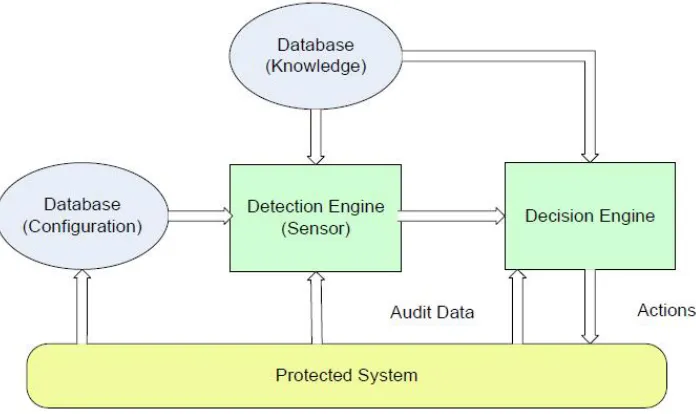
and alerts the network administrator. An IDS, as shown in Figure 1.1, is composed of
several components. Sensors are used to generate security events and a console is used to
monitor events and to control the sensors. It also has a central engine that records events
logged by the sensors in a database and uses a system of rules to generate alerts from
security events received. The two common types of IDS are based on pattern recognition
or anomaly detection techniques. The pattern recognition based IDS monitors packets on
the network and compares them against a database of signatures from known malicious
based IDS works by establishing a profile for the system’s normal activity. It raises an alert
when there is a conflict between observed activities and the normal profile.
To reduce the complexity of the overwhelming alerts generated by the IDSs, new
tech-niques called Alert Tracking have been proposed to create comprehensive alert reports.
Here the alerts that are related to each other would be grouped together as Attack Tracks.
Previous works have concentrated on developing efficient IDSs and correlating the
gener-ated alerts. But the concept of projecting future attacks, which happens beyond IDS and
attack tracking, hasn’t been completely explored by the researchers. Projection of likely
future attacks is a crucial aspect in the field of network security, because providing
informa-tion on the future alerts will assist the network analyst in taking necessary steps to protect
the network.
Attack tracks can be converted into sequences of symbols and then sequence modeling
schemes can be used to capture the properties of these sequences. The two main classes
of existing techniques for sequence characterization are Context-based Markov models and
State-based Hidden-Markov Models (HMM). Markov chains are most prominently used
probabilistic techniques in the field of intrusion detection because of their better
perfor-mance in terms of hit rate and false alarm rates [52]. Markov or finite-context models have
been used by Daniel Fava in [19] to capture the ordering properties of sequence symbols.
Different order Markov models have been implemented using a suffix tree, and then
com-bined into a Variable Length Markov Model (VLMM). Fava inferred the attackers
proba-ble future attack steps and behavior from the VLMM, created from several representative
attack tracks that have been previously observed. In [8], Byers has proposed a real-time
continually learning system capable of projecting attack tracks that does not require a priori
knowledge about network architecture.
In this thesis we propose to use a state-based model in place of a context-based model in
the field of cyber attack projection. An algorithm called Causal-State Splitting
preferred over conventional methods like subtree-merging algorithm introduced by
Crutch-field and Young [10] or topological merging procedure of Perry and Binder [36]. This is
because the conventional methods fit hidden Markov models to data, but CSSR makes no
assumptions about the process’s causal architecture and actually infers it from the data.
And the causal states it infers have important predictive properties that the states inferred
by other techniques lack. It builds a minimal set of hidden, markovian states that are
sta-tistically capable of producing the behavior exhibited in the data. Also the set of processes
that it can represent are more than the set of processes that a VLMM can represent. CSSR
algorithm is tested with the data sets from a simulation model used in [8] for VLMM. The
performance of both these algorithms is compared for the various data sets.
It should be noted that the mentioned models calculate the probabilities of the future
attacks assuming that the IDS has detected all attacks without any missed alerts. But in
reality, even the most efficient IDS is not perfect and will likely miss some attacks. As
the calculated predictions are based on the counts of past attacks (symbols), a change in
the count would result in erroneous probabilities. An important part of this research is to
study the effect of missed alerts on the VLMM model and its estimated predictions. In
practice, a false negative is much more serious and critical than a false positive because
of the damage caused by that missed intrusion. Based on the analysis of the results, the
network analyst can infer the predictive performance of VLMM algorithm when IDS has
missing alerts. This research basically takes one more step in creating a comprehensive
report to help the analyst in assessing the model. This work uses the real-time VLMM
model in [8] for gathering the results.
Chapter 2 gives a brief overview of Markov Models and Hidden-Markov Models. It
then discusses the suffix tree model and the VLMM algorithm used to predict future actions
with some examples. It also covers the modified real-time version proposed by Byers [8].
It should be noted that the model in [19] required pre-training of data, whereas the new
real-time model in [8] is more like a self-learning system that does not require any
an example. We then compare CSSR with other state-based models and also with
context-based models like VLMM. Chapter 4 covers the error analysis of the algorithms. We also
discuss about the different possible errors and their significance. Chapter 5 has the results
and their discussion, including the design of experiments. Chapter 6 has conclusions and
Chapter 2
Related Work
2.1
Markov and Hidden-Markov Models
A Markov Model is basically a probabilistic process over a finite set, (S1...Sk), usually
called its States. It is a simple stochastic process in which the distributions of the future
states depend only on the present state, and is independent of the path in which it arrived to
the present state. According to [34], a stochastic processx(t)is called Markov if for every
nandt1 < t2 < .... < tn, we have equation 2.1.
P(x(tn≤xn|x(t)∀t ≤tn−1) =P(x(tn)≤xn|x(tn−1)) (2.1)
An order ’0’ Markov model is equivalent to a multinomial probability distribution. An
order ’1’ (first-order) Markov model has a memory of size ’1’. The order of a Markov
model of fixed order is the length of the history or context upon which the probabilities of
the possible values of the next state depend. For example, the next state of an order ’2’
(second-order) Markov model depends upon the two previous states. In a Markov process,
the current state of a system depends on the previous states. Finite context models are also
known as Markov models. They assign a probability to a symbol based on the context in
which the symbol appears. In annth order finite-context model, an event depends onn
pre-vious observations. The simplest Markov Model is the Markov Chain, in which the states
are discrete and directly observable. The other forms of Markov process include
in various fields of engineering, physics and biology. As a practical example, any board
game whose moves are determined by a dice is a Markov Chain. Because in such board
games, the next state of the board depends only on the current state and the next roll of dice
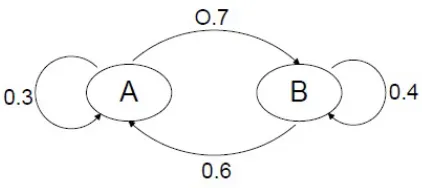
but not on how things got to the current state. Figure 2.1 can be considered as a Markov
process. It has two states and their corresponding transitions are shown with arrows. Given
an observed symbol, we can infer the next possible symbol based on the conditional
proba-bilities. For example, if the observed symbol is A, the probability that the next symbol will
[image:19.612.190.401.277.371.2]be B is 0.7 and the probability that the next symbol will again be A is 0.3.
Figure 2.1: Markov Process
On the other hand, finite-state models, also known as Hidden Markov Models (HMMs),
are composed of an observable part (events), and a hidden part (states). Events are observed
with different probability distributions depending on the state of the system. A Hidden
Markov Process (HMP) is a special type of Markov process in which the generation of
observation symbols depends on the emission properties of the states. Therefore a state
can usually generate more than one symbol and we cannot directly observe the state
se-quence from the observation sese-quence. A simple HMP can be explained with an example
as follows. Suppose we have three boxes and each box contains balls of three different
col-ors namely red, green, and blue. We randomly select a box according to some probability
distribution and pick a ball from that box. After noting the color of the ball, we place the
ball back in the same box and then select another box. This newly selected box can be the
color. If we repeat this process, we have a sequence of balls that we picked from the boxes.
Note that looking at a particular ball does not identify the box from which it was taken. We
can observe that there is an underlying hidden process, which is the selection of box. This
hidden process is not directly observable when we look at the sequence of balls. To build
a HMM to capture any process, there are three important factors to consider [31]. The first
one is to determine how many states are really needed to include the properties of the
pro-cess. The second factor is to choose the model parameters like state transition probabilities.
The third factor is the size of the observed sequence. Because if we are restricted to a small
[image:20.612.224.395.308.390.2]observed sequence, we may not be able to reliably estimate the optimal model parameters.
Figure 2.2: Hidden-Markov Process
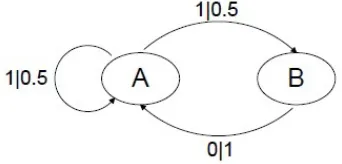
For example, Figure 2.2 can be considered as a Hidden-Markov process. The circles
A and B represent the states. The arrows connecting them represent the transitions of the
model from one state to another and the labels shown indicate what symbol is emitted and
its prediction to go to a particular state. For example the label at the left side1|0.5implies that the model can emit symbol 1 with a probability of 0.5 and remain in state A. Observe
that in this process, just by knowing the last observed symbol, one cannot always determine
the current state. If a 0 has been observed as last symbol, we can say that the current state of
the process is A but if a 1 was observed, we cannot determine which state the process is in.
Though we can infer the conditional distribution on the future based on the last observed
symbol, we cannot deduce the state the model is in. Since it has hidden states, this process
is an example of a hidden Markov process. Hidden Markov models have wide range of
Usage of Markov chains in the field of intrusion detection has given better performance
in terms of hit rate and false alarm rates compared to Hotelling’s T-square test and
chi-square multivariate test. These results have been proved by applying same testing set of
audit data on all the models in [52]. The hit rate is computed by dividing the total number
of hits with the total number of intrusive events in the testing data. The false alarm rate
is computed by dividing the total number of false alarms with the total number of normal
events in the testing data. 100% hit rate and 0% false alarm rate is ideal, which is the best
detection performance by the intrusion detection technique.
2.2
Intrusion Detection System and events happening
be-yond detection
There are many efficient IDSs that have been proposed and a survey is included in [5].
In [26], Kosoresow and Hofmeyr explained an intrusion detection technique via tracing of
system calls and discussed the issues of describing regular structure and calculating the
macros. [53] presented a cyber-attack detection technique through anomaly-detection, and
discussed the robustness of the modeling technique employed. This study also showed
that the performance of the Markov chain techniques is not always robust to the window
size: as the window size increases, the amount of noise in the window also generally
in-creases. Paxson [35] described Bro, a stand-alone system for detecting network intruders
in real-time by passively monitoring a network link over which the intruder’s traffic
tran-sits. [24] presented a new approach in representing and detecting computer penetrations
in real-time. The approach, called state transition analysis, models penetrations as a
se-ries of state changes that lead from an initial secure state to a target compromised state.
Valdes and Skinner [47] proposed a high performance, adaptive, model based technique
for attack detection, using bayes net technology to analyze bursts of traffic. This has the
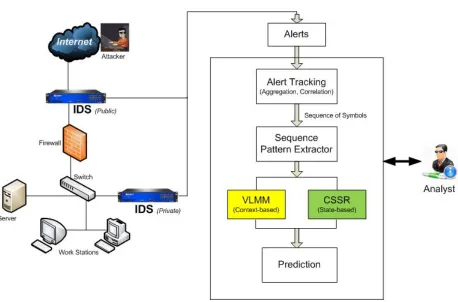
attractive feature of both signature based and statistical techniques. The events that happen
Figure 2.3: Overview of IDS and events happening beyond IDS
Projection of future alerts, andImpact Analysis. For large networks, the number of alerts
generated by the IDSs will be very large and hence analysts started making use of
tech-niques that would create comprehensive alert reports, categorized as alert aggregation [11],
[13], alert correlation [32], [44], [48],[49], [55], current and future threat analysis [4], [23],
and projection of likely future attack actions [29], [39]. The mentioned techniques fall
under the name of Alert Tracking, where the alerts that are related to each other would be
grouped. Such grouping of the alert data gives network defenders a more complete
pic-ture of the traffic on their network. [27] explains that alert verification is a process that is
launched in response to an alert raised by an intrusion detection system to check whether
the corresponding attack has succeeded or not. When the attack has not succeeded, the
the number of false alarms that an administrator has to deal with. It also improves the
re-sults of alert correlation systems by cleaning their input data from spurious attacks. The
proposed approach in [33] constructs attack scenarios by correlating alerts on the basis
of prerequisites and consequences of intrusions. Based on the prerequisites and
conse-quences of different types of attacks, the proposed approach correlates alerts by (partially)
matching the consequence of some previous alerts and the prerequisite of some later ones.
[54] describes an intrusion alert management system called TRINETR. The architecture is
composed of three parts: Alert Aggregation, Knowledge-based Alert Evaluation and Alert
Correlation. The architecture is aimed at reducing the alert overload by aggregating alerts
from multiple sensors to generate condensed views, reducing false positives by integrating
network and host system information into alert evaluation process and correlating events
based on logical relations to generate global and synthesized alert report. The definition of
attack correlation is extended in [12] to correlate attacks with intrusion objectives and to
introduce the notion of anti correlation. This approach provides the security administrator
with a global view of what happens in the system. It controls unobserved actions through
hypothesis generation, clusters repeated actions in a single scenario, recognizes intruders
that are changing their intrusion objectives and is efficient to detect variations of an
intru-sion scenario. This approach can also be used to eliminate a category of false positives.
A novel threat assessment scheme called TANDI was proposed in [23] to predict future
attacker actions. TANDI predicts future attack actions accurately as long as the attack is
not part of a coordinated attack and contains no insider threats. Even in the presence of
ab-normal attack events, TANDI will alarm the network analyst for further analysis. A novel
approach to assess the threat of network intrusions was proposed in [29]. This approach
assesses the attack threat from a forwarding perspective. To every attack type and some
attack scenarios, their Probabilities of having Following Attacks (PFAs) are calculated by
a data mining algorithm and then the threats of real time intrusions are assessed by these
probabilities. A graph-based approach to network vulnerability analysis was proposed in
It can analyze risks to a specific network asset, or examine the universe of possible
con-sequences following a successful attack. This method is based on the idea of an attack
graph which represents attack states and the transitions between them. The attack graph
can be used to identify attack paths that are most likely to succeed, or to simulate various
attacks. The major advantage of this method over other computer security risk methods is
that it considers the physical network topology in conjunction with the set of attacks. The
report in [50] examines the applicability of current risk assessment techniques to assess
modern electronic threats. It also analyses the concepts of risk, vulnerability, threat agent
and threat, and examine threat statistics from around the world and from various sources,
and the state of the art on the various risk and threat analysis techniques.
2.3
Sequence Modeling and Prediction using Context-based
Algorithm (VLMM)
The problem of projecting cyber attacks by looking at the sequential properties of
corre-lated IDS alerts belonging to multi-stage attack tracks was addressed by Fava [19]. The
basic methodology includes attack track pre-processing, sequence modeling and
predic-tion. Attack tracks consist of ordered collections of alerts belonging to a single multi-stage
attack. Sequence modeling techniques used in the fields like DNA analysis have been
ap-plied in the context of cyber attack projection by interpreting attack tracks as a sequence
of symbols. Finite-context models or Markov models have been used to characterize their
corresponding sequences of malicious actions.
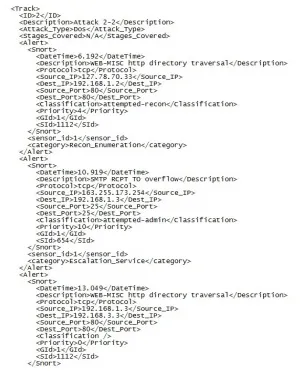
Figure 2.4 shows an example of Extensible Markup Language (XML) representation
of an attack track. Each alert within the attack track is defined by various fields and we
can divide these alerts based on any of the attributes like Description, Destination Internet
Protocol (IP) or Category. For example for Description, the algorithm converts all the alerts
with Description field as ’WEB-MISC http directory traversal’ to one symbol and all alerts
Suffix Tree :
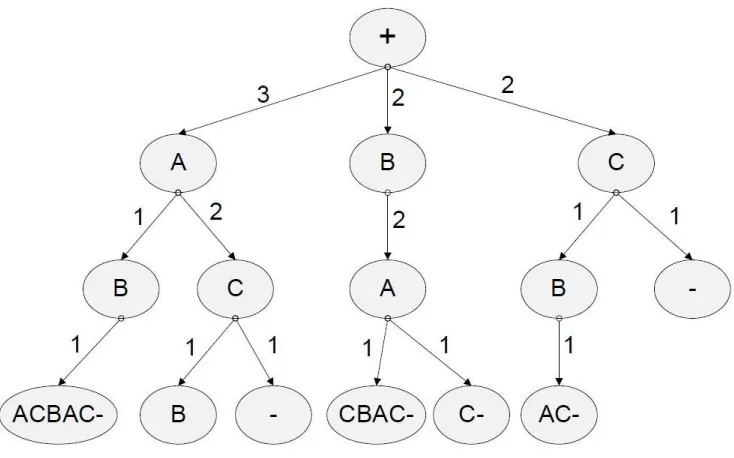
Different order Markov models can be implemented using a Suffix Tree. The actual
suffix tree training algorithm was originally motivated by the work of Begleiter, El-Yaniv
and Yona [7]. It was modified by Fava [19] to take a set of finite length sequences
in-stead of a single long sequence of observations. For example, let us consider the
se-quence ’+,A,B,A,C,B,A,C,-’, where +and−represent the start and end of the sequence,
A and B may represent any alert descriptions. Edges are weighted with the number of
times the suffix tree has traversed through that branch. The suffix tree for the sequence
[image:26.612.127.494.305.534.2]’+,A,B,A,C,B,A,C,-’ is shown in Figure 2.5.
Figure 2.5: Suffix Tree for sequence:
+ABACBAC-We can observe that Fava’s work [19] defines the start and end of sequence characters,
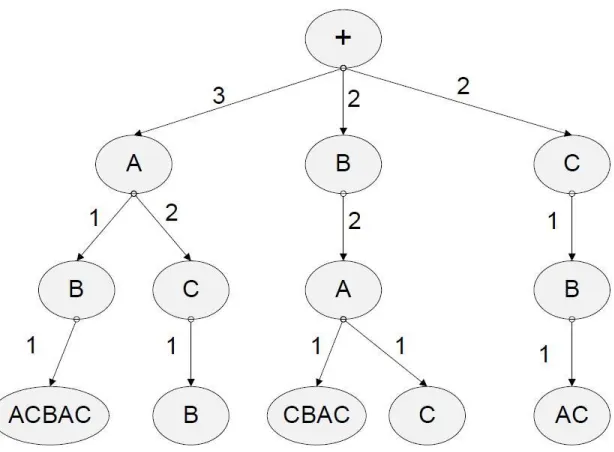
however the real-time algorithm proposed by Byers [8] trains the suffix tree with partial
sequences instead of finite completed sequence. Basically Byers algorithm [8] is more
like a self-learning system without the need for any pre-training. Now consider the same
track is not known. The sequence ’A,B,A,C,B,A,C’ is now trained as ’A’, ’A,B’, ’A,B,A’,
’A,B,A,C’ and so on as the track goes. The real-time version of building the suffix tree for
the sequence is shown in Figure 2.6, but without the end of sequence character ’-’. Note
that the path ’+’ to ’C’ has an edge weight of 2, whereas the summation of its child node
weights is only one. This is because there is no end of sequence character in this real-time
[image:27.612.159.466.236.462.2]suffix tree implementation.
Figure 2.6: Real-time Suffix Tree for sequence: +ABACBAC
Prediction :
The probable future attack steps and behavior have been inferred based on previously
observed attacks using Variable Length Markov Model (VLMM), which is formed by
blending the different order Markov models. A simple VLMM could attribute fixed weights
to each model order. A more complex way is to adapt weights as compression proceeds
to give more emphasis to high-order models later on. Neither of these take into account
The weights in [19] have been derived from escape probabilities. The probability of
en-countering a previously unseen character is called the Escape Probability. Denoting the
probability of an escape at level j by ej, equivalent weights can be calculated from the
escape probabilities by:
Wj = (1−ej)× l
Y
k=j+1
ek,−1≤j ≤l (2.2)
where l is the highest order context making a non-null prediction. In this formula, the
weight of each successively lower order is reduced by the escape probability from one
order to the next. The weights will be plausible provided that the escape probabilities
are between 0 and 1 and it is not possible to escape below order -1; hence e−1 = 0. The
advantage of expressing things in terms of escape probabilities is that they tend to be more
easily visualized and understood than the weights themselves, which can become small
very rapidly. Several methods have been proposed but Fava’s work [19] was not able to
identify any particular method to be better than others. One of the methods allocates one
additional count over and above the number of times the context has been seen to allow for
the occurrence of new characters. This was chosen as the default value in Byers work [8].
e0 =
1 C0+ 1
(2.3)
Using the equations of escape probabilities and weights, VLMM estimates the probabilities
using the following equation:
P(A) = l
X
j=−1
Wj×Pj(A) (2.4)
According to the results gathered by Fava [19], the first order model performs better than
0, or second or higher order models, because any next event has a strong correlation with
the immediate previous event. It was also shown that VLMM has the best prediction rate
due to the reason that annth order model introduces more information that is not captured
For example, with the sequence ’A,B,A,C,A,B,C’ trained using the real-time algorithm
[8], Table 2.1 shows the probabilities of the next occurring symbol given, let’s say, an
observed sequence of ’A,B’.
P(X) P(X given A) P(X given A,B)
X=A 3/7 0 1/2
X=B 2/7 2/3 0
X=C 2/7 1/3 1/2
Table 2.1: Probabilities of predicted symbols given observed sequence ’A, B’
Another interesting concept to notice is that this real-time algorithm [8] also predicts
the occurrence of new symbols. When a new symbol occurs, the suffix tree is first trained
as normal and then trained again with the suffix history added with the special new symbol
definition.
Graphical User Interface and Metrics used :
A Graphical User Interface (GUI) was designed in [8], that displays real-time
visu-alization of suffix tree. This GUI, as shown in Figure 2.7, has various options including
threshold options and various metrics like prediction accuracy and number of total
pre-dictions. This real-time system tracks only overall metrics for each alphabet and tracks
detailed metrics if requested by the user via the GUI. Whether a particular prediction is
correct or in-correct is determined by a set of predictions against the next event. This set of
predictions is determined by a threshold number. Traditionally top-3 predictions are
con-sidered relevant and are used in our analysis. The XML files that contain the alert tracks
can be loaded into the GUI from File menu. It also has the option to use only the ground
truth instead of the entire file. Once a file is loaded, we can inject the alerts inside it by
clicking Inject Next Alert or Inject All Remaining Alerts buttons. After all the alerts are
injected, we can observe the metrics in the GUI. Under the settings menu, we can select the
prediction threshold like top-1, top-2 or top-3 and so on. In this research, we use this GUI
Chapter 3
Sequence Modeling and Prediction
us-ing State-based Algorithm (CSSR)
A new algorithm for discovering patterns in data, called Causal-State Splitting
Reconstruc-tion (CSSR), was proposed in [41]. It builds a minimal set of hidden, markovian states that
are statistically capable of producing the underlying process’scausal states.
Below are some properties related to Causal states that have been proved in [40]:
• Causal states are the minimal sufficient statistics needed for predicting futures of all lengths.
• Causal states are not only minimum sufficient but also unique.
• Causal states are prescient. The causal states themselves form a Markov process.
• The causal states of a process are the members of the range of the function that maps from histories to sets of histories.
• Each causal state has a unique associated distribution of outputs, called itsmorph. In general every state has a morph, but two states in the same state class may have the
same morph.
• However each causal state has a unique morph, which means no two causal states will have the same conditional distribution of the future.
• The past and the future of a process are independent, conditioning on the causal states.
• A process’s causal states are the largest subsets of histories that are all strictly homo-geneous with respect to futures of all lengths.
The current causal state and the next value of observed process will determine the next
causal state. These possible next symbols have well defined conditional probabilities. The
Transition Probability can be defined as the probability of making a transition from one
state to another while emitting a symbol. The combination of the functionfrom histories
to causal states with the labeled transition probabilities is called the-machine of the
pro-cess [10]. -machines are deterministic and Markovian in nature, which means that given
a causal state at timet, the causal state at time t+ 1is independent of the causal states at
earlier times. -machine reconstruction is any procedure that given a process produces the
process’s -machine. An algorithm was developed for-machine reconstruction [10] [9],
which merged distinct histories together into states when their morphs seemed close.
Be-cause it works by merging, it effectively makes the most complicated model of the process
it can. Though the causal states are deterministic, the states it returns often aren’t. A new
-machine reconstruction algorithm called CSSR, which improves on the old algorithm,
was proposed in [41]. It operates on the opposite principle, by creating or splitting new
states only when absolutely forced to. The operation of CSSR is summarized in Figure 3.1.
3.1
Methodology
There are three procedures in CSSR: Initialize, Homogenize, and Determinize.
1. Initialize: The initial model is that the process is a sequence of independent,
Figure 3.2: Even process used to illustrate CSSR [42]
2. Homogenize: Generates states whose members are homogeneous for the next
sym-bol, which means these histories all lead to the same morph. In other words,
gener-ate stgener-ates whose member histories have no significant differences in their individual
morphs.
3. Determinize: Eliminates transient states from the current state-transition structure,
leaving only recurrent states.
To illustrate CSSR, consider an example how this algorithm works by taking an even
pro-cess as shown in Figure 3.2. Observe that this is an example of a hidden-Markov propro-cess.
Data from a simulation of process has been used with typical parameter settings for the
algorithm.
Word Count Word Count Word Count Word Count Word Count
0 3309 00 1654 000 836 0000 414 1000 422 1 6687 01 1655 001 818 0001 422 1001 396 10 1655 010 0 0010 0 1010 0 11 5032 011 1655 0011 818 1011 837
[image:34.612.207.355.101.195.2]100 818 0100 0 1100 818 101 837 0101 0 1101 836 110 1654 0110 814 1110 841 111 3378 0111 841 1111 2537
Table 3.1: Count statistics for words of length 4and shorter from104 samples of the even
Figure 3.3: The full -machine reconstructed from 10,000 samples of the even process before the determinization procedure [42]
ConsideringLmax=3 andα=0.01 for simplicity, simulations have been done on the even
process for104time steps and accumulated the sequence statistics for words of length 4 and shorter. The entire data contains 3309 0’s and 6687 1’s. The initial stateAL=0 formed atL
= 0, containing the null suffix *λ, therefore produces 1’s with probability≈0.669.
The null suffix ∗λ has two children, *0 and *1. At L= 1, the probability of producing a 1, conditional on the suffix *0, is P (1| *0) = 1655/3309≈ 0.500, which is significantly different from the distribution for the null suffix. Similarly, the probability of producing a
1, conditional on the suffix *1, is P (1|* 1) = 5032/6690≈0.752, which is also significantly different from that of the parent state. We thus produce two new states BL=1 and CL=1,
one containing the suffix *1 and the other suffix *0, respectively. There are now a total of
three states: AL=0={*λ},BL=1={*1}, andCL=1={*0}.
Similarly, in this way, by examining the next generation of children and finding the
conditional probabilities of children, add those that match parent’s distribution and split
off those that doesn’t match parent’s distribution till Lmax is reached. Finally we will be
left with four states, which contain the following suffixes: AL=0={*λ, *11}, BL=1={*1,
*111}, CL=1= {*0, *00, *10, *000, *100, *110, *011}, and DL=2= {*01, *001, *101}
After we reach longest histories, i.e.,Lmax=3 in our example, phase II is complete. Phase
III is done by checking which states have incoming transitions. State C can be reached
Figure 3.4: The final-machine by CSSR
from itself or from States A or B on a 0. Observe that State A can only be reached from
State B on a 1 and State B can only be reached from State A on a 1.
Continuing the process of determinization, we eliminate the two transient states A and
B. Since every suffix in State C goes to one in State C by adding a 0 and to State D by
adding a 1, we do not split C. Similarly we do not change State D because every suffix in
State D goes to one in State C by adding a 1. The process of determinization ends here.
The final result is an -machine with two states C and D as shown in Figure 5. These are
the causal states sufficient to capture the behavior exhibited in the data.
3.2
Comparison of CSSR with other state-based algorithms
The -machine captures all patterns in the process which have any predictive power. An
algorithm was initially developed for -machine reconstruction by Crutchfield and Young
in [10], [9]. Their default assumption is that each history that we come across in the data is
a causal state. The merging procedure can be explained as follows. Consider all the nodes
with subtrees of depth L, and take any two of them. If all the probability distributions
at-tached to the length-L path in their subtrees are within some constant, then the two nodes
are equivalent and will be merged. This procedure is repeated until no merging is possible.
All other-machine reconstruction methods are also based on merging. For example in the
’topological’ merging procedure of Perry and Binder [36], they consider the relationship
they yield are identical. Then they estimate the distribution for each state, not for each
history. The problem with state-merging methods lies in their default assumption that each
history is its own state. Because of this assumption, the state-merging methods start by
pro-ducing the most complex possible null model of the process, given the length of histories,
and then trim it by merging.
Instead of using merging methods, a new reconstruction algorithm based on
state-splitting (CSSR) was proposed. CSSR starts off with a zero-complexity null model by
putting every history in one state and then adds states only if the current set of states are not
sufficient according to the statistical tests. Unlike conventional algorithms, which tune the
parameters in a fixed architecture, CSSR is capable of inferring the appropriate architecture
as well. The causal states it infers have important predictive optimality properties. These
predictors take the form of minimum sufficient statistics, arranged into a hidden Markov
model (HMM). Hence they preserve the features of HMMs without making any
assump-tions about the nature of the process. Also as explained in [42], CSSR must estimate 2k
probabilities for each history, one for each member of the power set of the alphabet, but
the state-merging algorithm must estimate the probability of each member of the power set
of future sequences which is 2kL probabilities. In [41], CSSR is compared to the use of
cross-validation to select an HMM architecture, and the results imply that CSSR’s
predic-tive performance is at least comparable to cross-validated expected-maximization, but it is
constructive and faster.
Though CSSR does not require any prior knowledge about system dynamics, it cannot
exploit such information when it exists.
3.3
Comparison of CSSR with context-based algorithms
Context-based algorithms construct so called Variable Length Markov Models from
se-quence data. Contexts are considered to be the suffixes of history and the algorithms work
a threshold. VLMMs, similar to CSSR, do not rely on domain specific information. Each
state in a VLMM is represented by a single suffix, and consists of all and only the histories
ending in that suffix. For many processes, where the causal states contain multiple suffixes,
multiple contexts are needed to represent a single causal state, so VLMMs are generally
more complicated than the HMMs build in CSSR. The causal state model is the same as
the minimal VLMM if and only if every causal state contains a single suffix.
For the even process in Figure 3 that is used to illustrate CSSR, clearly A and B both
contain infinitely many suffixes, and so correspond to an infinite number of contexts. If we
let the length of histories grow, a VLMM algorithm will increase the number of contexts
it finds without bound. VLMM algorithms are incapable of capturing such even processes.
Hence the class of processes that CSSR can represent is larger than those that a VLMM can
represent. However the process involved in CSSR is a lot more complicated than VLMM,
which is far simpler. And also for CSSR to perform better with less error probability, we
Chapter 4
Error Analysis
4.1
Possible Errors and their Significance
In the field of statistics, to describe particular flaws in any process, there are two major
kinds of possible errors:
• Type I error: It is the wrong decision that is made when a test rejects a true null hypothesis. False Positive (FP) comes under this kind.
• Type II error: It is the wrong decision that is made when a test fails to reject a false null hypothesis. False Negative (FN) comes under this kind.
The definitions of these two kinds of errors change depending on the application. In the
field of Intrusion Detection, they can be defined as follows:
• A False Positive is raising an alarm for a non-malicious activity.
• A False Negative is failing to identify an attack and not raising an alarm for a mali-cious activity.
False Positives and False Negatives can happen to any Intrusion Detection System, no
mat-ter how efficient it is. Both types of errors cause various problems to the network security.
A false positive of the IDS will not result in an intrusion and it may be caused because
anomaly that turns out to be benign. Therefore, the false positives may cause security
ana-lysts to expend unnecessary effort. On the other hand, a false negative is a missed attack,
which may put networks or computer systems in danger. Clearly these are undesirable,
and every organization strives to avoid them. However, no detection system detects all the
attacks. Hence, the goal is to provide good coverage against high priority attacks.
Sev-eral other reasons may also cause a false negative. For example, in order to elude the IDS,
the attack may incorporate obfuscation techniques. Another possibility is to overwhelm the
IDS with traffic beyond its processing capacity, so that the IDS will drop the packets needed
to detect the attack. If an IDS raises an alert that did not happen, the worse that can happen
would be wastage of resources and time till the network administrator realizes that it is a
false alarm. But if an IDS fails to identify an alert, that alert might be malicious enough
to damage the whole network and hence risking the security. A mechanism proposed in
[21] collected more than two thousand FPs and FNs during sixteen months. It reported that
92.85% of false cases were FPs and 7.15% were FNs. Out of all the FPs, about 91% of
FP alerts occur because of IDS’s policy or company management policies, but not due to
security issues. Hence in practice, a false negative is much more serious and critical than
a false positive because of the negative effects it has and because of the damage caused by
that missed intrusion. Therefore it is necessary to analyze the effect of the false negatives in
detail to improve the network security. If reported data from IDS has some false negatives,
it impacts both the sequence model (suffix tree of VLMM or -machine of CSSR) that is
build and also the estimated probabilities that are calculated based on the model. This
re-search studies the effects of false negatives/missing alerts on the predictive performance of
the model being used. This would help the analyst in assessing the model (VLMM in our
4.2
VLMM
In case of a model like VLMM, the amount of effect a missing alert would have on the
suffix tree or the probability estimations would depend on many factors including:
• the occurrence rate of missing alert and its estimated probability
• the position of the missing alert in the sequence
• length of the sequence
• symbol space within the sequence
The future alerts are predicted based on weights and escape probabilities, which depend
on the occurrence rates of the symbols in the sequence. Hence missing alerts would result
in erroneous probability calculations. This change could be positive or negative depending
on the mentioned factors.
In order to have a comprehensive analysis, we will study the effect in two ways: one
with respect to the position of the missing alert and another with respect to the occurrence
of the missing alert. We will randomly remove alerts while doing the analysis. This random
removal in the design is based to reflect the scenarios where the attacker uses obfuscation
techniques to confuse the system by attacking at different positions at different times. We
will study the effect in terms of occurrence of missing alerts by defining the common and
rare alerts and compare it against the results based on position.
In addition to various factors like occurrence, position, length of sequence and symbol
space, the prediction accuracy of a model like VLMM will also be affected when missing
alerts cause a change in the order of probability within the threshold predictions.
Depend-ing on the occurrence rate of missDepend-ing symbols and their probabilities, missDepend-ing alerts can
result in change of the order of symbol probabilities. However, it does not mean a change
in the order of probabilities will always affect the prediction performance. If the estimated
probabilities of two symbols are close enough, it is likely that they will have a change in
Figure 4.1: Example showing the change in order of probabilities of two symbols
scenario, wherePe refers to erroneous probability,P refers to actual true probability and
dP/dxrefers to the differential probability.
4.3
CSSR
Error analysis of CSSR is done in [41] by considering the statistical errors that each of
the algorithm’s three procedures can produce. Since it merely sets up parameters and data
structures, nothing goes wrong in ’Initialize’ step. ’Homogenize’ step can make two kinds
of errors. First, it can group together histories with different distributions for the next
symbol. Second, it can fail to group together histories that have the same distribution.
Let Si and Sj are suffixes in the same state, with counts ni and nj. There is always the
variational distancetsuch that the significance test will not separate estimated distributions
differing by tor less. If we make ni large enough, then with probability arbitrarily close
to one, the estimated distribution for iis within t/2 of the true morph, and similarly for
j. Hence, the estimated morphs for the two suffixes are withintof each other and will be
merged. If any state contains any finite number of suffixes, by obtaining a sufficiently large
sample of each, we can ensure that they are all withint/2of the true morph and so within
t of each other and thus merged. In this way, the probability of inappropriate splitting can
true morph, then the test will eventually separate suffixes belonging to different morphs.
Since the step ’Determinization’ always refines the partition with which it starts, there is
no chance of merging histories that do not belong together. In summary, if the number of
causal states is finite andLmax is sufficiently large, the probability that the states estimated
are not the causal states becomes arbitrarily small, for sufficiently large N.
To analyze the bounds of the error probability, CSSR used the chernoff’s inequality
[51], which states that:
P(|An−µ| ≥t)≤2e−2nt
2
(4.1)
whereAn is the mean of the firstnof theXi (X1, X2,· · · , Xnare Bernoulli random
vari-ables), with probabilityµof success.
The convergence of CSSR algorithm was shown in [41] based on Kolmogorov-Smirnov
test (KS test) [22], and Chernoff’s inequality [51], as follows:
P(d(Pn(S→1|S←L=s←L), P(S→1|S←L))≥t)≤
X
A∈2A
2e−8nt2 = 2k+1e−8nt2 (4.2)
Two kinds of errors are possible in CSSR algorithm:
• It can group together histories with different distributions for the next symbol.
• It can fail to group together histories that have the same distribution.
Variable Name Description Values according
to Table 2.1
n suffix count
-N length of the sequence 1000
L length of histories considered 3
p∗ probability of the most improbable string 396/9996≈0.039
k constant 2
t difference between suffix and it’s true morph 0.461 (0.5-0.039) (magnitude of the prediction error)
q(t) probability of seeing an error of size t or larger ≈0
Table 4.1: CSSR variables description
q(t, n)≤ s
X
i=1
2e−8nit2 = 2k+1se−8mt2 (4.3)
wheremis the least of theniandsis the number of histories actually seen or as the number
of histories needed to infer the true states. We can upper boundsby the maximum number
of morphs possible as:
s≤ (k
L+1−1)
(k−1) (4.4)
=⇒q(t, n)≤2k+1(k
L+1−1)
(k−1) e
−8N p∗t2
(4.5)
The equation 4.5 approaches zero for large values ofN.
We have applied the CSSR convergence formula for the data given in Table 3.1. An
example is shown in Table 4.1, where the error probability was almost zero. Hence by
obtaining a sufficiently large sample of each suffix, the error probability of CSSR can be
Chapter 5
Results and Discussion
In this research, we will run two sets of simulations. One is by using the true data sets
assuming that they do not have any missing alerts and another is by removing the alerts
from those true data sets. We will compare the performance of VLMM and CSSR in terms
of prediction accuracy for the true data sets. Prediction Accuracy is the percentage of
symbols occurring within a set based on a threshold, consisting of symbols with highest
probabilities according to the chosen model. Hence if an observed symbol was one of
the top three predictions with the highest probability, that would be included in the Top-3
prediction accuracy section. The prediction accuracy is calculated by dividing the number
of correct predictions to the total number of predictions made by the model used. The
choice of ’three’ is arbitrary and can be changed to any reasonable number. Traditionally
top-3 predictions are considered relevant and so we have used it in our error analysis.
5.1
VLMM and CSSR on True Data
5.1.1
Experiment Design
In previous work [19], the experimental dataset of attacks was randomly split into two
halves. One-half of the tracks were used to pre-train the model, and the other half to
test the algorithm’s predictive performance. But this research is based on the real-time
symbols, dynamically trains models for each alphabet definition in parallel, and generates
next-step prediction sets for each attack track based on those changing models as events
unfold. This approach facilitates investigation into the adaptive qualities of the system to
new attack scenarios. For the first set of simulations, we will run the true data sets on two
different algorithms - VLMM and CSSR, and will compare their performance in terms of
[image:46.612.183.436.228.412.2]prediction accuracy.
Figure 5.1: Interface used to generate a simulated network [28]
In order to enable testing of situational awareness tools that are being developed to
detect and analyze attacks on computer networks, a simulation model was proposed in
[28]. This simulation model has been developed to generate representative cyber attacks
and intrusion detection sensor alert data. This model provides the user with the ability
to construct a computer network and setup and execute a series of cyber attacks on certain
target machines within that network. IDS sensors that are setup within this network produce
appropriate alerts based on the traffic they observe within the network. A user-interface is
used to specify the desired scenario. Figure 5.1 shows an example network interface setup.
When a computer network has been created, an attack scenario can be setup and run on the
network. Once the simulation is run and the scenario is executed, it generates the output
The outcome of this simulation model is a set of IDS alerts that can be used to test and
evaluate the various cyber security tools. Taking into account the need for ground truth (list
of actions executed during each attack), this research utilizes experimental datasets
gener-ated by the simulation model, implemented by RIT’s Industrial and Systems Engineering.
We have used five sets of data, containing ground truth without any noise, to test VLMM
and CSSR algorithms. The data sets used along with the length of the sequence and the
number of symbols in the sequence is shown in Table 5.1.
Data Set Alerts Symbols
[image:47.612.238.381.248.334.2]BVT-2A 376 61 BVT-2B 336 57 BVT-2F 378 55 BVT-2H 293 52 BVT-2I 496 60
Table 5.1: Data Sets used to compare VLMM and CSSR
5.1.2
Results and Discussion
Table 5.2 shows the prediction accuracies for the data sets without considering any
repe-titions. Here the data sets used are assumed to be true data sets, which do not have any
missed alerts. The accuracies achieved by both VLMM and CSSR are encouraging given
the relatively large number of symbols in the corresponding symbol spaces. Consider for
BVT-2A, where a blind guess of 3 out of 61 would give a prediction rate of around 4.9%
which is much smaller than 41.30% by VLMM and 51.91% by CSSR.
If we consider the average values of all data sets as shown in Figure 5.3, we can observe
that in terms of top-3, top-2, and top-1 prediction accuracies, both VLMM and CSSR give
very similar results. However we can observe from Figure 5.2 that for some cases, there is
some significant difference in top-1 accuracies of VLMM and CSSR. For example for data
set BVT-2B the top-1 accuracy by VLMM is 23.83% whereas CSSR has only 11.59%.
This is likely because the symbol CSSR assigned highest probability most of times, has
BVT-2A VLMM CSSR
Top-3 41.30% 51.91% Top-2 34.06% 42.01% Top-1 23.19% 29.16%
BVT-2B
Top-3 42.19% 52.17% Top-2 32.42% 40.94% Top-1 23.83% 11.59%
BVT-2F
Top-3 47.48% 46.90% Top-2 39.93% 35.59% Top-1 24.46% 24.59%
BVT-2H
Top-3 37.77% 37.55% Top-2 27.47% 27.70% Top-1 18.03% 22.9%
BVT-2I
[image:48.612.236.384.115.397.2]Top-3 36.78% 33.33% Top-2 30.29% 24.82% Top-1 19.23% 17.6%
Table 5.2: Prediction Accuracy of VLMM and CSSR for true data
[image:48.612.183.439.489.646.2]Figure 5.3: VLMM vs. CSSR for average of all data sets
occurred more frequently.
Because of the nature of different data sets, the results by VLMM and CSSR may not
always be consistent. From the results gathered, we can observe that CSSR does not give
any superior results in terms of predictive performance. Since we need to have infinitely
long sequences for CSSR to perform better and VLMM being a simpler process, we have
used VLMM for the error analysis of missed alerts.
5.2
VLMM in presence of Missed Alerts
For the second set of simulations, we analyze the effect of missing alerts using VLMM
by observing the change in prediction accuracies. One way to study the effect of missing
alerts using a particular algorithm is by adding alerts to data, where we assume that the data
gathered from the simulation model is as a result of IDS failing to identify alerts. However
this method is unclear and complicated because lot of factors need to be considered like
the various attributes of the alert and whether to introduce new alert or one of the already
occurred alerts. An easier way is by removing alerts from the data sequence, where we
assume that the data from simulation model is a result of IDS identifying each and every
alert without missing any attack. In order to have a more comprehensive analysis, we study
the process, we repeat this analysis for sequences of different lengths and different symbol
spaces, as they would also influence the prediction accuracies.
5.2.1
Analysis based on Position
5.2.1.1 Experiment Design
Since position of the alert is one of the factors that can influence the prediction accuracy, we
first study the effect of missing alerts based on its position. For this, we have chosen to split
the entire sequence into 3 parts (3 is arbitrary), referring them as Beginning, Middle and
End of sequence. Then we have randomly selected the positions within those 3 parts and
removed alerts. In order to have a complete analysis, we will also remove alerts randomly
from the whole sequence. Although any data set contains multiple tracks, while removing
alerts we look at the total data set as a single sequence generated by VLMM after combining
all the multiple tracks in an order. This random removal in the design is based to reflect
some real world scenarios where the attacker, in order to elude the IDS, may incorporate
obfuscation techniques and confuse the system by sometimes attacking at the beginning and
sometimes at the middle or at the end. We have run simulations by varying the percentage
of missing alerts: 5%, 15%, 25%, 40%. In this work, the Beginning of any sequence is
defined as a set ranging from start to 40%, the Middle of the sequence is defined to range
from 30%-70% and the End of the sequence is defined to range from 60%-100%. The
overlap is to allow us to remove more percentage of alerts. These percentages are calculated
with respect to the total length of the sequence. We know that, because of missing alerts,
each symbol’s prediction accuracy will either increase or decrease or remain the same. We
will then calculate the change in prediction accuracies to make observations. The data sets
Data Set Alerts Symbols True Top-3 True Top-1
[image:51.612.156.463.88.231.2]Description-1 376 63 41.30% 23.19% Destination IP-1 376 9 87.32% 58.70% Category-1 376 12 61.23% 28.99% Description-2 478 77 36.24% 19.58% Destination IP-2 478 9 91.53% 56.61% Category-2 478 12 56.61% 25.13% Description-3 599 69 39.88% 19.24% Destination IP-3 599 9 95.19% 71.94% Category-3 599 11 57.52% 24.25%
Table 5.3: Data Sets used for error analysis of VLMM based on position
5.2.1.2 Results and Discussion
After different percentages of alerts are removed from the sequence, we first gather the
results of new prediction accuracies. Figure 5.4 shows the change in prediction accuracies
for ten trials in each case for various percentages of missed alerts at different positions in
the sequence.
Figure 5.4: Change in Prediction Accuracy for data sets with 376 alerts
We have calculated the difference between the new prediction accuracy and the true
prediction accuracy, to know by how much the value got deviated (could be positive or
negative). For this, we use the metric ’Change in Prediction Accuracy’, which is the
differ-ence in prediction accuracies with and without missed alerts for different test cases.
The change in prediction accuracy can be positive or negative. In other words, the
[image:51.612.94.579.391.532.2]Figure 5.5: Change in Prediction Accuracy for ’Description’ data sets
[image:52.612.95.538.91.226.2]Figure 5.6: Change in Prediction Accuracy for ’Destination’ data sets
Figure 5.7: Change in Prediction Accuracy for ’Category’ data sets
that the change is not always exponential to the number of missing alerts. This is due
to the fact that prediction accuracies also depend on various other factors like length of
the sequence and number of symbols in the sequence. However if the alerts that were
missing have higher assigned probabilities, it is more likely that they will result in larger
values of change in the prediction accuracies. Though ’Description-1’, ’Destination IP-1’
and ’Category-1’ data sets have data of same length (376), it can be observed that their
behavior in presence of missed alerts is different because they have different number of
symbols implying a different behavior in their data set.
The change in prediction accuracy varies for each scenario depending on the weights
Figure 5.8: Change in Prediction Accuracy for ’Description’ data sets based on position for different trials
the change in prediction accuracies seems to be very small in the range of 0.5%-1%. We
can observe from Figures 5.8, 5.9, 5.10 that the values for all the ten trials do not deviate
much from the average value.
When the percentage of missing alerts increases to more than 10%, we can observe
from Figures 5.5, 5.6, 5.7 that the change in prediction accuracy is worse when the alerts
are missing in the whole sequence as opposed to missing in a particular section. We can
observe that this conclusion is valid for all the data sets with different attributes
(Descrip-tion, Destination IP, Category). This could be likely because many sequences will have the
alerts with higher weights dispersed throughout the sequence than only at the beginning
Figure 5.9: Change in Prediction Accuracy for ’Destination IP’ data sets based on position for different trials
the performance is affected the most if they were missing throughout the entire sequence.
The next badly affected case is if they were missing at the beginning of the sequence. The
change in prediction accuracy is in the range of 4%-7% when the alerts are missing in the
whole sequence and 0-2% when alerts are missing at the beginning or middle or end of
the sequence. From Figures 5.8, 5.9, 5.10, we can also observe that this observation is
consistent across different trials, datasets and attributes. For example, in all the Figures
5.8, 5.9, 5.10, for the case when 25% alerts are missing, the change in prediction accuracy
is more for the case when alerts are missing throughout the sequence (circular dots
high-lighted in light green) as opposed to when alerts are missing at the beginning (triangle dots
Figure 5.10: Change in Prediction Accuracy for ’Category’ data sets based on position for different trials
(square dots highlighted in light blue).
5.2.2
Analysis based on Occurrence
5.2.2.1 Experiment Design
Occurrence rate of the missing alerts is another important factor that will influence the
VLMM model and the prediction accuracies. For this analysis, we first identify the top-m
as common alerts and bottom-nas rare alerts based on their occurrence rates. Selection of
these numbersm andndepends on the symbol space in the sequence and varies from one
sequence, we can consider top-5 as common alerts and remaining(l−5)as the rare alerts. Since we have chosen top-3 in our results as the threshold for prediction accuracy values, it
is sufficient if we define the top-5 alerts as common alerts, because a change in the order of
symbols will also change the prediction accuracy. So if the 4th or5th ranked symbols are
close enough to the 3
![Figure 2.7: GUI used for projection system [8]](https://thumb-us.123doks.com/thumbv2/123dok_us/110727.10400/30.612.95.575.242.521/figure-gui-used-for-projection-system.webp)
![Figure 3.1: Flow chart of CSSR [40]](https://thumb-us.123doks.com/thumbv2/123dok_us/110727.10400/33.612.144.498.174.578/figure-flow-chart-of-cssr.webp)
![Table 3.1: Count statistics for words of length 4 and shorter from 1 04 samples of the evenprocess [42]](https://thumb-us.123doks.com/thumbv2/123dok_us/110727.10400/34.612.207.355.101.195/table-count-statistics-words-length-shorter-samples-evenprocess.webp)
