S T U D Y P R O T O C O L
Open Access
Mixed methods evaluation of the Getting it
Right First Time programme
-improvements to NHS orthopaedic care in
England: study protocol
Helen Barratt
1*, Simon Turner
1, Andrew Hutchings
2, Elena Pizzo
1, Emma Hudson
1, Tim Briggs
3, Rob Hurd
3,
Jamie Day
3, Rachel Yates
3, Panagiotis Gikas
3, Stephen Morris
1, Naomi J Fulop
1and Rosalind Raine
1Abstract
Background:Orthopaedic procedures, such as total hip replacement and total knee replacement, are among the commonest surgical procedures in England. The Getting it Right First Time project (GIRFT) aims to deliver improvements in quality and reductions in the cost of NHS orthopaedic care across the country. We will examine whether the planned changes have delivered improvements in the quality of care and patient outcomes. We will also study the processes involved in developing and implementing changes to care, and professional and
organisational factors influencing these processes. In doing so, we will identify lessons to guide future improvement work in other services.
Methods/design:We will evaluate the implementation of the GIRFT programme, and its impact on outcomes and cost, using a mixed methods design. Qualitative methods will be used to understand the programme theory underlying the approach and study the effect of the intervention on practice, using a case study approach. This will include an analysis of the central GIRFT programme and local provider responses. Data will be collected via semi-structured interviews, non-participant observation, and documentary analysis. Quantitative methods will be used to examine‘what works and at what cost?’We will also conduct focus groups with patients and members of the public to explore their perceptions of the GIRFT programme. The research will draw on theories of adoption, diffusion, and sustainability of innovation; its characteristics; and contextual factors at provider-level that influence implementation.
Discussion:We will identify generalisable lessons to inform the organisation and delivery of future improvement programmes, to optimise their implementation and impact, both within the UK and internationally. Potential challenges involved in conducting the evaluation include the phased implementation of the intervention in different provider organisations; the inclusion of both retrospective and prospective components; and the effects of ongoing organisational turbulence in the English NHS. However, these issues reflect the realities of service change and its evaluation.
Keywords:Orthopaedic surgery, Service reorganisation, Organisational change, Outcomes, Implementation, Health services research, Cost effectiveness
* Correspondence:[email protected]
1Department of Applied Health Research, University College London, 1-19 Torrington Place, London WC1E 6BT, UK
Full list of author information is available at the end of the article
Background
Orthopaedic procedures, such as total hip replacement (THR) and total knee replacement (TKR), are among the commonest surgical procedures in England [1]. Rates of joint replacement have risen substantially over the past decade [2], whilst orthopaedic referrals from primary to
secondary care have increased by 7–8% each year [1].
The first ‘Getting it Right First Time’ (GIRFT) report,
published in 2012, recommended changes to NHS ortho-paedic practice to improve patient outcomes, and achieve
cost savings [1]. NHS England subsequently funded a‘
na-tional professional pilot’ to be implemented by a project
team, hosted on behalf of the British Orthopaedic Associ-ation (BOA), at the Royal NAssoci-ational Orthopaedic Hospital in Stanmore. Senior clinicians visited providers to offer
bespoke recommendations about improving care. A‘
dash-board’ of clinical and financial performance data was
created for each provider organisation, to inform self-assessment of local services. By July 2015, the GIRFT pro-ject team had carried out reviews with 120 NHS Trusts in England. The project highlighted significant variations in practice and outcomes; device and procedure selection; costs; and infection rates [3].
Consequently, the Department of Health (DH) has commissioned a £2.45m, three-year programme to ad-dress these challenges initially in orthopaedics, and then across ten other clinical specialities. Building on the visits carried out during the professional pilot, the programme consists of three additional implementation tools, each acting at a different level: regular publication of provider-level performance data via a dashboard (clinical provider-level intervention); tailored written feedback to underperform-ing providers (top down intervention) and commissionunderperform-ing levers to change behaviour (commissioner level interven-tion). It seeks to change practice, (e.g. prosthesis choice) in order to improve patient outcomes (e.g. infection rates). Work is underway to enhance patient safety by increasing minimum volumes of complex procedures undertaken by individual surgeons. Regional networks will also be estab-lished to increase minimum volumes of complex proce-dures, and discussions are underway with NHS England and NHS Improvement around improvements to the tariff for purchasing, or commissioning, orthopaedic care. NHS Improvement is currently responsible for overseeing orga-nisations that provide NHS-funded care. Additionally, involvement of relevant professional organisations, includ-ing the British Orthopaedic Association (BOA) and the Specialist Orthopaedic Alliance, is being used to encour-age change. The programme also has strong links with
Lord Carter’s Procurement and Efficiency programme [4].
The GIRFT programme can thus be defined as a
‘complex intervention,’ containing several interacting
components, targeting different stakeholders and ad-dressing a number of different behaviours [5]. There
is, however, limited evidence to support the proposed approach. Best et al. suggest that the effectiveness of feedback, for example via dashboards, is dependent on the presence of incentives [6], whilst Turner et al. emphasise the importance of a combination of both system (top-down) and distributed (bottom-up) lead-ership in enabling change [7]. Dixon-Woods et al.
also highlight the importance of both ‘hard’ and ‘soft’
incentives for changing behaviour [8]. Whilst there have been reorganisations of a number of acute NHS services in recent years [9, 10], there have been few examples on this scale. Literature about the diffusion of health care innovations highlights the need for more research on the processes by which innovations are initiated, implemented and sustained, and in what contexts [6, 11].
This project aims to contribute to the development of that evidence base by studying in depth the implementa-tion of changes to orthopaedic services. The new DH-commissioned programme, which commenced in Janu-ary 2016, will continue the work trialled in the national pilot. We will therefore evaluate the intervention as a whole, including the pilot and the work currently being planned. We will focus on outcomes directly relating to patient care, for the commonest elective orthopaedic procedures: THR and TKR [12]. Through this, we will identify lessons to inform future service improvement efforts. In line with Medical Research Council guidance about the evaluation of complex interventions, key goals will be to refine our current understanding of the details and timing of the intervention, as well as the programme theory underpinning its implementation, to inform decisions about which impacts that should be measured [5]. Programme theory sets out the rationale and assumptions about the mechanisms that link an
intervention’s processes and inputs to outcomes.
Articulation of this theory helps improve the
measure-ment of the intervention’s impacts [13].
Aim and objectives
The aim of the proposed research is to evaluate the
implementation of a complex intervention,‘the GIRFT
programme’, which seeks to improve the quality and
cost-effectiveness of NHS orthopaedic care in England. In doing so, we will identify lessons to guide future improvement work in other services.
We will use formative and summative evaluation methods to:
2. Assess whether the GIRFT programme has reduced variations in orthopaedic practice and expenditure, and improved patient outcome measures;
3. Estimate the economic impacts (e.g. cost savings) of these changes; and
4. Explore patient and public perceptions of the planned improvements to care.
Methods/design
To develop worthwhile lessons for improvement pro-grammes in the future, it is important to establish not just whether process and outcome changes took place, but also how and why they occurred. We will therefore evaluate the implementation of the GIRFT programme, and the impact of specific interventions on outcomes and cost, using a mixed methods design. As part of this, we will ex-plore the interplay between the different implementation tools, acting at different levels, and their impact on both changes in practice and patient outcomes. The following component studies, which are interdependent and will inform one another, are planned in relation to each object-ive. Qualitative methods will be used to understand the details of the intervention, as well as the programme the-ory underlying its implementation, and to study the effect
of the different ‘implementation tools’ intended to
pro-mote changes in practice (Study 1). The research will draw on theories of adoption, diffusion, and sustainability of innovation [11]; its characteristics [14]; and contextual fac-tors at provider-level that influence implementation [15].
Quantitative methods will be used to examine‘what works
and at what cost?’(Studies 2 and 3). Details of the
inter-vention gathered in Study 1 will be used to inform the choice of variables and outcomes for these studies. We will also use qualitative methods to explore patient per-ceptions of the planned improvements to orthopaedic care (Study 4). Methods for data collection and analysis are described separately for each study.
To bring together the findings of the four study com-ponents, the proposed evaluation will make use of an existing analytic framework that aims to identify key components of major system change, and how they might interact [16]. Drawing on key features of change identified in the implementation literature, the
frame-work distinguishes between the ‘implementation
ap-proach;’ ‘implementation outcomes’(i.e. the adoption of,
fidelity to, and sustainability of a given intervention);
and ‘intervention outcomes’ (e.g. changes in provision
of care or patient outcomes). It will enable us to study the factors that influence implementation of the GIRFT programme (including the nature of the inter-vention and how its implementation is facilitated), and the potential relationships between these and
inter-vention outcomes, allowing insights into the ‘black
box’of implementation.
Study 1: Organisational study
To examine the nature and implementation of the changes to orthopaedics, we will conduct a multi-level organisational study of their planning and roll out, using a case study approach [17]. This will include an analysis
of the central GIRFT programme and local providers’
re-sponses. Case studies were chosen because this approach allows complex phenomena to be studied in-depth, taking into account both the case (here, organisations providing orthopaedic services) and the context (professional and organisational processes), as well as interactions between the two [17]. The research will focus on the potential implementation tools used to promote change, which are likely to be (1) performance review visits by a senior clin-ician; (2) performance feedback via‘dashboards’; (3) letters from the GIRFT project team and other national stake-holders recommending changes to practice, and (4)
intro-duction of ‘best practice’ tariffs for the purchasing of
orthopaedic care and related commissioning levers. Using objective criteria, the evaluation team will iden-tify six case study sites through discussion with the GIRFT project team. Purposive sampling within groups will be used to select: different types of hospital (e.g. district general hospital versus teaching hospital); and different settings (e.g. urban versus rural). Representa-tives of the wider local health economy will be inter-viewed where relevant (e.g. clinical commissioning
groups (CCGs)). As some for-profit providers with ‘Any
Qualified Provider’ (AQP) contracts are not part of the
general GIRFT programme, they will also be compara-tors: representatives of two to three providers will be interviewed to gain their perspective on implementing improvement in orthopaedics. We will identify AQPs providing elective orthopaedic services using internet searches, including the NHS choices website. The selec-tion criteria we apply will ensure the providers sampled reflect different geographies (region of England and urban/rural).
Data will be collected through semi-structured inter-views, non-participant observation, and documentary analysis. We will carry out semi-structured interviews and observations at both national (e.g. the GIRFT pro-ject team, including understanding and co-developing
the ‘programme theory’) and local levels (e.g. providers’
responses to the implementation tools and perceived impact of the approach to implementation, and the tools, on practice). Through the interviews we will
examine stakeholders’perceptions of barriers and
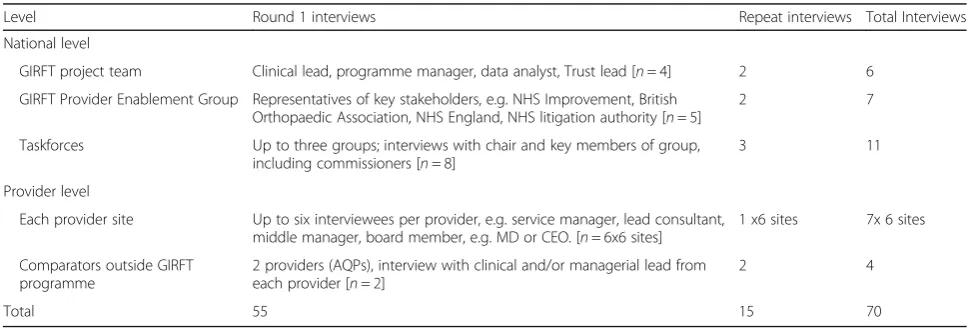
providers and the GIRFT project team will be conducted a year apart to assess the impact of the programme over time. A list of interviews is provided in Table 1.
Examples of non-participant observations at the na-tional level will include attending the GIRFT project
team’s planning meetings, as well as dissemination and
educational events. Observations at the provider level will include attending one-to-one feedback sessions pro-vided by the GIRFT project team and locally initiated responses to change, e.g. performance improvement
forums organised around the ‘dashboard’ and other
implementation tools.
We will also collect documentation about the GIRFT programme at both national and local level in order to capture how the programme is planned, communicated to providers, and local responses from providers. These documents will cover how the programme was devel-oped and the processes of implementation (e.g. GIRFT programme documentation; meeting minutes; letters and other communications with providers; performance
reports; dashboards; and local providers’ documented
responses to the programme). Project documentation will be collected over the lifespan of the evaluation. It will inform the planning and conduct of the interviews and non-participant observations in Study 1, as well as the proposed quantitative analysis (Study 2).
Interviews will be digitally recorded for professional transcription in full. Field journals for recording notes will be kept by the researchers. Data will be analysed thematically, combining inductive (ideas emerging from the empirical data) and deductive approaches (with reference to the innovations and implementation litera-ture) [18]. Initial analysis and category building will be conducted by the researchers and will include category mapping and constant comparison. Cross case compari-son will be used to compare and contrast findings at dif-ferent levels within the same case study (e.g. differences in the response of senior executives and service level within
providers) and the same level across different case studies (e.g. variation in responses of providers, role of CCGs). Validity will be assessed in relation to Patton’s four criteria of validity in qualitative research: verification, rival expla-nations, negative cases and triangulation [19]. Analysis of documentary evidence will focus on documents covering planning, events and progress of the GIRFT programme, to build an understanding of the development and
imple-mentation of the programme and providers’responses, as
well as identifying events that may have influenced pro-gress of the work.
Study 2: Quantitative study
The quantitative analysis will examine the relationship between the introduction and delivery of different
com-ponents of the ‘intervention’ (i.e. the implementation
tools) and intended changes to care processes and pa-tient outcomes. The methods will be developed in detail during the project and will draw on information about the intervention gathered during the organisational study (Study 1).
The quantitative analysis will be based on longitudinal organisational data with NHS provider or hospital as the primary unit of analysis. It will comprise (1) data from the GIRFT project team that describe the implementation tools and (2) process and outcome measures from linked anonymised patient-level data from routine sources. The analysis will seek to relate variation in the implementation tools (independent variables) with changes in measures of process and outcome (dependent variables). The final choice of variables will be based on findings from the multi-level organisational study (Study 1).
[image:4.595.55.540.568.733.2]The three indicative implementation tools are likely to comprise performance review visits by a senior clinician; dashboard distribution; provider letters (both trust-level); and tariff pricing levers (national). Details of the interventions and their timing will be confirmed during the Study 1 interviews with the GIRFT project team.
Table 1List of interviews for organisational study (Study 1)
Level Round 1 interviews Repeat interviews Total Interviews
National level
GIRFT project team Clinical lead, programme manager, data analyst, Trust lead [n= 4] 2 6
GIRFT Provider Enablement Group Representatives of key stakeholders, e.g. NHS Improvement, British Orthopaedic Association, NHS England, NHS litigation authority [n= 5]
2 7
Taskforces Up to three groups; interviews with chair and key members of group, including commissioners [n= 8]
3 11
Provider level
Each provider site Up to six interviewees per provider, e.g. service manager, lead consultant, middle manager, board member, e.g. MD or CEO. [n= 6x6 sites]
1 x6 sites 7x 6 sites
Comparators outside GIRFT programme
2 providers (AQPs), interview with clinical and/or managerial lead from each provider [n= 2]
2 4
However, implementation is likely to occur during the
period 2015–2017 and, in the case of dashboards and
letters, vary in timing between trusts.
Measures of process and outcome - the dependent variables - are likely to be derived from routine linked patient-level data (Hospital Episode Statistics (HES) admitted patient care; National Joint Registry (NJR); Public Health England surveillance data; and national patient-reported outcomes (PROMs) programme for elective surgery) and may comprise re-admission rates; rates of revision surgery; surgical site infection; length of stay; patient reported outcomes; type and cost of pros-thesis; and surgeon/consultant volume. Information about the use and cost of loan kits by providers will be provided by GIRFT. In addition, linked patient-level data will also provide information on potential confounders such as socio-demographic characteristics (age, sex, deprivation and ethnicity) and comorbidity. Data will be linked at the patient level by an encrypted identifier (encrypted HESID); no patient identifiable data will be required. Information about surgeon volumes is included in NJR data. It is anticipated that full data will cover the period from April 2009, when England's national PROMs programme started, to March 2018. Patient-level data and trust-Patient-level data on interventions will be linked by the HES trust provider code.
The approach to the analysis will also be dependent on the findings of the multi-level organisational study (Study 1). Descriptive analysis will map the timing and duration of the implementation tools in trusts with the periods of availability of linked patient-level data to iden-tify differences in timing within trusts and the number of monthly periods of pre- and post-implementation patient-level data that will be available for analysis. It is likely that the chosen analytical approach will involve multivariable regression that tests for changes in trends for the different process and outcome measures in re-sponse to the interventions. Analyses will need to allow for non-independence (e.g. at trust and/or surgeon level); adjustment for potential confounding; specifica-tion of modelled effect for intervenspecifica-tion (e.g. change in trend/step-change, wash-out period/delayed response); and control. Control is likely to combine within-trust
control (before:after intervention) and potentially
between-trust control (differences in timing in interven-tion sites and inclusion of non-interveninterven-tion sites, e.g. in-dependent providers of NHS orthopaedic surgery). Tariff pricing levers, as a national intervention, will not allow between-trust control. Interpretation of results will be sensitive to the potential for residual confounding and
other methodological limitations, e.g. ‘contamination’ in
control sites.
A statistical analysis plan will be produced as part of Study 2. The plan will determine the analytical approach
in greater detail and will draw on both the qualitative study and initial mapping and analyses from the quanti-tative study (variation, frequency and completeness of proposed independent and dependent variables). In par-ticular, the plan will consider the extent that it is possible to differentiate between the impacts of the different imple-mentation tools given their likely overlap in timing and ensure that sufficient periods of post-introduction data are available to allow an assessment of any impact. Initial ana-lyses will examine data on the implementation tools and on the process and outcome measures separately. Data will only be combined once the analysis plan has been approved by the study steering group. The timing of the interventions and the availability of data within the time-frame of the project will also determine which analyses will be undertaken during the project. In the event that the required data for this component of the evaluation are not available during the lifetime of this grant, we will apply for additional grant funding to continue the work.
Study 3: Economic study
To assess value for money, we will identify the difference in costs and the difference in benefits of implementing
the GIRFT programme compared to the situation ‘in
absence of intervention,’ using a similar methodological
approach to that described above for Study 2.
Three main cost categories will be explored: (1) the extra cost of GIRFT implementation tools (e.g. the cost of performance review visits by a senior clinician); (2) the extra cost incurred by providers to implement rec-ommendations and sustain change (e.g. ring fenced units); and (3) reduction in costs related to patient out-comes (e.g. reduced expenditure on loan kits). Benefits of the GIRFT programme could include health outcomes for patients (e.g. reduced surgical site infections). The
GIRFT project team’s partnership with the NJR will
allow us to explore the relationship between implant cost and effectiveness, measured by implant longevity and revision rate.
Data on the following costs will be examined: (1) the extra cost of GIRFT tools will be assessed using the data, documents and invoices provided by the GIRFT project team and where not available costed using marked prices; (2) the extra cost incurred by providers to imple-ment recommendations will be gathered directly from Trusts or using data from the literature; (3) reduction in costs related to outcomes will be assessed using NHS costs, payment by results costs for length of stay, other costs (for staff, consultations etc.) and data from litera-ture where the above are not available.
Study 4: Patient and public focus groups
development of future improvement programmes, we will explore patient and public perceptions of the pro-posed changes, and the desired outcomes. To do this,
we will conduct three focus groups, each with 6–8
participants. Two of the three groups (Groups 1 and 2) will involve patients who have undergone an elective hip or knee replacement in the two years prior to the start
of this study (Jan 2016–Jan 2018). Group 3 will include
patient representatives who have not undergone joint replacement surgery, but who are in the age bracket most likely to receive this type of intervention (age 60+) [20]. As participants may not be aware of the proposed changes to orthopaedics, the researchers will provide a brief lay language overview of the GIRFT programme at the start of each focus group.
Participants for Groups 1 and 2 will be recruited via patient representative groups. This will include the British Orthopaedic Association Patient Liaison Group and groups within NIHR CLAHRC North Thames pro-vider organisations in North Central and East London, Bedfordshire, Essex and Hertfordshire. Group 3 will be recruited via hospital based patient involvement groups, and local organisations such as Health Watch in the NIHR CLAHRC North Thames area.
During the focus groups, we will explore participants’
views about (1) the intended changes to practice and (2) the intended improvements to patient outcomes. At the start of the focus groups, the researchers will give partic-ipants a brief overview of the planned changes to ortho-paedics. Focus groups will be digitally recorded for professional transcription in full. Fieldwork notes will also be kept by the researcher. As in Study 1, data will be analysed thematically, combining inductive and deductive approaches [18].
Synthesis of quantitative and qualitative approaches The qualitative and quantitative components of the evaluation will be brought together in three ways. First, a key goal of the organisational study (Study 1) is to understand the programme theory underlying the GIRFT approach. The findings will therefore directly inform both the analytic design and final selection of variables for the quantitative and economic studies (Studies 2 and 3). Details of the intervention compo-nents and their timing will also be confirmed during the Study 1 interviews with the GIRFT project team.
Second, the dissemination of our findings will include qualitative data about the implementation of the GIRFT programme and patient/public perceptions of the inter-vention, as well as quantitative data describing the impact of specific interventions on outcomes and cost.
Finally, we will bring together the findings of all the
study components, using Fulop et al’s framework for
analyzing major system change [16]. This will enable us
to identify the key components of the GIRFT programme, and the factors influencing its implementation, as well as how these may have interacted.
Patient and public involvement
We have worked with the NIHR CLAHRC North Thames Patient and Public Involvement/Engagement Officer to seek the views of patients and the public on
the proposed evaluation, via the CLAHRC’s lay Research
Advisory Panel and the British Orthopaedic Association Patient Liaison Group. Their feedback has been used to refine the protocol and ensure appropriate consideration of the patient perspective. Through this, we have identi-fied three orthopaedic patients who have agreed to join our Patient and Public Reference Group, together pro-viding a range of perspectives on care. This group will have a collaborative role in refining research design, interpreting findings and disseminating results and will meet physically three times, as well as being involved in the interim via email/telephone/webinar. This will in-clude ensuring that patient priorities are adequately represented in Study 4, the patient focus groups. We will provide training to members where necessary, as well as appropriate reward and reimbursement for their contri-bution and expenses incurred in taking part.
Discussion
In this protocol, we describe a proposed evaluation of planned changes to NHS elective orthopaedic care in England. The Getting it Right First Time project (GIRFT) aims to deliver improvements in quality and reductions in the cost of orthopaedic care across the country. The approach will in due course be rolled out across ten other NHS surgical specialities. We will con-duct a mixed methods evaluation of the changes in or-thopaedics, using formative and summative approaches. Methods will include documentary analysis; one to one interviews with a range of stakeholders; analysis of per-formance and cost data; and focus groups with patients and members of the public.
research elements, for example by using the findings of the organisational study (Study 1) to inform the design of the quantitative study (Study 2), will permit an exam-ination of how change activities, contextual factors, and outcomes interrelate.
The evaluation faces a number of wider methodological and practical challenges.
First, the intervention was rolled out at slightly differ-ent times in differdiffer-ent provider organisations, as visits by the GIRFT project team in the national professional pilot took place in a phased way between September 2013 and July 2015 [3]. Therefore, as each provider
or-ganisation has different ‘before’ and ‘after’ phases, it is
possible that external factors might have influenced each organisation differently. Also, conclusions drawn about the relationship between the intervention and any im-provements seen are less clear in‘before’and‘after’ stud-ies. It is possible that any improvements that occur could have happened anyway and not as a direct result of the policies implemented. Without randomisation, it is also harder to rule out potential biases and gaming.
However, these complexities reflect the ‘real world’
nature of service change, and are thus commonly faced in evaluations of this kind [21].
Second, the evaluation also includes both retrospective and prospective components. This has the potential to impact the organisational component of the research (Study 2). For example, the planning and implementa-tion of the naimplementa-tional professional pilot was not observed
and interviewees’recollection of events will naturally vary.
Ensuring suitable representation of stakeholders—based
on documentary analysis—and applying Patton’s validity
criteria [19] in the analysis will be key to ensuring that important lessons are not missed.
Finally, the GIRFT programme has been implemented during a period of significant turbulence in the NHS, encompassing both the changes associated with the Health and Social Care Act in 2013 and now a period of unprece-dented financial challenge. However, our proposed methods will allow us to capture some of the influences of such turbulence, and how these might be dealt with when sus-taining change. The distraction and uncertainty brought by changes in associated organisations, such as commissioning structures, is common in many settings, meaning the research may have relevance in a wide range of settings.
In conclusion, this evaluation will provide an opportun-ity to understand better what works, at what cost, as well as how changes of this kind are implemented and sus-tained. Reviews indicate that more research is needed to understand drivers, processes, and outcomes when imple-menting such large-scale changes [6, 11]. We will identify lessons to inform the organisation and delivery of future improvement programmes, both within the UK and inter-nationally, to optimise their implementation and impact.
Abbreviations
AQP:Any Qualified Provider; BOA: British Orthopaedic Association; CCG: Clinical commissioning group; DH: Department of Health; GIRFT: Getting it Right First Time; HES: Hospital Episode Statistics; NHS: National Health Service; NJR: National Joint Registry; PROMs: Patient-reported outcome measures; THR: Total hip replacement; TKR: Total knee replacement
Acknowledgements Not applicable.
Funding
The research is funded by the National Institute for Health Research (NIHR) Collaboration for Leadership in Applied Health Research and Care North Thames at Barts Health NHS Trust. The views expressed are those of the authors and not necessarily those of the NHS, the NIHR or the Department of Health. The funding body had no role in the design of the study; collection, analysis, and interpretation of data; or in writing the manuscript.
Availability of data and materials Not applicable.
Authors’contributions
HB led overall study design and drafting of the protocol. ST and HB led drafting of the qualitative design and analysis sections (Studies 1 and 4) AH and EP led drafting of the quantitative design and analysis sections (Studies 2 and 3). ST, AH, EP, EH, TB, RH, JD, RY, PG, SM, NJF, and RR all contributed to study design and drafting of the protocol. All authors read and approved the final manuscript.
Authors’information Not applicable.
Competing interests
HB, ST, AH, EP, EH, JD, PG, SM, NJF, and RR declare that they have no competing interests. TB is clinical lead for the GIRFT programme, and National Director for Clinical Quality and Efficiency. RH is chief executive officer of an orthopaedic hospital (RNOH), as well as Senior Responsible Officer of the GIRFT programme. RY is deputy Senior Responsible Officer of the GIRFT programme.
Consent for publication Not applicable.
Ethics approval and consent to participate
This evaluation received ethical approval in August 2016 from the North West - Liverpool East Research Ethics Committee (Ref 16/NW/0654).
Author details
1Department of Applied Health Research, University College London, 1-19 Torrington Place, London WC1E 6BT, UK.2Department of Health Services Research & Policy, London School of Hygiene & Tropical Medicine, 15-17 Tavistock Place, London WC1H 9SH, UK.3Royal National Orthopaedic Hospital NHS Trust, Stanmore, London HA7 4LP, UK.
Received: 1 December 2016 Accepted: 13 January 2017
References
1. Briggs T. Getting it Right First Time: improving the quality of orthopaedic care within the National Health Service in England. London: British Orthopaedic Association; 2012.
2. Judge A, Chard J, Learmonth I, Dieppe P. The effects of surgical volumes and training centre status on outcomes following total joint replacement: analysis of the Hospital Episode Statistics for England. J Public Health. 2006; 28:116–24.
3. Briggs T. Getting it Right First Time: a national review of adult elective orthopaedic services in England. London: British Orthopaedic Association; 2015.
5. Craig P, Dieppe P, MacIntyre S, Michie S, Nazareth I, Petticrew M. Developing and evaluating complex interventions: new guidance. London: MRC; 2008.
6. Best A, Greenhalgh T, Lewis S, Saul JE, Carroll S, Bitz J. Large-System transformation in health care: a realist review. Milbank Q. 2012;90:421–56. 7. Turner S, Ramsay A, Perry C, Boaden R, McKevitt C, Morris S, et al. Lessons
for major system change: centralization of stroke services in two metropolitan areas of England. J Health Serv Res Policy. 2016;21:156–65. 8. Dixon-Woods M, Bosk CL, Aveling EL, Goeschel CA, Pronovost PJ. Explaining
Michigan: developing an ex post theory of a quality improvement program. Milbank Q. 2011;89:167–205.
9. Barratt H, Raine R. Hospital service reconfiguration: the battle for hearts and minds. BMJ. 2012;344:e953.
10. Morris S, Hunter RM, Ramsay AIG, Boaden R, McKevitt C, Perry C, et al. Impact of centralising acute stroke services in English metropolitan areas on mortality and length of hospital stay: difference-in-differences analysis. BMJ. 2014;349:g4757.
11. Greenhalgh T, Robert G, Bate P, Kyriakidou O, Macfarlane F, Peacock R. How to spread good ideas: a systematic review of the literature on diffusion, dissemination and sustainability of innovations in health service delivery and organisation. London: National Co-ordinating Centre for NHS Service Delivery and Organisation; 2009.
12. National Joint Registry for England and Wales. 12th annual report 2015. London: National Joint Registry; 2015. Available from: http://www.njrcentre. org.uk/njrcentre/Portals/0/Documents/England/Reports/
12th%20annual%20report/NJR%20Online%20Annual%20Report%202015.pdf. 13. Davidoff F, Dixon-Woods M, Leviton L, Michie S. Demystifying theory and its
use in improvement. BMJ Qual Saf. 2015;24:228–38.
14. Rogers EM. Diffusion of innovations. London: Simon and Schuster; 1995. 15. Pettigrew A, Ferlie E, McKee L. Shaping strategic change: making
change in large organizations: the case of the National Health Service. London: Sage; 1992.
16. Fulop NJ, Ramsay AIG, Perry C, Boaden RJ, McKevitt C, Rudd AG, et al. Explaining outcomes in major system change: a qualitative study of implementing centralised acute stroke services in two large metropolitan regions in England. Implement Sci. 2016;11:80.
17. Yin RK. Validity and generalization in future case study evaluations. Evaluation. 2013;19:321–32.
18. Bradley EH, Curry LA, Devers KJ. Qualitative data analysis for health services research: developing taxonomy, themes, and theory. Health Serv Res. 2007; 42:1758–72.
19. Patton M. Qualitative evaluation and research methods. Thousand Oaks: Sage; 2002.
20. Dixon T, Shaw M, Ebrahim S, Dieppe P. Trends in hip and knee joint replacement: socioeconomic inequalities and projections of need. Ann Rheum Dis. 2004;63:825–30.
21. Barratt H, Campbell M, Moore L, Zwarenstein M, Bower P, et al. Challenges, solutions and future directions in the evaluation of service innovations in health care and public health. In: Raine R, Fitzpatrick R, Barratt H, Bevan G, Black N, Boaden R, editors. Randomised controlled trials of complex interventions and large-scale transformation of services, Health Serv Deliv Res, vol. 4. 2016. p. 19–36.
• We accept pre-submission inquiries
• Our selector tool helps you to find the most relevant journal
• We provide round the clock customer support
• Convenient online submission
• Thorough peer review
• Inclusion in PubMed and all major indexing services
• Maximum visibility for your research
Submit your manuscript at www.biomedcentral.com/submit