R E S E A R C H A R T I C L E
Open Access
The Netherlands study of depression in older
persons (NESDO); a prospective cohort study
Hannie C Comijs
1,15*, Harm W van Marwijk
2, Roos C van der Mast
3, Paul Naarding
4, Richard C Oude Voshaar
5,6,
Aartjan TF Beekman
7, Marjolein Boshuisen
8, Janny Dekker
9, Rob Kok
10, Margot WM de Waal
11,
Brenda WJH Penninx
12, Max L Stek
13and Johannes H Smit
14Abstract
Background:To study late-life depression and its unfavourable course and co morbidities in The Netherlands. Methods:We designed the Netherlands Study of Depression in Older Persons (NESDO), a multi-site naturalistic prospective cohort study which makes it possible to examine the determinants, the course and the consequences of depressive disorders in older persons over a period of six years, and to compare these with those of depression earlier in adulthood.
Results:From 2007 until 2010, the NESDO consortium has recruited 510 depressed and non depressed older persons (≥60 years) at 5 locations throughout the Netherlands. Depressed persons were recruited from both mental health care institutes and general practices in order to include persons with late-life depression in various developmental and severity stages. Non-depressed persons were recruited from general practices. The baseline assessment included written questionnaires, interviews, a medical examination, cognitive tests and collection of blood and saliva samples. Information was gathered about mental health outcomes and demographic,
psychosocial, biological, cognitive and genetic determinants. The baseline NESDO sample consists of 378 depressed (according to DSM-IV criteria) and 132 non-depressed persons aged 60 through 93 years. 95% had a major
depression and 26.5% had dysthymia. Mean age of onset of the depressive disorder was around 49 year. For 33.1% of the depressed persons it was their first episode. 41.0% of the depressed persons had a co morbid anxiety disorder. Follow up assessments are currently going on with 6 monthly written questionnaires and face-to-face interviews after 2 and 6 years.
Conclusions:The NESDO sample offers the opportunity to study the neurobiological, psychosocial and physical determinants of depression and its long-term course in older persons. Since largely similar measures were used as in the Netherlands Study of Depression and Anxiety (NESDA; age range 18-65 years), data can be pooled thus creating a large longitudinal database of clinically depressed persons with adequate power and a large set of neurobiological, psychosocial and physical variables from both younger and older depressed persons.
Background
The prevalence of major depression in older persons liv-ing in the community ranges from 1-5%. [1] Rates of depressive disorders are substantially higher among spe-cific populations of older persons, ranging from 5-10% in medical outpatients to 14-42% in residents of long-term care facilities. [1] The prognosis of late-life
depression is often poor. [2] It appears to have a chronic course and higher relapse rates compared to early-life depression [3-6] and co morbidity with cognitive decline and somatic diseases is higher than in depression in younger adults. [7-9] In addition, in late-life depression co morbidity with other psychiatric disorders, especially anxiety disorders is high, [10-13] and leads to longer time to remission as well as higher recurrence rates [14]. These findings suggest that the risk factors for late-life depression and its course may change during lifetime. According to the Stress-Vulnerability Model [15], the * Correspondence: [email protected]
1
Department Psychiatry/EMGO Institute for Health and Care Research, VU University Medical Center/GGZinGeest, Amsterdam, The Netherlands Full list of author information is available at the end of the article
interaction of three factors is responsible for the devel-opment of depression and its course over time: vulner-ability, stress and protective factors. However, vulnerability factors, stressors and protective factors may change over time, and the extent to which these factors interact and influence mental health may change as well. Former studies suggest that personality, genetic factors as well as problems at work and in family rela-tionships may play a larger role in the onset of depres-sion at early age, whereas late-life depresdepres-sion has been hypothesized to be more strongly associated with frailty-associated processes and neurodegenerative biological abnormalities. [16,17] It is shown that psychosocial as well as biological factors play a role in (the course of) late-life depression and its co morbidities. [4,18-23] Sev-eral of these determinants are supposed to be common in older adults, such as loneliness and losses in social environment, [24] systemic low-grade inflammation [25] and functional and cognitive limitations. [26] In addi-tion, some of these determinants seem to function dif-ferently in older compared to younger adults, such as the hypo activation instead of hyper activation of biolo-gical stress-regulation systems; the hypothalamic-pitui-tary-adrenal (HPA)-axis and the autonomic nervous system (ANS) [27-32].
Many of these determinants for late-life depression are also interrelated, for instance, dysregulation of stress regulating systems in turn give rise to dysregulation of the immune system and to altered vascular and meta-bolic processes, which may ultimately have deleterious effects on the cardiovascular system, cognition and mood regulation, [33,34] although studies in this field show conflicting results. [35] More importantly, not only can somatic diseases be a contributing or etiologi-cal factor to late-life depression, late-life depression itself also increases the risk of the development of new somatic disease, such as cardiovascular disease [23,36-40] and diabetes mellitus [41] and of physical impairment [42].
A pronounced role for biological and neurodegenera-tive underlying mechanisms in (the course of) late-life depression may also explain the differences that have been found between the symptom profiles of early- and late-life depression. Compared to younger depressed adults, older depressed persons were found to show more psychomotor dysregulation and somatic distur-bances such as fatigue and sleep disturbance [43,44] and to have more apathy without the more traditional symp-toms of depression [45,46].
To better understand late-life depression, and its unfavourable course and co morbidities, we need long-itudinal studies that integrate underlying psychosocial and biological vulnerability and protective mechanisms. Furthermore, it is still questioned in what way late-life
depression differs from depression earlier in life. Leav-ing us with the question whether the concept of late-life depression is similar to that of early-late-life depression and, thus, to what extent we need differential diagnos-tic criteria and treatment strategies. To be able to make a direct comparison between early- and late-life depression we need studies that have sufficient num-bers of depressed persons in all age ranges. Therefore, we designed the Netherlands Study of Depression in Older Persons (NESDO; http://nesdo.amstad.nl) in which the course of late-life depression and its co morbidities will be followed up in detail in a prospec-tive design. To be able to make a direct comparison between early- and late-life depression, NESDO uses the same design and overlapping instruments as the Netherlands Study of Depression and Anxiety (NESDA). [47] NESDA has collected data from a large cohort of persons with depressive and anxiety disor-ders aged 18 through 65 years (N = 2,981), which makes it possible to directly compare data from the older cohort with the existing data from depressed younger persons from NESDA (n = 1,149), thus creat-ing a large longitudinal database of clinically depressed persons with adequate power and a large set of neuro-biological, psychosocial and physical variables from both younger and older depressed persons.
Aims of the study
The first aim for NESDO is to examine the determi-nants of late-life depression. The second aim is to exam-ine the course, the determinants of the course and the consequences of depressive disorders in older persons. The third aim is to compare the determinants of late-life depression, and the course and its determinants with that of early-life depression.
Methods Sample
measurement started in 2007 and was finished in Sep-tember 2010.
Three hundred and twenty-six persons of the depressed older persons (86.2% of the depressed sample) were recruited from the out- and inpatient clinics of the regional facilities for mental health care: Amsterdam (n
=113), Leiden (n = 70), Apeldoorn/Zutphen (n =50), Nijmegen (n = 47) and Groningen (n = 46). Patients with a primary diagnosis of major depression, dysthymia or minor depression according to DSM-IV criteria [48] and who were mentally able to give written informed consent received verbal and written information about NESDO and were asked to participate. Response rates are only available from Amsterdam, but these may be considered representative for the other mental health institutions. In the region of Amsterdam, 294 persons with a depressive disorder were enrolled to the study. Of these, 291 (99%) were contacted by telephone and 3 (1.0%) could not be reached despite multiple efforts. Of the persons who were approached by telephone, 57 per-sons (19%) were excluded because of meeting the exclu-sion criteria: 23 (7.8%) had had no depressive symptoms in the past 3 months, 14 (4.7%) were not able to undergo the interview because of severe mental illness or severe physical or cognitive frailty, and 6 (2.0%) were excluded because of language problems during the phone contact. Of the remaining 234 persons who ful-filled the inclusion criteria, 121 persons (51.3%) refused and 113 (48.7%) were willing to participate in NESDO. Compared with those who refused to participate, per-sons who participated in the baseline interview were comparable in gender, but were younger (72.0 years ver-sus 74.2 years, p < 0.03).
The primary care patients (n = 52) and the non-depressed control group (n =132) were recruited from 14 general practices (GPs) in the vicinity of Amsterdam, Groningen and Leiden. Depressed persons were referred by the GPs because of depressive complaints (n =17), or after screening with the fifteen item version of the Geriatric Depression Scale (GDS-15; n =35). [49] A screen positive score on the GDS-15 was defined as a score of 4 or higher. In total, 242 screen positive per-sons were contacted for a short phone-screen interview of whom 58 (24.0%) fulfilled the criteria for a current depression and the exclusion criteria. Of these, 23 (39.7%) refused to participate in the NESDO study, and 35 persons (60.3%) with a current depressive disorder underwent the baseline assessment. In addition, a ran-dom selection of screen-negative persons (n =198) were approached for a short phone-screen and those who ful-filled the criteria for a non-depressed control and had sufficient command of the Dutch language were invited to participate in NESDO. Of these, 132 (66.7%) were willing to participate in the study.
Sample size
Our sample size calculations indicated that for cross-sectional analyses with the baseline NESDO sample and a power of 80% and an alpha of 0.05 we will be able to detect small differences with respect to clinical variables and questionnaires. For the biological determinants we need to extend the sample with persons of 60-65 years from NESDA (depressed persons: N =77; normal con-trols N = 102), which results in a sample of 455 depressed and 234 non-depressed elderly, to detect moderate effects in the biological measures. When we extend the NESDO sample with younger age groups, the sample size will be suitable to detect even small effects in these biological measures.
For the analysis on the course of depression, we need a minimum of 255 persons to detect an odds ratio of 1.4 in a multiple logistic regression models with a cate-gorical outcome variable (for instance, presence of depression diagnosis yes/no) with a power of 80% and a level of significance of 0.05. In a multiple regression models with a continuous change variable as outcome (for example change in severity of depressive symp-toms), with a sample size of 255 and a power of 80% and an alpha of 0.05, we are able to detect a 5% change in the variance. So, the sample size is adequate to demonstrate statistical significances for even small dif-ferences. If we would examine change in the outcomes combining the 3 follow-up assessments using a multi-level analyses, our power would even be substantially higher than in the above described examples.
Assessment
payment of travel costs) for their time and cooperation. Participants are given feedback about the research pro-gram by means of yearly newsletters. Furthermore, there was prompt response to any question or letter from the participants. Cooperation was facilitated by offering the participants a mix of self-report question-naires, interviews, biological measures and cognitive tests.
Assessment of psychopathology
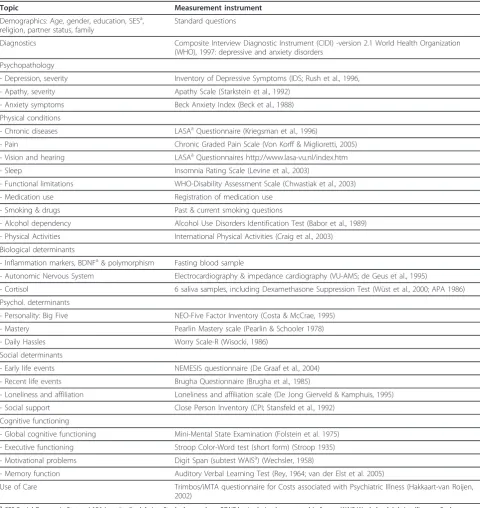
[image:4.595.57.538.99.608.2]Diagnosis of depression and dysthymia according to DSM-IV-R criteria [48] is assessed with the Composite International Diagnostic Interview (CIDI; WHO version 2.1; life-time version). The CIDI is a structured clinical interview that is designed for use in research settings and has high validity for depressive and anxiety disor-ders. [9,50] As in NESDA, we added questions to Table 1 Baseline assessment of NESDO
Topic Measurement instrument
Demographics: Age, gender, education, SESa,
religion, partner status, family
Standard questions
Diagnostics Composite Interview Diagnostic Instrument (CIDI) -version 2.1 World Health Organization (WHO), 1997: depressive and anxiety disorders
Psychopathology
- Depression, severity Inventory of Depressive Symptoms (IDS; Rush et al., 1996,
- Apathy, severity Apathy Scale (Starkstein et al., 1992)
- Anxiety symptoms Beck Anxiety Index (Beck et al., 1988)
Physical conditions
- Chronic diseases LASAaQuestionnaire (Kriegsman et al., 1996)
- Pain Chronic Graded Pain Scale (Von Korff & Miglioretti, 2005)
- Vision and hearing LASAaQuestionnaires http://www.lasa-vu.nl/index.htm
- Sleep Insomnia Rating Scale (Levine et al., 2003)
- Functional limitations WHO-Disability Assessment Scale (Chwastiak et al., 2003)
- Medication use Registration of medication use
- Smoking & drugs Past & current smoking questions
- Alcohol dependency Alcohol Use Disorders Identification Test (Babor et al., 1989)
- Physical Activities International Physical Activities (Craig et al., 2003)
Biological determinants
- Inflammation markers, BDNFa& polymorphism Fasting blood sample
- Autonomic Nervous System Electrocardiography & impedance cardiography (VU-AMS; de Geus et al., 1995)
- Cortisol 6 saliva samples, including Dexamethasone Suppression Test (Wüst et al., 2000; APA 1986)
Psychol. determinants
- Personality: Big Five NEO-Five Factor Inventory (Costa & McCrae, 1995)
- Mastery Pearlin Mastery scale (Pearlin & Schooler 1978)
- Daily Hassles Worry Scale-R (Wisocki, 1986)
Social determinants
- Early life events NEMESIS questionnaire (De Graaf et al., 2004)
- Recent life events Brugha Questionnaire (Brugha et al., 1985)
- Loneliness and affiliation Loneliness and affiliation scale (De Jong Gierveld & Kamphuis, 1995)
- Social support Close Person Inventory (CPI; Stansfeld et al., 1992)
Cognitive functioning
- Global cognitive functioning Mini-Mental State Examination (Folstein et al. 1975)
- Executive functioning Stroop Color-Word test (short form) (Stroop 1935)
- Motivational problems Digit Span (subtest WAISa) (Wechsler, 1958)
- Memory function Auditory Verbal Learning Test (Rey, 1964; van der Elst et al. 2005)
Use of Care Trimbos/iMTA questionnaire for Costs associated with Psychiatric Illness (Hakkaart-van Roijen, 2002)
a
determine the research DSM-IV diagnosis of current minor depression. Severity of depression was measured using a self-report questionnaire: the Inventory of Depressive Symptoms (IDS). [51] As co morbidity with anxiety disorders is high, anxiety disorders [General Anxiety Disorder (GAD), Panic Disorder (PAN), Agora-phobia (AGO) and Social Phobia (SOC)] were also assessed using the CIDI (12 month version). Severity of anxiety symptoms was measured using the Beck Anxiety Index (BAI), [52] a self-report questionnaire. Apathy which is assumed to be more common in late-life depression compared to early-life depression was assessed using the Apathy Scale as a self-report ques-tionnaire [53].
Vulnerability factors, stressors and protective factors
Demographic characteristics such as age, sex, ethnicity, place of living, household composition, and income were assessed with standard questions.
Psycho-social functioning
Childhood abuse, including emotional neglect as well as psychological, physical and sexual abuse, was assessed using a structured inventory. [54] Important life events during childhood and in the past years were assessed with the Brugha questionnaire. [55] Personality was assessed with the NEO-FFI, a 60 item questionnaire measuring the five personality domains neuroticism, extraversion, agreeableness, conscientiousness, and openness to experience [56] and a short mastery scale. [57] Daily hassles were assessed using a revised version of the Worry-Scale. [58] Details about present social support from the four most intimate persons were assessed with the Close Person Inventory, [59] and a self-report questionnaire on loneliness and affiliation [60].
Somatic and health markers
The presence of chronic diseases was assessed by means of a self-report questionnaire that has previously been used in NESDA. [47] The participants were asked whether they currently or previously had any of the fol-lowing chronic diseases or disease events: cardiac dis-ease (including myocardial infarction), peripheral atherosclerosis, stroke, diabetes mellitus, COPD (asthma, chronic bronchitis or pulmonary emphysema), arthritis (rheumatoid arthritis or osteoarthritis) or cancer, or any other disease. Compared to general practitioner infor-mation, the accuracy of self-reports of these diseases was shown to be adequate and independent of cognitive impairment [61].
Biomarkers that are parameters of cardiovascular sta-tus, immune function and metabolic syndrome were assessed in fasting blood. The interviews took place in the morning, and the respondents came in after an over-night fast. We drew 47.5 millilitres of blood which was
immediately transferred to a local laboratory to start processing within an hour. Routine assays included assessment of haemoglobin, hematocrit, creatinine, total cholesterol, HDL and LDL cholesterol, glucose, trigly-cerides, albumin, thyroid stimulated hormone (TSH) and Free T4. The rest of the blood was processed and stored at−80°C for later assaying.
Systolic and diastolic blood pressures were measured twice in a supine position using an electronic Omron phygmomanometer. Doppler assessment of ankle and arm blood pressure allows calculation of the ankle/bra-chial index, which is an indicator of peripheral athero-sclerosis [62].
Physical condition was assessed by means of measure-ment of handgrip using a hand-held dynamometer, which is an important indicator of physical frailty. Body composition assessment included objective, standardized assessments of height, weight and hip and abdominal circumference. Self reported functional limitations were assessed with the WHO-Disability Assessment Schedule. [63] Pain was assessed with the self report Chronic Graded Pain scale. [64] Sleep and insomnia was assessed with the Insomnia Rating Scale (IRS). [65] Vision and hearing were assessed with standard questions.
Physical stress regulation systems
The two most important biological stress regulation systems that have been hypothesized to be of impor-tance in depression are the HPA-axis and the auto-nomic nervous system (ANS). Functioning of the HPA-axis was assessed by the use of cortisol concen-trations in saliva, reflecting the free fraction of plasma cortisol, which was collected by the participants on two consecutive days. [66] Six saliva samples were taken: at the time of awakening (T1), 30 minutes post-awakening (T2), 45 minutes post-post-awakening (T3), 60 minutes post-awakening (T4) and at 22:00 h (T5). Dexamethasone suppression was measured by sampling the next morning at awakening (T6) after dexametha-sone ingestion of 0.5 mg the night before (directly after T5). This Dexamethasone Suppression Test (DST) is a measure of HPA axis regulation and nor-mally shows a decrease of morning cortisol concentra-tions due to inhibition of adrenocorticotropic hormone (ACTH) secretion after dexamethasone administration the night before. [67] The salivettes were restored in the tube labelled with date and time. After collecting all six samples, the subjects were asked to return the samples by post to the research centre. After receipt, salivettes were centrifuged at 2000 g for ten minutes, aliquoted and stored at −20°C.
(VU-AMS, version 5fs). Recording methodology of the VU-AMS as well as its reliability, validity and feasibility in large scale samples has been well documented [68,69].
Cognitive function
Tests for several cognitive domains were assessed: the Mini-Mental State Examination (MMSE) [70] for global cognitive functioning, the abbreviated version of the Stroop Colour-word test [71] for executive functioning; the subtest Digit Span from the Wechsler Adult Intelli-gence Scale [72] for motivational problems and a modi-fied version of the Auditory Verbal Learning Test [73,74] for memory function.
Health behaviour
Assessment of health behaviour included smoking, alco-hol use, physical activities and use of health care and medication. Smoking behaviour was assessed with stan-dard questions, and the use of alcohol was assessed using the Alcohol Use Disorders Identification Test (AUDIT). [75] With the International Physical Activities Question-naire (IPAQ) [76] energy expenditure based on sports and daily activities was calculated. Medical and psycholo-gical treatments and other professional support the per-sons have had for their mental and physical health problems was assessed with the Trimbos/iMTA ques-tionnaire for Costs associated with Psychiatric Illness (TIC-P). [77] Medication use was determined by observa-tion of the medicaobserva-tion that the participants brought in.
Longitudinal data collection
The course of late-life depression is followed up every 6 months by means of a postal assessment that includes questionnaires on the severity of depressive symptoms and somatic health in the past 6 months, incident (chronic) stressors and functional limitations, and use of medications and health care. The questionnaires are the same questionnaires that are used during the face-to-face assessments.
A second face-to-face assessment is being performed 2 years after the baseline assessment, and is currently going on. It consists of all measures (determinants and outcome variables) that are open to change, such as severity of psychopathology and diagnostics, change in socio-demographic characteristics, all somatic health and health markers, cognitive functioning, psycho-social functioning (except for the early life events and the per-sonality questionnaire), and health behaviour. More detailed fluctuation of depressive symptoms during the past 2 years will be assessed with a Life Chart method. This instrument uses a calendar method to re-fresh memory and then assesses presence and severity of symptoms during each month in the past two years. [78] Collection of blood and VU-AMS registration are also repeated.
The follow-up assessment lasts about 3 hours and the same instruments will be used as in the baseline assess-ment (see Table 1), including written questionnaires, an interview, and a medical examination. A third follow-up face-to-face assessment is planned 6 years after the baseline assessment.
Quality of the data
All interviews and physical examinations are conducted by carefully selected research assistants, mainly consist-ing of psychologists and mental health care nurses. The research assistants received a five day training from an experienced and certified trainer before the baseline and follow-up assessments. The research assistant is certified to conduct assessments after approval of two complete interviews which were audio taped and judged by the trainer. Question wording and probing behaviour of interviewers will frequently be monitored by checking a random selection of about 10% of all taped interviews. Data are collected with Computer Assisted Personal Interviewing (CAPI) procedures on laptop computers and with self-administered questionnaires.
Data management and control
Data management of NESDO is coordinated at the Department of Psychiatry of the VUMC. The collected data from the different sites are send to the coordinating centre, where the data are entered in the central data-base. A special team of data managers takes care of data quality, data archiving and the creation of variables and scales. Data quality check procedures are in place and are routinely carried out to review missing data and check for inconsistencies.
Ethical issues
Results
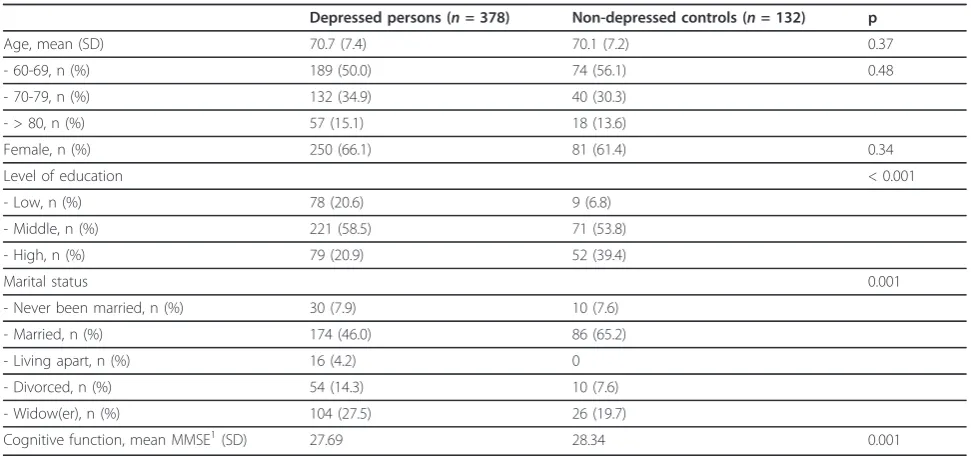
The baseline sample consists of 378 depressed persons and 132 non-depressed controls. The overall sample has a mean age of 70.6 years (SD: 7.3; range = 60-93) and consists of 331 (64.9%) women and 179 (35.1%) men. The average years of education is 11.0 (SD = 3.6; range 5-18 years). The majority of the sample has the Dutch nationality (99.4%).
The depressive persons do not differ from the non-depressed controls with respect to mean age and sex, but they have a lower level of education, are more often divorced or widowed, and have a lower score on the MMSE (Table 2). From the depressed persons 95% has a current (six-month) major depressive disorder, 26.5% has dysthymia and 5.6% has a minor depression. 26.5% of the depressed persons have two depressive disorders, major depressive disorder and dysthymia (Table 3). Mean age of onset of the depressive disorders was around 49 years. About thirty percent of the persons with major depression (MDD) and dysthymia had an onset before the age of 40 years, whereas about 33% of the persons with MDD and 41% of the persons with dysthymia had an onset after 60 years. For 33.1% of the depressed persons it was their first episode. Severity of the depression symptoms varied between mild and very severe. Forty-one percent of the depressed persons had in the past 6 months also an anxiety disorder.
Discussion
NESDO is a multi-site naturalistic cohort study that offers us the possibility to examine the determinants, the course and consequences of depressive disorders in older
persons, and to compare these with those of depression earlier in adulthood. Because of the increase of the aging population in the near future, the number of older per-sons suffering from (chronic) depression will further grow in the forthcoming years, and thus will become an even more relevant issue for public health care. It is of great importance to uncover mechanisms responsible for its chronic course and co morbidity. Differences in (the determinants of) the course and consequences of depres-sion have seldom been directly compared between older and younger adults using a similar study design and with comparable instruments. Knowledge about the adequacy of the postulated differences between late-life and early-life depression is important, since it will yield important implications for mental health care practice and research. By combining data from NESDA and NESDO we will be able to address important questions that have potential relevance to the development of interventions capable of improving the course of late-life depression. The clinical relevance of the study is enhanced by the fact that several determinants of the course of depression may be used in prevention and treatment programs, which may be implemented in regular care.
Conclusions
[image:7.595.55.541.494.724.2]The NESDO sample offers the opportunity to study the (determinants) of the long-term course of depression in older persons, and to pool data with NESDA. This pro-vides us with a large (longitudinal) database of clinically depressed persons with adequate power and a large set of neurobiological, psychosocial and physical variables from both younger and older depressed persons.
Table 2 Characteristics of the sample (N =510)
Depressed persons (n =378) Non-depressed controls (n =132) p
Age, mean (SD) 70.7 (7.4) 70.1 (7.2) 0.37
- 60-69, n (%) 189 (50.0) 74 (56.1) 0.48
- 70-79, n (%) 132 (34.9) 40 (30.3)
- > 80, n (%) 57 (15.1) 18 (13.6)
Female, n (%) 250 (66.1) 81 (61.4) 0.34
Level of education < 0.001
- Low, n (%) 78 (20.6) 9 (6.8)
- Middle, n (%) 221 (58.5) 71 (53.8)
- High, n (%) 79 (20.9) 52 (39.4)
Marital status 0.001
- Never been married, n (%) 30 (7.9) 10 (7.6)
- Married, n (%) 174 (46.0) 86 (65.2)
- Living apart, n (%) 16 (4.2) 0
- Divorced, n (%) 54 (14.3) 10 (7.6)
- Widow(er), n (%) 104 (27.5) 26 (19.7)
Cognitive function, mean MMSE1(SD) 27.69 28.34 0.001
1
Acknowledgements and disclosures
The infrastructure for NESDO is funded through the Fonds NutsOhra, Stichting tot Steun VCVGZ, NARSAD The Brain and Behaviour Research Fund, and the participating universities and mental health care organizations (VU University Medical Center, Leiden University Medical Center, University Medical Center Groningen, Radboud University Nijmegen Medical Center, and GGZ inGeest, GGNet, GGZ Nijmegen, GGZ Rivierduinen, Lentis, and Parnassia).
Author details
1Department Psychiatry/EMGO Institute for Health and Care Research, VU
University Medical Center/GGZinGeest, Amsterdam, The Netherlands.
2Department of General Practice and EMGO Institute for Health and Care
Research, VU University Medical Center, Amsterdam, The Netherlands.
3Department of Psychiatry, Leiden University Medical Center, Leiden, The
Netherlands.4Department of Old-age Psychiatry, GGNet, Apeldoorn/Zutphen, The Netherlands.5University Center of Psychiatry & Interdisciplinary Center of
Psychiatric Epidemiology, University Medical Center Groningen, Groningen,
The Netherlands.6Department of Psychiatry, Radboud University Nijmegen
Medical Center, Nijmegen, The Netherlands.7Department Psychiatry/EMGO
Institute for Health and Care Research, VU University Medical Center, Amsterdam, The Netherlands.8Lentis, Dignis, Groningen, The Netherlands. 9
Department of General Practice, University Medical Center Groningen, Groningen, The Netherlands.10Department of Old-age Psychiatry, Parnassia/
BAVO groep, The Hague, The Netherlands.11Department of Public Health and Primary Care, Leiden University Medical Center, Leiden, The Netherlands.
12
Department Psychiatry, EMGO Institute for Health and Care Research and Institute for Neurosciences, VU University Medical Center, Amsterdam, The Netherlands.13Department of Old-age Psychiatry, GGZinGeest, Amsterdam,
The Netherlands.14Department Psychiatry/EMGO Institute for Health and
Care Research/Institute for Neurosciences, VU University Medical Center and GGZ inGeest, Amsterdam, The Netherlands.15Department Psychiatry, VUMC, A.J. Ernststraat 1187, 1081 HL Amsterdam, The Netherlands.
Authors’contributions
All authors are key members of the research consortium and have made substantial contributions to the conception and the design of the study, and acquisition of the baseline data. They have all been involved in writing the manuscript and have given their approval for the final version.
Competing interests
The authors declare that they have no competing interests.
Received: 29 September 2011 Accepted: 5 December 2011 Published: 5 December 2011
References
1. Fiske A, Wetherell JL, Gatz M:Depression in older adults.Annu Rev Clin
Psychol2009,5:363-389.
2. Hybels CF, Pieper CF, Blazer DG, Steffens DC:The course of depressive symptoms in older adults with comorbid major depression and dysthymia.Am J Geriatr Psychiatry2008,16:300-309.
3. Licht-Strunk E, Van Der Windt DA, Van Marwijk HW, De Haan M, Beekman AT:The prognosis of depression in older patients in general practice and the community. A systematic review.Fam Pract2007, 24:168-180.
4. Mueller TI, Kohn R, Leventhal N, Leon AC, Solomon D, Coryell W, Endicott J, Alexopoulos GS, Keller MB:The course of depression in elderly patients.
Am J Geriatr Psychiatry2004,12:22-29.
5. Mitchell AJ, Subramaniam H:Prognosis of depression in old age compared to middle age: a systematic review of comparative studies.
Am J Psychiatry2005,162:1588-1601.
6. Stek ML, Van Exel E, Van Tilburg W, Westendorp RG, Beekman AT:The prognosis of depression in old age: outcome six to eight years after clinical treatment.Aging Ment Health2002,6:282-285.
7. Jorm AF:Is depression a risk factor for dementia or cognitive decline? A review.Gerontology2000,46:219-227.
8. Lyness JM:Depression and comorbidity: objects in the mirror are more complex than they appear.Am J Geriatr Psychiatry2008,16:181-185. 9. Kessler RC, Birnbaum H, Bromet E, Hwang I, Sampson N, Shahly V:Age
differences in major depression: results from the National Comorbidity Survey Replication (NCS-R).Psychol Med2010,40:225-237.
10. Beekman AT, De Beurs E, Van Balkom AJ, Deeg DJ, Van Dyck R, Van Tilburg W:Anxiety and depression in later life: Co-occurrence and communality of risk factors.Am J Psychiatry2000,157:89-95. 11. Lenze EJ, Mulsant BH, Shear MK, Alexopoulos GS, Frank E, Reynolds CF:
Comorbidity of depression and anxiety disorders in later life.Depress
Anxiety2001,14:86-93.
12. Cairney J, Corna LM, Veldhuizen S, Herrmann N, Streiner DL:Comorbid depression and anxiety in later life: patterns of association, subjective well-being, and impairment.Am J Geriatr Psychiatry2008,16:201-208. 13. Steffens DC:A multiplicity of approaches to characterize geriatric
depression and its outcomes.Curr Opin Psychiatry2009,22:522-526. 14. Andreescu C, Lenze EJ, Dew MA, Begley AE, Mulsant BH, Dombrovski AY,
Pollock BG, Stack J, Miller MD, Reynolds CF:Effect of comorbid anxiety on treatment response and relapse risk in late-life depression: controlled study.Br J Psychiatr2007,190:344-349.
15. Zubin J, Spring B:Vulnerability: A New View on Schizophrenia.J Abn
[image:8.595.55.291.112.520.2]Psychol1977,86:103-126.
Table 3 Characteristics of depression and co morbid anxiety disorders from the depressed cohort (N= 378)
Major depression
Major depression, current1, n (%) 359 (95.0)
Mean age of onset (SD) 48.6 (20.3)
Age of onset in categories (%)
- < 40 yrs 30.6
−40-60 yrs 34.5
− ≥60 yrs 32.9
- No answer 1.9
Dysthymia
Dysthymia, current1, % 100 (26.5)
Mean age of onset (SD) 50.7 (19.7)
Age of onset in categories, %
−< 40 yrs 29.3
−40-60 yrs 29.3
− ≥60 yrs 41.4
- No answer 1.0
Minor depression (current), % 21 (5.6)
Severity depressive symptoms
Mean IDS score2(SD) 30.14 (13.0)
IDS2categories
- mild 37.5
- moderate 35.4
- severe/very severe 27.1
First episode, % 33.1
Comorbid anxiety disorders1
Any anxiety disorder, n (%) 155 (41.0)
Social Phobia, n (%) 74 (19.6)
Panic disorder, without agoraphobia, n (%) 29 (7.7)
Agoraphobia, n (%) 41 (10.8)
Generalized Anxiety Disorder, n (%) 40 (10.6)
1
Current: disorder in the past 6 months
2
16. Baldwin RC, Tomenson B:Depression in later life. A comparison of symptoms and risk factors in early and late onset cases.Br J Psychiatry 1995,167:649-652.
17. Brodaty H, Luscombe G, Parker G, Wilhelm K, Hickie I, Austin MP, Mitchell P: Early and late onset depression in old age: different aetiologies, same phenomenology.J Affect Disord2001,66:225-236.
18. Gallo JJ, Richardson JP:Risk factors for depression among older adults.
Md Med J1996,45:411-414.
19. Beekman AT, Geerlings SW, Deeg DJ, Smit JH, Schoevers RS, de Beurs E, Braam AW, Penninx BW, Van Tilburg W:The natural history of late-life depression: a 6-year prospective study in the community.Arch Gen
Psychiatry2002,59:605-611.
20. Steunenberg B, Beekman AT, Deeg DJ, Bremmer MA, Kerkhof AJ:Mastery and neuroticism predict recovery of depression in later life.Am J Geriatr
Psychiatry2007,15:234-242.
21. Cui X, Lyness JM, Tang W, Tu X, Conwell Y:Outcomes and predictors of late-life depression trajectories in older primary care patients.Am J
Geriatr Psychiatry2008,16:406-415.
22. Vink D, Aartsen MJ, Schoevers RA:Risk factors for anxiety and depression in the elderly: a review.J Affect Disor2008,106:29-44.
23. Kendler KS, Gardner CO, Fiske A, Gatz M:Major depression and coronary artery disease in the Swedish twin registry: phenotypic, genetic, and environmental sources of comorbidity.Arch Gen Psychiatry2009, 66:857-863.
24. Ormel J, Oldehinkel AJ, Brilman EI:The interplay and etiological continuity of neuroticism, difficulties, and life events in the etiology of major and subsyndromal, first and recurrent depressive episodes in later life.Am J
Psychiatry2001,158:885-891.
25. Bremmer MA, Beekman AT, Deeg DJ, Penninx BW, Dik MG, Hack CE, Hoogendijk WJ:Inflammatory markers in late-life depression: results from a population-based study.J Affect Disord2008,106:249-255.
26. Beekman AT, Penninx BW, Deeg DJ, De Beurs E, Geerling SW, Van Tilburg W:The impact of depression on the well-being, disability and use of services in older adults: a longitudinal perspective.Acta Psychiatr
Scand2002,105:20-27.
27. Morrison MF, Redei E, TenHave T, Parmelee P, Boyce AA, Sinha PS, Katz IR: Dehydroepiandrosterone sulfate and psychiatric measures in a frail, elderly residential care population.Biol Psychiatry2000,47:144-150. 28. Fries E, Hesse J, Hellhammer J, Hellhammer DH:A new view on
hypocortisolism.Psychoneuroendocrinology2005,30:1010-1016. 29. Van Der Kooy KG, Van Hout HP, Van Marwijk HW, De Haan M,
Stehouwer CD, Beekman AT:Differences in heart rate variability between depressed and non-depressed elderly.Int J Geriatr Psychiatry2006, 21:147-150.
30. Bremmer MA, Deeg DJ, Beekman AT, Penninx BW, Lips P, Hoogendijk WJ: Major depression in late life is associated with both hypo- and hypercortisolemia.Biol Psychiatry2007,62:479-486.
31. Penninx BW, Beekman AT, Bandinelli S, Corsi AM, Bremmer M,
Hoogendijk WJ, Guralnik JM, Ferrucci L:Late-life depressive symptoms are associated with both hyperactivity and hypoactivity of the
hypothalamo-pituitary-adrenal axis.Am J Geriatr Psychiatry2007, 15:522-529.
32. Jindal RD, Vasko RC Jr, Jennings JR, Fasiczka AL, Thase ME, Reynolds CF: Heart rate variability in depressed elderly.Am J Geriatr Psychiatry2008, 16:861-866.
33. McEwen BS, Stellar E:Stress and the individual. Mechanisms leading to disease.Arch Intern Med1993,153:2093-2101.
34. Glei DA, Goldman N, Chuang YL, Weinstein M:Do chronic stressors lead to physiological dysregulation? Testing the theory of allostatic load.
Psychosom Med2007,69:769-776.
35. Tiemeier H, Hofman A, Van Tuijl HR, Kiliaan AJ, Meijer J, Breteler MM: Inflammatory proteins and depression in the elderly.Epidemiology2003, 14:103-107.
36. Penninx BW, Guralnik JM, Mendes de Leon CF, Pahor M, Visser M, Corti MC, Wallace RB:Cardiovascular events and mortality in newly and chronically depressed persons > 70 years of age.Am J Cardiol1998,81:988-994. 37. Taylor WD, McQuoid DR, Krishnan KR:Medical comorbidity in late-life
depression.Int J Geriatr Psychiatry2004,19:935-943.
38. Vinkers DJ, Gussekloo J, Stek ML, Westendorp RG, Van Der Mast RC: Temporal relation between depression and cognitive impairment in old age: prospective population based study.BMJ2004,329:881.
39. Bremmer MA, Hoogendijk WJ, Deeg DJ, Schoevers RA, Schalk BW, Beekman AT:Depression in older age is a risk factor for first ischemic cardiac events.Am J Geriatr Psychiatry2006,14:523-530.
40. Wouts L, Oude Voshaar RC, Bremmer MA, Buitelaar JK, Penninx BWJH, Beekman ATF:Cardiac disease moderates the effect of depression on the risk of stroke in an elderly population.Arch Gen Psychiatry2008, ,65: 596-602.
41. Pouwer F, Beekman AT, Nijpels G, Dekker JM, Snoek FJ, Kostense PJ, Heine RJ, Deeg DJ:Rates and risks for co-morbid depression in patients with Type 2 diabetes mellitus: results from a community-based study.
Diabetologia2003,46:892-898.
42. Beekman AT, Penninx BW, Deeg DJ, Ormel J, Braam AW, Van Tilburg W: Depression and physical health in later life: results from the Longitudinal Aging Study Amsterdam (LASA).J Affect Disord1997, 46:219-231.
43. Brodaty H, Peters K, Boyce P, Hickie I, Parker G, Mitchell P, Wilhelm K:Age and depression.J Affect Disor1991,23:137-149.
44. Brodaty H, Luscombe G, Parker G, Wilhelm K, Hickie I, Austin MP, Mitchell P: Increased rate of psychosis and psychomotor change in depression with
age.Psychol Med1997,27:1205-1213.
45. Gallo JJ, Rabins PV, Lyketsos CG, Tien AY, Anthony JC:Depression without sadness: functional outcomes of nondysphoric depression in later life.J
Am Geriatr Soc1997,45:570-578.
46. Adams KB:Depressive symptoms, depletion, or developmental change? Withdrawal, apathy, and lack of vigor in the Geriatric Depression Scale.
Gerontologist2001,41:768-777.
47. Penninx BW, Beekman AT, Smit JH, Zitman FG, Nolen WA, Spinhoven P, Cuijpers P, De Jong PJ, Van Marwijk HW, Assendelft WJ, Van Der Meer K, Verhaak P, Wensing M, De Graaf R, Hoogendijk WJ, Ormel J, Van Dyck R, NESDA Research Consortium:The Netherlands Study of Depression and Anxiety (NESDA): rationale, objectives and methods.Int J Methods
Psychiatr Res2008,17:121-140.
48. American Psychiatric Association:Diagnostic and Statistical Manual of Mental
Disorders.fourth edition. Washington, DC: American Psychiatric Publishing;
2000.
49. Yesavage JA:Geriatric Depression Scale.Psychopharmacol Bull1988, 24:709-711.
50. Wittchen HU, Robins LN, Cottler LB, Sartorius N, Burke JD, Regier D: Cross-cultural feasibility, reliability and sources of variance of the Composite International Diagnostic Interview (CIDI). The Multicentre WHO/ADAMHA Field Trials.Br J Psychiatry1991,159:645-653, 658.
51. Rush AJ, Gullion CM, Basco MR, Jarrett RB, Trivedi MH:The Inventory of Depressive Symptomatology (IDS): psychometric properties.Psychol Med 1996,26:477-486.
52. Beck AT, Epstein N, Brown G, Steer RA:An inventory for measuring clinical anxiety: psychometric properties.J Consult Clin Psychol1988,56:893-897. 53. Starkstein SE, Mayberg HS, Preziosi TJ, Andrezejewski P, Leiguarda R,
Robinson RG:Reliability, validity, and clinical correlates of apathy in Parkinson’s disease.J Neuropsychiatry Clin Neurosci1992,4:134-139. 54. De Graaf R, Bijl RV, Ten Have M, Beekman AT, Vollebergh WA:Pathways to
comorbidity: the transition of pure mood, anxiety and substance use disorders into comorbid conditions in a longitudinal population-based study.J Affect Disord2004,82:461-467.
55. Brugha T, Bebbington P, Tennant C, Hurry J:The List of Threatening Experiences: a subset of 12 life event categories with considerable long-term contextual threat.Psychol Med1985,15:189-194.
56. Costa PT, McCrae RR:Domains and facets: hierarchical personality assessment using the revised NEO personality inventory.J Pers Assess 1995,64:21-50.
57. Pearlin LI, Schooler C:The structure of coping.J Health Soc Behav1978, 19:2-21.
58. Wisocki PA, Handen B, Morse CK:The worry scale as a measure of anxiety among homebound and community active elderly.Behav Therapist1986, 5:91-95.
59. Stansfeld S, Marmot M:Deriving a survey measure of social support: the reliability and validity of the Close Persons Questionnaire.Soc Sci Med 1992,35:1027-1035.
60. De Jong Gierveld J, Kamphuis FH:The development of a rasch type loneliness scale.Appl Psychol Measurements1985,9:289-299.
diseases in community dwelling elderly. A study on the accuracy of patients’self-reports and on determinants of inaccuracy.J Clin Epidemiol 1996,49:1407-1417.
62. Newman AB, Siscovick DS, Manolio TA, Polak J, Fried LP, Borhani NO, Wolfson SK:Ankle-arm index as a marker of atherosclerosis in the Cardiovascular Health Study. Cardiovascular Heart Study (CHS) Collaborative Research Group.Circulation1993,88:837-845. 63. Chwastiak LA, Von Korff M:Disability in depression and back pain:
evaluation of the World Health Organization Disability Assessment Schedule (WHO DAS II) in a primary care setting.J Clin Epidemiol2003, 56:507-514.
64. Von Korff M, Miglioretti DL:A prognostic approach to defining chronic pain.Pain2005,117:304-313.
65. Levine DW, Kaplan RM, Kripke DF, Bowen DJ, Naughton MJ, Shumaker SA: Factor structure and measurement invariance of the Women’s Health Initiative Insomnia Rating Scale.Psychol Assess2003,15:123-136. 66. Würst S, Wolf J, Hellhammer DH, Dechoux R, Kumsta R, Kirschbaum C:The
cortisol awakening response, normal values and confounds.Noise Health 2000,29:174-184.
67. American Psychiatric Association:The dexamethasone suppression test: an overview of its current status in psychiatry. The APA task force on Laboratory tests in psychiatry.Am J Psychiatry1987,144:1253-62. 68. De Geus EJ, Willemsen GH, Klaver CH, van Doornen LJ:Ambulatory
measurement of respiratory sinus arrhythmia and respiration rate.Biol
Psychol1995,41:205-227.
69. Licht CM, De Geus EJ, Zitman FG, Hoogendijk WJ, Van Dyck R, Penninx BW: Association between major depressive disorder and heart rate variability in the Netherlands Study of Depression and Anxiety (NESDA).Arch Gen
Psychiatry2008,65:1358-1367.
70. Folstein MF, Folstein SE, McHugh PR:“Mini-mental state”. A practical method for grading the cognitive state of patients for the clinician.J
Psych Res1975,12:189-198.
71. Stroop JR:Studies of interference in serial verbal reactions.J Exp Psychol 1935,18:643-662.
72. Wechsler D:The measurement and appraisal of adult intelligence.4 edition. Baltimore: Williams & Wilkins; 1958.
73. Rey A:L’examen clinique en psychologie.Presses Universitaire de France, Paris, France; 1964.
74. Van Der Elst W, Van Boxtel MP, Van Breukelen GJ, Jolles J:Rey’s verbal learning test: normative data for 1855 healthy participants aged 24-81 years and the influence of age, sex, education, and mode of presentation.J Int Neuropsychol Soc2005,11:290-302.
75. Babor TF, Kranzler HR, Lauerman RJ:Early detection of harmful alcohol consumption: comparison of clinical, laboratory, and self-report screening procedures.Addict Behav1989,14:139-157.
76. Craig CL, Marshall AL, Sjostrom M, Bauman AE, Booth ML, Ainsworth BE, Pratt M, Ekelund U, Yngve A, Sallis JF, Oja P:International physical activity questionnaire: 12-country reliability and validity.Med Sci Sports Exerc 2003,35:1381-1395.
77. Hakkaart-van Roijen L:Trimbos/iMTA questionnaire for costs associated with
psychiatric illness (TIC-P)Rotterdam: Institute for Medical Technology
Assessment; 2002.
78. Lyketsos CG, Nestadt G, Cwi J, Heithoff K, Eaton WW:The lifechart method to describe the course of psychopathology.Int J Methods Psychiatry Res 1994,4:143-155.
doi:10.1186/1756-0500-4-524
Cite this article as:Comijset al.:The Netherlands study of depression in older persons (NESDO); a prospective cohort study.BMC Research Notes
20114:524. Submit your next manuscript to BioMed Central
and take full advantage of:
• Convenient online submission
• Thorough peer review
• No space constraints or color figure charges
• Immediate publication on acceptance
• Inclusion in PubMed, CAS, Scopus and Google Scholar
• Research which is freely available for redistribution