R E S E A R C H A R T I C L E
Open Access
Age-related changes in relative expression
stability of commonly used housekeeping genes
in selected porcine tissues
Muhammad Jasim Uddin
1,2, Mehmet Ulas Cinar
1, Dawit Tesfaye
1, Christian Looft
1, Ernst Tholen
1and
Karl Schellander
1*Abstract
Background:Gene expression analysis using real-time RT-PCR (qRT-PCR) is increasingly important in biological research due to the high-throughput and accuracy of qRT-PCR. For accurate and reliable gene expression analysis, normalization of gene expression data against housekeeping genes or internal control genes is required. The stability of reference genes has a tremendous effect on the results of relative quantification of gene expression by qRT-PCR. The expression stability of reference genes could vary according to tissues, age of individuals and experimental conditions. In the pig however, very little information is available on the expression stability of reference genes. The aim of this research was therefore to develop a new set of reference genes which can be used for normalization of mRNA expression data of genes expressed in varieties of porcine tissues at different ages. Results:The mRNA expression stability of nine commonly used reference genes (B2M, BLM, GAPDH, HPRT1, PPIA, RPL4, SDHA, TBPandYWHAZ) was determined in varieties of tissues collected from newborn, young and adult pigs. geNorm, NormFinder and BestKeeper software were used to rank the genes according to their stability. geNorm software revealed thatRPL4, PPIAandYWHAZshowed high stability in newborn and adult pigs, whileB2M, YWHAZ
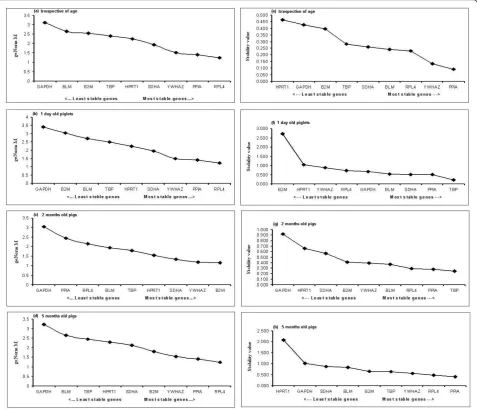
andSDHAshowed high stability in young pigs. In all cases,GAPDHshowed the least stability in geNorm.
NormFinder revealed thatTBPwas the most stable gene in newborn and young pigs, whilePPIAwas most stable in adult pigs. Moreover, geNorm software suggested that the geometric mean of three most stable gene would be the suitable combination for accurate normalization of gene expression study.
Conclusions:Although, there was discrepancy in the ranking order of reference genes obtained by different analysing software methods, the geometric mean of theRPL4, PPIAandYWHAZseems to be the most appropriate combination of housekeeping genes for accurate normalization of gene expression data in different porcine tissues at different ages.
Background
The pig is one of the most studied organism in research community as a food as well as a model animal, and many projects in pigs require the quantification of genes for many purposes. Real-time quantitative PCR (qRT-PCR) is the most frequently used method for gene quantification nowadays. qRT-PCR is an efficient method for quantifica-tion of mRNA transcript levels due to its high sensitivity, reproducibility and large dynamic range. Furthermore, it is
fast, easy to use and provides simultaneous measurement of gene expression in many different samples for a limited number of genes [1-3]. In case of qRT-PCR, when analyz-ing data for relative quantification, results are normalized to a reference. The most accepted approach to mRNA quantification is normalization of the expression level of a gene of interest (target gene) to the expression level of an internal stably expressed gene (control gene) [4-6]. The control gene, often termed reference gene or housekeeping gene, is a stably expressed gene that is experimentally veri-fied in given species and tissues under given experimental conditions [3,7-9]. Normalizing to a reference gene is a widely used method because it is simple in theory. The
* Correspondence: [email protected] 1
Animal Breeding and Husbandry/Genetics group, Institute of Animal Science, University of Bonn, Endenicher Allee 15, 53115 Bonn, Germany Full list of author information is available at the end of the article
normalization adjusts for differences in the quality or quantity of template RNA or starting material and differ-ences in RNA preparation and cDNA synthesis, since the reference gene is exposed to the same preparation steps as the gene of interest. This allows the direct comparison of normalized transcript expression levels between samples. However, this approach requires the selection of at least one reference gene for validation of a corresponding qRT-PCR method. Normalization is extremely important to allow accurate comparison of the results between different samples and conditions in gene expression studies [4]. For instance, the commonly used reference genes such as GAPDHandb-actin are unfortunately often used without prior validation of their expression stability under the spe-cific study conditions, but a number of studies have shown that the expression of those genes is significantly altered in some experimental conditions [10-12]. It is therefore necessary to validate the expression stability of reference genes prior to their use in an experimental protocol. Recently it has been recommended that a combination of reference genes should be used to obtain a more stable reference [6] and the use of a single reference gene is nowadays discouraged by more and more authors [4,6,13]. Because, a variability or alteration in the chosen reference gene by the experiment, however, may change the obtained results entirely and could be incorrect. Therefore, the validation of potential reference genes is essential.
An ideal reference gene should be stably expressed and unaffected by experimental protocol or status [14]. But, the recent studies showed that the housekeeping gene expressions could be changed according to the type of tis-sues [3,8,15] breeds [15], experimental condition (such as treatment or disease) [16-19] and age [15,20,21]. A set of reference genes are suggested on the basis of their stability over tissues in pigs [3,7,15,22,23] but studies for expres-sion stability of housekeeping genes in varieties of porcine tissue collected from different age of pigs are rare. There-fore, this study was aimed to explore the expressions of nine mostly used housekeeping genes in 14 different tis-sues collected from three different ages of pigs (1 day old piglet, 2 months old young and 5 months old adult pigs) in order to select the suitable set of housekeeping genes that could be used as an internal control to normalize gene expression in pigs.
Methods Tissues collection
A total of nine clinically healthy pigs of three age group were selected: neonatal (one day old), young (2 months old) and adult (5 months old) for this experiment. Each age group consisted of three animals of Pietrain, and all the animals were male and from the same batch. All pigs were kept at the Frankenforst experimental research farm at the University of Bonn (Germany). The animals were
reared and slaughtered according to the rules of German performance stations [24]. The animals were fed same diet ad libitumduring the whole experimental period. Blood was collected for peripheral blood mononuclear cells (PBMC) isolation. Lymph nodes (cervical and mesenteric), intestinal mucosa from duodenum, jejunum and ileum, tissues from stomach, liver, spleen, thymus, lung, kidney, heart and skin from ear were collected for mRNA isolation after slaughter. For mRNA isolation from tissues, samples were directly put into liquid nitrogen after washing in PBS. PBMC was isolated from whole blood using Ficoll-Histopaque (Sigma) following manufacturer’s protocol. All samples were kept in -80°C till used.
RNA isolation and cDNA synthesis
Total RNA was isolated from individual samples by using Tri-Reagent (Sigma-Aldrich, Munich, Germany) according to the standard protocol. In brief, sample was first grinded in a mortar, then mixed and homogenized with 1 ml Tri-Reagent using electric homogenizer. To ensure complete dissociation of nucleoprotein complexes, the sample was allowed to stand for 5 min before adding 0.2 ml of chloro-form. The mixture was shaken and left at room tempera-ture for 10 min and centrifuged at 12,000 × g for 15 min at 4°C. The upper aqueous phase was transferred to another fresh centrifuge tube and RNA was precipitated with 0.5 ml of isopropanol. After being incubated at room temperature for 10 min, the sample was centrifuged at 12,000 × g for 10 min at 4°C to get the RNA pellet, which was subsequently washed by 75% (v/v) ethanol. Centrifu-gation was then performed and the RNA pellet was air-dried and resuspended in 25μl of DEPC treated water. RNA was isolated from PBMC using Picopure RNA isola-tion kit (Cat.# KIT0202; Arcturus). All samples were kept at -80°C until cleanup.
In order to remove possible contaminating genomic DNA, the extracted RNA was treated with 5 μl RQ1 DNase buffer, 5 units DNase and 40 units of RNase inhibi-tor in a 40μl reaction volume. The mixture was incubated at 37°C for 1h followed by purification with the RNeasy Mini Kit (Qiagen, Hilden, Germany). Concentration of clean-up RNA was determined spectrophotometrically by using the NanoDrop (ND-8000) instrument; the purity of RNA was estimated by the ratio A260/A280 with respect to contaminants that absorb in the UV. Additional exami-nation of integrity was done by denaturing agarose gel electrophoresis and ethidium bromide staining. Finally, the purified RNA was stored at -80°C for further analysis.
manufacturer’s specification and protocol. cDNA was stored at -80°C until further use.
Selection of reference genes and primer design
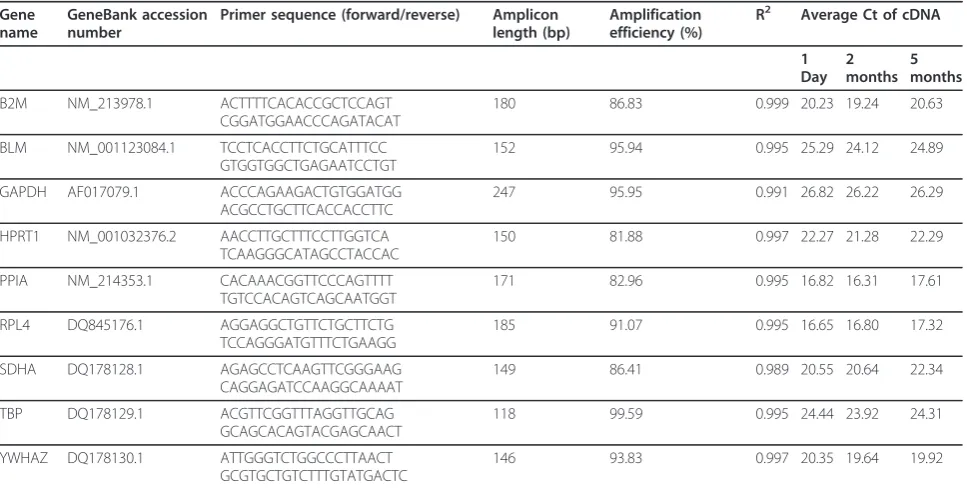
Only few previous studies validated selected reference genes across selected tissues in pigs [3,7,15,22,23] with specific purpose but no study was devoted to validate reference genes in the different tissues collected from dif-ferent ages of pigs. However,‘traditional’reference genes likeGAPDHandTBPhave been most often used in pigs [3,22,23,25-29]. Regarding porcine organs,ACTB, B2M, GAPDH, HMBS, HPRT1, RPL4, SDHA, TBP and YWHAZhave been previously compared [3]. More speci-fically in recent days,GAPDH, ACTB, RPL27, RPS29, RPS13are compared in porcine stomach [29];GAPDH, TBP, HPRT, RPS29, ACTBand RPL27are validated in porcine adipose tissues in different breeds of pigs [23] and B2M, SDHA, ACTB, GAPDH, HPRT1 and TBP expression stability are compared in porcine muscle and liver tissues in pigs [15]. The genes used in our study were selected based on these previous studies. Informa-tion about the nine candidate reference genes used in the present study is shown in table 1. The following nine commonly used reference genes were selected:ACTB, GAPDH, HPRT1, B2M, SDHA, RPL4, YWHAZ, TBPand PPIA. Primers were designed using the publicly available web-based Primer3 program [30] and are listed in table 1. They were tested using a BLAST analysis against the NCBI database (http://www.ncbi.nlm.nih.gov/tools/pri-mer-blast).
qReal-Time PCR
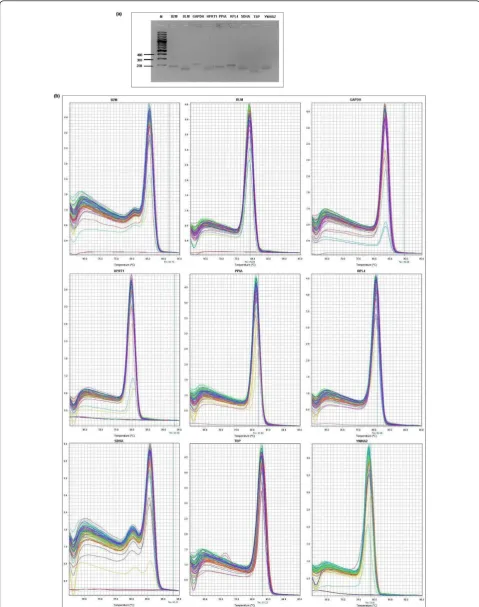
Nine-fold serial dilution of plasmids DNA were prepared and used as template for the generation of the standard curve. In each run, the 96-well microtiter plate contained each cDNA sample, plasmid standards for the standard curves and no-template control. A no-template control (NTC) was included in each run for each gene to check for contamination. Quantitative real-time RT-PCR (qRT-PCR) was set up using 2μl first-strand cDNA template, 7.4μl deionized H2O, 0.3μM of upstream and down-stream primers and 10μl 1× Power SYBR Green I master mix with ROX as reference dye (Bio-Rad). The thermal cycling conditions were 3 min at 95°C followed by 15 s at 95°C (40 cycles) and 1 min at 60°C. Experiments were performed using the StepOnePlus™Real-Time PCR Sys-tem (Applied BiosysSys-tems). Based on the Ct values for all dilution points in a series, a standard curve was generated using linear regression and the slope and the PCR ampli-fication efficiency of each primer pair is calculated from the slope of a standard curve [8]. Melting curve analysis was constructed to verify the presence of gene-specific peak and the absence of primer dimer. Agarose gel elec-trophoresis was performed to test for the specificity of the amplicons. To ensure repeatability of the experi-ments, all the reactions were executed in triplicate and the average was used for further analysis.
[image:3.595.57.541.476.721.2]Determination of reference gene expression stability The raw qRT-PCR amplification data was exported from the StepOne® software (Applied Biosystem) to
Table 1 Selected candidate reference genes, primers, and PCR reactions efficiencies
Gene name
GeneBank accession number
Primer sequence (forward/reverse) Amplicon length (bp)
Amplification efficiency (%)
R2 Average Ct of cDNA
1 Day 2 months 5 months
B2M NM_213978.1 ACTTTTCACACCGCTCCAGT
CGGATGGAACCCAGATACAT
180 86.83 0.999 20.23 19.24 20.63
BLM NM_001123084.1 TCCTCACCTTCTGCATTTCC
GTGGTGGCTGAGAATCCTGT
152 95.94 0.995 25.29 24.12 24.89
GAPDH AF017079.1 ACCCAGAAGACTGTGGATGG
ACGCCTGCTTCACCACCTTC
247 95.95 0.991 26.82 26.22 26.29
HPRT1 NM_001032376.2 AACCTTGCTTTCCTTGGTCA
TCAAGGGCATAGCCTACCAC
150 81.88 0.997 22.27 21.28 22.29
PPIA NM_214353.1 CACAAACGGTTCCCAGTTTT
TGTCCACAGTCAGCAATGGT
171 82.96 0.995 16.82 16.31 17.61
RPL4 DQ845176.1 AGGAGGCTGTTCTGCTTCTG
TCCAGGGATGTTTCTGAAGG
185 91.07 0.995 16.65 16.80 17.32
SDHA DQ178128.1 AGAGCCTCAAGTTCGGGAAG
CAGGAGATCCAAGGCAAAAT
149 86.41 0.989 20.55 20.64 22.34
TBP DQ178129.1 ACGTTCGGTTTAGGTTGCAG
GCAGCACAGTACGAGCAACT
118 99.59 0.995 24.44 23.92 24.31
YWHAZ DQ178130.1 ATTGGGTCTGGCCCTTAACT
GCGTGCTGTCTTTGTATGACTC
146 93.83 0.997 20.35 19.64 19.92
*R2
Microsoft®Excel. The averages of the Ct-values for each triplicate were used for stability comparison of candidate reference genes in the NormFinder, geNorm and Best-Keeper. The Proc GLM (ver9.2; SAS, SAS Institute Inc., Cary, NC, USA) analysis was performed to detect the effect of age and organs on the expression of house-keeping genes. Differences in gene expression levels between age groups within tissues were determined using t-test in SAS.P < 0.05 was considered statistically significant.
Ct values of all samples were exported to Excel, ordered for use in geNormPlus software (15 days free trial version qBasePlus; http://www.biogazelle.com) and transformed to relative quantities using the gene-specific PCR amplifica-tion efficiency [31]. These relative quantities were then exported to geNormPlus to analyze gene expression stabi-lity [6]. The approach of reference gene selection imple-mented in geNorm relies on the principle that the expression ratio of two ideal reference genes should be identical in all samples, independent of the treatment, con-dition, or tissue type. Increasing variations in the expres-sion ratio between two genes correspond to lower expression stability across samples. geNorm calculates the stability using a pairwise comparison model [6] and deter-mines the level of pairwise variation for each reference gene with all other reference genes as the standard devia-tion of the logarithmically transformed expression ratios. In this way, the reference gene expression stability measure (Mvalue) was calculated as the average pairwise variation of a particular gene with all other control genes included in the analysis [6,8]. LowerMvalues represent higher expres-sion stabilities, whereas the least stable gene showed the highestMvalue generates a ranking of genes according to theirMvalues resulting in the identification of the genes with the most stable expression in the samples under ana-lysis. geNorm was also used to estimate the normalization factor (NFn) by calculating the geometric mean of the
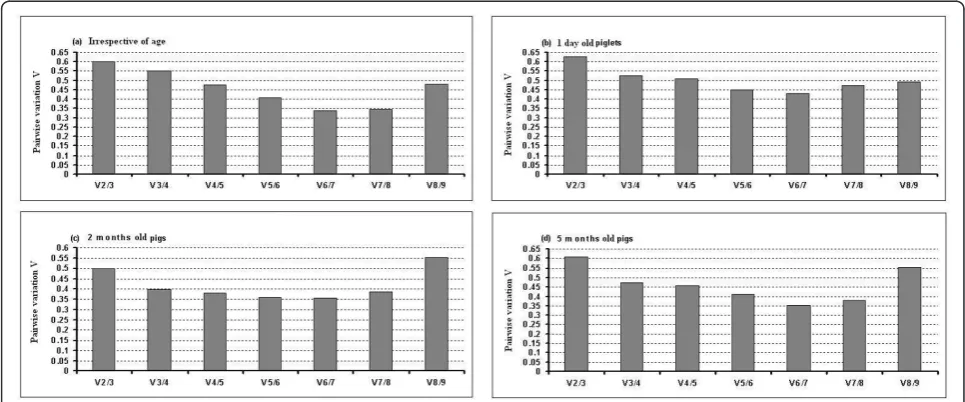
expression levels of thenbest reference genes [6]. The optimisation of the number of reference genes starts with the inclusion of the two genes with the lowestMvalue, and continues by sequentially adding genes with increasing values ofM. Thus, geNorm calculates the pairwise varia-tion Vn/Vn+1between two sequential normalization factors NFnand NFn+1containing an increasing number of refer-ence genes [6]. A large variation means that the added gene has a significant effect on the normalization and should preferably be included for calculation of a reliable normalization factor. Ideally, extra reference genes are included until the variation Vn/Vn+1drops below a given threshold. According to the geNorm, if Vn/Vn+1< 0.15 the inclusion of an additional reference gene is not required and the recommended number of reference genes is given byn[6].
NormFinder uses an ANOVA-based model [32]. The software calculates a stability value for all candidate refer-ence genes tested. The stability value is based on the com-bined estimate of intra- and inter-group expression variations of the genes studied [32]. For each gene, the average Ct value of each triplicate reaction was converted to relative quantity data as described for geNorm, to calcu-late the stability value with NormFinder program [32]. The NormFinder reference tool was applied to rank the candi-date reference gene expression stability for all samples with no subgroup determination as well as with age as subgroup. A low stability value, indicating a low combined intra- and inter-group variation, indicates high expression stability [32].
The average Ct value of each triplicate reaction was used (without conversion to relative quantity) to analyze the stability value of studied genes via BestKeeper [33] which creates a pairwise correlation coefficient between each gene and the BestKeeper index (BI). This index is the geo-metric mean of the Ct values of all candidate reference genes. BestKeeper also calculates standard deviation (SD) of the Ct values between the whole data set. The gene with the highest coefficient of correlation with the BI indi-cates the highest stability [33].
Results
Purity, quantity of extracted RNA and verification of amplicons
The optical density (OD) ratio A260/A280 nm measured with a Nanodrop spectrophotometer was 1.95 ± 0.16 (OD A260/A280 ratio ± SD). The average RNA concentration after extraction using the Tri-reagent (for tissues) and PicoPure (for PBMC) was 1.65μg/μl ± 1.03 (μg/μl ± SD). The results of the averaged amplification efficiencies are shown in table 1. The amplification efficiencies for the nine candidate reference genes ranged between 81.88% and 99.59%. The agarose gel electrophoresis (figure 1a) and melting curve analysis (figure 1b and table 1) revealed that all primer pairs amplified a single PCR product with expected size. Furthermore, sequence analysis of cloned amplicons revealed that all sequenced amplified fragments were identical to sequences used for primer design from GenBank.
Expression levels of candidate reference genes
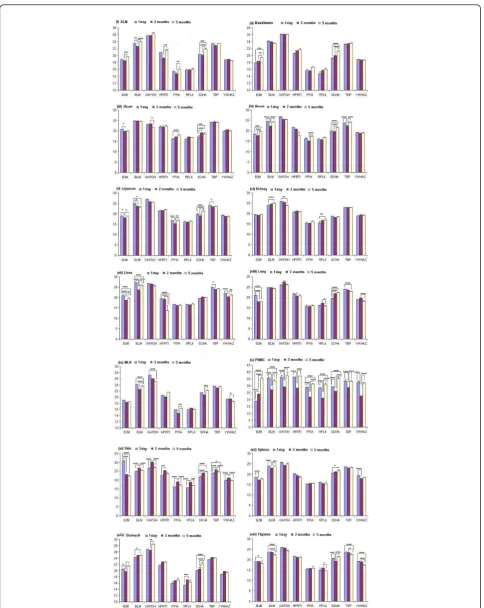
expressed at the lowest level in the porcine tissues used in this study (Additional file 1: Table S1). When expres-sion values were compared between ages within a tissue, the mRNA expression (average Ct values) differences for B2MandSDHAwere significant (P< 0.05) between ages in 12 tissues,BLMmRNA difference was significant (P< 0.05) between ages in 11 tissues and the mRNA differ-ences forGAPDH, PPIA, TBPandYWHAZwere signifi-cant (P< 0.05) between ages in seven tissues out of 14 tissues (figure 2). In case of PBMC and skin, all the can-didate reference genes were expressed differentially (P< 0.05) between ages (figure 2x and 2xi). According to the Ct values for candidate genes, less expression variability could be seen in duodenum (figure 2ii) followed by kid-ney (figure 2vi), spleen (figure 2xii) and heart (figure 2iii). Moreover, the expression of reference genes was found to be influenced by organ, age and age-organ interaction (Additional file 2: Table S2).
Identification of optimal reference genes
Figure 3a and 3e show the ranking of the nine candidate reference genes across the tissues without considering ages of individuals based on their stability values calcu-lated using geNorm and NormFinder, respectively. Both softwares showed thatRPL4, PPIAandYWHAZare the most stable genes. Similar stability for candidate genes could also be found in tissues collected from 5 months adult pigs (figure 3d and 3h). However, the expression sta-bility was never consistent between the used softwares. geNorm showed thatRPL4was the most stable candidate reference gene followed byPPIAandYWHAZin tissues collected from 1 day old piglets (figure 3b), whereasB2M was the most stable reference gene followed byYWHAZ andSDHAin case of 2 months old young pigs (figure 3c). GAPDHhas the highest stability value in all ages group when expression stability was analyzed using geNorm (fig-ure 3a-d). On the other hand, NormFinder showed that PPIAis the most stable gene when all tissues were consid-ered together and in tissues collected from 5 months old adult pigs (figure 3e, h), whereasTBPshowed highest sta-bility in tissues collected from 1 day old piglet and in 2 months old young pigs (figure 3f, g). Additionally,BLM andRPL4were recommended as the best combination of two genes with the stability value 0.083, whilePPIAwas recommended as the best gene with stability value 0.091 by NormFinder. Figure 3a-d shows the ranking of the nine candidate reference genes based on theirMvalue calcu-lated using geNorm. In all age groups, the most stable three candidate reference genes started with anMvalue below or equal to 1.5, which is the default limit below which candidate reference genes can be classified as stably expressed.
The results of reference gene evaluation by the Best-Keeper tool are shown in table 2. According to the
variability observed, candidate reference genes can be identified as the most stable genes exhibiting the lowest coefficient of variance (CV ± SD). In this context, we found thatYWHAZis the most stable reference gene in tissues collected from 2 months old young pigs (table 2). It is important to note that, genes that show a SD higher than 1 should be considered unacceptable [33,34]. A low SD of the cycle threshold (Ct) values should be expected for a useful reference gene. In this study, the estimation of the SD (± Ct) of the CV [%Ct] values for all the genes exceptYWHAZat 2 months (bold italic letters; table 2), was higher. This constitutes a reason to exclude these genes from the BestKeeper index calculation, as they are not reliable reference candidate gene in this setting [33].
Determination of the optimal number of reference genes for normalization
Discussion
For an exact comparison of mRNA transcription in different samples or tissues it is crucial to choose the appropriate reference gene. The optimal reference gene should be constantly transcribed in all types of cells at any time in cell cycle and differentiation. Moreover the transcription of such a gene should not be regulated by internal or external influences, at least not more than the general variation in RNA synthesis [3]. The reference gene used for normalization of gene expres-sion in qRT-PCR studies should also pass through the same steps of analysis as the gene to be quantified. However, such a perfect reference gene does probably not exist. Recent research has demonstrated that the expression of housekeeping genes may be altered due
[image:8.595.60.538.90.499.2]to differences in tissue types [3,15,22], breeds [23], ages [21,23] and experimental condition or treatment [6,16-19]. Therefore, it is critical to elucidate differ-ences that may exist in housekeeping genes between younger and older adults. As an increasing volume of data continues to be published exploring mRNA expression in cases of age-depended disease, there has been a greater interest in evaluating the commonly used, widely expressed housekeeping genes for com-parisons between ages. Without this information, age-dependent comparisons are very difficult to make. Therefore, it is necessary to investigate the validity and reliability of measuring the expression of various housekeeping genes in porcine tissues at different ages using qRT-PCR. To the author’s knowledge, this study
is the first to report that aging can influence the expression of certain housekeeping genes in pigs.
Numerous studies have been carried out in order to evaluate reference genes in specific tissues in several spe-cies. The majority of these studies are directed towards specific tissues in pigs [3,7,29,35,36]. Taken together, it is
[image:9.595.56.540.98.327.2]very difficult to find a‘universal’reference gene having stable expression in all cell types and tissues, and in parti-cular to find reference genes that remain stable between samples taken at different ages under different experi-mental conditions. According to the NCBI-PubMed sta-tistics [22],GAPDHandACTBare the two mostly used
Table 2 Expression stability of nine candidate reference gens evaluated by BestKeeper software
B2M BLM GAPDH HPRT1 PPIA RPL4 SDHA TBP YWHAZ BK
Irrespective of age
n* 42 42 42 42 42 42 42 42 42 42
SD [± Ct] 1.91 1.36 1.56 2.12 1.69 1.55 1.90 1.19 1.56 1.49
CV [% Ct] 9.54 5.50 5.90 9.67 9.99 9.16 8.95 4.92 7.81 7.07
1day
n** 42 42 42 42 42 42 42 42 42 42
SD [± Ct] 1.86 1.70 1.42 2.11 1.70 1.69 1.61 1.30 1.99 1.47
CV [% Ct] 9.17 6.70 5.28 9.45 10.11 10.17 7.82 5.30 9.76 6.95
2momths
n** 42 42 42 42 42 42 42 42 42 42
SD [± Ct] 1.37 1.10 1.19 1.73 1.35 1.05 1.49 1.04 0.96 1.11
CV [% Ct] 7.13 4.55 4.54 8.02 8.30 6.24 7.23 4.36 4.89 5.38
5 months
n** 42 42 42 42 42 42 42 42 42 42
SD [± Ct] 2.49 1.47 2.01 2.86 2.04 2.00 2.21 1.31 1.92 1.92
CV [% Ct] 12.07 5.92 7.65 13.12 11.56 11.57 9.89 5.39 9.64 8.97
Descriptive statistics of nine candidate reference genes based on their cycle threshold (Ct) values. In the last column the BestKeeper (BK) index is computed together with descriptive parameters for the nine genes. Abbreviations: CV [%Ct]: the coefficient of variance expressed as a percentage on the Ct level; SD [± Ct]: the standard deviation of the Ct; Results from overall tissues irrespective of age and in different ages (1 day, 2 months and 5 months) are shown. * indicates the number of samples (since BestKeeper tool has limitation for 100 samples, the average Ct for three individuals was used for analysis); ** indicates the average for triplicate run was used for analysis.
[image:9.595.56.539.472.673.2]porcine housekeeping genes. But they have been shown to vary considerably and are consequently unsuitable as reference genes for normalization of gene expression analysis in some cases [10-12]. Also the low expressed reference geneTBPis highly regulated in pigs [36]. The first priority, however, is to identify genes with stable expression preferably across cell types since many qRT-PCR studies are performed on cDNA isolated from tis-sues with a mixed cell population. Presently, only few major publications describe the stability of housekeeping genes in pig and are based on limited samples of specific categories [3,7,29,35,36]. Our comprehensive set of repre-sentative tissue samples and selected housekeeping genes provide valuable recommendations for the choice of endogenous control genes for the study of gene expression patterns in normal tissues. Notably, our results coincided with the finding of Gu et al [22] reported that YWHAZ is one of the most stably expressed reference genes across tissues in healthy pigs. Nygard et al. [3] reported thatRPL4, TBPandYWHAZ have the highest stability across tissues collected from healthy pigs which are in good agreement with our find-ings. In this study, geNorm showed thatPPIA, YWHAZ andRPL4are the most stable housekeeping genes across tissues in case of newborn piglets, adults and in irrespec-tive of ages. Additionally,PPIA, RPL4andYWHAZare
detected to be the most stably expressed genes across the tissues by NormFinder.
[image:10.595.57.540.90.349.2]geNorm finding is contradictory to the findings of Erkens et al. [7] who reported thatTBPis one of the most stable housekeeping gene in porcine backfat and muscle (longissimus dorsi) whileSDHAis reported as an unstable gene. Kuijk et al. [36] reported thatGAPDHandB2Mare the most and least stably genes, respectively in porcine oocytes and perimplantation embryos. Although tissues are different, the finding of this study is in good agreement with Piorkowska et al [23] who recently reported that GAPDHis the least stable reference candidate gene in por-cine adipose tissues collected from different pig breeds. The findings of this study that commonly used housekeep-ing genes studied are expressed differentially across por-cine tissues is supported by Svobodova et al [35] in pigs. Moreover, Svobodova et al [35] found that GAPDH expression was unstable across porcine tissues which is in good agreement with our result. Svobodova et al [35] reported thatHPRT1has the highest stability, whereas this study found that according to the geNormHPRT1is mod-erately stable across the porcine tissues (figure 3a-3d) but unstable according to the NormFinder (figure 3e-3h). Pierzchala et al. [15] recently reported thatHPRT1and TBPare the most stable housekeeping genes in porcine liver and in three different muscle tissues which is partially
supporting the NormFinder result as well as conflicting to the geNorm result. In this study we found thatHPRT1 andTBPare moderately stable genes in geNorm analysis (figure 3a-3d), whereasTBPis a stable gene butHPRT1is an unstable gene in NormFinder analysis (figure 3e-3h). RPL4, HPRT1andB2Mare reported as stably expressed and suitable candidate genes in intestinal tissues collected from healthy pig and from pigs with enteritis [37]. Report-edly,GAPDHis the least stable gene whileRPL27is most stable housekeeping gene in porcine stomach tissue [29]. However, different housekeeping genes are identified between the previous studies and our study, as the samples varied in their cell, tissue, sex and developmental stage specificities, and different catalogues of selected house-keeping genes are chosen.
According to the BestKeeper analysis software, all the studied reference candidate genes, exceptYWHAZat 2 months old young pigs tissues, are less suitable. Several studies previously reported similar findings for BestKeeper [8,29,34] and few studies followed the BestKeeper analysis method compared to geNorm and NormFinder. It is important to note that very similar discrepancies between the different algorithms have been observed in previous studies comparing statistical analysis methods [8,16,29,34,38,39]. However, we found that the first three most stable reference genes in most cases were consis-tently the same when using geNorm and NormFinder, even if they were not in the exact same ranking order. Similar findings are reported by previous studies in horse, human and plants [8,16,38,40]. Such discrepancy could be explained by genes’coregulation. Indeed, coregulated genes may become highly ranked independently of their expression stabilities with geNorm software [32]. More-over, NormFinder takes into account variation across sub-groups, thus avoiding artificial selection of coregulated genes by analyzing the expression stability of candidate genes independently from each other [6]. However, no studies dealing with porcine reference genes stability used different analysis methods except geNorm [3,7,22,23,29].
As described above, geNorm also provides a measure for the best number of reference genes that should be used for optimal normalization. In agreement with several pre-vious studies, we postulate that the use of more than one reference gene allows for a more accurate normalization than the use of only one reference gene [4,6,16,22,32]. Based on a cut-off point for the V value, as described by Vandesompele et al [6], a combination of the six most stable reference genes was calculated as being optimal for gene expression studies in different porcine tissues over ages (figure 4). However, as we described above and other studies [6,22] recommended, the combination of the most three stable genes seems to be appropriate for accurate normalization.
Conclusion
This investigation found evidence that there can be variafition in the expression of commonly used house-keeping genes with populations of different ages. Due to the new influx of data suggesting alterations in mRNA expression according to ages, we feel that beside therapy uses or experimental condition, the selection of housekeeping genes based upon the age of populations used should be taken into consideration. This shows again that the choice of reference genes cannot be transposed from one study to the other without validation for the specifics of each experimen-tal protocol. In general, we recommend using the geo-metric mean of RPL4, PPIAand YWHAZ to guarantee suitable normalization across the porcine tissues obtained from pigs of different ages.
Additional material
Additional file 1: Mean relative expression of candidate genes and effects of age and organ on expression level. The average and SD of the Ct values for different candidate reference genes studied in different tissues collected from 1 day old piglets, 2 months old young and 5 months old adult pigs.
Additional file 2: Relative expression of candidate genes and effect of age and organ on expression level. Overall expression data of reference candidate genes. Summary of the Proc GLM (ver.9.2; SAS, SAS Institute Inc., Cary, NC, USA) analysis detecting significant effects of age, organs and age-organ interaction on the expression of reference candidate genes. ***P<0.001.
List of abbreviations
qRT-PCR: quantitative real-time reverse transcriptase polymerase chain reaction;B2M: beta-2-microglobulin;BLM: Bloom syndrome, RecQ helicase-like;GAPDH: glyceraldehyde 3-phosphate dehydrogenase;HPRT1: hypoxanthine phosphoribosyltransferase 1;PPIA: peptidylprolyl isomerase A (cyclophilin A);RPL4: ribosomal protein L4;SDHA: succinate dehydrogenase complex subunit A flavoprotein;TBP: TATA box binding protein;YWHAZ: tyrosine 3-monooxygenase/tryptophan 5-monooxygenase activation protein zeta polypeptide; NTC: no-template control; Ct: cycle threshold; SD: standard deviation; BI: BestKeeper Index.
Acknowledgements
This project was supported by the Gene Dialog project, FUGATO Plus, BMBF, grant no: 0315130C, Germany. The authors are indebted to Prof. Dr. Florian M. W. Grundler, Molecular Phytomedicine, University of Bonn, Germany for providing with StepOnePlus Real-time PCR system (Applied Biosystem) during experiment.
Author details 1
Animal Breeding and Husbandry/Genetics group, Institute of Animal Science, University of Bonn, Endenicher Allee 15, 53115 Bonn, Germany. 2
Department of Medicine, Faculty of Veterinary Science, Bangladesh Agricultural University, Mymensingh-2202, Bangladesh.
Authors’contributions
Competing interests
The authors declare that they have no competing financial or other interest in relation to this work.
Received: 28 June 2011 Accepted: 24 October 2011 Published: 24 October 2011
References
1. Arya M, Shergill IS, Williamson M, Gommersall L, Arya N, Patel HR:Basic principles of real-time quantitative PCR.Expert Rev Mol Diagn2005, 5(2):209-219.
2. Nolan T, Hands RE, Bustin SA:Quantification of mRNA using real-time RT-PCR.Nat Protoc2006,1(3):1559-1582.
3. Nygard AB, Jorgensen CB, Cirera S, Fredholm M:Selection of reference genes for gene expression studies in pig tissues using SYBR green qPCR. BMC Mol Biol2007,8:67.
4. Huggett J, Dheda K, Bustin S, Zumla A:Real-time RT-PCR normalisation; strategies and considerations.Genes Immun2005,6(4):279-284. 5. Radonic A, Thulke S, Mackay IM, Landt O, Siegert W, Nitsche A:Guideline
to reference gene selection for quantitative real-time PCR.Biochem Biophys Res Commun2004,313(4):856-862.
6. Vandesompele J, De Preter K, Pattyn F, Poppe B, Van Roy N, De Paepe A, Speleman F:Accurate normalization of real-time quantitative RT-PCR data by geometric averaging of multiple internal control genes.Genome Biol2002,3(7):RESEARCH0034.
7. Erkens T, Van Poucke M, Vandesompele J, Goossens K, Van Zeveren A, Peelman LJ:Development of a new set of reference genes for normalization of real-time RT-PCR data of porcine backfat and longissimus dorsi muscle, and evaluation with PPARGC1A.BMC Biotechnol2006,6:41.
8. Maroufi A, Van Bockstaele E, De Loose M:Validation of reference genes for gene expression analysis in chicory (Cichorium intybus) using quantitative real-time PCR.BMC Mol Biol2010,11:15.
9. Lovdal T, Lillo C:Reference gene selection for quantitative real-time PCR normalization in tomato subjected to nitrogen, cold, and light stress. Anal Biochem2009,387(2):238-242.
10. Barber RD, Harmer DW, Coleman RA, Clark BJ:GAPDH as a housekeeping gene: analysis of GAPDH mRNA expression in a panel of 72 human tissues.Physiol Genomics2005,21(3):389-395.
11. Jung M, Ramankulov A, Roigas J, Johannsen M, Ringsdorf M, Kristiansen G, Jung K:In search of suitable reference genes for gene expression studies of human renal cell carcinoma by real-time PCR.BMC Mol Biol2007,8:47. 12. Selvey S, Thompson EW, Matthaei K, Lea RA, Irving MG, Griffiths LR:
Beta-actin–an unsuitable internal control for RT-PCR.Mol Cell Probes2001, 15(5):307-311.
13. Tricarico C, Pinzani P, Bianchi S, Paglierani M, Distante V, Pazzagli M, Bustin SA, Orlando C:Quantitative real-time reverse transcription polymerase chain reaction: normalization to rRNA or single housekeeping genes is inappropriate for human tissue biopsies.Anal Biochem2002,309(2):293-300.
14. Schmittgen TD, Zakrajsek BA:Effect of experimental treatment on housekeeping gene expression: validation by real-time, quantitative RT-PCR.J Biochem Biophys Methods2000,46(1-2):69-81.
15. Pierzchala M, Lisowski P, Urbanski P, Pareek CS, Cooper RG, Kuryl J: Evaluation based selection of housekeeping genes for studies of gene expression in the porcine muscle and liver tissues.Journal of Animal and Veterinary Advances2011,10(4):401-405.
16. Beekman L, Tohver T, Dardari R, Leguillette R:Evaluation of suitable reference genes for gene expression studies in bronchoalveolar lavage cells from horses with inflammatory airway disease.BMC Mol Biol2011, 12:5.
17. De Boever S, Vangestel C, De Backer P, Croubels S, Sys SU:Identification and validation of housekeeping genes as internal control for gene expression in an intravenous LPS inflammation model in chickens.Vet Immunol Immunopathol2008,122(3-4):312-317.
18. Maccoux LJ, Clements DN, Salway F, Day PJ:Identification of new reference genes for the normalisation of canine osteoarthritic joint tissue transcripts from microarray data.BMC Mol Biol2007,8:62. 19. Penning LC, Vrieling HE, Brinkhof B, Riemers FM, Rothuizen J, Rutteman GR,
Hazewinkel HA:A validation of 10 feline reference genes for gene
expression measurements in snap-frozen tissues.Vet Immunol Immunopathol2007,120(3-4):212-222.
20. Al-Bader MD, Al-Sarraf HA:Housekeeping gene expression during fetal brain development in the rat-validation by semi-quantitative RT-PCR. Brain Res Dev Brain Res2005,156(1):38-45.
21. Touchberry CD, Wacker MJ, Richmond SR, Whitman SA, Godard MP: Age-related changes in relative expression of real-time PCR housekeeping genes in human skeletal muscle.J Biomol Tech2006,17(2):157-162. 22. Gu Y, Li M, Zhang K, Chen L, Jiang A, Wang J, Li X:Evaluation of
endogenous control genes for gene expression studies across multiple tissues and in the specific sets of fat- and muscle-type samples of the pig.Journal of Animal Breeding and Genetics2011,128.
23. Piorkowska K, Oczkowicz M, Rozycki M, Ropka-Molik K, Piestrzynska-Kajtoch A:Novel porcine housekeeping genes for real-time RT-PCR experiments normalization in adipose tissue: assessment of leptin mRNA quantity in different pig breeds.Meat Sci87(3):191-195.
24. Zentralverband der Deutschen Schweineproduktion (ZDS):Richtlinie für die Stationsprüfung auf Mastleistung, Schlachtkörperwert und
Fleischbeschaffenheit beim Schwein, 10.12.2003..
25. Kaewmala K, Uddin MJ, Cinar MU, Grosse-Brinkhaus C, Jonas E, Tesfaye D, Phatsara C, Tholen E, Looft C, Schellander K:Association study and expression analysis of CD9 as candidate gene for boar sperm quality and fertility traits.Anim Reprod Sci2011,125(1-4):170-179.
26. Kayan A, Cinar MU, Uddin MJ, Phatsara C, Wimmers K, Ponsuksili S, Tesfaye D, Looft C, Juengst H, Tholen E,et al:Polymorphism and expression of the porcine Tenascin C gene associated with meat and carcass quality.Meat Sci2011,89(1):76-83.
27. Kayan A, Uddin MJ, Cinar MU, Grosse-Brinkhaus C, Phatsara C, Wimmers K, Ponsuksili S, Tesfaye D, Looft C, Juengst H,et al:Investigation on interferon alpha-inducible protein 6 (IFI6) gene as a candidate for meat and carcass quality in pig.Meat Sci88(4):755-760.
28. Laenoi W, Uddin MJ, Cinar MU, Phatsara C, Tesfaye D, Scholz AM, Tholen E, Looft C, Mielenz M, Sauerwein H,et al:Molecular characterization and methylation study of matrix gla protein in articular cartilage from pig with osteochondrosis.Gene459(1-2):24-31.
29. Oczkowicz M, Różycki M, Piórkowska K, Piestrzyńska-Kajtoch A, Rejduch B:A new set of endogenous reference genes for gene expression studies of porcine stomach.Journal of Animal and Feed Sciences2010,19:570-576. 30. Rozen S, Skaletsky H:Primer3 on the.Methods Mol Biol2000,132:365-386
[http://www for general users and for biologist programmers]. 31. Hellemans J, Mortier G, De Paepe A, Speleman F, Vandesompele J:qBase
relative quantification framework and software for management and automated analysis of real-time quantitative PCR data.Genome Biol2007, 8(2):R19.
32. Andersen CL, Jensen JL, Orntoft TF:Normalization of real-time quantitative reverse transcription-PCR data: a model-based variance estimation approach to identify genes suited for normalization, applied to bladder and colon cancer data sets.Cancer Res2004,64(15):5245-5250. 33. Pfaffl MW, Tichopad A, Prgomet C, Neuvians TP:Determination of stable
housekeeping genes, differentially regulated target genes and sample integrity: BestKeeper–Excel-based tool using pair-wise correlations. Biotechnol Lett2004,26(6):509-515.
34. Stern-Straeter J, Bonaterra GA, Hormann K, Kinscherf R, Goessler UR: Identification of valid reference genes during the differentiation of human myoblasts.BMC Mol Biol2009,10:66.
35. Svobodova K, Bilek K, Knoll A:Verification of reference genes for relative quantification of gene expression by real-time reverse transcription PCR in the pig.J Appl Genet2008,49(3):263-265.
36. Kuijk EW, du Puy L, van Tol HT, Haagsman HP, Colenbrander B, Roelen BA: Validation of reference genes for quantitative RT-PCR studies in porcine oocytes and preimplantation embryos.BMC Dev Biol2007,7:58. 37. Schroyen Martine., Verhelst R, Niewold T, Buys N:10th Gut Day Symposium
(The 10th Darmendag): 2008; Friday November 14th 2008 in the Boothzaal of the Utrecht University Library, Utrecht2008.
38. Cappelli K, Felicetti M, Capomaccio S, Spinsanti G, Silvestrelli M, Supplizi AV: Exercise induced stress in horses: selection of the most stable reference genes for quantitative RT-PCR normalization.BMC Mol Biol2008,9:49. 39. Hosseini A, Sauerwein H, Mielenz M:Putative reference genes for gene
40. Kriegova E, Arakelyan A, Fillerova R, Zatloukal J, Mrazek F, Navratilova Z, Kolek V, du Bois RM, Petrek M:PSMB2 and RPL32 are suitable
denominators to normalize gene expression profiles in bronchoalveolar cells.BMC Mol Biol2008,9:69.
doi:10.1186/1756-0500-4-441
Cite this article as:Uddinet al.:Age-related changes in relative expression stability of commonly used housekeeping genes in selected porcine tissues.BMC Research Notes20114:441.
Submit your next manuscript to BioMed Central and take full advantage of:
• Convenient online submission
• Thorough peer review
• No space constraints or color figure charges
• Immediate publication on acceptance
• Inclusion in PubMed, CAS, Scopus and Google Scholar
• Research which is freely available for redistribution