0022-538X/93/063630-05$02.00/0
Copyright © 1993,AmericanSociety for Microbiology
Effect of
Linker Insertion Mutations
in
the
Human
Immunodeficiency
Virus
Type
1
gag
Gene
on
Activation
of
Viral Protease
Expressed
in
Bacteria
JEREMYLUBAN,1 CATHERINE LEE,2ANDSTEPHENP. GOFF2*
Departmentof Medicine1 andDepartment of Biochemistry and Molecular Biophysics,2College of Physicians and
Surgeons,
ColumbiaUniversity,
630 West 168thStreet,
New York New York 10032Received 18 December 1992/Accepted 3March 1993
Wehave expressed the human immunodeficiencyvirus type 1(HIV-1)protease(PR)in bacteriaas aGag-PR polyprotein (J.Luban and S. P.Goff, J.Virol.65:3203-3212, 1991).Theprotein displays enzymaticactivity, cleavingtheGag polyprotein precursorPr559a` totheexpected products. The PRenzymeisonly activeasa
dimer,andwehypothesizedthat PR activationmightbe usedas anindicator ofpolyproteinmultimerization. We constructed 25 linker insertion mutationsthroughoutgagandassessed the PRactivityof mutantGag-PR polyproteins bytheappearanceofGag cleavage productsinbacteriallysates.All mutant constructsproduced stableproteininbacteria.PRactivityofthemajorityof theGag-PRmutantswasindistinguishablefromthat of the wild type. Six mutants,onewithaninsertion in the matrix(MA),four with insertions in thecapsid (CA), andone with insertions in the nucleocapsid (NC), globally disrupted polyprotein processing.When PRwas
providedintranson aseparateplasmid,theGag proteinswerecleaved withwild-type efficiency.Theseresults suggestthat thegag mutationsidentified as disruptiveofpolyprotein processingdid notconceal the scissile bonds of the polyprotein. Rather, the mutations prevented PR activation in the context of a Gag-PR
polyprotein, perhaps by preventing polyproteindimerization.
The threemajor retroviral genes, gag,pol,andenv, are all expressed as polyproteins which are proteolytically pro-cessedduringthelate stages of virionparticleformation (2).
Genetic and biochemical evidence indicates thatproteolysis
of gag and pol gene products is carried out by a protease
(PR) encoded by the retroviral provirus (3, 5, 9, 14-16,
20-22). Viral genomes defective in PR arecapable of
pro-ducingvirions, but these are of immature morphology and
theyare notinfectious. Themajor Gagpolyprotein of human
immunodeficiencyvirus type 1(HIV-1), the retrovirusmost
commonly associated with human AIDS, is
P655ag.
Thecleavage productsofPr55gaginclude the matrixprotein p17
(MA), the capsid protein p24 (CA), the nucleocapsid protein
p7 (NC), and the C-terminal product p6. HIV-1 pol is
expressed as a Gag-Pol fusion protein,
Pr1609a9P°,
via aribosomalframeshiftmechanism (13) bypassing translational
termination at the gag-pol boundary. The pol region is processed to four mature products, protease plO (PR), the twosubunits ofreversetranscriptase p66 and
pSi
(RT), andintegrase p32(IN).
The structure of the HIV-1 PR has been determined with and without bound substrate (25-27, 31, 33). PR is an
aspartylproteasewhichdiffers from cellular proteases of this
class in thattwoidentical protease monomers must associate symmetrically toform the substrate binding cleft (26). This workprovides a biochemical explanation for the observation that PRactivation does not occur prior to virion assembly. PR is translated as part of the Gag-PR polyprotein, and activation only occurs after dimerization of the Gag-PR polyprotein at the time of virion assembly.
PR substrate recognition is highly specific; only a few
unique sites in the Gag and Gag-Pol precursor proteins are
cleaved. Most of the specificity is provided by four amino
*Correspondingauthor.
acidsoneither side of the scissile bond thatare recognized
byflapspresent oneachmonomerof PR(4, 18, 22, 26, 31).
Detailed analysisofmultiplePRcleavagesites has revealed nosimpleconsensussequencefor PR substraterecognition,
but certain general rules have been deduced (28). On the basis of the amino acidatpositionP1', thereareatleasttwo general classes of substrate recognition sequences. It has
beensuggestedthat thedifferentialrecognitionof these sites
may be responsible for the different rates ofcleavage
ob-served for the various recognition sites in the Gag and
Gag-Polprecursorproteins (7, 10,28).
Active HIV-1 PR has been successfully expressed in bacteria by several groups (5, 11, 23). Thus, bacterially
expressed PRcandimerizewhensynthesizedalone, without
Gag. Inaddition, bacterially expressedPR from HIV-1 has
been shown to be active when imbedded in a precursor protein(5,6, 11,17).Active RoussarcomavirusPR canalso be expressed as a precursorpolyprotein; however, the PR
activity of the polyprotein is much less than that of the
excised PR (1, 19).
We previously described the PR activity of a Gag-PR
fusionprotein expressed inbacteria (24). Wereasoned that thisconstructmightbeaninteresting substrate for mutagen-esis in that PR activation might be used as a readout for
polyproteinmultimerization. Using this expression plasmid
as asubstrate formutagenesis,wehave constructed a panel oflinker insertion mutations distributed throughout gag and assayed the effect of these mutations on the ability of the
expressedmutantGag-Pr polyproteins to activate PR and to
cleave the substrate.
PlasmidpT7HG(Pro+) encodes native HIV-1Pr55gagand aGag-Pol fusion protein which extends 533 nucleotides into
thepol coding sequence (24). This plasmid contains the
completepro and produces active PR after induction by
standardmethods withisopropyl-,-D-thiogalactopyranoside
(IPTG); lysates from pT7HG(Pro+)-transformed bacteria
3630
on November 9, 2019 by guest
http://jvi.asm.org/
1
2
3
4
5
-pr55gag
-p41
wi
-p25/24_^~
-p17
sd xJ
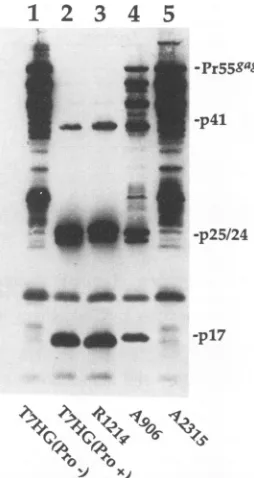
FIG. 1. Examples of the effect of linker insertion mutations in
the HIV-1 Gag-PR polyproteinonviralPRactivity in bacteria.After
standard induction with IPTG (30), bacteria transformed with the
indicated plasmid DNAswerepelleted and boiled in sodiumdodecyl
sulfate (SDS). The proteins were separated by electrophoresis on
SDS-polyacrylamide gels and transferred to nitrocellulose
mem-branes. A Western blotwasthen performed withacombination of
monoclonal anti-CA (p24) and monoclonal anti-MA (pl7) antibodies (24). Lanes: 1,pT7HG(Pro-); 2, pT7HG(Pro+); 3, pT7HG(Pro+)-R1214; 4, pT7HG(Pro+)-A906; 5, pT7HG(Pro+)-A2315. The posi-tions of the Gagpolyproteinprecursorand ofthe viral PR cleavage
products p41, p25/24, and p17areindicated atthe right.
contain predominantly the Pr55gag cleavage products, p41, p24/25, and p17, as indicated by Western immunoblotting
with monoclonalanti-p24oranti-p17 antibodies (Fig. 1, lane
2). A plasmid with a deletion in the PR coding sequence,
pT7HG(Pro-), produces the full Pr55a&a (Fig. 1, lane 1) as
well as several C-terminal cleavage products formed by
bacterial proteases. The identity of these breakdown
prod-uctswaspreviouslydetermined withapanel of monoclonal antibodies (24).
For the construction of linker insertion mutations, stan-dard recombinant DNA technology was employed (30).
pT7HG(Pro+) was partially cleaved with one of several restriction endonucleases (AluI, DdeI,DraI, HaeIII, NlaIV,
orRsaI)orcut tocompletionwith PvuII. Theresultinglinear molecules were purified by agarose gel electrophoresis.
Whennecessary, the ends of the linearproductsweremade
blunt endedbytreatmentwith the Klenowfragmentof DNA polymerase I, and the linear DNAwas thenligatedwith T4 DNA ligase to a nonphosphorylated oligonucleotide linker containing tandem XhoI sites (5'-CTCGAGCTCGAG-3'). The resulting linear molecules which possessed single-stranded linker sequences at either end were allowed to anneal and used to transform bacteria to ampicillin resis-tance. Clones were screened for the presence of aXhoI
restriction site, and the position of each insertion was
determined byrestriction mapping.
[image:2.612.127.254.79.318.2]Twenty-seven linker insertion mutations were obtained (Table 1).Twowerelocatedwithinpro codingsequence,and
TABLE 1. Insertion mutations in HIV-1 Gag-PR
Amino acidchangesb
Mutante
From To
H852 R-P R-.F,IF-P
A906 E-L E-I.F,,F,-L
A975 Q-L Q-TLL-L
D1009 L-R L-TRARV-R
P1144 A-A A-ARAR-A
R1214 V-H V-SSSR-H
H1222 A-I A-RARA-I
Dr1241 T-L-N T-FSSSR-N
Dr1337 D-L-N D-FSSSR-N
A1411 E-A E-ARAR-A
H1449 G-P G-LFJ.FE-P
H1463 G-Q G-SSSS-Q
R1509 S-T S-LELE-T
D1696 L-R L-TRARV-R
A1711 A-S A-RARA-S
Dr1787 I-L-K I-FSSSR-K
N1801 G-P G-SSSR-P
H1856 G-H G-SSSS-H
A1906 A-T A-RARA-T
N1941 R-N-Q R-TRARD-Q
R2066 C-T C-LEL,F,,-T
H2100 W-P W-I.F.IF.-P
A2173 S-F S-SSSS-F
N2218 Q-E-P Q-DSSS R-P
D2253 L-R L-TRARV-R
A2315 E-A E-ARA-A
A2462 A-I A-RABA-I
aLettersindicate the restrictionsiteused forlinker insertion: A,
AluI;
D,DdeI;Dr, DraI; H,HaeI;N,NlaIV;P, PvuII;R,RsaI.Numbers indicate the nucleotideposition of the restriction site withrespect to the5' edge of the 5' long terminalrepeat oftheHIV-1(HXB2C) provirus.
bAmino acidslost orgainedas aresult of themutationareunderlined.
the remainder were located within gag coding sequence. Restriction sites used and the amino acids inserted are shown in Table 1. Thenetsize of each insertionwas either four orfive amino acids.
ThePR activity ofwild-type ormutantGag-PR
polypro-teins was assessed by examining the expression of viral
proteins in JB-DE3, a lon mutant strain containing the T7
polymerase gene under the control of theUV5 mutant lac
promoter. Protein induction with IPTG and Westernblotting
with anti-HIV-1gagmonoclonal antibodieswas performed
asdescribedpreviously(24).Grossly,the level ofexpression
of each mutant protein wascomparable to that of the wild type. Precursor protein processing was revealed by the presence of the expectedPR cleavage products.
Thetwolinkers in PRcoding sequencecompletely oblit-erated processing of Pr55gag
(Fig.
1, lane5).
Of the two, mutantA2315containsaninsertionnearthe active site of the enzyme. Mutant A2462 contains an insertion in a more C-terminalregion,
whereonly
conservative substitutions werefound indifferent laboratoryisolates(8).
Themajorityof the linkers within the gagcodingsequence
had no effect on PR activity. Six of the linker insertion
mutations,however,producedasubstantial reduction in PR
activity, globally
affecting
allcleavage
sites inGag (Fig. 1,
lane 4). Thelocations of the linker mutantsand the
corre-sponding phenotypesaresummarized in
Fig.
2. Theresultsshow that mutations in three different areas were able to
disruptPRactivation.
Thefact that the six
disruptive
mutations blockedprocess-inginaglobalfashion
suggested
that the effect of the linkeron November 9, 2019 by guest
http://jvi.asm.org/
[image:2.612.329.570.92.366.2]p17 p24 I
II
p7 I I p6I
Protease
IA906 Drl337A1411 R1509 Drl787 R2066 A2315 A2462
H852 A975 241 H
D1009 H1463
HI
A,A
ZS
ZS1
D19 H1856 ] 1941 H2100A2173
A1711 N1801 A1906 D2253
N2218
FIG. 2. The effect of linker insertion mutationsonthe PRactivityof the HIV-1 Gag-PRpolyprotein. (Top)HIV-1 gag and procoding sequences.(Bottom) the position ofeachtriangle indicates the siteofalinker insertionmutation. The level ofPRactivitydemonstratedby eachmutantis indicated by theshading ofthetriangles:wild-type activityiswhite;moderateactivityisgrey;noactivityisblack.
insertions might be to disrupt protease activation.
Alterna-tively,the mutationsmightpreventrecognitionof the altered
substratebyanotherwise activePR.Todistinguishbetween
thepossibilities, wechosetolookattheeffectof thelinker
insertion mutations in gag coding sequence when PRwas
providedin trans.
Four selected mutant constructs with linker insertion
mutations in the gagcodingsequence (A906, A975, R1509,
and A1906) were modified to disrupt pro. DNAs were
cleaved with the restriction endonucleaseBclI,treated with Klenowfragment ofDNApolymerase, andcyclizedwith T4 DNA ligase, disrupting the reading frame of pro. Western
blots performedwithproteinfrom bacteriatransformed with
these plasmids confirmed that there was no longer active viral PR and that stable Pr55gag was produced (data not
shown). Bacterial cellstransformedwiththese PR-defective
plasmids were then cotransformed with pDPT-Pro4 (5),
whichexpresses the HIV-1 PR from the PL promoter. The
apparenttoxicityof the PR made it necessary forus tofirst
transform the bacteria with a third plasmid, pcI857 (29),
whichexpressesathermosensitive mutant of the lambda cI
repressor. Thus, Escherichia coli was sequentially
trans-formed to kanamycin, ampicillin, and chloramphenicol
re-sistance with pcI857, then with pT7HG(Pro-) or mutant
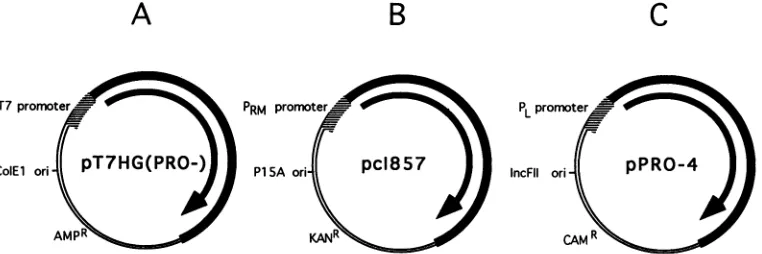
derivatives, and then finally with pDPT-Pro4 (Fig. 3). All
cultures were grown at 30°C until the time of protein induction. Protein was induced over a 3-h period by the
A
addition of IPTG at 42°C, and inductionwas monitoredby
Western blot.
MutantsA906, A975, R1509, A1906were tested for the
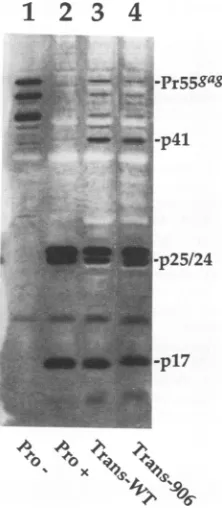
abilitytobe cleavedbyPRprovidedintrans(Fig. 4).These
four mutants, two of which were poorly cleaved in the previous assay(A906andR1509),werecleavedbytransPR
as efficiently aswild type. This demonstrates that the Gag
polyproteins which contain these linker insertion mutations arecapable ofbeingcleavednormallywhen active viral PR is provided in trans. Thus, the most likely mechanism by
whichthe mutants A906 and R1509 affect Gagcleavage in the Gag-PR setting is bydisrupting PRactivation, perhaps
by inhibiting polyprotein dimerization. Alternatively, it is
possiblethat these mutationsdisruptPRactivationby
alter-ing the conformation of the entire precursor polyprotein.
Thoughnottested directly,webelieve that the other
muta-tions which were disruptive of protease provided in the
Gag-Prsettingmayblock PR activation bythesame
mech-anism as mutantsA906 and R1509. To distinguish between these possible explanations it will be necessary to see whetherourmutations affect virionassembly and PR func-tion in vivo.
The three-dimensionalstructureof retroviralGag
polypro-teins and howtheyself-associate to formaparticle are not known. Ifour assay does reflect polyprotein
multimeriza-tion, our results suggest that several parts of the Gag
polyproteinmaybeinvolvedin multimerization; the
major-B
C
T7promoter PRM prom roter PLprormter
ColEl ori PT7HG(PRO() PlSA ori pc1857 IncFII ori pPRO-4 )
AMPR CAMR
FIG. 3. Plasmidsused totransform bacteria for the coexpression ofPr55gagand viral PR in trans. Bacteria were sequentially transformed with the three plasmids.The antibiotic resistance conferred by each plasmid is indicated. The bacterial origins of replication of the three plasmidsareall ofdifferentincompatibility groups. (A) pT7HG(Pro-) expressesPr55gagfrom the T7 gene 10 promoter. (B)pcI857expresses
atemperature-sensitive mutant of the lambdacI repressor from its native promoter. (C) pDPT-Pro-4 expresses the HIV-1 PR from thePL promoter. This promoter is regulated by the lambdacIrepressor, expressedfrompcI857at the permissive temperature.
on November 9, 2019 by guest
http://jvi.asm.org/
[image:3.612.106.488.77.209.2] [image:3.612.111.492.551.678.2]1
2 3
4
..pr55gag
4-p41
A.
A P k [image:4.612.134.245.78.332.2]% x
FIG. 4. Examples of the effect oflinker insertion mutations in Pr55rag on cleavage by viral PR expressed in trans in bacteria. Bacterial strain JB-DE3 was sequentially transformed with three
plasmids: pcI857, then pT7HG(Pro-) with or without a linker
insertion mutation in the gagcodingsequence, and finally
pDPT-Pro-4. Triple transformants were grown at 30'C until ready for
proteininduction. Forinduction,bacteriawereincubated withIPTG
at42'C for 3 h. ProteinexpressionwasassayedbyWestern blot with
a combination of anti-CA (p24) and anti-MA (p17) monoclonal antibodies (24). Lanes: 1, lysate from bacteria singly transformed
withpT7HG(Pro-);2,lysatefrom bacteriasinglytransformed with
pT7HG(Pro+); 3,triple transformant withpT7HG(Pro-); 4, triple
transformant withpT7HG(Pro-)-A906.
ity
of ourdisruptive
mutations map to CA,though
therewere
single, disruptive
mutationsidentified in MA and NCaswell. This is consistent with mutational studies on virion
assembly;
ingeneral,
CA isparticularly
sensitive todisrup-tion,
though
otherregions
inMAandatthe CA-NCjunction
may be
important
as well(for
a review, see reference32).
One group has
reported
the effect of linkerinsertion muta-tionsontheability
ofGag-o3-galactosidase
fusionproteins
to beincorporated
intoMoloney
murine leukemia virusparti-cles
(12). Interestingly,
as we found in our protease assay, linkers whichdisrupted incorporation
of fusionproteins
intoparticles
clusteredin the amino-terminal two-thirds of CA. The authors thank Martin Rosenberg and Christine Debouck of Smith-Kline Beecham, KingofPrussia, Penn., for generousassis-tanceandforplasmids
pc1857
andpDPT-Pro4.This workwassupported by grantAl 24845 from the National Institute ofAllergyand Infectious DiseasestoS.P.G. andbygrant KllAl00988from the National InstituteofAllergyandInfectious Diseases and JSMF grant 91-49 from the James S. McDonnell Foundation toJ.L.
REFERENCES
1. Burstein, H,D.Bizub,M.Kotler, G. Schatz,V. M.Vogt,and A. M.Skalka. 1992.Processingof avianretroviralgag
polypro-tein
precursors
is blockedbyamutationattheNC-PRcleavagesite. J.Virol. 66:1781-1785.
2. Coffin, J. 1984. Structure ofthe retroviral genome, p. 261-368. In R. Weiss, N. Teich, H. Varmus, and J. Coffin (ed.), RNA
tumor viruses. Cold Spring Harbor Laboratory, Cold Spring Harbor,N.Y.
3. Crawford, S.,and S. P. Goff.1985.Adeletion mutation in the 5' partofthepol geneofMoloney murine leukemia virus blocks proteolytic processing ofthe gag andpol polyproteins. J. Virol. 53:899-907.
4. Darke, P. L., R. F. Nutt, S. F. Brady, V. M. Garsky, T. M. Ciccarone,C.Leu,P.K.Lumma,R. M. Freidinger, D. F. Veber, and I. S. Sigal. 1988. HIV-1 protease specificity of peptide cleavage is sufficientforprocessing of gag and pol polyproteins. Biochem.Biophys.Res. Comm. 156:297-303.
5. Debouck,C.,J.G.Gorniak, J. E. Strickler, T. D. Meek, B. W. Metcalf, and M. Rosenberg. 1987. Human immunodeficiency virusprotease expressed in Escherichia coli exhibits autopro-cessingandspecificmaturation of the gag precursor. Proc. Natl. Acad. Sci. USA 84:8903-8906.
6. Ehrlich,L.S., H.-G.Krausslich, E.Wimmer,and C. A. Carter. 1990. Expression in Escherichia coli of human immunodefi-ciency virus type 1 capsid protein (p24). AIDS Res. Hum. Retroviruses 6:1169-1175.
7. Erickson-Viitanen, S.,J.Manfredi,P. Viitanen, D. E. Tribe, R. Tritch,C. A.Hutchison,D. D. Loeb, and R. Swanstrom. 1989. CleavageofHIV-1 gagpolyprotein synthesizedinvitro: sequen-tial cleavage by the viralprotease. AIDSRes. Hum.
Retrovi-ruses5:577-591.
8. Fontenot, G., K. Johnston, J. C. Cohen,W. R. Gallaher, J. Robinson,and R. B.Luftig. 1992. PCR amplification of HIV-1 proteinasesequenasesdirectly fromlabisolatesallows determi-nation of five conserved domains.Virology190:1-10.
9. Gottlinger,H. G., J. G. Sodroski, and W. A. Haseltine. 1989. Role of capsid precursor processing and myristoylation in morphogenesis and infectivity of human immunodeficiency
vi-rustype 1.Proc. Natl. Acad. Sci. USA 86:5781-5785. 10. Gowda,S.D.,B. S.Stein,and E.G. Engleman.1989.
Identifi-cation of protein intermediates in the processing of the p55 HIV-1 gag precursor incellsinfected withrecombinant vaccinia virus.J.Biol. Chem. 264:8459-8462.
11. Graves,M.C., J. J. Lim,E. P.Heimer,and R. A. Kramer.1988. An 11-kDa form of human immunodeficiency protease
ex-pressed in Escherichiacoli issufficient forenzymatic activity. Proc. Natl. Acad. Sci. USA 85:2449-2453.
12. Hansen, M., L. Jelinkek, S. Whiting, and E. Barklis. 1990. Transport and assembly ofgagproteins into Moloney murine leukemiavirus. J.Virol.64:5306-5316.
13. Jacks, T.,M. D.Power,F. R.Masiarz,P. A.Luciw, P. J. Barr, and H. E. Varmus.1988.Characterization of ribosomal frame-shiftingin HIV-1gag-pol expression.Nature(London) 331:280-283.
14. Katoh, I.,Y.Ikawa, and Y. Yoshinaka. 1989. Retrovirus
pro-tease characterized as a dimericasparticproteinase. J. Virol. 63:2226-2232.
15. Katoh, I.,Y.Yoshinaka,A.Rein,M.Shibuya,T.Odaka,and S. Oroszlan. 1985. Murine leukemia virus maturation: protease region requiredforconversion from "immature"to"mature"
coreform andfor virusinfectivity. Virology145:280-292. 16. Kohl, N. E., E. A. Emini,W. A. Schleif, L. J. Davis, J. C.
Heimbach,R. A. Dixon, E. M. Scolnick, andI. S.Sigal. 1988. Active humanimmunodeficiencyvirusproteaseisrequiredfor viralinfectivity. Proc. Natl.Acad. Sci. USA85:4686-4690. 17. Kotler,M.,G.Arad,andS. H.Hughes.1992. Human
immuno-deficiencyvirus type 1 gag-proteasefusion proteinsare enzy-maticallyactive. J. Virol.66:6781-6783.
18. Kotler, M.,R. A.Katz,W.Danho,J.Leis,andA. M. Skalka. 1988. Synthetic peptides as substrates and inhibitors of a
retroviralprotease. Proc.Natl. Acad. Sci.USA 85:807-811. 19. Kotler,M., R. A. Katz, and A. M. Skalka. 1988. Activity of
avian retroviral proteaseexpressedinEschenchia coli.J.Virol. 62:2696-2700.
20. Krausslich, H.-G.,R. H. Ingraham,M. T.Skoog,E.Wimmer, P. V. Pallai, and C. A. Carter. 1989. Activity of purified biosynthetic proteinaseof human immunodeficiency viruson
on November 9, 2019 by guest
http://jvi.asm.org/
naturalsubstrates andsynthetic peptides. Proc. Natl. Acad. Sci. USA 86:807-811.
21. Le Grice, S. F. J., J. Mills, and J. Mous. 1988. Active site mutagenesis of the AIDSvirus protease and its alleviation by transcomplementation. EMBO J. 7:2547-2553.
22. Loeb, D. D., C. A. I. Hutchison, M. H. Edgell, W. G. Farmerie, and R. Swanstrom. 1989. Mutational analysis of human immu-nodeficiency virustype 1 proteasesuggestsfunctional homology withasparticproteinases.J. Virol.63:111-121.
23. Louis, J. M., E. M. Wondrak, T. D. Copeland, C. A. D. Smith, P. T. Mora, and S. Oroszlan. 1989. Chemical synthesis and expression of the HIV-1 protease gene in E. coli. Biochem. Biophys.Res. Commun. 159:87-94.
24. Luban, J., and S. P. Goff. 1991.Binding of human immunode-ficiency virustype 1 (HIV-1)RNA to recombinant HIV-1 gag polyprotein. J. Virol. 65:3203-3212.
25. Miller, M., M. Jaskolski, J. Rao, J. Leis, and A. Wlodawer. 1989. Crystalstructureofaretroviralprotease proves relation-shiptoasparticproteasefamily.Nature(London) 337:576-579. 26. Miller, M., B. K. Sathyanarayana, M. V. Toth, G. R. Marshall, L. Clawaon, L. Selk, J. Schneider, S. B. H. Kent, and A. Wlodawer. 1989. Structure of complex of synthetic HIV-1 protease with a substrate-based inhibitor at 2.3 Aresolution. Science 246:1149-1152.
27. Navia, M. A., P. M. D. Fitzgerald, B. M. McKeever, C.-T. Leu,
J.C. Heimbach, W. K. Herber, I. S.Sigal,P. L.Darke, andJ.P. Springer. 1989. Three-dimensional structure of aspartyl pro-teasefromhumanimmunodeficiency virus HIV-1.Nature (Lon-don)337:615-620.
28. Pettit, S. C., J.Simsic, D. D. Loeb, L. Everitt,C.A. Hutchison III, and R. Swanstrom. 1991. Analysis of retroviral protease cleavage sites reveals two types of cleavage sites and the structural requirements of the P1 amino acid. J. Biol. Chem. 266:14539-14547.
29. Remaut, E., H. Tsao,and W. Fiers. 1983. Improved plasmid vectors with a thermoinducible expression and temperature-regulated runawayreplication. Gene22:103-113.
30. Sambrook, J., E. F. Fritsch, and T. Maniatis. 1989. Molecular cloning: a laboratory manual, 2nd ed. Cold Spring Harbor Laboratory, Cold Spring Harbor, N.Y.
31. Weber,I.T., M.Miller, M.Jaskolski, J. Leis, A. M.Skalka,and A.Wlodawer. 1989. Molecular modeling of theHIV-1 protease and its substratebinding site. Science 243:928-931.
32. Wills, J. W., and R.C. Craven. 1991.Form,function, anduseof retroviralGagproteins. AIDS5:639-654.
33. VVlodawer,A., M.Miller,M.Jaskolski,B. K. Sathyanarayana, E.Baldwin,I. T. Weber, L. M. Selk, L.Clawson,J.Schneider, and S. B. H. Kent. 1989. Conserved folding in retroviral pro-teases: crystal structure of a synthetic HIV-1 PR. Science 245:616-621.