A STUDY TO ASSESS THE EFFECTIVENESS OF STRUCTURED
TEACHING PROGRAMME ON MENARCHE AMONG
THE PRE ADOLESCENT GIRLS IN SELECTED
SCHOOLS AT NAGERCOIL, K.K. DIST
WITH A VIEW TO DEVELOP
A PAMPHLET
A DISSERTATION SUBMITTED TO THE TAMILNADU
DR. M.G.R. MEDICAL UNIVERSITY, CHENNAI IN
PARTIAL FULFILLMENT OF REQUIREMENT
FOR THE DEGREE OF MASTER OF
SCIENCE IN NURSING
A STUDY TO ASSESS THE EFFECTIVENESS OF STRUCTURED
TEACHING PROGRAMME ON MENARCHE AMONG THE
PRE ADOLESCENT GIRLS IN SELECTED SCHOOLS
AT NAGERCOIL, K.K. DIST WITH A VIEW
TO DEVELOP A PAMPHLET
Submitted in partial fulfillment of the requirement for the Degree
of Master of Science in Nursing to The Tamilnadu Dr.M.G.R Medical
University, Chennai, April 2011.
Internal
Examiner External
Examiner
DECLARATION
The Investigator, II year M.SC, Nursing Student of Christian College
of Nursing, Neyyoor do here by declare that this thesis,
“A study to assess
the effectiveness of structured teaching programme on menarche among
the pre adolescent girls in selected schools at Nagercoil, K.K. Dist with a
view to develop a pamphlet”
has not been submitted by me for the award of
M.Sc (N), title or recognition before.
CERTIFICATE
Certified that this thesis
“A study to assess the effectiveness of
structured teaching programme on menarche among the pre adolescent
girls in selected schools at Nagercoil, K.K. Dist with a view to develop a
pamphlet.”
Is a bonafide work done by P.R.G. Paul Reji, II year M.Sc.,
Nursing student of Christian College of Nursing Neyyoor submited in partial
fulfillment of requirement for the Master of Science in Nursing, under the
Tamil Nadu Dr. M.G.R. Medical University, Chennai, April 2011.
Date:
Signature
of
Principal
ACKNOWLEDGEMENT
I take immense joy to express my heartfelt gratitude to god almighty for his constant enlightenment and inspiration at every step and blessed me throughout the study.
My hearty gratitude to the correspondent Mr. Sunder Singh Bsc., B.L Correspondent Christian college of Nursing, Neyyoor for the support and encouragement he extended for this study.
It is my pleasure duty to express my sincere gratitude and heart felt thanks
to Prof. (Mrs.) Santhi Appavu, M.Sc(N)., M.Phil., Principal and H.O.D of medical
surgical nursing Christian College of Nursing,Neyyoor for her tremendous effort and who has helped me in the midst of her multifarious administrative responsibilities.
My deep sense of gratitude to our class co-ordinator Mrs. Diana, M.Sc., (N) Vice Principal, Christian College of Nursing, for her encouragements and support given during this work.
I express my sincere gratitude to my Clinical guide Mrs. Arzta Sophia,
M.Sc(N)., Reader, obstetrical and gynecological nursing in Christian College of
Nursing,Neyyoor for her excellent guidance, valuable suggestions, enduring interest, constant help and motivation. Special thanks for her affectionate support from the initial step till the completion of the study.
It is a privilege to thank Mr. John Wilson Correspondent in Stella’s Matriculation School, Anjukrammam, k.k.District for giving me the opportunity and for the encouragement in conducting this study.
I express my deep sense of gratitude and thanks to Mrs.Suguna M.Sc(N), Mrs.Anitta,M.Sc(N), Mrs.Henitta,M.Sc(N), and Dr. Reena M.B.B.S.,D.G.O.,who devoted their valuable time to validate the tool.
I thank Mr. Arumugam Biostatistician who helped me a lot for statistical analysis of the study.
I thank the librarian Mrs.Pramila, M.L.I.S.C, M.Phil and Mr.Gnanadhasan C.O.T, D.O.T for the help rendered to me in collecting the literature.
I express thanks to all the teachers in Stella’s Matriculation School for there direction, encouragement and tangible assistance given to me.
Next, I would like to express my sincere thanks to Vislee Internet Cafe in N.G.O. Colony, for the excellent work and untiring patience in doing correction work of computer printing.
I extend my thanks to Mrs. V. Arul Sofia MA., M.Phil, Asst. Professor Tamizhan College of Engineering and Technology for her guidance in proof reading.
ABSTRACT
A study to assess the effectiveness of structured teaching programme regarding menarche among preadolescent girls in selected Schools at Nagercoil, was conducted in partial fulfillment of the requirement for the Degree of Master of Science in Nursing, Christian College of Nursing, Neyyoor, which is affiliated to the Tamil Nadu Dr. M.G.R. Medical University, Chennai during the year April 2011.
OBJECTIVES
¾ To assess the level of knowledge regarding menarche before and after structured teaching programme among preadolescent girls.
¾ To evaluate the effectiveness of structured teaching programme regarding menarche among preadolescent girls.
¾ To associate the pretest knowledge score among preadolescent girls regarding menarche with selected demographic variables such as age, religion, education of mother, type of family, total family income.
The study was based on J.W. Kenny’s open system model. The study was conducted in Stella’s Matriculation School, Anjukrammam at Kanyakumari District. The study was to assess the effectiveness of structured teaching programme regarding menarche among pre adolescent girls. 60 pre adolescent girls were selected from Stella’s Matriculation School at Kanyakumari District for the study.
The data collection tool was a structured knowledge questionnaire to assess the knowledge on menarche. The content validity of the tools was established by 5 experts in the field of Obstetric and Gynecology in Nursing. The reliability of the structured knowledge questionnaire was established by test retest method (r = 0.993). The instrument was found to be reliable. Pilot study was conducted to find out the feasibility of the study.
FINDINGS OF THE STUDY
The significant findings of the study were:
i. There was a significant difference in mean post test knowledge score regarding menarche (t =25.974 * df 59, P<0.01).
ii. There was a significant association between pretest knowledge score and education of the mother and there is no association between age, standard, religion, type of family and total family income.
RECOMMANDATIONS
Based on the findings of the study recommendations for future study were, 1. The study can be done with larger group of people.
2. Further studies can be conducted to develop menarche health education programme for all preadolescent girls in different schools in urban and in rural areas.
3. A comparative study can be carried out to ascertain the knowledge and attitude regarding menarche among preadolescent girls in rural and urban areas.
4. Comparative study can be done between effectiveness of self instructional module versus structured teaching programme.
5. A study can be made to compare the effectiveness of menarche health education programme with other methods of teaching (eg: films, video, tapes).
TABLE OF CONTENTS
TITTLE CONTENTS PAGE NO
CHAPTER I INTRODUCTION 1
Need for the study 4
Statement of the problem 7
Objectives of the study 7
Hypothesis 7
Operational Definition 8
Projected outcome 8
CHAPTER II REVIEW OF LITERATURE 9
Conceptual frame work 22
CHAPTER III METHODOLOGY 23
Research approach 23
Research Design 23
Setting of the study 24
Population of the study 24
Sample 24
TITTLE CONTENTS PAGE NO
Development of structured teaching programme 26
Pilot study 27
Data collection procedure 27 Data analysis and statistical
Method 28 Production of human rights 28
CHAPTER IV DATA ANALYSIS
INTERPRETATION 29
CHAPTER V RESULTS AND
DISCUSSION 43
CHAPTER VI SUMMARY,
CONCLUSION AND
RECOMMENDATION 46
CHAPTER VII REFERENCES 56
APPENDICES
LIST OF TABLES
TABLE TITLE PAGE
NO NO
1. Frequency and percentage distribution of the demographic 32 variables.
2. Assessment of knowledge before and after structured teaching 37 programme.
3. Pretest and post test knowledge score of preadolescent girls 39
regarding menarche
4. Effectiveness of structured teaching programme 40 5. Mean, mean deference, standard deviation of mean difference, 41
standard error of mean difference and t value
6. Relationship between pretest knowledge score and 42
LIST OF FIGURES
TABLE TITLE PAGE
NO NO
1. Conceptual framework based on J.W. Kenny’s open system 23 model
2. Percentage distribution of age among preadolescent girls 34 3. Percentage distribution of standard among preadolescent 34
girls
4. Percentage distribution of religion among preadolescent 35 girls
5. Percentage distribution of education of mother among 35 preadolescent girls
6. Percentage distribution of type of family among 36
preadolescent girls
7. Percentage distribution of total family income among 36
preadolescent girls
8. Assessment of knowledge before and after structured 38
teaching programme
LIST OF APPENDICES
APPENDICES
NO TITLE
PAGE NO.
I. A. Copy of letter seeking permission to conduct research study
i
I. B. Letter seeking experts opinion for the validity of tool ii
II. A. List of experts for validation of the tool iii
II. B. Evaluation criteria check list for tool validation iv
III. Tool v-ix
IV Structured teaching programme x-xxi
V Score Key xxi
CHAPTER I
INTRODUCTION
“Pre adolescence is perhaps the natures way of preparing parents to
welcome the empty nest” - Karen
In humans, menarche is the process of physical changes by which a child's body becomes an adult body which is capable of reproduction. Menarche is initiated by hormone signals from the brain to the gonads (the ovaries and testes). In response, the gonads produce a variety of hormones that stimulate the growth, function, or transformation of brain, bones, muscle, skin, breasts, and reproductive organs. Growth accelerates in the first half of menarche and stops at the completion of menarche. Before puberty, body differences between boys and girls are almost entirely restricted to the genitalia. During puberty, major differences of size, shape, composition, and function develop in many body structures and systems. The most obvious of these are referred as secondary sex characteristics.
In a strict sense, the term puberty (derived from the Latin word puberatum (age of maturity, manhood)) refers to the bodily changes of sexual maturation rather than the psychosocial and cultural aspects of adolescent development. Adolescence is the period of psychological and social transition between childhood and adulthood. Adolescence largely overlaps the period of puberty, but its boundaries are less precisely defined and it refers as much to the psychosocial and cultural characteristics of development during the teen years as to the physical changes of puberty.
Adolescence is regarded as a unique phase of human development. Among adolescent girls menarche is an important landmark in the process of growth and maturation. Though menstruation is a natural and normal physiological process for all healthy adult women, as ever it has been surrounded by secrecy and myths in many societies.
The transition to adulthood is a critical stage of human development during which young people leave child hood behind and take on new roles and responsibilities. It is a period of social, psychological, economic and biological transitions and for many preadolescent girls it involves demanding emotional challenges. The process of growing up is a period of confusion and conflict. It is often difficult for young people to fully comprehend these changes as they are occurring.
The World Health Organization had defined adolescence in the age group of 10-19 years. This is a crucial and stressful, yet fascinating period in an individual’s life. It is characterized by physical, psychological and social change, transformation and maturation from childhood to adulthood where intense readjustment to the self, family, school, work and social life has to be made. Since the demands on the adolescent are too many, Stanley Hall termed adolescence as a phase of “stress and storm”. Puberty is the period in the growth and development of the child that encompasses the initiation and progression of sexual and physical maturation. The term menarche means the onset of menstruation and it is usually followed by a period of adolescent sterility till menstruation begins to occur at regular intervals. Menstruation is the monthly vaginal bleeding at an interval of about 28 days from the uterine endometrial. Menstrual flow is dark in color and contains 60 to 150 ml of fluid. It usually lasts for about four to five days.
with teenagers the onset of adolescent development. In recent years, however, the start of puberty has had somewhat of an increase in preadolescence (particularly females, as seen with early and precocious puberty), and adolescence has had an occasional extension beyond the teenage years (typically males). These changes have made it more difficult to rigidly define the time frame in which adolescence occurs.
The end of adolescence and the beginning of adulthood varies by country and by function, and furthermore even within a single nation-state or culture there can be different ages at which an individual is considered to be (chronologically and legally) mature enough to be entrusted by society with certain tasks.
NEED FOR THE STUDY
Menarche is the time of change for every adolescent girls due to lack of knowledge regarding menarche, the adolescent girls through the physiological and emotional stresses and malpractices. In Indian society most of the girls do not get adequate knowledge about their own body’s physiological changes and about menstruation. Providing accurate knowledge to the pre adolescent girls will be helpful for them at time of menarche.
and reproductive health is limited. Most of the adolescent girls do not have adequate knowledge about puberty and menstruation knowledge in a developing country like India, where very little attention is being paid to the reproductive health of adolescent girls. Majority of the school going adolescent girls are not aware of the fundamental facts about menstruation and puberty. Negative perceptions and misinformation, which they gather from here and there often, continues through their reproductive years and acts as a barrier for healthy reproductive life. Unhygienic practices during menstruation endanger the reproductive health and well being of adolescent girls and expose them to RTIs/PIDs and their complications. Therefore, adolescence is often seen as a stage of both opportunity and risks, since their behavior, including sexual and reproductive health, have generational and intergenerational consequences.
Girls need to know about menstruation well before menarche” (the first menstrual period) occurs. Too many parents wait until a girl in a certain age, say twelve, to discuss the subject, not realizing that many normal girls may begin their menstrual periods as early as nine or ten years of age. And yet, a girl can be as old as sixteen and just starting menarche, ages vary. At the onset of puberty, there are signs such as breast development and pubic hair growth; girls have special needs and we have to be aware of them. They are excited, scared, and wondering about the first period. We need to get them ready and help them through this time in their lives.
girls in urban Indian has dropped from 13 to 11 years. So far we had accepted the global average (around 13 years). More than 80% of the girls in cities are reaching puberty around age 11 years.
In recent generations there has been a lot of shame around a girl’s first experience of bleeding and these reactions are being passed down. The lack of adequate information, acceptance and support created an experience of anxiety and isolation. Menarche is the first significant rite of passage girls go through in their entry into womanhood. It affects their sexual, emotional and psychological maturation. The experience that girls have at this time and the reaction of their mothers and other adult women in their lives has a long term impact.
Adolescent girls constitute a vulnerable group, particularly in India where female child is neglected one. Menstruation is still regarded as something unclean or dirty in Indian society. The reaction to menstruation depends upon awareness and knowledge about the subject. The manner in which a girl learns about menstruation and its associated changes may have an impact on her response to the event of menarche. Although menstruation is a natural process, it is linked with several misconceptions and practices, which sometimes result into adverse health outcomes.
STATEMENT OF THE PROBLEM
A study to assess the effectiveness of structured teaching programme on menarche among the pre adolescent girls in selected schools at Nagercoil, K.K. Dist with a view to develop a pamphlet.
OBJECTIVES
To assess the level of knowledge regarding menarche before and after structured teaching programme among preadolescent girls.
To evaluate the effectiveness of structured teaching programme regarding menarche among preadolescent girls.
To associate the pretest knowledge score among preadolescent girls regarding menarche with selected demographic variables such as age, religion, education of mother, type of family and total family income.
HYPOTHESES
There will be a significant increase in the level of knowledge after structure teaching programme at the level of significant 0.01.
The will be an association between the knowledge regarding menarche and selected demographic variables.
OPERATIONAL DEFINITION
Knowledge
Effectiveness
Effectiveness refers to gain in knowledge on physiological and emotional changes during menarche, menstrual cycle and menstrual hygiene.
Menarche
It refers to the maturity of the girl child and the starting of menstrual cycle.
Pre-adolescent girls
It refers to the girls who have not attained menarche and in between the age group of 11-13 years.
ASSUMPTION:
It provides opportunity for learning and better understanding.
Pre adolescent girls undergoing structured teaching programme on puberty will gain knowledge.
LIMITATION
The study is limited to pre adolescent girl’s studying in selected schools at Nagercoil. Sample size limited to 60 pre adolescent girls
Prescribed data collection period is only 4 weeks.
PROJECTED OUT COME
CHAPTER –II
REVIEW OF LITERATURE
A review of literature refers to the activities involved in identifying and searching for information on a topic and developing an understanding of the state of knowledge on that topic.
This chapter consists of two parts,
PART A REVIEW OF LITERATURE
In this study, the literatures were reviewed on the basis of three main aspects. 1. Studies related to menarche
2. Studies related to emotional changes 3. Studies related to structured teaching
STUDIES RELATED TO MENARCHE
Danker (2009) suggested that a plausible explanation could be ethnic differences, among other factors. The use of different criteria by different researchers to define the socioeconomic status makes it difficult to compare with these studies. Thus it is a high time that we should categorize the parents on the basis of their occupation rather than income to establish the socioeconomic status.
Aparajita (2008) reported that menstruation is a phenomenon unique to the
among the girls during the adolescent years. The first menstruation (menarche) occurs between 11 and 15 years with a mean of 13 years.
Hygiene-related practices of women during menstruation are considerable as importance, as it has a healthy impact in terms of increased vulnerability to reproductive tract infections (RTI). The interplay of socio-economic status, menstrual hygiene practices and RTI are noticeable.
Preadolescent girls having better knowledge regarding menstrual hygiene and safe practices are less vulnerable to RTI and its consequences. Therefore, increased knowledge about menstruation, right from childhood may escalate safe practices and may help in mitigating the suffering of millions of Preadolescent girls.
Paula (2008) suggested norms for "precocious" puberty should be established, with the proposal that would be defined as pubertal development before age 7 in whites and age 6 in African Americans. However, this is still considered controversial, and it should be noted that pathologic causes of precious puberty can still occur in 6- to 7-year-old in the younger the signs of puberty occur, the more likely a pathologic cause will be found. Regardless, many scholars feel that these new guidelines present a practical, evidence-based approach.
the first evidence of sexual maturation - primary sexual characteristics - and terminates at the first appearance of pubic hair. Completion of both primary, sexual characteristics and fertility is possible.
Adolescent growth first centers on the extremities-the legs and arms during the early stages of adolescence. Changes also occur in the facial configurations of both sexes. The lower portion of the head begins to grow because the chin lengthens and the nose grows in width and/or length. Additional changes in proportion of the face is accredited to changes in tissue distribution. Even though both sexes undergo this change, within females a layer of subcutaneous fat develops which causes the rounding and softening of contours of the face and body. Whereas, the male subcutaneous fat development is much less pronounced, but the development of muscles and bones in the face is clearly seen. This gives the males a leaner and more angular face than the females.
Changes also occur on the surface of the body in both sexes. The most observable change is the growth in body hair, both pubic and axillary (armpit). The development of pubic hair is the first sign of a child ending the prepubescent stage and entering the pubescent stage. This process begins about the same time as the growth spurt begins, and is in the form of slightly coarse, straight hairs that grow at the base of the labia majora. The growth of pubic hair continues throughout adolescence, it spreads horizontally and then vertically until it surrounds the genital areas. Characteristically, pubic hair becomes longer, thicker, darker and kinkier as it spreads over the genital areas.
pituitary gland cyclically secretes two hormones which directly stimulate the ovary, these hormones are follicle stimulating and luteinizing hormones.
As follicle stimulating and luteinizing hormones act on the follicle; its cells multiply; causing a large fluid - filled cavity to form; the growth and activity of the follicular cells result in the secretion of estrogen by the cells, and this hormone is found in the fluid of the follicle.
Luteinizing hormones cause the cells of the follicle to rupture and expel the ovum. Then the fluids and cells form a new structure called the corpus luteum. The corpus luteum is stimulated by the gonadotropins and initiate the production of the hormone, progesterone. Progesterone causes the lining of the uterus to change, thus getting it ready for the reception, embedding, and gestation of a fertilized ovum. The coordinated action of progesterone and estrogen makes the lining of the uterus.
Menstruation occurs approximately every three to four weeks. If the ovum is not fertilized, most of the lining of the uterus mixed with blood is expelled through the cervix into the vagina. This bloody discharge is referred as menstruation (menses) or a menstrual period. The entire cycle repeats itself with regularity throughout the reproductive life of the female. However, at its onset after puberty, menstruation may be irregular for a year or two. said by, Joe Lewis (2007)
Soeffer et al (2006) Reveled menstruation and menarche include matters related
management of menstruation, as well as the emotional context of this developmental milestone.
Lynette (2004) in his study suggested that menarche in larger girls may be at risk for low perceptions of physical competence. Enhancing competence feelings among adolescent girls may be accomplished by emphasizing friendship and social interaction within physical activity.
Menarche, the first menstruation, is an important transition event in the female life cycle. It represents a concrete symbol of a shift from a girl to a woman. Unlike other gradual pubertal changes, such as breast development and pubic hair growth, menarche usually occurs suddenly and without precise predictability (Golub, 2004 ).
Also, this usually begins with an enlargement of the hands and feet and is later followed by growth in the arms, legs, trunk and chest. Other changes include a deepening of the voice, an increase in muscle mass.
According to social learning and feminist theories, teenage girl’s expectations and reactions to menarche can be understood in terms of their gender-role socialization and perceptions relating to femininity and women’s roles in the society. Indeed, studies have found that American teenage girls who are socialized with traditional cultural attitudes and stereotypes of the roles of women in their society tend to report more severe menarche-related symptoms noted by (Anson, 2002)
STUDIES RELATED TO EMOTIONAL CHANGES
Carol Dashiff (2006) this paper reviews research on the psychological impact of onset of menstruation (menarche). Menarche is an important event for all girls, yet there is relatively little research on this topic, and the existing research contains a number of conceptual and methodological problems. This paper, reviews an attitudes toward menarche and personality characteristics of pubertal girls. Overall, the studies indicate that menarche is a memorable and significant event for girls. Frequently the experience is perceived negatively, but there is also a positive, integrating result to menarche. Factors influencing the psychological impact of menarche include age at time of first period, social factors, amount of preparation, and cultural factors. The paper focuses on research problems and provides suggestions for future research.
Dannii (2006) Explored how psychosocial and cultural factors influenced
showed that participants’ expectations of menarche were largely negative and heavily
influenced by cultural beliefs about menstruation. Findings of hierarchical regression
analyses revealed that positive emotional expectations of menarche were best predicted
by perceptions of menstruation as a natural event, possession of positive self-concept, and
rejection of indigenous negative menstrual attitudes. Negative emotional expectations of
menarche were best predicted by perceptions of menstruation as a negative event, by
inadequate preparation for menarche, by endorsement of indigenous negative menstrual
attitudes, and by older age.
Corina (2004) the main finding of this study is that the acute experience of menarche adversely affects adolescent girl’s psychological well-being, most specifically in terms of depressive symptomatology. On the other hand, pubertal change in Mexican boys, as measured by voice-change, did not appear to adversely affect psychological well-being above and beyond a nonsignificant minimal and temporal readjustment and in fact had a positive effect on body-image. Results suggest that perceived maternal control, prior social–emotional adjustment, and menstrual attitudes may moderate the effect of pubertal changes.
STUDIES RELATED TO MENSTRUAL HYGIENE
Dasgupta (2007) suggested that menstrual hygiene, a very important risk factor for reproductive tract infections, is a vital aspect of health education for adolescent girls. Educational television programmes, trained school nurses/health personnel, motivated school teachers and knowledgeable parents can play a very important role in transmitting the vital message of correct menstrual hygiene to the adolescent girl’s of today.
Jams (2006) in a study on menstrual hygiene, reported that adolescent schoolgirls generally not have adequate knowledge of menstrual hygiene. Thus the present study was undertaken to identify the learning needs of pre-adolescent girls with a view to develop and evaluate a planned teaching programme on menstrual hygiene. It will help them to improve their self-care ability and follow healthy and menstrual hygien.
Rakesh (2004) reported that parents, especially the mothers do not educate their daughters about various aspects of menstruation such as age of its onset, its duration and healthy practices during menstruation. The girls are not motivated to take the event lightly. So, the inadequate knowledge, misconception and wrong ideas lead to undue fear, anxiety and undesirable attitudes in the minds of adolescent girls. The studies recommend a planned educational programme to enlighten young adolescent girls for healthy practices on attaining menarche.
George (2003) conducted a study to asses the who were Preparing girls for
education as a long term, continuous process, beginning well before menarche. If the girls are prepared even before menarche, they will develop a positive attitude to cope up with physical and psychological changes. Further, this will enable them to develop a healthy attitude towards menstruation and thus adopt hygienic practices during menstruation.
El-Gilany et al (2007), the different aspects of personal hygiene were generally
found to be poor, such as not changing pads regularly or at night, and not bathing during menstruation with lack of privacy being an important problem. Different restrictions were practiced by most of the girls in the present study, possibly due to their ignorance and false perceptions regarding menstruation
Singh (2006) reveled evil-eyes and magic is strong in India. The piece of cloth/rag/pad used for menstrual bleeding is considered by rural Indian women as one of the most vulnerable object and a potent agent which might be used for casting evil eyes/magic on some one. There is a belief prevalent in the study area that women often throw their ‘used’ rag/pad at road crossing to cast evil eyes/magic on others. Anybody who steps over this thrown rag/pad is said to become the victim of evil eye/magic. This piece of cloth is considered a part and parcel of the secret world of women’s lives…so, all attempts are made to hide/conceal the rag/pad… Thus, its disposal assumes a special significance in the daily lives of Indian women.
Khanna et al (2005) reported that nearly 70% believed that menstruation was not
might be due to poor literacy level of mothers or absence of proper health education programmes in school, which should focus on menstrual hygiene among girls.
Three-fourth of the girls was using old cloths during their periods and only one-fifth were using readymade sanitary pads. It was observed that the usual practice was to wash the cloth with soap after use and keep it at some secret place till the next menstrual period. To keep the cloth away from prying eyes, these were sometimes hidden in unhygienic places. Privacy for washing, changing or cleaning purpose is something very important for proper menstrual hygiene, but in this study, lack of privacy was an important problem since more than half of the respondents did not possess a covered toilet. Regarding the method of disposal of the used material, most of the girls (73.75%) reused cloth pieces and 57.5% girls properly disposed the used material.
CONCEPTUAL FRAME WORK
The conceptual frame work for the study is based on J.W.kenny’s open system model. In that, their continuous exchange of matters, exchange and information open system vary in degree of intention with the event. The system reviews input and gives feed back in the form of matters, energy and information.
This method of J.W. Kenny’s open system is suitable for this study to determine the effectiveness of structured teaching programme on menarche among pre adolescent girls.
The main concepts of the system theory are a) Input
b) Through put c) Out put d) Feed back
Input
Input refers to the resources taken from the external environment.
In this study, input refers to the pretest knowledge of the preadolescent girls.
Through put
Throughput refers to the structured teaching programme on menarche
Out put
Conclusion
CHAPTER-III
RESEARCH METHODOLOGY
Research methodology is the systematic way to solve the research problem (Kothari 1990). It consists of general and specific activities from, the identification of the problem to final interpretation and conclusion.
The study was aimed to educate the preadolescent girls regarding menarche. The study was conducted in Anjugramam at Kanyakumari District. It includes research approach, research design, variables, setting of the study, population, sample, sample size, technique of data collection and method of data analysis.
RESEARCH APPROACH:
Quantitative research approach was used in this study.
RESEARCH DESIGN:
The research design used for this study was quasi experimental with One group pre test, post test design
01 × 02 O2 Key:
01- Level of knowledge before the structured teaching programme X – Intervention.
VARIABLES
Variable are often inherent characteristics of research subjects. The presumed cause is independent variable, the presumed effect is the dependent variable, in this study.
Dependent variable - Knowledge on Menarche Independent variable - Structured teaching programme.
RESEARCH SETTING
The study was conducted in Stella’s Matriculation School at Anjugramam. This school is situated 3 kilometer from Christian College of Nursing .The total strength of the school 1012.The strength of the student of age 11to 13 years are 167.
POPULATION
The target population selected was pre adolescent girls in Stella’s Matriculation School at Anjugramam.
SAMPLE:
Preadolescent girls those who fulfill the inclusion criteria of the study were the samples for this study
SAMPLE SIZE:
The samples consisted of 60 of pre adolescent girls
SAMPLING TECHNIQUE:
CRITERIA FOR SAMPLE SELECTION
Inclusion Criteria:
Preadolescent girls
Studying in 6th 7th standard in Matriculation School at Kanyakumari District. Who are in the age group of 11-13 years.
Willing to participate in the study. Who have not attained menarche. Exclusion criteria:
Those who has absent on the day of data collection.
DESCRIPTION OF THE TOOL
The tool was organized in two sections. Section I: Contains demographic data Section II: Knowledge questionnaire
Section I
Included demographic variables it consisted of age, religion, education of the mother, type of family and total family income.
Section II
SCORING AND INTERPRETATION
A score of one was allotted for every correct answer and zero allotted for wrong answer. Total attainable score of knowledge item was 20, the score converted into percentage the resulting score was ranged as follows
Adequate knowledge 61% - 100%
Moderately adequate knowledge 41% - 60%
Inadequate knowledge 0% - 40%
TESTING THE TOOL
Validity:
The structured knowledge questionnaire was developed by the investigator based on review of literature and it was given to five experts in the field of obstetrics and gynecology for content validity.
Reliability:
In this study the reliability of the knowledge questionnaire was established by test re-test method. (r = 0.993).
DEVELOPMENT OF STRUCTURED TEACHING PROGRAMME:
PILOT STUDY
In order to test the feasibility, relevance and practicability of study, pilot study was conducted in Evans Matriculation School at Kanyakumari District, 6 preadolescent girls were selected. The pilot study revealed the study was feasible. Data were analyzed to find out suitability of statistics. Pilot study was conducted for one week.
DATA COLLECTION PROCEDURE
The data collection was done from six weeks (10/05/2010-12/06/2010) in Stella’s Matriculation Higher Secondary School Anjukrammam, convenience sampling method was used for the study. Group of 60 preadolescent girls who are students from 6th, 7th standard were selected as samples. The data was collected in 2 steps.
Step 1
During this time the researcher introduced her and selected the group of participants and obtained their consentand assured to maintain confidentiality of the answer.The respondents were asked to respond to the questionnaire according to the instruction given in the tool, First pretest was conducted to asses the knowledge among pre adolescent girls regarding menarche. Then Structured teaching programme was given to preadolescent girls it lasted for 45minutes the visual aids was liquid crystal display projector.
Step 2
DATA ANALYSIS AND STATISTICAL METHOD
The data was organized, tabulated, summarized and analyzed using Descriptive and inferential statistics. The plan for data analysis was divided as follows.
Descriptive statistics
,
Mean, standard deviation percentages were used for analyzing pretest, post test knowledge.
Inferential statistics:
Chi- square was used to determine the association between knowledge of menarche with demographic variables.
Paired ‘t’ test was used to determine the difference between pretest and post test knowledge score and effectiveness of Structured Teaching Programme.
PROTECTION OF HUMAN RIGHTS
CHAPTER IV
DATA ANALYSIS AND INTERPRETATION
This Chapter deals with the analysis and interpretation of the data which is collected from 60 sample consisting of the pre adolescent girls in selected schools, Nagercoil.
Statistical analysis is a method of rendering quantitative information messing full and intelligible statistical procedure enables the researcher to reduce, summarize, organize, evaluate, interpret and communicate numeric information (Polit, D.2008)
STATISTICAL ANALYSIS
The knowledge regarding menarche among the pre adolescent girl’s was assessed before and after teaching programme by per adolescent. The effectiveness of the teaching programme was evaluated and interpreted by standard deviation, paird t test. The association between the pre test knowledge with the select demographic variable was interpreted by the χ2 (chi-square) test.
The data collected from the subjects were tabulated analyzed in the tables and interpreted under the following section based on the objectives and hypothesis of the study.
THE OBJECTIVES OF THE STUDY WERE
To assess the level of knowledge regarding menarche before and after structured teaching programme among preadolescent girls.
To associate the pretest knowledge score among preadolescent girls regarding menarche with selected demographic variables such as age, religion, education of mother, type of family, and total family income.
ORGANIZATION OF THE FINDINGS
In order to find out the relationship between the variable and also to find out the gain in knowledge, the data gathered were tabulated analyzed and interpreted by using both descriptive and inferential statistics the data are presented under the following headings.
• Frequency and percentage distribution of sample characteristics of the study.
• Findings related to frequency and distribution of knowledge score of participants regarding menarche.
• Findings related to effect of structured teaching programme regarding menarche. ¾ Gain in knowledge as compared with pretest and post test knowledge
score.
• Relationship between pretest knowledge scores with selected variable such as age, standard, Religion, education of mother, type of family and total family income.
FREQUENCY AND PERCENTAGE DISTRIBUTION OF SAMPLE
CHARACTERIZATION OF THE STUDY
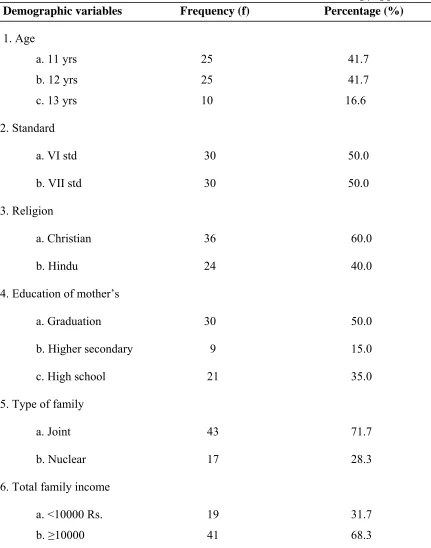
TABLE-1: FREQUENCY AND PERCENTAGE DISTRIBUTION OF
SAMPLE IN THE SELECTED DEMOGRAPHIC VARIABLES
N=60
Demographic variables Frequency (f) Percentage (%) 1. Agea. 11 yrs 25 41.7
b. 12 yrs 25 41.7
c. 13 yrs 10 16.6
2. Standard
a. VI std 30 50.0
b. VII std 30 50.0
3. Religion
a. Christian 36 60.0
b. Hindu 24 40.0
4. Education of mother’s
a. Graduation 30 50.0 b. Higher secondary 9 15.0 c. High school 21 35.0 5. Type of family
a. Joint 43 71.7
b. Nuclear 17 28.3
6. Total family income
a. <10000 Rs. 19 31.7
b. ≥10000 41 68.3
The data presented in Table-1 describe the pre adolescent girls. Regarding the age 25 (41.7%) girls were in the age of 11 yrs, age 25 (41.7%) girls were in the age of 12 years and 10 (16.6%) girls were in the age of 13 years. Among the 60 girls 30 (5.0%) were studying in the VI standard and the remaining 30 (50%) were studying in the VII standard. Regarding religion 36 (60%) were belongs to Christianity and 24 (40%) girls were belonging to Hinduism. Regarding mother’s education (50%) girls mother’s had acquired graduation, 9 (15%) girls, mother’s had studied up to higher secondary level and 21 (35%) Girl’s mother’s had studied up to high school level. Majorities (71.7%) of girls were living in the joint family and 17 (28%) girls were living in nuclear family. The total
FIGURE – 2: PERCENTAGE DISTRIBUTION OF AGE AMONG
PREADOLESCENT GIRLS
16.6 41.7 41.7 0 20 40 60 80 100 Percent a ge 11 12 13 Age 11 12 13FIGURE - 3: PERCENTAGE DISTRIBUTION OF STANDARD
AMONG PREADOLESCENT GIRLS
[image:46.612.117.522.440.650.2]FIGURE – 4: PERCENTAGE DISTRIBUTION OF RELIGION
AMONG PREADOLESCENT GIRLS
60 40 0 0 10 20 30 40 50 60 70 80 90 100 P e rcent a ge Religion Christian Hindu Muslim
FIGURE - 5: PERCENTAGE DISTRIBUTION EDUCATION OF THE
MOTHER AMONG PREADOLESCENT GIRLS
50 15 35 0 10 20 30 40 50 60 70 80 90 100 P e rcent a ge
Education of the Mother
Graduation
[image:47.612.111.505.450.652.2]FIGURE – 6: PERCENTAGE DISTRIBUTION OF TYPE OF
FAMILY AMONG PREADOLESCENT GIRLS
43 17 0 10 20 30 40 50 60 70 80 90 100 P e rcent a ge
Type of Family
Joint Nuclear
FIGURE – 7: PERCENTAGE DISTRIBUTION OF MONTHLY
INCOME AMONG PREADOLESCENT GIRLS
68 31.7 0 20 40 60 80 100 Per cent a g e < 10,000 Total family income
[image:48.612.106.447.487.617.2]FINDING RELATED TO FREQUENCY OF PERCENTAGE
DISTRIBUTION OF KNOWLEDGE SCORES OF PRE
[image:49.612.88.533.238.453.2]ADOLESCENT GIRLS REGARDING MENARCHE
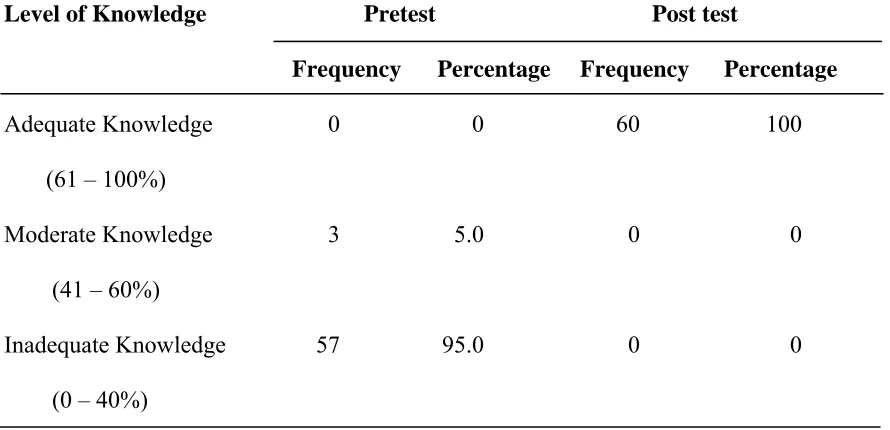
TABLE - 2: ASSESSMENT OF KNOWLEDGE BEFORE AND
AFTER STRUCTURED TEACHING PROGREMME
N=60
Level of Knowledge Pretest Post test
Frequency Percentage Frequency Percentage
Adequate Knowledge 0 0 60 100 (61 – 100%)
Moderate Knowledge 3 5.0 0 0 (41 – 60%)
Inadequate Knowledge 57 95.0 0 0 (0 – 40%)
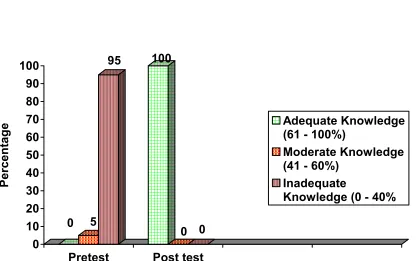
FIGURE - 7: ASSESSMENT OF KNOWLEDGE BEFORE AND
AFTER STRUCTURED TEACHING PROGRAMME
0 5
95 100
0 0 0
10 20 30 40 50 60 70 80 90 100
Percent
age
Pretest Post test
Adequate Knowledge (61 - 100%)
Moderate Knowledge (41 - 60%)
Inadequate
FINDINGS RELATED TO RANGE, MEAN, MEDIAN, STANDARD
DEVIATION OF PRE TEST AND POST TEST KNOWLEDGE
[image:51.612.81.531.282.374.2]SCORE OF PRE ADOLESCENT GIRLS REGARDING MENARCHE
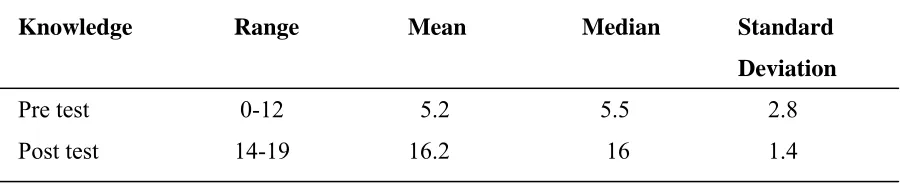
TABLE-3: PRE TEST AND POST TEST KNOWLEDGE SCORE OF
PRE ADOLESCENT GIRLS REGARDING MENARCHE
N=60
Knowledge Range Mean Median Standard
Deviation
Pre test 0-12 5.2 5.5 2.8
Post test 14-19 16.2 16 1.4
Note: the maximum possible score =20
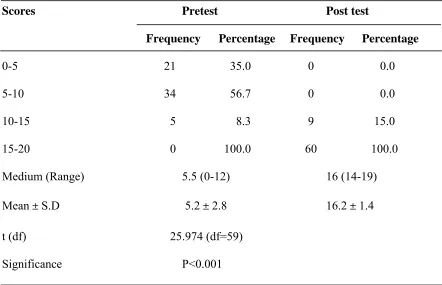
TABLE-4: EFFECTIVENESS OF STRUCTURED TEACHING PROGRAMME
Scores Pretest Post test
Frequency Percentage Frequency Percentage
0-5 21 35.0 0 0.0
5-10 34 56.7 0 0.0 10-15 5 8.3 9 15.0 15-20 0 100.0 60 100.0
Medium (Range) 5.5 (0-12) 16 (14-19)
Mean ± S.D 5.2 ± 2.8 16.2 ± 1.4
t (df) 25.974 (df=59) Significance P<0.001
TABLE - 5: MEAN, MEAN DIFFERENCE, STANDARD DEVIATION OF
MEAN DIFFERENCE, STANDARD ERROR OF MEAN DIFFERENCE AND t VALUE OF PRE TEST AND POST TEST KNOWLEDGE SCORE OF PRE
ADOLESCENT GIRLS REGARDING MENARCHE.
Knowledge Mean MD SDMD SEMD t value
Pre test 5.2
11 1.4 0.18 25.974 Post test 16.2
This data presented in the table 5 shows the mean knowledge score is higher in the post test (16.2) than the pre test (5.2), t=25.974, the value of P lies between 3.5 and 3.4 and hence it is less than calculated value of 25.974.
THE RELATIONSHIP BETWEEN PRE TEST KNOWLEDGE
[image:54.612.84.534.225.693.2]SCORES AND DEMOGRAPHIC VARIABLES
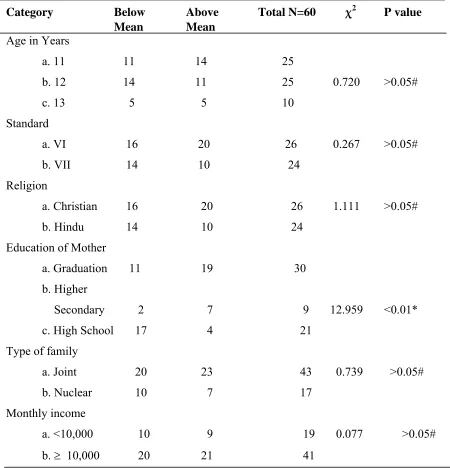
TABLE - 6: THE RELATIONSHIP BETWEEN PRE TEST KNOWLEDGE
SCORES AND DEMOGRAPHIC VARIABLES.
Category Below Above Total N=60 χ2 P value
Mean Mean
Age in Years
a. 11 11 14 25
b. 12 14 11 25 0.720 >0.05# c. 13 5 5 10
Standard
a. VI 16 20 26 0.267 >0.05# b. VII 14 10 24
Religion
a. Christian 16 20 26 1.111 >0.05# b. Hindu 14 10 24
Education of Mother
a. Graduation 11 19 30
b. Higher
Secondary 2 7 9 12.959 <0.01* c. High School 17 4 21
Type of family
a. Joint 20 23 43 0.739 >0.05# b. Nuclear 10 7 17
Monthly income
a. <10,000 10 9 19 0.077 >0.05# b. ≥ 10,000 20 21 41
Data on table 6 shows the relationship of knowledge scores regarding menarche with selected variable and chi-square test was computed.
CHAPTER – V
DISCUSSIONS
This study evaluated the effect of structured teaching programme on menarche .The study findings are discussed in this chapter with reference to the hypothesis.
CHARACTERISTICS OF THE PRE ADOLESCENT GIRLS
1.
The majority of participants 25(41.7%) were falling in the age group of 11 yrs, 25(41.7%) were falling in the age group of 12yrs and10 (16.6%) were 13 yrs.2. Most of the students 26(60%) were 6th standards, 24(40%) were 7th standards.
3. Regarding religion most of the students 26(60%) are Christians and 24(40%) were Hindus.
4. Regarding the mothers education the majority of the mothers were 30 (50%) were graduated 9(15%) had higher secondary education and 21(35%) were high school.
5. Majority of the students 43(71.6%) were joint family and 17(28.3%) were nuclear family.
2) KNOWLEDGE OF STUDENTS REGARDING MENARCHE
AMONG PRE ADOLESCENT GIRLS.
I.
Comparison of pre test and post test knowledge score
In pre test 57(97%) of the pre adolescent girls had inadequate knowledge and only 3(5%) had moderate knowledge whereas in post test 60(100%) of the pre adolescent girls had adequate knowledge. The result shows that there was a marked difference in the pre test and posttest level of knowledge of pre adolescent girls.
II.
Comparison of range, mean, median, standard deviation of pretest and
post test knowledge score of pre adolescent girls regarding menarche.
The score range obtained in the pre test varied from(0-12) and in the post test from 14-19.It was evident that from table 3 was the post test mean(5.2) and the findings also revealed that the pre test scores were less dispersed, pretest SD ± 2.8 and post test SD ± 1.4. The median for pre test was (5.5) and the post test was (16).3. EFFECTIVENESS OF STRUCTURED TEACHING PROGRAMME
ON KNOWLEDGE REGARDING MENARCHE AMONG PRE
ADOLACENT GIRLS
I)
Comparison of mean pre test with mean post test knowledge score
of pre adolescent girls.
(t=25.974,df=59) was significant. There was a significant difference in pre test and post test score which indicate effectiveness of structured teaching programme.
II) Comparison of mean, mean difference, standard deviation of
mean difference, standard error of mean difference and ‘t’ value of pre
test and post test knowledge scores regarding menarche among pre
adolescent girls.
The mean post test knowledge scores at pre adolescent girls (16.2) was higher than the mean pretest knowledge scores (5.2) and the mean difference was 11. The obtained t value (t=25.974, df 5.9) was significant at 0.01 level. It indicates that the structured teaching programme has played a significant role in improving the knowledge of pre adolescent girls.
ASSOCIATION BETWEEN PRE TESTS KNOWLEDGE SCORE
AND SELECTED DEMOGRAPHIC VARIABLES:
CHAPTER-VI
SUMMARY AND RECOMMENDATIONS
This chapter deals with the summary of the study and the conclusion drawn. It clarifies the limitation of the study and the implications. The recommendations for different areas like nursing education, public education, nursing administration and nursing research.
SUMMARY
This study was undertaken to determine the knowledge of pre adolescent girls regarding menarche.
THE OBJECTIVES OF THE STUDY
To assess the level of knowledge regarding menarche before and after structured teaching programme among preadolescent girls
To evaluate the effectiveness of structured teaching programme regarding menarche among preadolescent girls.
To associate the pretest knowledge score among preadolescent girls regarding menarche with selected demographic variables, Such as age, religion, education of mother, type of family and total family income.
Preparing a structured teaching programme on menarche will be of importance in educating the pre adolescent girls to increase their knowledge and help to prevent complication to lead a normal healthy life.
Reliability of the tool was found by using test retest method (r=0.993). The tool was validated by five experts in obstetric and gynecological nursing. Pilot study was conducted on six adolescent girls to find out the feasibility of the study. Pretest was conducted for the experimental group and their knowledge was assessed regarding menarche. After the pre test structured teaching programme was given to pre
adolescent girls in the experiment group after 5 days. Post test was done with the
same tool. Data was analyzed using descriptive and inferential statistics.
FINDINGS OF THE STUDY
1.
CHARACTERISTICS OF THE PRE ADOLESCENT GIRLS
i. The majority of pre adolescent girls 41.7 %( 25) were in the age group of
11 years 41.7% (25) were years and 16.6 %( 10) were 13 years.
ii. Regarding the standards the majority of pre adolescent girls 60 %( 36) VI standards, and 40 %( 24) were VII standards.
iv. Regarding the mother’s education the majority of the mothers 50 %(
30) were graduated, 15 %( 9) had secondary education and 35 %( 21)
had high school education.
v. Majority of the students 71.6%(43) belongs to Joint family and 28.3%(17) belongs to nuclear family
vi. Regarding total family income, most of the students total family
income was 68.3% (19) above Rs. ≥ 10,000, and 31.6 %( 41) was < 10,000.
2. KNOWLEDGE OF STUDENTS REGARDING MENARCHE
i.
Comparison
pretest
and
post
test
knowledge
scores.
In the pretest 95% of the preadolescent girls had inadequate knowledge and 5% had moderately adequate knowledge where as in post test 100% of the
student had adequate knowledge. The result shows that there is marked
difference in the pre test and post test knowledge scores of pre adolescent girls
regarding menarche.
ii.
Comparison
Range,
mean,
median
standard
deviation
of
pre
test
and
post
test
knowledge
scores
of
pre
adolescent
girls
regarding
menarche
higher than pre test mean (5.2). The standard deviation for pre test is 2.8 and for
post test is 1.4. The median of pre test is 5.5 and for post test is 16.
3.
EFFECTIVENESS
OF
STRUCTURED
TEACHING
PROGRAMME ON KNOWLEDGE REGARDING MENARCHE
i.
Comparison
of
mean
pre
test
with
mean
post
test
knowledge
score
of
pre
adolescent
girls:
‐
The mean post test knowledge score (16.2) was higher than the mean pre test knowledge score (5.2) and the mean difference is 11. The obtained‘t’ value
(‘t’ = 25.975, df 59) was significant at 0.01 level. It implies that structured
teaching programme has significant effect in increasing the knowledge and there
is a significant difference in the group with regard to the knowledge before and
after structured teaching programme
ii
.
Comparison
of
mean
difference
standard
deviation
of
mean
Difference
and‘t’
value
of
post
test
knowledge
score
regarding
menarche.
The Mean post‐test knowledge score of Adolescent girls (16.2) was higher
than the mean pretest knowledge score of the control group (5.2). The mean
level. It indicates that the structured teaching programme has played a
significant role in improving the knowledge of experimental group.
4.
ASSOCIATION
BETWEEN
PRE
TEST
KNOWLEDGE
SCORE
AND SELECTED DEMOGRAPHIC VARIABLES:‐
There was a significant association between knowledge score and education of mother. But there was no association between the knowledge score
and other demographic variables such as Age, Standard, Religion, Type of family
and Family monthly income.
IMPLICATIONS
Menarche is one of the natural processes among the female children, Hence the need to know regarding menarche is more important. The
implications which have been made in the study are of vital concern for health
planners, education planners, and nurse educators.
IMPLICATION
FOR
NURSING
PRACTICE
The finding of the study clearly enlighten the fact structured teaching programme regarding menarche had significantly improved the knowledge of
i. Nursing persons are in best position to impart knowledge regarding
menarche to the preadolescent girls in the schools, hospital and
communities.
ii. The nurse educator needs to prepare self instructional materials such as
learning package which can be placed in schools and all the community.
iii. The nurse educator needs to prepare a chart related to menarche which
can be placed in the schools and community.
iv. Health education on menarche and menstrual hygiene can be conducted
in these schools yearly among the pre adolescent girls in school or
community.
IMPLICATIONS
FOR
NURSING
EDUCATION
i. The nurse should be equipped with up to date knowledge on menarche,
so that they can be able to impart appropriate knowledge.
ii. The nursing students must be encouraged to actively participate in
education of pre adolescent girls regarding menarche by using
appropriate adequate visual aids.
iii. There should be more emphasis on menarche, menstrual hygiene and
need to be included in curriculum.
IMPLICATIONS
FOR
PUBLIC
EDUCATION
Carefully prepared menarche health education programme as part of mass educations, will be used in creating awareness among the general public
and mothers who have pre adolescent girls regarding menarche for the
maintenance of healthy life style. Awareness should be created from school
itself. Nurses are the vital source of educating the public through such
programme.
IMPLICATIONS
FOR
NURSING
ADMINISTRATION
i. Nursing personnel working on various settings should be given
in ‐service education to update their knowledge and abilities in
identifying learning needs of the preadolescent girls with menarche
and plan for appropriate intervention.
ii. The administrators should emphasis and encourage the nurses to
conduct periodic menarche and menstrual hygiene programmes.
iii. Nurse administrators should encourage nursing students to
prepare and utilize effective audio visual aids on menarche.
IMPLICATIONS
OF
NURSING
RESEARCH
i. It is essential to identify the present level of knowledge regarding
menarche among preadolescent girls to know what the required
ii. Extensive research must be conducted in this area to identify more
effective methods of educating the preadolescent girls on this issue.
iii. This study also brings about the fact that more studies need to be done
at different settings which is culturally acceptable with better teaching
strategies of education.
iv. This study can be a base line for the future studies to build upon.
LIMITATIONS
The limitations of the study are as follows,
The study was conducted among pre adolescent girls from selected school
Nagercoil at kanyakumari District. So generalization can be done with caution.
RECOMMENDATIONS
Based on the findings of the study recommendations for future study are, i. The study can be done with larger group of people.
ii. Further studies can be conducted to develop menarche health education
programme for preadolescent girls in different schools in urban and in
rural areas.
iii. A comparative study can be carried out to ascertain the knowledge and
attitude regarding menarche among preadolescent girls in rural and urban
iv. Comparative study can be done between effectiveness of self instructional
module versus structured teaching programme.
v. A study can be made to compare the effectiveness of menarche health
education programme with other methods of teaching (eg: films, video,
tapes).
vi. The structured teaching programme should be reviewed from time to time
in order to incorporate the current trends in the field of menarche.
RECOMMENDATION
BASED
ON THE
SUGGESTIONS
OF
THE
STUDY SUBJECTS
i. Menarche health education programmes should be conducted by
professionally trained personnel.
ii. Mass media should be effective for conducting programme of menarche
health education.
iii. Menarche health education for preadolescent girls should be culturally
oriented.
CONCLUSIONS
The following conclusions were drawn from the study,
1. There was a significant difference in mean post test knowledge score and
mean pre test knowledge score regarding menarche ( t= 25.974, df = 59).
2. There was a significant association between pre test knowledge score and
education of mother. But there was no association between age, standard,
religion, Type of family and monthly income of the family.
3. The study was done on a small sample 60 students. Hence generalization
is possible for the selected participants.
BIBLIOGRAPHY
Adele pilitteri.2007).Maternal and child health nursing (5th ed).Philadelphia: Lippincott William and wilkins.83-87.
Ammula Ratha ,Ramana Sree.(2008).Hand book of obstetrical Nursing.(2nd ed).Hyderabad: Frontling Publications.31.
Annamma Jacob.(2008).A comprehensive Text book of midwifery .(2nd ed).London : Jaypee Brothers medical publishers.65.
Anne Waugh,Allison Grand.(2003).Anatomy and physiology in Health and Illnes .(9th ed).London : Churchil Livingston.438-441
Basvanthappa BT. (1998). Nursing research. (1st ed.).Mumbai :Jayvee brothers medical publishers pvt ltd.185-188
Chris Henderson,sre Macdonald .(2004).Mayes midwifery A Text book for midwives.(13th ed).London : Bailliere Trindal.89-101.
Dutta,D.C.(2006).Text book of gynecology .(4th ed).Culcutta : New central book agency.75-77
Glantz.(2006).Primer of biostatistics.(16th ed). Singapore: McGraw Hill .105-110.
Helen Varnay.(1987).Nurse midwifery.(2nd ed).London ;Jones and Barlett publishers.46.
Lynna,YC,Joan,CE.(2005).Maternity Nursing care.(1sted).Australia: Thomson Delmar Learning.105-110.
Mahajan,B.K.(1997).Methods in biostatistics.(6th ed.).Delhi: Jaypee Brothers medical publishers.141-142.
Park K. (1998).Preventive and social medicine. (15thed.).Jabal Pur ;Banarsidas bhanot.331.
Polit DF.Beck CT. (2006).Essential of nursing research. (6th ed.). Philadelphia : Lippincott William and wilkins.260.
Ruth Bennet v.Linda K.Brown.(2001).Myles Text book for midwives.(13th ed).Londan : Churchil Livingstone.
Sembulingam ,prema sembulingam.(2008).Essential of medical Physiology.(4th ed.). London :Jaypee Brothers medical publishers.434-435.
Shashan KV,Parnlekar.((1998).Text book for midwives.(1st edn.).Mumbai – M/s.Vora Medical publication.35.
Shirish N daftry ,sudip chakaravarthi (2007).Manual of obstetrics. (2nd edn.). Delhi; Elsevier.25-26.
Verma BL,Shukla GD.(1993).Biostatistics perpectives in health care research and practice.(1st ed.). Delhi: Nazia priters.17.
JOURNAL
¾ Aggarwal s. (2006) menarche and menarcheal education: indian journal of community contemporary family therapy, november 4
¾ Aparajita dasgupta, (2007): how hygienic is the adolescent girl: department of preventive and social medicine,may.15.
¾ Carol dashiff (2009) psyclogical impact of onset of menstruation
¾ Corina benjet,(2004): psychological well-being of mexican early adolescents ,journal of youth and adolescent, november 6.
¾ Dannii journal of adolescent research2005 20: 118.
¾ lynette l university of south carolina, department of exercise science,
norman j. arnold school of public health,
¾ Paula j. adams hillard, md, professor and department of obstetrics
and gynecology chief, stanford university medical center,
stanford, california author's
¾ Rakesh (1988) preparing girls for menarche: nursing journal of india, mar2003
George (2003) preparing girls for menstruation: recommendations from adolescent: psychology, children, and parenting magazines, december 21
APPENDIX – I A
COPY OF LETTER SEEKING PERMISSION TO CONDUCT RESEARCH STUDY
71M.Sc(N)2010
To
The correspondent
Stella’s Matriculation School Anjugramam, Kanyakumari District. Respected Madam,
Sub : Requisition for getting permission to do research study to assess the effectiveness of structured teaching programme on menarche amo