Imprint
march 2014
DECISION-MAKING
UNDER
INDETERMINACY
J. Robert G. Williams
University of Leeds
©2014, J. Robert G. Williams
<www.philosophersimprint.org/014004/>
Sometimes, the facts run out. Faced with a reddish-orangish colour patch, it seems to many that it isindeterminate, orindefinite, orborderline, orunsettled, whether the patch is red. The notion of indeterminacy is deployed all over philosophy — in discussions of vague predicates, the-ory change, future contingents, incompleteness in mathematics, con-ditionals, presupposition failure, the paradoxes of self-reference, and more. But what is this notion? Is there even a single unified concept that covers all the cases just mentioned? Much sophisticated work has been done outlining semantico-logical frameworks for indeterminacy. But they do not directly address one of the most pressing questions about describing something as indeterminate. Suppose we accept that p is indeterminate; how should this belief affect our other doxastic states and wider mental life — in particular, what attitude can we ra-tionally adopt to p, while holding the belief that p is indeterminate? What is the cognitive role of indeterminacy judgements?1
This is one instance of a more general topic. We believe, desire, hope, fear, and act under vague guises. Our best accounts of the inter-relation between such attitudes (for example, the interinter-relation between belief and desire set out in decision theories) often presuppose a clas-sical backdrop that is under fire in the literature on vagueness. The methodology below is to approach the direct cognitive-role question indirectly, through looking at the interplay of beliefs, desires and ac-tion in the presence of indeterminacy.
Nothing I say here will depend on whether thesource of the inde-terminacy in question is ‘in the world’ or ‘due to language’, or the like. I will, however, appeal throughout to indeterminacy as an operator, rather than a predicate of linguistic items. Our cognitive and conative attitudes toit being indeterminate whether Harry is baldare one thing; the linguistic expression ‘Harry is bald’ having some particular semantic
status another. A basic desire to bring about the first is not the same as a basic desire to bring about the second; altering the meanings of words is one way to achieve the latter; the former would require ma-nipulations of Harry’s head.
I will, however, presuppose that there is a good question about what attitude we take to the propositionthat Harry is bald— I suppose that those words single out a particular proposition we could believe-true or desire-believe-true, whose truth conditions are indeterminate. A way of denying this presupposition would be to maintain that the contents of attitudes are always and everywhere precise — utterly determinate Fregean thoughts, Russellian structures, or sets of Lewisian worlds. On the latter view, indeterminacy in what one believes is traced to indeter-minacy in which precise content one bears the believing-relation. I be-lieve that the whole discussion to be given below can be reconstructed in the alternative setting just described; but this is a substantive claim that I won’t defend here.
The paper is divided into three parts. The first introduces our stalk-ing horse: a decision puzzle with indeterminacy at its heart. I describe the setup (1.1), the decision puzzle (1.2), and the possible patterns of
reaction (1.3). A dispositionally inconstant pattern of response is
iden-tified as our target.
In the second section, a model of mind is developed that supports such inconstant responses. (2.1,2.2) introduce the basic machinery of
sharpenings and sharpening-induced mental states. (2.3) links mushy
mental states to action, via the decision rules Caprice and Randomize. These sections are relatively informal, and the appendices regiment and generalize the proposals. (2.5,2.6) present and resolve a
theoret-ical worry for the account to do with diachronic coordination. (2.4, 2.7) apply the framework to talismanic puzzles of indeterminacy: the
sorites and forced-march paradoxes.
Section 3 explores an objection due to Adam Elga. The net
ef-fect of this is to bring into sharp relief two competing interpretations of the framework. One (discussed in3.2 and 3.3) involves steadfast
indeterminacy-induced uncertainty, supplemented by pragmatic
book-keeping to ensure one’s actions across time do not conflict. The other (3.4), the mind-making proposal, involves agents genuinely making a
judgement — albeit on an arbitrary basis — -when forced to act under indeterminacy.
The conclusion highlights the most characteristic features of the account of decision-making under indeterminacy developed here: its anti-compromise stance.
1.1 The Cabinet
The survival of a person across time can be an indeterminate matter, as van Inwagen (1990) emphasizes:
One’s life may be disrupted in various ways. If a pin is stuck into one’s finger, one’s life goes on. If one is blown to bits by a bomb, then — even if God immediately puts the bits back together again — one’s life has ended. . . . If, at the extremes of a spectrum along the length of which are arranged more and more radical disruptions of lives, we can find definite cases of the end of a life and definite cases of the continuation of a life, then it seems rea-sonable to suppose that somewhere between the extremes will be found disruptions of which it is not definitely true or defi-nitely false that they constitute the end of a life. And if this is so, then there are possible adventures of which it is not definitely true or definitely false that one would survive them. Let us call such episodes “indeterminate adventures”. Not everyone — per-haps hardly anyone — will agree with my contention that one survives an adventure if and only if one’s life persists through that adventure. But anyone who thinks that people are complex material organisms will be hard put to it to deny that possibility of indeterminate adventures. (van Inwagen,1990, p.243)
episodes, but it’s indeterminate whether it is the same person through-out. To discuss such cases without getting into the nitty-gritty of how to set things up for this or that theory of persistence, we’ll follow van Inwagen in appealing to “the Cabinet”:
Suppose that a person, Alpha, enters a certain infernal philo-sophical engine called the Cabinet. Suppose that a person later emerges from the Cabinet and we immediately name him ‘Omega’.Is Alpha Omega? . . . Let us suppose the dials on the Cabinet have been set to provide its inmates with indeterminate adventures. (We need not agree on what would constitute an indeterminate adventure to suppose this. Let each philosopher fill in for himself the part of the story that tells how the dials are set). Alpha has entered and Omega has left. It is, therefore, not definitely true or definitely false that Alpha is Omega. (van Inwagen,1990, p.243–4)
If one wants to discuss the impact of indeterminacy on belief, desire, and action, vague personal identity is a good place to start. The reason is that our own survivalmattersto us. One desires, inter alia, that good things happen to oneself in the future and fears the bad things that may happen. And these fears and desires are intrinsic, rather than in-strumental — it is not, in the most usual cases, that one fears one’s future pain because being in pain is a signal that something else fear-ful is happening. It is the pain itself one desires to avoid. Of course, one might also desire that good things happen to loved ones, or that the welfare of humanity in general is improved. But there’s a particular kind of self-interested concern that’s extremely psychologically salient. We can imagine that Alpha takes this to extremes — all that he cares about is the good or bad things that are going to happen to him. Our question is: How should Alpha then think about known goods and evils that happen to Omega? To test this, let some broker offer Alpha an investment opportunity. He’s certain, we’ll assume, that he will soon be subject to the Cabinet. For a small investment now by Alpha (100 dollars perhaps), Omega will benefit to the tune of
thou-sands.2
Alpha is entirely self-interested, but not exclusively present-self-interested: he’s prepared to give up goods now if doing so brings him great gains in the future. So if he was certain that Omega was him, this would be a no-brainer: he’d take the investment like a shot. But, caring only about his own benefit, if he was certain that he was not Omega, he’d keep his cash and spend it on a few final nights of partying. What should he do? What wouldyoudo, in his shoes?
1.2 The broker’s offer
How should Alpha think about the broker’s offer? It’s illuminating to compare the situation to a parallel one that does not involve indeter-minacy. Perhaps the makers of the Cabinet also make a machine that gives people chancy, rather than indeterminate, adventures. With the dials suitably set, anyone who enters this second machine has a50/50
chance of passing through unscathed. If the dice roll against an inmate, then he undergoes destruction and reconstruction that (according to one’s favoured view of personal identity) produces a person determi-nately distinct from the one who enters. Faced with the certainty he’s about to enter the chancy Cabinet, and knowing the relevant chances, the investment decision facing Alpha would be comparatively familiar. At first pass, he would calculate the expected utility of investing as opposed to not-investing, and choose whichever maximizes utility.
A first pass at the decision table (not attempting to assign numerical values at first) would be the following:
α=ω α6=ω
Invest Long life, No party, Short life, No party.
Riches No riches.
Reject Long life, Party, Short life, Party,
No riches No riches.
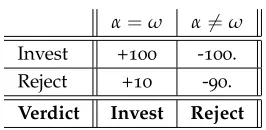
Expected utility theory requires we associate numbers with the out-comes described in the cells above. The determinants of utility of the outcome described in each cell include: whether an individual has a long or short life; whether or not they get a party; and whether or not they get riches (we assume that in all other respects the prospects are equally good). Let’s suppose that the life up to the point of encab-ination on its own contributes−100 utils; the extra years come with a boost of+100 utils on top of this. We’ll assume that having riches comes with a boost of+100 utils, and a party with a boost of +10. Lacking riches and lacking a party don’t add or subtract any utils to the life. We’re then in a position to figure out the net utility for each cell in the table above. The top left cell includes long life, i.e., a life up to encabination plus extra years (−100+100) and riches (+100), which will give a net utility of+100 The bottom right cell includes a short life (−100) and a party (+10), and thus has a utility of−90. Filling in the other cells likewise, we get the following:
α=ω α6=ω
Invest +100 −100. Reject +10 −90.
Alpha doesn’t know the exact outcome of either of the actions open to him. But he does know the relevant chances — we can list the prob-ability he attaches to each at the head of each column — and using this he can aggregate the utilities of the two possible outcomes of each action, to arrive at an overall ranking. The recommended choice is the action that maximizes expected utility:
P(α=ω)=0.5 P(α6=ω)=0.5 Expected utility
Invest +100 −100 0
Reject +10 −90 −40
Verdict: Invest
Let us now turn back to the original Cabinet, which delivered in-determinate rather than chancy adventures. Once more, we can assess the four outcomes individually. What Alpha values remains the same — having more years, partying, and riches all add utility. And so, I will be assuming, the same utilities should be entered into the four possibilities represented on the decision table.
(In making this assumption, I’m glossing over some differences be-tween the cases that you might think should make a difference to the utilities assigned. In the case of the chancy Cabinet, supposing Alpha survives, he will survive unchanged psychologically and biologically. With the indeterminate Cabinet, even on the hypothesis one survives, one knows that one will undergo radical changes; perhaps some [but not all] memory links to early childhood are erased and some [but not all] of one’s present plans for the future are erased. In the light of that, you might think that possibilities featuring extra years should deliver less of a utility boost for Alpha in the indeterminate Cabinet scenario, compared to the chancy Cabinet scenario. The exact numbers won’t matter for the points to be made below, and so we could indeed fac-tor this in. But for ease of comparison, I’ll be assuming that we add detail to the indeterminate Cabinet scenario so a utility boost of+100 for the extra years remains appropriate. For example, perhaps the psy-chological changes will include erasing traumatic memories as well as welcome ones; perhaps the erasure of some of Alpha’s plans will be compensated by raising the chance of success in others.)
The table we arrive at takes a familiar form:
α=ω α6=ω
Invest +100 -100.
Reject +10 -90.
this gives little steer about how to proceed.3
Our question is how to make decisions in the peculiar kind of uncertainty generated by inde-terminacy.
1.3 Patterns of action
One way to think about the advice we might give Alpha is to imagine the dispositions to act that agents could in principle have faced with this decision situation and variations thereof, and then try to pick one among them as appropriate. I will describe this space of options and identify one in particular for which it will be our task in what follows to provide rational underpinnings.
In any particular instance of the broker’s situation, Alpha must ei-ther invest or reject the offer (doing something indeterminate between investing and rejecting is not an option at all). So it looks like there are only two options he must decide between. But we should also re-member the possibility of randomly choosing what to do among the available options. To detect these random dispositions to act, suppose that we repeat the experiment many times over (perhaps with dupli-cates of Alpha; or perhaps the Cabinet-makers present him with the investment decision, then take him aside, wipe his memory, and rerun the experiment). Advice to invest, advice to reject, or advice to pick one or the other with certain chances predict different patterns under this repeat examination. Alpha might invariably invest, invariably not invest, or behave in an inconstant manner, sometimes investing and sometimes not investing (with the long-run frequency matching up to the chances in the mixed strategy). To gain even more information, we could include among the repetitions variations in the parameters of the setup. We could, for example, raise or lower the prize given to Omega if Alpha invests.
There are four salient possibilities here for what the overall pattern
3. The situation is reminscient of the classic puzzle of decision-making under
uncertaintyrather thanrisk, expected-utility theory being the inheritor of the latter tradition. A classic text on these matters is Luce and Raiffa (1989).
will look like:
Universal Acceptance Alpha displays constant behaviour and always accepts the broker’s offer no matter how much money is offered to Omega.
Universal Rejection Alpha displays constant behaviour and always rejects the broker’s offer no matter how much money is offered to Omega.
Threshold This pattern of behaviour features constant behaviour for a fixed level of prize. But when we vary the prizes awarded to Omega, there is a a tipping point. Prizes below this threshold invariably lead to not-investing; prizes above it lead to investing.
Inconstant Even for fixed prizes, Alpha acts inconstantly, sometimes investing, sometimes rejecting duplicate contracts. Subvarieties of this pattern involve a fixed frequency of investing vs. rejecting, or a varying frequency (perhaps depending on the exact contract of-fered).
Subsequent sections explore the Inconstancy view. The purpose of this paper is not to provide reasons for endorsing Inconstancy as the right reaction to the decision puzzle. It is rather to develop a model of the cognitive role of indeterminacy that would rationalize Incon-stancy, and to explore the implications of that model (insofar as those predictions look plausible, that will of course support the model, and Inconstancy). But the reader might reasonably ask, if not for a knock-down argument for the position, at least for a sketch of why one might find that option worth exploring. So I’ll sketch one possible route to this conclusion, in the specific case of personal identity.4
anti-verdict-The motivation I’ll offer is by elimination of alternatives, supposing (pace Parfit, 1971) that personal identity is what matters in survival.
First, I argue that the Universal Acceptance and Rejection options are incompatible with that thesis. If personal identity matters in survival then one’s self-interested actions should be sensitive to the welfare pos-sessed by y in outcomes iff y is oneself. But suppose one is a Uni-versal Rejector. Then it looks like one’s self-interested actions simply discount the interests ofy, whenever it’s indeterminate whether yis oneself. Modus tollens applies: one is noty. Thus, on the assumption that we’re Universal Rejectors, indeterminate survival collapses into non-survival. There’s a dual worry for Universal Acceptors — if what happens to indeterminateyalways matters to one’s self-interested ac-tion, then modus ponens on the same biconditional gives us thatyis oneself. So indeterminate survival collapses to survival. Further, if each premise of the above argument is determinately true, the conclusions hold determinately — and that amounts to a reductio.
That leaves the Threshold and Inconstancy views standing. So our question will be: Is there any problem in combining the view that iden-tity matters in survival with the Threshold view? In (Williams, ript) I explore exactly that combination. I argue that the combination (if not produced by ordinary uncertainty, as an epistemicist might argue) is best understood as committed to a nonclassical, degree-theoretic treat-ment of vagueness (following Lewis,1976). If that is right, then reasons
for rejecting epistemicist and degree-theoretic accounts of vagueness will be reasons for rejecting the Threshold view. The growing crowd of non-epistemicist classicists, for example, I think should regard all alternatives but the Inconstancy view as eliminated.5
exclusion arguments of (Wright,2003).
5. Non-epistemicist classicism was until relatively recently a fringe view, but in the last ten years or so has gained many advocates. See (Fine,1975) (in his dis-cussion of the conceptual priority of penumbral truth); McGee and McLaughlin (1994) (though they regard it only as one disambiguation of “truth” talk), Dorr (2003), Greenough (2008), Barnett (2009), Barnes (2007), Barnes (2010),Barnes and Cameron (2009), Barnes and Williams (2011) and Eklund (2010).
2. Uncertainty and Inconstancy
Our goal is to find rational underpinnings for inconstant behaviour in the presence of indeterminacy.6
First I want to make explicit the semantic skeleton on which the account will be built.
(A housekeeping note: In what follows I will be attributing semantic properties to truth-bearers. I’ll also be talking about the consequences these semantic properties have for attitudes such asbelieving that Al-pha is Omegawhere the embedded claim is indeterminate. One might be worried about a mismatch here, since usually truth-conditional the-orizing focuses on the semantic properties of sentences, whereas be-liefs have propositions as their objects. But there are plenty of ways in which the mismatch could be avoided. Perhaps the vehicles of truth and falsity in semantic theory are sentences, and beliefs consist in a relation to a mentalese sentence.7
Or perhaps beliefs and desires are in the first instance relations to Fregean thoughts; and then the truth-conditional theory should be construed as setting out a theory of the truth-conditions of such entities. But it doesn’t matter that much how it is achieved; what I need is that there is such a match. Under the presupposition that I flagged at the start — that the truth-conditions of the objects of our attitudes are themselves indeterminate — I predict that the matching thesis can be made to hold.)
2.1 Supervaluational indeterminacy
I will work with a broadlysupervaluationaltreatment of indeterminacy.
6. As already mentioned, my ideas in this area are shaped by Crispin Wright’s work (see especially Wright,1976,2001,2003), though the way I develop the idea is very different. My thinking below — especially the association of a de-gree theory with partial dispositions to act in conflicting ways, which grew into the weightings of Randomize — grew directly out of engagement with the characterization of vagueness-related degrees of partial belief in Schiffer (2003) — especially the brief characterizations of their characteristicambivalence. Schif-fer assures me, however, that his account should be intepreted as excluding the kind of inconstant behaviour I appeal to. Closest to the model I develop is the contextualist account of Shapiro (2006), which faces a quasi-supervaluational notion of conversational score.
Indeterminacy, on this conception, involves a kind ofunsettledness be-tween candidate truth-value assignments to propositions. An epistemi-cist thinks there’s One Correct Way of scattering truth and falsity over sentences or propositions, given the way the world is (including, in-ter alia, over the claim that Alpha is Omega — this comes out either as true or as false). The supervaluationist agrees that these are decent can-didates to be truth-value assignments, but holds that the relevant facts do not select one in particular as uniquely correct. Some candidates can be thrown away — those that give clearly wrong truth values to, e.g., ‘Alpha is human’, or say that some borderline colour patches are red, while colour patches even redder than them are not red. But even once all this information is in, there remain many candidate classical truth-value assignments{s1,s2, . . . ,sn} =S.8 We call the members of S sharpenings. The classical case is simply the limiting case whereSis a singleton; but indeterminacy characteristically is manifested by the presence of multiple sharpenings. A sentence or proposition is indeter-minate iff some of these sharpenings declare it true and others classify it as false. It is determinately true if all agree it is true, and determi-nately false if all agree it is false.9
There are some neat features of this picture. To start with, all cal tautologies (like the law of excluded middle) are true on each classi-cal interpretation and so a fortiori on all thesiin our set of sharpenings. So classical tautologies will be determinately true. Supervaluationism is closer to classical logic than many other semantic models of indeter-minacy. Furthermore, we can make room within the model for talk of “degrees of truth” (or degrees of determinacy, if the former vocabulary makes one queasy). A sentence or propositionpis true to degreekiff k=|{s∈S:pis true on|S| s}|.10
Such degrees of truth will be structured like a
8. I’ll standardly work with finite sets; though in actual applications, we ex-pect there to be infinitely many sharpenings. Everything I will say can be easily generalized to that case.
9. Some loci classici: (van Fraassen,1966), (Fine,1975), (Keefe,2000).
10. In the infinite case, we need to appeal to a (normalized)measureover the set of sharpenings, and then let the degree of truth ofpbe the measure of the
classical probability — something we will exploit below.11
This much structure I will suppose. But I am neutral on many other matters that supervaluationists need to take stances on, particularly on matters of truth and logic. I do not say what formal construct within the semantics is to be identified with truth; nor how to define logic in this setting. My own view is that supervaluationism is not a single view but a whole family, and the right way to individuate family members is to describe their interactions with belief, desires, and decision-making. Questions of what counts as truth, and what logic, should be settled after one has got clear on the roles that the basic features of the model play in our wider life. (My own view is that the package to follow is naturally paired with a classical, bivalent treatment of truth and logic. But nothing in the technical development to follow will depend on such issues.12
)
2.2 Indeterminacy-induced uncertainty
In the classical, bivalent setting, one familiar model of ideal psycholog-ical states associated with propositions are point-like credences: full confidence in p if p is true, no confidence if it is false. Cases of un-certaintyare similarly point-like, represented by real numbers strictly between1and0. Corresponding, the desirability or utility of a
propo-sition can be represented by real numbers (like those entered into our representation of the chancy Cabinet earlier). Overall, a classical state of mind will be a pair of a probability and utility function,hp,ui.
There is an alternative model of uncertainty: the “imprecise” or “mushy” credence model favoured by, inter alia, Isaac Levi (1974).13
set of sharpenings that makesptrue.
11. These supervaluational degrees of truth (or something like them) are explored in (Lewis, 1970; Edgington, 1997; Kamp, 1975; Cook, 2002) and (Williams,2011). For criticism, see (Smith,2008).
12. Pairing bivalent truth with a supervaluational model is a familiar theme — see Fine (1975) for an early exploration. (Williamson,1994, ch.5) argues against this being a version of supervaluationism.
The idea here is to represent a person’s doxastic state not by a single, precise credence, but by a wholesetof them, represent the agents’ open-mindedness or uncertainty between the various more particular views. Likewise for desirability/utility. So we expect to associate an agent not with a single classical state of mind but with a whole set of them: {hp1,u1i, . . . ,hpn,uni}. You are in some sense undecided between the views expressed by the classical states of mind within this set.
On this mushy credence model, there are two dimensions of un-certainty available. One can have a particular level of confidence in a question, which doesn’t reach the poles of complete certainty or utter rejection. Or one might be in the dark even about particular levels of confidence. Faced with a fair coin, midway through being flipped, one can justifiably be half-confident that it will land heads. But (say some advocates of mushy credences) the question of the state of the econ-omy a few years down the line, where statistics have proved a poor guide in the past, demands a more radical kind of uncertainty — one aptly captured by representing the range of levels of confidence one is open to.
There’s clearly an analogy between the way that supervaluationism generalizes classical semantics and the way that Levi-like mushy cre-dences generalize classical states of mind. This hasn’t gone unnoticed — indeed, Levi describes his view as one involving “indeterminate be-liefs”. But this kind of generalization of classical states of mind needn’t be (and usually is not) tied to a response to indeterminacy. However, the view to be explored below makes exactly this connection.14
The rough idea, then, is that ifpis known to be indeterminate, then one’s attitude to p is represented not by a single level of confidence, but by a whole set of them (or more generally, one’s doxastic state is
wider literature and the variety of approaches being pursued. (Jeffrey,1983) is perhaps the version closest in spirit to the approach I will be developing here. 14. I should note that a connection of this kind — sometimes accompanied by the additional gloss that it is indeterminate which of the classical beliefs described by elements in the mushy state the agent subscribes to — is very common in conversation. I do not know of places in the literature where it is examined in detail, however.
represented not by a single probability function, but by a set of them). But to tighten this up, we need to ask: what probabilities, in particu-lar, make it into the set? It is here that the supervaluational model of indeterminacy comes in.
Let’s go back to our worked example. Alpha, we may assume, knows exactly which particle-configurations will arise, for each action he may take. The difficulty is that ‘Alpha survives as Omega’ is true at one of these possibilities relative to one sharpening, and false at the same possibility relative to other sharpenings. So even though Alpha has perfectly definite credences over the possible worlds, the proper degrees of belief he should have oversentencesor (fine-grained) propo-sitionscannot be read off.15
But here is the rub: holding fixed a sharp-ening one can read off a definite truth-value assignment for sentences or propositions at those worlds. And so, relative to each sharpening, there’s a natural proposal for reading off appropriate degrees of belief in each vague sentence/proposition: it should be equal to the credence he invests in those worlds at which the proposition is true according to that sharpening.
For example, relative to anα=ωsharpening, and with Alpha hav-ing underlyhav-ing credence1that he enters the Cabinet and Omega will
emerge, the appropriate degree of belief for him to have in surviving encabination is 1. Relative to theα 6=ω sharpening, the appropriate
degree of belief in the same proposition is0. If Alpha were only0.5
con-fident that he would enter the Cabinet tomorrow morning (the alterna-tive being that it was all a bad dream and he’ll definitely survive) the appropriate degree of belief in him being around tomorrow evening would be1on theα=ωsharpening and0.5on theα6=ωsharpening.
In short, relative to an underlying credence distribution over worlds, the sharpenings induce asetof degrees of belief. Details are given in appendix A.
This kind of projection works equally well for utility. Alpha, we said, cares only about himself getting benefits. Relative to a sharpening, we know exactly who Alpha is across times and worlds (and whether he benefits there). So relative to that sharpening we can assign specific utilities to outcomes. But of course, rival sharpenings may lead to very different utility assignments. We see that in Alpha’s decision puzzle. One sharpening assigns Omega having money high utility; the other assigns situations where Omega gets money no extra utility.
More abstractly: if we desirePintrinsically, the rule might be that any world such thatPgets +1 utility. If it’s indeterminate whether P is true at w, we don’t have a straightforward way to pick out a sin-gle utility function over worlds. Relative to a sharpening, however, we can construct a utility function in this way. We can combine this with the indeterminacy-induced belief state described above to get a mushy mental state: a set of belief-desire pairs. Details are given in appendix B. Thus the supervaluational machinery, together with the vaguely spec-ified utility-determination recipe, generates a set of utility functions. So our model predicts the desirability-analogue of uncertainty. When I talk of an agent’s (mushy) mental state, I will be talking of this set of belief-desire pairs.
On this model indeterminacy will be characterized by a certain distinctive kind of indeterminacy-induced uncertainty. Now,typically, such uncertainty will show up in the very proposition one knows to be indeterminate. But this is not always the case: sometimes we can know that something is indeterminate and yet have a perfectly settled level of confidence in it, consistently with the model just described.16
16. In appendix A, I give one example: one can know that it is indeterminate whether p, since p is indeterminate at both the worlds one regards as open possibilities, and yet meet the coherence conditions above by having mushy credences over the worlds, while retaining degree of belief1 in the known-indeterminate proposition. One might be sceptical, however, about whether this particular combination is a permissible belief state. (I won’t need to sup-pose it is until the model discussed in the closing subsection — it will not arise, as far as I can see, if we require agents to have a definite credence distribu-tion over worlds). But even so, we can find examples where the level of
confi-The cognitive role of indeterminacy in this setting manifests in global constraints on mental states, but it does not require aspecifickind of uncertainty-related attitude to the proposition that is known to be in-determinate.17
2.3 Caprice and Randomize
With this account of Alpha’s mental state in hand, look back to the broker’s offer and the choice that Alpha faces. Earlier we represented the information available as follows:
α=ω α6=ω
Invest +100 -100.
Reject +10 -90.
We are now in a position to describe what this represents. One can think of the columns in such a decision table as representing a partition of Alpha’s mushy mental state. Possibilities within a given cell of this partition agree on enough of the facts to assign the same utility to each action. The numbers in each entry in that column record the desirabil-ity (expected utildesirabil-ity) of the relevant action. Equivalently, you can think of the column as a set of sharpenings — the sharpenings that induce
dence in known-indeterminate propositions is the same throughout the mushy mental state. Suppose ‘hails’ is indeterminate in reference between ‘heads’ and ‘tails’. I am0.5confident that the fair coin will land heads and0.5confident that it will land tails. On either sharpening, therefore, the degree of belief appropri-ate to ‘the coin will land hails’ is0.5. So here there is no mushy uncertainty, but a pointy degree of belief, in the proposition in question.
the respective elements of the mushy mental state.18
Given what Al-pha knows about the broker situation, the mental states induced by a given sharpening will agree on their evaluations of the utility of an act just in case they agree on whether Alpha is Omega. Hence, what we learn from the decision table above is that Alpha’s mushy mental state is mushy exactly on the crucial issue: whether investing is preferable to rejecting the broker’s offer, or vice versa.
[image:10.792.503.636.172.237.2]What this gives us is an interpretation of what’s going on in the table. It regiments the problem, but we can’t yet read off any impli-cations for how Alpha may permissibly act. Quite generally, it’s one thing to have formal tools for representing belief (or mental) states, quite another to spell out the relevance of these states for one’s wider psychology or behaviour. And that of course is precisely what we need to reach a recommendation for whether he should accept the broker’s offer.
There are many possible decision rules that may be associated with the mushy-mental-state representation. One common basis for deci-sion rules given a mushy mental state is the following dominance prin-ciple: that if an action is impermissible (does not maximize expected utility) on every belief-desire pair in the mushy mental state, then it is impermissible simpliciter. Contrapositively, each permissible action must be optimal by the lights of some belief-desire pair to which one’s uncertainty leaves one open.
The decision-rule that Weatherson (ript) labels “Caprice” says that the dominance principle is both necessary and sufficient for permis-sibility. Decision-making under uncertainty, on this view, characteris-tically leaves the agent options, since more than one act may be per-missible.19
A different option is to supplement the dominance prin-ciple with further rules. Levi’s preferred approach takes this form — once we have the arena of “admissible” options, we select among them,
18. For issues about whether a sharpening will induce a unique mental state, see appendix C.
19. Of course, ordinary expected utility theory also leaves one options, where the expected utility of a pair of acts is tied.
by choosing the one (roughly) that guarantees us the best worst-case-scenario.20
We wanted a model that would provide intelligible underpinnings for inconstant behaviour in the presence of indeterminacy. From that perspective, Caprice seems attractive. Let’s look again at our tabular representation of the broker’s offer, this time listing in a final row what eachcolumntaken individually recommends Alpha do:
α=ω α6=ω
Invest +100 -100.
Reject +10 -90.
Verdict Invest Reject
According to Caprice, this would make both investing and rejecting permissible — exactly what we want, if inconstant behaviour is what we’re seeking to fit. So our initial conjecture can be that Caprice is an appropriate decision rule for indeterminacy-induced mushy mental states.
The package of Caprice and sharpening-generation of uncertainty fits nicely with Alpha’s actions being inconstant when faced with the Cabinet. After all, investing looks good on one sharpening (that on which Alpha is Omega, and hence gets the returns) and seems terrible on the other. Inconstant acts are catered for, since we may interpret
them as cases where Alpha capriciously opts to act on the basis of one, or the other, sharpening.
But while the package of indeterminacy-induced mushy mental states and the Caprice rule isconsistentwith inconstant behaviour in decision-making under indeterminacy, the package does notpredict it. Caprice is committed only to the permissibility of a certain range of ac-tions. That is compatible with an agent being disposed to dogmatically stick to one particular sharpening no matter what. Such an agent is not disposed to act inconstantly. Furthermore, a capricious agent might capriciously opt for the survival sharpening iff the reward is over a given amount, and opt for the non-survival sharpening iff the reward is lower. So, it appears, a capricious agent is consistent with Thresh-old pattern of behaviour under repetitions. (Such examples could be multiplied: perhaps a pessimistic agent would capriciously opt for that action whose minimum sharpening-relative utility is highest; an opti-mistic one for the one whose maximum sharpening-relative utility is highest: in our case these correspond to Universal Rejection and Ac-ceptance respectively). If we allow such patterns, then it seems there is the potential for a whole body of different systematic dispositions to capriciously choose. In some contexts, this might be welcome flexi-bility. But we wanted an account that commits to Inconstancy and so shuts off these highly patterned options.
I suggest we replace/supplement the Caprice rule with a second-order rule for selecting which member of our mushy mental state to act in accordance with — one that in effect says that we must choose which way to goarbitrarily. This is the Randomize rule.21
Given a deci-sion situation in which one must choose whether toφorψ, ifk sharp-enings recommend φing, and 1−k ψing, then one should choose at
21. Compare (Ullmann-Margalit and Morgenbesser, 1977; Sunstein and Ullmann-Margalit,1999) on picking vs. choosing as a policy for selecting how to act; note that one of the cases mentioned as one where the rule is appro-priate is where the “alternatives are in some respect incommensurable”. The phenomenology and rationality of “big decisions” not based on weighing rea-sons is further explored in (Ullmann-Margalit,2004). Thanks to Laurie Paul for pointing me to this interesting literature.
random — φing with chance k and ψing with chance 1−k.22 So a given piece of behaviour will be describable in two ways — as being in accordance with Caprice as originally characterized, with the oper-ative sharpening selected truly arbitrary; or alternoper-atively as being the result of Randomize, generating a mixed act uniquely determined by the proportions of sharpenings supporting one act over another.
What Randomize tells you to do is choose randomly among your original set of options. It will be very important in what follows that we clearly distinguish this advice from a closely related procedure one could follow: to decide to flip a coin to determine which option to take (perhaps you delegate the actual implementation of AandBto a friend, telling her to do A if the coin lands heads,B if it lands tails). The latter involveschoosing to randomizebetween AandB. The choice to randomize over A and Bis different from choosing A, even if (as it happens) the coin lands heads and Ais brought about. By contrast, choosing at random betweenAand B, as I’m conceiving it, results in you choosing A or you choosing B— it’s just that you don’t have a settled disposition ahead of time about which to go for. On this model, randomness is apropertyof the eventual choice (choosing at random is a way of choosing, just as choosing quickly or confidently are ways of choosing) — but it isn’t part of thecontentof the choice.
The distinction between random choices and choices to randomize is a real one, as we can see from other areas in which we need to
ap-22. Two things to note here: first, this talks ofsharpeningsissuing recommenda-tions, but strictly speaking it is elements of our mushy mental state that evalu-ate options for action. In appendix C I briefly sketch why this is an acceptable slide. Second, the formulation of Randomize given in the text is applicable only when there are only finitely many sharpenings. However, in formulating the underlying supervaluational semantics earlier, I mentioned the possibility of the package including a designated measure over the sharpenings, used to define “degree of determinacy/truth” of sentences or propositions. I propose that in general we use this to fix the odds relevant to the Randomize rule. The result will be that the Randomize rule will assign a chance ofφing equal to the
measure of sharpenings that induce mental states that recommendφing. For
peal to it. Suppose that we are in an “al-Ghazali date” or “Buridan’s ass” situation, poised between two equally attractive alternatives. We have two cupcakes,A andB, and attach equal utility to eating either (though we cannot eat both). How should we decide what to do, given we have two equally good options? It’s very natural to advise some-one in this situation to make an arbitrary choice — to choose at ran-dom whether to eatAorB. But it would be perverse to interpret this piece of commonsensical advice as involving (a) the expansion of the agent’s conception of the available actions to include random acts such as flipping a coin to determine what to do; and (b) the advice to opt for one of the randomizations, as opposed to simply taking cupcake A. After all, flipping the coin hasexactly the same utility as taking A in the first place— so the expected utility of the available actions are just as tied as they were in the original scenario, except with three, rather than two, options.23
So the expansion of options doesn’t help at all in giving a principled basis for action. If one is going to end up resolving the symmetry by plumping for a particular action out of a tied set of options you could just as well have recommended (say)Aat the first stage. I think it’s pretty clear that this is an uncharitable interpretation of the commonsensical advice, and once we recognize one can choose randomly without choosing to randomize, we have a much better ac-count.
Confusing randomly choosing and choosing to randomize in
23. This is a simplification, based on assuming that the expected utility of ran-domizing betweenAandBis simply a weighted average of the utilities ofA
andB. But the utility of flipping a coin (or using any other randomizing device) turns in part on consequences of the coin flipping itself. If a coin-hating mad-man is hiding in the bushes, waiting to shoot anyone who randomizes in this way, that obviously decreases the utility of flipping. There could be madmen (equipped with appropriate brain-scanners) who are disposed to punish those who choose randomly. As a problem for Randomize, this is comparable to sit-uations involving madmen (equipped with brain-scanners) disposed to punish those making decisions by optimizing expected utility; or those who make de-cisions in cases of Levi-an uncertainty by minimizing the worst outcome. How to think about situations wherefollowing the rules of rationalityis itself punished is a very hard (and general) issue, and I won’t pursue it here.
Ghazali-Buridan situations results in rather odd interpretations of com-monsense advice. It’s a far worse confusion in the context of indeter-minacy — since (it will turn out) flipping a coin to decide between the options left open by sharpening-relative decision tables may actually be an act that isimpermissible. For more on this, see the end of section three.
2.4 Application to speech acts and the sorites argument
Randomize gives some interesting and plausible predictions about our attitudes to the sorites paradox. The most persuasive way I know to motivate the paradox is to ask people to first consider claims of the following form: Fa∧ ¬Fa0, where a and a0 are adjacent in a sorites series. Fmay be ‘red’, and a and a0 different though indiscriminable shades on the continuum from red to orange, for example. The data is that such conjunctions seem flatly false — indeed, it seems theycould notbe true. So, naturally enough, we assert the negation. But that is just to endorse something equivalent to the material conditionalFa⊃Fa0. Repeating this reasoning for other indiscriminable pairs along a sorites series, and chaining the resulting conditionals together, we just need to keep applying modus ponens to derive a contradiction — assuming we also classify some clearly scarlet patch as red, and some clearly orange patch as not red.
Patchy is red Patchy is not red
Affirm ‘Patchy is red’ +1 −1
Deny ‘Patchy is red’ −1 +1
Verdict: Affirm Deny
According to Caprice, both affirming and denying the sentence ‘Patchy is red’ are (separately) permissible. Once we add Randomize to the mix, we get stronger predictions. The chances of affirmation will increase with the proportion of sharpenings that make Patchy red. If Patchy is pretty reddish, then many ways of placing the cutoff will make it red, and so we expect most sharpenings to declare it red, and our model predicts a high chance of affirmation. If Patchy is flat border-line, then the chances of affirmation and denial will be evenly balanced. If Patchy is close to the clear non-red cases, the chances of affirmation will be tiny, and the chances of denial high. This all seems sensible.
An even nicer prediction of Randomize given this model of speech acts is its predictions about behaviour faced with the sorites itself. Let’s suppose, with the same utilities, we face a choice whether to affirm or deny one of the statements, resulting in the following decision table:
cutoff betweena,a0 cutoff elsewhere
Affirm ‘Fa∧ ¬Fa0’ +1 -1
Deny ‘Fa∧ ¬Fa0’ -1 +1
Verdict: Affirm Deny
Now, the proportion of sharpenings which place the cutoff between that particular pair of indiscriminable colour patches we can reason-ably take to be a tiny proportion of the available sharpenings. If we implement Randomize, the chances of affirmation are minute, and the chances of denial almost 1. Correspondingly (I won’t draw out the
chart this time) the chances of affirming the negation of the cutoff, or equivalently the conditional Fa ⊃ Fa0, are almost1. So we expect
agents following these roles almost always to endorse the premises of the longform sorites argument. If we looked at the conjunction of all such claims, then every sharpening will think one conjunct is false, and so the whole conjunction is false. The predicted chance of judging the conjunction true is0.
These predictions are very different from those that a Williamso-nian epistemicist (for example) should offer. An epistemicist should have very low confidence in the cutoff statements. But they will typ-ically demur from flat-out judging such statements false. By contrast, on the present model, on the most likely sharpening we must have confidence 1 that the cutoff statement is false, not merely very high
credence. Similarly, the epistemicist will presumably say that for all we know,Fa∧ ¬Fa0 mightbe true. There’s no reason for the advocate of the current framework to agree. Indeed, I think the principled line here is to assess epistemic modal judgements in a sharpening-relative manner — under a sharpening where the cutoff for red/not-red is somewhere else, our knowledge of the colour shades of a and a0 al-lows us to rule outFa∧ ¬Fa0 (after all, that’s why on that sharpening we feel able to assert its negation). And so, on such sharpenings, we should equally deny that Fa∧ ¬Fa0 mightbe the case. On the present model, the chances of endorsing the epistemic modal statement are as low as the chances of affirmingFa∧ ¬Fa0itself. That is a sharp contrast to Williamsonian epistemicism — and I think that it is an attractive re-sult.
All this suggests the package developed so far is promising. But Randomize can’t be correct as presently formulated. Well-known di-achronic puzzles for mushy mental states cause problems for Random-ize as presently stated. However, I will argue that those same puzzles motivate a more sophisticated, diachronic version of the package.
2.5 Diachronic puzzles and hyperplanning Here is the diachronic puzzle for Caprice.24
Suppose the broker offers
Alpha the investment opportunity att. But if Alpha invests, the broker is going to come back att+1 to offer Alpha another deal: this time, the broker will pay Alpha half the money back (enough to throw a mediocre party before encabination), so long as Alpha agrees to alter the earlier contract so nobody gets any money. In short, Alpha faces the following decision tree:
Start
Reject Invest
Accept Buyback Reject Buyback
If Alpha is at Start, then both Investing and Rejecting are permissi-ble. Suppose Alpha invests. Att+1, the buyback on offer looks a good deal to Alpha exactly on the sharpening where he does not survive — so construed, it’s money at no cost! On the sharpening where he does survive, Alpha is giving up thousands for a trivial gain now. So each sharpening recommends a different course of action, so again, both op-tions are permissible by the lights of Caprice, and Randomize tells us to choose randomly amongst them.
We can verify this by writing out the decision table that faces Alpha after he has decided to Invest. Just as before, we can assign utilities to each of the various options. The utility contributed by
it does affect the simple form we’ve been working with. See (Elga,2010) for the puzzle in the case of ordinary uncertainty, and for arguments against a range of possible reactions — including Weatherson’s version of the rule (which Elga calls “Sequence”).
each factor (years up to encabination; extra years; riches; the original planned party) will be exactly as before — with the addition that the mediocre party that Alpha could afford upon accepting the buyback offer produces a boost of only +5 utils, half of that attaching to
the original party plans. Thus, accepting the buyback offer, on the sharpening on which Alpha is Omega, produces a net utility of +5:
the result of summing -100 for the life to encabination, +100 for
the post-encabination years, and +5 for the mediocre party. Similar
calculations produce the following table:
α=ω α6=ω
Accept Buyback Meh party, Meh party,
long life, no riches: short life, no riches:
+5 -95
Reject Buyback No party, No party,
long life, riches: short life, no riches:
+100 -100.
Verdict Reject Buyback Accept Buyback
As predicted, it’s again a case of decision-making under indetermi-nacy, and Caprice allows Alpha to opt for the non-survival sharpening; hence it is permissible for Alpha to accept the later deal. Suppose Al-pha does so. The net effect of AlAl-pha’s route through the decision tree is that he is down 50 dollars (or 5 utils — the difference between a
great party and a mediocre one), and so is determinately operating at a loss. So it looks like we have an uncomfortable triad: permissibility of investing att, permissibility of accepting the buyback offer att+1, but the intuitive impermissibility of the conjunction of investing and accepting buyback together, which leads to a guaranteed (and determi-nate) loss.
per-missibility of two actions taken individually doesn’t generally entail the permissibility of their conjunction. Consider dating norms: it’s per-missible for A to be in a relationship with B, and perper-missible for A to be in a relationship with C, but typically not permissible for A to be in relationships with both simultaneously. However, the striking thing about the current case is that the related events aresuccessive, and we evaluate the later one as permissibleeven bearing in mind that the earlier one has already taken place. Given the temporal ordering, there’s some-thing weird about denying the conjunction is permissible though each conjunct is. For example: in signing the second contract, does Alpha do something permissible (qua accepting a buyback offer) or something impermissible (qua investing-and-then-accepting-buyback)?
The case is intuitively awkward, but no more, I think. Carefully de-scribed, there is nothing contradictory going on. But what we do learn is that if agents are to avoid violating norms (including norms govern-ing conjunctions), then later actions have to be in sync with earlier ones. Even though it’s permissible in a one-off case to opt for whatever sharp-ening one likes, in extended chains of action, one needs to ensure that the product of the individual acts is jointly permissible. Caprice should be read as characterizing not single actions, but whole sequences, as permissible when optimal on one element within the mushy mental state. This is indeed what Weatherson’s version requires.25
Randomize appears to be in more trouble. If Alpha Randomizes on the first offer, he must give a50/50chance (say) to investing. If Alpha
Randomizes on the second offer, he has a50/50chance of accepting the
buyback offer. But since the first act has already taken place, the well-run agent will invest-and-then-buyback in a quarter of cases. But that overall course of action is uncontroversially impermissible. Randomize
25. Compare (Chang,2005) on holistic constraints on choices between options that are ‘on a par’ (but not of equal value). She notes that choices between in-comparable options have a similar character. One proposal in the literature is to think of this cluster of phenomenon loosely associated with ‘incomparabil-ity’ as resulting from indeterminacy in value; I suspect that the analysis here would fit well with this thought. See (Chang,2005) for arguments against that assimiliation.
therefore leads to impermissible courses of action in a way that Caprice alone (due to its lack of predictive power!) does not.
The natural (and I think correct) reaction is not to abandon Ran-domize completely, but (like Weatherson) to switch focus from single actions to sets of actions, and to distinguish two readings of Random-ize. To say, ahead of time, that the chances in the two successive acts must be50/50in each casedoes notmean the chances need be
indepen-dent of one another. Indeed, it is compatible with the prior chance of each being50/50that the chance of accepting a buyback offer, given
one has already invested, is zero. To get a model for this, imagine that an agent must choose the sharpening on which to act at random at the beginning of an extended series of action, and subsequently must stick with that sharpening throughout. On one reading of Randomize, the letter of its recommendation will have been satisfied.
These diagnoses and alterations to Caprice and Randomize come at considerable cost, however. No longer does our model offer advice in individual, local decision situations. Since whole courses of action are evaluated, what is recommended are wholesequencesof action. If that has direct relevance to an agent in a choice situation at all, it would have to be to an agent who was settling on aplanof action, rather than how to act in the immediate situation they face. And since we don’t know which sequence of decisions situations we’ll in fact be faced with, from the initial position what we’ll need to choose between is complete contingency plans— plans of what to do in circumstances that may or may not arise. This would be of use to a fictional hyperplanner — an agent who before taking any action whatsoever sits down to work out a complete contingency plan for any situation, choosing the optimal sequence among those that they may be faced with. In its domain, I have no wish to quarrel with its recommendations.
it’s in my power to throw a dart twenty metres and hit a bullseye.26 A theory of decision entailing that the thing to do in my situation was to throw the dart and hit the bullseye wouldn’t be a theory with relevance to agents like me; and a theory that advised me to pick a hyperplan is similarly irrelevant.
(The point could easily be lost sight of amidst all the idealizations that are standardly made in the initial stages of a theory of decision. We work with logically omniscient agents with perfect recall, who [for example] when faced with a tree of decisions can perform backward induction reasoning of arbitrary complexity. But all these idealizations still retain their connection to real-world decision puzzles: for fixed information, goals, and available courses of action, the theory tells us what the best act is to perform. If the reasoning involved is too de-manding for boundedly rational agents, that doesn’t matter if we take the job to be to identify the best act, rather than describe how real agents should practically go about figuring out which act is best. The usual theory can be seen as an account of how my ideally rational self would advise me to act in my actual circumstances, holding fixed my goals and with the options in fact open to me. To retreat to a normative theory that restricts itself to ranking hyperplans would be to give up on this project entirely.27
)
26. As Michael Caie pointed out to me, one way of keeping track of a hyperplan is to adopt the particular beliefs and utilities that rationalize that hyperplan. So
unlessthere is already a problem with keeping track of such sharp mental states, it’s not clear that there is an in-principle problem. Of course, one motivating thought behind mushy credences, independent of uncertainty, is exactly the idea that it’s implausible that actual agents keep track of sharp credences and utilities.
27. A referee asked why an ideal advisor couldn’t give advice in a local situ-ation, based on her choice of global hyperplan. But note that a local decision could be part of two global strategies, one of which is choiceworthy and one of which is utterly dreadful. Anidealadvisor shouldn’t categorically tell me to take the local option, unless she has some assurance I won’t take the other choices that add up to the dreadful overall strategy.
2.6 Incrementalizing Caprice and Randomize
What we’d like to do is incrementalize our choice procedure, allowing agents to partially commit to a course of action, leaving open what they’ll do at later decision situations, while still ensuring that the ac-tions in the end are coordinated so they won’t end up losing money without compensation.
(I’m making a substantive presupposition here — that a finite se-quence ofchoiceworthy actionsshould be something that isitself choice-worthy, qua sequence.28
Some dispute this principle. Seidenfeld (1994,
§3) holds fixed a particular [controversial] principle of decision-making
under uncertainty and then shows that this forces a rational agent to choose a dominated path. Infinite decision trees may lead to analo-gous challenges (Arntzenius et al., 2004). My methodology here is to
assume the connection mentioned above, and then use information about choiceworthy sequences as guide to constructing an appropriate local decision rule applicable at individual nodes. After all, there is instrumental interest in figuring out what sorts of local decision rules one would have to adopt in order to achieve a choiceworthy sequence, whether or not those decision rules are rationally mandatory or even permissible to follow.29
)
Assuming that wedowish to incrementalize the choice procedure, let us first consider the same issue of diachronic coordination for the simpler decision rule Caprice. We shall assume that in the context of action there is a contextual “score”: a set that initially contains all the sharpenings.30
When an action is carried out that is permissible on some but not all sharpenings, the score updates by eliminating those on which it is not permissible. (As a special case, when a linguistic act
28. What I’m assuming is what Seidenfeld calls the “traditional view”: that we may reduce extensive-form games to normal-form ones.
is true on some but not all precisifications, those on which it is not true are eliminated.) We call an actiondynamically permissibleat timetjust in case it maximizes utility on some sharpening live at the score att. The practical implementation of Caprice is that agents should strive to make their actions dynamically permissible (as well as permissible in the absolute sense). If successful, they will have ensured that the prod-uct of their actions during the period in which the score is evolving is permissible in the absolute sense.31
What of Randomize? The analogous idea is that the mixed act ac-tually implemented at t should accord with chances that evolve dy-namically through the action period. Suppose that our decisions are, first, betweenAand¬Aand, second, betweenBand¬B. Suppose that ABis a sure loss outcome, and so must be avoided. The percentage of sharpenings recommending AB,¬AB, A¬B, and ¬A¬Brespectively are: 0, 0.2, 0.3, 0.5.
The first choice is between Aand¬A, and in accordance with our original Randomize rule, the respective weightings are0.3and0.7(so
31. Compare Elga’s discussion of the rule Narrow (of course, he is working in a rather different setting, concerned with the representation of ordinary uncer-tainty not the indeterminacy-induced kind). The narrowing proposal says that one’s doxastic change should update upon acting, to eliminate from the repre-sentor those probability functions that would not recommend the action one in fact takes. Elga complains that this is a case where one’s doxastic state up-dates without relevant evidence being gained. In the current setting, we have a couple of available responses. First, we can think of the doxastic state as be-ing constant throughout the process, and a separate scoreboard bebe-ing updated — the sharpenings and their induced credal functions are still around in the doxastic state, but some are not live: they have been eliminated from the score-board. It is the scoreboard, not the doxastic state, that updates and fixes what is dynamically permissible. But dynamic permissibility is interesting only be-cause it’s a way of practically ensuring that one’s overall course of action is (atemporally) permissible by the the lights of the original Caprice or Random-ize rule — and permissibility in this sense is fixed by the doxastic state alone. I don’t see any discomfort in non-evidential updating of the scoreboard in this context. The second option is to endorse Narrow, and take on Elga’s complaints directly. I discuss this in the Mind-Making interpretation of the framework in the final section, where I argue that we can identify the information that we gain that rules out the sharpenings. Thanks to Seamus Bradley for pressing me on these points.
on repetitions of the choice procedure, the relative frequency of A choices to¬A choices will be 3:7). But once the action has been
car-ried out, just as on the Caprice model, the score is updated to elimi-nate all sharpenings not in accord with the action taken. Suppose we end up going for the act ¬A at the first choice point. Then we face a second decision, and since all and only the sharpenings that recom-mendedAhave been eliminated, the proportions ofB-recommending sharpenings and¬B-recommending sharpenings will be2/7and5/7
respectively. At the second choice point we locally Randomize at these new odds. On the other hand, suppose we chose toAat the first choice point. Then all remaining sharpenings vindicate¬B, so applying the mixed strategy recipe at the second choice point we will go for ¬B with chance1.
This dynamic, local version of the Randomize rule accords perfectly with the original global Randomize rule, on the reading where it is ap-plied once and for all before any act is taken. Dynamically, there’s a0.3
chance of getting A, and that then ensures we get¬B, so the chance of ending up with A¬Bis0.3, as it should be. Likewise, there’s a0.7
chance of getting¬A, and given this a2/7chance ofB, for a0.2chance
of¬ABoverall; and a5/7chance ofBfollowing¬A, for a0.5chance
overall. The overall chance of getting¬Bthrough some route or other is0.5, and likewise forB. The incremental recipe is a practical way of
(locally, dynamically) implementing the mixed strategies at their orig-inal ratios.32
This is no coincidence. Effectively, given initial chances Ch, the chance of choosingAat the first choice point isCh(A), and the chance of choosing¬AisCh(¬A). If the first is realized, the chance of choosingBat time2isCh(B|A). If the second is realized, the chance of
choosingBat time2isCh(B|¬A). The overall chance ofBis therefore
Ch(A)Ch(B|A) +Ch(¬A)Ch(B|¬A), which, by the law of total prob-ability, is simplyCh(B). So the diachronic version of Randomize is a
way of implementing the original atemporal Randomize strategy.
2.7 Application to the forced-march sorites
I’ve just been arguing that for practical purposes, at least, Randomize needs to be construed as invoking chances for judging this way or that, evolving over time. This is a prediction of the account: how well does it fit data? We can test this by thinking again about the special case of linguistic action. I’ll adopt the same model as before, where utilities for linguistic action are assigned based on the truth value of the claim made.
Consider the forced-march sorites. This might again concern a set of colour patches, pairwise indiscriminable, taken at small intervals from the continuum from red to orange. The forced-march process is to ask a subject to classify a given colour patch as red or not. One starts with clear red cases and then marches down the sorites asking about the redness of successive patches. Presumably the subject starts by clas-sifying a scarlet patch as red. The first time she calls a patch not-red, she will have done something that seems utterly unprincipled — after judging the last patch red, she has now judged an indiscriminable one not-red. Taking the judgements together, she has effectively committed herself to the location of the red/not-red cutoff. There are many things to say about the forced-march sorites, but the immediate phenomenol-ogy that everyone needs to account for is that there is enormous felt pressure to judge thenextcolour patch red, given one has judged the last one red. And this is so even when, if you were given the same patch “cold”, you’d more likely reach a different verdict. Past history seems to bias your judgement. How?
Let’s build a toy model of the situation.33
Suppose that 99
bor-derline cases of redness are indexed from 1 to 99, from
almost-33. As a referee notes, the toy model below predicts a uniform distribution of the chances of defecting from red to not-red in the forced-march sorites. This is simply an artifact of the simple model of the distribution of determinacy over sharpenings that we use. By changing the determinacy-measure over the sharpenings we could predict all sorts of other distributions.
determinately-red to almost-determinately-not-red. There are100ways
of drawing the red/not-red cutoff, and we treat these as the initial set of sharpenings. One is then asked, of patch 1, whether it is red. On 99/100of these cutoffs, it counts as red, so almost certainly one will
judge it red. The score is updated to remove the one cutoff inconsis-tent with this verdict. The forced-marcher then moves to patch2. On
98/99of the remaining cutoffs, it counts as red. So chances are it’ll be
judged accordingly. The successive choices then give odds of finding it red97/98,96/97, and so on... in fact, even when one has gone almost
completely through the sorites and classified90of the patches as red,
the chances of classifying the (distinctly orangey)91st patch as red will
still be high:9/10. The odds don’t get very low till the last few patches:
the97th patch has a3/4chance of counting as red, the98th patch2/3,
and the99th1/2. But of course, if the forced-march had been run the
other way, we could get into a situation where there’s a3/4chance that
the third patch would be judged as not-red. So the account predicts for forced-march behaviour in an extremely strong fashion.
It’s worth emphasizing again that the chances just derived are en-tirely consistent with the low categorical chances assigned to judging one of the nearly-orange colour patches as red. For in each move in the forced-march sorites, there is a tiny but real chance of defecting. The chance of judging an almost-orange colour patch red is high con-ditionally on getting that far down the forced-march sorites. But the chance of getting that far in the first place is low, since the chance of defection at some previous point is, in aggregate, high. And if one has already defected, one is committed to a sharpening which classifies the nearly-orange patch as not-red. So everything works out smoothly.
start labelling them not-red.34
It’s not obvious how to fit this into the current model, which is built to ensure diachronic consistency. How-ever, the model we’ve been working with is just a baseline and could be elaborated in numerous ways — by varying the underlying measure, by accounting for pragmatic features, and so forth.35
What I found im-pressive on first encounter with it is the way it captured the central feature of the forced-march — that felt pressure tokeepcalling patches red — despite being designed with completely different problems in mind.
Intermediate conclusion
The first two sections of this section developed an account of indeterminacy-induced uncertainty. Drawing on the literature on mushy credence, this was represented as a set of mental states an agent is “open to”. This was linked to an account of acting under (this kind of) uncertainty: Caprice (the claim that any act recommended by any sharpening is permissible to perform) and Randomize (the positive claim that one should select randomly among the acts declared per-missible by the criteria just mentioned). Considerations of diachronic coherence motivated, initially, a restriction of these criteria to choices among courses of action rather than individual actions; and then an incrementalization to localized decision situations. Applications to the argument-form and forced-march sorites demonstrate the wider inter-est and plausibility of the framework.
3. Elga’s Puzzle
Everything so far looks rosy for the Inconstancy view, as underpinned by Caprice and Randomize. But Adam Elga (in commentary on an ear-lier version of this paper) put forward a puzzle case that is well worth
34. See the discussion of backward spread in Raffman (1994) — the phenomena she labels “hysteresis” and “reverse hysteresis” both pose challenges for my theory.
35. Shapiro (2006) explores adding some features onto a model of vagueness broadly similar to the one I’m exploring here.
exploring in depth. Elga’s puzzle goes like this. Suppose the broker offered Alpha a slightly different deal: he can either invest or refuse the contract, at fixed price, but he has an extra option: Alpha can take a few extra dollars and be presented with the invest/refuse decision again in five minutes (that time without the possibility of further de-lay). He faces a decision tree that looks like this:
Start
Invest Reject
Delay Invest Reject
The payoffs at the lower Invest and Reject leaves are just as before. At the Delay node, the extra dollars are given, and a second choice pre-sented. So the upper Reject and Invest leaves have payoffs that match those at the lower leaves, with the addition of a few dollars. Taking the Delay option seems a no-brainer. After all, Alpha won’t close off any of the rival options, and he’ll gain some money whichever way he goes.