White Rose Research Online URL for this paper:
http://eprints.whiterose.ac.uk/139164/
Version: Published Version
Monograph:
Claxton, K. orcid.org/0000-0003-2002-4694, Sculpher, M. orcid.org/0000-0003-3746-9913
and Carroll, S. (2011) Value-based pricing for pharmaceuticals : its role, specification and
prospects in a newly devolved NHS. Working Paper. CHE Research Paper . Centre for
Health Economics, University of York , York,UK.
[email protected] https://eprints.whiterose.ac.uk/ Reuse
Items deposited in White Rose Research Online are protected by copyright, with all rights reserved unless indicated otherwise. They may be downloaded and/or printed for private study, or other acts as permitted by national copyright laws. The publisher or other rights holders may allow further reproduction and re-use of the full text version. This is indicated by the licence information on the White Rose Research Online record for the item.
Takedown
If you consider content in White Rose Research Online to be in breach of UK law, please notify us by
Value-based pricing for pharmaceuticals:
Its role, specification and prospects
in a newly devolved NHS
Value-based pricing for pharmaceuticals:
Its role, specification and prospects
in a newly devolved NHS
Karl Claxton
1,2Mark Sculpher
1Stuart Carroll
31
Centre for Health Economics, University of York
2
Department of Economics and Related Studies, University of York
3Chairman Bow Group Health & Education Policy Committee
research material more widely available to health economists and other potential users. So as to speed up the dissemination process, papers were originally published by CHE and distributed by post to a worldwide readership.
The CHE Research Paper series takes over that function and provides access to current research output via web-based publication, although hard copy will continue to be available (but subject to charge).
Disclaimer
Papers published in the CHE Research Paper (RP) series are intended as a contribution to current research. Work and ideas reported in RPs may not always represent the final position and as such may sometimes need to be treated as work in progress. The material and views expressed in RPs are solely those of the authors and should not be interpreted as representing the collective views of CHE research staff or their research funders.
Further copies
Copies of this paper are freely available to download from the CHE website
www.york.ac.uk/che/publications/ Access to downloaded material is provided on the understanding that it is intended for personal use. Copies of downloaded papers may be distributed to third-parties subject to the proviso that the CHE publication source is properly acknowledged and that such distribution is not subject to any payment.
Printed copies are available on request at a charge of £5.00 per copy. Please contact the CHE Publications Office, email [email protected], telephone 01904 321458 for further details.
Centre for Health Economics Alcuin College
University of York York, UK
www.york.ac.uk/che
Contents
1. Introduction ...
1
2. Principles of value-based pricing ...
2
2.1
Value price and cost-effectiveness ... 2
2.2
The future value of a product ... 4
3. Value-based pricing in a devolved NHS ...
6
3.1
An effective vehicle for price rebates?... 6
3.2
Incentives for NHS prescribers... 6
3.3
Value-based rebate with volume agreements ... 7
3.4
Reducing postcode prescribing ... 9
3.5
Implications for NHS costs ... 9
3.6
Role of NICE ... 10
3.6.1
NICE appraisal process ... 10
3.6.2
Scope and reappraisal ... 11
3.6.3
Evidence based cost-effectiveness threshold... 12
3.6.4
Transparency, accountability and redress ... 13
4. Other aspects of value ...
15
4.1
A premium for innovation? ... 15
4.1.1
Anticipating future benefits of innovation ... 15
4.1.2
Incentives for innovation and location ... 16
4.1.3
Innovation and unmet need ... 16
4.2
Severity, burden and need? ... 17
4.3
Wider economic benefits? ... 18
4.3.1
Appropriately valuing opportunity costs ... 19
4.3.2
Wider economic benefits forgone ... 19
4.3.3
Questions of fact and value ... 20
4.4
Uncertainty, evidence and investment... 20
4.4.1
Value of access and the value of evidence ... 20
4.4.2
Price and the value of evidence ... 21
4.4.3
Investment, uncertainty and price ... 22
Summary
In December 2010, the Government launched its consultation on its plans to change the way medicines are priced in the UK. By 2014, a system of ‘value-based pricing’ (VBP) will replace the current Pharmaceutical Price Regulation Scheme (PPRS), which is a voluntary agreement between the Department of Health (DH) and the pharmaceutical industry whereby companies negotiate profit rates from drug sales to the National Health Service (NHS) every 5 years utilising price and profit controls. The concept of VBP emerged from the Office of Fair Trading (OFT) report in 2007, which recommended that prices of individual pharmaceutical products should reflect their 'clinical and therapeutic value to patients and the broader NHS'. The introduction of VBP provides an opportunity to found pharmaceutical pricing and access to new health technologies on sound principles; reflective of social values and the reality of a budget constrained NHS. This requires: clarity on key issues of principle and social value; as well as critical details of how it will be implemented and operate. This Research Report describes a potential framework for VBP in the type of devolved NHS envisioned in recent government reforms. It also considers some of the critical features of VBP arrangements which need to be appropriately specified if the potential benefits are to be realised.
Any assessment of value must be founded on the type of transparent scientific assessment of the costs and benefits offered by a technology which is already embodied in the National Institute for Health and Clinical Excellence (NICE) appraisal process. It is also important that the assessment of the health expected to be forgone elsewhere in the NHS due to additional costs displacing other NHS activities, i.e., the cost-effectiveness threshold, is evidence based. In addition, transparent rules of how prices might be negotiated based on such assessments are required. Rules, which are reflective of markets in other sectors where investment is also protected by patent, provide a suitable model. The triggers for when VBPs, once set, would be reconsidered must include patent expiry and the entry of cheaper generics and significant new evidence becoming available. Without the former, the NHS may never benefit from innovation even in the longer run and, without the latter, incentives for manufacturers conducting evaluative research will be undermined and/or the NHS will not realise the benefits of publically funded research.
The details of how the VBP scheme will be implemented and operate are also important. For example, an effective vehicle for price negotiation might be value-based rebates through a PPRS-type arrangement rather than reductions in UK list prices. Since the UK represents only 3% of the world market the influence of VBP in the UK on global investment appears limited. However, there is an opportunity to use the scheme to align incentives for local prescribing, which, in the absence of mandatory NICE guidance on the use of health technologies after 2014, is especially important. Since VBP is necessarily linked to particular indications and subgroups, there is an inevitable link between price and volume. Therefore, any agreed rebate needs to be combined with volume agreements which might be specified at a national or local level.
1. Introduction
Since the advent of the National Institute for Health and Clinical Excellence (NICE) in 1999, the NHS has used formal methods of cost-effectiveness analysis as a major input into its decisions about the use of new medical technologies, principally pharmaceuticals. NICE's rationale, processes and preferred methods are grounded in the reality of a fixed NHS budget constraint such that, if a new and more costly medication is to be funded, other services will need to be curtailed or eliminated to release the necessary resources which will have a negative impact on the health of other types of patients.1 Throughout this period it has been clear that the value for money of new pharmaceuticals is strongly influenced by the prices set by manufacturers which are typically determined with a view to the international market rather than the specific requirements of the NHS. Unlike some other countries like France and Italy, the NHS does not engage in a process of determining the price at which it is willing to adopt a specific new product. In contrast, the UK government's approach to the financial regulation of the pharmaceutical industry has been defined over the last 50 years or so through the Pharmaceutical Price Regulation Scheme (PPRS).2 This voluntary agreement with the pharmaceutical industry has sought to strike a balance between creating the conditions conducive to a thriving pharmaceutical sector and value for money in the medicines purchased by the NHS. However, the potential has been identified for improving upon the current system of regulating the overall rate of return a company achieves on capital invested by assessing the price at which a given product would represent good value to the NHS.3 In 2007 the Office of Fair Trading (OFT) recommended an alternative approach for the PPRS by which the prices of individual pharmaceutical products reflect their 'clinical and therapeutic value to patients and the broader NHS'.4 This concept of 'value-based pricing' (VBP) was broadly welcomed by the previous administration5 and is now a key feature of Coalition Government's policy towards the PPRS which is due to be renegotiated in 2014.6
2. Principles of value-based pricing
The value of a technology to the NHS requires a clear definition of the social objectives of collectively funded health care and a means of measuring whether the technology, at the price offered to the NHS, meets these social objectives. If the primary purpose is to improve health across the NHS then a technology can be said to be of value if the health expected to be gained from its use exceeds the health forgone as other NHS activities are displaced by its additional cost, i.e., if it is expected to improve overall health outcomes across the NHS. These assessments of health gained and forgone are already central to the NICE Technology appraisal process.1
2.1 Value price and cost-effectiveness
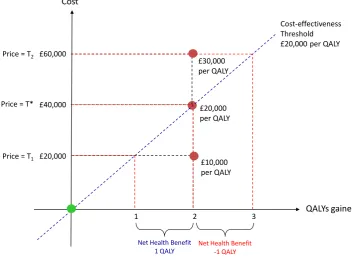
[image:9.595.115.468.325.585.2]The concept of value and its relationship to price and cost-effectiveness is illustrated in Figure 1.7 The new technology offers a gain of two units of health outcome, here expressed as quality adjusted life years (QALYs), at an additional cost to the NHS of £20,000 (an incremental cost-effectiveness ratio of £10,000 per QALY gained). The key question is whether the expected gain of 2 QALYs from this innovation is greater than the health outcomes (in QALYs) forgone elsewhere due to other NHS treatments being displaced by the additional cost.
Figure 1 Value, price and cost-effectiveness (adapted from Claxton et al.7)
If the transaction price is set at T1 then the additional NHS costs of £20,000 will be expected to
displace 1 QALY elsewhere, based on the lower range for cost-effectiveness threshold adopted by NICE (see Section 3.6.3). Therefore, at a price of T1, the technology offers net health benefits to the
NHS (it is expected to be cost-effective). At higher prices more health will be displaced elsewhere, and when price is equal to T* the expected gains in health outcome are just offset by the health expected to be forgone by the higher NHS costs (£40,000). At this point, there are no net health benefits to the NHS, so T* represents the maximum transaction price the NHS can afford to pay for the benefits offered by this technology. T* represents the value (benefit) based price so, if the NHS was to pay more than T*, e.g., T2, the technology would damage overall health outcomes because the
health expected to be forgone as a consequence of the higher costs (£60,000) would exceed the health expected to be gained.
£20,000 per QALY £40,000
Price = T*
Cost-effectiveness Threshold £20,000 per QALY
QALYs gained Cost
£60,000
£30,000 per QALY Price = T2
3 £20,000
2 £10,000 per QALY Price = T1
1
Net Health Benefit 1 QALY
Since manufacturers already have an incentive to price their products to the point where net benefits are zero (at T*), with a single indication and no identified subgroups all the value of the innovation will be appropriated by the manufacturer through the sales revenue they receive (the total value of the innovation to the NHS for the volumes associated with the indication (Q*) is T*.Q* and all of this value is appropriated by the manufacturer in the form of revenue). The NHS has no incentive for early uptake of the technology and, in the short run at least, ought to be indifferent between early access and delaying until patent expires and cheaper generics enter the market (see Figure 3)a.
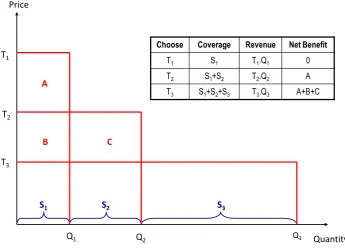
[image:10.595.135.481.343.595.2]If there are multiple indications and/or subgroups within a single indication an ‘average’ value-based price, which would make the technology just cost-effective ‘on average’ over the relevant indications and subgroups, would allow all value to be appropriated by the manufacturer (it would be equivalent to price discrimination). Some share of value will accrue to the NHS (providing an incentive for early uptake) if the rules of VBP are reflective of other markets in other sectors which are also protected by patent. Elsewhere temporary monopolies (created by patent protection) can freely select their price but have to be mindful of the implications that a higher price will have on sales. Applied to pharmaceuticals, manufacturers may choose a high price but they must then accept lower sales volumes. Alternatively, if they choose a lower price which provides unrestricted coverage across all indications and subgroups (where there are zero net benefits for the marginal indication or subgroup), there ought to be some positive net benefit for some patient groups. In other words, the value of the innovation is shared to some extent during patient protection just like in other markets.7-8 This principle of ‘marginal’ value-based pricing is illustrated in Figure 2 where the technology is most cost-effective for subgroup S1 and least cost-effective for subgroup S3.
Figure 2 A menu of price and volume (adapted from Claxton et al8)
The assessment of expected costs and effects across indications and/or subgroups essentially presents the collective NHS demand curve to the manufacturer. Just as a temporary monopolist in other markets may chose where to locate, pharmaceutical manufacturers may choose from the menu of price (Ti) and associated coverage (Qi). For example, if they were to choose T1 their sales volume
would be restricted to Q1 (revenue of T1.Q1). Alternatively choosing a price of T3 would be associated
with Q3 of sales across all the subgroups of indications (S1 to S3 with, in this case, higher revenue of
a
Once a drug has been developed, the longer term benefits which follow generic entry (see Figure 3) will be realised whether or not the NHS purchases the more expensive brand. However, in the longer run such a policy would undermine incentives for development of future drugs which will also offer net benefits on patent expiry, although the adverse impact on dynamic efficiency for the NHS depends in part on the UKs share of the world market.
Price
T1
Quantity T2
T3
Q1 Q2 Q3
S1 S2 S3
Choose Coverage Revenue Net Benefit
T1 S1 T1.Q1 0
T2 S1+S2 T2.Q2 A
T3 S1+S2+S3 T3.Q3 A+B+C A
T3.Q3). The NHS would receive some share of the total value with net benefits of A+B in S1 and C in
S2 (T3 is the VBP for S3, the marginal subgroup). Setting aside the marginal production costs,
manufacturers have an incentive to maximise revenue (located at unit price elasticity) which in Figure 2 is at T3,Q3. However, this need not be the case depending on how subgroups are defined and how
cost-effectiveness and coverage changes across subgroups. It should be noted that a choice of T1,Q1 is no worse, for the NHS as a whole, than an ‘average’ value-based price which would make the technology just cost-effective ‘on average’ over Q3 (also equivalent to price discrimination, i.e., T1 for
S1, T2 for S2 and T3 for S3). In both cases the net health benefits to the NHS will be zero. The only
difference between these outcomes is the way health gains and health losses are distributed. Clearly manufacturers will have a strong incentive not to identify any subgroups since the ‘average’ VBP will allow them to appropriate all the value.
Sometimes other mutually beneficial ‘deals’ could in principle be done, e.g., a manufacturer who would otherwise choose T1, Q1 may be willing to agree to price greater than T3 for Q3, which would
still offer net health benefits to the NHS while increasing their revenue. Such ‘deals’ are not available to temporary monopolists in other types of market as they depend on negotiation with a monopsony purchaser. Although such beneficial deals are possible, they must be balanced against the potential adverse outcomes once the principle of transparent rules mirroring other markets is conceded. Firstly, there will be a danger that the monopsonist may start to exploit its power, forcing down prices below T3 by offering all or nothing deals to manufacturers and undermining patent protection. Even
the possibility of this type of outcome now or in the future will undermine confidence that investment returns can be realised, making research and development more costly. Secondly, there may be a danger that those negotiating on behalf of the NHS could be ‘captured’ by the manufacturer especially when ‘deals’ are possible rather than following simple and transparent rules for which accountability and redress is possible (see Section 3.6.4). Thirdly, it is not at all clear that the monopsonist will have the upper hand in such negotiation if the level of transparency and accountability expected of public bodies is greater than that expected of manufacturers. This seems especially problematic when there is inevitable political pressure to provide NHS access to a technology, i.e., negotiators may be susceptible to all or nothing deals from manufacturers which damage the NHS (e.g., T1, Q3). Finally,
if there is a proper analysis of subgroups within the relevant indications,9 it is very unlikely that high price and low coverage options will be revenue maximising (as long as list prices are preserved – see Section 3.1) . However, if ‘deals’ are possible, T1,Q1 is very likely to be taken as a negotiating starting
point by manufacturers even if it does not represent their revenue maximising position. For all these reasons simple and transparent rules that mirror other markets (a choice of ‘marginal’ value-based prices and associated volumes) should be regarded as the most appropriate basis for VBP. This balances the interests of all sides (including other sectors which compete for government support, public money and private capital) and offers clear, accountable and predictable signals with the possibility of redress.
2.2 The future value of a product
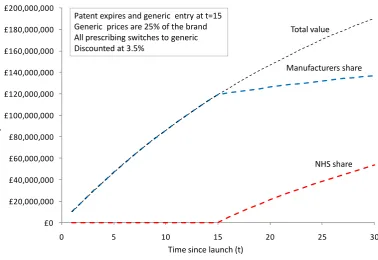
A key issue with VBP is whether the concept of value fully reflects the benefits to health systems in the longer term.7-8 10-11 Even where there are no net benefits during patent protection, in the longer run, if cheaper generics become available, following patent expiry then the health care system may ultimately benefit. This requires certain conditions to be satisfied – most importantly, that the generic market remains competitive and that the prices of future newly patented drugs reflect their value when compared to the cheaper generic versions of the old brand and, if they do not, then all prescribing switches to the generic version of the old brand. If any of these conditions are not met, the heath care system, as a whole, may never benefit from innovation and the low net benefits observed in the short term will be realised in the longer run as well. However, even when these conditions are met the private sector may still retain a significant proportion of value in the long run.11
version of the old, then the health care system will begin to benefit from the innovation and start to share some of the value of the innovation with the manufacturer. However, the manufacturer will still retain most of the value even in the long run. In this example, at 30 years the manufacturer appropriates 72% of the value and even at an unbounded time horizon (i.e. assuming that the innovation is forever relevant) it still retains 57%. Of course, the manufacturer's share will be higher (and the NHS share lower) if any of the three assumptions above do not hold and none can be taken for granted.
Figure 3 Sharing value over time
Any system of pricing and reimbursement should not undermine the protection offered by patents by exploiting the monopsony power of collective purchasing. The current system does not do so nor do the proposals for VBP: both provide manufacturers with an incentive, and the freedom, to price their products up to the point where net benefits are zero. The NHS will start to share the value of the innovation with the manufacturer following patent expiry, but should this potential future value also be transferred to the manufacturer? This would mean incurring negative net benefits during patent protection which may only be recovered later if the three assumptions described above hold. For the NHS this would be worse than indefinitely extending patents (that would assure zero rather than negative net benefits). It is also unlikely to be efficient since the health care system and other parts of the public sector contribute directly and indirectly to innovation through, for example, the infrastructure of basic science and clinical research, so should share the rewards to align investment incentives appropriately. Finally there are legitimate questions of social value: how the value of innovation should be shared across society (NHS, the pharmaceutical and other sectors for the economy) and between NHS patients, UK citizens and manufacturers and their shareholders often located outside the UK.
Value-based pricing aligns returns in the UK with NHS needs (with some, albeit limited influence on global investment decisions) as long as the measure of benefit captures those aspects of outcome that are socially valuable (see Sections 4.2, 4.3 and 4.4) and an assessment of what is likely to be displaced is empirically based (see Section 3.6.3). Nevertheless, it is beyond dispute that some innovations today will provide the basis for subsequent innovations which may be even more valuable in the future. The question is who should anticipate the benefits of the possibilities of further innovation and when should the NHS pay for them (see Section 4.1).
£0 £20,000,000 £40,000,000 £60,000,000 £80,000,000 £100,000,000 £120,000,000 £140,000,000 £160,000,000 £180,000,000 £200,000,000
0 5 10 15 20 25 30
C u m u la ti ve p re se n t v al u e a t t
Time since launch (t)
Total value Manufacturers share
NHS share Patent expires and generic entry at t=15
[image:12.595.90.469.208.468.2]3. Value-based pricing in a devolved NHS
Although currently there is little detail about how VBP will work in the NHS, more details have emerged about the future role of NICE. Importantly, from 2014, not only will NICE guidance no longer be mandatory, it will no longer issue guidance about whether or not a technology is or is not cost-effective or whether it is recommended for NHS use.12 Taken in isolation this announcement appears, at first sight, to be a significant step back from evidence based policy in the NHS. However, the Government has also made clear that VBP, based on NICE appraisal, will be introduced at the same time.12 If successful, VBP could well mean that the type of mandatory guidance issued by NICE based on prices offered by manufacturers will become unnecessary. However, the success of a VBP scheme for a newly devolved NHS depends critically on details of the type of scheme envisaged and of how it might be implemented.
3.1 An effective vehicle for price rebates?
A substantial segment of the world market references UK drug prices (estimated at 25% by OFT12). Therefore, manufacturers will typically be unwilling to lower their list price in the UK to match a VBP relevant to the NHS. Over recent years there has been an increase in patient access schemes offered by manufacturers during the NICE appraisal process.13 These schemes essentially offer a discount to the NHS whilst maintaining a product's list price. This is achieved by defining a marker of clinical success which has to be achieved in each patient in order for the full list price to be paid. However, such schemes are already costly to administer, and there is evidence that the discounts offered are not always recovered by the NHS.14 Such schemes are unlikely to provide an effective vehicle for administering VBPs after 2014 when the scheme will apply to all new drugs.
A more effective and less costly mechanism would be to use the current PPRS mechanism to recoup any discrepancy between the list and the VBP. For example, where the value-based or transaction price (T*) was less than the list price (L), manufacturers would be asked to agree to pay the rebate (L-T*) through the PPRS. The rebate might be paid directly or recovered through price cuts (with 'modulation' where companies have flexibility in deciding which products have prices reduced) for those drugs not subject to VBP. This mechanism has a number of advantages. Firstly, it removes the administrative burden of patient access schemes from the local NHS. Secondly, it allows manufacturers to maintain their list price which means they can isolate the effect of VBP from international referencing and be more likely to agree to such rebates. Finally, manufacturers retain freedom to set list prices and might also retain freedom to modulate the price of other products not covered by VBP.
3.2 Incentives for NHS prescribers
It is important that any VBP scheme aligns incentives for local prescribing, especially in the absence of mandatory NICE guidance after 2014. This will require the DH to hold back that part of drug expenditure which will be covered by value-based pricing and allocate L or T* to local prescribers based on use and whether or not a rebate agreement with a manufacturer is in place. This should not be regarded as an administrative budget for pharmaceuticals but rather an allocation mechanism from DH to local prescribers based on value. Some assessment will be required of likely expenditure to ensure that DH retains sufficient resources to reimburse local prescribers.
For example, those drugs included in the VBP scheme and for which there is an agreed value-based rebate, the DH could reimburse NHS prescribers at the list price in the knowledge that they will recover the difference from the manufacturer through the agreed rebate. Importantly, NHS prescribers would retain an incentive to negotiate local discounts (d) on the list price. Hence incentives are aligned: NHS prescribers will pay L-d, but receive L from the DH; DH will pay L to prescribers but receive a rebate of L-T* from the manufacturers; and manufacturers will receive L-d but pay a rebate of L-T* to the DH. Alternatively, DH could only reimburse local prescribers the difference between list price and value (L-T*)b. The difficulty is that this type of reimbursement would
b
reveal T*, which, given the implications of international reference pricing, would make manufacturers reluctant to agree rebates.
Where the list price is already below the VBP no rebate is necessary so manufacturers will receive L-d from prescribers anL-d DH will pay L to prescribers. Any local L-discounts achieveL-d (L-L-d) can be useL-d locally to provide other NHS care.
It is possible that, for particular products, manufacturers will not be willing to agree to a value-based rebate of (L-T*). This is much more likely if they believe that local prescribers will be willing to pay L anyway. Therefore, it is important that VBP is used to align incentives for prescribers which, in turn, will provide an incentive for manufacturers to agree to a rebate. This might be achieved by the DH not reimbursing prescribers when an agreement is not in place. In these circumstances incentives are also aligned: NHS prescribers will remain free to choose to purchase the drug. If the appraisal is reflective of the costs and benefits they face locally, they ought to be willing to pay up to T*. Therefore, they may nevertheless choose to prescribe if they can negotiate local discounts so that L-d=T*, or pay more than T* if they believe that there are greater than expected benefits for particular patients.c
This has a number of advantages. Firstly, it leaves prescribers free to negotiate local discounts and/or chose to prescribe because the value to a particular patient is believed to be higher than T*. Secondly, manufacturers have an incentive to agree a rebate since prescribing costs (L-d) will fall on local prescriber’s budgets. Local prescriber’s decisions may , however, be informed by the VBP that would have been acceptable to DH. This may provide an additional incentive for the manufacturer to agree rebates since failure to do so will reveal T*, with potential consequences in other markets through reference pricing. If an agreement is in place, local prescribers do not need to know T* and what rebate was agreed between manufacturers and the DH. Whether a scheme which retains transparency and accountability can also effectively withhold the information which would allow T* to be derived when an agreement is made is discussed in Section 3.6.4.
Rebate agreements alone, however, would incentivise over prescribing of those products where an agreement is in place, putting the NHS at risk of unjustified growth in expenditure on branded pharmaceuticals. Since any VBP relates to particular indications and or subgroups (see Figure 2), any rebate also needs to be linked to volumes associated with the agreed T*.
3.3 Value-based rebate with volume agreements
To establish accountability and to give clear and predictable signals to manufacturers, it is important that price ‘negotiation’ avoids undermining incentives. On the one hand, the process needs to ensure that incentives for innovation on the part of manufacturers are preserved by avoiding the NHS exploiting or appearing to exploit its monopsony power. On the other hand, manufacturers should not be permitted to appropriate all the value of new products through either price discrimination (that is, agreeing a different T for each indication and sub-group - see Figure 2) or all or nothing deals (see Section 2.1). To achieve this balance, it is important to have transparent rules which mirror markets in other sectors where innovation is also protected by patent. In other markets the temporary monopoly created by patent protection may choose where to locate on the market demand curve.
Any VBP will relate to a particular indication, groups of indications or particular patient subgroups within an indication. Where there are a number of subgroups and/or indications, the NHS demand curve is represented by the combinations of evidence based Ti and associated Qi (see Figure 2). The
manufacturer should be free to choose from this menu, i.e., they may choose a higher Ti but
associated with a narrower indication/subgroup and, therefore, a lower volume, Qi, associated with it.
Therefore, for each drug once a value-based rebate is agreed there would be a single T*, Q* chosen from the available Ti,Qi combinations available.
Mandating that prescribing be restricted to the indication(s)/subgroup(s) associated with the particular T* included in the agreed rebate would seem to undermine the principles of a more devolved NHS, where NICE guidance informs rather than determines which drugs should be used and for which
c
particular types of patients. However, since prescribers will be reimbursed at list price, there is a danger of over prescribing as there would be no incentive to restrict their prescribing to the indications and subgroups (Q*) associated with the agreed T*. This would place the NHS and DH at considerable risk of unjustified growth in prescribing expenditure for indications not covered by the rebate agreement where T* exceeds the value in these groups. There are broadly two responses to this problem.
The first is that reimbursement could be made conditional on the prescriber demonstrating that it was for the indication(s) and subgroup(s) covered by the agreement. The costs of prescribing beyond the coverage of the rebate would not be reimbursed and fall on prescribers' budgets. There are number of ways in which the administrative burden of such conditions might be reduced. For example, reimbursement from DH could be paid periodically based on routinely collected information about the number of patients treated which fall under the rebate agreement, i.e., the prescriber will be reimbursed at L up to the Q* relevant to their local patient population (if the subtleties of distinctions between subgroups are not routinely recorded, the Q* for the local prescriber might be based on national estimates of the proportion of the indication accounted for by relevant sub group). However, there are a number of alternative ways in which the rebate paid can be restricted to Q* without recourse to imposing mandatory guidance on local prescribers - a new role for the Healthcare Commission is one of many possibilities.
Alternatively (or in addition), a value-based rebate agreement could also include a volume agreement at a national level, where, for volumes up to Q*, a rebate of L-T* is paid. However, for volumes greater than Q* a greater rebate will be required because T* (what the DH ultimately pays) will exceed the value to the NHS. Any volume agreement should not place the manufacture at risk of incurring costs when they cannot directly control the volume of NHS prescribing. This could be achieved by setting the rebate for volumes greater than Q* as the difference between list price and the marginal production costs (C). Prescribing beyond Q* will not impose costs on the manufacturer since sales revenue will cover their costs. It may impose costs on the NHS if the value of the drug beyond Q* is less than C but then it is appropriately the responsibility of the NHS to ensure that prescribing is focused on the most valuable indications and subgroups (informed by NICE guidance and/or making reimbursement by DH conditional as discussed above). Of course, the marginal production costs of a new product are unlikely to be revealed by manufacturers, even if they have that information available. However, such costs are revealed by a competitive generics market. Therefore C and the greater rebate beyond Q* can be based on generic prices for comparable types of drugs. This arrangement has a number of advantages:
The DH is not put at risk of significant increases in expenditure due to over prescribing where a value-based rebate is in place.
The small risk pool of some local prescribers will not place them at financial risk and deter uptake when an agreement is in place for drugs with high list prices (the DH essentially pools this risk centrally).
The speed of uptake of new drugs with high acquisition costs but where a value-based rebate is in place would be expected to increase with claimed positive spin offs, e.g. incentives for manufacturers to launch in the UK and an improved research environment within the NHS. Manufacturers are not put at risk of incurring net costs as a consequence of NHS prescribing above Q*.
The costs to the DH and the revenue to manufacturers becomes more predictable than is currently the case where there is no VBP or Q* agreed.
There is little incentive for manufacturers to devote resources to marketing beyond the indication(s) and/or subgroup(s) associated with the agreed T*.
Manufacturers when offered the choice between higher Ti but with a lower Qi, or lower Ti but
with wider coverage of the agreement (a higher Qi) are more likely to choose the latter if
there is no strategic or financial advantage of agreeing a higher Ti but then hoping to market
beyond the associated Qi.
The type of appraisal conducted by NICE, which would inform value-based prices, also informs the assessment of Qi for each Ti that might be agreed, based on evidence relevant to
the NHS. This would provide some transparency and accountability in the assessment of both Ti and Qi which, with current consultation rights in the NICE process as well as redress
through appeals and judicial review, would provide a reassurance to manufacturers that both the Tis and Qis on offer are an evidence based expression of the NHS demand curve for their
products. Importantly, they would also be to a large extent predictable, providing a clear signal of likely returns for those making investment decisions in drug development.
Whether a national rebate-volume agreement would itself be sufficient, or whether incurring the additional costs of monitoring and/or establishing local volumes for conditional reimbursement would be appropriate might be established case by case. Clearly, where there is a large discrepancy between L and T* and where the agreed Q* is associated with only a small subset of all the patients who may benefit from the drug, then the latter is more likely to be worthwhile.
3.4 Reducing postcode prescribing
Postcode prescribing can be defined as geographical variation in access to NHS treatments for patients who are similar in terms of the characteristics which are relevant to the expected costs and benefits of those treatments. The existence of such variation may be regarded as unjust in a collectively funded national health care system. One fundamental problem has been that the way resources are allocated to localities has not necessarily reflected the local resource implications of national guidance issued by organisations such as NICE. NICE guidance issued through the Technology Appraisal (TA) Programme has been mandatory since 2001. The mandatory nature of this guidance should, in principle at least, have reduced variation in access to those drugs subject to TA guidance. The problem is that access to other health care, including other drugs, must be restricted to accommodate the additional NHS costs of such guidance. Therefore, reducing postcode prescribing for part of NHS prescribing can only increase geographic variations in access to other care not covered by such guidance. This unintended consequence of mandatory guidance is inevitable if resource allocation does not precisely match the costs of such guidance for local patient populations.
The type of value-based rebate scheme described above would to, some extent, overcome this problem since resources would flow from DH to localities based on the value of using particular drugs for agreed indication(s) and/or subgroups. Where a value-based rebate agreement is in place there seems little reason why geographic variation in access should persist even without mandatory national guidance. But more importantly, and unlike mandatory guidance, this will not lead to geographic variations in displaced health care as long as local prescribers are reimbursed by DH at the list price. However, when a value-based rebate is not agreed some variation in use would be expected, partly reflecting different assessments of value for particular patients, but also variations in local efficiency as well as the possibility that the allocation of the greater part of NHS resources may not fully reflect the local cost of providing access to the same care given the mix of the local patient population.
3.5 Implications for NHS costs
The DH could accept initially higher NHS costs as the coverage of VBP expands from 2014 due to the lag before agreed rebates are received, i.e., NHS initially pays L but receives L-T* in the following period. Alternatively the agreement could include provisions for ‘payment on account’ in the first year based on L-T* and an estimate of the likely volume (Q*) associated with the indication for which T* was estimated. In the following year a ‘balancing payment’ based on actual volumes could be made.
large NHS expenditures) as well as new technologies. This could be used to ensure the scheme is cost neutral after the first year.
There may be circumstances when L<T*, in which case no value-based rebate agreement would be needed. However, in these circumstances, manufacturers will have a strong incentive to increase list prices so that L=T, increasing NHS costs. Therefore, including some existing drugs in the VBP scheme could also be used to offset the cost implications of these incentives.
3.6 Role of NICE
Existing methods1 and processes15-16 can already establish value-based prices of technologies. However, there are some critical issues which, if not properly addressed, could mean that VBP does more harm than good: increasing NHS costs and reducing overall health outcomes as expensive new technologies displace more valuable NHS activities. Maintaining the independence and robustness of evidence based methods of appraisal developed by NICE is fundamental. However, four other considerations are particularly critical for the success of VBP.
3.6.1 NICE appraisal process
Through its methods of appraisal and the process of deliberation by its advisory committees, NICE issues guidance on whether technologies represent a cost-effective use of NHS resources based on the list prices offered by manufacturers at launch. Therefore, NICE appraisal can already establish the price at which a technology could be regarded as cost-effective and of value to the NHS. In other words, NICE has been undertaking the fundamental aspects of appraisal required to establish evidence based assessment of value since its inception. The restriction has been that NICE is unable to negotiate prices with manufacturers. Nevertheless, over recent years it has become increasingly common for manufacturers to offer patient access schemes (PAS) either before or, more commonly, during the NICE appraisal process when it is apparent that the technology is unlikely to be regarded as cost-effective at the list price. In some ways the increased use of patient access schemes, which effectively offer different forms of discount to the NHS but without formally changing the list price,13 has been a form of de facto value-based pricingd.
The appraisal process also commonly considers the cost-effectiveness of the technology, not just for the whole indication under consideration, but also for subgroups within the indication. Therefore, the current appraisal process is already capable of establishing the combinations of values (Tis) and
coverage levels (Qis) from which the manufacturer can choose T*,Q*. However, in the past, NICE
has tended to explore subgroups only when the technology would not be considered cost-effective for the whole indication at the list price. What should be apparent is that, once value-based rebates are possible, NICE should always explore subgroups so that manufacturers can always be offered the choice of value-based prices with the associated coverage levels.
This is important because it mirrors other markets similarly protected by patents where the temporary monopolist selects where to locate on the market demand curve for their product. It is also important for the NHS because, just like other markets, it means that value is more appropriately shared between the NHS and manufacturers during patent protection. A failure to explore subgroups and to offer a menu of prices and coverage levels to manufacturers will mean that, at a VBP for the whole indication, the additional health benefits offered by the technology will just be offset by the health expected to be forgone elsewhere in the NHS due to the additional costs. All value will be appropriated by manufacturers and new technologies will not improve health outcomes overall. Indeed, it would be equivalent to allowing perfect price discrimination (see Section 2.1). In other markets, with the exception of natural monopolies, the temporary monopoly offered by patent is regarded as sufficient.
The exact role NICE will undertake remains to be determined. It may supply an assessment of expected health benefit and expected costs to a pricing authority which will translate this into a menu
d
of VBPs and coverage levels (Ti,Qi) using an empirically based assessment of the cost-effectiveness
threshold for the NHS (see Section 3.6.3). Alternatively, NICE may apply the cost-effectiveness threshold to the results of its appraisal and then supply the combinations of Ti,Qi to the body negotiating value-based rebate agreements. What is critical is that, whichever organisation uses it, the cost-effectiveness threshold is empirically based and estimated and applied in a transparent and, therefore, accountable way (see Section 3.6.3). Without this, the clarity and predictability of the signal provided by VBP will be undermined, thus negating the dynamic benefits. Failure to use an appropriate and empirically based threshold would, on one hand, introduce additional uncertainty into investment decisions for manufacturers and a fear that monopsony power will be exploited now or in the future. On the other hand, the NHS and wider public might fear that limited NHS resources, expected to be employed to provide health care, are in fact being used to provide a hidden and unwarranted subsidy to a particular sector of the economy. This is a particular danger (in reality or appearance) and especially in hard pressed times when the spending department responsible for representing the NHS as a consumer of drugs (the DH in negotiating the value-based rebates) still has the necessarily conflicting responsibility of representing the longer term interest of the pharmaceutical sector in the UK. The latter responsibility would surely be more appropriately allocated to the Department of Business, Innovation and Skills as is the case in most other sectors which are also legitimately competing for the support of government and public expenditure to ensure their longer term interests.
3.6.2 Scope and reappraisal
NICE considers new technologies at launch under the Single Technology Appraisal (STA) process, where the appraisal is primarily based on a submission from the manufacturer which is reviewed by an independent Evidence Review Group (ERG). All NICE guidance also includes a date at which the guidance will be reviewed and if, at that time, there are sufficient changes to the evidence base or other relevant technologies then, commonly, all the technologies available for the indication are reappraised under the Multiple Technology Appraisal (MTA) process, where an independent Technology Appraisal Review (TAR) group develops an analysis of the whole area taking account of submissions from manufacturers and other stakeholders. This process of an initial STA followed by later MTA matches the proposals made by OFT of what they termed an ex-ante assessment at launch followed by ex-post assessment some time later (5 years suggested by OFT).4
The initial assessment of Ti, Qi could be undertaken as part of the existing STA process if methods and process were strengthened in some respects. For example, it would require either a greater role for the ERG in revising manufacturers' submissions to provide acceptable estimates of Ti,Qi, or more iterations with manufacturers so that their analysis reflects the social and scientific judgments of the appraisal committees, and routinely exploring subgroups (see Section 3.6.4).
3.6.3 Evidence based cost-effectiveness threshold
An assessment of whether the health expected to be gained from the use of a new technology exceeds the health likely to be forgone elsewhere is critical for decisions currently made by NICE and is fundamental to establishing value-based prices/rebates. This requires an estimate of the health that is expected to be forgone, on average across the NHS, as other activities are displaced to accommodate the additional costs of new technologies. The cost-effectiveness threshold range currently used by NICE (£20,000 to £30,000 per QALY gained) is intended to represent precisely that. However, it is widely recognised that this informal assessment has limited empirical basis and that more robust estimation of the NHS threshold is urgently required. The Methodology Research Programme funded by the National Institute for Health Research and Medical Research Council has funded research to establish appropriate methods to estimate the NHS threshold based on routinely available sources of data. This research extends earlier econometric analysis17-18 which utilised NHS programme budget data and mortality data for different programmes of care to estimate the relationships between programme expenditures and health outcomes. The results of this initial work are summarised in Table 1.
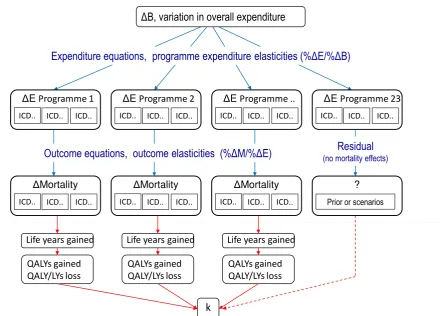
[image:19.595.76.480.435.487.2]This analysis is being extended in a number of ways by the current research. Firstly, it will estimate these relationships for more programmes of care to cover a greater proportion of overall NHS expenditure. Secondly, the relationship between changes in the overall NHS budget and expenditure by individual programmes will be estimated which will provide a key link to the estimate of the NHS threshold. Thirdly, routinely available mortality data will be more robustly translated into estimates of life years and QALYs gained for each programme to reflect better the impact of expenditure on morbidity as well as mortality. In addition, this work will characterise the uncertainty in any estimation. It will also exploit recently available panel data to explore how the threshold is expected to change over time and examine how the threshold changes with the sign and scale of changes in expenditure. The structure of this research and how each element combines to provide an estimate of the NHS threshold (k) is illustrated in Figure 4. Initial estimates are due to be presented in Spring 2011 and the final report is due in summer 2012, in time to inform VBP in 2014.
Table 1 The relationship between programme expenditure and life-years gained18
The empirical basis of the cost-effectiveness threshold will also need to be re-assessed over time, but with whom should this responsibility rest? It should be apparent that the type of threshold required is not a social value judgement about the value of health, but a scientific question about the current productivity of the NHS, i.e., the relationship between changes in expenditure and outcome. Therefore, the threshold is not something that NICE can choose or that can be negotiated between Ministers, DH and manufacturers. Nor can the value of an estimated threshold be raised (or lowered) to reflect the social value of different types of health improvement. If there are other values or weights to be applied to health benefits then they must also be applied to the type of health likely to be forgone when estimating the threshold, i.e., each alternative set of value implies a different but single threshold for VBP (see Section 4.2). It is important that the threshold used to generate the menu of Ti, Qi is known and that the methods and data for its estimation are open to scrutiny. Indeed, the
threshold ought to be based on the best available evidence and most appropriate methods. This, however, will require scientific value judgements which might best be made independently of DH, NICE or manufacturers. Periodic reassessment of the threshold, based on agreed methods and data, will provide some predictability for manufacturers making longer term investment whilst reflecting changes in overall NHS expenditure and productivity.
Cancer Circulation Respiratory Gastro-int Diabetes
04/05 Cost per LY £13,137 £7,979
Figure 4 Estimating the threshold for the UK NHS
3.6.4 Transparency, accountability and redress
It is critical that a VBP scheme offers transparency and the opportunity for accountability and ultimately redress. However, for based rebates to be agreed it is also important that the value-based transaction price T* is not revealed in a way which would impact on reference pricing in other countries. If it is, then manufacturers will be unlikely to agree to value-based rebatese. There are three discrete tasks which must be undertaken and each may require different levels of transparency and routes of accountability and redress. These tasks include: i) an assessment of the costs and benefits of a new technology for each indication and identifiable subgroup within an indication; ii) applying an evidence based threshold to turn these estimates of costs and benefits into a menu of TiQi combinations; and iii) negotiating the agreed T*, Q* from this menu ensuring that the rebate (L-T* up to Q* and L-C for volumes greater than Q*) are recovered.
The first task is already undertaken by NICE with unprecedented levels of transparency, consultation, rights of appeal and ultimately redress through judicial review. Maintaining the transparency and accountability of this task seems crucial for all sides and there seems little to be gained by making it less so (it does not reveal the particular T* for reference pricing). The third task cannot be undertaken by NICE (without primary legislation) but by DH. This separation of duties might also be appropriate as it clearly distinguishes these tasks and reduces the potential conflict between making a balanced assessment of what current evidence suggests might be the costs and benefits of a product, from what price the NHS will actually pay. It seems that this final task need not have the same level of public transparency as the first as long as the process (a set of rules which mirror other markets) is well specified. If they are, then accountability and redress can be achieved with a suitable appeal
e
If the VBPs for the NHS are expected to be lower than transaction prices likely to be agreed in other jurisdictions which reference UK prices, then the UK NHS will benefit from helping to facilitate such international price discrimination by making any agreed T* more difficult to reference.
E Programme 23
ICD.. ICD.. ICD..
Residual
(no mortality effects)
?
Prior or scenarios
B, variation in overall expenditure
Expenditure equations, programme expenditure elasticities (% E/% B)
E Programme ..
ICD.. ICD.. ICD..
Mortality
ICD.. ICD.. ICD..
E Programme 1
ICD.. ICD.. ICD..
E Programme 2
ICD.. ICD.. ICD..
Mortality
ICD.. ICD.. ICD..
Mortality
ICD.. ICD.. ICD..
Outcome equations, outcome elasticities (% M/% E)
k
Life years gained
QALYs gained QALY/LYs loss
Life years gained
QALYs gained QALY/LYs loss
Life years gained
[image:20.595.79.521.92.408.2]process which might use similar methods to handle commercial in confidence (CIC) information as existing NICE appraisal. Ultimately access to judicial review can establish whether the rules have been followed without making CIC information public.
The second task requires the application of an empirically based threshold to provide the menu of Ti,
Qi. It is critical that the threshold used is known and that the methods and data for its estimation are
open to scrutiny. Indeed, the threshold ought to be based on the best available evidence and most appropriate methods. This, however, will require scientific value judgements which might best be made independently of DH, NICE or manufacturers, i.e., an independent scientific threshold committee whose evidence, processes and deliberation should be transparent, accountable with routes for redress if its decisions appear perverse or its processes are not followed. Once estimates of costs and effects are established for each indication and subgroup, it is trivial to produce the menu of Tis based on an agreed threshold. However, additional evidence will be required to estimate the Qi
associated with each Ti. NICE appears best placed to undertake this second step which would be
conducted only after appraisal has been completed, i.e., Final Appraisal Document (FAD) issued and any appeal resolved. This second step may not require the same level of public transparency and consultation as the first so long as there is sufficient detail provided to make scrutiny of whether it has been done correctly possible and an assessment of whether the Qis are reasonable estimates. The
4. Other aspects of value
The principles of VBP outlined above can be implemented based on existing methods and process of appraisal adopted by NICE. Such a scheme would be wholly appropriate if the measure of benefit captures all important aspects of social value. However, there are four aspects of value discussed below which require further consideration.
4.1
A premium for innovation?
Although competing definitions of innovation are not particularly insightful, all make clear that it refers to new methods, ideas or products which are claimed to offer benefits over existing ones.19 In recent debates it seems more commonly invoked to support particular views of what ought to be given additional value or consideration when considering new patented products (pharmaceuticals and devices).20 It should be noted however, that there are other sources of innovation relevant to the NHS including new ways to deliver services as well as new surgical, diagnostic and other procedures.
The question of how to value innovation and how to ensure that there are sufficient incentives for private investment in the development of socially desirable innovations requires a clear view of the social value of a health technology, its relationship to price, and the incentives this provides for private sector investment decisions. These important issues are central to the principles of VBP (see Sections 2, 4.2 and 4.3) founded on the type of appraisal conducted by NICE in providing clear and predictable signals to the private sector of what is of value to the NHS.
The policy question is not whether innovation should be supported. Self evidently it should be and it is through patent protection, public investment in infrastructure and the research and development environment in the UK (including tax and other incentives). Any VBP scheme should not undermine the protection offered by patents which is why rules are required which mirror markets in other sectors also protected by patent i.e., a free choice of the Ti, Qi combinations so that the NHS cannot exploit
its monopsony power and manufacturers cannot price discriminate or claim more than the current value of the product. In these circumstances are there any reasons why the NHS ought to pay more that the current value of a product to encourage innovation?
4.1.1 Anticipating future benefits of innovation
It is beyond dispute that that some innovations today will provide the basis for subsequent innovations which may be even more valuable in the future. The question is who should anticipate the benefits (and associated returns) of the possibilities of further innovation and when should the customer (the NHS) pay for them? In other markets in other sectors, also protected by patent, it is the role of the private sector, supported by the Government’s industrial policy, to anticipate the benefits of further innovation and the future market returns which flow from better products when making investment decisions. No one suggests that consumers should be compelled to buy products (compulsion would indeed be required) merely to provide an additional incentive for future innovation!
In any case, the NHS is not best placed to anticipate future benefits: some products may and some may not offer future value, and even those that do, the investment required may not be the best use of private capital. Such assessment is appropriately the responsibility of the private sector because: i) it is best placed to anticipate the potential benefits and returns across global markets; ii) such returns must be compared to the cost they will commit during the development process; and iii) it is their decision (not the NHS') to risk private capital in such an endeavour. Those manufacturers that are better at making investment decisions based on anticipating and then delivering future benefits at lower development costs will succeed and those that are not will rightly fail.
incentives have been properly considered in the recent policy debate about premiums for innovation, it is reasonable to suspect that the NHS is actually being asked to pay twice for the same benefits, i.e., payment for current and future value now and then payment again for the same value if and when it is realised. If the NHS is not to pay twice, an innovation premium for particular products would be self defeating (dynamically inefficient): disincentivising the unknown innovators of the future. If the NHS is to pay twice for innovation then it would be both statically and dynamically inefficient: reducing health outcomes across the NHS as well as blunting incentives within the sector and encouraging overinvestment and higher costs compared to other sectors of the economy which do not receive such excessive rewards.
4.1.2 Incentives for innovation and location
It is, however, quite proper to be concerned whether the protection offered by patents is sufficient and whether the UK offers an environment in which research and development activities might be located. Indeed, a case could quite reasonably be made that some share of NHS resources as well as other public money might be devoted to this if the returns from such public investment are greater in this sector compared to others. In fact government already does this in a number of ways including using resources which could have been devoted to provision of health care. For example the investment in translation research following the Cooksey Report,21 as well as more fundamental science and biomedical research, can be viewed as an attempt to subsidise research and development and make the UK a more attractive location for such activities. However, the case for an innovations premium within a VBP scheme to achieve the same policy goals cannot logically be made.
It is not possible under EU law only to offer innovation premiums for products associated with manufacturers who locate in the UK. Therefore, if a premium is to be offered it must be offered irrespective of location. Although manufacturers would no doubt be grateful for this subsidy to their global research and development efforts, one presumes they will chose to invest it wherever offers the best environment. Since other countries compete for inward investment, those that devote similar resources to improving their environment, rather than offering a per product premium, will have the advantage. Therefore, a policy of innovation premiums will result in a perverse situation in which the NHS pays premiums for particular products only to find that the subsidy is invested in other countries which, quite sensibly, have devoted similar resources to improving the research and business environment instead. This is not to suggest that the pharmaceutical sector suffers from a lack of gratitude, or that innovation should not be supported through other more effective means, but simply an observation that the discipline of international capital markets means that incentives which are not excludable by location will not provide any incentive for inward investment. Innovation premiums are not excludable so cannot achieve the intended policy goals. In fact they make things worse as there will be less resource available to improve the research and business environment if they are paid; a policy imperative better aligned with the responsibilities of the Department of Business, Innovation and Skills.
4.1.3 Innovation and unmet need
The principle of VBP aligns the incentives for investment in research and development with NHS needs. Those manufacturers which develop products and present evidence that indicates they represent a ‘step change’ in treatment will achieve higher prices and greater returns since VBPs are based on an assessment of the expected benefits of the technology. Therefore, insofar as areas of unmet need also offer opportunities to develop technologies which offer significant improvements in treatment, VBP will provide a clear signal and incentive for such investment. Equally, insofar as innovation is incremental, each smaller step will be rewarded, although at lower premium prices reflecting smaller realised benefits; preserving rewards for future innovators (see Section 4.1.1).