NATIONAL INSTITUTE OF SIDDHA
Chennai – 47
THE TAMIL NADU DR. M.G.R. MEDICAL UNIVERSITY
,
CHENNAI - 32A STUDY ON
ATHISARAPITHAM
(DISSERTATION SUBJECT)
For the partial fulfillment of the
requirements to the Degree of
DOCTOR OF MEDICINE (SIDDHA)
BRANCH V – NOI NAADAL DEPARTMENT
2
Chapter No.
Contents Page no.
I II III IV V VI VII VIII Acknowledgement Introduction
1.1.Sukarana Nilai in Siddha System 1.2.Kukarana Nilai in Siddha System 1.3.Diagnostic Methodology
Aim and Objectives
Review of Literature - Siddha
1. Yugi Vaithiya Chinthamani 2. Survey of other Siddha literature
Pathological View of Dissertation Topic
Review of Modern Literature
Evaluation of Dissertation Topic 6.1. Materials and Methods 6.2. Observations and Results 6.3. Allied parameters
Discussion
Summary and Conclusion
3
A
4
ACKNOWLEDGEMENT
I express my sincere thanks to our Vice-chancellor, The Tamil Nadu
Dr. M. G. R. Medical University, Chennai.
I take this opportunity to express my gratitude and acknowledgement to
Dr. S. Boopathi Raj, M.D. (S)., Director, National Institute of Siddha, Chennai – 47 for giving me permission to utilize the facilities available in the college to complete my dissertation work.
I express my sincere thanks to Prof. Dr. Manickavasagam, M.D. (S). Dean, National Institute of
Siddha, Chennai.
I express my deep sense of gratitude, debtfulness, dignity and diligent salutations to
Prof. Dr. M. Logamanian, M.D. (S)., Ph .D, Head of the Department, Noi Naadal Hospital
Superindent, National Institute of Siddha, Chennai.
I take this opportunity to express my deep sense of gratitude, debtfulness, dignity
and diligent salutations to our Dr. S. K. Sasi M.D.(S)., former Head of the department,
Noi Naadal, National Institute of Siddha, Chennai - 47. Head of the department,
Department of Noi Naadal, Govt.Siddha medical college, Palayamkottai, for her
unstinted encouragement and most valuable guidance to undertake this dissertation
study. The moral strength which she provided me at odd times helped me reaching the
stars.
I express my whole hearted thanks to Dr. R. Neelavathy M.D. (S), Former
Lecturer, National Institute of Siddha, Chennai - 47, for her valuable guidance.
I express my sincere gratitude to Dr.A.Vasuki Devi, M.D. (S), FormerLecturer,
Department of Noi Naadal, National Institute of Siddha, Chennai -47, for her valuable
guidance.
I express my grateful thanks to Dr. S. Elansekaran M.D. (S), Lecturer
Department of Noi Naadal, National Institute of Siddha, for his moral support and
5
My deep sense of gratitude ness to Dr .G. J. Christian M.D.(S)., Lecturer,
Department of Noi Naadal, National Institute of Siddha, for his memorable support,
valuable suggestions and as well as encouragement carrying out this work
I express my sincere gratitude to Mr.P.Jayapal M. Sc., Asst. Professor, Bio- Statistics,
National Institute of Siddha, for his valuable guidance in statistical analyses.
I express my sincere thanks to Dr. Vijaya sathish kumar, M. D., Department of
Pathology, Govt. Medical College, Chengalpet for his valuable support during this work
I express my sincere thanks to Dr.Kalavaty Kamalkar Rao, CCRI,
Arumbakkam, for her valuable guidance and suggestions regarding this work.
I wish to thank Mrs. Maragatham M.Sc., (Bio-chemistry), Lecturer
in National institute of siddha, for her valuable support during this work.
I express my sincere thanks to , Dr.Saravana koodam M.D.(S) medical officer, National institute of
Siddha, for valuable support during this work.
I express my sincere gratitude to laboratory assistants, library staffs, staff nurses
of this institution for their kindly help through out the project work.
I am extremely grateful to the office, an all non - teaching and administration
staffs of this institution.
I express my gratitude to the libraryauthorities of Roja Muthiah Library CCRI, NIS, TN Dr.
MGR Medical University, and Kannimara Library for providing data and references for my work.
I wish to thank my beloved family members and friends for their selfless help
for this work.
Above all I express with whole hearted gratefulness to my beloved mother
Mrs. C. Rajeswari, who took pain to brought me up to this stage in my life. Although
6
I
7
INTRODUCTION
“ ÁÚôÀÐ ¯¼ø §¿¡ö ÁÕó¦¾É Ä¡Ìõ ÁÚôÀÐ ¯¼ø §¿¡ö ÁÕó¦¾É º¡Öõ
ÁÚôÀÐ þÉ¢ §¿¡ö Åá ¾¢Õì¸
ÁÚôÀÐ º¡¨Å ÁÕó¦¾É Ä¡§Á!"
The underlying concept of the Siddha system of Medicine is ‘to treat the
man as a whole and not merely the disease alone’.
Siddha System of Medicine, the Tamil traditional medicine practiced in
Tamil Nadu, is the oldest among the Indian Medical Systems such as Ayurveda
and Unani since its origin is suggested to be dates back to around 4,000 B.C.
Siddha System of Medicine is an integrated part of Indian System, which is
very potent and unique system when compared with traditional systems in
existence. The term ‘Siddha’ comes from the word ‘Siddhi’ which means
attainment of perfection.
Siddha System is propounded by eighteen Siddhars mainly and also
includes major contribution by other saints. The Siddhar were saintly figures.
Eighteen Siddhars glorified human being as the highest form of birth and believed
that to preserve human body is essential to achieve external bliss.
Siddha science is a well defined science which was originated in the
erstwhile Lemurian continent and followed to Dravidians, Thousands and
8
world. This system consists of four main branches, viz. Vatham, Maruthuvam,
Yogam and Gnanam.
Siddha system not only acts as curative and preventive effects on various
diseases but also paves the way for longevity and immortality. This system is
known for its complication free, simplicity, credibility, accessibility, curability
and food quality.
Siddha perhaps the earliest medical science which is vast and exemplary in
it principle, defines health as a harmonious blending of Physical, Psychological,
and Social and Spiritual well being of an individual. The system not only deals
with medicine, but with spirituality, righteous way of living, rejuvenation and its
main aim is the attainment of perfection.
Every system should have some fundamental principles of its own and as
such Siddha system of medicine too has its own doctrine of fundamental
principles known as ‘96 Thathuvams’ which is based on hypothetical logic of
natural law. This consists of Panchabootha theory, Thridosha theory, Andapinda
thathuvam. Acquaintance of thorough knowledge of these thathuvams is the basic
requirement for the fulfillment of treatment.This forms the main objective of this
9
S
10
1.1 SUKARANA NILAI IN SIDDHA MEDICINE
The five basic elements, namely Aagayam (Space), Kaal (Air), Thee
(Fire), Neer (Water), and Mann (Earth) are the building blocks of all the physical
and subtle bodies that existing in this whole universe. These are called as the
‘Fundamental Boothams’ (Basic Elements) (or) ‘Panchaboothams’
These five elements together constitute the human body and originate the
other worldly objects and are termed as ‘Pancheekaranam’ (Mutual Intra
Inclusion). None of these elements could act independently by themselves. They
could act only in co-ordination with other four elements. All the living creatures
and the non-living things are made up of these five basic elements.
cÈÔD √fiƒ Ø>D
" WÈD ¿Ïykπ s∑Dº√VÁ¶ÕmD ÔÈÕ>\B¬ ÔxÈÔD \V>o[ " º>Ô √fiƒ Ø>D
" >È∫ÔV‚Ω ÷Õ>fl ƒ¶\V™ nDØ>D WÈ∫ÔV‚Ω ¿Ï ÔV‚Ω W[§|Õ y ÔV‚Ω kÈ∫ÔV‚Ω kV•kV_ k·ÏÕº> ÷ÚÕ>m zÈ∫ÔV‚Ω kVM_ zΩBVF ÷ÚÕ>º>."
11
As per the above lines, the Universe and the human body are made of five
basic elements.
1.1.1
96 THATHUVAMS
(The 96 basic principles)
According to Siddha system of medicine, ‘Thathuvam’ is considered as a
science that deals with basic functions of the Human body. Siddhars described
96 principles as the basic constituents of Human body that include Physical,
Physiological, Psychological and Intellectual components of an individual.
These 96 Thathuvams are the once considered to be the cause and effect of our
physical and mental well-being. The Thathuvam is the first and foremost of the
conception, on which theory, the medicine is based on.
Bootham – 5 (Elements)
1. Aagayam - Space
2. Vaayu - Air
3. Thee - Fire
4. Neer - Water
12
Pori – 5(Sense organs)
1. Sevi (Ear) - a structural component of ‘Agahaya’ bootham
2. Thoal (Skin) - a structural component of ‘Vaayu’ bootham
3. Kan (Eye) - a structural component of ‘Thee’ bootham
4. Naakku (Tongue) - a structural component of ‘Neer’ bootham
5. Mookku (Nose) - a structural component of ‘Mann’ bootham
Pulan – 5(Functions of sense organs)
1. Kaetal - Hearing, a functional component of Aagayam bootham
2. Thoduthal - Touch, a functional component of Vaayu bootham
3. Paarthal - Vision, a functional component of Thee bootham
4. Suvaithal - Taste, a functional component of Neer bootham
5. Nugarthal - Smell, a functional component of Mann bootham
Kanmenthiriyam – 5 (Motor organs)
1. Vaai (Mouth) - Speech is executed by Space element
2. Kaal (Leg) - Walking takes place in concordance with Air element
3. Kai (Hands) - Giving/Taking are carried out by the influence of
Fire element
13
water element
5. Karuvaai (Sex Organs) - The Sexual acts are carried out in
association with earth element.
Karanam – 4(Intellectual faculties)
1. Manam - Thinking of a thing
2. Bhuddhi - Deep analyzing of the same thing
3. Agankaaram - Determination to do
4. Siddham - Accomplishment of the determined thing
Arivu – 1(Wisdom of self realization)
To analyze good and bad
Naadi – 1 (Channels of life force responsible for the dynamics of Pranan)
1. Idakalai - Starts from the right big toe, runs criss-cross to end in
left nostrils
2. Pinkalai - Starts from the left big toe, runs criss-cross to end at
the right nostrils
3. Suzhumunai - Starts from moolaathaaram and extends upto centre of
head
14
food and water
5. Purudan - Located in right eye.
6. Kanthari - Located in left eye.
7. Atthi - Located in right ear.
8. Allampudai - Located in left ear.
9. Sanguni - Located in genital organ
10. Gugu - Located in ano-rectal region
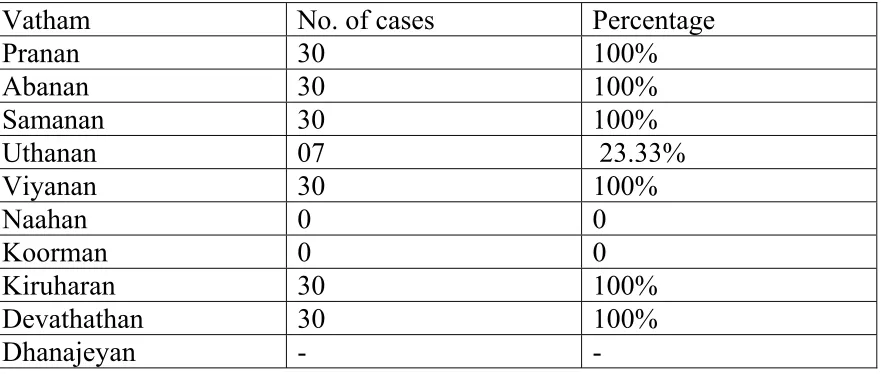
Vaayu – 10 (Vital nerve force which is responsible for all kinds of movement)
1. Uyir kaal (Praanan)
This is responsible for the respiration of the tissues,
controlling knowledge, mind and five sense organs and
digestion of the food taken in.
2. Keel nokku kaal (Abaanan)
It lies below the umbilicus. It is responsible for the downward /
onward expulsion of stools and urine, ejaculation of semen and
menstruation
3. Paravu kaal (viyanan)
This is responsible for the motor and sensory function of
the entire body and the distribution of nutrient to the various
15
4. Mael nokku kaal (Uthanan):
It originates from utharakini. It is responsible for digestion,
absorption, distribution of food. It is responsible for all the
upward movements.
5. Samaanan (nadu kaal)
This is responsible for the neutralization of the other 4 Valis
i.e. Piranan, abanan, viyanan and uthanan. More over it is
responsible for the nutrient and water balance of the body.
6. Naagan
It is responsible for the movements of the eyes
7. Koorman
It is responsible for the opening and closing of the eyelids
and vision. Also responsible for yawning.
8. Kirukaran
It is responsible for the salivation of the tongue and also
nasal secretion. Responsible for cough and sneezing and
16
9. Devathathan
This aggravates the emotional disturbances like anger, lust,
frustration etc. An emotional disturbances influence is to a
great extent the physiological activities to be responsible for
the emotional upsets.
10. Dhanancheyan
Expelled three days after the death by bursting out the
cranium
Asayam – 5(Visceral Cavities)
1. Amarvasayam (digestive organ) - Stomach.
It lodges the ingested food.
2. Pakirvasayam (absorption site) - Small intestine.
The digestion and assimilation of food, absorption of saaram
from the digested food are done here.
3. Malavasayam (Excretory organ) - Large Intestine, especially rectum,
The place where the expulsion of undigested food parts and
flatus is carried out.
4. Chalavasayam (Excretory organ) - Urinary Bladder, kidney.
17
5. Sukkilavasyam (Genital organs)
Site of formation and development of semen and ovum.
Kosam – 5 (Five Systems of the Human Body or Sheath)
1.Annamaya Kosam - Gastro intestinal system
2. Pranamaya Kosam - Respiratory system
3. Monomaya Kosam - Mental system
4. Vignanamaya Kosam - Nervous system and higher intellect
5. Ananthamaya Kosam - Reproductive system
Aatharam – 6 (Stations of Soul)
1. Moolatharam
Situated at the base of spinal column between genital organ
and anal orifice. Letter “{D” is stationed here.
2. Swathitanam
Located 2 fingerwidths above the Moolaathaaram, (i.e.)
between genital and navel region. Letter ""Â""î is inherent
18
3. Manipooragam
Located 8 fingerwidths above the Swathitanam, (i.e.) at the
navel center. Letter "\"is inherently present here. Element is
water.
4. Anakatham
Located 10 fingerwidths above Manipooragam, (i.e.) location
is heart. Letter found is ""E Element is fire.
5. Visuthi
Located 10 fingerwidths above the Anakatham (i.e.) located
in throat. Letter "k"î is inherently present. Element is Air.
6. Aakinai
Situated between the two eye brows. Letter"B" is inherently
19
Mandalam – 3 (Regions)
1. Thee Mandalam (Agni Mandalam)
Fire Zone, found 2 fingerwidths above the Moolaathaaram
2. Gnayiru Mandalam (Soorya Mandalam)
Solar zone, located 4 fingerwidths above the umbilicus.
3. Thingal Mandalam (Chandra Mandalam)
Lunar zone, located at the center of two eye brows
Malam – 3(Three impurities of the Soul)
1. Aanavam
This impurity masks the clarity of thought, discerning power
of the soul, yielding to the egocentric consciousness like ‘I’
and ‘Mine’. Considering everything to be his/her own
(Greediness).
2. Kanmam
Goes in collusion with the other two impurities and is
responsible for incurring Paavam (the Sin) and Punniyam
20
3. Mayai
Serve as an obstacle due to claiming ownership of the
property of others and thereby inviting troubles.
Thodam- 3(Three Humours)
1. Vali (Vatham) - a creative force, formed by combination of air and
space element
2. Azhal (Pitham) - a protective force, formed by Fire element
3. Iyyam (Kabam) - a destructive force, formed by combination of Earth
and Water element.
Eadanai -3 (Physical Bindings)
1. Porul Patru - Materialistic desires
2. Puthalvar Patru - Family affinity
3. Ulaga Patru - Worldly affections
Gunam – 3(Three Cosmic qualities)
1. Sathuvam (Characters of Renunciations or Ascetic Virtues)
Graces, control of senses, wisdom, penance, generosity, Excellence,
21
2. Raso (Characters of Ruler)
Enthusiasm, wisdom, velour, virtue, penance, offering gift,
art of learning, listening are the 8 traits]
3. Thamo (Immoral Charactors)
Immorality, lust, anger killing laziness, violation of justice,
Gluttony, false hood, forgetfulness, fraudulence.
Vinai – 2(Act)
1. Nalvinai - Good Acts (Meritorious acts)
2. Theevinai - Bad Acts (Sinful acts)
Ragam – 8(The Eight Passions)
1. Kamam - Desire
2. Kurotham - Hatred
3. Ulobam - Stingy
4. Moham - Infatuation
5. Matham - Pride (The feeling of respect towards yourself)
6. Marcharyam - Internal Conflict, Envy
7. Idumbai - Mockery
22
Avathai – 5(Five States of Consciousness)
1. Ninaivu
State of wakefulness with 14 elements (karuvikaranathigal) 5 senses
(pulan),5 performing parts (kanmenthriyam) and 4 mind
components(karanam) in operation and is able to experience the
pleasures and pain.
2. Kanavu
State of Dreams. In these 10 karuvikaaranathigal (5 senses, 5
performing parts) except karanam lie dormant in the neck.
3. Urakkam
State of sleep in which what is heared and viewed can’t be
expressed. The respiration is centred on heart.
4. Perurakkam
State of Coma/Narcosis. The Jeevathma lies in the naabi,
producing the respiration.
5. Uyirpadakkam
Somatic death. Insensibility to the surroundings. The
Jeevaathma deeply immersed in moolatharam and produce
23
1.1.1 THE UYIR THATHUKKAL
The physiological units of the Human body are vali (vatham), Azhal
(Pitham) and Iyyam (Kapham). They are also formed by the combination of the
five basic elements. Accordingly Vali is formed by the combination of Air and
Space. This is the Creative force. Azhal is formed by Fire. This is the Force of
preservation. Iyyam is formed by Earth and Water. This is the Destructive Force.
These three humors are in the ration 4:2:1 in equilibrium or Normal Condition.
They are called as the life forces.
“ÿ√V∫˛l Á´Õm¬z^ ÿ√V_ÈV J[Æ>V[ >∫˛B kV• ƒ\Ï›>[ \ÔVkV>D
√∫˛B k[MBV_ √zÕ>m ∏›>º\"
"√zÕ> ƒÈ›]_ √ˆE¬zD Â_ÁÈ•D
kzÕ> ÷DJ[≈V_ k·ÏÕ>m ºÂVÿB_ÈVD ∂zÕ>m >V™§Õm ∂·s‚¶ ºBV˛Ô^ \˛μÕº> l]_ W[≈ \B¬ÔD ∂§kVº≈”.
24
The formation of Uyir Thathukkal
JkÁÔ ÂVΩ•D clÏ >Vm°D
“>Vm xÁ≈ºB >M÷Á¶ kV>\VD º√VmÆ ∏[ÔÁÈ AÔ[≈m ∏›>\VD \Vm ∑axÁ™ kw∫˛|D nB\VD Œm xÁ≈ √VÏ›m cÏÕ>kÏ E›>º´”
á √]ÿ[ E›>Ï ÂVΩ ƒV¸]´D
JkÁÔ kV•°D clÏ >Vm°D
“ cÏÕ> ∂√V™[ cÆD ∂Õ> kV>›]_ AÏÕ> ∏´V[ AzD ∂Õ>© ∏›>›]_ ∂ÁÕ> ƒ\V™[ ∂¶∫zD Ô√›º>V| ÷ÁÕ]Ák J[Ƭz ®|›>z§ Œ[º≈”.
á √]ÿ[ E›>Ï ÂVΩ ƒV¸]´D
The vali naadi is formed by the Abanan and Idagalai.
The Azhal nadi is formed by Piranan and Pinkalai.
25
1. Vali (Vatham)
Vali is soft, fine and the temperature (coolness and hotness) could be felt by
touch.
The sites of vatha
According to vaidhya sathakam, vali dwells in the following places:
“ ÿÂπÕ]‚¶ kV>\√V™›Á>√ √u§
WÁ≈Õ]Á¶ÁBfl ºƒÏÕmÕ]¬ ˇºw W[Æ zπÕ]‚¶ J¶\# ÿ¶øÕm ÔV\¬
ºÔVΩlÁ¶ÁB© √u§ÿBø∫ ÿ≈V¬ÁÔ ÂVΩ W\V™ ÿ√VÚ›]¶xD º´V\¬ ÔVKD
WÁ≈kV˛ \V∫˛ƒÿ\_ ÈVD√´Õm”
á Ák›]B ƒ>ÔD
Umbilicus, rectum, faecal matter, abdomen, anus, bones, hip joints, navel
plexus, joints, hair follicles and muscles.
“ ∂§Õ]|D kV> \¶∫z \È›]M_ ” á ]ÚJÈÏ
“ ÂVÿ\[≈ kV>›m¬ ˛Ú©∏¶º\ ºÔ·VF ÂV∏¬z¬ ˇÿø[Æ ÂsÈ ÈVzD ”
á R˛ xMkÏ
According to Sages Thirumoolar and Yugi, the location of vatham are the
26
Properties of Vali:
“ Œø∫z¶º™ >Vº>μ JflºƒV∫˛ ÷B∫Ô ®øflEÿ√≈ ®©√Ë•\Vu≈ ®øÕ]ˆB ºkÔD AÈ[Ô”¬z º\kfl ∑Æ∑Æ©A kVÔπ¬zD \VÕ>Ϭz kV•”
á E›> \Ú›mkV∫Ô ∑Ú¬ÔD
The following are the natural properties of vatham
1) To stimulate the respiration
2) To activate the body, mind and the intellect.
3) To execute the fourteen different types of natural reflexes.
4) To activate the seven physical constituents in functional co- ordination.
5) To strengthen the five sense organs.
In the above process vatham plays a vital role to assist the body functions.
2. Azhal (Pitham)
The nature of Azhal is atomic. It is sharp and hot. The ghee becomes
watery, salt crystallizes and jaggery melts; all because of heat. The heat of Azhal
27
The sites of Azhal
According to Vaidhiya sathagam, the pingalai, urinary bladder,
Stomach and heart are the places where Azhal is situated. In addition to the above
places, the umbilicus, epigastric region, Stomach, sweat, saliva, and blood,
essence of food, eyes and skin are also the places where Azhal lives. Sage Yugi
says that the Azhal survives in urine and the places below the neck region.
The character of Azhal
Azhal is responsible for the digestion, vision, maintenance of the body
temperature, hunger, thirst, taste etc. Its other functions include thought,
knowledge, strength and softness.
The functions of Azhal
1) Maintenance of body temperature
2) Produces reddish or yellowish colour of the body.
3) Produces heat energy on digestion of food.
4) Produces sweating
5) Induces giddiness.
6) Produces blood and the excess blood is let out.
7) Gives yellow colouration to the skin, eyes, faeces and urine
8) Produces anger, heat, burning sensation, inaction and determination.
28
The types of Azhal
1. Aakkanal – Anala pitham or Pasaka pitham – The fire of digestion. It lies between the stomach and the intestine and causes
digestion and dries up the moist ingested substance.
2. Vanna eri – Ranjaga pitham – Blood promoting fire
This fire lies in the stomach and gives red colour to the chyme
and produces blood. It improves blood.
3. Aatralanki – Saathaga pitham – The fire of enery.
It gives energy to do the work.
4. Ulloti thee – Prasaka pitham – The fire of brightness.
It gives colour, complexion and brightness to the skin.
5. Nokku Azhal – Aloshaga pitham – The fire of vision.
It lies within the eyes and causes the faculty of vision. It helps to
29
3. Iyyam (Kabam):
• The nature of Iyyam
Greasy, cool, dull, viscous, soft and compact are the nature of
Iyyam.
• Seats of Iyyam
Head, tongue, eyes, nose, throat, thorax, bone, bone marrow,
Joints, blood, fat, sperm and colon are the seats of Iyyam. It also
lies in stomach, spleen, the pancreas, chyle and Lymph.
• The natural quality of Iyyam
Stability, greasiness, formation of joints, the ability to
withstand hunger, thirst, sorrow and distress are the qualities. It also helps to withstand sufferings.
• Functions of Iyyam
30
• Five types of Iyyam :
1. Ali Iyyam - Avalambagam
Heart is the seat of Avalambagam. It controls all other 4
Iyyam
2. Neerpi iyyam - Kilethagam:
Its location is stomach. It provides moisture and softness
to the ingested food.
3. Suvai kaan iyyam – pothagam:
Its location is tongue. It is responsible for the sense of
taste.
4. Niraivur iyyam – Tharpagam
It gives coolness to the vision.
5. Ondri iyyam – Santhigam
31
1.1.3. THE UDAL THATHUKKAL
Udal Thathukkal is the basic physical constituents of the body. They are also basically constituted by the Five Elements.
Seven physical constituents of the body:
1. Chyme - Thisgives mental and physical perseverance.
2. Blood - Imparts colour to the body and nourishes the body
3. Muscle - It gives shape to the body according to the physical
activities and covers the skin
4. Fat - It lubricates the joints and other parts of the body for
Smooth functioning
5. Bones - Supports the frame and responsible for the postures and
movements of the body.
6. Marrow - It occupies the medulla of the bones and gives strength and
softness to them.
7. Genital discharge - It is responsible for reproduction.
32
1.1.4. UDAL THEE (Four kinds of body fire)
There are four kinds of body fire. They are Samaakkini, Vishamaakkini, Deeshaakkini and Manthaakkini.
1. Samaakkini
The digestive fire is called as samaakkini. This is constituted by
Samana Vayu, Anala Pitham and kilethaga Kapham. If they are
in normal proportion then it is called as Samakkini. It is
responsible for the normal digestion of the food.
2. Vishamaakkini
Due to deranged and displaced Samana Vayu, it takes a longer
time for digestion of normal food. It is responsible for the
indigestion due to delay in digestive process.
3. Deeshaakkini
The samana vayu winds up the Azhal, which leads to increased
Anala Pitham, so food is digested rapidly.
4. Manthaakkini
The samana vayu winds up the Iyyam, which leads to increased
Kileythaga Kapham. Therefore food is poorly digested for a very
longer period leading to abdominal pain, distention heaviness of the
33
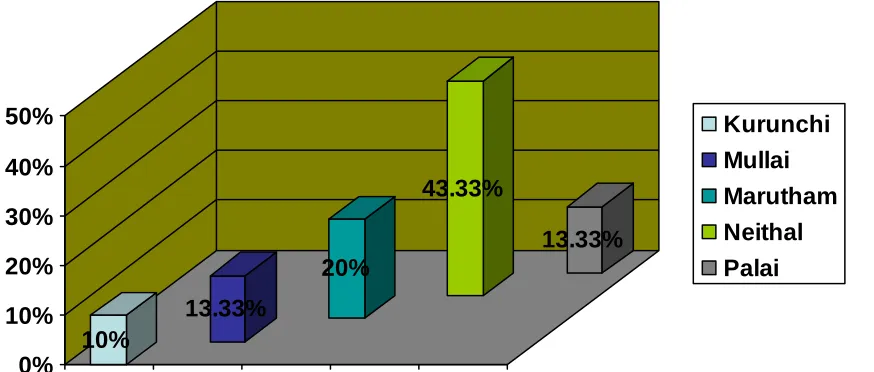
1.1.5 THINAI
There are five thinai (the land)
1. Kurinchi - Mountain and associated areas
2. Mullai - Forest and associated areas
3. Marudham - Agricultural land and associated areas
4. Neidhal - The coastal and associated areas
5. Paalai - Desert and associated areas
Features of the five regions:
1. Kurunji:-
“ z§fiE k´WÈ›]uz ÿÔVu≈xıΩ ´›>D
c§fiE kÚ∑´x xı¶VD á ∂§QÚÁ´¬ ∂Á™ ÁÔBº\ >∫zÂÏ >VÁ\k_ÁÈ •∫Ô]¬z\‚ nBº\ >∫zD ∂§. ”
á √>VÏ›> z EÕ>V\Ë
Fever leading to anemia, any abnormal enlargement in the abdominal organ
(vaitrul Aamai Kati). And also causes Iyya disease
2. Mullai
“ x_ÁÈ WÈ›>Bº\ JˆWÁ´ º\s–\À
34
kV>ÿ\Va BV>>–^ \[– \ÁÈkaºÂVF© º√>ÿ\Va BV>Á≈B© √ˆ° ”.
á √>VÏ›> z EÕ>V\Ë
This mullai, the pastoral land is the birth place of the Azhal disease, liver
disease and other Vali disease
3. Marudham
“ \Ú>WÈD Â[ÃÏ k·ÿ\V[Á≈¬ ÿÔVıº¶ ÿ√VÚ>MÈ \V]BºÂVF º√V¬zD á ÔÚ>WÈ› >V§´>fi Ûw ∂ÚÕmkÿ´[ ≈Vu∏ËÿB_ ºÈ§´>fi ÛμAs¬z t_ ”
á √>VÏ›> z EÕ>V\Ë
In this type of agricultural land, which is fertile with good water facilities,
will drive out diseases of all the three humors.
4. Neithal
“ ÿÂF>M_ º\K©Á√ ¿∫ÔV m§–\m ÿkF>M_ º\>∫z T¶VzD á ÿÂF>_
\Ú∫z¶ÁÈ t¬ÔV¬zD k_KÆ©Á√ T¬zD ÔÚ∫z¶ÁȬ ˇa≈¬z∫ ÔVı. ”
á √>VÏ›> z EÕ>V\Ë
35
5. Paalai
“ √VÁÈ WÈDº√Vu √¶Á´© ∏≈©∏¬Ô º\ÈWÈ tBVm sˆ›>uz? á ºkÁÈWÈ x©∏¬zD ÷_ÈD xÁ≈ºBku≈ÔÈVD ®©∏ˬz t_ÈD‡ ÿ>ı. ”
á √>VÏ›> z EÂ>V\Ë
This arid land will produces all the three Vali, Azhal and Iyyam disease
1.1.6. KAALAM
Ancient Tamilians divided a year into six different seasons known
as Perumpozhudhu and likewise the day into six which is known as
Sirupozhudhu
Perumpozhudhu:
A year is divided into six seasons. They are as follows
1. Kaarkalam (Aavsani-Puratasi) - 16th Aug to 15th Oct
2. Koothir (Iypasi-Kathigai) - 16th Oct to 15th Dec
3. Munpani (Markazhi-Thai) - 16th Dec to 15th Feb
4. Pin pani (Masi-Panguni) - 16th Feb to 15th Apr
5. Illavenil (Chithirai-Vaikasi) - 16th Apr to 15th June
36
Sirupozhudhu
A day is divided into six yamams. They are,
Maalai (evening),
Idaiyamman (Midnight),
Vaikarai (Dawn),
kaalai (Morning),
Nannapakal (Noon),
Erpaddu (Afternoon).
Each Perumpozhudhu and Sirupozhudhu is associated with the three humors
naturally.
1.1.7 FOURTEEN REFLEXES:
The natural reflexes, excretive, protective and preventive mechanism
are called 14 reflexes. They are
1. Vatham
2. Thummal
3. Siruneer
4. Malam
5. Kottavi
6. Pasi
37
8. Erumal
9. Ellaipu
10.Thookam
11.Vaanthi
12.Kaneer
13.Sukilam
14.Suvasam
These natural reflexes are said to be indication of normal functioning of our
body. A proper maintenance should be carried out and they should not be
obstructed forcibly.
1. Flatus:
If one resists this flatus air completely or partially, he will be infected with
the diseases of the chest, flatulence, constipation, pricking pain through out
the body, Vatha gunmam (acute abdomen), Kudal Vatham, Loss of appetite
and oliguria occur because of diminished digestive fire.
2. Sneezing:
Kiruharan vayu which lodges in nose is responsible for sneezing. It causes
head ache, pain in the sense organ, facial paralysis and back ache, if it is
38
3. Micturition:
Irregularity, if any, in the habit of micturition will cause obstruction in the
urethral passage, ulceration in the urinary tract, pain in the joints and
genetalia and distension of the lower abdomen, urinary tract infection with
ulceration in the genetalia and purulent discharge as mentioned in the text
Theriyar Karisal.
4. Defecation
Abaana vayu (downward air) is responsible for act of defecation.
Obstruction of this may cause head ache, pain in the thighs,
constipation, discomfort, and inability
4. Act of yawning
If prevented leads to poor digestion, tiredness and wilt of face.
And also leads to metabolic diseases, infection and abdominal pain.
6. & 7. Sensation of hunger and thirst
If hunger and thirst are not quenched properly, they lead to
impairment in the function of vital organs. Also causes mental
39
Fasting may lead to deterioration of all the seven physical
constituents and loss of weight. Infectious disease like tuberculosis
may result.
8. & 9. Coughing and fatigue
If cough is controlled, it leads to vigorous cough, bad odour of
breath and angina pectoris, abdominal pain and tiredness. Patient
may become unconscious.
10. Sleep
If one does not sleep well daily, he may get headache redness of
eyes, slurred speech and hearing impairment.
11. Vomiting
If vomiting is forcibly prevented, then it leads to utricarial rashes,
itching, pallor, eye diseases, Pitha diseases, dyspnoea, fever, cough
etc., and toxic manifestations due to deranged Pitham.;
12. Tears
Constraint of tears causes head ache, eye diseases, sneezing,
40
13. Semen
If it is controlled, it leads to fever oliguria, joint pain, urinary
infection, spermatorrhea, and leucorrhea and chest pain.
14. Breathing
Constraint of proper breathing leads to dyspnoea, abdominal
41
1.1.8. SIDDHA ANATOMY
As per the literature Pathinen siddhar nadi sasthiram the Siddha anatomy is explained as,
“ ∂∫zÈÕ ÿ>VıIu≈V≈ \k´kÏÁÔBV_ ÿ\F>V t∫Ô]Ï zÁ≈k>VztÁ≈flE ±u§Ú√›Á>Õm
√∫zÔ^ √È\Vÿ\[ √Vu√VÏÁk ºƒˆ´ı|Ôıb∫ Ô∫z_ º√VÈwz\V º>ÔwfiE ´ı¶Vz∫Ôı¶VF ÔıbÆÂVE J[ÆÔwfi∑ Ô´∫Ô^ÂV¬z ÂıbÆ Ô[™fiºƒ´ ÂVuÔwfiƒV zÿ\Fl_
OıËB ÿkKDÿ√ÈV ±uÿ≈VÚ√›m √È\Vÿ\[√V ÿ´ıbÆ *≈ÈV™ ÿ>[√Èÿ\ıÈVº\ ”
“ ®[–x© √Ⱥ\JÁ· lMfl EÆz¶o÷ x[–x©√›]´ı| xwÿ\™flÿƒV_ÈÈVzD √[–xÕ>V\Á´¬ÔVF√ÈÁ\Õm ÿ\ıÈVzD √[–ÂVuÔwfi∑√›mÁk©A´D√VÏÁkÔı¶VF,
√VFÕÿ>øƒBx[™Va√›>J°w¬zfl ºƒVˆ gFÕ>™ÂVaRÆ\§sº™V|l´VD ÂVΩ
∞FÕ>º>V|ÿ´ø √›y´Vl´\Ák ÿBKDÁ√© ∏[M› ∞FÕ>Á™sBV]BVÔ›]≈x¶MB∫zÕ>Vº™ ”
á √ˆØ´ ÂVΩ
The Height of one individual measures about 96 finger widths of his own;
42
Nose weighs about 3 Kazhanchu, Tongue weighs 4 Kazhanchu, total bones
weighs about 120 palam, Liver weighs 8 palam, the length of the total gastro
intestinal tract is 32 Muzham, Moolai weighs 8 Palam. Blood measures about 3
uzhakku and total Nadikal in the body is 72,000 in number.
1.1.9. THE ASTROLOGY
Macrocosm and microcosm
Man is said to be microcosm, and the Universe is the
macrocosm; since what exist in the Universe will be exist in human body
too. Man is being an integral part of universal nature. The forces prevailing
in the microcosm (man) are identical with that of the forces prevailing the
macrocosm (world). The natural forces acting in and through various organs
of the body are intimately related to or similar to or corresponding to the
forces acting in and through the organisms of the world.
This closely follows the Siddhars doctrine
“ ∂ı¶›] K^·º> ∏ı¶D ∏ı¶›] K^·º> ∂ı¶D ∂ı¶xD ∏ı¶x ÿ\V[º≈ ∂§Õº> >V[ √VϬzD º√Vm ”
43
Astral influences:
All the influences that irradiates from the sun, planets and that of the
stars can act up on the human bodies.
Moon exercises a very bad impact on the disease in general especially
during the period of new moon for instance paralysis, brain affections,
dropsy, and stimulation of sexual perversions. Mars causes women’s
suffering for want of blood and nervous strength. A conjugation of the
moon with other planets such as Venus, mars, etc may make her influence
still more injurious.
The following are the instance in which every sign of the zodiac
acts towards some particular parts of the body.
1. According to T.V.S. Dictionary:
1) Aries - To the neck
2) Taurus - neck and shoulder
3) Gemini - Arms and hands
4) Cancer - Chest and adjacent parts.
5) Leo - The heart and stomach
6) Virgo - The intestines, base of stomach and umbilicus
44
8) Scorpio - Genitals
9) Sagittarius - Lips
10) Capricorns - Knees
11) Aquarius - Legs
12) Pisces - Feet
2. According to literature Thiruvalluvar periya sunthara sekaram.
1) Mesam - Head
2) Risabam - Face
3) Mithunam - Neck
4) Kadagam - Shoulder
5) Simmam - Chest
6) Kanni - Side of body
7) Thulam - Posterior trunk (muthugu), stomach
8) Virutchigam - Testes
9) Thanusu - Thigh (thudai)
10) Magaram - Knee
11) Kumbam - Calcanium
45
The impact of the planets on the human organs
1. According to literature Siddha maruthuvanga surukkam:
Each of these planets holds jurisdiction over some parts of the body similar to the signs of the zodiac. The seven planets exercise special power over some parts of the body resulting in a disease or diseases in accordance with their impacts on the three basic humors in the system. 1. Saturn
It exhibit supremacy over the bones, tooth, cartilages, ear, spleen,
bladder and brain and gives rise to fever, leprosy, tabes, paralysis,
dropsy, cancer, cough, asthma, phthisis, deafness of the right ear,
hernia, etc.
2. Jupiter
It holds jurisdiction over the blood, liver, pulmonary veins, diaphragm, muscles of the trunk and sense of touch and smell.
3. Mars
It has got power upon the bile, gall bladder, left ear, pudendum,
kidneys, fever, jaundice, convulsions, hemorrhage, carbuncle,
erysipelas, ulcer etc.
4. Venus
It exercise its impact on the pituitous blood and semen , throat,
46
gonorrhea, barenness abscesses or even death from sexual passions
or from poison.
5. Mercury
It holds jurisdiction over the animal, spirit, also over legs, feet, hands,
fingers, tongue, nerves and ligaments and produces fevers mania,
phrenitis, epilepsy, convulsion, profuse expectoration or even death
by poison, witchcraft and so on.
Planets Organ of impact
1. Solar force - Heart
2. Lunar force - Brain
3. Mars - Gall Bladder
4. Mercury - Kidney
5. Venus - Lungs
6. Jupiter - Liver
47
5. According to literature Thiruvalluvar periya sunthara sekaram:
1. Sooriyan - head
2. Santhiran - Face
3. Sevvai - Chest
4. Puthan - Center of posterior trunk
5. Guru - Stomach
6. Sukiran - groin, genitalia
7. Sani - thigh (thudai)
8. Raagu - hands
9. Kedhu - legs
Each of these rasis and the organs of impact as well as the girahams are found to
be related with the resultant diseases of corresponding organs. Therefore, the
human body is impregnated with the vital forces that could be acted upon by the
astronomical bodies in the sky. With the augmented spiritual force, a sage can able
to get control over the above said planets. All the others are under the influence
of the forces exhibit by these asteroids.
So by the literature Sithamaruthuvanga surukkam, T.V.S. dictionary,
Thiruvalluvar periya sunthara sekaram, the Intestine is closely related to Simmam
48
S
49
1.2 KUGARANA NILLAI IN SIDDHA MEDICINE
The first ever medical system to emphasis health as the perfect state of
Physical, Psychological, Social and spiritual well-being of an individual is none
other than our Siddha system of medicine.
Maintaining a perfect state of equilibrium of three basic humors by means of
the dietary habits, regular physical and mental activities and the environmental
influence is considered as Healthy living of an individual.
DISEASE
Malady, sickness, distemper, suffering and ailment, distress of mind,
chronic disease and dreadful illness are some other terms of Disease
THE CHARACTRISTICS FEATURE OF DISEASE:
Disease is of two kinds:
1. Pertaining to the body
2. Pertaining to the mind according to the variation of the three humors.
Causes of Disease
The disease resulting from previous birth is due to karma. Disease of our present
birth is due to our food habits and actions.
50
“ t˛–D zÁ≈l–D ºÂVFÿƒF•D ±ºÈVÏ kπx>ÈV ÿkıËB J[Æ ”
- z≈^
The food and action of a person should be in harmony with the nature of his
body. Any increase or decrease in any of these three humors viz. Vali (Vatham),
Azhal (Pitham), Iyyam (kapham) leads to the vitiation and resulted in diseases.
The acceptance of food means the taste and quality of the food taken and a
person’s ability to digest. Action refers to his good words and deeds. According
to Thiruvalluvar, the disease is caused as a result of an increase or decrease in the
equilibrium of three humors.
So disease is a condition in which there is derangement in the five basic
elements that alters the three humors, which is also reflected in the seven physical
Constituents. The change may be either an increase or decrease in the equilibrium.
The exhibiting signs are in line with the vitiation of individual humor.
Functions of deranged Vali (Vatham)
Body ache and pain, pricking pain, the pain is as though the
body is tightly bound by cords, nervous debility, tremor, rigidness, dryness,
remorseless, emaciation, throbbing pain, trauma, displacement of joint,
weakness of the functional organ and loss of function, loss of sensation,
51
sensation of fragility in the foreleg and thigh, numbness and pricking pain
in the bone, goose skin, stiffness of upper and lower limbs and back, the
skin, the eyes, the faeces and urine appears dark.
Features of increased Vali
Emaciation, body colour – blackish, desire to take hot food,
tremors of body, abdominal distension, constipation, insomnia, weakness,
weakness of five sense organs, giddiness, lack of enthusiasm
Features of decreased Vali
Body pain, feeble voice, lessened activities, dull mental power,
syncope, disease caused by increased level of Iyyam.
Function of deranged Azhal:
Rise of temperature, reddish or yellowish discolouration, produces
heat during oxidation of food substances; sweating; vertigo; Excessive
bleeding; yellowish discolouration of skin; eye, urine and stool; produces
anger, distress vigorousness; Burning sensation; sour taste or pullipu taste.
Features of increased Azhal
Yellow colouration of the skin, eyes, urine, faeces, increased
52
Features of decreased Azhal
Poor digestion, chillness and demulcent, pallor, Iyya diseases.
Features of increased Iyyam
Increased salivary secretion, reduced activeness, heaviness of the
body, body colour – whitish, chillness of the body, reduced appetite, Cough,
laborious breathing, dizziness
Features of decreased Iyyam
Vertigo, weakness and dryness of joints, causing prominence of
articular bones, dry cough, lightens, excessive sweat, palpitation of heart.
The variation of the seven thathukkal:
1. Saaram (Chyme)
Increased amount of saaram leads to diseases like that of increased Iyyam such as indigestion etc
Decreased Saaram leads to loss of weight, tiredness, and lassitude, dryness of the skin and diminished activity of the sense organs
2. Chenneeer (Blood)
53
A decrease in chenneer leads to anemia, tiredness, neuritis and lassitude, pallor of body.
3.Oon (Muscle)
Oon in excess produces Cervical Lymph adenitis, syphilitic
ulcer, tumor in face, abdomen, thighs, genitalia, etc, hyper
muscularity in the cervical region
Decreased oon leads to impairment of sense organs. Joints
diseases and jaw, thighs and genitalia shrinked in their structure
(atrophied)
4. Kozhuppu (Fat)
The increased kozhuppu leads to that of increased oon associated
with dyspnoea and loss of activity.
Decreased kozhuppu leads to pain in the hip region and spleenic
disorder
5. Enbu (Bone)
Excess of enbu results in abnormal growth of bones and teeth.
Decreased enbu causes pain in joints, Dental disorders, brittle
54
6. Moolai (Marrow)
Excessive moolai results in obesity, heaviness of eyes, scanty
urine, delayed wound healing.
Decreased moolai causes osteoporosis in the bones, diminished
vision.
7. Venneer (Genital discharge)
An Excess in veneer causes calculus, increased sexual attitude.
Decreased venneer causes pricking pain in testis, dark
55
D
D
I
I
A
A
G
G
N
N
O
O
S
S
T
T
I
I
C
C
M
56
1.3. DIAGNOSTIC METHODS OF SIDDHA SYSTEM
The Methodology of diagnosing disease in Siddha system shows
uniqueness in its principle. The principle comprises examination of Tongue,
complexion, modulation in speech, Eyes and findings by palpation. It also
includes examination of Urine and Stool. The confirmation of diagnosis is based
on pulse examination. All these together constitute ‘Envagai thervugal’ which
forms the basis of diagnostic methodology in Siddha system of medicine.
These Tools not only help in diagnosis but also to observe the
prognosis of the diseases and for restoration of normal health. Besides these
envagai thervugal, there are some other parameters in Siddha system which is
greatly helpful in diagnosing various diseases. They are Manikaddai nool and
‘Sothidam’.
Envagai thervugal
Various aspects of Siddhars regarding ‘Envagai Thervugal’
“ ÂVΩ ¸√ˆƒD ÂVW≈D ÿ\Vasa \ÈD J›]´\ \Ú›mk´V•´D”
57
º>Á´BÏ
“ ÿ\Fz§ W≈Õÿ>VM saÂVsÚ\ÈD ÁÔ¬z§ ” á º>Á´BÏ
As per Saint Therayar, the eight methods of diagnosis are Naadi
(pulse); Naa (tongue); Niram (colour); Mozhi (voice); vizhi (eyes); Malam
(faeces) and Neer (Urine); Sparisam (touch).
√]ÿı E›>Ï ÂVΩ ƒV¸]´D
“ √VZÏÂVΩ B§Õm cÏÕm √´\[ ÿƒBKD ∏ËxÁ≈•D ¿º´ºBV| \ȃÈxD W≈x∫ zx xÔ¬z§•D
ƒVº´ l∫z∫zw_ \¶TÏÔVÈ[ º≈ÔD kB]·Á\ º>º´B§•xÔÂVΩ ÿ§∫z§•fi ÿƒ§•fi ÿƒV_ºkVº\ ”
á √]ÿı E›>Ï ÂVΩ ƒV¸]´D
As per sait Agathiyar Nadi, Malam, Salam, Niram, Gunam, Muga Kuri, Thegam, Vayadhu, Elamai are the diagonostic stools.
ÔıbƒVt©√´D√Á´ Ák›]BD
“ ÿ>Vz¬ÔKu≈ ∂‚¶s>© √Z‚Áƒ >[Á™ mȬÔxÆD √ıΩ>º´ ÿ>πk>VÔ© √z¬ÔˆB ÂVΩÁB ¿ ∏Ω›m© √VÚ
√ÔÏ˛[≈ kVÏÁ>ÁB©√VÏ ÂVÁk©√VÚ kz¬ÔˆB º>Ô\Á>› ÿ>V‚|©√VÚ
58
ƒVÏÕ>sa >Á™©√VÏ›m¬ ÿ>πkVF¬ ÔVº™ ”.
á ÔıbƒVt©√´D√Á´ Ák›]BD
According to literature Kannu saami parampari vaithiayam Naadi,
varthai, naa, Thegam, Thodu unarvu, Niram, Malam, Salam, Vizhi
are the diagonostic stools.
∂Ô›]BÏ Ák›]B ´›]™ ∑Ú¬ÔD
“ ÂVΩBV_ x[º™VÏ ÿƒV[™ Âuz§z∫Ô·VzD ¿ΩB sal™VKD W[≈ ÂV‚z§©∏™VKD
kVΩB º\MBVKD \Ⱥ\V| ¿ˆ™VKfi
ÛΩB sBV] >[Á™fl ∑ÔD ÿ√≈ k§Õm ÿƒV_ºÈ ”.
á ∂Ô›]BÏ Ák›]B ´›]™ ∑Ú¬ÔD
According to literature Agathiyar vaithiya rathina surukkam the
diagnostic stools are Naadi, Vizhi, Nalkurippu, Maeni, Malam, and
Neer.
√ˆØ´ ÂVΩ
“ ∂‚¶\V∫˛ˆÔ¶[Á™ B§Õm ¿•´ºkıΩ_ k‚¶\VxÔ∫Ô^√_KD kVB]_ÂV¬z∫ÔVB∫ Ô‚¶Ú\È∫Ô^ ÁÔ>M_ ÂVΩ>V–Õ
]‚¶\VB§ÕmÿƒF•Õ ]≈x^· Ák›]B´Vº\ ”
59
According to the above literature the diagnostic stools are
Mugam, pal, Vai, Naakku, Kaayam, Irumalam, Nadi.
>[kÕ]ˆ √ÔkV[:
“ ]Ú\Á≈ xMk[ ÌÆD kVÔ¶fl ÿƒFÁÔ>[M_ kÚ√È sBV]BV™ kÁÔB§ zkº> ÿ>[M_ cÚ°Æ ÂVΩ BVK ÿ\VıxÔ \È¿ ´VKD ÿ>ˆsa ÂVs™VKÕ >Õ>Ȭ Ô›] ™VKD”.
á >[kÕ]ˆ ( √.E. ÂVΩ ƒV¸]´D)
According to Literature Thanvantri vaithiyam the diagnostic stools are
Nadi, Mugam, Malam, Neer, Udal, Vizhi, Naa, and Pal.
√]ÿı E›>Ï ÂVΩ ƒV¸]´D:
“ >´Ë•^· sBV] >Á™Bi¶V∫ Ô›>V_ >V™§B ºkı|\m ∞ÿ>[M_
]´ËBº>VÏ ÂVΩÔıÔ^ ƒ›>›º>V| º>Ô›] ™m√ˆƒD kV™D ÂV¬z ÷´\ÈD ÷ÁkÔÿ·‚|D ÷>D√¶ºk >V[√VÏ›m¬ z§©A∫ Ôı|
√´™Ú·Vu ÿ√ˆºBVÏÔ‚√V>D º√Vu§© √ıA>k≈V\u √ıΩ>fi ÿƒFTº´ ”
á √]ÿı E›>Ï ÂVΩ ƒV¸]´D
According to the above literature the diagnostic stools are Nadi, Kan,
60
Tongue ( ÂV©√Z‚Áƒ)
“ √È\V™ ÚEB§•D ÂVs[ ÌuÁ≈© √ÔÏ˛[º≈[ kV>º´V˛ l[≈[ ÂV° ÔÈ\VÔ ÿkΩ›m ÔÆ›]Ú¬z x‚º√V_ Ôı| ÿÔV^kVF ∏›>º´V˛l[≈[ ÂV°
ÂÈx≈ EkÕm √flÿƒ[§Ú¬zD ‚∏ÈV EºÈ›m\º´V˛ l[≈[ ÂV°
>È\>MKu≈x] ºBVÏÔ^ ÿƒV[™ >[Á\√Ω >Ω›m ÿk”›]Ú¬zD√Vº´
- ÔıbƒVt √´D√Á´ Ák›]BD
“ ºƒ›m\ ÿ\øÕ>º√Vm ]›]©√VÂVsu ÿ≈V[ÆD ºÂ›]ºB Ôƒ©A*§ oÁƒÕ>m ∏›>\VzD
∞›]B Aπ©A*§ÿÈøÕ>m kV> ÿ\[™
√VÏ›m¿ l>Á™ÿB_ÈVD √V∫ÔVÔ k§ÕmÿƒFºB ”
á ∂Ô›]BÏ Ák›]B ´›]™ ∑Ú¬ÔD
In Vali derangement, tongue will be cold, rough, furrowed and
pungent taste. In Azhal, it will be red or yellow and kaippu taste will be
there. In Iyyam, it will be pale, sticky and sweet taste will be present. In
depletion of thontham, tongue will be dark, with raised papillae and
61
Colour (º>Ô W≈© √Z‚Áƒ)
“ J[≈VzD kV>∏›> EºÈ›m \›>V_ tzÕ>x≈› ÿ>VÕ]›> º´V˛ º>ÔD
º>V[≈V> Ê>B °i∫ ÔVÈJ[ÆÕ
ÿ>Vz›º>[BV[ ]º´Ô›] M≈›Á>¬ ºÔ” ª[≈V> kV>°¶_ ÔÆ›m¬ ÔVbD
ªˆB∏›> x¶_ Ek©A© √∑Á\ÔVbD º√V[≈V> ÁkB°¶_ ÿkıÁ\ º>V[ÆD
ÿ√VÚÕmÕÿ>VÕ> º´VÔ°¶u ˛kuÁ≈ ÿBV¬zD ”
á ÔıbƒVt √´D√Á´ Ák›]BD
“ √Á™kV> º>ÔW≈∫ ÔÆ›m WuzD Á√›]Bº>Ô W≈\fiƒ^ Ek©√>Vº\ >Vº\ EºÈ‚| \º>ÔW≈D ÿk”©A >V[ ÿ>VÕ>º>ÔD ÷ÕÂV_ s>\VBWuzD ”
á >[kÕ]ˆ ( √]ÿı E›>Ï ÂVΩ ƒV¸]´D)
In Vali, Azhal and Iyyam vitiations, the colour of the body will
be dark, Yellow or red and white colour respectively.
Voice
(k
VÏ›Á>© √Z‚Áƒ )62
ºƒÏ©√m>V[ ∏›>º´V˛l[≈[ kVÏ›Á> ÿƒ©√¬ºÔ^ ÿ√È›mº\ •≈›]Ú¬zD
∞u√m>V[ nBº´V˛ l[≈[ kVÏ›Á> ÿBπ>VÔfl EÆ›]Ú¬ztB_∏>VzD
ºÔƒuÔºk lDJ[ÆÕ ÿ>VÕ>\V˛_ ̃V\u √Ès>\VF º√∑kVº´ ”
á ÔıbƒVt √´D√Á´ Ák›]BD
“ \V\lºÈ ƒ›>\m ∂§BºkıΩ_
kV>º´V˛ƒ\ ÿ>VMBVF kVÏ›Á> º√∑D ~\x^· ∏›>Õ>V[ ÷Á≈Õ> ÌÆD
÷BD∏|D EºÈ‚|D º´V˛¬ˇ™ƒ›>D ÂVxÁ´›º>VD ÿ>VÕ> º´V˛¬z› >VMÕ> ÂV_s>\VF ÿ\VaÕ> ƒ›>D ÂBÕm ÔVº”.
á √]ÿı E›>Ï ÂVΩ ƒV¸]´D
In vitiation of Vali, Azhal and Iyyam, the voice will be medium, heavy
and low pitch respectively. By the modulation of voice, the strength of the
body can also be accessed.
The Eyes (sa© √Z‚Áƒ)
“ cıÁ\BVF¬ ÔıÔ^z§© √Á>¬ºÔ^ kV>D cu≈sa ÔÆ›mÿÂVÕm ¿Ú∫ ÔVbD
63
ƒVÏ√VÔ© √∑Á\Ek© º√Æ∫ ÔVbD k[Á\lÈV ÁkBº´V˛ saÔ^ >V–D k·\V™ ÿkıÁ\W≈ º\>V ™VzD ]ıÁ\lÈV› ÿ>VÕ>º´V˛ l[≈[ ÔıÔ^ y‚|kVF √ÈW≈ÿ\[ ≈Á≈B ÈVº\ ”.
á ÔıbƒVt √´D√Á´ Ák›]BD
“ ÔVb˛[≈ kV> º´V˛¬z ÔıÔ^
ÔÚW≈\VF ÿÂVÕmtÔ› >ıßÏ√V•D Øb˛[≈ ∏›>º´V˛ÔΩ \fiƒ^ º√VoÚ¬ÔD Ek©A W≈©ÿ√Vo° º>V[ÆD ”
á √]ÿı E›>Ï ÂVΩ ƒV¸]´D
In vali disease, the tears are black in colour, in Azhal disease
they are yellow, in Iyya disease they are whitish in colour and in thontha
disease the tears are multi colour. In Vali disease there will be excessive
tears. In disturbance of all three humor, eyes will be inflamed and reddish.
Faeces (\È© √Z‚Áƒ )
“ Œ¬zº\ kV>ºÂVF \È›Á>© √VϬ˛_ cÔÕ>\ÈD ÔÆ˛ºB ÔÆ›] Ú¬zD t¬Ô∏›> ºÂVF\È›Á> •uÆ© √VϬ˛_
tzÕ>Ek© A¶[√∑Á\ >V–Õ º>VuÆD Á\¬zkÁ· \Vº™ºÔ Á·B º´VÔD
64
√¬zk\V lDJ[ÆÕ ÿ>VÕ]© √V˛_ √ÔÚt[ M≈∫Ô^kÁÔ √ˆÕm ÔVbD ”
á ÔıbƒVt √´D√Á´ Ák›]BD
“ º\°D kV> xÁ¶BkÏ ÿ\F\Èfi Êk>VÔ¬ ÔÚ˛|fi ÿƒDtºB √VÁkºB ∏›>› º>VÏ\ÈD √VÏ>]Ω ÈVsºB ÿBø \[M≈ \fiƒº· ”
á >[kÕ]ˆ ( √]ÿı E›>Ï ÂVΩ ƒV¸]´D)
In provoked Vali – faeces is hard, dry and black in colour. In
Azhal vitiation, it is yellow. In Iyyam disturbance it is pale.
Urine (¿Ï© √ˆ‚Áƒ )
“{∫˛B kV>›º>VϬz ¿Ïsø∫ zÕ>V –Á´¬˛u Ø∫ÿÔVΩ ÔÆ›mÿÂVÕm EÆ›m¶[ ÿ√VÚt TøD √V∫z¶[ ∏›>›º>VϬzD √EB¿Ï EkÕm ÔV‚Ω ∞∫Ôºk ÔÆ›>>VÔ ®ˆ›m¶[ Ô|›m TøD ”
“Tøº\ EºÈu√™›º>VÏ ¿Ï¬zD s·D√¬ ºÔ·VF ÂV”º\ ÿk”›mÁ≈Õm ÂÈDÿ√≈ Tø∫ Ôı¶VF kV^sa \Vº™ÿ>VÕ> º´VÔ\V M¶ÏÔz› >Vº™ >V”¿Ï √ÈW≈Õ>V ÿ™[™ºk ƒVu§ º™Vº\ ”.
65
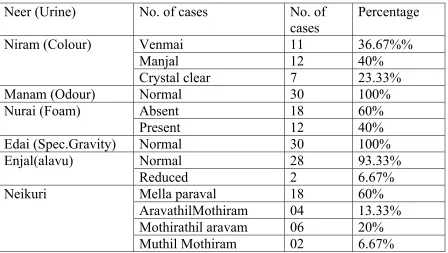
Neer refers to urine and kuri refers to signs and symptoms. Therayar, one of the renowned authors of Siddha medicine described urine examination and stages of health. He explains the colour and consistency of the urine in vitiated humor and disease. He also laid more emphasis on the spreading nature of a single drop of oil on the surface of the urine which indicates the imbalance of specific dosha and also the prognosis of disease. Normal urine is thin straw colour and odourless. The time of day and food taken will have an impact on the colour of the urine voided.
Colour of urine
1. Yellow colour – similar to straw soaked water – indigestion
2. Lemon colour – good digestion
3. Reddish yellow – heat in body
4. Colour similar to flame of forest red or flame coloured – excessive heat
5. Colour of saffron – extreme heat.
Nei Kuri
“ ∂ÚÕm \V§´>x ∂sº´V>\ >VF
∂‡Ô_ ∂ÈÏ>_ ∂ÔVÈ ∆ı>sÏÕ>wu zu≈· kÚÕ] c≈∫˛ ÁkÔÁ≈
gΩÔȃ› >VsºB ÔVmÿ√F ÿ>VÚ xÌÏ›>¬ ÔÁȬz‚ √| ¿ˆ[ W≈¬z§ ÿÂF¬Ô§ W‘∏›>_ Ô¶º™ ”
66
gaº√V_ √´s[ ∂‡º> ∏›>D
x›ÿ>V›m Wu˛[ ÿ\Vakÿ>[ Ô√º\”
á ∂Ô›]BÏ Ák›]B ´›]™ ∑Ú¬ÔD
The spreading pattern of oil drop is the indication of Vali, Azhal and Iyyam
disease e.g
1. Aravu (Snake pattern of spread) indicates Vali disease
2. Mothiram (Ring pattern of spread) indicates Azhal disease 3. Muthu (Pearl pattern of spread) indicates Iyya disease
In Nei kuri, the rapid spread of oil drop immediately after droping into
urine, Muthu like spreading and salladai kan type of spreading pattern indicates
Asaathiyam (incurable) state of the disease. From this, we can assess the
prognosis easily.
Touch(º>Ô√ˆƒ √Z‚Áƒ )
“ ºÂBx¶[ kV>›][ º>ÔÕ>VbD
ºÂÏÁ\BVF¬ zπÏÕm EÈ s¶›]ºÈ >V[ \VBx¶ –‚¶xÕ mΩmΩ©A
\Ú°>ÈVD ∏›>›][ º>ÔÕ >V–D º>VBºk °‚\>V lÚ¬zÕ ÿ>πkVF ºƒ›m\›][ º>Ô\m zπÏÕ]Ú¬zD
67
√VB ÿ>VÕ> º>Ô\m √ÈkV≈VzD
√ˆÕm ÿ>V‚|› º>Ô›Á>© √VÏ›m© º√ºƒ ”
á ÔıbƒVt √´D√Á´ Ák›]BD
“ xÁ™˛[≈ º>Ô√ˆƒ›Á> √VϬ˛_ x[kV>› º>˛¬zfl ƒ¬´fiƒuº≈ ∂Á™˛[≈ c‚ƒ\VD Á√›]B º>˛¬
Ô]Ôxı¶VD ∂©√V_ Ê>·\VF WuzD ∑Á™˛[≈ EºÈ‚| \Õ>V[ Ûμº>˛¬z ÿ>VÕ> zDÂV_s>\VD W≈Õ>V[ ̧_ ”
á >[kÕ]ˆ ( √]ÿı E›>Ï ÂVΩ ƒV¸]´D )
In Vali disease some regions of the body felt chill and in some areas
they are hot. In Azhal disease we can feel heat. In Iyya disease chillness can
be felt. In Thontha disease we can feel different sense.
Naadi (ÂVΩ )
The ‘Pulse Diagnosis’ is unique in Siddha Medicine, which was then
introduced to other Indian Systems of Medicine later. The pulse should be
examined in the Right hand for male and the Left hand for female. The pulse can
be recorded at the radial artery. By keenly observing the pulsation, the diagnosis
of disease as well as its prognosis can be assessed clearly.
Naadi is nothing but, the vital energy that sustains the life with in our body.
68
as foremost thing in assessing the prognosis and diagnosis of various diseases.
Any variation that occurs in the three humors is reflected in the naadi. These three
humors organize, regularize and integrate basic functions of the human body. So,
naadi serves as a good indicator of all ailments.
ÂVΩ √VϬzD kÁÔ
“ ÷|ÿ\[≈ ÂVΩÔ^√VϬzD kÁÔÁB¬ ºÔ” ®[™ÿk[≈V_ Â|s´_ ¿s©∏[º™ ∂|ÿ\[≈ ∂|›>s´_ º\V]´\VD s´ÁÈ ∂©√º™ ÷”›>∏[A Ôı|s´o”›m c|ÿ\[≈ #ı|s´ o”›m ∂©√V_
c›>ÿ>VÚ ∂∫z‚¶ s´ÁÈ¿ s¬Ô´›]_ √|ÿ\[≈ ʺBV] ∂∫zȺ\V >^π
√VÏ>¶s J[Æ>´D ∑´D√VϬzD kÁÔºB kÁÔ ®[™ kV>\m ŒıÁ´BVD ∏›>D k·Á\ÿBV[Æ ∂FB∫ÔV_ k·\VFWu˛_ √ÁÔl_ÁÈ ÂVΩÔ”Õ ÿ>VÕ> t_ÁÈ
√ı√V™ ∑ÔÿƒV‘√¬ ÌÆÿƒV[º™[ ”
á ∂Ô›]BÏ Ô™Ô\Ë 100
Naadi is felt as,
69
Azhal - Tip of middle finger
Iyyam - Tip of ring finger
JkÁÔ•D \V›]Á´ ∂·°D
“ kw∫˛B kV>D \V›]Á´ Œ[≈V˛_ kw∫˛B ∏›>D >[M_ ∂Á´kVE ∂w∫zD Ô√Õ>V[ ∂¶∫˛ºB ÔVºÈVΩ_ ∏w∫˛B Êkuz© ∏ƒÿÔV[Æ ÷_ÁȺB ”.
á ºÂVF ÂV¶_ (x>_ √VÔD)
The normal unit of pulse diagnosis is 1 for Vali (Vatham), ½ for Azhal
(Pitham) and ¼ for Iyyam (Kapham).
The Gait of the Naadi:
The beat of the naadi is compared with gait of various animals, reptiles and
birds.
“ kV˛È[™∫ ºÔVa \lÿÈ™ ¶¬zD kV>D ∞˛B kVÁ\B‚Á¶ lÁkÿB™ ¶¬zD ∏›>D º√V˛B >kÁ· √VDA º√VÈkVD ºƒ›m\Õ>V[”
á ºÂVF ÂV¶_ x>_ √VÔD
Vali - Movement of Swan and Peacock
Azhal - Movement of Tortoise and Leech
70
MANIKADAINOOL (Agathiya soodamanikayaru soothiram)
“ Ô\ȬÁÔ \ˬÁÔl_ ÔBÆ Û›]´D
s\Ⱥ™ ºÂV¬˛ºB ºk¶\VxM ]tÈVD ∏ËBm ºƒ´fl ÿƒ©∏ºB
∂\È™VxM¬z x[™Úπfl ÿƒF>º> ”
á √]ÿı E›>Ï ÂVΩ ±_
According to the Pathinen siddhar naadinool, Manikaddainool is also
helpful in diagnosis. This manikkadai nool is a parameter to diagnose the disease.
This can be achieved by measuring the length of the wrist by means of a thread
and then measuring that obtained length with the patient’s fingers. By this
71
A
A
I
I
M
M
A
A
N
N
D
D
O
72
AIM AND OBJECTIVES
As per Yugi Vaithiya Chinthamani, Pitha diseases are classified into 40
types. ‘Pitha’ disease can occur any where in the body. Of these, Athisarapitham
is one of the diseases of gastro intestinal system.
Athisaram can be defined as diarrhea (loose stools). Symptoms such as
increased thirst, tastelessness, nausea and/or vomiting, and emaciations denotes
the feature of vitiated Azhal. Hence in ‘Athisarapitham’, Pitha is deranged
predominantly than the other two humors viz. Vali and Iyyam. So that only it is
classified under the diseases of Pitham.
‘Athisarapitham’ presents with symptoms such as painful diarrhoea,
abdominal pain, abdominal bloating, pain in the loin; excessive sensation of
thirst; fatigue; tastelessness; emaciation; Nausea and / or vomiting.
Athisaram is widely a common lesion affecting about 20 to 30% of general
population. The disease occurs as a result of irregularity in diet, life style and day
to day activities which in turn alter the neutralization of ‘Pitha’ humor in the boby.
‘Athisarapitham’ may be dreadful if unnoticed or else ignorance of the
treatement. In order to alleviate these difficulties and to get rid of this stigma,
73
diagnosis in the clinical practice while dealing with the disease. This throws a big
challenge in the medical practice. Hence the author has selected the disease,
“Athisarapitham” from Yugi Vaithiya Chinthamani.
Primary Aim:
The main aim of this study is to evaluate the diagnostic methodology for
Athisarapitham through the parametes as follows:
Envagai thervu (Eight Fundamentals)
Manikaddai Nool (Measurement of wrist circumference)
Nilam (Land)
Kalam (Season)
Sothidam (Astrology)
and arrives at a diagnosis.
To study the origin and course of disease throughout various seasons and its
progress.
Surveying of the Siddha Literary works with reference to Athisarapitham
Aetiology
Pathogenesis (Naadi Nadai) Pathology (Noi Naadal)
Clinical features on the basis of our Siddha system.
To bring out the statistical data of the patients with reference to incidence,
74