0022-538X/96/$04.0010
Copyrightq1996, American Society for Microbiology
Four of Eleven Loci Required for Transient Complementation
of Human Cytomegalovirus DNA Replication Cooperate To
Activate Expression of Replication Genes
ANDREA C. ISKENDERIAN,1LILI HUANG,1ANDREW REILLY,1RICHARD M. STENBERG,2
ANDDAVID G. ANDERS1*
David Axelrod Institute, Wadsworth Center for Laboratories and Research, and Department of Biomedical Sciences, University at Albany School of Public Health, Albany, New York 12201,1and Department of Microbiology and
Immunology, Eastern Virginia Medical School, Norfolk, Virginia 23501
Received 31 July 1995/Accepted 17 October 1995
As previously shown, 11 loci are required to complement human cytomegalovirus (HCMV) DNA replication in a transient-transfection assay (G. S. Pari and D. G. Anders, J. Virol. 67:6979–6988, 1993). Six of these loci encode known or candidate replication fork proteins, as judged by sequence and biochemical similarities to herpes simplex virus homologs of known function; three encode known immediate early regulatory proteins (UL36-38, IRS1/TRS1, and the major immediate early region spanning UL122-123); and two encode early, nucleus-localized proteins of unknown functions (UL84 and UL112-113). We speculated that proteins of the latter five loci might cooperate to promote and regulate expression of the six replication fork proteins. To test this hypothesis we made luciferase reporter plasmids for each of the replication fork gene promoters and measured their activation by the candidate effectors, expressed under the control of their respective native promoters, using a transient-cooperativity assay in which the candidate effectors were subtracted individually from a transfection mixture containing all five loci. The combination of UL36-38, UL112-113, IRS1, or TRS1 and the major immediate early region produced as much as 100-fold-higher expression than the major immediate early region alone; omitting any one of these four loci from complementing mixtures produced a significant reduction in expression. In contrast, omitting UL84 had insignificant (less than twofold), promoter-dependent effects on reporter activity, and these data do not implicate UL84 in regulating HCMV early-gene expression. Most of the effector interactions showed significant positive cooperativity, producing synergistic enhancement of expression. Similar responses to these effectors were observed for the each of the promoters controlling expression of replication fork proteins. However, subtracting UL112-113 had little if any effect on expression by the UL112-113 promoter or by the simian virus 40 promoter-enhancer under the same condi-tions. Several lines of evidence argue that the cooperative interactions observed in our transient-transfection assays are important to viral replication in permissive cells. Therefore, the data suggest a model in which coordinate expression of multiple essential replication proteins during permissive infection is vitally dependent upon the cooperative regulatory interactions of proteins encoded by multiple loci and thus have broad implications for our understanding of HCMV biology.
Human cytomegalovirus (HCMV) is a common opportunis-tic pathogen associated with significant morbidity in immuno-compromised individuals and neonates (42). Currently available antiviral drugs target the lytic-phase replication machinery, but in spite of their biomedical importance and fundamental in-terest, the mechanisms of HCMV DNA synthesis and its reg-ulation are not completely understood. It is known that viral DNA synthesis utilizes both a cis-acting replicator, oriLyt (2, 4, 20, 41), and a set of trans-acting viral proteins. Transient complementation of HCMV oriLyt-mediated DNA replication requires proteins encoded within 11 distinct loci (44, 45). In HCMV-infected cells, blocking expression of individual pro-teins expressed by members of this set of loci also blocks viral DNA replication (49, 54), implying that the transient-transfec-tion assay accurately reflects requirements during infectransient-transfec-tion. Six of the defined loci encode herpesvirus group-common proteins whose roles in DNA synthesis are predicted by their homology to essential herpes simplex virus type 1 (HSV-1) replication
functions (6, 8, 68) and by basic biochemical studies (1, 3, 15, 18, 24, 29, 69). The six proteins encoded include the DNA polymerase (pUL54) and a candidate polymerase accessary protein (pUL44), the single-stranded DNA-binding protein (pUL57), and three proteins (pUL70, pUL102, and pUL105) homologous to HSV-1 helicase-primase subunits. These six proteins probably act coordinately at the replication fork to carry out the reactions necessary for DNA replication.
The finding that five additional loci were needed to comple-ment HCMV DNA replication was surprising because homol-ogous proteins were not required to complement HSV-1 or Epstein-Barr virus DNA synthesis (16, 17, 43). Moreover, none of these five showed evidence of similarity to the seventh es-sential HSV-1 replication component, the origin-binding pro-tein UL9 (8, 13, 14). Instead, these loci, spanning UL36-38, UL84, UL112-113, the major immediate early region (MIE) UL122-123, and IRS1/TRS1, encode proteins that are without obvious homologs in alpha- and gammaherpesviruses, and their roles in complementing DNA replication are not known. UL36-38, MIE, and IRS1/TRS1 proteins are expressed under immediate early conditions (60, 63) and have been shown to modulate expression of cellular and/or viral gene targets (10– 12, 48, 60, 62). In contrast, the UL84 and UL112-113 loci both
* Corresponding author. Mailing address: The David Axelrod Insti-tute, Wadsworth Center for Laboratories and Research, P.O. Box 22002, Albany, NY 12201-2002. Phone: (518) 474-8969. Fax: (518) 474-3181. Electronic mail address: [email protected].
383
on November 9, 2019 by guest
http://jvi.asm.org/
express early-temporal-class, nucleus-localized proteins with unknown functions (22, 67). pUL84 recently was shown to complex with the IE2 86-kDa protein (50, 57), but the signif-icance of this association remains unknown. Studies of the UL112-113 locus have characterized the transcripts, promoter, and encoded proteins and their expression but have not eluci-dated its function (27, 58, 59, 66, 67). We previously speculated that proteins encoded by each of these five loci may regulate expression of replication proteins (44). In the experiments described here, we have directly tested their abilities to regu-late promoters for each of the replication fork protein genes. Results indicate that UL36-38, UL112-113, IRS1/TRS1, and the MIE proteins cooperatively promote expression of the replication genes. In contrast, UL84 did not appear to partic-ipate in regulating HCMV early-gene expression under these conditions.
MATERIALS AND METHODS
Cells and virus.All experiments were done with low-passage-number (,15) human foreskin fibroblast cells and HCMV strain AD169 (ATCC VR-538). Cell and virus culture were as previously described (44). Nucleotide sequence coor-dinates are taken from the published data for the HCMV strain AD169 genome (8), accession number X17403.
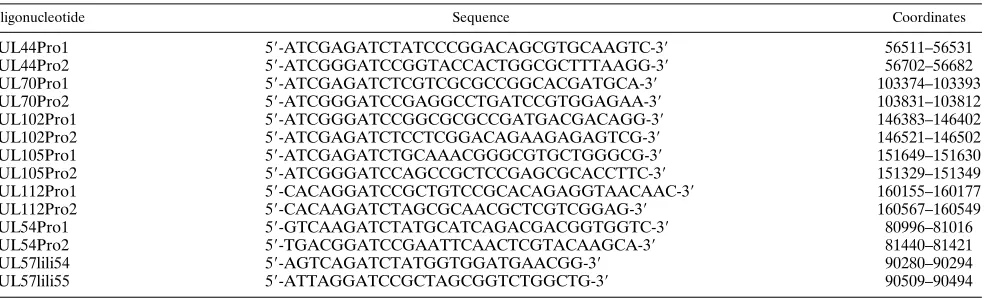
Plasmids.Plasmids used in this study that are not commercially available are detailed in Table 1. pGL2-Basic and pGL2-Control vectors were purchased from Promega Corp. (Madison, Wis.). Plasmids expressing the candidate effector proteins encoded within UL36-38, UL84, UL112-113, IRS1, TRS1, and MIE, or corresponding mutated versions, under the control of their respective native promoters were as described elsewhere (44, 45, 60, 62). Luciferase reporter plasmids were made by isolating the known or predicted promoter regions of the UL44, UL54, UL57, UL70, UL102, UL105, and UL112-113 loci by PCR and ligating them into the BglII site of the vector pGL2-Basic. Synthetic oligonucle-otides used for PCR primers had BamHI or BglII sites within a 10-nucleotide extension at their 59ends to facilitate cloning (Table 2); correct-sized PCR products were treated with BamHI plus BglII and gel purified prior to ligations. pLHB2 was an exception in that the PCR fragment was cleaved to produce NheI and BglII ends and inserted into similarly treated pGL2-Basic. The DNA se-quences of all cloned promoter fragments were verified.
Transfections.Most experiments were done by using the Chen and Okayama calcium phosphate transfection protocol to introduce plasmid DNAs into human fibroblast (HF) cells (9), just as was done for transient complementation of DNA replication (44, 45) but substituting luciferase reporter plasmids in place of an
oriLyt-containing plasmid. For the calcium phosphate transfections, 105HF cells were plated on 6-cm-diameter dishes 24 h prior to DNA addition, and subse-quent steps were as described elsewhere (45). Transfection mixtures contained a total of 5mg of DNA per dish (2.5mg of the indicated luciferase reporter plasmid plus 0.5mg of each test effector plasmid), as specified in the figure legends. Many later transfections, noted in the figure legends, were done with the lipofectamine reagent (catalog no. 18324-012; Gibco BRL, Gaithersburg, Md.) by following the vendor’s recommended protocol (21). For those experiments 33105
HF cells per well were plated on six-well plates. Each well received a total of 1mg of DNA (0.5 mg of the luciferase reporter plasmid plus 0.1mg of each test effector plasmid), as detailed in the figure legends. For both calcium phosphate and lipofectamine transfection experiments, the transfected cells were harvested for the luciferase assay at 96 h after transfection.
Luciferase assay.Luciferase activity was measured by using the Promega luciferase assay system (Promega Corp.) per the vendor’s recommendations and a liquid scintillation counter (Wallac model 1409) with coincidence counting turned off. A standard curve was constructed by using purified firefly luciferase (Boehringer-Mannheim, Indianapolis, Ind.) to ensure that output was measured in the linear range.
Statistical analysis.The effects of incorporating or omitting individual loci, and the magnitude of cooperativity, were assessed by using classical analysis-of-variance techniques (53). Outliers were identified by a robust regression method (46) and eliminated prior to the analysis. In the analysis of variance, separate parameters are estimated for the magnitude of each effector and combined effector responses. Predictions for each experimental outcome are then available as sums of the appropriate parameter estimates. Because the activity of the luciferase reporter was log-normally distributed, all analyses were performed on the log scale. Predictions were therefore obtained by taking antilogs.
RESULTS
[image:2.612.59.561.84.322.2]UL36-38, UL112-113, IRS1, and MIE proteins cooperate to activate expression of UL44.To determine whether all or sev-eral of the loci spanning the UL36-38, UL84, UL112-113, IRS1/TRS1, and MIE open reading frames (ORFs) encode proteins that cooperate to activate expression of replication genes, we cotransfected a set of five plasmids expressing the candidate effector proteins under the control of their respec-tive narespec-tive promoters, together with a replication gene pro-moter plasmid. We first tested the ability of these candidate effectors to cooperate in activating expression from the UL44 promoter-luciferase plasmid (pAI1) because this promoter has been characterized previously (36, 60) and because a segment almost identical to that previously characterized is sufficient for
TABLE 1. Plasmids used in this study
Plasmid Site/vector Coordinates Locus Reference
Reporter plasmids
pAI1 BglII/pGL2-Basic 56511–56702 UL44 promoter This paper
pAI3 BglII/pGL2-Basic 103374–103831 UL70 promoter This paper
pAI5 BglII/pGL2-Basic 146385–146522 UL102 promoter This paper
pAI7 BglII/pGL2-Basic 151329–151649 UL105 promoter This paper
pAI13 BglII/pGL2-Basic 80996–81441 UL54 promoter This paper
pLHB2 NheI-BglII/pGL2-Basic 90280–90509 UL57 promoter This paper
pAI15 BglII/pGL2-Basic 160154–160568 UL112-113 promoter This paper
Effector plasmids
pZP8 KpnI/pGEM7Zf(2) 42045–53104 UL36-38 45
pAI12 Same as for pZP8 pZP8D49168–53104 DUL36-38 This paper
pZP13 AatII-FspI/pGEM7Zf(2) 120502–123363 UL84 44
pZP13FS Same as for pZP13 Frameshift at 122665 UL84 44
pZP18 SphI-SacI/pGEM7Zf(2) 146036–151125 UL102 44
pZP3 SmaI/pGEM7Zf(2) 189500–193108 IRS1 45
pZP24 SphI-SacI/pGEM7Zf(2) DMscI 163028–163950 UL112-113 44
pZP24EcoRIFS Same as for pZP24 Frameshift at 162053 UL112-113 This paper
pZP24SalIFS Same as for pZP24 Frameshift at 161831 UL112-113 This paper
pZP24PstIFS Same as for pZP24 Frameshift at 160860 UL112-113 This paper
pSVH UL122-123 62
pON2334 XhoI-EcoRI/Bluescript SK(2) TRS1 60
pON2336 Same as for pON2334 Frameshift at NotI TRS1 60
pXEXX-6.1 SalI/pT7-1 222722–228794 TRS1 28
on November 9, 2019 by guest
http://jvi.asm.org/
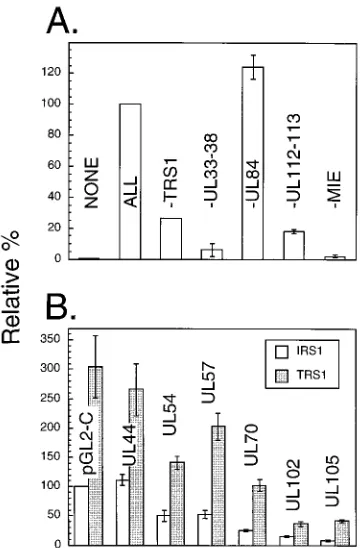
expression of UL44 in transient complementation of DNA replication (45). The tested UL44 promoter spanned nucleo-tides 56511 to 56702 of the published sequence. Salient results are presented in Fig. 1A and can be summarized as follows. When all of the five candidate effector plasmids were cotrans-fected with pAI1, luciferase expression was amplified as much as 100-fold in comparison with expression with no effectors (Fig. 1A). In later experiments that used lipofectamine instead of calcium phosphate transfection procedures, the amplifica-tion relative to expression with no effectors was even greater than 100-fold. To determine which of these loci encode pro-teins that participate in activating the UL44 promoter, the candidate effectors were individually subtracted from the trans-fection mixture. Omitting either IRS1-, UL36-38-, UL112-113-, or MIE-expressing plasmids from these cotransfections repro-ducibly reduced UL44 promoter expression between 2- and 10-fold in comparison with the transfections using all effectors (MIE reduced expression most dramatically, and IRS1 re-duced it the least). In contrast, omitting UL84 from the trans-fection mixture always resulted in slightly increased luciferase expression. Although there was considerable variability in ab-solute levels of luciferase expression between experiments, the noted trends, when expressed as the percent of activation with all effectors, were clear and reproducible (Fig. 1A). These results argue that proteins encoded by MIE, UL36-38, IRS1, and UL112-113 each participate in activating expression from the UL44 promoter.
Results consistent with the findings above were obtained when individual effector plasmids were cointroduced into HF cells with pAI1 or with only MIE (Fig. 1B). In these experi-ments IRS1-, UL36-38-, and MIE-expressing plasmids, trans-fected alone in the amount used in the subtraction experi-ments, activated the UL44 promoter slightly (two- to fivefold), whereas UL84- and UL112-113-expressing plasmids trans-fected alone had minimal effects or even appeared to inhibit expression slightly. As previously shown by Stasiak and Mo-carski for TRS1 (60), IRS1 cooperated with MIE to synergis-tically activate expression of the UL44 promoter. The combi-nation of UL36-38 and MIE also cooperatively activated the UL44 promoter. In contrast, UL112-113 failed to significantly augment MIE induction, suggesting that UL112-113 induction of the UL44 promoter requires cooperation with an additional activator(s); alternatively, adequate expression of the delayed-early UL112-113 locus, which is known to be activated by MIE (58), may require additional activating proteins under these conditions (see Fig. 3F). Not surprisingly, given the result shown in Fig. 1A, the UL84-expressing plasmid also failed to
cooperate with MIE to further activate expression of the UL44 promoter.
As an additional test, we repeated these experiments, sub-stituting frameshifted or mutated versions of each respective effector plasmid in place of the wild-type (Fig. 1C). Because in our DNA replication experiments we used a TRS1 frameshift instead of an IRS1 mutant, we tested two different plasmids expressing wild-type TRS1 for direct comparison of TRS1- and IRS1-containing transfection cocktails. We also made frame-shift mutations in UL84, UL112, and UL113. The UL36-38 locus was supplied in these experiments by pZP8, which spans ORFs UL33 to UL38. To confirm the role of the UL36-38 locus we used a pZP8-derived plasmid with a deletion which eliminated most of the UL36-38 region coding capacity and the predicted promoter regions but left intact the UL33-UL35 ORFs and associated promoters and polyadenylation signals (pAI12) (Table 1). Our results show that, in every case, the frameshifted or mutated effectors failed to activate expression; substituting the individual mutant plasmids for the wild-type plasmid in transfection mixtures produced levels of luciferase expression comparable to those obtained by omitting the cor-responding wild-type plasmid (Fig. 1C, bars 5 to 14). These results indicate that for TRS1, as already shown (60), and for UL112-113, the observed regulatory interactions are not due simply to promoter competition or other irrelevant plasmid effects and that encoded proteins are needed for cooperative activation of the UL44 promoter. Likewise, we concluded that the UL36-38 region contributes a protein(s) essential to coop-erative activation.
Although either IRS1 or its terminal repeat counterpart TRS1 functioned in the nonquantitative transient-replication assay (44), both the strain Towne (TRS1-M; pON2334) and strain AD169 (TRS1-J; pXEXX-6.1) TRS1-expressing plas-mids produced severalfold-higher levels of luciferase expres-sion when substituted for IRS1 (Fig. 1C, compare bar 2 with bars 3 and 4). Thus, either omitting TRS1 or substituting with the frameshifted version reduced overall levels of expression 5-to 10-fold in comparison with mixtures containing all effec5-tors including TRS1. This percent reduction relative to the all-effector mixture is comparable to that produced by omitting, or substituting mutated versions of, UL36-38 or UL112-113 plas-mids. Despite this greater potency of TRS1, replacing the IRS1 plasmid with TRS1 plasmid in the subtraction experiment did not affect the overall pattern of interaction between the effec-tors, except that the reduction relative to all effectors was greater upon omitting TRS1 than upon omitting IRS1 (com-pare Fig. 1A and 2A). Replacing IRS1 with TRS1 also
pro-TABLE 2. Synthetic oligonucleotides for PCR
Oligonucleotide Sequence Coordinates
UL44Pro1 59-ATCGAGATCTATCCCGGACAGCGTGCAAGTC-39 56511–56531
UL44Pro2 59-ATCGGGATCCGGTACCACTGGCGCTTTAAGG-39 56702–56682
UL70Pro1 59-ATCGAGATCTCGTCGCGCCGGCACGATGCA-39 103374–103393
UL70Pro2 59-ATCGGGATCCGAGGCCTGATCCGTGGAGAA-39 103831–103812
UL102Pro1 59-ATCGGGATCCGGCGCGCCGATGACGACAGG-39 146383–146402
UL102Pro2 59-ATCGAGATCTCCTCGGACAGAAGAGAGTCG-39 146521–146502
UL105Pro1 59-ATCGAGATCTGCAAACGGGCGTGCTGGGCG-39 151649–151630
UL105Pro2 59-ATCGGGATCCAGCCGCTCCGAGCGCACCTTC-39 151329–151349
UL112Pro1 59-CACAGGATCCGCTGTCCGCACAGAGGTAACAAC-39 160155–160177
UL112Pro2 59-CACAAGATCTAGCGCAACGCTCGTCGGAG-39 160567–160549
UL54Pro1 59-GTCAAGATCTATGCATCAGACGACGGTGGTC-39 80996–81016
UL54Pro2 59-TGACGGATCCGAATTCAACTCGTACAAGCA-39 81440–81421
UL57lili54 59-AGTCAGATCTATGGTGGATGAACGG-39 90280–90294
UL57lili55 59-ATTAGGATCCGCTAGCGGTCTGGCTG-39 90509–90494
on November 9, 2019 by guest
http://jvi.asm.org/
[image:3.612.64.556.82.231.2]duced higher expression with other early promoter reporter plasmids (Fig. 2B), indicating that the difference is not pro-moter specific. We do not know whether this apparent potency of TRS1 relative to IRS1 is due to an intrinsic difference in their activating abilities or simply is due to different levels of effector expression from the plasmids used for these studies.
Together, these experiments show that the loci UL36-38, UL112-113, MIE, and IRS1 or TRS1 express proteins that can cooperate to activate expression driven by the previously char-acterized UL44 promoter region to much higher levels than MIE alone (more than 100-fold higher in some experiments) and that each of these contributes significantly to overall acti-vation. Thus, although MIE is probably the single most impor-tant contributor to overall levels of UL44 promoter expression, in the absence of the other effectors its activity is severely compromised.
[image:4.612.344.524.71.345.2]Promoters of other HCMV replication genes respond simi-larly to the UL44 promoter. We next asked whether other HCMV promoters would respond to this set of effectors and whether the expression of other replication proteins was acti-vated by different subsets of the effectors. For these experi-ments, we made luciferase reporter plasmids for each of the other putative replication fork genes, UL54, UL57, UL70, UL102, and UL105. In addition, we also made a luciferase reporter plasmid containing the well-characterized UL112-113 promoter (5, 52, 58). The UL54 promoter has been studied
FIG. 1. At least four loci encode proteins that cooperatively activate transient expression by the UL44 promoter. Transfections were done and luciferase activity was measured as described in Materials and Methods. The shaded bars in panels A and B show results obtained with the lipofectamine reagent; all others were obtained by the calcium phosphate method. For mixtures in which a candidate effector plasmid(s) was omitted from the transfection mixture, the total DNA amount was adjusted to equivalence with pBluescript. The graphs plot measured luciferase ac-tivity relative to that obtained with all effectors, which was set to 100%. (A and B) Results of two independent experiments (open and shaded bars, respectively), each done in triplicate. Error bars plot the standard deviation for triplicate plates. (A) UL44 promoter. Transfection mixtures contained pAI1 plus either no effector plas-mids (none), all five candidate effector plasplas-mids (all), or all effectors less the indi-cated effector plasmid, which was replaced by an equivalent mass of pBluescript. The five candidate effector plasmids were pZP8 (UL33-38), pZP13 (UL84), pZP24 (UL112-113), pSVH (MIE), and pZP3 (IRS1). (B) Individual effectors. Transfection mixtures contained pAI1 plus the indicated effector plasmid(s). Plasmids were as listed for panel A. (C) Mutated effectors. Transfection mixtures contained pAI1 plus either no effector plasmids (none), the five candidate effector plasmids listed for panel A (all), all effectors with TRS1 in place of IRS1 (bars 3 and 4), all effectors less the indicated effector plasmid (bars 5, 7, 9, and 11), or all effectors with the indicated effector plasmid substitution (bars 6, 8, 10, and 12 to 14). The wild-type effector plasmids were those detailed for panel A plus pXEXX-6.1 (TRS1-J) and pON2334 (TRS1-M). Plasmids used to express frameshifted or deleted proteins were pON2336 (TRS1-FS), pAI12 (DUL36-38), pZP13FS (UL84-FS), pZP24EcoFS (UL112 113-Eco FS), pZP24SalFS 113-Sal FS), and pZP24PstFS (UL112-113-Pst FS).
FIG. 2. Comparisons of IRS1 and TRS1 activities. Transfections were done with the lipofectamine reagent, and luciferase activity was measured as described in Materials and Methods. Results were plotted as described for Fig. 1; results of only one experiment are shown for each panel. (A) Subtraction experiment done with the UL44 reporter plasmid pAI1, as described for Fig. 1A, except that the IRS1-expressing plasmid ZP3 was replaced with pXEXX-6.1 for each transfec-tion cocktail. (B) Comparison of relative responses to IRS1 and TRS1 by re-porter constructs containing the SV40 promoter-enhancer (pGL2-C), UL44 pro-moter (pAI1), UL54 propro-moter (pAI13), UL57 propro-moter (pLHB2), UL70 promoter (pAI3), UL102 promoter (pAI5), and UL105 promoter (pAI7). Trans-fection mixtures contained the indicated reporter plasmid and pZP8, pZP13, pZP24, and pSVH, plus either pZP3 (open bars) or pXEXX-6.1 (shaded bars).
on November 9, 2019 by guest
http://jvi.asm.org/
[image:4.612.84.273.71.518.2](23, 31–33, 62), and the luciferase reporter plasmid that we assembled contained a region nearly identical to that previ-ously characterized. For cases in which the promoter regions have not been described (UL57, UL70, UL102, and UL105), we assembled luciferase reporter plasmids (as detailed in Ta-ble 1) using promoter regions predicted by the DNA sequence data (8), transcript mapping (25, 55), and results of transient complementation of DNA replication (44, 45). The promoter fragments extended from well upstream of known or predicted transcription start sites downstream to the known or predicted translation start codon. Transfection experiments verified that the predicted promoter fragments were activated by virus in-fection (26). These reporter plasmids exhibited levels of acti-vation comparable to UL44, with the exceptions of the
pre-dicted UL102 and UL105 promoter regions (pAI5 and pAI7, respectively), which were 5- to 10-fold less responsive than the UL44 promoter (Fig. 2B).
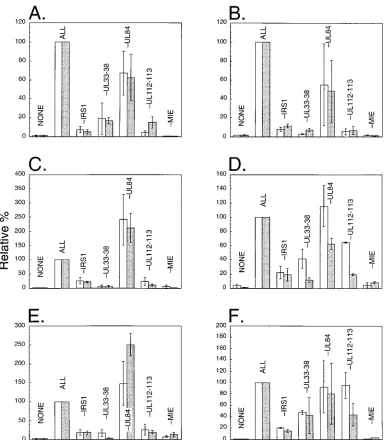
[image:5.612.115.501.67.507.2]Each of these plasmids then was tested for its activation by the set of effectors described in the legend to Fig. 1A. Results indicate that responsiveness to UL36-38, UL112-113, MIE, and IRS1 is evident for all of the promoters of replication fork genes. As with the UL44 promoter, omitting either IRS1-, UL36-38-, UL112-113-, or MIE-expressing plasmids from the cotransfection mixture reduced luciferase expression in com-parison with the all-effector controls from approximately 3- to more than 10-fold (Fig. 3A to E). Removing the MIE-express-ing plasmid from the cotransfection mixture almost universally produced the greatest reduction in luciferase expression. In
FIG. 3. Multiple early HCMV promoters are cooperatively activated by this set of loci. Transfections were done by the calcium phosphate protocol, and luciferase activity was measured as described in the text. Graphs were plotted as described for Fig. 1. Each panel presents the results of two independent experiments (open [experiment 1] and shaded [experiment 2] bars). All experiments were done as described for Fig. 1A, except that the reporter plasmid was varied as indicated for each panel. (A) UL54 promoter (pAI13); (B) UL57 promoter (pLHB2); (C) UL70 promoter (pAI3); (D) UL102 promoter (pAI5); (E) UL105 promoter (pAI7); (F) UL112-113 promoter (pAI15). Omitted plasmids were replaced with an equal mass of pBluescript, except for experiment 2 in panel C, in which case the subtracted plasmid was replaced with pZP18 (44).
on November 9, 2019 by guest
http://jvi.asm.org/
each case, reductions in activation following subtraction of the IRS1, UL36-38, and UL112-113 plasmids were reproducible and statistically significant. On the other hand, omission of UL84 produced variable results, dependent upon the promoter tested. Luciferase expression by UL54 and UL57 promoters (pAI13 and pLHB2, respectively) decreased by one-third to one-half when UL84 was left out of the transfection mixture (Fig. 3A and B, respectively), whereas luciferase expression by the UL70 (pAI3) and UL105 (pAI7) promoters increased by roughly the same degree (Figs. 3C and E, respectively); expres-sion of other reporters seemed unaffected by removal of UL84 from the mixture (Fig. 3D and F). In no example was the ratio of change produced by subtracting the UL84 effector compa-rable to those typically produced by subtracting the IRS1, UL36-38, UL112-113, and MIE plasmids. Nevertheless, these subtle modulations were reproducible and in some cases sta-tistically significant, and they were specific to UL84 in that substitution with other noneffector plasmids (e.g. pZP18, which expresses UL102 [Fig. 3C]) had no effect on reporter expression.
Finally, expression of the UL112-113 promoter (pAI15) was augmented by IRS1 and possibly by UL36-38 effectors (Fig. 3F), perhaps explaining why the combination of UL112-113-plus MIE-expressing plasmids was not highly cooperative in activating the UL44 promoter (Fig. 1B). Consistent with re-sults of Colberg-Poley et al. (11), UL36-38 subtraction had a lesser effect on UL112-113 promoter expression than on most other promoters, producing only a marginally statistically sig-nificant twofold reduction (compare Fig. 3F with A through E). However, the most striking difference between pAI15 and the other promoters is that subtracting the UL112-113 effector did not produce a statistically significant loss of activity.
Some apparent variations between reporter plasmids in their relative responsiveness to specific effectors were noted. For example, luciferase expression by the UL54 and UL112-113 promoters (pAI13 and pAI15, respectively) was reduced more by omission of IRS1 than by omission of UL36-38 (Figs. 3A and F, respectively), whereas in most other examples the op-posite was true (e.g., Fig. 3B and C), as it was for the UL44 promoter (Fig. 1A). As a caveat we note that, because of the degree of variation within each transfection experiment and between experiments, subtle trends indicating promoter-spe-cific differences amongst the replication gene promoters may not be statistically significant. Also, the apparent differences may be particular to the promoter regions examined; we have not dissected any of these promoters in detail to determine whether variant upstream regions would yield similar results. In this regard, we have noted some differences in the relative responses to specific effectors across a series of UL57-pro-moter reporter plasmids, although each examined plasmid was responsive to all of these effectors (25). Additional experi-ments will be needed to address these subtleties.
Evidence that activation by UL112-113 is promoter depen-dent.We tested other promoters for their response to this set of effectors under the same conditions. Representative results are those obtained with the pGL2-Control plasmid, which con-tains the simian virus 40 (SV40) promoter and enhancer re-gions (Fig. 4). Subtracting either the UL36-38 or MIE plasmid resulted in roughly 10- to 20-fold-lower activity. Therefore, these two effectors are capable of upregulating expression driven by the SV40 promoter-enhancer in HF cells, just as was found with the replication gene promoters. Indeed, all promot-ers that we have tested in this assay to date have responded negatively to subtraction of the UL36-38 and MIE plasmids, arguing that, at least in combination with MIE proteins, UL36-38 proteins are promiscuous activators of expression in
HF cells. Likewise, subtracting IRS1 or TRS1 in these exper-iments resulted in a significant reduction in luciferase activity. In contrast, significant changes in pGL2-Control expression were not observed upon subtraction of the UL112-113 plasmid. As noted above, expression from the UL112 promoter also did not show a significant effect of subtracting the UL112-113 plasmid (Fig. 3F), nor did expression driven by the putative promoter for an early temporal-class, small oriLyt transcript (25). Thus, whereas proteins encoded by the UL36-38, IRS1/ TRS1, and MIE loci appear to be comparatively broad-spec-trum activators, the ability of UL112-113 proteins to upregu-late expression in HF cells may be promoter specific.
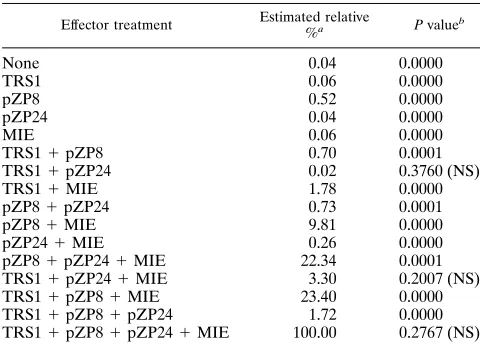
Some activating interactions are synergistic.The apparent differences in activation between each of the individual effec-tors and the collection of all five loci transfected together suggested that proteins encoded by some of the effector loci interact synergistically, as already shown for TRS1 and MIE (60). Moreover, statistical treatment of the combined data from UL44 subtraction and individual effector experiments resolved effector interactions. By this we mean that a signifi-cant difference was observed between the sum of the responses when given effectors were jointly present or absent and the sum of the responses when the same factors were individually present or absent. To examine all interactions directly, we measured expression of the UL44 promoter after cointroduc-ing all possible combinations of the activatcointroduc-ing loci UL36-38, UL112-113, MIE, and TRS1 (Fig. 5). We omitted the UL84 plasmid from this series of transfections, because in preceding experiments it did not activate UL44 promoter expression. Data were analyzed by standard statistical approaches as de-scribed in Materials and Methods (Table 3). Basically, in this analysis each combination was considered the sum of individ-ual contributions plus measured interaction parameters. For instance, the interaction parameter for any two effectors was derived by summing their individual activations and subtract-ing that sum from the measured combined activation; a
statis-tically significant (P,0.05) positive result is defined as
[image:6.612.347.521.71.184.2]syn-ergy. Higher-order interactions were similarly derived by summing all individual activations plus all relevant interaction parameters. The derived interaction parameters were tested for significance. As is obvious in Fig. 5, MIE and UL33-38 plasmids were synergistic in activating the UL44 promoter. Moreover, other pairwise interactions and most higher-order combinations also showed significant positive cooperativity; only the TRS1–UL112-113 pair and other combinations involv-ing these two were not found to interact significantly.
FIG. 4. Evidence that the SV40 promoter-enhancer does not respond to UL112-113. Transfections were done with the lipofectamine reagent, and lucif-erase activity was measured as described in Materials and Methods. Transfection mixtures contained either pGL2-Control alone (none); pGL2-Control together with pZP8, pZP13, pZP24, SVH, and either pZP3 (open bars) or pXEXX-6.1 (shaded bars) (all); or all except the indicated effector plasmid.
on November 9, 2019 by guest
http://jvi.asm.org/
DISCUSSION
We have extended our previous transient-complementation studies to search for cooperative regulatory interactions be-tween proteins encoded by several loci with unknown roles in complementing oriLyt-mediated DNA replication. For these experiments, roughly equimolar mixtures of candidate effector loci were cointroduced into permissive HFs and encoded pro-teins were expressed under the control of their respective na-tive promoters. This approach has the distinct advantage of preserving, to the greatest extent possible in a transient system, the regulatory relationships of proteins expressed by individual effector loci. Two major conclusions emerge. First, results show that the UL36-38, UL112-113, and IRS1 proteins coop-erate with each other, and with MIE, to significantly upregu-late transient expression of some HCMV early genes in HF cells. The observed interactions are not likely to be due to promoter competition artifacts because frameshift mutations within the coding regions of effector plasmids resulted in loss of function, and therefore they must reflect cooperative
acti-vation. Within the context of our assay, this cooperation re-sulted in expression levels much higher than those obtained with MIE activation alone (more than 100-fold higher in many experiments). In contrast, these experiments failed to find clear evidence that UL84 modulates expression of early viral genes. Second, multiple early promoters respond similarly to cooperative activation by these four effector loci. Indeed, each of the promoters driving expression of candidate replication fork proteins was responsive to each of these four activating plasmids. Thus, coordinate regulation of HCMV early gene expression in permissive HFs is a complex, multifactor process. These experiments do not reveal the mechanisms whereby these proteins cooperate. Such interactions could be due to cross-regulation between one or more of the effector loci, such that limiting activator proteins are more efficiently expressed, or to combinatorial activation of the early target loci, or both. Moreover, either or both of these could occur at any step in the series of events controlling protein accumulation. In this re-gard, we note that UL112-113-mediated activation of the UL54 promoter depends upon activation by MIE proteins me-diated through the IR1 element, whether or not the UL112-113 proteins are expressed constitutively (30).
[image:7.612.145.473.74.221.2]The MIE locus retains a central role in activating early expression. Individually it was generally the most potent acti-vator, and within the context of our assay its subtraction pro-duced the greatest drop in overall expression. It is not surpris-ing that the combination of immediate early loci spannsurpris-ing UL36-38, MIE, and IRS1/TRS1 can cooperatively promote expression of viral early promoters, because these have been shown individually to activate expression of viral early (10, 40, 48, 60) and cellular (11) genes; moreover, both UL36-38 and IRS1/TRS1 have been shown to cooperate with MIE proteins in activating selected targets (11, 60). The MIE region ex-presses several proteins via differential splicing, the most abun-dant and best understood of which are IE1-72kDa and IE2-86kDa (61). These two proteins synergistically activate expression of many different targets, by both direct and indi-rect pathways (5, 7, 19, 39, 52, 56, 62), and the IE2-86kDa protein also regulates MIE transcription (35, 37, 47, 62). In our experiments, both IE1 and IE2 proteins were expressed from pSVH (62); the relative contributions of individual IE1 or IE2 proteins to activation in the context of all effectors were not assessed.
FIG. 5. Regulatory interactions among the four loci expressing proteins that activate expression of the UL44 promoter. Transfections were done with the lipofectamine reagent, and luciferase activity was measured as described in Materials and Methods. The means and standard deviations for three independent experiments, each done in triplicate, are plotted relative to the value for the mixture of all four effectors, which was set to 100% (not shown). Effectors were pXEXX-6.1 (TRS1), pZP8 (UL33-38), pZP24 (UL112-113), and pSVH (MIE). Transfection mixtures contained the indicated combinations of one, two, or three effector plasmids; mixtures denoted by ‘‘-’’ contained all effectors except the noted plasmid.
TABLE 3. Statistical tests for effector interactions
Effector treatment Estimated relative
%a P valueb
None 0.04 0.0000
TRS1 0.06 0.0000
pZP8 0.52 0.0000
pZP24 0.04 0.0000
MIE 0.06 0.0000
TRS11pZP8 0.70 0.0001
TRS11pZP24 0.02 0.3760 (NS)
TRS11MIE 1.78 0.0000
pZP81pZP24 0.73 0.0001
pZP81MIE 9.81 0.0000
pZP241MIE 0.26 0.0000
pZP81pZP241MIE 22.34 0.0001
TRS11pZP241MIE 3.30 0.2007 (NS)
TRS11pZP81MIE 23.40 0.0000
TRS11pZP81pZP24 1.72 0.0000
TRS11pZP81pZP241MIE 100.00 0.2767 (NS) a
Estimated relative percents are antilogs of the predictions from the statistical analysis described in Materials and Methods.
b
P values give the probability that the interaction effect for each effector treatment is zero. NS, not significant.
on November 9, 2019 by guest
http://jvi.asm.org/
[image:7.612.57.297.519.693.2]The next most potent activator in our experiments was the pZP8 plasmid, which spans the UL36-38 region. Activation by this region has been shown to be both promoter and cell type dependent (11). Our results are consistent with previous find-ings and additionally provide new evidence that this locus contributes significantly to regulation of viral early-gene tran-scription. Like MIE, the UL36-38 region is complex in that it expresses at least four different proteins from overlapping transcripts produced by differential splicing and promoter us-age (63, 64). Three of those, UL36, UL37, and UL37x1, were shown by Colberg-Poley et al. (11) to cooperate individually with US3 to activate expression of the hsp70 promoter in HeLa cells. It remains to be determined which of these contributed to the cooperative activation of viral early promoters observed in our experiments. Deletion of the UL36-38 region from pZP8 completely abrogated its activation of the UL44 promoter in the complementation experiments; however, replacing pZP8 with a plasmid that contains only UL36-38 produced only about one-third as much UL44 expression as pZP8 (26). This difference may be due to less efficient expression of UL36-38 proteins. However, preliminary experiments suggest this dif-ference can be supplied in trans by a plasmid containing UL34 and UL35, although that plasmid had no effect in the absence of UL36-38 (26). We note that the UL34-UL35 region was not required for complementing DNA replication (45). These ob-servations are further suggestive of the overall complexity in regulation of HCMV early-gene expression. Additional exper-iments will be needed to assess the possible contributions of the UL34 and UL35 ORFs.
Finally, IRS1 and TRS1 proteins are predicted to have iden-tical sequences over their amino-terminal 550 amino acids, which are encoded within the short repeats, but diverge in their carboxyl-terminal approximately 300 residues. TRS1 was shown by Stasiak and Mocarski to cooperate with MIE to activate the UL44 promoter (60). Here we have demonstrated that IRS1 has similar capabilities and have also extended their observations to show activation of other HCMV early promot-ers.
Perhaps more surprising than the observed cooperative in-teractions among proteins encoded by the immediate early loci is the evidence that the early-temporal-class UL112-113 locus somehow participates in regulating viral early-gene expression. Like the MIE and UL36-38 immediate early loci, the UL112-113 region is expressed via differentially spliced transcripts to produce four proteins of 84, 50, 43, and 34 kDa, having a common amino-terminal segment (59, 67). Although UL112-113 transcripts are not detectable in the presence of cyclohex-imide (59), these proteins are seen by immunofluorescence as early as 2 h after infection and appear to localize to the char-acteristic intranuclear inclusions (27). Again, it remains to be determined which of these proteins contribute to cooperative activation. However, the finding that the SalI and EcoRI frameshift mutations eliminate cooperative activation may im-plicate the 84-kDa protein. In most of our experiments, the UL112-113 plasmid, alone or combined with MIE, failed to show a significant activation of early reporter constructs. Thus, we might have overlooked the apparent role of this region in regulating early gene expression if we had used simpler exper-imental designs; these results underscore the power of tran-sient complementation in dissecting complex processes. However, UL112-113 did activate the UL54 promoter in combination with MIE when transfected under slightly different conditions (30).
With respect to their role in transient complementation of HCMV DNA replication, our results are consistent with a requirement for UL36-38, UL112-113, MIE, and IRS1/TRS1
to adequately express essential replication fork proteins. When transfection protocols similar to those used for transient complementation of DNA synthesis were used, these loci ex-pressed proteins that contributed to luciferase expression driven by each of the replication fork gene promoters. Clearly, a significant reduction in expression of multiple early loci might produce too little accumulation of essential replication proteins to carry out DNA synthesis, especially if one or more are limiting. Nevertheless, these studies do not rule out direct involvement in initiating or performing DNA synthesis for any of these gene products. If transcription or cognate transcrip-tional regulatory elements are critical components or regula-tors of DNA synthesis, as is the case in many other systems, including Epstein-Barr virus (17, 51), then each of these pro-teins becomes a candidate for involvement. Moreover, these results provide no obvious explanation of the requirement for UL84 to complement HCMV DNA replication. The UL84 protein associates with the IE2-86kDa protein (50, 57), and we anticipated that it might participate in IE2-mediated transcrip-tional regulation via this interaction. Although we observed reproducible promoter-dependent modulations upon subtrac-tion of UL84, the differences were small. Therefore, we cannot yet conclude that UL84 is a significant contributor to viral early-gene expression. Instead, UL84 may well be responsible for mediating interactions with other proteins, with other types of promoters, or with oriLyt.
Several lines of evidence argue that the cooperation between these effectors observed in our transient-transfection assays reflects interactions important to viral replication. First, al-though some aspects of viral gene expression are not accurately reproduced by transient-transfection assays, basic findings of transient-transfection analyses have been validated by using recombinant viruses (30, 32), and it is likely that results of transient-transfection experiments reflect at least a subset of the regulatory events that occur in the natural context of the viral genome. Therefore, similar interactions are predicted to occur during viral infection of permissive cells. Second, these genes were individually found to be essential for complemen-tation of oriLyt-mediated DNA replication in a transient-trans-fection assay in which expression of the DNA polymerase and other replication fork genes was driven by their native promot-ers (44, 45). Results presented here are consistent with a model in which expression of those genes in permissive human fibro-blasts is vitally dependent upon this set of effectors. Finally, evidence for an essential role in viral replication in permissive cells has been obtained for one of these loci by using a com-plementary method. Selectively inhibiting expression of UL36-37 proteins by treating infected cells with an antisense oligonu-cleotide efficiently blocks viral replication in cultured cells (54). Clearly, an important challenge now is to assess the relative contributions of proteins encoded by these loci in regulating expression within the context of the HCMV genome during infection of permissive cells.
In conclusion, these data have broad implications for our understanding of HCMV biology and raise many new ques-tions. Our results suggest that a complex interplay between several viral regulatory loci encoding at least a dozen proteins is needed to create an intracellular environment suitable for viral gene expression and replication. In this model, disregu-lation of or by any one of these effectors could affect expression of many early genes and might greatly inhibit or block viral replication; this could explain the failure of HCMV to replicate in some cell types in which MIE expression is not blocked (34). We have not examined the responsiveness of immediate-early or late viral promoters to proteins encoded by this set of loci nor that of cellular targets. It will be of interest to revisit
on November 9, 2019 by guest
http://jvi.asm.org/
previous findings with those targets in the light of these data. For example, UL36-38 proteins have been found to cooperate with MIE to activate expression of certain cellular genes (11). Do UL112-113 and IRS1/TRS1 proteins participate in those regulatory activities as well? Likewise, we have not examined the abilities of these effectors to activate expression of these early targets in other cell types, such as endothelial cells and monocytes/macrophages, which are thought to be important sites of infection in the host. Finally, it is clear that these loci are not alone in encoding viral proteins that regulate expres-sion during infection. For example, US3 (11), UL69 (65), and UL82 (38) all have been shown to activate expression of se-lected promoters. In addition, UL36 and IRS1/TRS1 are mem-bers of the US22 family of HCMV genes, which includes 13 recognized members (8). The transient-complementation method offers a useful tool to study interactions of all of these candidate regulatory loci in a variety of cell types and conditions.
ACKNOWLEDGMENTS
We thank Tim Moran and Matt Shudt in the Wadsworth Center Molecular Genetics Core Facility for preparing oligonucleotides and for DNA sequencing, Mary Beth Coy for excellent technical assistance, and members of our laboratories for suggestions on the manuscript. We gratefully acknowledge Ed Mocarski and Tom Jones for providing plasmids expressing TRS1.
This work was supported by NIH grants AI31249 and AI33416 to D.G.A. and AI23313 to R.M.S.
REFERENCES
1. Anders, D. G., and W. Gibson. 1988. Location, transcript analysis, and partial nucleotide sequence of the cytomegalovirus gene encoding an early DNA-binding protein with similarities to ICP8 of herpes simplex virus type 1. J. Virol. 62:1364–1372.
2. Anders, D. G., M. A. Kacica, G. S. Pari, and S. M. Punturieri. 1992. Bound-aries and structure of human cytomegalovirus oriLyt, a complex origin for lytic-phase DNA replication. J. Virol. 66:3373–3384.
3. Anders, D. G., J. R. Kidd, and W. Gibson. 1987. Immunological character-ization of an early cytomegalovirus single-strand DNA-binding protein with similarities to the HSV major DNA-binding protein. Virology 161:579–588. 4. Anders, D. G., and S. M. Punturieri. 1991. Multicomponent origin of
cyto-megalovirus lytic-phase DNA replication. J. Virol. 65:931–937.
5. Arlt, H., D. Lang, S. Gebert, and T. Stamminger. 1994. Identification of binding sites for the 86-kilodalton IE2 protein of human cytomegalovirus within an IE2-responsive viral early promoter. J. Virol. 68:4117–4125. 6. Bankier, A. T., S. Beck, R. Bohni, C. M. Brown, R. Cerny, M. S. Chee, C. A.
Hutchinson III, T. Kouzarides, J. A. Martignetti, E. Preddie, S. C. Satchwell, P. Tomlinson, K. M. Weston, and B. G. Barrell.1992. The DNA sequence of the human cytomegalovirus genome. J. DNA Sequencing Mapping 2:1–12. 7. Caswell, R., C. Hagemeier, C. J. Chiou, G. Hayward, T. Kouzarides, and J.
Sinclair. 1993. The human cytomegalovirus 86K immediate early (IE) 2 protein requires the basic region of the TATA-box binding protein (TBP) for binding, and interacts with TBP and transcription factor TFIIB via regions of IE2 required for transcriptional regulation. J. Gen. Virol. 74:2691–2698. 8. Chee, M. S., A. T. Bankier, S. Beck, R. Bohni, C. M. Brown, R. Cerny, T.
Horsnell, C. A. Hutchinson III, T. Kouzarides, J. A. Martignetti, E. Preddie, S. C. Satchwell, P. Tomlinson, K. M. Weston, and B. G. Barrell. 1990. Analysis of the coding content of the sequence of human cytomegalovirus strain AD169. Curr. Top. Microbiol. Immunol. 154:125–169.
9. Chen, C., and H. Okayama. 1987. High-efficiency transformation of mam-malian cells by plasmid DNA. Mol. Cell. Biol. 7:2745–2752.
10. Cherrington, J. M., and E. S. Mocarski. 1989. Human cytomegalovirus ie1 transactivates theapromoter-enhancer via an 18-base-pair repeat element. J. Virol. 63:1435–1440.
11. Colberg-Poley, A. M., L. D. Santomenna, P. P. Harlow, P. A. Benfield, and
D. J. Tenney.1992. Human cytomegalovirus US3 and UL36-38 immediate-early proteins regulate gene expression. J. Virol. 66:95–105.
12. Depto, A., and R. M. Stenberg. 1989. Regulated expression of the human cytomegalovirus pp65 gene: octomer sequence in the promoter is required for activation by viral gene products. J. Virol. 63:1232–1238.
13. Elias, P., and I. R. Lehman. 1988. Interaction of origin binding protein with an origin of replication of herpes simplex virus 1. Proc. Natl. Acad. Sci. USA
85:2959–2963.
14. Elias, P., M. E. O’Donnell, E. S. Mocarski, and I. R. Lehman. 1986. A DNA binding protein specific for an origin of replication of herpes simplex virus type 1. Proc. Natl. Acad. Sci. USA 83:6322–6326.
15. Ertl, P. F., and K. L. Powell. 1992. Physical and functional interaction of human cytomegalovirus DNA polymerase and its accessory protein (ICP36) expressed in insect cells. J. Virol. 66:4126–4133.
16. Fixman, E. D., G. S. Hayward, and S. D. Hayward. 1992. trans-acting re-quirements for replication of Epstein-Barr virus ori-Lyt. J. Virol. 66:5030– 5039.
17. Fixman, E. D., G. S. Hayward, and S. D. Hayward. 1995. Replication of Epstein-Barr virus oriLyt: lack of a dedicated virally encoded origin-binding protein and dependence on Zta in cotransfection assays. J. Virol. 69:2998– 3006.
18. Gibson, W., T. L. Murphy, and C. Roby. 1981. Cytomegalovirus-infected cells contain a DNA-binding protein. Virology 111:251–262.
19. Hagemeier, C., R. Caswell, G. Hayhurst, J. Sinclair, and T. Kouzarides. 1994. Functional interaction between the HCMV IE2 transactivator and the retinoblastoma protein. EMBO J. 13:2897–2903.
20. Hamzeh, F. M., P. S. Lietman, W. Gibson, and G. S. Hayward. 1990. Iden-tification of the lytic origin of DNA replication in human cytomegalovirus by a novel approach utilizing ganciclovir-induced chain termination. J. Virol.
64:6184–6195.
21. Harms, J. S., and G. A. Splitter. 1995. LipofectAMINE reagent efficiently transfers genes into mammalian cell lines. Focus 17:34–35.
22. He, Y. S., L. Xu, and E. S. Huang. 1992. Characteriztaion of human cyto-megalovirus UL84 early gene and identification of its putative protein prod-uct. J. Virol. 66:1098–1108.
23. Heilbronn, R., G. Jahn, A. Burkle, U.-K. Freese, B. Fleckenstein, and H. zur
Hausen.1987. Genomic localization, sequence analysis, and transcription of the putative human cytomegalovirus DNA polymerase gene. J. Virol. 61: 119–124.
24. Huang, E.-S. 1975. Human cytomegalovirus. III. Virus-induced DNA poly-merase. J. Virol. 16:298–310.
25. Huang, L., and D. G. Anders. 1995. Unpublished results. 26. Iskenderian, A. C., and D. G. Anders. 1995. Unpublished results. 27. Iwayama, S., T. Yamamoto, T. Furuya, R. Kobayashi, K. Ikuta, and K. Hirai.
1994. Intracellular localization and DNA-binding activity of a class of viral early phosphoproteins in human fibroblasts infected with human cytomega-lovirus (Towne strain). J. Gen. Virol. 75:3309–3318.
28. Jones, T. R. Personal communication.
29. Kemble, G. W., A. L. McCormick, L. Pereira, and E. S. Mocarski. 1987. A cytomegalovirus protein with properties of herpes simplex virus ICP8: partial purification of the polypeptide and map position of the gene. J. Virol.
61:3143–3151.
30. Kerry, J. A., M. A. Priddy, T. Y. Jervey, C. P. Kohler, T. L. Staley, C. D.
Vanson, T. R. Jones, A. C. Iskenderian, D. G. Anders, and R. M. Stenberg.
1996. Multiple regulatory events influence expression of human cytomega-lovirus DNA polymerase (UL54) expression during viral infection. J. Virol.
70:373–382.
31. Kerry, J. A., M. A. Priddy, and R. M. Stenberg. 1994. Identification of sequence elements in the human cytomegalovirus DNA polymerase gene promoter required for activation by viral gene products. J. Virol. 68:4167– 4176.
32. Kohler, C. P., J. A. Kerry, M. Carter, V. P. Muzithras, T. R. Jones, and R. M.
Stenberg.1994. Use of recombinant virus to assess human cytomegalovirus early and late promoters in the context of the viral genome. J. Virol. 68: 6589–6597.
33. Kouzarides, T., A. T. Bankier, S. C. Satchwell, K. Weston, P. Tomlinson, and
B. G. Barrell.1987. Sequence and transcription analysis of the human cyto-megalovirus DNA polymerase gene. J. Virol. 61:125–133.
34. LaFemina, R. L., and G. S. Hayward. 1988. Differences in cell-type-specific blocks to immediate early gene expression and DNA replication of human, simian, and murine cytomegaloviruses. J. Gen. Virol. 69:355–374. 35. Lang, D., and T. Stamminger. 1993. The 86-kilodalton IE-2 protein of
human cytomegalovirus is a sequence-specific DNA-binding protein that interacts directly with the negative autoregulatory response element located near the cap site of the IE-1/2 enhancer-promoter. J. Virol. 67:323–331. 36. Leach, F. S., and E. S. Mocarski. 1989. Regulation of cytomegalovirus
late-gene expression: differential use of three start sites in the transcriptional activation of ICP36 gene expression. J. Virol. 63:1783–1791.
37. Liu, B., T. W. Hermiston, and M. F. Stinski. 1991. A cis-acting element in the major immediate-early (IE) promoter of human cytomegalovirus is required for negative regulation by IE2. J. Virol. 65:897–903.
38. Liu, B., and M. F. Stinski. 1992. Human cytomegalovirus contains a tegu-ment protein that enhances transcription from promoters with upstream ATF and AP-1 cis-acting elements. J. Virol. 66:4434–4444.
39. Macias, M. P., and M. F. Stinski. 1993. An in vitro system for human cytomegalovirus immediate early 2 protein (IE2)-mediated site-dependent repression of transcription and direct binding of IE2 to the major immediate early promoter. Proc. Natl. Acad. Sci. USA 90:707–711.
40. Malone, C. L., D. H. Vesole, and M. F. Stinski. 1990. Transactivation of a human cytomegalovirus early promoter by gene products from the
on November 9, 2019 by guest
http://jvi.asm.org/
ate-early gene IE2 and augmentation by IE1: mutational analysis of the viral proteins. J. Virol. 64:1498–1506.
41. Masse, M. J. O., S. Karlin, G. A. Schachtel, and E. S. Mocarski. 1992. Human cytomegalovirus origin of DNA replication (oriLyt) resides within a highly complex repetitive region. Proc. Natl. Acad. Sci. USA 89:5246–5250. 42. Mocarski, E. S. J. 1993. Cytomegalovirus biology and replication, p. 173–226. In B. Roizman, R. J. Whitley, and C. Lopez (ed.), The human herpesviruses. Raven Press, New York.
43. Olivo, P. D., N. J. Nelson, and M. D. Challberg. 1989. Herpes simplex virus type 1 gene products required for DNA replication: identification and over-expression. J. Virol. 63:196–204.
44. Pari, G. S., and D. G. Anders. 1993. Eleven loci encoding trans-acting factors are required for transient complementation of human cytomegalovirus ori-Lyt-dependent DNA replication. J. Virol. 67:6979–6988.
45. Pari, G. S., M. A. Kacica, and D. G. Anders. 1993. Open reading frames UL44, IRS1/TRS1, and UL36-38 are required for transient complementa-tion of human cytomegalovirus oriLyt-dependent DNA synthesis. J. Virol.
67:2575–2582.
46. Paulson, A. S., and T. A. Delehanty. 1982. Sensitivity analysis in experimental design, p. 52–57. In K. W. Heiner, R. S. Sacher, and J. W. Wilkinson (ed.), Computer science and statistics: proceedings of the 14th Symposium on the Interface. Springer-Verlag, New York.
47. Pizzorno, M. C., and G. S. Hayward. 1990. The IE2 gene products of human cytomegalovirus specifically down-regulate expression from the major im-mediate-early promoter through a target sequence located near the cap site. J. Virol. 64:6154–6165.
48. Pizzorno, M. C., P. O’Hare, L. Sha, R. L. LaFemina, and G. S. Hayward. 1988. trans-activation and autoregulation of gene expression by the immedi-ate-early region 2 gene products of human cytomegalovirus. J. Virol. 62: 1167–1179.
49. Ripalti, A., M. C. Boccuni, F. Campanini, and M. P. Landini. 1995. Cyto-megalovirus-mediated induction of antisense mRNA expression to UL44 inhibits virus replication in an astrocytoma cell line: identification of an essential gene. J. Virol. 69:2047–2057.
50. Samaniego, L. A., M. J. Tevethia, and D. J. Spector. 1994. The human cytomegalovirus 86-kilodalton immediate-early 2 protein: synthesis as a pre-cursor polypeptide and interaction with a 75-kilodalton protein of probable viral origin. J. Virol. 68:720–729.
51. Schepers, A., D. Pich, and W. Hammerschmidt. 1993. A transcription factor with homology to the AP-1 family links RNA transcription and DNA repli-cation in the lytic cycle of Epstein-Barr virus. EMBO J. 12:3921–3929. 52. Schwartz, R., M. H. Sommer, A. Scully, and D. H. Spector. 1994. Site-specific
binding of the human cytomegalovirus IE2 86-kilodalton protein to an early gene promoter. J. Virol. 68:5613–5622.
53. Seber, G. A. F. 1977. Linear regression analysis. John Wiley and Sons, New York.
54. Smith, J. A., and G. S. Pari. 1995. Expression of human cytomegalovirus UL36 and UL37 genes is required for viral DNA replication. J. Virol.
69:1925–1931.
55. Smith, J. A., and G. S. Pari. 1995. Human cytomegalovirus UL102 gene. J. Virol. 69:1734–1740.
56. Sommer, M. H., A. L. Scully, and D. H. Spector. 1994. Transactivation by the human cytomegalovirus IE2 86-kilodalton protein requires a domain that binds to both the TATA box-binding protein and the retinoblastoma protein. J. Virol. 68:6223–6231.
57. Spector, D. J., and M. J. Tevethia. 1994. Protein-protein interactions be-tween human cytomegalovirus IE2-580aa and pUL84 in lytically infected cells. J. Virol. 68:7549–7553.
58. Staprans, S. I., D. K. Rabert, and D. H. Spector. 1988. Identification of sequence requirements and trans-acting functions necessary for regulated expression of a human cytomegalovirus early gene. J. Virol. 62:3463–3473. 59. Staprans, S. I., and D. H. Spector. 1986. 2.2-kilobase class of early transcripts
encoded by human cytomegalovirus strain AD169. J. Virol. 57:591–602. 60. Stasiak, P. C., and E. S. Mocarski. 1992. Transactivation of the
cytomega-lovirus ICP36 gene promoter requires theagene product TRS1 in addition to IE1 and IE2. J. Virol. 66:1050–1058.
61. Stenberg, R. M. 1993. Immediate early genes of human cytomegalovirus: organization and function, p. 330–359. In E.-S. Huang, Y. Becker, and G. Darai (ed.), Molecular aspects of human cytomegalovirus diseases, vol. 2. Springer-Verlag, Heidelberg, Germany.
62. Stenberg, R. M., J. Fortney, S. W. Barlow, B. P. Magrane, J. A. Nelson, and
P. Ghazal.1990. Promoter-specific trans activation and repression by human cytomegalovirus immediate-early proteins involves common and unique pro-tein domains. J. Virol. 64:1556–1565.
63. Tenney, D. J., and A. M. Colberg-Poley. 1991. Expression of the human cytomegalovirus UL36-38 immediate early region during permissive infec-tion. Virology 182:199–210.
64. Tenney, D. J., and A. M. Colberg-Poley. 1991. Human cytomegalovirus UL36-38 and US3 immediate-early genes: temporally regulated expression of nuclear, cytoplasmic, and polysome-associated transcripts during infec-tion. J. Virol. 65:6724–6734.
65. Winkler, M., S. A. Rice, and T. Stamminger. 1994. UL69 of human cyto-megalovirus, an open reading frame with homology to ICP27 of herpes simplex virus, encodes a transactivator of gene expression. J. Virol. 68:3943– 3954.
66. Wright, D. A., and D. H. Spector. 1989. Posttranscriptional regulation of a class of human cytomegalovirus phosphoproteins encoded by an early tran-scription unit. J. Virol. 63:3117–3127.
67. Wright, D. A., S. I. Staprans, and D. H. Spector. 1988. Four phosphoproteins with common amino termini are encoded by human cytomegalovirus AD169. J. Virol. 62:331–340.
68. Wu, C. A., N. J. Nelson, D. J. McGeoch, and M. D. Challberg. 1988. Iden-tification of herpes simplex virus type 1 genes required for origin-dependent synthesis. J. Virol. 62:435–443.
69. Ye, L. B., and E. S. Huang. 1993. In vitro expression of the human cytomeg-alovirus DNA polymerase gene: effects of sequence alterations on enzyme activity. J. Virol. 67:6339–6347.