Copyright© 1994, AmericanSociety for Microbiology
Amino Acid
Substitution Mutations in the Herpes Simplex
Virus ICP27 Protein Define an Essential Gene
Regulation Function
STEPHENA. RICE* ANDVIVIAN LAM
Department of Biochemistry, University ofAlberta, Edmonton, Alberta, Canada T6G 2H7
Received 27 August 1993/Accepted 12 November 1993
ICP27 is anessential herpes simplex virus type 1 (HSV-1)a protein that is required for the transition from the , to the y phase of infection. To identify functional regions ofICP27, we constructed 16 plasmids that contain nucleotide substitution mutations in the ICP27 gene. The mutations createdXhoI restriction sites, altered one or two codons, and were spaced at semiregular intervals throughout the coding region. Three mutations completely inactivated an essential function of ICP27, as demonstrated by the
inability
of the transfected plasmids to complement the growth of an HSV-1 ICP27 deletion mutant. These mutations, Mll, M15, and M16, mapped in thecarboxyl-terminal one-third ofICP27 at residues 340 and 341, 465 and 466, and 488, respectively. In cotransfection assays, all three defective-plasmid mutants retained thetransrepression functionofICP27 but weredefective at transactivation. To define thelytic functions that are mediated by the transactivation activity ofICP27, we engineered HSV-1 recombinants containing the Mll, M15, or M16 mutation. All three viral mutants failed to growinVero cells and possessed similar phenotypes. The viral mutants replicated their DNA similarly to the wild-type virus but showed several defects in viral gene expression.These were afailure to down-regulateaandfi
genesat late timesafterinfection and aninability toinduce certain -y-2 genes.Our results demonstrate that the transactivation function of ICP27 (as it is defined in cotransfection assays) mediates an essential gene regulation function during the HSV-1 infection. This activity is notrequired forICP27-dependent enhancement of viral DNA replication. Our work supports and extends previous studies which suggest that ICP27 carries out two distinct regulatory activities during the HSV-1 infection.Herpes simplex virus type 1 (HSV-1), a widespread human pathogen, is the prototypic member of the alphaherpesvirus family (40).Invivo, HSV-1 can replicatelytically in a variety of cell types and can establish latent infections in neurons. In many cultured cells, HSV-1 undergoes a rapid and efficient
productive infection, allowing both biochemical and genetic analyses of the lytic cycle. This characteristic distinguishes HSV-1 from most of the other human herpesviruses, which in general replicate poorly in cell culture. HSV-1 is therefore a valuable modelfor understanding some of the basic replication pathways of human and other herpesviruses.
The events of the lytic HSV-1 infection occur in a temporally ordered and highly regulated fashion (reviewed in reference
40).TheDNAgenomeof HSV-1 encodes more than 70 genes andis transcribed in the infected cell nucleus by the host RNA
polymerase II. The HSV-1 genes have been classified into three groups dependingon the temporal order of, and func-tional requirements for, their expression (21). The a, or immediate-early, genes are the first class of genes to be
expressed. Transcription of these genes can occur in the absenceofnewviralproteinsynthesis and is stimulated by the action of the virion transactivator VP16 (alsocalled Vmw65, a-TIF, orICP25). The function of the a proteins appearstobe largely regulatory, as discussed in detail below. The ,B, or delayed-early, genes are the next to be expressed.
Transcrip-*Correspondingauthor.Mailingaddress:Departmentof
Biochem-istry, UniversityofAlberta,474MedicalSciencesBuilding, Edmonton, Alberta, Canada T6G 2H7. Phone: (403) 492-2717. Fax: (403) 492-0886. Electronic mail address:
[email protected].
ca.tion of the I genes requirestheaction of the a proteinICP4
(for infected-cell protein). For the most part, the protein
products of the ,B genes are involveddirectly or indirectly in viral DNAreplication. Viral DNA synthesis begins soon after
expression of the ,3proteins andstimulates the expression of the last class of viral genes, the -y, orlate, genes. The -y genes have been subdividedonthefollowing basis: y-1,orleaky-late, genes are expressed at low levels in the absence of DNA replication, while-y-2,ortrue-late, genesare notexpressedat readily detectable levels in the absence ofreplication. Mostof the y genesencode components of the HSV-1 virion.
Fourof the five aproteins(ICP4, ICPO,ICP22, and ICP27) arelocalized tothenuclei of infected cells (1)and have been demonstrated toperform regulatory functionsduringthelytic
infection.ICP4, the best characterized of theseproteins,hasan essential roleinthetranscriptional activation of ,B and -y genes
(8, 16, 34, 50). ICP4 possesses a sequence-specific DNA binding activity that appears tobe required for its
transcrip-tional-activation function (23, 31, 33, 45).
Our laboratory is interested in the regulatory functions of the a protein ICP27. ICP27 isa 512-residue phosphoprotein
that migrates on sodium dodecyl sulfate-polyacrylamide gel electrophoresis (SDS-PAGE) with an apparent molecular massof 63 kDa(21,27, 41,52).Itis essential for HSV-1growth
since viralICP27 nullmutantsarecompletelydefective for
lytic
replication (26, 36). Of interest is the fact that herpesviruses
from each of the three major classes (alpha-, beta-, and gammaherpesviruses) encode proteins with
recognizable
ho-mologytoICP27(2,7,32, 49,53).Suchconservationacrosstheherpesvirus kingdom suggests that ICP27 carries out one or
more functions that are fundamental to
herpesvirus
replica-tion.823
on November 9, 2019 by guest
http://jvi.asm.org/
Phenotypic studies of HSV-1 mutants bearing defined le-sions in the ICP27 gene have been useful in ascribing specific functions to ICP27. HSV-1 mutants which are null for ICP27 because of large gene deletions are 5- to 10-fold deficient in viral DNA replication, are unable to down-regulate ot or a
genes, and are unable to efficiently induce y genes (26, 36). These regulatory effects are separable, at least in part, as demonstrated by the analysis of amino (N)-terminus- and carboxyl (C)-terminus-specific ICP27 mutants. Thedl-2 mu-tant, which encodes an ICP27 molecule lacking an acidic regionnearits Nterminus, is deficient inDNAreplicationbut does not show severe defects in gene expression (38). In contrast,the n504Rmutant,which encodes anICP27 molecule with a short truncation at its C terminus, is not deficient in DNA replication but does show a severe restriction to the expression of many of its y genes and is unable to down-regulateox and ( genes (36,38). Thesestudies have supported amodel (38) in whichICP27carries out twodistinct regulatory activities that together contributetothe
P-to-'y
transition.One activity appears to enhance the efficiency of viral DNA repli-cation, whileasecond activity-appearstomediate the induction of certain y genes and the repression ofox and 1 genes.ICP27 has also been demonstrated to mediate regulatory activities in uninfected cells. When expressed from a trans-fected plasmid, ICP27 can either activate or repress the expression of certain cotransfectedreporter genes(4, 9, 35, 43, 48). Positiveandnegativeregulation of cotransfectedreporter genes by ICP27 (hereafter referred to as the transactivation and transrepression activities, respectively, of ICP27) are ge-netically separable functions,asdemonstrated by the analyses of various ICP27 mutants (20, 29, 39). Furthermore, these regulatory activities may be mediated at the level ofmRNA processing. Evidence forthiscomesfrom the identification of the cis-acting signals in the reporter genes which determine whether, and how, they are regulated by ICP27 (6, 42). The cis-acting DNA elements which confer transactivation by ICP27 are sequencesbearing polyadenylation signals (6, 42). In contrast, transrepression of reporter genes by ICP27 has been correlated with the presence of introns in the reporter gene (42).
An obvious but as yet unanswered question is how the transactivation and transrepression activities, defined in co-transfectionassays,relatetothefunctions ofICP27during the lytic infection. Inthisstudy,we have identified three substitu-tion mutasubstitu-tions in the C-terminal one-third of ICP27 which completely abrogate its transactivation activity. Although two of these mutations map in a C-terminal region that has previously been implicatedintransrepression(20,29), all three mutations leave ICP27's transrepression activity fully intact.To define the role of the transactivation activity in the lytic infection, the three substitution mutations were engineered into recombinantviruses.Weshow thatall three viralmutants possess a commonphenotype, characterized by wild-type(WT) levels ofviral DNAreplication but aberrantgene expression. Our results demonstrate that, during infection, the transacti-vationactivityof ICP27mediatesanessential gene regulation function. This activity does not appear to be required for ICP27's abilityto enhanceviral DNAreplication.
MATERIALS ANDMETHODS
Construction ofplasmids. The parental plasmid for these studieswaspM27, which containsa2.4-kbBamHI-SstIHSV-1 fragment obtained from the plasmid pBS27 (38) clonedin the BamHI-SstI sites of thevectorpSELECT-Sal-.Thisfragment contains the intact ICP27 gene, including its promoter and
mRNA 3'-end cleavage and polyadenylation signals. pSE-LECT-Sal- is aderivative of pSELECT (Promega) in which theSall sitewasdestroyed. Thiswasaccomplished bydigesting pSELECT with Sall, filling in the 3' recessed ends with the largefragmentof Escherichia coliDNApolymerase I, religat-ing the blunt ends with T4 DNA ligase, and obtaining a plasmid cloneafter transformation ofE. coli.
The construction of plasmids containing the Ml and M2 mutations,pBSpml2 and pBSpm64,wasdescribed previously (38). To construct pMl and pM2, the HSV-1 inserts from pBSpml2a/b and pBSpm64a/b were cloned as BamHI-SstI fragments into pM27 in place of the WT ICP27 gene insert. Plasmids pM3 throughpM16 wereconstructed from pM27 by oligonucleotide-directed mutagenesis with a commercially available kit (Altered Sites; Promega). For each plasmid mutant, twoindependentplasmid isolates, designatedaandb, were obtained. The structure of each mutant plasmid was initially confirmed by restriction enzyme digestion to ensure that the expected XhoI restriction site had been introduced. The identity of each a derivative was then confirmed by sequencing the DNA through the region mutagenized. To accomplishthis,relevantrestrictionfragmentsweresubcloned intobacteriophage M13 vectors.Single-stranded phage DNA was prepared and sequenced at the University of Alberta Biochemistry Department Core DNA facility by using an Applied Biosystems model 373ADNAsequencingsystem.The corresponding fragments of pM27 were also sequenced to identify naturally occurring nucleotide differences between strain KOS1.1, which wasthe strain used in ourexperiments, andstrain 17, for which theDNA sequencehasbeenpublished
(27). This analysis revealed three noteworthypointsregarding
the engineered mutants. First, as a result ofthe
oligonucleo-tide-directed mutagenesis, mutant M5 contained a strain 17-specific codon 155(GCTinstrain17and GCCinKOS1.1, both encoding alanine). Second, the strain 17 and KOS1.1 se-quences differ at codon 173, which was one of the codons mutagenized in mutant M6 (CCT in strain 17 and CCG in KOS1.1, both encoding proline; CTC in M6, encoding leucine). Third, strains 17 and KOS1.1 differ at codon 196
(GGC in strain 17 and GGA in KOS1.1, both encoding
glycine). Although mutantM7 contained the expected substi-tution mutations at codons 200 and 201, it contained a KOS1.1-specific codon 196. This alteration was unexpected, since codon 196 was encompassed by the strain 17-specific
mutagenic oligonucleotide, but itmayhave occurredas aresult of mismatch repairin E. coli.
Cells, viruses, and infections. All infections and transfec-tions were carried out in Vero cells (African green monkey kidney cells), obtained from the American Type Culture
Collection, Rockville, Md.,orinV27cells,alinederived from Vero cells after stable transfection with the ICP27gene (36). The cells were propagated in Dulbecco modified Eagle me-dium which contained 10% heat-inactivated fetal calf serum (GIBCO). HSV-1 strain KOSl.1 (22), originally provided by M. Levine (UniversityofMichigan, AnnArbor), wasthe WT strain of HSV-1 used in all experiments. Infections were carriedout at amultiplicity of infection of 10 PFU percell.
Transfections and CAT assays. Transfections were carried out by the calcium phosphate technique, as previously de-scribed(19,35).Forchloramphenicol acetyltransferase (CAT) assays, cell extracts were prepared after 2 days and relative CAT activitieswere measured by enzyme assay ofan appro-priate dilution of thecell extract (18, 35). The CATactivities were normalized according to the protein content of each extract, asdetermined witha Bio-Radprotein assaykit, which utilizes the Bradford assay(5).The amounts ofcotransfected
on November 9, 2019 by guest
http://jvi.asm.org/
TABLE 1. ICP27 genemutationsconstructedbyoligonucleotide-directedmutagenesis
Mutation Oligonucleotidea ICP27codon(s)altered Amino acidsubstitution(s)
Ml AATTGACCTCGAGCTGGACCTCTC 12 GtoE
M2 CGATACTCGA_GCCGCTCGCC 64 DtoE
M3 GTCGCCGGGCCTCGAGGCGCGAC 109 Gto E
M4 GCCCACGGCGTCCCTCGAGGGCAGGCTGGGC 138,139 RG to LE
MS ACCATCGGCAGCCTCGAGACCACCGCGACC 153, 154 PG toLE
M6 GGGGCGGGGTCCCTCGAGGTTGCGATTGGT 173, 174 PGtoLE
M7 GGCCTCCGGGTGGCTCGAGCTGCTCACTGCC 200,201 PDtoLE
M8 GCGCCTTTCGCTCGAGGGCCGGGGCGCG 235 P to L
M9 GCCCCCCAAAGGGCTCGAGCATGACCTGTGC 277, 278 HD toLE
M1O CCGTCTGGTCTCGAGGTCAAAGGGCCCT 305 A to L
M1l GGCGCAGCACGCACTCGAGCATGGCCTTGGC 340,341 RD toLE
M12 ATAATGGGGTCCTCGAGGCGCAGCGGCAG 375, 376 PQtoLE
M13 TTCAGGTAGCACT_GAGAAAGGGCCGC 399 QtoE
M14 GCTCGACGCGGTTCTCGAGCCTGGCCAG 437 A toE
M15 CGCCATGCAGGCCTCGAGGAGGTAGAAATG 465, 466 PGtoLE
M16 GGCCGTCAACTCGA GACACGACTCGAA 488 C toL
a Underlinednucleotidesdenotechanges from thepublished ICP27 gene sequence(27).
ICP27 plasmid DNA usedin the transfection assays (8p.gfor transactivation, 1 ,ug for transrepression) were based on our empirical determination of the amount of WT ICP27 plasmid whichgives the highest level of transactivation and transrepres-sion in therespective assays(37). The d27-1 virus complemen-tation assays were carried out as described previously (38, 39). Isolation ofrecombinant viruses and marker rescue. To transferthe mutant alleles into the HSV-1 genome, theM1, M15, and M16 mutationswerefirst engineered intoaplasmid, pPs27pdl (39), which contains the ICP27 gene on a 6.0-kb HSV-1 insert. This step was done to increase the extent of HSV-1 sequences flanking the mutation, thereby increasing theexpected frequency of in vivo homologous recombination. The 2.4-kbBamHI-SstI fragments of the pMlla,pMl5a, and pM16a plasmids were cloned into pPs27pdl in place of the correspondingWTfragment, and the resulting plasmids were designated pPsMll,pPsM15, and pPsM16, respectively.
The isolation of recombinant viruses containing the Mll, M15, and M16 mutationswascarried outbyamarker transfer protocol (36). Briefly, pPsMll, pPsM15, and pPsM16 were cleaved withPstI andindividuallycotransfected into V27 cells with infectious d27-lacZ1 DNA. The progeny from the cotrans-fectionwere plated in V27cells in the presence of
5-bromo-4-chloro-3-indolyl-,-D-galactopyranoside (X-Gal). Potential viral recombinants were isolated as clear plaques against a
background ofparental blueplaques. Eachisolatewasplaque
purified three times in V27 cells, and small stocks were prepared in V27 cells. The stockswereused to infect cultures of V27 cells, and viral DNA was prepared by the method of Gao and Knipe (13). The viral DNAs were subjected to Southern blotting analysis to confirm the expected genomic structureof each mutant. Southernblotting and hybridizations were carriedoutby standardprocedures(25).
To carryoutmarker rescue of theMll mutant, infectious Mll viral DNA (2 ,ug) was mixed with 20 M equivalentsof
purified WT restriction fragments obtained from plasmid
clones and transfected into V27 cells. Positive control frag-ments included a 4.1-kb SalI-PstI fragment and a 0.7-kb
SalI-SspI fragment,bothof whichencompassedtheC-terminal halfof the ICP27 gene. The viral progenywereharvested after 5days, andtiterswere determined on Vero and V27cells to ascertainthe fraction of progeny which could formplaqueson Vero cells. Both positive controlfragments rescued the Ml1 mutation
(.10%
of theWT growth phenotype), whereas norescue(<0.002%of the WTgrowthphenotype)wasobserved inthe absenceof added restrictionfragmentsorwitha1.9-kb PstI-SalI fragment which encompassed the N-terminal half of the ICP27 gene. Two marker-rescued isolates, Mllrl and Mllr2,wereobtained aftertwo rounds ofplaquepurification
in Vero cells. Mllrlwasobtained from amarker rescue with the SalI-SspI fragment, and Mllr2 was obtained with the SalI-PstI fragment.As anadditional control in theanalysisof therescuedviruses,apool of unrescued Ml1 progeny from the markerrescuetransfectionweregrownin V27 cellstoobtain a high-titered stock.
Analysis of mutant viruses. The analysis of viral DNA replication levels in HSV-1-infected cells was carried out as previously described (38). The isolation of cytoplasmic RNA and Northern (RNA) blot analysis were also performed as described previously (38). The probes for Northern analysis were the plasmids pE/3583 (ICP8 gene probe) (14) and pEcoRI-BamHI-I-I (gCgene probe) (12). TheplasmidDNA probes were prepared by 32P labeling by using the random-primerlabeling technique (3).
For analysis of protein expression, infected cellswere la-beled for1 or6 hwith 10to20,uCiof[35S]methionine-cysteine
perml (EXPRE35S35S; DuPont) inmethionine-free medium. Infected-cellproteinswereharvested andsubjectedtoSDS-gel electrophoresis in 9.25% polyacrylamide gels as described previously (15, 24). Immunoblotting of infected cellproteins wasperformed asdescribed previously (39). TodetectVP16, nitrocellulose filters were treated witha 1:10,000 dilution of SW8, a rabbit antiserum raised against a synthetic peptide
antigen corresponding to residues 475 to 488 of VP16 (51).
The SW8 antiserumwas agenerousgiftof SteveWeinheimer,
Bristol-Myers Squibb. Antigen detection was carried out by usingahorseradishperoxidase-conjugated secondaryantibody
andanenhancedchemiluminescence
detection.
system (Amer-sham).RESULTS
Construction and characterization of plasmids encoding mutant ICP27 molecules. We used oligonucleotide-directed mutagenesis to construct a setof 16 plasmids that contained nucleotide substitution mutations at sites
throughout
the ICP27coding region(Table 1).Each mutationwasdesigned
to create auniqueXhoI restriction enzymesite,
andin everycaseon November 9, 2019 by guest
http://jvi.asm.org/
E
101b
100.
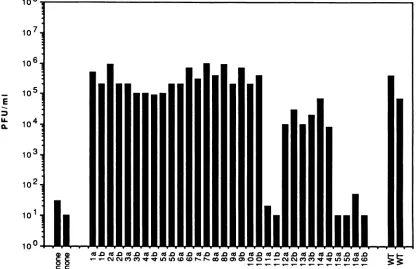
FIG. 1. Complementation ofd27-1 growth by mutant ICP27plasmids.Twoidentical cultures ofVerocells(2 x 10⁶cells)weretransfectedwith carrier DNAonly (labeled none,at left) orwith 8 p.gofWTICP27 plasmidpM27 (labeledWT, atright). Single cultures ofVerocells were
transfected with 8 ,ugeach of two isolates (a and b) of ICP27 mutantplasmids pMl through pM16 (labeled la through 16b). One dayafter transfection, the cultureswereinfected with the HSV-1 ICP27 deletionmutantd27-1 and incubated forafurther24hat37°C.Viruswasreleased from the cultures(10-mltotal volume) by three cycles offreeze-thawing and titrated by plaque assayonV27 cells.
the nucleotide alterations resulted in one or two amino acid substitutions in the encoded ICP27 protein. All the XhoI recognition siteswereintroducedintothesamereading frame, afeature that was intended tofacilitatethefuture construction ofin-frame deletion mutations in the ICP27coding region.
To determine whether any of the substitution mutations affectedanessential function ofICP27,we asked whether the plasmid-encoded proteins could complementthe growthofan HSV-ICP27 deletion mutant, d27-1 (36). Vero cells were transfected with carrier DNA only or with WT or mutant ICP27 plasmids. Foreach mutant, two independentlyderived plasmid isolates, designatedaandb,weretested. One dayafter transfection, the cultures were infected with d27-1 and incu-bated for anadditionalday. Theyieldofinfectious virusinthe cultures was then determined by plaque assay on V27 cells, derivatives of Vero cells which possess a stably transfected copy of the ICP27 gene and fully complement the growth of d27-1 and other HSV-1 ICP27 mutants(36).The results of this experimentareshown inFig.1.The plasmidmutantsappeared tofall into threecategories. The mutantspMl throughpM1O were as efficient as the WT plasmid in complementing the growth ofd27-1. The mutants pM12, pM13, and pM14 were moderatelydefective for ICP27 function, exhibiting an approx-imately 10-fold decrease in complementation activity. These mutants were not studied further. In contrast, the pMll, pM15, and pM16 mutants exhibited either very slight or no abilitytocomplementthegrowthofd27-1.The Ml1,M15, and M16 mutations therefore inactivate an essential function of ICP27.
In transfection assays, ICP27 can either transactivate or
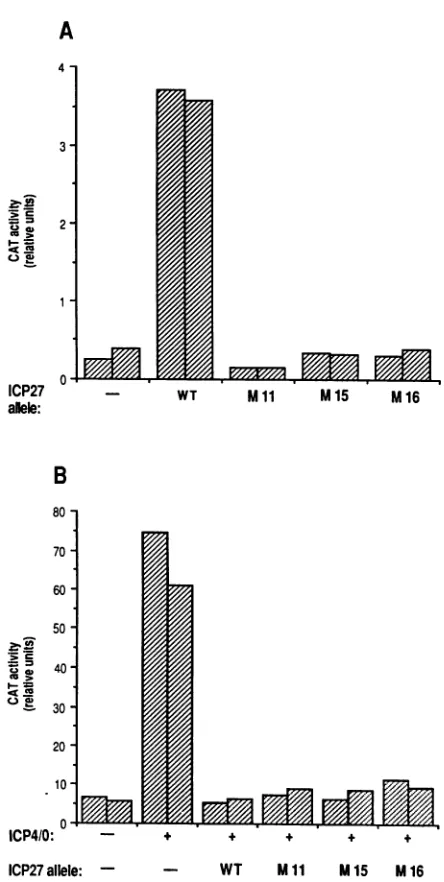
transrepresstheexpressionofcotransfected reporter genes(4, 9, 35, 43, 48). Since the virus complementation experiment demonstrated that the Mll, M15, and M16 mutants are defective in an essential lytic function, it was of interest to characterize the effect of thesemutations on the transactiva-tion andtransrepression activities. First,weaskedwhetherthe threeplasmidmutants wereable to transactivate gene expres-sion. The reporter geneused wasgBCAT(- 175), a construct previously shown to be responsive to ICP27 transactivation (35). The gBCAT(- 175) plasmid contains the HSV-1 glyco-protein B promoter driving expression of the CAT gene. In addition, this gene contains a 3' polyadenylation sequence which has been shown to confer ICP27 transactivation (42). Vero cells were transfected with pgBCAT(-175), with or without theWT ormutantICP27plasmids.Twodays later, the cells were harvested and testedforCATactivity (Fig. 2A).As expected, cotransfection with the WT plasmid significantly induced CAT expression. All three mutants, however, were unable to stimulate the expression of gBCAT(- 175). We conclude that the Mll, M15, and M16 mutations disrupt the transactivation activityofICP27.
We next tested the ability of the mutants to transrepress a cotransfected reporter gene. Although transrepression of re-porter genes can be mediated by ICP27 alone (4, 42), the transrepressionassayis oftencarriedoutinthe presenceof the HSV-1 transactivating protein ICPO and/or ICP4 (43, 48), whichgreatlystimulates manyHSV-1 promoters. Inthis case, ICP27canfully block the stimulationofcertainreporter genes byICP4and/or ICPO.The reporter gene we used was8CAT,a construct which contains the HSV-1 ICP8 promoter driving
on November 9, 2019 by guest
http://jvi.asm.org/
[image:4.612.100.517.79.348.2]A
4
-
3-Lu
I-Co NCL
ICP27
able:
0
WT M11 M15 M16
B
Zue
D
-a
0e
ICP4/0: 80
-70
-60
-50
-40
-30
-20
-10
-0-"
ICP27allele: - WT M11 M15 M16
FIG. 2. Ability of the Mll,M15, and M16 plasmidstoregulate the
expression ofcotransfected reportergenes. WTor mutant plasmids
were tested in transfection assays for the transactivation (A) or transrepression (B) functions of ICP27. (A) Transactivation assay.
Vero cell cultures were transfected in duplicate with 8 ,ug of
pgB-CAT(-175) plus, where indicated, 8 ,ug of WT or mutant ICP27 plasmids (-,noaddition). The cellswerecollected after2 days, and
relativeCATactivitiesweredetermined.Duplicatesamplesareshown asside-by-side bars. (B) Transrepressionassay.Verocell cultureswere
transfected induplicate with6 jigof p8CAT and, where indicated(+),
1,ugofpSG1 (17), encoding ICP4 andICPO. Where indicated,1,ugof theWITormutantICP27plasmidswasalso added (-,no addition). Analysisandrepresentation of CAT activities are asdescribed inthe
legendtopanel A.
expression of the CAT gene (48). This gene also contains a
downstream intron derived from the simian virus 40 small t antigengene.The presenceofthisintron has been correlated with the transrepression effect (42).The p8CAT plasmid was
transfected alone, with a plasmid expressing ICP4 and ICPO
(the ICP4/0plasmid),orwiththe ICP4/0 plasmid plusplasmids
expressing either theWT or mutantICP27genes. As shown in Fig. 2B, cotransfection of the ICP4/0 plasmid stimulated expression of 8CAT, and inclusion of a plasmid encoding
WT
ICP27 was able to block this effect. All three mutant plasmids showed a repression activity that wasequivalent tothat of theWIT plasmid. We conclude that the Mll, M15, and M16 mutations do not significantly affect the transrepression activity ofICP27.
Construction of viral mutants containing the Mll, M15, and M16 mutations. The experiments described above dem-onstrated that Ml 1,M15,and M16 mutationsspecifically affect the transactivation activity ofICP27.Therefore, the phenotype of viral recombinants bearing the Mll, M15, and M16 muta-tions should allow insight into the lytic funcmuta-tions that are mediated by this activity. We used a marker transfer protocol (36) to introduce the Mll, M15, and M16 mutations into the HSV-1 genome. Since our complementation analysis indicated that these mutations inactivated an essential function (Fig. 1), potential HSV-1 recombinants were isolated in
ICP27-comple-menting V27 cells.
To ensure that the intended mutations had been successfully introduced into the recombinant viruses, the mutant genomes were analyzed by Southern blotting (Fig. 3). In this analysis, we also included DNAs from WT strain KOS1.1 as well as d27-lacZl, the recipient genome used in the marker transfer, which has an insertion of the E. coli lacZ gene in the ICP27 gene (36). The viral DNAs were digested with PstI and hybridized with theWT 6.0-kbPstI fragment that contains the ICP27 gene (Fig. 3A and B). As expected, the
d27-lacZl
genome, because of its lacZ insertion, yielded an 8.3-kb PstI fragment (Fig. 3C, lane 1), while the WTfragment was 6.0 kb (lane 2). The
M11,
M15, and M16 genomes all yielded ICP27 gene PstI fragments that comigrated with the WT fragment (Fig. 3C, lanes 3 to 5), demonstrating that thed27-lacZ1gene had been replaced by alleles that were of the WT size. As expected, all of the viral genomes also yielded a common but less strongly hybridizing fragment which was derived from the opposite long repeated region-long unique region (RL-UL) junction (Fig. 3A). When the DNAs were digested with PstI and XhoI (Fig. 3C, lanes 6 to 9), the Mll, M15, and M16 genomes yielded two strongly hybridizing bands, demonstrat-ing the presence of the introduced XhoI sites. Furthermore, these fragments were of the expected sizes (Fig. 3B) and comigrated with the PstI-XhoI fragments from the donor plasmids used in the marker transfer (data not shown). These results demonstrate that the Ml1,M15, and M16 substitution mutations were successfully introduced into the recombinant viruses.To see whether the Mll, M15, and M16 mutants were defective for growth, we carried out a virus plaque assay. Although the mutants efficiently formed plaques on V27 cells, all three mutant virus stocks were unable to form plaques on Vero cells at any dilution tested (data not shown). Therefore, as expected, the Mll,M15, and M16 mutations are lethal. To more quantitatively assess the replication defects of the mu-tants, we carried out a single-cycle virus yield experiment. Parallel cultures of Vero or V27 cells were infected at a multiplicity of infection of 10 with either the substitution mutants, the ICP27 null mutant d27-1, or the WIT strain KOS1.1 and incubated for 24 h. Virus yield was determined by plaque assay on V27 cells. The results of this experiment (Table 2) indicated that theMl1,M15,and M16 mutants were severely restricted for growth in Vero cells, yielding less than 0.002 PFU per infected cell. The very low yields observed for the substitution mutants were at least 5 orders of magnitude less than theWTvirus yield in Vero cells. However, the yields
MMM,-FJA
WIMM-1on November 9, 2019 by guest
http://jvi.asm.org/
[image:5.612.69.291.71.512.2]RL UL RL Rs Us Rs
P- -.- \ P
B
C
kb
9.4-
6.7-
4.4-
2.3-
2.0-P 6.0 P
P X P
2.1 1 3.9
P 2.4 3.6
P 2.5 x 3.5
1 2 3 4 5 6 7 8 9
FIG. 3. IntroductionofMl,Ml5,and M16 mutations into
recom-binantHSV-1 genomes. (A) Representation of the HSV-1 genomne, includingtheregion encoding ICP27.Thedrawingatthetop illustrates the prototype arrangement of theHSV-1genome,while theexpanded drawing below shows the 6.0-kb PstI (P) restrictionfragmentwhich contains theICP27gene.The solid lines denotelongandshortunique (ULandUs)regionsof the viralgenome,and theopenbarsrepresent longand shortrepeated regions (RLandRs).Thearrowdenotes the ICP27 coding region. (B)Structure of theICP27-encodingPstI restric-tion fragment from WT or mutant genomes. Restriction sites are
indicated(P, PstI; X, XhoI),aswellasthesizes of restrictionfragments
in kilobase pairs. (C) Southern blotting analysis of mutant viral genomes.ViralDNAs fromd27-lacZ1(lacZl) (lane 1), WT KOS1.1 (WT) (lanes2and6), Mll (lanes3 and7),M15,(lanes4and8),and M16(lanes 5 and 9)weredigestedwith PstIalone(lanes 1to5)orwith both PstI and XhoI(lanes6to9)andsubjectedtoSouthernblotting. Thefilterwasprobedwith 32P-labeled DNA fromaplasmid containing the WT6.0-kbPstI restrictionfragmentshown inpanelB. Shownat
the leftarethepositions of DNA size standards. Notethatforeach digestion,all viralDNAsyielda commonandmoreweaklyhybridizing
fragmentwhich isderivedfromtheopposite RL-UL junction.
of the substitution mutants were measurably higher (10- to 40-fold higher) than the yield observed for the null mutant d27-1. Allthreesubstitutionmutants,aswellasd27-1,yielded nearWTlevelsofprogenyviruswhenthe viral infectionswere
carried out in V27 cells. This result demonstrates that the replicationdefectof the Mll, M15,andM16mutantscanbe efficiently complemented by expression of the WT ICP27 proteinfrom V27 cells.
TABLE 2. Growthpropertiesof HSV-1 ICP27 mutants
Virusyield(PFU/cell)' in cellline:
Virus
Vero V27
d27-1 <0.000045 80
M11 0.0019 36
M15 0.00043 33
M16 0.0014 36
KOS1.1 190 100
WT aVero cells (2.2 x 10⁶)wereinfected at amultiplicity of infection of 10PFU
percell. Thesameinoculawereusedtoinfectparallel culturesof2.5 x 106V27
cells. The cultures were harvested at 24hpi,and virusyieldwasdeterminedby
M11 plaqueassay on V27 cells.
M15 Phenotypic characterization of the Mll, M15, and M16
viral mutants. We next carried out experiments to identify M16 which aspects of viral replicationwere altered in Vero cells
infected with theM11, M15,andM16mutants.Previouswork has implicated ICP27inboth the enhancement of viral DNA synthesisand theregulationofgeneexpression duringthe late phase ofinfection (26, 29, 36, 38, 41). Therefore, we carried
outexperimentstoexamine both of theseprocesses.
First,wecharacterizedtheabilityof eachmutanttoreplicate its DNA. Verocells were mock infected orinfected with the WT virusorICP27mutants.Ascontrols,weincludedanICP27
null mutant, d27-1, and an ICP27 nonsense mutant, n504R. Then5O4Rmutant,whichencodes anICP27moleculelacking its 12 C-terminal residues, shows the WT level of DNA synthesis but shows altered late-gene expression (36). The cultures were labeled with [3H]thymidine from 6 to 12 h postinfection (hpi),atwhichtime total DNAwaspurifiedfrom each culture. Equal amounts of DNAwere digestedwith the riztrir_tin em7vmec. F,rRTFR nd XhnTa ind electronhoresed on anagarosegel.Thelabeled DNAswerevisualizedby
fluorog-raphy (Fig. 4).Asexpected,thed27-1-infected culture showed
T -0
2- Z 2- -0 E
FIG. 4. Viral DNA replication in ICP27 mutant-infected cells. Verocellsweremockinfectedorinfected with the viruses indicatedat
the top. The cellswerelabeledwith [3H]thymidinefrom 6 to12hpi. Total DNAwasthenpurified, andequalamountsweredigestedwith EcoRIplusXbaIandelectrophoresedon a0.9%agarosegel.Thegel
wasprocessedforfluorography, dried,andexposedtoX-rayfilm.The n504RgenomecontainsanXbaIsiteatthe 3'end of theICP27gene
(36) and therefore gives rise to a novel EcoRI-XbaI restriction fragment.
A
on November 9, 2019 by guest
http://jvi.asm.org/
[image:6.612.59.297.76.433.2] [image:6.612.317.557.90.169.2] [image:6.612.364.510.454.637.2]-5 -6 -8
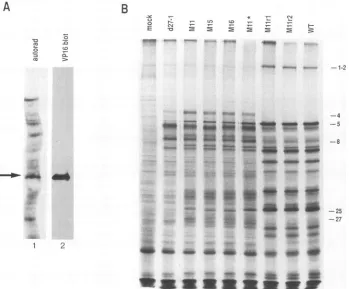
25
- 27
FIG. 5. Protein expression in ICP27 mutant-infected cells. Vero cellsweremock infected orinfected with the viruses indicated atthe
top.Thecellswerelabeled with [35S]methionine-cysteine from 6to 12 hpi and then harvested. Equal fractions of each cell lysate were
analyzedby SDS-PAGE and autoradiography. Shown atthe rightare
the positions of several known HSV-1 proteins (ICP designations are
indicated). An unknown protein of -80 kDa which accumulates in
M11-, M15-, and M16-infected cells is indicated by an asterisk.
low levels of DNAreplication, consistent with the knownrole ofICP27 in the enhancementofviral DNA synthesis, and the n504R culture showed the WT level of DNA synthesis. All three substitutionmutantsalsoshowed WTlevelsofviral DNA
replication.Therefore, the Mll, M15, and M16 mutations do
notappear toaffect theabilityofICP27 toenhance viralDNA
replication.
Wenextexaminedviral lategeneexpression in cellsinfected with the Mll, M15,and M16 mutants. First,we examined the production of viral proteins during the mid-to-late phase of infection. As before, the d27-1 and n5O4R viruses were in-cluded in the analysis. Infected Vero cells were labeled with
[35S]methionine-cysteine from 6 to 12 hpi, and the labeled
proteins were analyzed by SDS-PAGE and autoradiography.
The results of this experiment (Fig. 5) demonstrated that the Mll, M15, and M16mutants all expressvery similar patterns of proteins at late times after infection. This pattern was
characterizedbyenhancedexpression, comparedwith the WT
infection, of a proteins (including ICP4 and the ICP27 polypeptide itself) and, to a lesser extent, ofa proteins (in
particular, ICP8). Of interest was the finding that the three substitutionmutants,andtoalesserextentn5O4R, appearedto
expresshigher levels ofICP4from 6to 12hpi than didthenull
mutant, d27-1, which was previously shown to overexpress ICP4 relative to the WT virus (36). The other common alteration exhibited by the Ml1, M15,and M16 mutants was a deficiency in the expression ofseveral y proteins. Proteins of the y-I kinetic class, such as ICP5 and ICP25, were slightly reduced in abundance, whereas at least one y-2 protein, ICP1-2 (30),was notdetectable.
The pattern of gene expression exhibited by the Ml 1, M15, and M16 mutants from 6 to 12 hpi was very similar to thatof the previously characterized n504R mutant. However, there were some significant differences. In particular, we noted that all three substitution mutants, but not n504R, expressed very high levelsof an -80-kDa protein (indicated by an asterisk in Fig. 5).The identityofthisproteinis unknown but iscurrently under investigation.
Althoughthe patternsoflateproteins expressedbythethree substitution mutants were quite similar to each other, MI I differed from M15and M16withrespect to twoproteins. First, the ICP25 protein expressed in M1l-infected cells had a slightly slower electrophoretic mobility than it did in all the other infections. This was intriguing, since the ICP25 protein (also known as VP16, Vmw65, and c-TIF) is an important regulatory and structural protein, and ICP27 is knownto have an effect on the electrophoretic mobility of at least one other viral protein, ICP4 (29, 35, 48). The identity of this protein as ICP25 (VP16)wasconfirmed by immunoblotting with a VP 16-specific antiserum (Fig. 6A). The second difference between the M11 protein pattern and that ofMi5 and M16 concerned the ICP27 protein itself. Although all three substitution mu-tants overexpressed ICP27, M1l-infected cells expressed somewhat higher levels of ICP27 from 6 to 12 hpi than did either M15- or M16-infected cells.
To see whether the two differences described above were due tothe M1I mutation, a marker rescue analysis was carried out. Viruses showingWT growthin Vero cells were generated by marker rescue of the Mll mutation with WT ICP27 gene restriction fragments derived from clonedplasmid DNAs (see Materials and Methods for details). Two independently res-cued viruses, designated Mllrl andMllr2, wereisolated. We then carried out a protein-labeling experiment tocomparethe protein expression patterns at late times after infection in Mll-, Mllrl-, and Mllr2-infected cells. The infected Vero cells were labeled with [35S]methionine-cysteine from 7 to 8 hpi and analyzed by SDS-PAGE (Fig. 6B). The Mllrl and Mllr2viruses were nearlyindistinguishable from theWTvirus in their patterns of late viral protein synthesis, demonstrating that the major alterations in gene expression observed in Mll-infected cells result from the ICP27 gene mutation in MI1. This included the effect on expression ofICP27 itself, as the Mllrl- and Mllr2-infected cells showed normal down-regulation of ICP27 expression at late times after infection (Fig. 6B and data not shown).
However, careful inspection of the autoradiogram shown in Fig. 6B and those from a repeat experiment revealed that Ml lrl- and Mllr2-infected cells expressed an ICP25 protein that migrated with the same slow electrophoretic mobility as the MII ICP25 protein. We conclude that the alteration in ICP25 (VP16) electrophoretic mobility seen in the Ml1 mu-tant is not due to the Ml I mutation but isdue to an unrelated secondary mutation, most likely in the ICP25 gene itself. It is important to note that the Mllrl and Mllr2 rescuants show WT growth in Vero cells and express a pattern of late viral proteins that is extremely similar to the WT pattern. There-fore, the secondary mutation in M11 does not appear to contribute in a significant way to itsmutant phenotype.
Our protein expression experiments demonstrated that at
on November 9, 2019 by guest
http://jvi.asm.org/
[image:7.612.106.258.75.395.2]830 RICE AND LAM
A
B
_
o
E P _ U)
E ME
c J
ID 3
co
o0 QS0.01
~~~~~~~~~~~~~~~~~~~~~~~~~~~
x vK5t; X 0 t AN HX ~4~ -1-2
-5
-25
-27
FIG. 6. Analysisofprotein expressionincells infected withMllormarker-rescuedderivatives ofMll.(A)VP16immunoblot.A35S-labeled protein sample from WT-infected cells was subjected to immunoblottingwith a VP16-specificantiserum. Lane 1 is an autoradiograph of the immunoblot filter (overnight exposure) showingall of the labeled proteins, including the protein we designate ICP25 (arrow). Lane 2 shows detection ofVP16(ICP25) onthesamefilterby immunoblottingwithanenhancedchemiluminescence detectionsystem
(10-mmn
exposure). (B) Proteinexpressionininfected cells.Verocellsweremockinfectedorinfected with the viruses indicatedatthetop.Theinfected cellswerelabeled with[35SJmethionine-cysteine
from7to8hpiandanalyzed bySDS-PAGE andautoradiography.Ml1*referstoapoolof unrescuedMl progeny from thesamemarkerrescuetransfection that gave risetoMllrland Mllr2.Thepositionsof several known HSV-1 proteinsareindicated(ICP designations)ontheright.least one y-2protein, ICP1-2, was not inducedto detectable extents in the Mll, M15, and M16 infections, despite WT levels of viral DNAsynthesis. We havepreviouslyshownthat the expression of another y-2gene, that encoding the glyco-proteinC(gC), is also dependentuponICP27(36).Inthecase of thegCgene, wedemonstratedthat1CP27isrequired for the appearanceofmaturegCmRNA.Furthermore,wefound that gCmRNAisnot inducedinn504Rinfections, indicating that anintact ICP27 C terminus is required for gCmRNA induc-tion.To seewhethergCmRNA was expressed inMll, M15, and M16 infections, wecarried outNorthern blotting experi-ments. Vero cells were mock infected or infected with WT virus orICP27 mutants. CytoplasmicRNA was isolated from infectedVerocellsat10hpi, and equal amounts were electro-phoresedondenaturing agarosegelsandtransferredtonylon filters.Hybridizationwasfirst carriedoutwitha probespecific fora
P
gene,thatencoding ICP8(Fig. 7A). Consistentwith the protein analyses, the Ml1, M15, and M16 mutants expressed higher levels of ICP8mRNA atlate times after infection than didthe WT virus. However, when hybridizationwascarriedout with the -y-2gCprobe,wefound that theM11,M15,and M16 mutants, like n504R and d27-1, were unable to efficiently induce expression of gC mRNA. Comparison of different autoradiographicexposures ofthis blot demonstrated that the level ofgCmRNAin the Mll, M15, and M16infectionswas_
c lr U) cO
6
E;
- e- va * JY _ fiS, _
A
-
ICP8
[image:8.612.135.484.81.370.2]B
t:
gc
f iS Xt 2 |
FIG. 7. Defective accumulation of -y-2 gC mRNA in ICP27 mutant-infected cells. Vero cells were mock infected or infected with the viruses indicatedatthe top.CytoplasmicRNA wasisolatedat10hpi, andequalamounts(10 ,ug)weresubjectedtoNorthern blotanalyses using32P-labeled probesspecificforICP8 mRNA(A)orgCmRNA (B).
J. VIROL.
on November 9, 2019 by guest
http://jvi.asm.org/
[image:8.612.322.558.516.661.2]reduced more than 30-fold compared with the level found in the WT infection.
DISCUSSION
Isolation of plasmids with amino acid substitution muta-tions which inactivate ICP27. Several of the regulatory pro-teins encoded by DNA viruses replicating in the cell nucleus have been shown to be composed of multiple and in some cases
independentfunctional domains. Well-characterized examples include the adenovirus ElA proteins (11) and the simian virus 40largeTantigen (10). Such multifunctional proteins may be acommonfeature of these viruses, which have limited coding
capacity but must interact with, and in some cases modify, multiple components of the infected cell nucleus. The existing data suggest that ICP27 is also a multifunctional regulatory
protein, affecting both HSV-1 DNA replication and gene
expression.
Inthe present study, we have engineered a set of 16 mutant
plasmidsthat contain nucleotide substitution mutations spaced at semiregular intervals throughout the ICP27 coding region. These mutants were constructed with two aims in mind. The firstwastocreate a set of plasmid reagents that could be used in the future to construct additional plasmids containing in-frame deletions. The 16 mutations were designed so that all create XhoI restriction sites in a common reading frame.
Therefore, any two plasmids can be used to engineer a third
plasmidwhich contains an in-frame deletion between the two
parental XhoI sites. We have already used this strategy to construct and characterize an HSV-1 mutant which bears an in-frame deletion near the N terminus ofICP27 (38). More
recently, we have isolated several additional recombinant
viruses possessing in-frame deletion mutations in the ICP27 gene (37).
The second aim in constructing the nucleotide substitution mutants was to gain further insight into the structure and function of ICP27. We reasoned that amino acid substitution mutations in ICP27 might be interesting for a number of reasons. First, although temperature-sensitive (ts) mutants mutated in ICP27 have been obtained, no nonconditional lethalmutants resulting from substitution mutations have been isolated. Unlike ts mutants, substitution mutants of the type we have generated are not constrained to function under any conditions andmight therefore displayphenotypes not exhib-ited by conditional mutants. Second, amino acid substitution mutantsare lesslikely to disrupt ICP27 tertiary structure than
previously isolated insertion (20), deletion (29, 38), or non-sense (29, 36) mutants and therefore might lead to more
specific
phenotypic effects. Indeed, as discussed below, the M15 mutation is associated with a different phenotype in cotransfection assays than is a linker insertion mutationmap-ping at the same site. Finally, recombinant viruses bearing substitution mutations in ICP27 may be useful in the future for
isolatingsecond-site reversion mutants. Suchrevertants can be
extremely helpful in defining intramolecular protein interac-tions and insomecasescandisplay alteredphenotypes which areinformative(44).
Of the 16mutations weengineered, only the mutations in the C-terminal half of ICP27 affected its essential functions. Our resultsare reminiscent of those of Hardwicke et al. (20), who found that linker insertion mutations in the C-terminal, butnot N-terminal, half of ICP27 affected its gene regulatory functions in transfected cells. It thus appears that the N-terminal half ofICP27 is more tolerant of amino acid substi-tutions or short insertions than is the C-terminal half. How-ever, the N-terminal half of ICP27 is required for ICP27's
regulatory activities, because a viral mutant bearing an in-frame deletion near theN terminus of the
ICP27
coding region fails toreplicate in Vero cells (38). These observations under-score the importance ofanalyzing different types of mutations when studying protein structure and function.Location of the transrepression function of
ICP27.
In co-transfection assays,ICP27
can mediate both gene transactiva-tion and transrepression. A number of studies have been carried out withICP27plasmid mutants to map the regions of ICP27 which are involved in these two activities (20, 29, 39). While most of the data suggest that the C-terminal half ofICP27 is critical for transactivation, there are some apparent discrepancies concerning which regions are involved in trans-repression. For example, on the basis of the phenotype of a number of linker insertion mutants, Hardwicke et al. (20) have proposed that the repression activity of
ICP27
maps to the C-terminal 78 residues (residues 434 to 512). However, both we (39) and McMahan and Schaffer (29) have found that a truncated ICP27 molecule not containing the C-terminal 106 residues could mediate either complete (39) or partial (29) transrepression. These results suggest that the transrepression function maps to sequences N terminal to residue 406. Con-sistent with this idea, we recently found that deletion of an acidic region at the N terminus ofICP27
significantly de-creased its transrepression activity (38).The results of this study are relevant to the location of the transrepression region ofICP27. The Mll,
M15,
and M16 plasmid mutations, which map at codons 340 and 341, 465 and 466, and 488, respectively, inactivate the transactivation func-tion of ICP27, consistent with previous mutational analyses (20, 29, 39). However, the Mll, M15, and M16 mutations do not affect transrepression. It is noteworthy that theM15
and M16 mutations fall in the C-terminal region where linker insertion mutations inactivate transrepression function (20). In fact, the M15 mutation maps at the same site as the linker insertion mutation S2 described by Hardwicke et al. (20), a mutation which causes a four-residue insertion between amino acids 465 and 466. Thus it would appear that substitution mutations in the C-terminal 78 residues can inactivate trans-activation without affecting transrepression, whereas small insertions in the same region lead to inactivation of both activities. Recent analysis of the ts mutation in the HSV-1 ICP27 ts mutant tsLG4 is consistent with this idea. This mutation was recently identified as a point mutation which alters codon 480 (47). In transfection assays, the ICP27 allele of tsLG4 is defective at high temperature for transactivation but not transrepression (20).Two hypotheses that would reconcile most of the existing dataconcerningthe location of the transrepression region can be advanced. First, as suggested by McMahan and Schaffer (29), ICP27 might contain two regions which can mediate transrepression. A second explanation, which we raise here,is that certain types of mutations in the C-terminal 78 residues can interfere with a transrepression activity which maps else-where in the molecule. We postulate that mutations which have this effect are those that cause significant structural alterations to the C-terminal region, as would be expected for linker insertion mutations. In this model, the C-terminal region ofICP27 would not be required for transrepression but could have a modulatory role in some circumstances. Further muta-tional studies are required to test these and other hypotheses. The role of the transactivation function during HSV-1
infection. We have previously presented evidence which sug-gests that ICP27 carries out two distinct functions duringthe HSV-1 infection which together result in the transition from the ,3 to the yphase (36, 38). We proposed that one activity
on November 9, 2019 by guest
http://jvi.asm.org/
acts to enhance viral DNAreplication approximately 10-fold, indirectly stimulating the expression of all y genes. A second activity appears to directly affect gene expression, independent ofDNAreplication, resulting inthe stimulation ofcertain y-2 genes and therepression ofot and a genes.
Intransfection assays,ICP27 alsocarriesout two regulatory activities. One activity acts to transactivate gene expression, whiletheother acts to transrepressgene expression. A critical question is how the transactivation and transrepression func-tions of ICP27, defined in cotransfection assays, relate to ICP27'sactivities in lytically infected cells. Previous studies of ICP27 deletion and nonsense mutations in the context of recombinant viruses have not been totally conclusive,since the viral mutantshave hadmultipleandcomplex phenotypes,most often including defectsin bothviral DNAreplication andviral gene regulation (29, 36).
The Ml1, M15, and M16 mutants are informative in this regard. These substitution mutations are less likely than pre-viousmutations todisruptICP27 proteinstructure. In cotrans-fection studies, all three mutations disrupt the transactivation activity of ICP27 but haveno demonstrable effect on transre-pression. In the context of recombinant viruses, the three mutationsall lead to acommonphenotypewhichis character-izedby severaldefects in viral geneexpression. These include afailure to down-regulate a and 1 genes and an inability to induceseveral-y-2genes.Therefore, duringviralinfection, the transactivation activity of ICP27 acts to mediate the essential gene regulation function which we previously attributed to ICP27 (38). The term transactivation may be a misnomer, becausein infectedcells thisactivity is requiredfor both gene repression and activation. However, atpresentwedonotknow whether the gene repression mediated by ICP27 in infected cells is direct orindirect. It ispossible that the direct transac-tivation of y genes by ICP27 leads indirectly to the down-regulation of(x and 13 genes.
It is important to note that the Mll, M15, and M16 viral mutants replicate their DNA to WT levels. Therefore, the transactivation activity is not required for ICP27's ability to enhance viral DNA replication. Our work thus supports and extendsprevious studieswhich suggest that ICP27 carries out two distinct regulatory activities during the HSV-1 infection (36, 38).
In transfection assays, the transactivation activity ofICP27 correlateswith the presenceofcertainpolyadenylation signals in the reporter genes, suggesting that ICP27 regulates these genes at aposttranscriptional level (6, 42). By inference, then, therepression of ox and 13genesandthe induction of y-2genes during HSV-1 infection may be mediated by posttranscrip-tional mechanisms which are dependent on polyadenylation signals. This hypothesis is consistent with the recent observa-tionthat ICP27 isrequired for the induction ofLPF, afactor that selectively increases RNA 3'-end processing at an HSV latepolyadenylationsite(28).However, it should be noted that ICP27 has also been reported to affect thetranscription rates of viralearly andlate genes (26, 46). Furtherexperimentation isrequiredtodetermine the mechanismsby which a, 1,and y genes are regulatedby ICP27 in infected cells.
Our studies shed light on the role that the transactivation function of ICP27 plays during the lytic HSV-1 infection. However, it isnot yet clear what role, if any, the transrepres-sion activity plays. One interesting possibility is that the transrepression function isinvolved in ICP27's ability to stim-ulate viral DNA replication. However, at present it is not possible to carry out a genetic study analogous to the one described here. This is because, to date, no ICP27 plasmid mutants have been described which are fully competent for
transactivation but are defective fortransrepression. Further-more, if the transrepressionfunctiondependsin somewayon the transactivation function, it maybe impossible togenerate such mutants. However, the M15 mutation may provide a strategy to gain insight into thetransrepressionphenomenon. On thebasis ofthe results of Hardwickeetal. (20),weexpect that a linker insertion derivativeof M15 will be defective for both transactivation and transrepression. If so, we plan to generateanHSV-1recombinant virus thatbearsthismutation and compareitsphenotype withthatofM15.Thiscomparison should elucidate the role of the transrepression function of ICP27.
ACKNOWLEDGMENTS
We aregrateful to Steve Weinheimer (Bristol-MyersSquibb) for the generousgift ofVP16antisera, toNancy Mah forhelp withsomeof the plasmid constructions, toWendy Eamon for performinghelpful relatedexperiments, and to Leslie Schiff, Wendy Eamon, and Bruce Stevenson fordiscussion, critique, and advice. Thanks alsotoLeslie Schiff andWendyEamonfor criticalreviews of themanuscript.
This research was supported by an operating grant from the National Cancer Institute of Canada (NCIC) and an establishment grant from the Alberta Heritage Foundation for Medical Research (AHFMR) to S.A.R. S.A.R. was supported by a Terry Fox Team Development award from the NCIC and a scholarship from the AHFMR.
REFERENCES
1. Ackermann, M.,D.K. Braun,L.Pereira, andB.Roizman.1984. Characterization ofherpessimplex virus type 1aproteins 0, 4, and 27with monoclonal antibodies. J. Virol. 52:108-118.
2. Albrecht, J.-C., J. Nicholas,D.Biller, K. R. Cameron,B.Biesinger, C.Newman, S.Wittman,M. A.Craxton,H.Coleman,B. Flecken-stein,and R. W.Honess.1992. Primarystructureof the
herpesvi-russaimiri genome. J. Virol. 66:5047-5058.
3. Ausubel, F., R. Brent, R. Kingston, D. Moore, J. Seidman, J. Smith,and K. Struhl (ed.). 1987. Currentprotocolsinmolecular biology, p. 3.5.9-3.5.10. John Wiley & Sons, Inc., New York. 4. Block, T.,and R.Jordan. 1988. Herpessimplex virus type 1 (x gene
containing plasmidcaninhibitexpression regulatedfromanalpha promoter in CV-1 butnotHeLacells. Virus Res. 11:269-279. 5. Bradford, M. M. 1976. A rapid and sensitive method for the
quantitation of microgram quantities of protein utilizing the principle of protein-dye binding. Anal. Biochem. 72:248-254. 6. Chapman, C. J., J. D.Harris, M. A. Hardwicke,R. M.
Sandri-Goldin,M. K. L.Collins,and D. S. Latchman. 1992. Promoter-independent activation of heterologous virus gene expression by theherpessimplexvirusimmediate-earlyproteinICP27.Virology 186:573-578.
7. Davison, A. J., and P. Taylor. 1987. Genetic relations between varicella-zoster virus and Epstein-Barr virus. J. Gen. Virol. 68:
1067-1 079.
8. DeLuca,N.A.,A. M.McCarthy,and P. A.Schaffer. 1985. Isolation andcharacterization of deletionmutantsofherpessimplexvirus type I in the gene encoding immediate-early regulatory protein ICP4.J.Virol. 56:558-570.
9. Everett,R. D. 1986.The productsofherpes simplexvirus type 1 (HSV-1) immediate-early genes 1, 2, and 3 can activate gene expression in trans.J. Gen.Virol. 68:2507-2513.
10. Fanning, E., and R. Knippers. 1992. Structure and function of simian virus 40largeTantigen.Annu. Rev. Biochem.61:55-85. 11. Flint, J.,and T.Shenk. 1989.Adenovirus ElAprotein: paradigm
viral transactivator.Annu. Rev.Genet. 23:141-161.
12. Frink, R.J., R.Eisenberg, G. Cohen, and E. K. Wagner. 1983. Detailedanalysisof theportionof theherpes simplexvirus type1 genomeencoding glycoproteinC. J. Virol. 45:634-647.
13. Gao, M.,and D. M. Knipe. 1989. Genetic evidence for multiple nuclear functions of the herpes simplexvirus ICP8DNA-binding protein.J. Virol.63:5258-5267.
14. Gao, M.,and D. M.Knipe. 1993. Intragenic complementation of
on November 9, 2019 by guest
http://jvi.asm.org/
herpessimplex virus ICP8 DNA-binding proteinmutants.J.Virol. 67:876-885.
15. Godowski,P.J., and D. M. Knipe. 1983. Mutations in the major DNA-binding protein of herpes simplex virus type 1 result in increased levels of viralgeneexpression. J. Virol. 47:478-486. 16. Godowski,P. J.,and D. M.Knipe.1986.Transcriptional control of
herpesvirusgeneexpression:gene functionsrequired for positive
andnegative regulation. Proc. Natl. Acad. Sci. USA 83:256-260. 17. Goldin, A.L.,R.M.Sandri-Goldin, M. Levine, and J. C. Glorioso.
1981.Cloning of herpes simplex virustype1sequences
represent-ing the whole genome.J. Virol. 38:50-58.
18. Gorman, C. M., L.F. Moffat, and B. H. Howard. 1982.
Recombi-nantgenomeswhichexpresschloramphenicolacetyltransferasein mammalian cells. Mol. Cell. Biol. 2:1044-1051.
19. Graham,F. L., and A. J. VanderEb. 1973. Anewtechnique for the assayof human adenovirus5 DNA. Virology 52:456-467.
20. Hardwicke,M. A., P.J.Vaughn,R.E.Sekulovich,R. E.O'Connor, and R. M. Sandri-Goldin. 1989. The regions important for the activator andrepressorfunctionsofherpes simplexvirustype1 a protein ICP27maptothe C-terminalhalfof themolecule.J.Virol. 63:4590-4602.
21. Honess, R.W., and B. Roizman.1974. Regulationofherpesvirus macromolecularsynthesis.I.Cascaderegulationof thesynthesisof threegroupsof viralproteins.J. Virol. 14:8-19.
22. Hughes, R. G., and W. H. Munyon. 1975.Temperature-sensitive
mutantsofherpes simplexvirustype1defective inlysisbutnotin transformation. J. Virol. 16:275-283.
23. Kattar-Cooley, P., andK. W. Wilcox.1989.Characterizationof the DNA-bindingproperties of herpes simplexvirus regulatory pro-tein ICP4. J. Virol.63:696-704.
24. Knipe, D. M., andA. E. Spang. 1982. Definition ofa seriesof
stages in theassociationoftwoherpesviralproteinswith the host cell nucleus.J. Virol. 43:314-324.
25. Maniatis, T., E. F. Fritsch, and J. Sambrook. 1982. Molecular cloning: a laboratory manual. Cold Spring Harbor Laboratory, ColdSpring Harbor,N.Y.
26. McCarthy, A. M., L. McMahan,andP.A.Schaffer. 1989.Herpes simplex virus type 1 ICP27 deletion mutants exhibit altered
patternsoftranscriptionand areDNAdeficient. J. Virol. 63:18-27.
27. McGeoch,D.J.,M. A.Dalrymple,A.J. Davison,A.Dolan,M.C. Frame, D.McNab, L.J.Perry, J.E.Scott,and P.Taylor.1988. The completeDNAsequenceof thelongunique regioninthegenome
ofherpessimplexvirus type 1. J. Gen. Virol. 69:1531-1574. 28. McLauchlan,J.,A.Phelan,C.Loney,R. M.Sandri-Goldin,and
J. B. Clements. 1992. Herpes simplex virus IE63 acts at the posttranscriptionalleveltostimulate viral mRNA 3'processing.J. Virol. 66:6939-6945.
29. McMahan, L., and P. A. Schaffer. 1990. The repressing and enhancingfunctions of theherpessimplexvirusregulatoryprotein ICP27maptothe C-terminalregionsandarerequiredto modu-late viralgeneexpressionveryearlyininfection. J. Virol. 64:3471-3485.
30. McNab,D.S.,and R.J. Courtney. 1992. Characterizationof the
largetegument protein (ICP1/2) ofherpes simplexvirus type 1.
Virology190:221-232.
31. Michael,N.D.,D.Spector,P.Mavromara-Nazos,T.Kristie,and B. Roizman. 1988. The DNA-binding properties of the major regulatory proteina4ofherpes simplexvirus. Science 239:1531-1534.
32. Nicholas, J., U.A. Gompels, M. A.Craxton,and R. W. Honess. 1988.Conservation ofsequenceandfunction between theproduct of the 52-kilodalton immediate-earlygeneofherpesvirus saimiri
and the BMLF1-encoded transcriptional effector (EB2) of Ep-stein-Barr virus. J. Virol. 62:3250-3257.
33. Paterson,T.,andR. D. Everett. 1988. Mutational dissection of the HSV-1 immediate-early protein Vmwl75 involved in transcrip-tionalactivation andrepression. Virology 166:186-196.
34. Preston,C.M.1979. Control ofherpessimplexvirus type 1 mRNA synthesisincellsinfectedwithwild-typevirusorthe temperature-sensitivemutanttsK. J. Virol. 29:275-284.
35. Rice,S.A.,andD. M.Knipe. 1988.Gene-specifictransactivation by herpes simplexvirus type 1aprotein ICP27.J.Virol. 62:3814-3823.
36. Rice, S. A., and D. M. Knipe. 1990. Genetic evidence for two
distinct transactivation functions ofthe herpes simplex virus a
protein ICP27.J. Virol.64:1704-1715. 37. Rice,S.A.,and V. Lam.Unpublisheddata.
38. Rice, S.A.,V. Lam, and D. M. Knipe. 1993. The acidic amino-terminalregionofherpessimplexvirustype1alpha
protein
ICP27 isrequiredforanessentiallyticfunction. J. Virol.67:1778-1787. 39. Rice,S.A.,L.Su,andD. M.Knipe.1989.Herpessimplexvirusaprotein ICP27possesses separablepositive andnegative
regula-toryactivities. J. Virol.63:3399-3407.
40. Roizman, B.,andA. E. Sears. 1990.Herpessimplexviruses and theirreplication,p. 1795-1842. In B. N. Fields and D. M.Knipe
(ed.),Fundamentalvirology. RavenPress,NewYork.
41. Sacks,W. R.,C.C.Greene,D. P.Aschman, and P. A. Schaffer. 1985.Herpessimplexvirustype IICP27isanessentialregulatory
protein.J. Virol.55:796-805.
42. Sandri-Goldin, R. M., and G.E. Mendoza. 1992. Aherpesvirus
regulatoryproteinappearsto act
post-transcriptionally
byaffectingmRNAprocessing. Genes Dev. 6:848-863.
43. Sekulovich,R.E.,K. Leary,and R. M.Sandri-Goldin.1988. The herpes simplex virus type 1 a protein ICP27 can act as a
trans-repressoror atrans-activator incombinationwith ICP4 and ICPO.J. Virol.62:4510-4522.
44. Shepard,A.A.,and N. A. DeLuca.1991. Asecond-siterevertantof
a defective herpes simplex virus ICP4
protein
with restored regulatory activities and impaired DNA bindingproperties.
J. Virol.65:787-795.45. Shepard, A. A., A. N. Imbalzano, and N. A. DeLuca. 1989.
Separation ofprimarystructuralcomponents
conferring
autoreg-ulation,transactivation, andDNA-bindingproperties
tothe her-pessimplexvirustranscriptionalregulatoryproteinICP4. J. Virol. 63:3714-3728.46. Smith,I. L., M. A.Hardwicke, and R. M. Sandri-Goldin. 1992. Evidence that the herpes simplex virus immediateearly
protein
ICP27actspost-transcriptionally duringinfectiontoregulategeneexpression. Virology186:74-86.
47. Smith, I. L., R. E. Sekulovich, M. A. Hardwicke, and R. M. Sandri-Goldin. 1991.Mutationsin theactivation
region
ofherpes
simplexvirusregulatoryproteinICP27can betransdominant. J. Virol.65:3656-3666.48. Su, L., and D. M. Knipe. 1989. Herpes
simplex
virus aprotein
ICP27caninhibitoraugment viral genetransactivation.Virology 170:496-504.
49. Telford,E.A.,M.S.Watson,K.McBride,andA.J.Davison.1992. The DNAsequence ofequine herpesvirus-1. Virology 189:304-316.
50. Watson, R.J.,andJ. B. Clements.1980. Aherpes simplexvirus type 1functioncontinuouslyrequiredforearlyand late virus RNA
synthesis.Nature
(London)
285:329-330.51. Weinheimer,S.P.,B. A.Boyd,S. K. Durham,J.L.Resnick,and D.R.O'BoyleII. 1992. Deletionofthe VP16 open
reading
frame ofherpessimplexvirustype 1.J.Virol. 66:258-269.52. Wilcox,K.W.,A.Kohn, E.Sklyanskaya,and B.Roizman. 1980. Herpessimplexvirus
phosphoproteins.
I.Phosphate
cycles
onand offsomeviralpolypeptidesandcanaltertheiraffinity
for DNA. J. Virol. 33:167-182.53. Zhao,Y.,V.R.Holden,R.N.
Harty,
andD.J.O'Callaghan.1992. Identification and transcriptional analyses ofthe UL3 and UL4 genes of equine herpesvirus 1, homologs of the ICP27 andglycoproteinKgenesofherpessimplexvirus. J. Virol. 66:5363-5372.