This is a repository copy of Quasimonotone Graphs.
White Rose Research Online URL for this paper:
http://eprints.whiterose.ac.uk/131000/
Version: Accepted Version
Proceedings Paper:
Dyer, M and Muller, H (2018) Quasimonotone Graphs. In: Graph-Theoretic Concepts in
Computer Science. 44th International Workshop on Graph-Theoretic Concepts in
Computer Science, 27-29 Jun 2018, Cottbus, Germany. Springer , pp. 190-202.
https://doi.org/10.1007/978-3-030-00256-5_16
© Springer Nature Switzerland AG 2018. This is an author produced version of a paper
published in Lecture Notes in Computer Science. Uploaded in accordance with the
publisher's self-archiving policy.
[email protected] https://eprints.whiterose.ac.uk/ Reuse
Items deposited in White Rose Research Online are protected by copyright, with all rights reserved unless indicated otherwise. They may be downloaded and/or printed for private study, or other acts as permitted by national copyright laws. The publisher or other rights holders may allow further reproduction and re-use of the full text version. This is indicated by the licence information on the White Rose Research Online record for the item.
Takedown
If you consider content in White Rose Research Online to be in breach of UK law, please notify us by
Quasimonotone Graphs
Martin Dyer1 and Haiko M¨uller1⋆
School of Computing, University of Leeds, Leeds LS2 9JT, UK
{M.E.Dyer|H.Muller}@leeds.ac.uk
Abstract. For any class C of bipartite graphs, we define quasi-C to be
the class of all graphs G such that every bipartition of G belongs to
C. This definition is motivated by a generalisation of the switch Markov chain on perfect matchings from bipartite graphs to nonbipartite graphs. The monotone graphs, also known as bipartite permutation graphs and proper interval bigraphs, are such a class of bipartite graphs. We in-vestigate the structure of quasi-monotone graphs and hence construct a polynomial time recognition algorithm for graphs in this class.
1
Introduction
In [5] (with Jerrum) and [6] we considered the switch Markov chain on perfect matchings in bipartite and nonbipartite graphs. This chain repeatedly replaces two matching edges with two non-matching edges involving the same four ver-tices. We considered the ergodicity and mixing properties of the chain.
In particular, we proved in [5] that the chain israpidly mixing (i.e.converges in polynomial time) on the class of monotone graphs. This class of bipartite graphs was defined by Diaconis, Graham and Holmes in [4], motivated by sta-tistical applications of perfect matchings. The biadjacency matrices of graphs in the class have a “staircase” structure. Diaconis et al. conjectured the rapid mixing property shown in [5]. We also showed in [5] that this class is, in fact, identical to the known class of bipartite permutation graphs [14], which is itself known to be identical to the class ofproper interval bigraphs [9].
In extending the work of [5] to nonbipartite graphs in [6], we showed that the rapid mixing proof for monotone graphs extends easily to a class of graphs which includes, beside the monotone graphs themselves, all proper, orunit,
in-terval graphs [1]. In this class the bipartite graph given by the cut between any
bipartition of the vertices of the graph must be a monotone graph. We called these graphsquasimonotone.
In fact, “quasi-” is an operator on bipartite graph classes, and can be applied more generally. In this view, quasimonotone graphs are quasi-monotone graphs, as formally defined in section 2, and discussed in section 2.1, below. For any class of bipartite graphs that is recognisable in polynomial time, the definition of its quasi-class implies membership in co-NP. Thus an immediate question is whether we can recognise the quasi-class in polynomial time. The main contribution of this paper is a polynomial time recognition algorithm for quasimonotone graphs.
⋆
1.1 Definitions and notation
If G = (V, E) is a graph and U ⊆ V, then G[U] is the subgraph induced by
U. Often we do not distinguish between the setU and the subgraph it induces. So a cycle in Gis either a subgraph or the set of its vertices. Similarly, we will writeG=H whenGis isomorphic toH. A subgraph ofGis acycleinGif it is connected and 2-regular. Thelengthorsizeof a cycle is the number of its edges (or vertices). Achord of a cycle (U, F) inGis an edge inU(2)∩E\F. A chord in a cycle of even length isodd if the distance between its endpoints on the cycle is odd. That is, anodd chordsplits an even cycle into two cycles of even length.
Aneven chord splits an even cycle into two cycles of odd length.
Ahole in a graph is a chordless cycle of length at least five. A cycle of length three is a triangle, and a cycle of length four a quadrangle. A hole is odd if it has an odd number of vertices, otherwise even. LetHoleFree be the class of graphs without a hole, and EvenHoleFree the class of graphs without even holes. Along hole is an odd hole of size at least 7.
For a graph G = (V, E), L ⊆ V and R = V \L the graph G[L:R] is the bipartite graph withbipartition L, R, and edge set the cutL:R={xy∈E:x∈
L, y∈R}. We refer toG[L:R] as abipartition ofG.
Thedistancedist(u, v) between two verticesuandvis the length of a shortest
(u, . . . , v) path in G. For vertices x and y in a subgraph H of G we denote their distance in H by distH(x, y). If v ∈V, dist(v, H) is the smallest distance dist(v, w) from v to any vertex w ∈ H. The maximum distance between two vertices inGis thediameter ofG. Theneighbourhood of a vertexv isN(v).
1.2 Structure of the paper
In 2 we discuss quasi-classes and give examples in 2.1. Sections 3 to 6 show that quasimonotone graphs can be recognised in polynomial time. In 3.1 we prove some properties of quasimonotone graphs, using their characterisation by forbidden induced subgraphs. The anticipated recognition algorithm first looks for flaws (defined in 3.1) and then branches into different procedures depending on the length of a short hole (defined in 3.3) in the input graph. The remaining forbidden subgraphs are preholes, also defined in 3.1.
Sections 4 and 5 deal with graphs containing a long hole. We start with lemmas showing that the long hole enforces an annular structure in the absence of flaws. The structure is determined by splitting, described in 5.1. Possible preholes must wind round this annulus once or twice. We complete the process by checking for preholes, using a procedure given in 5.2. The remaining cases where no long hole exists are considered in 6. Finally 7 concludes the paper.
A more detailed version (also with more examples) is available, see [7].
2
Quasi-classes and pre-graphs
Ahereditary class of graphs is closed under induced subgraphs. Let Bipartite
Lemma 1. If C ⊆Bipartite is a hereditary class that is closed under disjoint
union then C=Bipartite∩quasi-C.
Proof. First let G = (L∪R, E) be any bipartite graph that does not belong
to C. SinceG = G[L:R] the graph G does not belong to quasi-C. Hence C ⊇
Bipartite∩quasi-C.
Next we showC ⊆Bipartite∩quasi-C. LetG= (X∪Y, E) be a graph in
C and letL:R be a bipartition of X ∪Y. Now G[L:R] is the disjoint union of
G1=G[(X∩L)∪(Y∩R)] andG2=G[(X∩R)∪(Y∩L)]. The graphsG1 and
G2belong toCsince the class is hereditary, and henceG[L:R] is inCbecauseC is closed under disjoint union. ThusG∈quasi-C. ⊓⊔
A hereditary graph class can equally well be characterised by a setFof forbidden subgraphs. The set F is minimal if no graph in F contains any other as an induced subgraph. For a bipartite graph H, a graph G= (V, E) is a pre-H if there is a bipartition L, R of V such that G[L:R] = H. In this case H is a spanning subgraph ofG. Clearly any bipartite graphH is itself a pre-H.
Lemma 2. If C ⊆Bipartite is characterised by a setF of forbidden induced
subgraphs, let pre-F ={pre-H | H ∈ F}. Then quasi-C is characterised by the
set of forbidden induced subgraphs pre-F.
Proof. SupposeG = (V, E) contains H′ = (V′, E′), a pre-H for some H ∈ F.
Then V′ has a bipartition L′, R′ such thatH′[L′:R′] =H. ExtendingL′, R′ to a bipartitionL, R ofV, G[L:R] contains H. ThenG[L:R]∈ C/ , soG /∈quasi-C. Conversely, if G∈quasi-C, everyG[L:R]∈ C, so noG[L:R] containsH, for any
H ∈ F. ThusGcontains no pre-H, for anyH ∈ F, that is, no H′ ∈pre-F. ⊓⊔
2.1 Examples
The class quasi-Bipartiteis clearly the set of all graphs.
IfC is the class of complete bipartite graphs, it is easy to see that quasi-C is the class of complete graphs. Note however, that this class is not closed under disjoint union. Now, ifCbecomes the class of graphs for which every component is complete bipartite, then quasi-C is the class of graphs without P4, paw or diamond. These three graphs are the pre-P4’s, see Fig. 1.
Fig. 1: The pre-P4’s: the pathP4, the paw and the diamond
IfCdis the class of bipartite graphs with degree at mostd, for a fixed integer
is characterised by forbidding pre-K1,d+1’s, a set with sizeO(d2). Hence quasi-Cd can be recognised in polynomial time, for fixedd.
A less obvious example is for the classC oflinear forests, which are disjoint unions of paths. Its quasi-class contains all graphs with connected components that are either a path or an odd cycle.
ChordalBipartiteis the class of hole-free bipartite graphs.OddChordal
is the class of graphs in which every even cycle of length at least six has an odd chord. We show in [6] that quasi-ChordalBipartite = OddChordal. The complexity of the recognition problem for the classOddChordalis open, even thoughChordalBipartitecan be recognised in almost linear time [12].
3
The structure of quasimonotone graphs
3.1 Flaws and preholes
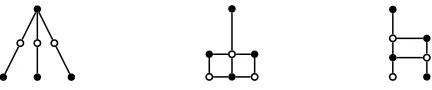
A bipartite graph is monotone if and only if the rows and columns of its biad-jacency matrix can be permuted such that the ones appear consecutively and the boundaries of these intervals are monotonic functions of the row or column index. That is, all the ones are in a staircase-shaped region in the biadjacency matrix. A bipartite graph is monotone if and only if it does not contain a hole, tripod, stirrer or armchair as induced subgraph, see Fig. 2 and [11] Lemma 1.46 on page 52 or [2] Proposition 6.2.1 on page 93. Monotone graphs are also called
[image:5.612.197.413.416.461.2]bipartite permutation graphs [14] andproper interval bigraphs [9].
Fig. 2: The tripod, the stirrer and the armchair.
Let Monotone denote the class of monotone graphs, then the
Quasimono-tone will denote the class quasi-Monotone. Two example graphs are shown in Fig. 3. Let Flaw be the class containing all pre-tripods, pre-stirrers and pre-armchairs. We will say that any graph inFlawis aflaw. Aflawless graph
G will be one which contains no flaw as an induced subgraph. Since all flaws have seven vertices, we can test inO(n7) time whether an input graph Gonn vertices is flawless. Let Flawless denote the class of flawless graphs, and let
Quasimonotone be the class of quasimonotone graphs.
LetP = (p1, p2, . . . , pℓ) be a path or even cycle in G. Thealternating
bipar-tition L, R of P assigns L ={p1, p3, . . .} and R ={p2, p4, . . .}. The path P is
prechordless if it is an induced path G[L:R]. Similarly, let C = (p1, p2, . . . , pℓ)
Fig. 3: Two quasimonotone graphs
odd chord. The alternating partition is inconsistent for an odd cycle, so an odd cycleC cannot be a prehole.
3.2 Properties of flawless graphs
Lemma 3. LetG∈Flawless. LetP = (p1, p2, p3, p4, p5, p6, p7)be a
prechord-less path in G, (p2, p3, p4, p5, p6) be a hole in G, or (p1, p2, p3, p4, p5, p6) be a
prehole in G. Ifv /∈P is such that dist(v, P) = dist(v, p4), thendist(v, p4) = 1.
Lemma 4. Every hole or prehole in a connected flawless graph is dominating.
Proof. Let C be an odd hole or prehole in the connected flawless graph G.
We show dist(v, C) ≤ 1 for every vertex v of G. If v ∈ C, this is obvious. Otherwise, let w be a vertex such that dist(v, C) = dist(v, w). Consider the subpath P = (p1, p2, . . . , p7) of C such that w = p4, where this path wraps aroundCif|C|<7. SinceCis a hole or a prehole,P is prechordless. The result
then follows from Lemma 3. ⊓⊔
If C is an odd hole we will call n(C) = {v ∈ V : dist(v, C) ≤ 1}, the neighbourhood ofC. IfGis connected thenG=N(C) for any odd holeC⊆G.
Lemma 5. SupposeG∈Flawless∩EvenHoleFree, and that C is an odd
hole in G, of length at least seven. Then every vertex v ∈V has at most three
neighbours inC. If there are two neighbours,w, x, thendistC(w, x) = 2. If there
are three neighbours, w, x, y, thendistC(w, x) = distC(x, y) = 2. If C is a short
odd hole (see 3.3) inG, thenv has at most two neighbours onC.
Lemma 6. Let Cbe a prehole in G∈Flawless. Then every vertexv∈C has
at most five neighbours in C. Two of these are via edges of C, so v is incident
to at most three chords. If there are two chords,vw, vx, thendistC(w, x) = 2. If
there are three chords, vw, vx, vy, thendistC(w, x) = distC(x, y) = 2.
Proof. Otherwise,vmust have at least four chords. These must be even chords to
c0 c1 c2 c3 c4 c5 c6 c7
v
c0 c1 c2 c3 c4 c5 c6 c7
[image:7.612.237.379.243.268.2]v
Fig. 4: An armchair
The degree bound of Lemma 6 is tight, see Fig. 5.
Fig. 5: A prehole with a vertex of degree 5
Lemma 7. Let C be an odd hole inG∈Flawlesssuch thatv /∈Candx /∈C
are adjacent. Then verticesw, y∈C exist such that (v, x, y, w)is a quadrangle.
3.3 Determining a short odd hole
We can test whether G contains a hole in time O(|E|2), using the algorithm of [13]. Moreover, the algorithm returns a hole if one exists. If the hole is even, we can concludeG /∈Quasimonotone. IfG∈Flawless, we will show that it has a well-defined structure.
Lemma 8. IfC is an odd cycle in a graphG, there is a triangle or an odd hole C′ in G.
Proof. The claim is clearly true if|C| ≤3. Otherwise, assume by induction that
it is true for all cycles shorter thanC. IfCis not already a hole, it has a chord that divides it into a smaller odd cycle C1, and an even cycle C1′. The lemma
now follows by induction onC1. ⊓⊔
The proof of Lemma 8 can easily be turned into an efficient algorithm to find
C′. An odd holeCisshort if dist(v, w) = distC(v, w) for all pairsv, w∈C.
Lemma 9. If Gis a triangle-free graph containing an odd hole C, thenG con-tains a short odd hole.
Fig. 6: Short odd holes of unequal size in a quasimonotone graph.
Corollary 1. If Ghas a short odd hole C,diam(G)≥diam(C) = (|C| −1)/2.
If C is a prehole, G′ = G[C], andL:R is the alternating bipartition of C, then G′[L:R] contains no edge other than those ofC. A minimal prehole C is such thatG[C] contains no prehole with fewer than|C|vertices.
4
Flawless graphs containing a long hole
4.1 Triangles
Lemma 10. LetGbe a quasimonotone graph containing an odd hole C of size
at least 7. Then Gcontains no triangle that has a vertex inC.
Fig. 7: In a quasimonotone graph a 5-hole and a triangle can share a vertex.
Lemma 11. LetGbe a quasimonotone graph containing an odd hole C of size
at least7. ThenG contains no triangle which is vertex-disjoint fromC.
4.2 Long odd holes
Lemma 12. LetC, C′ be odd holes in a quasimonotone graph Gsuch thatC′∩
C6=∅, and|C|,|C′| ≥7. Let G′ =G[(C′∪C)\(C′∩C)], ThenG′ has no odd
hole or prehole.
Corollary 2. Let C, C′ be odd holes in a quasimonotone graph G, such that
C′∩C6=∅. Let G′ =G[(C′∪C)\(C′∩C)]. ThenG′ is a monotone graph.
Note that the holes C, C′ in Corollary 2 can have different size. See Fig. 6, where G′ is a ladder (see [5]) with two pendant edges. However, if we have vertex-disjoint odd holes they cannot have different lengths.
Aprism is the graph given by joining corresponding vertices in two cycles of
[image:8.612.174.431.375.429.2]Lemma 13. Let Gbe a quasimonotone graph containing an odd holeC. Then
Gcontains no vertex-disjoint holeC′ with|C′| 6=|C|. Moreover, if|C| ≥7, any
two vertex-disjoint holes with |C′|=|C|induce a prism in G.
5
Preholes in flawless graphs
Lemma 14. IfG∈Flawless and has an odd hole of size ℓ≥7, any minimal
prehole C in G is either an even hole or (a) two odd holes intersecting in an
edge or (b) two disjoint odd holes connected by a quadrangle. See Fig. 8.
[image:9.612.180.430.258.312.2]C1 C2 C1 C2
Fig. 8: Preholes with odd holesC1,C2, cases (a) left and (b) right.
[image:9.612.204.405.403.471.2]Thus, ifGcontains an odd hole of size at least 7, minimal preholes have only two types, case (a) and case (b). From Lemma 13, case (b) are crossover preholes.
Fig. 9: Flawless crossover preholes.
So let us consider the case (a) preholes. We will call theseM¨obius preholes, since we will show that such a prehole must be aM¨obius ladder [8, 10].
Lemma 15. Every M¨obius prehole in a flawless graph is a M¨obius ladder.
[image:9.612.210.397.583.644.2]5.1 Splitting
Let G be a flawless graph with a hole C of length |C| ≥ 6. If|C| is even, we conclude G /∈Quasimonotone, so|C| ≥7 is odd. ThusGdoes not contain a triangle, from Lemmas 10 and 11. We will assume that this has been tested. We will now show thatGmust have the annular structure referred to in section 1.2, rather like a monotone graph with its ends identified.
Now suppose G has a short odd hole C with C ≥ 7, determined by the procedure of Lemma 9. Thus, by Corollary 1, diam(G)≥ 12(|C| −1)≥3. Choose anyv∈C, and consider the graphGv=G[V\N[v]]. ThenGvcontains no holes, since any holeH inGv must be a hole inG. But any holeH inGeither contains
v, or has a vertex w adjacent to v, by Lemma 4. Since v, w /∈ Gv, H * Gv. Neither can Gv contain a prehole, since any prehole must contain two holes. ThusGv is flawless and contains no holes or preholes, so is a monotone graph. Now diam(G) is at least diam(C) = (|C| −1)/2≥3. Thus there exists a w∈C
such thatN(v)∩N(w) =∅.
A chain graph is a bipartite graph (L∪R, E) where L and R are linearly ordered by inclusion of neighbourhoods. Its biadjacency matrix has the form indicated in Fig. 11, see [5] for details. In the monotone representation, it is
C
L
[image:10.612.275.343.366.411.2]R
Fig. 11: Chain graph structure
an easy observation that the graph has a decomposition into chain graphs, as indicated in Fig. 12, whereLis partitioned inD1, D3, . . .andRintoD2, D4, . . .. Brandst¨adt and Lozin showed in [3] that such a partition exists. For verticesv
C1 C2
C3 C4
C5
D2 | D4 | D6
D5 —
D3 —
D1 C′
w
Cw
| N(w) | v
w
Fig. 12: Decomposition of a monotone graph / Neighbourhood ofwinGv
and w as above,N(w) and its neighbours induce a monotone subgraphNw of
[image:10.612.164.453.511.587.2]below and includingw, and C′
win the rows above. Using the algorithm of [14], the monotone representation ofGv determines this split. Then we can construct a representation of the adjacency matrix A(G) of G as indicated in the first diagram in Fig. 13, whereD2=N(w),C1=Cw (transposed), andC7=Cw′. The chain graphs C2, . . . ,C6 are a decomposition of the monotone graph Gw. Note that the ordering of the chain graphs in the decomposition is circular, and the second diagram in Fig. 13 gives an equivalent representation to the first, where
C1 (transposed) is moved from the first to the last position.
C1 C2 C3 C4 C5 C6 C7
D2 | D4 | D6 | D1
D7 — D5 — D3 — D1 C1 C2 C3 C4 C5 C6 C7
D2 | D4 | D6 | D1
[image:11.612.150.463.240.335.2]D2 — D7 — D5 — D3
Fig. 13: Decomposition ofA(G) for a quasimonotone graphG
Lemma 16. A flawless graph G which has an odd hole of size at least 7 is quasimonotone if and only if it has such a decomposition and does not contain
a prehole. If there are k chain graphs in the decomposition, then k is odd, and
the shortest hole in Ghask vertices.
5.2 Recognising preholes
Let G = (V, E) be a flawless graph with a hole of size ℓ ≥ 7. Lemma 16 can determine whether or not G is quasimonotone provided it does not contain a prehole. We now consider recognition of a prehole in such a graph.
We use the partition of V from 5.1 into independent sets D1, D2, . . . , Dℓ, where Dℓ+1 ≡ D1. All edges in E run between Di and Di+1 (i ∈ [ℓ]). Let
Gi=G[Di∪Di+1], with edge setEi, and letGi = (V, E\Ei). Note thatGi is a chain graph andGiis a monotone graph. ThusGiis bipartition, with bipartition
L:R, say, withDi, Di+1∈L.
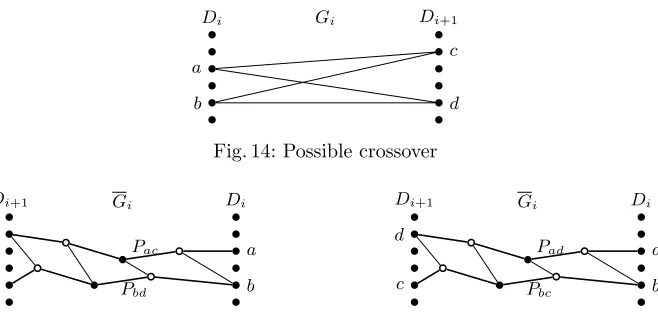
We search for possible crossovers inGi. These are pairsa, b∈Di+1,c, d∈Di, such thatac, ad, bc, bd∈E. We list all such quadruplesa, b, c, d,O(n4) in total, see Fig. 14. Given any quadruple, we attempt to determine vertex disjoint paths
Pac, Pbd in Gi betweena, c and b, dor between a, d and b, c. See Fig. 15, cases (a) and (b). We can do this in O(n|E|) =O(n3) time by network flow. Both paths are even length, sinceGi is bipartite anda, b, c, d∈L.
b d a
c Gi
[image:12.612.145.474.114.273.2]Di Di+1
Fig. 14: Possible crossover
b d
a c
Di
Di+1 Gi
Pac
Pbd c b
a d
Di
Di+1 Gi
Pad
Pbc
Fig. 15: Vertex-disjoint paths, case (a) left, (b) right
Pac, ad, Pbd, bc, in case (b) we have found a M¨obius preholePad, bd, Pbc, ac. This is clearly a cycle with even length. That it is a prehole is certified by reversing the bipartition on Pac in case(a),Padin case (b), as shown in Fig. 16. Thus we can detect a prehole, or show that none exists, inO(n7) time. If a prehole exists the input graph is not quasimonotone.
b d
a c
Pac
Pbd
b c
a d
Pad
[image:12.612.155.443.402.473.2]Pbc
Fig. 16: Preholes, left with crossover (a), right of M¨obius type (b).
6
Flawless graphs without long holes
6.1 Minimal preholes in hole-free graphs
LetCbe any minimal prehole in a flawless hole-free graphG. A triangle inG[C] will be called an interior triangle ofC if it has no edge in common withC, a
crossing triangle if it has one edge in common withC, and acap ofC if it has
two edges in common with C.
Lemma 17. IfC is a minimal prehole in a flawless graph with|C|>12, then
G[C] has no interior or crossing triangles, and C is determined by two
Let T1, T2 be caps of C, such that vi ∈ Ti is adjacent to two edges of C (i= 1,2). Then there are two edge-disjoint (v1, . . . , v2) pathsP1, P2 inC.
v1 T1 T2 v2
P1
P2
v1 v2
P1
[image:13.612.134.484.163.214.2]P2
Fig. 17: A prehole and its Hamilton subgraph
Lemma 18. LetC, with |C|>12, be a minimal prehole in a flawless hole-free
graph determined by v1, v2, and letC′=C\ {v1, v2}. Then G[C′]is a Hamilton
monotone graph, and all chords ofC′ connectP
1 toP2.
Proof. ClearlyG[C′] is Hamilton, sinceG[C] is Hamilton. NowC′ cannot be a
prehole, since it is strictly smaller than C. So G[C′] cannot contain a triangle, by Lemma 17. It cannot contain a larger odd cycle, since then it would contain a triangle, by the argument of Lemma 17. Therefore,G[C′] is bipartite and, since
G∈HoleFree, contains no hole. So, sinceG∈Flawless,G[C′] is a monotone graph. Supposeuvis an edge ofG[C′] withu, v∈P
1. Then, sinceG[C] has only even chords, the even chord uv and the segment of P1 betweenuand v forms an odd cycle, giving a contradiction. ⊓⊔
Thus any minimal preholeC comprises a Hamilton monotone graph G[C′], to which we add two capsT1,T2. We may also add edges fromv1 andv2 toC′, as long as they are even chords inC.
Lemma 19. LetC be a minimal prehole with a cap atv∈ {v1, v2}. Then there
are at most two chords from v, and both must be connected to eitherP1 orP2.
LetT1={v1, u1, w1},T2={v2, u2, w2}be any two edge-disjoint triangles in a flawless graph G. Let M be the component of G\ {v1, v2} containingu1w1,
u2w2, if such a component exists. IfM does not exist thenv1, v2 clearly do not determine a prehole.
Lemma 20. C = (v1, u1, . . . , u2, v2, w2, . . . , w1, v1) determines a minimal
pre-hole if and only if M is a monotone graph containing two vertex-disjoint paths
betweens u1, u2 andv1, v2.
6.2 Preholes containing 5-holes and triangles
It remains to consider preholes in graphs which contain 5-holes. Preholes deter-mined by two triangles will be dealt with as in section 6.1.
Lemma 21. Let C be a minimal prehole in a flawless graphG which contains
no odd hole of size greater than five. IfC connects a 5-hole and a triangle, or if
7
Conclusion and discussion
In [6] we considered the problem of ergodicity and rapid mixing of the switch chain in hereditary graph classes. We gave a complete answer to the ergodicity question, and showed rapid mixing for the new class of quasimonotone graphs. This led us to introduce a new “quasi-” operator on bipartite graph classes, which is of independent interest. Quasimonotone graphs are a particular case of this construction. Another interesting class is the class of odd-chordal graphs, which are the quasi-chordal bipartite graphs. This is close to the largest class for which the switch chain is ergodic.
A more straightforward approach to recognising quasimonotone graphs would be provided by a polynomial time recognition algorithm for odd-chordal graphs. This is equivalent to the detection of preholes in a graph. We have considered this question, but we leave it as an open problem. The only evidence we can provide is that it isNP-complete to determine if a graph is a prehole, which may be a harder question. Nonetheless, theNP-completeness proof suggests that an efficient algorithm for recognising odd-chordal graphs may be elusive.
References
1. K. P. Bogart and D. B. West. A short proof that ‘proper = unit’.Discrete
Mathe-matics 201(1):21–23, 1999.
2. A. Brandst¨adt, V. B. Le, and J. P. Spinrad.Graph classes: a survey. Society for Industrial and Applied Mathematics, Philadelphia, PA, USA, 1999.
3. A. Brandst¨adt and V. V. Lozin. On the linear structure and clique-width of bipar-tite permutation graphs.Ars Combinatoria 67:273–281, 2003.
4. P. Diaconis, R. Graham, and S. P. Holmes. Statistical problems involving permu-tations with restricted positions. In State of the art in probability and statistics
vol. 36 ofLecture Notes–Monograph Seriesp. 195–222. Inst. of Math. Stat. 2001. 5. M. Dyer, M. Jerrum, and H. M¨uller. On the switch Markov chain for perfect
matchings.Journal of the ACM 64:Article 2, 2017.
6. M. Dyer and H. M¨uller. Counting perfect matchings and the switch chain.CoRR
abs/1705.05790, 2017.
7. M. Dyer and H. M¨uller. Quasimonotone graphs.CoRRabs/1801.06494, 2018. 8. R. K. Guy and F. Harary. On the M¨obius ladders.Canad. Math. Bull.10:493–496,
1967.
9. P. Hell and J. Huang. Interval bigraphs and circular arc graphs.Journal of Graph
Theory 46:313–327, 2004.
10. M. Hladnik, D. Maruˇsiˇc, and T. Pisanski. Cyclic Haar graphs.Discrete Mathemat-ics 244(1):137–152, 2002.
11. E. K¨ohler.Graphs without asteroidal triples. PhD thesis, TU Berlin, 1999. 12. A. Lubiw. Doubly lexical orderings of matrices. SIAM Journal on Computing
16(5):854–879, 1987.
13. S. D. Nikolopoulos and L. Palios. Detecting holes and antiholes in graphs.
Algo-rithmica 47(2):119–138, 2007.
14. J. Spinrad, A. Brandst¨adt, and L. Stewart. Bipartite permutation graphs.Discrete