Theme 9
Research and development
Series Β
Shortterm statistics
Redis News
ISSN 10230998
1 Π 1995
Biannual
FOREWORD
Commission's Targeted SocioEconomie Research Programme:
New Demands
The Council decision on the targeted socio economic research programme was adopted beginning of December 1994. As already mentioned in the previous edition of this newsletter, it will cover areas which are highly relevant for R&D statisticians. The first one, evaluation of science and technology policy options, will aim at stimulating activities such as
• analysis of the RTD situation in Europe,
• development of methodologies, tools and approaches relevant for the preparation, monitoring and evaluation of S&T policies.
This legal framework complements what has already been decided by the Council in January 1994, when it established a multiannual programme for the development of Community statistics on Research, Development and Innovation. It shows once more the importance given by the European Union to S&T policies, their coordination, their comparisons and their evaluation. Our work will have to respond to this pressing demand of the policy makers.
With the assistance of three incoming new countries, well advanced in R&D statistics, with a good coordination with OECD and UNESCO, we are sure that the European statistical system will efficiently contribute to these new demands.
Table of Contents
Foreword Editorial
Achievements & Results
# Community Innovation Survey # Human Resources in S&T * Regional R&D&I indicators * Govt R&D Appropriations # Other Projects
♦ COFOG
♦ Internal EC Indicators ♦ Cooperation with Russia ♦ Analysis of user needs REDIS Databases & Publications Plans for the 1st half of 1995 Organization
Focus on R&D in Europe
eurosta
OFICINA ESTADÍSTICA DE LAS C O M U N I D A D E S EUROPEAS DE EUROPÆISKE FÆLLESSKABERS STATISTISKE KONTOR STATISTISCHES A M T DER EUROPÄISCHEN GEMEINSCHAFTEN ΣΤΑΤΙΣΤΙΚΗ ΥΠΗΡΕΣΙΑ Τ Ω Ν ΕΥΡΩΠΑΪΚΩΝ ΚΟΙΝΟΤΗΤΩΝ STATISTICAL OFFICE OF THE EUROPEAN COMMUNITIES OFFICE STATISTIQUE DES COMMUNAUTÉS EUROPÉENNES ISTITUTO STATISTICO DELLE COMUNITÀ EUROPEE
BUREAU VOOR DE STATISTIEK DER EUROPESE GEMEENSCHAPPEN SERVIÇO DE ESTATÍSTICA DAS COMUNIDADES EUROPEIAS
L-2920 Luxembourg - Tél. 43 01-1 - Télex COMEUR LU 3423 B-1049 Bruxelles, rue de la Loi 200 - Tél. 299 11 11
Editorfei
This edition of Redis News reviews the activities on the project in the second half of 1994. The period as could be seen in the following pages was a very busy (and fruitful) one. While work continued on developing the necessary methodology, a great amount of time was devoted to producing and processing data to meet the needs of the users through various publications. Apart from contributing to Eurostat's publications such as 'Basic Statistics of the Community' and 'Europe in Figures', providing the statistical support for the Commission's publication "European Report on Science and Technology Indicators 1994", a special publication was prepared for the European Parliament. Needless to say that the period also witnessed the preparation and publication (slightly late) of a substantially enlarged edition of our flagship -"Research and Development: Annual Statistics 1994".
The focus in this edition takes a close look at R&D in Europe. Based on a special publication prepared by the REDIS team for the European Parliament, the analysis shows the current trends in R&D expenditures. It compares the situation in the European Union with those of Japan and United States.
Contacts with both the national experts and users of our data continue to be of great importance to the project. In September 1994, we held a meeting of the working party to discuss the progress and made plans for the future. In November, we held a meeting with our group of users to discuss the needs and how best to meet them.
Abbreviations and Acronyms used
CIS Community Innovation Survey
COFOG Classification of Functions of Government
CSRS Centre for Science Research and Statistics
DG General Directorate (of the European Commission)
DOSIS Development of Statistical Information Systems
EC European Commission
EEA European Economic Area
EFTA European Free Trade Association
EIMS European Innovation Monitoring System
EU European Union
GDP Gross Domestic Product
HRST Human Resources in Science & Technology
NESTI National Experts on Science and Technology Indicators
OECD Organisation for Economic Cooperation and Development
REDIS R&D and Innovation Statistics
TACIS Technical Assistance for the Commonwealth of Independent States
REDIS News is one of a series of three newsletters prepared by Unit D3 of Eurostat The others are Research In Official Statistics (on DOSIS) and The Panelists (on Enterprise Panels Statistics). Please note that the opinions expressed are those of the authors alone. Neither the European Commission nor any person acting on its behalf is responsible for the use which might be made of the information contained in this newsletter.
ECSC-EC-EAEC, Brussels · Luxembourg, 1995
Reproduction is authorized, except for commercial purposes, provided the source is acknowledged.
R&D STATISTICS IN EUROSTAT
Achievements and Results in the Second Half of 1
9ÉÉ
Community Innovation Survey (CIS)
All data are now in house
All EU Member States and Norway have now transmitted individual data from the innovation survey to Eurostat which means that the CIS database now consists of data from over 41,000 European enterprises covering 13 countries. After the transfer, the data are checked for consistency and methods have been developed to estimate missing values. In practice, data from each individual enterprise is checked and modified, where necessary. The next step is to micro-aggregate the data, which will make the data available for the EIMS contractors of DG XIII to perform detailed international innovation comparisons within the EU and Norway.
During 1995 the calculation of extrapolation factors will be performed where necessary and useful, which will make the data as representative as possible. Furthermore the data has to be corrected according to the results of non-response surveys, which have been carried out in some Member States. This is done if the characteristics of non-responding enterprises seem to be different from the characteristics of responding enterprises. The extrapolation and the non-response analysis will both make the data as representative as possible, so that the analysis of the CIS will also be representative, which will hopefully provide clear, sound and reliable political recommendations.
Even though the data is not representative at the moment some preliminary descriptive analyses are being performed.
• The products resulting from innovation accounts for between 35% of the total sales in the Netherlands to 50% in Germany and Spain.
• The innovators engaged in R&D during 1992 vary from 56% in Italy to approximately 70-79% in Germany, Spain and Greece*.
• The R&D intensities vary between 3% in Belgium, Netherlands, Spain to 11% in Greece*.
The CIS team plans to publish information on methodology and results during 1995 and organise a conference by beginning of 1996.
For more information please contact Mr. Per Nymand-Andersen or
Mr. Kwet Eric NgShing (+352-4301.34014).
Human Resources in Science and
Technology (HRST)
Continuation on stock indicators
The "Manual on the Measurement of Human Resources devoted to Science and Technology" drawn up jointly by the OECD Secretariat and Eurostat is now available in English and French. In accordance with traditional OECD practice the manual will henceforth be known as "Canberra Manual", since its last version was discussed at the NESTI (National Experts on Science and Technology Indicators) meeting in Canberra, 18-20 April 1994.
Presently, Eurostat is drafting a catalogue on meaningful basic indicators for describing the HRST population. The first version of this document was completed recently and sent out to the OECD Secretariat for comments. After some redrafting it will be submitted to the EU/OECD Member States for discussion. This catalogue on basic HRST indicators together with the HRST-lnventory on data availability will serve as basis for future data collection exercises from existing sources at least in the EU Member States.
There seems to be an indication that innovators have a higher proportion of employees than non-innovators.
For more information please contact Ms. Daniela Schackis (Tel.: +352-40 30 22).
Regional R&D and Innovation
indicators
Expanded database
Eurostat's database on regional R&D indicators has been expanded. Although the expansion is slight yet its effect is rather significant. Detailed data on R&D expenditure, the Higher Education sector and their innovation survey have been sent by Greece, and Eurostat received regional data on R&D expenditure and R&D personnel in the Government and Higher Education sectors for the United Kingdom for the first time. In addition, the European Patent Office sent a first version of regional patent data, broken down by IPC codes, for Belgium, France and Greece for 1993.
For more information please contact Ms. Ruth Magono (Tel.: +352-40 30 22).
Government R&D appropriations
Actions required
The presentations on the methods and practices for the collection of government R&D budget data by Austria, Finland, Norway, Sweden and the European Commission (DGXII) during the last Working Party meeting on R&D and innovation statistics confirmed past conclusions: current methodological differences endanger the comparability of the data. The delegates of the Member States accepted Eurostat's proposal to develop an inventory of existing similarities and discrepancies in concepts, methods and practices as a first step to a better harmonization. A first draft of this inventory will be discussed with the Member States during the first half of 1995. As the next step, the inventory could form the basis for the development of concrete proposals aimed at reducing existing dissimilarities.
For more information please contact Ms. Daniela Schackis (Tel.: +352-40 30 22) or Mr. Werner Grünewald (Tel.: +352-4301.33280).
Other Projects
COFOG:
Consequence and end
At the second meeting of the working party of the EEA on R&D statistics and Innovation held in Luxembourg on 22 and 23 September 1994, it was decided that the revision of the COFOG could no longer be continued without the support of other General Directorates and of the Member States. Since, Eurostat has been remaining attentive to the
debate and adopts currently the observer status in all the discussions covering this subject.
For more information please contact Ms. Aline Bouzergan (Tel.: +352-40 30 22).
Internal EC indicators:
A step ahead
The last few months were devoted to developing a model which describes the various stages of the system in order to define the key words. These key words would facilitate the definition of the desirable indicators. At the last meeting with all the General Directorates concerned by this project, it was decided to concentrate initially, on the definition of the indicators covering the various forms of Community support.
For more information please contact Ms. Aline Bouzergan (Tel.: +352-40 30 22).
Cooperation with the CS RS under the TACIS programme:
An extension of two years
The visit of an official of Eurostat and two consultants to Moscow during the week of 10 October last year made it possible to assess the numerous actions which have been set up since the beginning of this cooperation.
Main actions were on methodology, the preparation of a survey on government R&D appropriations and on publications.
A very detailed work plan for the period 1995-97 was developed jointly by the various parties involved (CSRS, Eurostat, the CESD-Communautaire and the consultants to Eurostat).
For more information please contact Ms Aline Bouzergan (Tel.: +352-40 30 22).
Analysis of user needs:
In accordance with the Council decision establishing a multi-annual programme on the development of Community Statistics on Research, Development and Innovation, Eurostat has started an analysis of users needs in this field. The Member States have submitted written reports to Eurostat. A synthesis report which will form the basis of future discussions will be made out of these individual reports. The analysis to be done will also include the needs of the various Commission services. The information on the Commission needs will be collected by a questionnaire in February 1995.
REDIS Databases and Publications
More and more recent data
The "Research and Development: Annual Statistics 1994" publication is now available. With the goal of better meeting the needs of policy makers, scientists and the general public in the field of R&D, the content of the 1994 edition has been extended in comparison with the previous one. For the first time data on R&D personnel and R&D expenditure from 1985 up to 1991 at national and regional level have been published. Furthermore, data on Government R&D appropriations for Austria, Finland, Sweden as well as Norway are also available for the first time.
Information on how to obtain copies of the publication can be obtained from: Eurostat Information Office (Luxembourg), Tel.: +352-4301.34567 - Fax: +352-436464.
For further information please contact Ms. Piera Calcinaghi (Tel.: +352-4301.33713).
R&D data dissemination: The new Cronos dissemination product is now available.
• Starting from January 1995, "Cronos", the Eurostat dissemination database, will no longer exist in its present version and will be replaced with "New Cronos" which is now operational and includes 9 themes of Eurostat products catalogue. It runs on a very user-friendly system under the Windows environment.
Data on government R&D appropriations, R&D personnel and R&D expenditure can be consulted under "Theme 9: Research and Development". • Information on R&D can also be found in the
following Eurostat publications:
Basic Statistics of the Community - 31st edition;
Europe in Figures - 3rd edition.
For further information please contact: Eurostat Information Office (Luxembourg), Tel.: +352-4301.34567 - Fax: +352-436464 or Eurostat Data Shop (Bruxelles) Tel.: 2996666 - Fax: +32-2-2950125.
European Report on Science and Technology Indicators -1994
In November 1994 the first edition of this new report was published by DG XII of the Commission. The report was produced under the direction of DG Xll-A with MERIT (NL) as lead contractor and contributions by PREST (UK), OST (FR), Institute of Employment Studies (UK) and the Department of Applied Economics of Cambridge University (UK). Eurostat provided a lot of data for the publication and was also involved in various stages of the production of the report.
The report has six parts:
The first part 'European Science and Technology in the World' compares some resource and performance indicators for European countries to indicators from a number of important countries in the world. The second part 'Industrial R&D and Competitiveness' looks in more detail at sectoral performance indicators. The third part 'European Diversity, Convergence and Cohesion' analyses the specific features of science and technology systems in EU, EFTA and Eastern European economies. The fourth part 'European Cooperation' deals with intra-European cooperation in science and technology. The fifth part on 'European Union as world partner" sets out the science and technology cooperation agreements with other countries or regions in the World. The sixth part 'European Attitudes to Science and Technology' highlights the differences between European countries in the attitudes towards science and technology.
The report ends with a 150 page appendix of statistical tables, a methodological appendix and a glossary of terms.
For more information please contact
Mr. Mikael Åkerblom (Tel.: +352-4301.34902) or Mr. Ian Perry, DG XII (Tel : +32-2-2962079).
mans for the 1st Half of iWS
Delay and new tasks
Several events such as the active involvement in the preparation of the European Report on Science and Technology Indicators 1994 (see above) caused substantial delays in our plans for the second half of 1994. Most of the actions announced for this period are yet to be finalized. Some are yet to be started. New tasks turned up at the same time. Altogether,
the following main actions are planned for the first half of 1995 without neglecting the routine activities: • continuation in the construction of the CIS
databases, and first analyses of the CIS results; • preparation of the collection of basic HRST stock
indicators;
R&D and innovation statistics including all annexes;
preparation of an inventory of the concepts and methods used in the Member States to collect data on Government R&D appropriations;
analyses of the (future) needs in the Member States (and the European Commission) in the field of R&D and innovation statistics;
preparation of an interim report to the Council on the realization of the plan of action as required in the Council decision establishing a multiannual
programme for the development of Community statistics on research, development and innovation;
• preparation of a first draft of a legal framework for harmonized R&D and innovation surveys in the European Union.
For more information please contact
Mr Mikael Åkerblom (Tel.: +352-4301.34902) or Mr Werner Grünewald (Tel.: +352-4301.33280).
No edition without modifications
Eurostat's team in the field of R&D and innovation statistics has again undergone substantial modifications. Ms. Carine Muzzarelli who was involved in the preparation of the European Report on Science and Technology Indicators 1994 left at the end of her contract. Mr. Marco Doudeyns who helped with the CIS left the project at the beginning of December 1994 to join the OECD.
Furthermore, our unit, D3, was substantially restructured at the end of 1994. It is now split into four sections. Amongst others, one section is on innovation statistics (head of section: Mr. Mikael Åkerblom, deputy head of section: Mr. Werner Grünewald) and one section on R&D statistics and business registers (head of section: Mr. Werner Grünewald, deputy head of section: Mr. Mikael Åkerblom).
Finally, we are happy to announce the arrival of two new colleagues. Ms. Véronique de Känel will support Ms. Piera Calcinaghi in the management of our databases and Ms. Anne-Françoise Van Schingen in the secretariat. Mr. Eric Kwet-Ket Ng Shing will replace Mr. Marco Doudeyns on the CIS. All other persons keep their responsibilities except Ms. Ruth Magono who took over the daily work on regional aspects of R&D and innovation statistics (from Ms. Aline Bouzergan) and on nowcasting, and Ms. Aline Bouzergan who is now deeply involved in the analyses of the user needs (instead of the regional aspects).
For more information please contact
.On R&D in Europe
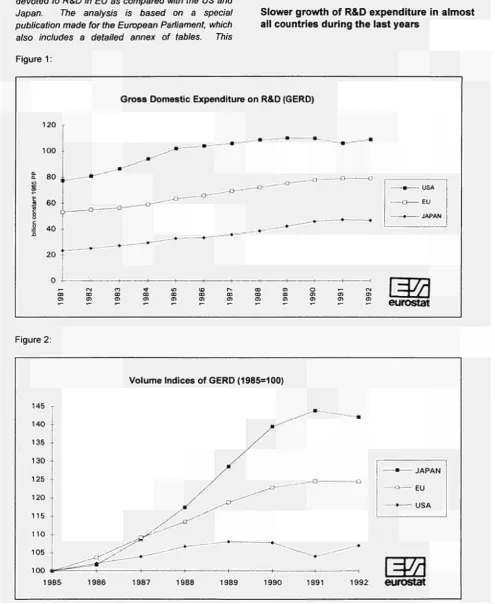
This Focus of the REDIS News presents an analysis of recent trends in the development of resources devoted to R&D in EU as compared with the US and Japan. The analysis is based on a special publication made for the European Parliament, which also includes a detailed annex of tables. This
publication which is in very limited number may be obtained from Eurostat subject to availability.
Slower growth of R&D expenditure in almost
all countries during the last years
Figure 1 :
120
100
Gross Domestic Expenditure on R&D (GERD)
USA
EU
JAPAN
CM CO 00
m
CO 01
■ * co
CD i n CO CO
CD CO
en r~
CO CD
CO CO CD
CO CO
CO
m
eurostat
Figure 2:
1985
Volume Indices of GERD (1985=100)
JAPAN
EU
USA
1986 1987 1988 1989 1990 1991
m
[image:7.595.61.557.195.800.2]Until 1990, total real R&D expenditure increased rapidly in Japan. The increase was slower in the EU and rather small in the US. During 1991 and 1992 R&D expenditure was more or less at the same level as 1990, still considerably higher in the US than in the EU (figures 1 and 2). Within the EU, the fastest real growth of R&D expenditure has been in Spain,
Ireland and Portugal, where R&D expenditures have nearly doubled between 1985 and 1992. Of the EFTA countries, the fastest increase in R&D expenditure was in Iceland, where R&D expenditure more than doubled between 1985 and 1992).
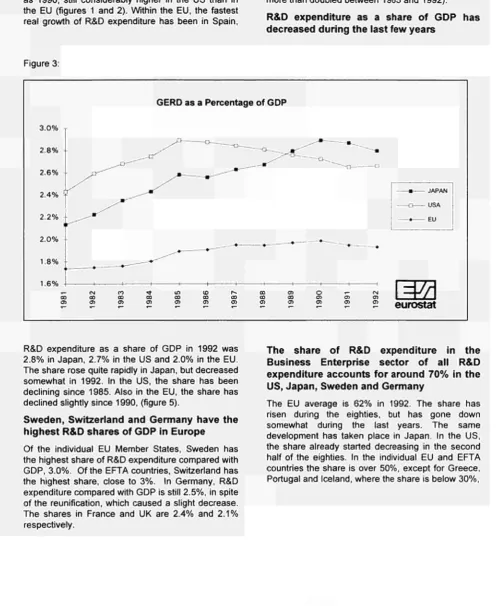
R&D expenditure as a share of GDP decreased during the last few years
[image:8.595.31.531.108.715.2]has
Figure 3:
GERD as a Percentage of GDP
or σ
1
CM
CO CD
1
CO CD
1 —
■<+
CO CD
1 in CO CD
1 to CO CD
1
r--co
CD
1 — CO
CO CD
1 CD
CO CD
1
o
CD CD
1
CD CD
!
CO
CD
m
eurostat
R&D expenditure as a share of GDP in 1992 was 2.8% in Japan, 2.7% in the US and 2.0% in the EU. The share rose quite rapidly in Japan, but decreased somewhat in 1992. In the US, the share has been declining since 1985. Also in the EU, the share has declined slightly since 1990, (figure 5).
Sweden, Switzerland and Germany have the highest R&D shares of GDP in Europe
Of the individual EU Member States, Sweden has the highest share of R&D expenditure compared with GDP, 3.0%. Of the EFTA countries, Switzerland has the highest share, close to 3%. In Germany, R&D expenditure compared with GDP is still 2.5%, in spite of the reunification, which caused a slight decrease. The shares in France and UK are 2.4% and 2 . 1 % respectively.
The share of R&D expenditure in the Business Enterprise sector of all R&D expenditure accounts for around 7 0 % in the US, Japan, Sweden and Germany
Figure 4:
Business Enterprise Expenditure on R&D (BERD)
USA EU JAPAN ro co CD ' t co
CD co co
co co CD Γ ΟΟ CD CO CO CD CO CO CO O CD
CD CD CD
2 eurostat
R&D expenditures in the Business Enterprise sector seem to have been on approximately the same level in the US since 1985. In the EU Member States R&D expenditure still increased slightly in the second half of the eighties. In Japan the increase was stronger, but even there the increase in R&D expenditure stopped after 1990.
In the individual EU countries the increase in Business Enterprise R&D has been particularly strong in Spain, Greece and Ireland, where R&D expenditure has more than tripled between 1981 and 1991.
EU government R&D appropriations grew until 1991
[image:9.595.65.550.511.788.2]EU government R&D appropriations are about five times as high as Japanese government R&D appropriations. Total government R&D appropriations have grown slightly faster in the EU compared with the US, even if there was a slight decline in EU appropriations between 1991 and 1993 (figure 5). The development in the US has been influenced by the decline in the relative share of defence R&D appropriations. In the EU Member States, the share of defence R&D appropriations has decreased in France and Germany but increased slightly in the UK during the last few years (figure 6).
Figure 5:
Total Government Budget Appropriations or Outlays for R&D (GBOARD)
50
45
4 0
η 35 CL
i 30
I 25 ¥ S
c 8 20 o I 15 10 5 0 USA EU JAPAN r ce σ 1 — τ— CO CD 1 CM CO CO 1 CO CO CD 1 <* CO CD 1 in CO CD 1 CO CD 1 Γ ΟΟ CD 1 CO CO CD 1 — CD CO CD 1 o CD CO 1 CD CO CN CO CO I C O CD
Figure 6:
70% τ
60%
50%
40%
-30%
20%
10%
0%
n co co
Defence Budget R&D as a Percentage of Total G BOAR D
us UK
FR
SE
DE
JP
2
eurostat
About a quarter of government R&D
appropriations for technological objectives
About a quarter of the total R&D appropriations of the EU Member States countries considered as a whole is spent on R&D for technological objectives, such as earth and space exploration and exploitation, industrial production and technology, production and utilisation of energy.
Figure 7:
About the same amount is, however, also allocated to the R&D part of general university funds. Compared with 1987, the share of government R&D appropriations going to general university funds and human and social objectives, such as infrastructure and land use, pollution, human health, social structures and relationships has increased (figure 7).
EU Government R&D Appropriations Classified by Groups of Objectives (in %)
100.0% τ
90.0%
80.0%
70.0%
60.0% ·
50.0%
40.0%
30.0%
20.0%
10.0% t
0.0%
^r'-M
?mm&.
1987 1992
■ Other civil research
¡ I Agriculture
■ Human & social objectives
■ Nonoriented research
Π Defence
■ Technological objectives
□ Research financed from GUF
m
eurostat
[image:10.595.31.522.65.736.2]. » . OFICINA DE PUBLICACIONES OFICIALES DE LAS COMUNIDADES EUROPEAS I COKI 1 noo_nqOQ . « a . » KONTORET FOR DE EUROPÆISKE FÆLLESSKABERS OFFICIELLE PUBLIKATIONER ΙΟΟΠ I UtO-υσσο • O O · AMT FUR AMTLICHE VERÖFFENTLICHUNGEN DER EUROPÄISCHEN GEMEINSCHAFTEN
* " " * " · ΥΠΗΡΕΣΙΑ ΕΠΙΣΗΜΩΝ ΕΚΔΟΣΕΠΝ ΤΟΝ ΕΥΡΩΠΑΪΚΩΝ ΚΟΙΝΟΤΗΤΩΝ * * * OFFICE FOR OFFICIAL PUBLICATIONS OF THE EUROPEAN COMMUNITIES
OFFICE DES PUBLICATIONS OFFICIELLES DES COMMUNAUTÉS EUROPÉENNES UFFICIO DELLE PUBBLICAZIONI UFFICIALI DELLE COMUNITÀ EUROPEE BUREAU VOOR OFFICIËLE PUBLIKATIES DER EUROPESE GEMEENSCHAPPEN SERVIÇO DAS PUBLICAÇÕES OFICIAIS DAS COMUNIDADES EUROPEIAS