White Rose Research Online URL for this paper:
http://eprints.whiterose.ac.uk/136428/
Version: Published Version
Article:
Karatrantos, A., Koutsawa, Y., Dubois, P. et al. (2 more authors) (2018) Miscibility and
nanoparticle diffusion in ionic nanocomposites. Polymers, 10 (9). 1010.
https://doi.org/10.3390/polym10091010
[email protected]
https://eprints.whiterose.ac.uk/
Reuse
This article is distributed under the terms of the Creative Commons Attribution (CC BY) licence. This licence
allows you to distribute, remix, tweak, and build upon the work, even commercially, as long as you credit the
authors for the original work. More information and the full terms of the licence here:
https://creativecommons.org/licenses/
Takedown
If you consider content in White Rose Research Online to be in breach of UK law, please notify us by
Miscibility and Nanoparticle Diffusion in
Ionic Nanocomposites
Argyrios Karatrantos1,*, Yao Koutsawa1 , Philippe Dubois2, Nigel Clarke3 and Martin Kröger4,*
1 Materials Research and Technology, Luxembourg Institute of Science and Technology, 5,
Avenue des Hauts-Fourneaux, L-4362 Esch-sur-Alzette, Luxembourg; [email protected]
2 Center of Innovation and Research in Materials and Polymers (CIRMAP), Laboratory of Polymeric and
Composite Materials, University of Mons & Materia Nova Research Centre, Place du Parc 20, B-7000 Mons, Belgium; [email protected]
3 Department of Physics and Astronomy, University of Sheffield, Sheffield S3 7RH, UK;
4 Polymer Physics, Department of Materials, ETH Zurich, Leopold-Ruzicka-Weg 4,
CH-8093 Zurich, Switzerland
* Correspondence: [email protected] (A.K.); [email protected] (M.K.)
Received: 2 August 2018; Accepted: 5 September 2018; Published: 10 September 2018
Abstract: We investigate the effect of various spherical nanoparticles in a polymer matrix on dispersion, chain dimensions and entanglements for ionic nanocomposites at dilute and high nanoparticle loading by means of molecular dynamics simulations. The nanoparticle dispersion can be achieved in oligomer matrices due to the presence of electrostatic interactions. We show that the overall configuration of ionic oligomer chains, as characterized by their radii of gyration, can be perturbed at dilute nanoparticle loading by the presence of charged nanoparticles. In addition, the nanoparticle’s diffusivity is reduced due to the electrostatic interactions, in comparison to conventional nanocomposites where the electrostatic interaction is absent. The charged nanoparticles are found to move by a hopping mechanism.
Keywords:ionic nanocomposites; miscibility; chain dimensions; nanoparticle diffusion
1. Introduction
In the past three decades, polymer nanocomposites [1–4], where spherical, cylindrical or plate-like nanoparticles are finely distributed and dispersed [5–7] in a polymer matrix, have become of growing importance to industry and academia due to their advanced mechanical [8–10], thermal [11–13], tribological [14], rheological [15], and electrical properties [16] comparable to polymer blends. Because nanoparticles are increasingly being added to polymers, there is a motivation to explore how nanoparticles impact polymer dynamics [17–20], structure [21–24], morphology [25–29], stability [30], and ultimately how these features are correlated and how they impact macroscopic properties [1]. Nanoparticle dispersion [31–36] (high degree of distribution/dispersion is needed for effective reinforcement [28,33] in the matrix) allows property “tuning” [24] and provides appropriate functionalities. There are three main ideas on how to achieve better nanoparticle dispersion. The first is to tether the chains on the surface of the nanoparticle, of linear size [7,37,38] or larger than the quarter length of polymer matrix chains [39,40]. The second is to achieve a chemical favorable interaction between nanoparticle and polymer matrix [41–44]. The third idea is to let the interaction between nanoparticles and chains to be of ionic nature [5,6]. Nanoparticle aggregation has been observed for conventional polymer nanocomposites with weak interactions, such as polystyrene–silica
nanocomposite [45], for nanocomposites with an oligomeric matrix [41,46], possibly for the repulsive nanoparticles composite of poly(ethylene-propylene) (PEP)–silica (in which the transmission electron microscopy (TEM) data, were not reported [47]), and also for the polyurethane–silica nanocomposite when the electrostatic interactions are absent [48,49]. Nowadays, dispersion of high concentrations of surface-functionalised spherical nanoparticles (up to 50 vol% [47,50–54]) is accessible.
While there is a substantial amount of research on nanocomposites containing bare or grafted nanoparticles [55–58], exhibiting tethered chains on the surface of the nanoparticle, there is only a limited amount of research in ionic polymer nanocomposites. In these materials, the nanoparticles are ionically functionalized and react with a polymer with a functionality of the opposite charge [59] (either end-terminated or grafted along the chain). Oppositely charged ions interact with energies greater than the thermal energy. The presence of oppositely charged ions at the polymer/nanofiller interphase can promote dispersion according to Refs. [48,49]. This is a new class of ionic polyurethane nanocomposites that combines sulfonate-modified nanosilicas reinforcement with the reversibility of ionic interactions. Such nanocomposite materials have presented an increase of the storage modulus and toughness [48,49].
Nanoparticle mobility [60,61] is a feature that has been observed in nanocomposites [62–65]. This mobility and the interphase region [66] can be altered by changing the nanoparticle size [66,67] and polymer–nanoparticle interactions [66,68]. The nanoparticle (colloid) diffusivity in a polymer matrix can be predicted by the Stokes–Einstein relation [69] and depends on the viscosity of the matrix, η, and the nanoparticle radius,R, according toDSE
=
kBT/6πηR, in agreement with experiments [70] and the theoretical scaling by Brochard-Wyart and de Gennes [71], when the nanoparticle radius, R, is greater than the tube diameter [72], dT (R≥
3.5–5dT) [64]. The Stokes–Einstein relation ishowever invalid when nanoparticles are smaller (R
≤
2dT) as shown recently by simulations [61,73,74]and experiments [64,67]. Such small nanoparticles are very mobile and alter [61,75] polymer diffusion [62,76–78].
To the best of our knowledge, fundamental research on ionic polymer nanocomposites to understand and investigate the ionic interactions, nanoparticle mobility on the interphasial region, and nanoparticle dispersion state of the nanocomposite have not been performed so far. Exceptions are the coarse grained model by Hong et al. [79,80] for nanoparticle ionic liquids, where nanoparticles diffuse like in a polymer solution [81–83] while chains diffuse faster than nanoparticles, as well as the studies in ionomer nanocomposites [59,84], polymer charged solutions [85,86] and polymer gels [87,88].
We set out to investigate how the ionic (electrostatic) interaction between nanoparticles and polymers impact the nanoparticle dispersion state, polymer structure/dimensions and nanoparticle mobility (diffusion). The rest of this paper is organized as follows. In Section2, the methodology and simulation details of the present study are described. Subsequently, in Section 3.1, the structure of nanoparticles in the polymer melt is investigated and compared to that of experiments [48]. In Section3.2, the polymer dimensions of unentangled and weakly entangled chains is calculated. In Section 3.3, the diffusion of nanoparticles of different diameter, in the various molecular weight polymer matrices, is calculated subject to dilute nanoparticle loading, and compared to the Stokes–Einstein formula and experiment. Finally, in Section4, conclusions are presented.
2. Methodology
To address these fundamental questions, we use the molecular dynamics method [89–92] of a coarse grained semiflexible polymer model (Kremer–Grest) [93,94] with nanoparticles, using the GROMACS 4.6.7 version (University of Groningen, Groningen, Holland). A schematic of the ionic nanocomposite of polymers with charged chain ends and ionic nanoparticles is shown in Figure1.
The classical Newton–Langevin equations that govern the motion of the particles is [89,93]:
midvi
dt
=
−∇
Vi−
Γ driwhereViis the potential experienced by particlei, andmiits mass;Γis the friction coefficient andWi
describes the random force which essentially is a Gaussian white noise with zero mean acting on each particle. The total deterministic forcefion particleiis the gradient of the potentialVigiven by a sum
of four terms:
Vi
=
∑
j6=i(
VijLJ+
VijCoulomb+
VijS+
VijB)
. (2)-
Ze+e
+ +
+ +
+ +
[image:4.595.203.405.148.323.2]+ +
Figure 1. Schematic of ionic nanocomposite: Chain ends are positively charged (+e) and nanoparticles are negatively charged (−Ze).
The truncated, purely repulsive Lennard–Jones (LJ) potentialVijLJ, whose corresponding force acts along the line between the centres of mass of two particles [95], is given by
VijLJ
=
4ǫijσij12 rij12
−
σ6
ij
rij6
!
, rij
≤
rc=
21/6σij, (3)whererijrepresents the distance between particlesiandj,ǫijis the characteristic interaction energy
between particlei and particle j. The combination rulesǫij
= (
ǫiǫj)
1/2andσij= (
σi+
σj)
/2 [95]are used; for monomers: ǫm
=
σm=
mm=
1, for nanoparticles:ǫn=
1, σn=
2R,R/σm=
2 or 4,mn
=
0.85×
4πR3/3. For monomer (m) – nanoparticle (p) interactions, a more repulsive LJ potential is selectedVijLJ=
4ǫmn(
σmn/rij)
12−
2ǫmn(
σmn/rij)
6forrij≤
rc. In addition, the coulombic interactionis given by
VijCoulomb
=
qiqj4πǫrǫ0rij
(4)
withqm
= +
eandqn=
−
Ze. The particle mesh Ewald (PME) method [96–98] has been used to treat the long range electrostatics with a Fourier-spacing of 0.12 nm and an order of interpolation 4. The dielectric constant of the coulombic part is ǫr=
50 [99,100]. The Bjerrum lengthlB/σm=
Zqiqj/ǫrkBT
<
1 (forR=
2) signals weak electrostatic strength between monomers and nanoparticles. Adjacent monomers within polymer chains are connected using the finitely extendable nonlinear elastic (FENE) spring potential [93]VijS
=
−
1 2kR02ln 1
−
r 2ij
R02 !
, (5)
where, in applying Equation (5), the sum in Equation (2) is over all particlesjto which particleiis permanently connected. The maximum bond length and spring coefficient were set toR0
=
1.5 andis controlled by a cosine harmonic bending potential [101], which acts on consecutive bonds along the chain,
VijkB
=
12kθ
(
cosθijk−
cosθ0)
2, (6)
where θijk is the bending angle between three consecutive beads. We use the equilibrium value
θ0
=
109.5◦, and the bending constantkθ=
25 [101]. By increasing the intramolecular stiffness [72] of the polymer chain, the entanglement length [94,102] is decreased to a value ofNe≈
48 (as predictedby the modified S-coil estimator) similar to Ref. [73] (Ne
≈
45).The simulations of the polymer nanocomposites consisted of spherical nanoparticles in a dense polymer melt. They were performed in a simulation cell starting from relaxed configurations of conventional non-ionic nanocomposites [61], using the isothermal isobaric (NPT) ensemble. The pressure calculated for theN
=
200 polymer melt wasP∗=
Pσm3/ǫm=
4.864 [68]. That pressure was used to perform all the nanocomposite systems simulations in the NPT ensemble. The linear size of the simulation cell was always larger than the root mean square end-to-end distance of the polymer chains. To set the temperature at T∗=
kBT/ǫ=
1 and pressure at P∗=
4.864, the Langevin thermostat with a friction constant Γ=
0.5τLJ−1 and the Berendsen barostat were used with time constant 2τLJ, respectively. The equations of motion were integrated using the Leap frog algorithm [103] with a time step equal to 0.005τLJfor polymer melts, and a time step of 0.002τLJ for nanocomposite simulations with R=
2 (0.001τLJ for nanocomposite simulations withR=
4), whereτLJ= (
mσm2/kBT)
1/2is the LJ time unit. The duration of the simulation production runs were between 4×
104−
4×
107τLJdepending on the length of molecules. Details of the ionic nanocomposite systems studied (nanoparticle volume fraction:φ, number of nanoparticles:Nn, nanoparticle charge: [image:5.595.168.426.469.651.2]−
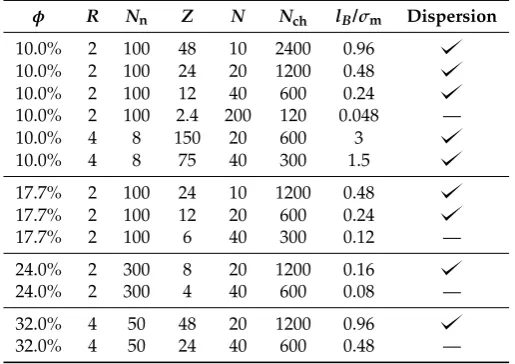
Ze, nanoparticle radius:R, Bjerrum lengthlB) are summarized in Table1.Table 1.Nanoparticle volume fractionφ(%), nanoparticle radiusR, number of spherical nanoparticles Nn, individual nanoparticle charge−Ze, polymerization degreeNand number of such chainsNch,
Bjerrum lengthlB/σm, for ionic nanocomposite systems studied. Nanoparticle dispersion is detected
for systems marked by a checkmark. The monomer radius isσm/2=0.5 in each case.
φ R Nn Z N Nch lB/σm Dispersion
10.0% 2 100 48 10 2400 0.96 10.0% 2 100 24 20 1200 0.48 10.0% 2 100 12 40 600 0.24
10.0% 2 100 2.4 200 120 0.048 —
10.0% 4 8 150 20 600 3
10.0% 4 8 75 40 300 1.5
17.7% 2 100 24 10 1200 0.48 17.7% 2 100 12 20 600 0.24
17.7% 2 100 6 40 300 0.12 —
24.0% 2 300 8 20 1200 0.16
24.0% 2 300 4 40 600 0.08 —
32.0% 4 50 48 20 1200 0.96
32.0% 4 50 24 40 600 0.48 —
3. Results and Discussion
3.1. Nanoparticle and Polymer Structure
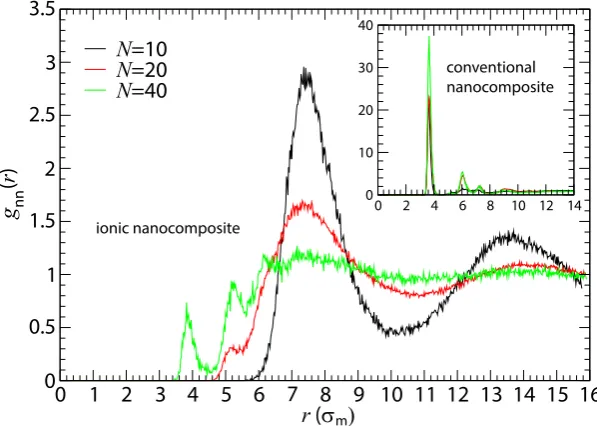
contact with each other rather than with monomers (inset of Figure2), which implies nanoparticle aggregation. On the other hand, attractive (electrostatic) monomer–nanoparticle interaction helps the nanoparticles to be well dispersed in the polymer matrix. For low nanoparticle loading (φ
=
10%), there are no nanoparticle contacts if the number of monomers in the chain isN=
10 or N=
20, while, ifNis increased further, some nanoparticle–nanoparticle contacts emerge, as can be seen from the first peak ofgnn(
r)
in Figure2. For a longer polymer matrix (N=
200), nanoparticle dispersion is not achieved for our polymers who carry charges at their terminals only (results shown in the supplementary information, Figure S3).For slightly higher nanoparticle loading (φ
=
17.7%), a similar behavior appears (gnn(
r)
data shown in Figure S1), whereas for even higher loading atφ≈
24% (Figure S2), nanoparticle aggregation occurs. Experiments [48] reported φ=
20% as an upper limit for which nanoparticles could still be dispersed effectively; beyond that threshold, nanoparticle aggregation occured. Upon increasing the nanoparticle radius toR=
4, poor dispersion is also observed in conventional nanocomposites, c.f. Figure S3. Thus, in nanocomposites containing nanoparticles of radius to R=
2 or R=
4, the nanoparticles form aggregated clusters in the absence of electrostatic interaction. However, when the monomer–nanoparticle electrostatic attraction is present, there are not any (or few) nanoparticle contacts for loading below 20%, for the oligomers matrices withN=
10 andN=
20, as can be seen from the simulations (gnn(
r)
in Figure2) and TEM pictures [48]. In the simulations, the nanoparticles are well dispersed in the oligomeric matrix (the same behavior is observed for nanoparticles of radius R=
4) for nanoparticle loading below 20% in agreement with the experimental observations [48,49]. Nanoparticle dispersion is a result of the incorporation of charges in the nanocomposite and not due to changes inR/Rg. It is worth noting that, at loadingbelow 20%, nanoparticle dispersion occurs at the Bjerrum lengthlB
≥
0.24σm. In conventional (non-ionic) nanocomposites, a phase separation has been observed whenRg≤
Rin agreement withexperiments [41,46].
0
1
2
3
4
5
6
7
8
9 10
11
12
13
14
15
16
r
(
σ
m)
0
0
.
5
1
1
.
5
2
2
.
5
3
3
.
5
g
nn(
r
)
N
=10
N
=20
N
=40
0 2 4 6 8 10 12 14 0
10 20 30 40
ionic nanocomposite
[image:6.595.147.446.444.657.2]conventional nanocomposite
Figure 2. Nanoparticle–nanoparticle radial distribution functions (RDF) gnn(r) in the ionic
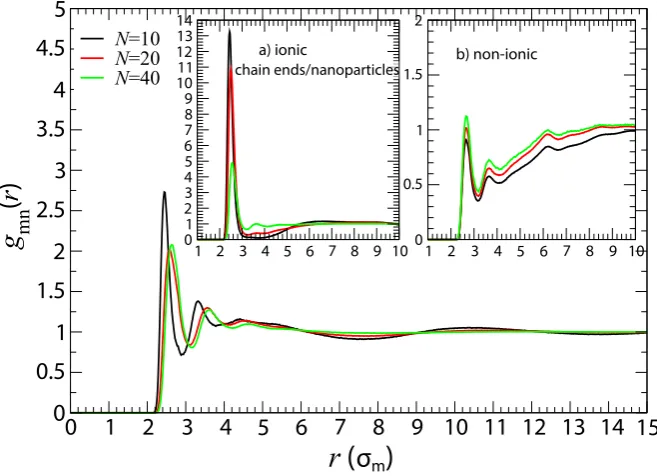
In Figure3, we show the monomer–nanoparticle radial distribution functiongmn
(
r)
, for different polymerization degrees, in ionic nanocomposites with small nanoparticles (R=
2). As can be seen from Figure3,gmn(
r)
exhibits a layering structure. The high monomer density of the layers establishes a well defined interphase [104] between nanoparticles and polymer melt whose structure differs from that of the amorphous polymer melt. By dispersing charged nanoparticles in the polymer matrix the polymer density around the nanoparticles increases, but the interphase layer is thin, as can be seen by the enhanced first peak ofgmn(
r)
, compared togmn(
r)
in conventional nanocomposites with repulsive nanoparticles (inset b in Figure3). Moreover, the chain end monomers/nanoparticle contacts are enhanced in oligomer matrices due to the electrostatic attraction that leads to the dispersion of charged nanoparticles (inset a in Figure3).0
1
2
3
4
5
6
7
8
9 10 11 12 13 14 15
r (
σ
m)
0
0
.
5
1
1.5
2
2
.
5
3
3
.
5
4
4.5
5
g
m n(
r
)
N
=10
N
=20
N
=40
1 2 3 4 5 6 7 8 9 10
0 0.5 1 1.5 2
1 2 3 4 5 6 7 8 9 10
0 1 2 3 4 5 6 7 8 9 10 11 12 13 14
a) ionic b) non-ionic
[image:7.595.132.461.236.474.2]chain ends/nanoparticles
Figure 3. Monomer-nanoparticle radial distribution functions (RDF)gmn(r)in ionic nanocomposites
for different polymer matrices with nanoparticles (R=2) at≈10% volume fraction. Inset: (a) chain end monomer–nanoparticle radial distribution functions for the very same systems of the outset; (b) monomer–nanoparticle radial distribution functions in conventional (non-ionic) nanocomposites with nanoparticles (R=2) for different polymer matrices at 10% volume fraction. The RDF for the ionic nanocomposite withN=200 shows a similar behavior with those in the conventional nanocomposites (results shown in Figure S3).
3.2. Polymer Dimensions
We now turn attention to the polymer dimensions [54] analysis of ionic nanocomposites. The radius of gyrationRgof a molecule, defined as the average squared distance between monomers
in a given conformation and the molecule’s center of mass is given by [68,105]
h
R2g(
N)
i
=
1 N
*N
∑
i=1
(
ri−
rcm)
2 +, (7)
wherercm
=
N−1∑i=1riis the center of mass of the chain. The radii of gyration of the polymer meltsimulated systems are given in Table2.
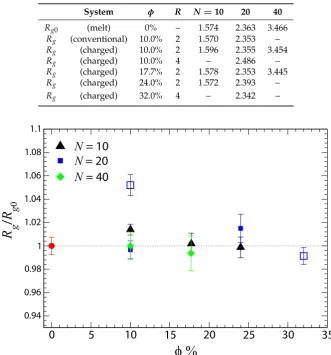
and there is no change on radius of gyration values. In particular, for the case of conventional nanocomposites containing short polymers (N
=
10, 20, 40) as matrix, polymers remain unaltered compared with their bulk values, at low nanoparticle loading (φ=
10%). We do not find any evidence for polymer contraction at any nanoparticle loading. For entangled PEP polymers filled with silica nanoparticles (which is a repulsive system), a polymer contraction of 12% above percolation (φ=
50%) was reported [47].Table 2. Average radius of gyration (of σm units) for both ionic and conventional polymer
nanocomposite systems studied in the present simulations. Volume fractionφ. Nanoparticle radiusR. Polymerization degreeN. The nanocomposites systems in which nanoparticle dispersion has not been achieved have not been analyzed.
System φ R N =10 20 40
Rg0 (melt) 0% – 1.574 2.363 3.466 Rg (conventional) 10.0% 2 1.570 2.353 –
Rg (charged) 10.0% 2 1.596 2.355 3.454
Rg (charged) 10.0% 4 – 2.486 –
Rg (charged) 17.7% 2 1.578 2.353 3.445
Rg (charged) 24.0% 2 1.572 2.393 –
Rg (charged) 32.0% 4 – 2.342 –
0
5
10
15
20
25
30
35
φ %
0.94 0.96 0.98 1 1.02 1.04 1.06 1.08 1.1
R
g/
R
g0
N
= 10
N
= 20
N
= 40
Figure 4. Radius of gyrationRg of end-charged polymers in the presence of oppositely charged nanoparticles, relative to their Rg0, nanoparticle-free melt (red filled circle at φ = 0%) value.
Results for the ionic nanocomposite as a function of nanoparticle volume fraction for a polymer matrix with polymerization degree (i)N=10 (triangles up); and (ii)N=20 (blue squares),N=40 (green diamonds),N=200 (triangles down). Filled symbols are forR=2 whereas open symbols are forR=4. Error bars are estimated by the standard deviation values ofRgand propagated for the ratio
Rg/Rg0. The error bar for the melt corresponds toN=20 matrix.
In ionic nanocomposites containing charged nanoparticles of radiusR
=
2, oligomers (N=
10) are expand their conformation only at low nanoparticle loading (φ=
10%), as long as Rg<
R.polymers (N
=
10 andN=
20) increases, in comparison to its bulk value, in ionic nanocomposites but only at low nanoparticle loading (10%) and as long asRg<
R(Figure4). However,Rgdoesn’t changein comparison to its bulk value for higher nanoparticle loadings or ifRg
≥
R. We can thus concludethat short polymers in ionic nanocomposites withRg
<
R, are perturbed at low nanoparticle loadingsuch asφ
=
10% but remain unperturbed at higher nanoparticle loading.In addition, we have calculated the primitive paths of the polymer chains with charges located at their chain ends, and upon ignoring the nanoparticles (phantom limit) as in [106], using the Z1 algorithm [107]. The chains’ entanglement lengths Ne as predicted by different estimators,
for conventional and ionic nanocomposites, are given in Table3. The polymer entanglement length does not change (outside the error margin) with the addition of the nanoparticles.
Table 3. Volume fraction φ, nanoparticle radius R, chain length N, end to end distance Ree, contour length of primitive path Lpp, coil- and kink-based, classical and modified Ne estimators [94,108],appis the tube diameter of the ionic and conventional nanocomposites,Zkinksis
the number of interior kinks of the primitive path. All lengths,R,Ree,Lpp, andappare given in terms
ofσmunits. The other nanocomposites at higher nanoparticle loading with polymer matrixN=40
have not been analyzed this way, since nanoparticle dispersion has not been achieved.
Coil-Based Kink-Based
System φ R N Ree Lpp app Neclass-S Nemod-S Zkinks Neclass-S Nemod-S
melt 0% – 40 8.5±0.1 9.9±0.1 7.3 28.8±0.6 74.8±4.5 1.07±0.04 19.1±0.4 37.6±1.5 charged 10.0% 2 40 8.7±0.2 10.1±0.2 7.4 28.8±0.6 75.3±4.4 1.03±0.04 19.5±0.4 39.0±1.5 charged 10.0% 4 40 8.9±0.2 10.5±0.2 7.6 28.1±0.6 72.0±4.8 1.12±0.05 18.6±0.4 35.7±1.6
3.3. Nanoparticle Diffusion
While in other theoretical studies [61,73,109,110] only neutral nanoparticle diffusion [74,111] has been explored, we investigate here, apparently for the first time, diffusion of charged nanoparticles in polymer matrices. The nanoparticle diffusivities of the simulated nanocomposite systems are calculated from the mean square displacement measurements (Figure S5) as follows:
D0
=
1 6tlim→∞d dt
D
|
ri(
t)
−
ri(
0)
|
2E
, (8)
where
h|
ri(
t)
−
ri(
0)
|
2i
is the time dependent mean square displacement of nanoparticle i,averaged over the ensemble of nanoparticles, andri
(
t)
denotes the center position of a nanoparticleiat timet.
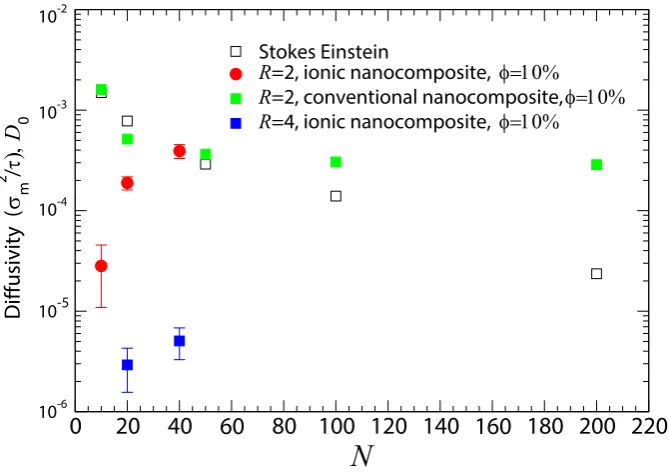
The nanoparticle diffusivity in different polymer matrices can be inferred from Figure 5. The diffusion of such small sized nanoparticles in conventional nanocomposites [67,110,112] reaches a plateau in entangled polymer matrices forN
>
100 [61,73,81,111], in agreement with the GeneralizedLangevin Equation (GLE) theory [113–115] and theoretical predictions by de Gennes [116]. He argued that bulk viscosity does not capture the behavior of surrounding flows near nanoparticles, and thus the nanoparticle diffusion is decoupled from the Stokes–Einstein relation.
It can be seen, from the data, that such nanoparticles, smaller than the tube diameter dT
nanoparticle diameter is smaller than the entanglement strand, such dispersed nanoparticles can diffuse inside the mesh of polymers, faster in comparison to the Stokes–Einstein predictions, due to local viscosity [61,74,75,117], but this is not the case in ionic nanocomposites. In these materials, the electrostatic strength as controlled by the Bjerrum length affects the diffusion of the nanoparticles. Furthermore, we calculated the displacement distribution of the nanoparticles at different times. Such distribution can be obtained from the self-part of the van Hove function (VHF),
Gs
(
r,∆t) =
h
δ[
r− |
ri(
t0+
∆t)
−
ri(
t0)
|
]
i
t0, (9)which gives the probability density to find a nanoparticle at a distancerfrom the initial position after a time interval∆t. The probability is normalized as
R
Gs
(
r,∆t)
d3r=
1. As can be seen from Figure6,for nanocomposites with nanoparticlesR
=
4 and matrixN=
40 at small time intervals 3τand 15τ (τ=
1000τLJ), the data can be fitted to a a Gaussian function (10) with a peak value corresponding to the most probable traveled distance during that time interval∆tGs
(
r,∆t) = (
4πD∆t)
−3/2e−r2/4D∆t. (10)
For larger time intervals∆t
=
37.5τand 55.5τ, the displacement distribution of the nanoparticles can only be fitted using a bimodal superposition of Gaussians, which can be attributed to a hopping motion [118] of the nanoparticles. It means that charged nanoparticles effectively hop in space. In particular, the area of the secondary local peak in the displacement distribution can become larger at a long time interval∆t, indicating that the hopping is performed more easily on longer time scales (diffusion regime). This phenomenon is also observed in fullerene (C60)/polystyrene or polypropylene nanocomposites as was shown recently by atomistic simulations [112]. Similar behavior appears for the other ionic nanocomposites studied, where dispersion has achieved (results shown in Figures S6–S9).0
20
40
60
80 100 120 140 160 180 200 220
N
10-610-5 10-4
Diffusivity (
σ
m 2/
τ),
D
0Stokes Einstein
R
=2, ionic nanocomposite,
φ=10%
R
=2, conventional nanocomposite,
φ=10%
R
=4, ionic nanocomposite,
φ=10%
[image:10.595.132.467.431.669.2]10-3 10-2
Figure 5. Dependence of nanoparticle (R=2 andR =4) diffusivityD0according to Equation (8)
(a)
0 1 2 3 4 5
0 0.2 0.4 0.6 0.8 1
(b)
0 1 2 3 4 5
0 0.2 0.4 0.6 0.8 1
(c)
0 1 2 3 4 5
0 0.2 0.4 0.6 0.8 1
(d)
0 1 2 3 4 5
[image:11.595.121.474.85.303.2]0 0.2 0.4 0.6 0.8 1
Figure 6.Van Hove functionGs(r,∆t)for nanoparticles in nanocomposite withφ=10%, nanoparticle radiusR=4, nanoparticle chargeZ=75, polymer matrixN =40, at four different∆t(in units of τ=1000τLJ). Blue symbols are data from the simulations, and solid lines are fitting of Equation (10) in the two upper panels (a,b) for∆t≤15τ, while the two bottom panels (c,d) for larger time intervals
∆t ≥ 37.5τcan only be fitted by a superposition of two Gaussians. The individual contributions are shown by black dashed lines (basically invisible for∆t =55.5τ). The mentioned values forD correspond to the first peak in (c,d).
4. Conclusions
To summarize, we investigated the structure and conformations of polymers and nanoparticle diffusion, for the first time in ionic nanocomposites containing small spherical nanoparticles up to high volume fraction, using a coarse grained model for nanoparticles and polymers by means of molecular dynamics simulations. We find that in nanocomposites with repulsive monomer–nanoparticle interaction, such as in conventional nanocomposites, the polymers and nanoparticles phase separate in agreement to experiments. However, in ionic nanocomposites and for short polymer chains matrix (N
=
10, 20, 40), nanoparticle dispersion is achieved. This result has also been observed in qualitative agreement with the experimental data.Additionally, we have observed that the average radius of gyration of ionic oligomer chains (N
=
10, 20) with charged chain ends can be perturbed (expanded) by charged nanoparticles in ionic nanocomposites at low nanoparticle loading such asφ=
10%, but only ifRg<
R. However,these short polymer chains as well as their entangled counterparts do not alter their size compared to their melt values at the higher volume fractions studied, for both repulsive and charged nanoparticles. The nanoparticles are still mobile but their diffusion, which follows a hopping motion, is decreased due to the electrostatic strength between monomers and nanoparticles.
Supplementary Materials:The following are available online athttp://www.mdpi.com/2073-4360/10/9/1010/s1, Figures S1–S5: RDF for ionic nanocomposites at different nanoparticle volume fractions and for variousN, Figure S5: Mean square displacement for different ionic nanocomposites atφ=10%, Figures S6–S9: van Hove functions for ionic nanocomposites atφ=10%.
Author Contributions:Conceptualization, A.K. and P.D.; Methodology, A.K. and M.K.; Validation, A.K. and M.K.; Formal Analysis, A.K. and M.K.; Investigation, A.K., M.K. and N.C.; Writing—Original Draft Preparation, A.K., Y.K. and M.K.; Writing—Review and Editing, A.K., Y.K., N.C, and M.K.; Project Administration, A.K. and M.K.
Funding:This research received no external funding.
References
1. Kumar, S.K.; Benicewicz, B.C.; Vaia, R.A.; Winey, K.I. 50th anniversary perspective: Are polymer nanocomposites practical for applications? Macromolecules2017,50, 714–731. [CrossRef]
2. Winey, K.I.; Vaia, R.A. Polymer Nanocomposites. MRS Bull.2007,32, 314. [CrossRef]
3. Moniruzzaman, M.; Winey, K.I. Polymer nanocomposites containing carbon nanotubes. Macromolecules
2006,39, 5194–5205. [CrossRef]
4. Kumar, S.K.; Krishnamoorti, R. Nanocomposites: Structure, phase behavior, and properties. Annu. Rev. Chem. Biomol. Eng.2010,1, 37–58. [CrossRef] [PubMed]
5. Fernandes, N.J.; Akbarzadeh, J.; Peterlik, H.; Giannelis, E.P. Synthesis and properties of highly dispersed ionic silica-poly(ethylene oxide) nanohybrids. ACS Nano2013,7, 1265–1271. [CrossRef] [PubMed] 6. Fernandes, N.J.; Wallin, T.J.; Vaia, R.A.; Koerner, H.; Giannelis, E.P. Hairy nanoparticle assemblies as
one-component functional polymer nanocomposites: Opportunities and challenges.MRS Commun.2013, 3, 13–29. [CrossRef]
7. Srivastava, S.; Choudhury, S.; Agrawal, A.; Archer, L.A. Self-suspended polymer grafted nanoparticles. Curr. Opin. Chem. Eng.2017,16, 92–101. [CrossRef]
8. Crosby, A.; Lee, J.Y. Polymer nanocomposites: The nano effect on mechanical properties. Polym. Rev.2007, 47, 217–229. [CrossRef]
9. Hu, H.; Onyebueke, L.; Abatan, A. Characterizing and modeling mechanical properties of nanocomposites. Review and evaluation. J. Miner. Mater. Charact. Eng.2010,9, 275–319. [CrossRef]
10. Suvorova, Y.V.; Alekseeva, S.I.; Fronya, M.A.; Viktorova, I.V. Investigations of physical and mechanical properties of polymeric nanocomposites (Review).Inorg. Mater.2013,49, 1357–1368. [CrossRef]
11. Clancy, T.C.; Frankland, S.J.V.; Hinkley, J.A.; Gates, T.S. Multiscale modeling of thermal conductivity of polymer/carbon nanocomposites. Int. J. Therm. Sci.2010,49, 1555–1560. [CrossRef]
12. Pereira, P.; Gaspar, H.; Fernardes, L.; Bernardo, G. Impact of fullerenes on the thermal stability of melt processed polystyrene and poly(methyl-methacrylate) composites. Polym. Test.2015,47, 130–136. [CrossRef] 13. Koutsawa, Y.; Karatrantos, A.; Yu, W.; Ruch, D. A micromechanics approach for the effective thermal conductivity of composite materials with general linear imperfect interfaces. Compos. Struct. 2018, 200, 747–756. [CrossRef]
14. Rong, M.Z.; Zhang, M.Q.; Liu, H.; Zeng, H.; Wetzel, B.; Friedrich, K. Microstructure and tribological behavior of polymeric nanocomposites.Ind. Lubric. Tribol.2001,53, 72–77. [CrossRef]
15. Everaers, R. Topological versus rheological entanglement length in primitive-path analysis protocols, tube models, and slip-link models.Phys. Rev. E2012,86, 022801. [CrossRef] [PubMed]
16. Winey, K.I.; Kashiwagi, T.; Mu, M.F. Improving electrical conductivity and thermal properties of polymers by the addition of carbon nanotubes as fillers. MRS Bull.2007,32, 348–53. [CrossRef]
17. Mangal, R.; Srivastava, S.; Archer, L.A. Multiscale dynamics of polymers in particle-rich nanocomposites. Macromolecules2016,49, 5502. [CrossRef]
18. Karatrantos, A.; Composto, R.J.; Winey, K.I.; Kröger, M.; Clarke, N. Entanglements and dynamics of polymer melts near a SWCNT.Macromolecules2012,45, 7274. [CrossRef]
19. Karatrantos, A.; Composto, R.J.; Winey, K.I.; Clarke, N. Primitive path network, structure and dynamics of SWCNT/polymer nanocomposites. IOP Conf. Ser. Mater. Sci. Eng.2012,40, 012027. [CrossRef]
20. Karatrantos, A.; Clarke, N. A theoretical model for the prediction of diffusion in polymer/SWCNT nanocomposites. Soft Matter2011,7, 7334. [CrossRef]
21. Chen, T.; Qian, H.J.; Zhu, Y.L.; Lu, Z.Y. Structure and dynamics properties at interphase region in the composite of polystyrene and cross-linked polystyrene soft nanoparticle.Macromolecules2015,48, 2751–2760. [CrossRef]
24. Jankar, J.; Douglas, J.F.; Starr, F.W.; Kumar, S.K.; Cassagnau, P.; Lesser, A.J.; Sternstein, S.S.; Buehler, M.J. Current issues in research on structure property relationships in polymer nanocomposites. Polymer2010, 51, 3321–3343. [CrossRef]
25. Ganesan, V.; Jayaraman, A. Theory and simulation studies of effective interactions, phase behavior and morphology in polymer nanocomposites. Soft Matter2014,10, 13–38. [CrossRef] [PubMed]
26. Gaspar, H.; Teixeira, P.; Santos, R.; Fernardes, L.; Hilliou, L.; Weir, M.P.; Parnell, A.J.; Abrams, K.J.; Hill, C.J.; Bouwman, W.G.; et al. Impact of fullerenes on the thermal stability of melt processed polystyrene and poly(methyl-methacrylate) composites. A Journey along the Extruder with Polystyrene: C60 Nanocomposites: Convergence of Feeding Formulations into a Similar Nanomorphology.Macromolecules
2017,50, 3301–3312. [CrossRef]
27. Karatrantos, A.; Clarke, N.; Composto, R.J.; Winey, K.I. Structure, dynamics and primitive path network of polymer nanocomposites containing spherical nanoparticles.MRS Symp. Proc.2014,1619. [CrossRef] 28. Karatrantos, A.; Clarke, N.; Kröger, M. Modeling of polymer structure and conformations in polymer
nanocomposites from atomistic to mesoscale: A Review. Polym. Rev.2016,56, 385–428. [CrossRef]
29. Lu, C.T.; Weerasinghe, A.; Maroudas, D.; Ramasubramaniam, A. A Comparison of the Elastic Properties of Graphene- and Fullerene-Reinforced Polymer Composites: The Role of Filler Morphology and Size. Sci. Rep.
2016,6, 525. [CrossRef] [PubMed]
30. Mangal, R.; Srivastava, S.; Archer, L.A. Phase stability and dynamics of entangled polymer-nanoparticles composites. Nat. Commun.2015,6, 7198. [CrossRef] [PubMed]
31. Supova, M.; Martynkova, G.S.; Barabasyova, K. Effect of Nanofillers Dispersion in Polymer Matrices: A Review.Sci. Adv. Mater.2011,3, 1–25. [CrossRef]
32. Bernardo, G.; Deb, N.; King, S.M.; Bucknall, D.G. Phase behavior of blends of PCBM with amorphous polymers with different aromaticity. J. Polym. Sci. B2016,54, 994–1001. [CrossRef]
33. Mackay, M.E.; Tuteja, A.; Duxbury, P.M.; Hawker, C.J.; Van Horn, B.; Guan, Z.; Chen, G.H.; Krishnan, R.S. General strategies for nanoparticle dispersion. Science2006,311, 1740. [CrossRef] [PubMed]
34. Ferdous, S.F.; Sarker, F.; Adnan, A. Role of nanoparticle dispersion and filler-matrix interface on the matrix dominated failure of rigid C60-PE nanocomposites: A molecular dynamics simulation study. Polymer2013, 54, 2565–2576. [CrossRef]
35. Cao, X.Z.; Merlitz, H.; Wu, C.X.; Ungar, G.; Sommer, J.U. A theoretical study of dispersion-to-aggregation of nanoparticles in adsorbing polymers using molecular dynamics simulations. Nanoscale2016,8, 6964–6968. [CrossRef] [PubMed]
36. Jouault, N.; Dalmas, F.; Boue, F.; Jestin, J. Multiscale characterization of filler dispersion and origins of mechanical reinforcement in model nanocomposites. Polymer2012,53, 761–775. [CrossRef]
37. Hore, M.J.A.; Composto, R.J. Strategies for dispersing, assembling, and orienting nanorods in polymers. Curr. Opin. Chem. Eng.2013,2, 95–102. [CrossRef]
38. Kumar, S.K.; Jouault, N.; Benicewicz, B.; Neely, T. Nanocomposites with polymer grafted nanoparticles. Macromolecules2013,46, 3199–3214. [CrossRef]
39. Akcora, P.; Liu, H.; Kumar, S.K.; Moll, J.; Li, Y.; Benicewicz, B.C.; Schadler, L.S.; Acehan, D.; Panagiotopoulos, A.Z.; Pryamitsyn, V.; et al. Anisotropic self-assembly of spherical polymer-grafted nanoparticles.Nat. Mater.2009,8, 354–359. [CrossRef] [PubMed]
40. Chevigny, C.; Dalmas, F.; Di Cola, E.; Gigmes, D.; Bertin, D.; Boué, F.; Jestin, J. Polymer-grafted-nanoparticles nanocomposites: Dispersion, grafted chain conformation, and rheological behavior. Macromolecules2011, 44, 122–133. [CrossRef]
41. Crawford, M.K.; Smalley, R.J.; Cohen, G.; Hogan, B.; Wood, B.; Kumar, S.K.; Melnichenko, Y.B.; He, L.; Guise, W.; Hammouda, B. Chain conformation in polymer nanocomposites with uniformly dispersed nanoparticles.Phys. Rev. Lett.2013,110, 196001. [CrossRef] [PubMed]
42. Jouault, N.; Crawford, M.K.; Chi, C.; Smalley, R.J.; Wood, B.; Jestin, J.; Melnichenko, Y.B.; He, L.; Guise, W.E.; Kumar, S.K. Polymer Chain Behavior in Polymer Nanocomposites with Attractive Interactions. ACS Macro Lett.2016,5, 523–527. [CrossRef]
44. Robbes, A.S.; Cousin, F.; Meneau, F.; Jestin, J. Melt Chain Conformation in Nanoparticles/Polymer Nanocomposites Elucidated by the SANS Extrapolation Method: Evidence of the Filler Contribution. Macromolecules2018,51, 2216–2226. [CrossRef]
45. Sen, S.; Xie, Y.; Kumar, S.K.; Yang, H.; Bansal, A.; Ho, D.L.; Hall, L.; Hooper, J.B.; Schweizer, K.S. Chain conformations and bound-layer correlations in polymer nanocomposites. Phys. Rev. Lett. 2007, 98, 128302. [CrossRef] [PubMed]
46. Tuteja, A.; Duxbury, P.M.; Mackay, M.E. Polymer chain swelling induced by dispersed nanoparticles. Phys. Rev. Lett.2008,100, 077801. [CrossRef] [PubMed]
47. Nusser, K.; Neueder, S.; Schneider, G.J.; Meyer, M.; Pyckhout-Hintzen, W.; Willner, L.; Radulescu, A.; Richter, D. Conformations of silica-poly(ethylene-propylene) nanocomposites. Macromolecules 2010, 43, 9837–9847. [CrossRef]
48. Odent, J.; Raquez, J.M.; Dubois, P.; Giannelis, E.P. Ultra-stretchable ionic nanocomposites: From dynamic bonding to multi-responsive behaviors. J. Mater. Chem. A2017,5, 13357–13363. [CrossRef]
49. Odent, J.; Raquez, J.M.; Samuel, C.; Barrau, S.; Enotiadis, A.; Dubois, P.; Giannelis, E.P. Shape-memory behavior of polylactide/silica ionic hybrids.Macromolecules2017,50, 2896. [CrossRef]
50. Lin, C.C.; Gam, S.; Meth, J.S.; Clarke, N.; Winey, K.I. Do attractive polymer-nanoparticle interactions retard polymer diffusion in nanocomposites.Macromolecules2013,46, 4502. [CrossRef]
51. Gam, S.; Meth, J.S.; Zane, S.G.; Chi, C.; Wood, B.A.; Seitz, M.E.; Winey, K.I.; Clarke, N.; Composto, R.J. Macromolecules diffusion in a crowded polymer nanocomposite. Macromolecules2011,44, 3494. [CrossRef] 52. Gam, S.; Meth, J.S.; Zane, S.G.; Chi, C.; Wood, B.A.; Winey, K.I.; Clarke, N.; Composto, R.J. Polymer Diffusion in a polymer nanocomposite:effect of nanoparticle size and polydispersity.Soft Matter2012,8, 6512. [CrossRef]
53. Jouault, N.; Kumar, S.K.; Smalley, R.J.; Chi, C.; Moneta, R.; Wood, B.; Salerno, H.; Melnichenko, Y.B.; He, L.; Guise, W.E.; et al. Do Very Small POSS Nanoparticles Perturb s-PMMA Chain Conformations? Macromolecules2018,51, 5278–5293. [CrossRef]
54. Jouault, N.; Dalmas, F.; Said, S.; Schweins, R.; Jestin, J.; Boue, F. Direct measurement of polymer chain conformation in well-controlled model nanocomposites by combining SANS and SAXS. Macromolecules
2010,43, 9881–9891. [CrossRef]
55. Pimer, D.; Dulle, M.; Forster, S. Viscoelastic properties and reinforcement of non-aggregated and aggregated nanocomposites. Polymer2018,145, 101–107.
56. Shen, J.; Liu, J.; Gao, Y.; Cao, D.; Zhang, L. Revisiting the dispersion mechanism of grafted nanoparticles in polymer matrix: A detailed molecular dynamics simulation. Langmuir2011,27, 15213–15222. [CrossRef] [PubMed]
57. Teh, S.L.; Linton, D.; Sumpter, B.; Dadmun, M.D. Controlling Non-covalent interactions to modulate the dispersion of fullerenes in polymer nanocomposites. Macromolecules2011,44, 7737–7745. [CrossRef] 58. Hore, M.J.A.; Frischknecht, A.L.; Composto, R.J. Nanorod assemblies in polymer films and their
dispersion-dependent optical properties. ACS Macro Lett.2012,1, 115–121. [CrossRef]
59. Sampath, J.; Hall, L. Influence of a nanoparticle on the structure and dynamics of model ionomer melts. Soft Matter2018,14, 4621–4632. [CrossRef] [PubMed]
60. Shah, D.; Maiti, P.; Jiang, D.D.; Batt, C.A.; Giannelis, E.P. Effect of nanoparticle mobility on toughness of polymer nanocomposites.Adv. Mater.2005,17, 525. [CrossRef]
61. Karatrantos, A.; Composto, R.J.; Winey, K.I.; Clarke, N. Polymer and spherical nanoparticle diffusion in nanocomposites. J. Chem. Phys.2017,146, 203331. [CrossRef] [PubMed]
62. Lin, C.C.; Parrish, E.; Composto, R.J. Macromolecule and particle dynamics in confined media. Macromolecules2016,49, 5755–5772. [CrossRef]
63. Lungova, M.; Krutyeva, M.; Pyckhout-Hintzen, W.; Wischnewski, A.; Monkenbusch, M.; Allgaier, J.; Ohl, M.; Sharp, M.; Richter, D. Nanoscale motion of soft nanoparticles in unentangled and entangled polymer matrices.Phys. Rev. Lett.2016,117, 147803. [CrossRef] [PubMed]
64. Grabowski, C.A.; Mukhopadhyay, A. Size effect of nanoparticle diffusion in a polymer melt. Macromolecules
2014,47, 7238–7242. [CrossRef]
66. Karatrantos, A.; Composto, R.J.; Winey, K.I.; Clarke, N. Structure and conformations of polymer/SWCNT nanocomposites. Macromolecules2011,44, 9830–9838. [CrossRef]
67. Mangal, R.; Srivastava, S.; Narayanan, S.; Archer, L.A. Size-dependent particle dynamics in entangled polymer nanocomposites.Langmuir2016,32, 596–603. [CrossRef] [PubMed]
68. Karatrantos, A.; Clarke, N.; Composto, R.J.; Winey, K.I. Polymer conformations in polymer nanocomposites containing spherical nanoparticles. Soft Matter2015,11, 382. [CrossRef] [PubMed]
69. Einstein, A. Eine neue Bestimmung der Moleküldimensionen. Ann. Phys. (Leipzig)1906,19, 289. [CrossRef] 70. Griffin, P.J.; Bocharova, V.; Middleton, L.R.; Composto, R.J.; Clarke, N.; Schweizer, K.S.; Winey, K. Influence of the bound polymer layer on nanoparticle diffusion in polymer melts. ACS Macro Lett. 2016,5, 1141. [CrossRef]
71. Wyart, F.B.; de Gennes, P.G. Viscosity at small scales in polymer melts. Eur. Phys. J. E2000,1, 93–97. [CrossRef]
72. Everaers, R.; Sukumaran, S.K.; Grest, G.S.; Svaneborg, C.; Sivasubramanian, A.; Kremer, K. Rheology and microscopic topology of entangled polymeric liquids. Science2004,303, 823. [CrossRef] [PubMed]
73. Kalathi, J.T.; Yamamoto, U.; Schweizer, K.S.; Grest, G.S.; Kumar, S.K. Nanoparticle diffusion in polymer nanocomposites. Phys. Rev. Lett.2014,112, 108301. [CrossRef] [PubMed]
74. Ge, T.; Grest, G.; Rubinstein, M. Nanorheology of Entangled Polymer Melts.Phys. Rev. Lett.2018,120, 057801. [CrossRef] [PubMed]
75. Liu, J.; Cao, D.; Zhang, L. Molecular Dynamics study on nanoparticle diffusion in polymer melts: A test of the Stokes–Einstein Law. J. Phys. Chem. C2008,112, 6653–6661. [CrossRef]
76. Goswami, M.; Sumpter, B.G. Anomalous chain diffusion in polymer nanocomposites for varying polymer-filler interaction strengths. Phys. Rev. E2010,81, 041801. [CrossRef] [PubMed]
77. Mu, M.; Seitz, M.E.; Clarke, N.; Composto, R.J.; Winey, K. Polymer tracer diffusion exhibits a minimum in nanocomposites containing spherical nanoparticles. Macromolecules2011,44, 191–193. [CrossRef]
78. Lin, C.C.; Cargnello, M.; Murray, C.B.; Clarke, N.; Winey, K.I.; Riggleman, R.A.; Composto, R.J. Nanorod mobility influences polymer diffusion in polymer nanocomposites. ACS Macro Lett. 2017, 6, 869–874. [CrossRef]
79. Hong, B.; Chremos, A.; Panagiotopoulos, A.Z. Simulations of the structure and dynamics of nanoparticle-based ionic liquids. Faraday Discuss.2011,154, 29. [CrossRef]
80. Hong, B.; Panagiotopoulos, A.Z. Diffusivities, viscosities, and conductivities of solvent-free ionically grafted nanoparticles.Soft Matter2013,9, 6091–6102. [CrossRef]
81. Babayekhorasani, F.; Dunstan, D.E.; Krishnamoorti, R.; Conrad, J.C. Nanoparticle diffusion in crowded and confined media.Soft Matter2016,12, 8407–8416. [CrossRef] [PubMed]
82. Nath, P.; Mangal, R.; Kohle, F.F.E.; Choudhury, S.; Narayanan, S.; Wiesner, U.B.; Archer, L.A. Dynamics of nanoparticles in entangled polymer solutions.Langmuir2017,50, 2896. [CrossRef] [PubMed]
83. Poling-Skutvik, R.; Krishnamoorti, R.; Conrad, J.C. Size-dependent dynamics of nanoparticles in unentangled polyelectrolyte solutions.ACS Macro Lett.2015,4, 1169–1173. [CrossRef]
84. Wu, S.; Xiao, C.; Zhang, Z.; Chen, Q.; Matsumiya, Y.; Watanabe, H. Molecular design of highly stretchable ionomers. Macromolecules2018,51, 4735–4746. [CrossRef]
85. Pandav, G.; Pryamitsyn, V.; Ganesan, V. Interactions and Aggregation of Charged Nanoparticles in Uncharged Polymer Solutions. Langmuir2015,31, 12328–12338. [CrossRef] [PubMed]
86. Pandav, G.; Pryamitsyn, V.; Errington, J.; Ganesan, V. Multibody Interactions, Phase Behavior, and Clustering in Nanoparticle–Polyelectrolyte Mixtures. J. Phys. Chem. B2015,119, 14536–14550. [CrossRef] [PubMed] 87. Parrish, E.; Caporizzo, M.A.; Composto, R.J. Network confinement and heterogeneity slows nanoparticle
diffusion in polymer gels. J. Chem. Phys.2017,146, 203318. [CrossRef] [PubMed]
88. Parrish, E.; Seeger, S.C.; Composto, R.J. Temperature-Dependent Nanoparticle Dynamics in Poly(N-isopropylacrylamide) Gels.Macromolecules2018,51, 3597–3607. [CrossRef]
89. Bekker, H.; Berendsen, H.J.C.; Dijkstra, E.J.; Achterop, S.; van Drunen, R.; van der Spoel, D.; Sijbers, A.; Keegstra, H.; Reitsma, B.; Renardus, M.K.R. Gromacs: A parallel computer for molecular dynamics simulations.Phys. Comput.1993,92, 252.
91. Lindahl, E.; Hess, B.; van der Spoel, D. Gromacs 3.0: A package for molecular simulation and trajectory analysis. J. Mol. Mod.2001,7, 306–317. [CrossRef]
92. Van der Spoel, D.; Lindahl, E.; Hess, B.; Groenhof, G.; Mark, A.E.; Berendsen, H.J.C. GROMACS: Fast, Flexible and Free.J. Comp. Chem.2005,26, 1701–1718. [CrossRef] [PubMed]
93. Kremer, K.; Grest, G.S. Dynamics of entangled linear polymer melts: A molecular-dynamics simulation. J. Chem. Phys.1990,92, 5057. [CrossRef]
94. Karatrantos, A.; Clarke, N.; Composto, R.J.; Winey, K.I. Entanglements in polymer nanocomposites containing spherical nanoparticles. Soft Matter2016,12, 2567. [CrossRef] [PubMed]
95. Allen, M.P.; Tildesley, D.J.Computer Simulation of Liquids; Clarendon Press: Oxford, UK, 1987.
96. Hatlo, M.; Karatrantos, A.; Lue, L. One-component plasma of point charges and of charged rods.Phys. Rev. E
2009,80, 061107. [CrossRef] [PubMed]
97. Karatrantos, A. Isotropic-nematic transition and dynamics of rigid charged molecules. Chem. Phys. Lett.
2016,647, 89–94. [CrossRef]
98. Karatrantos, A.; Cai, Q. Effect of pore size and surface charge on sodium ion storage in carbon nanopores. Phys. Chem. Chem. Phys.2016,18, 30761–30769. [CrossRef] [PubMed]
99. Bocharova, V.; Wojnarowska, Z.; Cao, P.F.; Fu, Y.; Kumar, R.; Li, B.; Novikov, S.; Zhao, S.; Kisliuk, A.; Saito, T.; et al. The influence of chain rigidity and dielectric constant on the glass transition temperature in polymerized ionic liquids.J. Phys. Chem. B2017,121, 11511–11519. [CrossRef] [PubMed]
100. Fu, Y.; Bocharova, V.; Ma, M.; Sokolov, A.P.; Sumpter, B.G.; Kumar, R. Effects of counterion size and backbone rigidity on dynamics of ionic polymer melts and glasses. Phys. Chem. Chem. Phys.2017,19, 27442–27451. [CrossRef] [PubMed]
101. Bulacu, M.; van der Giessen, E. Effect of bending and torsion rigidity on self-diffusion in polymer melts: A molecular-dynamics study.J. Chem. Phys.2005,123, 114901. [CrossRef] [PubMed]
102. Karatrantos, A.; Clarke, N.; Composto, R.J.; Winey, K.I. Topological entanglement length in polymer melts and nanocomposites by a DPD polymer model.Soft Matter2013,9, 3877–3884. [CrossRef]
103. Van Gunsteren, W.F.; Berendsen, H.C.J. A leap-frog algorithm for stochastic dynamics. Mol. Simul.1988, 1, 173–185. [CrossRef]
104. Cheng, S.; Carroll, B.; Borachova, V.; Carrillo, J.M.; Sumpter, B.; Sokolov, A.P. Focus: Structure and dynamics of the interfacial layer in polymer nanocomposites with attractive interactions.J. Chem. Phys.2017, 146, 203201. [CrossRef] [PubMed]
105. Rubinstein, M.; Colby, R.H.Polymer Physics; Oxford University Press Inc.: New York, NY, USA, 2003. 106. Toepperwein, G.N.; Karayiannis, N.C.; Riggleman, R.A.; Kröger, M.; de Pablo, J.J. Influence of nanorod
inclusions on structure and primitive path network of polymer nanocomposites at equilibrium and under deformation. Macromolecules2011,44, 1034. [CrossRef]
107. Kröger, M. Shortest multiple disconnected path for the analysis of entanglements in two- and three-dimensional polymeric systems. Comput. Phys. Commun.2005,168, 209–232. [CrossRef]
108. Hoy, R.S.; Foteinopoulou, K.; Kröger, M. Topological analysis of polymeric melts: Chain-length effects and fast-converging estimators for entanglement length. Phys. Rev. E2009,80, 031803. [CrossRef] [PubMed] 109. Sorichetti, V.; Hugouvieux, V.; Kob, W. Structure and Dynamics of a Polymer-Nanoparticle Composite:
Effect of Nanoparticle Size and Volume Fraction.Macromolecules2018,51, 5375–5391. [CrossRef]
110. Volgin, I.G.; Larin, S.V.; Abad, E.; Lyulin, S.V. Molecular Dynamics Simulations of Fullerene Diffusion in Polymer Melts. Macromolecules2017,50, 2207–2218. [CrossRef]
111. Carroll, B.; Bocharova, V.; Carrillo, J.M.Y.; Kisliuk, A.; Cheng, S.; Yamamoto, U.; Schweizer, K.S.; Sumpter, B.G.; Sokolov, A.P. Diffusion of sticky nanoparticles in a polymer melt: Crossover from suppressed to enhanced transport. Macromolecules2018,51, 2268–2275. [CrossRef]
112. Ren, K.X.; Jia, X.M.; Jiao, G.S.; Chen, T.; Qian, H.J.; Lu, Z.Y. Interfacial Properties and Hopping Diffusion of Small Nanoparticle in Polymer/Nanoparticle Composite with Attractive Interaction on Side Group.Polymers
2018,10, 598. [CrossRef]
113. Yamamoto, U.; Schweizer, K.S. Spatially dependent relative diffusion of nanoparticles in polymer melts. J. Chem. Phys.2013,139, 064907. [CrossRef] [PubMed]
115. Yamamoto, U.; Carrillo, J.M.Y.; Bocharova, V.; Sokolov, A.P.; Sumpter, B.G.; Schweizer, K.S. Theory and simulation of attractive nanoparticle transport in polymer melts. Macromolecules2018, 51, 2258–2267. [CrossRef]
116. De Gennes, P.G. Reptation of a polymer chain in the presence of fixed obstacles.J. Chem. Phys.1971,55, 572. [CrossRef]
117. Choi, J.; Cargnello, M.; Murrey, C.B.; Clarke, N.; Winey, K.I.; Composto, R.J. Fast nanorod diffusion through entangled polymer melts. Macromolecules2015,4, 952–956. [CrossRef]
118. Cai, L.; Panyukov, S.; Rubinstein, M. Hopping diffusion of nanoparticles in polymer matrices.Macromolecules
2015,48, 847–862. [CrossRef] [PubMed]
c