...
• *
•
*
··~
COMMISStON OF lHE EUROPEAN COMMUNITIES
Brunell, 24.03.1998 COM( 1998) 178 final
- The
Phare
Programme
Annual Report 1996
'
Contents
Commissioner's statement The Phare Programme
I Phare in 1996
Developments in
EU-central European relations Phare Programme activities in 1996 Developments in operational management Financial overview and performance
II Ph are in the individual partner countries
Albania
Bosnia and Herzegovina Bulgaria
Czech Republic Estonia
FYROM Hungary Latvia Lithuania Poland Romania Slovakia Slovenia
m
Statistical overviewPhare funding by country Phare funding by sector
List of tables
Europe Agreements
Phare's grant contributions as a facilitator and multiplier for infrastructure co-financing
Shift towards priority sectors of pre-accession strategy Funds committed, contracted and paid 1990-1996 Cumulative funds committed,
contracted and paid 1990-1996 Contrads concluded by calendar year Payments in each budget year
Commissioner's statement
For the European Commission, 1996 was primarily a year of consolidation of its relations with the countries of Central and Eastern Europe (CEECs) in particular, through the instruments of the pre-accession strategy: the Europe Agreements, the Structured Dialogue and the Phare programme all of which are designed to assist the CEECs in their preparation for membership of the European Union.
1996 was also a year of great challenge, as Phare, for the first time, was rapidly mobilised to provide essential aid to war-torn Bosnia-Herzegovina immediately after the signature ofthe Dayton Agreement.
1996, was lastly, a year of reflection within the Commission on how to adapt the pre-accession strategy and its constituent instruments to best meet the needs of the candidate countries as they prepare for membership ofthe European Union.
This Annual Report describes the activities of the Phare programme in 1996. A particular effort has been made this year, to include descriptions of results achieved under programmes initiated in earlier years as well as the difficulties encountered in the implementation of a programme with such challenging objectives and high visibility. This new approach to the annual report aims to provide the reader with a clearer overview of the Phare programme, and responds to the comments received on the
1995 Annual Report.
I would, nevertheless, like to touch on the most recent developments in relations with the candidate countries and their impact on the Phare programme in particular. With regard to the Phare programme the Commission elaborated new orientations for the Phare programme in the candidate countries in March 1997. The main thrust of the orientations are to turn Phare into an "accession-driven" programme, focusing on the most pressing needs of the candidate countries in their preparation for accession. They will not affect the non-associated countries that have not applied to join the European Union and whose programmes, therefore, are not directed towards preparation for EU membership.
Two priority areas are identified in these orientations, as a result of the Commission's analysis of the situation in the candidate countries, set out in the Commission's Opinions on each country's application for EU membership which were published in July 1997. First and foremost, Phare will henceforth focus on institution building, that is the strengthening of the administrative capacity of the candidates to implement and apply the acquis communautaire with the same guarantee of effectiveness as in the current Member States. Second, it will support investments needed in the candidate countries to address acquis-related sectoral, regional and structural imbalances in their economies, and help bring their industry and infrastructure up to EU standards.
As well as this ongoing political process, the Commission has reviewed the manner in which Phare operates. In July 1997 the Commission issued an interim evaluation of the Phare programme which highlighted the strengths and weaknesses of the Phare programme since its creation in 1989. Whilst in its conclusions the overall contribution that the Phare programme has made was evaluated positively, shortcomings were identified, particularly in the construction of the programme. In order to address these problems, the Commission has taken decisions to improve the manageability and financial performance of the programme, in addition to the new policy orientations mentioned above. Phare will henceforth focus its efforts on precise objectives and on larger projects. This should enable Phare to avoid a multiplication of small projects and the fragmentation of its effectiveness. In addition, timetables for programme implementation will be closely monitored and respected.
With enlargement set to profoundly reshape the European continent, the Phare programme, as the main financial instrument of the pre-accession strategy, will face new challenges in the years ahead. The new orientations elaborated by the Commission in 1997 will streamline and improve the efficiency of this instrument designed to meet the mutual objectives of the European Union and the candidate countries. As the European Commissioner responsible for the Phare Programme, I commend this Annual Report to you and hope that it will provide useful information to contribute to a better understanding of the Phare programme in general, its objectives and results.
Hans van den Broek
Member of the European Commission
. <
The Phare Programme
The Phare Programme is the main channel for the European Community's financial and technical cooperation with the countries of central and eastern Europe. Set up in 1989 to support reform in Poland and Hungary, by 1996 Phare had been extended to include 13 partner countries from central and eastern Europe.
Initially designed to support these countries in their transition towards democracy and a market economy, Phare's role has gradually evolved. At the Essen European Council of December 1994, it was decided that Phare would be the main financial instrument supporting the ten associated countries in their preparations for accession to the EU. In addition, for the non-associated countries in the region, Albania, the Former Yugoslav Republic of Macedonia (FYROM) and Bosnia-Herzegovina, Phare provides support in their transition to democracy and a market economy.
Originally allocated a budget which totalled ECU 4.2 billion for the 1990-1994 period, the Phare budget was increased to ECU 6.693 billion for the 1995-1999 period, following the European Council in Cannes in 199 5. Phare assistance takes the form of grants rather than loans, and its work encompasses a wide range of activities, such as supporting partner countries as they adopt the 'acquis communautaire', inter-regional cooperation, nuclear safety, promotion of civil society, financing or financing of infrastructure investment, often in close co-operation with IFis.
Throughout the 1989-1996 period, Phare has shown a continuing flexibility in adapting to the changing priorities and limitations of the economic and social reform process. The evolving distribution of funding by sector illustrates the way in which Phare has responded to changes in needs and political direction. In the period 1994-1996 Phare has increased its support for the approximation of EC legislation and administrative reform, as well as projects promoting democratisation and civil society, and investment in infrastructure, including cross-border cooperation.
Conceived as a technical assistance programme to provide direct support to the partner countries, Phare was organised on a demand-driven basis. This meant that the projects financed have generally been those put forward by the beneficiary country. As the objectives evolved, however, it became necessary to make a thorough appraisal ofthe Programme so as to re-direct Phare towards the essential task of the coming years, namely, preparing the candidate countries for accession. During 1996, the Commission carried out a review of Phare, which led to the elaboration of new orientations for the programme in March 1997. While the new orientations appeared in 1997, and thus outside the period covered by this Report, they are inseparable from the Phare Programme and its political context, and it was felt necessary to include them in the Report. The same reasoning applies to other developments that took place in 1997, but which have nonetheless been included in this Report in order that Phare's objectives can be properly understood.
In July 1997, the Commission presented its Agenda 2000, together with its opinions on each of the applications for membership by ten associated countries of central and eastern Europe. In a single framework, the Commission outlined the broad perspective for the development of the European Union and its policies beyond the turn of the century, the impact of enlargement on the EU as a whole, and the future financial framework beyond 2000, taking into account the prospect of an enlarged Union. The Agenda 2000 documents, taken together, offer a clear and coherent vision of the EU as it enters the 21st century.
I
Phare in 1996
Developments in EU-central European relations
In 1996 , the Phare partner countries continued their efforts to reform their political and economic structures in preparation for accession to the European Union. The pace of change was uneven across the applicant countries. The EU for its part continued its activities that assist these countries in their efforts, while at the same time concentrating on the reforms it has to undergo itself if it is to be able to welcome new members.
Phare also provides support to Albania, Bosnia-Herzegovina, and the former Yugoslav Republic of Macedonia. As non-associated countries, they are not covered by the pre-accession strategy. During 1996, Phare supported these countries in their efforts to reform their economies and political structures, and to overcome the ravages ofwar and social upheaval.
The EU's pre-accession strategy
Phare is at the centre of the political and economic relations between the European Union and the countries of central and eastern Europe. Bulgaria, the Czech Republic, Estonia, Hungary, Latvia, Lithuania, Poland, Romania, Slovakia and Slovenia have applied to join the European Union. The pre-accession strategy, adopted at the Essen Council in December 1994, is designed to help them align their political, economic and legal systems with those of the European Union. The pre-accession strategy has three main components: the Europe Agreements, the Structured Dialogue, and the Phare Programme.
Europe Agreements
The Europe Agreements set the framework for bilateral relations between the European Communities and their Member States on the one hand, and the individual candidate countries on the other. Developed by the European Community in 1990 and signed with individual countries over subsequent years, the Europe Agreements cover trade-related issues, political, economic and cultural cooperation.
Under the Agreements, the associated countries prepare for progressive convergence in a wide range of areas and commit themselves to approximating their legislation, particularly in the areas relevant to the internal market, to that of the European Union.
In June 1996, Slovenia became the tenth country of central and eastern Europe to apply for accession to the EU. The signing of a Europe Agreement on 10 June 1996 meant that Slovenia formally became part of the pre-accession process. An Interim Agreement, enabling the implementation of the trade chapter of the Europe Agreement prior to ratification of the Europe Agreement, was signed in November 1996.
Europe Agreement Europe Official
Country signed Agreement came application for EU
into force membership
Bulgaria March 1993 February 1995 December 1995
Czech October 1993 February 1995 January 1996
Republic
Estonia June 1995 November 1995
Hungary December 1991 February 1994 March 1994
Latvia June 1995 October 1995
Lithuania June 1995 December 1995
Poland December 1991 February 1994 April1994
Romania February 1993 February 1995 June 1995
Slovakia October 1993 February 1995 June 1995
Slovenia June 1996 June 1996
Key instruments of the Europe Agreements are the Association Council, Association Committee meetings and Joint Parliamentary Committees. Association Councils are bilateral meetings at ministerial level between the European Union and an associated country, where progress in all areas of approximation towards the EU is discussed. The Associatjon Councils are complemented by Association Committees at senior official level, which review in more detail all areas under the Europe Agreements. These are supported by a series of sub-committees, which allow for more regular and detailed in-depth technical discussions on all areas covered by the agreements. Furthermore, there are Joint Parliamentary Committees, which bring together parliamentarians of the national parliaments of the associated countries and members of the European Parliament. In 1996 a full cycle of Association Councils, Committees and sub-committees was completed with the countries with which Europe Agreements are in force, i.e. Bulgaria, the Czech Republic, Hungary, Poland, Romania and Slovakia.
The Europe Agreements aim gradually to establish free trade in industrial products over a transition period, on the basis of asymmetry: the European Community opens its market more rapidly than the associated country. As a result, industrial products from the associated countries have had virtually free access to the European Community since the beginning of 1995, with certain restrictions in only a few sectors such as agriculture and textiles.
Following the Uruguay Round and EU enlargement with Austria, Sweden and Finland, the Europe Agreements with Poland, Hungary, and the Czech and Slovak Republics were adapted to reflect institutional as well as commercial changes. Similar work is continuing in order to adapt the agreements with Romania and Bulgaria. Appropriate adjustments have also been made to the free trade agreements with the Baltic States.
Structured dialogue
The second instrument of the pre-accession strategy is the structured dialogue. Agreed at the European Council of Copenhagen in 1993, the structured dialogue provides for a multilateral framework of regular meetings between the institutions of the European Union and the associated countries. In the conclusions of the European Council of Essen in 1994, the structured dialogue was listed among the instruments of the pre-accession strategy together with the bilateral Europe Agreements, the Phare Programme and the White Paper on the Internal Market. At Essen it was agreed to hold regular meetings at ministerial level in order to exchange views on issues of interest to both European Union Member States and the associated countries.
The structured dialogue enables discussion of issu~s of common concern in areas where solutions require action at European level, ranging from cooperation in the fields of energy, environment, transport, science and technology through Justice and Home Affairs to the Common Foreign and Security Policy (CFSP). In February 1996, Foreign Affairs Ministers from Member States and from associated countries agreed to improve the structured dialogue by means of better preparation of the meetings, the establishment of annual programming of the work to be done over a period encompassing two presidencies, and by focusing on a reduced number of topics for discussion. In order to provide common information to . all delegations, the Commission prepares the basic document for the dialogue at ministerial meetings and the Presidency of the European Union drafts the concluding remarks.
Phare: deepening and widening
Developed initially in response to the challenges of transition, the Phare Programme has become the main financial instrument of the pre-accession strategy.
In 1996, the scope of Phare assistance was extended to include two more countries. The former Yugoslav Republic of Macedonia (FYROM) became the twelfth Phare partner country in March. Between 1992 and 1995, Phare had already operated under a Critical Aid Programme (ECU 85 million) with the aim of providing the country with essential raw materials, industrial spare parts and fuel for social institutions such as schools and hospitals. Since March, the recent relative economic and political stability in the country has allowed Phare to evolve in harmony with domestic developments. A country strategy was drawn up in 1996 that reflected government priorities and identified activities most appropriate to achieving market reforms, such as the strengthening of the enterprise sector, support of land reform and agriculture, the development of human resources and support for overall restructuring.
In June, Bosnia and Herzegovina followed FYROM to become the 13th Phare partner country. In Bosnia-Herzegovina, the Phare Programme operates in coordination with other donor's activities, and programmes were drawn up in 1996 to reflect the country's priorities such as economic revitalisation, institution-building and democratisation. As with FYROM, Phare was already providing assistance through an Essential Aid P~ogramme worth ECU 125 million before the country officially became eligible for Phare assistance.
During 1996, Albania's position as an established Phare partner country was further developed. Phare assistance worth a total of ECU 32.5 million in 1996 focused on support of the country's market reforms and the medium-term restructuring and modernisation of the Albanian economy as well as the strengthening of links with the European Union.
Phare Programme activities in 1996
In 1996, the Phare Programme focused on programmes aimed at supporting the candidate countries in their efforts and strategies to prepare for membership. The reform efforts of the non-associated countries continued to receive support. The funds made available to the 13 Phare partner countries in 1996 amounted to ECU 1 ,223 million of grant aid, i.e. 5 per cent more than in 1995, and this in a context where some other donors are phasing out their assistance.
Facilitating the approximation of the EC acquis.
Approximation towards and eventually adoption of the 'acquis communautaire' is being pursued by all the associated countries. To assist with the adoption of the single market acquis, the Commission published a White Paper on the Internal Market in mid-1995; subsequently a large number of partner countries elaborated and adopted national strategies.
Programmes providing support for the 'acquis' objective receive important allocations in the multi-annual programmes. In 1996, this priority was also included in national, horizontal and multi-country programmes. These programmes provide support not only for mechanisms to the legislative approximation process itself but also for the reinforcement of the administration and bodies necessary to ensure that this approximated legislation is effectively applied and enforced.
A closer look at the 1996 Phare programmes in this area reveals activities in the following areas:
• upgrading of the administrative and ministerial structures in charge of steering the European integration process
• raising public awareness of the integration process
• contributing to the development of university and professional knowledge of the wide body of European Community law
• rendering public procurement practices more stringent and compatible with the EC model
• facilitating adaptation to EC standards and norms through upgrading labs and services in charge of accreditation and certification
• particular programmes in areas such as the development and strengthening of anti-monopoly and competition bodies, VAT administrations, customs, veterinary services.
Of the many horizontal programmes addressing this area, the following received new budget allocations: Sigma (ECU 5 million) for the continuation of support to public administration upgrading and T AlEX (ECU 6 million) for the office in charge of technical assistance information exchange on internal market issues that became operational in early 1996.
Integration through linking upgraded infrastructures with Trans-European Networks
A second important component of Phare's contribution to the pre-accession strategy involves the integration of the associated countries with the EU through the interconnection of the main communications infrastructure. Programmes in support of infrastructure investment in Trans-European Networks in transport, telecommunication and energy embody that objective. In the transport sector, nine main corridors that ensure the interconnection of the associated countries' transport infrastructure with that of the EU were identified (the Crete corridors) and supported through co-financing. ·
A large amount of the 1996 budget (ECU' 424.4 million including cross-border infrastructure projects) was allocated to such infrastructure programmes. The relevant national programmes will be described under their respective country chapters. Significant funds were also provided under multi-country programmes, which covered notably:
- Transit facilitation
ECU 22 million, providing an integrated approach covenng border-crossing infrastructure and customs services.
-Transport
ECU 9 million, for feasibility studies for rail and road infrastructure on the Crete corridors and activities for improving safety in the transport of hazardous materials.
- Telecommunications and post
ECU 7 million, notably to facilitate CEECs compliance with international standards and for the management of the frequency spectra crucial for radio and television broadcasting and mobile telephony.
Although a large proportion of these sector programmes consists of physical investment, they also include funds for project management and supervision, policy, approximation of EC norms and feasibility studies on future investment.
Where investment is concerned, Phare operates as a complement to the normal actors, i.e. the partner country governments, the International Financial Institutions and commercial lenders. The Phare contribution, however, is frequently the part that makes the whole project feasible by helping the country provide the input other lenders require before they engage their funds.
A concrete example of Phare's leverage function is illustrated in the box below. It
analyses a sample of seven transport infrastructure projects under the 1996 programme. The analysis reveals that with an input of ECU 183 million of Phare grant funds, investment projects worth ECU 886 million were started, i.e .. five times the Phare contribution. Loan finance by the International Financial Institutions (EIB, EBRD, and IBRD) accounted for ECU 489 million of total funding in these projects.
bare's grant contributions as a facilitator and multiplier for infrastructure co Inanclng
ungary: Budapest container terminal and intennodallogistics centre omania: railway rehabilitation
omania: rehabilitation of Constanta port facilities lbania: Tirana-Durres road
ulgaria: road rehabilitation on transit roads II project oland: modernisation of A4 motorway
oland: modernisation ofE20 railway, Western part
Contributors: ECU million %of total
Phare 183 21
IFls (BIB, EBRD, IBRD) 489 55
Partner government 214 24
Total 886 100
Phare leverage x5
Cross-border and intra-regional cooperation
A key element of the pre-accession strategy therefore consists in promoting cooperation initiatives through different types of programmes. Regional cooperation, in particular in regions where obstacles to cooperation rooted in historical or cultural heritages have to be overcome, is of great importance. ,
In 1996, cross-border cooperation (CBC) programmes between Phare countries and Member State border regions have again supported projects for an amount of ECU 180 million under a specific budget line, with infrastructure projects continuing to have a large share in this programme. A number of these comprise environmental projects such as wastewater treatment projects.
Investment at a local or municipal level in the regions around the Baltic Sea has a direct impact on the quality of life of the macro-region as a whole. The Baltic Sea region has further developed a specific cooperation framework and several Phare-funded programmes underpin this effort. The cross-border programmes of the Baltic countries have been included in an integrated Poland/Baltic cross-border programme thereby creating more synergy and leverage than a bilateral approach. A similar development has occurred in the region encompassing the Czech Republic, Hungary, Poland, Slovakia, Slovenia where a cross-border cooperation programme provides support to multi-country projects involving at least two countries from central and eastern Europe and one EU Member State (ECU 11 million under the 1996 budget).
In addition to the traditional cross-border programmes, 1996 also saw the extension of the cross-border cooperation concept to cooperation between the countries of central and eastern Europe and those to the east (NIS). The Credo programme made available ECU 12 million in 1996 (out of an indicative envelope of ECU 100 million) and aims
to improve good neighbourly relations, promote cooperation between 'East-East' border regions and communities and contribute to economic and community development in these border areas. It will fund small-scale activities both of a 'hard' (infrastructure) and 'soft' (people-to-people) nature.
Phare also financed projects in collaboration with Tacis within the framework of Black Sea Economic Co-operation (BSEC), which comprises all Black Sea littoral states, as well as Greece and Albania. The Black Sea region being a future EU border region, is of growing importance for the EU, and the EU aims to strengthen both political stability and ~conomic recovery in this region. The Commission contributed to the establishment of the Black Sea Trade and Development Bank and the International Centre for Black Sea Studies. Phare also provided financial assistance to the energy centre for the Black Sea in Sofia, Bulgaria.
A new Ecos-Ouverture partnership programme (ECU 6 million) promotes good governance at local authority level in the countries of central and eastern Europe with a view to later decentralisation and devolution of some powers from central governments.
Two special programmes have been launched to support the aims of good neighbourly relations and friendly cooperation. The first is the special programme for the reconstruction of the Danube bridge between the Slovak town of Sturovo and the Hungarian town of Esztergom destroyed in 1944 (ECU 5 million from Phare). The second is a special cross-border programme (ECU 10 million) between Romania and Hungary.
Justice and home affairs
The extension of this cooperation in the area of justice and home affairs to the current partner countries has been specifically included as a full priority of the pre-accession strategy.
A horizontal programme on Justice and Home Affairs, funded with ECU 11 million, was launched in 1996 after extensive preparation with experts from the Member States and the associated countries. It will support activities in combating organised and trans-national crime, judicial cooperation, immigration as well as asylum policies and procedures. It will complement Phare support in related areas such as the multi-country drug programme for which an additional ECU 5 million programme was made available in 1996.
A Baltic Eastern Border Management programme was set up during 1996 with a budget of ECU 6 million. This cooperation programme aims at assisting Estonia, Latvia and Lithuania to solve the problems of a wide range of illegal border activities. This Phare Programme is complemented by a similar programme provided under the Tacis Programme for Russia.
Democracy and civil society
Equally important for all partner countries is the objective of developing the stability of the institutions guaranteeing democracy, the rule of law, human rights and the protection of minorities. For the candidate countries, this is one of the Copenhagen criteria against which readiness for the opening of accession negotiations is assessed
Programmes that operate in these areas include support for civil society, NGOs and local structures as well as cooperation among EU and partner country bodies outside the realm of central government. The Democracy programme (ECU 10 million) provides support for projects from non-profit organisations promoting a pluralistic and democratic society. The LIEN programme, (ECU 10.5 million) aims to support disadvantaged groups of the population. The Partnership programme (ECU 10 million) focuses primarily on support for local economic development and cooperation between the private sector, local government and civil society. National programmes mobilised further support in this domain. Examples from 1996 include the Bulgarian civil society programme and language training for minorities in Latvia.
Improving the environment
Support to improve the environment has been present in the Phare Programme since the very beginning. Both the Inter-Ministerial Conference ofLuzern in 1993 and Sofia in 1995, which brought together EU, EFT A, Phare, and European Tacis beneficiary countries, stressed the need for environmental investment.
A major part of EC environmental legislation is not covered by the White Paper on the Internal Market, and help from T AlEX in this sector is currently limited by its mandate. Therefore in order to close this gap, the Commission decided to allocate ECU 10 million to the creation of an environmental apoproximation facility (Development of Implementation Strategies for Approximation in Environment) for small projects dealing with the implementation of legislation and enforcement. In addition, ECU 15 million has been allocated for the third environmental project preparation facility.
The true extent of environmental support cannot be assessed in the sector tables at the end of this report, since direct and indirect environmental projects are also included in energy and cross-border programmes, and in regional development and local authority programmes. Projects tend to be classified under headings which reflect the nature of the largest component of the programme concerned. For example, the 1996 Czech-German cross-border programme (ECU 25 million), although classified as infrastructure for its main purpose, also comprises environmental support worth ECU 9 million, notably in sewage and wastewater treatment projects. A less typical example under the 1996 programmes is a comprehensive disposal programme for unwanted and. dangerous pesticides (ECU 1.7 million) which forms part of an agricultural programme in Albania. Analysis of the sector classification reveals that within the 1996 budget more than ECU 100 million was mobilised to serve clear environmental purposes·.
Consolidating economic reform
A functioning market economy capable of coping with global competitive pressures remains a fundamental objective for every Phare partner country. Therefore programmes aimed at consolidating economic reform and supporting restructuring and the creation of enterprises continued to receive full attention under the Phare 1996 allocations (ECU 190 million approximately).
Programmes supporting the privatisation and restructuring processes, helping the institutions for trade and investment promotion, maintaining or restoring sound banking and financial sectors and furthering SME development were all present in the
1996 programmes.
They were completed with regionally focused development programmes that have the twin characteristic of being instruments for fostering economic development and key elements of current EC policies (cohesion and regional development). Such programmes help the associated countries programme for accession.
Education, training, research and social policy
Physical infrastructure networks facilitate the integration of the structures of the central and east European countries into those of the EU, as do networks in the fields of research and education. The Tempus programme supports links among universities and higher education institutions in the CEECs and in the EU through exchanges of teachers and students and common projects. It has maintained a strong presence within the Phare Programme. In 1996, ECU 83 million were made available for projects in this area. The network of economic research being supported by the ACE programme also received a new allocation of ECU 10 million. In 1996, the European Training Foundation- managed 16 projects over ECU 50 million in the field of vocational education and training.
The gradual opening up of Community programmes is an important aspect of the pre-accession strategy and is expected to lead to the participation of the Phare countries in more than l 0 Community programmes in the fields of human resources, audiovisual and culture, environment and energy saving. However, the process of enabling third countries, even associated countries, to participate legally and financially in Community programmes has proved admini~tratively complex.
A number of new programmes in support of social development and employment were launched. By their nature containing a high level of so-called 'soft' measures, their budgetary cost remains moderate.
Summary of the 1996 programme focus
Sectors concerned primarily with EU integration and pre-accession have received most attention in the 1996 programme package, as illustrated in the table below.
Shift towards priority sectors of pre-accession strategy in 1996
1Sector allocations, as percenta!l;e of total Phare budg_et-commitrnents)
SECTORS: 1990-94: 1995: 1996:
PROGRAMMES WITH PREDOMINANT EU INTEGRATION AND PRE-ACCESSION CONTENT:
Public administration, EU integration, 5.1 2.6 12.9
legislation (including consumer protection)
Civil society and democratisation 0.8 0.9 1.9
Infrastructure: energy, transport & telecom 13.7 39.6 34.7
(of which under CBC) (3.5) (13.4) (13.1)
Integrated regional measures 0.8 4.0 6.4
Environment and nuclear safety 9.4 7.1 4.5
Subtotal: 29.8 54.2 60.4
PROGRAMMES WITH PREDOMINANT TRANSITION AND REFORM CONTENT:
Agriculture 9.1 3.5 2.2
Private - and financial sector 21.8 15 8.7
Social development and _public health 5.3 4.2 1.4
Education 14 12.7 10.3
Subtotal: 50.2 35.4 22.6
OTHER PROGRAMMES:
Humanitarian and critical aid 8.6 2.2 10.2
General technical assistance and 10.6 7.4 6.3
miscellaneous
Subtotal: 19.2 9.6 16.5
There has been strong growth in the allocations for administrative reform (legislation and institutions).
Infrastructure, either under direct programmes or under cross-border programmes, continued to feature strongly in budget allocations. There has been a common tendency towards front-loading in the infrastructure budgets, i.e. allocating already in 1995-1996 most of the funds foreseen for infrastructure under the multi-annual framework up to 1999. This can be explained by the fact that Phare's grant contribution in public works is frequently that which unlocks the loan funds of the International Financial Institutions.
The importance of the humanitarian aid component is mainly due to the Bosnia-Herzegovina programme.
Budgetary allocations are an indicator of the relative importance given to the various areas of support, albeit an imperfect one: the instrumental importance of an activity frequently bears no direct relationship with its budgetary costs. The sector allocations,
as used in this report, are also an imperfect indicator of the sector coverage of the programmes, although they are the best indicator available. Most of the programmes consist of integrated approaches and pursue multiple objectives.
Over the second half of 1996 and in early 1997, the Commission developed, notably through the exercise of preparing the Opinions on the countries having applied for membership, a closer knowledge of the status of the partner countries in the various relevant areas. This exercise revealed that, although a change in direction had been initiated, there remained a number of problems in relation to Phare's capacity to function as an effective tool and help achieve its ambitious pre-accession objectives. Still operating under the 'demand-driven' principle, the Programme continued to disperse its efforts over too wide a range of subject areas and beneficiaries. The need to address the immediate and urgent needs of reform had also led to the mobilisation of a large variety of support mechanisms and operators. This dispersion of objectives and instruments, while unavoidable and necessary in the first phase of transition is now inappropriate to the new goal. It was therefore decided to strengthen the accession focus of the programme and new orientations were subsequently elaborated by the Commission in 1997.
Multi-country programmes
A large part of the work done in 1996 by Phare staff and officials, as well as by experts and consultants, concerned the implementation of pre-1996 programmes. The individual country sections below pay specific attention to progress and achievements made in 1996 in those earlier Phare national programmes. In this section, a . brief overview is ·given of the most significant achievements of the three main sectors supported by the multi-country programmes.
Phare multi-country support in the area of transport, worth ECU 86.5 million over the past few years, has produced a comprehensive training programme for the air-traffic controllers of all Phare countries, implemented by Eurocontrol. A substantial number of strategic and pre-investment studies have been prepared, now underpinning many of the effective investment projects under national programmes. The largest part of the budgets was spent on investment aimed at the elimination of border-crossing bottlenecks. Due to a number of difficulties related to the fact that authorities of different countries as well as various layers of government must coordinate and reach an agreement before a specific project can start, this component was faced with severe delays, which have now been addressed.
In the energy sector, Phare has developed through its multi-country programmes (ECU 40 million) an overall integrated approach that addresses three crucial areas of action, namely energy policy, energy supply and energy efficiency. Capacity-building has been achieved through training and twinning arrangements. Strategies have been prepared for the gas and electricity sectors, which have led to concrete projects being implemented (UCPTE/CENTREL electricity grid connection and works initiated in south-east Europe). The study of an integrated approach to promote clean coal technology has been completed.
Phare's multi-country assistance for the environment (ECU 56 million) has focused on a number of key programmes including the integrated environmental" programme
for the Danube river basin, the Baltic Sea programme and the Black Sea environmental programme. The Danube programmehas provided for the development of an enhanced monitoring strategy and Accident Emergency W aming System, support to NGOs and the development of river-basin management techniques. Under the Black Sea programme, which has been funded jointly by Phare and Tacis, support has been provided to Romania and Bulgaria for the implementation of the Bucharest Convention and the Black Sea Action Plan, which is designed to adopt a unified aJ)proach to the control of pollution 'in this region. Finally, in the context of the Baltic Sea programme, activities are related to the implementation of the Helsinki Convention and address the 'hot spots' identified by the Helsinki Commission. They have led to improvements in wastewater treatment and, as a result, in the condition of the Baltic Sea in general.
In addition, 1996 saw important progress in the area of statistical analysis in all Phare countries, with the exception of Bosnia-Herzegovina. The basic tools of the CEEC statistical systems, such as the adoption of international classifications, building of basic registers (population, businesses, etc.}, were further developed. The general CEEC data processing capacity increased as a result of training provided by the multi-country programmes, and investment in hardware and software through the national programmes. The quality of basic macro-economic data such as national accounts, prices and basic labour related data such as costs and employment much improved. Some
very
specialised surveys launched in areas of particular interest to EU policies, such as road transport, newly created enterprises, and the retail trade, revealed data that were of comparable quality to those produced by the Member States' statistical offices.Developments in operational management
Multi-annual programming
The European Council in Essen of December 1994 asked that Phare should be developed "into an indicative medium-tenn financial instrument". During 1996, multi-annual indicative. programming was completed for the majority of the Phare countries with the negotiation and signature of Multi-Annual Indicative Programmes. These included Albania, Estonia, Latvia, Lithuania, Romania, and Bulgaria with Multi-Annual Indicative Programmes covering the period 1996 to 1999.
Multi-annual indicative programmes set out the basic objectives and strategy for refonn in each country, establish the priority areas for Phare financial assistance and actions, and include broad sector allocations of funds for the period covered.
The Multi-Annual Indicative Programme does not constitute an official budgetary commitment on behalf of the EC. The Multi-Annual Indicative Programmes are implemented through successive annual Country Operational Programmes which, through individual Financing Memoranda, constitute the formal EU financing commitment for a given budget year. The indicative nature of the Multi-Annual Indicative Programmes offers Phare the flexibility to vary annual allocations according to the countries' absorption capacity and sector requirements as they develop.
Nevertheless, the Multi-Annual Indicative Programmes have increased the predictability of Phare assistance and resulted in improved programme design and preparedness of programmes when the commitments are made.
Financial management
In 1996 improvements in the financial management and operation of Phare were introduced in accordance with the overall objectives of the Commission's SEM 2000 initiative (Sound & Efficient Management 2000).
New Financial Directorate
These improvements were characterised at the organisational level by the creation of an independent financial Directorate within DG IA responsible for the financial and human resources of all programmes managed by DG IA, including Phare. This meant the creation of a 'counterweight' to the operational Directorates on aspects related to the allocation of human resources, financial management and awarding of contracts.
The main functions of the Financial Directorate, which came into operation in October 1996, are
• human resources
• global coordination of the management of the budget including budgetary performance and audits
• financial management
• development of procedures and verification oftheir application
• evaluation, notably ex-post
• information.
Increased transparency
In 1996 the Commission launched a significant initiative to further improve the transparency and efficiency of tendering and contracting under Phare. This initiative was a response to a modification in October 1995 of the arrangements in the EC Financial Regulation relating to the award of service contracts.
In a bid to make Phare more accountable to the taxpayer and more transparent to its partners, the European Commission decided to publish a notice on every upcoming Phare tender. While this did not affe.ct the tendering for supply and work contracts, which have always been published in the Official Journal, it affected the award procedure for service contracts significantly. Service contracts will continue to be awarded following a restricted tendering procedure, but the way shortlists are compiled was changed.
Information on all upcoming service tenders including a standardised expression of interest form was published from October 1996 on the Internet. This enabled companies and organisations to submit their expression of interest and thus be taken into consideration in a fully standardised and official pre-qualification procedure.
Apart from announcing specific tenders on Internet, the procedure introduced during 1996 also meant that general project and contract information (programme summaries, budgets still available for contracting, etc.) relating to services and technical cooperation is published in the Official Journal. Finally, the new procedure ensures that a list of awarded contracts will be published in the Official Journal on a regular basis.
The new system implies that any company wishing to be short-listed for a particular tender will have to express interest in that tender using a standardised expression of interest form, also available on
th.e
Phare Internet site. On the basis of the expressions of interest submitted, the short list is established through a standardised pre-qualification procedure. This has increased not only the transparency of this procedure but also ensured that only companies having indicated specific interest will be invited to tender.New standard procedures
During 1996 the Commission undertook a detailed review of the tendering and contracting procedures used in Phare. The process included the introduction of new standard tender and contracting documents, new procedures for tender evaluation committees, clearer definition on the rules concerning the formation of consortia and strengthening of the rules stipulating that firms participating in project preparation and design cannot participate in the subsequent tender. These improvements, prepared in
1996, were decided by the Commission in early 1997.
The objectives behind these initiatives go far beyond the simple issue of tendering. The Commission is now assisting the ten associated countries in their efforts to prepare for- membership of the EU. This daunting task will only be feasible if the Commission and its programmes, such as Phare, rely on the two driving principles of maximising transparency and involvement and of striving for greater efficiency.
Human Resources
With the 1996 budget fully committed, the total volume of funds to be managed by the same level of staff increased by around 40 per cent and the ratio between human resources and commitments to be managed decreased.
In response to this situation the budgetary authorities for the first time allowed that a small part of the Phare budget (2 per cent) be used by the Commission to supply technical support and cover relevant administrative expenditures for the mutual benefit of the Commission and the partner country. Following agreement with the partner countries, in 1996 these 2 per cent were allocated, amongst others, to the recruitment of external staff supporting the European Commission Delegations in the supervision of programme implementation for the total duration of the 1996 programmes. Thus a direct link was introduced between the total size of a programme budget and the resources available for its implementation.
This development, together with an internal redeployment of staff from Headquarters to the EC Delegations in the Phare partner countries, will make it possible gradually to increase the responsibility of the Delegations in supervising the implementation of Phare and thus simplify procedures.
The new orientations will also lead to a significant increase in the average size of Phare contracts and, therefore, a reduction in the number of contracts to be managed and supervised.
Some further organisational shifts in respect of the competence of the various Directorates within DG IA took place. Directorate B is now responsible for relations with the associated countries of central Europe, while Directorate D is in charge of co-operation with Albania, Bosnia-Herzegovina and the former Yugoslav Republic of Macedonia, and a number of other European countries. At the same time, the democracy programmes have been brought under the aegis of the Human Rights and Democracy Unit within Directorate A.
Monitoring and assessment
During 1996 the chain of monitoring-assessment-evaluation structures and activities was rearranged with a view to reinforcing Phare's potential for ensuring qualitative performance, substantive achievements and impact.
As part of the newly created financial department, an Evaluation Unit, independent of the Operational Directorate has been created. The Unit's remit covers all DG IA's programmes, of which Phare is, in terms of budget, the most important. The
Evalaation Unit establishes at the beginning of each year an evaluation plan which is part of the overall Commission's evaluation plan covering all internal and external policies with a budgetary impact. Evaluations under this plan will start in 1997.
Duriag 1996, a system was introduced through which all programmes are assessed regularly with the input of external assessors. This system aims to facilitate early corrective action and redirection of activities under ongoing programmes. Teams of extemal assessors have been recruited and took up their assignments between May and September. By the end of the year the systematic release of operational asse.ment reports became effective. Before that, a specific effort had been made by pro8JIIlmne management to conduct individual ad hoc evaluations as and when needea for the operational progress of the programme and for the effective definition of new programmes.
Moa: than 40 such operational reviews and reports were produced in 1996. Their immediate and main outputs have consisted of operational concluiions fed back to the various relevant levels of programme management including the partner country. They have also influenced the updates of sector strategies, like those on the use of finas:ial instruments in support ofSME's or the environmental strategy.
The
.Phare
Programme has developed into the single largest source of donor financing of know-how transfer to the Phare partner countries. Its objectives and activities have beeri tel evant in addressing important issues of the transition process. Its contribution, particularly in areas in whith other donors have shown little interest and have devoted limitea resources, such as democracy and civil society, has overall been positive. The Programme has shown remarkable flexibility in adapting to the rapidly changing political and economic environment of the Phare countries.The demand-driven nature of the Programme has been both a strength and a weakness; it may have enhanced ownership by the partners but it has also led to fragmcrrtation of effort and dispersion of resources with adverse effects on programme performance. The Programme has realised less than its full potential: its effectiveness and impact have, to an extent, been.Ailuted by lack of leverage to ensure good programme perfonnance, by deficiencies in project cycle management and by a pre<l=cupation with financial and procedural control to the detriment of substantive programme design and performance.
Information and communications activities
The Phare Multi-Country Information Programme, providing finance for a total of ECU 8.7 million, was approved in July 1995. It comprised a foundation programme, covering a visual and written identity and including strategic counselling and advice, public opinion research, and database maintenance. It also provided for a publications programme comprising operational, financial, management and business information~
promotional publications~ an annual report~ European Dialogue magazine; the Together in Europe newsletter; and one-off publications linked to themes or events. Also included in the programme were internal communications and trai~ing in Brussels for Delegations and PMUs; a media programme, including support, to central European journalists~ visits; audio-visual sponsoring and production of TV dossiers; a Parliamentary programme, including visits~ and an in-country communications programme linked to partner countries' own efforts and those of Delegations.
The principal achievement of 1996 was to put Phare information on-line, which came into effect at the beginning of April. All programme and contract information, as well as background information, news and general data are being transposed, as well as 1995 and 1994 programme information. In addition, regular updates on programmes and contracting status are published on Internet. Information appears within one week of the Commission's decision.
Another new service is the advance publication of tender opportunities. From mid-July 1996, notices of upcoming service tenders were published on the Internet within 24 hours of task managers issuing the relevant notice. This service, which helps companies to express their interest in participating in a tender, is a result of the Commission's strategy to introduce greater transparency into Phare and helps it satisfy the transparency requirements (of Article 118) of the Financial Regulation. First indications are that the service is in considerable demand, and this is likely to increase as the Internet gains momentum amongst central Eurdpean countries.
The Information Unit also produced brochures to explain wider policies, such as "The European Union's pre-accession strategy", a summary of the various pre-integration initiatives undertaken with the associated countries of central Europe, published in June 1996. The Unit carried out research into press reactions to the Second Donor Conference on Bosnia and Herzegovina, and made proposals to ensure more balanced and positive press coverage in future. It responded to over 60,000 external telephone calls, 5,000 visitors and well over 100 speaking engagements at conferences, workshops and visitors' programmes.
The 1995 Financing Proposal set aside ECU 2 million for reinforcing the information capacity of EU Delegations. Research is underway to establish the exact information needs notably the establishment of European Information Centres in city-centre locations. These Centres would be under Delegation control.
September 1996, no further activities involving the production of newsletters, brochures or material for events were undertaken either in Brussels or in the candidate countries, although essential services such as speeches and the reception of visitors were maintained until the framework contract expired in November. Since that time, a skeleton Internet service continued until approval was given for a 1997 budget at the end of November 1996.
The Commission made several proposals, notably in October 1995 and May 1996, to increase MEPs' awareness of the information resources available and to research and monitor potential areas of conflict. A first high-level exchange took place at the end of October with a parliamentary audience of approximately 50 MEPs, staff and others.
Financial overview and performance
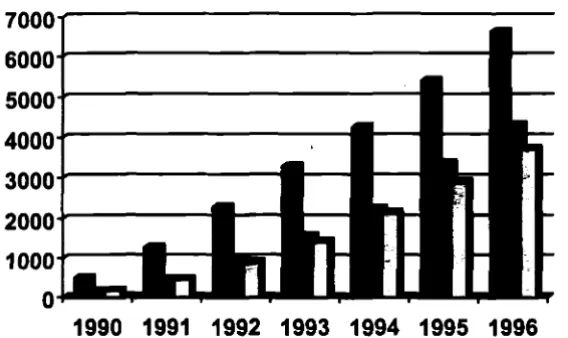
The financial performance of the Phare Programme is summarised by the level of the funds committed, contracted and paid, and by the relationship between these three over time. The box on page 27 explains the technical meaning of the terms 'commitment', 'contracting' and 'payment'.
Figure 1: Funds committed, contracted and paid 1990-1996 (in ECU million)
1
1
1
1990 1991 1992 1993 1994 1995 1996
• commitments •contracts Dpayments
Figure 2: Cumulative funds committed, contracted and paid 1990-1996 (in ECU million)
7000
5000
4000
3000
2000
1990 1991 1992 1993 1994 1995 1996
26
[image:27.587.108.512.276.444.2] [image:27.587.121.405.574.743.2]Funding procedure
As part of the Phare Programme, there are three steps that take the annual budget approved by the Budgetary Authority through to the point where projects are implemented and funds disbursed.
Phare has a financial management procedure that matches this process.
ommitment
ach year a Phare budget is agreed, indicating the funds which the Commission is repared to commit through the Phare Programme in each country. Count perational programmes are then designed and financing proposals prepared. One hese financing proposals have been given a favourable opinion by the Phar anagement Committee and decided by the Commission, the relevant funds ssociated with these proposals are said to have been 'committed'. Phare mus ommit its entire annual budget within the year to which that budget applies.
ontracting
nee funds have been committed, tenders are issued so that the activities outline · n the operational programmes can be put into practice. As soon as a tender has
een successfully completed and a contract signed, the relevant funds are said to ave been 'contracted'. Contracting is a key measure of the implementation of th rogramme, as it is via the contracts that Phare funding is unlocked and real 'mplementation on the ground can start.
ayment
ayment is the final stage of the funding process. It takes place over the period o ach contract, reflecting the completion of each component of the project. As rojects may take several years, payments are often spread over the same time. It is for this reason that payments always lag behind the committed and contracte
Committed funds
In 1996 the Phare Programme committed via various national, multi-country, horizontal and cross-border cooperation programmes a total of ECU 1,222. 9 million (including Budget line 87-7000) to its partner countries. This represents an overall record and an increase of 5.9 per cent on 1995. The commitment rate was 100 per cent. Total commitments cumulated over the life of the programme now equal ECU 6,636.1 million.
Contracted funds
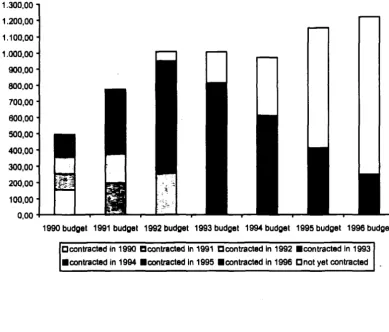
The sum of the contracts concluded in 1996, through the PMUs in the partner countries and via the Commission services, amounted to ECU 927.5 million. This is in Phare's history a very high total. However, the 1996 performance did not match the 1995 record (ECU 1,142.9 million) and the total of new contracts initiated remained below that level needed to keep pace with the increase of funds coming from new 1996 programme budgets (i.e. the total of new commitments). As a result, the stabilisation of the contracting backlog realised for the ftrst time in 1995 could not be repeated in 1996.
The contracting backlog, defined as the ,difference between the programmes committed and the activities contracted, amounts over the period 1990-1996 to ECU 2,335 million. Only 65% of the activities included in the programmes approved during that period actually had been contracted. This backlog originated mainly in the early years of the programme. It has its origin in the complication of the programming cycle, the time-consuming procedures and the large number of small projects. Additional factors having contributed to the persistence of the backlog are linked to the absorption capacity of the partner countries and to the comparatively low ratio of staff resources in relation to the programme portfolio.
After a stabilisation in 1995, the contracting backlog grew again in 1996, thereby demonstrating that the cumulative effect of a number of programme measures taken have not been able to yield a sustainable improvement. This conclusion led the Commission in 1997 to propose a number of measures as part of the Phare reorientation to clear the past backlog and prevent the development of a new backlog in the future.
Figure 3 allocates the contracting activity deployed during each calendar year to the year of origin of the funds. It appears that in 1996 ECU 351 million, or 38 per cent of the total contracted, related to 1990-1993 programmes. This indicator of relatively slow implementation progress is largely explained by delays incurred in the reform process itself (as can be seen from the sector composition of those programmes, i.e. mainly programmes supporting reform) and by limits on the absorption capacity of the partner countries. Being aware of the impact of this overhang on the performance of the programme, the Commission decided in the new Orientations that it elaboratedfor Phare not to continue with extending systematically the slower programmes and to close 1990-93 programmes.
Paid funds
Payments reached ECU 829.9 million, which is an overall record and an increase of 8.9 per cent compared with 1995. The initial budgeted amount of ECU 1,139.1 was subsequently reduced during the budget year to ECU 1 ,002.4 million. The payments effectively executed were 82.8 per cent of this budget appropriation. Figure 4 relates the payments made in each calendar year to the year of origin of the programme. In 1996, ECU 297 million, or 36% of the total payments, related to activities undertaken under 1990-1993 programmes.
Figure 3: Contracts concluded by calendar year (in ECU million)
1.300,00
1.200,00 1.10(},00
1.000,00 900,00 800,00 700,00 600,00 50(},00
400,00 300,00 200,00
100,00
0,00 +-....L.-L...,... ...
-L...,...&..-.L...,...
1990 budget 1991 budget 1992 budget 1993 budget 1994 budget 1995 budget 1996 budget Ccontracted in 1990 l:lcontracted In 1991 Ccontracted In 1992 •contracted In 1993 •contracted in 1994 •contracted In 1995 •contracted in 1996 Cnot yet contracted
Figure 4: Payments in each budget year (in ECU million)
1300~---
1200+---~~--·---1100+---~ 1000+---r--~----r--;~--~~~--~
900+--- aoo---700
600 +---500
400
300 +--+--+---1
200
100
o+-~--._~~--~~~._~~~-1990 budget 1991 budget 1992 budget 1993 budget 1994 budget 1995 budget 1996 budget
Cpaid in 1990
• paid in 1994
Cpaid in 1991
•paid in 1995
30
Cpaid in 1992
•paid in 1996
Elpaid in 1993
[image:31.585.81.513.257.580.2]Figure 5: Cumulative contracts and payments 1990·1996 (%)
Cumulative contracts as percentage of cumulative commitments
Cumulative payments as percentage of cumulative commitments
1990
31.0
35.0
1991 1992
36.0 44.0
36.0 39.0
31
1993 1994 1995 1996
48.0 52.0 62.0 64.8
II Phare in the individual partner countries
Albania
Year in review
Albania has generally made considerable progress in its transformation to a market economy since 1992. Implementing a series of reforms under the guidance of the International Monetary Fund, Albania had annual growth rates of about 9 per cent during the period 1993-1995. However in 1996 there was slippage. Inflation rose from 8 per cent (1995) to 18 per cent ( 1996) and due to slippages in budgetary and monetary policies in the pre-election period. The crisis, which occurred in late 1996, can be traced back to two particular developments.
The first involved a setback in the process of democratisation. There were serious irregularities during parliamentary elections in May 1996 and although the local elections which took place in October 1996 were generally considered by the international community to have been fair, they did not lead to a normalisation of the political process (continued boycott of the new parliament by main opposition parties and continuing controversy over the drafting of a new constitution).
The second trigger was the collapse of a number of "pyramid" savings schemes which had worked on a speculative basis with remittances from emigrant workers reflecting the absence of a reliable banks. Following the collapse of several schemes in November 1996 the situation in Albania was marked by major unrest and the break-down of additional schemes at later stage brought the country into a major state crisis during early 1997.
Phare 1996 Programme in Albania
Phare assistance for the period 1996-1999 is provided under the Multi-annual Indicative Programme, which allocates ECU 145 million for Phare national programmes. These programmes will focus on developing
• closer links with the European Union (including the modernisation of the structures of state and society and the approximation of standards, legislation and regulations)
• the domestic productive base (including infrastructure development)
• human and natural resources.
From these broad strategy areas, a number of priority areas of assistance can be identified.