This is a preprint of an article whose final and definitive form has been published in IJPL.
Implementing Proactive Maintenance Policies to Address
Problems with Access to Technology at Korean Universities
Thomas E. Webster ([email protected]) English Program Office, Ewha Womans University, Korea
Jeong-Bae Son ([email protected])
Faculty of Education, University of Southern Queensland, Australia
Abstract
Internationally, numerous seminal studies (e.g., Becker, 1994; Cuban, 2001; Cuban,
Kirkpatrick, & Peck, 2001; Dwyer, Ringstaff, & Sandholtz, 1990; Sheingold & Hadley, 1990; Zhao, Pugh, Sheldon, & Byers, 2002) have largely left the general issue of access to
technology and specifically classroom technology maintenance unexplored despite significant evidence in their findings. This article is a call for researchers, administrators and others involved in the implementation of technology to place more focus upon the important local causes and effects of inadequate maintenance policies and procedures in order to overcome one of the most prevalent barriers to teachers’ classroom use. To this end, a step by step process for Korean administrators is outlined, including the establishment of reliability teams based on production plant management techniques developed by Carroll, Sterman and
Marcus (1998). It is proposed that the shift to a more proactive maintenance policy at Korean universities will enable more reliable technology in the classroom and thereby facilitate greater potential for use by teachers. The change will also lower the costs associated with large repairs and premature replacement of equipment leading to lower overall long-term budgets. Importantly, the largest beneficiaries of the change will be the students who will receive instruction that regularly employs the classroom technology that their tuitions have paid and continue to pay for at Korean universities.
Keywords:Maintenance, After Service (AS), technology, teacher perceptions, technology implementation
Introduction
Findings from a recent study on teachers’ perceptions and uses of technology in a Korean university English program (Webster, 2011) revealed that the teachers in the study made repeated and diverse choices about technology use based on its applicability to and reliability in particular situations. The teachers in the study simply considered “what works” and only employed specific technology on any occasion if they perceived that it would. Further
as needed to bring a piece of equipment back into service after failure. For the teachers in Webster’s (2011) study who considered the use of classroom technology, the unavoidable delays or breakdowns which resulted from the lack of maintenance led most not to depend on regular use and prevented others from risking even occasional use. Interview data further indicated that problems associated with deficient maintenance were apparently widespread among universities throughout Seoul as well as other cities and provinces in the Republic of Korea. For instance, three veteran participant-teachers (who averaged more than 10 years of experience teaching at multiple universities in Korea each) illustrated the ubiquity of this problem through personal experiences and analogies:
I think it’s a common problem for universities actually, for institutions unfortunately to ignore maintenance – that’s been my experience. Um…I think administrators get a lot of credit for getting new stuff…um…or building new buildings, but they don’t get much credit for
maintaining what they have. Unfortunately, that’s a fact, and you know, I think that’s been my experience in almost every place I’ve worked at – maintenance has always been an issue. (Russ, SSI#4) (Webster, 2011, p. 163)
It’s one of the things that I worry about because we have this brand new building with all this technology, and I’m wondering just how long that’s going to last! Soon they’re going to be really outdated and become practically useless… Well, I just think it’s really important for universities to keep upgrading their technology. (Sarah, SSI#7) (Webster, 2011, p. 162)
I was thinking of sort of a simile to explain this: it’s like you have a car and you just leave the keys in the ignition and everybody in the family can use it. But nobody bothers to change the oil or to fill up the gas tank unless it’s empty… (Stephen, SSI#8) (Webster, 2011, p. 359)
Internationally, past and present studies also make clear that the issue of computer
maintenance has not been given due consideration, often being lumped together as part of the concern for and cost of “new technologies” (Cuban, 2001, p. 99). Others have devalued their findings in this area by expressing that [external] barriers are “more easily recognized and easier to fix while [internal] second-order barriers may require major changes in teachers’ beliefs and daily teaching practices (Ertmer, 1999)” (Park, H. & Ertmer, 2008, p. 247). In other words, seminal studies such as Cuban (2001) as well as more recent studies have equally downplayed the significance of the issue by relegating discussion to a few lines or a brief paragraph suggesting that support for technology use by teachers had been neglected or insufficient and then never gone on to explore its serious effects upon the frequency of use. Instead, these articles and chapters typically focus on other concerns such as teachers’
pedagogical choices and innovative opportunities or potential. As illustrated above, neglect of the issue of access to technology and maintenance in particular have become so
support the claim that recurring problems found in their study continue to “reduce teacher confidence and cause teachers to avoid using the technology in future lessons” (p. 3). Even more recent studies such as one by Tondeur, van Keer, van Braak and Valcke (2008) likewise found that 50% of teachers in their study reported that computer access problems were their main barrier to use. However, Tondeur et al. apparently did not explore the problem further to identify the main issue(s) involved including the role that maintenance policies might have played. They concluded by returning to their study’s main focus on schools’ information and communication technology (ICT) vision and overall policy plans without any elaboration on why half of the teachers in their study might have had problems with access to technology.
The point here is not to suggest that other significant considerations such as pedagogical development and policy making are not of equal (or greater) importance in the long-term, but that overlooking the maintenance and upkeep of classroom technology in practice if not in theory may be equivalent to attempting to build a house on sand. As shown in the data from the above studies, any new technologies must continue to function consistently throughout their lives if they are to become a regular part of teachers’ classroom practices. It cannot simply be assumed upon startup that new technologies in the classroom will be perfectly maintained by underfunded and often overworked support staff who typically lacks computer expertise and sufficient time or systematic impetus to perform even basic maintenance tasks.
The lack of attention to sustaining classroom technologies appears to correspond with other findings by Webster (2011) which revealed that Korean educational administrators and policy makers are typically rewarded for their new projects but rarely given recognition for
maintaining them. In terms of technology use in Korean education, the situation represents a puzzling paradox and begs the question, “Why invest in and promote computer technology in teaching if it will be neglected and subsequently become unemployable by teachers?” As is illustrated below, the Korean government has striven throughout its modern history to have one of the most innovative educational systems in the world through major funding and support of ICT use from elementary education to the tertiary level, while at the same time has failed to address teachers’ complaints pointing to the lack of logistical support as one of the central impediments to the use of classroom technology (Jo, 1995; Suh, 2004). In short, the lack of priority placed on the maintenance of computer technologies in tertiary education runs counter to Korean government policies and practices over the past three decades and
consequently should be properly addressed now.
The aim of this article is to make the case for Korean universities to shift to more proactive maintenance policies for classroom and supplemental technologies and thus finally tackle one of teachers’ most persistently reported barriers to use. This article first provides background into the Korean cultural bias in commercial maintenance and its effects upon universities’ maintenance policies. A brief look at the major government policies involving the use of ICT in Korean education is then outlined as prelude to the hindrances to the use of ICT in
classrooms both within the Korean context and internationally. The prevalent reactive maintenance polices currently followed by a majority of universities in Korea are next
explored along with their associated effects and side-effects. Finally, a practical outline of the steps involved in making a shift to more proactive policies is detailed before final conclusions are offered.
Beginning in the 1960s, when its “GDP per capita was comparable with levels in the poorer countries of Africa and Asia” (Central Intelligence Agency, 2012, para. 6), the Republic of Korea began an economic boom which would eventually enable it to become one of the world’s top 20 economies and boost its literacy rate to 98% by 2003 (UNDR, 2003).
However, Korea’s advance was made possible by an overemphasis on quantity over quality and a fostering in Korean society of the “bally-bally” or “hurry, hurry” culture. Citizens learned to get things done quickly and cheaply and came to expect the same treatment from service providers. Consequently, Korean businesses devised a number of unique practices to accommodate Korean consumers who according to T. Kim (2012) tend to be emotional and regard brands and customer care more passionately than customers in other countries:
For example, the installation of the internet, TV, telephone and other utilities after moving to a new home can happen within hours. It would be unthinkable for utility companies to drag their heels. Furthermore, such visits or after-service arrangements are all free. This explains why some companies had a difficult time when entering the Korean market as consumers simply didn't understand why they would charge extra for the after-service. (Kim, T., 2012, para. 9)
As implied above, the frequency of repairs needed for electronic devices earlier on in the economic boom (from the late 1960s to the mid 1990s) led major companies to establish free After-Service (AS) programs that responded quickly to customer needs whenever their
products faltered. Years later the same policies and consumer expectations prevail even as the quality of products in Korea continues to improve. Recently, for example, the Apple
Corporation was required by the Fair Trade Commission to list differences in its international after-service policies on their products sold in Korea, as they differed considerably from local Korean expectations (Lee, E., 2012). However, it is important to recognize that AS, as it is known in Korea, primarily involves reactive maintenance rather than more proactive practices such as preventive and predictive maintenance. Put differently, although the purchase of certain companies’ products such as water purifiers includes preventive free or low-cost AS visits such as changing out filters and cleaning related parts, the major electronic companies wait for consumer calls of product failures before they send out repair technicians. As a consumer, it is inconvenient to be unable to use a product when it fails but owing to quick and reliable, mostly-free repairs, problems are usually resolved very quickly – usually within one or two days if not within hours.
At Korean universities, the situation is considerably more complex as maintenance is mostly handled by in-house maintenance or related departments responsible for structures, furniture and electronic equipment across their campuses. However, maintenance generalists in these departments also follow the pervasive AS policy by responding to calls of equipment failures in as timely a manner as possible given their work load requirements. In addition, in an attempt to preempt potential future problems associated with use – and perceived abuse – of electronic equipment, some maintenance or related departments even limit access to various features or supportive equipment by designing security measures that in effect discourage or prevent general use by faculty.
adverse conditions. This type of maintenance style is frequently referred to as ‘fighting fires’ as it is a reactive maintenance style that attempts to keep equipment running within a distinct short-term horizon (Mobley, 2002; Starr et al., 2010). The unfortunate result of AS
maintenance policies at universities is that they inhibit reliable service that can ensure timely repairs of equipment for busy classrooms and guarantee a full and productive life for
equipment that should be but as a result are not in high demand.
To exacerbate the situation, owing to “a glut of university graduates and a work force hard-wired to outdated 20th-century manufacturing skills” (McNeill, 2011, para. 2), the director of the Korean Educational Development Institute (KEDI) speculates that by 2040, as many as one quarter of the nations’ universities “will be forced to shut their gates or merge in what is likely to be a very painful downsizing for a nation that reveres education” (McNeill, 2011, para. 6). Regardless of the extent and degree of the cutbacks, any future downsizing that takes place will have a negative impact on university maintenance or related departments who will face tighter budgets with reduced staffing. As mentioned above in the study by Webster (2011), it is important to keep in mind that, even when considerable funding for ICT is provided, the overwhelming majority is spent on setup and initial training rather than upkeep and reliability.
Major Technology Policies in Korean Education
From 1970 to 1985, the Korean government began using television and radio broadcasts to augment public curricula in what was termed the “Beginning Stage” (MOEHRD, 2006, p. 7). A second or “Rolling Out Stage” (p. 7), which ran from 1986 to 1995, advanced into the first use of computers in fundamental education. From 1996 to 2000, the first national “Master Plan” (p. 7) was implemented which sought to improve the ICT infrastructure in elementary and secondary education as well as to make gains in English education in a move to position Korea for better globalization (KEDI, 2007; MOEHRD, 2003, 2006). In the second “Master Plan” from 2001 to 2005, improvements in teacher ICT training were coupled with the development of streaming content and other attempts to improve the availability of online Cyber education. The final third “Master Plan” from 2006 to 2010 moved into u-Learning amplification and provisions for more research and development as well as expansion into the use of digital textbooks. Over the course of these initiatives, three government bodies have played and continue to play primary roles. The Ministry of Education, Science and
Technology (MEST) (previously known as the Ministry of Education and Human Resources Development [MOEHRD]) has developed new policies and helped coordinate efforts, while the Korea Education and Information Service (KERIS), consolidated in 1999 from two agencies (i.e., the Korea Multimedia Education Center [KMEC] and the Korea Research Information Center [KRIC]), has focused specifically on the planning and implementation of ICT policies. The third body has autonomously governed regional realization of national policies through 16 Metropolitan Provincial Offices of Education (MPOEs) and 180 local offices of education (KEDI, 2007; MOEHRD, 2003; 2006; 2007).
Educational and Cultural Development (OECD)’s most recent Digital Reading Assessment (DRA) (Lee, J., 2011). As evidenced through these major policies as well as a plethora of lesser initiatives, the Korean government is and plans to be heavily invested into the development and continuing use of ICT in education. In fact, the financial value placed on the development of ICT in Korean education through the years has run parallel to ICT development in manufacturing and industry, and was so significant that it is credited with helping the country overcome the economic crisis of 1997 while other countries faltered (Kim, D., 2009). However, nowhere within any of the various ICT educational policies mentioned above is the ongoing maintenance of technology addressed or researched in relation to the obstacles to implementation in the classroom.
The Persistence of Access to Technology Problems
Problems with what is typically described as “access to technology” have persisted for decades (Cuban, 1986; Dwyer, Ringstaff, & Sandholtz, 1990; Lee, S., 2006; Sheingold & Hadley, 1990; Suh, 2004; Zhao, Pugh, Sheldon, & Byers, 2002) despite the evolution of better funding, availability and support of computer technologies. However, ironically, studies from the 1980s to present have also commonly included findings related to access issues which are often further grouped together with a wide array of other variables into categories such as “lack of support” or “problems with infrastructure” without further exploration or elaboration. By reviewing a sample of noteworthy studies, it is possible to trace a path to the need for more attention on proactive maintenance policies and procedures both internationally and in Korea.
To begin, in 1986, Cuban (1986) concluded that a majority of U.S. teachers were non- or infrequent-users of technology in their classrooms. Years later, Cuban admitted that this earlier finding was not particularly surprising given the low availability of both software and hardware at that time (Cuban, Kirkpatrick, & Peck, 2001). Another central study in 1990 by Dwyer, Ringstaff and Sandholtz reported, among other variables, on the frustrations that Apple Computers of Tomorrow (ACOT) teachers experienced with frequent computer access problems but it apparently did not attempt to isolate the factors involved. Also, in 1990, Sheingold and Hadley described a study of over 600 teachers who were thought to be exemplars of best practices in the use of ICT. The study suggested that the use of ICT was both practical and successful in the right conditions, particularly if teachers were committed and had support and access to technology. Once again, no real attempt was made to
determine if problematic maintenance policies had interfered with teachers’ access in the classroom. In 1994, Becker discussed a large study of computers in schools and posited that advances were largely premised on a supporting social network of knowledgeable computer-using teachers and provisions for training and smaller class sizes. However, he also found that access to equipment was an important consideration. In 2002, Zhao, Pugh, Sheldon and Byers related a study that determined 11 principle factors in three interactive domains that affected successful implementation of ICT in the classroom: the teacher, the innovation and the context. Significantly, in the study, all three of these domains included aspects directly involving access to technology either through teachers’ abilities to handle associated problems and dependence on resources or factors related directly to the infrastructure and support themselves. However, Zhao et al. merely concluded that problems with access
The relatively small number of studies from Korea which include specifics about
maintenance have also reached similar conclusions which recognized but did not explore the reasons for teacher complaints about the contextual impediments to the use of classroom computers. For instance, one of the most explicit sources is an authoritative book by a former Minister of Education entitled: Korean higher education: Its emergence, development & future challenges (Lee, S., 2006). The book reported from a major survey of teachers’ experiences that, among other findings, more than half of the teachers in the study had complaints about the “inadequacy, obsolescence, and deferred maintenance” (p. 180) of technology at their universities, and yet S. Lee only reported that these hindrances led to low morale. Other studies such as two by Suh (2004) and Jo (1995) have likewise included significant, general data related to teacher complaints about inadequate support for and reliability of technology in the classrooms. However, the researchers in both studies apparently chose not to further investigate the issue and did not report on the possible detrimental effects of poor maintenance policies or procedures.
The Prevalence of Reactive Maintenance at Korean Universities
There are many reasons why a business or institution might adopt a reactive maintenance policy. Most of these reasons are founded on perceived operational necessities by individuals with agendas which downplay or ignore long-term vision or planning (Carroll, Sterman, & Marcus, 1998). Compounding the problem in Korea, financial and planning departments, like other departments at universities, often have regular rotation policies for leadership which unintentionally encourage decisions which similarly hinder long-term consistency. Under this system, administrative leaders with a set term-limit necessarily tend to focus on making their mark in a limited period and so often demonstrate little deep understanding of their positions or care for the long-term consequences of their decisions. Carroll, Sterman and Marcus (1998) found the same to be true for decision-making at manufacturing facilities: “In the short run, a plant can always cut preventive maintenance; the problems emerge later because preventive maintenance is an investment in the future” (p. 100).
Another underpinning issue involves the rigid, Confucian-based hierarchical system in place at Korean universities which socially restricts the management of maintenance or related departments. J. Lee (2000) illustrates the impact of traditional and adopted methods of thinking in Korean higher education in this way:
Thirdly, many college or university administrators in Korea usually stress not only traditional values and norms, but also hierarchical order and authority. In other words, they generally use authoritarian leadership, which stems from confucianism or Japanese shinto-confucianism, and seldom or never allow participation and discussion in decision-making (KCUE, 1988a). (p. 46)
Within the strict hierarchical system in Korean education, intra- and inter-department
(2008) believed that Korean Airline co-pilots were “trapped in roles dictated by the heavy weight of their country’s cultural legacy” (p. 256) which prevented them from discussing vital information about their planes’ statuses to senior pilots even when not doing so resulted in plane crashes. In summary, owing in large part to Confucian principles and turnover policies in effect at Korean universities, maintenance or related departments are often compelled to operate under the reactive maintenance system which is prevalent in Korea despite its apparent long-term disadvantages.
Problems Associated with Reactive Maintenance
Negative consequences of following a reactive maintenance policy include longer down-times, higher costs and unpredictability (Daley, n.d.; Fluke Corporation, 2005; Graves, 2005; Mobley, 2002; Starr et al., 2010). In fact, reactive maintenance is not only more expensive – normally three times higher than scheduled repairs (Mobley, 2002) – but the failing
equipment is out-of-service for a longer period of time which can cause other serious side effects. For these and other reasons, Mobley (2002) describes this “run-to failure”
management technique as a “no-maintenance” approach (p. 2). Furthermore, owing to its low short-term cost, reactive maintenance can effectively be a way for unscrupulous leaders to defer maintenance costs to a time when they will not likely be held responsible for higher-cost equipment failures. Whether intentional or not, decisions to cut higher-costs in maintenance or related departments necessarily lead to more reactive maintenance practices which in turn increases overall costs.
Computer technology is particularly susceptible to the problems associated with a lack of maintenance. Not only can hardware such as CPUs, monitors and CD-ROM and DVD drives suffer from a lack of regular maintenance, but computer software that is not regularly
serviced can render the computer ineffective long before it leads to failure (White, 2011). As a result, reactive maintenance is at odds with the main tenet of any competent maintenance policy which is to “maintain the capability of the system while controlling the cost”
(Stephens, 2010, p. 3). The detriments of reactive maintenance in practice effectively make it a “no-maintenance” policy which not only increases costs but also reduces the utility and effective life of an asset leading to serious and wide-ranging side effects.
Implementing a Proactive Maintenance Strategy at Korean Universities
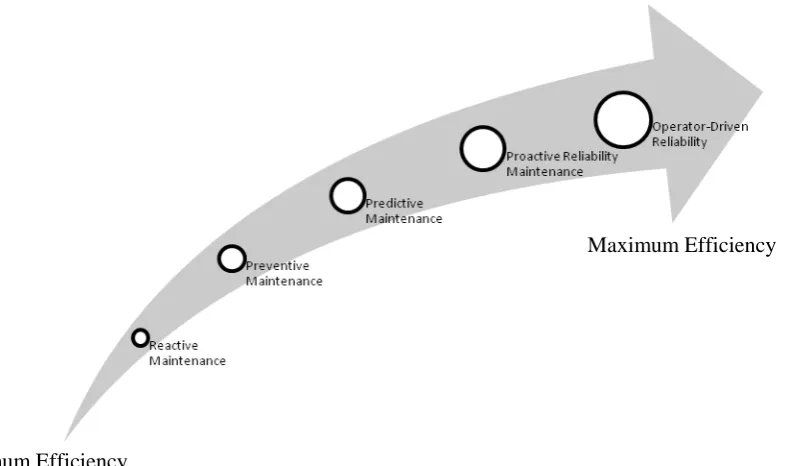
The two most common policies of proactive maintenance are preventive maintenance and predictive maintenance that are best employed conjointly (Carroll, Sterman, & Marcus, 1998; Daley, n.d,; Levitt, 2003; Mobley, 2002; Stephens, 2010; Swanson, 2001). Preventive
the source of maintenance issues to extend the operating period between maintenance services. At the top level of efficiency, operator-driven reliability has operators own the machinery that they use in order to empower them to maximize their usage techniques, identify more subtle issues of operation and communicate more directly with other operators about how to best manage and coordinate use of their machines within the plant (Stephens, 2010).
Figure 1. Moving upward in maintenance planning strategy (adapted from Stephens, 2010, p. 21).
The first step for Korean universities following reactive maintenance policies for classroom computer technology would be to consider if and how preventive and predictive maintenance might be realized in the maintenance or related departments of their schools. It involves pondering elements of proper design and installation of classroom technologies which are consistent with the use that they will be put to by teachers as well as the scheduling of routine maintenance inspections and servicing with planned stoppages which do not interfere with regular use (Stephens, 2010). Moreover, in a predictive plan, simple tests would additionally need to be performed on classroom computer technology to determine such things as “PC scores” (White, 2011, para. 4) which would tell the technician which parts of the computer will likely need future repairs. Preventive and predictive maintenance strategies for classroom technology such as these are relatively easy to follow and only require personnel with more or less the same skills to perform roughly the same tasks as needed in a reactive maintenance plan. On the surface, the only requirements in making such a change to a more proactive system would appear to be more focus on resource allocation for planning and scheduling.
However, many researchers (e.g., Carroll, Sterman, & Marcus, 1998; Daley, n.d,; Levitt, 2003; Mobley, 2002; Stephens, 2010; Swanson, 2001) are quick to point out the difficulty in making the shift to a more proactive system successful and lasting. Stephens (2010) believes that it “requires a significant shift from the traditional maintenance philosophy and practice, often reactive in nature, to a proactive, well-planned process that is fully integrated across the plant” (p. 19). Carroll, Sterman and Marcus (1998) likewise point out that while it is true that Minimum Efficiency
managers may struggle when learning how to schedule predictive and preventive work, the real challenge is no less than to “create a culture of defect elimination and preventive maintenance in place of the prevailing culture of reactive maintenance” (p. 116). Mobley (2002) concurs but stresses the complexity of such an endeavor. He emphasizes the need for change to begin at the top levels of management and extend to all levels of the organization. Moreover, asking maintenance personnel at Korean universities to be proactive toward classroom computer technology but to remain reactive for some or all of their other duties would be confusing and inconsistent: “In that situation, the choices appear somewhat subjective and the result of convenience or politics” (Daley, n.d., pp. 4-5). After further reflection, it would seem that nothing short of a complete and painstaking change of culture toward maintenance university-wide would be necessary.
Nevertheless, Carroll, Sterman and Marcus (1998) suggest that a better approach would be to form “a reliability group that is charged with the responsibility and is accountable for plant optimization … [and which has] the authority to cross all functional boundaries and to implement changes that correct problems uncovered by their evaluations.” (p. 11, emphasis added). The reliability group would not be tied to any one area of the university’s operations and so would be able to unearth the root cause of problems without impedance from groups or individuals who for various reasons were resistant to change. The new reliability group could function much like a Crime Scene Investigation (CSI) Unit to “ensure that potential physical evidence is not tainted or destroyed or potential witnesses overlooked” (U.S. Dept. of Justice, 2000, p. iii). However, it would be equally crucial to ensure that the group
members received more general training that stressed both the global perspective or vision of the change and in particular, the inter-personal social skills and strategies needed to
understand how not to treat non-members as suspects (Carroll, Sterman, & Marcus, 1998). In short, a reliability team could be formed which is well-versed in both maintenance procedures and efficiency as well as inter-personal social skills. The group would have the authority to effect changes in such a way as to positively influence departments to optimize their approach to maintenance and operations in general.
Forming a Reliability Group at Korean Universities
Two approaches to forming such a reliability group would be either to select members from within an organization (typically from maintenance management) or to look outside the university for reliability experts. The former approach has several problems including the chance appointment of individuals who were part of or were the cause of existing problems. Still others might be extrinsically motivated to join the group while not taking on board the mission. Further, employees within the university might also be highly regarded but not have the capabilities assumed for their position and which are crucial for the new task: “In other words, the best operator may in fact be the worst contributor to reliability or performance problems” (Mobley, 2002, p. 11). Also, employees may not have the ability to see beyond their specialty area owing to limited education or training. For instance, “U.S. managers with engineering backgrounds in particular, tend to think in terms of parts rather than wholes” (Carroll, Sterman, & Marcus, 1998, p. 111). As discussed earlier, owing to the Confucian principles which underpin Korean culture, this can be a common problem for all Korean managers regardless of their area of education or training.
obtained. For instance, after interviewing 150 predictive engineers who were thought to have been qualified, Mobley (2010) and colleagues found that only five were adequate for the job and then only after completing additional extensive training. Outsiders may also meet resistance because of differences in status between the outside experts and the staff they are meant to educate (Argyris & Schon, 1978). Finally, Korean outside experts, like their intra-university counterparts are susceptible to thinking in limited rather than holistic ways and may act conservatively or aggressively, particularly given their lack of familiarity as newcomers in new settings (Choi, 2004).
Consequently, the key to staffing a new reliability group – whether from within or outside the university – would be to choose dedicated individuals who had not only espoused proactive ideals during interviews but had also demonstrated a commitment to those principles throughout their work histories. Further, the individual(s) who are to head the selection of staff members (and probably the group members themselves) would have to be highly committed to the mission even to the point of willingness to shed his or her own cultural upbringing:
To cope with the new world of high technology, information, and globalization, the educational system must produce human resources with creative abilities through quality education and innovative educational methods. In this renovation, Confucian values may prove to have no role. (Park, T. 1999, p. 135)
In the Korean Airlines situation discussed above, for example, Gladwell (2008) concluded that the only way for the pilots to overcome the social restrictions which hindered
communication in the cockpits was to force all pilots to converse in English while onboard. Only by adopting another language could they divorce themselves from the Confucian principles which underpin the Korean language and culture and thus enjoy open communication channels.
Operating a Reliability Group at Korean Universities
The reliability group would first and foremost need to act with sensitivity and care as cooperation and harmony are essential to the process. In effect, the group would need to proceed more like passionate guidance counselors than optimization specialists as they work to apprehend the big picture for each issue that they need to address. Upon obtaining enough background and evidence to form a corrective plan to tackle the issue, the group would then set up a learning lab (Morecroft & Sterman, 2000; Senge & Sterman, 1992) rather than attempt to make changes through traditional one-way presentations or enforcing more direct changes. Participants and the reliability group would work together to develop holistic long-term solutions to maintenance issues with the aim of improving the effectiveness of their administrative system as a whole rather than attempting to solve issues in isolation. Leaning labs would involve games and/or skits in a modeling format which emphasizes teamwork in experiential activities to gain new insights and perspectives on issues (Morecroft & Sterman, 2000; Senge & Sterman, 1992). Once complete, the next step would then be to translate the insights gained in the labs into action plans that would begin small but have the global proactive aim and objectives in mind.
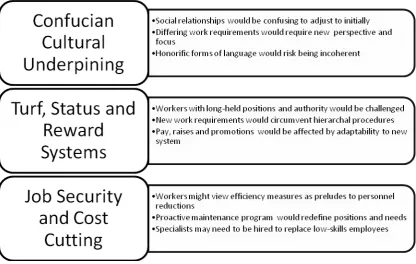
encountered at a Du Pont chemical plant: “countervailing reward systems”; “turf and status”; “loss of challenging work”; and “job security and cost cutting” (p. 121). An adaptation of this list for Korean universities might include the three main categories shown in Figure 2.
Figure 2. Challenges to implementing a proactive maintenance program at Korean universities (adapted from Carroll, Sterman, & Marcus, 1998).
The first challenge, Confucian cultural underpinning involves all the social factors that govern how workers and management interact in the workplace. As discussed above, imposed social restrictions would need to be lifted which would necessitate a significant adjustment period. In particular, new perspectives on cooperation between non-related groups and members with varying statuses would need to be encouraged. In addition, honorific verb forms and vocabulary use common in the Korean language might need to be modified to provide a consistent method for teams to communicate more freely. For instance, the use of honorific question and verb endings such as “-nika” and “-nida” among members of different standing could be replaced by the “-yo” forms.
The second challenge category, Turf, status and reward systems is also highly influenced by the Confucian hierarchical structure at Korean universities but focuses more on the self-esteem and self-efficacy of individual employees’ positions. A new focus on optimization would involve inter-department interactions and shared responsibilities which varied from situation to situation. Upper-level workers and management would need to adapt well to new circumstances in order to be successful. Reward structures for advancement and
replaced but only after participating in learning labs to educate and encourage them to take part in the new system. Furthermore, in terms of computer technology, specialists with training in proactive techniques may need to be hired to lead teams who may be unfamiliar or resistant to optimizing their work schedules and procedures in a way which is consistent with the goals of the reliability team objectives.
It is important to bear in mind that how a reliability team would work in each university would be highly dependent on variables within each setting. Maintenance issues would need to be carefully assessed by the reliability team and top management before application of any new approaches. To reiterate, reliability teams would need to be deliberately chosen and allowed free access to operate as need be with the aim of optimizing department procedures which have an effect upon maintenance approaches and procedures. The team would not dictate changes but would instead work closely with personnel to educate them through learning labs. Sensitivity, open-mindedness and real teamwork would necessarily be central to the process.
Conclusions
A shift to a more proactive maintenance policy at Korean universities will enable more reliable technology in the classroom and thereby facilitate greater potential for use by teachers. The change will also lower the costs associated with large repairs and premature replacement of equipment leading to lower overall long-term budgets. Importantly, the largest beneficiaries of the change will be the students who will receive instruction that regularly employs the classroom technology that their tuitions have and continue to pay for at Korean universities. This article has outlined a practical theory to allow reliability teams to optimize areas related to maintenance through learning labs which would aid the likely new approach needed for success. It is acknowledged that change to such a system would
undoubtedly involve a great deal of effort and significant adaptation on the part of university management and personnel alike. However, it is believed that through the implementation of such a system a consistent approach can be achieved. As mentioned above, half-measures such as generally encouraging maintenance departments to be proactive only in regard to classroom technology would be confusing, inefficient and in the long-term ineffective or even counter-productive. Unless serious and invasive steps such as these are taken, future literature on this topic will continue to ponder why teachers are avoidant or inconsistent in their use of classroom technology while scores of unexplored data related to problems with access to technology or support lay underdeveloped or dormant within its pages.
Acknowledgements
The authors wish to thank the faculty of the English Program Office (EPO) at Ewha Womans University for their willingness to provide invaluable insights which have greatly contributed to the potential for overcoming one of the most persistent barriers to technology integration in English education in Korea.
References
Turkey. Educational Technology & Society, 9(1), 176-187.
Argyris, C., & Schon, D. (1978). Organizational learning: A theory of action perspective. Reading, MA: Addison-Wesley.
Becker, H. (1994). How exemplary computer-using teachers differ from other teachers: Implications for realizing the potential of computers in schools. Journal of Research on Computing in Education, 26(3), 291-321.
British Educational Communications and Technology Agency (Becta). (2004). A review of the research literature on barriers to the uptake of ICT by teachers. Becta ICT Research. Retrieved from
Carroll, J., Sterman, J., & Marcus, A. (1998). Playing the maintenance game: How mental models drive organizational decisions. In J. Halpern & R. Stern (Eds.), Debating rationality: Nonrational aspects of organizational decision making (pp. 99-124). New York: Cornell University Press.
Central Intelligence Agency (CIA) (2012). East & Southeast Asia: Korea, South. The World
Factbook. Retrieved from
Choi, J. (2004). Transformation of Korean HRM based on Confucian values. Seoul Journal of Business, 10(1), 1-26. Retrieved from
Cuban, L. (1986). Teachers and machines: The classroom use of technology since 1920. New York: Teachers College Press.
Cuban, L. (2001). Oversold and underused: Computers in the classroom. Cambridge, MA: Harvard University Press.
Cuban, L., Kirkpatrick, H., & Peck, C. (2001). High access and low use of technologies in high school classrooms: Explaining an apparent paradox. American Educational Research Journal, 38, 813-834.
Daley, D. (n.d.). Predictive and preventive maintenance. Retrieved from
Dwyer, D., Ringstaff, C., & Sandholtz, J. (1990). Teacher beliefs and practices part 1: Patterns of change - the evolution of teachers’ instructional beliefs and practices in high-access-to-technology classrooms first-fourth year findings (ACOT Report No.8). Cupertino, CA: Apple Computer. Retrieved from
Ertmer, P., Ottenbreit-Leftwich, A., & York, C. (2006). Exemplary technology-using
teachers: Perceptions of factors influencing success. Journal of Computing in Teacher
Education, 23(2), 55-61. Retrieved from
Fluke Corporation (2005). The basics of predictive/preventive maintenance. White paper: Thermography. Everett, WA: Fluke Corporation. Retrieved from
Gladwell, M. (2008). Outliers: The story of success. New York: Little, Brown and Company. Graves, M. (2004). A+ guide to pc hardware maintenance and repair. Clifton Park, NY:
Thompson/Delmar Learning.
Jo, M. (1995, April). Uses of and attitudes toward computers in Korean schools. Paper presented at the annual meeting of the American Educational Research Association, San Francisco, CA.
Communications Technology and Disaster Risk Reduction Division. Retrieved from
Kim, T. (2012). The hermit kingdom reconnects. FrontlineOnline. International Public Relations Association. Retrieved from
Korean Educational Development Institute (KEDI). (2007). Understanding Korean education (Vol.2; ICT in Korean education). Retrieved from
Lee, E. (2012, Jan 5). FTC pressures Apple to state after-sales policies. Korea JoongAng Daily. Retrieved from
Lee, J. (2000). The administrative structure and systems of Korean higher education. In Organization for Economic Cooperation and Development (OECD), Journal of the Programme on Institutional Management in Higher Education: Higher Education Management and Policy, 19(2). Retrieved from
Lee, J. (2011, July 26). Korea’s choice: “Smart Education”. Educationtoday, OECD Blog. Retrieved from
Lee, S. (2006). Korean higher education: Its emergence, development & future challenges. Seoul: Hakjisa Publisher.
Levitt, J. (2003). Complete guide to preventive and predictive maintenance. New York: Industrial Press.
McNeill, D. (2011). After decades of building colleges, South Korea faces a lack of students. The Chronicle of Higher Education.Retrieved from
Ministry of Education and Human Resources Development (MOEHRD). (2003). White paper: Adapting education to the information age. Retrieved from
Ministry of Education and Human Resources Development (MOEHRD). (2006). White paper: Adapting education to the information age. Retrieved from
Ministry of Education and Human Resources Development (MOEHRD). (2007). White paper: Adapting education to the information age. Retrieved from http://
english.keris.or.kr/whitepaper/WhitePaper_eng_2007.pdf
Mobley, R. (2002). An introduction to predictive maintenance (2nd ed.). New York: Butterworth Heinemann.
Morecroft, J., & Sterman, J. (2000). Modeling for learning organizations. Portland, OR: Productivity Press.
Park, H., & Ertmer, P. (2008). Impact of problem-based learning (PBL) on teachers’ beliefs regarding technology use. Journal of Research on Technology in Education, 40(2),
247-267. Retrieved from
Park, T. (1999). Confucian Values and contemporary economic development in Korea. In T. Brook & H.V. Luong (Eds.), Culture and economy: The shaping of capitalism in eastern Asia (pp. 125-136). Ann Arbor, MI: University of Michigan Press.
Senge, P., & Sterman, J. (1992). Systems thinking and organizational learning: Acting locally and thinking globally in the organization of the future. In T. Kochan & M. Useem (Eds.), Transforming organizations, (pp. 353-370). Oxford: Oxford University Press. Sheingold, K., & Hadley, M. (1990). Accomplished teachers: Integrating computers into
classroom practice. New York: Center for Technology in Education, Bank Street
College of Education. Retrieved from
Starr, A., Al-Najjar, B., Holmberg, K., Jantunen, E., Bellew, J., & Albarbar, A. (2010). Maintenance today and future trends. In K. Holmberg, A. Adgar, A. Arnaiz, E. Jantunen, J. Mascolo & S. Mekid (Eds.), E-maintenance, (pp. 5-37). London: Springer-Verlag.
Stephens, M. (2010). Productivity and reliability-based maintenance management. West Lafayette, IN: Purdue University Press.
Suh, S. (2004, December). Technology training and English language teacher education in Korea. Proceedings of CLaSIC 2004 (pp. 1040-1048). Singapore: Centre for Language Studies, National University of Singapore.
Swanson, L. (2001). Linking maintenance strategies to performance. International. Journal of Production Economics, 70, 237-244.
Tondeur, J., van Keer, H., van Braak, J., & Valcke, M. (2008). ICT integration in the classroom: Challenging the potential of a school policy. Computers & Education, 51(1), 212-223.
United Nations Development Programme (UNDR). (2003). United Nations Human
Development Report (UNHDR). Millennium development goals: A compact among nations to end human poverty. Retrieved from
United States Department of Justice (2000). Crime scene investigation: A guide for law enforcement, research report. Office of Justice Programs, National Institute of Justice.
Retrieved from
Webster, T. (2011). Doing what works: A substantive grounded theory of teachers perceptions and uses of technology in a Korean university general English
department. Unpublished doctoral dissertation. Toowoomba, Queensland, Australia: University of Southern Queensland.
White, E. (2011). Why you need to maintain your computer. Retrieved from