MANAGING DIRECT ENERGY USE
NOW AND IN THE FUTURE
Craig Baillie
1and Bruce Pyke
2National Centre for Engineering in Agriculture (NCEA), Toowoomba, Qld1 Cotton Research and Development Corporation (CRDC), Narrabri, NSW2
Background
Agricultural producers are currently aware of increasing energy costs. This has occurred before the scientific and political debate on climate change has been resolved and a decision made on the best policy instruments to be used to respond. In parallel to this discussion, the on farm assessment of direct energy inputs (i.e. diesel and electricity) enables farmers to react positively to the potential of rising energy costs while contributing to a reduction in greenhouse gasses (GHGs) regardless of the scientific and policy debate surrounding climate change and emissions reduction.
Previous work undertaken by the National Centre for Engineering in Agriculture (NCEA) has studied direct on farm energy use involving a number of case study cotton farms to understand the range, costs and contributions of energy use to cotton production and greenhouse gas emissions. The results from this work showed that energy use varies depending on the cropping enterprise and the farming system and that there are significant opportunities to reduce energy and costs. In comparison the greenhouse gas emissions (GHGs) from direct energy use can be similar and in fact greater than the GHGs generated by soil / fertiliser / water interactions. Improving on farm energy use would appear to be as important as improving nitrogen efficiency.
A more detailed study undertaken by the NCEA on a large cotton farm in the Gwydir Valley (reference) identified significant reductions in energy resulting from the adoption of reduced tillage systems. The study showed that the adoption of a minimum tillage system had reduced energy costs (and greenhouse emissions) by 12% since 2000 and developing a “near zero till” system had the potential to reduce this to 24% less than 2000 energy costs. It is evident from this work that there is substantial scope to improve energy use efficiency in cotton production systems, but to enable more growers to identify where they can improve, further development of tools, processes and human capacity is required.
Introduction
Within highly mechanised agricultural productions systems such as the Australian Cotton Industry direct energy inputs (i.e. diesel and electricity) represent a major cost to the grower and potentially a significant proportion of the total green house gas (GHG) emissions. Previous studies by Baillie and Chen (2008) have reported significant savings in energy for both a refinement in current practices (i.e. up to 30 % for individual operations) and a change in practice (10 – 20% across the farming system) through energy assessment.
Future Energy Threats
Like most sectors of our economy, the Agricultural sector is very dependent on fossil fuels to meet energy and fertiliser needs. Debate around Peak Oil (when world production can no longer meet demand) has moved from “if” to “when” this will occur. Some of the more pessimistic analysts and commentators (e.g. Michael Lardelli - see link http://www.onlineopinion.com.au/author.asp?id=4679
)
suggest that we may have already reached Peak Oil in 2007 or 2008 (and that the GFC has masked its impact). Others (e.g. UK Energy Research Centre – see link http://www.ukerc.ac.uk/support/tiki-index.php?page=Global+Oil+Depletion ) believe Peak Oil will occur before 2030 and possibly before
2020.
CSIRO modelling in 2008 (IN: “Fuel for thought – The Future of transport fuels: challenges and opportunities” – see link http://www.csiro.au/resources/Fuel-For-Thought-Report.html
)
show the possible impact on the Australian transport sector of a Peak Oil event by modelling both slow and rapid responses in the establishment of alternative energy sources – a rapid decline in oil supply coupled with a slow response would create significant socio-economic upheaval. Just in terms of the impacts on liquid petroleum fuel prices, the CSIRO estimates that by 2018: A rapid response to a peak event that had a slow decline in oil supplies could lead to fuel prices increasing to around $2-$3 per litre.
A slow response to a peak event that had a rapid decline in oil supplies could very rapidly lead to fuel prices of up to $8 per litre
In contrast a carbon price of up to $100 per ton CO2-e would increase prices by only about $0.25
per litre.
In addition, Australia’s imports of liquid petroleum fuels are increasing as production in our local oil fields declines and by 2020 production in our major existing fields will effectively decline to zero. With these points in mind, how well positioned are our agricultural industries to maintain production in response to a future likely to see declining oil supplies and increasing prices?
Managing Energy Challenges
Energy Assessments
savings which will lead to reduced greenhouse gas emissions (GHGs). The concept of energy assessments in the cotton industry is relatively new with ongoing work being continued within the industry through the development of assessment protocols (i.e. CRDC project NEC1011) to refine the approach previously undertaken. The concept of an energy assessment includes:
Record farm energy usage to identify how efficiently energy is used and where the most energy
is consumed
Explore ways to reduce energy use by focusing on high energy input areas and investigate opportunities to reduce energy inputs by changing practice or by doing the same operation more efficiently
Identifying ways to reduce energy consumption can pay for itself in real dollar terms while significantly and legitimately reducing greenhouse gas emissions.
Reducing Energy Inputs
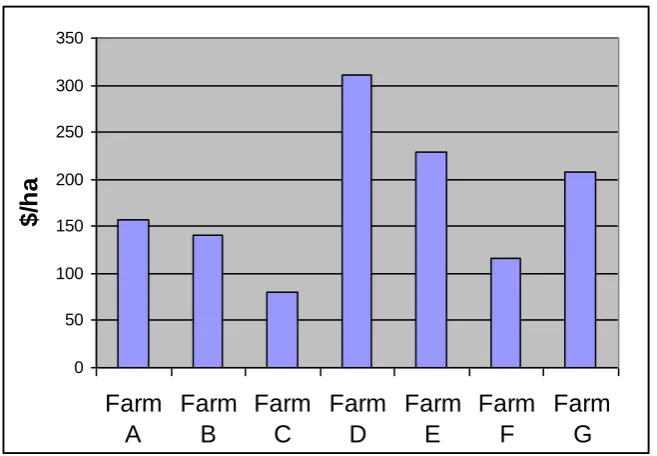
In 2007, CRDC commissioned the National Centre for Engineering in Agriculture (NCEA) to conduct a series of case study energy audits on cotton farms (Chen and Baillie, 2007). The report on this work showed that energy use the case study farms varied significantly from farm to farm with the range from 3.7 to 15.2 GJ/ha costing $80 to $310/ha (see Figure 1). Greenhouse gas emissions associated with this direct energy use was estimated to be between 275 and 1404 kgCO2-e /ha.
N
ote that this [image:3.595.134.463.431.659.2]study did not include the indirect energy and emissions associated with the production of the fertiliser and pesticides used. Cotton Incorporated in the US has estimated that, in irrigated cotton, energy use from the production of these inputs is equivalent to the energy used in the production of the crop.
Figure 1 Total direct energy costs of case study farms (cotton production only)
For irrigated cotton, average energy related greenhouse gas emissions can be equivalent to emissions from fertiliser use. A focus on improving on-farm energy use efficiency can be as important in irrigated cropping systems as improving nitrogen use efficiency. For example, data contained in the Australian Governments submission to the UN Framework Convention on Climate Change May 2010
(Australian Government, 2010) suggests that, in irrigated cotton, average energy related costs and greenhouse gas emissions (0.712 t CO2-e per ha) appear to be equal to average costs and emissions
from fertiliser use (0.67 t CO2-e per ha).
In cotton systems, water pumping is often the major energy use operation. Several more detailed examples are now available to show that significant efficiency gains (and in some cases crop productivity gains) can be made by optimising pump performance to provide reductions in diesel costs and in some cases improved pump efficiency can lead to increased water flow, more timely irrigation and improved crop yield (Reynolds et al 2008) .
The energy calculator developed under the NCEA project, EnergyCalc, was adapted under a subsequent QFF funded project to measure a range of primary production systems, including cotton, grains, sugar, horticulture, nursery and aquaculture (Chen et al, 2008)
.
Figure 2 compares energy use in the production of a number of intensive industries in Queensland (QFF, 2008). [image:4.595.107.490.306.610.2]Figure 2. Energy use in the production of a number of intensive industries in Queensland
Development of Protocols for Energy Assessment
In terms of future work on energy assessment, one of the major limitations is the heavy reliance on published data. Significant work and case studies are therefore required to establish benchmarking energy use data and to compare and evaluate energy use for alternative productions systems and impacts on greenhouse gas emissions. There is also a strong need to develop a detailed model report/manual so that effective and widespread energy audits in agriculture can take place.
Energy assessments may include direct measurement of actual performances in the field, assessment by a proxy based protocol and / or the appropriate application of both methods. A proxy based protocol is where energy inputs are assumed based on practices as opposed to direct measurement. A proxy (practice) based protocol is a far more economic method of assessment however to adopt a practice based protocol for energy assessment it is necessary to i) underpin with detailed measurements and ii) demonstrate that performance at an acceptable level of accuracy can be achieved when compared with a direct measurement approach. This is particularly important if users are to make significant changes to their farming operations in pursuit of energy (diesel and electricity) savings and BMP.
To adopt a practice (proxy) based protocol it is necessary to demonstrate how accurately energy use (and performance) can be determined by default values as opposed to direct measurement. In future work to develop a protocol for energy assessment, it is envisaged that this work will include a systematic examination of various farming operations to determine energy use. This analysis will also investigate the variation in energy use for particular farming practices and the significance of these results when reported across the farming system. These assessments will require direct measurements of energy use for specific farming operations by monitoring total fuel / energy consumption. Other considerations will include mechanical efficiency and potential energy and cost saving opportunities.
Broader applications of protocols for energy assessment include the determination of carbon footprints and Life Cycle Assessment for rural product differentiation which is currently based on a lack of reliable data. Similarly carbon trading schemes such as the Chicago Climate Exchange® (CCX®) are based on a practice (proxy) based protocol and therefore reliant on this information.
Conclusion
References
Australian Government (2010), Australian National Greenhouse Accounts, National Inventory Report 2008 Volume 1, Department of Climate Change and Energy Efficiency, Canberra
Baillie, C. (2009), Energy and Carbon Accounting Case Study (Keytah), National Centre for Engineering in Agriculture Publication 1003254/1, USQ, Toowoomba.
Baillie, C. (2008), Reducing Energy Input Costs and Associated Greenhouse Gas Emissions in Cotton, Australian Cotton Conference, Gold Coast Convention & Exhibition Centre, Broadbeach, Queensland.
Chen, G., Kupke, P. and Baillie, C. (2008), Opportunities to Enhance Energy Efficiency and Minimise Greenhouse Gases in Queensland’s Intensive Agricultural Sector, National Centre for Engineering in Agriculture, Publication 1002801/1, USQ, Toowoomba
Chen, G. and Baillie, C. (2007), Development of Energy/Calc - A Tool to Assess Cotton On-Farm Energy Uses, National Centre for Engineering in Agriculture Publication 1002565/1, USQ, Toowoomba.
CSIRO (2008), Fuel for through, The future of transport fuels: challenges and opportunities, Future Fuels Forum, CSIRO Corporate Centre, ACT
QFF (2008), A Farmers Guide to Climate Change in Queensland, Queensland Farmers Federation, Brisbane, pp. 23 - 24.