Research Report No 188
Causing Concern but Improving:
A Review of Schools’ Experiences
John Gray Homerton College
The Views expressed in this report are the authors' and do not necessarily reflect those of the Department for Education and Employment.
© Crown Copyright 2000. Published with the permission of DfEE on behalf of the Controller of Her Majesty's Stationery Office. Applications for reproduction should be made in writing to The Crown Copyright Unit, Her Majesty's Stationery Office, St Clements House, 2-16 Colegate, Norwich NR3 1BQ.
ACKNOWLEDGEMENTS
This review would not have been possible without the assistance of a wide range of people including a number of heads, teachers and LEA officers who have worked in or with schools on Special Measures. Members of the Standards and Effectiveness Unit at the Department for Education and Employment and individuals with experience of Ofsted also provided me with insights as did several researchers. I am most grateful to them all for the help they provided. Dr. Mary Berry and Dr. Helen Dimitrou helped with the search for relevant evidence.
TABLE OF CONTENTS
1. Introduction
2. Some characteristics of school
3. A question of culture?
4. Tracks to improvement
5. Leadership: people and commitments
6. Staffing and restaffing: the need for some renewal
7. Professional development and the concern for teaching
8. Tackling behaviour and attendance
9. Taking stock and the agenda for change
10. After Special Measures
References
LIST OF FIGURES AND TABLES
Table 1: HMI’s prognosis for schools still in Special Measures
Table 2: Incidence of Special Measures and levels of free school meals Table 3: Issues identified by inspectors as needing to be tackled
Table 4: Areas in which HMI seek evidence of schools’ progress Table 5: Some initial areas for change
Table 6: Major issues on the road to recovery
Table 7: Leadership skills of heads leading schools to recovery
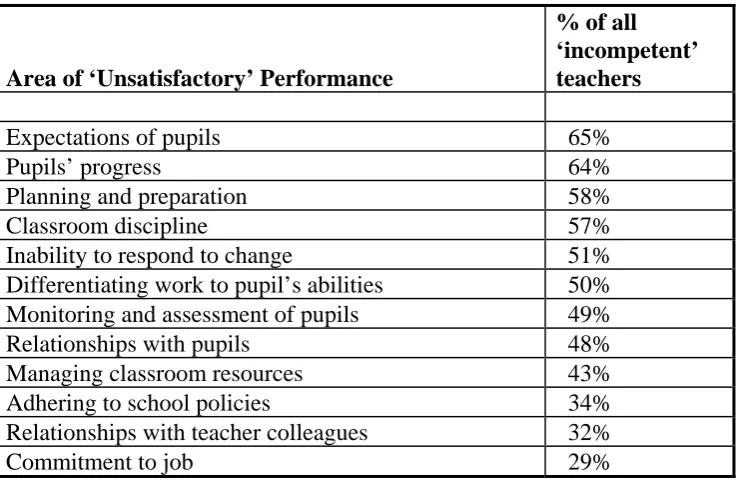
Table 8: Heads’ perceptions of ‘unsatisfactory’ performance amongst ‘incompetent’ teachers
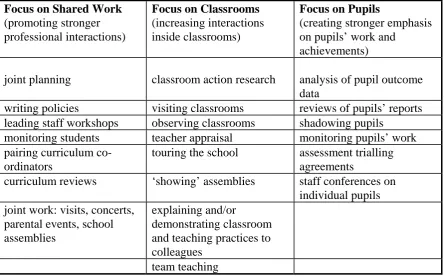
Table 9: Probable outcomes of different types of professional development
Figure 1: Levels of pupil exclusion before and after Special Measures broken down by school type
Figure 2: Improvement trajectories for three schools in Special Measures
1. INTRODUCTION
When people talk about school ‘failure’ they usually attribute it to one of several causes: a lack of will or effort on the part of those most closely involved; a lack of appropriate personnel equipped with the skills needed to bring about recovery; a lack of resources; or a lack of knowledge about what to do. This review is mainly concerned to contribute to the last of these issues. It brings together evidence from a variety of different sources (research studies on school effectiveness and improvement, Ofsted reports and overviews, the DfEE Standards web-site, case studies of individual schools, schools’ own accounts of the changes they have initiated and media contributions) with four purposes in mind:
1) to outline some of the challenges and difficulties facing schools ‘causing concern’; 2) to describe some of their common experiences;
3) to piece together some of the problems they encountered in seeking to improve; and 4) to establish some of the ways in which they have successfully overcome them.
The review is distilled from experiences across a range of institutions: primary, secondary and special schools; large schools and small schools; schools in inner cities, in rural areas and with a sprinkling from more advantaged communities; schools which have ‘caused concern’ for a long time; and so on.
Each, of course, has had a different starting point; all have had some unique experiences.1 A review will fail to give adequate expression to the diversity. Furthermore, given the range, the idea that there could be some common ‘blueprint’ for improvement across all of them seems improbable.2 Regrettably, not all of them have significantly improved; they too have contributions to make to the knowledge-base although to date rather less about them has been entered into the public domain.
What all these schools have shared in common is the experience of being put under enormous pressure to raise their standards and improve quickly; indeed, the vast majority have participated in the government’s Special Measures programme. It would be
disingenuous to pretend that this policy has not engendered strong views and feelings - both for and against. Indeed, virtually every school which has been told it is ‘failing’ seems to have something to say on the topic. Such concerns are not ignored in what follows but they do not form a central focus; nor do questions about alternative strategies for raising educational standards in disadvantaged areas.3
The driving questions addressed in this review have been about schools’ experiences as both they and others have reported them. What were the problems? What did they do? What were some of the common factors influencing or inhibiting improvement? And what advice could they pass on to other schools finding themselves in similar positions?
1
For some examples see Mortimore (1996) and the contributions to Part 3 of Stoll and Myers (1998). 2
For fuller reviews (and critiques) of the search for the sources of school effectiveness (and latterly school improvement) see Silver (1994), Gray et al (1996), Stoll and Fink (1996), Reynolds and Teddlie (1999) and Slee et al (1998).
3
For fuller discussions see, for example, the contributions to Barber and Dann (1996) and Kovacs (1998).
2. SOME CHARACTERISTICS OF SCHOOLS IN SPECIAL MEASURES
By the Summer of 1999 some 900 schools had been placed in Special Measures.
This total included around 3% of secondary schools, about 3% of primary schools, 8% of special schools and 6% of Pupil Referral Units (PRUs)(Ofsted, 1999:54). For every secondary school placed in Special Measures there have been four or five primaries. The build-up in numbers during 1997/98 and 1998/99 has been matched by a substantial increase in the numbers of schools coming off Special Measures. By the end of 1998/99 somewhere in the region of 400 schools had emerged from Special Measures .
The 1999 annual report from Ofsted’s Chief Inspector suggests that the number of
primary and secondary schools has been rising; indeed, during the year 1997/98 some 4% of secondary schools inspected were made subject to Special Measures. Ofsted identifies two contributory reasons for this trend. First, and in relation to primary schools, 1997/98 was the last year of Ofsted’s initial cycle of inspections. In a number of cases schools had had their inspections delayed, sometimes because of ‘particular internal difficulties’ the full nature of which had eventually come to light during the inspection. Second, in relation to secondary schools, just under half (40%) of those being placed in Special Measures were there because ‘national indicators and previous inspection reports had shown them to be weak’ (Ofsted , 1999a: 54). ’These were schools which had made little or no improvement since the first inspection or in which (inspectors judged) the quality of education to have deteriorated’.
Progress in Coming Off Special Measures
The two main thrusts of the Special Measures programme are that schools should turn themselves round and that they should do so fairly promptly. A two-year window is offered for this to happen. The limitations of existing data, however, make it difficult to say precisely what proportion of schools meet both these targets. Given that schools are constantly being put into Special Measures and subsequently removed from them, the picture is blurred whenever any particular ‘snapshot’ is taken.
By November 1998, for example, 760 schools had been placed in Special Measures since the introduction of the programme five years previously. Of this total 7% (just over 50 schools) had been closed and 22% had successfully emerged from Special Measures. In broad terms this would suggest that for every school that doesn’t make it some three do. However, whether this interpretation holds depends crucially on the prognosis for the remaining 71% of schools which were still failing at the time the picture was taken.
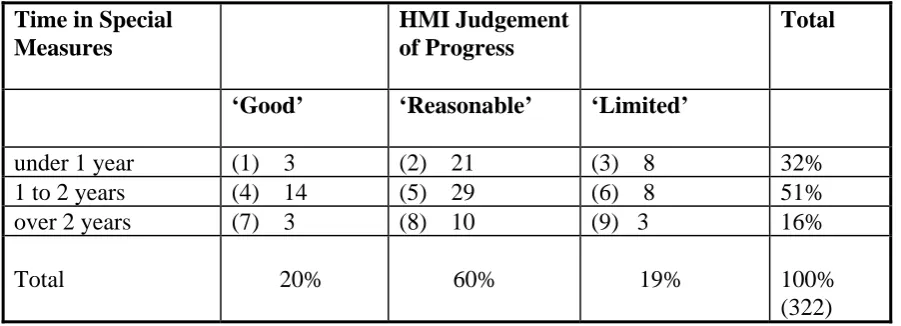
After a school has been placed in Special Measures and produced its action plan a team of HMI make the first of several monitoring visits. The main purpose of these visits is to assess the school’s progress. The data suggest about one-in-five schools were judged to be making ‘good’ progress at the time of the last visit whilst a similar proportion were making only ‘limited’ progress; in the remaining three-out-of-five schools HMI judged that progress was ‘reasonable’. Table 1 links these judgements with the periods of time schools had already spent in Special Measures.
It is clear from Table 1 that the prognosis for two-thirds of schools (67%) is, in HMI’s view, fairly good (cells 1, 2, 4 and 5). The evidence from their monitoring visits indicates that these schools were making ‘good’ or ‘reasonable’ progress within the two-year time-frame. For most of the remaining third the picture was less clear although potentially optimistic - progress to date had been ‘good/reasonable’ even though the two-year period had expired (cells 7 and 8) or, where progress was more ‘limited’ it was too early to make a firm prediction (cells 3 and 6).
In the case of 3% of the schools in the ‘still failing’ group, however, HMI judged that only ‘limited’ progress had been made and that they had been in this position for more than two years (cell 9). If it is assumed that the future of all the schools in this last
[image:6.595.83.534.337.500.2]category is in doubt, then the expected number of schools in Special Measures that might, at some point or other, be closed rises. Taking into account schools which had already closed, some nine-out-of-ten schools (91%) could eventually be expected to emerge successfully from Special Measures.
Table 1: HMI’s Prognosis for Schools Still in Special Measures
Time in Special Measures
HMI Judgement
of Progress
Total
‘Good’ ‘Reasonable’ ‘Limited’
under 1 year (1) 3 (2) 21 (3) 8 32%
1 to 2 years (4) 14 (5) 29 (6) 8 51%
over 2 years (7) 3 (8) 10 (9) 3 16%
Total 20% 60% 19% 100%
(322)
Source: DfEE internal analysis.
Table 1 suggests that roughly one-in-six schools had been in the Special Measures group for more than two years (cells 7, 8 and 9). Detailed analysis indicates that different types of school have required different amounts of time to improve. For example, the typical primary school and the typical special school have come off Special Measures in between 20 and 22 months; in the case of secondary schools the average has been higher at around 27 months (table not shown).
All three figures, however, mask considerable variations within types. Small numbers of schools in Special Measures seem to have recovered in around a year; in others slow but steady progress towards the removal of Special Measures was still being made some three years after first entering the programme. Schools serving areas experiencing very high levels of social deprivation took longer than average to come through; primary schools in these communities have taken about four months longer than the average whilst
secondaries have taken five. Larger primary and secondary schools have also required two or three months more to come up to the mark.
Whilst this review concentrates largely on schools needing Special Measures it also refers, at times, to a further group of schools considered by Ofsted’s inspectors to have ‘serious weaknesses’ (Ofsted, 1999a). The size of this group is considerably larger - some 12-13% of schools have been judged to be in this position. In general, less is known about the circumstances of these ‘ineffective’ schools. However, insofar as their experiences are relevant to the recovery process, they feature as part of the evidence base.
Context and Location
The most obvious contextual characteristic shared by schools in Special Measures is that they tend to be located in areas experiencing high levels of social deprivation. As an early Ofsted analysis, reported by the DfEE, put it: ‘schools drawing their pupils from the least favoured socio-economic groups account for only 17% of schools throughout the country but the same data indicate that over two thirds of failing schools belong to this group’ (DfEE, 1996: 2).
Subsequent Ofsted analyses have continued to underline what the DfEE referred to as ‘the clear link between socio-economic deprivation and the likelihood that a school will be found failing’ (DfEE, 1996: 2). For example, the 1999 annual report of the Chief Inspector states that ‘just over one third of (primary schools) have intakes with high levels of disadvantage in and around large cities’ and that ‘about half the secondary schools subject to Special Measures have intakes with high levels of disadvantage’ (Ofsted, 1999a: 54).
Both assessments are reinforced by the evidence in Table 2 which compares the presence of poverty (as measured by entitlement to free school meals) in schools in Special
[image:7.595.80.531.535.652.2]Measures with other schools. It is clear from the table that secondary schools in Special Measures have more than twice as many pupils on free school meals as the national average.
Table 2: Incidence of Special Measures and Levels of Free School Meals
% of Pupils Eligible to Receive Free School Meals
Type of School National Average
Schools in Special Measures
Primary 23% 37%
Secondary 18% 41%
Source: DfEE internal analysis.
Whilst schools serving severely disadvantaged areas are over-represented amongst schools in the programme, Ofsted points out that ‘primary schools subject to Special Measures continue to differ in size, type and socio-economic circumstances’ (Ofsted, 1999a: 54). Small primary schools and, in particular, small primary schools in rural areas,
are also present in larger than expected numbers. Problems specifically associated with their size seem to make them more vulnerable. Secondary schools in Special Measures are similarly varied but the range is more restricted; hardly any could be described as serving socially advantaged areas. Boys’ only schools serving inner city communities, smaller schools and schools with falling rolls are also over-represented in the secondary group.
As with primary and secondary schools, the incidence of social deprivation in special schools in Special Measures is well above the national average. What is particularly striking about these schools, however, is the extent to which they provide for ‘pupils with emotional and behavioural difficulties and cover at least three key stages’. This was the case for almost half the special schools placed in the programme during 1997/98 (Ofsted, 1999a: 54). Schools which had recruited SEN pupils with a wide range of disabilities from their localities also appear to have been particularly prone to difficulties.
Most LEAs have (or have had) at least one failing school. However, there are
undoubtedly some regional variations in the incidence of schools entering into Special Measures. As an early DfEE (1996: 2) analysis concluded: ‘Failing secondary schools are concentrated in urban areas, particularly London and the major conurbations of the Midlands and the North. The primary schools are more geographically dispersed: the majority are, again, in the inner cities but there is a fair scattering in county towns and suburbs and a substantial number are small, isolated country schools’.
Common Problems Facing Schools in Special Measures
Schools in Special Measures face many problems. The criteria which Ofsted employs to judge schools’ performance, however, delineate a core set of concerns4. The application of their inspection framework focuses particular attention on three features of failing schools which emerge ‘consistently’ across cases (Ofsted, 1997a: 8). These are:
• the under-achievement and low levels of attainment of the pupils;
• a high proportion of unsatisfactory teaching; and
• ineffective leadership.
Every school in Special Measures is required to draw up an action plan and, not
surprisingly, strategies to address the three concerns outlined above feature prominently in them. A more detailed review of schools’ action plans, however, suggests that schools in Special Measures embark (and need to embark) on a broader agenda.
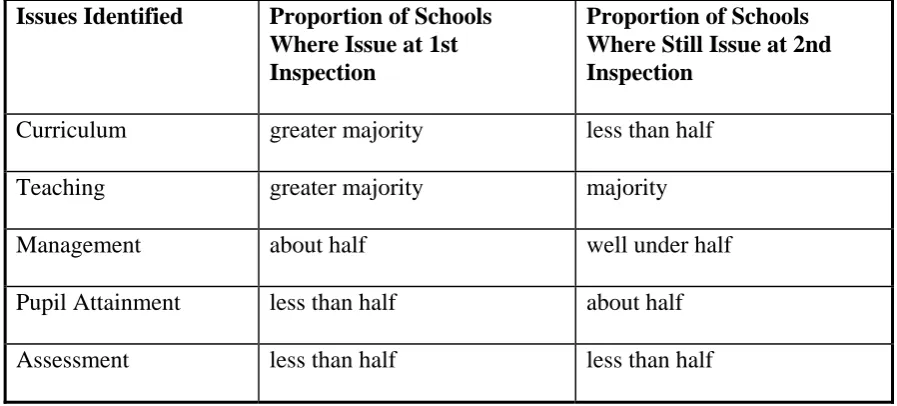
Table 3 is based on an analysis of the keywords featuring most frequently in the action plans of schools in Special Measures. It shows that issues to do with the curriculum and the quality of teaching featured in the plans of the greater majority of schools in Special Measures, that some aspect of management (including leadership) was an issue in about half of them and that in somewhat less than half there were concerns about assessment. Interestingly, issues to do with pupils’ overall attainment levels were explicitly mentioned
4
Inspectors reaching the conclusion that a school should be recommended for Special Measures are expected to answer over 20 questions which are outlined in Annex 1 of the Inspection Framework. Any school recommended for Special Measures is then subsequently visited by a team of HMI who decide whether to confirm this recommendation.
in less than half the plans although clearly most of their thrust will have been in this general direction.
Table 3: Issues Identified by Inspectors as Needing to be Tackled (a) Whilst School on Special Measures and (b) After School has Come Off Special Measures
Issues Identified Proportion of Schools Where Issue at 1st Inspection
Proportion of Schools Where Still Issue at 2nd Inspection
Curriculum greater majority less than half
Teaching greater majority majority
Management about half well under half
Pupil Attainment less than half about half
Assessment less than half less than half
Source: DfEE internal analysis based on the major issues addressed in schools’ subsequent action plans.
A keywords analysis can provide only the most rudimentary of insights into the problems facing schools in Special Measures although the recurrence of certain themes is
interesting. There were some variations from these general patterns when the type of school is taken into account (table not shown). At the time of the first inspection
curriculum issues were less prominent in secondary schools and teaching was more of an issue in primary schools. By the second inspection, however, concerns about teaching had become more salient in secondary schools whilst monitoring had emerged in primaries. Curriculum issues had also become more prominent in special schools.
3. A QUESTION OF CULTURE?
There is one thing on which most researchers and commentators are agreed - schools in trouble have had troubled histories. In a brief but instructive intervention into the debates David Hargreaves has expressed concern that: ‘there is too much emphasis on the
symptoms of failure and too little understanding of its pathology’ (quoted in Stoll and Myers: 1998: 6).
A number of commentators and researchers see the core problem facing failing schools as one of ‘culture’. When teachers talk about ‘the way we do things around here’ they are referring to the school’s culture. In a pioneering study of organisational cultures Schein refers to the ‘deeper level of basic assumptions and beliefs that are shared by members of an organisation, that operate unconsciously, and that define in a basic taken-for-granted fashion an organisation’s view of itself and its environment’ (Schein: 1985: 6).5 As Louise Stoll (1998: 1) has argued, these elements are ‘situationally unique’ and are ‘what makes (culture) so hard to grasp and to change’. Teachers in ostensibly similar schools can see things very differently.
Hargreaves (1995) outlines four different types of school culture and explores some of their consequences for school improvement. These ‘types’ are defined in terms of two key components: the need for social control over pupils and teachers (the instrumental dimension) and the need for social cohesion (the expressive dimension). Of course, few schools are at the extremes of either of these dimensions, but where a school is
‘exceptionally weak’ on both it can face serious problems. For Hargreaves the failing school is a clear case of the ‘anomic’ institution:
“For both teachers and students the school is close to breakdown - a classic ‘at risk’ situation. This is a ‘survivalist’ culture. Social relations are poor, teachers are striving to maintain basic control and allowing pupils to avoid academic work in exchange for not engaging in misconduct. Lessons move at a leisurely pace; little time is given to academic tasks. Teachers feel ‘on their own’, unsupported by the (head) and colleagues in curriculum planning and classroom control. They manage each lesson as best they can. Life is lived a day at a time. Many students feel alienated from their work which bores them, but there are no compensations in warm relationships with their teachers who enjoy little professional satisfaction. Delinquency and truancy rates are high as is staff absenteeism, especially of the occasional kind. The ethos is one of insecurity, hopelessness and low morale (Hargreaves, 1995: 28).
The issue of relationships features prominently in other accounts as well. David Reynolds, for example, argues that ‘poor relationships’ and ‘low levels of staff competency’ interact. Such schools, he maintains, are:
“...likely to be missing the prior competencies that are needed to do precisely the kinds of things that we tell them they have to do to become more effective (like development planning). They may be thoroughly non-rational institutions, where all sorts of delusions may flourish.
5
Quoted in Stoll (1998).
There may well be in these schools various pathologies - there may be a fear of outsiders which is likely to be masked by strong defences, both personal and group-based. There may be a reluctance to risk change, not because the school doesn’t need it (which is the reason ineffective teachers will give) but actually because of the fear that the change will be unsuccessful and further hurt teachers who have, in reality, low self-esteem. The ineffective school may also have inside itself ‘multiple schools’ formed around cliques and friendship groups, cliques that act to reflect and in turn mould differences in competence. There will be none of the organisational, social, cultural and symbolic ‘tightness’ of the effective school” (Reynolds, 1995: 67).
This kind of analysis has lead Reynolds (1996 and 1998) to argue that ‘ineffective’ schools may need to be rebuilt, possibly from the ground up. Stringfield (1999) refers to the ‘chaos of factors’ underpinning even the most ‘exemplary’ of schools. Drawing on work from other fields (notably engineering), they argue for the creation of the ‘highly reliable’ organisation - the school which is primarily oriented towards the elimination of failure. It is a conceptualisation of the educational process which is simultaneously powerful and emotive. Some schools might find it a useful template; others will want to reject it as too mechanistic, opting instead for a more organic approach to the change process.
In their pioneering study Improving the Urban High School, Louis and Miles (1992) argue that some schools had developed ‘improvement cultures’ whilst others had not or were only in the early stages of doing so. What differentiated those which managed to improve from those which didn’t was the way they handled problems and their ‘coping’ strategy - a cultural characteristic. Less successful schools were into ‘shallow’ coping - ‘doing nothing, procrastinating, doing it the usual way, easing off, increasing pressure’ and so on. More successful schools, by contrast, had acquired what Louis and Miles term ‘deep’ coping strategies. They were interested in the reasons why things were as they were and were prepared to change them; consequently the initiatives they launched were often substantial. They were also prepared to restaff and retrain where necessary and, on occasion, go back to the drawing board. The challenge for failing schools is to find ways of moving from the ‘shallower ‘to the ‘deeper’ strategies.
Different Types of ‘Failure’
Whilst acknowledging that failing schools may have many of the characteristics outlined above, Kate Myers prefers a more differentiated picture (Myers, 1998: 179). Based on her own experiences of working with schools in difficulties, she suggests that there are at least three types:
“striving schools are those that are in trouble but determined to change and improve. Although the head and staff know there are serious problems to address, they do not accept a simple definition of their future. There was a great
determination to ‘prove our accusers (the inspectors) wrong’. The fact that the vast majority of the staff worked with the head to demonstrate that the judgement was wrong proved to be very significant for the schools’ subsequent
improvement. The head exercised strong leadership and the staff allowed her to do so”.
This kind of school does not fit neatly into some prevailing views about failing schools. It may already have in place some of the characteristics schools in this situation need to develop in order to improve. Myers’ other two categories match stereotypes more closely:
“swaying schools are ones where, for a while, it may be touch and go whether the school will survive, let alone improve, in the face of their difficulties. Within a two-year period there was considerable staff turnover including the head and the deputy head...Staff morale wavered. On occasions staff appeared organised and enthusiastic but at other times they were demoralised and dejected. In the end, ‘under new management’ and with additional support, the school started to improve”.
So-called ‘sliding’ schools are the third type in Myers’ typology. It is this group that comes closest to the ‘ideal types’ Hargreaves and Reynolds portray. They are:
“...(schools) that seem to have become fixed in a never-ending downward
spiral....This school experienced considerable staff turnover including most of the SMT. A number of initiatives were mounted to counter high student disaffection and improve student behaviour but these were rarely carried through because staff were constantly ‘firefighting’ in response to immediate problems. The cumulative effect of these problems was that the staff became increasingly cynical about whether new initiatives could have any impact. As each initiative failed to deliver an improvement in student behaviour it became more difficult for the staff and students to believe that anything could work. In addition, there were serious relationship problems amongst the SMT and dysfunctional relations were also apparent amongst other staff”.
In short, low staff morale could lead to ‘resistance’ to change simply because stability was more reassuring and may, indeed, in certain circumstances, have seemed necessary for ‘personal survival’.
Michael Barber is another commentator who points to the different circumstances of different schools. In his Greenwich lecture he divided them into those which are
‘struggling’ (a much larger group than is conventionally considered) and those which are actually ‘failing’ (Barber, 1995). Myers does not suggest that her typology of failing schools is the only one that could be adopted but its existence alerts us to the need to think carefully about the circumstances of individual schools and the kinds of
improvement strategies they might require. Louise Stoll (1996) has recently added a fourth type to the list: the ‘cruising’ school. This type is some distance from the other stereotypes (Stoll and Fink, 1996: 32). The ‘cruising’ school is perceived as ’effective or at least more than satisfactory by teachers and the school’s community’ until the
inspectors tell a different story:
“It has a carefully constructed camouflage. Whilst it appears to possess many of the qualities of an effective school, it is usually located in a more affluent area
where pupils achieve in spite of teaching quality. League tables and other ratings based on absolute achievement rather than value-added often give the appearance of effectiveness...It is generally unsuitable for the less academically involved pupils and unchallenging for the more able. It also contributes little to goals of social justice for ‘at risk’ pupils (Stoll and Fink, 1998: 193).
External Influences and Constraints
The balance between internal cultural features and external influences and constraints, as well as the ways in which these interact, has received little attention in most accounts of school improvement. Stoll and Fink argue that an ‘ineffective’ school:
“ could be viewed as one that is controlled by change rather than controlling it; that lacks appropriate conditions and strategies; is not pupil-outcome oriented; and, for whatever reason, does not attempt to improve. Such a school tends to be locked into crisis planning and makes little attempt to build the capacity to
respond to increasingly complex and unpredictable societal changes” (1998: 191).
But what accounts for schools getting into this position? Martin Thrupp (1999) argues that improvement researchers have either ignored or given too little emphasis to the constraints imposed by a school’s ‘social mix’ which, he suggests, is the crucial element which defines and holds a school’s culture in place. But whilst such factors may go some way towards explaining a school’s position at or near the bottom of the rankings, how is it that some schools get into this position and others don’t?
In a recent study Gray and colleagues (1999) have argued that more attention should be paid to a school’s ‘natural history’. They show how poorly-performing schools had a number of ‘ghosts’ and ‘legacies’ in their recent pasts which interacted with community characteristics. They write:
“...all experienced significant changes in the composition of their catchment areas, problems with their local communities, difficulties in managing falling pupil numbers, budget restraints and the threat of closure. In addition they have been characterised by low staff morale, general developmental apathy and low levels of pupil performance.... Improvement from such a baseline represented a formidable challenge. The total quantum of staff energy for change was, of course, finite and much of it was consumed in attempting to keep the schools functioning on a day-to-day basis as viable institutions. Much of whatever energies were available for change had to be focused within the schools. Of comparable importance,
however, was the restoration and maintenance of support and regard from their communities and, in particular, their parent bodies” (Gray et al, 1999: 73).
Hitherto researchers have tended to give primacy to the cultures of ‘ineffective’ schools whereas inspectors and policy-makers have emphasised the specifics of what needs to be tackled to get schools back on track. The former seem to assume that if the general conditions for change and improvement can be generated, particular strategies for addressing specific tasks will follow in their wake; the latter that by focusing on particular concerns a more general orientation or responsiveness towards improvement issues will be engendered. In practice, of course, most change makers try to bridge the
gap between the two. They build, at much the same time, around both. By working on some of the issues identified by the inspectors they hope to shift the culture and by reinforcing aspects of the culture they hope to improve the ways in which particular concerns are tackled. Captured in a phrase their aspiration is that colleagues will, in time, come to say: “that’s how we used to do things round here - now we do them differently”.
4. TRACKS TO IMPROVEMENT
To be removed from Special Measures schools must demonstrate to the HMI responsible for monitoring them that they have made progress on various fronts. Advice from Ofsted (1997b) outlines seven areas in which evidence is sought (see Table 4). These relate to specific aspects of educational standards, the quality of teaching and the management and efficiency of the school.
Table 4: Areas in Which HMI Seek Evidence of Schools’ Progress:
with reference to educational standards:
1) pupils’ attainment (in secondary schools and some special schools) on various measures of performance at GCSE; and pupils’ attainment (in secondary and primary schools) in relation to performance in National Curriculum tests;
2) levels of exclusion as well as types of exclusion;
3) pupils’ levels of attendance;
4) pupils’ progress in lessons (as observed);
5) pupils’ attitudes, behaviour and personal development (as observed).
with reference to the quality of education being offered and the school’s management and efficiency:
6) the proportion of teaching judged satisfactory or better (as observed) along with evidence for schemes of work; and
7) evidence of ‘effective leadership and management, appropriate staffing for all classes and ‘secure’ budgeting and financial management (as judged by HMI).
Source: Ofsted (1997b)
This is an extensive and potentially challenging agenda. The mix of things which any particular school has to undertake will, of course, differ. Ofsted are careful to stress that these are ‘indicators, not a tick list to recovery’ and that ‘a school can be removed from Special Measures even if weaknesses remain’. Crucially, however, it must show that it is offering an ‘acceptable standard of education’ in terms of the Ofsted Framework and ‘is well placed to make continued improvement’. The judgement that a school has made sufficient progress is made on the balance of the evidence and permits a school’s performance to be seen in the round. Areas where improvement has been rapid can compensate, to some limited extent, for others where change is less evident.
A good deal of the evidence, to date, about schools in Special Measures has been derived from case studies. Such approaches can yield insights into the specific circumstances of individual schools and help to show the ways in which progress in one area may be linked to progress in others. There is a danger, however, that they may produce, albeit
unintentionally, a somewhat skewed picture. Schools which have improved rapidly or, alternatively, hardly moved at all may become unduly prominent. To counter any such tendency there is a need to bring together a wider range of experiences. The following account, therefore, has been pieced together from a number of disparate sources.
Areas of Measurable Progress
As part of this review a small but random selection of administrative files for schools in Special Measures was studied. These provide evidence on schools’ improvement drawn from HMI’s monitoring visits. When a school is making ‘good’ progress only three or four visits may be necessary before it is deemed to have been ‘restored to health’; where progress is more limited, however, further visits may be required (between 6 and 8 is not unusual). In the process evidence is assembled both on issues emerging from the
implementation of schools’ action plans and in relation to the specific criteria listed in Table 4 above.
It is clear that schools are expected to make progress across a broad range of fronts. However, two of the four criteria where judgements are based primarily on evidence gathered from HMI visits and observation seem particularly crucial: improvements in the quality of teaching and in leadership (criteria 6 and 7 respectively).
To judge from the small sample reviewed, schools in Special Measures may secure increases of up to 25% in the area of ‘quality of teaching’ - the overall proportion of lessons judged ‘satisfactory or better’ by HMI might rise from somewhere over half to around three-quarters over the course of 18 months. However, the proportions might vary for lessons at different key stages and increases of between 10% and 20% seem much more common.
Evidence relating to improvements in the effectiveness of schools’ leadership is, of necessity, more qualitative. Changes to the membership of senior management teams probably provide the key to this judgement. These usually, but not invariably, involve the hiring of a new headteacher around the time of the inspection putting the school into Special Measures - either shortly prior to it or shortly after. In the case of a primary school a change of deputy sometimes seems to be enough to tip the balance.
Some more systematic evidence relating to two of the other listed criteria (attendance and exclusions) is now available from internal DfEE analyses. (The data analysis undertaken by the DfEE on pupil attendance and exclusions is based on an early sample of OfSTED Reports for primary, secondary and special schools that had come out of special measures by Spring 1999. The attendance and exclusion data was extrapolated from the OfSTED reports placing schools in and removing schools from special measures). Secondary and special schools coming off Special Measures seem, on average, to have raised pupils’ attendance (as formally recorded in school registers) by some two percentage points - overall figures have risen from the low to the mid-eighties. In primary schools, where
attendance already averaged over 90%, improvement has been confined to around a percentage point.
[image:17.595.114.474.248.422.2]Improvements in the area of exclusions have been more dramatic, especially where special schools have been concerned. When entering Special Measures special schools have had exclusion rates averaging some 20%; amongst schools coming off Special Measures the average has fallen to below 1% (see Figure 1). In secondary schools the changes appear to have been almost as substantial whilst in primary schools exclusions have been virtually eliminated.
Figure 1: Levels of Pupil Exclusion Before and After Special Measures Broken Down by School Type
Secs. Primaries Special 0
10 20 30 40
Secs. Primaries Special
Pre-SM Post-SM
Source: DfEE internal analysis.
It is more difficult to tell what the effects on pupils’ measured attainments have been. The HMI responsible for monitoring schools’ progress are expected to seek evidence in relation to performance in GCSE at various levels (such as those achieving 1+ A* to G grades or 5+ A* to C grades) and to look, in particular, for signs of ‘increases, year-on-year, in the proportion of pupils....with an emphasis on trends, for example, over three years’ (Ofsted, 1997b: 2). Similarly, they are expected to judge, in both primary and secondary schools, what proportion of the school are ‘achieving levels of attainment appropriate to their age’ in National Curriculum tests and, again, there is a concern for evidence relating to ‘sustained improvement year-on-year’.
We can be confident that schools removed from Special Measures have satisfied the HMI monitoring them that they have made progress. It is, nonetheless, surprising that neither of the two major reports from Ofsted (1997a and 1999b) on the experiences and
challenges faced by schools coming off Special Measures makes any mention of the
actual levels of improvement in pupil performance and progress secured by the schools involved over two years (for those recovering more quickly) or three years (for those taking longer). This is clearly an area where further research is needed.6
6
A story in The Times Educational Supplement (29 August 1997) refers to this issue but the number of cases mentioned is too small for any generalisations to be appropriate.
18
Table 3 earlier showed that whilst schools might be making progress in particular areas these could still be issues after Special Measures had ended. Teaching and attainment, for example, were still prominent concerns in at least half the schools. As Ofsted has
suggested, a school ‘does not have to be a good school before Special Measures are removed’ (Ofsted, 1997b: 4). What it must demonstrate, to HMI’s satisfaction, is that subsequent progress will probably be sustained.
Improvement Trajectories
[image:18.595.93.524.356.747.2]Research on schools’ ‘improvement trajectories’ is still at an early stage but can help to illuminate the nature of the challenges facing different schools (Gray, 1998; Gray et al, 1999). The vertical axis in Figure 2 refers to schools’ overall levels of effectiveness with the ‘most effective’ being placed at the top of the axis and the ‘least effective’ at the bottom. The horizontal axis describes the schools’ positions over time from a period three years prior to the inspection to the position some four years after it.
Figure 2: Improvement Trajectories for Three Schools in Special Measures
(The graph is confined to the least effective fifth of schools)
--- Level of school’s effectiveness
(percentiles above least effective) 21% -
18% -
15% -
12% -
9% -
6% -
3% -
Y -3 Y -2 Y -1 Inspection Y +1 Re- Y +3 Y +4
Inspection
Special Measures
Borderline for schools in Special Measures Borderline for schools with ‘serious weaknesses’
z
z z
z z
z z z z
z
z z
z z
z
z z
z
z z
z
?
?
?
For the purposes of this discussion the figure is confined to the least effective fifth of schools (the remaining four-fifths including the most effective are excluded). Horizontal bands are also shown representing (roughly) the bottom 3% of schools (those that can expect to be placed in Special Measures) and the bottom 15% of schools (which includes those with ‘serious weaknesses’).
Schools in Special Measures share at least two things in common. At the time of their first inspection they find themselves in the bottom band. To be removed they must get themselves onto a ‘trajectory’ which secures a fairly rapid increase in their position. Several possibilities are outlined in Figure 2. In one (School A with the steeper slope) the school makes sufficient progress over its time in Special Measures to move beyond the group of schools with ‘serious weaknesses’ and join those which are simply ‘less
effective’. In another (School B with a less steep slope) progress is not quite so rapid and the school finds itself in the upper reaches of the ‘serious weaknesses’ group but the prognosis looks good; if the slope is extrapolated for a further year then the school will, at some point in the not-too-distant future, move out of ‘serious weaknesses’ and into the much larger group of schools which are simply ‘less effective’.
Estimates by researchers of the general rates of improvement in secondary schools’ performance over recent years suggest that increases of this order are possible (Gray et al, 1999; Sammons et al, 1997). At the time of writing no equivalent evidence on primary schools’ rates of progress was available but improvements on this scale do not seem implausible7. In both cases the school must improve its ranking in terms of its
‘effectiveness’ by something in the order of ten percentile points. Whether schools in Special Measures face level playing fields in this respect is, however, a matter for further research.
Figure 2 shows, in addition, the schools’ ‘trajectories’ in the years prior to the inspection which originally placed them in Special Measures as well as their subsequent
performance. In one case a school was functioning at a higher (although not necessarily acceptable) level of ‘effectiveness’ but had ‘dipped’ into the Special Measures band around the time of the inspection (School A). In a second the decline in performance seems to have been of longer standing - overall levels of effectiveness had been falling over a number of years (School B). The third, meanwhile, had always occupied a position in or close to the bottom band (School C). The challenges facing schools on these
different trajectories undoubtedly vary.
The improvement trajectory for School A in the post-Special Measures period is also extrapolated in Figure 2. In the most optimistic scenario the school continues its rapid rate of improvement; in the most pessimistic it remains on the borderline of the ‘serious weaknesses’ band. In reality rather little is known about these phases of schools’
development and more research is needed. Such limited evidence as is available, however, suggests that in the greater majority of cases three years of year-on-year
7
Some further assumptions are probably necessary since a school’s ‘effectiveness’ is a relative concept. For a school to improve its position in an ‘effectiveness’ ranking other schools must stay in the same position or improve more slowly. Since the emphasis in re-inspecting schools in Special Measures is on the progress (in absolute terms) which they have made since the first inspection, the judgements being made about ‘effectiveness’ are probably benchmarked in terms of schools’ positions at the time of the first inspection rather than two years later.
improvement in schools’ effectiveness represents ‘a good run’; after this schools begin to plateau, possibly consolidating existing gains before considering further challenges. Schools which can at present sustain progress for longer periods seem fairly rare (Gray et al, 1996). 8
Creating Some Conditions for Change
The first few months after a school is put into Special Measures are a time of crisis. An action plan is demanded but there is also a pressing need to find (or rediscover) a sense of purpose. Pragmatism and vision are required, probably in equal measure. To add to the pressures the school must find ways of progressing issues with a rapidity which may be unfamiliar.
How schools handle these tensions in the early stages will vary - every school is potentially different. Nonetheless, some common patterns can be discerned from their accounts. Schools which show signs of progress have found ways of tackling (some) staffing issues, have succeeded in developing a sense of commitment to the school’s future from key players, and have experienced certain contextual factors either working in their favour or, at worst, not working against them quite as strongly as in the recent past. Table 5 summarises some of the key factors in these early stages.
Table 5: Some Initial Areas for Change
Commitments
• renewal of teachers’ commitment to the school
• acceptance of need to change by staff (and pupils)
• involvement of concerned parents and governors in supporting action plan(s)
• use of external support (usually from the LEA) to encourage developments
Restaffing
• some recent changes in leadership at senior level
• some ‘fresh but experienced’ blood in classrooms
Context
• clarification of the school’s future (notably in relation to any extant proposals for closure)
• reductions in competition for pupils with other local schools
• the absence of extreme social deprivation
• a relatively short history of problems at the school.
How schools have restaffed and secured renewed commitments is dealt with in greater detail at a later stage in this review. Contextual questions cannot, however, be ignored - lack of movement on some of the factors listed in Table 5 markedly inhibits a school’s
8
This observation is based on evidence drawn from schools across the range of ‘effectiveness’; the sample sizes analysed were too small for generalisations to be made with any great confidence to schools
specifically in Special Measures.
ability to make progress. Where debates about the need for closure have continued for a number of years, for example, and are not brought to a rapid conclusion by the school’s entry into Special Measures, continuing difficulties are commonly reported. Many
schools in Special Measures have already experienced problems in recruiting pupils up to their target numbers. Furthermore, where parents have some choice of schools (and especially in urban areas), initial reactions to reports that a school is in trouble may compound recruitment problems - the next intake may require still more persuasion that the school can deliver on its promises.
High levels of social deprivation and exclusion are facts of life which many schools in Special Measures share in common. Schools which experience them in their severest forms, however, appear to have greater difficulty than others in making progress. The longer time period (up to six months more) that they require to come off Special Measures is one very tangible indicator of the scale of the problems they face.
Schools may also have experienced a succession of other problems, sometimes extending back over a number of years. The list of those frequently reported in case studies of schools in Special Measures includes: staffing problems with frequent changes of
headteacher (a new head or acting head every 12-18 months); high levels of staff turnover amongst other members of staff with the staff split between those who have been in post for many years and newly-qualified teachers; long-standing disputes between
management and unions; cases of arson and vandalism; conflicts between pupils,
sometimes along ethnic lines; and tensions between the school and its local community.
Within six months a school which is beginning to make progress is likely to have turned its attention to some further issues as well. Four particularly salient ones are listed in Table 6. They include: the introduction or revamping of codes of conduct relating to pupil behaviour and expectations along with their enforcement; targeted efforts to tackle
attendance and exclusions, particularly in secondary schools; a focus on aspects of teaching and curriculum including the development of strategies for handling ‘incompetent’ or potentially ‘incompetent’ teachers; and the more systematic use of performance analysis and review to identify areas of under-performance where interventions might usefully be contemplated. Some of these issues are considered in greater depth in the sections which follow.
Table 6: Major Issues on the Road to Recovery
• Pupil behaviour and expectations
• Attendance and exclusion (in secondary schools)
• Teaching and curriculum including the handling of ‘incompetent’ teachers
• Performance analysis and review
5. LEADERSHIP: PEOPLE AND COMMITMENTS
The stage at which a school is being placed in Special Measures is almost universally reported to be one of turmoil. This can easily become a time for recrimination and blame. Everyone examines their own commitments to the school (pupils, parents, teachers and policy-makers alike) as well as their responsibilities. How well a school survives will depend crucially on how quickly some convincing strategies can be formulated.
Feelings and Commitments
Whether one is a pupil, teacher, parent or governor the initial experiences of those involved in schools which have been placed in Special Measures are scarring. Linda Turner (a head on secondment to her LEA as an adviser) took over a primary school. She states simply: ‘the staff were devastated’ (Turner, 1998: 96). John Cullis, an experienced head who agreed to turn around a failing primary school, commented in similar terms: ‘confidence and morale were devastated. I just had to listen, to gain people’s trust and to give them reassurance and respect’ (Cullis, 1999).
Staff at the Ridings School, many of whose problems were played out on nightly
television, had similar responses. ‘Many staff’, Peter Clark (the new head) reports, ‘were very upset’ (Clark, 1998). Other evidence confirms that teachers feel that that their ‘professional selves’ have been confronted (Wilcox and Gray, 1996).
Such feelings are widespread. Regardless of teachers’ own position, experience or, crucially, performance in the school, they report being deeply affected. Drawing on the literature of bereavement Stephen Pugh (who became head of a special school in trouble), suggests staff responses ‘followed the recognised pattern of grieving (denial, anger and depression)’ before more constructive possibilities for change began to emerge (Pugh, 1998: 108). Feelings of shock and anger prevail, even amongst those who have already prepared themselves for the worst.
Such responses are sometimes matched by other emotions. Clark suggests, for example, that at the Ridings:
“Others saw the (temporary) closure as a step forward: at least, they felt,
something would now happen. Some also saw it as an opportunity to make sure that when the school re-opened it was on their terms - perhaps they would play a more significant role in its future management”.
The Ridings is likely to have been an extreme case. Studies of other schools, however, confirm that it is rare for the staff in an institution in trouble to share a united view (Gray
et al, 1999).
There is another group whose feelings have, at least in comparison with those of teachers, been relatively neglected - namely pupils. Recalling the traumatic period when the school was put into Special Measures, Jean Millham, head of Morningside Primary, said the impact of failing an inspection was dreadful. ‘I had a playground full of weeping children who felt that they had been rubbished; they had been told that yet again they were no
good’. 9Clark also describes in some detail the responses of pupils to the news that the Ridings was in the throes of failing its inspection and would be (briefly) closed. Reporting on the pupils’ responses, he writes:
“The older (pupils) were concerned for their futures and GCSE courses but when the younger ones were told there were many smirks. ‘I understand why you’re pleased’, Peter Bartle (Calderdale’s Chief Adviser) told them, but in time you’ll look back on all this with regret” (Clark: 1998).
However, as Clark himself goes on to report, there were signs of change amongst some pupils at the Ridings over the ensuing weekend:
“Anna (the deputy) and I took the first assembly together. The students behaved impeccably. Attendance was around 75%... ‘Things have now changed’, I explained as they listened politely and attentively. ‘We’re here to ensure that there’ll be no return to the shambles of the previous weeks. It’s not in your
interests and it won’t be allowed to happen....We want to work with you to rebuild the school’.”
Other accounts confirm that pupils’ concerns run deeply - it is, after all, their educational futures which are at stake. But, as an American educator, Sonia Nieto (1994), reminds us:
“Reforming school structures alone will not lead to differences in student
achievement....if such changes are not accompanied by profound changes in how educators think about students... One way to begin the process of changing school policies is to listen to students’ views about them (but) student perspectives are, for the most part, missing in discussions concerning strategies for educational problems”.
Pupils quickly grasp the implications of the negative publicity which attends ‘failure’; the danger is that they accept the label. Whilst change leaders frequently acknowledge the importance of winning pupils’ ‘hearts and minds’, to date too little attention has been given to the distinctive part pupils can play in becoming a force for change (Rudduck et al, 1996).10
Comparatively little is known about the feelings and motivations of those who agree to take on leadership roles in schools in Special Measures. It is widely assumed that
financial considerations are a persuasive factor. Certainly, for someone who is currently a deputy headteacher this is likely to be true. But, as an Ofsted study (1998a) suggests, the use of major salary increases varies considerably from LEA to LEA. ‘In some LEAs, seconded headteachers transfer onto the going rate for the receiving school, or an adjustment is made so that the headteacher is not out of pocket but in other LEAs salary enhancement can range up to six thousand pounds, depending on the persuasiveness of the case’ (Ofsted, 1998a: 17).
9
Quoted on the BBC On-line Network website, 9 February 1999. 10
In an unpublished account Rudduck (1999) mentions some of the issues pupils raised when staff in a school in Special Measures were persuaded to listen to pupils’ views and started to build them into their agendas for change.
Whilst pay matters, other ‘motivational’ factors seem to count as well. The Ofsted study lists some of the qualities heads used to describe themselves: ‘tenacious’, ‘charismatic’ and ‘a street fighter’ being amongst them. As the report observes:
“the (heads) have been asked to take on a difficult task because they are believed to have the necessary skills but they need to know how well they are succeeding. Having previously enjoyed a good professional reputation, seconded heads
sometimes worry that if they are not successful in the secondment their career will suffer. Whatever the circumstances, affirmation of success is uppermost in
headteachers’ minds” (Ofsted, 1998a: 15).
Leadership At All Levels
Leadership and staffing issues dominate accounts of the challenges schools have faced in securing progress. Indeed, early predictions about a school’s prospects are likely to be intimately bound up with feelings about its leadership. As Ofsted (1998a: 4) notes, when a school is put into Special Measures ‘a common outcome is for the headteacher to consider whether she or he has the necessary skills to improve matters. In many cases the headteacher leaves the school’. Alternatively, an LEA may have anticipated the likely findings and brought about a change in the run-up to the inspection. Stark (1998: 39) reports that during the period 1993-96 ‘in just over half the cases thus far the head has changed within a term or two before (25%) or after (75% )the school’s failure’. The challenges which heads face in the aftermath of the inspection will differ accordingly. In either case, however, be they ‘new broom’ or longer-standing incumbent, the head has to establish or re-establish their credentials to lead the changes.
How a head stamps their impression on a school during these early days can be crucial. Stark has outlined the array of skills possessed by heads who turn their schools around (see Table 7). The list is both multi-dimensional and extensive. Schools in Special Measures which can recruit candidates who possess all these characteristics will be fortunate. More often some compromises are required.
Whilst acknowledging the range of leadership skills that heads may need, Brighouse and Woods (1999: 76) place the emphasis elsewhere:
“...some leaders have the capacity to sweep away problems, not by minimising them, still less by ignoring them, but mainly by turning them into opportunities for growth and development. Moreover, if they hadn’t this gift themselves, they recognised the need and were good at identifying people in the organisation who had...these leaders move beyond ‘order’ and ‘relationships’ in their activities and find ways of engaging the staff in continually exhilarating discussions about the purposes of the school”.
In some ways the ‘new broom’ faces the easier task. High hopes usually attend the change of leadership on all sides - amongst pupils, parents, governors and staff. As Gray and colleagues (1999: 56) observe:
“Teachers’ feelings about how well the school as a whole is doing are often bound up with their perceptions of their heads’ performance. The arrival of a new head
offers the prospect of change for those who seek it; even the more cynical seem prepared to suspend judgement during a new head’s honeymoon”.
But, as Stark also notes, ‘in a substantial number of cases a head who has been at the school for some years has remained at the helm’. More attention needs to be focused on the ways in which they too increase the pace of change at their schools.
Table 7: Leadership Skills of Heads Leading Schools to Improvement and/or Recovery
• strategic skills: formulating (or helping governors to formulate) an overall vision for the future of the school; and within it, identifying strategic targets and prioritising between them;
• monitoring skills: keeping tabs on the crucial points where improvement is needed, including classroom observation of colleagues’ teaching as a constructive rather than an oppressive technique;
• collegiate skills: enabling the governors to work as a cohesive, focused unit; creating a sense of common purpose and identity amongst teaching colleagues; this includes the crucial trait of being ‘approachable’;
• staff management skills: including gaining the co-operation and respect of colleagues and if necessary taking and implementing tough decisions about early retirement and competency proceedings’;
• staff development skills: planning the personal development of other teachers to give them the skills they need to raise standards;
• resource management skills: relating limited means (financial and staffing) to strategic ends, matching the priorities and ensuring proper resource control; and
• ambassadorial skills: representing the school’s interests to the LEA, diocese or other body, negotiating their support and more widely presenting its public face to parents and the local community (particularly to local newspapers) to regenerate public confidence
Source: Stark (1998: 40)
It is easy enough to assert that some change of leadership is required - ensuring that the replacement is up to the demands is more problematic. The leadership templates both Stark and Brighouse and Woods outline are, after all, formidable. Location and context, the scale of the problems facing the school, the new resourcing available to support the demands of a prospective head and the ratio of stress to reward may all inhibit the search for the ‘right’ person. Christine Whatford’s (1998) account of her efforts, as a Chief Education Officer, to find a new headteacher for a troubled school in her LEA underlines how difficult the search for new leaders can be and the range of concerns that prospective heads seek reassurance on. Anyone already well-qualified for the job was likely to be fully occupied making their contribution elsewhere and needed to be prised out.
Furthermore, from the perspective of potential candidates the risks may well outweigh the likely rewards; some may view it is as a step to something better, others as a challenge too far.
Rethinking Leadership
The difficulties of securing appropriate leadership in times of crisis has lead some LEAs to rethink their school improvement strategies. Several approaches have emerged. Rather than waiting for a school to be inspected and then responding, for example, they have tried to anticipate the likely results. In this scenario the need to strengthen a school’s leadership has surfaced as an issue in the run-up to the inspection (Ouston et al, 1997). A part of the Special Measures programme is, in effect, put into place prior to the inspection rather than in its wake. As a result, the period for recovery is extended. But such a
strategy also carries risks. Handled insensitively, such interventions may actually undermine the existing leadership and precipitate the judgements they were intended to evade.
Ideally, a school in Special Measures would have a field of applicants. In practice it may be lucky to have any choices at all - between, say, an ‘insider’ who knows the school well, but could be seen as part of the problem, and an ‘outsider’ who might, under certain circumstances and with the right package of incentives and encouragement, be persuaded to take it on. Schools have, perforce, been required to think more laterally about the injection of new leadership.
The hierarchical structure of schools in this country focuses attention on the headteacher. The experiences of schools in Special Measures, however, suggest that it is the combined
skills and experience of the senior management team that matter. Vivien Cutler took over Highbury Grove, a boys’ secondary school in trouble. She writes:
“Most studies of school effectiveness see leadership as the key to school
improvement. But this underestimates the importance of the senior management team in facilitating coherence and supporting middle managers in a range of roles” (Cutler, 1998: 94).
This is a relatively neglected area but one which offers some alternative avenues for development. The shift of focus away from the potentially dispiriting quest for the ‘right’ leader can open up a broader range of opportunities for restaffing at senior level.
A striking feature of several ‘ineffective’ secondary schools which have improved rapidly is the extent to which they have benefited from some form of ‘dual’ leadership (Gray et al, 1999). One member of the team has concentrated on ‘maintenance’, the other on ‘change’. Such partnerships have typically tended to emerge over several years and have relied on a measure of mutual trust and understanding; formal clarifications of the ‘division of labour’ have emerged at a later date. Could they, one wonders, be deliberately forged at an earlier date?
The attraction of an expanded view of leadership for schools in Special Measures is that it widens the range of available strategies and (importantly) potential candidates. A change of deputy (or an additional deputy) in a secondary school can give some impetus to action although, without other changes, it may not be sufficient to overcome inertia. In a primary school it may be just enough to tip the balance and could, in some contexts, be sufficient.
Part of the power of changes in leadership is, of course, symbolic. But changing the headteacher alone is rarely sufficient. It is the ‘new team’ which frequently accompanies
such restructuring which secures progress. By widening concepts of leadership a school’s capacity may be (temporarily) expanded.
The Role of External Support
Two other strategies also merit attention. Both are examples of the ways in which an LEA (or other outside body) can anticipate the likely needs of schools potentially in
difficulties. ‘Consultant heads’ are experienced colleagues whom LEAs can deploy for varying lengths of time to support school managements. They might provide specific kinds of help prior to an inspection, serve as ‘caretaker’ managers during periods of crisis and subsequently help the school to strengthen its commitment to change. Schools also report that governors sometimes take on a particular responsibility (such as assisting in the creation of a financial plan) whilst LEA support staff may be available to give added impetus to the revamping and development of school policies.
The second strategy is more radical and still embryonic. It involves matching
interventions to ‘stages of development’ (Hopkins and Harris, 1997). Rapid change may, in certain circumstances, require toughness and a willingness to be decisive as well as diplomacy and tact. Few prospective heads possess both sets of attributes in equal
measure. Even if they do, circumstances may not permit them to be revealed - resentment and resistance may follow. A small number of LEAs have begun to see recovery as a two stage process in which certain heads are deployed as the educational equivalent of
‘trouble-shooters’. They intervene and then move on, making way in the process for successors who can work on longer-term issues at a rather less hectic pace. More
evidence of the medium-term effects of this kind of approach on schools’ development in the post-Special Measures phase is, however, required.
In brief, the quality of LEA interventions depends heavily on the preparations they have made (Southworth and Sebba, 1997; Ofsted, 1998a).11 Where such understanding is present it can enhance considerably the potential for improvement. Handled badly, and with insensitive monitoring, however, it can simply compound the pressures a school is already under. With LEAs’ own performance on the line, they can sometimes transfer their own anxieties onto the failing institution. It is one of the ironies of school improvement that some of the schools which feel most strongly that they ‘did it by themselves’ were amongst those which have been most heavily supported by LEAs who believed in ‘helping schools to help themselves’ (Gray et al, 1999).
11
Since the role of the LEA has recently been comprehensively reviewed by a research team from the CEPPP Centre at Brunel University (1999) it is not reviewed here in any detail.