1 High performance management practices in manufacturing and service-based SMEs. A
comparative study
Abdul Raziq
Faculty of Business, University of Southern Queensland Tel: +61 412546043
email: [email protected] Abstract
This study reports comparative analysis of high performance management practices (HPMP) in Pakistani SMEs by using data from 436 manufacturing and service-based organisations. The findings of this study suggest that there is a significant difference between manufacturing and service-based SMEs regarding the adoption of HPMP. Service-based SMEs have adopted more formal recruitment, selection, compensation, training, and performance appraisal practices in comparison to manufacturing SMEs. However, consultation practices were found to be associated more with manufacturing SMEs than service-based SMEs.
Keywords: high performance management practices, manufacturing, service-based, SMEs
Introduction
Small and Medium Enterprises (SMEs) play a significant role in the economic development of a country (Bacon & Hoque, 2005). SMEs play a distinctive role in countries’ industrial development in terms of employment creation and income generation (Lange, Ottens, & Taylor, 2000). Moreover, most developed countries acknowledge the significant role of the SME sector in assisting their economies (Rohra & Panhwar, 2009). A central key to strengthening the SME sector is through the optimal utilisation of its human resources, technology and processes (Neeson and Billington 2007; Barney, 1991; Huselid, 1995). In terms of SMEs, each employee constitutes a larger percentage of the total workforce (Hill & Stewart 2000) emphasising the crucial importance of employing high performance practices which create an environment within which the skills and capabilities could be optimised and contribute to firm performance (Hornsby & Kuratko 2003; Golhar & Despande 1997). The purpose of this paper is to focus on the comparative analysis of HPMP in manufacturing and
2 High performance management practices (HPMP)
Research in the past have primarily focused on the relationship between ‘individual’ human resource (HR) practices and firm performance, while the recent research studies are based on ‘bundles’, ‘systems’ or ‘configurations’ of HR practices and their impact on performance outcomes (deKok & Hartog, 2006; Drummond & Stone, 2007). The configurations of HR practices have been shown to lead to better performance of business (Delery & Doty, 1996). Such bundles of HR practices are named as high performance management practices (HPMP). The recent literature have used this term in many different ways such as high involvement (Bryson, Forth, & Kirby, 2005; Gollan, 2005) , high commitment (Whitener, 2001), high performance work system (Beltrán-Martín, Roca-Puig, Escrig-Tena, & Bou-Llusar, 2008; Chow, 2005; Datta, Guthrie, & Wright, 2005; deKok & Hartog, 2006; Drummond & Stone, 2007; Hartog & Verburg, 2004; Tsai, 2006; Way, 2002), high performance work practices (Bae, Chuma, Kato, Kim, & Ohashi, 2011; Connolly & McGing, 2007; Huselid, 1995) and high performance management practices (Wiesner, McDonald, & Banham, 2007). However, all these terms refer to the same philosophy and are used interchangeably (Evans & Davis, 2005; Pfeffer, 1998; Wiesner, et al., 2007).
3 management, employee communication, consultation and empowerment, all of which are regarded as the reverse of Taylor’s ‘scientific management’ (Gollan, 2005; Kirkman, Lowe, & Young, 1999; Lawler, Mohrman, & Gerald E. Ledford, 1995; Tsai, 2006).
Some of the more recent studies in this area have explained high performance management practices. For example, Tsai (2006) looked at high performance management practices as job flexibility, team working and employee participation. While according to Golan (2005), high performance management practices (HPMP) are intended to develop employee relations and organizational performance and profitability through quality communication and consultation between management and employees. Moreover, Subramony (2006, p. 198) defined HPMP as ‘developing a skilled and motivated workforce through the application of sound HR principles such as rigorous employee selection, reward for performance, training, and employee involvement’.
Research on HPMP has focused primarily on large organizations (Barrett & Mayson, 2007; Wiesner, et al., 2007; Wilkinson, 1999). For instance, in the US, Huselid (1995) studied the relationship among HPMP and turn-over, productivity and firm financial performance. He used 13 high performance management practices related to personnel selection, performance appraisal, incentive compensation, job design, grievance procedures, information sharing, attitude assessment and labour management participation. In the United Kingdom, Wood and Menezes (1998) performed an analysis of HPMP, including different facets of quality management, for example team work and quality circles. Furthermore, in a study of Fortune 1000 large companies, Lawler, Mohrman and Ledford (1995) analysed employee involvement and TQM. Their model was intended to improve employees’ skills and knowledge, hence having an impact on motivation of employees.
4 1999) the small business is in many ways the perfect place for the development of a HRM approach. Firstly, the communications are linear, there is a greater degree of flexibly, hierarchies are flatter, the impact of each employee on organizational performance is more obvious, and the larger uncertainty associated with the small business context makes the organization more accessible to changes in market and customer demands. Secondly, the character of change programs in SMEs tend to be more familiar and natural and as a result, change could more easily be implemented (Bacon, et al., 1996).
Recently research on HPMP have started to surface with the SME context, however these studies have been mainly conducted in developed countries. In the US, Way (2002) researched 446 small firms and concluded that HPMP are associated with lower turnover and higher perceived productivity. In addition, he assert that HPMP may enhance the ability of small firms to select, develop, retain and motivate a work force that produces superior employee output which may be a key to success and a source of sustainable competitive advantage. Moreover, in a study of high performance and human resource characteristics of successful small manufacturing firms in United States, Rowden (2002) illustrated similar findings. His study found that HPMP such as training and development, compensation and benefit packages and selective staffing were the most familiar HPMP among these companies. However, in a comparative study of large and small manufacturing firms in US, Desphande and Golhar
5 small organizations are less likely to use formal HRM practices than medium or large firms due to lack of resources, management training and formal strategic planning.
In the UK, small companies utilize an informal approach to employee relations with lack of strategic approach (Duberley & Walley, 1995; Marlow, 2000). Moreover, in another empirical study in UK revealed that the adoption of HPMP in SMEs is somewhat gradual and reactionary, rather than practical, holistic or logical (Cassell, Nadin, Gray, & Clegg, 2002). However, in a study of 560 companies in UK, Bacon et al. (1996) found a high degree of the application of HPMP in small businesses.
In China examples of research concentrating particularly on HPMP in SMEs include the study by Zheng et al. (2009) in which they identified HPMP such as performance-based pay, training and development, performance evaluation, encouragement of employee participation in decision making and strategic recruitment and selection as the most regularly implemented work practices among growth-oriented SMEs.
In the Netherlands, a comparative study of 700 Dutch firms by de Kok et al. (2003) found that smaller firms apply less formal HRM practices than larger firms do. Moreover, they found that smaller firms do not use formal recruitment and training practices. The study further reported that most of the small firms do not have HRM department.
The only study focusing on HRM in Pakistan was conducted by Rana et al. (2007) in 650 manufacturing firms who found informal human resource practices in Pakistani SMEs. In addition, their study indicates lack of formal appraisal system in these SMEs and most of the human resource decisions are taken by their owners.
HPMP in manufacturing and service-based organizations
6 products that can be touched weight and examined while the output of service organizations are intangible (Lewis, Goodman, Fandt, & Michlitsch, 2007). Moreover, in service organizations, services are produced and consumed simultaneously(p. 436). In the manufacturing organizations, the customers are not engaged in the production process. However, in service firms the customers interact directly in the production process (Yavas & Yasin, 1994). Furthermore, the operation management is more product oriented in manufacturing firms while the operation management is more people oriented in service-based organizations (Jiang, 2009). According to Yavas and Yasin (1994) the information flow in the service firms is structured around the customers where as in manufacturing organizations the information technology is integrated with manufacturing processes and systems.
7 Bartman and Lindley (1995) found more sophisticated recruitment and selection practices in service firms than in manufacturing firms.
The Pakistani Context
Prior studies on Pakistani SMEs have shown that there is no uniform definition of SMEs in Pakistan (e.g. Dasanayaka, 2008; Mustafa & Khan, 2005; Rana, et al., 2007). The Small and Medium Enterprise Development Authority (SMEDA), SME Bank, Federal Bureau of Statistics and State Bank of Pakistan have defined SME in numerous ways. Following the definition of SMEs by SMEDA (1- 250 employees), we define SME as organization having employee size between 20 and 250. The lowest size limit 20 is used because this research study is about HPMP and SMEs employing more than 20 employees are expected to have management structure (Wiesner & McDonald, 2001).
Pakistan’s economy, like that of many developing countries is the direct reflection of its SME sector. According to the (Federal Bureau of Statistics, 2010), there are 3.2 million businesses in Pakistan. SMEs represent more than ninety percent of all private businesses and employ nearly 78 percent of the non agriculture labour force in Pakistan. SMEs’ contribution to Pakistan’s Gross Domestic Product is more than thirty percent. Additionally, the sector represents 25 percent of exports of manufactured goods and represents thirty-five percent in manufacturing value added. Almost fifty-three percent of all SME activity is in retail trade, wholesale, restaurants and the hotel sector. Twenty percent of SME activity is in industrial establishments and twenty-two percent in service provision.
8 and high turnover in employees are the common problems of these organizations. However, there are very few businesses that have followed a systematic approach to HRM systems. In addition, with the expansion of economy and foreign direct investment, these businesses have adopted new perspective to management system. Furthermore, several private sector organizations tend to encourage the employee involvement in decision making and team work (Yasmin, 2008).
In Pakistan the main focus of research has also been on large organisations (Khilji, 2001, 2004; Yasmin, 2008) and the SME sector has largely been ignored. Keeping in mind the importance of SMEs to the economic development of Pakistan (SME policy 2007) and their unique characteristics (Heneman & Tansky, 2002), efforts are needed to identify the broad nature of the patterns and developments in human resource management and more particularly HPMP in Pakistani SMEs.
Research Questions
In view of the discussion above the following research question has been formulated:
To what extent do firm’s HPMP differentiate the manufacturing and service-based SMEs in Pakistan.
This research question examines the comparative analysis of adoption of HPMP in manufacturing and service-based SMEs. The following hypotheses are developed to test the significant difference between manufacturing and service-based SMEs regarding the adoption of HPMP.
Recruitment
9 experienced people for effective selection decisions (Compton, et al., 2009). Thus, ‘recruitment is about sourcing the right people at the right time in the right place at the right price’(p. 15). Research in the past has shown informal recruitment practices in small organization. However, Bartman et al. (1995) found more sophisticated recruitment practices in small service firms than in manufacturing firms. Therefore, the following hypothesis is developed.
H1: Service-based SMEs apply more formal recruitment practices in comparison to manufacturing SMEs
Selection
The selection process involves evaluating the suitable applicants, their information from application forms, resumes, references and documents, tests undertaken and information collected from interviews (Compton, et al., 2009). According to Pfeffer (1998), firm should emphasize on important attributes that differentiate among the applicants. In addition, he argue that employees should be selected on the basis of basic ability and attitude rather than on technical skills, which can be easily acquired (p. 101).
Prior research has found more formal selection practices in service-based organizations in comparison to manufacturing firms (e.g. Bartman, et al., 1995; Jackson & Schuler, 1992). For instance, Jackson and Schuler (1992) argue that the jobs of service-based organizations require more diversified skills and abilities than manufacturing firms. Furthermore, the study of Bartman et al. (1995) report more formal selection practices in service-based organization in comparison to manufacturing firms. Thus it is hypothesized that:
H2: Service-based SMEs use more formal selection practices than manufacturing SMEs
Compensation
10 business strategy of the firm (Singh, 2004). A firm can compensate its employees in many different ways such as gain sharing, profit sharing, stock ownership, pay for skills, and individual or team incentives (Pfeffer & Veiga, 1999, p. 42).
Te prior research has found significant differences in the use of compensation practices between service-based firms and manufacturing firms (e.g. Jackson & Schuler, 1992; Othman, 1999). For instance, Jackson & Schuler (1992) report that service-based firms reward their employees based on the results of performance appraisal. Therefore it is suggested that:
H3: Service-based SMEs apply more formal compensation practices in comparison to manufacturing SMEs
Training
Human resource development is the crucial element that affects the performance of SMEs (Pansiri & Temtime, 2008; Temtime & Pansiri, 2004). In addition, highly skilled employees is the key to enhance competiveness and sustainable growth (Lange, et al., 2000). Research on small firms have shown that informal on the job training is the predominant training method for human resource development (e.g. Kotey & Slade, 2005; Lange, et al., 2000; Nolan, 2002).
11 manufacturing SMEs in UK and found very low level of training and development. Therefore, it is hypothesized that:
H4: Service-based SMEs provide more formal training to their employees in comparison to manufacturing SMEs
Performance appraisal
‘Performance appraisal is a process through which an organization measures an employee’s contribution to it. The employee’s performance is measured for a specific period of time and is assessed against concrete, job-related criteria’(Glidden & Whelan, 1996). The rationale of performance appraisal is to support goal setting and feed back processes in a way that employees can enhance their performance (Lee, Lee, & Wu, 2010). Moreover, result-oriented appraisal system provide incentives for employees to put more effort to achieve their performance goals (Akhtar, g, & GE, 2008). Huang (2000) suggested that although performance appraisal is important in making compensation and promotion decisions, however can also be useful in enhancing other HRM activities such as recruiting, selection, orientation and training.
12 H5: Service-based SMEs use more formal performance appraisal methods than
manufacturing SMEs
Consultation
Consultation is defined as a decision making process by which organization shares influence on decision making between superior and subordinate (Wagner Iii & Gooding, 1987). Through formal or informal consultation, the managers and subordinates expect to achieve organizational objectives such as effectiveness, productivity, product quality and organizational change (Sagie & Koslowsky, 2000).
There is dearth of research available on the comparative use of consultation practices in service-based and manufacturing SMEs. However, based on the above arguments regarding other HPMP it may be hypothesize that:
H6: Service-based SMEs use more formal consultation practices than manufacturing SMEs
Methodology
Sample
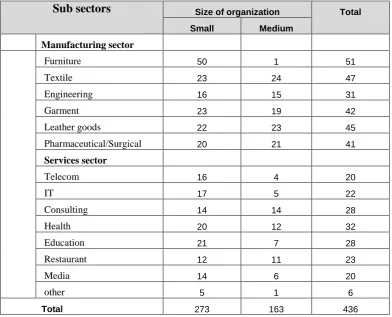
13 The sample frame was based on Karachi chamber of commerce and Industry (KCCI) and The Jamal’s Yellow Pages of Pakistan (2010 databases). For this study, the sample was selected from manufacturing and service sector SMEs located in Karachi. These two sectors were selected because the objective of the study was to study HPMP and these sectors were expected to have a minimum of 20 employees and also have management structure. Table 1 shows the total number of responses from manufacturing and service sector SMEs. The manufacturing sector includes leather goods, garments, textile, engineering, pharmaceutical/surgical and furniture. Moreover, the service sector includes telecom, information technology, consulting, health, education, media, and restaurants. Table2 is designed to show the responses from manufacturing and service sector industries.
Table1 : Responses of the sample based on size of organization and industry type
Type of industry
Size of organization Total
Small Medium
Manufacturing 158 104 262
Services 115 59 174
Total 273 163 436
14 by the owners/human resource managers for each firm. In the end, we collected 453 questionnaires. However, 17 of them were unusable, thus leaving us with 436 usable questionnaires.
Table 2 Responses of the sample based on size of organization and subsectors of strata
Sub sectors Size of organization Total
Small Medium Manufacturing sector
Furniture 50 1 51
Textile 23 24 47
Engineering 16 15 31
Garment 23 19 42
Leather goods 22 23 45
Pharmaceutical/Surgical 20 21 41
Services sector
Telecom 16 4 20
IT 17 5 22
Consulting 14 14 28
Health 20 12 32
Education 21 7 28
Restaurant 12 11 23
Media 14 6 20
other 5 1 6
Total 273 163 436
Measurement Instrument
15 The survey questionnaire comprised of three main sections: demographic variables/section A, HPMP/section B, firm performance variables/section C. This paper is based on the results of first two parts. Section A addresses the demographic characteristics of respondent (owner/managers) and SMEs. This section comprised of 27 questions. Moreover, this section focuses on: size of organization; ownerships; location; industry type; Industry sub sectors; establishment of organization; internalization; HR department and HR manager; internet access; website; Human resource information system; experience of respondent; education level of respondent; age of respondent and gender of respondent. This section employs a categorical scale.
Section B asks respondents to indicate the prevalence of HPMP in their organizations. This section is comprised of six parts i.e. C1, C2, C3, C4, C5, and C6. C1 measures 25 recruitment processes and methods used by the respondent SMEs; C2 measures 19 selection processes and practices; C3 measures 21 compensation practices; C4 measures 24 training and development practices; C5 measures 18 performance appraisal practices; C6 measures 15 consultation practices; C7 measures 9 communication practices and C8 measures 26 organizational change practices . The first five parts (C1, C2, C3, C4 and C5) employ a 3-point continuous scale of ‘never’, ‘for some jobs’ or ‘for all jobs’. While C6 employs a four point continuous scale of ‘involves widespread involvement of employees in decisions’; ‘involves consultation with employees with their possible limited involvement in goal setting’; ‘managerial authority and direction is the main form of decision-making; managers initiate and implement change’.
Demographic profile of Pakistani SMEs and respondents
16 manufacturing and service sectors. Manufacturing sector constituted 60.1 percent and service sector firms 39.9 percent. Each sub sector representing the industries accounted for less than 10 percent except for three subsectors such as leather goods, textile, and furniture. Twenty three percent of the sample firms exported their products or services of which 56 percent were exporting for more than five years. Only 6.9 percent of firms were franchise operations.
Most of the sample SMEs (78.4%) operated from single location, 17.2 percent operated in 5-10 locations and the remaining firms in more than 10 locations. Forty three percent of the sample firms were more than 10 years old, 30 percent were 5-10 years, 14 percent were 3-5 years, and the remainders were less than 5 years old. Almost 50% of SMEs had HR department. However, thirty four percent of firms did not have any specialist manager for HR. Formal strategic plan were used by 42% of the sample SMEs. Sixty six percent had the internet facility, and 44% of SMEs had human resource information system.
The respondents’ demographic characteristics were measured in terms of education age, gender and ownership. Only 23 % had postgraduate qualification. 53.9 percent were 31-45 years old, while 28.7 percent were under 30 years of age. One third of respondents (33.5%) were owners or part time owners of their firms, and only six percent were female.
Result
Data were analysed by using statistical software SPSS18. The statistical procedure t-test (using Compare Means) was used to compare the significant differences of adoption of HPMP between manufacturing and service sector SMEs. The result of the analysis is presented in Table3.
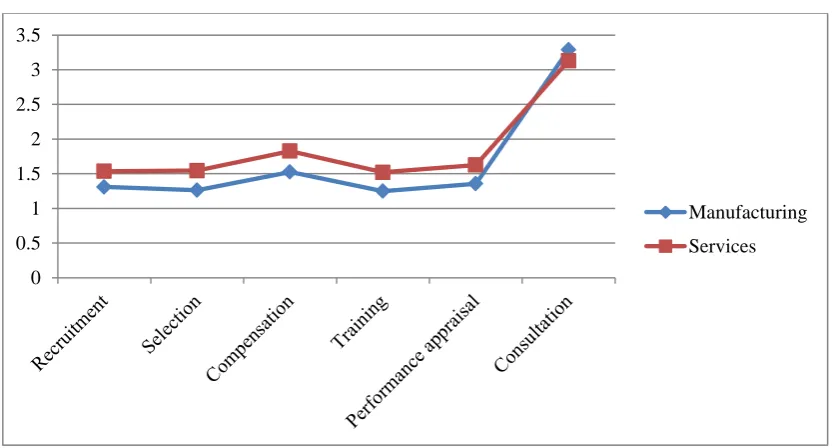
17 The second hypothesis, suggesting that services-based SMEs use more selection practices than manufacturing SMEs was supported by the data. The differences in the mean scores (Services 1.5; Manufacturing 1.2) between manufacturing and service-based SMEs were statistically significant.
The third hypothesis, stating that services-based SMEs apply more compensation practices in comparison to manufacturing SMEs was supported by the data. The differences in the mean scores (Services 1.8; Manufacturing 1.5) between manufacturing and service-based SMEs were statistically significant.
The fourth hypothesis, suggesting that services-based SMEs provide more training to their employees than manufacturing SMEs was supported by the data. The differences in the mean scores (Services 1.5; Manufacturing 1.2) between manufacturing and service-based SMEs were statistically significant.
The fifth hypothesis, stating that services-based SMEs use more performance appraisal practices in comparison to manufacturing SMEs was supported by the data. The differences in the mean scores (Services 1.6; Manufacturing 1.3) between manufacturing and service-based SMEs were statistically significant.
The sixth hypothesis, suggesting that services-based SMEs use more consultation practices than manufacturing SMEs was not supported by the data. The differences in the mean scores (Services 3.1; Manufacturing 3.2) between manufacturing and service-based SMEs were statistically significant. However, the mean score of service-based SMEs was lower than the manufacturing SMEs.
18 Table 3: Mean scores, standard devotions, and t-test results of HPMP in manufacturing and
service-based SMEs
HPMP Manufacturing Services
Mean S.D Mean S.D t p
1 Recruitment 1.3096 0.12054 1.5364 0.16880 16.357 0.000*
2 Selection 1.2636 0.15417 1.5453 0.19667 16.715 0.000*
3 Compensation 1.5261 0.18050 1.8267 0.16723 17.530 0.000*
4 Training 1.2496 0.14913 1.5206 0.35605 8.629 0.000*
5 Performance appraisal 1.3563 0.13654 1.6268 0.29576 12.884 0.000*
6 Consultation 3.2903 0.51008 3.1314 0.55188 3.084 0.002*
*
p < 0.05
Figure 1: Mean score results of HPMP in manufacturing and service-based SMEs
Source: Developed for this research
Discussion
The basic objective of this paper was to explore the significant differences between manufacturing and service-based SMEs regarding the adoption of HPMP. All hypotheses were supported by the data except the sixth hypothesis, stating that service-based SMEs use more formal consultation practices than manufacturing SMEs. The use of more consultation
0 0.5 1 1.5 2 2.5 3 3.5
[image:18.595.71.488.331.555.2]19 practices by the manufacturing SMEs is due to the fact that these SMEs are engaged in exporting their products, and are more concerned for changes in product design and quality.
The support of hypotheses 1 and 2 regarding the use of more formal recruitment and selection practices by service-based SMEs is consistent with the study of Bartman and Lindley (1995). One could argue that service-based SMEs expect more diversified skills and experience from potential applicants in comparison to manufacturing SMEs. The support of hypotheses 3, 4 and 5 regrading the adoption of more formal compensation training and performance appraisal practices by the service-based SMEs is consistent with the previous research studies (e.g. Jackson & Schuler, 1992; Othman, 1999). According to such studies, service-based SMEs use more formal performance appraisal methods to enhance training and compensation practices in comparison to manufacturing SMEs. However, the results of this study contradicts with Deshpande & Golhar (1994). They argue that HRM practices in small firms are similar across manufacturing and service-based industries.
Conclusion
Based on the above results, there is a significant difference between manufacturing and service-based SMEs regarding the adoption of HPMP. Service-based SMEs have adopted more formal recruitment, selection, compensation, training, and performance appraisal practices in comparison to manufacturing SMEs. However, consultation practices were found to be associated more with manufacturing SMEs than service-based SMEs.
20 retaining their employees as high turnover can be more costly to organizations (Othman, 1999). Similarly, the use of more formal training and performance appraisal practices by service-based SMEs shows that they tend to invest in building the competence and skills of their employees. Furthermore, the use of more formal performance appraisal practices by service-based SMEs indicate that results of performance appraisal may be used for training need assessment and performance-based payment (Jackson & Schuler, 1992).
The study has some limitations. This study has focused on the comparative analysis of SMEs i.e. manufacturing and service. Future research should make comparison among other sectors. This study has based on the cross sectional data. Future studies should rely on longitudinal data. This study has not examined the relationship between HPMP and firm performance. Future research should investigate the relationship between HPMP and sustainability outcomes in Pakistani SMEs.
References
Akhtar, S., g, D. Z. D. i. n., & GE, G. L. (2008). Strategic HRM practices and their impact on company performance in Chinese enterprises. Human Resource Management, 47(1), 15-32.
Bacon, N., Ackers, P., Storey, J., & Coates, D. (1996). It's a a small wporld: managing human resources in small businesses. The International Journal of Human Resource Management, 7(01), 82-100.
Bacon, N., & Hoque, K. (2005). HRM in the SME sector: valuable employees and coercive networks. International Journal of Human Resource Management, 16(11), 1976-1999. Bae, K.-S., Chuma, H., Kato, T., Kim, D.-B., & Ohashi, I. (2011). High Performance Work Practices and Employee Voice: A Comparison of Japanese and Korean Workers.
Industrial Relations: A Journal of Economy and Society, 50(1), 1-29.
Barrett, R., & Mayson, S. (2007). Human resource management in growing small firms.
Journal of Small Business and Enterprise Development, 14(2), 307-320.
Bartman, D., Lindley, P. A., Marshall, L., & Foster, J. (1995). The recruitment and selection of young people by small businesses. [Article]. Journal of Occupational & Organizational Psychology, 68(4), 339-358.
Bartram, T. (2005). Small firms, big ideas: The adoption of human resource management in Australian small firms. Asia Pacific Journal of Human Resources, 43(1), 137-154. Beltrán-Martín, I., Roca-Puig, V., Escrig-Tena, A., & Bou-Llusar, J. C. (2008). Human
21 Bryson, A., Forth, J., & Kirby, S. (2005). High-involvement management practices, trade union representation and workplace performance in Britain. Scottish Journal of Political Economy, 52(3), 451-491.
Cassell, C., Nadin, S., Gray, M., & Clegg, C. (2002). Exploring human resource management practices in small and medium sized enterprises. Personnel Review, 31(6), 671-692. CDGK. (2011). City district government Karachi: Economy and development. Retrieved
April 28, 2011, 2011, from
http://221.132.118.186/cdgk/Home/AboutKarachi/Economy/tabid/271/Default.aspx
Chow, I. H.-S. (2005). High-performance work systems in Asian companies. Thunderbird International Business Review, 47(5), 575-599.
Compton, R., Morrissey, E., & Nankervis, A. (Eds.). (2009). Effective recruitment and selection Practices (5th ed.). Australia: CCH Australia Limited.
Connolly, P., & McGing, G. (2007). High performance work practicesand competitive advantage in theIrish hospitality sector. International Journal of Contemporary Hospitality Management, 19(3), 201-210.
Dasanayaka, S. W. S. B. (2008). SMEs in globalized world: A brief note on basic profiles of Pakistan's small and medium scale enterprises and possible research directions.
Business Review, 3(1), 69-76.
Datta, D. K., Guthrie, J. P., & Wright, P. M. (2005). Human resource management and labor productivity: Does industry matter? Academy of Management Journal, 48(1), 135-145. de Kok, J., Uhlaner, L. M., & Thurik, A. R. (2003). Human resource management with small and medium sized enterprises firms: Facts and explanations. Rotterdam: Eramus university.
deKok, J., & Hartog, D. d. (2006). High Performance Work Systems, Performance and Innovativeness in Small Firms (Scales Research Reports): EIM Business and Policy Research.
Delery, J. E., & Doty, H. (1996). Modes of theorizing in strategic human resource management: Tests of uiversalistic, contingency, and configurational performance predictions. The Academy of Management Journal, 39(4), 802-835.
Deshpande, S. P., & Golhar, D. Y. (1994). HRM practices in large and small manufacturing firms: A comparative study. Journal of small Business Management, 49-56.
Drummond, I., & Stone, I. (2007). Exploring the potential of high performance work systems in SMEs. Employee Relations, 29(2), 192-207.
Duberley, J. P., & Walley, P. (1995). Assessing the adoption of small and medium-sized manufacturing organizations. The International Journal of Human Resource Management, 6(4), 891-909.
Evans, W. R., & Davis, W. D. (2005). High-performance work systems and organizational performance: The mediating role fo internal social structure. Journal of Management, 31(5), 758-775.
Federal Bureau of Statistics, G. o. P. (2010, 5 March 2010). Economic Census of Pakistan
2005. Retrieved 9 March, 2010, from
http://www.statpak.gov.pk/depts/fbs/publications/nec2005/nec2005.html
Glidden, P. A., & Whelan, K. S. (1996). Performance Appraisals: How to Achieve Top
Results Available from
<http://common.books24x7.com.ezproxy.usq.edu.au/book/id_1872/book.asp>
Gollan, P. J. (2005). High involvement management and human resource sustainability: The challenges and opportunities. Asia Pacific Journal of Human Resources, 43(1), 18-33. Guest, D. E., Michie, J., Conway, N., & Sheehan, M. (2003). Human Resource Management
22 Hartog, D. N. D., & Verburg, R. M. (2004). High performance work systems, organisational culture and firm effectiveness. [Article]. Human Resource Management Journal, 14(1), 55-78.
Heneman, R. L., & Tansky, J. W. (2002). Human resource management models for entrepreneurial opportunity: Existing knowledge and new directions (Vol. 5). Amsterdam: JAI Press Inc.
Huang, T.-c. (2000). Are the human resource practices of effective firms distinctly different from those of poorly performing ones? Evidence from Taiwanese enterprises.
International Journal of Human Resource Management, 11(2), 436-451.
Huselid, M. A. (1995). The impact of HRM on turnover, productivity, and corporate financial performance. Academy of Management Journal, 38(3), 635-672.
Ichniowski, C., Shaw, K., & Prennushi, G. (1993). The effects af human resource management practices on productivity.
: Working paper, Columhia University.
Jackson, S. E., & Schuler, R. S. (1992). HRM practices in service-based organizations:A role theory perspective. Advances in Services Marketing and Management, 1, 123-157. Jackson, S. E., & Schuler, R. S. (1995). Understanding human resource management in the
context of organizations and their environments. [Article]. Annual Review of Psychology, 46(1), 237.
Jiang, X. (2009). The relationship between manufacturing and service provision in operations management. International Journal of Business and Management, 4(3), 183-189. Kaman, V., McCarthy, A. M., Gulbro, R. D., & Tucker, M. L. (2001). Bureaucratic and High
Commitment Human Resource Practices in Small Service Firms. [Article]. Human Resource Planning, 24(1), 33-44.
KCCI. (2010). Karachi chamber of commerce and industry: Introduction. Retrieved April 25, 2011, 2011, from http://www.kcci.com.pk/AboutKCCI/Introduction.aspx
Khilji, S. E. (2001). Human Resource Management in Pakistan’, . In P. S. Budhwar & Y. A.Debrah (Eds.), Human Resource Management in Developing Countries. London: Routledge.
Khilji, S. E. (2004). Whither tradition?: Evidence of generational differences in HR satisfaction from Pakistan. International Journal of Cross Cultural Management, 4(2), 141-156.
Kirkman, B. L., Lowe, K. B., & Young, D. P. (1999). What is high performance work organization? Leadership in Action, 19(2), 13-15.
Kotey, B., & Slade, P. (2005). Formal Human Resource Management Practices in Small Growing Firms. Journal of small Business Management, 43(1), 16-40.
Lange, T., Ottens, M. l., & Taylor, A. (2000). SMEs and barriers to skills development: A Scottish perspective. Journal of European Industrial Training, 24(1), 5.
Lawler, E. E., Mohrman, S. A., & Gerald E. Ledford, J. (1995). Creating High Performance Organizations: Survey of Practices and Results of Employee Involvement and TQM in Fortune 1000 Companies. Wiley, John & Sons Incorporated.
Lawler, E. E., Mohrman, S. A., & Ledford, G. E. (1995). Creating High Performance Organizations: Survey of Practices and Results of Employee Involvement and TQM in Fortune 1000 Companies Wiley, John & Sons Incorporated.
Lee, F.-H., Lee, T.-Z., & Wu, W.-Y. (2010). The relationship between human resource management practices, business strategy and firm performance: evidence from steel industry in Taiwan. The International Journal of Human Resource Management, 21(9), 1351 - 1372.
23 Marchal, B., & Kegels, G. (2008). Focusing on softwarre of managing health workers: what we learn from high commitment management practices? International Journal of Health Planning and Management, 23, 299-311.
Marlow, S. (2000). Investigating the use of emergent strategic human resource management activity in the small firm. Journal of Small Business and Enterprise Development, 7(2), 135-148.
Marlow, S., & Patton, D. (1993). Managing the Employment Relationship in the Smaller Firm: Possibilities for Human Resource Management. International Small Business Journal, 11(4), 57-64.
Mustafa, I., & Khan, F. M. (2005). Small and Medium Enterprises in Pakistan. South Asian Journal, 9(3).
Nolan, C. (2002). Human resource developmentin the Irish hotel industry: the case of small firm. Journal of European Industrial Training, 3(4), 88-99.
Othman, R. (1999). Human Resource Management Practice of Service Organizations: Evidence from Selected Malaysian Firms. Journal of Asia-Pacific Business, 2(3), 65 - 80.
Pansiri, J., & Temtime, Z. T. (2008). Assessing managerial skills in SMEs for capacity building. Journal of Management Development, 27(2), 251-260.
Pfeffer, J. (1994). Competitive advantage through people: Unleashing the power of the work force. Harward Business School Press.
Pfeffer, J. (1998). Seven practices of successful organizations. California Management Review, 40(2), 96-123.
Pfeffer, J., & Veiga, J. F. (1999). Putting people first for organizational success. Academy of Management Executive, 13(2), 37-48.
Rana, A., Khan, J., & Asad, U. (2007). The SME pulse: An exploratory study of the performance of SMEs in Pakistan and the characteristics of successful firms. Small and Medium Enterprise Center, Lahore University of Management Sciences.
.
Rowden, R. W. (2002). High performance and human resource charcteristics of successful small manufacturing and processing companies. Leadership & Organizational Development Journal, 23(2), 79-83.
Sagie, A., & Koslowsky, M. (2000). Employee participation-What does it mean? In J. Barling & K. Kelloway (Eds.), Participation and empowerment in organizations: Modeling, effectiveness, and appplications. California: Sage Publications, Inc.
Singh, K. (2004). Impact of HR practices on perceived firm performance in India. Asia Pacific Journal of Human Resources, 42(3), 301-317.
Subramony, M. (2006). Why organizations adopt some human resource management practices and reject others: An exploration of rationales. Human Resource Management, 45(2), 195-210.
Temtime, Z. T., & Pansiri, J. (2004). Small business critical success/failure factors in developing economies. American Journal of Applied Sciences, 1(1), 18-25.
Tsai, C.-J. (2006). High perormance work systems and organizational performance: an empirical study of Taiwan's semiconductor design firms. The International Journal of Human Resource Management, 17(9), 1512-1530.
Wagner Iii, J. A., & Gooding, R. Z. (1987). Shared influence and organizational behaviour: A meta-analysis of situational variables expected to moderate participation-outcome relationships. [Article]. Academy of Management Journal, 30(3), 524-541.
24 Whitener, E. M. (2001). Do "high commitment" human resource practices affect employee commitment? A cross-level analysis using hierarchical linear modeling. Journal of Management, 27(5), 515-535.
Wiesner, R., & McDonald, J. (2001). Bleak house or bright prospect? Human resource management in Australian SMEs. Asia Pacific Journal of Human Resources, 39(02), 31-53.
Wiesner, R., McDonald, J., & Banham, H. C. (2007). Australian small and medium sized enterprises (SMEs): A study of high performance management practices. Journal of Management and Organization, 13(3), 227-248.
Wilkinson, A. (1999). Employment relations in SMEs. Employee Relations, 21(3), 206-217. Wood, S., & Menezes, L. d. (1998). High commitment management in the U.K: Evidence
form the workplace industrial relations survey, and emplyer's manpower and skills practices survey. Human Relations, 51(4), 485-515.
Yasmin, R. (2008). A study on the effects of strategic HRM systems on performance: The case of Pakistani manufacturing companies. Japanese Journal of Administrative Sciences, 21(1), 47-60.
Yavas, U., & Yasin, M. (1994). Manufacturing versus Service Organizations: An Investigation of Informational and Operational Interactions in the International Domain. Industrial Management & Data Systems, 94(4), 24-29.