International Journal of Innovative Technology and Exploring Engineering (IJITEE) ISSN: 2278-3075, Volume-8 Issue-12, October 2019
Abstract: The concept of industrialization of the construction technology has emerged as well accepted and preferred option in the field of building construction now days in order to reduce in – situ construction up to maximum extent. Ferrocement is the one of the relatively new cementitious composite considered as a construction material. The main aim of this study is to investigate the behavior of Ferrocement panel under low velocity impact. Size of panel is 250 x 250 mm and thickness is varying from 20mm to 40mm. Corrugated fibers were added in panels. Volume of corrugated fibers was considered as 1.5% of total volume of panel. Weld mesh and woven mesh were used in ferrocement panels. Numbers of layers of mesh were 2 and 3. Height of drop is 1m. M30 and M40 Grade of mortar were used. Equivalent stress, Normal stress and Deformation were the main parameters for this research work. From the results it can be concluded that weld mesh with corrugated fibers is good at the impact resistance.
Keywords: Ferrocement, Weld mesh, Woven Mesh, Corrugated fibers, Low velocity impact
I. INTRODUCTION
U
sually the concrete buildings are intended for static load. Sometimes, however, these structures may be subjected to dynamic blasts, impulsive loads, external projectiles, militant or terrorist behavior, and accidental multi-chemical explosions, machine vibrations and earthquakes. The structure can shake, vibrate, serious concrete cracking during explosions and fragment effect and crater shapes on the front of the concrete and for large load, and huge penetration can occur and can result in rear facet wall scabbing or perforation with the risk of injury to individuals within the frame. Cement panels can be found under effect loading to be most helpful. Ferrocement was described as tightly strengthened mortar shaped into a thin shell that acts as a composite material whose features rely on the mixture of steel and thick, high-resistance mortar. Ferrocement components are usually very ductile when placed next to the standard reinforced concrete component, because the reinforcement is spread evenly across the whole component Ferrocement is a thin composite made of a cement-based full-mortar mix, reinforced with small diameter wire-mesh layers that are thoroughly spaced. Many researchers have also found that theRevised Manuscript Received on October 05, 2019. * Correspondence Author
Yash N. Patel, is currently pursuing Master’s degree program in structural engineering in MIT World Peace University, Pune-India, Email: [email protected]
Prof. Darshan G. Gaidhankar, is currently associate professor in school of civil engineering, MIT World Peace University, Pune-India, Email: [email protected]
Prof.Dr.Mrudula S. Kulkarni,is currently professor in school of civil engineering, MIT World Peace University, Pune-India.
ductility and shear capacity in the matrix has considerably enhanced by incorporating discontinuous brief synthetic fibers into the cement matrix, which in turn also shows an increase in tensile strength.
II. LITERATUREREVIEW
Abdulkader Ismail A. Al-Hadithi, Khalil Ibrahim Aziz et. al. (2015) In this paper, Authors carried out the behaviour of Ferro-cement panels under high and low velocity impact. Total 36 panels has been tested under low velocity impact test and 12 panels has been tested under high velocity impact test. Dimensions of panels were 500 x 500 x 50mm. Low velocity impact test has been done by using 1300gm hammer dropped from various heights of 2.4 m, 1.2 m and 0.83 m. High velocity impact test has been done by using 7.62 mm diameter bullet fired from distance of 15 m with velocity of 720 m/s. The main parameters evaluated in this works were content of SBR and height of falling mass. From this work researchers can be concluded that adding SBR in Ferro-cement panels shows good results in preventions of the appearance of cracks. T.Subramani, R.Siva (2016) the researchers investigated the behaviour of Ferro-cement with addition of plastic fibre. The volume of plastic fibre varied between 5% to 15%. Total 8 panels with size of 600 mm x 600 mm x 25mm and 600 mm x 600 mm x 25 mm has been tested. Low velocity impact test has been done by using 1400 gm. steel ball dropping from height 2.4 m, 1.2m and 0.32 m. Four point flexural test has been done by using UTM machine. From the research it can be concluded that addition of plastic fibre increases the strength and energy absorption capacity of panels.
Anitha M et.al, the authors carried out an experimental work to review the behaviour of hybrid ferrocement block subjected to impact. The square ferrocement panels casted was of cross-section (500*500) mm. The thickness of the squared ferrocement panels is 25 mm and 35 mm. The ferrocement panels were tested for impact by using drop impact test. All the bottom four sides of the panel was fixed and repeated drop load test was carried out. The authors concluded that due to presence of number of layers of wire mesh, the panel requires more no. of blows for first crack as well as failure also the ductility of the ferrocement panel is increased with increase in no. of layers of wire mesh. K.Mounika, A.Suchith Reddy, G.Latha (2015) the main objective of this study was to find out the flexural behaviour and impact resistance of ferrocement panel with different layer of welded mesh with varying percentage of steel fibres. Numbers of layers of mesh were 1 & 2. Percentage of steel fibres were varying between 0.5% to 2%. Ferrocement panels with dimensions of 500 x 500 x 25 mm were tested under low velocity impact. Low velocity
impact test was done by using 3.84 kg steel ball and it was
Effect of Mortar Strength On The Behaviour of
Ferrocement Panel Under Low Velocity Impact
released from height of 1 m repeatedly. Ferrocement panels with size of 700 x 300 x 25 mm were tested under flexural test using UTM machine. Two point loading was given to panels under UTM machine. From this study it was concluded that increases in steel fibres content and layer of mesh increases impact resistance and flexural strength of panels.
P.B. Sakthivel, A. Ravichandran,N. Alagumurthi (2014)The main aim of researchers was to find out the effect of adding polyolefin fibres in steel mesh reinforced cementitious composites. Number of wire mesh layer was varying between 3 to 5 and polyolefin fibres content was varying between 0.5%to 2.5% of volume of specimen. Dimensions of specimen was 250 x 250 x 25 mm. Low velocity impact test was done by using 3kg steel ball. Steel ball was dropped at height of 600 mm repeatedly. From this study it can be concluded that adding of fibres in composites shows good energy absorption capacity of panel.
III. OBJECTIVES
Effect of panel thickness on the deformation, equivalent stress and normal stress.
Effect of different type of wire mesh on the deformation, equivalent stress and normal stress.
Effect of different type of grade of mortar on the deformation, equivalent stress and normal stress
Effect of height of drop on the deformation, equivalent stress and normal stress.
IV. ANALYTICALWORK
ANSYS 16.0 used for analytical study. An explicit dynamics analysis is used to determine the dynamic response of a structure due to stress wave propagation, impact or rapidly changing time-dependent loads.
4.1 Modelling for Impact load test 1. Mortar with wire mesh
In this study analytical work is done totally in ANSYS Explicit Dynamics. In which Ferro cement panel was modelled. The size of Ferro cement panel is 250 x 250mm. The thickness of the panel is taken as 20mm, 30mm and 40mm. The diameter of the wire is taken as 1.2mm.
2. Drop Weight
The weight of the drop is 3.5kg. Total Height of the weight hammer is 365mm, out of which 340mm is cylindrical in shape and rest of it is conical in shape. The conical part is located at the bottom side of the drop. Diameter at the bottom side of the conical is 10mm and diameter at the top side of the conical is 40mm. Diameter of the cylindrical shape is 40mm throughout and total length of it is 340mm.
Fig 1 Dimension of Drop Weight 3.Properties of Mesh
Two types of meshes are used in the Ferro cement panel in this study, Welded square mesh and Woven Square mesh. Yield strength of both the meshes is 450MPa. Young’s modulus of welded square mesh is 200GPa and due to more elasticity in woven square mesh its elastic modulus or young’s modulus is less than that of welded square mesh, it is 138GPa.
3.Fibres
Corrugated steel fibres of length 67mm and diameter 1.0mm were used for modelling. Tensile strength of fibres was 500MPa.
4.Body Interaction
A body interaction is defined while modelling, which is used to define that the wire mesh which is placed inside the Ferro cement panel is reinforcement of it. Reinforcement body interaction should be supported in the case when only line bodies are scoped to a body interaction of type reinforcement. The line bodies will then be tied to any solid body that they intersect. This body interaction type is used to apply discrete reinforcement to solid bodies. All line bodies scoped to the object will be flagged as potential discrete reinforcing bodies in the solver. On initialization of the solver, all elements of the line bodies scoped to the object which are contained within any solid body in the model will be converted to discrete reinforcement. Elements which lie outside all volume bodies will remain as standard line body elements. A body interaction is defined while modeling, which is used to define that the wire mesh which is placed inside the Ferro cement panel is reinforcement of it.
5.Meshing
[image:2.595.321.529.346.423.2]Meshing is the process in which your geometry is spatially discretized into elements and nodes.
Fig 2 Meshing of Model 6.Fixed Support
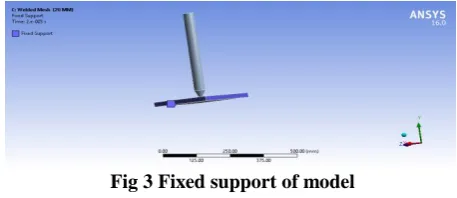
[image:2.595.310.539.493.592.2]All the four bottom edges of the Ferro-cement panel is assigned with fixed support such as to restrained it from displacing after the impact of bullet or when the drop weight is dropped. Following is the figure of the fixed support condition.
Fig 3 Fixed support of model
V. RESULTANDDISCUSSION
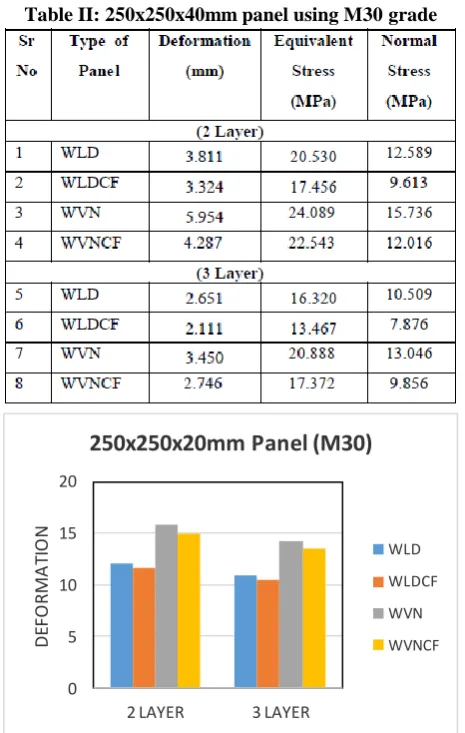
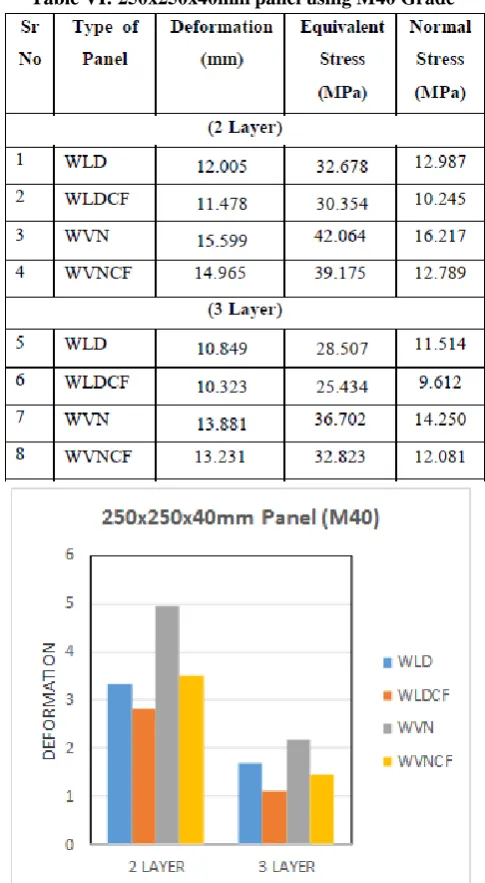
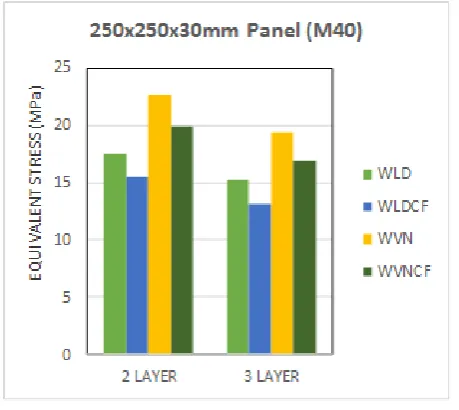
The Analytical work has been carried out for ferrocement panels with and without corrugated fibers. The panel size of 250x250mm with thickness of 20mm, 30mm and 40mm. For cement mortar M30 and M40 grade was used.
International Journal of Innovative Technology and Exploring Engineering (IJITEE) ISSN: 2278-3075, Volume-8 Issue-12, October 2019
Table I: 250x250x20mm panel using M30 Grade Sr
No
Type of Panel
Deformation Equivalent Stress (MPa)
Normal Stress (MPa) (mm)
(2 Layer)
1 WLD 12.091 35.343 14.732 2 WLDCF 11.575 32.325 11.707 3 WVN 15.807 45.935 19.16 4 WVNCF 14.925 41.699 15.089
(3 Layer)
5 WLD 10.94 33.125 13.238 6 WLDCF 10.425 30.013 10.156 7 WVN 14.222 42.512 16.43 8 WVNCF 13.437 38.723 12.695
[image:3.595.51.286.60.360.2]Fig 5. Deformation of 30mm thick panel for M30 grade Table II: 250x250x40mm panel using M30 grade
0 5 10 15 20
2 LAYER 3 LAYER
D
EF
O
R
M
A
TI
O
N
250x250x20mm Panel (M30)
WLD WLDCF WVN WVNCF
Fig. 4. Deformation of 20mm thick panel for M30 grade
Table III: 250x250x30mm panel using M30 grade Sr
No
Type of Panel
Deformation (mm)
Equivalent Stress (MPa)
Normal Stress (MPa)
(2 Layer)
1 WLD 12.091 35.343 14.732 2 WLDCF 11.575 32.325 11.707 3 WVN 15.807 45.935 19.160 4 WVNCF 14.925 41.699 15.089
[image:3.595.307.548.334.691.2]Fig. 6. Deformation of 40mm thick panel for M30 grade
Table IV: 250x250x20mm panel using M40 Grade Sr No Type of
Panel
Deformation Equivalent Stress (MPa)
Normal Stress (MPa) (mm)
(2 Layer)
1 WLD 12.005 32.678 12.987 2 WLDCF 11.478 30.354 10.245 3 WVN 15.599 42.064 16.217 4 WVNCF 14.965 39.175 12.789
(3 Layer)
5 WLD 10.849 28.507 11.514 6 WLDCF 10.323 25.434 9.612 7 WVN 13.881 36.702 14.25 8 WVNCF 13.231 32.823 12.081
0 2 4 6 8 10 12 14 16 18
2 LAYER 3 LAYER
DE
FO
R
M
A
TI
O
N
250x250x20mm Panel (M40)
WLD WLDCF WVN WVNCF
[image:3.595.53.286.384.751.2]Fig.8.Equivalent Stress of 20mm thick panel for M40 grade
Table V: 250x250x30mm panel using M40 Grade Sr
No
Type of Panel
Deformation Equivalent Stress (MPa)
Normal Stress (MPa) (mm)
(2 Layer)
1
WLD 4.02 25.346 11.942 2
WLDCF 3.421 23.323 9.745 3
WVN 5.219 33.205 14.672 4
WVNCF 4.713 30.089 12.189
(3 Layer)
5
WLD 2.855 23.226 9.45 6
WLDCF 2.331 21.169 7.328 7
WVN 3.654 29.7 12.46 8
WVNCF 3.112 27.345 9.385
0 1 2 3 4 5 6
2 LAYER 3 LAYER
DE
F
O
RM
A
T
IO
N
250x250x30mm Panel (M40)
WLD
WLDCF
WVN
WVNCF
Fig. 9. Deformation of 30mm thick panel for M40 grade
Fig. 10.Equivalent Stress of 30mm thick panel for M40 grade
Table VI: 250x250x40mm panel using M40 Grade
[image:4.595.305.548.255.697.2]International Journal of Innovative Technology and Exploring Engineering (IJITEE) ISSN: 2278-3075, Volume-8 Issue-12, October 2019
Fig. 12 Equivalent Stress of 30mm thick panel for M40 grade
VI. CONCLUSION
For M30 Grade of mortar, deformation of 30mm thick panel is higher by 34%, as compared with 40mm thick panel using 2 layers of weld mesh.
For M40 Grade of mortar, equivalent stress of 30mm thick panel is lower by 28% than 20mm thick panel using 2 layer of weld mesh.
The equivalent stress of 30mm thick panel is 54% more than 40mm thick panels using 2 layers of woven mesh for M30 grade of mortar.
The reduction is observed in the equivalent stress is 10-17% in M30 grade as compared with M40 grade of mortar for 40mm thick panel with 2 layer weld mesh.
According to analytical results, for M30 as compared with M40 grade, it shows that Average Normal stress decreased by 14% and 16% for weld and woven mesh respectively. When 30mm thick panel is compared with 40mm thick
panel, it shows that Average deformation decreased by 49% and 48% for weld and woven mesh using 3 layer respectively.
For both M30 and M40 grade of mortar, deformation and equivalent stress for weld mesh is around 29% less than woven mesh.
For both M30 and M40 grade of mortar, normal stress for weld mesh is around 24% less than woven mesh.
ACKNOWLEDGMENT
I sincerely thank Prof. Mr. D. G. Gaidhankar who guided me throughout the research work and suggested the correct means to carry out the work in every aspect for his consistent guidance and inspiration throughout the seminar work, which I am sure, will go a long way in my life.
REFERENCES
1. Abdulkader Ismail A. Al-Hadithi, Khalil Ibrahim Aziz, Mohammed TarradNawar Al-Dulaimi,”Behaviour of Ferro-cement slabs containing SBR under impact loads”, International Journal of Sustainable and Green Energy 2015; pp 34-50.
2. T.Subramani, R.Siva. “Experimental Study On Flexural And Impact Behavior Of Ferro-cement Slabs”, sInternational Journal of Application or Innovation in Engineering & Management (IJAIEM) , Volume 5, Issue 5, May 2016.
3. Anitha, M.tenmozhi, R. and Deepa Shri, S., “Behaviour of hybrid ferrocement slabs subjected to impact”, International Journal of Emerging trends in Engineeringand Development,2(4), May 2012. 4. K.Mounika, A.Suchith Reddy, G.Latha, “Experimental Investigation
On Performance of Fibrous Ferrocement”, International Journal of Innovative Research in Science, Engineering and Technology, Vol. 4, Issue 8, August 2015.
5. P.B. Sakthivel , A. Ravichandran and N. Alagumurthi, “An Experimental Study on Mesh and Fibre Reinforced Cementitious Composites”, Concrete Research Letters, Vo. 5(1), March 2014. 6. SmithaGopinath∗, R Ayashwarya, V Ramesh
Kumar,PrabhatRanjanPrem, A Rama Chandra Murthy,C K Madheswaran and R NageshIyer, “ Low Velocity Impact Behaviour of Ultra High Strength Concrete Panels”, Indian Acadamyn of Science, Vol. 39, Part 6, December 2014, pp 1497 – 1507.
7. ZakariaCheMuda, AgusrilSyamsir, Kamal Nasharuddin Mustapha, SorefanSulleman, SalmiaBeddu , SivadassThiruchelvam, Firas B. Ismail5, Fathoni Usman1, NurLiyanaMohd Kamal, Md AshrafulAlam, Ahmed H Birima, ZarinaItam, O S Zaroog, “The Effect of Mortar Grade and Thickness on The Impact Resistance of Ferrocement Slab”, International Conference on Advances in Renewable Energy and Technologies, 2016.
8. Dr.Abdulkader Ismail Abdulwahab Al-Hadithi and Zayd Abdul-Jabbar Al-Obaidi, “Behavior of Ferrocement Slabs Containing Waste Plastic Fibers under Impact Loadings”,Dams & Water Resources Engineering Department, College of Engineering, University of Anbar. Ramadi, Anbar, Iraq.Amar Prakash, Srinivasan, S.M. and Rama Mohan Rao,A., “High Velocity Impact Behaviour of Layered Steel Fibre Reinforced Cementitious Composite(SFRCC)Panels” CMC, vol.42, no.1, 2014, pp.75-102.
AUTHORSPROFILE
Yash N. Patel Mr.Yash Patel was born in 1995 in small village Maktupur of Gujaratr. He got his bachelor of engineering of degree in Civil Engineering from L.C.Institute of Technology, Bhandu in 2017. He is pursuing his Master of Technology in Structural Engineering at MIT-World Peace University, Pune-Maharashtra.
Email: Id [email protected]
Prof. Darshan G. Gaidhankar He is associate professor at School of Civil Engineering at MIT-WPU. He has completed his master of technology in structural engineering and righ now he is pursuing his Ph.D. He has total 16 years of teaching experience and 1.5 years of Industrial experience.
Email:Id. [email protected]