International Journal of Innovative Technology and Exploring Engineering (IJITEE) ISSN: 2278-3075, Volume-8 Issue-12, October 2019
Abstract: Optical Character Recognition is a most recent field in area of pattern recognition and machine learning in last decade. In this article, the suitable techniques are designated for better character recognition in document into machine readable form. It is belonging with Content Based Image Retrieval (CBIR) system, which solve the delinquent of searching images in huge dataset. The recognition technique of handwritten character is not developed efficiently till, because of variations in size, shape, style, slats etc. in writing skill of human being. To overcome such problems, the part of concentration is feature extraction and algorithm that take care of such variation. In this paper independent component analysis is used for extracting features. For feature vector selection particle swarm optimization and firefly algorithms are applied. It is observed that due to distributed neighborhood pixel of an image, the PSO gives better recognition rates.
Keywords : Independent Component Analysis, Particle Swarm Optimization, Firefly Algorithm, Pattern Recognition.
I. INTRODUCTION
G
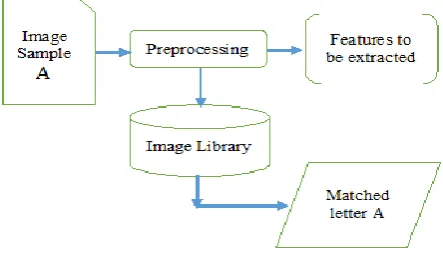
enerally, the recognition of characters and numbers is the easiest task for a human being as it compared with a machine or computer. So that, the improvement in digital computers and machine learning algorithms for the handwritten character recognition has been a very challenging exploration in image processing and pattern recognition. It is used in computer and text processing applications. The conversion of text image into editable word document occurs in offline handwriting recognition which is used in computer and text processing applications. Figure 1 shows generalized flow of Content Based Image Retrieval (CBIR) process. In general, it consists of various steps as mentioned in fig 1. It is also referred as Query by Image Content (QBIC). Most of the researchers have been worked on this process depend on pixel, but image retrieval process is still facing complications. There are lot of challenges in OCR system like poor handwriting, low quality of old documents, variation in shape and size, similar shaped characters have been overcome in the system. Optical character recognition isRevised Manuscript Received on October 05, 2019.
Shrinivas R. Zanwar, Electronics and Telecommunication Engineering department, CSMSS, Chh. Shahu College of Engineering, Aurangabad, India. Email id: [email protected].
Abhilasha S. Narote, Electronics and Telecommunication Engineering department, S.K.N. College of Engineering, Pune, India. Email id: [email protected].
Sandipann P. Narote, Electronics and Telecommunication Engineering department, Government Residence Women’s Polytechnic, Tasgaon, Sangli, India. Email id: [email protected].
[image:1.595.309.531.413.543.2]an area which covers artificial intelligence, deep learning, machine learning, and pattern recognition and computer vision. By performing processing steps in OCR, it can be drawn some attributes as text intensity, structure of text, font, character type, art effects, location etc. Recently, lot of algorithms are developed for character extraction in image [1]. To reduce classification complexity, shape decomposition based segmentation technique is used, it decompose compound character in to prominent shape components [2]. Also, it can be possible by enhanced Maximally Stable Extremal Regions (MSERs) supported by various preprocessing steps [3]. The novelty of work is focused on harmonization of feature extraction techniques. It give scope to improve feature extraction methods. Here, error rate probabilities are minimized and true rate recognition is improved by swarm intelligence algorithm. The scanned document extract various feature vectors with separate component and analyzed accordingly.
Fig. 1. Generalized Flow
Here, the paper is organized in various section as first part presents an introduction to OCR. In section II, related work is explained in detail. Dataset preparation and preprocessing steps are described in section III. Also, this section explicated ICA, PSO and FF algorithms for backpropagation neural network as classifier. Results and discussion is analysed and compared in next section IV. Finally, conclusion and summary justified in the last unit V.
II. RELATED WORK
In present situation, many of the researchers have proposed techniques for efficient character recognition in different languages. Nisha Sharma et. al. [4] used dataset, prepared by 40 people. This dataset consists approximately 3517, 2340 and 1804 occurrences of uppercase typescripts,
Feature Extraction Techniques Based on Swarm
Intelligence in OCR
lowercase typescripts, and digits disparately. These images were captured with resolution 200 and 300 dpi. With the help of the latent variable approach, the noise will be removed, whose arrays appearance comparable to original characters or parts of characters. To overcome this problem Mehdi Haji et al. [5] proposed an unsupervised machine learning tactic which is not based on the noise patterns of any actual distribution which is formulated optimization problem containing latent variables. Santosh K.C., [6] explained the binarization technique, in which, isolated character images are binarized by taking average grayscale pixel intensity values. With this technique the reduction of noise is also performed. Jewoong Ryu et al. has anticipated a word segmentation process for handwritten characters. They obtained the braces wise correspondences between word separators and unary assets in the word segmentation, because of the formulation as a binary quadratic algorithm and estimated the factors with the structured learning method [7]. Soumendu Das [8] explains Japanese Hiragana character recognition based on geometry topology. This algorithm explicit center of gravity identification, conversion and revolution invariant. Hassan Althobaiti et. al. [9] identified general difficulties in recognition and developed system by using encoded Freeman chain code. Z Shi et al. [12] has designed the Smearing method. The fuzzy RLSA measures the calculation of standing at a pixel along the horizontal direction. Here, a new gray scale image is formed and
binarized then the lines of text are dig out from the new image. Bruzzone et al. [13] has introduced projection profiles algorithm, which is dependeng on the evaluation of horizontal run projections are split on a panel of the input image into vertical strips for skewed text. The rising and downhill letterings from been besmirched by arbitrary cuts are preserved in it. of closed loops and multiple strokes. Hassan Althobaiti et. al. [9] identified general difficulties in recognition and developed system by using encoded Freeman chain code. Z Shi et al. [12] has designed the Smearing method. The fuzzy RLSA measures the calculation of standing at a pixel along the horizontal direction. Here, a new grayscale image is created and binarized then the lines of text are extracted from the new image. Bruzzone et al. [13] has introduced projection profiles algorithm, based on the analysis of horizontal run projections are split on a partition of the input image into vertical strips for skewed text. The ascending and descending characters from been corrupted by arbitrary cuts are preserved in it.
III. PROPOSED METHODOLOGY
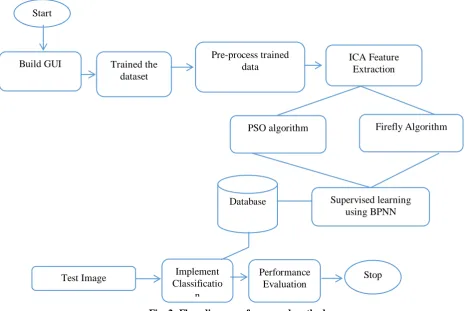
[image:2.595.58.532.430.741.2]The proposed methodology for automatic handwritten character recognition in efficient way with two different optimization algorithm in proposed in this section. As shown in figure 2, System flow diagram consists of training and testing phase.
Fig. 2.Flow diagram of proposed methods
Start
Build GUI Trained the
dataset
Pre-process trained data
ICA Feature Extraction
Database
Test Image Implement
Classificatio n
Performance
Evaluation Stop
Firefly Algorithm PSO algorithm
International Journal of Innovative Technology and Exploring Engineering (IJITEE) ISSN: 2278-3075, Volume-8 Issue-12, October 2019
A. Digitization
It is the procedure of changing a paper article into electronic arrangement. Here, each text contains only one atmosphere. The electronic adaptation is achieved by technique where as a file is skimmed and an electronic illustration of the unique text as an image file is formed. Various scanners are used to obtain digital images, and it is successful for succeeding stage as a preprocessing point. We used Chars74K data set for digitization. It has consisting of 3410 samples including upper case and lower case.
B. Preprocessing
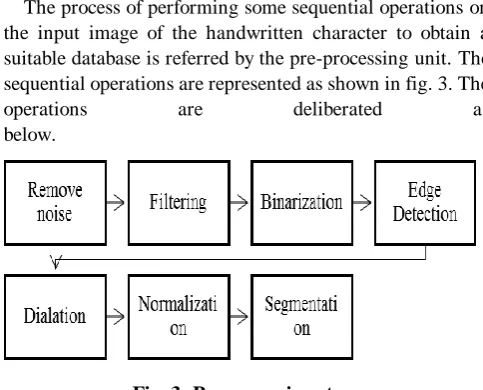
The process of performing some sequential operations on the input image of the handwritten character to obtain a suitable database is referred by the pre-processing unit. The sequential operations are represented as shown in fig. 3. The
operations are deliberated as
[image:3.595.315.544.169.307.2]below.
Fig. 3.Preprocessing steps
In this sector there is a sequence of tasks achieved on the scanned input appearance [10]. It improves the image translation process for division of the gray scale appearance and is normalized into an n-dimension. After noise lessening, a bitmap copy is obtained. Then, bitmap appearance was distorted into a thinned appearance. The raw statistics is endangered to an amount of introductory handling ladders to mark it practical in the descriptive phases of character breakdown. Preprocessing aims to yield statistics that are relaxed for the OCR schemes to operate accurately.
Noise Reduction: When the text is scanned, the skimmed
images strength is polluted by additive noise and low superiority images will disturb the next step of text processing. So, a preprocessing stage is compulsory to recover the quality of descriptions before distribution to subsequent phases of document handling. Due to the distortion there can be the detached line section, large gaps among the lines. So it is needed to remove all errors in which the data can be saved in the best way. There are several noises in descriptions. “Salt and Pepper Noise” is the noise in which the black and white points scattered all over an appearance, which can be established in almost all images. Noise reduction methods can be considered in two major clusters as cleaning, morphological processes.
Filtering: It is used to eliminate noise and reduce specious
opinions, usually presented by uneven writing shallow and poor sampling degree of the data attaining device. Various 3-D and frequency domain screens can be calculated for this
determination.
Binarization: Binarization of gray-scale images consist of
[image:3.595.45.287.204.399.2]characters is a vital step in offline recognition of the characters. Good binarization enables segmentation and acknowledgment of characters. Binarization procedure changes a gray scale appearance into a binary appearance as shown in fig 4. In this it consumes labeled new approaches for the noisy gray-scale binarization character pictures obtained in manufacturing location.
Fig. 4. Binarization
Our approach is specially intended to binarize character images which are in the gray scale format more efficiently by using the fact that typescripts are usually consists of tinny appearances of uniform thickness.
Edge (Boundaries) Detection: Boundaries describe object
borders and are consequently useful for subdivision, recording, and recognition of substances. Edge sensing an image meaningfully diminishes the volume of information and cleans out useless data, while conserving the significant physical belongings in an image. There are numerous ways to achieve edge discovery. However, the majority of diverse methods may be gathered into two classes. The very first is the gradient and the second one is the Laplacian. The gradient technique senses the edges by observing for the supreme and least in the first derivative of the appearance. The Laplacian technique examines for zero crossings in the derivative of the appearance to find boundaries. Thresholding is to decrease stowing necessities and to increase handling speed, it is often needed to signify grey scale or color descriptions as binary images by gathering some inception value for all above that rate is set to 1 and all below is set to 0. Two groups of thresholding occur: Universal and Adaptive. Universal thresholding picks one value for the total document image, often grounded on a valuation of the contextual level from the strength histogram of the appearance. Adaptive is a technique used for descriptions in which dissimilar regions of the image may need different edge values.
Morphological Operations: Morphological processes are
Morphological processes can be effectively used to remove the distortion on the document imageries due to low superiority of paper as well as unpredictable hand measure.
Dilation and filling with Skew Detection: For a text
scanning procedure, there might be the skewness of the image. There are numerous used approaches for noticing skew in an image; identifying connected mechanisms and discover the average viewpoints linking their centroids. There should be detached skewness because it decreases the exactness of the text. The slanting angle is deliberated and the skewed appearances are made straight.
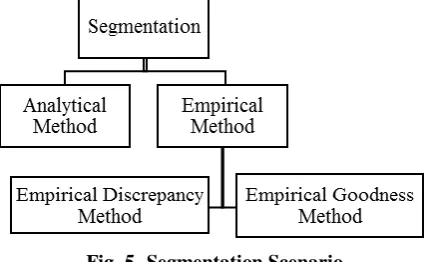
Segmentation: The Segmentation stage is the most
[image:4.595.61.278.347.478.2]significant process as in fig 5. Division is completed by splitting-up from the separate fonts of a sample image. Segmentation of typescripts into diverse sectors and typescripts is more problematic situation than that of published forms. This is essentially because inconsistency in a paragraph, arguments of line and typescripts of a word, angle, slant, scope and curled. Sometimes mechanisms of two end-to-end typescripts may be affected or covered and this state of affairs generates complications in the separation task. The moving or overlying problem arises recurrently since of improved fonts in upper lower area [11].
Fig. 5. Segmentation Scenario
C. Independent Component Analysis Feature Extraction
In this stage, features of separate typescripts are removed. The presentation of an each letter recognition scheme that depends on the topographies is removed. The removed features from response character should permit arrangement of an atmosphere in an exclusive way. Different sorts of features are presented in the area of free space features.
Independent component analysis generative approach for multivariate data, which perform many operation on image to extract basic information of the character image. The system is proposed for linear as well as nonlinear undefined variables combine. These variables give information with non-Gaussian and self-determined components. The blind source separation is applied to computations for factor analysis. It is a power computation process, shows independent component to extract feature values. With these vector values, it is suitable to apply factor analysis to evaluation. The ICA uses some parameter to develop algorithm as, centering i.e. eliminate mean value to obtain zero mean signal, whitening i.e. decomposition of eigenvalues as well as dimensionality minimization to reduce
complexity of designing algorithm [14].
In proposed method ‘n’ number of linear variables are defined ‘p’ number of mixture given by p1, p2, p3, … , pn. It can be represented by,
And hidden component are
Here, the general model of linear ICA without noise are obtained for pi component and mixing weight ai,k as
The generative formula to find independent component vector can be written as
Where, A be the mixing matrix given by,
The realization of random vectors pi is adaptively calculated by linear static transform T having set of t vectors and the cost function to maximize the non-Gaussian function or minimize mutual information.
D. Swarm Intelligence Based Feature Vector Selection
This is the process of choosing attributes or variables, which are extracted in terms of feature, with subset of appropriate predictors for building of system [15]. According to feature extracted by independent component analysis suitable optimization techniques are applied as particle swarm optimization and firefly optimization separately as category of swarm intelligence.
Particle swarm optimization: PSO algorithm is a global
algorithm, which has a strong ability to find the global optimistic result [16]. PSO is a population-based searching method which imitates the social behavior of bird flocks or fish schools. The population and the individuals are called a swarm and particles, respectively. Each and every particle will try to subordinate with fittest (best) solution. According to closeness, the terms personal best (pbest) and global best (gbest) are denoted and encountered by all particles of the swarm, communicated with all other particles. The gbest will gives overall best value and its location obtained by any particle in the population. It consists of changing the velocity of each particle as per values of pbest and gbest in each step. It is weighted by separate random numbers being generated for speeding up near pbest and gbest.
The optimize feature vector is the input swarm for the optimizing problem in an iterative manner which will provide global best solutions from the number of solutions. It deals with free space search operations over the particle’s position and velocity and can seek vast spaces to get best optimize solution. So, PSO is generally considered for the sake of optimization which is popularly known as routing optimization. The pseudocode is explained as below.
for every Particle j = 1, ..., Swarm do
Set the particle's location with a steadily isolated random vector Xj
Set the particle's best predictable location to its initial location Pj
International Journal of Innovative Technology and Exploring Engineering (IJITEE) ISSN: 2278-3075, Volume-8 Issue-12, October 2019
if f (Pi) <f (G) then
Update the swarm's best finest position: G Set the particle's speed: Vi
while a finishing is not encountered do for each particle j= 1, ..., Swarm do
for each measurement m = 1, ..., n do Evaluate fitness function
Update the particle's speed: Vj Update the particle's location: Xj
Update the best known location: G (resultant global best optimize solution)
(That G is the global best instance selected vector which is the training vector for the neural to train the system).
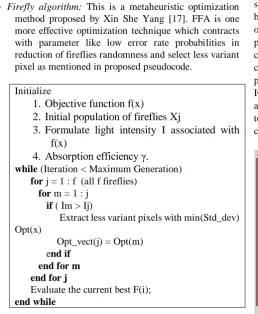
Firefly algorithm: This is a metaheuristic optimization
method proposed by Xin She Yang [17]. FFA is one more effective optimization technique which contracts with parameter like low error rate probabilities in reduction of fireflies randomness and select less variant pixel as mentioned in proposed pseudocode.
Initialize
1. Objective function f(x)
2. Initial population of fireflies Xj
3. Formulate light intensity I associated with f(x)
4. Absorption efficiency γ.
while (Iteration < Maximum Generation) for j = 1 : f (all f fireflies)
for m = 1 : j if ( Im > Ij)
Extract less variant pixels with min(Std_dev) Opt(x)
Opt_vect(j) = Opt(m) end if
end for m end for j
Evaluate the current best F(i);
end while
E. Classification by backpropagation neural network
Classifier is nothing but the system which train the input images to obtained appropriate testing output. The features which are extracted are to be selected by feature vector selection process with optimization techniques. Once the system is trained using back propagation neural network then the testing phase is taken place. The test image is applied for the recognition and classified as th andwritten character which matches with the training set and then the performance will be evaluated in terms of high specificity, high senstivity and high recognition rate with low error rate probabilities.
The backpropagation neural network algorithm is proposed in two phases. In the forward phase, the input pattern is into the network layer. The network banquets pattern from layer to layer until the output pattern is created. In backward phase, the mode of classification is discussed as, if the input pattern is different from the required output, an error is
calculated and then propagated backward through the network from the output layer to the input layer. The weights and bias are updated as the error.
IV. RESULTS AND DISCUSSION
This section deals with experimental results of proposed recognition techniques applied for existing data set of CHAR74K. It consists of characters in lower case & upper case and numbers written by various people. The 80 % data set is used for training phase, 10 % is for validation and rest 10% is for testing phase.
[image:5.595.50.309.246.561.2]Initially, the neural network is trained with training dataset. Here, in this proposed method we have performed two techniques for recognition as, ICA, used for feature extraction is combined with PSO and FFA for feature vector selection. Also, these two methods are compared for getting best recognition scheme. As shown in fig 6 and fig 7, it is observed that the input data set is uploaded and preprocessing steps are performed on it to recognize character by ICA PSO and ICA FFA combination correspondingly. The figure shows uploaded original image, preprocessing, edge detection, feature extraction stage. This ICA feature extraction shows independent value in accordance with bit value. The parameters are obtained in terms of average intensity, contrast, entropy, white pixels and correlation according to input character.
Fig. 6.Upload all images for ICA & PSO combination
[image:5.595.302.546.392.568.2]As exposed in fig 8 and fig 9, feature vector selection is obtained with optimized feature values in according to length of feature vectors for ICA PSO and ICA FFA respectively.
[image:6.595.311.545.49.310.2]Fig. 8. Feature vector for ICA & PSO combination
Fig. 9.Feature vector for ICA & FFA combination
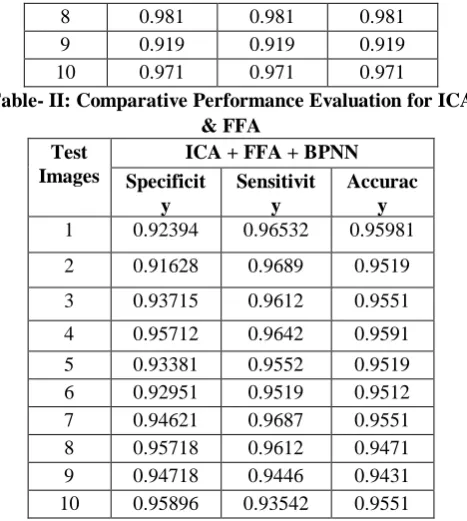
Now, performance evaluation is identified for different image samples and test for these. It can be given away in the following table I and table II. The experiment is enlisted for 10 samples for classification. The recognition rate can be compared in three classification parameter like specificity, sensitivity and accuracy. The comparative performance evaluation noticed that the PSO approach is having high classification rates for low false negative and false positive rates than FFA. The optimization and normalization is the main part in the evaluation of the classifications and performance evaluations through which the high specificity and high sensitivity is achieved.
Table- I: Comparative Performance Evaluation for ICA & PSO
Test Images
ICA + PSO + BPNN Specificit
y
Specificit y
Specificit y
1 0.975 0.975 0.975
2 0.979 0.979 0.979
3 0.968 0.968 0.968
4 0.969 0.969 0.969
5 0.922 0.922 0.922
6 0.978 0.978 0.978
7 0.971 0.971 0.971
8 0.981 0.981 0.981
9 0.919 0.919 0.919
10 0.971 0.971 0.971
Table- II: Comparative Performance Evaluation for ICA & FFA
Test Images
ICA + FFA + BPNN Specificit
y
Sensitivit y
Accurac y
1 0.92394 0.96532 0.95981
2 0.91628 0.9689 0.9519
3 0.93715 0.9612 0.9551
4 0.95712 0.9642 0.9591
5 0.93381 0.9552 0.9519
6 0.92951 0.9519 0.9512
7 0.94621 0.9687 0.9551
8 0.95718 0.9612 0.9471
9 0.94718 0.9446 0.9431
10 0.95896 0.93542 0.9551
From table III, the performance evaluation in terms of Specificity, Sensitivity and Accuracy are made known for both the techniques. It can be noticed from the above results that the results are closely related to each other for high true positive and negative rates. But, PSO approach is achieving somewhat better results than firefly.
Table- III: Average Performance Evaluation
Parameter PSO + BPNN Firefly +
BPNN
Specificity 0.9633 0.9407
Sensitivity 0.9694 0.9576
Accuracy 0.9692 0.9529
V. CONCLUSION
Optical Character Recognition is a most powerful technique to convert scanned document in to editable form. There are several steps involved in OCR like digitization, preprocessing, feature extraction and classification. This paper focused on feature extraction techniques based on swarm intelligence as particle swarm optimization and firefly optimization. As result section analyses PSO is achieving better recognition rate with low error rate probabilities.
ACKNOWLEDGMENT
[image:6.595.60.287.92.437.2]International Journal of Innovative Technology and Exploring Engineering (IJITEE) ISSN: 2278-3075, Volume-8 Issue-12, October 2019
REFERENCES
1. Rao, T. Kameswara, K. Yashwanth Chowdary, I. Koushik Chowdary, K.
Prasanna Kumar, and Ch Ramesh. "Optical Character Recognition from Printed Text Images." (2019).
2. Pramanik, Rahul, and Soumen Bag. "Shape decomposition-based
handwritten compound character recognition for Bangla OCR." Journal of Visual Communication and Image Representation 50 (2018): 123-134.
3. Islam, Md Rabiul, Chayan Mondal, Md Kawsar Azam, and Abu Syed Md
Jannatul Islam. "Text detection and recognition using enhanced MSER detection and a novel OCR technique." In 2016 5th International Conference on Informatics, Electronics and Vision (ICIEV), pp. 15-20. IEEE, 2016.
4. Nisha Sharma, Bhupendra Kumar, Vandita Singh "Recognition of
Off-line Hand printed English Characters, Numerals, and Special Symbols", IEEE International Conference- Confluence The Next Generation Information Technology Summit, p.p 640-645, 2014.
5. Mehdi Haji n, Tien D. Bui, Ching Y. Suen, “Removal of noise patterns in
handwritten images using expectation maximization and fuzzy inference systems”, Elsevier journal of pattern recognition, p.p. 4237-4249, 2012.
6. Santosh K.C. :Character Recognition based on DTW-Radon, 11th
International Conference on Document Analysis and Recognition - ICDAR 2011, Sep 2011, Beijing, China. IEEE Computer Society, pp. 264-268, (2011).
7. Jewoong Ryu, Hyung Koo and Nam Ik Cho, “Word Segmentation
Method for Handwritten Documents based on Structured Learning”, IEEE signal processing letters, Vol. 22, p.p. 1161-1165, August 2015. 8. Das, Soumendu, and Sreeparna Banerjee. "An algorithm for Japanese
character recognition." International Journal of Image, Graphics and Signal Processing (IJIGSP) 7, no. 1 (2015): 9-15.
9. Althobaiti, Hassan, and Chao Lu. "A survey on Arabic Optical Character
Recognition and an isolated handwritten Arabic Character Recognition algorithm using encoded freeman chain code." In 2017 51st Annual Conference on Information Sciences and Systems (CISS), pp. 1-6. IEEE, 2017.
10. Bajeh, Amos Orenyi, Muftau Oluwatosin Wasiu, and Fatima Enehezei
Usman-Hamza. "Performance Evaluation of Optimised Backpropagation Algorithms for Yorùbá Character Feature Extraction and Recognition." (2019).
11. Mollah, Ayatullah Faruk, Nabamita Majumder, Subhadip Basu, and
Mita Nasipuri. "Design of an optical character recognition system for
camera-based handheld devices." arXiv preprint
arXiv:1109.3317 (2011).
12. Z. Shi, V. Govindaraju, Line separation for complex document images
using fuzzy run length, First International Workshop on Document Image Analysis for Libraries, 2004, p.p. 306.
13. E. Bruzzone, M.C. Coffetti, An algorithm for extracting cursive text lines, Proceedings of the Fifth International Conference on Document Analysis and Recognition, Bangalore, India, 1999, p.p. 749.
14. Isomura, Takuya, and Taro Toyoizumi. "A local learning rule for independent component analysis." Scientific reports 6 (2016): 28073.
15. James, Gareth, Daniela Witten, Trevor Hastie, and Robert Tibshirani. An
introduction to statistical learning. Vol. 112. New York: springer, 2013.
16. Golbon-Haghighi, Mohammad-Hossein, Hadi Saeidi-Manesh, Guifu
Zhang, and Yan Zhang. "Pattern synthesis for the cylindrical polarimetric phased array radar (CPPAR)." Progress In Electromagnetics Research 66 (2018): 87-98.
17. Yang, Xin-She. Nature-inspired metaheuristic algorithms. Luniver press,
2010.
AUTHORS PROFILE
Mr. Shrinivas R. Zanwar was born in India in 1987. He has completed the bachelor degree in electronics and telecommunication engineering (2009) and master degree in electronics (2012) from Dr. Babasaheb Ambedkar Marathwada University, Aurangabad. Also, he is pursuing Ph. D. in Electronics and telecommunication engineering from the same university. Currently, he is working as Assistant Professor of Electronics and Telecommunication Engineering department in CSMSS, Chh. Shahu College of Engineering, Aurangabad. His research and teaching interest include signal and image processing. He is the Associate member (AM1776218) of the Institute of Engineers, India. He has authored and co-authored nearly 11 publications in indexed journals and conferences.
A. S. Narote received B.E. (Electronics) in from Shivaji University and M.E.(Electronics) from University of Pune, India in 2004 and 2006 respectively. She is pursuing his research in the field of biometrics and machine vision. She is currently working as Assistant Professor in S. K. N. College of Engineering, Pune, India. Her research areas are image processing and signal processing.