International Journal of Innovative Technology and Exploring Engineering (IJITEE) ISSN: 2278-3075, Volume-8 Issue-7 May, 2019
Developing University Classroom Model
For Creativity Education by Delphi Survey
Hyejin Yang, Kyunghwa Lee
Abstract The purpose of this study is to propose the university classroom model to promote the creative competence using the Delphi survey method. As a research procedure, the literature review and analysis of case study on spaces of education and working were conducted, so that the characteristics of class envi-ronment for promoting creative competence would be identified. In addition, the expert Delphi survey was carried out to propose the university classroom for creative competence. The result showed that it is necessary to establish the classroom standard for size, structure, arrangement, the color of the wall, and lighting for the university classroom for creative competence. Further-more, autonomy, sociability, flexibility, and diversity should be implemented in the classroom environment. The creative compe-tence the university student should improve includes flexibility, originality, sophistication, curiosity, task-commitment, and prob-lem-solving leadership, and these elements have correlations with each other. Therefore, in establishing a university classroom encompassing these elements, the arrangement and colors shall be taken into account along with creating differentiated space depending on the study.
Keywords: Use about five key words or phrases in alphabetical order, Separated by Semicolon.
I. INTRODUCTION
Recently the Korean Ministry of Education has proposed many policies and educational directions focusing on grow-ing convergent creative talents. Therefore, there is the in-creasing need to acquire creative competence in our society. The recent research trend on creativity is concluding that, in order for creativity to be manifested, various components including cognitive, affective, and environmental should interact with each other. This is the mainstream multi-faceted and comprehensive approach that the creativity is manifested by the interaction of elements such as intelli-gence, knowledge, personality, motivation, and environment [1]. In the cognitive element perspective, creativity is con-sidered as an intellectual ability and as the basis for the abil-ity to think creatively through the overall process of thinking [2]. Researchers classified sub-variables of creative thinking ability which is the cognitive element of creativity as fluen-cy, flexibility, originality, and elaboration so that they could be measured by a creativity test [3], [4]. This study accepts the integrated view on the concept of creativity. Creativity is manifested by the interaction of cognitive, affective, and environmental factors. The cognitive factors are related knowledge and functions and extensive thinking activities which sub-variables are fluency, flexibility, the sensitivity of thinking, originality, imagination,
Revised Manuscript Received on May 06, 2019
Hyejin Yang, Dept. of Interior Design, SoongSil University, Rep. of Korea
Kyunghwa Lee, Dept. of Lifelong Education, SoongSil University, Rep. of Korea
and elaboration. The affective factors characteristics of per-sonality and motivation which sub-variables are curiosity, a sense of humor, task-orientation, independence, and prob-lem-solving leadership.
Urban proposed five essential elements of creativity: prob-lem, person, process, product, and environment. In other words, it refers to the social and cultural environment to promote and sustain a person’s creativity to solve a problem, and its process and product [5]. In the same perspective, Karnes and Strong referred to the classroom atmosphere as a factor influencing creativity while Dacey & Lennon pointed out that students are more creative in a free, supportive, comfortable atmosphere [6]. On the other hand, Kristensen argued that creative activities improve when physical space is well-connected [7], and Haner suggested that physical space motivates and inspires creativity [8]. Although the importance of the creative environment has been continu-ously suggested by various scholars like Amabile & Gryskiewicz and there is a growing interest in teaching-learning method and programs for fostering creative compe-tence, there is an insufficient amount of research and study on the creative environment [9]. Csikszentmihalyi argued that the theme of creativity research has focused on the characteristics of an individual that it needs to be extended to the socio-cultural environment. Isaksen, Puccio, & Treffinger has also pointed out that creative productivity is not the only result of the interaction between factors within an individual character but also influenced by time, place, background, and other people emphasizing the influence of time and place [10].
The outset of the traditional school has not changed much despite the technological development. However, it is clear that the school in the future should be different from the current outset to foster creative talents that can respond to changes and create new things. Therefore, it is necessary to research how the educational environment should change according to the predictable educational system in the fu-ture. Taking psychological, physical, and social environment into consideration, if entering to the future society with the fourth industrial evolution is taken as the social environ-ment, the conditions of future learners should be viewed as the psychological environment. Then in what kind of class environment would the future learners be in this social cli-mate? What will be the physical environment that can en-hance the creative competence along with the introduction of different machines and the advancement of high technol-ogy?
Developing University Classroom Model For Creativity Education by Delphi Survey
The psychological environment refers to the space that pro-vides challenging but accomplishable stimulus to raise inter-est and confidence through a sense of achievement. The affective environment refers to the space that provides sup-port for creative and challenging activities. Moos found that factors such as physical and organizational environment and characteristics of teachers and learners affect the social and psychological environment directly and indirectly [12]. As the physical environment is an independent factor that indi-rectly affects the social and psychological environment, identifying it is crucial to understand the teacher’s aware-ness in the classroom.
The purpose of this study was to suggest a university class-room model for enhancing the creative competence and so first of all identifying the needed elements of creative com-petence for university students through literature review and then proposing the constituent of the classroom. Finally, Delphi method by the experts was conducted to verify the content validity of how the university classroom model should be for enhancing creative competence.
II. METHODS
The purpose of this study is to design a university classroom that can enhance creative competence. To do this, the analy-sis of precedent studies and Delphi survey methods were conducted twice to propose a university classroom model (Table 1). The first step was the basic research by analysing literature review and precedent studies to identify environ-mental features for enhancing creative competence and ele-ments of interior design in a physical space. In addition, by analysing the spatial arrangement, the particular layout for enhancing the ability was suggested. Furthermore, the effec-tive colours that are beneficial to enhance the competence were confirmed based on the analysis of applied colours in creative spaces.
The second step is survey using Delphi method. The Delphi method was conducted by selecting expert group members who are recognized as experts in architecture, design, educa-tion, and creativity fields (Table 2). Based on the analysis results in the first step, the primary survey was constructed and the first Delphi survey was conducted in December 2016. The first survey was composed of constructed ques-tions using a 6-point Likert Scale based on the precedent studies. The primary survey was conducted via e-mail, and the returned survey sheets were statistically calculated to conduct the second survey in February 2017. The second survey was composed of closed-ended questions and addi-tional and revised questions based on the answers from the first survey. Google Survey with electronic questionnaire was used for the second survey, and the responses were ana-lysed using SPSS Statistics 24.0 program for frequency, descriptive statistics (M, SD, Mode, Min/Max, CV, CVR), and correlation analysis.
Table 1: Procedure of conducting research
Step Classifica-tion
Pe-riod Contents
1st
step
Literature analysis
2016 .09~20 16.11
- Environmental characteristics & spatial factors to support creative capac-ity enhancement
Spatial analysis of domestic and foreign
crea-tive
2016 .11~20 16.12
- Arrangement classification accord-ing to environmental characteristics to support the enhancement of creative competence
- Creative space applied colour analysis (Korea standard colour analy-sis, Munsell conversion)
Current Status
2017 .02~20 17.03
- Analysis of the current status of lec-tures in domestic universities (size, layout, design)
2n d
step
Selection of experts and composition of questions
2016 .12
- Architecture, Design, Education, Creativity field: 30 people
1st Delphi survey
2016 .12~20 17.01
-Structured questions (6-point Likert scale): The necessity, the necessary capacity of creativity, the space factor to improve, the space requirement char-acteristic, the space characteristic detail, the influence relation between the crea-tive capacity and the space characteris-tic
First Re-sponse
Analy-sis
2017 .02
- Statistical processing for each item (frequency, descriptive statistics - mean, standard deviation, median, min / max, CV, CVR)
Second Delphi Survey
2017 .02~20 17.03
- Details of spatial characteristics (modification and addition), necessary major, appropriate space arrangement and space colour, spatial characteristics and major suitable for each arrangement and colour scheme room
Second Re-sponse
Analy-sis
2017 .03
- Statistical processing for each item (frequency, descriptive statistics - mean, standard deviation, median, min / max, CV, CVR)
Table 2: Participants for Delphi (Expert group)
# Specialty Task Career
1 education professor 10~20 years
2 creativity teacher more 20 years
3 education, creativity supervisor more 20 years
4 education professor 10~20 years
5 Architecture / Design professor 10~20 years
6 Architecture / Design professor 10~20 years
7 education teacher more 20 years
8 education professor more 20 years
9 education professor 10~20 years
10 education expert
committee less 5 years
11 Architecture / Design professor 5~10 years
12 education, creativity professor 10~20 years
13 education professor 10~20 years
14 creativity professor more 20 years
15 education, creativity professor more 20 years
16 education, Architecture
/ Design professor more 20 years
17 creativity director more 20 years
18 education professor less 5 years
19 education professor 10~20 years
20 education researcher 10~20 years
21 education professor 10~20 years
22 creativity professor 10~20 years
International Journal of Innovative Technology and Exploring Engineering (IJITEE) ISSN: 2278-3075, Volume-8 Issue-7 May, 2019 Published By:
Blue Eyes Intelligence Engineering & Sciences Publication
24 education director 10~20 years
25 Architecture / Design professor more 20 years
26 Architecture / Design professor 10~20 years
27 education professor 10~20 years
28 education professor 10~20 years
29 creativity professor more 20 years
30 Architecture / Design professor 10~20 years
III. Results and Discussion
To the standard established based on the literature review and precedent studies established with literature review and precedent studies, the Delphi survey was conducted for the architecture, design, education, and creativity expert groups to reaffirm the classroom for enhancing creative competence. In the Delphi survey, 1) the necessity of creating physical environment for enhancing creative competence, 2) neces-sary facilities, 3) current level of application, 4) spatial ele-ment that may affect the creative thinking, 5) sub-variables that may need to improve through classes, 6) environmental features that affect improving creative competence, 7) the relation between creative competence and environmental features, and 8) the relation between the sub-variables of creative competence and environmental features were inves-tigated.
The result of the Delphi survey is as follows.
3.1. Need to create a physical environment to enhance creative competence in educational institutions
The result of an expert survey on the need for building physical environment to enhance creative competence in educational institutions showed 5.54 on average. In the 6 point scale survey, the score indicates that it is more than needed. The result of frequency showed that all the response was needed to some extent. ‘Highly needed’ accounted for more than 60% which marks the need to establish a physical environment for university students’ creative competence. 3.2. Facilities needed to establish an environment to en-hance creative environment
Although this study was focused on establishing a physical environment for university classrooms, to figure out in which educational institution needs the most for the creative environment, the survey question included elementary schools, middle schools, high schools, and universities. The result showed that 41.7% of respondents answered that elementary schools need the environment. The middle and high schools and universities accounted for 27.1% and 31.3% respectively. Although the elementary schools accounted the most for the need, the overall difference is not significant. Therefore, it can be concluded that all the educational insti-tutions including elementary schools, middle and high schools, and universities have the need for a creative envi-ronment.
3.3. The current status of creative environments in edu-cational institutions
As a result of the descriptive statistical analysis, the current average level of the creative environment in educational
institutions was 2.25, which was at the low level in the 6-point scale.
The frequency analysis showed that 10.7% of respondents answered ‘a little high’ while the rest of the respondents answered ‘a little low’, ‘low’, and ‘very low’. This result indicates that despite the high need for the creative envi-ronment, the current status of the environment is at the low level (89.3%), marking the strong necessity to establish the creative environment.
3.4. Space elements expected to affect creative thinking activities
To examine the creative thinking change induced by physi-cal environment change, the classroom spatial element that may affect the creative thinking was identified. For spatial elements, the sub-variables of interior spatial elements such as layout, the classroom size which accounts as size among aesthetic elements, an arrangement which accounts as shapes, and colours, finishing materials, lighting wall, ceil-ing, and furniture as aesthetics were identified for investiga-tion.
Among these spatial factors, the ones that may affect crea-tive thinking were to be selected with 6 points Likert Scale. The results of analysis were as follows; first, in order to con-firm if the experts made consensus, CV was calculated. Sec-ond, to check the content validity for the result of each fac-tor, according to the standard presented, the items which CVR is below 0.33 were eliminated. Third, based on the highest content validity which is 0.60~0.80 (Ahn, J. S., 2011), for the items that are 0.70 or more for the validity have more than 5 points which are ‘Yes’ for the spatial fac-tor, the item was chosen as the one that affects the creating thinking (Table 3).
The factors selected according to the above standard for affecting the university students’ creative competence are the size and shape of the classroom, layout, colour of the wall, and lighting on the ceiling.
Table 3: Descriptive statistics
M SD D Min Max CV CV R
D e l -
s c a l e
scale 5.21 .74 5.00 3 6 0.14 0.79
shape 5.54 .58 6.00 4 6 0.10 0.93
ceiling height 4.86 .97 5.00 3 6 0.20 0.36
l a y o u t
layout 5.61 .74 6.00 3 6 0.13 0.86
d e si g n
wall
colour 5.21 .69 5.00 4 6 0.13 0.71
finish
mate-rials
4.39 .92 5.00 3 6 0.21 0.07 √
furni-ture 4.79 .96 5.00 3 6 0.20 0.43
ceil-ing
colour 4.57 .96 5.00 3 6 0.21 0.21 √
finish
mate-rials
3.75 .93 4.00 2 6 0.25
-0.71 √
light 5.07 .54 5.00 4 6 0.11 0.79
Developing University Classroom Model For Creativity Education by Delphi Survey
finish
mate-rials
4.68 1.02 4.50 3 6 0.22 0 √
illuminance 5.04 .69 5.00 4 6 0.14 0.57
natural light 5.07 .90 5.00 3 6 0.18 0.43
3.5. Sub-variables of creative competence that needs to be improved through university lectures
The sub-variables of creative competence were divided by creative skills and creative characters. The analysis result applying the same standard to measure of agreement and content validity, imagination, and fluency from creative skills and a sense of humor in creative characters were be-low the minimum standard and eliminated. For the rest of the sub-variables, if the average was more than 5 points which is ‘Yes’, the sub-variable was selected as the ones that need to be improved by the lectures. The final sub-variables are flexibility, creativity, elaboration, curiosity, task-orientation, and problem-solving leadership (Table 4).
Table 4: Sub-variables of creative competences
M SD D Min Max CV CV R
d
e
l
Cre
ative
think-ing
ability
im 4.68 1.09 5.00 2 6 0.23 0.21 √
flu 4.75 1.08 5.00 3 6 0.23 0.14 √
flex 5.36 .83 6.00 3 6 0.15 0.71
Sent 5.07 .98 5.00 3 6 0.19 0.57
or 5.29 .81 5.00 3 6 0.15 0.71
elab 5.29 .71 5.00 4 6 0.13 0.71
Cre
ative
per-sonalit
y
cur 5.14 1.08 5.50 2 6 0.21 0.79
sen 4.96 1.04 5.00 2 6 0.21 0.43
tc 5.32 .72 5.00 4 6 0.14 0.71
hu 4.32 1.12 5.00 2 6 0.26 0.07 √
ind 5.18 .82 5.00 4 6 0.16 0.5
pro 5.43 .74 6.00 4 6 0.14 0.71
* im-imagination, flu-fluency, flex-flexibility, sent-sensitive thinking, or-originality, elab-elaboration, cur-curiosity, sen-sensitivity, tc-task-commitment, hu-humor, ind- independence/adventure, pro-problem-solving leadership
3.6. Environmental characteristics required to enhance creative competence
The total of ten environmental characteristics for enhancing creative competence was derived based on the precedent studies. Among these, the characteristics that are applicable to university classrooms were surveyed. The analysis results of measurement of agreement (CV=0~.05), content validity (CVR<0.33), and average (M>5) for environmental charac-teristics for enhancing creative competence showed that autonomy, sociability, flexibility, and diversity were select-ed as the final. It analyzselect-ed as presentselect-ed in Table 5.
Table 5: Characteristics of classroom environment for creativity
M SD D Min Max CV CVR del
autonomy 5.32 .67 5.00 4 6 0.13 0.79
sociability 5.43 .63 5.00 4 6 0.12 0.86
playful-ness 5.07 .81 5.00 4 6 0.16 0.43
flexibility 5.32 .72 5.00 4 6 0.14 0.71
openness 5.14 .80 5.00 3 6 0.16 0.64
diversity 5.14 .65 5.00 4 6 0.13 0.71
comfort 4.86 1.01 5.00 3 6 0.21 0.43
sufficien-cy 5.04 .74 5.00 4 6 0.15 0.50
connectiv-ity 4.96 .74 5.00 3 6 0.15 0.57
privacy 4.46 1.17 4.50 3 6 0.26 0 √
For each environmental characteristic, the most appropriate structure was to be suggested. The most appropriate struc-ture for autonomy, sociability, and diversity in an educa-tional institution is presented in Table 6.
For content validity, pursuant to the minimum standard, the items that are below 0.33 were eliminated. Among the re-mains, the items that have ‘Yes (5point)’ on average were selected as the final. In the case of diversity, all three re-sponses did not reach average point 5 in detailed structure. To complement the content for the detailed structure, from the correlation analysis results using Delphi method, the detailed structure that is related to diversity was selected and complemented by the second Delphi survey.
Table 6: Content validity of creative competencies
detailed configuration M SD D CV CV R del
au-ton om y
place where you can
freely work and study 5.43 .69 6.00 0.13 0.79
space for easy re-trieval of necessary information
4.96 .96 5.00 0.19 0.43
space that you can take advantage of yourself
5.36 .68 5.00 0.13 0.79
sso ciab ility
communication free
space 5.50 .58 6.00 0.10 0.93
space where furniture is arranged for easy communication
5.25 .75 5.00 0.14 0.64
space that allows discussion and col-laboration with team members
5.61 .50 6.00 0.09 1.00
flex ibili ty
space that can utilize
various functions 5.46 .64 6.00 0.12 0.86
space that can
pro-duce various sizes 5.11 .79 5.00 0.15 0.50
space that can
facili-tate deformation 5.43 .69 6.00 0.13 0.79
di-vers ity
space where various functions of space are divided
4.82 .85 5.00 0.18 0.29 √
space composed of various shapes, sizes, and atmosphere
4.96 1.0
9 5.00 0.22 0.43 √
space rich in colour and finishing materi-als
International Journal of Innovative Technology and Exploring Engineering (IJITEE) ISSN: 2278-3075, Volume-8 Issue-7 May, 2019 Published By:
Blue Eyes Intelligence Engineering & Sciences Publication
3.7. The relationship between the creative environment and the creative competence
To identify how the environmental characteristics that may have positive effects on creative competence influence the sub-variables of creative competence, the relations between the two were analysed through frequency analysis. The sub-variables that may affect the environmental characteristics were to be selected multiple times by the respondents and the results were analysed. Imagination and originality were the highest in the environment for autonomy while it had a comparatively low influence on sophistication. Independ-ence/exploration, curiosity, and task-commitment were the highest for creative characteristics factors. However, a sense of humour, sensitivity, and problem-solving leadership were comparatively lower in the response.
In the social environment, flexibility was the highest for the probability of affecting the creative skills followed by flu-ency and sensitivity in the expert's groups’ response. How-ever, it is expected by the groups that it would have little influence in originality and imagination. For the creative characteristics, it was expected to have the highest influence on problem-solving leadership whereas it would have a lower influence on curiosity and independence/ exploration. In the flexible environment, it was expected that flexibly will be influenced the most among creative skills while it was expected that it would have the lowest influence on sophistication. In creative characteristics, the majority of the respondents said it would have the highest influence on cu-riosity followed by sensitivity.
In the diverse environment, the expert survey result showed that it would have the positive effects on imagination. For creative characteristics, the answer showed that sensitivity, curiosity, independence/ exploration would have a positive influence.
Among sub-variables of creative skills and characteristics, as it is presented in Table 7, the creative competence that needs to be improved through lectures concluded in this study are flexibility, originality, elaboration, curiosity, task-commitment, and problem-solving leadership. Among each factor, the ones that have the highest frequency can be used for projecting the enhancement of creative competence
Table 7: Correlation between environmental characteristics and creative competencies
autonomy
socia-bility flexibility diversity
Cr eat ive thi nk in g ab ilit y
im 26.5 2.2 13.6 23.9
flu 16.3 28.9 15.9 30.4
flex 14.3 33.3 50.0 28.3
sent 10.2 20.0 11.4 2.2
or 26.5 0 6.8 13.0
elab 6.1 15.6 2.3 2.2
Tot % 100.0 100.0 100.0 100.0
Cr eat ive pe rs on ali ty
cur 24.4 2.6 31.0 27.3
sen 6.7 15.4 24.1 33.3
tc 24.4 10.3 13.8 3.0
hu 0 15.4 6.9 3.0
ind 35.6 7.7 13.8 24.2
pro 8.9 48.7 10.3 9.1
Tot % 100.0 100.0 100.0 100.0
* im-imagination, flu-fluency, flex-flexibility, sent-sensitive thinking, or-originality, elab-elaboration, cur-curiosity, sen-sensitivity, tc-task-commitment, hu-humor, ind-independence/adventure, pro-problem-solving leadership
3.8. The correlation between creative competence and environment
Through the overall correlation analysis between the sub-variables that are needed to be improved by lectures and environmental characteristics of classrooms for enhancing creative competence, the relation within the creative compe-tence and environmental characteristics, and the relation between the creative competence and environmental charac-teristics.
First of all, the correlations between 12 sub-variables of creative competence were analyzed
While imagination had positive correlations with fluency (r=.403, p<.05), curiosity (r=.418, p<.05), sensitivity (r=.481, p<.01), and task-orientation (r=.465, p<.05), the fluency also had positive correlations with flexibility (r=.521, p<.01), sophistication (r=.435, p<.05), and independence/adventure (r=.431, p<.05) While the flexibility was correlated with fluency while it had positive relationships with sensitivity of thinking (r=.517, p<.01) and problem-solving leadership (r-.587, p<.01). The sensitivity of thinking had positive rela-tionships with sensitivity (r=.660, p<.01), a sense of humor (r=.450, p<.01), and problem-solving leadership (r=.466, p<.05). Originality had positive relationships with sensitivi-ty (r=.410, p<.01) and a sense of humor (r=.465, p<.01) and sensitivity and a sense of humor had a correlation. Curiosity had a correlation with imagination as mentioned earlier and sensitivity (r=.469, p<.01).
The correlations between creative skills and characters had secondary and tertiary correlations among all the sub-variables led by fluency, flexibility, the sensitivity of think-ing, and sensitivity.
Second, for the correlations within the environmental char-acteristics for enhancing creative competence, autonomy had a positive correlation with sociability (r=.449, p<.01) and sociability had positive relationships with openness (r=.457, p<.01), comfort (r=.505, p<.05), and connectivity (r=.583, p<.05). Playfulness had positive correlations with flexibility (r=.401, p<.01), diversity (r=.400, p<.01), and comfort (r=.374, p<.01). Flexibility had other positive corre-lations with openness (r=.428, p<.01), diversity (r=.529, p<.05), and connectivity (r=.435, p<.01). In the case of openness, it had a correlation with sociability and flexibility, had positive correlations with adequacy (r=.425, p<.01) and connectivity (r=.628, p<.05). Adequacy had positive correla-tions with diversity (r=.524, p<.05), comfort (r=.451, p<.01, and connectivity (r=.403, p<.01). Comfort (r=.529, p<.05) and privacy (r=.530, p<.05) had a correlation with connec-tivity.
The results indicate that the environmental characteristics for enhancing university students’ creative competence in-teract with each other to influence the creative competence rather than one characteristic has a single outcome. There-fore, in order to create a classroom for the creative compe-tence of universities, various environmental characteristics should be taken into account
Developing University Classroom Model For Creativity Education by Delphi Survey
Fig. 1: Correlation of creativity competencies to enhance through lectures
Fig. 2: Correlation between environment characteristics to support creative competencies
3.9. Layout of Classroom to promote the creative competencies
In this study, we surveyed using Delphi method to select the lecture room model that using color and layout derived from previous research for fostering the creative competency of university students. Unlike elementary, middle, and high school classrooms, the size of the university classroom in selecting the model for promoting creativity competence was excluded from the condition of this study because it was possible to classify it according to the class size and the number of students. In addition, a classroom model is pre-sented focusing on placement and color that can be easily changed and realizable.
Experts predicted that L2 layout would be most appropriate for promoting creative competence among the five class-room layouts presented in [figure 3]. Then, they selected the appropriate classroom layout in the order of L3, L4, L1, and L5. However, the difference in selection distribution is not significant, and it is expected that the placement of the class-room will not be different enough to constitute the lecture room for creative competence.
lay-out type of layout
Appropriate-ness N(%)
L1 4(16.0)
L2 8(32.0)
L3 6(24.0)
L4 5(20.0)
L5 2(8.0)
Fig. 3:Layout of Classroom to promote the creative competencies
3.10. Characteristics of cclassroom to promote the creative competencies according to layout
International Journal of Innovative Technology and Exploring Engineering (IJITEE) ISSN: 2278-3075, Volume-8 Issue-7 May, 2019 Published By:
Blue Eyes Intelligence Engineering & Sciences Publication
Table 8: Degree of creativity environmental characteristics in classroom
L1 N(%) L2 N(%) L3 N(%) L4 N(%) L5
N(%)
autonomy 16(41.0) 8(19.0) 11(26.2) 19(45.3) 19(46.4 )
sociabil-ity 15(38.5) 13(31.0) 11(26.2) 9(21.5) 8(19.5)
flexibility 5(12.8) 10(23.8) 12(28.6) 7(16.6) 5(12.2)
diversity 3(7.7) 11(26.2) 8(19.0) 7(16.6) 9(21.9)
Total 39(100) 42(100) 42(100) 42(100) 41(100)
Table 8 shows the results of the frequency analysis of the environmental characteristics for enhancement of creative competencies revealed in the classroom layout. The L1 lay-out emphasized autonomy and sociality, and the highest environmental characteristic of L2 layout was sociality. However, since there is no large difference in the distribu-tion of the four characteristics, it can be interpreted that it includes all environmental characteristics. The layout of L3 seems to be similar to all environmental characteristics. In the case of L4 layout, autonomy was analyzed as the most emphasized layout, but other spatial characteristics were also included. Similarly, all the environmental characteris-tics of the L5 layout were revealed, among which the distri-bution of autonomy was the highest.
As shown in the results of the correlation analysis, it was confirmed that there were direct and indirect correlations between the 10 environmental characteristics, which were found to be important in promoting creative competence. Therefore, it was found that there is a correlation between the four environmental characteristics in the entire layout where the appropriateness was confirmed although there is a difference in degree.
3.11. Differences of classroom layout between majors
In this study, it was confirmed that there is a difference in the need of the lecture room for creative competence accord-ing to the college major, and it is analyzed that the lecture room for creative competency is needed according to order of artistic ability, engineering, and education. Therefore, in order to know whether there is a difference in the needs of each subject according to the five classroom layouts sug-gested in this study, the appropriateness of the use of each major is confirmed and presented in Table 9.
As a result of frequency analysis of multiple responses to the appropriateness of major in use according to layout, we found that L1 layout is suitable to be used in major in hu-manities, social studies, and education. In the case of L2 layout, it was confirmed that it was suitable for the arts and humanities, humanities, and social studies, and L3 layout showed the highest possibility in the engineering department. The distribution of L4 was the highest in social studies, edu-cation, and humanities, but it showed a high distribution in all major fields. Also, the use of social studies and education was most frequent in L5 placement.
As a result, it can be confirmed that L1 ~ L5 layout is ex-pected to be used in humanities, social studies, and educa-tion. L2 layout can be expected to enhance creative compe-tence in the arts and physical education, and L3 layout can be expected in the engineering field
Table 9: Appropriateness of major in use between L1∼L5 layout
Major L1 N(%) L2 N(%) L3 N(%) L4 N(%) L5 N(%)
humanity 16(21.4) 16(24.3) 7(10.3) 15(17.3) 14(18.0)
social 20(26.7) 13(19.7) 10(14.7) 19(21.9) 18(23.0)
education 17(22.6) 9(13.7) 9(13.2) 16(18.4) 15(19.3)
engineering 6(8.0) 5(7.6) 16(23.6) 10(11.5) 8(10.3)
nature 6(8.0) 4(6.0) 9(13.2) 9(10.3) 6(7.6)
medicine 4(5.3) 2(3.0) 10(14.7) 8(9.1) 10(12.9)
Art/physical 6(8.0) 17(25.7) 7(10.3) 10(11.5) 7(8.9)
Total 75(100.0) 66(100.0) 68(100.0) 87(100.0) 78(100.0)
3.12. Differences of degree of environmental characteristics, major in layout - color classroom
We examined whether there are differences in environmen-tal characteristics and the degree of utilization in the major when four colors were applied to each layout. In the case of applying the color to the layout of the lecture room promot-ing creative competence, the frequency of the four environ-mental characteristics expressed in each lecture room was analyzed by multiple responses. However, the number of frequency distribution is not high because each batch - color model is selected as appropriate, but it is a reliable answer because it is the response of expert group.
As shown in Table 10, the appropriateness of the color ap-plication of L1 layout is most appropriate, and L1-C4 layout is the most suitable in terms of environmental characteristics. The results show that all four characteristics are expressed, although the L1-C2 layout shows higher expression of au-tonomy, but all four characteristics are shown.
In the case of L2, all colors and appropriateness were high, but in the case of L2-C2 layout, all the environmental char-acteristics were well shown and colors were used to enhance the creative capacity. L2-C4 showed a higher degree of flex-ibility, but the four environmental characteristics appeared to be even. The L3 layout showed high suitability with C3 and C4 colors. The L3-C3 layout represented all four envi-ronmental characteristics, and L3-C4 emphasized flexibility and diversity.
The L4 layout is more appropriate for the rest of the colors except for C2, and the L5-C4 layout can be said to be a lay-out in which all four spatial characteristics are well repre-sented.
Table 10: Degree of environmental characteristic expression in layout - color classroom
Layout color Ap Au So Flex Di
L1
C1 4 2 3 1 1
C2 9 1 5 3 2
C3 4 1 1 1 1
C4 11 7 4 3 3
L2
C1 4 1 2 1 1
C2 9 4 5 7 5
C3 7 0 4 2 4
C4 8 3 2 5 3
Developing University Classroom Model For Creativity Education by Delphi Survey
C2 9 4 5 3 2
C3 12 6 4 4 3
C4 10 3 3 6 5
L4
C1 8 5 5 4 3
C2 7 5 2 1 2
C3 1 0 0 0 0
C4 12 7 9 5 6
L5
C1 10 4 1 4 3
C2 5 1 0 1 0
C3 10 3 1 1 4
C4 12 5 3 5 3
*Ap: appropriate, Au: autonomy, So: sociability, Flex: flexibility, Di: diversity
The frequency analysis results for multiple responses in or-der to find out which majors can best utilize the layout-color model to enhance the creative capacity of college students are presented in Table 11.
In the case of L1-C4 in the L1 layout, it was found that the application for promoting creative competence would be most effective in the humanities, social studies, and educa-tion major. In the case of L2 layout, L2-C3 layout is ex-pected to show a slightly higher distribution in the arts and physics department, which will improve the creative capaci-ty of the college students.
The L3 layout can be expected to improve the creative ca-pacity of the engineering college students with a high distri-bution of the engineering department in the two layouts of L3-C3 and L3-C4. In the case of L4 layout, it is expected that the layout of L4-C4 will be utilized in all majors. The distribution of L5 in L5-C4 was the highest in the majors excluding education and arts, so it could be considered a university lecture room plan.
Table 11: Degree of major in layout - color classroom
Hu So Edu En Na Med A.P.
L1
C1 2 3 3 1 1 1 2
C2 5 5 3 2 3 2 1
C3 2 3 1 2 2 1 2
C4 7 10 7 2 2 1 2
L2
C1 2 2 1 0 0 0 1
C2 5 5 5 5 2 1 7
C3 4 3 3 0 1 0 5
C4 5 5 3 1 1 1 3
L3
C1 2 4 1 3 1 3 0
C2 5 5 3 5 2 5 1
C3 3 4 3 6 2 5 2
C4 4 6 3 6 3 4 2
L4
C1 4 7 5 2 2 3 2
C2 2 3 3 2 2 1 1
C3 0 0 0 0 0 0 0
C4 8 8 8 7 5 5 6
L5
C1 2 4 7 3 4 3 2
C2 1 1 3 0 0 1 0
C3 2 5 5 2 2 4 3
C4 3 4 7 2 4 6 2
*Hu: humanity, So: social, Edu: education, En: engineering, Na: nature, Med: medicine, A.P: Art/physics
IV. Conclusion
In this study, we tried to derive the criterion for creating the lecture room to promote the creative competence by analyz-ing the literature and the previous research, and to recon-struct the composition criterion through Delphi survey. Therefore, the Delphi survey identifies the spatial factors that are expected to influence creative thinking activities and extracts the sub - factors of creative capacity to be promoted through lectures. In addition, the environmental characteris-tics influencing creative capacity enhancement were derived, and the correlation between environmental characteristics and creative capacity was confirmed. After that, we con-firmed the layout of the lecture room and the appropriate color of the applied color.
The results of the study confirmed in this study are summa-rized as follows.
First, among the space elements of the university lecture room, the space factors that are expected to influence the enhancement of the creative capacity were the size, shape, layout, color of the wall, lighting of the ceiling. The spatial factors that are expected to have the greatest effect are the classroom type (M = 5.54, CVR = 0.93) and the classroom layout (M = 5.61, CVR = 0.86) and classroom size, wall color, ceiling lighting. It can be predicted as a spatial factor that affects the improvement of creative competence with an average of 5 or more and a content validity of 0.7 or more (Table 12).
Table 12: Classroom Space Elements for Enhancing Creative Compe-tence (Final)
M SD D CV VR C
size
size 5.21 .74 5.00 0.14 79 0.
shape 5.54 .58 6.00 0.10 0.
93
lay
out layout 5.61 .74 6.00 0.13 0. 86
de-sign
wall-
color 5.21 .69 5.00 0.13
0. 71
ceiling
-light 5.07 .54 5.00 0.11
0. 79
Second, the creative ability of college students to be pro-moted through lectures was flexible, originality, and elabo-ration, and the creative personality ultimately led to curiosi-ty, task commitment, and problem - solving leadership. However, as can be seen from the correlation between the sub-factors of creativity in the correlation analysis, it is nec-essary to aim at enhancing the overall creative capacity ra-ther than promoting only one or two factors due to the corre-lation between the sub-factors (Table 13).
Table 13: Creative Competence to Promote Through Lecture (Final)
M SD D CV VRC
Cre-ative ability
flexibility 5.36 .83 6.00 0.15 0.7 1
originali-ty 5.29 .81 5.00 0.15
International Journal of Innovative Technology and Exploring Engineering (IJITEE) ISSN: 2278-3075, Volume-8 Issue-7 May, 2019 Published By:
Blue Eyes Intelligence Engineering & Sciences Publication
elabora-tion 5.29 .71 5.00 0.13
0.7 1
Cre-ative per-sonalit
y
curiosity 5.14 1.08 5.50 0.21 0.7 9
task
commitment 5.32 .72 5.00 0.14
0.7 1
Problem-solving leadership
5.43 .74 6.00 0.14 0.7
1
Third, the environmental characteristics that should be pre-sented to enhance creative competence in the classroom are autonomy, sociality, flexibility, and diversity. As a result of the correlation analysis, rather than focusing on only one environmental characteristic for each space, the creativity capacity will be further enhanced due to the environmental characteristics correlated by considering various environ-mental characteristics. Therefore, it is important to construct a classroom environment so that the four characteristics can be displayed in the classroom (Table 14).
Table 14: Appropriate Environmental Characteristics for Enhancing Creative Competency (Final)
M SD D in M ax M CV CVR
au tono my
5.32 .67 5.0 4 6 0.13 0.79
so
cial 5.43 .63 5.0 4 6 0.12 0.86
fle xibil ity
5.32 .72 5.0 4 6 0.14 0.71
di versi ty
5.14 .65 5.0 4 6 0.13 0.71
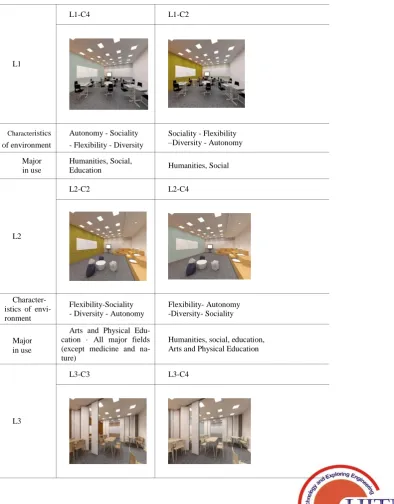
[image:9.595.50.286.50.149.2]Fourth, the six lecture rooms for enhancing creative capacity to utilize environment characteristics and major in the placement-color model derived from Delphi results are shown in Table 15.
Table 15: Six lecture rooms for enhancing creative capacity
L1
L1-C4 L1-C2
Characteristics
of environment
Autonomy - Sociality - Flexibility - Diversity
Sociality - Flexibility –Diversity - Autonomy
Major in use
Humanities, Social,
Education Humanities, Social
L2
L2-C2 L2-C4
Character-istics of envi-ronment
Flexibility-Sociality - Diversity - Autonomy
Flexibility- Autonomy -Diversity- Sociality
Major in use
Arts and Physical Edu-cation · All major fields (except medicine and na-ture)
Humanities, social, education, Arts and Physical Education
L3
[image:9.595.307.542.75.202.2] [image:9.595.133.528.281.786.2]Developing University Classroom Model For Creativity Education by Delphi Survey
Character-istics of envi-ronment
Autonomy- Sociality - Flexibility- Diversity
- Flexibility- Diversity - Autonomy- Sociality
Major
in use Engineering / Medicine Engineering / Social
L4
L4-C4 L4-C1
Character-istics of envi-ronment
Sociality-Autonomy -Diversity - Flexibility
Autonomy- Sociality - Flexibility- Diversity
Major
in use All Major fields
Humanities, Social, Education
L5
L5-C4 L5-C1
Character-istics of envi-ronment
Autonomy - Flexibility - Sociality - Diversity
Autonomy - Flexibility - Diversity - Sociality
Major
in use Education, Medicine Education
REFERENCES
1. Csikszentmihalyi, M. (1989). Society, culture, and person: A system view of creativity. In R. J. Sternberg (Ed.), The nature of creativity: Contemporary psychological perspectives. New York: Cambridge Uni-versity Press, 325-339.
2. Lee, K. H., Lew, K. H. (2014). Creativity, Seoul: Dongmansa. 3. Guilford, J. P. (1967). The nature of human intelligence, New York:
McGrow-Hill.
4. Lee, K. H. (2014). K-ICT (Integrated Creativity Test). Seoul: Inpsyt 5. Urban, K. K. (1995). Test for creative thinking-drawing production.
Lisse, The fianlists. Gifted Child Quarerly, 27(3). 139-144.
6. Dacey, J., & Lennon, K.(1998). Understanding Creativity. SF: Jossey-Bass Publishers.
7. Kristensen, T. (2004). The physical context of creativity. Creativity and Innovation Management, 13(2). 89-96.
8. Haner, U. E. (2005). Spaces for creativity and innovation in two estab-lished organizations. Creativity and Innovation Management, 14(3). 288-298.
9. Amabile, T. M., & Gryskiewicz, N. (1989). Assessing the environment for creativity: The Work Environment Inventory. Paper Presented at the annual meeting of the Society of Industrial and Organizational Psy-chology. Boston.
10. Isaksen, S. G., Puccio, G. J., & Treffinger, D. J. (1993). An Ecological approach to creativity research: profiling for creative problem solving. Journal of Creativity Behavior, 31(3), 212-226.