International Journal of Innovative Technology and Exploring Engineering (IJITEE) ISSN: 2278-3075, Volume-8 Issue-11, September 2019
Power Allocation in Cognitive Radio Networks
using Genetic Algorithm
Keshav Mishra, Aditya Trivedi, Rekha Gupta,
Abstract: Cognitive radio is one of the Frontline areas in wireless communication. With the evolution of 5th generation wireless communication techniques, the expected use of cognitive-communication will be enhanced. The joint model consisting of the Overlay and Underlay spectrum mechanism has been considered for transmission rate optimization using the genetic algorithm and the performance improvement has been recorded over the suboptimum scheme using the JOUSAM model for the cognitive radio network.For a given power budget and interference limit, the transmission rate is optimized with respect to power and bandwidth.
Keywords: Cognitive radio, JOUSAM, GA, Wireless communication, etc.
I. INTRODUCTION
L
ake of spectrum availability and its increasing requirement is a challenging area of a wireless system. In this direction, cognitive radio becomes one of the solutions for this problem, which utilizes the unused frequency spectrum of the primary users. This spectrum sharing technique allows the multiuser to communicate their data on the same frequency spectrum. Another situation is the underutilization of the spectrum band. Hence two types of spectrum sharing systems may be suggested for secondary user data transmission. First is underlay and the other is overlay spectrum access [1-6]. Figure 1 shows the mechanism of both schemes.For efficient utilization of spectrum, CR systems are required to use the unused and underutilized spectrum.
Hence
, a scheme is proposed for power allocation in a joint overlay and underlay spectrum access mechanism (JOUSAM) for [8]. Figure 2 shows the JOUSAM scheme.The purpose of the proposed scheme is transmission rate optimization and it is done concerning power budget and bandwidth. By doing so, the enhancement of transmission rate of CR users is achieved for available power and interference limit. Many researchers had published their work in this field. Some of the related work is described below.
K.R. Shanthy M. E. Et.al, in this paper authors, has considered joint underlay and overlay resource allocation for the cognitive radio system. Results show that an improvement in the transmission rate is achieved in comparison with OSAM or the USAM.
Revised Manuscript Received on September 06, 2019
* Correspondence Author
Keshav Mishra*, Department of Electronics and Communication, MITS, Gwalior, India, Email: [email protected]
Dr. Aditya Trivedi, Information and Communication Technology (ICT) Department, ABV Indian Institute of Information Technology and Management, Gwalior, India.
Dr.Rekha Gupta, Department of Electronics and Communication, MITS, Gwalior, India.
A suboptimal technique is also designed to provide fairness among cognitive users, although compromising with transmission rate [10]
Peng Wang, et. Al, In this paper, to allocate power in the Cognitive Radio system, the traditional water filling method applied in general OFDM is modified due to the per sub-channel power constraints in such systems. They have proposed an iterative partitioned water-filling algorithm for power allocation in cognitive radio systems using OFDM. The Primary Users (PUS) suffer interferences caused by not only the Secondary Users (SUS) transmission in the corresponding sub-channel but also the side-lobes of other sub-channels, which was not considered in this paper [11].
Figure1: Overlay and underlay scheme for spectrum access for cognitive radio[7]
Chin-Hsu Chen, in this paper, the authors have proposed the power allocation scheme considering the primary user activity technique. The proposed power allocation problem becomes maximizing the sum capacity, to do so, water filling is used and performance approaches that of the optimal one. [12].
In [13], imperfect sensing has been identified as one of the reasons for the interference. Also, authors have considered interference due to missed detection while designing power allocation schemes to maximize transmission capacity, but interference because of primary users (PUs) and secondary (SUs) co-existence is not considered
A suboptimal resource allocation scheme is proposed by G. Bansal et. Al. [9]. An improvement in terms of total achievable transmission rates compared to USAM or an OSAM has been observed. According to the suboptimal scheme in this paper, each underlay subcarriers are supplied with constant power while the overlay subcarriers are supplied following a ladder profile, as discussed in [6] Motivated by the above works on resource allocation, particularly in [9], in this paper, we have proposed a new power allocation scheme for the CR system with a JOUSAM using a genetic algorithm. Our contribution can be summarized as follows: with GA it is easy to handle the multivariable and multiobjective problem with nonlinear constraints. Therefore, we have proposed a GA based approach that can
Results
in this paper show that, for specified interference value, an improvement in the transmission rate is recorded by this method. The
scheme is based on the optimization of a cost function. This cost function essentially enhanced the transmission rate and reduce the interferenceThe paper is organized as follows. The mathematical system model is described and the objective function is formulated in Section 2. The proposed GA Based approach is given in Section 3. results using a GA based approach are discussed in Section 4. conclusions are presented in Section5.
II. SYSTEM MODEL
A. Mathematical modeling
PUs and CR users forming a coexistence scenario are depicted in Figure.2.
Figure2: Scheme of joint underlay and overlay spectrum access mechanism for cognitive radio [9]
Let consider, for a given geometrical area, total W bandwidth is allotted to primary users. W bandwidth is divided into M parts for different primary user groups.
(1) Where Wm is the bandwidth of the mth primary user group. Consider K CR users are also using the bandwidth W. For Z subcarriers of CR users, the spectral distance between subcarriers can be given as
(2) both overlay and underlay subcarriers are contained in Z
subcarriers ( i.e. Z=N+L). The power spectral density is given as [5]
(3) Where Ts and are symbol duration and the power allocated in the kth subcarrier respectively.
Let is fading coefficient of the channel between CR transmitter and uth PU subcarrier.
The interference created by CR subcarrier to lth primary user group can be given as [5][6].
(4)
Where denotes the status (0 or 1) if the kth subcarrier is allocated to the uth CR user or not. is the transmitted power by the uth CR user in the kth subcarrier. spectral
distance factor F( ) is defined as [9].
(5)
Let is fading channel coefficient between uth CR user in kth subcarrier and CR transmitter of all CR hence,the
transmission rate for secondary users is given using the well-known Shannon capacity formula, the theoretical total transmission rate of all CR users can be written as
(6)
denotes the additive white Gaussian noise (AWGN) variance, jk,u denotes the interference introduced to the kth subcarrier of the uth CR user due to the transmission of all PUs. Interference is Jk,u treated as Gaussian in the capacity formula
B. Problem domain
To enhance the total transmission rate C with minimizing the interference for all primary users different spectrum access techniques are applied to CR systems while doing so the Probability (Pr) for interference should remain below a certain value a to the lth underlay subcarrier. Therefore, the objective function for a given power budget (PT) is given as
(7)
Conditions (8) & (10)
for all u and k
C. Subcarrier allocation and Objective function
To achieve the goal defined by equation7, subcarrier allocation to a CR user should be done satisfying the following conditions
(11)
Where,
(12) After subcarrier allocation according to (12), the equation
(7) can be written as
(13)
The channel type is Rayleigh channel and if Rayleigh parameter is βl. Then equation(8) can be written as
(14)
(15)
III. PROPOSED GA BASED APPROACH
International Journal of Innovative Technology and Exploring Engineering (IJITEE) ISSN: 2278-3075, Volume-8 Issue-11, September 2019
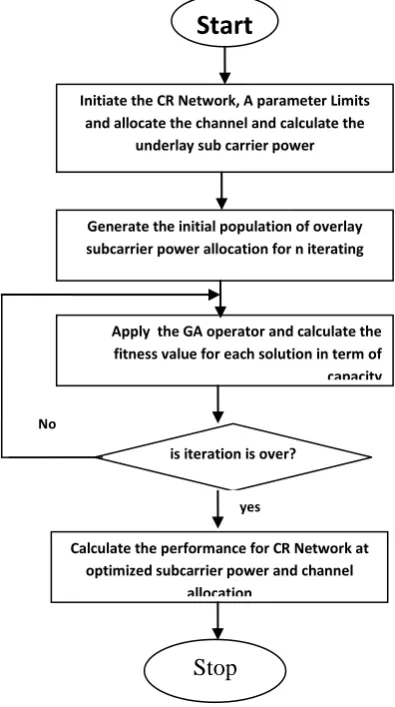
Figure 3: Flowchart of the GA based optimization for power allocation of overlay subcarrier.
GA is an excellent optimization tool due to fast convergence, ease of implementation, and optimization of discrete and continuous radio parameters, render for making resource management decisions in CR networks [15] [16]. The problem 13 is optimized by a genetic algorithm for constraints in equations 14 and 15. The flow chart of optimization is shown in figure3. In this paper, optimization has been performed in terms of the power distribution of
overlay subcarrier using GA. The
underlay subcarriers power is kept fixed and
overlay subcarrier power is calculated as
(16)
where
Poi is the power of ith overlay subcarrier, x is the constant factor which will be determined by simulation and is underlay subcarriers power and is given as
(17)
Where Δf is the spectral distance , Δi is the spectral distance between the ith overlay subcarrier and the closest PU band
In [9] the x is considered as constant for all overlay subcarriers irrespective of the channel conditions. For better power allocation, it is proposed to use the GA to optimize the overlay subcarriers' power by modifying the value of x for each overlay subcarrier. Therefore, equation (16) is modified as
(18)
The optimization function may be defined as
(19)
Each xi is optimized with the constraint[9]
(20) The allocation of channel and underlay subcarrier power is
calculated using the mathematical model and overlay subcarrier power is obtained by using GA based optimization. The results of the above method are described in the next sectionof this paper.
IV. RESULTS
[image:3.595.51.249.60.414.2]The Rayleigh wireless channel is used for simulation. The parameters of the simulations are shown in Table1and the channel conditions (magnitude and Raleigh distribution) are shown in figure 4.
[image:3.595.318.535.450.622.2]Figure 4: Rayleigh channel magnitude and distribution for CR users
Table.1 Parameters used for channel conditions S.
No.
Parameters Specificatio n
1 No .of primary Users 10
2 No .of cognitive radio user
4
3 No. of CR subcarrier 16
4 No. of underlay subcarrier
8
5 No. of overlay subcarrier 8
6 Bandwidth Up to 5 MHz
7 Signal to Noise ratio -10 dBm
8 Power budget 1to 9 mW
9 Interference threshold 500
The transmission rate optimization is the main key of all the simulations. The rate depends on the bandwidth and SNR for data transmission over the network. The simulation has been performed in two phases
A. Transmission rate optimization for different power budget
Transmission rate optimization for different power budget with optimum power distribution is performed. The optimum power distribution to overlay the subcarrier is used to maximize the transmission rate. The transmission rate for the proposed method using the GA algorithm is shown in Figure 5. The Ladder based
approach for overlay
subcarrier power is also
Start
Initiate the CR Network, A parameter Limits and allocate the channel and calculate the
underlay sub carrier power
is iteration is over? Generate the initial population of overlay subcarrier power allocation for n iterating
Apply the GA operator and calculate the fitness value for each solution in term of capacity
Calculate the performance for CR Network at optimized subcarrier power and channel
allocation
Stop
shown in red color. The numerical results show that the GA based approach has produced improved results. The maximum transmission rate achieved is 13.3 Mbps using GA based method as compared to 12.7 Mbps for ladder based power allocation method.
Figure 5: Transmission rate for proposed method using GA algorithm
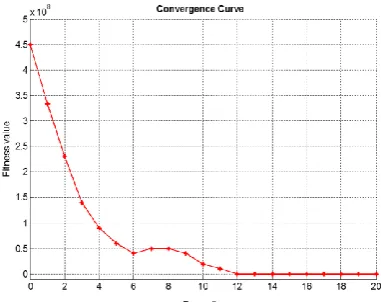
An enhancement of 5% has been observed with the proposed method. Almost 12 iterations or generation
is
required
to converge the optimization. [image:4.595.71.262.317.468.2] [image:4.595.325.524.491.690.2]Figure 6: Convergence curve of GA for transmission rate optimization
Figure 7: Optimum overlay and underlay subcarrier power. Table.2 The GA parameters used for simulation
S. No.
Parameters Specification
1 No. of variables 8(No. of overlay subcarrier)
2 No. of population size 25 3 No. of Generation 20,50,100 4 Lower boundary of variable 1 5 Upper boundary of variable 4
The corresponding convergence curve of the optimization is shown in figure 6. The optimum power distributions to the overlay subcarriers for the different power budgets are shown in figure 7. In the graph, constant points show the underlay subcarriers and other points showing overlay subcarrier. It is clear from the graph, the overlay subcarrier power distributions are modified with an increase in the power budget
B . Transmission rate Optimization with different Bandwidth:
The other important aspect is to improve the rate at different bandwidth. The same parameters of the network have been used for simulation except for the power budget. The fixed power budget is used in the simulation. The parameters of the simulation for this purpose are shown in table3.
Table.3. Parameters of the simulation
S. No. Parameters Specification
1 No. of Primary Users 10
2 No. of cognitive radio user 4
3 No. of CR subcarrier 16
4 No. of underlay subcarrier 8
5 No. of overlay subcarrier 8
6 Bandwidth 1 to 5 MHz
7 Signal to Noise ratio -10 dBm
8 Power budget 1 mW
9 Interference threshold 500
The transmission rate is linearly varied with the bandwidth. The proper distribution of the power to subcarriers improves the increasing trend of transmission rate w.r.t. bandwidth. The genetic algorithm-based optimization is used to optimize power distribution to subcarriers. The Cost function used for the optimization is given as
[image:4.595.75.262.494.638.2]International Journal of Innovative Technology and Exploring Engineering (IJITEE) ISSN: 2278-3075, Volume-8 Issue-11, September 2019
hoto
Figure9 : Improvement in the transmission rate with bandwidth using genetic algorithm
. Where the power budget cases used in the optimization is n. and R(k) is the rate at condition k. The convergence curve for genetic algorithm-based optimization is shown in figure8. The improvement of the transmission rate is shown in figure9. At a bandwidth of 5MHz, improvement of almost 0.3 Mbps has been recorded in the transmission rate. About 3-4 % enhancement was observed with the optimization concerning bandwidth
V. CONCLUSION
The power allocation to overlay subcarriers using GA is done and the performance is compared to a ladder based approach. Optimization is performed concerning different power budget and bandwidth. Improvement in the transmission rate concerning bandwidth using a genetic algorithm is significant at high power as can be observed from figure9. More complicated problems with several subcarriers and considering underlay subcarrier power can be solved with a similar approach. The other evolutionary approach can also be tried to improve the speed of optimization with the much-complicated problem
REFERENCES
1. J. Mitola,III and G. Q. Maguire, Jr., “Cognitive radios: Making software radios more personal,” IEEE Pers. Commun., vol. 6, no. 4, pp. 13–18,Aug. 1999.
2. D.Cabric and R. W. Brodersen, “Physical layer design issues unique to cognitive radio systems,” in Proc. IEEE Int. Symp. PIMRC, Sep. 2005,pp. 759–763.
3. S. Haykin,“Cognitive radio: Brain-empowered wireless communications, ”IEEE J. Sel. Areas Commun., vol. 23, no. 2, pp. 201–220,Feb. 2005.
4. E. Hossain and V. K. Bhargava, Cognitive Wireless Communication Networks. New York: Springer-Verlag, 2007.
5. T. Weiss, J. Hillenbrand, A. Krohn, and F. K. Jondral, “Mutual interference in OFDM-based spectrum pooling systems,” in Proc. IEEE VTC, Milan, Italy, May 2004, vol. 4, pp. 1873–1877. 6. G. Bansal, Md. J. Hossain, and V. K. Bhargava, “Optimal and
suboptimal power allocation schemes for OFDM-based cognitive radio systems,”IEEE Trans. Wireless Commun., vol. 7, no. 11, pp. 4710–4718,Nov. 2008.
7. I. F. Akyildiz, W.-Y. Lee, M. C. Vuran, and S. Mohanty, “Next generation/ dynamic spectrum access/cognitive radio wireless networks: A survey,” Comput . Netw., vol. 50, pp. 2127–2159, May 2006.
8. G. Bansal, O. Duval, and F. Gagnon, “Joint overlay and underlay power allocation scheme for OFDM-based cognitive radio systems,” in Proc .IEEE VTC, Taipei, Taiwan, May 2010, pp. 1–5.
9. Bansal, Gaurav, Md. Jahangir Hossain, Vijay K. Bhargava and Tho Le-Ngoc. “Subcarrier and Power Allocation for OFDMA-Based Cognitive Radio Systems With Joint Overlay and Underlay Spectrum
Access Mechanism.” IEEE Transactions on Vehicular Technology 62 (2013): 1111-1122
10. K. R. Shanthy M. E., M. Suganthi2 and S. Kumaran, “Resource Allocation For OFDMA Based Cognitive Radio System Using Joint Overlay And Underlay Spectrum Access Mechanism”, ARPN Journal of Engineering and Applied Sciences, VOL. 10, NO. 8, MAY 2015 11. Peng Wang, Ming Zhao, Limin Xiao, Shidong Zhou, Jing Wang,
“Power Allocation in OFDM-based Cognitive Radio Systems”, IEEEGLOBECOM 2007
12. Chiuan-Hsu Chen, Chin-Liang Wang, “Power Allocation for OFDM-Based Cognitive Radio Systems under Primary User Activity”, IEEE 2010.
13. S. M. Almalfouh G. L. Stuber, “Interference-aware radio resource allocation in OFDMA-based cognitive radio networks,” IEEE Trans. Veh. Technol., vol. 60, no. 4, pp. 1699–1713, May 2011.
14. Ludovic Me,"Audit de securite par algorithme genetique",university of Rennes1,France,1994.
15. E Adamopoulou, K Demestichas, M Theologou, Enhanced estimation of configuration capabilities in cognitive radio. IEEE Commun. Mag. 46(4), 56–63 (2008)
16. Jamal Elhachmi; Zouhair Guennoun " Cognitive radio spectrum allocation using genetic algorithm" EURASIP Journal on WirelessCommunications and Networking2016 2016:133
AUTHORSPROFILE
Keshav Mishra received the Bachelor’s degree in Electronics and Communication Engineering from the Barkattullah University, Bhopal in 1999, ME in2005 from RGPV, Bhopal in 2005. currently, He is doing his Ph.D. from RGPV, Bhopal. E-mail [email protected]
Dr. Aditya Trivedi is a Professor in the ICT Department of ABV-IIITM, Gwalior, India. He obtained his Ph.D. from IIT Roorkee in the area of Wireless Communication Engineering. His teaching and research interest include Digital communication, CDMA systems, Signal processing, and Networking. He is a fellow of the Institution of Electronics and Telecommunication Engineers (IETE) and a member of Institution of Electrical and Electronics Engineers (IEEE), USA. Email id:[email protected]