International Journal of Innovative Technology and Exploring Engineering (IJITEE) ISSN: 2278-3075, Volume-8 Issue-5S March, 2019
Abstract: The point of this paper is to present and analyze a numerical method to illuminate fuzzy initial value problems (FIVPs) including nonlinear fuzzy differential equations. The primary thought is based reformulate the six stages Runge Kutta strategy of order five (RK65) from crisp case to fuzzy case by taking the advantage of fuzzy set theory properties. It is appeared that the comes about demonstrate that the strategy is exceptionally compelling and basic to apply and fulfil the properties of the fuzzy solution. The capability of RK65 is outlined by fathoming to begin with arrange nonlinear FIVP taken after by usage of the convergence theory. Thus, the strategy can be executed and utilized to allow a numerical solution of nonlinear FIVPs.
Keywords: Fuzzy set theory, Fuzzy differential equations, Six- Stage Fifth Order Runge Kutta Method.
I. INTRODUCTION
The most excellent definition of uncertainty is a term utilized in unobtrusively different ways in a number of fields, including reasoning, insights, financial matters, fund, protections, brain research, building and science. Most dynamical genuine life issues can be defined as a scientific either as a framework of ordinary or partial differential equations [1-3]. Fuzzy differential equations (FDEs) are an excellent tool to demonstrate a dynamical framework when the behavior of most of the data is insufficient or imperfect. Fuzzy initial value problem (FIVP) shows up when the modeling of these issues was defective or not clear and its nature is beneath vulnerability [4]. Fuzzy ordinary differential equations are reasonable real models to demonstrate dynamical frameworks in which there exist vulnerabilities or unclearness. These models are utilized in different applications such as population models [5,6], medicine fields [7], mathematical physics [8]and soon one of the objectives for examining fuzzy set theory is to create the technique of details and to discover solutions of problems that are as well complicated or ill-defined to be satisfactory for examination by ordinary methods.
Revised Manuscript Received on March 08, 2019.
Hala A. Hashim, Dentistry Department, Dijlah University College, Baghdad, Iraq
Akram H Shather, Department of Computer Engineering Techniques, Al Kitab University College, Kirkuk, Iraq
Ali F. Jameel, School of Quantitative Sciences, Universiti Utara Malaysia (UUM), Kedah, Sintok, 06010 Malaysia,[email protected]
Azizan Saaban, School of Quantitative Sciences, Universiti Utara Malaysia (UUM), Kedah, Sintok, 06010 Malaysia
In this manner, fuzziness may be considered as a sort of imprecision that stems from a gathering of components into classes that do not have correct characterized boundaries [3]
An ordinary differential equation involving linear FIVP can be the least difficult case to test the adequacy of proposed strategies for find in the solution of FDE. The one-step Runge-Kutta methods with various orders have been widely successfully implemented for the solution of first order linear FIVPs in [9-12].
According to the Runge-Kutta methods in [9-12], we concluded that of the first order FIVPs that have been solved by are linear. Furthermore, it is noted that the method of the Six- Stage Fifth Order Runge Kutta Method (RK56) has not been employed yet on first order nonlinear FIVP. It would be of interest to investigate the feasibility of fifth order Runge -Kutta method for first order nonlinear FIVPs.
The efficiency of Runge-Kutta methods depend on increasing the number of function evaluations per step [13].
Our primary objective is to show and analyze the utilize of (RK65) in arrange to get the numerical solutions of nonlinear by using fuzzy set theory properties. The structure of this work is as follows. We will begin in Section 2 with a few essential definitions for fuzzy sets. In Section 3 we characterized the defuzzification method of first order nonlinear order FIVP followed by formulation and detailing RK56 in fuzzy domain. In Section 4, we test and actualize RK65 on first order nonlinear FIVP followed by the impanation convergence theory in [1] on the obtained results. Finally, deliver the conclusions is given in Section 5.
II. SOME FUZZY CONCEPTS
Definition 2.1 [14]: The r-level (or r-cut) set of a fuzzy set , labeled as , is the crisp set of all such that
i.e.
.
The r-level set is the interface between the fuzzy space and the crisp space. In that case we can utilize the preferences of the hypotheses in crisp space in the fuzzy space.
Hala A. Hashim, Akram H Shather, Ali F. Jameel, Azizan Saaban
Numerical Solution of First Order Nonlinear
Fuzzy Initial Value Problems by Six- Stage
Fig. 1 Nested r-level sets
From Fig. 1, we concluded that the degree of fluffy enrollment work [4] is associated with the values of r-level setsfor all . In other hand when the esteem of r -level set is approach to 1 that implies the fuzzy range ended up and near to crisp space.
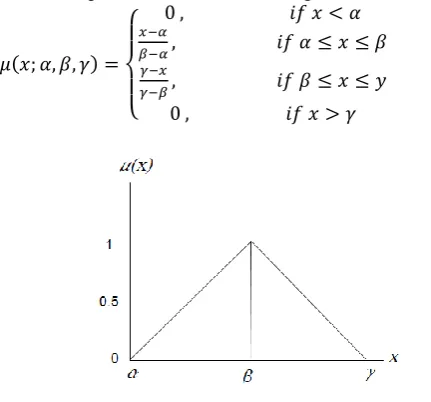
Definition 2.2: Fuzzy numbers are a subset of the real numbers set and represent uncertain values. Fuzzy numbers are connected to degrees of membership which state how genuine it is to say in case something has a place or not to a decided set. A fuzzy number is called a triangular fuzzy number [15] that characterized by three parameters
where the graph of (see Fig. 2) is a triangle with the base on the interval and vertex at and its membership function has the following form:
(1)
Fig. 2 Triangular Fuzzy Number
From Eq. (1) the r-level set [16] of the triangular fuzzy number for all is:
.
The class of all fuzzy subsets of real number satisfy the following properties [9, 17]:
1. is normal, i.e with .
2. is convex fuzzy set, i. e. ,
3. upper semi-continuous on , 4. is compact.
Definition 2.3 [18]: Define the r-level set , ,where is compact [9] which is a closed bounded interval and denoted by
. In the single parametric form
[18], a fuzzy number is represented by an ordered pair of functions
, which satisfies:
1. is a bounded left continuous non-decreasing
function over .
2. is a bounded right continuous non-increasing
function over .
3. , A crisp number r is
simply represented by ,
Toward to end the solution of the FIVP must satisfy the properties 1-3 of triangular fuzzy number.
Definition 2.4 [19]: If be the set of all fuzzy numbers, we say that is a fuzzy function if
Definition 2.5 [9]: A mapping for some interval is called a fuzzy function process and we denote r -level set by:
.
The sets of a fuzzy number are much more compelling as representation shapes of the fuzzy set. Fuzzy sets can be characterized by the families of their sets based on the determination character hypothesis.
Definition 2.6 [20]: Each mapping induces another mapping defined for each fuzzy interval in by:
This is called the Zadeh extension principle.
III. ANALYSIS OF RK 65 IN FUZZY ENVIRONMENT
Concurring of the defuzzification strategy in [9], consider the nonlinear first order FIVP of the following type:
(2)
where : is a fuzzy function of the crisp variable such that
, and : is fuzzy nonlinear function of the crisp variable and the fuzzy variable , such that . We note that
, (3)
where such that is
the inhomogeneous term. The fuzzy coefficients in Eq. (3) are triangular fuzzy numbers denoted by and for all the fuzzy level set .
: is the first fuzzy H-derivative [17,19] such that ,
: is the initial condition triangular fuzzy numbers denoted by .
[image:2.595.47.263.365.566.2]International Journal of Innovative Technology and Exploring Engineering (IJITEE) ISSN: 2278-3075, Volume-8 Issue-5S March, 2019
(4)
Let such that and by using the fuzzy Zadeh extension properties as in Definition 2.6, we can define the following membership function
(5)
where
(6)
The RK65 for the numerical solution of crisp initial value problems was presented in [21]. According to Section (2), we modify Eq. (2) in to taking after conditions
(7)
(8)
On solving Eq. (7) using RK65, we have: Let ,
32 5( )+7 6( ) , where
;
;
;
;
9 4( )/16( );
12 4( )+8 5( )/7( ).
On solving Eq. (8) using RK65, we have: Let
,
where
;
( 1( )2)( )
;
;
9 4( )/16( );
12 4( )+8 5( )/7( ),
Thus, we have = , and
=
for i = 1. . . N. we note that where
j=1,2,3,4,5,6.
IV. NUMERICAL EXAMPLE
Consider the first order nonlinear FIVP
(9)
Using MTHEMATICA version 11, to obtain the exact analytical solution of Eq. (9) for all 0 ≤ r ≤ 1 as follows
,
.
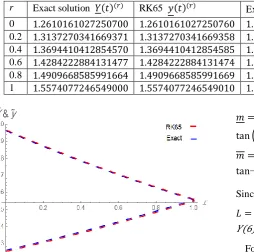
Figure 3 show the exact solutions of Eq. (9) i.e. ( and where , and 0 ≤ r ≤ 1):
Fig. 3 Exact solutions of Eq. (9) i.e.
Fig. 4 Exact solutions of Eq. (9) i.e.
According to Section 3, we have
, with initial point ,
(10)
, with initial point .
(11)
Table 1 show the exact solutions and the numerical solution generated by RK65 in Section 3 with selected step
[image:4.595.54.546.88.439.2]size for different values of
Table. 1 Compassion between exact solutions and lower and upper bound solutions of Eq. (9) generated by RK65 at with for all
r Exact solution
RK65
Exact solution RK65
0 0.2 0.4 0.6 0.8 1
Fig. 5 RK65 numerical solutions (y) and the exact solutions (Y) of Eq. (9) at t =1
Following the definition of convex fuzzy number in Section 2, one can see that the outputs in Fig.5 and Table 1 the fuzzy number conditions and approach to one solution for the upper and lower bound solutions of Eq. (8).Finally, we define error bounds of RK65 for as follows:
,
,
such that,
,
tan−11− 10.
Since
, hence then
, we note that
(6) ( ).
For , and then the global errors and the error bounds of the numerical solution of Eq. (9) can be written as:
.
[image:4.595.68.323.110.362.2]Table 2 show the absolute errors and the errors bound for the numerical solution solved by RK65 for Eq. (9).
Table. 2 Absolute errors and the errors bound of Eq. (9) of the numerical solutions by RK65 at t=1 with step size
r RK65 RK65
0
0.2
0.4
0.6
0.8
1
From Table 2 one can see thatfor all such that
, and .
V. CONCLUSIONS
In this article, we presented a numerical a scheme for solving first fuzzy order differential equation. The scheme is based on the six stages fifth order Runge Kutta method for solving first order nonlinear FIVP. Numerical example was provided and the RK65 is a competent and precise scheme. The testing of the convergence theorem 5.6 of RK65 in [1] was successfully connected of numerical solutions generated by RK65. Moreover, the gotten outcomes obtained from
RK65 fulfil the properties of triangular fuzzy number and fuzzy differential equations.
VI. ACKNOWLEDGEMENT
This research was funded by a matching grant research project between University Utara Malaysia, Sintok, Kedah, Malaysia and Al-Kitab University, Kirkuk, Iraq under the research collaboration
[image:4.595.111.489.532.633.2]International Journal of Innovative Technology and Exploring Engineering (IJITEE) ISSN: 2278-3075, Volume-8 Issue-5S March, 2019
REFERENCES
1. Ali, Jameel, Anakira, N R,Alomari, AK, Hashim, I and Shakhatreh MA. “ Numerical solution of n’th order fuzzy initial value problems by six stages ,”Journal of Nonlinear Science and Applications 9, no. 2 (2016):627–640.
2. Abbasbandy S, Allahvinloo T, andDarabi P. “Numerical solution of n-order fuzzy differential equations by RungeKutta method,” Mathematical and Computational Applications 16, no. 4 (2011): 935– 946, 2011.
3. Ali, Jameel, Anakira, N R, Alomari, A K, Hashim, I, and Momani, S.“A New Approximation Method for Solving Fuzzy Heat Equations,”Journal of Computational and Theoretical Nanoscience 13, no. 11(2016): 7825-7832.
4. Seikkala, S.“On the Fuzzy initial value problem,”Fuzzy sets and systems14,no. 3 (1987):319-330.
5. Omer, A, and Omer, O.“A pray and predator model with fuzzy initial values,”Hacettepe Journal of Mathematics and Statistics 14, no. 3 (2013): 387– 395.
6. Smita, T, and Chakraverty, S.” Numerical solution of fuzzy arbitrary order predator-prey equations,”Applications and Applied Mathematics8, no. 1(2013): 647-673.
7. Abbod M F, Von Keyserlingk, D G, and Mahfouf M. ” Survey of utilization of fuzzy technology in medicine and healthcare,”Fuzzy sets and systems 120, no 2(2001): 331-3491.
8. El Naschie M S.“From Experimental Quantum Optics to Quantum Gravity Via a Fuzzy Kahler Manifold,”Chaos, Solitons & Fractals 25, no. 5 (2005): 969-977.
9. Ali F J, Ahmad I I, and Amir S, “Numerical solution of fuzzy IVP with trapezoidal and triangular fuzzy numbers by using fifth order Runge-Kutta method,”World Applied Sciences Journal 17, no. 12 (2012):1667-1674.
10.Duraisamy C, and Usha, B. “Numerical Solution of Fuzzy Differential Equations by Runge-Kutta Method of Order Four,”European Journal of Scientific Research 67, No.2, pp. 324-337, 2012.
11.V. Nirmala, S. Chenthur Pandian, New Multi-Step Runge –Kutta Method For Solving Fuzzy Differential Equations, Mathematical Theory and Modeling, Vol.1, no.3 (2011): 16-22.
12.Ramli, A, Ahmad, R R, Din A,and Salleh, A R. “Third-order Composite Runge Kutta Method for Solving Fuzzy Differential Equations,”Global Journal of Pure and Applied Mathematics22, no. 3 (2016): 2753-2764.
13.Julyan H E, Oreste P.”The dynamics of Runge–Kutta methods,”International Journal of Bifurcation and Chaos 2, no. 3 (1992): 27–449.
14.Bodjanova, S.” Median Alpha-Levels of A Fuzzy Number,” Fuzzy Sets and Systems157, no. 7 (2006): 879-891, 2006.
15.Dubois D, Prade H, “Towards fuzzy differential calculus, Part 3: Differentiation,”Fuzzy Sets and Systems 8, no. 3(1982): 225-233. 16.Fard, O S. “ An iterative scheme for the solution of generalized system
of linear fuzzy differential equations,”World Applied Sciences Journal 7, no. 12 (2009):1597-1160.
17.Faranak, R, Fudziah I, Ali, A,and Soheil S.”Numerical solution of second-order fuzzy differential equation using improved Runge-Kutta Nystrom method,”Mathematical Problems in Engineering 2013, (2013): pp 1-10.
18.Kaleva, O.” Fuzzy differential equation,”Fuzzy Sets and Systems 24, no. 3 (1987): 301-317.
19.Mansour, S S, and Ahmady, N.“A numerical method for solving Nth-order fuzzy differential equation by using Characterization theorem,”Communications in Numerical Analysis2012, (2012): 1-12. 20.Zadeh, L A. “Toward a generalized theory of uncertainty,”Inform
Sciences172, no. 2 (2005):1–40.