Abstract: This work review’s commercial and residential scale adsorption cooling systems and other industrial size adsorption refrigeration systems in line with the need to make enhanced heat transfer a compact system. The main objective of the study is to present the methods used for enhancing the specific cooling power output, cooling effect leading to make a compact adsorption cooling system. Various systems studied include silica gel-water, activated carbon-ammonia, zeolite-water, and metal-organic framework (MOF) material. The review concludes that silica gel-water working pair gives better performance as compared to MOF material with 10-15 min as short cycle time. MOF material gives better results as compared to silica gel-water with more than 60 min of adsorption-desorption cycle time. For the case of activated carbon- ammonia, when the metal powder of copper, iron, and aluminum replaces 10 to 30% of the mixture gives better performance than using activated carbon alone due to the high thermal conductivity of added metals. It is also concluded that performance of Regular Density (RD) silica gel is slightly better than RD 20-60, Type A and Type B silica gel. Silica gel-water working pair is preferable as compared to Zeolite-water pair for low-grade heat utilization.
Index Terms: MOF materials, Adsorption, Refrigeration, Silica gel, Zeolite
I. INTRODUCTION
Conventional vapor compression refrigeration system (VCRS) and air conditioning unit consumes a lot of electrical energy. Worldwide it has consumed around 15% of total electricity produced. This electricity has been traditionally produced by using fossil fuels like coal, oil, natural gas etc which releases greenhouse gases as cited by Wang et al. (2010)[1]. The greenhouse gases are responsible for global warming and climate change. VCR Systems uses chlorofluorocarbon (CFC’s) and hydrochlorofluorocarbon (HCFC’s) which are a threat to the ozone layer as cited by Wang et al. (2006) [2]. The adsorption cooling technology has emerged as an alternative to the present system of VCRs as here there are no moving parts, so this system is noiseless. It does no use CFC’s and HCFC’s refrigerant. It has zero global warming potential (GWP). This system can effectively utilize waste heat for the production of the cooling effect, so it increases the utility of the existing system. It can use solar energy as driving energy for producing cold so the demand for peak cooling need is offset by peak availability of solar energy.
In adsorption cooling system the adsorbate is regenerated by application of heat energy and the refrigerant vapors released are
Revised Manuscript Received on May 25, 2019.
Jaspalsinh B Dabhi, Ajitkumar N Shukla , Sukanta Kumar Dash Research Scholar, Department of Mechanical Engineering, School of Technology, PDPU, Gandhinagar,Gujarat, India.
Director, PSIT-Pranveer Singh Institute of Technology Kanpur, Assistant Professor, School of Technology, PDPU, Gandhinagar.
condensed in the condenser. The condensate enters the evaporator where it absorbs heat energy from the working medium and vaporizes thus produces the cooling effect. This work presents the methods for enhancing SCP output by adding MOF material to increase heat transfer, heat and mass recovery schemes, using advanced working pairs, multi-bed – multi-stage systems, cycle time optimization, and heat exchanger designs focussed on making it compact. The cooling effect, compactness of adsorption cooling system and coefficient of performance (COP) are key driving forces for the new design of the adsorption system. The various system studied includes different working pairs like silica gel-water, activated carbon- ammonia, activated carbon-methanol, zeolite-water, and MOF Materials.
Graphical Abstract of Model Nomenclature:
Symbols:
TTemperature [⁰C]
V Latent Heat of Vaporisation [kJ kg-1] t Cycle Time [sec]
Δq Cycle adsorption quantity [kg kg-1 ] Q Heat [kJ kg-1]
Abbreviations:
SCP Specific Cooling Power [W kg-1] COP Coefficient of performance [-] Qc Cooling capacity [W]
Subscript: amb ambient. reg regeneration. max maximum. ads adsorption. ev evaporation. con condensation. c cycle.
hp high pressure. lp low pressure. in input. out output.
Compact Adsorption Cooling System: An
Evaluation
In adsorption cooling system the adsorbate is regenerated by application of heat energy and the refrigerant vapors released are condensed in the condenser. The condensate enters the evaporator where it absorbs heat energy from the working medium and vaporizes thus produces the cooling effect. This work presents the methods for enhancing SCP output by adding MOF material to increase heat transfer, heat and mass recovery schemes, using advanced workit
ng pairs, multi-bed – multi-stage systems, cycle time optimization, and heat exchanger designs focussed on making it compact. The cooling effect, compactness of adsorption cooling system and coefficient of performance (COP) are key driving forces for the new design of the adsorption system. The various system studied includes different working pairs like silica gel-water, activated carbon- ammonia, activated carbon-methanol, zeolite-water, and MOF Materials.
Basics of Adsorption Cooling and its working principle: Thermal cooling is a process of thermo-chemical sorption, in which liquid or gaseous fluid is either attached to the solid, porous material or absorbed in the solid/liquid material. Adsorption is a reversible process in which fluid molecules set onto the solid matrix or porous surface of the material. During the time set, it releases some energy because of an exothermic process and thermodynamic divariant equilibrium is established. `
Figure 1 Adsorption Chillers Process (Mohammed et al. 2018) [5]
As shown in Figure 1 the adsorption chillers consist of four major components namely Evaporator, Condenser, Adsorber, and Desorber. The components of Adsorption chillers are already discussed in the literature (Al-Mousawie et al. (2017)[3], Liu et al. (2005)[4], and Mohammed et al. (2018)[5]). Adsorption is a surface-based process; Physical adsorption depends on the Vander Waal force among the molecules and occurs on the surface of adsorbents. The Physical adsorption becomes a multilayer adsorption. The phenomena of physical adsorption are treated as the condensation process of the refrigerant inside the adsorbents and the adsorption heat is similar to the condensation heat of the refrigerant for adsorbents. The molecules of the physical adsorption are unchanged in the desorption process. Chemical Adsorption takes place due to the chemical reaction between the adsorbent and surface of adsorbate. In chemical Adsorption heat energy adsorbed or desorb will be more as compared to physical adsorption. Chemical adsorption is a selective process and it occurs in certain pairs e.g. H2 (hydrogen) can be adsorbed in the surface W(Tungsten), Pt(Platinum), and Ni(Nickel), but cannot be adsorbed in the surface of Cu(Copper), Ag(Silver), and Zn(Zinc). As like the conventional air conditioning system, this system operates between evaporator and condenser. The total system works in a vacuum including the evaporator and condenser. The work supplied by the compressor in the conventional system is supplied in form of heat energy to the adsorption bed in this system. The system is analyzed by using the Clausius Claperyon diagram shown in Figure 2.
Figure 2 Clausius Claperyon diagram for the basic Adsorption cooling thermodynamic cycle with refrigerant loop. (Mohammed et al. 2018) [5]
Adsorption-Evaporation and Desorption- Condensation occur at evaporator pressure and condenser pressure respectively. Clausius Claperyon diagram consists of four processes namely isosteric-heating (1-2), isobaric heating (2-3), isosteric cooling (3-4) and isobaric cooling (4-1). The working principle of the adsorption cooling system has already been discussed in literature. (Youssef et al. (2017)[6], Jafari and Poshtiri (
2017)[7], and Teng et al. (1997)[8]).
Adsorption chillers are larger in size as compared to VCR Systems due to poor thermal inertia but due to the absence of moving parts, it seems very advantageous to the industries with low maintenance cost and smooth operation by removing the compressor.
II. LIMITATIONSOF ADSORPTIONSYSTEM
The basic limitation of the adsorption/desorption process is that it is not continuous. It requires maintenance of high vacuum, low specific cooling power output and has a low coefficient of performance. These machines are largely due to lower thermal inertia; it requires more space for its different components installation, high investment cost and skill to operate it. So to look into these aspects the adsorption cooling system is discussed in the following section focussing on technology and applications.
III. CERTAINEXPERIMENTSTOCOMPACT
Metal-Organic Framework
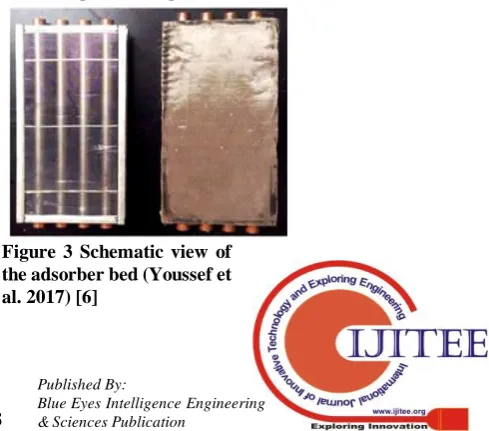
Youssef et al. (2017)[6] investigated the use of CPO-27(Ni) as an advanced MOF adsorbent material in 1-bed adsorption cooling system for water desalination and cooling application by conducting an experiment and also developed a mathematical model. The mathematical model was validated to predict cycle outputs at different working conditions. Figure 3 shows a rectangular fin-tube heat exchanger with adsorbent material packed between fins and surrounded by metal mesh to keep adsorbent particles in position.
[image:2.595.308.524.50.186.2] [image:2.595.304.549.616.831.2]Characterization of CPO-27(Ni) was carried out by Elsayed et al. (2015)[9] based on particle size and pressure for adsorption of water. They measured particle size and pressure by laser diffraction chemical composition by using XRD and DVS. They observed that for short (10-15min) Adsorption-Desorption cycle time; silica gel performed better than CPO-27(Ni). For longer duration (more than 1 hour) of Adsorption-Desorption cycle time, CPO-27(Ni) performed better than silica gel.
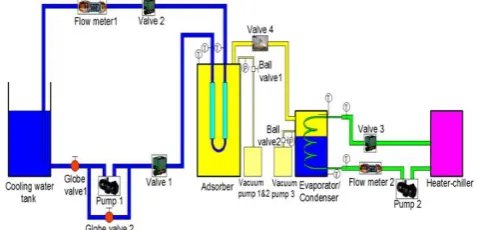
[image:3.595.310.536.110.249.2]Shi et al. (2016)[10] investigated the feasibility of MOF, CPO-27(Ni) using dynamic modeling and experimental testing facility by employing an adsorption cooling system for automobile air conditioning application. They simulated 2.4kW double bed adsorption system and found SCP of 440W/kg and COP of 0.456 at temperature 130°C of desorption obtained from exhaust gases. They concluded from the experiment that CPO-27(NI) produced 42% higher SCP output which makes the system more compact. Figure 4 shows the schematic diagram for the test facility.
Figure 4 Schematic diagram of Test rig (Elsayed et al.2017) [11]
MOF materials; CPO-27(Ni), Aluminium fumarate and MIL-101(Cr) were used for water desalination by using adsorption system by Elsayed et al. (2017) [11] at laboratory scale. The MOF adsorption distillation system was modeled and compared to the silica gel with the use of Matlab/ Simulink. They conclude that at low evaporation temperature 5°C CPO-27(Ni) is more appropriate and high regeneration temperature ≥110°C available for achieving a water production rate of 6.3 m3.(ton.day)-1 specific daily water production (SDWP). The MIL-101(Cr) results in excellent performance producing of 11 m3. (ton.day)-1 at an evaporation temperature of 20 °C which outperforms with any other adsorbent material. Elsayed et al. (2016)[12] worked to observe the water adsorption characteristics of two MOF materials namely CPO-27(Ni) and Aluminium fumarate in terms of isotherms, kinetics, and cyclic stability. They investigated thermodynamic cycle performance of this material based on their equilibrium adsorption data under different operating conditions for various adsorption applications such as heating, cooling, and water desalination. They observed that the CPO-27(Ni)/water working pair performed better than aluminium fumarate/water pair at low evaporation temperatures (5⁰C) and high desorption temperatures (≥ 90⁰C), while the aluminum fumarate/water pair has been more suitable for applications requiring high evaporation temperature (20⁰C) and/or low desorption temperature (70⁰C). Al-Mousawi et al. (2016)[75], observed the effect of advice need adsorbent materials such as AQSOAZ02 (SAPO-34) zeolite and MIL101Cr Metal-Organic Framework (MOF) at various operating conditions on power and cooling performance of adsorption cooling system, compared to commonly used silica-gel has been investigated using water as the refrigerant. Experiment results show that for all adsorbents used as the heat
[image:3.595.48.288.266.381.2]source temperature increases, the cooling effect and power generated increase. Figure 5 shows the effect of bed cold temperature on the efficiency of the system for different working pairs namely silica gel – water, SAPO-34-water, and MIL 101Cr-water.
Figure 5 Effect of bed cold temperature on efficiency with a different pair. (Al-Mousawi, Al-Dadah and Mahmoud 2016) [76]
The comprehensive analysis of MOF and Zeolite coatings was studied by Tatlier (2017) [13] for various operating conditions of the adsorption cooling system. Tatlier also developed a mathematical model with an objective function to improve the power of the adsorption system. It concluded that 10-20% high power provided by Zeolite LiX coating as compared to zeolite NaX coating and zeolite X have high water adsorption capability as compared to the triazolyl phosphonate MOF.
Adsorption chillers:
Jafari and Poshtiri (2017) [7] developed a mathematical model of adsorption cooling system the sing solar energy for cooling of the single-story building. Their system contains four basic components; adsorption chiller, solar heat source, solar chimney, and cooling channel. They simulated theoretically the system and evaluated the room temperature, relative humidity, and air change per hour. They observed the ACH remains almost stable during the system's operation time at each cooling demand. This indicated that the adoption of three cooling plates in the channel provides the lowest room temperature and use of three plates instead of one decreases to room temperature by 26.8%. Ali (2017) [14] worked on the residential scale solar based adsorption cooling system with the thermal driven module. They developed a dynamic model that couples the solar cooling system and building using TRNSYS tool. After gaining the operational experience of four years it was concluded that heat rejection has a significant effect on the performance system. The average COP of chiller was ranging from 0.4 to 0.64 with a cooling capacity of 8kW was reported.
Solar-driven adsorption chillers were studied by Mitra et al. (2014) [15]; they observe the effect of collector area and cycle time on the performance of adsorption system to determine the most advantageous operating conditions for cooling and desalination application. They used silica gel-water as a working pair for single stage four bed adsorption chillers. Jaiswal et al. (2016)[16] studied the dynamic performance of single stage two-bed adsorption chiller using silica gel-water as working pairs. They observed that the performance parameters such as Cycle Averaged Cooling Capacity (CACC) and Daily Average Cooling Capacity (DACC) increase relative to the increase in the solar collector area. Hybrid Stirling engine adsorption chillers were studied by Flannery et al.
trucks and tested experimentally. The system is superior as it has low noise level and maintenance. The adsorption chiller system achieved a regular COP of around 0.42 and 2.3 kW of cooling capacity at the baseline test condition. The adsorption chiller was examined by Sapienza et al. (2017) [18] with water- silica gel for equilibrium and dynamics study of water adsorption in the commercial application. They compared the experimental data to the earlier reported Fuji silica Regular density (RD). They examined the effect of silico-alumino-phosphate (AQSOA FAM-ZO2) and Water working pair for dynamic optimization of adsorption chillers. Reasonable change of the water uptake of ca. 0.12 g/g was achieved with typical boundary conditions that used for an AC cycle.
Bataineh and Taamneh (2016)[19] reviewed recent improvements in solar sorption cooling systems and conclude that in order to compete with conventional cooling systems requires building the sorption cooling systems more cost and energy efficient. Large-Temperature Jump Method and dynamic modeling for adsorption heat pumps and chillers have been utilized by Graf et al. (2016)[20] to predict SCP and COP. The objective of this experiment was to reduce the cost and desorption time by combining Large-Temperature Jump and dynamic modeling methods. They determined SCP 268 W.kg-1 and COP 0.51 for desorption time of 125 sec and adsorption time of 200 sec. The multi-bed adsorption chiller study was carried out by Wang, He, and Chua (2015) [21] with silica gel – water as a working pair. The lumped parameters have been developed for four-bed adsorption chillers and the predictions were compared to the experimental results. They concluded that cooling capacity and COP prediction error increased from 7% to 12% with cycle time increasing from 120s to 420s. Fast water adsorption chillers and heat pumps have been studied by Kumar, Fuldener, and Henninger (2015) [22] with siloxane adsorbent coatings. Two absorbents SAPO-34 and Zeolite were used as adsorbents. The results were compared to the pure binder MP50E adsorbent. They observed the slight change in the shape of isobar at low relative vapor pressure for the SAPO-34 coatings. Adsorption chillers cycle time allocation optimization was carried out by Bau et al. (2015) [23] with the gradient descent method. From the results, it was observed that the model predictive control method could increase the cooling energy by 16:5% for a sunny day and 21.6% for a cloudy day. Thus it can be useful to develop advanced controllers for switching from optimization of cooling power to optimizing efficiency, according to cooling demand. 4-bed silica gel-water adsorption chillers for combined cooling and desalination system with the detailed mechanical design were presented by Mitra et al. (2015)[24] with 1.6mm average RD-type silica gel. The results show that the inter-stage plenum and plenum before condenser helps to attenuate adsorber pressure within a fluctuation of 0.5 kPa. Solar power adsorption chillers have been studied by Sarkar et al. (2013) [44] with finned tube heat exchanger bed using silica gel-water augmentation technique. They conclude that it is necessary to make the system economically viable and development in performance simulation of the adsorption chillers will help to optimize the system. The operation parameters effect has been observed by Luo, Wang, and Dai (2010) [25] on the solar-powered adsorption chillers performance. They have been observed that for daily solar radiation of 16-21 MJ/m2 the cooling capacity produced by adsorption chillers was about 66-90W/m2 collector area and COP about 0.1-0.13. Problems and solution of adsorption heat pump have been reviewed by Demir, Mobedi, and Ulku (2008) [26] as compared to the Vapour compression and absorption heat pumps. The problems
[image:4.595.315.504.300.441.2]during the design and production such as high vacuum and leakages, poor mass, and heat transfer have been observed. With recent developments in design and reduction of some problems of the adsorption heat pump will lead to the application of adsorption heat pumps in industries, commercial, and residential in near future. A detail parametric study of regenerative adsorption chillers was performed by Saha et al. (2006)[27] on dual-mode multi-bed regenerative chillers using silica gel-water as working pairs for utilizing low-grade waste heat. The highly efficient chiller has been operated between 60 to 95°C. The results have been observed that the COP increased with increasing chilled water inlet temperature above 14°C results in declination of cooling quality. Continuous adsorption water chiller was designed and experimentally performed by Liu, Wang, and Xia (2005) [4] with silica gel-water working pair. They compare the experimental results of an adsorption icemaker operating without refrigerant mass recovery and under two kinds of mass recovery cycles. The results show that the cycle with mass recovery in a double stage generated 42% more refrigerant mass than the cycle without mass recovery when the regeneration temperature was 85 ⁰C.
Figure 6 Cycle with mass recovery in double stage operation (Liu, Wang and Xia 2005).[4]
Figure 6 shows the operation mode of the cycle with mass recovery for two-stage adsorption chiller. For mass recovery operations at the end of the adsorption phase, two pairs of adsorbents are required. One pair operates at low and medium evaporation pressure and another pair operates at medium and high condensing pressure.
Air conditioning and ice making solar adsorption systems were reviewed by Dieng and Wang (2001) [28]. They compared adsorption systems with required heat source temperature above 100°C like zeolite- water system and activated carbon-methanol or conventional compressor chillers; they concluded that silica gel – water adsorption systems that work below 100°C were able to utilize low-grade waste heat. Multi-bed adsorption chillers have been reported by Saha, Akisawa, and Kashiwagi (2001) [29] for waste heat utilization and reduction of fluctuation in Chilled water outlet temperature. The aim of this study was to extract the most enthalpy of low-grade waste heat before draining. They found that four-bed chillers produced 70% more cooling compared to with two-bed chillers and six-bed chillers producing 40% more cooling capacity as compared to the four-bed chillers. Two-stage adsorption chillers have been studied by Chua et al. (1999) [30] which utilize solar waste heat and used silica gel - water as working pair. They found that the system effectively runs at
55°C regeneration
prediction and experimental data to verify the system agreement.
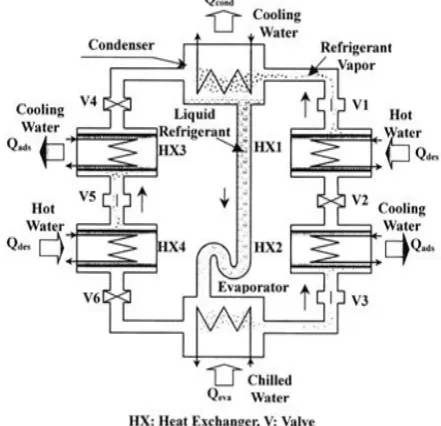
Figure 7 Schematic of the two-stage adsorption chillers (Chua et al. 1999).[30]
Figure 7 shows two-stage adsorption chiller. The heat rejected by HX4 is utilized by HX3 as regeneration heat to regenerate adsorbent.
Commercialization:
Al-Mousawi, Al-Dadah, and Mahmoud (2017) [3] worked to exploit the low-grade heat sources from industrial processes with the help of adsorption cooling and organic Rankine cycle (ORC). The integrated double bed adsorption cooling cycle with ORC and working pairs utilized were AQSOA-ZO2 (SAPO-34)-Water, Silica Gel- Water. The ORC working fluid used in the system was R245fa, R365mfc, and R141b. The investigation was performed in four different scenarios such as Adsorption Heat Recovery Scenario (AHRS), Return Adsorption Heating Fluid Scenario (RAHFS), Heat Exchanger Scenario (HES), and Return Adsorption Heating Fluid Scenario (RORCHFS). From the experiment it has been found that the integrated adsorption – ORC system by using silica gel-water and R252b had achieved efficiency up to 70% and the SAPO 34 – water and R141b achieved efficiency up to 60%. But the maximum Specific Power (SP) and Specific Cooling Power output (SCP) was achieved 208W/kg.ads and 616 W/kg.ads by SAPO 34 and R141b respectively. Younes et al. (2017) [31] reviewed working pairs for the adsorption cooling application. They built a comparison based on SCP and COP of selected physical adsorption cooling and refrigeration systems. The selection of working pairs depended upon their availability, cost, physical, chemical and thermodynamic properties. They noted that the refrigerant must have a good latent heat of vaporization to enhance the cooling capacity. From the whole review, they observed that the development of present refrigeration systems is needed to compact commercial adsorption cooling systems. Vehicle air conditioning using waste heat adsorption performance has been studied by the Sharafian et al. (2016) [32] to measure the effect of adsorbent mass and number of adsorber beds on adsorption system with a working pair of 2mm particle size AQSOA-FAM-ZO2/water ACS under different operating conditions. The heat transfer area in the bed is 2.8m2 with 2.5mm fin spacing compared to 0.235m2 heat transfer area with 8.5mm spacing between fins. The investigational results show that reducing the mass of FAM-Z02 from 1.9 to 0.5 kg in a one-adsorber bed ACS increases the SCP by 82% from 65.8 to
[image:5.595.63.284.71.284.2]119.4 W/kg at a cycle time of 20 min. However, the COP reduces by 37% because of the increase in the adsorber bed to adsorbent mass ratio.
Figure 8 Schematic of two-bed Adsorption Cooling System ACS (Sharafian et al. 2016) [32].
Figure 8 shows the schematic diagram for a two-bed adsorption cooling system. The black line indicates the path of refrigerant flow while pink and blue line indicates the path of heat transfer fluid flow. Critical analysis of Adsorption Cooling System (ACS) has been carried out by Sharafian and Bahrami (2015) [33] for light-duty vehicle Air Conditioning (AC) application. The ACS has been driven by 2kW waste heat. The maximum SCP and COP have been observed between 10 and 15 min cycle time.
Residual methods:
Askalany et al. (2017) [34] measured the effect on adsorption cooling system performance due to enhancing the thermal conductivity of adsorbent. They mixed iron, copper, and Aluminium with different concentration ratio ranging from 10% to 30% in the granular activated carbon and their effect on the thermal conductivity has been observed. From this experiment, they observed the highest effect on enhancement of thermal conductivity with the Aluminium mixture as compared to the iron and copper the metallic percentage calculated by equations.
Figure 9 A schematic diagram of a two-bed adsorption cooling system (Askalany et al. 2017) [34]
Figure 9 shows two bed ACS with GAC/HFC-407C Adsorption pair. Adsorption-evaporation and desorption-condensation take place in the beds simultaneously producing a continuous cooling effect.
Solovyeva, Aristov, and Gordeeva (2017) [35] worked on water adsorptive dynamics with NH2-MIL-125 as a promising adsorbent for good water
adsorption capacity and high thermal conductivity. The
[image:5.595.311.540.91.216.2] [image:5.595.306.525.469.632.2]adsorption-desorption temperature, adsorbent grain size, and Number of the grain layer has been explored. There are 0.2 to 1.8 mm size grains adsorb water under grain size insensitive mode. In the experiment, NH2-MIL-125-water pair illustrates high potential performance for the realistic application. Combined adsorption cooling and distillation cycle with integrated condenser/evaporator have been numerically simulated by Youssef, Mahmoud and Al-Dadah (2016) [36] using AQSOA-ZO2. In this system low condensing temperature has been achieved by exchanging heat with integrated evaporator-condenser. Operating condition in this double bed adsorption system is in which inlet water temperature ranging from 10-30°C for evaporator and condenser with 425 seconds of cycle time. Cooling and heating water temperatures are 30°C and 85°C respectively. This experiment has been performed by researchers in three different modes A, B and C mode from which the mode C gave the highest distilled water outlet of
15.4m3/tonne adsorbent/day. The average cost of production/m3 of distilled water was 0.15 USD. The AQSOA coated four heat exchangers are placed in a single bed with double layer evaporative system had been investigated by Lingbao wang et al. (2018) [37] for the experimental study of adsorption cooling cycle test setup and compared the double layer and single layer evaporative effect on the performance of the system. Double-layers evaporator (ARDE) COP and SCP are 15% higher than the Single layer evaporator (ARSE).
Adsorption cooling system based on working pairs:
Adsorption cooling system uses different pairs of Adsorbate- adsorbent in order to produce useful cooling. In this section, a comprehensive comparison of different working pairs is reported for different application like Ice production, Air conditioning, and chilled water production by utilizing a wide range of temperature.
TABLE1ACOMPREHENSIVECOMPARISONOFTHEDIFFERENTWORKINGPAIRS
Reference no/Name Year Application
Heat source Temper ature or insolatio
n
Lowest Temperatur
e achieved
Working pair COP SCP or Ice production/ cooling capacity
Wang et al. (2004) [38]
Food storage in
trains 100⁰C 0⁰C CaCl2-NH3 0.3 945kJkg
-1
Pons and Guilleminot (1986) [39] Ice making 20MJm -2
day - activated carbon-methanol 0.12 6 kgday -1
.m -2
Tamainot-Telto and Critoph (1997)
[40] Ice making 105⁰C -2⁰C activated carbon- NH3 0.10 35 Wkg
-1
Suzuki (1993) [41]
Automobile air
conditioning 200⁰C 10⁰C Zeolite-water 0.38 2300W
Jones and Golben (1985) [42]
Aerospace
cryogenics < -244⁰C -263⁰C Charcoal-liquid hydrogen - 1 W
Wade et al. (1992) [43] Aerospace
cryogenics 176⁰C -136⁰C Charcoal-helium - 2W
Saha, Akisawa, and Kashiwagi
(2001) [29] Chilled water 55⁰C 8⁰C Silicagel-water 0.36 3.2kW
Liu, Wang and Xia (2005) [4] Chilled water 80⁰C 9⁰C Silicagel-water 0.2-0.42 91.7–171.8 W/kg-1 Luo, Wang, and Dai (2010) [25] Air conditioning 65-85⁰C Not Provided Silica gel-water 0.1-0.13 3.2-4.2 kW
Sarkar et al.
(2013) [44] Air conditioning 85⁰C 8-12⁰C Silicagel-water - 10.5kW
Activated carbon based adsorption system:
Aaron Dzigbor, and Annie Chimphango (2019) [45] evaluating the performance of a two-bed adsorption cooling system with an ethanol/water mixture working pair and activated carbon-sodium chloride composite adsorbent. They used activated carbon with 10-35.7% of NaCl as a refrigerant and receive an outcome of COP at 0.091, specific cooling power at 79 W.Kg-1. When the activated carbon paired with ethanol than the outcome received by them is 0.146 and 150 W.Kg-1.
Figure 10 Flow schematic diagram of two-bed adsorption refrigeration cycle (Aaron Dzigbor, and Annie Chimphango 2019) [45]
Performance of continuous adsorption cooling system has been improved by Fadar et al. (2016) [46] with the double energy storage system using double adsorber bed. Parabolic trough collector supplied an excess energy and the operating working pair used in the system was activated carbon/ammonia. The performance with only sensible energy storage tank used Daily Specific Cooling Production (DSCP) and Solar Coefficient of Performance (SCP) was found 1626 kJ/kg and 0.13 respectively. CO2 adsorption in carbon-based composite adsorbent had been studied by Pal et al. (2016) [47] for adsorption cooling system. From the experiment, it has been observed that the CO2 with consolidating composite is more effective as compared to the CO2 with parent activated carbon. Activated carbon – ammonia working pair has been utilized by Xu, L.W. Wang and R.Z. Wang (2016) [48] for single and multistage adsorption cooling system. It was concluded that although multistage cycles are difficult to operate but are able to work under complex conditions such as high condensing temperature, low evaporator temperature, and low heating source temperature. CO2 adsorption on activated carbon has been studied by Fan, Chakraborty, and Kayal (2016) [49] at a temperature ranging from 303K to 363K. The best
[image:6.595.50.287.612.738.2]carbons ranging from 7 to 15 Angstrom (Å). Shmroukh, Ali, and Abel-Rahman (2013) [50] reported a work on adsorption refrigeration pairs. They show improvement in classical and modern adsorption working pairs and found that the activated carbon/methanol has the highest adsorption 0.259kg/kg capacity in classical adsorption working pairs, 2kg/kg capacity of max orb III/R-134a in Modern working pairs. Performance evolution and complete steady-state thermodynamic analysis have been carried out by Hassan (2013) [51] for an adsorption refrigeration system based on energy conservation principle with activated carbon-methanol working pairs. He observed that 315.97kj/kg total energy was removed per cycle and about 13.21% energy was lost in the ambient during the constant concentration cooling process. A dry sorption machine has been studied by Groll (2013) [52] with metallic foam matrices reaction bed. The Specific Power Output (SPO) of >1kW/kg with (Porous Metallic-matrix Hydrides) PMH-compacts and equivalent high conductance structure for heat pump operation and for refrigerator operation >0.5kW/kg had been reached. The continuous adsorption refrigeration system has been reported by A El Fadar et al. (2009) [53] using solar parabolic trough collector employing activated carbon –ammonia as working pair. The SCP and COP of the system have been observed 104 W/kg and 0.43 respectively. Low-grade heat driving thermal convective thermal wave chillers have been reported by Tierney (2008) [54] with activated carbon-methanol and ammonia-carbon activated working pairs. They evaluated system both numerically and parametrically with methanol-activated carbon working pair for convective heat transfer. Solidified activated carbon-methanol has been used by Wang et al. (2003) [55] as a working pair for ice maker plant. The cooling power in the experimental process has been enhanced by the process of mass recovery up to 11%. Adsorption time was double of desorption time. The result showed that the optimum SCP and COP are 22 W/kg and 0.239 respectively when the mass and heat recovery proceeds between three beds. Solid sorption refrigeration and heat pumping technology have been reviewed by Critoph and Zhong (2005) [56] for the basic cycle. The major refrigerants used in the system were water, methanol, ammonia and the adsorbent were zeolites, activated carbons, silica-gels, salts, alumina, etc. They conclude that the system requires new sorbent materials, thermodynamic cycles for achieving comprehensiveness between twin goal of energy and size compacting. An experimental investigation has been done by Li et al. (2002) [57] on solar adsorption refrigeration for ice maker with methanol – activated carbon working pairs. They simulated heat source for providing regeneration energy based on quartz lamps. They produce 4-5kg of ice at the end of 14-16MJ of radiation energy with 1.5m2 area. Regenerative heat adsorption refrigerator and heat pump have been improved by Wang et al. (2001) [58] for air conditioning application employing activated carbon-methanol adsorption working pairs at 100°C temperature. They achieved a Coefficient of performance of 0.13 for air conditioning.
Zeolite working pair in adsorption system:
Metal impregnated with Zeolite-4A has been performed by Trisupakitti, Jamradloedluk, and Wiriyaumpaiwong, (2016) [59] for the ACS system. They used zeolite-water as a working pair for adsorption system. They used copper and silver for mixture with zeolite-4A to enhance the COP of the system. From the experiment, it has been observed that the 0.56 and 0.52 COP for Cu6%/Z4A, Ag15%/Z4A respectively. New zeolite 13x/Cacl2 composite adsorbent has been studied by Chan et al. (2012) [76] for ACS. They found that the Ca ion exchange was
optimum by soaking zeolite 13x in 46wt. % CaCl2 solution for 24h.
The different configuration in the adsorption cooling system: Different fin geometry with capillary assisted tubes had been studied by Thimmaiah et al. (2016) [60] on the performance of the evaporator for ACS application at low pressure operating condition. A four pass tube evaporator has been used with total 1.54m tube length placed horizontally in the chamber. Water has been used as a refrigerant. They used copper alloys C12200 turbo chill – 26 FPI wolverine tube with continuous and parallel fins, interrupted micro pin fins, continuous with interrupted crossheads on top, GEW-KS -40 FPI Wieland Thermal Solution with continuous and parallel fins and plain tube. The operating condition of evaporator has been maintained at 0.5, 0.6, 0.7 and 0.8 kPa. The results have been compared to the plain tube data. 1.6 - 2.2 times higher heat transfer has been achieved by using capillary assisted tubes as compared to the plain tube. From the results, it has been noticed that 26FPI given a 13% higher heat transfer than that of 40FPI and with increasing the mass flow rate of chilled water from approx 6 times than the evaporator heat transfer coefficient by 110%. Methanol adsorption has been studied by Kummer et al. (2017) [61] on coating of HKUST-1 and MIL-101(Cr) adsorbents for the thermally driven refrigeration system. MIL101- ethanol working pair performance evolution has been observed by Ma et al. (2016) [62] for adsorption refrigeration. They observed that the adsorption equilibrium capacity of ethanol on MIL101 was 0.74 kg/kg at 25°C. Adsorption behavior has been studied by Lin et al. (2017) [63]on levulinic acid (LA) onto porous hyper cross-linked polymer SY-01. They observed a reduction in maximum capacity of adsorption of LA onto SY01 resin with increasing temperature. From the experiment, it has been noticed that the potential application of SY-01 for recovery of LA from the biomass hydrolysate. Closed Solar physisorption cooling system has been reviewed by Hassan and Mohamad (2012) [64] for air conditioning application. They divided the system into two parts physical sorption and chemisorptions systems. They suggested numerical simulation and methods improve the system performance. Thermally activated cooling technologies have been reviewed by Deng, Wang, and Han, (2011) [65] for combined cooling-heating and powered systems. The comprehensive review has been reported on existing problems, available products in the markets, thermally activated technology. Solar cooling systems have been reported by Fong et al. (2010) [66] for buildings. The comparative study has been observed that the solar electric compression refrigeration and solar adsorption refrigeration systems had the highest energy saving potential. The thermo-chemical double way sorption refrigeration system has been proposed by Li et al. (2009) [67] with two combined composite reactive sorbents and ammonia used as a refrigerant. Average SCP in the Adsorption cooling possess was 301 W/kg. The proposed system of double way sorption cycle has the larger cooling capacity /heat input been concluded from the experimental comparative study of the proposed system and maximum COP of the system has been noticed at 1.24 when MnCl2 and BaCl2 used as reactive sorbents. The mass recovery adsorption system has been experimentally observed by Wang and Oliveira (2006) [2] at 85 and 115°C temperature. They got 37% more mass recovery than conventional systems with similar operating conditions. Thus they concluded that
demand by using solar energy as driving energy. CaCl2-NH3 adsorption working pair performance has been evaluated by Wang et al. (2004) [68] for the refrigeration process. The analysis shows that the activated energy needed in the adsorption process for ras of 2:1 sample has less than the sample with ras of 3:1. The cooling capacity of one adsorption cycle at adsorbent ras of 2:1 is about 945.4 kJ / kg. Adsorption system has been examined by Teng, Wang, and Wu (1997) [8] for refrigeration and air conditioning application. They prepare model based on Dubinin – Radushkevich equation with various physical properties with temperature, Specific heat of working pairs, isosteric heat adsorption, and other main factors. The observation result of the study has been helpful in solving the controlling of factors Vs, the total pore volume of adsorbent problems. 2W, 137⁰K net load sorption refrigeration has been performed by Wade et al. (1992) [43] for test performance. Passive joule Thomson valve has been used to accomplished expansion. The comparisons were made between predicted and experimental results.
Silica gel-water adsorption working a pair
Adsorption isostere characteristics with silica gel–water working pair has been investigated experimentally by Ng et al. (2001) [69] for designing the adsorption chillers. The experiment incorporated the moisture balance technique in control-volume-variable-pressure apparatus with three types of silica gel namely Type A, Type B, and Type RD used. A comprehensive study with two different silica gel–water working pair has been carried out by Mohammed et al. (2018) [70] for adsorption cooling system. The silica gel RD and RD-2060 have been used for the experiment and the results show that the silica gel –RD has more uptake as compared to the silica gel RD-2060. The minimum desorption temperature has been evaluated by Mitra et al. (2017) [71] for two-stage silica gel-water adsorption system. From results, minimum desorption temperature is observed which increasing from 46 °C to 52 °C at chilled water inlet temperature was decreasing from 24 °C to 11.5 °C. The effect of heat source temperature on the performance of two-stage air cooled adsorption system has been modeled by Mitra el al. (2016) [72] for silica gel-water working pair. The results observed that with increasing half cycle time from the 1800s to 2700s for enhancing SCC and SDWP as the heat source temperature decreases from 85°C to 65°C. The modeling and performance parameter effect of RD silica-gel water based two-bed adsorber cooling system had been observed by Mahmoud B. Elsheniti et al. (2019) [73] to improve in heat and mass transfer. They observed the change in the cooling capacity (CC) and COP in percentage were diverse between +12.3% to −18.5% and +4.7% to −5.6% for the prearranged cases, respectively. Muhammad UMAIR et al. (2014) [74] representing three-stage three-bed silica-gel water based adsorption cooling system. As shown in figure 11, they developed a simulation model and compared to the conventional six-bed adsorption cooling system, which operates with a new operational strategy at a low heat source temperature of 45 °C. From the result, they have been concluding that the three-stage three-bed adsorption cooling system is more effective as compared to the conventional six-bed adsorption cooling system.
Figure 11 Schematic diagram of Three-stage adsorption cooling cycle with Three Silica-gel Beds (Muhammad UMAIR et al. 2014) [74]
Roadmap of the Technology
This review covers the literature as published in last decade and builds the roadmap of the technology key driving forces as shown in Figure12: lower size, higher COP, higher SCP and host of a combination of new material. Out of this material is the most promising area to look into with use of creative thinking for newer design. It has become more pertinent as among all the key driving force the climate change is leading us to strive for utilization of low-grade thermal energy in place of electricity. So the roadmap of technology development will be decided by the intersection of material, design and innovative use of technology.
Figure 12 Technology development road of the compact adsorption refrigeration system.
IV. CONCLUSION
The review was carried out to enhance the COP of the conventional adsorption cooling system leading to make it compact for commercialization. As the basic adsorption/desorption process in intermittent in nature, it requires a minimum two-bed system for continuous cold production. These machines are largely due to lower thermal inertia, to overcome these difficulties it is necessary to use MOF material to increase the thermal conductivity of the adsorption bed. Another drawback of adsorption cooling system is low specific cooling power this problem is overcome by increasing heat and mass transfer rate by using composite adsorbent material. These drawbacks lead to the low coefficient of performance in adsorption cooling this system is advantageous for its silent, long life and low maintenance features. Extract of this study, in the short cycle time silica gel-water adsorbent given a higher efficiency as compared to the other working pairs. So, it is needed to increase the
cumulative thermal
[image:8.595.354.494.47.210.2] [image:8.595.311.553.395.520.2]conductive material such as silver powder, diamond powder, copper, aluminum etc. It will help to compact the size of the system and enhance the COP.
V. THE SCOPE OF FUTURE WORK:
Design of Experiment (DOE) is one of the best tools to optimize the effect of operating variables on performance parameters of the system. Till now the use of DOE for optimization of adsorption cooling system parameters is not reported.
References
[1] Wang,T D.C.,T Li,T Y.H.,T Li,T D.,T Xia,T Y.Z.T andT Zhang,T J.P.,T 2010.T AT reviewT onT adsorptionT refrigerationT technologyT andT adsorptionT deteriorationT inT physicalT adsorptionT systems.T RenewableT andT SustainableT EnergyT Reviews,T 14(1),T pp.344-353.
[2] Wang,T R.Z.T andT Oliveira,T R.G.,T 2006.T AdsorptionT refrigeration—anT efficientT wayT toT makeT goodT useT ofT wasteT heatT andT solarT energy.T ProgressT inT EnergyT andT CombustionT Science,T 32(4),T pp.424-458.
[3] Al-Mousawi,T F.N.,T Al-Dadah,T R.T andT Mahmoud,T S.,T 2017.T IntegratedT adsorption-ORCT system:T ComparativeT studyT ofT fourT scenariosT toT generateT coolingT andT powerT simultaneously.T AppliedT ThermalT Engineering,T 114,T pp.1038-1052.
[4] Liu,T Y.L.,T Wang,T R.Z.T andT Xia,T Z.Z.,T 2005.T ExperimentalT studyT onT aT continuousT adsorptionT waterT chillerT withT novelT design.T InternationalT JournalT ofT Refrigeration,T 28(2),T pp.218-230 [5] Mohammed,T R.H.,T Mesalhy,T O.,T Elsayed,T M.L.T andT Chow,T L.C.,T
2018.T PerformanceT evaluationT ofT aT newT modularT packedT bedT forT adsorptionT coolingT systems.T AppliedT ThermalT Engineering,T 136,T pp.293-300.
[6] Youssef,T P.G.,T Dakkama,T H.,T Mahmoud,T S.M.T andT AL-Dadah,T R.K.,T 2017.T ExperimentalT investigationT ofT adsorptionT waterT desalination/coolingT systemT usingT CPO-27NiT MOF.T Desalination,T 404,T pp.192-199.T
[7] Jafari,T A.T andT Poshtiri,T A.H.,T 2017.T PassiveT solarT coolingT ofT single-storyT buildingsT byT anT adsorptionT chillerT systemT combinedT withT aT solarT chimney.T JournalT ofT CleanerT Production,T 141,T pp.662-682.
[8] Teng,T Y.,T Wang,T R.Z.T andT Wu,T J.Y.,T 1997.T StudyT ofT theT fundamentalsT ofT adsorptionT systems.T AppliedT ThermalT Engineering,T 17(4),T pp.327-338.
[9] Elsayed,T A.,T Al-Dadah,T R.,T Mahmoud,T S.,T Shi,T B.,T Youessef,T P.,T Elshaer,T A.T andT Kaialy,T W.,T 2015.T CharacterizationT ofT CPO-27NiT Metal-OrganicT FrameworkT MaterialT forT WaterT Adsorption.T InT ConferenceT Paper,T SusTEM,T NewcastleT University,T UK.
[10] Shi,T B.,T Raya,T A.D.,T Mahmoud,T S.,T Elsayed,T A.T andT Elsayed,T E.,T 2016.T CPO-27T (Ni)T metal-organicT frameworkT basedT adsorptionT systemT forT automotiveT airT conditioning.T AppliedT ThermalT Engineering,T 106,T pp.325-333.
[11] Elsayed,T E.,T Raya,T A.D.,T Mahmoud,T S.,T Anderson,T P.A.,T Elsayed,T A.T andT Youssef,T P.G.,T 2017.T CPO-27T (Ni),T AluminumT fumarateT andT MIL-101T (Cr)T MOFT materialsT forT adsorptionT waterT desalination.T Desalination,T 406,T pp.25-36.
[12] Elsayed,T E.,T Raya,T A.D.,T Mahmoud,T S.,T Elsayed,T A.T andT Anderson,T P.A.,T 2016.T AluminumT fumarateT andT CPO-27T (Ni)T MOFs:T characterizationT andT thermodynamicT analysisT forT adsorptionT heatT pumpT applications.T AppliedT ThermalT Engineering,T 99,T pp.802-812.
[13] Tatlier,T M.,T 2017.T PerformancesT ofT MOFT vs.T zeoliteT coatingsT inT adsorptionT coolingT applications.T AppliedT ThermalT Engineering,T 113,T pp.290-297.
[14] Ali,T A.H.H.,T 2017.T PerformanceT assessmentT andT gainedT operationalT experiencesT ofT aT residentialT scaleT solarT thermalT drivenT adsorptionT coolingT systemT installedT inT theT hotT aridT area.T EnergyT andT Buildings,T 138,T pp.271-279.
[15] Mitra,T S.,T Srinivasan,T K.,T Kumar,T P.,T Murthy,T S.S.T andT Dutta,T P.,T 2014.T SolarT drivenT adsorptionT desalinationT system.T EnergyT Procedia,T 49,T pp.2261-2269.
[16] Jaiswal,T A.K.,T Mitra,T S.,T Dutta,T P.,T Srinivasan,T K.T andT Murthy,T S.S.,T 2016.T InfluenceT ofT cycleT timeT andT collectorT areaT onT solarT drivenT adsorptionT chillers.T SolarT Energy,T 136,T pp.450-459. [17] Flannery,T B.,T Lattin,T R.,T Finckh,T O.,T Berresheim,T H.,T andT
Monaghan,T R.F.,T 2017.T DevelopmentT andT experimentalT testingT ofT aT hybridT StirlingT engine-adsorptionT chillerT auxiliaryT powerT unitT forT heavyT trucks.T AppliedT ThermalT Engineering,T 112,T pp.464-471.
[18] Sapienza,T A.,T Velte,T A.,T Girnik,T I.,T Frazzica,T A.,T Füldner,T G.,T Schnabel,T L.T andT Aristov,T Y.,T 2017.T ―Water-SilicaT Siogel‖T
workingT pairT forT adsorptionT chillers:T AdsorptionT equilibriumT andT dynamics.T RenewableT Energy,T 110,T pp.40-46.
[19] Bataineh,T K.T andT Taamneh,T Y.,T 2016.T ReviewT andT recentT improvementsT ofT solarT sorptionT coolingT systems.T EnergyT andT Buildings,T 128,T pp.22-37.
[20] Graf,T S.,T Lanzerath,T F.,T Sapienza,T A.,T Frazzica,T A.,T Freni,T A.T andT Bardow,T A.,T 2016.T PredictionT ofT scpT andT copT forT adsorptionT heatT pumpsT andT chillersT byT combiningT theT large-temperature-jumpT methodT andT dynamicT modeling.T AppliedT ThermalT Engineering,T 98,T pp.900-909.
[21] Wang,T X.,T He,T Z.T andT Chua,T H.T.,T 2015.T PerformanceT simulationT ofT multi-bedT silicaT gel-waterT adsorptionT chillers.T InternationalT JournalT ofT Refrigeration,T 52,T pp.32-41.
[22] Kummer,T H.,T Füldner,T G.,T andT Henninger,T S.K.,T 2015.T VersatileT siloxane-basedT adsorbentT coatingsT forT fastT waterT adsorptionT processesT inT thermallyT drivenT chillersT andT heatT pumps.T AppliedT ThermalT Engineering,T 85,T pp.1-8.
[23] Bau,T U.,T Braatz,T A.L.,T Lanzerath,T F.,T Herty,T M.T andT Bardow,T A.,T 2015.T ControlT ofT adsorptionT chillersT byT aT gradientT descentT methodT forT optimalT cycleT timeT allocation.T InternationalT JournalT ofT Refrigeration,T 56,T pp.52-64.
[24] Mitra,T S.,T Kumar,T P.,T Srinivasan,T K.T andT Dutta,T P.,T 2015.T PerformanceT evaluationT ofT aT two-stageT silicaT gel+T waterT adsorptionT basedT cooling-cum-desalinationT system.T internationalT journalT ofT refrigeration,T 58,T pp.186-198.
[25] Luo,T H.,T Wang,T R.T andT Dai,T Y.,T 2010.T TheT effectsT ofT operationT parameterT onT theT performanceT ofT aT solar-poweredT adsorptionT chiller.T AppliedT Energy,T 87(10),T pp.3018-3022. [26] Demir,T H.,T Mobedi,T M.,T andT Ülkü,T S.,T 2008.T AT reviewT onT
adsorptionT heatT pump:T ProblemsT andT solutions.T RenewableT andT SustainableT EnergyT Reviews,T 12(9),T pp.2381-2403.
[27] Saha,T B.B.,T Koyama,T S.,T Ng,T K.C.,T Hamamoto,T Y.,T Akisawa,T A.T andT Kashiwagi,T T.,T 2006.T StudyT onT aT dual-mode,T multi-stage,T multi-bedT regenerativeT adsorptionT chiller.T RenewableT Energy,T 31(13),T pp.2076-2090.
[28] Dieng,T A.O.T andT Wang,T R.Z.,T 2001.T LiteratureT reviewT onT solarT adsorptionT technologiesT forT ice-makingT andT air-conditioningT purposesT andT recentT developmentsT inT solarT technology.T RenewableT andT sustainableT energyT reviews,T 5(4),T pp.313-342. [29] Saha,T B.B.,T Akisawa,T A.T andT Kashiwagi,T T.,T 2001.T Solar/wasteT
heatT drivenT two-stageT adsorptionT chiller:T theT prototype.T RenewableT Energy,T 23(1),T pp.93-101.
[30] Chua,T H.T.,T Ng,T K.C.,T Malek,T A.,T Kashiwagi,T T.,T Akisawa,T A.T andT Saha,T B.B.,T 1999.T ModelingT theT performanceT ofT two-bed,T silicaT gel-waterT adsorptionT chillers.T InternationalT JournalT ofT Refrigeration,T 22(3),T pp.194-204.
[31] Younes,T M.M.,T El-Sharkawy,T I.I.,T Kabeel,T A.E.T andT Saha,T B.B.,T 2017.T AT reviewT onT adsorbent-adsorbateT pairsT forT coolingT applications.T AppliedT ThermalT Engineering,T 114,T pp.394-414. [32] Sharafian,T A.,T Mehr,T S.M.N.,T Thimmaiah,T P.C.,T Huttema,T W.T
andT Bahrami,T M.,T 2016.T EffectsT ofT adsorbentT massT andT aT numberT ofT adsorberT bedsT onT theT performanceT ofT aT wasteT heat-drivenT adsorptionT coolingT systemT forT vehicleT airT conditioningT applications.T Energy,T 112,T pp.481-493.
[33] Sharafian,T A.T andT Bahrami,T M.,T 2015.T CriticalT analysisT ofT thermodynamicT cycleT modelingT ofT adsorptionT coolingT systemsT forT light-dutyT vehicleT airT conditioningT applications.T RenewableT andT SustainableT EnergyT Reviews,T 48,T pp.857-869.
[34] Askalany,T A.A.,T Henninger,T S.K.,T Ghazy,T M.T andT Saha,T B.B.,T 2017.T EffectT ofT improvingT theT thermalT conductivityT ofT theT adsorbentT onT theT performanceT ofT adsorptionT coolingT system.T AppliedT ThermalT Engineering,T 110,T pp.695-702.T
[35] Solovyeva,T M.V.,T Aristov,T Y.I.T andT Gordeeva,T L.G.,T 2017.T NHT 2-MIL-125T asT aT promisingT adsorbentT forT adsorptiveT cooling:T WaterT adsorptionT dynamics.T AppliedT ThermalT Engineering,T 116,T pp.541-548.T
[36] Youssef,T P.G.,T Mahmoud,T S.M.T andT Al-Dadah,T R.K.,T 2016.T NumericalT simulationT ofT combinedT adsorptionT desalinationT andT coolingT cyclesT withT integratedT evaporator/condenser.T Desalination,T 392,T pp.14-24.
[37] Wang,T R.Z.T andT Oliveira,T R.G.,T 2006.T AdsorptionT refrigeration—anT efficientT wayT toT makeT goodT useT ofT wasteT heatT andT solarT energy.T ProgressT inT EnergyT andT CombustionT Science,T 32(4),T pp.424-458.
[38] Wang,T L.,T Wang,T R.,T Wu,T J.T andT Wang,T K.,T 2004.T AdsorptionT performancesT andT refrigerationT applicationT ofT adsorptionT workingT pairT ofT CaClT
[39] Pons,T M.T andT Guilleminot,T J.J.,T 1986.T DesignT ofT anT experimentalT solar-powered,T solid-adsorptionT iceT maker.T JournalT ofT solarT energyT engineering,T 108(4),T pp.332-337.
[40] Tamainot-Telto,T Z.T andT Critoph,T R.E.,T 1997.T AdsorptionT refrigeratorT usingT monolithicT carbon-ammoniaT pair.T InternationalT JournalT ofT Refrigeration,T 20(2),T pp.146-155.
[41] Suzuki,T M.,T 1993.T ApplicationT ofT adsorptionT coolingT systemsT toT automobiles.T HeatT recoveryT systemsT andT CHP,T 13(4),T pp.335-340.
[42] Jones,T J.A.T andT Golben,T P.M.,T 1985.T Design,T lifeT testing,T andT futureT designsT ofT cryogenicT hydrideT refrigerationT systems.T Cryogenics,T 25(4),T pp.212-219.
[43] Wade,T L.,T Ryba,T E.,T Weston,T C.T andT Alvarez,T J.,T 1992.T TestT performanceT ofT aT 2T W,T 137T KT sorptionT refrigerator.T Cryogenics,T 32(2),T pp.122-126.
[44] Sarkar,T D.,T Tiwari,T S.N.,T Yadav,T A.,T andT Choudhury,T B.,T 2013.T DevelopmentT ofT aT solar-poweredT adsorptionT chiller.T InternationalT JournalT ofT EmergingT TechnologyT andT AdvancedT Engineering,T 3,T pp.382-388.
[45] Dzigbor,T A.T andT Chimphango,T A.,T 2019.T EvaluatingT theT potentialT ofT usingT ethanol/waterT mixtureT asT aT refrigerantT inT adsorptionT coolingT systemT byT usingT activatedT carbon-sodiumT chlorideT compositeT adsorbent.T InternationalT JournalT ofT Refrigeration,T 97,T pp.132-142.
[46] ElT Fadar,T A.,T 2016.T AT novelT processT forT performanceT enhancementT ofT aT solarT continuousT adsorptionT coolingT system.T Energy,T 114,T pp.10-23.
[47] Pal,T A.,T El-Sharkawy,T I.I.,T Saha,T B.B.,T Jribi,T S.,T Miyazaki,T T.T andT Koyama,T S.,T 2016.T ExperimentalT investigationT ofT CO2T adsorptionT ontoT aT carbon-basedT consolidatedT compositeT adsorbentT forT adsorptionT coolingT application.T AppliedT ThermalT Engineering,T 109,T pp.304-311.
[48] Xu,T S.Z.,T Wang,T L.W.T andT Wang,T R.Z.,T 2016.T ThermodynamicT analysisT ofT single-stageT andT multi-stageT adsorptionT refrigerationT cyclesT withT activatedT carbon–ammoniaT workingT pair.T EnergyT ConversionT andT Management,T 117,T pp.31-42.
[49] Fan,T W.,T Chakraborty,T A.,T andT Kayal,T S.,T 2016.T AdsorptionT coolingT cycles:T InsightsT intoT carbonT dioxideT adsorptionT onT activatedT carbons.T Energy,T 102,T pp.491-501.
[50] Shmroukh,T A.N.,T Ali,T A.H.H.T andT Abel-Rahman,T A.K.,T 2013.T AdsorptionT refrigerationT workingT pairs:T TheT state-of-the-artT inT theT application.T WorldT AcademyT ofT Science,T EngineeringT andT Technology,T InternationalT JournalT ofT Chemical,T Molecular,T Nuclear,T Materials,T andT MetallurgicalT Engineering,T 7(11),T pp.793-805.
[51] Hassan,T H.Z.,T 2013.T EnergyT analysisT andT performanceT evaluationT ofT theT adsorptionT refrigerationT system.T ISRNT MechanicalT Engineering,T 2013.
[52] Groll,T M.,T 1993.T ReactionT bedsT forT dryT sorptionT machines.T HeatT RecoveryT SystemsT andT CHP,T 13(4),T pp.341-346. [53] ElT Fadar,T A.,T Mimet,T A.T andT Pérez-García,T M.,T 2009.T
ModellingT andT performanceT studyT ofT aT continuousT adsorptionT refrigerationT systemT drivenT byT parabolicT troughT solarT collector.T SolarT Energy,T 83(6),T pp.850-861.
[54] Tierney,T M.J.,T 2008.T FeasibilityT ofT drivingT convectiveT thermalT waveT chillersT withT low-gradeT heat.T RenewableT Energy,T 33(9),T pp.2097-2108.
[55] Wang,T L.W.,T Wu,T J.Y.,T Wang,T R.Z.,T Xu,T Y.X.T andT Wang,T S.G.,T 2003.T ExperimentalT studyT ofT aT solidifiedT activatedT carbon-methanolT adsorptionT iceT maker.T AppliedT thermalT engineering,T 23(12),T pp.1453-1462.
[56] Critoph,T R.E.,T andT Zhong,T Y.,T 2005.T ReviewT ofT trendsT inT solidT sorptionT refrigerationT andT heatT pumpingT technology.T ProceedingsT ofT theT InstitutionT ofT MechanicalT Engineers,T PartT E:T JournalT ofT ProcessT MechanicalT Engineering,T 219(3),T pp.285-300.
[57] Li,T M.,T Wang,T R.Z.,T Xu,T Y.X.,T Wu,T J.Y.T andT Dieng,T A.O.,T 2002.T ExperimentalT studyT onT dynamicT performanceT analysisT ofT aT flat-plateT solarT solid-adsorptionT refrigerationT forT theT iceT maker.T RenewableT energy,T 27(2),T pp.211-221.
[58] Wang,T R.Z.,T Wu,T J.Y.,T Xu,T Y.X.T andT Wang,T W.,T 2001.T PerformanceT researchesT andT improvementsT onT heatT regenerativeT adsorptionT refrigeratorT andT heatT pump.T EnergyT conversionT andT management,T 42(2),T pp.233-249.
[59] Trisupakitti,T S.,T Jamradloedluk,T J.T andT Wiriyaumpaiwong,T S.,T 2016.T AdsorptionT CoolingT SystemT UsingT Metal-ImpregnatedT Zeolite-4A.T AdvancesT inT MaterialsT ScienceT andT Engineering,T 2016.
[60] Thimmaiah,T P.C.,T Sharafian,T A.,T Huttema,T W.,T McCague,T C.T andT Bahrami,T M.,T 2016.T EffectsT ofT capillary-assistedT tubesT withT differentT finT geometriesT onT theT performanceT ofT aT low-operatingT
pressureT evaporatorT forT adsorptionT coolingT systemT applications.T AppliedT Energy,T 171,T pp.256-265.
[61] Kummer,T H.,T Baumgartner,T M.,T Hügenell,T P.,T Fröhlich,T D.,T Henninger,T S.K.T andT Gläser,T R.,T 2017.T ThermallyT drivenT refrigerationT byT methanolT adsorptionT onT coatingsT ofT HKUST-1T andT MIL-101T (Cr).T AppliedT ThermalT Engineering,T 117,T pp.689-697.
[62] Ma,T L.,T Rui,T Z.,T Wu,T Q.,T Yang,T H.,T Yin,T Y.,T Liu,T Z.,T Cui,T Q.T andT Wang,T H.,T 2016.T PerformanceT evaluationT ofT shapedT MIL-101–ethanolT workingT pairT forT adsorptionT refrigeration.T AppliedT ThermalT Engineering,T 95,T pp.223-228.
[63] Lin,T X.,T Huang,T Q.,T Qi,T G.,T Xiong,T L.,T Huang,T C.,T Chen,T X.,T Li,T H.T andT Chen,T X.,T 2017.T AdsorptionT behaviorT ofT levulinicT acidT ontoT microporousT hyper-cross-linkedT polymersT inT aqueousT solution:T Equilibrium,T thermodynamic,T kineticT simulationT andT fixed-bedT columnT studies.T Chemosphere,T 171,T pp.231-239. [64] Hassan,T H.Z.T andT Mohamad,T A.A.,T 2012.T AT reviewT onT
solar-poweredT closedT physisorptionT coolingT systems.T RenewableT andT SustainableT EnergyT Reviews,T 16(5),T pp.2516-2538. [65] Deng,T J.,T Wang,T R.Z.T andT Han,T G.Y.,T 2011.T AT reviewT ofT
thermallyT activatedT coolingT technologiesT forT combinedT cooling,T heatingT andT powerT systems.T ProgressT inT EnergyT andT CombustionT Science,T 37(2),T pp.172-203.
[66] Fong,T K.F.,T Chow,T T.T.,T Lee,T C.K.,T Lin,T Z.T andT Chan,T L.S.,T 2010.T ComparativeT studyT ofT differentT solarT coolingT systemsT forT buildingsT inT theT subtropicalT city.T SolarT Energy,T 84(2),T pp.227-244.
[67] Li,T T.X.,T Wang,T R.Z.,T Kiplagat,T J.K.,T Wang,T L.W.T andT Oliveira,T R.G.,T 2009.T ThermodynamicT studyT ofT aT combinedT double-wayT solid–gasT thermochemicalT sorptionT refrigerationT cycle.T internationalT journalT ofT refrigeration,T 32(7),T pp.1570-1578. [68] Wang,T L.,T Wang,T R.,T Wu,T J.T andT Wang,T K.,T 2004.T AdsorptionT performancesT andT refrigerationT applicationT ofT adsorptionT workingT pairT ofT CaClT 2−T NHT 3.T ScienceT inT ChinaT SeriesT E:T TechnologicalT Sciences,T 47(2),T pp.173-185.
[69] Ng,T K.C.,T Chua,T H.T.,T Chung,T C.Y.,T Loke,T C.H.,T Kashiwagi,T T.,T Akisawa,T A.T andT Saha,T B.B.,T 2001.T ExperimentalT investigationT ofT theT silicaT gel–waterT adsorptionT isothermT characteristics.T AppliedT ThermalT Engineering,T 21(16),T pp.1631-1642.
[70] Mohammed,T R.H.,T Mesalhy,T O.,T Elsayed,T M.L.,T Su,T M.T andT Chow,T L.C.,T 2018.T RevisitingT theT adsorptionT equilibriumT equationsT ofT silica-gel/waterT forT adsorptionT coolingT applications.T InternationalT JournalT ofT Refrigeration,T 86,T pp.40-47.
[71] Mitra,T S.,T Thu,T K.,T Saha,T B.B.T andT Dutta,T P.,T 2017.T PerformanceT evaluationT andT determinationT ofT minimumT desorptionT temperatureT ofT aT two-stageT airT cooledT silicaT gel/waterT adsorptionT system.T AppliedT Energy,T 206,T pp.507-518. [72] Mitra,T S.,T Kumar,T P.,T Srinivasan,T K.T andT Dutta,T P.,T 2016.T
DevelopmentT andT performanceT studiesT ofT anT air-cooledT two-stageT multi-bedT silica-gel+T waterT adsorptionT system.T InternationalT JournalT ofT Refrigeration,T 67,T pp.174-189. [73] Elsheniti,T M.B.,T Hassab,T M.A.T andT Attia,T A.E.,T 2019.T
ExaminationT ofT effectsT ofT operatingT andT geometricT parametersT onT theT performanceT ofT aT two-bedT adsorptionT chiller.T AppliedT ThermalT Engineering,T 146,T pp.674-687.
[74] Wirajati,T I.G.,T UMAIR,T M.,T Enoki,T K.,T Ueda,T Y.T andT Akisawa,T A.,T 2014.T AT Three-StageT AdsorptionT CycleT withT ThreeT Silica-GelT Beds.T TransactionsT ofT theT JapanT SocietyT ofT RefrigeratingT andT AirT ConditioningT Engineers,T 31(4),T pp.423-429.
[75] Al-Mousawi,T F.N.,T Al-Dadah,T R.T andT Mahmoud,T S.,T 2016.T Low-gradeT heatT drivenT adsorptionT systemT forT coolingT andT powerT generationT usingT advancedT adsorbentT materials.T EnergyT ConversionT andT Management,T 126,T pp.373-384.
![Figure 6 Cycle with mass recovery in double stage operation (Liu, Wang and Xia 2005).[4]](https://thumb-us.123doks.com/thumbv2/123dok_us/8196987.259667/4.595.315.504.300.441/figure-cycle-mass-recovery-double-stage-operation-wang.webp)
![Figure 10 Flow schematic diagram of two-bed adsorption refrigeration cycle (Aaron Dzigbor, and Annie Chimphango 2019) [45]](https://thumb-us.123doks.com/thumbv2/123dok_us/8196987.259667/6.595.50.287.612.738/figure-schematic-diagram-adsorption-refrigeration-aaron-dzigbor-chimphango.webp)