
International Journal of Innovative Technology and Exploring Engineering (IJITEE) ISSN: 2278-3075, Volume-8 Issue-9, July 2019
Abstract: Current web applications are “closed” web applications. Such applications do not support integration and interoperability amongst them. Semantic web stack, however provides for languages and tools that help in achieving interoperability and integration amongst various web applications. Web applications developed nowadays are distributed and interoperable. Semantic web stack enables the designers to embed semantic web descriptions using Ontologies [1]. Ontologies provide a shared understanding of a given realm that can be disseminated amongst people and across application systems [2]. In addition to building semantic web systems that are interoperable and distributed there is also a need to make these semantically enabled systems trustworthy. Various work has been done till date regarding the trust and various mathematical models have been proposed t regarding the same. In this paper we are trying to address the issue of provenance using PROV-DM data model. The Provenance architecture has been proposed by the Provenance working group. We have tried to implement the data model in a university Ontology and have tried to show how provenance can be embedded to Semantically enabled University People Program Ontology.
Index Terms: Provenance, Education, Ontology, Semantic web, Trust.
I. INTRODUCTION A. Semantic Web-
The huge amount of data present in the web cannot be understood by the computers alone nor can the computers make effective decisions with these pieces of information. The rapid development and the application of the world wide web has made it easy to share information and collaborate with each other, however there are many information resources distributed on the web. This makes it difficult to effectively search and retrieve information that is present in the web. The information that is usually retrieved from the web is keyword based. This is due to the fact that the information is usually unstructured and thus the traditional data mining techniques do not work on it[3].Semantic Web also contemplated as the extension of the current web, provides for standards and techniques for interoperation and understanding by computers[4]
Revised Manuscript Received on July 05, 2019.
Mrinal Pandey,Research Scholar, Amity Institute of Information Technology, Amity University Uttar Pradesh, Lucknow, India.
Rajiv Pandey, Assistant Professor, Amity Institute of Information Technology, Amity University Uttar Pradesh, Lucknow, India.
Manuj Darbari, Associate Professor, Department of IT, BBDNITM, Lucknow, India
The semantic web thus is an extension of the current web, in which information is tagged using meta tags thereby giving it useful meaning and enabling man and machines to work in cooperation with each other[5].The inventor of the semantic web, Tim Berners-Lee described that the semantic web would enhance the structure of the current web by adding meta- tags to it or descriptive tags to it. These tags would enable pedagogical agents to understand the meaning of the web pages and would aid in effective search and retrieval process [6]. The process of adding meaningful descriptions to web pages was done by the use of Ontologies. We discuss the concept of Ontologies in the following section.
B. Ontology
“Ontologies are widely used in applications dealing with knowledge management, natural language processing,
e-commerce, and various forms of knowledge
engineering,[7]”. “Ontologies, i.e. formalized conceptualizations [8], are a well authenticated tools for interdisciplinary modelling, that provide indispensable sharing of formal language”. Ontologies allow for static software design and help in interoperability amongst different domains [9]. Among the forms of representing knowledge, ontologies are the best for allowing inference mechanisms because they provide logical information of the web page. Ontologies are considered for knowledge representation in various domains as they are flexible, general and semantically expressive, thereby allowing for the change of information as per the context and needs. It is due to these reasons that works in the literature use ontologies to represent context information. Though several Ontologies have been developed for various domains they still lack the element of trust as regards the data or the information retrieved from them. Various definitions of trust have been proposed by various scientists. We discuss the concept of trust in the section provided below and further discuss how it can be incorporated in our Ontologies.
C. Trust
Trust is a parameter that undermines or, relates to fairness, probity, purity and sincerity of agent which can be a human agent or a machine agent and the services that this agent or service can offer[10]. Trust is a crucial factor that aids in enhancing the Quality of Ontologies present in the semantic web. Several Models and strategies [11][12][13][14] have been proposed for evaluating
trust in the semantic web in recent years. Besides these several Belief Functions [14],
Provenance use and it’s Application in Education
Domain using owl/XML Syntax in Protégé
Published By: Data Quality Algorithms, Trust Inference algorithms [15]
have also been devised for estimating trust in ontologies. These models usually use graph theory to generate and assign value to trust and then derive trust from these values [16], however no practical derivation of trust implementation in ontology has been proposed. In the subsequent sections we thus discuss the Concept of Provenance and state how this can be incorporated in our ontologies.
D. Provenance
Provenance also known as the lineage or the source of derivation of an entity, is a crucial factor in evaluating trust in ontologies. Tracking the source or the lineage or the derivation history of a given piece of information helps in answering question like who, what, when and how regarding the piece of information. Several organizations across the world use provenance a base for evaluating trust. For example, the American Food and Drug Administration keeps the record of the drug, as long as the drug is in use, similarly data regarding a patient history e.g the drugs given to a patient, the history of medical treatment are also kept for further reference and tracking. Aerospace engineering also keeps records of the design and the experimental uses of it in order to track user data. Provenance is gaining wide acceptance in application areas like Service Oriented Architecture (SOA) and Open Grid Service Architecture (OGSA)[17][18].Thus provenance[19] or pedigree aims to capture the processing history of a data item along with the dependencies that a data item has. Several research [20][21] has been made in regards to provenance in semantic web. These researches are motivated by the fact that provenance has many real world applications like healthcare [22], banking, Finance and life sciences [23][24]. Thus form the above descriptions of trust its can be easily seen that provenance is a crucial component in evaluating the trust of ontologies. In the subsequent sections we first discuss the work that has been done in the Educational Section till date regarding ontologies, then discuss the motivation of implementing trust in University Ontology and then finally discuss the implementation of trust using Provenance data Model in detail.
II. RELATED WORK
The new age mantra of the Information age has been- “The more information the better!”. However, there is also the need to store information such that it is easily accessible to pedagogical agents and humans as well. Semantic web serves to solve this problem using Ontologies. Ontologies describe domain knowledge in ways that can be easily analyzed, extracted and integrated thereby creating a strong knowledge base for software agents to use and access. Ontologies helps in the process of scrutinizing, extricating, and desegregating information on the web, creation of solid knowledge bases that help intelligent services retrieve relevant information [25]. Likewise , a number of ontologies have been described in education domain to support e-Learning operations like Edu Onto, which is an ontology for Educational Resources [26][27].Also , Ontologies like Onto Edu have been developed to support e-learning system in a grid framework[28].Ontologies like Univ-bench ,describing the
Working of a university Structure have also been implemented. Thus, in environments where semantic web and ontologies provide everyone the ability to contribute something, it becomes necessary to evaluate the trustworthiness of the information provided by the individual contributors [29]. Grandison [30] defines the trust in the following manner; “Trust is the confidence in the capability of an entity or a person to act conscientiously, resolutely, and loyally within respect to a given frame of reference or situation”. On the other hand, “Distrust may be a useful concept to specify as a means of nullifying previously agreed confidence for situations when entities are trusted, by default, and it is necessary to identify some ways to identify entities which are not trustworthy” [30] [31]] trust plays Trust plays significant role in making semantic web applications dependable. Several mathematical models have been proposed till date for evaluating the trustworthiness of Ontologies. However, there are no practical implementations of trust embedment in Ontologies proving the same. Thus, in our paper we have made an attempt to demonstrate the importance of trust by embedding the same using the concept of provenance. We have implemented the concepts using the PROV-DM data model in University People Program Ontology.
III. MOTIVATION OF WORK
In conventional system, educators follow a scheduled curriculum.Pupils in such cases also broaden their knowledge by means of verbal collaboration inside and outside the classes. In the modern society people however often use of the Internet to cooperate, participate and hookup with each other. They share knowledge in an informal way on forums, blogs, wikis and other. The informal sources usually lack structural information. The information that is retrieved from the forums, blogs and wikis usually varies with the kind of search engine used and is primarily based on keyword-based search. Additionally, the content itself can be structured, unstructured, or semi- structured. This makes it unfit for consumption by man and machine [32].The Semantic web provides a solution to this problem by providing Ontologies that embed meta tags which can be understood by man and machines, thereby helping in efficient retrieval of information e.g. the data retrieved using semantically annotated web pages will reduce the time that students waste sorting through unwanted information and sources[33].The data retrieved using Semantically enabled web pages called Ontologies will not only act as substitute for LMS systems but would also provide teachers with feedback about information their courses lack. Indeed, the organizations most companies like Google, yahoo etc are also are working towards making business models that support semantic web, thereby helping users in retrieving useful information (Liu, Yu & Meng, 2004). They use semantic web tags that allows for searching web pages tailored to learner’s interest. Similarly tailoring method which are dependant on learners’ interests, strengths and requirements could be applied in university scenarios and other teaching and learning environments. Ontologies in semantic web also allow
International Journal of Innovative Technology and Exploring Engineering (IJITEE) ISSN: 2278-3075, Volume-8 Issue-9, July 2019
at their own pace as emphasized by Czerkwaski in 2012. In this regard, Devedzic has emphasized that “Model based learning can be used to know the learner’s background knowledge of the subject, skills, motivations, learning and aptitude preferences and learning progress to provide tailor made instructions to the learner. The sharing of domain knowledge using Ontologies allow teacher educators to tag a resource that is connected to the given appropriate academic standard, which itself can exist within one or more comprehensive taxonomies. The Semantic Web makes it trivial to create learning materials and retrieve them thereby enabling educators to easily find reuse and remixing them. This provides for flexibility to create new repositories of knowledge from various resources including teacher’s knowledge. It also provides for informal online spaces where teachers and teacher candidates can share, discuss and collaborate together on various learning scenarios. With the help of Semantic web agents’ educators can track the progress of their students and can check for which assignments was made by a given student LMS.[32] Meta-tags of the semantic web will help in answering questions like- Which subject was assigned to a particular instructor, qualification of the instructor, no of students taught by the instructor, areas of interest of an instructor?
What is the study material prescribed by a given instructor, how many books the instructor has published, what are the areas of specialization of the instructor?
Courses opted by a student, areas of interest of students, weak areas of a given student, assignments submitted by a student in an LMS?
Thus, Semantic web -
1. Helps in locating information by the use of URI’s 2. Helps in Data Integration by the use of OWL annotations 3. Can help in help in Collaborating and co-operating with other agents on the web to retrieve common information by the means of ontology.
4. Also, it Aggregates information from various sources to aid in effective and novel research.
5. A fully-ripened semantic search tool will retun accurate results from a searching images, text, and other content which is aggregated in meaningful way. Thus, it can be sufficiently concluded that -Semantic web ontologies help in gathering useful and relevant information from these knowledge repositories via semantic annotations. However, these ontologies still suffer from lack of trustworthiness, regarding the information retrieved.
For instance, Questions like-
When, where and by whom was a piece of data item made? Is the piece of data item that is retrieved by means of these semantically annotated web pages trustworthy?
What were the processes that were involved in making the piece of data item?
Is the item updated or recent? And many more…… Remain unanswered…
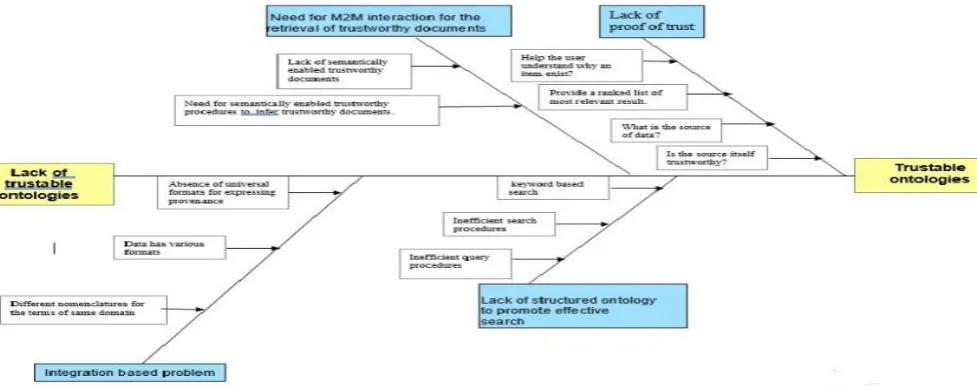
[image:3.595.50.539.484.677.2]The fish bone Diagram provided below in Fig. 1 clearly shows the limitations regarding current ontologies and the need for trustable ontologies-
Fig. 1-Limitations of current ontologies This can be accomplished by embedding provenance
annotations into the ontologies. Provenance allows the semantic web agents to track the lineage of information stored in repositories thereby providing the proof of trustworthiness of the information retrieved from these repositories Our work –We have implemented provenance using the PROV-DM data model in a university Ontology The methodology for
Published By:
IV.PROV MANAGEMENT IN UNIVERSITY ONTOLOGY
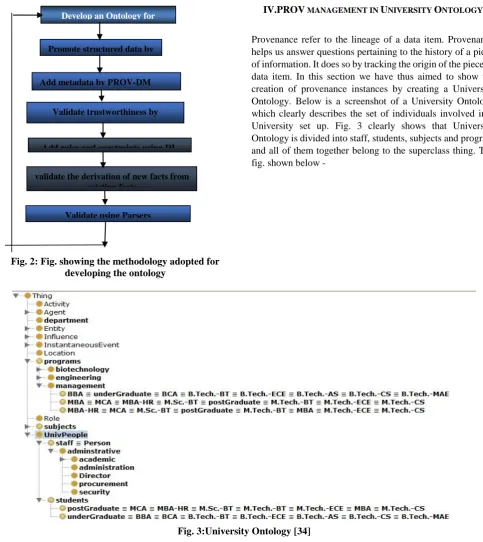
[image:4.595.53.537.47.590.2]Provenance refer to the lineage of a data item. Provenance helps us answer questions pertaining to the history of a piece of information. It does so by tracking the origin of the piece of data item. In this section we have thus aimed to show the creation of provenance instances by creating a University Ontology. Below is a screenshot of a University Ontology which clearly describes the set of individuals involved in a University set up. Fig. 3 clearly shows that University Ontology is divided into staff, students, subjects and program and all of them together belong to the superclass thing. The fig. shown below -
Fig. 2: Fig. showing the methodology adopted for developing the ontology
Fig. 3:University Ontology [34] Additionally, the above fig. also shows the division of
Ontology into Entity, Agent and activity. This has been accomplished by adding the PROV-O Ontology to the OWL.
Fig. 4 clearly shows the asserted model of the University Ontology created using OWLVIZ.
Develop an Ontology for
university people
Promote structured data by OWL
Add metadata by PROV-DM
Validate trustworthiness by Reasoners
Add rules and constraints using DL Axiomtization
validate the derivation of new facts from existing facts
International Journal of Innovative Technology and Exploring Engineering (IJITEE) ISSN: 2278-3075, Volume-8 Issue-9, July 2019
Fig. 4-Asserted Ontology of University People Program Ontology[34] Addition of PROV-O to University Ontology also helps to
add provenance assertions to various elements of this Ontology. In the code and Fig. 5 and Fig. 6 provided below we have attempted to add the same and have verified the same using reasoners.The Code snippets and Screenshots shown below have been taken from our University Ontology. The code states that Col.Mahotra along with Mr.Bisht both of whom are human agents, and individuals of class Security are
involved in the creation of the entity
DisciplinaryCommitteeReport by acting as a moderator and a compiler of the report. The activity which was used to create the Disciplinary committee was “Creation of disciplinary committee report”. The provenance assertions are
prov#activity, prov#hadrole,
prov#wasAttributedto,prov#wasAssociatedwith.Furthermore
assertions like prov# hadprimarysource,
prov#wasderivedFrom state the fact that the entity Disciplinary Committee Report is derived from AntiRaggingGuidelines which itself is an entity as entity AntiRaggingGuidelines contributed in making of the new Entity.
<Declaration>
<NamedIndividual IRI="#Colonel_Malhotra"/> </Declaration>
<ClassAssertion>
<Class IRI="#security"/>
<NamedIndividual IRI="#Colonel_Malhotra"/> </ClassAssertion>
<ObjectPropertyAssertion> <ObjectProperty
IRI="http://www.w3.org/ns/prov#hadRole"/>
<NamedIndividual IRI="#Colonel_Malhotra"/> <NamedIndividual
IRI="#moderator_and_compiler"/> </ObjectPropertyAssertion> <ObjectPropertyAssertion> <ObjectProperty
IRI="http://www.w3.org/ns/prov#wasAssociatedWith"/> <NamedIndividual
IRI="#Creation_of_DisciplinaryCommiteeReport"/> <NamedIndividual IRI="#Colonel_Malhotra"/> </ObjectPropertyAssertion>
<ClassAssertion>
<Class IRI="http://www.w3.org/ns/prov#Activity"/> <NamedIndividual
IRI="#Creation_of_DisciplinaryCommiteeReport> </ClassAssertion>
<DataPropertyAssertion>
<DataProperty IRI="#hasEmpID"/> <NamedIndividual IRI="#Bisht"/> <Literal
datatypeIRI="&xsd;nonNegativeInteger">3301</Literal> </DataPropertyAssertion>
<ObjectPropertyAssertion> <ObjectProperty
IRI="http://www.w3.org/ns/prov#wasAssociatedWith"/> <NamedIndividual
IRI="#Creation_of_DisciplinaryCommiteeReport"/> <NamedIndividual IRI="#Bisht"/>
<ObjectPropertyAssertion> <ObjectPropertyAssertion> <ObjectProperty
IRI="http://www.w3.org/ns/prov#wasAttributedTo"/> <NamedIndividual
IRI="#DisciplinaryCommiteeReport"/>
<NamedIndividual IRI="#Colonel_Malhotra"/> </ObjectPropertyAssertion>
<ObjectPropertyAssertion> <ObjectPropertyAssertion> <ObjectProperty
IRI="http://www.w3.org/ns/prov#hadPrimarySource"/> <NamedIndividual
Published By: <NamedIndividual IRI="#AntiRaggingGuidelines"/>
</ObjectPropertyAssertion> <ClassAssertion>
<Class IRI="http://www.w3.org/ns/prov#Entity"/> <NamedIndividual IRI="#AntiRaggingGuidelines"/> </ClassAssertion>
Fig. 5[34]-Fig. showing the rules applied to the agent Colonel Malhotra
Fig. 6:Fig. showing the assertions applied to various instances of a university and derivations done using hermit reasoner.
The above Provenance assertions answer questions like how, by whom and what role did an agent have in the creation of new entities, what were procedures involved and if it all an
old entity was used for the creation of new entities. Provenance also helps us in
[image:6.595.58.552.134.406.2] [image:6.595.52.568.208.688.2]International Journal of Innovative Technology and Exploring Engineering (IJITEE) ISSN: 2278-3075, Volume-8 Issue-9, July 2019
creating a piece of data item. The fig. provided below states that the activity namely Creation of Research paper for Semantic web was carried out used another entity used a pdf, an image and was performed by the agent Mrinal who is a type of person this shown using the prov#usage assertions and the used clause in the Fig. 7 provided below. The Fig. 7 also shows inferences that were automatically generated by the reasoners using the dotted lines. The fig. was generated using OWLVIZ. Provenance also provides us answers to questions like whether a particular data item was derived by Quoting a certain piece of information from another data item. This is accomplished using the prov#quotedfrom provenance assertion. The fig. 8 provided below states that the research paper on Semantic Web was developed by quoting some text
from a pdf namely1C6bd36…..thus a professor can easily identify if at all the particular research submitted by a student paper is genuine or not.By specifying the prov#quotedFrom prov assertion we can say that a particular piece of data item has been derived from another. Additionally, we can also specify the prov#atLocation provenance assertion to specify the location of a data item. This will help in identifying if a given piece of data item is coming from a trusted source or not. This can be seen by the Fig. 7 shown below. Fig. 8 states that a given entity namely GrievanvceRedersalGuidelines is stores at location specified by the prov#atLocation clause and this prov# at/location further helps in creating the report of the GrievanceRedressal Committee of the University.
Fig.7[34]:Fig. showing the relationships of entities with various agents, activities and entities
[image:7.595.63.558.226.489.2] [image:7.595.55.529.518.732.2]Fig. 9[34]-Fig. showing the asserted and reasoned ontology using the Hermit reasoner V.CONCLUSION
Provenance or the lineage of a document enables to provide the proof of trustworthiness of a document. Provenance tracking is thus a crucial component of the semantic web application. The procedure to create, embed and track has been done using the PROV-DM model and the discharge of the same can be done by following the procedures, codes and snippets provided above
REFERENCES
1. V. Torres,J. Fons,V. Pelechano,O. Pastor “Navigational Modeling and the Semantic Web. An Ontology based Approach”, In. Proc WebMedia and LA-Web, 2004.
2. M. Xiao ; L. Zhong ; Q.Xiong , “Semantic Similarity between Concepts from Different OWL Ontologies,” In Proc. 2009 Second International Workshop on Knowledge Discovery and Data Mining.
3. W.Yong-gui; J.Zhen “Research on Semantic Web Mining.”, In Proc. International Conference On Computer Design and Applications,2010. 4. G. Stumme, A. Hotho, B. Berendt "Semantic Web Mining",Journal
Web Semantics: Science, Services and Agents on the World Wide Web archive Volume 4 Issue 2, June, 2006
5. Tim Berners-Lee, Jim Hendler, and Ora Lassila. (2001 May 17). The semantic web. Scientific American. pp. 35-43. [Online]. Available: http://www.sciam.com/article. cfm?id=the-semantic-web.
6. S.Grimm., A. Abecker, J. Völker, R Studer. (2011) Ontologies and the Semantic Web. In: Domingue J., Fensel D., Hendler J.A. (eds) Handbook of Semantic Web Technologies. Springer, Berlin, Heidelberg.
7. T. R. Gruber, “A Translation Approach to Portable Ontology Specification,” Journal of Knowledge Acquisition —Special Issue: Current Issues in Knowledge Modelling, Vol. 5, No. 2, 1993, pp. 199-220.
8. J. H. Gennari, M. A. Musen, R. W. Fergerson, W. E. Grosso, M. Crubezy, H. Eriksson, N. F. Noy, S. W. Tu, "The evolution of Protégé: an environment for knowledge-based systems development", International Journal of Human-Computer Studies, vol. 58, no. 1, pp. 89-123, January 2003.
9. K. H.V.Dam ; J. Keirstead ,"Re-use of an ontology for modelling urban energy systems", In Proc. Next generation infrastructure systems for eco-cities,2011.
10. Effective Design of Trust Ontologies for Improvement in the Structure of Socio-Semantic Trust Network, International Journal On Advances in Intelligent Systems,vol1no1, year2008
11. K.'Hara, H. Alani, Y. Kalfoglou, and N.Shadbolt, “Trust Strategies for the Semantic Web”, Workshop on Trust, Security, and Reputation on the Semantic Web at ISWC2004, Hiroshima, Japan, November 2004.
12. V.D.S Almendra, D.Schwabe, “Trust Policies for Semantic Web Repositories”, 2nd Semantic Web Policy Workshop (SWPW'06). 13. Donovan Artz, Yolanda Gil:“ A survey of trust in computer science and
the Semantic Web”, Web Semantics: Science, Services and Agents on the World Wide Web archive. Volume 5, Issue 2 (June 2007) Pages 58-71 ,2007.
14. L. Ding, T. Finin. “Weaving the Web of Belief into the Semantic Web.”
Submitted to WWW2004. Availaible
[Online]:http://ebiquity.umbc.edu/v2.1/get/a/publication/74.pdf 15. U. Kuter and J. Golbeck. SUNNY, “A New Algorithm for Trust
Inference in Social Networks, using Probabilistic Confidence Models”, In Proc. Twenty-Second National Conference on Artificial Intelligence (AAAI-07). Vancouver, British Columbia, July, 2007.
16. G.Lopez ,C. Leon , “Impact of certification, evaluation and time in determining trust on the social semantic web”, In Proc. International Symposium on Computer, Consumer and Control,2012.
17. I Foster, C. Kesselman, Nick, J. ,S. Tuecke, (2002). Grid Services for Distributed System Integration, Computer, 35(6), 37-46
18. L. Chen, X. Yang , “A Semantic Web Service Based Approach for Augmented Provenance”, In Proc. IEEE/WIC/ACM International Conference on Web Intelligence (WI 2006 Main Conference Proceedings)(WI'06)
19. P. Buneman and W.-C. Tan, "Provenance in databases," in SIGMOD '07: In.Proc. of the 2007 ACM SIGMOD international conference on Management of data. New York, NY, USA: ACM, 2007, pp. 1171-1173.
20. W. C. Tan, "Provenance in databases: Past, current, and future," IEEE Data Eng. Bull., vol. 30, no. 4, pp. 3-12, 2007.
21. R. Bose and J. Frew, "Lineage retrieval for scientific data processing: a survey," ACM Comput. Surv., vol. 37, no. 1, pp. 1-28, 2005. 22. M. Blount et. al., "Century: Automated aspects of patient care," In proc.
of the 13th IEEE International Conference on Embedded and Real-Time Computing Systems and Applications (RTCSA 2007), 2007, pp. 504-509.
23. A. Misra, M. Blount, A. Kementsietsidis, D. Sow, and M. Wang, "Advances and challenges for scalable data provenance in stream processing systems," In proc. IPAW, 2008.
24. A. Kementsietsidis, M.Wang , “On the Efficiency of Provenance Queries”, IEEE 25th International Conference on Data Engineering,2009.
25. I. I. Bittencourt, S. Isotani, E.Costa, R.Mizoguchi, "Research directions on semantic web and education" ,Scientia Interdisciplinary Studies in Computer Science 19(1): 60-67, January/June 2008.
26. J.Qin., N. Hernández, "Ontological representation of learning objects: building interoperable vocabulary and structures", In Proc. of the 13th International World Wide Web conference on Alternate track papers & posters table of contents, ACM, New York, USA, 2004, pp. 348-349. 27. A.Ameen ; Khaleel Ur Rahman
[image:8.595.46.525.50.274.2]International Journal of Innovative Technology and Exploring Engineering (IJITEE) ISSN: 2278-3075, Volume-8 Issue-9, July 2019
Conference on Technology for Education,2012.
28. C .Guangzuo, C Fei, L.S Chenhu,., "OntoEdu: Ontology-based education grid system for e-learning", In Proc.GCCCE2004 , Hong Kong, 2004.
29. N. Dokoohaki, M. Matskin. “Effective Design of Trust Ontologies for Improvement in the Structure of Socio-Semantic Trust Networks”, International Journal On Advances in Intelligent Systems, vol1no1, year2008.
30. T.W.A. Grandison, “Trust Management for Internet Applications”. PhD thesis, Imperial College of Science, Technology and Medicine, University of London, Department of Computing, (2001)
31. T.W.A. Grandison, M. Sloman, “A Survey of Trust in Internet Applications”, IEEE Communications Surveys and Tutorials, 1553877X, Vol.3, No. 4, Page 2, (2000).
32. J.Jankowski, A. Westerski , S. Ryszard Kruk, T. Nagle , Jaroslaw Dobrzanski “IKHarvester – Informal eLearning with Semantic Web Harvesting”,In Proc. International Conference on Semantic Computing,2008.
33. B.Özkan Czerkawski, “Semantic web in teacher’s education,” The Turkish Online Journal of Educational Technology – October 2014, volume 13 issue 4.
34. 34.PROTEGE:AVAILAIBLE[ONLINE]PROTÉGÉ:HTTPS://PROT EGE.STANFORD.EDU/
35. 35.P.RISTOSKI,H.PAULHEIM,“SEMANTICWEBINDATAMININ GANDKNOWLEDGEDISCOVERY:ACOMPREHENSIVESURVEY ”,WEBSEMANTICS:SCIENCE,SERVICESANDAGENTSONTHEWO RLDWIDEWEB36(2016)1–22.
AUTHORS PROFILE
Ms.Mrinal Pandey is a Research scholar, from Amity Institute of Information technology ,Lucknow, Uttar Pradehs..She is MCA. The author is doing Ph.D. inInformation Technology from Amity Instituteof Information Technology, Amity University,Lucknow Campus, Uttar Pradesh. Her research areas include Semantic web, Artificial Intelligence,Provenance. Her papers are published in IEEE International conferences and are all Indexed in Scopus.
Dr. Rajiv Pandey, Senior Member IEEE is a Faculty at Amity Institute of Information Technology, Amity University, Uttar Pradesh, Lucknow Campus, India. He possesses a diverse back ground experience of around 30 years to include 15 years of Industry and 15 years of academic. His research interests include the contemporary technologies as Semantic Web Provenance, Cloud computing, Big-Data, and Data Analytics. He has been on technical Committees of Various Government and Private Universities. He is intellectually involved in supervising Doctorate Research Scholars and Post graduate Students. He is also an active contributor in professional bodies like IEEE, IET and LMA. He is a member of Machine Intelligence Labs.
![Fig. 4-Asserted Ontology of University People Program Ontology[34]](https://thumb-us.123doks.com/thumbv2/123dok_us/8194249.258899/5.595.57.530.50.284/fig-asserted-ontology-university-people-program-ontology.webp)
![Fig. 5[34]-Fig. showing the rules applied to the agent Colonel Malhotra](https://thumb-us.123doks.com/thumbv2/123dok_us/8194249.258899/6.595.52.568.208.688/fig-fig-showing-rules-applied-agent-colonel-malhotra.webp)
![Fig.7[34]:Fig. showing the relationships of entities with various agents, activities and entities](https://thumb-us.123doks.com/thumbv2/123dok_us/8194249.258899/7.595.55.529.518.732/fig-showing-relationships-entities-various-agents-activities-entities.webp)
![Fig. 9[34]-Fig. showing the asserted and reasoned ontology using the Hermit reasoner 12](https://thumb-us.123doks.com/thumbv2/123dok_us/8194249.258899/8.595.46.525.50.274/fig-showing-asserted-reasoned-ontology-using-hermit-reasoner.webp)
