https://doi.org/10.5194/angeo-36-925-2018 © Author(s) 2018. This work is distributed under the Creative Commons Attribution 4.0 License.
A case study of mesospheric planetary waves observed over a
three-radar network using empirical mode decomposition
Pangaluru Kishore1, Isabella Velicogna1,2, Tyler C. Sutterley1, Yara Mohajerani1, Enrico Ciracì1, and Gummadipudi Nagasai Madhavi3,4
1Department of Earth System Science, University of California, Irvine, California 92697, USA 2Jet Propulsion Laboratory, California Institute of Technology, Pasadena, California, USA 3Department of Physics, Sri Venkateswara University, Tirupati, India
4Vignana Bharathi Institute of Technology, Hyderabad, India
Correspondence:Pangaluru Kishore ([email protected])
Received: 30 November 2017 – Revised: 20 April 2018 – Accepted: 24 May 2018 – Published: 21 June 2018
Abstract. In this paper an attempt is made to study equa-torial Kelvin waves using a network of three radars: Ko-totabang (0.204◦S, 100.320◦E) meteor radar, Pameung-peuk (7.646◦S, 107.688◦E) medium-frequency radar, and Pontianak (0.003◦S, 109.367◦E) medium-frequency radar. We have used the continuous data gathered from the three radars during April–May 2010. Empirical mode decompo-sition (EMD), Lomb–Scargle periodogram (LSP) analysis, and wavelet techniques are used to study the temporal and altitude structures of planetary waves. Here, we used a novel technique called EMD to extract the planetary waves from wind data. The planetary waves of∼6.5 and∼3.6 days pe-riodicity are observed in all three radar stations with peak amplitudes of about 12 and 11 m s−1, respectively. The 3.6-day wave has an average vertical wavelength from the three radars of about 42 km. The 3.6- and 6.5-day planetary waves are particularly strong in the zonal wind component. We find that the two waves are present at the 84–94 km height re-gion. The observed features of the 3.6- and 6.5-day waves at the three tropical-latitude stations show some correspon-dence with the results reported for the equatorial-latitude sta-tions.
Keywords. Electromagnetics (wave propagation) – history of geophysics (atmospheric sciences) – meteorology and at-mospheric dynamics (middle atmosphere dynamics)
1 Introduction
Planetary waves (PWs) are prominent features that appear in the mesosphere and lower thermosphere (MLT) region. The source of these waves is most likely to be excitations with a periodicity of∼2 to 20 days, which have been ob-served using medium-frequency (MF) radar and meteor radar wind measurements (Williams and Avery, 1992; Tsuda et al., 1988). The observed PW amplitudes indicate substan-tial variability with different periodicities, which dynami-cally changes with time. PWs are classified based on inter-vals of periodicity as opposed to single period classifica-tion criteria. The pioneering work was done by Charney and Drazin (1961) on upward-propagating PWs and the PW dis-tribution of the zonal wind with height.
the Atmosphere using the Broadband Emission Radiometry (SABER) satellite temperature measurements, demonstrated PWs at around 3–5 days with an amplitude of 4 K in the MLT region. Later Takahashi et al. (2007) specified that the PWs propagate upwards from the stratosphere to the mesosphere and lower thermosphere with a velocity of 5 km day−1 in view of two meteor radar MLT winds and ionospheric vir-tual height. Simulations by Forbes (2000) showed that 3–5-day waves excited in the troposphere could propagate verti-cally to penetrate into the MLT region using the Global Scale Wave Model (GSWM), and the maximum amplitudes were observed at 100–105 km at about 10 K. The wave activities have been reported in the equatorial MLT region (Salby et al., 1984; Garcia et al., 2005). Wave activity for this oscilla-tion period is intermittent throughout the year, but maximum amplitudes are generally observed from May to August.
Another PW with a period of 5–8 days is a frequent occur-rence near the equinox in the MLT (Talaat et al., 2001; Clark et al., 2002). The MLT observations sometimes indicate the presence of waves having periods of 5–8 days, the charac-teristics of which are consistent with those of 6.5-day waves. Talaat et al. (2001) and Clark et al. (2002) observed a 6.5-day wave using the zonal wind data in the stratosphere in the United Kingdom Meteorological Office (UKMO), and these wave periods are well correlated with satellite observations in the MLT region. The 6.5-day waves are generally found earlier than and after the equinox at low latitudes and these wave events propagate from the lower stratosphere up to the upper stratosphere. Meyer and Forbes (1997) suggested that the mesospheric 6.5-day waves are unstable and also that the vertical-propagating phase of the 6.5-day waves responds to an in-situ wave source in the lower mesosphere due to wind instabilities. Kishore et al. (2004) found 6.5-day oscillations, using Tirunelveli MF radar, and they discovered that the 6.5-day wave amplitude peaks at altitudes between 94 and 98 km with a maximum of∼20 K during equinoctial (April–May and September–October) months.
All these observations and results are based on satellite and single ground-based observations. In this paper, we chose the wind data observed by a network of three MLT radars over Indonesia to study the PWs with periods of 3–5 and 5–8 days in April–May 2010 as a function of height, latitudinal struc-tures, and wavelength. The collection of data and investiga-tion method received for the present review are portrayed in Sect. 2, results and discussion are given in Sect. 3, and the overall conclusions drawn from the present study are pre-sented in Sect. 4.
2 Database and analysis procedure
The equatorial MLT zonal and meridional wind data obtained by MF radar observations from Pameungpeuk (7.646◦S, 107.688◦E; hereafter PAM), Pontianak (0.003◦S, 109.3◦E; hereafter PON), and meteor radar observation from
Kotota-bang (0.204◦S, 100.320◦E; hereafter KOT) for the period of April–May 2010 are used to study the characteristics of the PWs. These data periods are chosen because they are the ones for which simultaneous observations are available over the three radars.
The MF radars at PAM and PON operate at frequen-cies of 2.008 and∼2 MHz, respectively. At both sites, the radar soundings involve sampling at 2 km intervals from ap-proximately 78 to 98 km, with a sampling rate of approxi-mately every 2 min. The zonal and meridional winds are es-timated using full correlation analysis (FCA; Briggs, 1984). The yield of mesospheric wind data depends on the occur-rence of echoes, the electron densities, and the strength of the scatters (Gregory et al., 1982). The Kototabang radar is an all-Sky interferometric meteor radar (SKiYMET), the details of which are well described by Venkateswara Rao et al. (2011). Briefly, the radar operates at a frequency of 37.7 MHz with an output power of 12 kW, installed at the ERA (equatorial atmosphere radar) site. Continuous sound-ing involves samplsound-ing at 2 km intervals from∼78 to 98 km, with an hourly time resolution. The equatorial MF and me-teor radar winds are greatly influenced by the ionospheric E region currents, especially at altitudes greater than 94 km. Winds above 94 km represent electron drift and not neutral wind (Ramkumar et al., 2002; Dhanya et al., 2008). In order to consider reliable data and neutral winds, we utilize data within the altitude range 82 to 94 km in this study.
82 84 86 88 90 92 94 96 98
Altitude (km)
-50 -30 -10 10 30 Koto Tabang: 2010 (a) Zonal wind
82 84 86 88 90 92 94 96 98
Altitude (km)
-50 -30 -10 10 30 Pameungpeuk: 2010 (b) Zonal wind
Apr 01 Apr 15 May 01 May 15 May 30 82
84 86 88 90 92 94 96 98
Altitude (km)
-50 -30 -10 10 30
Pontianak: 2010 (c) Zonal wind
82 84 86 88 90 92 94 96 98
-20 -10 0 10 20
(m
s
-1)
Koto Tabang: 2010 (d) Meridional wind
82 84 86 88 90 92 94 96 98
-20 -10 0 10 20 Pameungpeuk: 2010 (e) Meridional wind
Apr 01 Apr 15 May 01 May 15 May 30 82
84 86 88 90 92 94 96 98
-20 -10 0 10 20 Pontianak: 2010 (f) Meridional wind
(m
s
-1)
(m
s
-1)
(m
s
-1)
(m
s
-1)
(m
s
[image:3.612.89.507.65.357.2]-1)
Figure 1. Time–altitude sections of the daily mean zonal(a, b, c)and meridional(d, e, f)winds over Kototabang, Pameungpeuk, and Pontianak locations during the period from 1 April to 31 May 2010.
elsewhere (Kishore et al., 2012; Huang et al., 2012). In addi-tion, the Lomb–Scargle periodogram (LSP) analysis method (Scargle, 1982) of spectral analysis was used for determina-tion of PW amplitude and phase. This technique allows for the estimation of amplitude or power spectra of a time series that is unevenly spaced (Press et al., 1992). LSP weighs the data by each point rather than by each time interval. The LSP technique provides as estimate of the significance of each fre-quency by examining the probability of its emergence from random fluctuations (Namboothiri et al., 2002).
A band-pass filter is used in the time domain to identify possible PWs, following Kishore et al. (2005). To reduce the effect of long-term trends, all the data are detrended by a sec-ond order polynomial fit before filtering and performing the spectral analysis (Kishore et al., 2005). Here we use another adaptive spectral analysis method based on Morlet wavelets. The wavelet transform is a localized transform in both space (time) and frequency. We extract the spectral intensity from a temporally evolving signal with inherent variable frequencies (Kumar and Foufoula-Georgiou, 1997). The time-frequency resolution of a wavelet is not constant, but varies with fre-quency.
3 Results and discussion
3.1 Temporal variability in mean winds
In this section, we present mean wind circulation in the MLT region over the three radars located at KOT, PAM, and PON. Figure 1 illustrates the time–height plots representing the zonal winds (panels a–c) and meridional winds (pan-els d–f) over the altitude region of 82–94 km from 1 April to 31 May 2010. Wind contours are constructed from daily mean values, with the solid black line representing the zero wind in zonal and meridional contours. It can be seen that before mid-April, zonal winds are mostly westward for all radars, while the flow is eastward for most observation days after this period. According to Venkateswara Rao et al. (2012), westward winds are stronger than eastward winds within ±9◦ latitude, whereas at ±22◦ eastward winds are stronger. The maximum westward wind is observed to be about 40 m s−1over KOT at an altitude of 82 km. The
max-0 5 10 15 20 0
10 20 30 40
Kototabang
Pontianak
(d)
0 5 10 15 20
0 10 20 30
40 (e)
0 5 10 15 20
Time (days) 0
20 40 60 80
100 (f)
Zonal wind 90 km
0 5 10 15 20
0 10 20 30 40
Pontianak Pameungpeuk
(g)
0 5 10 15 20
0 10 20 30
40 (h)
0 5 10 15 20
Time (days) 0
20 40 60 80
100 (i)
Zonal wind 90 km
0 5 10 15 20
0 10 20 30 40
Power (10log10) Kototabang Pameungpeuk
(a)
0 5 10 15 20
0 10 20 30 40
Cross power (10log10)
(b)
0 5 10 15 20
Time (days) 0
20 40 60 80 100
Coherence (%)
(c)
[image:4.612.96.502.65.324.2]Zonal wind 90 km
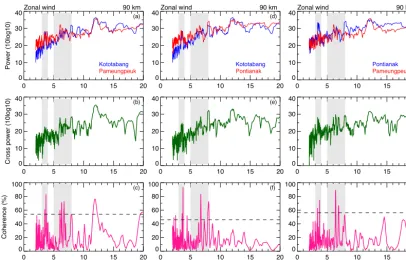
Figure 2.The zonal wind power spectral density of two radars(a, d, g), cross power spectral density(b, e, h), and coherence(c, f, i)during 1 April to 31 May 2010.
imum of about 30 m s−1, and are located at about 84 km at the Ascension Island equatorial station. The UARS High-Resolution Doppler Imager (HRDI) has also documented the tendency of the speed of westward winds (e.g., Burrage et al., 1996). Figure 1d–f represent the meridional wind for the three radar stations. The major structures produced by the three stations are generally the same. In all three stations southward wind is larger than the northward wind. The max-imum southward wind is observed in early April between the 82 and 86 km altitude regions at about∼25 m s−1 over
PON. The maximum northward wind is observed over KOT at about ∼15 m s−1 between the altitudes of 86 to 92 km. Independent observations of equatorial mean winds at As-cension Island (Hirota, 1978) and other longitudes (Burrage et al., 1996) agree with the general form of the winds. These studies demonstrated that westward winds peak during the equinox while eastward winds peak during the solstice.
A cross-correlation analysis was performed between the three zonal and meridional time series between 82 and 94 km altitudes. This analysis provides a set of time-dependent cor-relation coefficients of two signals. We found corcor-relation co-efficients of 0.68 between KOT and PAM with a lag of zero, 0.65 between KOT and PON, and 0.63 between PON and PAM zonal wind at 86 km, which are significant at the 95 % confidence level. The maximum lag is observed in the alti-tude range between 90 and 94 km. In the case of meridional wind we observed a time lag of±5 h. Figures 2 and 3 show the results of the cross-spectral analysis for the zonal and
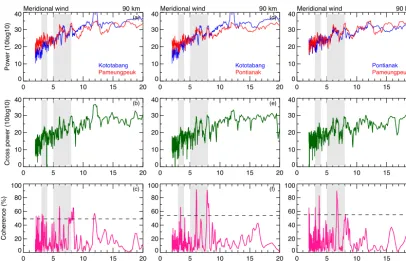
meridional winds. In Fig. 2, the top row (panels a, d, and g) shows the power spectral density of two radars, the mid-dle row (panels b, e, and h) corresponds to the cross-spectral power, and the bottom row (panels c, f, and i) is the coher-ence spectrum estimated for the 90 km altitude level using the CCS technique. The dashed line in the bottom panels corresponds to the 95 % confidence level. From the figures it can clearly be seen that the zonal and meridional wind power spectra are characterized by a dominant peak at 3–4 and 5–8 days. Furthermore, these peaks appear at all meso-spheric heights (82–94 km). Comparing the bottom panels of Figs. 2 and 3 demonstrates that PWs appear in the three radar datasets, and these waves are above the 95 % confidence level. The average coherence is 0.53 between the radars zonal winds and 0.5 between the meridional winds. These coher-ence plots identify cycles of 3–4 and 5–8 days. In addition, some other PWs (8 and 10–12 days) are also clearly evident; however, they are out of the scope of the present study.
0 5 10 15 20 0
10 20 30 40
Kototabang Pontianak
(d)
0 5 10 15 20
0 10 20 30 40
(e)
0 5 10 15 20
Time (days) 0
20 40 60 80
100 (f)
Meridional wind 90 km
0 5 10 15 20
0 10 20 30 40
Pontianak Pameungpeuk
(g)
0 5 10 15 20
0 10 20 30 40
(h)
0 5 10 15 20
Time (days) 0
20 40 60 80
100 (i)
Meridional wind 90 km
0 5 10 15 20
0 10 20 30 40
Power (10log10) Kototabang
Pameungpeuk (a)
0 5 10 15 20
0 10 20 30 40
Cross power (10log10)
(b)
0 5 10 15 20
Time (days) 0
20 40 60 80 100
Coherence (%)
(c)
[image:5.612.96.502.65.325.2]Meridional wind 90 km
Figure 3.The meridional wind power spectral density of two radars(a, d, g), cross power spectral density(b, e, h), and coherence(c, f, i) during 1 April to 31 May 2010.
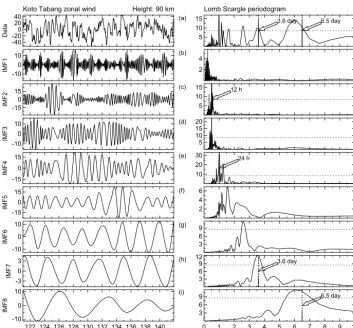
characterize the most important components. We investigate the gross characteristics of oscillations for each IMF using LSP analysis to the IMF time series. All IMFs exhibit slow-varying amplitudes and frequencies. The amplitude spectral plots are shown in the right panels of Fig. 4. The 95 % confi-dence level is shown by a horizontal dashed line. For this fig-ure, the selected altitude is 90 km from the KOT hourly zonal wind dataset. The figure shows that the dominant peaks near semi-diurnal (12 h) and diurnal (24 h) are present in IMF2 and IMF4. IMF7 shows a clear PW period of about 3.5 days, while IMF8 shows a broader range of oscillations with pe-riods ranging from 5 to 8 days and the maximum amplitude occurring at about 6.5 days. The Lomb–Scargle amplitude spectra are shown on the right side of Fig. 4, which reveals components centered at ∼3.6 and 6.5 days. The 3.6-day peak is somewhat broad, extending over roughly 3–5 days. Similarly, the 6.5-day wave also shows a broad peak (∼5– 8.0 days). The EMD technique reveals that some waves with periods that are close to those of diurnal tide are generated due to the interactions of the diurnal tide and PWs, which in-dicate extensive coupling between the diurnal tide and PWs (Takahashi et al., 2006). In both methods, the PWs in meso-spheric altitudes over equatorial radars are clearly seen. The PW periods are observed throughout mesospheric altitudes at all stations, although their amplitudes vary with altitude and from station to station. Similar results are also found at the other radars, indicating that these IMFs are statistically different from noise.
re--40 -200 20 40
Data
Koto Tabang zonal wind Height: 90 km
5 10
15 3.6 day 6.5 day
Lomb Scargle periodogram
-10 0 10
IMF1 2
4
-150 15
IMF2 105
15 12 h
-10 0 10
IMF3 105
15 20
-15 0 15
IMF4 10
20
30 24 h
-15 0 15
IMF5 24
6
-10 0 10
IMF6 36
9
-3 0 3
IMF7 36
9
12 3.6 day
122 124 126 128 130 132 134 136 138 140 Day number
-10 0 10
IMF8
0 1 2 3 4 5 6 7 8 9 10
Period (day) 3
6
9 6.5 day
(a)
(b)
(c)
(d)
(e)
(f)
(g)
(h)
(i)
(j)
(k)
(l)
(m)
(n)
(o)
(p)
(q)
[image:6.612.122.475.71.399.2](r)
Figure 4.Time series of(a)daily mean zonal wind observed using the Kototabang radar during 1 to 21 May 2010 at the 90 km altitude level. Intrinsic mode function components from the first to eighth IMFs are shown in(b–i). Corresponding LSP are shown in(j–r), respectively. The dashed horizontal lines in(j–r)indicate the 95 % confidence level.
gions and the vertical wavelengths are slightly smaller than the theoretical estimates for a 3.6-day wave.
Figure 6 shows the mean vertical profiles of the 6.5-day wave amplitudes and phases observed in the zonal (top pan-els) and meridional (bottom panpan-els) wind components at the three equatorial stations, together with the mean wind. In the figure, the 6.5-day wave amplitude is shown by solid curves, mean wind is shown by curves with solid circles, and the phase is indicated by curves with open circles. The am-plitudes are generally<10 m s−1below 90 km altitude lev-els. The maximum amplitudes (12–14 m s−1) are observed at KOT and PAM radar stations at 94 km of altitude, while moderate amplitudes are observed over the PON radar. Jiang et al. (2008) observed that 6.5-day wave amplitudes were strongest between 84 and 98 km, and the maximum ampli-tude of∼14.5 m s−1appeared at 92 km in April–May 2004 using the Wuhan meteor radar. Furthermore, they indicated that the 6.5-day waves near the spring equinox were gen-erally stronger than those in other seasons. A large meso-spheric 6.5-day wave was seen during late April and early May 2003 by the SABER instrument aboard the TIMED
satellite and the ground-based radar systems (Riggin et al., 2006; Jiang et al., 2008). They mentioned that the 6.5-day wave in the MLT region during April–May 2003 should be regarded as an atmospheric normal mode, which was am-plified through sympathetic interaction with the background wind. Takahashi et al. (2006) reported observations of a very strong ∼6-day wave with amplitudes reaching∼25 m s−1 present simultaneously in the zonal winds over Cariri (7.4◦S) and Ascension Island (7.9◦S). Liu et al. (2004) using the National Center for Atmospheric Research Thermosphere-Ionosphere-Mesosphere Electrodynamics General Circula-tion Model (TIME-GCM) investigated the structures and sea-sonal variability in 6.5-day waves. The phase profiles of the 6.5-day wave for zonal and meridional winds for the three radars are shown adjacent to the wind profiles in Fig. 6. Usu-ally there is a downward propagation with time, although up-ward phase progressions are sometimes observed.
0 5 10 15 Amplitude (m s-1) 80 82 84 86 88 90 92 94 96 98 100 Altitude (km)
-20 -10Zonal wind (m s0 10 20
-1)
0 60 120 180 240 300 Phase (deg)
Kototabang (a)
0 5 10 15 80 82 84 86 88 90 92 94 96 98
100-20 -10 0 10 20
0 60 120 180 240 300 Phase (deg)
Pontianak (b)
0 5 10 15 80 82 84 86 88 90 92 94 96 98
100-20 -10 0 10 20
0 60 120 180 240 300 Phase (deg)
Pemeungpeuk (c)
0 5 10 15 80 82 84 86 88 90 92 94 96 98 100 Altitude (km)
-20 -10Meridional wind 0 10 20
0 60 120 180 240 300 Phase (deg)
Kototabang (d)
0 5 10 15 80 82 84 86 88 90 92 94 96 98
100-20 -10 0 10 20
0 60 120 180 240 300 Phase (deg)
Pontianak (e)
0 5 10 15 80 82 84 86 88 90 92 94 96 98
100-20 -10 0 10 20
0 60 120 180 240 300 Phase (deg)
Pemeungpeuk (f)
Zonal wind (m s-1) Zonal wind (m s-1)
(m s-1) Meridional wind (m s-1)
Meridional wind (m s-1)
Amplitude (m s-1) Amplitude (m s-1)
Amplitude (m s-1) Amplitude (m s-1)
[image:7.612.105.492.72.347.2]Amplitude (m s-1)
Figure 5.Height profiles of the amplitudes and phases (open circle) of the 3.6-day waves over Kototabang, Pameungpeuk, and Pontianak locations. The thick solid lines represent the mean zonal winds over the period from 1 April to 31 May 2010.
0 5 10 15 80 82 84 86 88 90 92 94 96 98 100 Altitude (km)
-20 -10 0 10 20
0 60 120 180 Phase (deg)
Kototabang (a)
0 5 10 15 80 82 84 86 88 90 92 94 96 98
100-20 -10 0 10 20
0 60 120 180 Phase (deg)
Pontianak (b)
0 5 10 15 80 82 84 86 88 90 92 94 96 98
100-20 -10 0 10 20
0 60 120 180 Phase (deg)
Pemeungpeuk (c)
0 5 10 15 80 82 84 86 88 90 92 94 96 98 100 Altitude (km)
-20 -10Meridional wind 0 10 20
0 60 120 180 Phase (deg)
Kototabang (d)
0 5 10 15 80 82 84 86 88 90 92 94 96 98 100
-20 -10Meridional wind 0 10 20
0 60 120 180 Phase (deg)
Pontianak (e)
0 5 10 15 80 82 84 86 88 90 92 94 96 98 100
-20 -10Meridional wind 0 10 20
0 60 120 180 Phase (deg)
Pemeungpeuk (f)
Zonal wind (m s-1) Zonal wind (m s-1) Zonal wind (m s-1)
(m s-1) (m s-1) (m s-1)
Amplitude (m s-1) Amplitude (m s-1) Amplitude (m s-1)
Amplitude (m s-1) Amplitude (m s-1)
Amplitude (m s-1)
[image:7.612.105.489.406.678.2]82 84 86 88 90 92 94 96 98
Altitude (km)
(a) Koto Tabang BP:3-4 day Zonal wind
15 m s-1
82 84 86 88 90 92 94 96 98
Altitude (km)
(b) Pameungpeuk Zonal wind
Apr 01 Apr 10 Apr 20 Apr30 May 10 May 20 May 30 Date during 2010
82 84 86 88 90 92 94 96 98
Altitude (km)
(c) Pontianak Zonal wind
82 84 86 88 90 92 94 96 98
(d) Koto Tabang BP:3-4 day Meridional wind
15
82 84 86 88 90 92 94 96 98
(e) Pameungpeuk Meridional wind
Apr 01 Apr 10 Apr 20 Apr30 May 10 May 20 May 30 Date during 2010
82 84 86 88 90 92 94 96 98
(f) Pontianak Meridional wind
[image:8.612.107.483.65.353.2]m s-1
Figure 7.The band-pass filter results of the zonal(a, b, c)and meridional(d, e, f)at Kototabang, Pameungpeuk, and Pontianak locations. The bandwidth is 3–4 days and the interval is 15 m s−1.
three radars as shown in Fig. 7. In this figure, we considered step sizes of 2 km between the heights of 82 and 94 km. The data at the three sites were subjected to an elliptical band-pass filter with cutoff periods of 3.0–4.0 days. The figure clearly shows the time variations in the occurrence of the 3.6-day wave, with the KOT amplitudes being larger than those of the other two radars. The largest wave activity, with am-plitudes of∼16 m s−1, occurred at 92 km in the zonal wind
during 1–15 April and 20 April–10 May over KOT. While the zonal and meridional wind components have similar am-plitudes near the equator, the zonal 3.6-day wave amam-plitudes are larger than the meridional wind amplitudes. This is con-sistent with the other measurements.
Next, we perform a similar analysis with the 6.5-day lations. Figure 8 illustrates the features of the 6.5-day oscil-lations at different heights from 82 to 94 km. The zonal and meridional wind dataset was subjected to a band-pass filter of 5–8 days width. The amplitude of the oscillations at KOT reached∼16 m s−1at 88–94 km and lasted for 2 to 3 cycles in the 21-day interval spanning 22 April to 12 May 2010. It is interesting to note that the 6.5-day zonal wind oscilla-tions at KOT, PAM, and PON were almost in phase during this period. The PAM and PON zonal winds showed com-mon oscillation features during the intervals 1–14 April and 20 April–12 May 2010. The KOT zonal wind showed larger amplitudes than the other equatorial sites. The filter
analy-sis determined that 6.5-day waves have a period of about 6– 7.5 days, with the maximum wave amplitude occurring at 6.5 days. The zonal 6.5-day amplitudes are generally slightly stronger than the meridional amplitudes in all radar observa-tions.
3.2 Wavelet analysis of the 3.6- and 6.5-day oscillation variability
In this section, we investigate the possible temporal modu-lation of 3.6 and 6.5-day waves throughout the observation period through wavelet analysis. Figures 9 and 10 show the 3.6 and 6.5-day periodicities at three different height lev-els (86, 90, and 94 km) over three different radars. Wavelet analysis was applied to the dataset for the period 1 April– 31 May 2010 for constructing the contours. Specifically, the commonly used Morlet wavelet function was used which bet-ter captures the time-varying nature periodicities. The details of this method can be found in Torrence and Compo (1998). In the figures, the 3.6- and 6.5-day periods are marked by white dotted lines.
82 84 86 88 90 92 94 96 98
Altitude (km)
(a) Koto Tabang BP:5-8 day Zonal wind
82 84 86 88 90 92 94 96 98
Altitude (km)
(b) Pameungpeuk Zonal wind
Apr 01 Apr 10 Apr 20 Apr30 May 10 May 20 May 30 Date during 2010
82 84 86 88 90 92 94 96 98
Altitude (km)
(c) Pontianak Zonal wind
82 84 86 88 90 92 94 96 98
(d) Koto Tabang BP:5-8 day Meridional wind
82 84 86 88 90 92 94 96 98
(e) Pameungpeuk Meridional wind
Apr 01 Apr 10 Apr 20 Apr30 May 10 May 20 May 30 Date during 2010
82 84 86 88 90 92 94 96 98
(f) Pontianak Meridional wind
[image:9.612.112.483.62.354.2]15 m s-1 15 m s-1
Figure 8.The band-pass filter results of the zonal(a, b, c)and meridional(d, e, f)winds at Kototabang, Pameungpeuk, and Pontianak. The bandwidth is 5–8 days and the interval is 15 m s−1.
imum intensity was near 3.6 days. The black line in the plots indicates areas with 95 % confidence level. The white dotted line indicates the 3.6-day wave period. From the figure, the wave intensity at higher altitudes appears to be slightly larger than that at the lower altitude levels. Figure 9d shows wider periods oscillating at 2–7 day periods. The 3.6-day wave am-plitudes at PON have slightly smaller amam-plitudes compared to the other two radars.
To deduce more information on the time–height variations and dependence of the 6.5-day wave, we show the ampli-tudes at the three radars at 86, 90, and 94 km in Fig. 10. The 6.5-day peak is somewhat broad, ranging over 5–8 days at some heights and 5–10 days at other levels. The wave am-plitude increases with altitude and reaches a maximum of about 22 K at mesospheric altitudes for all three radars. The 6.5-day oscillation has a broad spectral peak extending over several days at 90 and 94 km of altitude at KOT. The maxi-mum amplitude of∼24 K is observed over KOT at altitudes of around 94 km. The temporal localization oscillations us-ing wavelet analysis shows strong 6.5-day waves durus-ing the observation period. During the observation period, the max-imum amplitudes show differences between the measure-ments and thus make the wave activity out of phase at these locations (Kishore et al., 2005).
4 Conclusions
In the present study we made an attempt to study the plan-etary wave (PW; 3.6- and 6.5-day) oscillations over three radars (KOT, PAM, and PON) installed in tropical latitudes during the period from 1 April to 31 May 2010. The main findings obtained from this study are summarized below:
The major zonal wind structures produced by the three sta-tions are generally the same. The main features of the zonal winds are mostly westward before mid-April, and thereafter eastward wind is observed in all three radar stations. The maximum westward wind seems similar in all three stations, while the maximum westward jet is observed at different al-titudes at each station. The maximum southward wind is ob-served in early April between the 82 and 94 km altitude lev-els in all three radars. Furthermore the southward wind is stronger than the northward wind.
0 2 4 6 8 10 12 Period (days) 95 % 95 % (a) Koto Tabang: 86 km
0 2 4 6 8 10 12 95 % 95 % (d) Pameungpeuk: 86 km
0 2 4 6 8 10 12 95 % 95% (g) Pontianak: 86 km
0 2 4 6 8 10 12 Period (days) 95 % 95 % (b) Koto Tabang: 90 km
0 2 4 6 8 10 12 95% 95% (e) Pameungpeuk: 90 km
0 2 4 6 8 10 12 95 % 95 % (h) Pontianak: 90 km
Apr 01 Apr 10 Apr 20 Apr 30 May 10 May 20 0 2 4 6 8 10 12
Period (days) 95 % 95 %
(c) Koto Tabang: 94 km
Apr 01 Apr 10 Apr 20 Apr 30 May 10 May 20 0 2 4 6 8 10 12 95 % 95 %
1 3 5 7 9 11 13 Amplitude
(f) Pameungpeuk: 94 km
Apr 01 Apr 10 Apr 20 Apr 30 May 10 May 20 0 2 4 6 8 10 12 95 % 95 % (i) Pontianak: 94 km
Zonal wind
[image:10.612.103.490.80.342.2]m s-1
Figure 9.Contours of wavelet intensities as a function of frequency and time for the zonal wind of IMF3 at three different heights (86, 90, and 94 km) over Kototabang, Pameungpeuk, and Pontianak locations.
0 2 4 6 8 10 12 Period (days) 95 % (a) Koto Tabang: 86 km
0 2 4 6 8 10 12 95 % 95 % (d) Pameungpeuk: 86 km
0 2 4 6 8 10 12 95 % (g) Pontianak: 86 km
0 2 4 6 8 10 12 Period (days) 95 % (b) Koto Tabang: 90 km
0 2 4 6 8 10 12 95 % (e) Pameungpeuk: 90 km
0 2 4 6 8 10 12 95 % 95 % (h) Pontianak: 90 km
Apr 01 Apr 10 Apr 20 Apr 30 May 10 May 20 0 2 4 6 8 10 12 Period (days) 95 % (c) Koto Tabang: 94 km
Apr 01 Apr 10 Apr 20 Apr 30 May 10 May 20 0 2 4 6 8 10 12 95 %
1 3 5 7 9 11 13 15 17 19 21 23 (f) Pameungpeuk: 94 km
Apr 01 Apr 10 Apr 20 Apr 30 May 10 May 20 0 2 4 6 8 10 12 95 % (i) Pontianak: 94 km
Zonal wind
Amplitudem s-1
[image:10.612.103.489.413.675.2]technique was used to explore planetary waves over three equatorial radars.
The 3.6-day wave amplitudes were somewhat similar across all the radars, with the maximum mean amplitude observed in KOT and PAM at ∼12 m s−1, always above the 90 km altitude level. The phase profiles showed a fairly downward progression, with an estimated mean vertical wavelength of about 42 km.
The amplitudes of the 6.5-day waves show roughly simi-lar values in all three radars. However, the zonal amplitude reaches its maximum at altitudes between 90 and 94 km with a peak value of ∼12 m s−1 in KOT and PAM radars. The PON zonal 6.5-day amplitudes are slightly smaller compared to the other two radars. Vertical wavelengths are observed to be between 30 and 38 km with the network of the three radars, which is similar to the equatorial site measurements.
To understand the temporal behavior of the PW (3.6- and 6.5-day) oscillations, we used a wavelet transform technique at three different altitudes for the network of radars. Further-more, it suggested that these oscillations are dominant in the mesosphere over equatorial regions. In a future study we will combine datasets from other equatorial stations with long-term observations, which will allow for a better understand-ing of wave characteristics and includunderstand-ing the wave number.
Data availability. Data can be provided on request to Atsuki Shin-bori, Research Institute for Sustainable Humanosphere (RISH), Ky-oto University, Japan.
Competing interests. The authors declare that they have no conflict of interest.
Acknowledgements. We would like to thank the Research Institute for Sustainable Humanosphere (RISH), Kyoto University and all associated members involved in data acquisition by the network of radars. Distribution of the data has been partly supported by the Inter-university Upper atmosphere Global Observation NETwork (IUGONET) project funded by the Ministry of Education, Culture, Sports, Science and Technology (NEXT), Japan. Gummadipudi Na-gasai Madhavi is grateful to the Department of Science and Tech-nology (DST-SERB) for providing the National Post-Doctoral Fel-lowship.
The topical editor, Andrew J. Kavanagh, thanks Quan Gan and one anonymous referee for help in evaluating this paper.
References
Briggs, B. H.: The analysis of spaced sensor records, in: Handbook for Map, edited by: Vincent, R. A., 13, 166–186, 1984.
Bloomfield, P.: The spectrum, in: Fourier analysis of time series, John Wiley and Sons, New York, NY, USA, 133–166, 2005. Burrage, M. D., Vincent, R. A., Mayr, H. G., Skinner, W. R., Arnold,
N. F., and Hays, P. B.: Long-term variability in the equatorial
middle atmosphere zonal wind, J. Geophys. Res., 101, 12847– 12854, https://doi.org/10.1029/96JD00575, 1996.
Charney, J. G. and Drazin, P. G.: Propagation of planetary scale disturbances from the lower to the upper atmosphere, J. Geophys. Res., 66, 83–109, 1961.
Clark, R. R., Burrage, M. D., Franke, S. J., Manson, A. H., Meek, C. E., Mitchell, N. J., and Muller, H. G.: Observations of 7-d plane-tary waves with MLT radars and the UARS-HRDI instrument, J. Atmos. Sol.-Terr. Phy., 64, 1217–1228, 2002.
Dhanya, R., Gurubaran, S., and Emperumal, K.: Lower E-region echoes over the magnetic equator as observed by the MF radar at Tirunelveli (8.7◦N, 77.8◦E) and their re-lationship to Esq and Esb, Ann. Geophys., 26, 2459–2470, https://doi.org/10.5194/angeo-26-2459-2008, 2008.
Forbes, J. M.: Wave coupling between the lower and upper atmo-sphere: case study of an ultra-fast Kelvin wave, J. Atmos. Sol.-Terr. Phy., 62, 1603–1621, 2000.
Garcia, R. R., Lienerman, R., Russell III, J. M., and Mlynczak, M. G.: Large-scale waves in the mesosphere and lower thermosphere observed by SABER, J. Atmos. Sci., 62, 4384–4399, 2005. Gregory, J. B., Meek, C. E., and Manson, A. H.: An assessment
of winds data (60–110 km) obtained in real-time from a medium frequency radar using the radio wave drifts technique, J. Atmos. Sol.-Terr. Phy., 44, 649–655, 1982.
Hirota, I.: Equatorial waves in the upper stratosphere and meso-sphere in relation to the semiannual oscillation of the zonal wind, J. Atmos. Sci., 35, 714–722, 1978.
Holton, J.: Waves in the equatorial stratospheric generated by tro-pospheric heat resources, J. Atmos. Sci., 27, 368–375, 1972. Holton, I.: Kelvin waves in the equatorial middle atmosphere
ob-served by the Nimbus 5 SCR, J. Atmos. Sci., 36, 217–222, 1979. Huang, B., Hu, Z. Z., Kinter, J. L., Wu, Z., and Kumar, A.: Con-nection of stratospheric QBO with global atmospheric general circulation and tropical SST. Part 1: methodology and composite life cycle, Clim. Dynam., 38, 1–23, 2012.
Huang, N. E., Shen, Z., Long, S. R., Wu, M. C., Shih, H. H., Zheng, Q., Yen, N. C., Tung, C. C., and Liu, H. H.: The empirical mode decomposition and the Hilbert spectrum for nonlinear and non-stationary time series analysis, P. Roy. Soc. Lond. A Mat., 454, 903–995, 1998.
Jiang, G., Xu, J., Xiong, J., Ma, R., Ning, B., Murayama, Y., Thorsen, D., Gurubaran, S., Vincent, R. A., Reid, I., and Franke, S. J.: A case study of the mesospheric 6.5-day wave observed by radar systems, J. Geophys. Res., 113, D16111, https://doi.org/10.1029/2008JD009907, 2008.
Kishore, P., Namboothiri, S. P., Igarashi, K., Gurubaran, S., Sridhran, S., Rajaram, R., and Venkat Ratnam, M.: MF radar observations of 6.5-day wave in the equatorial mesosphere and lower thermosphere, J. Atmos. Sol.-Terr. Phy., 66, 507–515, 2004.
Kishore, P., Subba Reddy, I. V., Namboothiri, S. P., Igarashi, K., Venkat Ratnam, M., Narayana Rao, D., and Vijaya Bhaskara Rao, S.: Study of equatorial Kelvin waves using the MST radar and radiosonde observations, Ann. Geophys., 23, 1123–1130, https://doi.org/10.5194/angeo-23-1123-2005, 2005.
ma-jor stratospheric warming, Ann. Geophys., 30, 1529–1538, https://doi.org/10.5194/angeo-30-1529-2012, 2012.
Kumar, P. and Foufoula-Georgiou, E.: Wavelet analysis for geo-physical applications, Rev. Geophys., 35, 385–412, 1997. Liu, H. L., Tallat, E. R., Roble, R. G., Liberman, R. S., Riggin, D.
M., and Yee, J. H.: The 6.5-day wave and its seasonal variabil-ity in the middle and upper atmosphere, J. Geophys. Res., 109, D21112, https://doi.org/10.1029/2004JD004795, 2004. Meyer, C. K. and Forbes, J. M.: A 6.5-day westward propagating
planetary wave: Origin and its characteristics, J. Geophys. Res., 102, 26173–26178, 1997.
Namboothiri, S. P., Kishore, P., and Igarashi, K.: Climatological studies of the quasi 16-day oscillations in the mesosphere and lower thermosphere at Yamagawa (31.2◦N, 130.6◦E), Japan, Ann. Geophys., 20, 1239–1246, https://doi.org/10.5194/angeo-20-1239-2002, 2002.
Pancheva, D., Mitchell, N. J., and Younger, P. T.: Meteor radar observations of atmospheric waves in the equatorial meso-sphere/lower thermosphere over Ascension Island, Ann. Geo-phys., 22, 387–404, https://doi.org/10.5194/angeo-22-387-2004, 2004.
Pancheva, D., Mukhtarov, P., Andonov, B., and Forbes, J. M.: Global distribution and climatological features of 5– 6 day planetary waves seen in the SABER/TIMED tem-peratures (2002–2007), J. Atmos. Terr. Phys., 72, 26–37, https://doi.org/10.1016/J.jastp.2009.10.005, 2010.
Press, W. H., Teukolsky, S. A., Vetterling, W. T., and Flannery, B. P.: Numerical Recipes in C, Cambridge University Press, New York, 2002.
Ramkumar, T. K., Gurubaran, S., and Rajaraman, R.: Lower E-region MF radar spaced antenna measurements over magnetic equator, J. Atmos. Sol.-Terr. Phy., 64, 1445–1453, 2002. Riggin, D. M., Fritts, D. C., Tsuda, T., Nakamura, T., and Vincent,
R. A.: Radar observations of 1 3-day Kelvin wave in the equato-rial mesosphere, J. Geophys. Res., 102, 26241–26157, 1997. Riggin, D. M. Liu, H., Lieberman, R. S., Robble, R. G., Russell III,
J. M., Mertens, C. J., Mlynczak, M. G., Pancheva, D., Franke, S. J., Murayama, Y., Manson, A. H., Meek, C. E., and Vin-cent, R. A.: Observations of the 5-day wave in the mesosphere and lower thermosphere. J. Atmos. Sol.-Terr. Phy., 68, 323–339, https://doi.org/10.1016/j.jastp.2005.05.010, 2006.
Salby, M. and Garcia, R.: Transient response to localized episodic heating in the tropics, Part 1: excitation and short-time near-field behavior, J. Atmos. Sci., 44, 458–498, 1987.
Salby, M. L., Hartmann, D. L., Bailey, P. L., and Gille, J. C.: Evi-dence for equatorial Kelvin modes in Nimbus-7 LIMS, J. Atmos. Sci., 41, 220–235, 1984.
Scargle, J. D.: Studies in astronomical time series analysis. II, Sta-tistical aspects of spectral analysis of unevenly spaced data, J. Astrophys., 263, 835–853, 1982.
Stoica, P. and Moses, R. I.: Spectral analysis of Signals, Prentice Hall, Bergen, NJ, USA, 2004.
Takahashi, H., Wrasse, C. M., Pancheva, D., Abdu, M. A., Batista, I. S., Lima, L. M., Batista, P. P., Clemesha, B. R., and Sh-iokawa, K.: Signatures of 3–6 day planetary waves in the equato-rial mesosphere and ionosphere, Ann. Geophys., 24, 3343–3350, https://doi.org/10.5194/angeo-24-3343-2006, 2006.
Takahashi, H., Wrasse, C. M., Fechine, J., Pancheva, D., Abdu, M. A., Batista, I. S., Lima, I. M., Batista, P. P., Clemesha, B. R., Schuch, N. J., Shiokawa, K., Gobbi, D., Mlynczak, M. G., and Russell, J. M.: Signatures of ultra fast Kelvin waves in the equa-torial middle-atmosphere and ionosphere, Geophys. Res. Lett., 34, L11108, https://doi.org/10.1029/2007GL029612, 2007. Talaat, E. R., Yee, J.-H., and Zhu, X.: Observations of the 6.5-day
wave in the mesosphere and lower thermosphere, J. Geophys. Res., 106, 20715–20723, 2001.
Torrence, C. and Compo, G. P.: A practical guide to Wavelet Anal-ysis, B. Am. Meteorol. Soc., 79, 61–78, 1998.
Tsuda, T., Kato, S., and Vincent, R. A.: Long period wind oscilla-tions observed by the Kyoto meteor radar and comparison of the quasi 2-day wave with Adelaide HF radar observations, J. Atmos. Terr. Phys., 50, 225–230, 1988.
van Hoek, M., Jia, L., Zhou, J., Zheng, C., and Menenti, M.: Early drought detection by spectral analysis of satel-lite time series of precipitation and normalized differ-ence vegetation index (NDVI), Remote Sens., 8, 422, https://doi.org/10.3390/rs8050422, 2016.
Venkateswara Rao, N., Tsuda, T., Gurubaran, S., Miyoshi, Y., and Fujiwara, H.: On the occurrence and variability of the terdiur-nal tide in the equatorial mesosphere and lower thermosphere and a comparison with the Kyushu-GCM, J. Geophys. Res., 116, D02117, https://doi.org/10.1029/2010JD014529, 2011. Venkateswara Rao, N., Tsuda, T., Riggin, D. M., Gurubaran,
S., Reid, I. M., and Vincent, R. A.: Long-term variabil-ity of mean winds in the mesosphere and lower thermo-sphere at low latitudes, J. Geophys. Res., 117, A10312, https://doi.org/10.1029/2012JA017850, 2012.
Williams, C. R. and Avery, S. L.:Analysis of long-period waves us-ing the mesosphere-stratosphere-troposphere radar at Poker Flat, Alaska, J. Geophys. Res., 97, 855–861, 1992.