This is a repository copy of
The role of magnetic fields in the scattering of p-modes
.
White Rose Research Online URL for this paper:
http://eprints.whiterose.ac.uk/9073/
Article:
Gascoyne, A. and Jain, R. (2009) The role of magnetic fields in the scattering of p-modes.
Astronomy and Astrophysics, 501 (3). pp. 1131-1137. ISSN 0004-6361
https://doi.org/10.1051/0004-6361/200911711
[email protected] https://eprints.whiterose.ac.uk/ Reuse
Unless indicated otherwise, fulltext items are protected by copyright with all rights reserved. The copyright exception in section 29 of the Copyright, Designs and Patents Act 1988 allows the making of a single copy solely for the purpose of non-commercial research or private study within the limits of fair dealing. The publisher or other rights-holder may allow further reproduction and re-use of this version - refer to the White Rose Research Online record for this item. Where records identify the publisher as the copyright holder, users can verify any specific terms of use on the publisher’s website.
Takedown
If you consider content in White Rose Research Online to be in breach of UK law, please notify us by
DOI:10.1051/0004-6361/200911711 c
ESO 2009
Astrophysics
&
The role of magnetic fields in the scattering of p-modes
A. Gascoyne and R. Jain
Applied Mathematics Department, The University of Sheffield, S3 7RH, UK e-mail:[app07adg;R.Jain]@sheffield.ac.uk
Received 23 January 2009/Accepted 13 May 2009
ABSTRACT
Aims.We determine the direct and indirect effects of magnetic field on p-mode scattering.
Methods.We solve a set of magnetohydrodynamic equations using the Born approximation to determine phase shifts in p-modes due to a region of inhomogeneity. The region of inhomogeneity is a magnetic flux tube with the characteristics of flaring field lines. This enables us to investigate the magnetic field effects on the phase shifts.
Results.The magnetic configuration of our flux tube model plays a vital role in the phase shifts of p-modes. The suppression of sound speed and pressure within the flux tube region is not the only factor to consider in the scattering of p-modes. There is a direct effect of the magnetic fields caused by the flaring of field lines on phase shifts.
Key words.sun: magnetic fields – sun: helioseismology – sun: oscillations – magnetohydrodynamics (MHD) – scattering
1. Introduction
Propagating modes can get scattered when travelling through an inhomogeneity and the resulting scattered modes carry in-formation about this inhomogeneity. Scattering of p-modes by sunspots have been studied, using various theoretical and obser-vational helioseismic techniques.Braun et al.(1988) found that sunspots can absorb about half of incident p-mode power. Later Braun et al.(1992) observed, for the first time, phase shifts be-tween the incident and outgoing p-modes with the same tempo-ral frequency and radial orders. Further observations of p-mode phase shifts by sunspots were found byBraun(1995), paving the way for great insight into the subsurface structure of sunspots.
To understand and study how p-modes interact and conse-quently are scattered by inhomogeneities, various observational techniques have been put forward.Braun et al.(1988) (see also, Braun et al. 1992;Braun 1995) used a Fourier-Hankel decom-position method whereby the wave field is decomposed into its ingoing and outgoing components distinguished by Hankel func-tions. Another technique to observe the scattering of p-modes are investigated inDuvall et al.(1993). Here they extract time-distance information from temporal cross-correlations of the in-tensity fluctuations at subsurface inhomogeneities near sunspots. Similar methods and observational results can also be found in Kosovichev(1996),Kosovichev et al.(2000) andCouvidat et al. (2006).
Theoretical models of these inhomogeneities have been con-structed to interpret the observations in an attempt to fully un-derstand the structure of sunspots. Just like observations there are various techniques and approaches to model sunspots.
Rosenthal (1995) introduced the Born approximation to model p-mode scattering by a magnetic flux tube. This paper outlined the formulation of applying the Born approximation to calculate p-mode frequency shifts due to the presence of a fibril field. Fan et al. (1995) used a phenomenological model to calculate phase shifts. They modelled scattering by local
inhomogeneities in wave speed, pressure and density consis-tent with those observed in active regions such as sunspots. They applied the Born approximation in the calculation of phase shifts, thus restricting the wavelength of the modes. Their ap-proach gave good agreement with the observational data of Braun(1995).
Gordovskyy et al. (2006) and Gordovskyy & Jain (2007) studied the scattering of acoustic waves by a magnetic flux tube embedded in a stratified polytropic atmosphere, taking into ac-count magnetic field perturbations. Unlike Fan et al. (1995), Gordovskyy & Jain(2007) included the Lorentz force in the gov-erning equations. They also investigated the effect that flaring of fieldlines (observed in sunspot regions) has on phase shifts, by considering converging fieldlines. Similar toFan et al.(1995), they applied the Born approximation to the wave equation with the added magnetic terms and calculated the phase shifts as a function of mode parameters. They found that for a strongly con-verging field the phase shift is noticeably increased compared to a weakly converging field, thus showing that sunspot mag-netic fields play an important role in the scattering of p-modes. However,Gordovskyy & Jain(2007) did not explicitly study the direct and indirect effects of magnetic fields on the phase shifts. It is not obvious fromGordovskyy & Jain(2007) whether the p-mode phase shifts are a direct result of the magnetic fields or due to the thermal modification of the atmosphere in the pres-ence of magnetic fields.
In this paper we use the magnetic flux tube model of Gordovskyy & Jain(2007) to further understand how parame-ters in the source term influence the overall phase shifts. We also use the method introduced byFan et al.(1995) andRosenthal (1995) to set up our wave field taking into account magnetic field terms as done inGordovskyy & Jain(2007). We then in-vestigate the effect of the Lorentz force by comparing the phase shifts with and without this term in the governing wave equa-tion. This gives us insight into whether the scattering of p-modes is affected predominantly by the suppression of pressure in the
1132 A. Gascoyne and R. Jain: The role of magnetic fields in the scattering of p-modes
scattering region, or whether the presence of a magnetic field has an added effect due to magnetic pressure and tension. This is clear by the direct comparison of phase shifts for the two cases. In Sect.2we describe the construction of our magnetic flux tube model and its features. Section3describes the wave field and the use of the Born approximation to calculate phase shifts. Then in Sect.4we present our results and discuss our findings. Our main conclusions are mentioned in Sect.5.
2. The model
Consider a vertical magnetic flux tube embedded in an adiabat-ically stratified polytropic atmosphere, which is axisymmetric. This causes local inhomogeneities in pressure, density and sound speed due to the presence of the tube. Thus, the equilibrium pres-surep, densityρand sound speedc2consist of their background values denoted by the index “a”, and their deviation, due to mag-netic fieldB, by the index “m”. Thus, we have:
p = pa(z)+pm(r,z), (1)
ρ = ρa(z)+ρm(r,z), (2)
c2 = c2a(z)+c2m(r,z). (3)
We now make the following assumptions for the ambient pres-sure:
pa(z)=p0
1+ z L
α+1
, (4)
wherez increases with depth. Thus, the ambient pressure in-creases with depth. Hereαis the polytropic index given by the ratio of specific heats i.e.γ= (α+1)α which we set toα=2.5;Lis the characteristic length scale which we set asL=0.5 Mm and p0 =9×10³Pa is a constant for pressure atz=0 (pressure at
the photosphere). Using the equation of motion in the absence of a magnetic field, we get
ρa(z)=
1
g
dpa(z)
dz =(α+1) p0
gL
1+ z L
α
, (5)
where we assume constant gravity g = 2.7 × 10² ms−2 in z-direction. Thus, the ambient sound speed is
c2a=γpa ρa
· (6)
Now we define the magnetic profile first introduced by Gordovskyy & Jain(2007)
Bz(r,z)=B0
1+ z D
e−r
2
R2(1+Dz), (7)
Br(r,z)=− 1 2B0
r De
−r2
R2(1+Dz). (8)
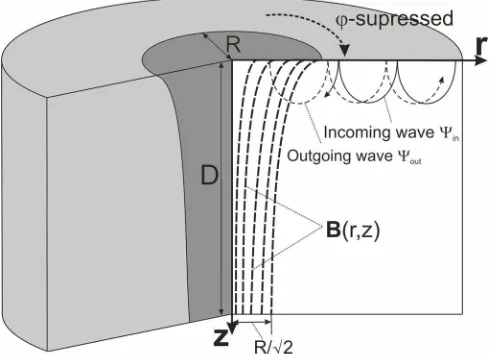
Here, D is the convergence length, which corresponds to the depth at which the flux tube cross section decreases by a fac-tor of 2.R is the flux tube radius and B0 is the characteristic
[image:3.595.319.564.78.255.2]magnetic field strength. We shall use the term strong (weak) con-vergence when the ratioD/R<1(≥1). This magnetic profile is non-uniform in that the field lines tend to bend from a vertical position asDis decreased, which results in a substantial radial component asz→0 andr→R(see Fig.1). This represents the flaring of field lines observed in sunspots. Although we denoteR as the radius of the tube, there is a smooth transition from inside to outside of the tube due to the exponential component tending
Fig. 1.The Model configuration. Dashed lines indicate magnetic fields and the wavefield consists of incomingΨinand outgoingΨout compo-nents.
to zero very quickly forr > R. Thus, there is no rigid bound-ary at the transition from magnetic to ambient (see alsoJain & Gordovskyy 2008).
Using the equation of motion the equilibrium pressure, den-sity and sound speed due to the presence of magnetic field are given by
pm(r,z) = −
B20
2µ
(1+z/D)2+ R
2
8D2(1+z/D)+
r2
4D2
× e−2r
2
R2(1+Dz), (9)
ρm(r,z) =
B20
gµ
r2
8D3(1+z/D)−
1
D(1+z/D)
+ R
2
16D3(1+z/D) 2
e−2r
2
R2(1+ z
D), (10)
and
c2m(r,z)=γ
pa(z)+pm(r,z)
ρa(z)+ρm(r,z)
− pa(z)
ρa(z)
· (11)
In Fig.2we plot the sound speed distributionc2(r,z) normalised by the ambient sound speedc2
a(z) showing the effect of
conver-gence and field strength on the medium. We can see that the sound speed is suppressed in the flux tube region i.e.,R≤4 Mm, this suppression increases with magnetic field strength and with convergence strength. We have plotted contour lines to show where the sound speed approaches the value of the undisturbed atmosphere.
3. Wavefield description
In order to investigate the scattering of p-modes in and around the magnetic flux tube model we set up a wavefield consistent to that of our model i.e., cylindrical symmetry. Outside the flux tube region the wavefield consists of two components: incoming wavefieldΨinand outgoing scattered waves represented byΨout
Fig. 2.Sound speed distributionc2(r,z) normalised by ambient sound speedc2
a(z), forR=4 Mm.Left panelsare forD→ ∞(i.e. no convergence)
andright panelsare forD=2 Mm. Thetop and bottom panelsare forB0 =1.1 kG and 1.4 kG respectively. Dark areas represent a decrease in
sound speed.
We consider the ideal MHD equations for a gravitationally stratified polytropic atmosphere. Thus, we have the following linearised MHD equations for wave perturbationsp′,ρ′andu′:
∂ρ′
∂t +∇·(ρu
′
)=0, (12)
ρ∂u
′
∂t +∇p
′ − 1
µ[(∇×B)×B
′
]
− 1
µ[(∇×B
′
)×B]−ρ′g=0, (13)
∂p′
∂t +(u
′·∇
)p
−c2
∂ρ′
∂t +(u
′·∇
)ρ
=0, (14)
∂B′
∂t −∇×(u
′×B
)=0. (15)
We now take the time dependence ofp′, ρ′ andu′ aseiωt and eliminateρ′andu′from Eqs. (12) to (15). After rearranging the
terms we have the inhomogeneous wave equation for pressure perturbations (see alsoFan et al. 1995)
Lp′+ ω
2
(z+L)α+1p ′=S,
(16)
where,
L= g
α(z+L)α
∇2− α
(z+L)
∂ ∂z+
α
(z+L)2
, (17)
S= g
α(z+L)α
iωF+ g iω
∂F
∂z + 1 iω∇·U
, (18)
F = 1 c2 a
(u′·∇)pm−(u′·∇)ρm+ρa
c2 m
c2 a
(∇·u′), (19)
U = 1
µ[(∇×B)× {∇×(u
′×B
)}]
− 1
µ[{∇×∇×(u
′×B
)} ×B]. (20)
Here sUis the term which describes the effect of the Lorentz force which is omitted inFan et al.(1995).
To solve Eq. (16) we use the Born approximation (Fan et al. 1995), thus we set S = 0 and solve the homogeneous wave equation, thus acquiringp′(0). We then construct the approximate source term,
S(0)= g
α(z+L)α
iωF(0)+ g iω
∂F(0)
∂z + 1
iω∇·U(0)
. (21)
The solutions to the homogeneous wave equation, for azimuthal orderm=0, under the physical boundary conditions form a set of orthogonal eigenfunctions (Fan et al. 1995),
ψn,k(r,z)=Φn,k(z)J0(kr), (22)
where
ω2n,k=gk
α+
2n
α
, (23)
corresponds to the eigenfrequencies of the different modes of oscillation, n, and kis the horizontal wavenumber. The radial component of the eigenfunctions are represented by the Bessel functionJ0(kr). The horizontal component is defined as,
Φn,k(z) =
Γ(α+n) n!
1 Γ(α)e
−k(z+L)
(2k)α2(z+L)α
× M(−n, α,2k(z+L)) (24)
1134 A. Gascoyne and R. Jain: The role of magnetic fields in the scattering of p-modes
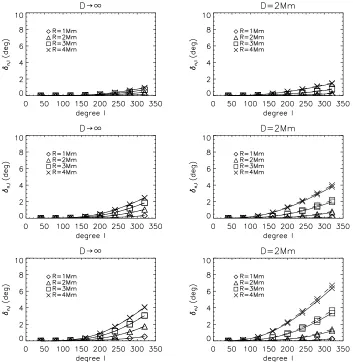
Fig. 3.Phase shiftsδn,las a function of angular degreelforn=1 and various flux tube radii.Left panelsare forD→ ∞(i.e. no convergence) and
right panelsare forD=2 Mm. Thetop,middle and bottom panelsare forB0 =0.7, 1.1 and 1.4 kG respectively. The dashed lines indicate the
phase shifts in the absence of theUterm given by Eq. (20).
Fan et al.(1995) andGordovskyy & Jain(2007), thus we com-pute the following integral for a truncated polytrope (Hindman & Jain 2008):
tanδn,l= 2π ω2
∞
0
dz
∞
0
rdr[k2ψn,k(r,z)S(0)]. (25)
We calculate this integral numerically for various model pa-rameters ensuring that the Born approximation is valid, i.e., the wavelength of the propagating wave modes are greater than the radius of the scattering region. We must also restrict the mag-netic field strength toB0 ≤ 1.4 kG as the Born approximation
is valid only for small source termS(0). Also for stronger
mag-netic field strengths and convergence, pressure inside the tube becomes negative.
4. Results and discussion
In this section we discuss the phase shifts calculated numerically using Eq. (25). The phase shifts are plotted as a function of an-gular degreesl;nis the radial order which we take as 1 or 2. We want to study the effect that different magnetic flux tube param-eters have on the phase shifts of p-modes. Thus, we plot phase shifts as a function of degree for different flux tube radii and field strengths. We also show the effect of magnetic field term on the phase shifts for various model configurations by including
and omitting theUterm in the source term. We further investi-gate whether the magnetic field has a direct or an indirect effect on acoustic wave scattering by fixing D/Rand comparing the change in phase shifts for differentR. The following subsections discuss each of these effects.
4.1. Effect of magnetic flux tube radius, angular degree, radial order and field strength
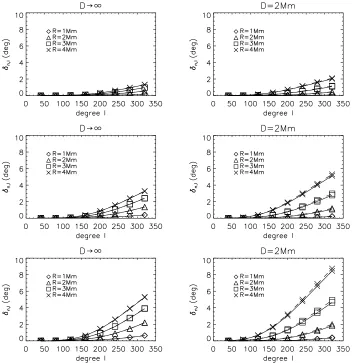
By analysing plots in Figs.3 and4 we can clearly see that in-creasing the radius of the flux tube increases the phase shifts of the p-modes for all wave parameters. This is expected because as we increase the radiusR, the region of suppressed sound-speed becomes larger; thus a larger inhomogeneity. We do not consider very large radii as the Born approximation forces limitations on the radius of the scattering region and the wavelength of modes. We have ensured that eitherkR<1 orkR≈1 (Birch et al. 2001). The phase shift functions δn,l versus angular degree l de-scribe a behaviour similar to that found in Fig. 8 ofFan et al. (1995). Aslincreases the phase shift increases, but this increase is less dramatic whenlbecomes greater than 200.
Fig. 4.Phase shiftsδn,las a function of angular degreelforn=2 and various flux tube radiiR.Left panelsare forD→ ∞(i.e. no convergence)
andright panelsare forD=2 Mm. Thetop, middle and bottom panelsare forB0 =0.7, 1.1 and 1.4 kG respectively. The dashed lines indicate
phase shifts in the absence of theUterm given by Eq. (20).
are zero and that the phase shifts increase with radial order (at least up ton=2).
We expect the magnetic field strength to have a strong impact on phase shifts (see e.g. Braun 1995) so we plotδn,lfor three dif-ferent field strengthsB0 =0.7, 1.1 and 1.4 kG shown in Figs.3
and4. As predicted, they show an increase in phase shift as we increaseB0, due to the increased suppression of sound speed for
higherB0. As mentioned earlier there is an upper bound forB0
which we take as 1.4 kG, an increase in this value would result in negative pressure inside the tube which is obviously meaning-less.
4.2. Effect of converging magnetic fieldlines
Convergence of the magnetic fieldlines can be separated into two categories: strong convergenceD < R and weak conver-genceD≥R. We have plotted the two extremes of convergence, D → ∞and D = 2 Mm. It can be seen from Figs. 3 and4 that phase shifts significantly increase with convergence. This indicates that substantial flaring of field lines has a greater effect on the suppression of sound speed within a magnetic flux tube which then results in greater phase shifts. This increase is more substantial for angular degreel≥100 and for stronger magnetic fields. This is in agreement with the findings ofGordovskyy & Jain(2007).
Note that when studying the sound speed profiles of the flux tube region it is hard to distinguish the difference between a con-verging (D=2 Mm,B0=1.1 kG) and non-converging (D→ ∞,
B0=1.4 kG) magnetic flux tube, as shown in Fig.2. This means
that it would be difficult to make inferences on magnetic stuc-ture when inverting the observational data to get sound speed profiles.
4.3. Direct effect of the magnetic field on phase shifts
In Figs.3and4we plot phase shifts with and without the term
Uin the source termS(see Eq. (20)). These are represented by
solid and dashed lines respectively. This is done in order to in-vestigate the direct effect of magnetic field on phase shifts. It is clear from the figures that for weak convergence (D≥R), there is no significant difference between the two cases but for strong convergence (D<R), the phase shifts are slightly reduced when the magnetic field term U is included. This reduction in the phase shift due to direct magnetic field effect will be more pro-nounced for stronger field (B0 > 1.5 kG) though this is not
shown here due to the restrictions imposed by the Born approx-imation.
1136 A. Gascoyne and R. Jain: The role of magnetic fields in the scattering of p-modes
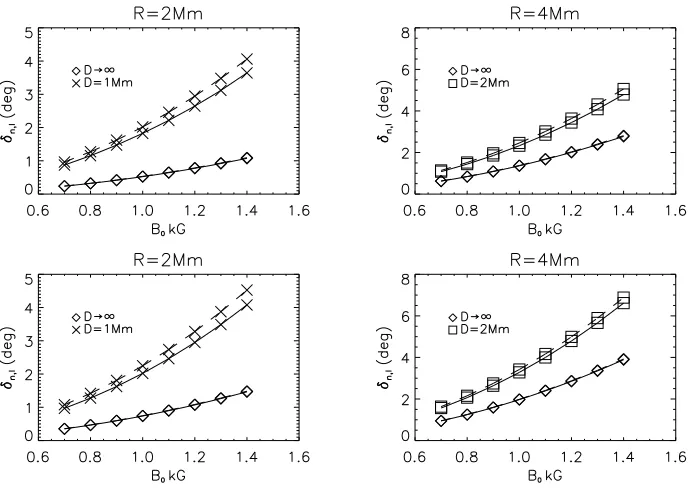
Fig. 5.Phase shiftsδn,las a function of magnetic field strengthB0kG forl=280 and different convergence lengthsDMm.Left and right panels correspond to radiusR=2 and 4 Mm respectively.Top and bottom panelsare forn=1 and 2 respectively. The dashed lines indicate the phase shifts in the absence of theUterm given by Eq. (20).
Fig. 6.Phase shiftsδn,las a function of magnetic field strengthB0kG (left panel) forl=280 and a function of angular degreel(right panel) for
B0 =1.4 kG. We have setn=1 and the ratioD/R=0.5 for variousR. The dashed lines indicate the phase shifts in the absence of theUterm given by Eq. (20).
parameters. Note that as D → ∞, the solid and dashed lines overlap. This is due to the fact that forD→ ∞(non-converging field case), there is no magnetic tension or radial component of magnetic pressure, as a result of which there is no contribution ofUterm in the phase shifts.
As we decrease the convergence length, the magnitude of the phase shifts increases which is expected as there is more tension in the fieldlines. The phase shifts also increase with the magnetic field strengthB0 because of more suppression in sound speed;
this is also true when we increase radiusRand radial ordern. To further understand the direct and indirect effects of mag-netic fields on phase shifts and the role of the term U (see Eq. (20)), we plot in Fig.6the phase shifts for fixedD/R=0.5 verses B0 (left panel) and angular degree l (right panel). The
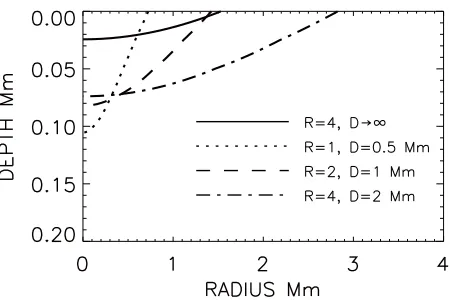
dashed (solid) lines indicate phase shifts due to the absence (presence) of theU term. As we decreaseR (consequentially decreasing D) the difference between dashed and solid lines increases. This is due to the fact that although the magnetic tension is the same for all three cases, magnetic pressure is less for smaller R. Also, the size of the equipartition layer is small for smallerRresulting in less efficient mode conversion
(Cally & Bogdan 1993). This is illustrated clearly in Fig.7where we have shown the equipartition layer for each of the cases in-vestigated in Fig.6. It can be seen from Figs. 6 and 7 that in the current model, the direct effect of magnetic field (magnetic tension, magnetic pressure and mode conversion) is to further re-duce the phase shifts. This phase shift difference also increases with magnetic field strength and angular degreel.
5. Conclusions
[image:7.595.152.492.371.488.2]Fig. 7.Plot showing the equipartition layer (v2
A =c
2) forB
0 =1.4 kG. The solid line is for the vertical field case where as the dotted, dashed and the dot-dashed lines are all forD/R=0.5.
to make inferences on the structure of strong magnetic flux tube regions such as sunspots. In particular, strongly converging fields of high strength could have appreciable effect on the phase shifts of p-modes. Inversions of observed travel-times or phase shifts in and around a sunspot could easily give incorrect sound speed distribution if the geometry of the sunspot is not accu-rately known. By ignoring magnetic tension terms (for example, in penumbrae) during inversions one could easily underestimate the sound speed suppression compared to the surroundings or overestimate the magnetic field strength by presuming vertical field geometry.
It is important to note from the present study that the phase speeds obtained from the ray analysis does not necessarily di-rectly correspond to the background sound speed, since the mag-netic field is also playing a direct role in altering the phase. However, since the magnetic tension terms will not be the same for all sunspots and other magnetically active regions, we can-not suggest a unique way to invert the observational data for the sound speed distribution in these regions. More future work will be directed towards this aspect.
As clearly seen from the present work, the inclination of the field lines near the surface of a magnetic structure are affected by the convergenceD/R, which in turn influences the magnitude of the phase shifts. Although this ratio cannot be currently mea-sured accurately from observations, one can constrain it for this model by surface observations of the vector magnetic field of sunspots (see e.g.Schunker et al. 2008). Thus we expect typical value ofD/Rto be 0.4<D/R<2 for the inclination observed in the sunspots between umbrae and penumbrae.
In this paper we used the Born approximation to calculate phase shifts; this imposes restrictions on our model parameters. The inhomogeneity must not be too strong or else the approxi-mation will not be accurate, so interpreting our results for any
observed phase shifts higher than 60◦should be considered with caution. Our future work will address this issue. The calculations presented here are very sensitive to the physical boundary cho-sen at the surface but we want to emphasize the effect ofUterm (magnetic) instead of the absolute value of the phase shifts.
In the current model, it appears that if magnetic and thermal perturbations are to be considered separately then although they compete against each other, thermal perturbations dominate. In our future work we will investigate in detail the effects of mode conversion and reflection which as shown in Fig.6, clearly play an important role. It has been known that such effects are signif-icant for p-mode phase shifts. For example,Cally et al.(2003) investigated mode-conversion mechanism in inclined fields and reproduced the observed phase shifts calculated from Hankel analysis by Braun(1995). Recently, Lindsey & Braun (2005) andSchunker et al.(2008) have shown that the phase shift of the outward propagating waves is opposite to the phase shift of the inward propagating waves in stronger, vertical fields.Couvidat & Rajaguru(2007) also report possible contamination of helio-seismic inversions for sound speed beneath sunspots, possibly due to near surface magnetic field effects. Obviously the choice of the surface magnetic field and the profile of the background atmosphere can vary results but it is becoming evident that in addition to purely thermal effects, the direct effects of magnetic field play a significant role in altering the phase shift of p-modes.
Acknowledgements. We are thankful to M. Gordovskyy for many useful discus-sions. We also appreciate constructive comments from an anonymous referee which have helped to improve this manuscript. This work is supported by UK STFC studentship.
References
Birch, A. C., Kosovichev, A. G., Price, G. H., & Schlottmann, R. B. 2001, ApJ, 561, L229
Braun, D. C. 1995, ApJ, 451, 859
Braun, D. C., Duvall, T. L., & LaBonte, B. J. 1988, ApJ, 335, 1015 Braun, D. C., Duvall, T. L., LaBonte, B. J., et al. 1992, ApJ, 391, L113 Cally P. S., & Bogdan, T. J. 1993, ApJ, 402, 732
Cally, P. S., Crouch, A. D., & Braun, D. C. 2003, MNRAS, 346, 381 Couvidat, S., & Rajaguru, S. P. 2007, ApJ, 661, 558
Couvidat, S., Birch, A. C., & Kosovichev, A. G. 2006, ApJ, 640, 516
Duvall, T. L., Jefferies, S. M., Harvey, J. W., & Pomerantz, M. A. 1993, Nature, 362, 430
Fan, Y., Braun, D. C., & Chou, D. Y. 1995, ApJ, 451, 877 Gordovskyy, M., & Jain, R. 2007, ApJ, 661, 586
Gordovskyy, M., Jain, R., & Thompson, M. J. 2006, Beyond the Spherical Sun: a new era of helio and astero-seismology, proceedings of SOHO18/GONG2006/HeLAS I, Sheffield, UK, ESA SP-624
Hindman, B. W., & Jain, R. 2008, ApJ, 677, 769 Jain, R., & Gordovskyy, G. 2008, Sol. Phys., 251, 361 Kosovichev, A. G. 1996, ApJ, 461, L55
Kosovichev, A. G., Duvall, T. L., & Sherrer, P. H. 2000, Sol. Phys., 192, 159 Lindsey, C., & Braun, D. C. 2005, ApJ, 620, 1118
Rosenthal, C. S. 1995, ApJ, 438, 434