JUDUL: AN IMPLEMENTATION OF FCM-RBF TECHNIQUE FOR ELBOW
JOINT FLEXION USING SINGLE CHANNEL SURFACE
ELECTROMYOGRAPHY (SEMG) SIGNALS
SESI PENGAJIAN: 2013/2014
Sa ya SOH JIA SHAN
(HURUF BESAR)
mengaku membenarkan tesis (PSM/Sarjana/Doktor Palsafah) ini disimpan di Perpustakaan Fakulti Teknologi Maklumat dan Komunikasi dengan syarat-syarat kegunaan seperti berikut:
1. Tesis dan projek adalah hak milik Universiti Teknikal Malaysia Melaka. 2. Perpustakaan Fakulti Teknologi Maklumat dan Komunikasi dibenarkan
membuat salinan untuk tujuan pengajian sahaja.
3. Perpustakaan Fakulti Teknologi Maklumat dan Komunikasi dibenarkan membuat salinan tesis ini sebagai bahan pertukaran antara institusi pengajian tinggi.
4.
* *
Sila tandakan (/)SULIT
TERHAD
/
TIDAK TERHADAlamat tetap: No.20, Jalan Ibrahim, 85000 Segamat, Johor.
Tarikh: 27 Ogos 2014
(Mengandungi maklumat yang berdarj ah keselamatan a tau kepentingan Malaysia seperti yang termaktub di dalam AKTA RAHSIA RASMI 1972)
(Mengandungi maklumat TERHAD yang telah ditentukan oleh organisasi/badan di mana penyelidikan dij alankan)
(TANDATANGAN PENYELIA)
DR. CHOO YUN HUOY Nama Penyelia
Tarikh:
(),7/
Bf
~t,.
CATATAN: *Tesis dimaksudkan sebagai Laporan Projek Sarjana Muda (PSM) ** Jika Tesis ini SULIT atau TERHAD, sila Lampirkan surat daripada pihak berkuasa
FLEXION USING SINGLE CHANNEL SURF ACE ELECTROMYOGRAPHY
(SEMG) SIGNALS
SOHJIA SHAN
This report is submitted in partial fulfilment of the requirements for the
Bachelor of Computer Science (Artificial Intelligence)
FACULTY OF INFORMATION AND COMMUNICATION TECHNOLOGY
UNIVERSITI TEKNIKAL MALAYSIA MELAKA
I hereby declare that this project report entitled
AN IMPLEMENTATION OF FCM-RBF TECHNIQUE FOR ELBOW JOINT
FLEXION USING SINGLE CHANNEL SURFACE ELECTROMYOGRAPHY
(SEMG) SIGNALS
is written by me and is my own effort and that no part has been plagiarized
without citations.
STUDENT
(SOH JIA SHAN)
SEPERVISOR:
~
DATE:q;tf
ll{>1111/-
DEDICATION
To my beloved parents, Mr. Soh Hai Lun and Mrs. Tee Poh Geok, my love
and support are my greatest inspiration upon accomplish this project.
To my dearest supervisor, Dr. Choo Yun Huoy for being responsible,
receptive and always by my side to encourage and motivate me.
To my dear friends, especially Yap Tian Bee, Liew Siaw Hong, Shidah and
DEDICATION
To my beloved parents, Mr. Soh Hai Lun and Mrs. Tee Poh Geok, my love
and support are my greatest inspiration upon accomplish this project.
To my dearest supervisor, Dr. Choo Yun Huoy for being responsible,
receptive and always by my side to encourage and motivate me.
To my dear friends, especially Yap Tian Bee, Liew Siaw Hong, Shidah and
ACKNOWLEDGEMENTS
I would like to express my deepest appreciation to all those who provided me
the possibility to complete this report. A special gratitude I give to my final year
project supervisor, Dr Choo Yun Huoy, whose contribution in stimulating
suggestions and encouragement, helped me to coordinate my project especially in
writing this report.
Furthermore I would also like to acknowledge with much appreciation the
crucial role of the student of Faculty of Engineering, which is Muhamad Syazwan
Bin Mohd Jasni who collected the EMG signals real data using goniometer and
whom gave me some necessary information to complete my final year project. A
special thanks goes to all of my course mate, who help me to assemble the parts and
gave suggestion directly or indirectly. Last but not least, many thank again to my
final year project title suggestion, Dr Choo Yun Huoy, whose have invested her full
effort in accompany and guidance throughout the whole final year project. I have to
appreciate the guidance given by other lecturer as well as the evaluator and panels
especially in project presentation that has improved my presentation skills, thanks to
ABSTRACT
Muscle force to every joint position movement is very important. Human
movement involves the activation and control of muscle force. Therefore, EMG
evaluation had been recorded from movement activity produced by skeletal muscles
to predict the muscle force from human motion. This study mainly aim to predict the
muscle force during elbow joint flexion using single channel surface
Electromyography (sEMG) signals. However, the challenge of using the single
channel sEMG signals was it facing the problem of accuracy in prediction although it
is cheaper than using multi-channel signals. Therefore, a good prediction method had
been carried out using the technique of Radial Basis Function (RBF) Network hybrid
with teclmique of Fuzzy C-means (FCM). Most of the researched were used RBF
and Multilayer Perceptron (MLP) technique only to predict the muscle force.
Anyway, the technique of RBF in prediction is better than MLP. To improve the
performance of RBF, FCM was used to find the cluster centres and used in hidden
layer of RBF network so that it can improve the performance during the prediction of
muscle force. The result shown that the FCM did the clustering according to the
pre-set category, so the hidden node in the hidden layer had been cluster in the different
node and it affect the high Root Mean Square Error (RMSE) values produced. MLP
using nntoolbox also had been carried out in this research to compare the RMSE
results with the technique of RBF based on FCM. The result had proof that the
TABLE OF CONTENTS
CHAPTER SUBJECT PAGE
DECLARATION i
DEDICATION ii
ACKNOWLEDGEMENTS iii
ABSTRACT iv
LIST OF TABLES viii
LIST OF FIGURES ix
LIST OF ABBREVIATIONS x
LIST OF APPENDICES xiv
CHAPTER I INTRODUCTION 1
1.1 Project Background 1
1.2 Problem Statements 3
1.3 Objectives 3
1.4 Scope 4
1.5 Project Significance 4
1.6 Conclusion 5
CHAPTER II LITERATURE REVIEW 6
2.1 Introduction 6
2.2 Muscle Force Estimation 6
2.3 Electromyography (EMG) 8
2.4 The Effect of Multi-channel and Single
channel in EMG Signals Prediction 9
2.5 Soft Computing Techniques 11
2.5.1 Multilayer Perceptron (MLP) Neural
2.5.2 Radial Basis Function (RBF) Neural
Network 12
2.5.3 Adaptive Neuro Fuzzy Inference
System (ANFIS) 13
2.5.4 Fuzzy c-means (FCM) 14
2.5.5 Radial Basis Function based on Fuzzy
C-means (FCM-RBF) 15
2.6 Parameter measurements 17
2.7 Description of dataset 17
2.8 Conclusion 17
CHAPTER III METHODOLOGY 19
3.1 Introduction 19
3.2 Preliminary Studies 20
3.3 Data collection 20
3.4 FCM-RBF Modelling 22
3.5 Comparison Method- Multilayer Perceptron
(MLP) Neural Network 24
3.6 Technique Evaluation 24
3.7 Result Analysis 25
3.8 Conclusion 26
CHAPTER IV RADIAL BASIS NETWORK BASED ON FUZZY
C-MEANS (FCM-RBF) TECHNIQUE 27
4.1 Introduction 27
4.2 Fuzzy C-means (FCM) 27
4.3 Radial Basis Network (RBF) 28
4.4 Radial Basis Network based on Fuzzy C-means
(FCM-RBF) 29
CHAPTERV
CHAPTER VI
EXPERIMENTAL RESULTS AND RESULT ANALYSIS
5.1 Introduction
5.2 Experimental Results and Analysis
5.3 Experimental Results Validation and Analysis
5.3.1 Wilcoxon Signed-Rank Test
5.4 Conclusion
CONCLUSION
6.1 Introduction
6.2 Observation on Strengths and Shortcomings
6.3 Contributions
6.4 Propositions for Improvements
6.5 Conclusion
LIST OF TABLES
TABLE TITLE PAGE
2.1 Summary of the Soft Computing Techniques 16
5.l(a) Cluster centres of the dataset 33
5.l(b) Standard deviation of each cluster centres. 33
5.2 Weight calculated during training data for iteration-1 35
5.3 The targeted output, and predicted output with 10
iteration times 36
5.4 The 10 iterations experimental results of FCM-RBF
andMLP 37
5.5 The test of normality for both techniques result based
on RMSE value for 10 iterations time of test of
normality respectively 41
5.6(a) The ranks results of Wilcoxon Signed-Rank Test using
two samples of data 44
5.6(b) The test statistics of Wilcoxon Rank Sum Test 44
LIST OF FIGURES
FIGURE TITLE PAGE
2.1 The Action Potention of EMG signal 8
2.2 Position of Biceps Brachii 10
2.3 MLP neural network structure 12
2.4 RBF neural network structure 13
3.1 Phases of Project Methodology 19
3.2 Goniometer setup on the subject
(a) Resting condition (b) Lifting up condition 21
3.3 The bicep in human arm 22
3.4 Bipolar electrode in EMG prediction. 22
5.l(a) Example of Means Square Error (MSE) output
interfaces of MLP neural network on performance 38
5.l(b) One of the graphs of MSE using the MLP technique 39
5.2(a) Normal
Q-Q
Plot of RMSE by FCM-RBF technique 42EMG
sEMG
AI
RMSE
RBF
FCM
FCM-RBF
NN
ANFIS
MLP
SVM
MAE
LIST OF ABBREVIATONS
Electromyography
Surface Electromyography
Artificial Intelligence
Root Mean Square Error
Radial Basis Function
Fuzzy C-means
Radial Basis Function based on Fuzzy C-means
Neural Network
Adaptive Neuro Fuzzy Inference System
Multilayer Perceptron
Support Vector Machine
LIST OF APPENDICES
ATTACHMENT TITLE PAGE
A.1 Cluster centres for FCM-RBF from
iteration-2 until iteration-IO 53
A.2 Standard Deviation for FCM-RBF from
iteration-2 until iteration-IO 55
A.3 The weight generated during training data
from iteration-2 until iteration-IO 57
A.4 The performance of training rate and
training iteration during MLP network
from iteration-2 until iteration-IO 58
A.5 Matlab Codes for FCM-RBF Technique 66
INTRODUCTION
1.1 Project Background
The human movement involves the activation and control of muscle force. In
human body, the static and dynamic balance can be represented by articulated
segments. Movement can be arising from internal force in the body, acting outside
the joint axis and causing the external force to the body. The muscle force to joint
position movement is vitally important for every muscle activity and also the
coordination of muscle activities during functional movement. However, the
generation of force by a muscle is associate with electrical signal closely by placing
the electrode to the surface of the human skin to detect the electricity activity and the
waveform show on screen is called electromyogram and it called as
Electromyography (EMG).
Electromyography (EMG) is a technique to test and record the bio-signal
activity produce by human or animal skeletal muscles and the nerves cell which
control them (Aik & Zainuddin 2008); (Oludolapo 2012); (Kuriki & Azevedo n.d.).
EMG uses a tiny device called electrodes to transmit or detect bio-electrical signals.
The devices translate electrical signal which cause the muscles to contract into graph,
sound or numerical value that a specialist interprets. The signals can be analyzed to
detect activation level, abnormalities, or recruitment order or to analyse the human or
animal motion. In the result, EMG signals is often used as control signals in
rehabilitation robotic systems and virtual models which mimic the human upper or
lower limb (Marcos et al. 2008). The analysis of EMG signals has been largely used
interfaces, diagnose neuromuscular disease, and model neuromuscoloskeletal system.
The association between EMG and human muscle forces is the basis for many
application of EMG to allow inferences according to various aspects of muscle
physiology. However, it is impossible to measure muscle force directly using EMG
bio-signal.
EMG signals are hard to recreate because these may influenced by some
source of noise, such as from the quality of the EMG amplifier, environment may
overlay and the quality of the given detection condition (Oludolapo 2012).
Since the accuracy of signal channel prediction will be affect by variety
source of noise, an uncertainty and hybridization method called adaptive neuro fuzzy
inference system (ANFIS) common and popular method to predict the muscle force
of human arm among the methods of neural-fuzzy hybridization because the
accuracy of prediction is high (Crd 1997). Thus, ANFIS is a kind of neural network
structure based on Takagi-Sugeno fuzzy inference system which it is capable of
learning to approximate any non-linear function (Petkovic et al. 2013). ANFIS is
mostly used for the two or above number of channels when doing prediction method
so that the experiment result provide a vast amount of useful information and it
avoid noise and also increase the accuracy for the prediction (Khezri et al. 2007). If
signal within 16 channels, it needs the technique of Fuzzy C-mean (FCM) to select
certain wavelet features that maximized the class separability (Tang et al. 2012).
Therefore, FCM is suitable for single or multi-channel because classify the signal
data when the data is complicated or contain many of channels. Based on the Sugeno
type fuzzy rule base, when come to hybridization with radial basis function (RBF)
technique neural network, it allow the system to learn from the training data
(Phinyomark et al. 2012b ).
Therefore, the hybrid method between FCM and Radial Basis Function (RBF)
was proposed. Fuzzy system used, FCM will be choosing because it selects those
wavelet features that maximized the class separately(Awad et al. 2009). RBF will be
used in neural network due to RBF is a single hidden layer and because it allowing
the system to learn from the training data.
Muscle force plays an important role to move our limbs. These forces must
be predicted with indirect techniques, as direct measurements are neither generally
possible nor practical. EMG is always applied to estimate muscle activation, force
and moments from the signal's amplitude. However, they are always towards using
multi-channel EMG signal data (Tang et al. 2012). Most studies of multifunctional
myoelectric control system (MCSs) have used multi-channel to get more information
to increase the classification and estimation performance. This is because the ability
of EMG to classify movements is based on information obtained from different
muscle positions and information contained in feature of signal (Staudenmann et al.
2006). The use of single channel EMG signal is benefit also for estimate and classify
low-level muscle activation because it does has the further advantage of lower cost
and lower computational complexity. But, the use single channel EMG signal in
estimation of force, the challenge of using single channel is the information is very
limited, and identifying of EMG signal difficult in classification due to no single
muscle has a major correspondent to different kind of movement. The signals derived
from one of a selected group of muscles will contain both high-level and low-level
EMG signals. Therefore, the ability of the feature extraction methods needed to solve
the problem of loss of signal detection sources (Phinyomark et al. 2012a;
Phinyomark et al. 2012b ).
1.3 Objectives
This project embarks on the following objectives:
L To identify signal features for single channel force prediction using sEMG
signal.
11. To propose the FCM-RBF hybrid method for modeling muscle force in human
arm using single channel EMG signal.
111. To compare the proposed method with Multilayer Perceptron (MLP) prediction
method.
The prediction will be focus on the single channel, which is bicep to control
the movement of elbow joint. The use of single channel and multi-channel of muscle
signal will totally affect the accuracy of the prediction of the data. So a prediction
method will be use proposed to solve the problem of prediction.
The weight of the object is constant when the hand lifts up, which separate
into 4 type of weight: 0 kg, 2kg, 4 kg and 6kg. While, the degree also will be fix
which the subject will bent up at 45°, 90° and 145°. For each experiment, 11 seconds
will be fix. For example, when a people test with lift up 2kg object until 45°, the will
not move for initial 2 seconds, and it will spend another 2min to lift up until 45°,
then remain constant at 45° at the following 4 seconds so that we can observe the
changes on the graph. Each experiment will be repeat until 10 time iteration to
increase the accuracy of data. The optimum force needed will be predicted when the
hand bent up.
The sample will be test for 10 people. 3 basic method of feature extraction
will be carrying out, which are time domain analysis method, frequency domain
analysis method and time-frequency analysis method. Hence, muscle v3 sensor will
be chosen to reduce the noise data when doing the experiment.
1.5 Project Significance
The project significance for this project is to propose muscle force prediction
of human arm using EMG signals. Apart from that, the combination of FCM and
RBF are chosen and implementation in Matlab R2013a in order to do clustering and
predicting sEMG signal for muscle force estimation.
As a conclusion, FCM-RBF is proposed to predict sEMG data based on the
single channel of EMG signal. It is believe that with the hybridization of FCM and
RBF can produce a better result compared to the others in tenn of accuracy
prediction. At the end of this project, the expected output is to get a set of coding for
prediction of EMG signals and a best predict method will be determined in order to
predict EMG signals prediction result for muscle force of human arm.
LITERATURE REVIEW 2.1 Introduction
In this chapter, a literature review of muscle force prediction models with
single channel of EMG signal and a literature review on a various type of artificial
intelligence techniques to cluster and predict the EMG signals have been studied. It
is because artificial intelligence techniques are believed to get better result in
accuracy and use less time to cluster and predict the EMG signals. This chapter
contain 8 sections. The first section presents the introduction of this chapter. Second
session present the importance of EMG signals in muscle force prediction and
session three present the important of muscle force. The following session will
discussed about all the existing techniques in estimate muscle force. All the existing
using artificial will be compare so that the best technique will be apply or continue to
do new hybridization method among two high accuracy methods. The fifth session
will describe the parameter measurement. And, the sixth session will descript about
the EMG signal dataset. At last, a summary or conclusion will be made to give the
reason and choose a best technique in predict force.
2.2 Muscle Force Estimation
Skeletal muscle responsible generates force for movement (Kuriki &
Azevedo n.d.). No matter what motion, when we want to move any part of our body,
become shorter, the force applied is therefore a tension (Rosen et al. 1999). The force
generated by muscle action and the most basic type of force is weight, which is the
product of mass and acceleration. To overcome the inertia of an object, we have to
apply a force so that the force will exceed the weight (Bodlne-fowler 1993). Muscle
force from our body is needed to estimate due to different load when push or pull an
object (Dasanayake et al. 2013). Muscle force is important so that can control the
movement according to the weight (Biscarini et al. 2003). Information of muscle
force is used to control the physical movement of human or animals. Within this
movement control, one of the movement of robot design is it can be used to design
robot arm system so that we able to control it when the system get the information of
object to bent up and lift down the arm (C. et al. 2012); (Pujana-Arrese et al. 2010).
Movement can arise from internal forces acting outside the joint axis, causing force
external to the body. When the muscles begin to develop force, the tendon start to
carry load or weight as well and transfers force from muscle to the bone
(Staudenmann et al. 2006).
However, muscle force cannot easily measure directly because it is highly
nonlinear system. It must be assessed, calculated or modeled. The use of force
sensors for interface normal operation is often inconvenient and not practical for
direct measurement of forces (Franz & Mallot 2000). Other than that, the high cost of
commercially available force sensor makes the alternate method of force prediction
from a group of muscles using electromyography (EMG) signals (Rosen et al. 1999).
EMG signal is directly proportional to muscle strength for isometric and isotonic
contraction with constant speed. In most cases, EMG rises non-linear with increasing
force of muscle contraction. For isometric contraction, angle does not vary in the
isometric case, the relationship between EMG and force must be different for each
angle, and depends on the level of strength and speed of contraction (Choi & Hong
2010). While for isotonic contraction, a movement implies change in joint angle over
which the muscle acts.
Electromyography (EMG) is proposed so that to measure muscle force using
EMG signals. EMG signals are the bio-signals collected on human skeletal
muscle(Franz & Mallot 2000). The bio-signal appeared when muscle membrane
movement or excitation allowed the muscle to go through the process of
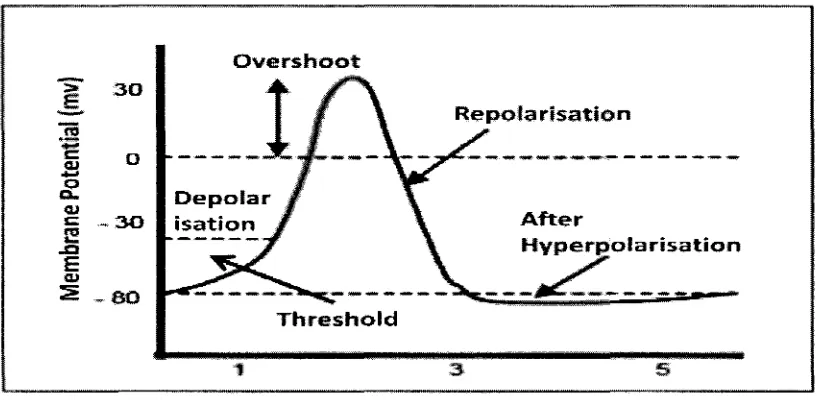
depolarisation and repolarisation. This process was called action potential. The
muscle membrane potential will be produced when sodium (Na+) influx exceeded a
certain threshold voltage and will cause a depolarisation process occur (Sidek et al.
2012). This action potential for raw electromyography (EMG) signal normally will
increase from -80mV to 30mV as shown in Figure 2.1.
Overshoot
¥
30-0
_____ l
De polar
Threshold
1 3
After
Hyperpolarisation
___
/ ,
____ _
[image:22.589.63.472.304.504.2]5
Figure 2.1 : The Action Potential of EMG signal (Gheab & Saleem 2008)
For surface EMG (sEMG) signals, it is hard to apply as a main EMG signal
because of the noise and several factors that were present in the surrounding of the
raw EMG signal, The inner and external environment will affect the changes of
EMG signal, the example of inner affect are the temperature of the skin, the
physiological changes and thickness varies with electrical conductivity, while the
external noise also will caused the EMG signal to be distorted (Antfolk et al. 2010).
The prevention method of this external noise is to run EMG experiment in a
Noise-less room or compartment within using the sensor when collect the EMG signals data
EMG (Mankar 1995).
The EMG signals can be collect by placing electrodes on the skin surface to
detect underlying electrical activity and the signal will displaying the associated
waveform on a computer monitor (Khushaba & Al-jumaily n.d.). EMG signals are
directly proportional to muscle strength for contraction with constant speed and
nonlinear motion (Oludolapo 2012); (Padmavathi 2011). Due to the relationship of
EMG and muscle force is not linear and a bit of environmental changes will affect
the accuracy of prediction computing method for processing and analyzing EMG
signals had been proposed and applied before such as Radial Basis Function (RBF)
and Multilayer Perceptron (MLP) in Neural Network, Fuzzy logic and Adaptive
Neuro Fuzzy Inference System (ANFIS). The used of ANFIS is a hybridization of
fuzzy logic and neural network which integrated the best features of both techniques
(Crd 1997).
2.4 The effect of multi-channel and single channel in EMG signals prediction
During the prediction of EMG signals, single channel will be choosing in
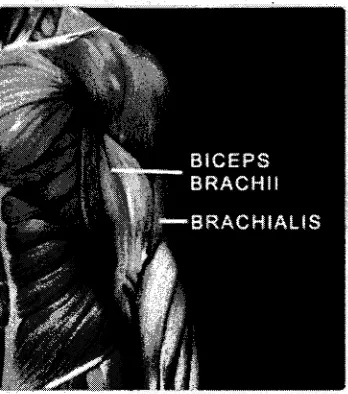
predict muscle force of hand arm. The single channel, biceps muscle that will be
choosing in this research is biceps brachii and the position of muscle is as shown in
Figure 2.2.
Number of multi-channel channel and single channel has some affection on
prediction. For multi-channel in EMG signals prediction, most studies of
multifunctional myoelectric control system (MCSs) have employed multi-channel
sensors to deal with the problem in increase the classification performance
(Staudenmann et al. 2005); (Phinyomark et al. 2012b); (Sidek et al. 2012). The
multichannel sensor ring is a kind of redundant sensor that provides a large amount
of useful information. Between, it is enough to cover circumference of the posterior
side and can record the contraction information of the muscle and also detect other
redundant information. When the collecting enough information from many channel,
it will improve the estimation of muscle force (Kuriki & Azevedo n.d.). While,
increasing number of channel increase its complexity and take time in classify action
too (Staudenmann et al. 2005); (Phinyomark et al. 2012b).
In this research, single channel will be using in estimate muscle force of
EMG signals. This is bicep for single channel, it is very convenient to control
human-computer interface (HCis), but the information obtained from the muscle is
limited to a single channel (Phinyomark et al. 2012a). Besides that, there is no any
single channel that has a major correspond in many different kind of movement.
When single channel provide the information is limited, the ability of the feature
extraction method is needs to be increase to balance for the loss of signal detection
sources (Phinyomark et al. 2012b) . The example of feature extraction can reduce the
[image:24.588.181.355.45.242.2]