IJPSR (2019), Volume 10, Issue 11 (Research Article)
Received on 01 June 2019; received in revised form, 13 October 2019; accepted, 21 October 2019; published 01 November 2019
IN-VITRO AND IN-VIVO QUANTITATIVE ESTIMATION OF TOTAL PHENOLS, ASCORBIC ACID CONTENT AND ANTIOXIDANT ACTIVITY IN NORMAL FLOWER AND FLOWER
GALL OF CRATAEVA RELIGIOSA
Surabhi Sharma
Plant Pathology, Tissue Culture and Biochemistry Laboratory, Department of Botany, University of Rajasthan, Jaipur - 302004, Rajasthan, India.
ABSTRACT: Plant galls are remarkable close associations between plants and insects, in which the plant produces an abnormal growth of tissue in response to a specific stimulus from the attacking insect. The present investigation was undertaken to assess the antioxidant activity as well as the total phenols and ascorbic acid content in in-vivo (normal flower and galled flower) and in-vitro (unorganized static callus cultures) of Crataeva religiosa. Callus cultures (fifteen months old) were grown on MS medium supplemented with NAA (1.0 mg/l) and BAP (0.5 mg/l) using normal and galled flower explants. Antioxidant potential was found to be maximum (89.54%) in galled flower and minimum in normal flower callus (16.58%). Lower IC50 value indicates high antioxidant activity which was maximum in normal flower callus (456.12 ± 0.36) and minimum in galled flower (73.49 ± 0.24). Total phenols and ascorbic acid were also higher in galled tissues as compared to normal flower and in-vitro tissues. These primary findings showed that insect induces higher levels of phenolics and ascorbic acid constituents that are responsible for higher antioxidant activity. The results indicate that insect induced galls may be considered as a promising source of natural antioxidants for food and medicinal applications.
INTRODUCTION: Crataeva religiosa Forst.
(Family-Capparidaceae), a large tree distributed in the tropical zone and is common throughout India, Myanmar, and Sri Lanka. It is one of the herbal drugs in urolithiasis 1. The tree is well known for its various pharmacological properties like diuretic, antimycotic, contraceptive, antipyretic, antilithitic, antihelminthic, rubefacient anti-inflammatory, laxative, vasicant, antioxaluric, hepatoprotection, lithonotriptic, antirehumatic, antiperiodic, and antioxidant properties 2.
QUICK RESPONSE CODE
DOI:
10.13040/IJPSR.0975-8232.10(11).5103-08
This article can be accessed online on www.ijpsr.com
DOI link: http://dx.doi.org/10.13040/IJPSR.0975-8232.10(11).5103-08
The nectar-filled flowers of the plant are very attractive to several Kinds of insects and birds. The flowers and fruits are discontentedly afflicted by the insect, Aschistonyx crataevae Mani, order diptera 3. The interaction between a gall-inducing species and a suitable host plant (and their genomes) results into gall. Galls arise due to the growth and development reactions of plants to the attack of insects 4. Galls often reflect a parasitic relationship, in which the gall inducer alters resources of the host plant to be more easily accessed or consumed by themselves 5.
The higher plants have the capacity to produce a large number of secondary metabolites. The most important bioactive constituents of the plants are tannins, flavonoids, alkaloids and phenolic compounds 6.
Keywords:
Crataeva religiosa, Galls, Phenol, Ascorbic acid, Antioxidants, 2, 2-diphenyl
1-picrylhydrazyl
Correspondence to Author: Surabhi Sharma
Plant Pathology, Tissue Culture and Biochemistry Laboratory, Department of Botany, University of Rajasthan, Jaipur - 302004, Rajasthan, India.
Insect induces stress to the plant. Stress triggers a wide range of plant responses and can have an upsetting impact on plant growth and yield 7 or it can also result into the enhancement of secondary metabolites production 8. These secondary metabolites trigger changes into plants cell which helps to overcome stress 9. Antioxidant compounds derived from plant parts are natural and preferable
over synthetic because of their safety measures 10. Therefore, in recent times research is directed towards discovering plants that have high reducing power that can protect against various kinds of ailments with antioxidant potential 11, 12. The Determination and extraction of the natural antioxidant compounds from insect induced galls may help to develop new drug moiety for therapy.
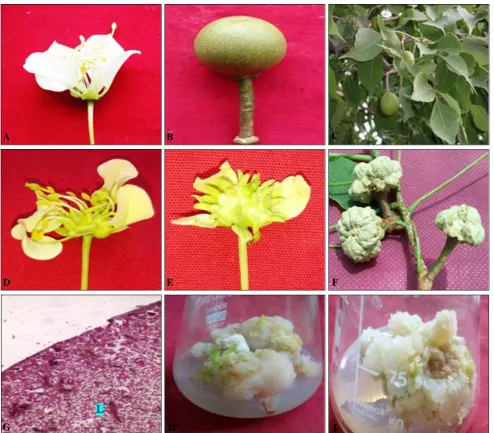
FIG. 1: (A) NORMAL FLOWER, (B-C) NORMAL FRUIT, (D-E) YOUNG GALL, (F) MATURE GALL, (G) GALL ANATOMY SHOWING INSECT LARVA (L),(H) NORMAL FLOWER CALLUS, (I) GALL CALLUS
MATERIALS AND METHODS:
Plant Materials and Culture Establishment: The floral plant parts of Crataeva religiosa were collected from the Central park of Jaipur and was verified (Authentication no.- RUBL-13249) by herbarium of the Department of Botany, University of Rajasthan, Jaipur. Unorganized callus cultures (fifteen months old) were grown on MS medium
consisting of basal salts and vitamins with 3% (w/v) sucrose and 0.8% agar with NAA (1.0 mg/l) and BAP (0.5 mg/l) using normal and galled flower explants 13. These cultures were allowed to grow up to their maximum growth age (6-8 weeks) 14.
Quantitative Estimation of Total Phenols: Each of the fresh samples of the plant weighing 0.5gm
A B C
D E F
[image:2.612.61.555.171.604.2](normal flower, galled flower and callus) were homogenized and centrifuged with 10 ml of 80% ethanol. The filtrate was used for the estimation of total phenol as alcoholic extract. To measure the total phenolic contents 15 1 ml of folin ciocalteau phenol reagent (diluted with equal volume of distilled water before use) was added to 1 ml of alcoholic extract in a test tube and followed by 2 ml of 20% sodium carbonate solution. The mixture was heated for 1 min in a boiling water bath.
The blue color obtained was diluted with 25 ml of distilled water and OD was taken at 725 nm in spectrophotometer against 80% ethanol used as blank. Total phenols were calculated from a standard curve prepared from different concentrations of tannic acid. The total phenols were expressed as mg/g fresh wt of tissues.
Quantitative Estimation of Ascorbic Acid: Each of the floral plant samples was dried, powdered, weighed and homogenized separately in mortar and pestle in 2% Meta Phosphoric Acid (MPA) and allowed to marinate for 1 hour then centrifuged separately for fifteen minutes at 2500 rpm. The residues were discarded and the supernatants were used for the estimation of ascorbic acid 16.
Standard solutions of ascorbic acid of different concentrations were prepared (0.1 to 0.9 mg/ml) in 2% MPA. Each of the 1.0 ml of standard as well as tested samples was mixed with 2.0 ml of 5% MPA and kept at room temperature for 30 min without stirring. To each of these 5.0 ml of n-amyl alcohol and 3.2 ml dye (5 mg in 100 ml, 2,4-dichlorophenol indo-phenol) were added and air fizzed through lower layer. Each of the test tubes was stoppered firmly.
The mixture was vigorously shaken and the upper layer was used for the estimation of ascorbic acid. Then absorbance of the preparations was taken by a UV spectrophotometer at 546 nm. The amount of free endogenous ascorbic acid in the test samples was calculated by comparing with that of the standard curve, in mg/100 g dry weight.
Quantitative Estimation of Antioxidant Activity: The antioxidant activity of the methanolic extracts was determined on basis of the scavenging activity of the stable DPPH free radical. DPPH is stable free radical, containing an odd electron in its
structure and usually utilized for detection of the radical scavenging activity 17. 5g of each plant sample in-vivo (normal flower and galled flower)
and in-vitro (unorganized callus tissues) was
Soxhlet extracted in 80% methanol for 24 h at 60 ºC. Then the extracts were used to prepare multiple dilution series from 100 μg/ml to 800 μg/ml concentrations with methanol. To1ml each of the plant extracts samples, standard (ascorbic acid) and blank (methanol), 3 ml of 0.004% methanolic DPPH solution was added. Then all the samples were incubated at room temperature for 30 min.
Absorbances of the sample preparations were taken by using UV spectrophotometer at 517 nm. The results were expressed as IC50 values. The
discoloration of sample was presented in terms of % inhibition of radical scavenging ability that was calculated by using following formula.
Percent inhibition = [(Abs. of control – Abs. of sample) / Abs. of control] × 100
Ascorbic acid was used as the positive control. In order to calculate the IC50 value percent inhibition
of free radicals was plotted against the sample concentration. It is defined as the amount of sample necessary to decrease the absorbance of DPPH by 50% that was calculated from the curve. Radical scavenging activity index of samples was then calculated using following formula:
Antioxidant Activity Index = IC50 of the Ascorbic acid (μg/ml) / IC50 of Sample (μg/ml)
RESULTS AND DISCUSSION: Total phenols
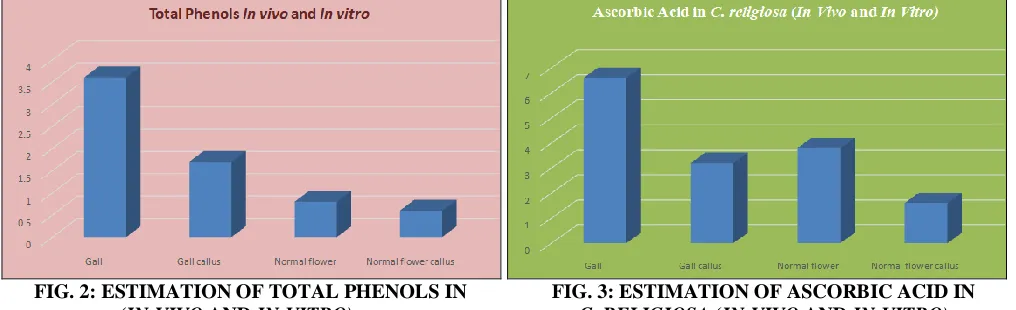
were found to be higher in galled flower as compared to other in-vitro and in-vivo floral tissues as shown in Fig. 2. In gall callus, total phenols were higher than the normal flower. The minimum amount of phenols was measured in normal flower callus. Total phenols were higher in galled flower followed by galled flower callus, normal flower, and normal flower callus.
TABLE 1: ESTIMATION OF TOTAL PHENOL AND ASCORBIC ACID Plant Part Total Phenols mg/gm Ascorbic Acid mg/gm
FIG. 2: ESTIMATION OF TOTAL PHENOLS IN FIG. 3: ESTIMATION OF ASCORBIC ACID IN (IN-VIVO AND IN-VITRO) C. RELIGIOSA (IN-VIVO AND IN-VITRO)
The endogenous ascorbic acid contents were also found to be higher in gallas compared to other
in-vitro and in-vivo floral plant parts. The amount of
ascorbic acid was found more in gall tissues followed by normal flower, gall callus, and normal flower callus as shown in Fig. 3.
Among the tested floral plant parts (in-vivo and
in-vitro), galled flowers were found to have good
antioxidant potential when compared to ascorbic acid standard as shown in Fig. 4. Antioxidant activities of the galled flower (89.54%) and normal
flower (32.45%) extract were found to be higher than callus of normal and galled flower by the DPPH assay Fig. 6. Lower IC50 value indicates
high antioxidant activity.
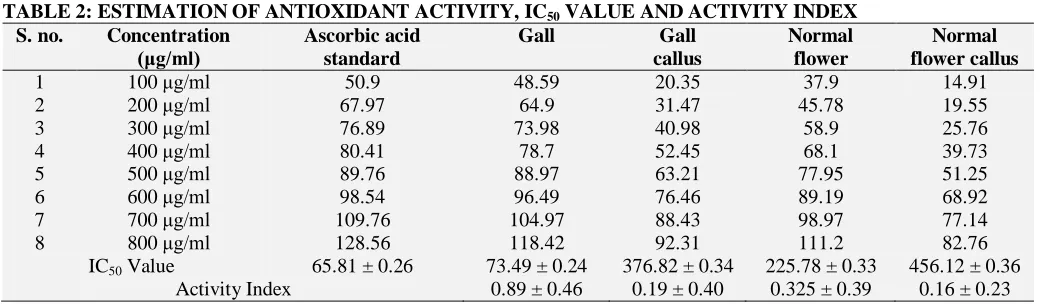
Fig. 5 revealed that the IC50 value for the galled
flower extract was minimum (73.49 ± 0.24), and normal flower callus showed the highest IC50 value
(456.12 ± 0.36) and least antioxidant potential. From these IC50 values, activity indices of all the
[image:4.612.54.562.56.211.2]tested samples against ascorbic acid were analyzed Fig. 6.
FIG. 4: DPPH RADICAL SCAVENGING ACTIVITY OF METHANOLIC EXTRACTS OF C. RELIGIOSAIN-VIVO
AND IN-VITRO FLORAL PLANT PARTS
FIG. 5: IC50 VALUES OF C. RELIGIOSA AGAINST FIG. 6: ACTIVITY INDEX OF ANTIOXIDANT
[image:4.612.182.438.402.538.2]The activity index of gall was found to be highest among tested plant parts (0.895 ± 0.46), and it was lowest in normal flower callus (0.167 ± 0.23) as shown in Fig. 6. From the analysis of percentage
[image:5.612.47.570.120.274.2]inhibition of free radicals, it was found that the antioxidant potentials of galled flower, was higher than normal flower and thus its activity index was nearby to one.
TABLE 2: ESTIMATION OF ANTIOXIDANT ACTIVITY, IC50 VALUE AND ACTIVITY INDEX
S. no. Concentration
(μg/ml) Ascorbic acid standard
Gall Gall
callus
Normal flower
Normal flower callus
1 100 μg/ml 50.9 48.59 20.35 37.9 14.91
2 200 μg/ml 67.97 64.9 31.47 45.78 19.55
3 300 μg/ml 76.89 73.98 40.98 58.9 25.76
4 400 μg/ml 80.41 78.7 52.45 68.1 39.73
5 500 μg/ml 89.76 88.97 63.21 77.95 51.25
6 600 μg/ml 98.54 96.49 76.46 89.19 68.92
7 700 μg/ml 109.76 104.97 88.43 98.97 77.14
8 800 μg/ml 128.56 118.42 92.31 111.2 82.76
IC50 Value 65.81 ± 0.26 73.49 ± 0.24 376.82 ± 0.34 225.78 ± 0.33 456.12 ± 0.36 Activity Index 0.89 ± 0.46 0.19 ± 0.40 0.325 ± 0.39 0.16 ± 0.23
Vitamin C (Ascorbic acid) has a considerable antioxidant activity. It scavenges ROS (reactive oxygen species) and prevents oxidative damage to the important biological macromolecules such as proteins, lipids and DNA 18. The higher total phenols and ascorbic acid lead to better DPPH scavenging activity 19, 20.
CONCLUSION: The free radical scavenging ability of C. religiosa flower gall extract was found to be excellent due to the presence of a high level of antioxidants such as phenols and vitamin C (Ascorbic acid). Insects induce stress to the plant, and in response to stress the plant induces high secondary metabolites, therefore higher antioxidant activity is found in galled flower than normal flower. The outcome of the present study is promising that these insect induced flower galls can be a potent material for protecting the human body from oxidative stress, cancer, infections, inflammation, and acts as immune modulators in traditional medicine.
Further investigation on the identification and extraction of antioxidant component(s) from the flower galls of C. religiosa may lead to chemical entities with potential for clinical use.
ACKNOWLEDGEMENT: We are thankful to
DST-INSPIRE fellowship and to the Department of Botany, UOR for helping and providing necessary research facilities for this work.
CONFLICT OF INTEREST: I declare that I have no conflict of interest.
REFERENCES:
1. Sharma S, Mishra P and Patni V: Analysis of volatile constituents in normal flower and insect induced flower gall of Crataeva religiosa. J Pharma & Phyto 2018; 7(1): 2667-73.
2. Udaysing HP and Gaikwad DK: Medicinal Profile of a Scared Drug in Ayurveda: Crataeva religiosa. J Pharm Sci & Res 2011; 3(1): 923-29.
3. Mani MS: Plant Galls of India. Macmillan India, New Delhi 1973; 354.
4. Mani MS: Ecology of plant galls. Dr. W. Junk Publisher, The Hague 1964; 434.
5. Stone GN and Schonrogge K: The adaptive significance of insect gall morphology. Trends Ecol Evol 2003; 18: 512-22.
6. Castello MC, Phattak A, Chandra N and Sharon M: Antimicrobial activity of crude extracts from plant parts and corresponding calli of Bixa orellana L. Indian J Exp Biol 2002; 40: 1378-81.
7. Nobuhiro S, Rosa MR, Vladimir S, Eduardo B and Mittler R: Abiotic and biotic stress combinations. New Phytologist 2014; 203(1): 32-43.
8. Sudha G and Ravishankar GA: Involvement and interaction of various signaling compounds on the plant metabolic events during defense response, resistance to stress factors, formation of secondary metabolites and their molecular aspects. Plant Cell, Tissue and Organ Culture 2002; 71(3): 181-12.
9. Zeng AP and Biebl H: Bulk chemicals from biotechnology: the case of 1, 3-propanediol production and the new trends. Adv Biochem Eng Biotechnol 2002; 74: 239-59.
10. Arya D, Patni V, Nair P and Kale RD: In-vivo and in-vitro determination of total phenols, ascorbic acid content and antioxidant activity in Pluchea lanceolata Oliver & Hiern. Int J Pharm Sci Res 2015; 6(2): 875-79.
11. Sheik S and Chandrashekhar KR: In-vitro antimicrobial, antioxidant, antiarthritic and phytochemical evaluation of Pscychotria flavida Talbot, an endemic plant of Western Ghats. Int J Pharm Pharma Sci 2013; 5(1): 214-18. 12. Sharma N and Patni V: Comparative analysis of total
13. Bhuiyan MAR, Hoque MZ and Hossain SJ: Free radical scavenging activities of Zizyphus mauritiana. World J of Agri Sci 2009; 5(3): 318-22.
14. Bray HC and Thorpe WV: Analysis of phenolic compounds of interest in metabolism. Biochem Analysis 1954; 1: 27-52.
15. Arirudran B, Thenmozhi A and Priyadharshini P: Evaluation of preliminary phytochemicals and antioxidant efficacy of Crocus sativus. Int J Pharmaceutical Res Dev 2014; 5(12): 1-8.
16. Priya B, Zade SR, Shaikh A, Gahlot M and Joshi P: In-vitro antioxidant activity and determination of total phenolic, flavonoid contents of stems of Rotula aquatic. Int J Pharm Sci Res 2013; 4(9): 3608-14.
17. Jensen WA: Botanical histochemistry: Principles and practice. WH Freeman and Company, San Francisco, 1962; 201.
18. Konopacka M: Role of vitamin C in oxidative DNA damage. Postepy Hig Med Dosw 2004; 58: 343-48. 19. Shieyin NG, Abdullah S and Khimpin C: Phytochemical
constituents from leaves of Elaeis guineensis and their antioxidant and antimicrobial activities. J Pharm Pharm Sci 2013; 5(4): 137-40.
20. Khanam N and Sharma GK: A critical review of antioxidant and antimicrobial properties of Aloe vera. Int J Pharm Sci Res 2013; 4(9): 3304-16.
All © 2013 are reserved by the International Journal of Pharmaceutical Sciences and Research. This Journal licensed under a Creative Commons Attribution-NonCommercial-ShareAlike 3.0 Unported License.
This article can be downloaded to Android OS based mobile. Scan QR Code using Code/Bar Scanner from your mobile. (Scanners are available on Google Play store)
How to cite this article: