2212
T
he high prevalence and diversity of longer-term problems
experienced by patients with stroke and their carers has
long been recognized,
1but they remain poorly addressed by
existing services.
2Postdischarge contact with therapy
ser-vices is associated with improved outcomes.
3,4However, these
interventions are generally time limited and have little effect
on psychosocial outcome. National guidelines
5acknowledge
that stroke should be regarded as a long-term condition, and
the role of a Stroke Care Coordinator (SCC) to facilitate
inputs for community-based patients with stroke and their
families after initial (usually hospital-based) treatment is a
recommended policy.
6,7However, procedures and processes
of this role are unevenly developed, and there has been no
robust evaluation.
Using the Medical Research Council framework for the
development and evaluation of complex interventions,
8incor-porating systematic reviews, qualitative exploration, and
inter-vention modeling, we developed an evidence-based system
of care (longer-term stroke [LoTS] care) that aimed to meet
the longer-term needs of patients with stroke and their carers
living at home. The system of care incorporates a structured
assessment focused on patient- and carer-centered problems
Background and Purpose
—We developed a new postdischarge system of care comprising a structured assessment covering
longer-term problems experienced by patients with stroke and their carers, linked to evidence-based treatment algorithms
and reference guides (the longer-term stroke care system of care) to address the poor longer-term recovery experienced
by many patients with stroke.
Methods
—A pragmatic, multicentre, cluster randomized controlled trial of this system of care. Eligible patients referred
to community-based Stroke Care Coordinators were randomized to receive the new system of care or usual practice.
The primary outcome was improved patient psychological well-being (General Health Questionnaire-12) at 6 months;
secondary outcomes included functional outcomes for patients, carer outcomes, and cost-effectiveness. Follow-up was
through self-completed postal questionnaires at 6 and 12 months.
Results
—Thirty-two stroke services were randomized (29 participated); 800 patients (399 control; 401 intervention) and 208
carers (100 control; 108 intervention) were recruited. In intention to treat analysis, the adjusted difference in patient General
Health Questionnaire-12 mean scores at 6 months was −0.6 points (95% confidence interval, −1.8 to 0.7;
P
=0.394) indicating
no evidence of statistically significant difference between the groups. Costs of Stroke Care Coordinator inputs, total health and
social care costs, and quality-adjusted life year gains at 6 months, 12 months, and over the year were similar between the groups.
Conclusions
—This robust trial demonstrated no benefit in clinical or cost-effectiveness outcomes associated with the new
system of care compared with usual Stroke Care Coordinator practice.
Clinical Trial Registration
—URL: http://www.controlled-trials.com. Unique identifier: ISRCTN 67932305.
(Stroke. 2015;46:2212-2219. DOI: 10.1161/STROKEAHA.115.008585.)
Key Words:
cluster randomized controlled trial
◼
community health services
◼
cost-benefit analysis
◼
quality-adjusted life years
◼
rehabilitation
◼
stroke
Clinical and Cost-Effectiveness of a System of Longer-Term Stroke Care
Anne Forster, PhD; John Young, MSc; Katie Chapman, PhD; Jane Nixon, PhD;
Anita Patel, PhD; Ivana Holloway, MSc; Kirste Mellish, PhD; Shamaila Anwar, PhD;
Rachel Breen, PhD; Martin Knapp, PhD; Jenni Murray, PhD; Amanda Farrin, MSc
Received January 21, 2015; final revision received March 19, 2015; accepted April 6, 2015.
From the Academic Unit of Elderly Care and Rehabilitation, Bradford Teaching Hospitals NHS Foundation Trust (A. Forster, J.Y., K.C., K.M., R.B.), Leeds Institute of Clinical Trials Research, Clinical Trials Research Unit (J.N., I.H., S.A., A. Farrin), and Leeds Institute of Health Sciences (J.M.), University of Leeds, Leeds, United Kingdom; Institute of Psychiatry, King’s College London, London, United Kingdom (A.P.); and Personal Social Services Research Unit, London School of Economics and Political Science, London, United Kingdom (M.K.).
The report of the full programme of research (including this trial) is published in the NIHR Journals Library, Volume 2, Issue 6. For further information see http://www.journalslibrary.nihr.ac.uk/pgfar/volume-2/issue-6#abstract. December 2014.
Presented in part at the European Stroke Conference, London, UK, May 28–31, 2013.
The online-only Data Supplement is available with this article at http://stroke.ahajournals.org/lookup/suppl/doi:10.1161/STROKEAHA. 115.008585/-/DC1.
Correspondence to Anne Forster, PhD, Academic Unit of Elderly Care and Rehabilitation, Temple Bank House, Bradford Royal Infirmary, Bradford, BD9 6RJ, United Kingdom. E-mail [email protected]
© 2015 Bradford Teaching Hospitals NHS Foundation Trust. Stroke is published on behalf of the American Heart Association, Inc., by Wolters Kluwer. This is an open access article under the terms of the Creative Commons Attribution License, which permits use, distribution, and reproduction in any medium, provided that the original work is properly cited.
Stroke is available at http://stroke.ahajournals.org DOI: 10.1161/STROKEAHA.115.008585
and is linked to evidenced-based treatment algorithms and a
goal and action planner based on a problem-solving approach.
We report findings from a trial evaluation of the LoTS care
system of care.
Methods
Study Design and Participants
The trial was a pragmatic cluster randomized controlled trial of the clinical and cost-effectiveness of the LoTS care system of care deliv-ered by community-based SCCs compared with SCC usual practice. Trial procedures were informed by a survey of SCCs.9 The methods have been reported in detail elsewhere10 and undertaken after appro-priate ethical approval.
A SCC was eligible if the following criteria were fulfilled: a reg-istered healthcare professional with documented experience in stroke care; undertaking a community-based coordinating role for patients with stroke; in contact with patients and coordinating a range of care inputs on behalf of the patient or carer (eg, signposting, carrying out assessments); receiving referrals from an acute stroke service that in-cluded a stroke unit fulfilling the Royal College of Physicians audit definition.11 A SCC was classified as working in a team if they partici-pated in community multidisciplinary team meetings. Eligibility of the SCC service was confirmed before randomization by completion of a questionnaire and semistructured interview describing the service and client group (these were repeated midway through recruitment and after 12-month follow-up). This information was also used for stratifi-cation to provide context for trial implementation and monitor any po-tential contamination or confounding between the 2 arms of the trial.
In keeping with the pragmatic trial design, patient eligibility crite-ria were broad. Patients were eligible if they had a confirmed primary diagnosis of a new stroke, were referred to an SCC on discharge home or within 6 weeks of stroke (if not admitted to hospital), and were still waiting for their first community SCC assessment. Patients were ex-cluded if they had a planned permanent admission to, or were already resident in, a nursing or residential care home; or their main require-ment was palliative care. Carers were eligible if a participating patient identified them as the main informal carer who provided practical sup-port at least once per week. Written informed consent for baseline and follow-up assessments was obtained from patients (and carers if ap-propriate) before baseline assessment. In the event that a patient lacked capacity to consent, the patient’s family member, carer, or friend was asked to act as the consultee and provide consultee declaration.
Randomization and Masking
The unit of randomization was the SCC service randomized on a 1:1 basis to either the control or the intervention group. Randomization
was stratified by the quality of the local stroke unit (National Sentinel Stroke Audit median score of 65 based on 2006 data)11; annual num-ber of referrals to the SCC service; SCCs working alone or within a community team; and by geographical area. A method of obtaining a balanced randomization from these covariates based on a method by Carter and Hood12 was used.
Control
Patients in services allocated to the control group received the SCC service in accord with the existing local policies and practices. After randomization, the control group SCCs were asked to complete time logs for all patients documenting the number and duration of contacts, and the time spent coordinating actions, note writing, and discussing the patient in multidisciplinary team meetings if these took place.
Intervention
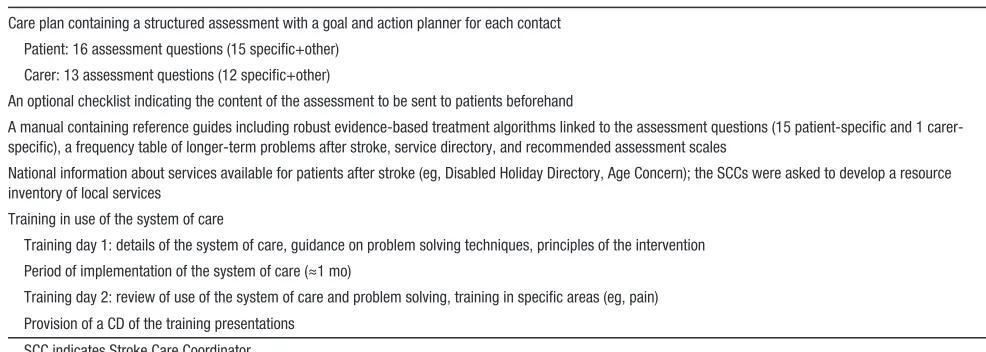
The SCC services allocated to the intervention group provided care according to the LoTS care system of care. This comprises a frame-work of 16 structured assessment questions (linked to evidence-based treatment algorithms and reference guides) that directly relate to lon-ger-term stroke problems previously identified by patients with stroke and their carers13,14 and related prompts provided in a care plan. The care plan also includes a goal and action planner to be completed after each contact (patients and carers). This system of care was supported by a training program and detailed manual, underpinned by a prob-lem-solving approach (Table 1; details are provided in the online-only Data Supplement). The number of contacts was not specified but de-termined by the SCCs’ usual practice and patient need. The key prin-ciples being that all assessment questions were asked and that goals and action plans were identified and reviewed with service responses being provided as appropriate within the context of the services avail-able and the patient’s own environment.15
Recruitment was opened 4 to 6 months after the initial training meeting, providing sufficient time for the implementation of the sys-tem of care into standard practice. Compliance with the intervention was predefined by the trial team as including at least 12 (75%) of the 16 assessment areas recorded as discussed on the care plan during the first patient contact.
Procedures
The trial used existing SCC referral pathways as determined during site set-up. The majority of patients were referred to an SCC service through a predischarge inpatient referral. Recruitment of trial partici-pants was by independent research staff blinded as to whether they were recruiting within a control or an intervention service, and the SCCs were unaware which of their patients had consented to partici-pate. This trial design reduced the potential for selection bias from
Table 1. Components of the Longer-Term Stroke Care System of Care
Care plan containing a structured assessment with a goal and action planner for each contact Patient: 16 assessment questions (15 specific+other)
Carer: 13 assessment questions (12 specific+other)
An optional checklist indicating the content of the assessment to be sent to patients beforehand
A manual containing reference guides including robust evidence-based treatment algorithms linked to the assessment questions (15 patient-specific and 1 carer-specific), a frequency table of longer-term problems after stroke, service directory, and recommended assessment scales
National information about services available for patients after stroke (eg, Disabled Holiday Directory, Age Concern); the SCCs were asked to develop a resource inventory of local services
Training in use of the system of care
Training day 1: details of the system of care, guidance on problem solving techniques, principles of the intervention Period of implementation of the system of care (≈1 mo)
Training day 2: review of use of the system of care and problem solving, training in specific areas (eg, pain) Provision of a CD of the training presentations
SCC indicates Stroke Care Coordinator.
[image:2.585.42.535.562.738.2]differential recruitment16 inherent if the SCCs were responsible for patient identification and minimized likelihood of altering of SCCs’ clinical activity for trial participants.
The research staff collected anonymous screening data (demo-graphic data and modified Rankin Scale score17) for all patients referred to a participating SCC. For recruited patients, researchers collected baseline demographic data, including assessment of cogni-tion (6-Item Cognitive Impairment Test),18 language ability, prestroke disability (Barthel index19), and the 6 items that allow calculation of the Edinburgh stroke case mix adjuster.20
Consistent with a patient-centered model of stroke recovery in which adjustment to activity restrictions and participation are re-garded as the critical issues, the primary outcome was an assessment of psychological well-being measured by patient reported General Health Questionnaire-12 (GHQ-12)21 at 6 months after recruitment, with a secondary outcome at 12 months (for the GHQ-12 higher scores equate to poorer outcomes). This outcome measure is short and easy to complete, consistent with the high prevalence of psycho-logical symptoms after stroke,13 and that psychological problems be-come more prevalent with time.22 Other patient reported secondary outcome measures were Frenchay Activities Index (extended activi-ties of daily living),23 Barthel Index (activities of daily living),19 and European Quality of Life-5 Dimensions (health state).24,25 Patients also completed the Longer-term Unmet Needs after Stroke question-naire (unmet stroke related needs).26 Carer-reported outcomes includ-ed GHQ-12 and Carer Burden Scale (assessment of carer burden).27 A Client Service Receipt Inventory (CSRI28,29; use of services prestroke and postdischarge) was completed to inform the economic evalua-tion. The research staff recorded deaths, emergency outpatient treat-ment, and hospital admissions at 6 and 12 months post recruitment.
Patient- and carer-reported outcomes were assessed in baseline questionnaires and via postal questionnaires at 6 and 12 months post recruitment. This was supported by postal and telephone reminders if questionnaires were not returned within 2 weeks. If necessary (af-ter postal and telephone reminders), patients were contacted by tele-phone to complete the primary outcome measure (GHQ-12).
Process data were collected for trial patients after the end of 12 month follow-up so as not to unblind the SCC to trial patients. Time logs were collected for patients in control services. In intervention services, data on the use of the structured assessment and goal and action planner (including time taken) were collected by researchers transcribing the appropriate information from the care plans at site.
Sample Size
The sample size calculations, based on the primary outcome measure GHQ-12 at 6 months, indicated that recruitment of 800 patients from 40 services would provide 90% power at 5% significance level to detect a clinically relevant difference of 2.5 GHQ-12 points (SD, 7), as reported in a previous study.30 This sample size accounted for an estimated 25% loss to follow-up and clustering: the inflation factor of 1.95 was derived from a maximum cluster size of 20 and an intra-cluster correlation coefficient of no >0.05.31 Losses to follow-up were anticipated to increase over time, and interpretation and credibility of results are difficult if losses exceed 30%; therefore, follow-up was limited to 12 months post recruitment and the primary outcome was defined as 6 months.
We were able to identify 32 SCC services which were eligible, willing to participate and provide a principal investigator, and these were randomized. We planned that each service would recruit 25 patients for 18 months, to provide power of 88%, assuming equal cluster size and no >25% loss to follow-up. To minimize unequal re-cruitment to clusters, the maximum number of patients per service was capped at 45.
Statistical Methods
Statistical analyses were conducted on the intention to treat popula-tion for both primary and secondary analyses. The intenpopula-tion to treat population was defined as all patients registered for active follow-up regardless of noncompliance with the intervention. A per-protocol
analysis was also undertaken where major protocol violators and pa-tients not receiving care from SCC were excluded from the analy-sis. All statistical testing was performed at a 2-sided 5% significance level. Analyses were completed using SAS software version 9.2 (SAS Institute Inc, Cary, NC).
Primary and secondary outcomes were compared between the control and intervention groups using a 2-level multilevel model, with patients nested within stroke services. The models were ad-justed for the patient-level covariates (level 1): baseline Barthel Index (prestroke and poststroke), sex, age, living circumstances (liv-ing alone versus with carer), stroke severity reflected by speech and language impairment (normal/impaired), baseline 6-Item Cognitive Impairment Test score (normal/impaired cognitive function), and patient baseline score for the outcome measure; and the following stroke unit-level covariates (level 2): quality of stroke unit (National Sentinel Stroke Audit score), referral rate, and SCCs working alone versus within a community multidisciplinary team.
Sensitivity analyses were undertaken to test the robustness of analysis assumptions, including patients who died by assuming worst possible GHQ-12 outcome; only including patients returning postal questionnaires at 6 months (excluding patients who provided primary outcome via telephone call); repeating the analysis without proxy responses; using data collected at 12 months for patients who did not return questionnaires at 6 months, and assuming data missing at random using multiple imputation.
Details of patient deaths and hospital readmissions, unmet needs, carer deaths, any serious adverse events, and related and unexpected serious adverse events were reported for each treatment group. The relationships between adjusted primary outcome and completion of time logs in control or compliance with care plans in intervention were explored graphically.
Economic Evaluation
The prospective economic evaluation was from both health/social care and societal perspectives linking costs (including SCC inputs) with the GHQ-12 and quality-adjusted life years (QALY) derived from European Quality of Life-5 Dimensions. The primary end point was 6 months, but we also examined findings at 12 months and over the year (full details are provided in the online-only Data Supplement). Unit costs (£, 2010/11 prices) were attached to individual-level resource use quantities (measured retrospectively by self-report) to calculate total costs per participant. Costs are shown in English pounds sterling (£) and can be converted to US dollars using the rate £1=$1.43, based on 2011 purchasing power parities, which equalize the purchasing power of the currencies.32 Discounting was unnecessary for the study time frame. We compared costs and QALY gains using multilevel models with baseline covariates, calculating incremental cost-effec-tiveness ratios only where 1 intervention showed higher costs and better outcomes. We examined the intervention’s probability of cost-effectiveness by constructing cost-cost-effectiveness acceptability curves (5000 bootstrap replications) for threshold ranges of £0 to £2000 for GHQ-12 point gains and £0 to £50 000 for QALY gains.
Results
The CONSORT diagram is shown in Figure. Thirty-two stroke
service clusters were randomized (75% of these involved were
team-based rather than individual SCCs); 29 clusters recruited
participants (14 control and 15 intervention clusters). Of the
3 services unable to participate, 1 service changed its
refer-ral process after randomization; in 1 service, the SCC was
absent because of long-term sickness; and in 1 service, we
were unable to identify a researcher to undertake recruitment.
Between July 1, 2009 and March 31, 2011, 2488 patients
were screened; 800 patients (56.3% [800/1420] of eligible
patients) and 208 carers were registered into the trial (399
patients/100 carers in the control group; 401 patients/108
car-ers in the intervention group). Of these, 66 of 800 (8.2%)
were by consultee declaration. The study was completed after
receipt of the 12-month assessments of the final patients in
May 2012. The baseline characteristics of the patients and
carers were balanced across the control and intervention
groups other than there were more patients with higher
edu-cation and fewer with language or cognitive impairments in
the control group and a difference in length of inpatient stay
which was shorter in the control arm. Language and
cogni-tive impairment were accounted for in the statistical
model-ing. Patient baseline characteristics are shown in Table 2, and
carer baseline characteristics are shown in the online-only
Data Supplement.
Of patients registered to the trial, 314 of 399 (78.7%)
patients in the control group and 318 of 401 (79.3%) patients in
the intervention group received the SCC service. Reasons for
not receiving the service included SCC not receiving a
refer-ral; patient declining; patient death or patient not contactable.
Response rates for patient reported outcomes at 6 months were
75.2% (300/399) in control and 77.3% (310/401) in
interven-tion and at 12 months, 67.2% (268/399) in the control and
Figure. Cluster allocation and patient flow by treatment arm. PI indicates principal investigator.
70.1% (281/401) in the intervention group. Response rates for
carer reported outcomes are provided in the online-only Data
Supplement.
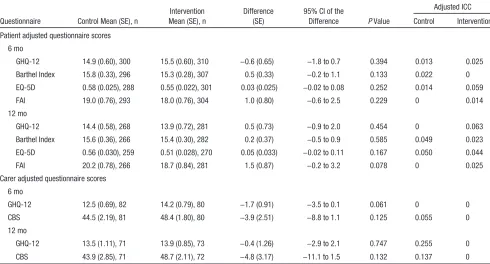
There was no evidence of a statistically significant
differ-ence for the primary end point. The adjusted GHQ-12 mean
score at 6 months was 14.9 (SE, 0.6) points for the control
group and 15.5 (SE, 0.6) points for the intervention group,
with a difference of −0.6 points (95% confidence interval, −1.8
to 0.7), P value of 0.394, and adjusted intracluster correlation
coefficients of 0.013 in the control group and 0.025 in the
inter-vention group. Analyses of secondary patient end points also
indicated no evidence of statistically significant differences in
the Barthel Index, European Quality of Life-5 Dimensions,
Frenchay Activities Index at 6 and 12 months, or the GHQ-12
at 12 months (Table 3; unadjusted patient questionnaire scores
are provided in the online-only Data Supplement). The
num-ber and types of unmet needs reported (Longer-term Unmet
Needs after Stroke questionnaire), deaths, hospital
readmis-sions, institutionalization, and treatment on an emergency
out-patient basis were similar for both groups (details are provided
in the online-only Data Supplement). Between-group
compar-isons of the adjusted scores for the carer reported GHQ-12 and
Carer Burden Scale at 6 and 12 months indicated no evidence
of statistical differences for these outcomes (Table 3).
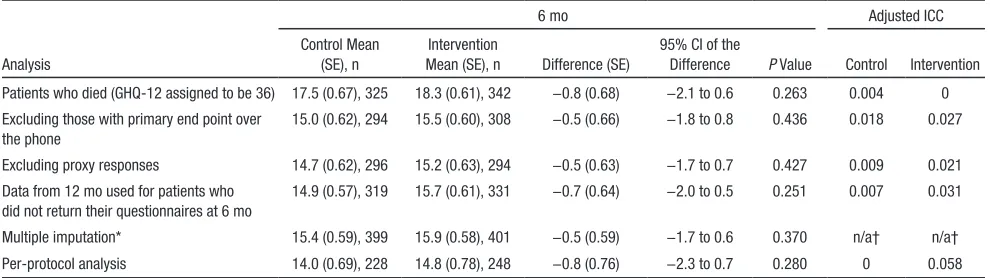
Results of per-protocol analyses (conducted for all patient
and carer end points) and sensitivity analyses (conducted on
the primary end point) were consistent with results of the
intention to treat analyses with no evidence of statistical
dif-ferences between treatment groups (Table 4).
SCCs completed care plans within the trial period for 280
of 401 (69.8%) patients in the intervention group and time
logs for 207 of 399 (51.9%) patients in the control group. In
the intervention group, there were 269 of 280 (96.1%) care
plans that met the definition of compliance with on average 15
of 16 (93.8%) of assessment areas asked at first contact. From
the care plan and time log records, the median number of
SCC patient assessment contacts was 2 (range, 1–6) contacts
in the intervention group and 2 (range 1–7) contacts in the
control group. No linear trend was observed between
percent-age of compliant care plans or percentpercent-age of completed time
logs and adjusted mean primary outcome for intervention and
control services respectively (Figures and further information
presented in the online-only Data Supplement). Review of
Table 2. Patient Baseline Demographic and Clinical DetailsPatient Control, n=399 Intervention, n=401 Age, mean (SD) 72.5 (12.84) 70.9 (13.18) Sex, male, n (%) 218 (54.6) 215 (53.6) Ethnicity, white, n (%) 389 (97.5) 388 (96.8) Formal education, n (%) 383 (96.0) 380 (94.8) Left education at ≤16, n (%) 282 (73.6) 319 (83.9) Cerebral infarction, n (%) 343 (86.0) 341 (85.0) Left hemiparesis, n (%) 179 (44.9) 178 (44.4) Normal language ability, n (%) 323 (81.0) 295 (73.6) Normal cognitive function (6CIT), n (%) 267 (66.9) 229 (57.1) In-hospital stay, d, mean (SD)* 29.5 (34.9) 38.9 (44.4) Living alone post stroke, n (%) 138 (34.6) 118 (29.4)
6CIT indicates 6-Item Cognitive Impairment Test.
*Data for patients with in-hospital stay (control, n=389; intervention, n=391).
Table 3. Primary and Secondary Outcomes: Patient- and Carer-Adjusted Questionnaire Scores at 6 and 12 mo
Questionnaire Control Mean (SE), n
Intervention Mean (SE), n
Difference (SE)
95% CI of the
Difference P Value
Adjusted ICC Control Intervention Patient adjusted questionnaire scores
6 mo
GHQ-12 14.9 (0.60), 300 15.5 (0.60), 310 −0.6 (0.65) −1.8 to 0.7 0.394 0.013 0.025 Barthel Index 15.8 (0.33), 296 15.3 (0.28), 307 0.5 (0.33) −0.2 to 1.1 0.133 0.022 0 EQ-5D 0.58 (0.025), 288 0.55 (0.022), 301 0.03 (0.025) −0.02 to 0.08 0.252 0.014 0.059
FAI 19.0 (0.76), 293 18.0 (0.76), 304 1.0 (0.80) −0.6 to 2.5 0.229 0 0.014
12 mo
GHQ-12 14.4 (0.58), 268 13.9 (0.72), 281 0.5 (0.73) −0.9 to 2.0 0.454 0 0.063
Barthel Index 15.6 (0.36), 266 15.4 (0.30), 282 0.2 (0.37) −0.5 to 0.9 0.585 0.049 0.023 EQ-5D 0.56 (0.030), 259 0.51 (0.028), 270 0.05 (0.033) −0.02 to 0.11 0.167 0.050 0.044
FAI 20.2 (0.78), 266 18.7 (0.84), 281 1.5 (0.87) −0.2 to 3.2 0.078 0 0.025
Carer adjusted questionnaire scores 6 mo
GHQ-12 12.5 (0.69), 82 14.2 (0.79), 80 −1.7 (0.91) −3.5 to 0.1 0.061 0 0
CBS 44.5 (2.19), 81 48.4 (1.80), 80 −3.9 (2.51) −8.8 to 1.1 0.125 0.055 0
12 mo
GHQ-12 13.5 (1.11), 71 13.9 (0.85), 73 −0.4 (1.26) −2.9 to 2.1 0.747 0.255 0
CBS 43.9 (2.85), 71 48.7 (2.11), 72 −4.8 (3.17) −11.1 to 1.5 0.132 0.137 0
CBS indicates Carer Burden Scale; CI, confidence interval; EQ-5D, European Quality of Life-5 Dimensions; FAI, Frenchay Activities Index; GHQ-12, 12-item General Health Questionnaire; and ICC, intracluster correlation coefficient.
[image:5.585.46.281.77.241.2] [image:5.585.47.537.457.721.2]the semistructured interviews indicated that no control SCCs
used a similar structured assessment tool or had access to an
evidenced-based treatment manual.
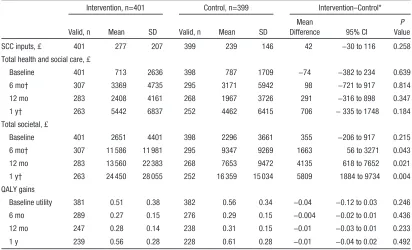
For the economic evaluation, 564 (70.5%) participants
had the combination of complete cost and European Quality
of Life-5 Dimensions data and 589 (73.6%) had complete cost
and GHQ-12 data. Costs of SCC inputs were similar in both
groups (mean difference,
£
42; 95% confidence interval, −30 to
116; Table 5; mean includes zero costs where SCC inputs were
not received). There were no differences in mean total health
and social care costs (Table 5). Informal care costs increased
after baseline and were significantly higher in the intervention
group at 6 months, 12 months, and over the year. Although
informal care costs fell between the 6- and 12-month
assess-ments in the control group, they increased over the same period
in the intervention group. This is reflected in higher total
soci-etal costs in the intervention group at 6 and 12 months and
over the year (mean difference at 6 months,
£
1163; 95%
con-fidence interval, 56–3271; Table 5). QALY gains were similar
(Table 5). Imputing missing health and social care costs and
QALYs at 6 months did not alter conclusions about cost or
QALY differences. Incremental cost-effectiveness ratios were
unnecessary because no cost–outcome combination suggested
statistically significant between-group increases in both costs
and outcomes. At 6 months, the intervention had low
probabili-ties of cost effectiveness from both perspectives and for both
outcomes, remaining <0.3 for the threshold ranges examined.
More details on the economic evaluation are given in the
online-only Data Supplement.
Discussion
The LoTS care trial was a pragmatic, multicenter, cluster
ran-domized, controlled trial of a complex intervention designed to
provide a structured but individualized care planning process
that encompassed the range of problems commonly
encoun-tered by people recovering from a stroke and delivered by SCCs
working in the community. The main finding was no evidence
of statistically significant differences between the control and
intervention groups in primary or secondary outcomes in the
intention to treat and per-protocol analyses, or in the primary
outcome in sensitivity analyses, and no evidence of cost
effec-tiveness from health and social care and societal perspectives.
Strengths of the Study
The trial followed closely the Medical Research Council
guidance on the evaluation of a complex intervention. The
trial recruited 800 patients in 29 services across the United
Kingdom. This makes it one of the largest stroke rehabilitation
trials completed to date. The range of disparate geographical
regions ensured a good representation of different healthcare
settings optimizing generalizability. The eligibility criteria were
kept to a minimum, in keeping with the pragmatic trial design,
to ensure that a stroke patient population representative of
refer-rals to SCCs was recruited, including patients with language
and cognitive impairment. Of the patients eligible for the trial,
56% were recruited. Comprehensive screening and
recruit-ment data were collected from all participating services, and
no evidence for bias in selection procedures was found. The
75% follow-up rate for patients at 6 months as required for the
power calculation was achieved. Postal assessment was used
to maintain unbiased assessment, problematic in cluster trials
where unblinding of a researcher to 1 participant would
inevi-tably result in unblinding of the whole cluster. The intervention
documentation (care plan) was so designed that it replaced the
intervention SCCs’ previous patient documentation and thus
became embedded in their standard practice. A range of
sensi-tivity analyses were undertaken to test robustness of trial results.
Limitations of the Study
The GHQ12 was selected as an appropriate primary outcome
measure that was person-centered and reflected the desirable
outcome of well being after stroke rather than the more narrow
focus of functional recovery. It is possible that the GHQ12
was insufficiently sensitive to change to identify outcome
differences in our study population, and an alternative
pri-mary outcome addressing quality of life may have been more
appropriate. However, we used a broad range of secondary
outcomes all of which demonstrated no differences between
treatment arms.
Table 4. Sensitivity and Per-Protocol Analyses for Primary End Point—Patient-Adjusted GHQ-12 Scores at 6 mo
6 mo Adjusted ICC
Analysis
Control Mean (SE), n
Intervention
Mean (SE), n Difference (SE)
95% CI of the
Difference P Value Control Intervention Patients who died (GHQ-12 assigned to be 36) 17.5 (0.67), 325 18.3 (0.61), 342 −0.8 (0.68) −2.1 to 0.6 0.263 0.004 0 Excluding those with primary end point over
the phone
15.0 (0.62), 294 15.5 (0.60), 308 −0.5 (0.66) −1.8 to 0.8 0.436 0.018 0.027
Excluding proxy responses 14.7 (0.62), 296 15.2 (0.63), 294 −0.5 (0.63) −1.7 to 0.7 0.427 0.009 0.021 Data from 12 mo used for patients who
did not return their questionnaires at 6 mo
14.9 (0.57), 319 15.7 (0.61), 331 −0.7 (0.64) −2.0 to 0.5 0.251 0.007 0.031
Multiple imputation* 15.4 (0.59), 399 15.9 (0.58), 401 −0.5 (0.59) −1.7 to 0.6 0.370 n/a† n/a† Per-protocol analysis 14.0 (0.69), 228 14.8 (0.78), 248 −0.8 (0.76) −2.3 to 0.7 0.280 0 0.058
CI indicates confidence interval; GHQ-12, 12-item General Health Questionnaire; ICC, intracluster correlation coefficient; ITT, intention to treat; and n/a, not available. *Sensitivity analysis accounting for all participants in the ITT population assuming data missing at random was performed using multiple imputation. Information based on Edinburgh stroke case mix adjuster, clinical classification of stroke, patient health status (alive, died, or too poorly) and prespecified model covariates were used to impute the missing outcomes, and the analysis of primary end point was repeated using the same model as multilevel modeling.
†n/a—unable to obtain ICCs from multiple imputation, as estimates in some of the imputations had ICC=0.
[image:6.585.45.540.552.691.2]In designing the trial we were concerned about losses to
follow-up, which are likely to increase over time and impair
the interpretation and credibility of results. We therefore
lim-ited follow-up to 12 months post recruitment and defined the
primary outcome at 6 months. However, it may be that the
intervention had a beneficial effect for a longer period of time,
which our assessment schedule would not detect.
Interpretation
Unlike other chronic diseases in which evidenced-based
guidelines for long-term care management are available (eg,
heart failure
33), there has been little research on
comprehen-sive management systems to optimize outcomes for patients
with stroke. The need for this is attested by observational
stud-ies that describe longer-term stroke outcomes, for example,
in a survey of >750 stroke survivors in the United Kingdom
1 to 5 years after the stroke onset,
34half reported some unmet
needs. This deficiency in care was identified in the specific
rec-ommendation of the National Stroke Strategy (England)
7and
other national guidelines
35,36for regular poststroke reviews.
The LoTS care system of care was designed to address this
recommendation.
Although the structured assessment was delivered to the
majority of participants who received the intervention SCC
service, it is more difficult to assess the extent to which a
change of practice occurred in relation to the problem-solving
and goal-setting approaches. The number of patient
assess-ment contacts was comparable with the control services, with
a median of 2 contacts in both. This reflects the pretrial survey
and existing SSC service models but may be insufficient
con-tact time to meaningfully review goals and develop a
problem-solving approach. Although all of the reference guides are
evidence-based, the evidence points to more effective
inter-ventions for certain problems than for others, thereby
poten-tially weakening the overall effectiveness of this complex
intervention. In addition, some needs may only be
success-fully addressed if appropriate care and treatment are locally
available for the problems identified. This may be particularly
relevant in relation to psychological problems.
37This in turn
impinges on our main outcome measure that assessed
psycho-logical wellbeing.
Future Research
There remains a need to develop, implement, and evaluate
complex interventions capable of addressing the longer-term
needs of people recovering from stroke. Regular review of
these needs is an essential component of a longer-term stroke
service not only to improve patient care but also to highlight
gaps in service provision, which require addressing. The
het-erogeneity of stroke survivors, who have a wide range of
prob-lems and unmet needs, indicates that targeted more bespoke
interventions may be the way forward.
Table 5. Mean Total Costs at Baseline (for the Previous 3 mo), 6 mo (Previous 6 mo), 12 mo (Previous 6 mo), and Over the Year (£, 2010/11 Prices); QALY Gains at 6 mo (Since Baseline), 12 mo (Since 6 mo), and Over the Year
Intervention, n=401 Control, n=399 Intervention–Control*
Valid, n Mean SD Valid, n Mean SD
Mean
Difference 95% CI
P Value
SCC inputs, £ 401 277 207 399 239 146 42 −30 to 116 0.258
Total health and social care, £
Baseline 401 713 2636 398 787 1709 −74 −382 to 234 0.639
6 mo† 307 3369 4735 295 3171 5942 98 −721 to 917 0.814
12 mo 283 2408 4161 268 1967 3726 291 −316 to 898 0.347
1 y† 263 5442 6837 252 4462 6415 706 − 335 to 1748 0.184
Total societal, £
Baseline 401 2651 4401 398 2296 3661 355 −206 to 917 0.215
6 mo† 307 11 586 11 981 295 9347 9269 1663 56 to 3271 0.043
12 mo 283 13 560 22 383 268 7653 9472 4135 618 to 7652 0.021
1 y† 263 24 450 28 055 252 16 359 15 034 5809 1884 to 9734 0.004
QALY gains
Baseline utility 381 0.51 0.38 382 0.56 0.34 −0.04 −0.12 to 0.03 0.246
6 mo 289 0.27 0.15 276 0.29 0.15 −0.004 −0.02 to 0.01 0.436
12 mo 247 0.28 0.14 238 0.31 0.15 −0.01 −0.03 to 0.01 0.233
1 y 239 0.56 0.28 228 0.61 0.28 −0.01 −0.04 to 0.02 0.492
Costs are shown in English pounds sterling (£) and can be converted to US dollars using the rate £1=$1.43, based on 2011-purchasing power parities, which equalize the purchasing power of the currencies. 6CIT indicates 6-Item Cognitive Impairment Test; CI, confidence interval; GHQ12, 12-item General Health Questionnaire; QALY, quality-adjusted life years; and SCC, Stroke Care Coordinator.
*Comparisons of 6 mo, 12 mo, and 1 y costs include covariates for baseline patient Barthel Index (prestroke and poststroke), sex, age, living circumstances (living alone vs with carer), stroke severity as represented by speech and language impairment (normal/impaired) and 6CIT score (normal/impaired), utility score, GHQ12 score, and the relevant cost category. Comparisons of QALY gains include covariates for baseline patient Barthel Index (prestroke and poststroke), sex, age, living circumstances (living alone vs with carer), stroke severity as represented by speech and language impairment (normal/impaired) and 6CIT score (normal/impaired), utility score, and GHQ12 score.
†Including the cost of SCC input.
[image:7.585.87.499.90.340.2]Acknowledgments
We are grateful to all the patients, carers, and stroke services who participated in this trial. Details of participating services are provided in the online-only Data Supplement. The longer-term stroke (LoTS) care trial was a huge collaborative effort, immensely supported by the Stroke Research Networks in the United Kingdom. Our appre-ciation and gratitude goes to all who supported the development of the intervention, delivery of the training, and implementation of the trial. We thank Peter Wanklyn, Tony Rudd, and Allan House who as-sisted with the intervention training. We also thank the Consumer Research Advisory Group and the many colleagues in the Academic Unit of Elderly Care and Rehabilitation, Bradford Teaching Hospitals National Health Service Foundation Trust and University of Leeds, and the Clinical Trial Research Unit, University of Leeds and Kings College London, including R. Romeo, M. Heslin, A. Carter, A. Fergusson, and N. Hearfield who provided help and support in the delivery of this trial.
Sources of Funding
This report presents independent research commissioned by the National Institute for Health Research (NIHR) under its Programme Grants for Applied Research Programme (grant reference number, RP-PG-0606-1128). The views and opinions expressed by the authors in this publication are those of the au-thors and do not necessarily reflect those of the National Health Service, the NIHR, or the Department of Health. We also ac-knowledge the funding support of The Stroke Association (TSA 2006/15).
Disclosures
None.
References
1. Murray J, Young J, Forster A. Review of longer-term problems after a disabling stroke. Rev Clin Gerontol. 2007;17:277–292.
2. The Stroke Association. The Stroke Association Manifesto. London: The Stroke Association; 2005.
3. Langhorne P, Taylor G, Murray G, Dennis M, Anderson C, Bautz-Holter E, et al. Early supported discharge services for stroke patients: a meta-analysis of individual patients’ data. Lancet. 2005;365:501–506. doi: 10.1016/S0140-6736(05)17868-4.
4. Legg L, Langhorne P; Outpatient Service Trialists. Rehabilitation therapy services for stroke patients living at home: systematic review of randomised trials. Lancet. 2004;363:352–356. doi: 10.1016/ S0140-6736(04)15434-2.
5. Intercollegiate Stroke Working Party. National Clinical Guideline for Stroke. 4th ed. London: Royal College of Physicians; 2012.
6. Department of Health. National Service Framework for Older People. London: Department of Health; 2001.
7. Department of Health. National Stroke Strategy. London: Department of Health; 2007.
8. Craig P, Dieppe P, Macintyre S, Michie S, I Nazareth I, Petticrew M. Developing and Evaluating Complex Interventions: New Guidance. London: Medical Research Council; 2008.
9. Murray J, Forster A, Young J. Survey to investigate the role of the com-munity stroke care coordinator. Br J Community Nurs. 2008;13:31–36. doi: 10.12968/bjcn.2008.13.1.27981.
10. Forster A, Young J, Nixon J, Chapman K, Murray J, Patel A, et al. Protocol of a cluster randomized trial evaluation of a patient and carer-centered system of longer-term stroke care (LoTS care). Int J Stroke. 2015;10:259–263. doi: 10.1111/ijs.12038.
11. Royal College of Physicians of London. National Sentinel Audit for Stroke. London: Royal College of Physicians of London; 2006. 12. Carter BR, Hood K. Balance algorithm for cluster randomized trials.
BMC Med Res Methodol. 2008;8:65. doi: 10.1186/1471-2288-8-65. 13. Murray J, Young J, Forster A, Ashworth R. Developing a primary
care-based stroke model: the prevalence of longer-term problems experienced by patients and carers. Br J Gen Pract. 2003;53:803–807.
14. Murray J, Ashworth R, Forster A, Young J. Developing a primary care-based stroke service: a review of the qualitative literature. Br J Gen Pract. 2003;53:137–142.
15. Hawe P, Shiell A, Riley T. Complex interventions: how “out of control” can a randomised controlled trial be? BMJ. 2004;328:1561–1563. doi: 10.1136/bmj.328.7455.1561.
16. Farrin A, Russell I, Torgerson D, Underwood M; UK BEAM Trial Team. Differential recruitment in a cluster randomized trial in primary care: the experience of the UK back pain, exercise, active management and manip-ulation (UK BEAM) feasibility study. Clin Trials. 2005;2:119–124. 17. van Swieten JC, Koudstaal PJ, Visser MC, Schouten HJ, van Gijn
J. Interobserver agreement for the assessment of handicap in stroke patients. Stroke. 1988;19:604–607.
18. Brooke P, Bullock R. Validation of a 6 item cognitive impairment test with a view to primary care usage. Int J Geriatr Psychiatry. 1999;14:936–940.
19. Collin C, Wade DT, Davies S, Horne V. The Barthel ADL Index: a reli-ability study. Int Disabil Stud. 1988;10:61–63.
20. The FOOD Trial Collaboration. Performance of a statistical model to predict stroke outcome in the context of a large, simple, randomized, controlled trial of feeding. Stroke. 2003;34:127–33.
21. Goldberg D, Williams P. A User’s Guide to the General Health Questionnaire. Windsor: NFER-Nelson; 1992.
22. Dowswell G, Lawler J, Dowswell T, Young J, Forster A, Hearn J. Investigating recovery from stroke: a qualitative study. J Clin Nurs. 2000;9:507–515.
23. Wade DT, Legh-Smith J, Langton Hewer R. Social activities after stroke: measurement and natural history using the Frenchay Activities Index. Int Rehabil Med. 1985;7:176–181.
24. Krabbe P, Weijnen T. Guidelines for Analysing and reporting EQ-5D Outcomes. In: Brooks R, Rabin R, De Charro F, eds. The Measurement and Valuation of Health Status using EQ-5D: A European Perspective. Dordrecht: Kluwer Academic Publishers; 2003:7–19.
25. Brooks R. EuroQol: the current state of play. Health Policy. 1996;37:53–72.
26. LoTS care LUNS Study Team. Validation of the longer-term unmet needs after stroke (LUNS) monitoring tool: a multicentre study. Clin Rehabil. 2013;27:1020–1028.
27. Elmståhl S, Malmberg B, Annerstedt L. Caregiver’s burden of patients 3 years after stroke assessed by a novel caregiver burden scale. Arch Phys Med Rehabil. 1996;77:177–182.
28. Patel A, Knapp M, Evans A, Perez I, Kalra L. Training care givers of stroke patients: economic evaluation. BMJ. 2004;328:1102. doi: 10.1136/bmj.328.7448.1102.
29. Patel A, Knapp M, Perez I, Evans A, Kalra L. Alternative strategies for stroke care: cost-effectiveness and cost-utility analyses from a pro-spective randomized controlled trial. Stroke. 2004;35:196–203. doi: 10.1161/01.STR.0000105390.20430.9F.
30. Parker CJ, Gladman JR, Drummond AE, Dewey ME, Lincoln NB, Barer D, et al. A multicentre randomized controlled trial of leisure therapy and conventional occupational therapy after stroke. TOTAL Study Group. Trial of Occupational Therapy and Leisure. Clin Rehabil. 2001;15:42–52. 31. Campbell MK, Mollison J, Grimshaw JM. Cluster trials in implemen-tation research: estimation of intracluster correlation coefficients and sample size. Stat Med. 2001;20:391–399.
32. PPPs and exchange rates. OECD. StatsExtracts 4. http://stats.oecd.org/ Index.aspx?DataSetCode=SNA_TABLE4. Accessed December 22, 2014. 33. National Clinical Guideline Centre. Chronic Heart Failure: The
Management of Chronic Heart Failure in Adults in Primary and Secondary Care. London: National Clinical Guideline Centre; 2010. 34. McKevitt C, Fudge N, Redfern J, Sheldenkar A, Crichton S, Rudd AR,
et al. Self-reported long-term needs after stroke. Stroke. 2011;42:1398– 1403. doi: 10.1161/STROKEAHA.110.598839.
35. Duncan PW, Zorowitz R, Bates B, Choi JY, Glasberg JJ, Graham GD, et al. Management of Adult Stroke Rehabilitation Care: a clini-cal practice guideline. Stroke. 2005;36:e100–e143. doi: 10.1161/01. STR.0000180861.54180.FF.
36. Lindsay P, Bayley M, Hellings C, Hill M, Woodbury E,Phillips S. Canadian best practice recommendations for stroke care. CMAJ. 2008;179:S1–S25.
37. Care Quality Commission. Supporting Life After Stroke: A Review of Services for People Who Have Had a Stroke and Their Carers. London: Care Quality Commission; 2011.