ΒηΒΗΜΙΗΗΒΗΗΗ]
■....:■■■
ÉÜ I I I
ISSN 0252-8266
eurostat
■ ■;■- . ■■
- - ¿ e i ' "ÍU&
IH ι œ "
7
·
... ■ :ν:^:^ : ::. | i ώ | ...ν.
EUROSTATISTIK
Daten zur Konjunkturanalyse
5- '
"»Sr.Jía
1-!
'f^M
■••'■.■■■¡...i,:--.-SUP
¥003
:.:-.^.;:-,'v.
.-■ s Kg... g g
-Λ-"
1-■■■--.-I
... . . . . y / · . . .■" . j
Κ» § Sä»!»?
SM SB ■ ■ . - ■ ' ■ ■ ■
■■■
*ffi ¡llllli
EUROSTATISTICS
Data for short-term economic analysis
â « lM H B I
i g m
I HI
»MSSSSJSí· -ï, νΛ' ¡ U f e ! .'ΐν";':
Γ'- *· " . .
¿ 4 I - Í X & J &
'¿-\
t;.:
;-^v;^;:,'^..,.;;í, .:.
;-.:';,.·.,:·,;:,;;.,:
SUU
i
EUROSTATISTIQUES
Données pour l'analyse de là conjoncture
Monatlich D Monthly D Mensuel
6 Π
1986
U p
y ■'**■■ ...
% m&Bsm,
m
■HH^BBB
Themenkreis D Theme D Thème
Allgemeine Statistik D General statistics
Statistiques générales
eurostat
O F I C I N A E S T A D Í S T I C A DE L A S C O M U N I D A D E S E U R O P E A S DE E U R O P Æ I S K E F Æ L L E S S K A B E R S S T A T I S T I S K E K O N T O R S T A T I S T I S C H E S A M T DER E U R O P Ä I S C H E N G E M E I N S C H A F T E N Σ Τ Α Τ Ι Σ Τ Ι Κ Η Υ Π Η Ρ Ε Σ Ι Α Τ Ω Ν Ε Υ Ρ Ω Π Α Ϊ Κ Ω Ν Κ Ο Ι Ν Ο Τ Η Τ Ω Ν S T A T I S T I C A L OFFICE OF T H E E U R O P E A N C O M M U N I T I E S OFFICE S T A T I S T I Q U E DES C O M M U N A U T É S E U R O P É E N N E S I S T I T U T O S T A T I S T I C O D E L L E C O M U N I T À E U R O P E E
B U R E A U V O O R DE S T A T I S T I E K DER E U R O P E S E G E M E E N S C H A P P E N S E R V I Ç O DE E S T A T Í S T I C A D A S C O M U N I D A D E S E U R O P E I A S
L 2 9 2 0 L u x e m b o u r g — Tél. 4 3 0 1 1 — Télex : C o m e u r Lu 3 4 2 3
B 1 0 4 9 Bruxelles, B â t i m e n t B e r l a y m o n t , Rue de la Loi 2 0 0 ( B u r e a u d e liaison) — T é l . 2 3 5 11 11
Las p u b l i c a c i o n e s de Eurostat están c l a s i f i c a d a s por temas y por series. La c l a s i f i c a c i ó n se e n c u e n t r a al f i n a l d e la obra. Para m a y o r i n f o r m a c i ó n sobre las p u b l i c a c i o n e s , r o g a m o s se p o n g a n en c o n t a c t o c o n Eurostat.
Para los p e d i d o s , diríjanse a las o f i c i n a s de v e n t a c u y a s d i r e c c i o n e s f i g u r a n en la p á g . 3 de la c u b i e r t a .
Eurostats p u b l i k a t i o n e r er klassificeret efter e m n e o g serie. En oversigt herover f i n d e s bag i hæftet. Y d e r l i g e r e o p l y s n i n g e r o m p u b l i k a t i o n e r n e kan fås v e d h e n v e n d e l s e til Eurostat.
B e s t i l l i n g kan afgives til de salgssteder, der er a n f ø r t på o m s l a g e t s side 3.
Die V e r ö f f e n t l i c h u n g e n v o n Eurostat s i n d n a c h T h e m e n u n d Reihen g e g l i e d e r t . Die G l i e d e r u n g ist h i n t e n in j e d e m B a n d a u f g e f ü h r t . Genauere A u s k ü n f t e über die V e r ö f f e n t l i c h u n g e n erteilt Eurostat.
Ihre B e s t e l l u n g e n r i c h t e n Sie b i t t e an die V e r k a u f s b ü r o s , deren A n s c h r i f t e n j e w e i l s auf der d r i t t e n U m s c h l a g s e i t e der V e r ö f f e n t l i c h u n g e n zu f i n d e n s i n d .
Οι εκδόσεις της Eurostat τ α ξ ι ν ο μ ο ύ ν τ α ι κ α τ ά θ έ μ α και κ α τ ά σ ε ι ρ ά . Η α κ ρ ι β ή ς τ α ξ ι ν ό μ η σ η α ν α φ έ ρ ε τ α ι σ τ ο τέλος κάθε έ κ δ ο σ η ς . Για λ ε π τ ο μ ε ρ έ σ τ ε ρ ε ς π λ η ρ ο φ ο ρ i ε ς σ χ ε τ ι κ ά με τις εκδόσεις, μπορεiτε να α π ε υ θ ύ ν ε σ θ ε σ τ η ν Eurostat.
Για τις παραγγελiες μπορεiτε να α π ε υ θ ύ ν ε σ θ ε σ τ α γ ρ α φ ε i α πώλησης, τ ω ν οποiων οι δ ι ε υ θ ύ ν σ ε ι ς α ν α γ ρ ά φ ο ν τ α ι σ τ η σ ε λ i δ α 3 τ ο υ ε ξ ω φ ύ λ λ ο υ .
Eurostat's p u b l i c a t i o n s are classified a c c o r d i n g to subject matter and series. This classification is indicated at the end of the p u b l i c a t i o n . For more detailed i n f o r m a t i o n o n p u b l i c a t i o n s , c o n t a c t Eurostat.
Orders are obtainable f r o m the sales offices m e n t i o n e d on the inside back cover.
Les p u b l i c a t i o n s de l'Eurostat sont classées par t h è m e et par série. Cette c l a s s i f i c a t i o n est précisée à la f i n de l ' o u v r a g e . Pour des i n f o r m a t i o n s plus détaillées sur les p u b l i c a t i o n s , c o n t a c t e z l'Eurostat.
Pour les c o m m a n d e s , a d r e s s e z v o u s aux b u r e a u x de v e n t e d o n t les adresses s o n t i n d i q u é e s à la page 3 d e la c o u v e r t u r e .
Le p u b b l i c a z i o n i d e l l ' E u r o s t a t s o n o classificate per tema e per serie. Tale classificazione è precisata alla f i n e d e l l ' o p e r a . Per i n f o r m a z i o n i più d e t t a g l i a t e sulle p u b b l i c a z i o n i rivolgersi all'Eurostat.
Per e v e n t u a l i o r d i n a z i o n i rivolgersi a u n o d e g l i u f f i c i di v e n d i t a i c u i indirizzi f i g u r a n o nella 3a p a g i n a della c o p e r t i n a .
De p u b l i k a t i e s v a n Eurostat zijn i n g e d e e l d naar o n d e r w e r p en reeks. Deze i n d e l i n g is achter in het boek o p g e n o m e n . V o o r nadere i n f o r m a t i e over d e p u b l i k a t i e s k u n t u z i c h w e n d e n t o t Eurostat.
Gelieve b e s t e l l i n g e n o p te g e v e n bij de v e r k o o p b u r e a u s , w a a r v a n de adressen o p b l a d z i j d e 3 v a n de o m s l a g zijn v e r m e l d .
A s p u b l i c a ç õ e s d o Eurostat estão classificadas por tema e por série. Esta classificação está i n d i c a t a n o f i m da obra. Para mais i n f o r m a ç õ e s sobre as p u b l i c a ç õ e s é favor c o n t a c t a r o Eurostat.
E n c o m e n d a s : serviços de v e n d a c u j o s e n d e r e ç o s estão i n d i c a d o s na c o n t r a c a p a .
Para obtener esta publicación, se ruega dirigirse a las oficinas de venta cuyas direcciones figuran en la tercera página de cubierta. Denne publikation kan fås gennem de salgssteder, som er nævnt på omslagets tredje side.
Diese Veröffentlichung ¡st bei den auf der dritten Umschlagseite aufgeführten Vertriebsbüros erhältlich.
Την έκδοση αυτή μπορεiτε να την προμηθευτεiτε από τα γραφεiα πωλήσεων τα οποiα αναφέρονται στην τρiτη σελiόα του εξωφύλλου. This publication is obtainable trom the sales offices mentioned on the inside back cover.
Pour obtenir cette publication, prière de s'adresser aux bureaux de vente dont les adresses sont indiquées à la page 3 de la couverture. Per ottenere questa pubblicazione, si prega di rivolgersi agli uffici di vendita i cui indirizzi sono indicati nella 3a pagina della copertina.
EUROSTATISTIK
Daten zur Konjunkturanalyse
EUROSTATISTICS
Data for short-term economic analysis
EUROSTATISTIQUES
Données pour l'analyse de la conjoncture
Luxembourg: Office des publications officielles des Communautés européennes, 1986
Kat./cat.: CA-BJ-86-006-3A-C
© EGKS-EWG-EAG, Brüssel — Luxemburg, 1986
Nachdruck — ausgenommen zu kommerziellen Zwecken — mit Quellenangabe gestattet.
© ECSC-EEC-EAEC, Brussels — Luxembourg, 1986
Reproduction is authorized, except for commercial purposes, provided the source is acknowledged.
© CECA-CEE-CEEA, Bruxelles — Luxembourg, 1986
Reproduction autorisée, sauf à des fins commerciales, moyennant mention de la source.
Vorwort
Die Daten der EurostatistikVeröffentlichung sind im ICGBereich (konjunkturelle und
allgemein statistische Informationen) von Cronos gespeichert. Cronos ¡st eine Daten
bank, die Zahlenangaben in zumeist bis zum Jahr 1960 zurückreichenden Zeitreihen
enthält.
Cronos ist in 23 Bereiche eingeteilt, die fast das ganze Spektrum des Wirtschaftsge
schehens erfassen.
Jede Zeitreihe ist durch einen neunstelligen numerischen Kode gekennzeichnet, der
seinerseits in Unterkodes gegliedert ist, welche im Falle von „Eurostatistik" das
Land, den Sektor, die Tafel, die Einheit und die Periodizität bezeichnen.
XX
Land
XX
Sektor
XXXX
Tafel
Einheit und Periodizität
vierstelliger
Wert, der im Titel
jeder Tafel erscheint
Die Bedeutung der einzelnen Unterkodes ist der nachstehend aufgeführten Tabelle zu
entnehmen.
Land
02 EUR 12 03 EUR 10 12 D 14 F 16 I 18 NL 22 Β 24 L 2G UK 28 IRL 30 DK 32 E 34 GR 36 Ρ 42 USA 46 JAP
Sektor
93
Tafel XXXX vierstelliger Wert,
der im Titel jeder Tafel erscheint
Periodizität und Einheit 0 jährlich, Angaben in Prozent 1 vierteljährlich, Angaben in Prozent 2 monatlich, Angaben in Prozent 3 jährlich. IndexAngaben (1980 = 100) 4 vierteljährlich, IndexAngaben (1980=100) 5 monatlich, IndexAngaben (1980= 100) 6 jährlich, Angaben in absoluten Werten 7 vierteljährlich, Angaben in absoluten Werten 8 monatlich, Angaben in absoluten Werten 9 Gewicht, EUR 10 = 100 bzw. EUR 12 = 100
Wer Zugang zur Datenbank Cronos hat, kann also durch Abfrage der Daten in Echtzeit
die Neuauflegung der Tabellen verfolgen.
Beispiel:
Will man die monatlichen Arbeitslosenzahlen (absolute Zahlen) erfahren, wie
sie in der Tafel 0304 dieser Veröffentlichung wiedergegeben sind, so braucht man nur
den Kode 12 93 0304 8 einzugeben.
Der Zugang zu Cronos erfolgt über folgende Hosts:
CISIWharton
35, bd Brune
F75680 Paris Cedex 14
Tel.: (1) 45 45 88 45
GSIECO
25, bd de l'amiral Bruix
F75782 Paris Cedex 16
Tel.: (1)45 02 12 20
Datacentralen
Retortvej, 6 8
DKKøbenhavnValby
Tel.: 46 81 22
Weitere Informationen über den Inhalt und die Verbreitung der Datenbank Cronos kön
nen unter folgender Anschrift angefordert werden :
Statistisches Amt der Europäischen Gemeinschaften
Abteilung A2
Boîte postale 1907
L2920 Luxemburg
Inhaltsverzeichnis
Zeichen und Abkürzungen
„Kurz notiert"
Schaubilder .
KONJUNKTURDATEN
1. Volkswirtschaftliche Gesamtrechnungen
2. Beschäftigung
3. Arbeitslosigkeit
4. Industrielle Produktion
5. Meinungsumfrage in der Industrie
6. Industrieerzeugnisse
7. Einzelhandel
8. Landwirtschaftliche Erzeugnisse
9. Außenhandel
10. Verbraucherpreise
11. Landwirtschaftliche Erzeugerpreise
12. Löhne und Gehälter
13. Finanzstatistiken
14. Zahlungsbilanz
5
15
35
39
42
45
52
56
60
61
63
84
87
88
89
93
0
i-4
6 + 8
%
%,T4/T0
%,T12/T0 1
%,T/T-12 |
%, SALDO
1980 = 100
EUR10 = 100
MIO
MRD
Τ
TROEE
GWH
M3
ß
DK
D
GR
E
F
IRL
I
L
NL
Ρ
UK
USA
JAP
USD
ECU
SZR
EG
Eurostat
EUR 10
UEBL/BLEU
ACP
ESVG
NACE
SITC
Nichts
Weniger als die Hälfte der verwendeten
Einheit
Kein Nachweis vorhanden
Von 1 bis 4
6 und 8
Prozent
Prozentualer Zuwachs eines Vierteljahres
gegenüber dem entsprechenden Vierteljahr
des Vorjahres
Prozentualer Zuwachs eines Monats
gegenüber dem entsprechenden Monat
des Vorjahres
Saldo zwischen den positiven Antworten
(Zunahme, Verbesserung der Situation) und
den negativen Antworten (Abnahme,
Verschlechterung der Situation) der
Konjunkturbefragung bei den
Unternehmern in der Gemeinschaft
Saisonbereinigt (Ländertabellen)
Basisjahr
Prozentuale Angaben im Verhältnis zur
Gemeinschaft der 10 ( = 100)
Million
Milliarde
Metrische Tonne
Tonne Rohöleinheiten
Gigawattstunde = 10
6kWh
Kubikmeter
Belgique/België
Danmark
BR Deutschland
Ελλάδα/Griechenland
España
France
Ireland
Italia
Luxembourg
Nederland
Portugal
United Kingdom
United States of America
Japan
US-Dollar
Europäische Währungseinheit
Sonderziehungsrechte
Europäische Gemeinschaften]
Statistisches Amt der Europäischen
Gemeinschaften
Gesamtheit der Mitgliedsländer der
Europäischen Gemeinschaften ab 1981
Belgisch-luxemburgische Wirtschaftsunion
Länder Afrikas, der Karibik und des Pazifiks
— Abkommen von Lomé
Europäisches System Volkswirtschaftlicher
Gesamtrechnungen
Allgemeine Systematik der
Wirtschaftszweige in den Europäischen
Gemeinschaften
Eurostatistik: Kurz notiert
1. ARBEITSLOSIGKEIT: Trotz erneuten jahreszeitlich
bedingten Rückgängen im Mai ( — 1,6%) stellen die
Jugendlichen unter den Arbeitslosen 37 % der
Gesamtzahl in der Gemeinschaft
Auch im Monat Mai 1986 ist die Zahl der bei den Arbeitsämtern
eingeschriebenen Arbeitslosen in der Gemeinschaft der Zwölf aus
überwiegend saisonalen Gründen um mehr als 370 000 Personen,
d. h. um 2,4 0/o, zurückgegangen. Damit waren 15,6 Millionen
Per-sonen in den zwölf Mitgliedstaaten als arbeitslos registriert.
Die saisonbereinigten Werte haben sich wie schon in den
vorheri-gen Monaten praktisch nicht verändert.
Während im Vormonat die Zahl der eingeschriebenen Arbeitslosen
bei jüngeren und älteren Arbeltslosen etwa gleichmäßig
abgenom-men hat, betrug der Rückgang bei den Arbeitslosen unter 25
Jah-ren im Mai 1986 1,6 0/0, bei den Arbeitslosen im Alter von 25 JahJah-ren
und mehr jedoch 2,9 0/0. Eine entsprechende Entwicklung fand
sich in Spanien, Griechenland, Dänemark und Irland. In den
übri-gen Mitgliedstaaten ist die Zahl der jüngeren Arbeitslosen unter 25
Jahren stärker zurückgegangen als die Gesamtzahl der
Arbeitlo-sen. Italien meldete sogar eine Zunahme der jüngeren
Arbeitslo-sen.
Der Anteil jüngerer Arbeitsloser unter 25 Jahren an den
Arbeitslo-sen insgesamt erreichte Ende Mai 1986 in der Gemeinschaft (ohne
Portugal) etwa 37 0/0. Für die einzelnen Mitgliedstaaten ergab sich
ein uneinheitliches Bild. Die höchsten Anteile wurden in Spanien
und in Italien mit 52 bzw. 51 % gemessen, die niedrigsten fanden
sich in der BR Deutschland und in Dänemark mit 25 °/o.
2. PREISE: Anstieg im Mai 1986 niedrig ( + 0,2 %)
Mit einer nur leichten Steigerung von rund 0 , 2 % beim Index der
Verbraucherpreise für die Gemeinschaft insgesamt (EUR 12)
ver-ändert sich das Tempo der Inflation im Mai weiterhin in günstigem
Sinne. In Belgien wurde sogar ein Preisrückgang ( - 0 , 2 % )
ver-zeichnet, während die Preise in der BR Deutschland, in den
Nie-derlanden und im Großherzogtum Luxemburg konstant blieben. In
den übrigen Mitgliedstaaten kam es zu einer schwachen Erhöhung,
nämlich in Frankreich und im Vereinigten Königreich ( + 0,2%), in
Italien ( + 0,4%), in Griechenland und in Dänemark (0,5%).
Der irische Vierteljahresindex ist in der Zeit von Mitte Februar bis
Mitte Mai 1986 um 1,2% angestiegen, was bei monatlicher
Berechnung eine Preissteigerung von rd. 0,4 % entsprechen
würde.
Die Inflationsrate über den Zeitraum von 12 Monaten (Mai 86/Mai
85) beträgt
3,5 0/0
für
EUR 12;
für die EG-Mitgliedstaaten ergeben
sich folgende Änderungen:
BR Deutschland - 0 , 2 % , Luxemburg 0,4 0/0, Niederlande 0,5%,
Belgien 1 , 1 % , Frankreich 2 , 3 % , Vereinigtes Königreich 2 , 8 % ,
Dänemark 3,8%, Irland 4,40/0, Italien, 6,40/0, Spanien 7,8 0/0,
Por-tugal 11,5 0/0, Griechenland 24,5 0/0.
Nachstehend sind die entsprechenden Inflationsraten der
Nichtge-meinschaftsländer, für die Eurostat regelmäßig Indizes bekannt
gibt, angegeben:
Schweiz 0,8%, Österreich 1,40/0 (April), Finnland 3,1 %,
Schwe-den 3,40/0, Norwegen 5,6 0/0, Japan 0,7 0/0, USA 1,6 0/0 (April),
Kanada 4,2 0/0.
3. INDUSTRIELLE PRODUKTION: Kräftiger Anstieg für
die Gemeinschaft im April nach schwachem Niveau im
März.
Der Index für die Gemeinschaft
(EUR 12) für den Monat März wird
derzeit auf 109,6 geschätzt; das entspricht einem Anstieg von 5 %
gegenüber April 1985.
Der saisonbereinigte Index
für April - zur Zeit 106,9 - weist eine
außerordentliche Zunahme auf, die zumindest aus zwei Gründen
mit Vorsicht zu bewerten ist. Die Saisonbereinigung wurde
dadurch stark beeinflußt, daß die Osterfeiertage in diesem Jahr auf
den Monat März fielen; außerdem führten besonders niedrige
Tem-peraturen in einigen Mitgliedstaaten zu einer für den Monat April
außergewöhnlich hohen Produktion von Elektrizität bzw. Verteilung
von Gas.
Für die drei letzten Monate,
für die Angaben vorliegen, beläuft sich
die Veränderung gegenüber den entsprechenden drei
Vorjahrsmo-naten auf + 2 , 9 % . Die entsprechende Steigerung beträgt 1,2 0/0
für Frankreich, 2 , 6 % für das Vereinigte Königreich, 2 , 8 % für
Ita-lien und +3,3 0/0 für die BR Deutschland.
4. STAHL: Erneuter Produktionsrückgang im Mai 1986
Im Mai 1986 wurden in der Gemeinschaft (ohne Griechenland) 10,6
Mio t Rohstahl erzeugt.
Diese Zahl bestätigt die allgemein rückläufige Tendenz:
- 9,9 0/0 gegenüber Mai 1985;
- 8,8 0/0 saisonbereinigt gegenüber April 1986;
- 4,2 0/0 im Vergleich der für die ersten fünf Monate kumulierten
Werte.
Die Auftragseingänge für Massenstahl (EUR 9) stiegen im ersten
Vierteljahr 1986 auf 22,4 Mio t, was einer Zunahme von 8,40/0
gegenüber dem letzten Vierteljahr 1985 und einem Rückgang um
4,9 % gegenüber dem ersten Vierteljahr 1985 entspricht.
5. AUSSENHANDEL: Im ersten Vierteljahr 1986 ist die
Ausfuhr der Gemeinschaft in die OPEC-Staaten,
bedingt durch den Sturz der Dollarkurse und der
Roh-stoffpreise, stark zurückgegangen
( —
27
% )
Das erste Vierteljahr war insofern ungewöhnlich, als die in ECU
ausgedrückten Einfuhr- und Ausfuhrpreise infolge der vereinten
Wirkung des Dollarkurseinbruchs (um 2 6 % in 12 Monaten) und
der mehr als halbierten Ölpreise erheblich gesunken waren. Das
hat dazu geführt, daß die Gemeinschaftsausfuhr in Drittländer nur
84 Mrd ECU betrug, also gegenüber dem Stand des ersten
Vorjah-resquartals um 9 0/0 gesunken war.
Bei der Ausfuhr in Industrieländer war der Rückgang um 3 % im
wesentlichen auf Auswirkungen der Währungsbewegungen auf die
Preise zurückzuführen. So stieg die Ausfuhr in EFTA-Länder um
3 0/0 auf 21 Mrd ECU, während die Ausfuhr in die USA um 9 0/0 auf
18 Mrd ECU zurückging. Trotzdem der Yen eine Aufwertung
erfuhr, sank jedoch die Ausfuhr nach Japan um 2 0/0 auf 2,7 Mrd
ECU.
Dagegen ist für den Rückgang bei der Ausfuhr in die
Entwick-lungsländer um 18 % neben gesunkenen Preisen auch ein
rückläu-figes Exportvolumen ursächlich. Die Ausfuhr in OPEC-Staaten fiel
erstmals in fünf Jahren unter den Stand von 10 Mrd ECU pro
Vier-teljahr und war gegenüber dem Vorjahresstand um 27 0/0
gesun-ken. Selbst die Ausfuhr in nicht der OPEC angehörende
Entwick-lungsländer war um 1 3 % gesunken, da die
Grundstoffausfuhrlän-der durch gesunkene Preise und deshalb durch niedrigere
Ein-kommen betroffen waren.
Allgemein gesehen sind die Warenbereiche, in denen zu erwarten
war, daß die Nachfrage weniger preisempfindlich reagiert, in
gerin-gerem Maße durch die derzeitige Lage betroffen worden. So ist die
Ausfuhr von Maschinen und Fahrzeugen um nur 4 % und die von
verschiedenen bearbeiteten Waren um nur 3 % zurückgegangen.
Im ersten Vierteljahr belief sich die Ausfuhr der USA auf 58 Mrd
ECU, das sind 29 % weniger als im entsprechenden
Vorjahreszeit-raum. Die japanische Ausfuhr ist um 13 0/0 auf 49 Mrd ECU
gesun-ken.
Die Einfuhr der Gemeinschaft aus dritten Ländern ist im ersten
Vierteljahr mit 89 Mrd ECU um 17 0/0 zurückgegangen. Besonders
stark rückläufig war die Einfuhr von Grundstoffen, die um 29 0/0 auf
38 Mrd ECU gesunken war. Die Einfuhr von Brennstoffen war um
36 0/0 niedriger und betrug 21 Mrd ECU, die Rohstoffeinfuhr war
um 2 4 % und die Einfuhr von Nahrungs- und Genußmitteln um
11 % gesunken. Andererseits fiel die Einfuhr von bearbeiteten
Waren um nur 5 % auf 45 Mrd ECU, weil sie von einem geringeren
Preisrückgang betroffen waren.
Die Einfuhr aus Entwicklungsländern sank um 27 0/0, d. H. ungefähr
im gleichen Maße wie die Einfuhr von Grundstoffen. Die Einfuhr
aus Industrieländern war um 11 0/0 niedriger und betrug 49 Mrd
ECU. Japan konnte immer noch einen Anstieg seiner Ausfuhr in
die Gemeinschaft um 10 0/0 verzeichnen, im Gegensatz zum
Rück-gang im Falle der USA von 26 % und der EFTA von 4 %.
Die Einfuhr der USA ist um 18 0/0 auf 105 Mrd ECU
zurückgegan-gen, während die Einfuhr Japans um 24 0/0 auf 36 Mrd ECU sank.
Das Handelsbilanzdefizit der Gemeinschaft im ersten Vierteljahr
betrug 4,8 Mrd ECU. Gegenüber dem entsprechendem Zeitraum
von 1985 ist damit eine Besserung um 10 Mrd ECU eingetreten,
was auf das Schrumpfen des Defizits bei Mineralöl und anderen
Brennstoffen um 11 Mrd ECU und eine Verbesserung des Saldos
bei Rohmaterial um 2 Mrd ECU zurückzuführen ist.
Das Außenhandelsdefizit der USA hat nach wie vor mit 47 Mrd ECU
einen hohen Stand, während Japans Überschuß auf 13 Mrd ECU
angewachsen ist.
Der Handel zwischen den Mitgliedstaaten hatte im ersten
Viertel-jahr ein Volumen von 116 Mrd ECU, das sind 3 0/0 weniger als im
gleichen Zeitraum 1985. Das Absinken war auf einen Rückgang im
Brennstoffaußenhandel um 41 0/0 zurückzuführen. Die Ausfuhr von
bearbeiteten Waren nahm dagegen vergleichsweise um 5 0/0 zu.
6. ZAHLUNGSBILANZ: Im ersten Viertel 1986 verbesserte
Leistungsbilanz in den meisten Mitgliedstaaten und
deutliche Verschlechterung in den USA
Die jüngste Entwicklung der zwischenstaatlichen Transaktionen
muß von dem Gesichtspunkt der internationalen Lage geprüft
wer-den, die durch einen spürbaren Preisrückgang bei Rohstoffen und
insbesondere bei Mineralöl und durch eine erhebliche Aufwertung
der meisten europäischen Währungen gegenüber dem
amerikani-schen Dollar gekennzeichnet ist.
Umfeld durch Stabilisierung der Ausfuhr und Verringerung der
Ein-fuhr günstig auf die Leistungsbilanzen - und insbesondere auf die
Handelsbilanzen - der Mitgliedstaaten ausgewirkt haben. Die
Ver-besserung der Leistungsbilanz beruht jedoch in stärkerem Maße
auf Preis- als auf Mengenänderungen.
So hat in der BR Deutschland der Leistungsbilanzüberschuß
gegenüber dem ersten Vierteljahr 1985 um 5 166 Mio ECU -
haupt-sächlich infolge einer erheblichen Verbesserung der Handelsbilanz
- zugenommen; die Warenausfuhr weist einen gegenüber dem
I.Vierteljahr 1985 unveränderten Stand auf, während die Einfuhr
um 11,1 o/o gesunken ist.
Ähnliches hat sich in Frankreich zugetragen. Die im ersten
Viertel-jahr übliche Verschlechterung der laufenden Transaktionen ist
1986 schwächer als im Jahre 1985. Wie in der BR Deutschland ist
die Verbesserung fast ausschließlich an der Stufe der
Handelsbi-lanz wirksam, wo sie in einem starken Rückgang der Wareneinfuhr
ihren Ausdruck findet ( — 7 , 8 % gegenüber dem I.Vierteljahr
1985).
Die Lage im Vereinigten Königreich weicht vom Besagten in
erheb-lichem Umfang ab. Obgleich sich die Leistungsbilanz wesentlich
verbessert hat, war dieses Ergebnis von einer bedeutenden
Ver-schlechterung bei den gewerbliche Erzeugnisse betreffenden
Transaktionen begleitet.
Die übrigen Mitgliedstaaten werden voraussichtlich eine ähnlich
günstige Entwicklung - allerdings mit unterschiedlicher und
wahr-scheinlich geringerer Wirkung in den einzelnen Staaten -
verzeich-nen.
Die Entwicklung in den Vereinigten Staaten und in Japan erscheint
bei den laufenden Transaktionen geradezu gegenläufig. Trotz der
1985 erfolgten starken Dollarabwertung auf den Devisenmärkten
hat sich die amerikanische Leistungsbilanz laufend verschlechtert
(nahezu —35 Mrd ECU im Jahr 1985), während die japanische
Lei-stungsbilanz einen neuerlichen Rekordüberschuß (von rund
64 Mrd ECU) ausweist, und zwar ungeachtet der Aufwertung des
Yen.
7. WECHSELKURSE: In der Zeit vom 15. Mai bis zum
15. Juni 1986 setzten sich die unregelmäßigen
Dollar-kursbewegungen fort, und das EWS hat sich in seiner
Wirksamkeit bestätigt
Nach mehr als einem Jahrzehnt (frei oder reguliert) gleitender
Wechselkurse scheint sich in bezug auf die
Wechselkursbewegun-gen eine
einmütige Auffassung
herausgebildet zu haben:
Kurzfri-stig wird der Wechselkurs an den Geldmärkten auf die gleiche
Weise bestimmt, wie das bei Wertpapieren oder anderen
finanziel-len Vermögenswerten geschieht, während die mittel- und
langfri-stige Veränderung der Wechselkurstendenz die wirtschaftlichen
Grundtatbestände - wie Ausgabe-, Spar- und
Investitionsentschei-dungen der Wirtschaftssubjekte und die Effizienz des
Produktions-apparates der betroffenen Volkswirtschaften -widerspiegelt.
Die jüngsten Kursbewegungen des Dollars scheinen diese
Auffas-sungen zu stützen: die fortwährende Dollaraufwertung seit 1980
führte zu den im Februar 1985 verzeichneten höchsten
Kursstän-den gegenüber Kursstän-den wichtigsten Währungen, und diese Kurse
erwiesen sich angesichts der hohen Defizite der
US-Leistungsbi-lanz als nicht haltbar. Die Notwendigkeit, diese Ungleichgewichte
zu beseitigen, ließ den Dollarkurs auf Werte sinken, die um 30 %
unter denen vom Februar 1985 lagen. Die derzeit zu beobachtende
Unbeständigkeit der Dollarkurse läßt sich im Sinne kurzfristiger
Schwankungen um einen festen Trend deuten und steht
haupt-sächlich mit den Erwartungen der Geldanleger in bezug auf
künf-tige Ereignisse oder politische Maßnahmen im Zusammenhang.
Diese Erwartungen sind meistens kurzlebig und wechseln leicht
die Richtung, wodurch sie das typisch regellose Verhalten der
Preise von Vermögenswerten auslösen. Wie weit die
Unbeständig-keit des Dollarkurses in letzter Zeit ging, kann anhand der
folgen-den Tabelle ermessen werfolgen-den:
Schwankungsbreite der Wechselkurse des US-Dollars (Zeitraum:
15. Mai —15. Juni)
Bezugs-währung
ECU
DM
FF
UKL
YEN
Niedrigster
Kurs
1,018
2,19
6,98
0,649
163,3
Höchster Kurs
1,082
2,33
7,43
0,680
175,5
Maximale
Kursdifferenz
6,3 o/o
6,4 o/o
6,4 o/o
4,8 o/o
7,5 o/o
Der erwähnte Konsens, was die Bestimmung der Wechselkurse
betrifft, gilt auch für das Beispiel der EWS-Währungen - allerdings
in erheblicher Abwandlung. Einerseits lassen die engen
Schwan-kungsbereiche der Wechselkursänderungen innerhalb des EWS
und der systeminterne Mechanismus zur Aufdeckung und
Verhin-derung übermäßiger Kursbewegungen die Erwartungen der
Anle-ger beständiAnle-ger werden und begrenzen damit die Hauptursache
für die kurzfristige Unbeständigkeit der Wechselkurse.
Anderer-seits sorgt das gemeinsame Interesse an der Festsetzung
zuver-lässiger
zentraler Wechselkurse bei Neufestsetzungen der
EWS-Währungen dafür, daß die Wirtschaftsrealität (verglichen mit ihrem
Einfluß auf die Bildung der Dollarkurse) sehr viel stärker
„geach-tet" und daß ein Abgleiten der äußeren Ungleichgewichte in einen
nicht mehr kontrollierbaren Stand verhindert wird. Zu beachten ist
jedoch, daß die Anpassungsbedürftigkeit im Falle von
Überschuß-ländern sehr viel weniger drängend ¡st als im Fall von
Defizitlän-dern, und diese Asymmetrie erklärt in manchen Fällen die
Bestän-digkeit von Leistungsbilanzüberschüssen.
Innerhalb des EWS
bedarf im letzten Monat das weiterhin gute
Ver-halten des französischen Frankens der Erwähnung, was es der
Französischen Staatsbank ermöglichte, ihren Interventionszinssatz
zum zweitenmal in fortlaufenden Monaten auf 7 % zu senken. Was
die übrigen EWS-Währungen betrifft, so bilden der belgische
Fran-ken, die DM, die dänische Krone und der holländische Gulden
zusammen eine Gruppe am unteren Ende der EWS-Paritätenskala,
jede dieser Währungen jedoch aus anderen Gründen.
8. GELDVOLUMEN: Gesteigerte Zuwachsrate des
M1 -Volumens in mehreren Staaten
Die Zuwachsrate der Geldmengengrößen, besonders in der
enge-ren Abgenge-renzung des Geldvolumens, scheint sich im Verlauf der
letzten Monate in einer Reihe von Gemeinschafts- und
Nichtge-meinschaftsländern verstärkt zu haben. In den
Vereinigten Staaten
lag die 12-Monats-Zuwachsrate des Geldvolumens M1 bei 11,6 o/o
und damit weit über dem für M1-Zuwachsraten anvisierten Bereich,
Die weitergefaßten Maßzahlen des Geldvolumens, M2 und M3,
blei-ben dagegen, wie es sich gehört, innerhalb ihrer Zielbereiche, und
deswegen erscheint es weniger besorgniserregend, wenn M1 wie
beschrieben über das Ziel hinausschießt. Im
Vereinigten
König-reich
lag die M1-Jahreszuwachsrate im April mit 1 9 , 8 % auf der
gleichen Höhe wie die Zuwachsraten der letzten Monate und
über-traf die bei Berücksichtigung der Inflationsrate und die Steigerung
der Nominaleinkommen als „normal" angesehenen Werte. Die
jüngste Beschleunigung der weitgefaßten Maßzahl M3 beim
Geld-volumen im Vereinigten Königreich könnte zu weiteren
Besorgnis-sen Anlaß geben.
Eine beachtliche M1-(Jahres-)Zuwachsrate von 9 , 9 % wurde in
Deutschland
im März festgestellt, das ist ein für das Verhalten der
Geldmengengrößen in Deutschland atypischer Wert. Eine
Beschleunigung des M1-Anstiegs wurde in den letzten Monaten
auch in
Spanien
beobachtet.
9. Z I N S E N : Deutlicher Rückgang der realen Zinssätze im
Mai 1986
Nach einer Periode fortwährend fallender langfristiger Zinssätze
(d. h. Renditen von Anleihen der öffentlichen Hand) haben diese im
Mai in fast allen hier untersuchten Ländern angezogen. Die
genannten Nominalsätze erlauben nach Bereinigung um die
Infla-tionsrate des jeweiligen Landes einen besseren
zwischenstaatli-chen Vergleich der genannten Indikatoren.
Nachstehend die entsprechenden Daten:
Reale langfristige Zinssätze
(')
Luxemburg 8,5 % Niederlande 5,9 °/o
Belgien 6,8 o/
0Deutschland 5,9 o/o
Italien 6,5 o/
0Japan 4,4 %
Frankreich 6,3 o/o Irland 4,4 o/
0Vereinigtes Königreich 6,2 % Spanien 3,5 %
USA 6,0 o/o Portugal 3,0 o/o
Dänemark 5,9 %
Für Griechenland liegen keine jüngeren Daten vor.
10. LANDWIRTSCHAFT: Mittelfristige Ernteperspektive in
der EG für den Zeitraum (1986) bis zum 16. 6. 1986
Ein zweites ziemlich warmes und trockenes Vierteljahr 1985 im
Zentrum der Gemeinschaft führte zu Schwierigkeiten bei der
Aus-saat der Winterkulturen: Raps sehr mäßig in Frankreich, Weizen
und Gerste mittelmäßig, allerdings mit guter Verwurzelung. Das
recht feuchte und kalte Wetter zu Anfang des Jahres 1986, das bis
Ende Mai andauerte, erhöht die ursprünglich erwarteten
Ertrags-aussichten bei Weizen und macht es möglich, einen großen Teil
der Rapskulturen unterzupflügen, um danach Mais,
Sonnenblu-men, Soja und Trockengemüse anzubauen. Obwohl die
Frühjahrs-kulturen allgemein verspätet sind, dürften die Erträge gut sein.
Die Getreideerzeugung dürfte sich in der Größenordnung von
162 Millionen t (1985 160 Millionen t) bewegen: Weizen und Mais
ansteigend, Gerste und andere Getreide leicht rückläufig. Der
Anstieg bei Sonnenblumen und Soja könnte den Rückgang der
Rapserzeugung ausgleichen und eine Erzeugung von weit über
7 Millionen Tonnen bei Ölsaaten erbringen.
Die Kartoffel- und Zuckerrübenerzeugung dürfte trotz eines
merkli-chen Rückgangs bei den Anbauflämerkli-chen der des letzten Jahres
ent-sprechen.
Foreword
The data in Eurostatistics are stored in the Cronos domain ICG (general economic
information). Cronos is a numerical data bank containing time series, most of which
data back to 1960.
Cronos is divided into 23 domains covering almost all economic activities.
Each time series is identified by a 9-digit code broken down into subcodes which, in the
case of Eurostatistics, represent the country, the sector, the table, the unit and the per
iodicity.
XX
country
XX
sector
XXXX
Table
X
Unit and periodicity
4-digit
value quoted in the title
of each table
The significance of the various subcodes may be found in the table below:
Country
02 EUR 12 03 EUR 10 12 D 14 F 16 I 18 NL 22 Β 24 L 26 UK 28 IRL 30 DK 32 E 34 GR 36 Ρ 42 USA 46 JAP
Sector
93
Table
XXXX 4-digit value quoted
in the title of each table
Periodicity and unit
0 annual 1 quarterly 2 monthly
3 annual 4 quarterly 5 monthly
6 annual 7 quarterly 8 monthly
9 weighting
in % in o/o in o/o
index 1980 = 100 index 1980 = 100 index 1980 = 100
absolute value absolutevalue absolutevalue
EUR 10 = 100 or EUR 12 = 100
Thus, by linking up to the Cronos data bank, it is possible to follow the updating of the
tables by consulting the data in real time.
For example, in order to know the monthly unemployment figures for the Federal
Republic of Germany (absolute figures) as they are shown in Table 0304, it is sufficient
to key in the code 12 93 0304 8.
Cronos may be accessed via the following hosts:
- CISI-Wharton
35, bd Brune
F-75680 Paris Cedex 14
Tel. (1) 45 45 88 45
- GSI-ECO
25, bd de I'amiral-Bruix
F-75782 Paris Cedex 16
Tel. (1)45 02 12 20
- Datacentralen
Retortvej, 6 - 8
DK-Kobenhavn-Valby
Tel. 46 81 22
Further information on the contents and availability of Cronos data may be obtained
from the following address:
Statistical Office of the European Communities
Division A2
P.O. Box 1907
L-2920 Luxembourg.
Contents
Symbols and abbreviations
Page
'In brief'
Graphics
SHORTTERM TRENDS
1. National accounts
2. Employment
3. Unemployment
4. Industrial production
5. Opinions in industry
6. Industrial products
7. Retail sales
8. Agricultural products
9. External trade
10. Consumer prices
11. Producer prices of agricultural products
12. Wages and salaries
13. Financial statistics
14. Balance of payments
9
15
35
39
42
45
52
56
60
61
63
84
87
88
89
93
0
;
1-4
6 + 8
%
%,T4/T0
%,T12/T0
%,T/T-12
%,BALANCE
•
1980=100
EUR 10= 100
MIO
MRD
Τ
TOE
GWH
M3
Β
DK
D
GR
E
F
IRL
I
L
NL
Ρ
UK
USA
JAP
USD
ECU
SDR
EC
Eurostat
EUR 10
UEBL/BLEU
ACP
ESA
NACE
SITC
INII
Data less than half the unit used
No data available
From 1 to 4
6 and 8
Per cent
Percentage increase on the corresponding
quarter of the previous year
Percentage increase on the corresponding
month of the previous year
Balance between positive replies (increase
improvement in the situation) and negative
replies (reduction, worsening of the
situation) in the shorttermtrends enquiry
conducted among heads of enterprises in
the Community
Seasonally adjusted (Tables by country)
Reference year
Data for countries expressed as a
percentage of the Community of 10 total
Million
Thousand million
Tonne
Tonne of oil equivalent
Gigawatt hour ( = 10
6kWh)
Cubic metre
Belgique/België
Danmark
BR Deutschland
Ελλάδα/Greece
España
France
Ireland
Italia
Luxembourg
Nederland
Portugal
United Kingdom
United States
Japan
US dollar
European currency unit
Special Drawing Right
European Communities
Statistical Office of the European
Communities
Total of the member countries of the EC
from 1981
Belgo-Luxembourg Economic Union
African, Caribbean and Pacific countries of
the Lomé Convention
European System of Integrated Economic
Accounts
General Industrial Classification of
Economic Activities within the European
Communities
Eurostatistics: In brief
1. UNEMPLOYMENT: Despite a further seasonal
reduc-tion in May ( — 1.6%) youth unemployment continues
to account for 3 7 % of the total number of jobless in
the Community.
In May 1986 there was a further seasonal drop of over 370 000
(2.40/0) in the number of persons registered as unemployed at
unemployment offices in the Community of the Twelve. As a result
15.6 million persons were registered as unemployed in the 12
Member States.
As in the preceding months, the seasonaly-adjusted figures
remained more or less unchanged.
In April the number of young unemployed and the unemployed
aged 25 years and over fell by similar proportions in the
Com-munity (excluding Portugal). In May by contrast the number of
unemployed aged under 25 years fell by 1.6%, whereas
unem-ployed aged 25 years and over fell by 2.9%. This Community trend
in unemployment in May 1986 was reflected in the figures for
Greece, Denmark and the Netherlands. In other Member States
however the number of unemployed aged less than 25 years fell
more sharply than those aged 25 years and over whilst in Italy the
number of young unemployed actually rose.
At the end of May 1986, persons aged under 25 accounted for
about 37% of total unemployment in the Community (excluding
Portugal). However, the proportions varied widely from one
Mem-ber State to another. The highest proportions were recorded in
Spain and Italy, with 5 2 % and 5 1 % respectively, the lowest being
found in the FR of Germany and Denmark, at 25%.
2. PRICES: Little increase in May 1986 ( + 0.2%).
With an increase of only 0.2% in the CPI for the Community as a
whole (EUR 12) the favorable trend in inflation continued also in
May.
A decrease was recorded in Belgium ( - 0 . 2 % ) and in Portugal
(-0.5%) while the consumer prices in Germany (FR), the
Nether-lands and Luxemburg remained unchanged. In the other Member
States increases were rather low to moderate: France and the
United Kingdom + 0 . 2 % , Spain + 0 . 3 % , Italy + 0 . 4 % , Denmark
and Greece +0.5%.
The quarterly index for Ireland went up by 1.2% from mid-February
to mid-May 1986, which corresponds to a monthly rise of about
O.40/0.
The inflation rate over 12 months (May 86 compared to May 85) is
3.50/0
for EUR 12; for the EC Member States, these rates are as
follows:
Germany - 0 . 2 % , Luxembourg + 0 . 4 % , Netherlands + 0 . 5 % ,
Bel-gium + 1.1%, France + 2 . 3 % , United Kingdom +2.8%, Denmark
+ 3.8%, Ireland + 4 . 4 % , Italy +6.40/0, Spain +7.80/0, Portugal
+ 11.50/0, Greece + 24.50/0.
The corresponding rates for the non-Community countries for
which Eurostat regularly publishes indices are:
Switzerland +O.70/0, Austria +I.40/0 (Apr.), Finland +3.IO/0,
Sweden +3.40/0, Norway +5.60/0, Japan +O.70/0, USA +I.60/0
(April), Canada +4.20/0.
3. INDUSTRIAL PRODUCTION: A marked increase for
the Community in April 1986 following the poor result
for March.
The index for the Community
(EUR 12) for April is currently
esti-mated at 109.6 an increase of 5.00/0 over April 1985.
After adjustment for seasonal variation
the April index - which at
present stands at 106.9 - represents an exceptional increase
which has to be interpreted with some reserves for two main
rea-sons:
(a) the seasonal adjustment coefficients have been disturbed by
the Easter holidays which this year took place in March
(b) the very low temperatures (exceptionnaly low for an April)
pushed to high levels the production of electricity and the gas
distribution in several Member States.
For the last three months for which figures are available,
the
increase of the index for EUR 12 compared with the same three
months of last year is 2.9%, with changes of 1.2% for France,
2.6O/0 for the United Kingdom, 2.80/o for Italy and 3.3% for the FR of
Germany.
4. STEEL: A further decline in output in May 1986.
In May 1986, 10.6 million tonnes of crude steel were produced in
the Community (excluding Greece).
This figure confirms the general downward trend:
-9.90/0 compared with May 1985
— 8.8% deseasonalized compared with April 1986
— 4.2% for the comparison between the totals of the first
5 months.
In the course of the first quarter of 1986 new orders for ordinary
steels (EUR 9) rose to 22.4 millón tonnes, representing an increase
of 8.40/0 compared with the last quarter of 1985 and a fall of 4.90/o
compared with the first quarter of 1985.
5. EXTERNAL TRADE: A marked reduction in Community
exports to the OPEC countries ( — 27%) during the
first quarter of 1986, following the downturn of the
dol-lar and a fall in commodity prices.
The first quarter was an unusual one in that export and import
prices were considerably lower in ECU terms than a year before
due to the combined effect of the tumbling dollar (down 2 6 % over
12 months) and oil prices which have more than halved. As a
result, Community exports to third countries were only 84 000
mil-lion ECU, down 90/0 from the level of the first quarter of last year.
For exports to the industrialized countries, the decline in exports
of 30/0 was largely a matter of prices reflecting currency
move-ments. Thus exports to EFTA rose 30/0 to 21 000 million whilst
those to the USA declined 90/0 to 18 000 million ECU. In spite of an
appreciating yen however, exports to Japan fell 2 % 2 700 million
ECU.
On the other hand, the decline in exports to developing countries
of 18% reflects a falling volume of exports as well as lower prices.
Exports to OPEC countries fell below 10 000 million ECU in a
quarter for the first time in five years, and were 270/o lower than a
year ago. Even exports to non-OPEC developing countries were
down by 13%, since primary commodity exporters have been hit
by weaker prices, and thus lower revenues.
Generally speaking products sectors where one would expect
demand to be less sensitive to price have been least affected by
the current situation. Thus exports of machinery and tranport
equipment declined by only 40/0 and miscellaneous manufactures
by 30/0.
In the first quarter, the USA's exports were 58 000 million ECU,
29% lower than a year ago. Japan's exports fell 13% to 49 000
mil-lion ECU.
The Community's imports from third countries, at 89 000 million
ECU, were I70/0 lower in the first quarter, imports of primary
com-modities were particularly depressed, falling 290/o to 38 000 million
ECU. Fuel imports were 360/o down at 21 000 million ECU, raw
material imports were 24o/o lower, and imports of food, drink and
tobacco declined by 1 1 % . On the other hand, imports of
manufac-tured goods fell by only 50/0 to 45 million ECU, due to a smaller
reduction in prices.
Imports from developing countries fell 270/o i.e. more or less in line
with imports of primary commodities. Imports from industrialized
countries were 1 1 % lower at 49 000 million ECU. Japan still
man-aged to increase its exports to the Community by IO0/0, in contrast
to the USA with a 260/o fall, and EFTA with a 40/0 decline.
The USA's imports were I80/0 lower at 105 000 million ECU, whilst
Japanase imports fell by 240/0 to 36 000 million ECU.
The Community's trade deficit in the first quarter was 4 800 million
ECU. This is an improvement of some 10 000 million ECU
com-pared with the same period of 1985, traceable to a reduction in the
deficit in oil and other fuels of 11 000 million ECU and an
improve-ment in the balance on raw materials of 2 000 million ECU.
The USA's trade deficit remained high, reaching 47 000 million
ECU, whilst Japan's surplus grew to 13 000 million ECU.
Trade between member States was 116 000 million ECU in the first
quarter, down 3% on the same period of 1985. The decline was
attributable to a 410/0 fall in trade in fuel. Exports of manufactures,
in comparison, rose by 50/0.
6. BALANCE OF PAYMENTS: In the first quarter of 1986
an improvement in the current account balance of
most of the Member States and a significant
deterior-ation in that of the United States.
The recent trend in international transactions has to be viewed in
the light of an international situation which reflects a marked
reduction in prices of raw materials, particularly that of petroleum,
and a significant upturn in most of the European currencies
vis-à-vis
the American dollar.
The data available for the first quarter of 1986 suggest that in the
immediate term this situation has had a positive effect on the
Mem-ber States' balance of payments, with trade balances in particular
benefiting from a levelling out of exports and a reduction in
imports. However, this improvement can be attributed more to
var-iations in prices than in volumes.
Germany, the improvement is focused almost entirely on the trade
balance, which reflects a marked reduction in imports of goods
( - 7 . 8 % compared with the first quarter of 1985).
The situation in the United Kingdom is quite different. Although
there has been a considerable improvement in the current account
balance, this has been accompanied by a marked deterioration in
transactions in industrials products.
It seems likely that a similar, though probably less marked
improve-ment has been recorded in the other Member States, its impact
varying from country to country.
The trends in the current account balances of the United States
and Japan appear to be diametrically opposite. Despite the marked
downturn of the dollar on exchange markets in 1985, American's
current account balance continues to deteriorate (by almost 35 000
million ECU in 1985), whereas that of Japan despite the upturn of
the yen, has again reached record levels (surplus of around 64 000
million ECU).
7. EXCHANGE RATES: Between 15 May and 15 June
1986 the value of the dollar continued to fluctuate and
the EMS proved its worth.
After more than a decade of floating exchange rates (free or
man-aged floating) a consensus view seems to have emerged as
regards the movements of the exchange rates: in the short-run the
exchange rate is determined in the financial markets in the same
way the prices of bonds and the other financial assets are formed,
while in the medium- to long-term the trend-movement of the
exchange rate reflects the economics fundamentals, such as the
spending, saving and investment decisons of the economic agents
as well as the efficiency of the production apparatus of the
econ-omies concerned.
The recent dollar movements seem to corroborate this view: its
continuous appreciation since 1980 led to than peak dollar levels of
February 1985
vis-à-vis
the main currencies, levels that proved to
be unsustainable in view of the huge deficits in the US current
account. The need to remove these imbalances pushed the dollar
down to levels around 300/o lower than those of February 1985. The
currently observed volatility of the dollar rates can be interpreted
as short-term oscillations around an established trend and and are
linked mainly to investors' expectations concerning future events
or policy measures. These expectations are usually short-lived and
easily reversed creating thus the typical erratic behaviour of the
assets prices. A measure of the recent dollar volatility is given in
the following table:
Trading range of the
US
dollar (Period: 15 May —15 June)
Vis-à-vis
Lowest rate Highest rate Maximum spread
ECU 1.018 1.082 6.3%
DM 2.19 2.33 6.40/o
FF 6.98 7.43 6.40/0
UKL 0.649 0.680 4.8O/0
YEN 163.3 175.5 7.50/o
The said consensus view for the exchange rate determination
applies also in the case of the EMS currencies although
substan-tially modified. On the one hand the narrow margins for currency
fluctuations inside the EMS and the built-in mechanism to detect
and prevent excessive currency movements render investors'
expectations more stable and restrict thus the main source of the
short-term currency volatility. On the other hand the common
interest in setting viable central rates during the EMS currency
realignments sees to it that economic reality is much more
res-pected (compared to the formation of dollar rates) and external
imbalances are not allowed to attain unmanageable levels. It should
be noted however that the need for adjustment is much less
pressing in the case of 'surplus' countries than for 'deficit' ones
and this asymmetry explains the persistent current account
sur-pluses in certain cases.
Inside the EMS,
a noteworthy feature last month was the
continu-ing strong performance of the French franc which permitted the
Bank of France to lower its intervention rate for the second
con-secutive month to 7%. As for the other EMS currencies, the
Bel-gian franc, the DM, the Danish Krone and the Dutch Guilder are
grouped near the lower end of the EMS parity grid, each one for
different reasons.
8. MONEY SUPPLY: An increase in the M1 groth rate in
several countries.
The rate of growth of the monetary aggregates, in particular the
more narrow definition of the money supply, seems to have
acce-lerated in the recent months in a number of Community and
non-Community countries. In the United States the 12-month rate of
growth of the M1 was 11.6% in last March well above the targeted
rate for M1 growth rates. The more broad measures of the money
supply, M2 and M3, remain nevertheless well behaved inside their
targeted zones and therefore the said M1 overshooting appears
less worrisome. In the United Kingdom the 19.80/o annual growth
rate of the M1 in April was as high as in recent months and above
the levels considered as 'normal' if the rate of inflation and of
nom-inal income are taken into accounts. The recent acceleration of the
broad measure of money (M3) in the UK might create some
addi-tional worries.
A noticeable 9.90/0 (annual rate) of M1 increase was registered in
Germany in March, a rate atypical of the behaviour of the monetary
aggregates in Germany. A quickening for the M1 growth rate was
also observed in Spain during recent months.
9. INTEREST RATES: A significant upturn in real terms in
May 1986.
After a period of continuous fall the long-term interest rates (i.e.
the yields on the long-term government bonds) edged-up in May in
almost all countries examined here. These nominal interest rates
are indicators of the cost of the long-term finance to borrowers as
well as of the corresponding yield to investors inside the countries
concerned. The said nominal interest rates adjusted for the rate of
inflation in each country would give a more comparable picture of
the said indicators across countries. The relevant date comparable
picture of the said indicators across countries. The relevant data
are given here below:
Real L-T interest rates
1Luxembourg 8.5%
Belgium 6.8%
Italy 6.50/0
France 6.30/0
UK 6.20/0
USA 6.00/0
Denmark 5.9%.
No recent data are available for Greece.
Netherlands 5.90/o
FR Germany 5.90/o
Japan 4.40/0
Ireland 4.4%
Spain 3.50/0
Portugal 3.0o/o
10. AGRICULTURE: Average prospects for Community
harvest in 1986 at 16 June 1986.
The second half of 1985 was warm and dry in the centre of the
Community, and this led to difficulties in establishing winter crops:
colza was poor in France, and wheat and barley were average but
rooted well. The relatively cold and wet weather at the start of
1986, persisting until the end of May, helped to improve the crop
yields for wheat beyond initial expectations, and it was possible to
use a large proportion of the land under colza for maize, sunflower,
soya and pulses. Although spring crops are generally late, yields
should be good.
Cereal production should amount to approximately 162 million
tonnes (compared with 160 million tonnes in 1985): wheat and
maize production will increase, while barley and other cereals will
be slightly lower. The progress of the sunflower and soya crops
could still compensate for the fall in colza production and provide
an oilseed yield substantially in excess of 7 million tonnes.
Potato and sugarbeet production should be similar to last year's,
despite a marked reduction in acreages.
To arrive at the 'real' interest rate the expected inflation rate seems 10 be a more suitable variable than the current rate. The use of current rates depends on the (strong?) assumption that they approximate the expected ones.
Avant-propos
Les données de la revue «Eurostatistiques» sont stockées dans le domaine ICG (Infor
mations conjoncturelles générales) de Cronos. Cronos est une banque de données
numériques contenant des séries chronologigues dont l'historique remonte pour la plu
part à 1960.
Cronos est divisée en 23 domaines couvrant la quasitotalité de l'activité économique.
Chaque série chronologique est identifiée par un code à neuf chiffres structuré en
souscodes représentant, dans le cas d'Eurostatistiques, le pays, le secteur, le tableau,
l'unité et la périodicité.
XX
pays
XX
secteur
XXXX
tableau
unité et périodicité
valeur à 4 chiffres
figurant dans le titre
de chaque tableau
on trouvera dans le tableau cidessous la signification des différents souscodes.
Pays 02 EUR 12 03 EUR 10 12 D 14 F 16 I 18 NL 22 Β 24 L 26 UK 28 IRL 30 DK 32 E 34 GR 36 Ρ 42 USA 46 JAP
Secteur 93
Tableau
xxxx
valeur à 4 chiffres figurant dans le titrede chaque tableau
Périodicité et unité 0 annuelle
1 trimestrielle 2 mensuelle
3 annuelle 4 trimestrielle 5 mensuelle 6 annuelle 7 trimestrielle 8 mensuelle 9 pondération
exprimée en pourcentage exprimée en pourcentage exprimée en pourcentage
exprimée en indice 1980= 100 exprimée en indice 1980= 100 exprimée en indice 1980= 100 exprimée en valeur absolue exprimeé en valeur absolue exprimée en valeur absolue EUR 10=100 ou EUR 12=100
En se connectant à la banque de données Cronos, il est donc possible de suivre la
mise à jour des tableaux en consultant les données en temps réel.
Exemple: pour connaître le chômage mensuel (chiffres absolus) de l'Allemagne, tel
qu'il figure au tableau 0304, de cette publication, il suffit d'appeler le code 12 93 0304 8.
L'accès à Cronos est assuré par les serveurs:
CISIWharton
35, bd Brune
F75680 Paris Cedex 14
tél. (1) 45 45 88 45
GSIECO
25, bd de l'AmiralBruix
F75782 Paris Cedex 16
tél. (1)45 02 12 20
Datacentralen
Retortvej, 6 8
DKKobenhavnValby
tél. 46 81 22
De plus amples informations sur le contenu et la diffusion de la banque de données
Cronos peuvent être obtenues à l'adresse suivante:
Office statistique des Communautés européennes
Division A2
Boîte postale 1907
L2920 Luxembourg
Pour des raisons techniques la partie «Tableaux par pays» est provisoirement suppri
mée, mais elle sera de nouveau incluse prochainement. Elle concernera cette fois 14
pays (États membres plus USA et Japon).
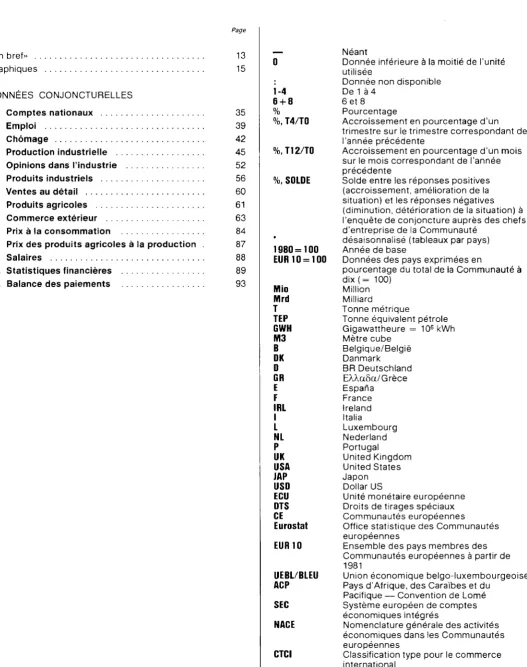
Table des matières
Signes et abréviations
«En bref»
Graphiques
DONNÉES CONJONCTURELLES
1. Comptes nationaux
2. Emploi
3. Chômage
4. Production industrielle
5. Opinions dans l'industrie
6. Produits industriels
7. Ventes au détail
8. Produits agricoles
9. Commerce extérieur
10. Prix à la consommation
11. Prix des produits agricoles à la production
12. Salaires
13. Statistiques financières
14. Balance des paiements
Page
13
15
35
39
42
45
52
56
60
61
63
84
87
88
89
93
1-4
6
+
8
%
% ,
T 4 / T 0
% , T 1 2 / T 0
%, SOLDE
1980
=
100
EUR 10
=
100
Mio
Mrd
Τ
ΤΕΡ
GWH
Μ3
Β
DK
D
GR
E
F
IRL
I
L
NL
Ρ
UK
USA
JAP
USD
ECU
DTS
CE
Eurostat
EUR 10
UEBL/BLEU
ACP
SEC
NACE
CTCI
Néant
Donnée inférieure à la moitié de l'unité
utilisée
Donnée non disponible
De 1 à 4
6 et 8
Pourcentage
Accroissement en pourcentage d'un
trimestre sur le trimestre correspondant de
l'année précédente
Accroissement en pourcentage d'un mois
sur le mois correspondant de l'année
précédente
Solde entre les réponses positives
(accroissement, amélioration de la
situation) et les réponses négatives
(diminution, détérioration de la situation) à
l'enquête de conjoncture auprès des chefs
d'entreprise de la Communauté
désaisonnalisé (tableaux par pays)
Année de base
Données des pays exprimées en
pourcentage du total de la Communauté à
d i x ( = 100)
Million
Milliard
Tonne métrique
Tonne équivalent pétrole
Gigawattheure = 10
6kWh
Mètre cube
Belgique/België
Danmark
BR Deutschland
Ελλαδα/Grèce
España
France
Ireland
Italia
Luxembourg
Nederland
Portugal
United Kingdom
United States
Japon
Dollar US
Unité monétaire européenne
Droits de tirages spéciaux
Communautés européennes
Office statistique des Communautés
européennes
Ensemble des pays membres des
Communautés européennes à partir de
1981
Union économique belgoluxembourgeoise
Pays d'Afrique, des Caraïbes et du
Pacifique — Convention de Lomé
Système européen de comptes
économiques intégrés
Nomenclature générale des activités
économiques dans les Communautés
européennes
Eurostatistiques: en bref
1. C H Ô M A G E : malgré une nouvelle baisse saisonnière
en mai (— 1 , 6 % ) , les jeunes chômeurs représentent
37 % du total dans la C o m m u n a u t é
Au mois de mai 1986, le nombre de chômeurs inscrits auprès des
bureaux de placement de la Communauté des Douze a continué à
décroître et ce, essentiellement pour des raisons saisonnières; la
diminution a été de plus de 370 000, soit 2,4 o/o. Quant au nombre
de personnes qui restaient inscrites comme chômeurs dans les
douze États membres, il était de 15,6 millions. Comme c'était le
cas des mois précédents, les chiffres désaisonnalisés n'ont prati
quement pas changé.
En avril, le nombre des jeunes chômeurs et celui des chômeurs
plus âgés avait diminué dans des proportions similaires dans
l'ensemble de la Communauté (sans le Portugal). En mai, par con
tre, le nombre des chômeurs de moins de 25 ans était en recul de
1,6%, tandis que celui des chômeurs de 25 ans et plus avait
régressé de 2,9 o/o. Une évolution semblable à celle de l'ensemble
de la Communauté a été observée au cours du mois de mai 1986,
en Grèce, au Danemark et aux PaysBas.
Dans les autres États membres, par contre, le nombre des chô
meurs de moins de 25 ans a diminué plus fortement que celui des
chômeurs de 25 ans et plus alors qu'en Italie celui des chômeurs
de moins de 25 ans a augmenté.
Fin mai 1986, les chômeurs de moins de 25 ans représentaient
environ 37 o/o du nombre total des chômeurs de la Communauté (à
l'exclusion du Portugal). La situation varie d'un État membre à
l'autre: leur part est la plus forte en Espagne (52 o/o) et en Italie
(51 o/o) et la plus faible en RF d'Allemagne et au Danemark (25 o/o).
2. PRIX: accroissement faible en mai 1986 ( + 0,2 % )
Avec un accroissement faible de l'IPC de l'ordre de 0,2 o/o pour
l'ensemble de la Communauté (EUR 12), l'évolution favorable de
l'inflation a continué en mai. On a même enregistré un recul des
prix en Belgique ( 0,2 o/o) et au Portugal (— 0,5 o/o), alors que
ceuxci ont stagné en RF d'Allemagne, aux PaysBas et au grand
duché de Luxembourg. Dans les autres États membres, les haus
ses ont été faibles à modérées: en France et au RoyaumeUni (Ι
Ο,2 o/o), en Espagne ( + 0,3 o/o), en Italie ( + 0,4 o/
0), en Grèce et au
Danemark ( + 0,5 o/o).
L'indice trimestriel de l'Irlande a progressé de 1,2% entre
mifévrier et mimai 1986, ce qui correspond à une hausse de
0,4 o/o environ en rythme mensuel.
Le taux d'inflation sur 12 mois (mai 1986/mai 1985) est de 3,5%
pour EUR 12, pour les pays membres de la CE les taux sont les
suivants (en o/o):
Allemagne (RF) 0,2 o/o, Luxembourg 0,4 o/o, PaysBas 0,5 o/o,
Belgique 1 , 1 % , France 2,3 o/o, RoyaumeUni 2 , 8 % , Danemark
3,8 o/o, Irlande 4,4 o/
0, Italie 6,4 o/o, Espagne 7,8 o/o, Portugal 11,5 o/o,
Grèce 24,5 o/o.
Les taux correspondants pour les pays non communautaires pour
lesquels Eurostat publie régulièrement des indices sont (en % ) :
Suisse 0,7 0/o, Autriche 1,4 (avr.), Finlande 3,1 0/0, Suède 3,4 % ,
Norvège 5,6 0/0, Japon 0,7 0/0, USA 1,6 0/0 (avr.), Canada 4,2 0/0
3. PRODUCTION INDUSTRIELLE: forte hausse en avril
1986 pour la Communauté, suite au faible niveau cons
taté en mars
L'indice pour la Communauté (EUR 12) du mois d'avril est actuelle
ment estimé à 109,6 soit une hausse de 5 % par rapport à l'indice
du mois d'avril 1985.
Après correction
des variations saissonières
l'indice d'avril
actuellement de 106,9 correspond à une hausse exceptionnelle
qui doit être interprétée avec prudence au moins pour deux rai
sons. Les coefficients de correction des variations saissonières ont
été perturbés par les fêtes de Pâques qui sont tombées en mars
cette année, de plus les températures particulièrement faibles
d'avril ont entraîné dans plusieurs États membres des productions
d'électricité et de distribution de gaz particulièrement élevées pour
un mois d'avril.
Pour les trois derniers mois connus, la croissance en un an de
l'indice d'ensemble EUR 12 par rapport aux trois mois correspon
dants est de 2,9 % . La variation correspondante est de 1,2 % pour
la France, de 2,6 0/0 pour le RoyaumeUni, de 2,8 0/0 pour l'Italie et
de 3,3 0/0 pour la RF d'Allemagne.
4. ACIER: nouvelle baisse de la production en mai 1986
En mai 1986, 10,6 millions de tonnes d'acier brut ont été produites
dans la Communauté (Grèce exclue).
Ce résultat confirme la tendance générale à la baisse:
9 , 9 0/0 par rapport à mai 1985,
— 8,8 % désaisonnalisé par rapport à avril 1986.
4,2 0/0 pour la comparaison entre les cumuls des cinq premiers
mois.
Au cours du premier trimestre de 1986, les commandes nouvelles
pour aciers courants (EUR 9) se sont élevées à 22,4 millions de
tonnes, ce qui représente une hausse de 8,4 0/0 par rapport au der
nier trimestre de 1985 et une baisse de 4,9 0/0 par rapport au pre
mier trimestre de 1985.
5. C O M M E R C E
EXTÉRIEUR: au premier trimestre d e
1986, et suite à la chute du dollar et des prix d e s
matières premières, forte baisse des exportations
communautaires ver les pays de l'OPEP
( —
27
% )
Le premier trimestre se caractérise par une situation inhabituelle
en ce sens que les prix des exportations et des importations
étaient considérablement plus bas, en Écus, qu'une année aupara
vant à cause de l'effet conjugué de la chute du dollar ( — 26 % en
douze mois) et de l'effondrement des prix du pétrole qui ont bais
sée de plus de moitié. De ce fait, les exportations, de la Commu
nauté vers les pays tiers ne se sont élevées qu'à 84 milliards
d'Écus, ce qui correspond à une diminution de 9 0/0 par rapport à
leur niveau du premier trimestre de l'année dernière.
En ce qui concerne les exportations vers les pays industrialisés, la
baisse de 3 0/0 est largement due aux mouvements monétaires
reflétés dans les prix. Ainsi, les exportations vers l'AELE se sont
élevées à 21 milliards d'Écus ( + 3 % ) , alors que les exportations
vers les ÉtatsUnis sont retombées à 18 milliards ( — 9 0/0). Cepen
dant, malgré la hausse du yen, les exportations vers le Japon ont
reculé n'atteignant que 2,7 milliards d'Ecus ( — 2 % ) .
La baisse de 18 0/0 des exportations vers les pays en voie de déve
loppement reflète, quant à elle, la double diminution du volume des
exportations et des prix. Les exportations vers les pays de l'OPEP
sont passées, pour la première fois depuis cinq ans, sous le niveau
de 10 milliards d'Écus pour un trimestre, ce qui correspond à une
diminution de 27 0/0 par rapport à l'année dernière. Même les
exportations vers les pays en voie de développement non mem
bres de l'OPEP ont reculé de 1 3 % , puisque les exportateurs de
produits de base ont été touchés par la chute des prix, qui a