A CHANDRA X-RAY OBSERVATORY
STUDY OF PSR J1740-5340 AND
CANDIDATE MILLISECOND PULSARS
IN THE GLOBULAR CLUSTER NGC 6397
The Harvard community has made this
article openly available. Please share how
this access benefits you. Your story matters
Citation
Bogdanov, Slavko, Maureen van den Berg, Craig O. Heinke, Haldan
N. Cohn, Phyllis M. Lugger, and Jonathan E. Grindlay. 2009.
“ACHANDRA X-RAY OBSERVATORY STUDY OF PSR J1740-5340 AND
CANDIDATE MILLISECOND PULSARS IN THE GLOBULAR CLUSTER
NGC 6397.” The Astrophysical Journal 709 (1): 241–50. https://
doi.org/10.1088/0004-637x/709/1/241.
Citable link
http://nrs.harvard.edu/urn-3:HUL.InstRepos:41399754
Terms of Use
This article was downloaded from Harvard University’s DASH
repository, and is made available under the terms and conditions
applicable to Other Posted Material, as set forth at
http://
The Astrophysical Journal, 709:241–250, 2010 January 20 doi:10.1088/0004-637X/709/1/241
C
2010. The American Astronomical Society. All rights reserved. Printed in the U.S.A.
A
CHANDRA X-RAY OBSERVATORY
STUDY OF PSR J1740–5340 AND CANDIDATE MILLISECOND PULSARS
IN THE GLOBULAR CLUSTER NGC 6397
Slavko Bogdanov1,5, Maureen van den Berg2, Craig O. Heinke3, Haldan N. Cohn4, Phyllis M. Lugger4, and Jonathan E. Grindlay2
1Department of Physics, McGill University, 3600 University Street, Montreal, PQ H3A 2T8, Canada;[email protected] 2Harvard-Smithsonian Center for Astrophysics, 60 Garden Street, Cambridge, MA 02138, USA
3Department of Physics, University of Alberta, Edmonton, AB T6G 2G7, Canada 4Department of Astronomy, Indiana University, 727 East Third Street, Bloomington, IN 47405, USA
Received 2009 August 21; accepted 2009 November 17; published 2009 December 30
ABSTRACT
We present a deepChandra X-ray Observatorystudy of the peculiar binary radio millisecond pulsar (MSP) PSR J1740–5340 and candidate millisecond pulsars in the globular cluster NGC 6397. The X-rays from PSR J1740–5340 appear to be non-thermal and exhibit variability at the binary period. These properties suggest the presence of a rel-ativistic intrabinary shock formed due to interaction of a relrel-ativistic rotation-powered pulsar wind and outflow from the unusual “red-straggler/sub-subgiant” companion. We find the X-ray source U18 to show similar X-ray and op-tical properties to those of PSR J1740–5340, making it a strong MSP candidate. It exhibits variability on timescales from hours to years, also consistent with an intrabinary shock origin of its X-ray emission. The unprecedented depth of the X-ray data allows us to conduct a complete census of MSPs in NGC 6397. Based on the properties of the present sample of X-ray-detected MSPs in the Galaxy, we find that NGC 6397 probably hosts no more than six MSPs.
Key words: globular clusters: general – globular clusters: individual (NGC 6397) – pulsars: general – pulsars: individual (PSR J1740-5340) – stars: neutron – X-rays: stars
Online-only material:color figure
1. INTRODUCTION
Globular clusters are well known for their abundance of rotation-powered millisecond pulsars (MSPs; Camilo et al.
2000; Freire et al.2003; Ransom et al.2005).6These objects are
believed to have been produced by the evolution of low-mass X-ray binaries (LMXBs) that were themselves produced through dynamical interactions of binaries and neutron stars. The superb sub-arcsecond X-ray imaging capability of the Chandra X-Ray Observatory has allowed X-ray studies of MSPs in the dense cores of globular clusters for the first time. In addition to establishing the X-ray properties of the Galactic population of MSPs, X-ray studies of cluster MSPs offer constraints on stellar and binary evolution and the internal dynamical evolution of globular clusters. To date, X-ray counterparts of these systems have been detected withChandrain 47 Tuc (Grindlay et al.2002; Bogdanov et al.2006), NGC 6397 (Grindlay et al. 2002; and this work), M28 (Becker et al.2003; S. Bogdanov et al. 2010, in preparation), M4 (Bassa et al.2004), NGC 6752 (D’Amico et al.2002), M71 (Elsner et al.2008), and Ter 5 (Heinke et al.
2006).
NGC 6397 is the nearest apparently core-collapsed and the second closest globular cluster, with D ≈ 2.4 kpc (Hansen et al. 2007; Strickler et al. 2009; and references therein). It hosts one known MSP, PSR J1740–5340 (D’Amico et al.2001), which is bound to an unusual “red-straggler” or “sub-subgiant”7
companion in a 32.5-hr binary orbit (Ferraro et al.2003). This
5 Canadian Institute for Advanced Research Junior Fellow. 6 For an up-to-date list of all known globular cluster MSPs, see
http://www.naic.edu/∼pfreire/GCpsr.html.
7 The terms red-straggler and sub-subgiant are used for cluster stars that lie in a location below the base of the red giant branch that is difficult to understand in the context of standard evolution scenarios for single stars or binaries in a dynamically inactive environment (Orosz & van Kerkwijk2003).
is at odds with the standard MSP formation theory that predicts either a white dwarf or a very low mass (∼0.03M) degenerate companion (see Bhattacharya & van den Heuvel 1991; for a review), implying that either this binary has just emerged from the “recycling” phase in a LMXB (Burderi et al.2002) or has been involved in a close dynamical binary–binary encounter in which the original companion to the pulsar was exchanged for the current one (Camilo & Rasio2005; and references therein). Observations of MSPs, both in the field of the Galaxy and in globular clusters, have revealed that their X-ray emission can be of thermal and/or non-thermal character (see Zavlin 2007; Bogdanov & Grindlay 2008; for a review). In many MSPs, the X-rays appear to be predominantly due to surface emission from the magnetic polar caps of the neutron star (Bogdanov et al.2006; Zavlin 2006; Bogdanov & Grindlay2009). Non-thermal pulsed X-ray emission, on the other hand, can arise from particle acceleration processes in the pulsar magnetosphere as seen from the most energetic MSPs (see, e.g., Rutledge et al.
2004). Alternatively, non-thermal X-rays can be produced via interaction of the rotation-powered pulsar wind with the ambient interstellar medium, as seen for PSR B1957+20 (Stappers et al.
2003) and J2124–3358 (Hui & Becker2006), or material from a close binary companion as in PSR J0024–7204W in 47 Tuc (Bogdanov et al.2005).
In this paper, we presentChandradeep imaging spectroscopic observations of NGC 6397, with a particular focus on PSR J1740–5340 and CXOGlb J174041.6–534027 (U18), a plausible MSP candidate. We also investigate the X-ray source population of NGC 6397 in an attempt to identify plausible MSP candidates and constrain the MSP content of this cluster. The work is organized as follows. In Section 2, we describe the data reduction and analysis procedures. In Section 3, we focus on the properties of PSR J1740–5340, while in Section 4 we investigate the MSP candidate U18. In Section 5, we attempt
Table 1
ChandraObservations of NGC 6397
Telescope/ Epoch of Observation Exposure Instrument Observation ID Time (ks)
Chandra/ACIS-I 2000 Jul 31 79 49.0 Chandra/ACIS-S 2002 May 13 2668 28.5 Chandra/ACIS-S 2002 May 15 2669 27.0 Chandra/ACIS-S 2007 Jun 22 7461 90.0 Chandra/ACIS-S 2007 Jul 16 7460 160.0
to place interesting constraints on the total number of MSPs in the cluster based on the available X-ray and optical data. We present a discussion in Section6and conclusions in Section7.
2. DATA REDUCTION AND ANALYSIS
The Chandra data discussed herein were acquired during two separate observations in Cycle 8, on 2007 June 22 (ObsID 7461) and 2007 July 16 (ObsID 7460) for 90 and 160 ks, respectively. In both cases, the ACIS S3 chip in VFAINT telemetry mode was at the focus. We also make use of two Cycle 3 ACIS-S observations of 28.5 ks and 27 ks (ObsIDs 2668 and 2669, respectively), and a single Cycle 1 ACIS-I (ObsID 79) observation of 49 ks (Grindlay et al.2001), all acquired in FAINT mode. Table1summarizes all the observations used in this work.
The data re-processing, reduction, and analysis were per-formed using CIAO84.0. Starting from the level 1 data products,
we first removed pixel randomization from the standard pipeline processing in order to aid in source disentanglement in the dense cluster core. In addition, for the purposes of faint source detec-tion we applied the background-cleaning algorithm for the data taken in VFAINT observing mode. However, as this procedure tends to discard real source counts for relatively bright sources, the background-cleaned data were not used for the spectral anal-yses discussed in Section3and Section4but were used for the population study in Section5. Before co-adding the four ACIS-S images, the individual aspect solutions were reprojected rela-tive to the longest observation (ObsID 7460) using the brightest sources in the cluster in order to correct for any differences in the absolute astrometry between the four exposures.
X-ray source detection was performed with thewavdetect
tool in CIAO. In the crowded cluster core, we also used the PWDetect9script (Damiani et al.1997a,1997b), which tends to
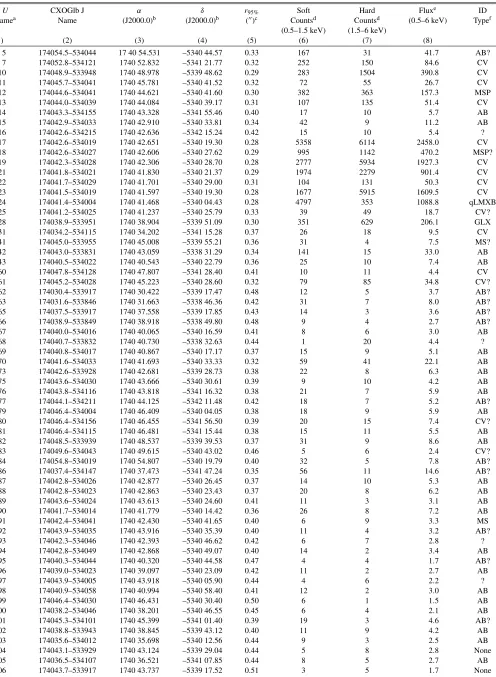
be more effective at identifying faint sources near much brighter sources. The resulting source positions were refined using the IDL toolacis_extract. The 95% confidence positional uncertainty radius for each source was computed using the empirical relation given by Equation (5) in Hong et al. (2005). In total, 79 sources are detected within the 2.33 half-mass radius of NGC 6397 (see Table3). Compared to the source list from Grindlay et al. (2001), based on the single ACIS-I observation, and Grindlay (2005), based on the I and two short ACIS-S observations, we find that all sources except U20, U64, U71, U72, U74, U78, and U85 are detected in the combined deep ACIS-S image.
For the purposes of optical matching of the X-ray sources (see Section 5) using the set of Hubble Space Telescope
Advanced Camera for Surveys Wide-Field Channel (HSTACS/ 8 Chandra Interactive Analysis of Observations, available at
http://cxc.harvard.edu/ciao/
9 PWDetect has been developed by scientists at Osservatorio Astronomico di Palermo; G. S. Vaiana thanks to Italian CNAA and MURST (COFIN) grants.
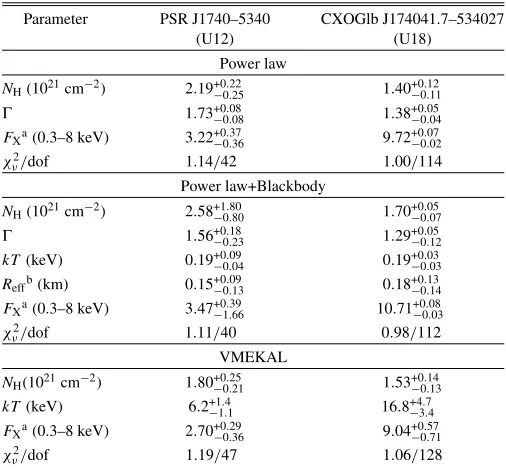
Table 2
Spectral Fits for PSR J1740–5340 and U18
Parameter PSR J1740–5340 CXOGlb J174041.7–534027
(U12) (U18)
Power law
NH(1021cm−2) 2.19−+00..2225 1.40+0−0..1211
Γ 1.73+0.08
−0.08 1.38+0−0..0504 FXa(0.3–8 keV) 3.22+0−0..3736 9.72+0−0..0702 χ2
ν/dof 1.14/42 1.00/114
Power law+Blackbody
NH(1021cm−2) 2.58+1.80
−0.80 1.70
+0.05
−0.07
Γ 1.56+0.18
−0.23 1.29+0−0..0512 kT (keV) 0.19+0.09
−0.04 0.19+0−0..0303 Reffb(km) 0.15+0−0..0913 0.18+0−0..1314 FXa(0.3–8 keV) 3.47−+01..3966 10.71
+0.08
−0.03 χ2
ν/dof 1.11/40 0.98/112
VMEKAL
NH(1021cm−2) 1.80+0.25
−0.21 1.53+0−0..1413 kT (keV) 6.2+1.4
−1.1 16.8+4−3..74 FXa(0.3–8 keV) 2.70+0−0..2936 9.04+0−0..5771 χν2/dof 1.19/47 1.06/128
Notes.
aUnabsorbed flux in units of 10−14ergs cm−2s−1in the 0.3–8 keV band. bEffective blackbody emission radius assuming a distance of 2.4 kpc to NGC
6397.
WFC) observations (GO-10257) in F435W (B), F625W (R), and F658N (Hα), we computed a boresight correction for the Chandrasource coordinates (see H. Cohn et al. 2010, in preparation, for details). The resulting shift of the Chandra
coordinates isΔα = −0.19±0.02 and Δδ = 0.18±0.02. The X-ray position based on this correction for PSR J1740– 5340 agrees with the optical position (Bassa & Stappers2004) to 0.01 inαand 0.03 inδ. While theChandraACIS-S mosaic encompasses the entire half-mass radius of the cluster, theHST
ACS/WFC mosaic provides complete coverage out to a radius of∼1.5 from the cluster center, partial coverage in two or more exposures out to ∼2.5, and partial coverage in at least one exposure out to 2.9. As a result, the sources U5, U16, U77, and U84 lie outside theRfield making their classification difficult due to the absence of BR and Hα−R color measurements. However, Kaluzny et al. (2006) have shown that the optical counterparts of U5 and U77, V30 and V36, respectively, are variable using ground-based photometry and thus are probably active binaries (ABs; Kaluzny et al.2006).
Net counts and spectra for each X-ray source were extracted usingacis_extractfrom polygonal regions sized to contain 90% of the total energy at 1.5 keV. For spectroscopy, the extracted source counts in the 0.3–8 keV range were then grouped in energy bins so as to ensure at least 15 counts per bin. The X-ray spectral analyses of PSR J1740–5340 and U18 were carried out using the XSPEC10package (see Table2). For the variability analysis, the photon arrival times were first reduced to the solar system barycenter, using the CIAO toolaxbary.
3. PSR J1740–5340
Grindlay et al. (2001,2002) have found the X-ray counterpart of the PSR J1740–5340 system (see Figure1) to be a moderately
[image:3.612.43.295.76.154.2]No. 1, 2010 X-RAYS FROM MILLISECOND PULSARS IN NGC 6397 243
0.3 - 6 keV ACIS-S
Chandra
30" U18
[image:4.612.162.456.58.339.2]PSR J1740-5340
Figure 1.Co-addedChandra X-ray Observatory295.1-ks ACIS-S3 image of the core of the globular cluster NGC 6397 in the 0.3–6 keV band. The 1.5 circles are centered on the 79 X-ray sources detected within the 2.3 half-mass radius of the cluster (outer dashed circle), with the positions of PSR J1740–5340 (U12) and CXOGlb J174041.6–534027 (U18) marked. The inner dashed circle shows the 5.5 core radius of the cluster. The gray scale corresponds to the number of counts increasing logarithmically from 0 (white) to 3515 (black). North is up and east is to the left.
luminous (LX∼1031ergs s−1) and relatively hard X-ray source
(Γ ∼ 1.4), compared to most MSPs. Indeed, the combined
ChandraACIS-S spectrum (Figure 2) is well described by a pure non-thermal model with power-law photon index Γ = 1.73±0.08, hydrogen column density ofNH =(2.19+0−0.22.25)×
1021 cm−2, and unabsorbed X-ray flux F
X = (3.2±0.4) ×
10−14ergs cm2s−1(0.3–8 keV) withχν2 =1.14 for 42 degrees of freedom. All uncertainties quoted are 1σ. For an assumed distance of 2.4 kpc to NGC 6397, the implied X-ray luminosity in the 0.3–8 keV band isLX=2.2×1031ergs s−1.
We also applied a two-temperature thermal (blackbody or H atmosphere) model, which provides a good description of the X-ray spectra of several nearby MSPs (Zavlin 2006; Bogdanov & Grindlay2009). However, this model fits the phase-averaged spectrum of PSR J1740–5340 poorly. The spectrum of PSR J1740–5340 likely contains a soft thermal component (with Teff ∼ 106 K and L
X of order a few×1030 ergs s−1)
originating from the hot magnetic polar caps of the MSP, as seen in many X-ray-detected MSPs (e.g., PSR J0437–4715 and most MSPs in 47 Tuc, see Zavlin2006; Bogdanov et al.
2006). To investigate this possibility, we first introduce a single blackbody component to the spectral model. Fitting a com-posite power-law plus blackbody model yieldsΓ= 1.56+0−0..1823,
NH = (2.6+1.8
−0.8)×1021 cm−2,kT = 0.19+0
.09
0.04 K, and Reff =
0.15+0−0.09.13 km with χν2 = 1.1 for 40 degrees of freedom.
Al-though anF-test indicates that the addition of a thermal compo-nent is not statistically warranted by the data, the best-fit values for Teff andReff are similar to those obtained for the 47 Tuc
MSPs so this component may, in fact, be genuine. A compos-ite model consisting of a power law plus two thermal com-ponents yields good fits to the spectrum, although the limited
10−4 10−3
Cou
nts
s
−1
keV
−1
PSR J1740−5340
1
0.5 2 5
−20 2
χ
Photon energy (keV)
Figure 2.Phase-integrated stacked spectrum of PSR J1740–5340 from all four ChandraACIS-S observations, fitted with an absorbed power-law spectrum. The lower panel shows the best-fit residuals. See the text and Table2for the best-fit parameters.
photon statistics do not allow meaningful constraints for a three-component model. In principle, the presence of surface thermal emission could be determined by way of high time-resolution X-ray observations, which would reveal any thermal pulsations. Unfortunately, the 3.2-s time resolution of the ACIS observa-tions precludes such an investigation with the present data set.
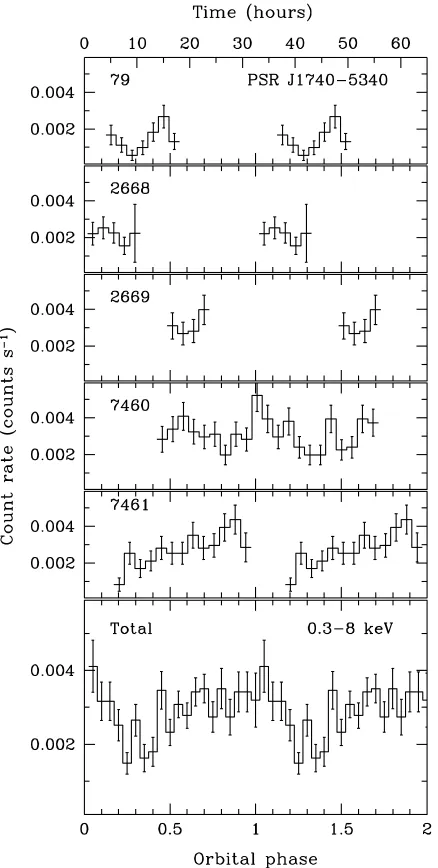
[image:4.612.320.567.401.560.2]Figure 3.Light curves of PSR J1740–5340 folded at the pulsar’s binary period for eachChandraACIS observation. The bottom panel shows the combined folded light curve from the four ACIS-S observations, with the count rate corrected for the non-uniform exposure across the orbit. The phase is defined based on the radio pulsar timing convention in which superior conjunction occurs atφ=0.25. Two orbital cycles are shown for clarity.
6397 (Castilho et al.2000; Gratton et al.2001). This model also reproduces the observed spectral shape rather well, with best-fit parametersNH=(1.80+0.25
−0.21)×1021 cm−2,kT =6.2+1
.4
−1.1 keV,
and FX = (2.70+0−0..2936)×10−14 ergs cm2 s−1 (0.3–8 keV),
with χ2
ν = 1.2 for 47 degrees of freedom. As discussed in
Section 6.1, although a thermal plasma model is consistent with the observed X-ray emission from the PSR J1740–5340 binary, a predominantly non-thermal origin of the X-rays is more likely.
Based on the ACIS-I observation of NGC 6397, Grindlay et al. (2002) reported evidence for a gradual increase (by a factor of 2 in total) in the X-ray count rate of PSR J1740–5340. However, due to the limited phase coverage and photon statistics, no conclusive statements could be made regarding variability. Figure 3 shows the X-ray count rate from the pulsar as a function of binary phase, based on the radio timing ephemeris
10−4 10−3
Coun
tss
−1
ke
V
−1
U18
1
0.5 2 5
−20 2
χ
Photon energy (keV)
Figure 4. Total Chandra ACIS-S spectrum of the X-ray source CXOGlb J174041.6–534027 (U18) fitted with a pure power-law spectrum. The bottom panel shows the best-fit residuals. See the text and Table2for best-fit parameters. (A color version of this figure is available in the online journal.)
from D’Amico et al. (2001), of all Chandra observations of PSR J1740–5340. Although the individual light curves are suggestive of flux modulations, with generally lower count rates around the radio eclipse phases (0.05–0.45), a Kolmogorov– Smirnov (K–S) test on the unbinned light curves within each observation reveals no statistically significant variability. In addition, the same test indicates variability only at a 1.7σ
confidence level over the entire set of ACIS-S observations. On the other hand, based on Poisson statistics, we find that the count rate minimum that occurs near φ = 0.25 (see the bottom panel of Figure 3) for the light curve folded at the binary period and grouped in 20–40 bins, deviates by∼3.8σ
from what is expected from a constant source. Aχ2test on the
same light curve indicates a 98.7% probability of variability. There is also marginal evidence (at ∼95% confidence) for spectral variability, with an apparent softening of the X-ray emission around φ = 0.25. Due to the long binary period, the ACIS-S data cover less than three full binary orbits so it is not clear whether this variability is truly periodic and stable over many orbits. Interestingly, the folded light curve exhibits the same characteristic shape as that of PSR J0024– 7204W in 47 Tuc (Bogdanov et al. 2005), with a minimum around superior conjunction, roughly coincident with the radio eclipses. The spectral and temporal similarities of the two systems point to an intrabinary shock origin of the X-rays from PSR J1740–5340.
4. U18: A MSP CANDIDATE
The X-ray source CXOGlb J174041.6–534027 (hereafter U18) is positionally coincident with a peculiar “red-straggler” star11 (Grindlay et al. 2001). In addition, it is known to have a relatively hard spectrum making it a plausible candidate for a MSP given the similarities in X-ray and optical properties with PSR J1740–5340. A fit of a power-law model to the combined ACIS-S spectrum of U18 gives Γ = 1.38+0.05
−0.04,
NH = (1.4+0−0..1211)×1021 cm−2 withχν2 = 1.0 for 114 degrees
of freedom. The derived unabsorbed flux of FX = 9.7 × 10⁻¹⁴ergs cm−2s−1(0.3–8 keV) implies a luminosity ofLX=
11 We note that the proper motions of the optical counterparts to U12 and U18 are consistent with cluster membership (see H. Cohn et al. 2010, in
[image:5.612.61.280.55.489.2]No. 1, 2010 X-RAYS FROM MILLISECOND PULSARS IN NGC 6397 245 6.7×1031ergs s−1forD=2.4 kpc. Figure4shows the spectrum
of U18 in the 0.3–8 keV band and the best-fit power-law model. As with PSR J1740–5340, we also conducted fits using a two-component (thermal plus non-thermal) model. The resulting best-fit values areΓ =1.29+0.05
−0.12,kT =0.19−+00..0303 keV,Reff =
0.18+0−0.13.14,NH =(1.70+0−0.05.07)×1021 cm−2, withχν2 =0.98 for
112 degrees of freedom. The unabsorbed flux in the 0.3–8 keV band is 1.07×10⁻¹³ergs cm−2s−1, which corresponds to an X-ray luminosity ofLX=7.4×1031ergs s−1forD=2.4 kpc. By
analogy with the nearest known MSPs (Zavlin2006; Bogdanov & Grindlay 2009), we also apply a model with a power law plus two thermal components. This model is consistent with the observed spectrum as well, although the relatively high column density along the line of sight, which absorbs a large fraction of source photons below∼0.5 keV, makes it difficult to reliably constrain the softer thermal component.
A thermal plasma model (vmekal with the same assumed abundances as for PSR J1740–5340) also provides a good description of the spectrum of U18. The best-fit parameters in this case areNH=(1.53+0−0..1413)×1021cm−2,kT =16.8+4
.7
−3.4keV,
and FX = 9.0 × 10⁻¹⁴ ergs cm−2 s−1 (0.3–8 keV), with
χ2
ν =1.06 for 128 degrees of freedom.
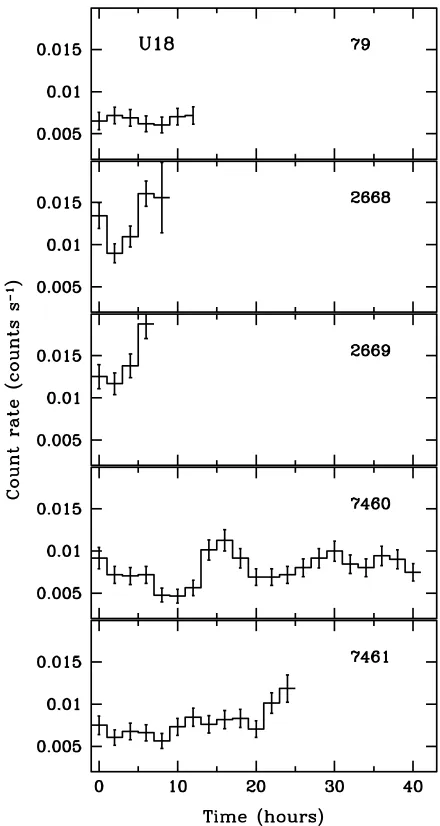
It is obvious from Figure 5 that the X-ray flux from U18 exhibits variability by as much as a factor of∼4 on timescales spanning from hours to years. Indeed, a K–S test on the concatenated set of ACIS-S observations indicates a 3.5×10⁻¹⁵
probability of the observed photons coming from a steady flux distribution. Moreover, the photon arrival times from U18 within observations 2668, 2669, 7460, and 7461 deviate by 3σ, 2.3σ, 3σ, and 4σ from a constant distribution, based on a K–S test.
Kaluzny et al. (2006) have reported the likely detection of periodicity, possibly due to ellipsoidal variations, with P =
1.3 days in the source V31, which they associate with U18. It should be noted, however, that the position of V31 lies at
∼2.1σfrom U18 after boresight correction. Moreover, V31 does not correspond to the red-straggler optical counterpart of U18 reported by Grindlay et al. (2001), which is only∼0.4σ away. We have folded the set of fourChandraACIS-S observations at the period of V31 but find no statistically significant variability. This implies that V31 is most likely not the actual optical counterpart of U18.
5. AN X-RAY CENSUS OF MSPS IN NGC 6397 As noted previously, several nearby MSPs in the field of the Galaxy (Zavlin 2006; Bogdanov & Grindlay 2009) and most MSPs in the globular cluster 47 Tuc (Bogdanov et al.2006) appear to be predominantly soft, thermal X-ray sources due to their hot polar caps. As demonstrated by Bogdanov et al. (2008, see in particular their Figure 1), the (nearly) antipodal geometry of the polar caps and the effects of light bending guarantee that this surface emission is observed for any combination of magnetic inclinations and viewing angles. In addition, the difference in observed luminosity between the most and least favorable geometric orientations (always face-on versus always edge-on hot spots) is only a factor of∼3 as a consequence of gravitational bending of light near the neutron star surface. Thus, thermal MSPs should be observable in X-rays even if they cannot be seen in the radio due to unfavorable beaming and fall within a relatively narrow range of X-ray luminosities. The limiting sensitivity of the available ACIS-S data is ∼1029 ergs s−1,
meaning that typical thermal MSPs (with luminosities of a few
[image:6.612.333.553.53.466.2]×1030 ergs s−1) would be detected in the combinedChandra
Figure 5.X-ray light curves of CXOGlb J (U18) in the 0.3–8 keV band from allChandraACIS observations binned in 1-hr intervals. Time zero corresponds to the start of each observation.
ACIS-S observations if they were located in NGC 6397, even in the unlikely event that their two hot spots are always seen edge-on. Binary MSPs that eclipse in the radio tend to have X-ray luminosities ∼1031 ergs s−1 (Stappers et al.2003; Bogdanov et al.2005,2006; Elsner et al.2008). Moreover, the intrabinary shock in such systems should presumably be visible in X-rays regardless of the pulsar geometry and the orientation of the binary. Therefore, based on our current understanding of the X-ray properties of these sources,allMSPs in NGC 6397 should be detected with high significance in the available data.
We have compiled a set of “template” MSP X-ray colors and luminosities using the cluster and field MSPs that have been detected in X-rays to date. These include the 11 MSPs listed in Table 1 of Pavlov et al. (2007), the 15 MSPs in the globular clusters 47 Tuc with unconfused spectra (Bogdanov et al. 2006), one MSP in M71 (Elsner et al. 2008), two MSPs in Ter 5 (Heinke et al.2006), and the recently discov-ered PSR J1023+0038 in the field of the Galaxy (Archibald et al. 2009). Using the measured spectral properties of these MSP, we calculate their X-ray luminosities and colors as they would appear in NGC 6397 using NH = 2 ×1021 cm−2
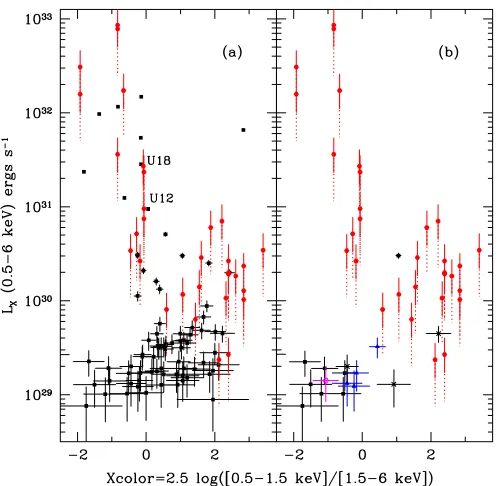
Figure 6.(a) X-ray luminosity vs. color diagram for NGC 6397. The black points show all 79 sources within the NGC 6397 half-mass radius (Table3), for an assumed power-law spectrum withΓ=2.5. (b) Same as (a) but with all sources with probable optical identifications removed. The red circles in both panels correspond to simulated MSPs based on the current Galactic sample of MSPs detected in X-rays (see the text for details). Sources with no optical counterparts are marked with black squares, those with ambiguous or unknown optical counterparts with solid blue triangles, the main-sequence star candidates with black crosses, and the main-sequence turnoff star candidate with the open magenta circle. The dotted lines extending below the error bars for the MSPs illustrate the effect of the uncertainty in the viewing geometry of the X-ray-emitting polar caps.
source population (see Figure 6). We define the color as Xcolor = 2.5 log(counts[0.3–1.5 keV])/(counts[1.5–6 keV]) and consider the absorbed luminosity in the 0.5–6 keV band. To estimate the uncertainties in the derived MSP luminosities, we have considered a nominal 30% error in the pulsar distances plus the uncertainty due to the range of possible distances to NGC 6397. Furthermore, we have taken into account the lack of information regarding the viewing angles of the X-ray-emitting polar caps of any thermal MSPs in NGC 6397 (represented by the dotted lines in Figure6). High-quality X-ray spectra of nearby thermal MSPs show at least two thermal components and a much fainter hard tail above∼2 keV. For crude photon statistics, the X-ray emission of these MSPs resembles a power law with photon indexΓ∼2–3 in the 0.5–6 keV range. Thus, to estimate the X-ray luminosities of the sources in NGC 6397, we considerΓ=2.5. To ascertain the effect of our choice of spec-tral model, we also used a pure blackbody withkT =0.2 keV and variedNH=(1–3)×1021cm−1. We find that the
assump-tions regarding the spectral shape do not affect the conclusions of our analysis.
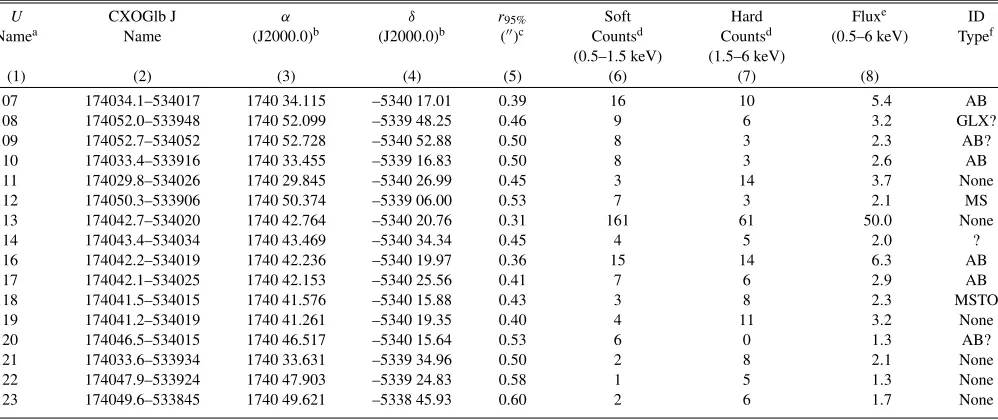
Using the computed set of MSPs, we attempt to identify MSPs in NGC 6397 without the benefit of radio timing searches (see Heinke et al. 2005, for a similar study for 47 Tuc). Important constraints can be gained from optical counterpart identifications usingHSTACS/WFC observations of the core of NGC 6397 (H. Cohn et al. 2010, in preparation). Of the 79 X-ray sources detected within the half-mass radius of NGC 6397, 64 sources have probable associations in the optical (see Table 3) predominantly with ABs and cataclysmic variables
(CVs). Additionally, U24 is classified as a qLMXB based on its X-ray properties (Grindlay et al.2001). The remaining sources either have ambiguous/unknown or no optical counterparts.
Solitary MSPs should have virtually no optical counterparts.12
Therefore, any X-ray source without an optical counterpart is a viable MSP candidate. Binary MSPs both in clusters and the field are commonly bound to low-mass He white dwarfs or very low mass (brown-dwarf-like) companions (∼0.03M) such as in the canonical “black-widow” system PSR B1957+20 (Fruchter et al.1988). For NGC 6397, Strickler et al. (2009) have found that none of the 41 He white dwarfs identified optically have X-ray counterparts, implying that they are not partnered with MSPs. The optical properties of black widow systems are not well established as only two objects have been studied in any detail, PSRs B1957+20 (Reynolds et al.2007) and J2051–0827 (Stappers et al.2001). Nonetheless, these systems tend to have
LX 1031 ergs s−1 (Stappers et al. 2003; Bogdanov et al.
2006; Elsner et al. 2008), so the lack of unidentified sources with comparable X-ray luminosities implies the absence of black widow systems in NGC 6397. Moreover, this indicates that aside from J1740–5340 and U18, there are no additional peculiar interacting binaries in this cluster either. Only a single source without an optical counterpart (U113 in Table3) has X-ray colors and luminosity (Xcolor=1.05 and logLX =30.5)
consistent with those of a typical MSP (Figure 6). The sole source with an ambiguous/unknown optical counterpart that has soft colors, U16, as well as U41 and U112, which appear to have probable main-sequence optical counterparts, are also possible MSP candidates. Based on these findings, we obtain a limit of6 MSPs in NGC 6397.
6. DISCUSSION
6.1. PSR J1740–5340
Optical observations of the PSR J1740–5340 system (Ferraro et al. 2003; Sabbi et al.2003) have revealed the presence of ellipsoidal variations as well as a stream of gas protruding from the 1.6R secondary star through the L1 point implying that the companion is Roche-lobe overflowing. However, the fact that PSR J1740–5340 is observed as a radio pulsar implies that this gas stream never reaches the underlying NS and is instead swept back and probably expelled from the binary system by the relativistic particle wind from the MSP. The presence of this swept-back gas stream is suggested by the very unusual Hα
emission line profile (Sabbi et al.2003). This gas is likely the cause for the irregular radio eclipses that the MSP exhibits over a wide range of orbital phases.
As seen in “black-widow” systems (Stappers et al. 2003; Bogdanov et al. 2006; Elsner et al. 2008) and “exchanged” MSP systems (Bogdanov et al.2005), the interaction between the pulsar wind and material from the companion star should result in a shock front where the ram pressure of the wind balances the pressure of the infalling gas leading to X-ray emission due to particle acceleration (Arons & Tavani1993). In this scenario, synchrotron emission is expected to be the primary energy loss mechanism in the resulting shock wave, given that it occurs in a relatively strong magnetic field. In the PSR J1740–5340 binary, for a shock situated approximately at the L1 point and an isotropic pulsar wind, the pulsar magnetic
No. 1, 2010 X-RAYS FROM MILLISECOND PULSARS IN NGC 6397 247
Table 3
X-ray Sources in NGC 6397
U CXOGlb J α δ r95% Soft Hard Fluxe ID
Namea Name (J2000.0)b (J2000.0)b ()c Countsd Countsd (0.5–6 keV) Typef (0.5–1.5 keV) (1.5–6 keV)
(1) (2) (3) (4) (5) (6) (7) (8)
5 174054.5–534044 17 40 54.531 –5340 44.57 0.33 167 31 41.7 AB?
7 174052.8–534121 1740 52.832 –5341 21.77 0.32 252 150 84.6 CV
10 174048.9–533948 1740 48.978 –5339 48.62 0.29 283 1504 390.8 CV
11 174045.7–534041 1740 45.781 –5340 41.52 0.32 72 55 26.7 CV
12 174044.6–534041 1740 44.621 –5340 41.60 0.30 382 363 157.3 MSP
13 174044.0–534039 1740 44.084 –5340 39.17 0.31 107 135 51.4 CV
14 174043.3–534155 1740 43.328 –5341 55.46 0.40 17 10 5.7 AB
15 174042.9–534033 1740 42.910 –5340 33.81 0.34 42 9 11.2 AB
16 174042.6–534215 1740 42.636 –5342 15.24 0.42 15 10 5.4 ?
17 174042.6–534019 1740 42.651 –5340 19.30 0.28 5358 6114 2458.0 CV 18 174042.6–534027 1740 42.606 –5340 27.62 0.29 995 1142 470.2 MSP? 19 174042.3–534028 1740 42.306 –5340 28.70 0.28 2777 5934 1927.3 CV 21 174041.8–534021 1740 41.830 –5340 21.37 0.29 1974 2279 901.4 CV
22 174041.7–534029 1740 41.701 –5340 29.00 0.31 104 131 50.3 CV
23 174041.5–534019 1740 41.597 –5340 19.30 0.28 1677 5915 1609.5 CV 24 174041.4–534004 1740 41.468 –5340 04.43 0.28 4797 353 1088.8 qLMXB
25 174041.2–534025 1740 41.237 –5340 25.79 0.33 39 49 18.7 CV?
28 174038.9–533951 1740 38.904 –5339 51.09 0.30 351 629 206.1 GLX
31 174034.2–534115 1740 34.202 –5341 15.28 0.37 26 18 9.5 CV
41 174045.0–533955 1740 45.008 –5339 55.21 0.36 31 4 7.5 MS?
42 174043.0–533831 1740 43.059 –5338 31.29 0.34 141 15 33.0 AB
43 174040.5–534022 1740 40.543 –5340 22.79 0.36 25 10 7.4 AB
60 174047.8–534128 1740 47.807 –5341 28.40 0.41 10 11 4.4 CV
61 174045.2–534028 1740 45.223 –5340 28.60 0.32 79 85 34.8 CV?
62 174030.4–533917 1740 30.422 –5339 17.47 0.48 12 5 3.7 AB?
63 174031.6–533846 1740 31.663 –5338 46.36 0.42 31 7 8.0 AB?
65 174037.5–533917 1740 37.558 –5339 17.85 0.43 14 3 3.6 AB?
66 174038.9–533849 1740 38.918 –5338 49.80 0.48 9 4 2.7 AB?
67 174040.0–534016 1740 40.065 –5340 16.59 0.41 8 6 3.0 AB
68 174040.7–533832 1740 40.730 –5338 32.63 0.44 1 20 4.4 ?
69 174040.8–534017 1740 40.867 –5340 17.17 0.37 15 9 5.1 AB
70 174041.6–534033 1740 41.693 –5340 33.33 0.32 59 41 22.1 AB
73 174042.6–533928 1740 42.681 –5339 28.73 0.38 22 8 6.3 AB
75 174043.6–534030 1740 43.666 –5340 30.61 0.39 9 10 4.2 AB
76 174043.8–534116 1740 43.818 –5341 16.32 0.38 21 7 5.9 AB
77 174044.1–534211 1740 44.125 –5342 11.48 0.42 18 7 5.2 AB?
79 174046.4–534004 1740 46.409 –5340 04.05 0.38 18 9 5.9 AB
80 174046.4–534156 1740 46.455 –5341 56.50 0.39 20 15 7.4 CV?
81 174046.4–534115 1740 46.481 –5341 15.44 0.38 15 11 5.5 AB
82 174048.5–533939 1740 48.537 –5339 39.53 0.37 31 9 8.6 AB
83 174049.6–534043 1740 49.615 –5340 43.02 0.46 5 6 2.4 CV?
84 174054.8–534019 1740 54.807 –5340 19.79 0.40 32 5 7.8 AB?
86 174037.4–534147 1740 37.473 –5341 47.24 0.35 56 11 14.6 AB?
87 174042.8–534026 1740 42.877 –5340 26.45 0.37 14 10 5.3 AB
88 174042.8–534023 1740 42.863 –5340 23.43 0.37 20 8 6.2 AB
89 174043.6–534024 1740 43.613 –5340 24.60 0.41 11 3 3.1 AB
90 174041.7–534014 1740 41.779 –5340 14.42 0.36 26 8 7.2 AB
91 174042.4–534041 1740 42.430 –5340 41.65 0.40 6 9 3.3 MS
92 174043.9–534035 1740 43.916 –5340 35.39 0.40 11 4 3.2 AB?
93 174042.3–534046 1740 42.393 –5340 46.62 0.42 6 7 2.8 ?
94 174042.8–534049 1740 42.868 –5340 49.07 0.40 14 2 3.4 AB
95 174040.3–534044 1740 40.320 –5340 44.58 0.47 4 4 1.7 AB?
96 174039.0–534023 1740 39.097 –5340 23.09 0.42 11 2 2.7 AB
97 174043.9–534005 1740 43.918 –5340 05.90 0.44 4 6 2.2 ?
98 174040.9–534058 1740 40.994 –5340 58.40 0.41 12 2 3.0 AB
99 174046.4–534030 1740 46.431 –5340 30.40 0.50 6 1 1.5 AB
100 174038.2–534046 1740 38.201 –5340 46.55 0.45 6 4 2.1 AB
101 174045.3–534101 1740 45.399 –5341 01.40 0.39 19 3 4.6 AB?
102 174038.8–533943 1740 38.845 –5339 43.12 0.40 11 9 4.2 AB
103 174035.6–534012 1740 35.698 –5340 12.56 0.44 9 3 2.5 AB
104 174043.1–533929 1740 43.124 –5339 29.04 0.44 5 8 2.8 None
105 174036.5–534107 1740 36.521 –5341 07.85 0.44 8 5 2.7 AB
Table 3
(Continued)
U CXOGlb J α δ r95% Soft Hard Fluxe ID
Namea Name (J2000.0)b (J2000.0)b ()c Countsd Countsd (0.5–6 keV) Typef (0.5–1.5 keV) (1.5–6 keV)
(1) (2) (3) (4) (5) (6) (7) (8)
107 174034.1–534017 1740 34.115 –5340 17.01 0.39 16 10 5.4 AB
108 174052.0–533948 1740 52.099 –5339 48.25 0.46 9 6 3.2 GLX?
109 174052.7–534052 1740 52.728 –5340 52.88 0.50 8 3 2.3 AB?
110 174033.4–533916 1740 33.455 –5339 16.83 0.50 8 3 2.6 AB
111 174029.8–534026 1740 29.845 –5340 26.99 0.45 3 14 3.7 None
112 174050.3–533906 1740 50.374 –5339 06.00 0.53 7 3 2.1 MS
113 174042.7–534020 1740 42.764 –5340 20.76 0.31 161 61 50.0 None
114 174043.4–534034 1740 43.469 –5340 34.34 0.45 4 5 2.0 ?
116 174042.2–534019 1740 42.236 –5340 19.97 0.36 15 14 6.3 AB
117 174042.1–534025 1740 42.153 –5340 25.56 0.41 7 6 2.9 AB
118 174041.5–534015 1740 41.576 –5340 15.88 0.43 3 8 2.3 MSTO
119 174041.2–534019 1740 41.261 –5340 19.35 0.40 4 11 3.2 None
120 174046.5–534015 1740 46.517 –5340 15.64 0.53 6 0 1.3 AB?
121 174033.6–533934 1740 33.631 –5339 34.96 0.50 2 8 2.1 None
122 174047.9–533924 1740 47.903 –5339 24.83 0.58 1 5 1.3 None
123 174049.6–533845 1740 49.621 –5338 45.93 0.60 2 6 1.7 None
Notes.
aSource names based on the X-ray source list from Grindlay et al. (2001). bJ2000.0
acis_extractderived positions of each source boresighted to the frame of theHSTACS data set.
cThe 95% positional uncertainty radius based on Hong et al. (2005), in units of arcseconds. dBackground-subtracted source counts in the 0.3–1.5 and 1.5–6 keV bands.
eSource flux in the 0.5–6 keV band in units of 10−16ergs cm−2s−1, assuming a power-law model with spectral photon indexΓ=2.5.
fProbable source identifications based on optical counterpart properties (from H. Cohn et al. 2010, in preparation). AB is an active binary, CV a cataclysmic variable, GLX a background galaxy, qLMXB a quiescent LMXB, MS a main-sequence star, MSTO a main-sequence turnoff star, and MSP a MSP. Sources marked with an additional “?” are probable but less certain classifications, those with only “?” have ambiguous or unknown optical counterparts, and those labeled “None” have no optical counterparts.
field at this distance (≈4×1011 cm) immediately upstream
from the shock is B1 ≈ 2–3 G or B1 ≈ 0.1 G, implying a
post-shock field ofB2 =3B1 ∼6–9 G orB2 ∼0.3 G (Arons
& Tavani1993). The two values correspond to the two possible cases of a magnetically dominated shock (σ 1, where σ
is the magnetic to kinetic energy flux ratio) or a kinetic energy dominated shock (σ =0.003 as in the Crab pulsar). This implies that the X-ray emission from the PSR J1740–5340 source is most likely non-thermal in origin and not from a thermal plasma.
An intrabinary shock origin of the X-rays from J1740–5340 is also suggested by the fact that the derived spectral parameters are quite similar to those of the canonical “black-widow” pulsar, PSR B1957+20 (Stappers et al. 2003), the peculiar MSP-main-sequence binary in 47 Tuc, PSR J0024–7204W (Edmonds et al.2002; Bogdanov et al.2005), and the recently identified radio MSP in the field of the Galaxy, PSR J1023+0038 (Archibald et al. 2009; and references therein), which also appears to be bound to a non-degenerate (“main-sequence-like”) star. Moreover, the shape of the X-ray modulations at the binary period are quite similar to that of J0024–7204W (see Figure 1 in Bogdanov et al. 2005). This variability can be attributed to an occultation of the shocked material by the secondary star. This scenario is supported by the compelling (albeit marginal) evidence for a softening of the spectrum at
φ ≈0.25. The constraint on the system inclination (47◦–56◦; Ferraro et al.2003) suggests that the line of sight to the pulsar is never obstructed by the companion. Therefore, when the shock is occulted atφ ≈0.25 (either partially or totally), the soft thermal radiation from the MSP surface provides a larger contribution to the total X-ray emission, resulting in a softening
of the observed spectrum. In principle, detailed orbital-phase-resolved X-ray observations would permit disentanglement of the thermal polar cap emission and the non-thermal shock emission.
Note that the moderate spin-down luminosity13 of E˙ ≈
3.3×1034 ergs s−1 (Bassa & Stappers 2004) does not favor
a magnetospheric origin of the observed non-thermal X-rays considering that most other MSPs with comparable values ofE˙
exhibit much softer, predominantly thermal spectra (see, e.g., Bogdanov et al. 2006; Zavlin 2006; Bogdanov & Grindlay
2009). Furthermore, for pulsed non-thermal emission, it is difficult to explain the observed variations in the total flux and the softening of the spectrum atφ≈0.25.
6.2. U18: A Hidden MSP?
The X-ray and optical properties of U18 are consistent with those of a binary containing a rotation-powered pulsar wind interacting with material from the secondary star. It is interesting to note the significantly larger luminosity compared to J1740– 5340 and other interacting MSP systems. This could indicate either a much larger shock region, an enhanced density of radiating particles, and/or a more energetic pulsar wind. If this binary does indeed harbor a MSP, it may be difficult to detect at radio frequencies due to the large quantities of gas present within and around the binary. This gas may render the pulsar perpetually eclipsed at radio frequencies. Thus, U18 may belong to the class of so-called “hidden” MSPs (Tavani1991) making a confirmation of its true nature quite difficult. The detection
No. 1, 2010 X-RAYS FROM MILLISECOND PULSARS IN NGC 6397 249 of pulsed X-ray emission from the pulsar itself may also be
difficult due to the dominant X-ray flux from the intrabinary shock and thea prioriunknown pulsar spin period.
We note that, at present, we cannot strictly rule out the possibility that U18 is a CV, such as an intermediate polar (IP), instead of an MSP. These objects also generally exhibit hard X-ray spectra and X-X-ray luminosities comparable to that of U18. In addition, the IP AKO9 in 47 Tuc (Heinke et al.2005) appears to have a “red-straggler” or “sub-subgiant” companion as well. In order to unveil the true nature of the U18 system, further optical observations, optimized for variability study, are needed. The cadence of ourHSTACS/WFC optical data set (10 single-orbit observations spaced∼one month apart, see H. Cohn et al. 2010, in preparation) is not suitable for a reliable determination of the binary period of this system.
6.3. The MSP Population of NGC 6397
The analysis in Section5suggests that NGC 6397 most likely harbors 1–6 MSPs. It is of interest to compare these limits to the expected number of MSPs in this cluster, scaling by the stellar encounter rate (Γ; Verbunt & Hut 1987) from other clusters with detected MSPs.14 Pooley et al. (2003) integrate collision rates over King models out to the half-mass radius, finding a collision rate for NGC 6397 1/74 that of 47 Tuc. Other analyses (e.g., Heinke et al. 2003; Bassa et al. 2008), using a simpler formalism (Γ =ρ1.5
0 rc2, whereρ0 is the central density andrc
is the core radius of the cluster), find collision rates for NGC 6397 roughly 1/10 that of 47 Tuc. As 47 Tuc has 23 known MSPs, and has been suggested to have a total of∼25 MSPs (Heinke et al.2005), the two approaches suggest either<1 or
∼2 MSPs should be present in NGC 6397. Comparisons with the number of MSPs in other clusters, such as Terzan 5 (Ransom et al. 2005) give similar results. However, Γ comparisons seem to underpredict the number of X-ray sources in NGC 6397 (Pooley et al.2003), indicating differences in the X-ray binary production processes in core-collapsed clusters such as NGC 6397. For instance, Fregeau (2008) has suggested that continuing globular cluster collapse means that the values ofΓof King-model clusters during the epoch of X-ray binary formation were a factor of 3 smaller. In any case, the predicted numbers of MSPs in NGC 6397 from any of the above comparisons are generally in agreement with our estimate of 1–6 MSPs in NGC 6397.
7. CONCLUSION
We have presented Chandra X-ray Observatory ACIS-S observations of the nearby core-collapsed globular cluster NGC 6397. The depth of the available data has allowed interesting insight into the MSP population of this cluster. For instance, it has provided a more complete multi-wavelength picture of the PSR J1740–5340 binary. This peculiar system appears to exhibit predominantly non-thermal emission modulated at the orbital phase. Given the pulsar energetics, the variable non-thermal X-ray emission is indicative of interaction between the relativistic pulsar wind and material from the companion, with evidence for an occultation of the resulting shock by the secondary star. Ascertaining the detailed geometry of the
14 We note that the numbers of (quiescent) LMXBs in globular clusters, likely progenitors of MSPs, appear to scale withΓ(Pooley & Hut2006; Heinke et al.
2006).
intrabinary shock would require much more sensitive orbital-phase-resolved spectroscopic X-ray and optical observations of this system than presently available.
Based on its X-ray and optical properties, U18 is a strong candidate for a MSP, though one that may be perpetually eclipsed at radio frequencies. As noted by Tavani (1991), such MSPs may be relatively common both in globular clusters and in the field of the Galaxy. Moreover, these sources may be misclassified as LMXBs or CVs based on their X-ray to op-tical flux ratio alone (see, in particular, Homer et al. 2006; Archibald et al.2009). Further detailed multi-wavelength ob-servations of PSR J1740–5340, U18, and similar systems may reveal more information concerning the physics of the shock, which may, in principle, offer insight into the properties of MSP winds, collisionless relativistic shocks, and particle ac-celeration mechanisms. Moreover, this and similar MSP bi-naries provide important clues about the behavior of accret-ing neutron stars transitionaccret-ing to rotation power, which are also believed to contain an active radio pulsar and an over-flowing companion (Campana et al.2004; Heinke et al.2007,
2009).
The deep X-ray observations of NGC 6397, supplemented by optical observations, also provide insight into the MSP population of this cluster. Specifically, if the X-ray luminosity function of the NGC 6397 MSP population resembles that of the Galactic sample of MSPs, then this cluster contains no more than ∼6 MSPs. This range of values is generally consistent with those inferred based on scaling of stellar encounter rates in globular clusters.
This work was funded in part by NASAChandragrant GO7-8033A, awarded through the Harvard College Observatory. S.B. is supported in part by a Canadian Institute for Advanced Research Junior Fellowship. The research in this paper has made use of the NASA Astrophysics Data System (ADS).
REFERENCES
Archibald, A. M., et al. 2009,Science,324, 1411
Arons, J., & Tavani, M. 1993,ApJ,403, 249
Bassa, C. G., Pooley, D., Verbunt, F., Homer, L., Anderson, S. F., & Lewin, W. H. G. 2008,A&A,488, 921
Bassa, C. G., & Stappers, B. W. 2004,A&A,425, 1143
Bassa, C. G., et al. 2004,ApJ,609, 755
Becker, W., et al. 2003,ApJ,594, 798
Bhattacharya, D., & van den Heuvel, E. P. J. 1991,Phys. Rep.,203, 1
Bogdanov, S., & Grindlay, J. E. 2008, in AIP Conf. Proc., Vol. 983, 40 Years Of Pulsars: Millisecond Pulsars, Magnetars and More, ed. C. Bassa et al. (Melville, NY: AIP),64
Bogdanov, S., & Grindlay, J. E. 2009,ApJ,703, 1557
Bogdanov, S., Grindlay, J. E., Heinke, C. O., Camilo, F., Freire, P. C. C., & Becker, W. 2006,ApJ,646, 1104
Bogdanov, S., Grindlay, J. E., & Rybicki, G. B. 2008,ApJ,689, 407
Bogdanov, S., Grindlay, J. E., & van den Berg, M. 2005,ApJ,630, 1029
Burderi, L., D’Antona, F., & Burgay, M. 2002,ApJ,574, 325
Camilo, F., Lorimer, D. R., Freire, P., Lyne, A. G., & Manchester, R. N. 2000,ApJ,535, 975
Camilo, F., & Rasio, F. A. 2005, in ASP Conf. Ser. 328, Binary Radio Pulsars, ed. F. A. Rasio & I. H. Stairs (San Francisco, CA: ASP),147
Campana, S., et al. 2004,ApJ,614, L49
Castilho, B. V., Pasquini, L., Allen, D. M., Barbuy, B., & Molaro, P. 2000, A&A,
361, 92
Damiani, F., Maggio, A., Micela, G., & Sciortino, S. 1997a,ApJ,483, 350
Damiani, F., Maggio, A., Micela, G., & Sciortino, S. 1997b,ApJ,483, 370
D’Amico, N., Lyne, A. G., Manchester, R. N., Possenti, A., & Camilo, F. 2001,ApJ,548, L171
Edmonds, P. D., Gilliland, R. L., Camilo, F., Heinke, C. O., & Grindlay, J. E. 2002,ApJ,579, 741
Elsner, R. F., et al. 2008,ApJ,687, 1019
Ferraro, F. R., Sabbi, E., Gratton, R., Possenti, A., D’Amico, N., Bragaglia, A., & Camilo, F. 2003,ApJ,584, L13
Fregeau, J. M. 2008,ApJ,673, 25
Freire, P. C., Camilo, F., Kramer, M., Lorimer, D. R., Lyne, A. G., Manchester, R. N., & D’ Amico, N. 2003,MNRAS,340, 1359
Fruchter, A. S., Stinebring, D. R., & Taylor, J. H. 1988,Nature,333, 237
Gratton, R. G., et al. 2001,A&A,369, 87
Grindlay, J. E. 2005, in AIP Conf. Proc., Vol. 797, Interacting Binaries: Accretion, Evolution, and Outcomes, ed. L. Burdieri et al. (Melville, NY: AIP),13
Grindlay, J. E., Camilo, F., Heinke, C. O., Edmonds, P. D., Cohn, H., & Lugger, P. 2002,ApJ,581, 470
Grindlay, J. E., Heinke, C. O., Edmonds, P. D., Murray, S. S., & Cool, A. M. 2001,ApJ,563, L53
Hansen, B. M. S., et al. 2007,ApJ,671, 380
Heinke, C. O., Grindlay, J. E., Edmonds, P. D., Cohn, H. N., Lugger, P. M., Camilo, F., Bogdanov, S., & Freire, P. C. 2005,ApJ,625, 796
Heinke, C. O., Grindlay, J. E., Lugger, P. M., Cohn, H. N., Edmonds, P. D., Lloyd, D. A., & Cool, A. M. 2003,ApJ,598, 501
Heinke, C. O., Jonker, P. G., Wijnands, R., Deloye, C. J., & Taam, R. E. 2009,ApJ,691, 1035
Heinke, C. O., Jonker, P. G., Wijnands, R., & Taam, R. E. 2007,ApJ,660, 1424
Heinke, C. O., Wijnands, R., Cohn, H. N., Lugger, P. M., Grindlay, J. E., Pooley, D., & Lewin, W. H. G. 2006,ApJ,651, 1098
Homer, L., et al. 2006,AJ,131, 562
Hong, J., van den Berg, M., Schlegel, E. M., Grindlay, J. E., Koenig, X., Laycock, S., & Zhao, P. 2005,ApJ,635, 907
Hui, C. Y., & Becker, W. 2006,A&A,448, L13
Kaluzny, J., Thompson, I. B., Krzeminski, W., & Schwarzenberg-Czerny, A. 2006,MNRAS,365, 548
Koptsevich, A. B., Lundqvist, P., Serafimovich, N. I., Shibanov, Yu. A., & Sollerman, J. 2003,A&A,400, 265
Mignani, R. P., & Becker, W. 2004,Adv. Space Res.,33, 616
Orosz, J. A., & van Kerkwijk, M. H. 2003,A&A,397, 237
Pavlov, G. G., Kargaltsev, O., Garmire, G. P., & Wolszczan, A. 2007,ApJ,664, 1072
Pooley, D., & Hut, P. 2006,ApJ,646, L143
Pooley, D., et al. 2003,ApJ,591, L131
Ransom, S. M., Hessels, J. W. T., Stairs, I. H., Freire, P. C. C., Camilo, F., Kaspi, V. M., & Kaplan, D. L. 2005,Science,307, 892
Reynolds, M. T., Callanan, P. J., Fruchter, A. S., Torres, M. A. P., Beer, M. E., & Gibbons, R. A. 2007,MNRAS,379, 1117
Rutledge, R. E., Fox, D. W., Kulkarni, S. R., Jacoby, B. A., Cognard, I., Backer, D. C., & Murray, S. S. 2004,ApJ,613, 522
Sabbi, E., Gratton, R., Ferraro, F. R., Bragaglia, A., Possenti, A., D’Amico, N., & Camilo, F. 2003,ApJ,589, L41
Stappers, B. W., Gaensler, B. M., Kaspi, V. M., van der Klis, M., & Lewin, W. H. G. 2003,Science,299, 1372
Stappers, B. W., van Kerkwijk, M. H., Bell, J. F., & Kulkarni, S. R. 2001,ApJ,
548, L183
Strickler, R. R., Cool, A. M., Anderson, J., Cohn, H. N., Lugger, P. M., & Serenelli, A. M. 2009,ApJ,699, 40
Tavani, M. 1991,ApJ,379, L69
Verbunt, F., & Hut, P. 1987, in Proc. IAU Symp. 125, The Origin and Evolution of Neutron Stars, ed. D. J. Helfand & J.-H. Huang (Dordrecht: Reidel),
187
Zavlin, V. E. 2006,ApJ,638, 951