Rochester Institute of Technology
RIT Scholar Works
Theses
Thesis/Dissertation Collections
6-1-1976
Calculation of the time averaged optical transfer
function by the fast Fourier transform
Jan Pierce
Follow this and additional works at:
http://scholarworks.rit.edu/theses
This Thesis is brought to you for free and open access by the Thesis/Dissertation Collections at RIT Scholar Works. It has been accepted for inclusion in Theses by an authorized administrator of RIT Scholar Works. For more information, please [email protected].
Recommended Citation
MASTER
IS THESIS
This is to certifY that the Master's Thesis of
Jan L. Pierce
name of student
yjt.b
a
maJor in»
date
John F. Carson
Thesis Committee:
~~~~~~_ _ _
_
Thesis adViser
G. W. Schumann
Graduate adviser
CALCULATION OF THE TIME AVERAGED
OPTICAL TRAwSFER FUNCTION
BY THE FAST FOURIER TRANSFORM
by
Jan L. Pierce
A thesis submitted in partial fulfillment of the
requirements for the degree of Master of Science in Photographic Science and Instrumentation
at the Rochester Institute of Technology.
ACKNOWLEDGMENT
The author expresses his gratitude to his thesis advisor, Pro fessor John F. Carson of the Department of Photographic
Science,
Rochester Institute ofTechnology
for his patience and guidance. Inparticular the author extends his appreciation to Barbara Friedman and Carol
Lindsey
of the Office of Computer Services for their assistancewith the Tektronix graphics routines and in
learning
to use the Xerox Sigma6
software,hardware,
and shared processors.In addition the author would like to thank Mr. Peter Engeldrura of the Xerox Webster Research Center for several enlightening dis cussions relating to two-dimensional Fourier
transforms,
and Mr. B. R. Desai of RIT for contributing the 16mm shutter film.Finally
the author gratefully acknowledges the support of the United States Central IntelligenceAgency
which enabled the author to use state-of-the-art computer graphics software.TABLE OF CONTENTS
LIST OF FIGURES iv
I.
INTRODUCTION
1II. THEORY
3
III.
PROCEDURE23
IV.
RESULTS 31V. SUMMARY
68
REFERENCES . 7h
GENERAL REFERENCES ... 76
APPENDIX A
80
APPENDIX B
89
APPENDIX C 92
APPENDIX D
9$
APPENDIX E 98
APPENDIX F 112
Figure 1. A schematic representation of the process
leading
to image formation on photographicfilm.
Figure
2.
In(a)
the Fourier transform relationships between pupil,image,
andfrequency
coordinates is shown. In(b)
the value of the polynomial^Mf
>^*h) is shown to be the distancebetween the actual wave-front and the reference sphere.
Figure
3.
The blades of a certer opening pupil shutter form a pinwheel or bent star shapeduring
exposure, andthe"
shutter function
S(t)
is used to weight the corresponding two-dimensional OTF.Figure
U.
A two-dinensional array representing a circular pupil function sampled at frequenciesT~
and
T~.
x y
Figure
5*
A graphical development of the discrete Fourier transform.Figure
6.
Graphical development of the discrete Fouriertransform,
continued from Figure 5-Sampling
the function F'(v)
to obtainF(n)
makes f'(k)
periodic in the space donain.Figure 7.
Aliasing
occurs when the DFT is applied to functions which are notband-limited,
and thefrequency
labeled i/is known as the Nyquist orfolding
frequency.Figure
8.
When aliasing occurs, high frequencies are detectedby
the sampling process as low frequencies.Figure 9. Leakage. Each "spectral line"
is broadened
by
the data window sine function.Figure
10.
Thefrequency
response of the DFT is notflat,
but contains a rdpple due to the finite mimber of data points.Figure
11.
A schematic representation of the relation between the discrete and continuous quantities.Figure
12.
The location of the unity amplitude data window inone-dimension.
Figure 13. Illustration of the proper window location in kx- k space for a function defined on a circular region. y
Figure .k. The proper locations of the function quadrants in the transform array.
Figure
16.
Outline of the algorithm used in the main program 0TF2D.Figure
17.
Outline of the algorithm used in the main program 0TF2D continued from figure16.
Figure
18.
The shutter functionsS(t)
andS(t.).
Figure
19.
The OTF for a diffraction limited optical system as calculatedby
the FFT program 0TF2D and compared to the theoretical values.Figure
20.
Absolute error in the diffraction limited OTF using thetheoretical
results as reference.Figure
21.
OTF for a circular exit pupil and one wave of defocus.Figure
22.
The OTF for a circular exit pupil and1/TTwaves
of defocus.Figure
21;.
The absolute difference between the time-averaged diffraction limited OTF as calculatedby
the FFT program 0TF2D using valuescalculated from the analytical solution in equation 31 as
reference.
Figure
2$.
The two-dimensional diffraction limited OTF for a circularexit pupil.
Figure
26.
The two-dimensional diffraction limited OTF for one of the frames used in the leaf shutter model.Figure 27- The time-averaged two-dimensional diffraction limited OTF
for the leaf shutter model.
Figure 28. The two-dimensional OTF for a circular exit pupil and one
wave of defocus.
Figure 29. The two-dimensional OTF for one frame of the leaf shutter
model and one wave of defocus.
Figure 30. The two-dimensional time-averaged OTF for the leaf shutter
model and one wave of defocus.
Figure 31. The time-averaged diffraction limited OTF.
Figure 32. The time-averaged OTF for
1/U
wave ofdefocus.
Figure
33.
The time-averaged OTF for 1/2 wave ofdefocus.
Figure 3b. The time-averaged OTF for one wave of
defocus.
Figure 3$. The difference between the valuse predicted
by
the leaf shutter and circular shutter models for an aberration-freeFigure 37. The time-averaged OTF at
Wvc
-0.25
for the leaf shutter model as a function of the defocus coefficient 0C20Figure
38.
The time-averaged OTF for one wave of third order sphericalaberration.
Figure 39. The difference between the values predicted
by
the leafshutter and circular shutter models for one wave of third order shperical aberration.
Figure
UO.
The relationship between the wave-front,l
max*, and$.
Figure
U1.
The time-averaged OTF at the optimum focus position(jLL=.8)
for an optical system with both third and fifth orderspherical aberration.
Figure
U2.
The figuresU2(a)
-(i)
show the effect ofdefocusing
afully-corrected optical system on the time-averaged OTF for the leaf shutter
(+)
and on the system OTF with the shutter removed(
).
Figure
U3.
Comparison of the Leaf Model and Circular Model Shutter Functions,Figure
hh.
The effect on defocusion afully
corrected optical systemon the OTF at
V/v
= .2$.ABSTRACT
The fast Fourier transform is used in two-dimensions to calculate the apodizing effect of a center opening
pupil shutter. Two shutter models are investigated and
compared, a circular shutter with diameter a function
of
time,
and a five-bladed leaf-type shutter. The influence of shutter shape,defocus,
and third andfifth order spherical aberration on the time-averaged
optical transfer function is investigated. The results indicate that there is only a small effect on resolution
and depth of focus due to shutter motion in a well
The optical transfer function
(OTF)
of a lens may be calculatedfrom the pupil function
by
performing two Fourier transforms.Assuming
a point object,
transforming
the pupil function(,7])
yields theamplitude spread function a(x,y). The OTF for incoherent light is
then the Fourier transform of the
intensity
spread functionI(x,y)
-a(x,y) a*(x,y).
*
A center opening pupil shutter changes the shape of the exit
pupil,
and hence theOTF, during
exposure. Thisimplies,
providingreciprocity
holds,
and in the absence of image motion, that theeffective photographic transfer function is the result of a
time-averaged apodization. In
1959 Bechtel(1)
investigated the effectof a slowly opening "between-the-lens" circular shutter on resolution
by
calculating the spread function.Shack(2)
in196U
also assumeda circular shutter and for a shutter efficiency of
fifty
percentindicated the effect of defocus on the time-averaged OTF. An ex
amination of the available literature reveals no evidence of
experiments in which the Fourier transform is applied in two dimen
sions in order to predict the effect of shutter motion on image
quality.
Efficient evaluation of the Fourier transform became possible
with the development of an algorithm in
1965 by
James W.Cooley
and John W. Tukey(3). Use of the algorithm, known as a "fast"
Fourier transform
(FFT),
reduces the number of machine calculationsalgorithm has been used successfully
by
Lerman(li)
in 1968 to evaluatethe effect of third order spherical aberration on the two-dimensional
OTF,
by
Minnick andRancourt(5)
in 1968 for "real"optical systems
with and without central
obscurations,
andby Baum(6)
in 1972 to calculate third and seventh order spherical aberration. It has been suggest
ed that the OTF may be calculated for any image point, lens aberrations,
and aperture shapes using this technique.
The purpose of this research is to create a.computer program
which will calculate the time-averaged OTF which results when the
exposure is made with a center opening pupil shutter. The effects
of shutter shape,
defocus,
and spherical aberration on thetime-averaged OTF will be
investigated,
and the results used to examineProviding
reciprocityholds,
theof energy received in the image of a pnotographic system is equal
to the time-integrated optical image. The optical image may vary
during
exposure due to image motion, which has been treated in references
7-10 , and due to shutter motion, which changes the shapeof the exit pupil.
Assuming linearity
and stationarity, Fourieranalysis ana transfer functions may be used to cHaracterize the
system up to the formation of the exposure
image,
a hypotheticalimage in terms of energy rather than power per unit area. The sta
tistical latent image may then be obtained
by
a non-lineartransi"er(
11)m
R. V.
Shack(12)
has shown that the effective photographic transfer function associated with the exposure image may be written as:
co
-oo
Where,
1/ , i/ Spatial
frequency
coordinatesx y
Tp
= Transfer function associated witn the filmt - Effective exposure time
s(t) Shutter function
^aYq(
fx> Vyt^) = The time dependent optical transferfunction
x(tj,y(tj = Parametric expressions
describing
image
In the absence of image motion equation
(1)
becomes:/-oo
"*E- Vx
*y>
"%*?
/
-*>%( VxV
t)
dt-oo
(2)
[OPTICAL
IMAGEVariation in time due to shutter motion
Variation in time
due to image motion
/
I
EXPOSURE IMAGEDistribution of
photographic grains
LATENT IMAGE
LINEAR TRANSFER
NON-LINEAR TRANSFER
Figure 1.
^E
=Wo
(3)
where,
oo
-1
-oo
is the time-averaged optical transfer function.
The optical transfer function may be obtained from the pupil
function
by
performing two Fourier transforms.Assuming
a pointobject,
transforming
the pupil functionP(,77t)
Proc-Uces theamplitude spread function:
(U)
a(x,y,t) =
.00 00
n^v^)e
-**d^
(5)
-00 -00The OTF for incoherent light is then the Fourier transform of the
intensity
spreadfunction,
00 00
I(x,y,t)e"i2'n"(xl/x^^y)dxdy
(6)
where,
I(x,y,t)
= a(x,y,t)a*(x,y,t)The pupil
function,
which describes the shape of the wave-frontemerging from the exit pupil
(figure
2b.),
may be written as,p(f.77.t)-i(f.77.t)e12,rA<f,?'h)
(8)
where
A(r,77,t)
represents the amplitude transmittance of the exitpupil and
Z\(>77h)
is a polynomial which describes the aberrationspresent
(13).
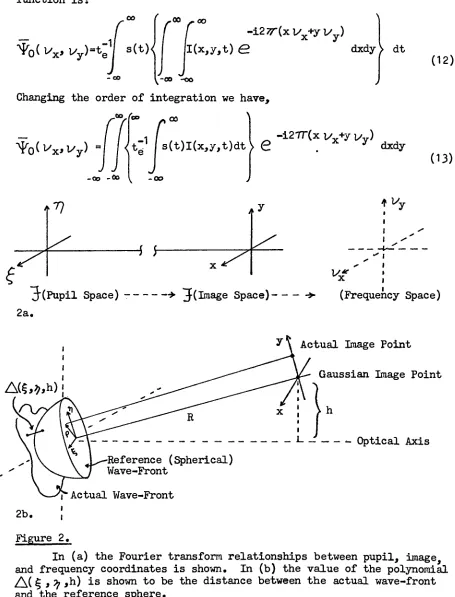
The relationships between the pupil, theimage,
and thefrequency
coordinate systems are shown in figure 2.With an appropriate change to polar coordinates
(1U)
the aberrationpolynomial
becomes,
A(p,0,h)
-oC00 +
(oC20/2+1C11hPCos(+2COOh2)
2_2
2 + (0CliOpSC31hp3 Cos<+2C22h2p2Cos+ + 3C11h3pCos<fc> +
^^
)
?and
looking
at a point on the optical axis,A(p,<f>,o)
=0c00 +
+ * ?
(9)
(10)
a polynomial in powers of O in which the value of the coefficients
0C20 0CliO 0C60 ' determine the amount of
defocus,
third and fifthorder spherical aberration present in the image.
Considering
on axis points and up to fifth order sphericalaberration, the amplitude spread function is then given by:
J
J
(11)
-1
%lVxVy)<l
S(t)<
.00 _ oo
I(x,y,t)
-27r(xl/y+y\yy)
dxdy
}
dt^-00 -OO
Changing
the order of integration wehave,
(12)
00
At oo
-1
NM^x,Vy)
-<t~'
s(t)l(x,y,t)dt
>e
-i2TT(x i/x+yyy)
-00 -Ck> oo
f
7?
dxdy
?
!-.
(13)
-5
5-Hf
j(Pupil
Space)
*J
(Image Space)
>(Frequency
Space)
2a.
A($,*,-0
-Reference
(Spherical)
Wave-FrontT"
Actual Wave-Front 2b.
y
\
Actual Image PointGaussian Image Point
h
- Optical Axis
Figure 2.
In
(a)
the Fourier transform relationships between pupil,image,
and
frequency
coordinates is shown. In(b)
the value of the polynomial/\(
E , % ,h) is shown to be the distance between the actual wave-front [image:16.551.50.505.101.698.2]or.
oo ao
Y0(^x>i/y)
-I
fi-^y-
e
-i2TT(x1/ +yi/v)
dxdy
(1U)
-oo-oo
where
T(x,y)
is the time-averagedintensity
spread function.Now consider the operation of a center opening pupil shutter
during
a short exposure. The amplitude transmittance of the exit pupilis modified
by
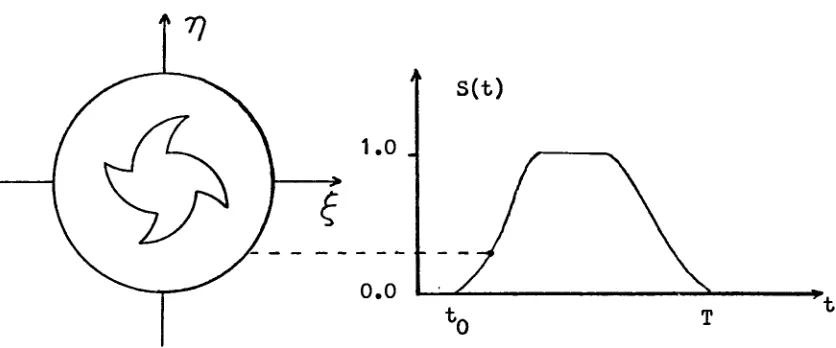
the motion of the shutter blades as,shown in figure 3.If we assume the shutter allows a transmittance of 1 .0 or
0.0,
theeffect of the changing shutter shape may be included in the
A(rt7^Jt)
term.
;'
S(t)
Figure 3.
The blades of a center opening pupil shutter form a pinwheel
or bent star shape
during
exposure, and the shutter functionS(t)
is used to weight the corresponding two-dimensional OTF.
For evaluation on a digital computer
A(g,7^,t),
a(x,y,t), and [image:17.551.62.480.351.525.2]The pupil function is then defined
by
a two-dimensional array of points,and the continuous Fourier
transform,
7
/
-i27T( i/y. + i^y)p<^
V
Jf(^'e
dxd-
(1S)
becomes the discrete Fourier transform:
V1
*?
-i2ir(nxk3C/hx + nyky/Ny)^x^VVW
=,4
X
h(kxTx-
Vy}
e
where, nx=0,1,2,...,Nx-1 and ny=0,1 ,2,...,Ny-1
(16)
The function f
(x,y)
is sampled at frequenciesT~
and such
that x-k T and y-le.T where
1^
andk^
are integers between zero andNx
and Ny.U
^
N oooooooooooooooo o
oooooooooooooooo o
oooooooooooooooo o
oooooooooooooooo o
ooooooeooooo o i
~y
OOOOO09**OOOO o oooo*****ooo o ooo*t>oo o ooo**oo o ooo***oo o ooo*oo o ooo***oo o ooootooo o
. ooooooooo o
*
oooooo*****ooooo o
3
oooooooooooooooo o2 oooooooooooooooo o
1 oooooooooooooooo o
V
1 2 3...*
Nx
Fifflire
U.
A two-dimensional array representing a circular pupil function
sampled at frequencies T~
and T
10
The graphical development of a one dimensional discrete Fourier
transform
(DFT)
in figures5
and6,
willhelp
to illustrate the threeproblems known as aliasing,
leakage,
and the picket-fence effect, whicharise when equation
(16)
is substituted for equation(15).
The function to be
transformed,
f(x),
is multipliedby
a combof delta functions and
by
a unity amplitude data-window to obtainthe
finite,
discretefunction,
f(k). Since multiplication in the spacedomain corresponds to convolution in the
frequency
domain,
the transformof
f(k)
is the result of convolvingF(l/)
with another comb of deltafunctions and then with a sine function due to the data window. When
the resulting periodic function
F'(v)
is sampled, the functionf-(k)
is made periodic
(figure
6).
Both functions of the discrete Fourier transform pair f (k)
F(n)
are periodic, and if
f(x)
is not bandlimited,
F(i/)
will not be finiteand overlapping in
F(n)
will occur(figure
7) The overlapping isreferred to as
aliasing,
and will always occur to some extent unlessthe space function is band
limited.
In that case it is preventedby
-1
making the sampling
frequency
T at least twice the highestfrequency
component present in f
(x)
(the
function f(x)
shown in figures5
and6
is band
limited)
. The aliasing which occurs with non-band limited-P cd 0) p CD O CO H fc ---T)
<D>"EJ
Eh - 3
P w CD Si o rt g a o H -P U <H 0) CO u * cd cu .0 ,fl -P
Ik
II
-l*OJ 0 En CM 0 c:> E-t 1 . "ti <rt cv o c TJ G r-i
. O (X U aj rt
a> +> -p a
S o o >
3 -H-P
C CO r-l -H O
H P. fl TJ
P W -P -H H CD H cd ?
fl i-H 3
rt Q. g J3 cd
*h e -p-p
< W X>
^S
TJ
0 T > O fl U) 2 o d) fn 4H fl H n> cd -3 e-p 0 T) c H CD O fl cd O fX-rt m -p 73 IDt-i X! P -p t> fl c O H O fl O O -P H -P 10 cd tJ 0 fl H O H P. P. 0J H CD -P Ug
UO a O JL. fc S -P 0 0 fc . CD O Xirt cd P
fc fc O
SS
O ti fced (D CD -3
J5 <H -P En O O
F(V)
Figure 7.
Aliasing
occurs when the DFT is applied to functions which are notband-limited,
and thefrequency
labeledV
is known as the Nyquistor
folding
frequency.
'IfAl/
V,
Vfr&VFigure
8.
When aliasing occurs, high frequencies are detected
by
the [image:22.551.32.509.99.563.2]1U
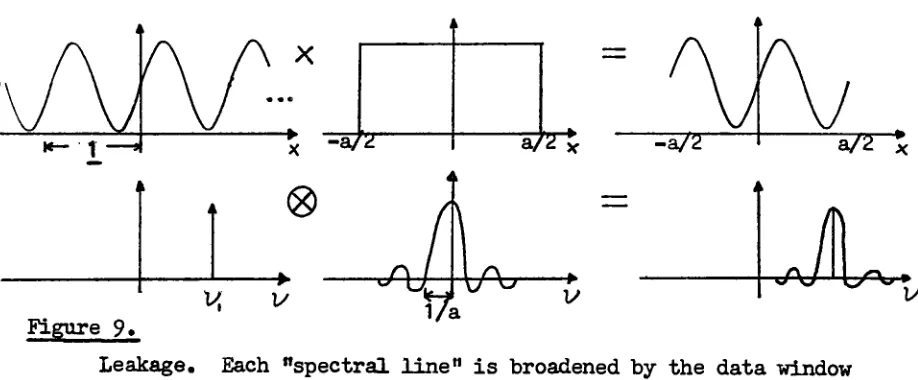
The problem of leakage is caused
by
analyzing a finite numberof data points. Consider an input consisting of only one
frequency
l/i
(figure
9). Multiplicationby
a finite data window broadens thedelta function
by
convolution with a sine function. The contribution of Va. to a spectrum would leak via the side lobes of the sine
function into other frequencies.
According
toBergland(l5)
the sidelobes and hence leakage may be reduced
by
applying data windows which are not rectangular.A
i
A
A
X\
J
\J\
A
*** 1
J
X
[image:23.551.43.502.264.454.2]M
Figure 9.Leakage. Each "spectral line" is broadened
by
the data windowsine function.
The picket-fence effect is also caused
by
the finite datawindow. The
frequency
response of the DFT might be representedby
the plot in figure10.
The response at each of the out-put frequencies
(multiples
of T~)
is notrectangular,
rather it has theshape of the main lobe of the sine function shown in
figure
nine. Afrequency
component 1/', betweenV, and1/h,
is detectedby
both thefourth and fifth harmonic windows, but with a response of less than
analogous to viewing the true spectrum through a picket fence. The
effect is reduced when the width of the main lobe is
increased,
thatis,
by
applying a non-rectangular data window, orby
extending thelength of the data window with a set of zero valued samples. The
last of these two solutions produces frequencies between the original
harmonics.
DFT
Response
1.0-1 2
3
Harmonic Number Figure 10.
The
frequency
response of the DFT is notflat,
but containsa ripple due to the finite number of data points.
The problems of aliasing and leakage encountered in OTF
calculations are discussed
by Lerman(l6)
and Minnick(17).Aliasing
may be prevented
by
calculating the OTF cut-offfrequency
\y fora circular exit pupil. Consider in one dimension the relationships
between the discrete and continuous quantities in the transforms from
pupil space
(f,Tj)
to image space(x,y),
and then tofrequency
space16
v*
.-,y
Pupil Coordinates
(,77)
(Vx'VV
Image coordinates
U,y)
(7-s
A
T,
,n9
A^
I,
)
(nx/NxTx>Wy)
Frequency
coordinates(
l/X,
l/y)Figure 1 1.
A Schematic representation of the relation between the discrete
and continuous quantities.
We have
that,
t-H\
07)
x = k T
x x
and when we compare the quantities in the exponentials of
equations
(11)
and(16),
08)
X a
X
f
or substituting equation
(17)
:(19)
x ==
^R
nE nc -"0,1,2,... N. -1T?N^
(20)
The cut-off
frequency
for a circular exit pupil may be writtenas,
'e.x- 2max
and in order to prevent aliasing in
frequency
space,f1 s
2 y
x c
or:
T -
X
Rx
T
^
max(22)
Substituting
equation(22)
into(18),
X
R;max
x =
kx
y
*
kx
- 0,1,2,...Nx-1
(23)
eliminating x between
(20)
and(23),
k ^=0,1,2,..^-!
m
*
^max
n
=0,1,2,...N?-1(2U)
and with
Nx
= N we have:fJ
-af
%
sN4
(25)
Assuming
then that the cut-offfrequency
is givenby
equation(21),
sampling the pupil function at thefrequency
T will preventaliasing of the OTF results. Note also from equation
(25),
that ifthe pupil function is represented
by
an array of 32 x 32 elements(C
m 16),
then a6U
x6k
array must be presented to the DFT asinput.
18
be concentrated in a small area
(due
to aberrations and possibly theshutter effect under
investigation),
leakage will occur when it istruncated to an N X N array. As stated previously, the error due
x y
to
leakage
and the picket-fence effect, may be reducedby increasing
the number of data points N ,N
(and
thusN>
,N)
in the transform.The problem of accuracy versus the number of data points is investigated
by
Baum(l8).
Also of importance in
defining
the input data to a discreteFourier transform is the definition of the function value at a point
of discontinuity. A sufficient but not necessary condition for the
existence of a Fourier transform
F(l/)
is thatf(x)
is integrablein the sense
that,
.00
|
f(x)
|
dx < ooloo
However,
if f(x)
is a periodic or an impulsefunction,
justificationof the existence of
F(t/)
requires the use of distributiontheory
asindicated
by
Brigham(19). Distributiontheory
indicates that any function f
(x)
must be defined as the mid-value at points ofdiscontinuity
in order for a unique inverse transform to exist.
p
When the pupil function is defined
by
an array of Nelements,
evaluation of the discrete Fourier transform in equation 16 requires
N^
complex multiplication-addition operations. The fast Fourier
and John W.
Tukey(20)
in1965
makes use of the periodic properties ofthe complex exponential kernel to reduce the number of calculations.
In
particular,
if all the factors of N and N are equal to2,
thatis,
x y
Nx-N
2^, the number of operations is reduced toIjN
LogJJI. A reductionfrom
16,777,216
to98,30a
complex multiplication-additions is obtainedfor a
6a
x6a
working array.Significant in the processing of data with the fast Fourier
transform is the location of the unity amplitude data window. In
the one-dimensional case the FFT algorithm assumes that the data
entered is correctly specified at points
k=0,
to k=N-1.Entering
any other range of data creates an apparent shift in the function
being
transformed as shown in figure 12.Transforming
the discretefunction
f(k)
with the values off(x)
for x<0 in the right half ofthe data window, yields a spectrum for which the values of n>N/2
are interpreted as negative
frequencies.
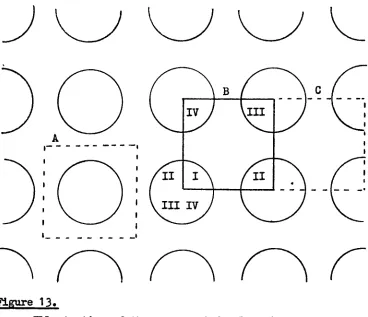
A function of two variables transformed
by
the FFT must alsobe considered periodic, and in two-dimensions. Figure
13
illustratesthe fact that the unity amplitude data window may be placed in several
positions and still contain all of the information about the
function.
However,
the spectrum obtainedby transforming
the data in windowlocation A will be multiplied
by
the shift factor E50>(-i27r(Nx/2 +N/2))(
Positions B and
C,
correct windowlocations,
will produce the spectrumof f
(k
,k)
without the linear phasefactor.
The properlocation
ofthe data in the transform array for a function defined on a circular
20
The function f
(x)
to be transformed.Ill
Li
lil
lil
-? kt
H
N/2:
k-O k-N-1
The discrete and periodic function f(k).
When
x-0 isentered as the point corresponding to k=N/2 the FFT
calculates the spectrum of f(x+N/2).
lil
111
hy.
k-0 k=N-1
The proper location of the data window, x=0 corresponds
to kO.
Figure
12.
The location of the unity amplitude data window in
Figure
13.
Illustration of the proper window location in k -k space
for a function defined on a circular region. x ^
Figure ia.
[image:30.551.74.442.68.385.2]22
Assuming
that the sampling periods are set equal to unity,T
"T*
"Tx
"Ty
= 1 ,0calculation of the time-averaged OTF as a function of shutter shape,
defocus,
third and fifth order spherical aberration, requires theevaluation of the
following
expressions:N*-1 N-1
t-,
A
-i2-7T(ngk-A,
*n.k /N)
a^A^n/N^t.) =
^
2-^VV^VV
e
k -0 k -0
n? 0,1,2,...
,N -1 n^=
0,1,2,...,
N^-1(26)
I(kx,ky,t..)
=a^/N^n/N^)
*(^/\,^/\,\)
(27)
T
T(kx,ky)
-t;1
2
S-V
K^ky^JAt
(28)
'
i=1
Nx-1 Ny-1
r)
V
"V _-i27r(n^cx/N + rik/N
)
^^x^y^^o^o^'Ve
^X
Wy
nx=
0,1,2,...,
Nx-1ny-0,1, 2,...,
Ny-1(29)
Where,
a(nt,n_) - The amplitude spread function
A(k ,k
)
= Transmittance of the exit pupilW(k ,k
)
The wave aberration function
-EXP(
i27T(0C20p2 <
?
))
I(k ,k
)
= The time averaged spread functionx y
S(t.
)
= Shutter function valuet " Effective shutter time e
III.
PROCEDUREBefore writing software specific to the OTF calculation, a system
was outlined which would take advantage of the computer resources
available. The extensive computer hardware and software facilities
at RIT include a Xerox Sigma-6 main-frame with 128K words
(32-bit
words)of high speed memory, direct access storage in the form of magnetic disk
packs, three 9-track 1600 BPI tape
drives,
Tektronix Terminal ControlSystem
(TCS)
software, and a Tektronixa6l0
HardCopy
Unit. In addition,numerous
language,
execution control, service, and command processorsare available in batch and time-sharing.
A system called
OTFBAR,
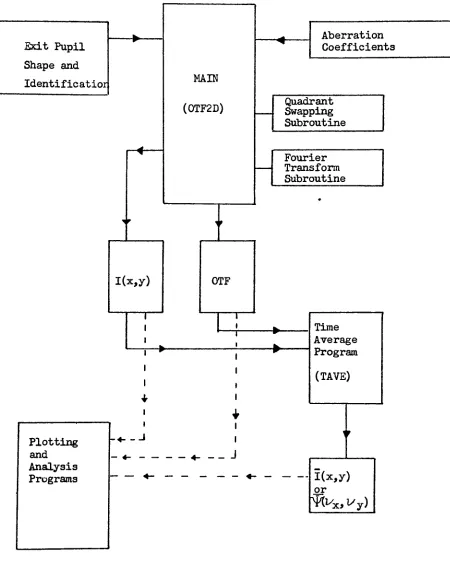
was designed(Figure
15)
which wouldcalculate point spread functions and transfer functions for any given
set of pupil shapes and aberration coefficients. The time averaging
routine is a separate program capable of averaging either the point
spread or transfer function data. Each surface generated is identified
with a pupil shape number, the aberration coefficients, and the value of
the shutter function as it is written to a file. One- and two-dimen
sional plotting routines and a Tektronix
a006-1
computer graphicsterminal provide an efficient method of comparing and analyzing the
surfaces qualitatively, so that significant results and unusual
asymmetries can be identified rapidly and investigated in more
detail.
Essential to the OTFBAR system is the efficient and flexible
FORTRAN program titled 0TF2D which appears in appendix A. Data to
0TF2D consists of the three aberration coefficients nC?n, QCi n, and
2a
Exit Pupil
Shape and
Identificatior MAIN
(0TF2D)
I(x,y)
OTFPlotting
and
Analysis
Programs
i
I
I
+
i J
l
i
lI
J
Aberration
Coefficients
Quadrant
Swapping
SubroutineFourier Transform Subroutine
Time
Average
Program
(TAVE)
Kx,y)
orFigure 15.
[image:33.551.47.497.52.616.2]using small
arrays,
in batch with the array sizesincreased,
or inbatch
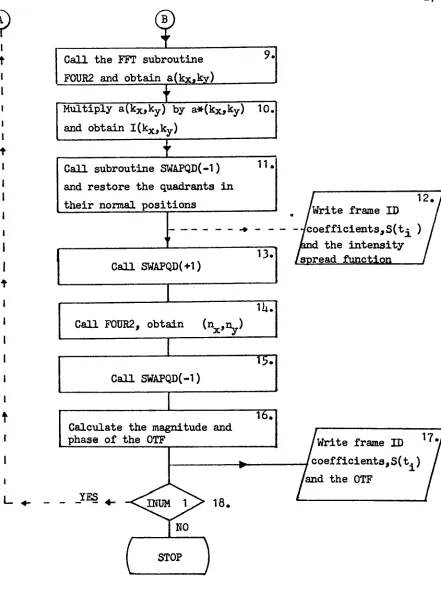
with magnetic tape to process a large number of exit pupil shapes.An outline of the algorithm used in 0TF2D is shown in figures 16
and
17.
The wave aberration functionW(kg
>k)
is generated once instep
3
for a given set of aberration coefficients and placed in afile if needed for processing subsequent shutter frames. The shutter
shape is entered at the
beginning
of theloop
at point$.
In steps7
and8
the pupil function?(k&
,k)
is formed and prepared for thefast Fourier transform routine. Equations 26 through
29
are evaluatedin steps
6-1
6.
If required the spread function may be written to afile in step
12,
and theOTF,
frame identification number, theaberration
coefficients,
and the value of the shutter function iswritten to a file in step
17.
At point 18 the program is completedand will exit or return to step number 2 for a new shutter
frame.
In its present form 0TF2D requires 21 K words of core and .3
minutes of CPU time in order to process a single shutter shape defined
in a
33X33
element array. Single frames may be processed on-line asthe core requirement is small. The Total CPU time for a set of
thirty-six shutter frames is on the order of ten minutes, placing
very little demand on the Sigma Six system.
The array dimensions of 0TF2D may be increased without
difficulty
in order to process a
65X65
array.The
core requirement is then56K
with
1.3
minutes of CPU required to process one frame andapproximately
50
minutes for thirty-sixframes.
Processing
on-line with thelarger
arrays is not possible due to a 32K on-line
limit,
and processing for26
START
'Enter
the/number
offrames: INUM
Enter the
aberration
coefficients
Generate the circular pupil
function containing
W(kg
,k)
Enter frame ID
'number
and thefshutter
shapeA(kg
,k)
Store
rW(k4,k^)
inj
fa
file ifINUM>1
Calculate the value of the
shutter function S(t2
)
6.
Multiply
Wdc-j
,k^
)
by
A(k^
,k^7)and obtain the pupil function
Call subroutine
SWAPQD(+1)
8*
to arrange the quadrants
containing
P(kg
.k,.)
for the FFT<b
Figure
16.
[image:35.551.92.498.44.684.2]9
it
t
r
L
Call the FFT subroutine
F0UR2 and obtain a(kxky)
Multiply
a(kx,ky)by
a*(kx,ky) 1Gand obtain
I(kx,ky)
Call subroutine
SWAPQD(-1)
--and restore the quadrants in
their normal positions
Call
SWAPQD(+1)
13.
ia.
Call
F0UR2,
obtain(nx>-0
-w.
Call
SWAPQD(-1)
Calculate the magnitude and phase of the OTF
1BT
YES
JNUM O"
18.
NO
STOP
12.
fWrite
frame ID/coefficients, S(t^
)
theintensity
^spread
function'Write frame ID
^
coefficients,
S(
t.)
(and
the OTFFigure
17.
[image:36.551.74.515.36.628.2]28
Provided sufficient accuracy is obtained, 0TF2D written to transform
a pupil function defined
by
a33X33,
in a6a
X6a
working arraysatisfies the OTFBAR system requirements and at a low cost in computer
resources
The OTF and spread function data is time averaged with the
program titled TAVE
(appendix
B). The values of each spread functionor OTF surface are scaled
by
the shutter function S(t.)
obtainedin 0TF2D. The weighted sequence of two-dimensional functions are
suimned and normalized to 1.0 at zero spatial
frequency
or at x=y0.0in the image plane.
The
result is written to a file in a formacceptable to the plotting routines
COMPARE,
OTFPLOT,
AND PL0T3Dwhich appear in appendix E.
The program titled SHAPE
(Appendix
C)
was written to generateinput data for 0TF2D which would simulate a circular shutter with a
specific shutter function S(t). SHAPE can create one or more arrays
representing digitized circular exit pupils with varying
diameters.
The elements of the arrays are 1.0 for
100%
amplitude transmittancefor points within the shutter
boundary,
0.5
at points ofdiscontinuity
as required
by
the Fouriertransform,
and 0.0 for points outside theshutter boundary. Each array is assigned a frame identification number
and is written to a file on magnetic disk or magnetic
tape.
The
data used to model the effect of a leaf-type shutter wasobtained from a high-speed film.
Thirty-six
16mm images of afive-bladed Copal shutter in its closing cycle were projected onto a
ao
cmgrid containing an array of
33X33
points. Each image was digitizedboundary
of the shutterimage.
It was assumed, for simplicity, thatnone of the array points coincided with a
discontinuity
of the pupilfunction.
The digital representation of each shutter image was recorded
with the program titled DIGIT
(appendix
D). DIGIT will accept thecolumn coordinates of elements with value 1.0 for each row, then
display
the entire image with row and column coordinates for a visualcheck of the data entered. After any necessary corrections the data
for that image is written to a file in a form acceptable for processing
with 0TF2D.
Approximately
seven hours total were required to digitizethe thirty-six 16mm images with this method.
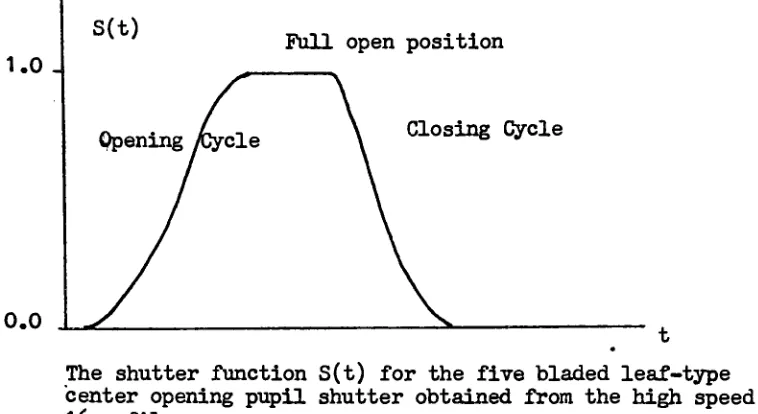
The opening sequence of the shutter was not digitized as the
shutter function shown in figure 18 would be assumed symmetrical
and with no
delay
in the full open position. The shutter efficiencyof this model could be increased from
50% by including
a number offull open circular shapes generated
by
program SHAPE.Several transfer functions for various amounts of defocus and
spherical aberration were calculated for a single circular pupil
defined in a
33
X33
array to establish the accuracy of0TF2D.
Theaberration-free time averaged OTF for the circular shutter model
was then calculated and compared to a second numerical solution to
establish the accuracy of the OTFBAR system.
Finally
timeindependent
and time averaged transfer functions for various aberrarions were
calculated for both circular and leaf shutter models. The results are
30
i.o.
Full open position
Closing
Cycle0.0
The shutter function
S(t)
for the five bladed leaf-typecenter opening pupil shutter obtained from the
high
speed16mm film.
1.0
0.0
s(t)
A schematic representation of the discrete shutter function S(t.
)
created from the closing cycle shownabove, and used to weight the time averaged OTF for the leaf-shutter model.
Figure
18.
[image:39.551.60.439.77.284.2]IV. RESULTS
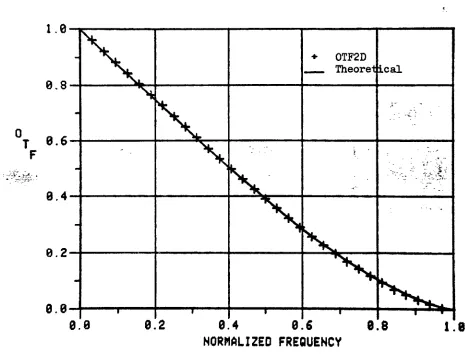
The accuracy of the program 0TF2D for a
6a
point transform andthe case of a single circular exit pupil generated
by
the programSHAPE is illustrated in figures
19
through 22. Because thetwo-dimensional transfer function has rotational symmetry about
the line 1/ a V = 0.0 for a circular exit
pupil, any section in one
x y
dimension
describes it completely.1.0
0.8
6.2
0.4
e.e
NORMALIZED
FREQUENCY
0.8
1.8
Figure
19.
The OTF for a diffraction limited optical system as calculated
[image:40.551.46.511.255.611.2]32
In figures one and two the 32 values returned
by
0TF2D for0C20"oCao"oC60
s ' ^ compared to the values given
by
the equation* :OTF(y)
-A(y-Cosy
Siny)
y-Cos"1(t-7i)
which describes the diffraction limited OTF exactly. Figure two
indicates an accuracy of
-.005 OTF units for this particular set
of aberration coefficients.
(30)
X18
-29.4
8.2
Q
w
8.8
Ehi
CO9
-8.2
-8.4-
-0.6-+ -0.6-+ -0.6-+
'
^t'^v-0.0
0.2
++
0.4
+
+
+
0.6
.. -"; JrJ.f
0.8
1.0
Normalized Spatial
Frequency
Figure 20.
Absolute error in the diffraction limited OTF using the
theoretical results as reference.
Because the shape of the spread function changes with the
aberration coefficients, the amount of error due to truncation in
image space changes also. In figures 16 and
17
the 0TF2D valuesfor one wave of defocus and ./fT waves of defocus are compared to
those published
by
Barakat andHouston(21),
and Steel(22).Only
a few of the numerical values in figures 16 and
17
can be compareddirectly,
as the values in the literature are not computed atnormalized
frequency
increments of1/32.
However,
"a comparison ofthose points which do coincide indicate agreement within + .005
3a
1.25
1.00
8.75-r
%
8.50-8.25
0.00
-0.25
iL
X
--*.0.0
ma>o<
0.2
^>oo^oc:ooo
X Barakat
0 0TF2D
I
|
I0.4
0.6
NORMALIZED
FREQUENCY
0.8
"r
1.8
Figure 21.
[image:43.551.25.480.232.573.2]1.0
0.8
T
8.6
F
0.4
0.2
0.0
3l
x
*
0.0
0.2
a
x
a
FFT
Steel
*b
I
8.'4
0.6
NORMALIZED
FREQUENCY
0.8
1.8
Figure
22.
[image:44.551.33.465.238.599.2]36
To test the entire OTFBAR system a sequence of 36 circular
exit pupils were generated
by
SHAPE which would simulate a circularcenter opening pupil shutter with a symmetrical shutter function
and a shutter efficiency of
50
percent. The diffraction limitedtime-averaged OTF values for this model are compared in figure
six to those given
by
the analytical function :Y(U)
--T^
TTT'
y(u,t)-Cosy(u,t)
Siny(u,t)
dtWhere,
"X(u,t)
= Cos-1 u/(2t/T)'(3D
Figure
2a
indicates that the OTFBAR system values are consistently less than those given
by
equation 31 with a maximumabsolute difference of .005 OTF units.
X18
-20.0
0.2
0.4
0.6
NORMALIZED FREQUENCY
8.8
1.8
Figure 2a.
[image:46.551.41.464.228.579.2]38
The effects of a leaf-type center opening pupil shutter on the
two-dimensional
time-averaged OTF as predictedby
the OTFBAR system areillustrated
in figures25
through30.
The diffraction limited OTFfor a circular exit pupil shown in figure
25
may be compared tofigure 21, the diffraction limited transfer function produced at
one instant in time
by
the partly open leaf shutter. Thetime-averaged sequence of 36 shutter frames produced the OTF shown in
figure
27,
asmoothed,
symmetrical surface which does not exhibitthe vane-like structure shown in figure 26. Figures 26-30 show
the effects of
introducing
one wave of defocus. As would be predicted
by
an elementary geometrical model the time-averaged transferfunction surface retains vane-like structure when the aberrations
are large
(
> 1 wave). In all cases investigated the magnitudeof this irregular structure is on the order of +
.005 OTF units.
Consequently
a one-dimensional OTF curve corresponding to asection along the 1/ axis is a satisfactory representation of
OPTICAL
TRANSFER FUNCTION
FRAME
ID*23
0C20-.088
[image:48.551.25.460.207.605.2]0C40'
888
0C60- .008SCTW.800
Figure 25.
The two-dimensional diffraction limited OTF for a circular exit
ao
OPTICAL
TRANSFER
FUNCTION
FRAME
ID7
0C20* .008 0C40'000
0C60-888
S<T> .315Figure
26.
[image:49.551.38.488.186.632.2]OPTICAL
TRANSFER FUNCTION
FRAME
10=999
0C20.800 0C40-
008
0C60- .000 8<T) .890
Figure 27.
The time-averaged two-dimensional diffraction limited OTF for
[image:50.551.20.503.208.607.2]a2
OPTICAL
TRANSFER
FUNCTION
FRAME
IO*25
0C201.088
0C40 .088 0C6Q" .888S<T)1.809
Figure 28.
The two-dimensional OTF for a circular exit pupil and one wave
[image:51.551.34.480.181.569.2]OPTICAL
TRANSFER FUNCTION
FRAME
10=7
0C201.000
0C40*000
0C60-008
S(T) .315Figure
29.
The two-dimensional OTF for one frame of the leaf shutter
[image:52.551.33.466.199.566.2]aa
OPTICAL
TRANSFER
FUNCTION
FRAME
10=999
0C20*1.000
0C40= .000 0C60 .000 8<T>* .099Figure
30.
The two-dimensional time-averaged OTF for the leaf shutter
[image:53.551.15.465.203.566.2]The effects of shutter motion on the time-averaged OTF as pre
dicted
by
the circular and leaf shutter models for various values ofthe aberration coefficients are shown in figures 31-ao. As indicated
in figures
35
and 36 the difference between the values predictedby
the two models varies with
frequency
but lies within + .06 OTF unitswhen the only aberration present is defocus. Both of the models
indicate an increase of ten percent in the low
frequency
region of theOTF for the largest
(one
wave) amount of defocus when compared toa system with the shutter removed. The effect of varying the
defocus coefficient
QC?n with and without a leaf type shutter in
the optical system is indicated
by
figure37
at a normalizedfrequency
of .25 The value of the transfer function is reduced in the
presence of the shutter as much as ten percent for small values of
0^20
(0-0-0.3)
and then increased to as much as ten percent for thelarger values of
a6
1.0
o
No Shutter
Circular
Leaf Shutter
Shxtter
I
|
l1
1|
Ie'e
0.2
0.4
0.6
0
NORMALIZED FREQUENCY
[image:55.551.29.476.242.591.2]8
1.8
Figure 31 .
8.4
8.6
NORMALIZED
FREQUENCY
1.8
Figure
32.
[image:56.551.35.464.206.612.2]as
i
1
i|
r8.4
8.6
NORMALIZED FREQUENCY
Figure 33.
[image:57.551.24.468.243.569.2]1.25
1.80
0.75
0.50
0.25
0.00
-0.25
0.0
0.2
T
J
1j
I0.4
0.6
0.8
1.0
NORMALIZED FREQUENCY
Figure
3a.
[image:58.551.36.478.236.563.2]50
9.84
0.02
Ert
O
<
-0.02
-9.04
0.00-O
0.0
0.2
0.4
0.6
NORMALIZED FREQUENCY
8.8
1.8
Figure 35.
The difference between the values predicted
by
the leaf [image:59.551.37.465.245.569.2]E-i
O
<
8.88
0.86
0
04
0.02
0.00H
-0.82|
11
1j
1 1 1j
r0.0
0.2
0.4
0.6
0.8
1.8
NORMALIZED FREQUENCY
Figare-36.
The difference between the values predicted
by
the leaf52
0.8
0.6
T
0.4
F
0.2
-v
0.0
-0.2
No Shutter
Leaf Shutte:
X X
...A.
. :>m
-. z-<
'mm-'"-yzz?^
-'-'.
"
^
^
1 .. ,,
t ....
0.0
0.2
0.4
0.6
0C20
0.8
1.8
Figure 37.
The time averaged OTF at
V/v
[image:61.551.25.469.248.608.2]Figure 38 indicates a much greater effect on the time averaged
OTF when the only aberration present is one wave of third order
spherical. The OTF is increased as much as .15 OTF units according
to the leaf shutter model and.20 OTF units according to the circular
shutter model. The increased difference between values predicted
by
the two models for spherical aberration is shown in figure 39. A
maximum difference of .09 OTF units occurs at the normalized spatial
frequency
.125If in
designing
or constructing an optical system the coefficientsfor third and fifth order spherical aberration are such
that,
0Cao/oC60
a -3/2
the wave front is shaped so that the marginal rays converge at the
paraxial focus position as shown in figure
ao,
and the system is saidto be
fully
corrected.Following
the notation in0*Neill(23)
theaberration polynominal may be written as,
A(p)
0C60 (p6 - 3/2p^ +3/a^.p2)
(32)
where/1, in terms of the residual maximum longitudinal spherical
aberration
&
L and the displacement of the receiving plane fromHiL&
the paraxial focus position df is given
by,
max
Ad indicated in figure
ai
the two shutter models agreewithin + .005 OTF units when
qC^q
=
a.O
in equation(32)
and thesystem is focused at the normally optimum position given
by
fj. = 0.8The effects of varying the focus parameterfj,on the time averaged
5a
1.25
1.00
0.75
0.50
0.25
0.00
-9.25 1
j
r0.0
0.2
0.4
0.6
8.8
NORMALIZED FREQUENCY
Figure 38.
The time-averaged OTF for one wave of third order spherical
[image:63.551.39.465.234.570.2]8.19
0.0
0.2
0.4
0.6
NORMALIZED FREQUENCY
8.8
1.8
Figure 39.
The difference between the values predicted
by
the leafshutter and circular shutter models for one wave of third order
[image:64.551.35.468.241.566.2]56
I
Receiving
planeParaxial focus
Optical axis
Figure
ao.
The relationship between the wave-front,
Sl
, andSf.
[image:65.551.53.506.69.324.2]
1.8
T
1
11
10.0
0.2
0.4
0.6
0.8
NORMALIZED
FREQUENCY
Figure
ai
.The time averaged OTF at the optimum focus position
(JLl^.S)
for an optical system with both third and fifth order spherical
[image:66.551.35.464.239.627.2]58
Figures
a2(a).
-a2(i).
The effect of
defocusing
a fully-corrected optical systemon the time-averaged OTF for the leaf shutter
(+)
and on the1.25
1.08
0
75
0.50
0.25
0.00
-0.25
0.4
0.6
NORMALIZED
FREQUENCY
60
0
1.25
1.80
0.75
9
50
8.25
0.00
-0.25
0.0
^
. . .
r
0.4
0.6
NORMALIZED
FREQUENCY
8.8
1.8
0
1.25
1.00
0.75
0.50
8.25
0.00
0.25
0.0
0.2
t
1
1j
r0.4
0.6
NORMALIZED
FREQUENCY
8.8
1.0
62
0
1.25
1.00
8.75
0.50
0.25
0.00
-0.25
M- = 0.6
-Yf
+ .
-
<^
",'-:K+-4-+-*
^4^^,
1 1 1 1
0.0
0.4
0.6
NORMALIZED FREQUENCY
0.8
1.8
1
0
0.0
0.2
0.4
0.6
8.8
NORMALIZED FREQUENCY
1.0
6a
1.25
1.00
0.75
8.50
0.25
0.08
-0.25
"*
/< = i-o
-r "" "
r i t
0.0
0.4
0.6
NORMALIZED FREQUENCY
8.8
1.0
0
1.25
1.80
0
75
0.50
0.25
0.00
-8.25 > p
0.4
0.6
NORMALIZED FREQUENCY
1.0
66
0
1.25
1.80
8.75
0.50
9.25
8.00
0.25
y***^;*-*!
lllllll
|if.|
|
/t = iy
,
|
11
r|
1 i0.0
0.2
0.4
0.6
0.8
1.8
NORMALIZED FREQUENCY
0
1.25
1
00--0.75
0.50
0.25
0.00
-8.25
0.0
ihd-h*
0.2
M-M
t
H
^
= lr6r
0.4
o.'e
NORMALIZED FREQUENCY
0.8
1.8
68
V. SUMMARI
Comparison of the values generated
by
the program 0TF2D and theOTFBAR
system with literature and theoretical values indicate anaccuracy of + .005 OTF units with the pupil defined in a
33
X33
array and transformed with the FFT in a
6a
X6a
working array. Therapid oscillations of magnitude .001 OTF units illustrated in figures
20 and
2a
may be attributed toleakage,
the picket, fence effect, andmachine round off.
Collectively
the errors could be reduced to givean over all accuracy of
+_
.001 OTF unitsby
increasing
the workingarray size to 128 X 128 elements.
However,
an overall accuracy of+_
.005is judged satisfactory for the purpose of
identifying
the effects ofshutter motion on the time averaged OTF.
The two-dimensional graphs created with the program PL0T3D
clearly indicate the dependence of the transfer function on pupil
shape. Figures 26 and
29
indicate the contribution of an individualshutter frame while figure 30 and the numerical data indicate that the
time-averaged OTF is smooth enough to be characterized
by
a singlesection along one dimension. Attempts to plot corresponding spread
functions in three dimensions indicated that a larger array and a
plotting instrument with high resolution would be required to delineate
the small minima or side lobes. The three-dimensional plots proved
valuable in presenting a complete, qualitative representation of the
two-dimensional transfer function.
The circular and leaf shutter models were in close agreement.
OTF than the leaf shutter model in the low
frequency
region.This might be attributed to the difference in shutter functions
as
illustrated
in figurea3
. Frames 1-13
used in generating thecircular model transfer
functions,
were weighted from2%
to8%
more than the frames for the leaf shutter model.
Similarly
frames 19-32 for the leaf model were weighted
2%
to5%
more thanthe circular shutter model and the OTF predicted
by
the leaf shuttermodel is higher than the OTF for the circular modql in the high
frequency
range. This suggests that agreement between the twomodels would improve if the shutter functions were identical.
In that case the effects predicted
by
the circular model wouldbe satisfactory in predicting the effect of a semi-circular
center opening pupil shutter on image quality.
In obtaining the leaf shutter data it was assumed for con
venience that the
boundary
of the exit pupil did not lie on asingle sampling point. The assumption is valid in view of the
accuracy of the subjective method used in
digitizing
the exitpupil. To eliminate the subjective analysis and in order to
process a large number of frames the OTFBAR system could be
interfaced with a computer controlled image scanning device.
In addition to
identifying boundary
points an estimated reductionin the amount of time required to digitize the exit pupil, from
seven hours of operator time to one hour of machine
time,
wouldbe expected.
If we assume that detail corresponding to a given spatial
the effect of shutter motion on resolution in the exposure image
may be
determined
from figuresa2(a)~a2(I)
for the case of awell-corrected optical system.
Figure
a2(e)
indicates a reduction
in resolution due to the presence of the shutter whenthe receiving plane is located at the position of best focus
(
/1=.8).
Shifting
the receiving plane toward the paraxialfocus
(
/_L =.6) produces a very slight increase in resolution as
shown in
a2(d),
while further amounts of defocus correspondingto values of (J, less than .6 or greater than .8 does not produce
a recognizable effect on resolution.
An indication of the depth of focus in an optical system
is given
by
the amount of defocus required to reduce the valueof the OTF to 0.10 at a given spatial frequency.
Hence,
theeffect of shutter motion on depth of focus may be obtained
from figures
37
anda
a
which indicate the value of the timeaveraged OTF as a function of the aberration coefficient
0C20,
and LLat
VAy
=0.25. In the presence of shutter motionc
figure
37
indicates an increase in depth of focus* on the orderof + .2\n when the system is diffraction limited and focused
at infinity. This is a negligible increase in depth of focus in view of the Rayleigh quarter wave rule which indicates that
a difference in focus position of + wovld require a
considerable amount of effort to detect in terms of performance.
Applying
the same criteria to figurea3
indicates that there isalso a negligible increase in depth of focus when the system is
72
Figure
aa..
The effect of
defocusing
afully
corrected optical system on the OTF atWt/C
[image:81.551.42.471.238.585.2]The OTFBAR system has been used to investigate the effects
of a center
opening
pupil shutter on the time-averaged opticaltransfer
function in the presence of defocus and sphericalaberration. The over-all effect of the shutter is to degrade
the OTF in the presence of small aberrations
(A
=0.5), andin well-corrected optical systems, while creating a slight
inqprovement
for larger(A
1.0) aberrations. In view of the
fact that the effects are small and will decrease with
increasing
shutter efficiency it is unlikely that
they
are significant inroutine pictorial photography.
*The longitudinal displacement of the receiving plane is given
by
L =
2qC2qR
/a
where R is the radius of the reference sphere and a is the diameter
7a
REFERENCES
1 . M. E.
Bechtel,
Cornell AeronauticalLaboratory,
Rept. No.VF-1260-P2,
Contract No.AF33(6l6)-8870,
1959.2. R. V.
Shack,
"The Influence of Image Motion and ShutterOperation on the Photographic Transfer Function," Applied Optics
(Oct.
196a),
Vol.3,
No.10,
pp. 117-1181."
3. J.W.
Cooley
and J. W.Tukey,
"An Algorithm for the MachineCalculation of Complex Fourier Series," Mathematics
of
Computation
(1965)
Vol.19,
No.90,
pp. 297-301.a.
S. H.Lerman,
"Application of the Fast Fourier Transformto the Calculation of the Optical Transfer
Function,
"SPIE MTF Seminar
Proceedings,
Rochester,
NewYork,
(1968),
pp. 51-70..
5.
W. A. Minnick and J. D.Rancourt,
"Transfer FunctionTechniques for Real Optical Systems," SPIE MTF Seminar
Proceedings,
Rochester,
NewYork,
(196b),
pp.87-103.
6.
R. C.Baum,
Optical Transfer Function Calculationby
theCooley
-Tukey Algorithm,
M. S.Thesis,