BCN
IC
MPHRS
COIIIMISSIOT{ OF THE EUROPEAil COTIMUTIITIES O OIRECTORATE-GE]IERAL FOR ECOilOMIC AIID FIIIAI{CIAL AFFAINS
No.
4? December 1985WORK SHARING: t,.|HY? HOt,l? HOt.l NOT
...
with
them.
The "Papers"
are
intended
to
increase
awareness
of
the
technicaI
work
being
done
by
the
staff
and
to
seek
comments andsuggestions
for
further
anaLyses.
They
maynot
be quoted without
authorisation.
Views expressed
represent
excLusiveLy
the
positions
of
the
author
and do
not
necessari Ly correspond
with
those
of
the
Commission
of
the
European
Communities.
Commentsand
enquiries
shouLd
be addressed
to
The Directorate-GeneraL
for
Economicand F'inanciaL
Affairs,
Commission
of
the
European Communities,
?OO,
rue
de
ta
Loi
ECONOMIC
PAPERS
No.
42December
1985WORK SHARING: WHY? HOW? HOW NOT •••
.. *
Jacques H. Dreze
*
Universite Catholique de Louvain
by
Jacques H. Dreze*
Universite Catholique de Louvain
1.
INTRODUCTION AND SUMMARY
PART I: THEORY (Why?)
2. Regular jobs
3.
Short-run fluctuations
4.
Labour contracts and market failures
5.
Scope for intervention
6.
INTERLUDE (Sorbet)
PART II: APPLICATIONS (How? How Not •.. )
7.
Trading jobs (early retirements)
8. Sharing jobs (part-time work)
9.
Trading hours for jobs (the working week)
10.
POLICY PROSPECTS AND CONCLUSIONS
APPENDIX:
FOOTNOTES
REFERENCES
Part-time work in Europe
Appendix tables
1
5
11
13
22
24
27
30
33
39
43 47
59
63
l
-1.
INTRODUCTION AND SUMMARY
1.1
As soon as it became clear to Europeans that the recession born in the mid-seventies was going to be severe and protracted, some of them became concernedwith the prospects for redistributing work over people so ~s to reduce the extent of involuntary unemployment, i.e. with the prospects for work sharing.
That was not an innovation. A similar concern had arisen in the thirties, leading
to the dramatic unsuccessful attempt by the Front Populaire to impose abruptly a
40 hours week in France. (See for instance, Economie Europeenne (1980) and
Fontaine (1984) for a summary account of that earlier development. Average weekly
hours in French manufacturing did not come down to the 40 hours target until .•• 1982!)
In recent years, a number of policy measures designed to promote work sharing
have been implemented in European countries, and several reports have attempted
to asses their impact; see, for instance Van Den Bergh and Wittelsbur~er (1981), Hart (1984) or Commissariat General du Plan (1985).
The overall impression conveyed by these reports is one of limited effectiveness
of work-sharing measures in reducing unemployment - at least if one goes by herd
evidence. (See also Part II below.) Also,some authoritative voices asserted that
these measures are misdirected and bound to be self-defeating; see Layard et al. (1984).
Yet, with unemployment rates among the young ·reaching 25 % or more in several
European countries and no major improvement in sight (Cfr European Economy,
November 1984, Table 8, p. 16), it is understandable that motivations to bring
about some degree of work sharing should persist.
The present paper is not meant to replicate the existing collective reports,
but rather to provide an appraisal of the recent European experience, and of the
prospects for work sharing, in the light of the modern microeconomic analysis of
labour contracts. This calls for some theoretical considerations(Part I) before
turning to the evidence (Part II), and I must beg readers to endure the detour.
A brief summary of the arguments may serve the dual purpose of providing the
patient readers with markers, and the less patient or less interested readers
with an excuse for jumping to the conclusions, or discarding the paper altogether1•
1.2
To begin with (Section 2), I shall argue that most people attach a positivevalue to having a "regular job" (as opposed to a "casual job", or no job at all).
Within the context of regular jobs, their sup~ly of hours and effort obeys the
individuals, and for given individuals over time, in the value of a job and in
the supply of hours. From the viewpoint
ot
business firms, "regular jobs'' arethe typically preferred form of employment. But the provision of such jobs entails
fixed hiring costs (of screening, training and long-term commitments). Also, the
provision of these jobs requires the existence of working posts, and the
expecta-tion of continued need for the addiexpecta-tional employee, hence of continued output
demand. Accordingly, the provision (supply) of regular jobs is inelastic to their
short-run cost.
Next (Section 3), I shall argue that short-run disequilibria on the markets
for regular jobs can occur, can sometimes become sizeable and are subject to
self-aggravating tendencies. In such situations (well illustrated by present
circumstan-ces), the resorption of disequilibrium can be very slow. It would be both undesirable
and unrealistic to rely on wage flexibility alone to clear labour markets in the
short run.
The theory of "implicit labour contracts" explains why the wages of employees
on regular jobs remain downward rigid in periods of slack demand for labour.
Quantity adjustment~ take place, preferably in the form of partial unemployment
or temporary layoffs, which combine labour hoarding by firms with some degree of
work sharing among the employees under contract. New entrants to the labour market
are not part to these arrangements, however. There is no market mechanism whereby
work could be redistributed efficiently between workers under contract and newcomers.
In addition, the effectiveness of preexisting contracts requires a degree of
rigidity for the wages specified in new contracts as well. And the fixed costs of
new hirings, coupled with rigidities in the organisation of work, stand in the way
of work sharing among newcomers in the form of part-time employment. There results
an inefficient allocation of regular jobs, from which many newcomers (in particular
the young) are left out. Special measures are needed to correct that inefficiency
(Section 4).
The scope for special measures is based on three considerations (Section 5).
First, there are externalities, the most obvious of them being the unemployment
compensation, which is a cost to society but not to individual agents. Second,
there are complex legal provisions, which may or may not facilitate work sharing.
Third, there are many "public good" aspects to the organisation of working time,
3
-After a brief interlude (Section 6), which offers a normative alternative to
Part I, I turn at last to the record (Part II). Selected fragments of evidence
from various sources are organised under three headings:
(i) Trading jobs, i.e. replacing a worker under contract by a newcomer (Section 7) : there is scope for such replacements to the extent that the value of
a job varies widely over individuals; the most obvious measure calls for early
retirement (voluntary) with mandatory replacement; measures of that kind have
been introduced in several countries, pulling large numbers of workers out of the
labour force; although hard figures on new hirings are scanty, those which exist
reveal a large measure of success when but only when replacement is mandatory;
this is the easiest form of work sharing; but more detailed work remains needed to quantify prospects, both numberwise and costwise.
(ii) Sharing jobs; this can take two forms (Section 8):
(a) a worker under contract is replaced by a newcomer on a part-time basis
(typically half-time); measures to that effect have been introduced in some
countries, with negligible effects; still, surveys suggest substantial potential
interest in progressive retirement schemes;
(b) newcomers are hired on a part-time basis, so that a single working post
is filled by more than one person; this is in principle easier, since no worker
under contract is involved; measures facilitating part-time employment have been
taken in some countries, and hirings of public servants on an 80 %basis have
been introduced in the Benelux countries; there is no indication of growth in
part-time work by men; the growth for women is concentrated in those countries
which are lagging behind in this respect, and reflects a trend towards greater
accommodation of worker preferences rather than a cyclical pattern. One specific
difficulty with job sharing seems to arise from rigidities in the organisation
of working schedules, which stand in the way of part-time early retirement and
of part-time contracts on a 75 % or 80 % basis. This is the area where
innova-tive measures, difficult as they may be, seem to offer the greatest challenge.
Additional data on part-time work in Europe are collected in the Appendix.
(iii) TPading hours for jobs~ i.e. reducing weekly~r annua~ working time for workers under contract in order to create new jobs (Section 9): this is the
workers under contract are involved, and because the measure interferes with the
organisation of work; more significantly, firms engaged in labour hoarding will
not hire additional employees in response to reductions in hours, whereas
ex-uanding firms will resist such reductions; the short-run elasticity of emoloyment
with respect to hours worked is probably very small, and we know very little about
the long-run elasticity. There is no clear evidence of promisin~ prospects along
this line, outside of isolated situations (like continuous operation with
multiple shifts).
In conclusion, both short-run and long-run policy prospects are evaluated
(Section 10).
1.3
The summary just given indicates that the paper covers a broad range of issues.Length considerations will force me .to deal with some of these issues very briefly.
In particular, aspects well covered in accessible documents (like implicit contracts
theory) will be treated summarily2• Also, I shall refrain from any peripheral
developments. This is not a paper on employment policies in general, but
specific-ally on work sharing. Thus, the issues of the trade-off between work sharing and
other measures, or between employment and other objectives (like price stability),
are not taken up. This is not belittle their significance. Promotin~ overall
employment through an adequate combination of supply-side and demand management
5
-PART 1: THEORY (WHY?)
2.
REGULAR JOBS
2.1
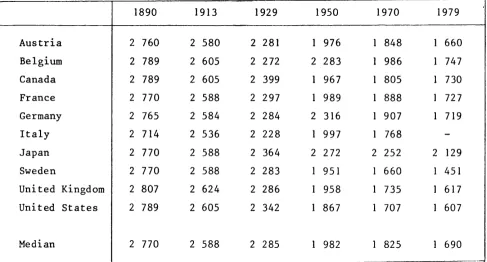
The distinction between the total number of hours worked and the number ofpersons employed is now part of any serious discussion of labour use and employment
(OECD 1983, 1985). It has also found its way progressively into econometric practice
(see Fair, 1969, for an early account). The relevance of the distinction is brought
out by the figures on hours worked per person, which reveal a steady decline, both
in the long run and in the recent past (Tables 1 and 2).
The same distinction is relevant at the microeconomic level, both on the side
of labour supply by households and on the side of labour demand by firms; at that
level, it is also usefully coupled with the distinction between "regular jobs" and
"casual jobs", as already developed in some detail by Hicks in
The Theory of Wages
(1932, 63-74).
By a "regular job" is meant an employment relationship that is expected by both
parties to have some stability and to ·extend over such duration as circumstances
will permit, with neither party forcing termination whimsically. The stability may
be guaranteed through an explicit contract; due to the difficulty of covering
enough relevant contingencies in formal terms, the typical contract will be largely
implicit and rely on accepted norms of behaviour, to which both parties are expected
to conform.
"Regular jobs" are opposed to "casual jobs", which carry no expectation of
stability. The latter are fully defined by the performance of a specific task over
a specific time span (typically, a short span), against a given wage. Neither party
commits itself, not even implicitly, to continue the relationship.
There are many cogent reasons why regular jobs are a superior form of employment
relationship, from the viewpoint of tiri!'s and ~11orkers alike. Relevant considerations
include the following:
(i) Most jobs are performed better with the benefit of experience, including
some experience specific to the workplace itself; when the job involves
team work, the experience is an attribute of the team, and needs to be rebuilt
.
(2)
Year
Men
Women
All workers
1891
153
51
102
1911
146
46
96
1921
130
39
84
1931
126
41
83
1951
118
40
79
1961
113
40
76
1971
100
40
69
1981
88
40
64
TABLE
1.Life hours of work in the United Kingdom (thousands)
Source : P.J. Armstrong, Technical Change and Reductions in
Life Hours of Work, London, The Technical Change
Centre, 1984.
1890
1913
1929
1950
1970
Austria
2 760
2 580
2 281
1 976
1 848
Belgium
2 789
2 605
2 272
2 283
1 986
Canada
2 789
2 605
2 399
1 967
1 805
France
2 770
2 588
2 297
1 989
1 888
Germany
2 765
2 584
2 284
2 316
1 907
Italy
Japan
Sweden
United
United
Median
2 714
2 536
2 228
I997
1 768
2 770
2 588
2 364
2 272
2 252
2 770
2 588
2 283
1 951
1 660
Kingdom
2 807
2 624
2 286
1 958
1 735
States
2 789
2 605
2 342
1 867
1 707
2 770
2 588
2 285
1 982
1 825
TABLE
2.Annual
----
hourB UJo1~7<ed perpersor:.
~---1890--:.979
Sq~£ce
A Maddison, Phases of Capitalist Development,
Oxford University Press, 1982.
1979
I
660
1 747
1 730
1 727
1 719
-2 1-29
1 451
1 617
1 607
[image:10.575.115.463.90.290.2] [image:10.575.48.535.442.704.2]7
-(ii) Most firms are complex organisations, where individual workers stand
in relationship with many other members of the firm (supervisors, personnel
department, maintenance or inventory services, .•. ); these relationships are facilitated by repeated contact.
(iii) The employer-employee relationship is in itself a complex relationship,
involving a measure of trust and mutual understanding which can only be developed gradually.
(iv) A longer-run employment contract provides opportunities not present in
short-lived contracts; thus,rewarding realised performance ex post, averaging
between good and bad years, or between periods of pressure and slack, is possible
with regular jobs, but not with casual jobs.
2.2
From the viewpoint of workers, the workplace provides one among many examplesof areas of life where regular relationships, developed over time on a continuing
basis, are essential to the pursuit of human goals. The foremost examples are of
course the family and friendship. Medical care, education, community relationships,
trades, services, leasure activities, and so on, provide additional examples. ~~
important indirect benefit from a regular job lies in the prospects which it affords
for founding a family, buying a house, establishing consumption patterns, etc •••.
In modern economies, fringe benefits and social security benefits are more
exrensive for holders of regular jobs, thereby increasing their attractiveness.
These benefits form a growing part of overall compensation.
It is thus safe to assume that most
individuals attach a positive value to
hwing a r-egular job; within the context of such jobs, they supply hours (and effort) in accordance with the traditional assumption of a diminishing marginal rate ofsubstitution between leasure and income. This eminently sensible view is not
in-corporated in standard textbook treatments of labour supply, because it introduces
a non-convexity in preferences and a discontinuity in the supply of hours. It is
however incorporated indirectly in the models of "learning by doing" and "embodied
human capital", which aim at capturing the advantages of regular jobs mentioned
under (i) and (ii) above; or in the models of employment over time under uncertainty,
where a simple assumption of risk aversion brings in the aspects mentioned under
For a proper appraisal of work-sharing measures, the significance of
recognis-ing the positive value to workers of regular jobs is twofold. First comes the
immediate implication that the distribution of an aggregate number of hours over
individual jobs matters, to an extent imperfectly captured by the supply of hours.
A distribution over more jobs carries the advantage of shorter hours and more
leasure for all concerned;
in addition,
it carries the advantage of endowing moreindividuals with positively valued regular jobs~ .
Second, it is important to recognise that the value attached to a regular
job varies conside~ably, both across individuals,and for given individuals over time. That different individuals may value differently the stability of employment is
an immediate corollary of the diversity of tastes. There is no need to elaborate,
but one specific point should be mentioned. The idiosyncracies of attitudes towards
labour concern also the supply of hours. At given wage rates, different individuals
would prefer different working times. Yet, it is a commonplace observation that
most regular jobs specify standard working times, imposed on whole sets of employees,
with little room for individual variations. A!so, these standard working times vary
little from firm to firm. There are understandable reasons for that uniformity
(discussing them would be peripheral to my purpose). Hopefully, standard working
times may reflect the preferences of a "median worker", being too long for half
the labour force and too short for the other half. When faced with the choice of either working the standard time, or not at all, each worker takes an
ali-or-none decision. The net value of the job will, other things equal, be the higher,
the closer standard working time comes to an individual's preferences. In particular,
those who would prefer definitely shorter hours will benefit less from holding
the job. It would seem plausible that older workers fall into that category and hence
place a lower net value on regular jobs.
There are two additional reasons why the value to any individualofhaving a regular job is bound to decline as the age of retirement draws near. On the one
hand, the period over which a stable relationship is anticipated becomes shorter,
hence less significant. On the other hand, the link with other durable patterns of
behaviour (family, house, ••. ) becomes less important, as these are well established already.
The significance of individual variations in the value of regular jobs is of
course that they offer prospects for gains through redistribution - a point that is
9
-2.3
The considerations in Section 2.1 pointing to the superiority of regularemployment relationships explain why this is typically the form of employment
preferred by business firms. They also suggest two important characteristics of
regular jobs.
First, the provision of a regular job requires an initial investment on the part of the firm - the "toll" discussed at length by Okun (1981, chapters 2, 3 ) and turning labour into a '·'semi-fixed factor" (Oi, 1962) 5 • Obviously, the benefits
of experience acquired on the job, of integration in a work team and in the firm's organisation, of mutual trust or of averaging rewards over time and across states,
will accrue only progressively after a period of initiation. There will often be
a period of training, during which a worker's productivity may be ins~fficient to cover his or her wage. Furthermore, because workers are heterogeneous, firms will
attempt to identify the more promising candidates through screening. Expenses
associated with training and screening are in the nature of a fixed cost attached to each new hiring. Also, to the extent that the firm is offering some degree of
income and employment stability6 , it is undertaking a commitment, which may under
adverse circumstances prove costly. The present value of whatever costs or risk premium may be associated with that commitment is another component of the fixed
cost of a new hiring.
An important implication of this initial investment, or toll, is the typical
preference of firms for hiring employees on a full-time rather than a part-time basis. By "typical", I mean here that special advantages iinked to part-time work
must be present in order for that form of employment to be offered. (The foremost
example comes from peak loads within the week, as in retailing, where part-time work is indeed widespread.) Otherwise, the initial investment is basically the same
whether a person· works full time or part time. (This is obvious for screening and training costs. It is also true for on-the-job learning. If it takes 500 hours to
learn a job well, two half-time workers will need 1000 hours together; and so on.)
Consequently, full-time work is altogether cheaper, and part-time work is
"typical-ly" confined to casual jobs 7 , pending special inducements.
Second, "regular jobs" are not created at will, they must correspond to some real employment prospect in the firm. At the start, this requires the av~ilability of a working post, the existence of demand for the output, and relative prices at which
the additional job is profitable. In addition, the firm must anticipate that the
additional employee will remain wanted with sufficient probability for a sufficient time. Adverse anticipations or considerable uncertainty about technological
developments, demand or relative prices would destroy the prospect of potential
employment. The disconcerting fact is that so many conditions must be fulfilled
simultaneously in order for a regular job to be forthcoming; whereas failure of any
An important implication of the combination of real factors needed for the
existence of a regular job is that the supply of such jobs is bound to be highly
inelastic to their short-run cost. Specifically, temporary wage cuts or employment
subsidies will not be very effective in increasing the supply of regular jobs.
First, the other elements must be there(working posts and demand for output).
Second the relevant cost consideration is the long-run cost over the prospective
period of employment, of which the short-run cost is only a part. Thus, temporary
employment subsidies will at best move forward in time hirings that were
contem-plated anyhow 8 , and stimulate casual employment. Desirable as they may be, these
effects remain limited in scope.
These remarks also help to put the issue of severance pay in sharper
perspective. It is often stressed that rights to severance pay deter firms from
hiring additional workers who could profitably he employed in the short run. Clearly,
if the prospect for continued employment is there, severance pay (though relevant)
is not a major issue. But if the prospect for continued employment is lacking, then
no regular job is at hand, irrespective of the severance pay issue. One should thus
not expect a reduction of severance pay to have a major influence on the supply of
regular jobs. At the same time, severance pay for casual jobs, where it exists,
will deter that form of employment. And there is scope for illusion about the extent
to which a job is casual or regular •••• It is thus understandable that proposals
to reduce severance rights be regarded with suspicion by unions. And it might be
I I
-3. SHORf-RUN FLUCTUATIONS
3.1 The short-run equilibrium between supply and demand for regular jobs is subject
to numerous hazards - as we know only too well from recent experience. There are
several independent factors affecting either the supply or the demand for regular
jobs. When a number of them operate simultaneously to reduce the supply and inflate
the demand, a serious imbalance may result. A long time may be needed to correct
that imbalance, during which time selfperpetuating forces are apt to be at work.
There are clear signs of such an unhappy combination of circumstances in the
present situation.
To begin with the supply of jobs (demand for labour), four main factors should
be listed as exerting macroeconomic influences. (These factors may of course affect
specific labour markets differently; the point of interest here is that, when these
factors affectmany specific labour markets of a given country, or set of countries,
in the same direction, then macroeconomic implications become noticeable.)
(i) The demand for output may be slack, due to an excess of savings over
in-vestment, to a fall in the demand for exports, to a contractionary fiscal policy, to a combination of these, etc ••••
(ii) Labour-saving technological progress may reduce the demand for labour at
given levels of output.
(iii) Relative factor prices may induce substitution of capital for labour,
or subsitution of production elsewhere for production in the home country.
(iv) The capital stock physically available, or susceptible of profitable use,
may become insufficient to offer an adequate number of jobs.
Looking at a given country at a given time, the first three factors may set in
exogenously. (This is obvious for technological progress. The slack of final demand
may originate abroad. And the shift in relative factor prices may reflect, for
instance, the progress of industrialisation in developing countries.) These factors
may also originate in the country itself, as when domes tic labour costs undergo an
auto-no~ous movement, which may in turn direct research and development towards
labour-saving technological progress. In either case, the response of fiscal policy is
basically an endogenous factor - but that does not guarantee the proper response!
And a selfperpetuating force sets in, when public deficits originating in the
reduced levels of employment and activity are deemed unbearable and fought through
Most significantly, as the demand for domestic output slackens, investment is
discouraged, plants are scrapped, and the capital stock is brought down to the
level warranted by current output. While the low level of investment further reduces aggregate demand, the fourth factor comes into play: there are no longer
enough working posts to g~nerate adequate employment; reflating the supply of jobs
now requires investment in new capacity; the growth of employment is bound to be slow, even in the face of a detr.and upheaval; and demand management is discouraged by the fear that insufficient capacities lead to inflationary pressures.
Turning to the demand for jobs (the supply of labour), the main factors
operating in the short run are the demographic and migratory movements, and the changes in participation rates. In some European countries, female participation
rates have gone up steadily over the past decades, resulting in significant increases
in labour supply through the recession.
Although there is frequent reference in the literature to the so-called
"discouraged worker effect", it may also be the case that unemployment discourages
some workers (especially married women) from quitting jobs which they would other-wise have given up temporarily; at the same time, unemployment may induce others to register as job seekers, even though they might otherwise have postponed entry
in the labour force. In this way, unemployment becomes subject to selfperpetuation.
3.2
The two characteristics of regular jobs discussed under 2.3 above take upadditional significance, when the prospect of sizeable short-run fluctuations is recognised.
First, because regular jobs entail an initial investment, prospective fluctuations shift the terms of trade against them and in favour of casual jobs.
In particular, at times of high uncertainty about demand, technology and real wages in the future, one may expect a temporary increase in the reliance on casual
employment. Unfortunate as this development may be, given the well-founded preference
of employees for regular jobs, it is to so~e extent unavoidable, and still compatible
with efficiency. In particular, postponing the investment into a new hiring unti 1 it can be directed more effectively may be desirable. This would call for accepting a develop-ment of casual jobs during a recession, and waiting for the signs of recovery to
incur the tolls of job creation in those activities which do benefit from the recovery.
There is some casual evidence that the private sector is relying more
intensive-ly on casual employment (including sub-contracting and contracting ad interim) in
times of recession and uncertainty, like nowadays. In the public sector, special
employment programs make sense in such times, especially those providing casual jobs for the young. The attractiveness· of these programs comes from the relative
1 3
-Second, because the supply of regular jobs is inelastic to wage costs in the short run, relying on wage flexibility to clear the markets for regular jobs is not
a realistic prospect. Indeed, market clearing wages could drop to very low levels
in response to a conjunction of adverse shocks. Most likely, wages could drop to
a level where the "market clears" ••. because sizeable unemployment becomes
voluntary! That is, market clearing wages could drop to a level sufficiently close
to the opportunity cost of workers (including unemployment benefits - about which
more below) that many of them become unattracted by employment (although still
registered as involuntarily unemployed, to collect the benefits).
There are two compelling reasons why that kind of flexibility is undesirable. The first, of a microeconomic nature, is that it would generate an extent of
income uncertainty placing an excessive burden on workers holding regular jobs. That argument is taken up in Section 4, and extended to a discussion of wage
discrimination between workers under contract and new recruits. The second,of a
macroeconomic nature is that a major drop in labour incomes would depress
aggre-gate demand further, leading to an "equilibrium" with very low levels of output
and employment. The fact that the resulting unemployment be labeled "voluntary"
provides little solace . . . . Given our imprecise estimates of the wage elasticity
of labour demand and of the income multiplier, not to mention our near ignorance
of the implications of wage moderation for government budgets, it is safer to look
at incomes policy as a long-run instrument and not to rely on it as a short-run stabiliser of employment.
4.
LABOUR CONTRACTS AND MARKET FAILURES
4.1
How then does one reconcile the idea that most people want to have a regular job and stable income with the prospect of recurrent fluctuations in the demandfor labour? This very question is taken up in recent theoretical work on labour
contracts, known as "implicit (labour) contracts" the?ry; see Azaradias (1975),
Baily (1974) and Gordon (1974) for the seminal contributions; Dreze (1979 b) for
a non-technical presentation of the main ideas; and the more recent accounts in
The merit of that theory consists in looking at the shocks affecting labour
markets ex ante, as of the time when an employment relationship is initiated
with some prospect for duration. A current limitation of the theory is that it looks only at employment patterns withinpreexisting contracts, and does not address
itself to disequilibrium on the market for contracts. I shall consider the two
issues successively, then sum up the argument in Section 4.5.
The main premisses of implicit contracts theory are:
(i) in the face of fluctuations in output and labour demand, lasting
employ-ment relationships (regular jobs) offer scope for pursuing employemploy-ment and
compensa-tion policies which are Pareto optimal ex ante from the viewpoint of the firm and i~
employees;
(ii) workers, being unable to diversi~y their labour supply, are more risk-averse
than firms, whose shareholders can hold diversified portfolios;
(iii) incentives, moral hazard, information asymmetries, the illegality of
involuntary servitude, a.s.o., place limitations on implementable contracts.
This is not the place to review or summarise a sizeable and growing literature,
to which accessible introductions are available elsewhere (see referenc~above).
The main point of relevance to us here is that efficient labour contracts
will
embody an element of risk-sharing, whereby labour incomes are to a sizeable extent protected from the vagaries of supply and demand shocks. If wages were allowed to jump up and down in response to these shocks, the resulting income uncertainty
would be costly to bear for workers, more so than it would benefit the less
risk-averse firms. Hence the prospect for Pareto superior arrangements, where the
labour contracts include a form of income insurance through downward wage rigidity.
The insurance premium should be paid partly through lower wages during the early
period of employment (explaining to some extent the practice of seniority bonuses),
partly through reduced upward wage flexibility (to the extent compatible with
incentives). A Pareto-optimal arrangement would combine an efficient degree of
risk-sharing (whereby in particular labour incomes become immune from firm-specific
risks and bear a less-than-proportional share of economy-wide risks 10 ) with
privately efficient levels of employment (marginal value product of labour equal
1 5
-The combination of downwards wage rigidity and efficient levels of employment
implies that wages actually paid out do not correspond to the ~arginal value
product of labour at all times, but only do so in expectation. In particular, during a recession, wages will in many firms exceed the marginal value product of
labour. These firms will be said to practise "labour hoarding". It is an immediate
implication of the theory that such firms will not hire new workers, even at wages lower than those which they currently pay_; new hirings will start only at wages lower than the marginal value product of labour, with all employees under contract
working full hours. For these firms (which could well be a majority during a deep
recession), the elasticity of employment with respect to wage decreases is zero 11
As for the workers under contract, whatever degree of unemployment would
have been voluntary at market clearing wages remains warranted (Pareto efficient)
at the rigid wages; the marginal value product of labour should not fall below
the reservation wage of the workers - but should fall that much! The difference
is that, at the downward rigid wage, unemployment appears to be involuntary - and is definitely perceived as such by the individual worker; or else, laid off
workers should enjoy full income insurance, which is seldom observed in practice
(probably because firms cannot afford to supply that much insurance). Efficient
arrangements again call for wbrk sharing among employees under contract, who
should preferably be laid-off on a part-time basis at times of slack employment,
to the extent compatible with incentives and the organisation of work. In practice,
that approach seems applicable only to blue collar workers; temporary layoffs,
whether on a part-time or full-time basis, are practically unknown among white
collars 12• And part-time layoffs for blue collars are often discouraged by the
rules governing unemployment compensation, which is not always forthcoming on a
flexible, part-time basis.
4.2
There is very little hard evidence on the extent to which the recommendationsof implicit contract theory are implemented in practice13 , beyond the easy
observa-tion of widespread downward rigidity of wages, either real (as in most European
countries) or nominal (as in the US). The extent to which firms use labour at marginal
products below nominal wages in bad times (and conversely in good times) is not easy
to ascertain, beyond the general belief (corroborated by econometric studies) that
firms practice "labour hoarding" during recessions. Neither do we know precisely how
reductions of labour inputs are distributed over workers under contract - a subject
on which some evidence should now be available in Europe 14
• Collecting and analysing
that evidence would seem worthwhile, if only for the light it could throw on the
A partial indication is available at the European level for employees of
the steel industry. Some recent figures are reproduced in Table 3. It is unfortunate
that no details are given on the category "other leavers", whose content seems to
differ as between countries (presumably, it includes temporary layoffs in France and Germany, but not in Italy and the UK). Still, there are important national
differences in separation patterns, especially in the form of dismissals and
resignations. And it is interesting to notethe significance of early retirements.
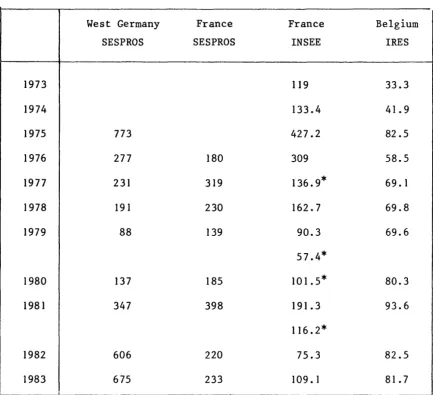
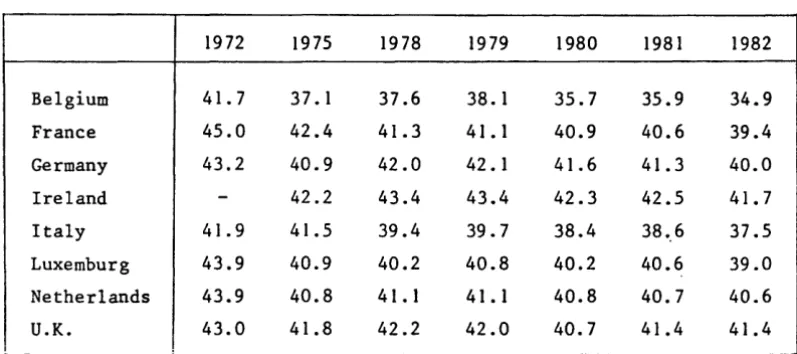
As for temporary layoffs and part-time unemployment, there is evidence that
they move pro-cyclically. Some recent figures are reproduced in Table 4. They do
suggest that the phenomenon is both significant and limited in scope.
4.3
The literature in print about labour contracts does not explain why we observeprolonged spells of mass unemployment, with large numbers of workers without regular jobs (without contracts). The theory in print deals with properties of efficient
contracts in economies where the markets for-contracts clear, it does not deal with
disequilibrium on these markets. To understand the issue of work-sharing, we must go beyond the findings of implicit contract theory and consider situations of
disequilibrium on the market for regular jobs. Of course, the existing theory has
useful implications for these situations as well, some of which are spelled out in
Section 4.4 below. But a major extension is needed, which calls for a model with successive generations15' ~.
Consider again ex ante the prospect of sizeable fluctuations in the supply of regular jobs (in the marginal value product of regular labour), taking into account
the fact that a new generation of workers will enter the labour market in the future,
under conditions that may be either "good" or "bad". If conditions are "good",
there will be full employment of both initially employed workers and newcomers. If conditions are ''bad", there will not be enough regular jobs for everybody at
full hours. How could the prospect of excess demand for regular jobs under "bad"
conditions be eliminated?
The answer which is implicit in the implicit contracts literature is the
following. Assume that the members of the new generation are present~ or-represented~ when the initial labour contracts are
drawn.
It will then be possible for firms to hire ·the newcomers forward~ specifying the compensation and terms of employmentsimultaneously for the "good" and "bad" conditions. The newcomers would thus be under contract from the start, on par with earlier generations; the only difference
being that actual employment of the newcomers starts later. In so far as clearing
West Germany
France
France
Belgium
SESPROS
SESPROS
IN SEE
IRES
1973
119
33.3
1974
133.4
41.9
1975
773
427.2
82.5
1976
277
180
309
58.5
1977
231
319
136.9*
69.
I1978
191
230
162.7
69.8
1979
88
139
90.3
69.6
57 .4*
1980
137
185
101.5*
80.3
1981
347
398
191.3
93.6
116.2*
1982
606
220
75.3
82.5
1983
675
233
109.
I81.7
TABLE 4. Temporary layoffs (Thousands of employees)
Sources
SESPROS.
Eurostat, Protection Sociale, 2, 1984.
These numbers are annual averages and include temporary
layoffs due to weather conditions.
INSEE.
Enquete Emploi (Publication annuelle).
These numbers apply to a single week in march or april,
and do not include temporary layoffs due to weather
conditions.
*
denotes a single week in october.
[image:22.570.63.496.82.477.2]-
19-global equilibrium, everbody would work full hours under "good" conditions, and
everybody would take part in some fom of work shar:ing under ''bad" conditiona
-hopefully, to such an extent that the marginal value product of labour be equal
to the opportunity cost of hours. In such a world, no excess demand for regular jobs would occur in bad states; instead, a proper degree of labour hoarding and
work sharing would be built into the private contracts, leaving no scope for public
intervention. In particular,old and young would participate symmetrically in the
labour-hoarding and work-sharing arrangements 16
Of course, the assumption that potential future workers take part in a market clearing process years ahead of time is a preposterous idea, to say the least.
Yet, that is the very stretch of imagination required to rescue the ''magic of the
market" in our context- which is loaded with "market failures" 17•
4.4
An intriguing question, not explicitly answered (to the best of my knowledge} by the labour contract theory in print, is that of wage discrimination betweenemployees under contract and new recruits. I have alluded in Section 3~2 to two reasons, one microeconomic (spelled out in Section
4.1)
and one macroeconomic,why it may not be desirable to let wages of workers under contract fall to market clearing levels during recessions. But these reasons do not by themselves preclude
a form of wage discrimination, whereby new contracts would stipulate wages different
from those of extant contracts. Specifically, new recruits could be paid wages that
clear the labour market for new contracts, while previously employed workers would
keep their earlier w~ges. Evidence that such is not the case comes, on the one
hand from the observation of mass unemployment; on the other hand from casual
empiricism to the effect that wage discrimination
by
hiring dates is not a wide-spread phenomenon.Of course, some degree of discrimination by dates of hiring is consistent
with the available evidence. And it is known that the quality of new recruits at
g1ven job characteristics improves during recessions and deteriorates during booms
-see Okun (1981, pp. 67-68) and references given there (pp. 79-80). But there is
no doubt that downward wage rigidity applies to new contracts as well, with limited
It could well be that such discrimination is regarded as impractical by
firms and as undesirable by firms and workers alike. Wage settlements, including
differentials by occupation and seniority, are complex enough already. Adding an
extra dimension to the existing differentials would increase that complexity, to
an extent possibly regarded as impractical. And it certainly goes against the ~rain
of accepted ethical norms to accentuate pay differences for equal work.
It is, however, a direct, and to my mind compelling, consequence of implicit
contract theory that some degree of wage rigidity for new contracts should emerge. For otherwise new firms (or expanding established firms) could hire newcomers at
very low wages and outbid established firms on the product markets, thereby
reducing further their output and employment. It is thus in the joint interest of
established firms and their (unionised ••• ) employees to prevent, if they can, the
wages specified in new contracts from dropping to market clearing levels (to levels
at which all unemployment becomes voluntary). Furthermor~, a majority of newcomers
is apt to endorse that attempt, whenever the market clearing wages would be very
low (say, close to the level of unemployment compensation). Indeed, all workers
with a reservation wage higher than or equal to the market clearing level stand
to gain from the wage rigidity, and similarly for those with a reservation wage
slightly inferior to the clearing level 18 •
The absence of market mechanisms leading to wage discrimination between
workers under contract and new recruits has led to a number of proposals for
marginal employment subsidies- see, e.g. Dornbusmet al. (1983) or Steinherr (1985). As I have noted above (Section 2.3), such subsidies should be substantial
and durable in order to affect significantly the long-run cost of a regular job,
hence employment. In addition, the argument presented in this section suggests
that existing firms, and their employees, may object to such subsidies as
generat-ing unfair competition on the product markets.
4.5
We can now summarise the implications of labour contract theory for the workers seeking employment during a recession (the new entrants, and those who have losttheir jobs, for instance in firms closing down). These job seekers are facing two
kinds of firms, those engaged in labour hoarding (which contract employment), and
those (including the new firms) which hire new workers. The former, which may well
2 1
-labour inferior to wage costs and equal to the reservation wage of their employees.
Routine demographic replacements, which will normally absorb all new entrants in
stationary conditions, are not taking place. Newcomers are excluded both from the
labour hoarding and from whatever work sharing is organised.among employees under
contract. And these firms will-not respond to wage cuts by new hirings, until the
gap between wage costs and the marginal value product of labour has been bridged. In
these firms, competition between workers under contract and newcomers is shut off.
Expanding firms and new firms hire labour to the point where its marginal
value product covers wage costs, but not beyond. And they practise little or no
wage discrimination between workers under contract and newcomers.
We thus have three groups of workers: {i) those under contract in firms which
are not hiring, where they are employed at a marginal value product below their
wages; (ii) those employed in new and hiring firms, with a marginal value product
equal to their wage; and (iii) the unemployed.
There are two sources of inefficiency in this situation. First, employment should increase in the expanding firms, to the point where the marginal value
product of labour is equal to the reservation wage of the unemployed. It is not
.clear how this can be achieved without some form of wage-cost discrimination
between workers under contract and newcomers.
Second, the distribution of jobs and hours worked between the employed and the unemployed is inefficient. Indeed, I have adduced in Section 2 some quite
compelling arguments to the effect that some newcomers at least will place a higher value on finding a regular job than some workers under contract attach to keeping theirs. (In particular, young workers may be more eager to start a career
than workers close to retirement are eager to bring their own to term.) Hence,
some redistribution of regular jobs between workers under contract and newcomers
would be desirable - but will not be naturally forthcoming. In addition, the supply
of hours being definitely upward sloping, ·within the context of regular jobs, it would be desirable to increase the number of employees and redistribute aggregate
hours among them- a standard argument. Thus, whether we look at positively valued
jobs, or at negatively valued hours of work, we conclude that the allocation of
(4)
Finally, it is easy to understand why little or no work-sharing takes place
among newcomers, in the form of part-time jobs. With. firms facing fixed costs of
screening and training, and half the newcomers prepared to work more than
full-time (as must be the case if standard working full-time corresponds to median worker
preferences), there is ample scope for mutually agreeable contracts on a
full-time basis. The special motivation of risk sharing embodied in a long-term contract
would be needed to organise work sharing in the form of part-time unemployment.
That motivation does not apply to work sharing in the form of·part-time work for
newcomers. Again, special measures will be needed to overcome the market failure
and bring about a more efficient allocation of regular jobs.
The upshot of these arguments is ••• precisely what we observe today in
Europe! Namely, a prolonged spell of deeply depressed demand for labour, with
employment declining in many firms (especially in the manufacturing sector exposed
to international competition), downward rigid wages there and a modest degree of work
sharing among workers.under contract; with very high unemployment. rates among the
young entrants to the labour market (and older workers who have lost their previous
jobs), and a fair degree of wage rigidity on new contracts. The resulting
alloca-tion of work among all workers is definitely inefficient, both because little or no
work sharing takes place between workers under contract and newcomers, and because
little or no work sharing takes place among newcomers finding employment. More
efficient work sharing thus requires special measures.
5.
SCOPE FOR INTERVENTION
5.1
Market failures provide a motivation .for public intervention aimed at correcting inefficiencies. In the case under discussion, that motivation is enhanced by theexistence of a social externality. Unemployment is not only a burden on individuals,
who are frustrated in their desire to work and to enjoy a stable employment
relation-ship. It also entails additional real burdens for society - for instance when
prolonged inactivity leads to deliquency or health deterioration; that is, it entails
externalities. Of course, the most immediate externality comes from the existence
2 3
-In the light of the arguments reviewed above, it is obvious that public
unemployment compensation schemes are important and should be maintained, in
spite of some obvious drawbacks19 • Now unemployment compensation accrues to the
unemployed at no private cost; but it is paid out of public funds which need to be
collected somehow20 and thus entail a social cost. This creates an externality.
Any measure resulting in less unemployment also results in less public expenditure
on unemployment compensation. More positively, the money spent on unemployment
compensation could more profitably be spent on reducing unemployment.
One way is
to subsidise
~ork sharing~ the~byproviding financial incentives to overcome the
market failures.
There are two additional reasons, specific· to the issue under discussion, why
public measures aimed at promoting work sharing could
possibly
be effective.First, social security.has become in most European countries a complex legal
system, many provisions of which introduce additional distortions in the already
imperfect functioning of labour markets. An obvious example arises when ceilings
or other regressive formulae for social security contributions (employment taxes)
impose a penalty on part-time jobs as compared with full-time jobs. Eliminating
those distortions which discourage work sharing, possibly creating distortions
which favour it, offers scope for public intervention.
Second, the organisation of working time is a complex social phenomenon,
in-volving coordination of all kinds of activities, with numerous externalities; it
falls largely outside the sphere of market allocation. To take again an obvious
example, think back to the transition from the 6-days week to the 5-days week.
Although 5 days became the norm for blue collar workers shortly after World War II,
it took nearly twenty years before that schedule became universal, with schools
adopting it late. And it is prob~bly fair to say that consumption patterns fully
adjusted to a 5-days week for all are still spreading. With further reductions in
~orking time below 40 hours per week now emerging here and there, a number of
alternative patterns of work are possible. The coordination aspects and externalities
provide scope for public initiative in sorting out the costs and benefits
for
soaiety
of these alternative patterns, then for public leadersh~p in promoting themost desirable pattern and anchoring individuals expectations in that respect.
6.
INTERLUDE
(Sorbet~Before turning to consider specific measures aimed at promoting
work-sharing and recent experience with them in Europe, it is suggestive to speculate
briefly on how a substantial decline in the demand for regular labour would be
handled in a decide~ycooperative environment- like a kibbutz, a network of
cooperatives (as in Mondragon) or an integrated set of family businesses. For
definiteness, think about a hypothetical kibbutz where the major use of labour
(entirely supplied by the members) goes into the manufacturing of some gadget
sold outside. Normally, young members are taken up into the factory work force and
trained to replace retiring older members. Assume now that a non-negligible decline
occurs in the need for labour input, a decline that was not anticipated with
certainty, although its possibility may have been contemplated - say a decline
due to a major accidental plant destruction or to a shortage of raw materials, to
a major decline in demand for the gadget, to the introduction of a new labour
saving technology, or a combination of these. And let the decline be expected to
last for some time, with progressive resorption over a period of months or years at
a highly uncertain speed. How would the kibbutz community react to such an event?
Most likely, a whole set of measures would be combined, such as: (i) diverting
some labour to other uses, previsouly endowed with lower priority, like improving
the grounds, repainting the buildings, ••• ; (ii) excusing from work in the factory
the older, less able or. less motivated workers, as well perhaps as some with
high productivity alternatives (like young mothers, or members with valuable
personal projects); (iii) reducing across the board effective working times,
through either shorter hours, or longer vacations, or occasional days off;
(iv) calling some of the young workers into the workforce on a part-time basis,
with the rest of their time devoted to continued education, or to the other work
mentioned under (i).
The list could be extended. The point I wish to make is that various forms
of work sharing would naturally be introduced; and 1t is highly unlikely that a large number of young members would remain totally inactive for prolonged periods.
There is room for speculation as to who would carry out the casual activities
mentioned under (i). Would these be mostly entrusted to the young, or would some
of the members previously employed in the factory turn to such tasks? More
2 5
-members into the factory workforce
and the diversion of some factory workers to
casual tasks -either part-time or full-time? There is no compelling answer to
that question. The only safe consideration is the following. If it were
anti-cipated that future needs for labour will be qualitatively so different from
current needs that training acquired now will be of little value in the future,
then young workers would be mostly oriented towards casual activities and would
not be trained now for factory work.
This digression provides a us.eful ·background against which to evctluate
the alternative forms of work sharing which have ·been considered recently by
European policy-makers. I will group them under three headings:
trading jobs,
i.e. replacing a worker under contract by a newcomer;
sharing jobs,
i.e. filling
a single working post by more than one person; and
trading hours for jobs,
i.e.
PART II: APPLICATIONS (HOW? HOW NOT ... )
7.
TRADING JOBS (Early Retirements)
7.1
Trading jobs between workers under contract and unemployed persons is the simplest, and in a way the most natural, form of work sharing. In particular,it does not interfere at all with the organisation of work. Because the value
to individuals of regular jobsvaries from one person to the next, there is scope
for mutually advantageous trading 21 •
By definition, the holder of a regular job places a non-negative value on
that job - otherwise, (s)he would quit. But that value could be small - in which
case a small "bribe" would induce the holder to give up the job. If the "bribe"
per year falls short of the level of unemployment compensation, the state can "buy"
the job for an unemployed person, at no net cost (the compensation paid to the
quitter is no longer paid to the new employee); this generates ·a positive
externali-ty, namely the value of the job to the new employee.
Also, the value of a job is often blown up artificially by the social legislation·
For instance, some statutory pensions are proportional to average salary over the last
~five years prior to retirement age; consequently,quitting during these five years
entails a cost by far in excess of the salary itself; see Hart (1984, p. 27). The
state could then step in to correct the externality - say by neutralising the effect
of early quitting on the pension.
These two ideas are combined in early retirement schemes, as introduced in
several European countries over the past decade (namely, in 1976 in the Netherlands
and Belgium, in 1977 in the UK, in 1981 complementing earlier measures in France, in
1984 in Germany). As explained in Section 2, workers close to retirement are natural
candidates for giving up jobs, under moderate financial incentives (but subject to
suitable adjustments in pension rules). All the schemes under consideration permit
early retirement, at no loss of pension rights after the normal age of retirement,
and with an income allowance over the interm~diate years. The level of that
transi-t
tory income, and its sources, vary from scheme to scheme; typically, the basic
c~-ponent corresponds to unemployment compensation, and an additional allowance is
sometimes provided by the firm or by the state. In several schemes, the retired